Your board meeting is in three days. Someone asks which investors engaged with last quarter's update, whether the lead from the roadshow ever followed up, and what your ownership profile looks like versus peers. The answer is split across your inbox, a shared Google Sheet, and a CRM that was never designed for investor relationships.
This is the operating problem investor relations software solves. Once you have meaningful outside capital and a growing stakeholder base, managing investor data manually creates real risk: Missed follow-ups, stale ownership data, inconsistent messaging, and board meetings where the CFO is reconstructing history the morning before.
The right investor relations management software gives your team a clear picture of who is engaged, what changed since last quarter, and which next action moves a relationship forward. According to a 2024 Broadridge survey, 76% of investors say digital communications significantly influence their engagement with issuers, which means the infrastructure behind those communications matters.
This guide separates public-company IR platforms from private-market investor CRM products, so you leave with a shortlist that matches your actual operating model, not the one you might have in four years.
What's inside
This guide compares 10 investor relations software platforms for 2026. Coverage spans public-company IR suites, shareholder intelligence platforms, investor communication tools, and private-market investor CRM products.
Items were selected based on:
- Investor and shareholder data depth
- Relationship and interaction tracking capabilities
- Reporting and communication workflow support
- Fit across public companies, private-market funds, and private SaaS businesses
Pricing and G2 ratings reflect verified sources at time of publication.
TL;DR
- Best for public-company investor targeting: Irwin combines investor CRM with ownership intelligence and shareholder surveillance in one platform
- Best for shareholder intelligence and IR planning: Nasdaq IR Insight delivers proprietary data, peer benchmarks, and engagement analytics for mature IR teams
- Best for digital investor engagement and events: Q4 Platform covers IR websites, virtual earnings events, and engagement analytics under one system
- Best for private-market investor CRM: Juniper Square CRM is purpose-built for LP relationships and fundraising pipelines at private-markets firms
- Best for direct-to-investor communications: InvestorHub connects registry data with investor engagement tools for listed companies running active outreach programs
- Best for issuer-focused IR at an accessible entry price: Issuer Direct IR Solutions starts at $895/month for communications, filings, and webcasting support
What is investor relations software?
Investor relations software helps companies manage investor data, communications, reporting, relationship history, and market intelligence from a central system.
The category covers a wide range of workflows. Some platforms focus on shareholder surveillance and investor targeting for public companies. Others act as CRM systems for private-market fund managers tracking LP relationships and fundraising pipelines. Many sit somewhere between, combining communications tools, reporting workflows, and engagement analytics.
Core capabilities of investor relations software
- Investor and shareholder contact records
- Investor targeting and market intelligence
- Meeting, roadshow, and interaction tracking
- Board-ready investor reporting and analysis
- Earnings, webcast, and event communications
- Investor website content and engagement analytics
- Private-market fundraising and LP relationship management
- Permissions, audit controls, and data governance
Public-company IR platforms
Public-company tools center on shareholder intelligence, ownership monitoring, analyst targeting, investor meeting preparation, earnings communications, and market context. Teams use these to understand who owns their stock, which institutions are building or reducing positions, and how to prioritize outreach before a roadshow or earnings cycle.
Private-market investor CRM platforms
Private-market tools focus on LP relationships, fundraising pipelines, capital activity, investor communications, and fund reporting. A general partner managing a venture or private equity fund needs to track contact history with hundreds of LPs, record commitments and capital call activity, and distribute investor updates with appropriate permissions.
| If you need to manage | Start by evaluating |
|---|---|
| Shareholder targeting and ownership changes | Public-company IR software |
| Investor meetings, earnings, and market intelligence | Public-company IR software |
| LP communications and fundraising pipeline | Private-market investor CRM |
| Investor updates and direct communication | Investor engagement platform |
A generic sales CRM tracks contacts and activities broadly. It does not provide shareholder intelligence, ownership analysis, or capital-markets workflows. That gap is where dedicated IR software earns its place in the stack.
When to use investor relations software
Centralize investor communications before reporting gets chaotic
When investor update drafts, meeting history, and follow-up ownership live across multiple tools, the problem compounds over time. A new CFO or VP of Finance hired to own this workflow needs a working system on day one, not an archaeology project through email threads. Adopt dedicated software before the next reporting cycle, not after.
Build an investor targeting and shareholder intelligence motion
Public companies preparing for a roadshow or monitoring activist activity need more than a contact list. Ownership surveillance, peer benchmarking, targeting models, and investor meeting preparation require data that generic CRM tools simply do not carry. This workflow becomes urgent well before the IR function is fully staffed.
Run fundraising and LP relationships with more discipline
Private companies, funds, and investment managers accumulate significant LP relationship complexity as they scale. Tracking pipeline stage, recording investor interactions, managing capital call communications, and controlling who sees what requires a platform designed for fund workflows, not a workaround built on sales tooling.
Investor relations software comparison
No single product fits every investor workflow. The right starting point is company type and operating model. A Series B founder evaluating tools for the next fundraise has completely different requirements from a public-company IR director managing a roadshow calendar and activist monitoring.
| # | Product | Best for | Key differentiator | Pricing | G2 rating |
|---|---|---|---|---|---|
| 1 | Irwin | Public-company IR teams, investor targeting | Investor CRM plus ownership intelligence | Contact for pricing | 4.5/5 |
| 2 | Nasdaq IR Insight | Shareholder intelligence, IR planning | Proprietary data, benchmarks, AI transcript analysis | Contact for pricing | 4.3/5 |
| 3 | Q4 Platform | Digital investor engagement and events | IR website, earnings events, engagement analytics | Add-ons from $3,000/yr | 4.4/5 |
| 4 | S&P Global Capital Access | Enterprise capital-markets intelligence | Ownership analysis and investor targeting at scale | Contact for pricing | Not listed on G2 |
| 5 | Cision Investor Relations Tools | Communications-led IR teams | News distribution, IR websites, webcasts | Contact for pricing | 3.9/5 |
| 6 | EQS IR COCKPIT | European and compliance-heavy IR operations | Regulatory disclosure, investor targeting, GDPR-compliant CRM | Contact for pricing | Not listed on G2 |
| 7 | InvestorHub | Direct-to-investor outreach, listed companies | Registry-integrated investor hub and engagement analytics | Contact for pricing | Not listed on G2 |
| 8 | Juniper Square CRM | Private-market LP and investor relationships | AI-powered investor CRM built for fund workflows | Contact for pricing | 4.7/5 |
| 9 | Issuer Direct IR Solutions | Issuer communications and reporting | Flat-rate platform covering filings, webcasts, and IR website | From $895/month | Not listed on G2 |
| 10 | Backstop Investor Relations Platform | Institutional investor relationship management | Relationship intelligence for investment firms and allocators | Contact for pricing | 4.7/5 |
Pricing and G2 ratings verified against each vendor's live pricing page and G2 listing, October 2026.
Best 10 investor relations software platforms for 2026
1. Irwin
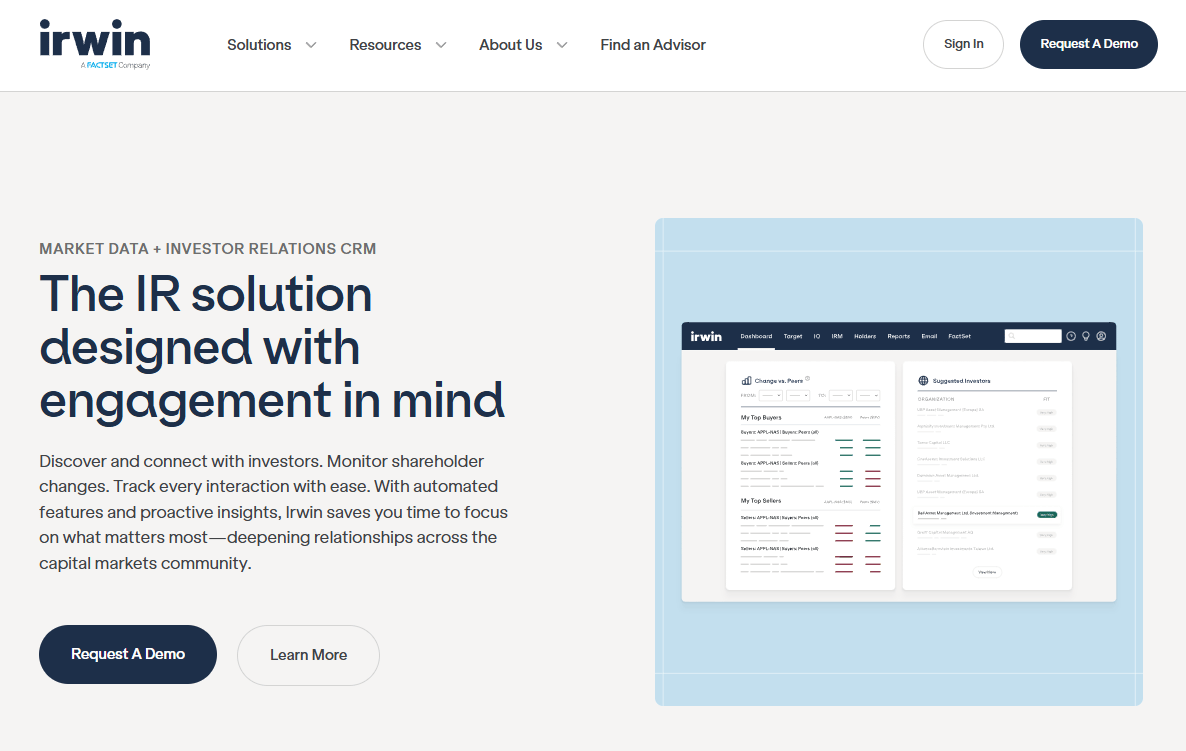
Irwin is an investor relations platform that combines investor CRM, shareholder intelligence, investor targeting, interaction tracking, and market monitoring in one system. It is built for public-company IR teams that need to connect relationship management with real ownership and capital-markets context. The platform covers everything from roadshow scheduling to activist activity surveillance.
Best for: Public-company IR teams that need to track investor relationships alongside live ownership data and shareholder movement.
Key features
- Investor CRM with full interaction history
- Shareholder monitoring and surveillance
- Target investor screening and outreach tracking
- Ownership and market intelligence dashboards
- Roadshow and meeting scheduling tools
Why choose Irwin: Choose Irwin when the IR team needs shareholder intelligence and relationship tracking in a single workflow. It is the strongest fit for teams that currently manage investor activity in separate tools and want to consolidate without losing data depth.
Irwin pricing: Irwin does not display subscription pricing on its website. Contact the sales team directly for a quote. G2 reviewers rate the tool at 4.5/5 across 57 reviews, which provides some social proof for the category.
G2 rating: 4.5/5
Fit note: Irwin is built for formal public-company IR operations. A pre-IPO SaaS team with a light investor-update process may find a private-market investor CRM more appropriate for their current stage.
2. Nasdaq IR Insight
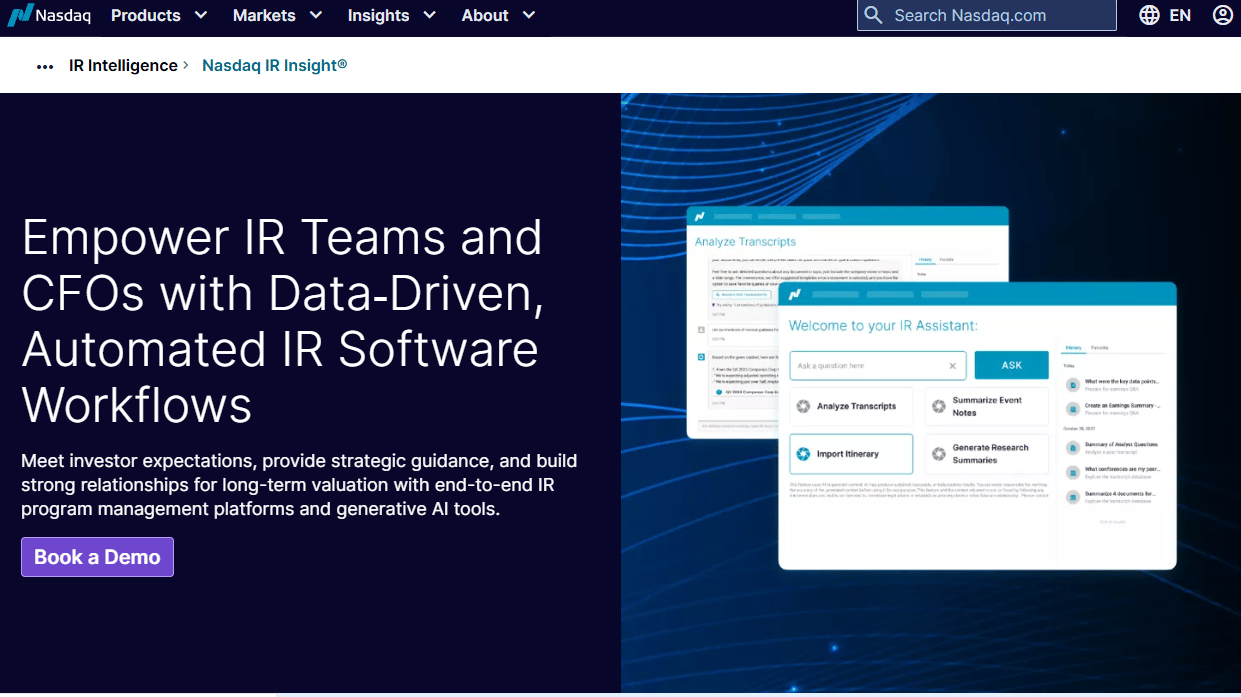
Nasdaq IR Insight is a purpose-built investor relations platform that combines engagement workflows, market intelligence, shareholder analytics, and board reporting in one system. It uses proprietary data and AI-assisted analysis, including transcript summaries and activist activity alerts, to help IR teams prioritize outreach and measure program performance.
Best for: Public-company IR teams and CFOs that need integrated shareholder engagement, investor screening, and board-ready reporting with proprietary data backing.
Key features
- AI assistant and transcript analysis
- Shareholder activity, activist monitoring, and proxy voting trends
- Investor targeting, contact management, and meeting execution
- Real-time peer, ownership, filings, and market monitoring
- Board-ready reporting and Microsoft Office integration
Why choose Nasdaq IR Insight: The combination of proprietary data and engagement workflow management makes this the right pick for mature IR programs that need investor intelligence, not just a contact database. Teams that make targeting decisions based on ownership changes and peer behavior will find the data depth justified.
Nasdaq IR Insight pricing: Pricing is contact-based and configured to team size and data requirements. Request a quote through Nasdaq's sales team.
G2 rating: 4.3/5
Fit note: Companies without a public-market shareholder base will not use the core ownership intelligence features. The platform is built for IR teams managing active investor programs, not early-stage fundraising operations.
3. Q4 Platform
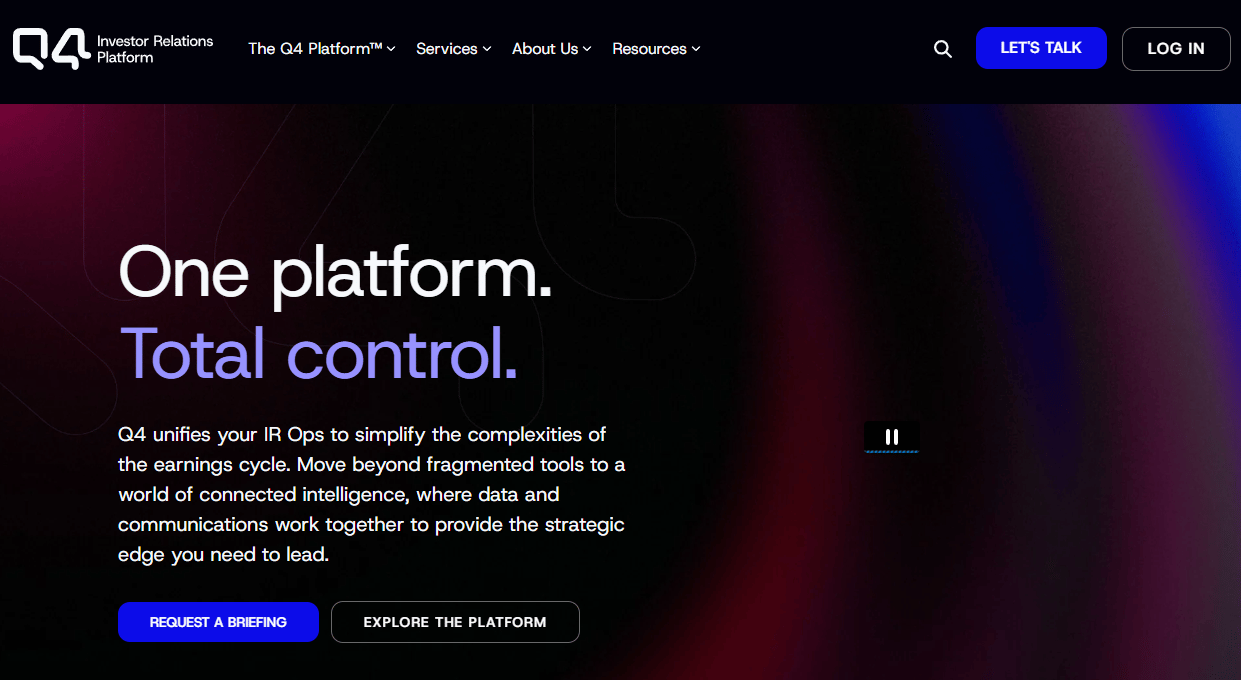
Q4 Platform is an AI-driven investor relations operations platform combining IR websites, virtual earnings events, CRM, engagement analytics, and investor intelligence. The product includes an IRO Agent named Q for AI-assisted workflows, earnings co-pilot tools for script generation, and peer monitoring for competitive context.
Best for: Investor-relations and finance teams that want a unified system covering digital communications, earnings events, and investor engagement analytics.
Key features
- AI chat with Q, the IRO agent
- IR website management and digital earnings events
- Investor engagement analytics and investor profile data
- Peer monitoring and earnings-transcript summaries
- Built-in CRM and relationship management
Why choose Q4 Platform: Q4 suits teams where investor communications and digital experience matter as much as ownership analytics. If your IR program runs quarterly earnings events, maintains an investor website, and tracks engagement with that content, Q4 integrates those workflows rather than leaving them spread across separate tools.
Q4 Platform pricing: Q4 does not display subscription prices for its Base, Plus, or Premium plans. The pricing page publicly lists buy-up options including 6,000 additional prompts for $3,000 per year and extra agent storage for $500 per year. Contact Q4 for plan-level pricing.
G2 rating: 4.4/5
Fit note: Q4 fits companies running regular public-market communications. A private founder who only needs fundraising relationship management will find the platform broader than necessary at this stage.
4. S&P Global Capital Access
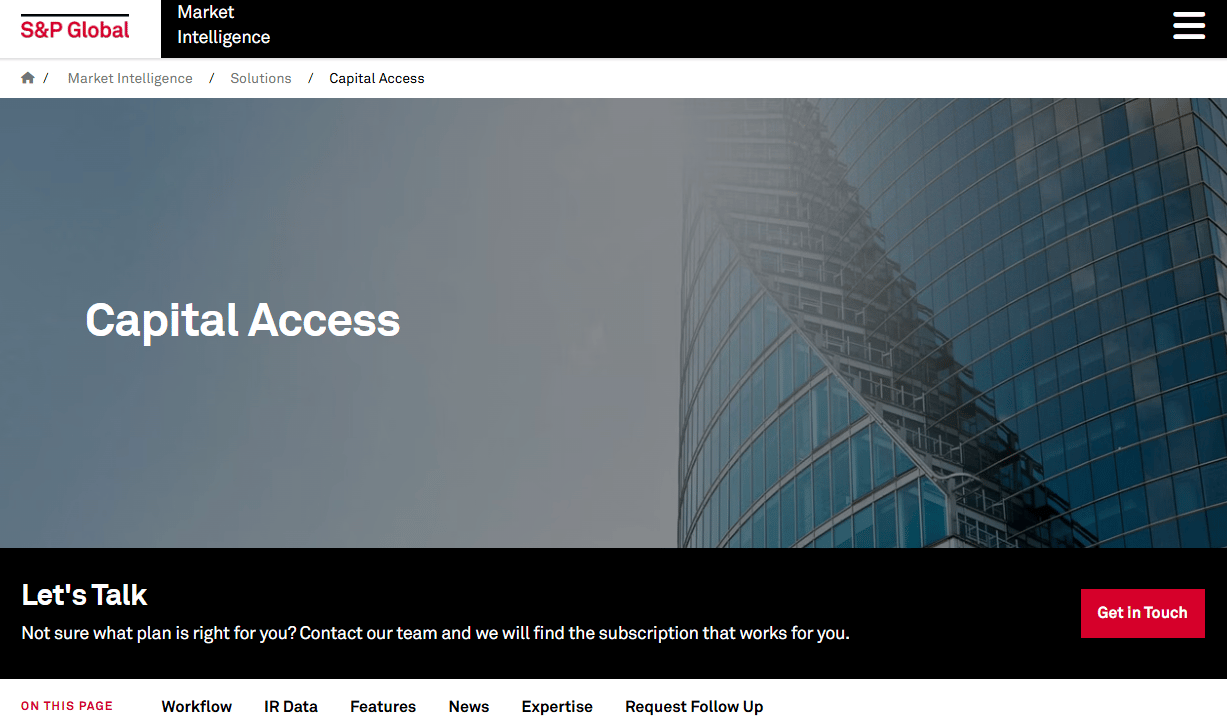
S&P Global Capital Access is an investor-relations workflow platform focused on shareholder analysis, investor targeting, engagement tracking, ROI measurement, and sustainability insights. It gives corporate IR teams access to institutional-grade ownership data and capital-markets research for targeting and outreach programs.
Best for: Large public companies with complex investor targeting requirements and demand for institutional-grade ownership intelligence at scale.
Key features
- Shareholder analysis and engagement tracking
- Investor targeting and ownership research
- IR program ROI and measurement tools
- Sustainability and ESG-related investor insights
- Capital-markets data access for enterprise teams
Why choose S&P Global Capital Access: The value is data depth. IR teams that make targeting decisions across a broad institutional shareholder and peer universe will find the research coverage justifies the investment. This is enterprise-grade tooling for enterprise-scale investor programs.
S&P Global Capital Access pricing: Pricing is not displayed; S&P Global uses a contact-sales model. Reach out to its team for subscription details specific to your company size and data requirements.
G2 rating: No verified G2 rating specific to Capital Access was found at time of publication.
Fit note: Early-stage founders preparing for a Series C or managing a small LP base will likely not need this depth of institutional data. Consider it when the IR program has grown to require formal ownership surveillance.
5. Cision Investor Relations Tools
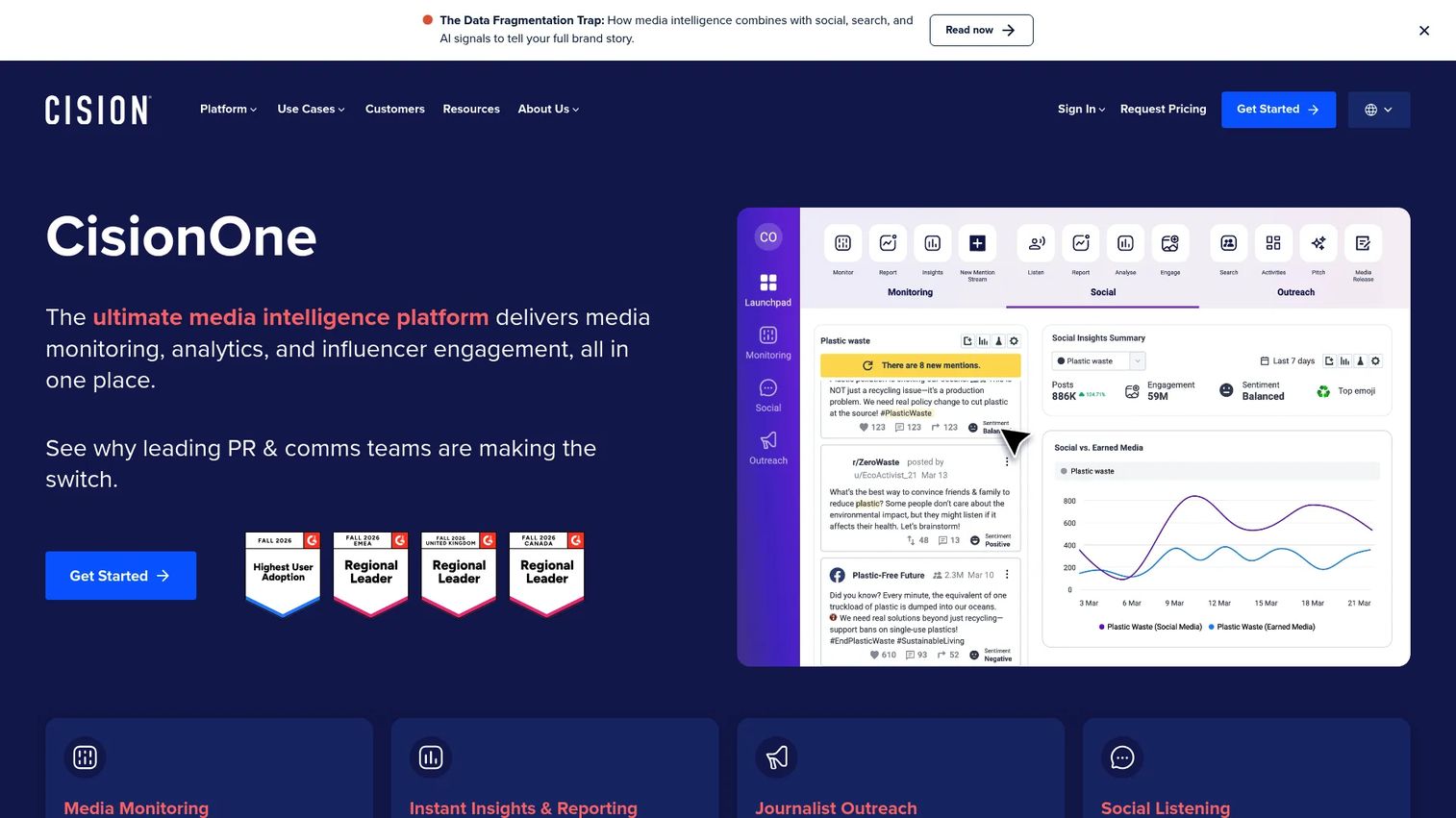
Cision provides investor-relations communications tools covering financial news distribution, SEC filing support, hosted IR and ESG websites, interactive stock tools, earnings webcasts, and live event services. Its offering is oriented toward public-market disclosure obligations and coordinated communications programs across investor, media, and regulatory audiences.
Best for: IR and communications teams where press releases, earnings communications, media monitoring, and investor updates run through the same operating motion.
Key features
- Financial news distribution to analysts, investors, and media
- SEC and SEDAR filing workflow with single-click submission
- Hosted IR and ESG websites with automated content posting
- Audio and video webcasts with live Q&A and transcription
- 24/7 editorial support and event archiving
Why choose Cision: Cision suits organizations whose IR strategy is built around public communications and coordinated messaging. The filing and distribution workflow reduces manual coordination across disclosure, investor outreach, and media relations that otherwise fragment into separate tools.
Cision Investor Relations Tools pricing: Cision does not display pricing for its investor-relations product suite. Contact the sales team for a quote.
G2 rating: 3.9/5
Fit note: Cision's communications depth does not replace dedicated private-market investor CRM workflows. Teams needing LP relationship management and fundraising pipeline tracking should look at private-market-specific options in this list.
6. EQS IR COCKPIT
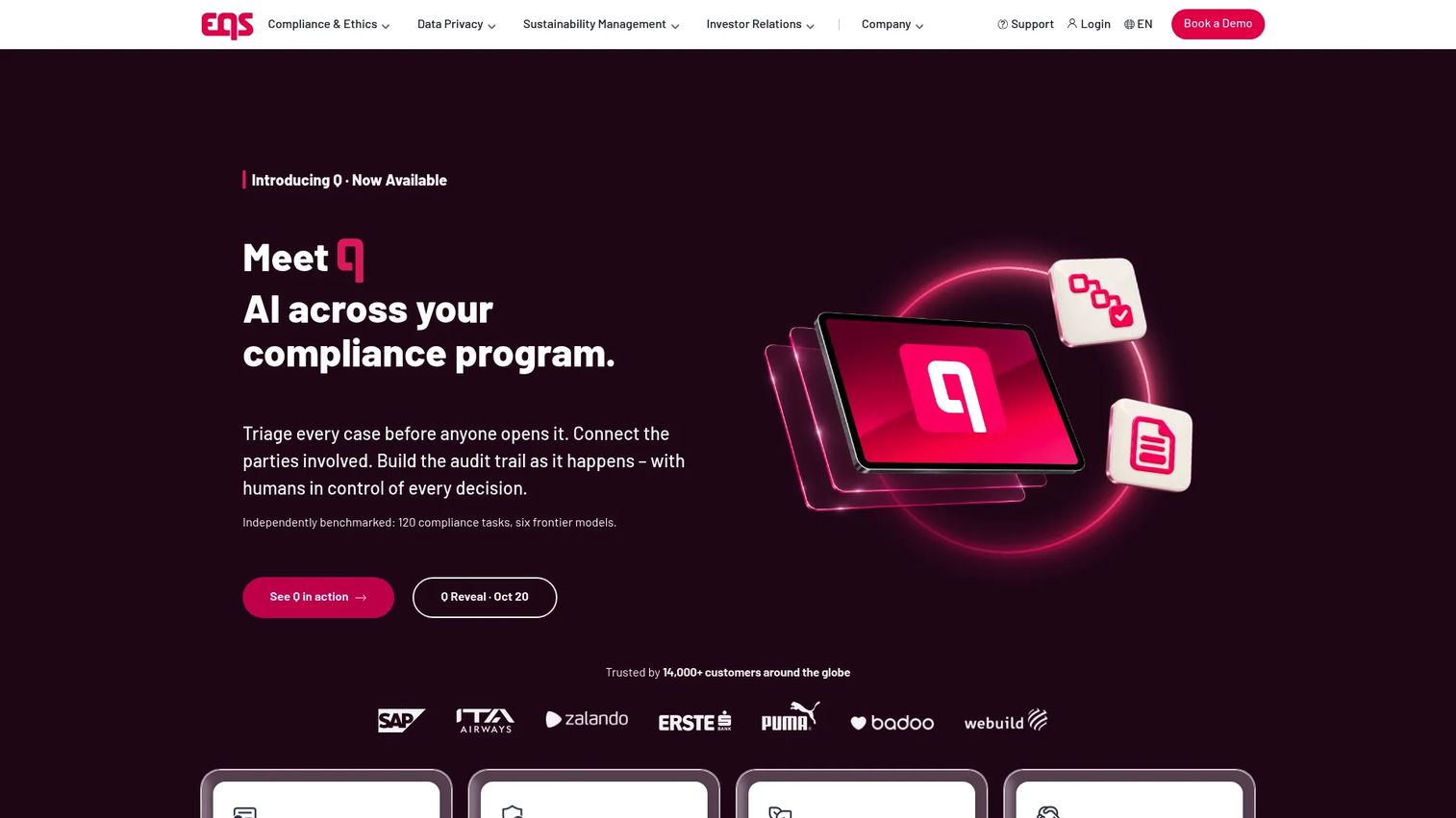
EQS IR COCKPIT is a cloud-based investor-relations platform combining investor data, contact management, regulatory disclosure management, and news distribution. It covers SEC, SEDAR, and EU regulatory news distribution alongside investor targeting, peer-group analysis, and GDPR-compliant contact management for European and multinational IR teams.
Best for: European or multinational public companies that need investor relations operations with formal reporting workflows, regulatory disclosure support, and data governance controls.
Key features
- Regulatory disclosure management: SEC, SEDAR, and EU regulatory news
- Investor targeting and peer-group analysis
- GDPR-compliant CRM and mailing for investor contacts
- Shareholder identification and evaluation tools
- Investor engagement tracking and workflow management
Why choose EQS IR COCKPIT: EQS suits teams operating in complex regulatory environments where workflow controls and investor data governance carry real operational weight. The combination of disclosure management and investor CRM in one platform reduces the risk of fragmented compliance across separate systems.
EQS IR COCKPIT pricing: Pricing is not displayed. EQS directs prospective customers to request pricing through its team.
Fit note: The platform's value grows as public-company IR complexity increases. Early-stage or private companies without regulatory disclosure obligations will find significant portions of the platform unused.
7. InvestorHub
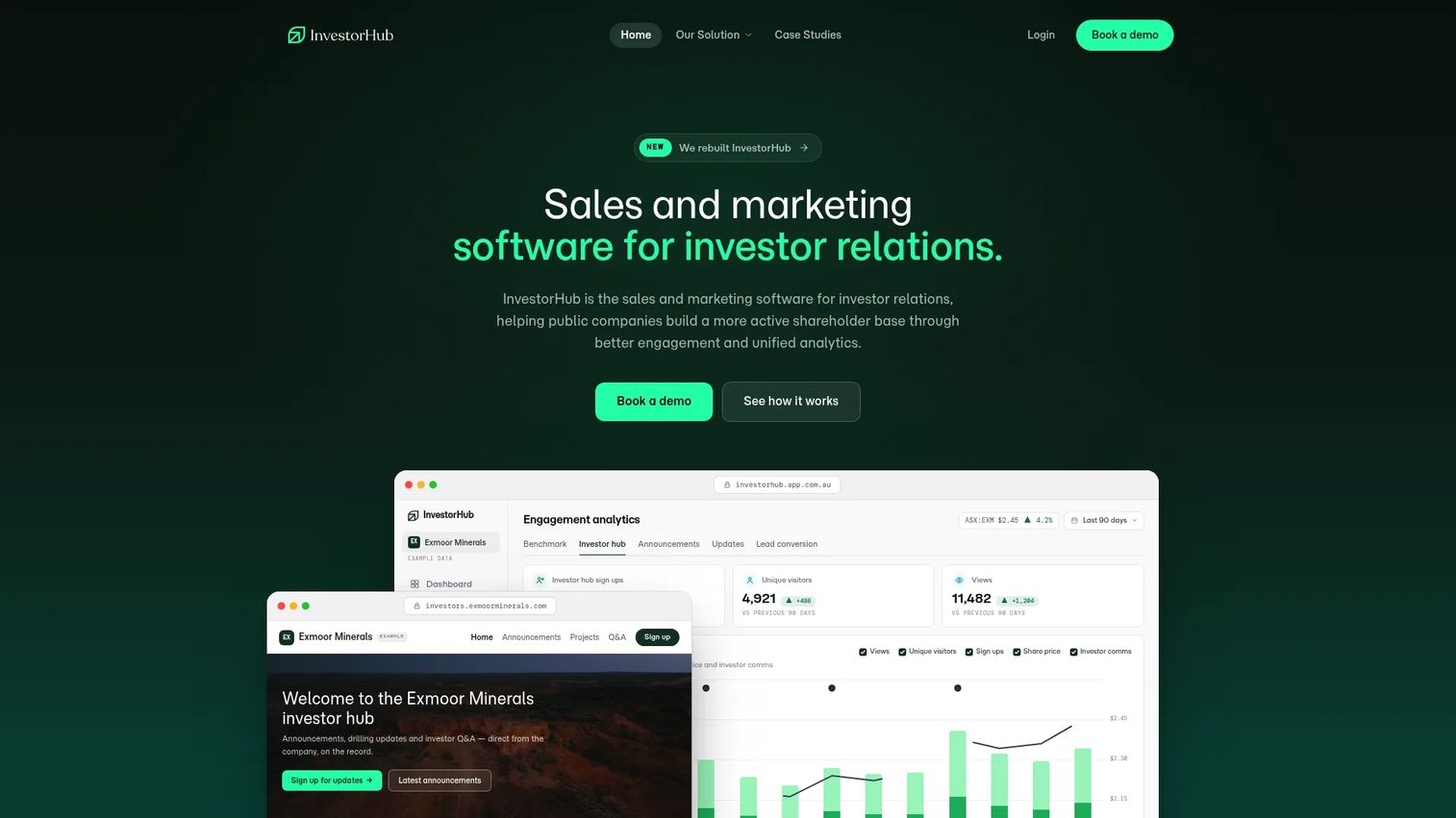
InvestorHub positions itself as sales and marketing software for investor relations. It combines branded interactive investor hubs, registry-integrated CRM with shareholder and trading insights, and multi-channel campaigns across email, social, and webinars. The platform is oriented toward ASX- and LSE-listed companies that want to build direct investor audiences.
Best for: Listed companies seeking registry-integrated investor engagement tools and analytics for running active direct-to-investor communications programs.
Key features
- Branded investor hubs with live prices, announcements, and lead capture
- Registry-integrated CRM with shareholder segmentation and movement insights
- Multi-channel campaigns: Email, social, webinars, and investor hubs
- Investor engagement analytics tied to trading and registry data
- Q&A capabilities and investor audience management
Why choose InvestorHub: The registry integration is the differentiator. Connecting engagement data directly to shareholder registry activity gives listed companies insight into how communications influence investor behavior, which is harder to achieve with general-purpose IR platforms. It is the strongest fit where direct investor outreach is an active strategic priority.
InvestorHub pricing: Pricing is not displayed on the website. Book a demo through InvestorHub's team to discuss pricing for your company size and market.
Fit note: Companies needing deep institutional ownership surveillance should compare data depth carefully before committing. InvestorHub excels at engagement and communications, not at the ownership intelligence workflows that public-company IR platforms like Irwin or Nasdaq IR Insight cover.
8. Juniper Square CRM
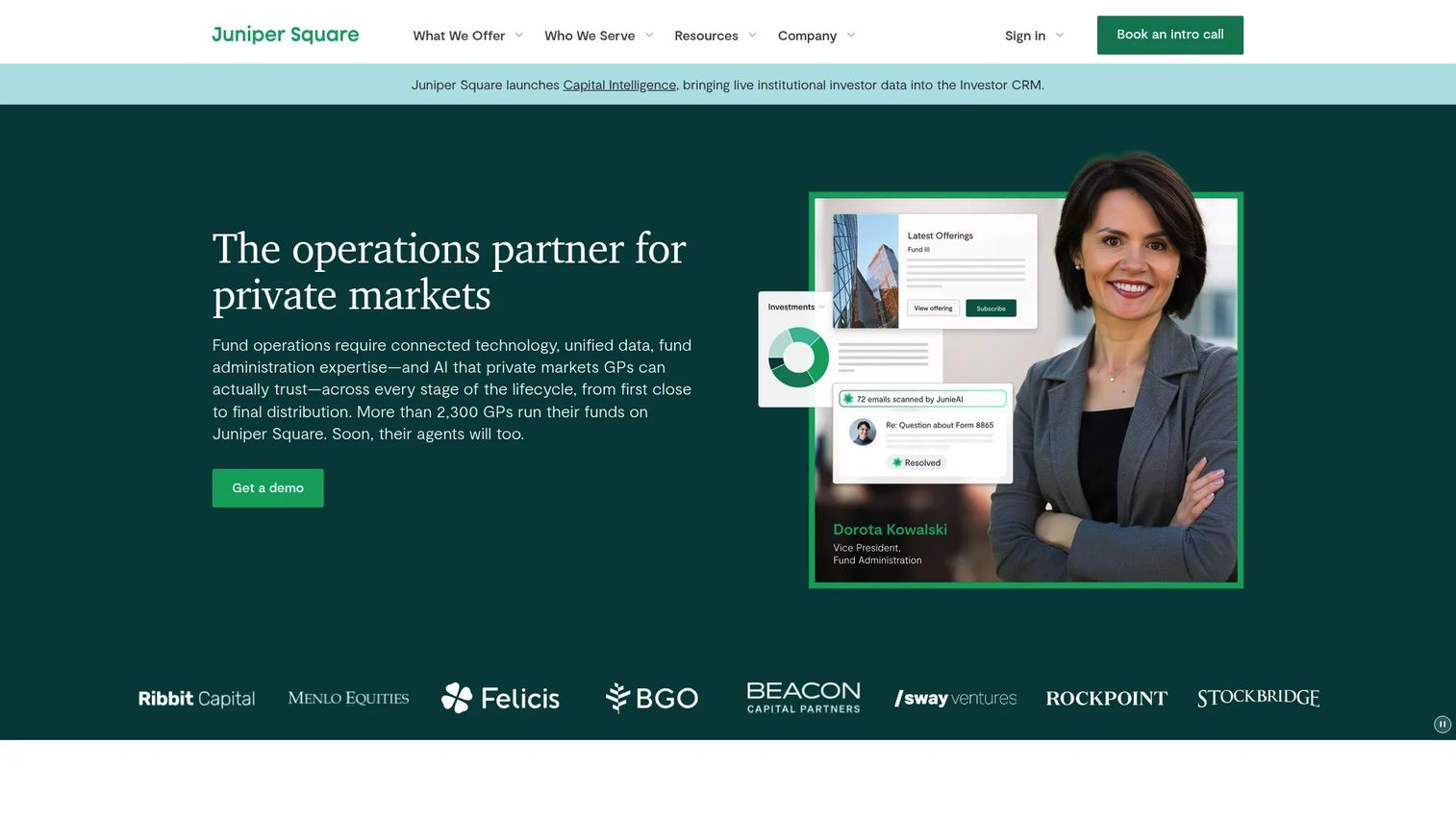
Juniper Square CRM is an AI-powered investor CRM built for private-markets investor relations teams. It covers investor and prospect management, email and calendar synchronization, customizable activity tracking, AI-generated activity summaries, investor communications with engagement analytics, and integrations with Gmail, Outlook, HubSpot, and Preqin.
Best for: Private-markets GPs and investor-relations teams managing LP relationships, fundraising pipelines, and ongoing investor workflows.
Key features
- Investor and LP contact management with activity tracking
- Email, calendar, and attachment synchronization
- AI-generated activity summaries and conversational insights
- Investor communications with engagement analytics
- Integrations with Gmail, Outlook, HubSpot, and Preqin
Why choose Juniper Square CRM: Juniper Square is the leading private-market recommendation for teams whose investor relationships center on fund LPs, capital activity, and ongoing reporting obligations. The AI summarization and engagement analytics reduce the administrative overhead that typically falls on a small IR team managing a large LP base.
Juniper Square CRM pricing: Pricing is not displayed on the website and requires contacting the sales team. G2 reviewers rate the product at 4.7/5 across 106 reviews, which reflects strong satisfaction across the private-markets customer base.
G2 rating: 4.7/5
Fit note: An operating SaaS company raising a Series B from a small set of institutional VCs may not need fund-administration depth. If the primary need is investor update distribution and meeting tracking, evaluate whether a lighter investor CRM fits before committing to a full fund-operations platform.
9. Issuer Direct IR Solutions
Issuer Direct provides communications and compliance technology for corporate issuers. Platform id., its core offering, covers investor-relations websites, regulatory and EDGAR/XBRL filing workflows, earnings calls and webcasts, investor targeting, news distribution, stock-transfer account management, and annual-meeting and proxy management.
Best for: Smaller public companies that want an issuer-focused IR communications platform with predictable flat-rate pricing.
Key features
- Investor-relations website management
- EDGAR, XBRL, and disclosure filing workflows
- Earnings call and webcast delivery
- Investor targeting and peer analysis tools
- News distribution and corporate communications
Why choose Issuer Direct: The flat-rate pricing model removes one of the most common objections to dedicated IR software: Unpredictable cost at scale. For a lean public-company IR team that needs practical communications support without building an enterprise stack, Issuer Direct covers the core workflow at a defined monthly number.
Issuer Direct IR Solutions pricing: Platform id. starts at $895 per month (billed monthly). The modular structure covers communications, compliance, IR, events, and annual-meeting capabilities.
Fit note: Teams needing institutional-grade ownership intelligence and sophisticated investor targeting should compare data depth carefully. Issuer Direct focuses on communications and disclosure rather than the shareholder surveillance capabilities found in dedicated intelligence platforms.
10. Backstop Investor Relations Platform
Backstop provides investor-relations software for managing investor relationships, communications, capital-raising activity, and investor data for investment firms and institutional investors. The platform covers relationship management, capital-raising pipelines, investor communications, activity tracking, client portals, and return and risk statistics with benchmarks.
Best for: Investment firms and institutional teams managing complex investor, allocator, consultant, and intermediary relationships across large networks.
Key features
- Investor relationship management with full activity tracking
- Capital-raising management and pipeline tools
- Investor communications and interaction history
- Client portal for investor data, balances, and performance reporting
- Return and risk statistics with benchmark comparisons
Why choose Backstop: Backstop suits sophisticated investment organizations that need relationship intelligence across large, complex investor networks. The depth of allocator and intermediary profiling goes beyond what a general-purpose CRM provides, and the capital-raising pipeline view gives teams a structured way to manage multi-stage fundraising conversations.
Backstop Investor Relations Platform pricing: Pricing is not displayed and requires contacting the sales team. G2 reviewers rate the product at 4.7/5 across the Backstop Solutions Suite.
G2 rating: 4.7/5
Fit note: Operating-company founders looking for a lightweight investor update and follow-up system will find the institutional workflow broader than necessary. Backstop fits investment professionals managing capital on behalf of LPs and allocators, not operating companies managing their own investor base.
Considerations when choosing investor relations software
Public-market intelligence versus private-market CRM
The first question is which workflow you are buying for. Shareholder targeting and ownership surveillance require public-company IR tooling. LP relationship management and fundraising pipelines require private-market investor CRM. Buying a public-company system for a private fundraising workflow wastes budget on features you cannot use.
Data quality and source-of-truth ownership
Define who owns investor profiles, interaction records, and ownership data before any migration begins. A system that centralizes investor context is only as good as the data going into it. Assign a data owner and establish a cleanup process before committing to a platform.
Reporting cadence and board workflow
Evaluate whether the platform can support your recurring board reporting cycle, investor update schedule, or earnings calendar. The right system should shorten preparation time for each cycle, not add another layer of manual export and formatting.
Communications and engagement measurement
Check whether the platform tracks investor engagement with emails, websites, events, or investor hub content. For a founder preparing a fundraise, the difference between a prospect who engaged three times this quarter and one who politely opened a single email is meaningful signal.
Integrations, permissions, and security review
Verify connections with finance systems, email, calendar, and document repositories relevant to your workflow. Assess access controls for board members, legal counsel, and external stakeholders. Platforms used in formal investor processes will face security review, especially at Series C and beyond.
How to choose the right investor relations software for your team
If you are a private SaaS company preparing for the next round
Start with a private-market investor CRM or a disciplined internal process. Prioritize investor history, fundraising pipeline visibility, update distribution, and follow-up ownership. Juniper Square CRM is the primary recommendation for firms with active private-market capital operations. For companies whose primary goal is direct investor communication rather than full fund workflow management, InvestorHub handles that motion well for listed companies.
If you are public or building toward a public-company IR function
Prioritize shareholder intelligence, investor targeting, ownership change monitoring, peer data, and earnings workflow support. Irwin or Nasdaq IR Insight fit this motion well. For multinational or European operating contexts with regulatory compliance requirements, EQS IR COCKPIT covers the disclosure and governance workflow alongside investor relationship management.
If investor events and communications are the bottleneck
Prioritize investor website management, event delivery, webcast support, content distribution, and engagement analytics. Q4 Platform handles this end of the workflow well. Cision Investor Relations Tools or Issuer Direct IR Solutions suit communications-led operating models, particularly for teams managing regulatory disclosure alongside investor outreach.
If your organization manages institutional investor networks
Prioritize relationship intelligence, investor segmentation, activity capture across large networks, and reporting depth. Backstop Investor Relations Platform fits investment firms and institutional teams managing allocator and intermediary relationships at scale. S&P Global Capital Access is the right comparison for capital-markets research-heavy programs at large public companies.
Conclusion
Investor relations software is not one category. The decision starts with your operating model, not a feature checklist.
Public-company teams should prioritize shareholder intelligence, investor targeting, and market context. Private-market teams should prioritize investor CRM, LP workflow, and fundraising visibility.
Here is how the ten platforms break down:
Irwin covers IR intelligence and investor relationship management for public companies. Nasdaq IR Insight delivers shareholder intelligence with proprietary data depth. Q4 Platform handles digital investor engagement and events. S&P Global Capital Access serves enterprise capital-markets intelligence needs. Cision Investor Relations Tools manages public communications and disclosure. EQS IR COCKPIT suits compliance-heavy and European IR workflows. InvestorHub connects registry data to direct investor outreach. Juniper Square CRM is the private-market LP relationship standard. Issuer Direct IR Solutions provides flat-rate issuer communications starting at $895/month. Backstop Investor Relations Platform supports institutional relationship intelligence at investment firms.
Start with the workflow you need to fix today. Software companies selling complex investor-facing platforms often use an interactive demo to let prospects evaluate workflows before scheduling a call, which reduces friction early in the buying process.
Start your journey with Guideflow today!
FAQs
Investor relations software centralizes investor data, relationship history, communications, reporting, and market intelligence from a single system. The exact feature mix differs significantly between public-company IR platforms, which focus on shareholder intelligence and regulatory workflows, and private-market investor CRM products, which focus on LP relationships and fundraising pipelines.
A CRM manages contacts and activities across a broad set of business relationships. Investor relations software adds investor-specific data layers: Shareholder intelligence, ownership monitoring, investor targeting models, earnings workflow support, or LP relationship management and capital-raising pipelines. Generic CRM tools do not provide these capabilities without significant custom configuration that rarely holds up over time.
Many Series B companies can start with structured investor updates and a disciplined CRM process. Dedicated software becomes more valuable when investor relationships, fundraising activity, reporting, and stakeholder coordination grow too complex to manage manually. A useful trigger: If preparing a quarterly investor update takes more than a day of assembly, a dedicated platform starts paying for itself.
Public-company IR teams should evaluate shareholder intelligence depth, investor targeting and screening capabilities, ownership change monitoring, peer benchmarking, engagement analytics, earnings and webcast support, and permissions controls. Integration with existing financial reporting and communications systems is also a practical requirement for teams that cannot afford workflow gaps around earnings cycles.
Private-market teams need LP and investor profile management, fundraising pipeline tracking, interaction capture, investor communications with permissions controls, reporting tools, and connections to fund administration systems. The quality of email and calendar synchronization matters significantly, since LP communication often happens through a small number of senior team members whose inboxes hold most of the relationship history.
Many public-company IR platforms use ownership data, peer analysis, and market intelligence to identify target investors and build outreach programs. The distinction worth understanding is that shareholder targeting is different from managing a generic contact list. Targeting tools screen institutions by ownership profile, sector mandate, and recent activity, not just by company name and email address.
Pricing varies widely across the category. Issuer Direct IR Solutions starts at $895 per month for its Platform id. offering. Most public-company IR platforms and private-market investor CRM products use contact-based pricing configured to team size, data access requirements, and contract terms. Expect annual contracts from most providers. Request quotes from Irwin, Nasdaq IR Insight, Q4 Platform, Juniper Square CRM, and Backstop directly to compare total cost against your current workflow.
The relevant integrations depend on company type. Public-company teams typically need connections to financial reporting systems, email, calendar, market-data providers, investor websites, and virtual-event platforms. Private-market teams prioritize email and calendar sync, fund administration systems, and data enrichment tools like Preqin. Across both contexts, access controls for board members and legal counsel need to work within the same permissions framework as investor-facing content.
These are separate categories with different jobs. Cap table management software tracks equity ownership, option grants, dilution modeling, and shareholder of record for corporate governance purposes. Investor relations software manages communications, relationships, engagement, and market intelligence. Some data overlaps, but the workflows do not. A company typically needs both, and the output of cap table software may inform parts of the IR process without replacing it.