Product teams are under real pressure right now. Stakeholders want AI in the product. Engineering wants a clear scope. And the directive is often as vague as "add a conversational interface." The problem is that "add a chat box" is not a strategy. The real decision is which interaction model fits the job you are actually trying to solve.
The global conversational AI market reached $14.3 billion in 2025, according to Grand View Research. But market size does not tell you whether a large language model, an embodied research agent, or a simple retrieval signal is the right choice for your onboarding flow. The range of systems called "conversational interface agents" spans LLM-based assistants, task-oriented dialogue systems, multimodal embodied agents, autonomous browsing recommenders, and retrieval methods that have been around for decades.
This guide maps all twelve. The goal is not to pick the most impressive model. It is to help you match the interaction model to the product job, so you can instrument it properly and maintain it as the product changes.
What's inside
This guide covers 12 conversational interface agents and systems relevant to product teams in 2026. It was built for product managers evaluating conversational AI for onboarding, support, search, and discovery experiences. Items were selected based on:
- Interaction model: How does the agent communicate with the user (text, voice, gesture, suggestion)?
- Product use case fit: Which PM jobs does it actually address?
- Architecture and integration implications: What does building with it cost your engineering team?
- Trust, autonomy, and maintainability: How does it handle errors, consent, and product changes?
TL;DR
- Best for general-purpose conversational AI: GPT-4 handles natural language reasoning across onboarding, support, and knowledge retrieval when paired with grounding and measurement
- Best for open model experimentation: Llama 2 is free for commercial use and gives your engineering team full control over hosting and fine-tuning
- Best for multilingual research context: PaLM 2 shaped Google's approach to multilingual reasoning and conversational AI architecture
- Best embodied conversational agent reference: REA demonstrates how speech, gaze, and gesture must work together in multimodal interfaces
- Best autonomous recommendation reference: Letizia shows how agents can suggest without interrupting, which is the right autonomy model for most product contexts
- PM reminder: Define the interaction model before you pick a model. The wrong abstraction creates maintenance debt and trust problems that compound over time
What is conversational interface agent software?
Conversational interface agent software is a system that lets users interact with digital products through natural language, multimodal cues, autonomous recommendations, or dialogue-driven task assistance.
The category covers several distinct families:
- LLM-powered conversational agents: Models like GPT-4, Llama 2, and BLOOM that generate language responses based on training and context
- Task-oriented dialogue systems: Agents built around specific workflows with defined states, intents, and slots
- Embodied conversational agents: Research systems like REA that coordinate speech, gaze, gesture, and facial behavior
- Autonomous interface agents: Systems like Letizia that observe user behavior and proactively suggest next steps
- Retrieval and recommendation systems: Methods like TFIDF that match user needs to content without generating language
- Conversational user interfaces embedded inside products: Chat windows, copilots, and assistant panels built on top of any of the above
Key capabilities to evaluate:
- Natural language understanding: Intent detection, entity recognition, slot filling
- Dialogue management: State tracking, turn-taking, repair, context persistence
- Response generation: Retrieval-based, template, neural, or LLM output
- Multimodal interaction: Speech, gaze, gesture, facial display coordination
- Autonomy and suggestion: What the agent can do without explicit user instruction
- Instrumentation: Task completion rate, escalation rate, deflection, correction rate
- Safety and trust: Hallucination handling, bias checks, privacy constraints, audit trails
For product managers, the frame matters. Evaluate conversational agents by the job they support, not by how human they sound. For onboarding, the metric is activation rate and time to first value (TTFV). For support, it is deflection quality and escalation rate. For discovery, it is task success and user confidence.
When to use conversational interface agents
Guide users through complex workflows
Conversational agents help when users face multi-step tasks where the next step is not obvious from the interface alone. Admin configuration, initial setup, and product onboarding with branching paths are strong candidates. Track activation rate, onboarding completion, and drop-off by step to measure whether the agent reduces friction or adds it.
Help users retrieve answers without query syntax
Search works well when users know what they want. Conversational retrieval helps when users know roughly what they need but cannot construct an exact query. This covers documentation access, analytics interpretation, and knowledge-base exploration. Instrument for successful answer rate, escalation to human support, and correction frequency.
Recommend next actions while preserving user control
Agents that suggest rather than act maintain user trust during browsing, discovery, and decision-support tasks. Letizia-style framing applies here: The agent monitors concurrent context and surfaces recommendations, but the user stays in control of navigation. Consent, interruption cost, cognitive load, and explainability all matter before you ship a recommendation agent into an active workflow.
Conversational interface agents comparison
The table below covers all 12 systems in this guide. Research prototypes carry N/A for pricing and G2 rating because no commercial product exists to verify against. Ratings and pricing for commercial systems were verified against each vendor's live documentation.
| # | Product | Best for | Key use case | Pricing | G2 rating |
|---|---|---|---|---|---|
| 1 | GPT-4 | General conversational AI | Natural language reasoning and task assistance | $30/1M input tokens | 4.6/5 |
| 2 | PaLM 2 | Google-native AI research | Multilingual reasoning and conversational AI foundation | Contact Google Cloud | N/A |
| 3 | Llama 2 | Open model experimentation | Self-hosted conversational AI prototypes | Free (compute costs vary) | 4.3/5 |
| 4 | LaMDA | Open-domain dialogue research | Conversational quality and groundedness research | Research system | N/A |
| 5 | BLOOM | Multilingual open model research | Multilingual text generation and experimentation | Free (compute costs vary) | N/A |
| 6 | BART | Retrieval and generation pipelines | Summarization and response modeling | Free via Hugging Face | N/A |
| 7 | T5 | Flexible NLP task modeling | Question answering, summarization, translation | Free (compute costs vary) | N/A |
| 8 | UL2 | Unified pretraining research | Flexible language model fine-tuning | Research model | 4.3/5 |
| 9 | REA | Embodied agent research | Speech, gaze, gesture, and interruption handling | Research prototype | N/A |
| 10 | Letizia | Autonomous recommendation concepts | Browsing observation and page suggestion | Research prototype | N/A |
| 11 | TFIDF | Lightweight retrieval baseline | Keyword-weighted matching and recommendation | Open source | 4.8/5 |
| 12 | Google Scholar | Research discovery | Academic search and citation exploration | Free | N/A |
Best 12 conversational interface agents for 2026
1. GPT-4
GPT-4 is OpenAI's high-intelligence language model for generating safer, more useful responses across text and image inputs. Product teams use it to build conversational assistants, copilots, onboarding guidance flows, and knowledge retrieval experiences. When paired with retrieval grounding and clear instrumentation, it can support complex, open-ended user interactions at scale.
Best for: Product teams building general-purpose conversational AI where language reasoning quality is the core requirement.
Key features
- Natural language reasoning across long, complex prompts
- Tool and function calling for structured task execution
- Multimodal input support: Text and image
- Context-aware response generation over extended conversations
- Enterprise API deployment with usage-based billing
Why choose GPT-4: GPT-4 excels when the product experience depends on nuanced language understanding. PMs should budget engineering time for hallucination control, prompt design, retrieval grounding, and feedback loops before shipping to users.
GPT-4 pricing: API access is usage-based at $30.00 per million input tokens and $60.00 per million output tokens. Note that OpenAI has marked GPT-4 as shut down on its model page; check the current OpenAI model roster for the active successor before committing to implementation.
G2 rating: 4.6/5 (OpenAI product portfolio, verified November 2026)
2. PaLM 2
PaLM 2 is Google's Transformer-based large language model designed for multilingual understanding, reasoning, code generation, and improved inference efficiency. It served as a foundation for several Google conversational AI products and shaped how Google approaches dialogue systems. Teams researching Google-native large language model agents or studying model evolution will find PaLM 2 a relevant reference point.
Best for: Teams researching Google's conversational AI foundations and multilingual model architecture.
Key features
- Multilingual language understanding across hundreds of languages and domains
- Code generation and reasoning capabilities
- Compute-efficient architecture with faster inference
- Inference-time toxicity control
- Google ecosystem alignment
Why choose PaLM 2: Use PaLM 2 as a conceptual reference for Google's approach to multilingual reasoning. For production decisions, verify the current state of Google's model family through Google Cloud documentation, as PaLM 2 may have been superseded in the active stack.
PaLM 2 pricing: Access is through Google Cloud; contact Google Cloud directly for current model availability and pricing.
3. Llama 2
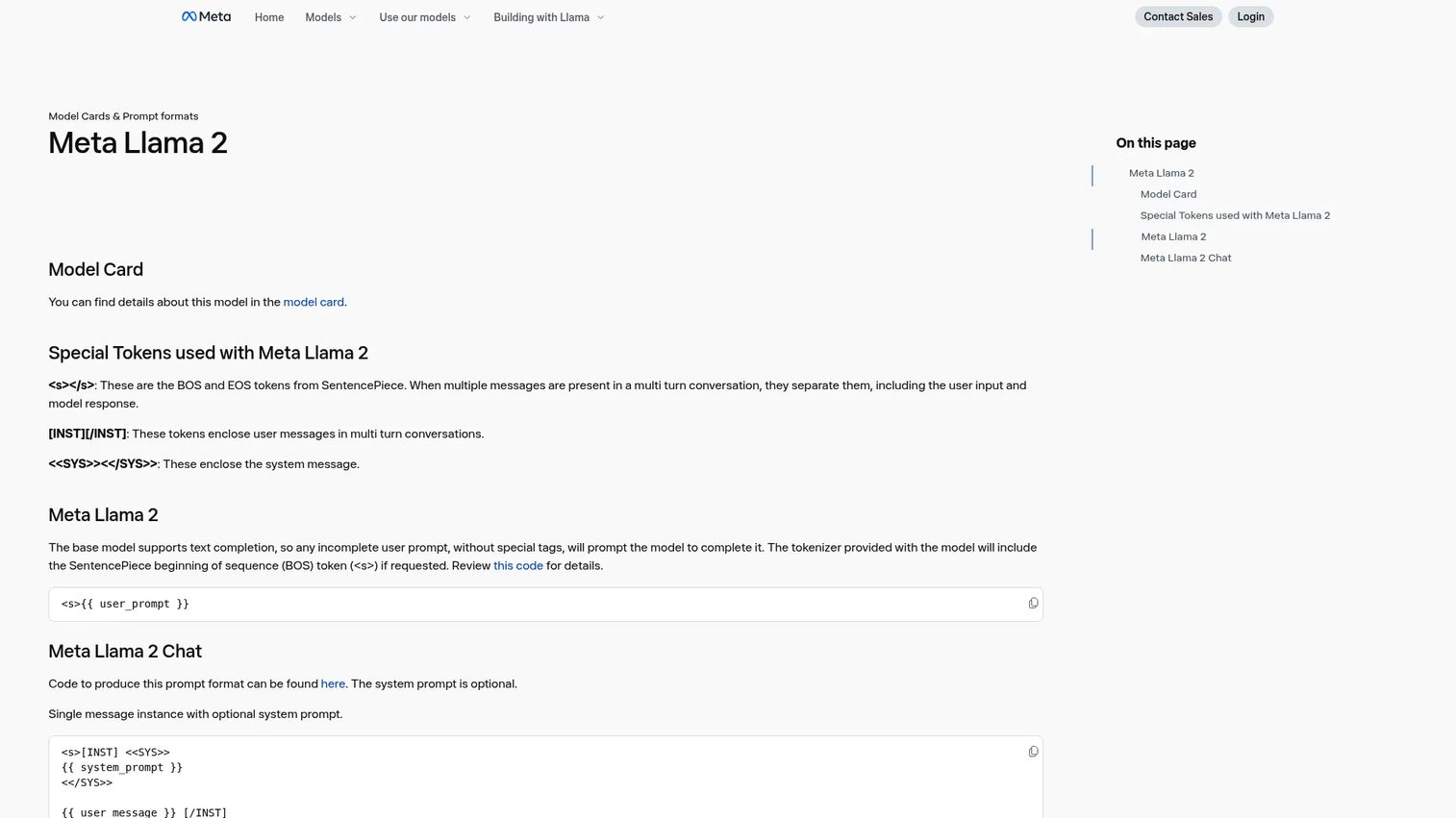
Llama 2 is Meta's open large language model family offering pretrained and fine-tuned models for research and commercial use. Model sizes range from 7B to 70B parameters, with conversational variants (Llama-2-chat) fine-tuned specifically for dialogue. For product teams, the tradeoff is clear: More control over hosting and customization, but more responsibility for evaluation, infrastructure, safety, and ongoing maintenance.
Best for: Developers and teams prototyping self-hosted or customized conversational AI experiences where data control matters.
Key features
- Pretrained and fine-tuned model weights available
- Model sizes from 7B to 70B parameters
- Conversational fine-tuning via Llama-2-chat variants
- Open license for research and commercial use
- Developer ecosystem with Hugging Face compatibility
Why choose Llama 2: Choose Llama 2 when deployment control outweighs managed-model convenience. PMs should align with engineering and security early because hosting decisions directly drive cost, latency, and governance requirements.
Llama 2 pricing: The model weights are free for research and commercial use. Infrastructure costs depend on compute environment, managed hosting provider, and inference volume.
G2 rating: 4.3/5 (Llama product listing, verified November 2026)
4. LaMDA
LaMDA (Language Model for Dialogue Applications) is Google's research language model designed for open-ended, natural conversation across many topics. Its focus on conversation quality, groundedness, specificity, and safety shaped how the field thinks about what good dialogue actually requires. It is a research milestone rather than a production tool.
Best for: Readers studying the history of open-domain conversational agents and the design principles behind dialogue quality.
Key features
- Open-domain, free-flowing conversation across many topics
- Dialogue-trained Transformer architecture
- Fine-tuning emphasis on sensibleness and specificity
- Safety evaluation methodology
- Groundedness research relevant to hallucination prevention
Why choose LaMDA: Use LaMDA as a conceptual foundation. It demonstrates why conversational quality requires more than fluent text generation, and its safety framing remains relevant for anyone shipping LLM-based agents today.
LaMDA pricing: Research system.
5. BLOOM
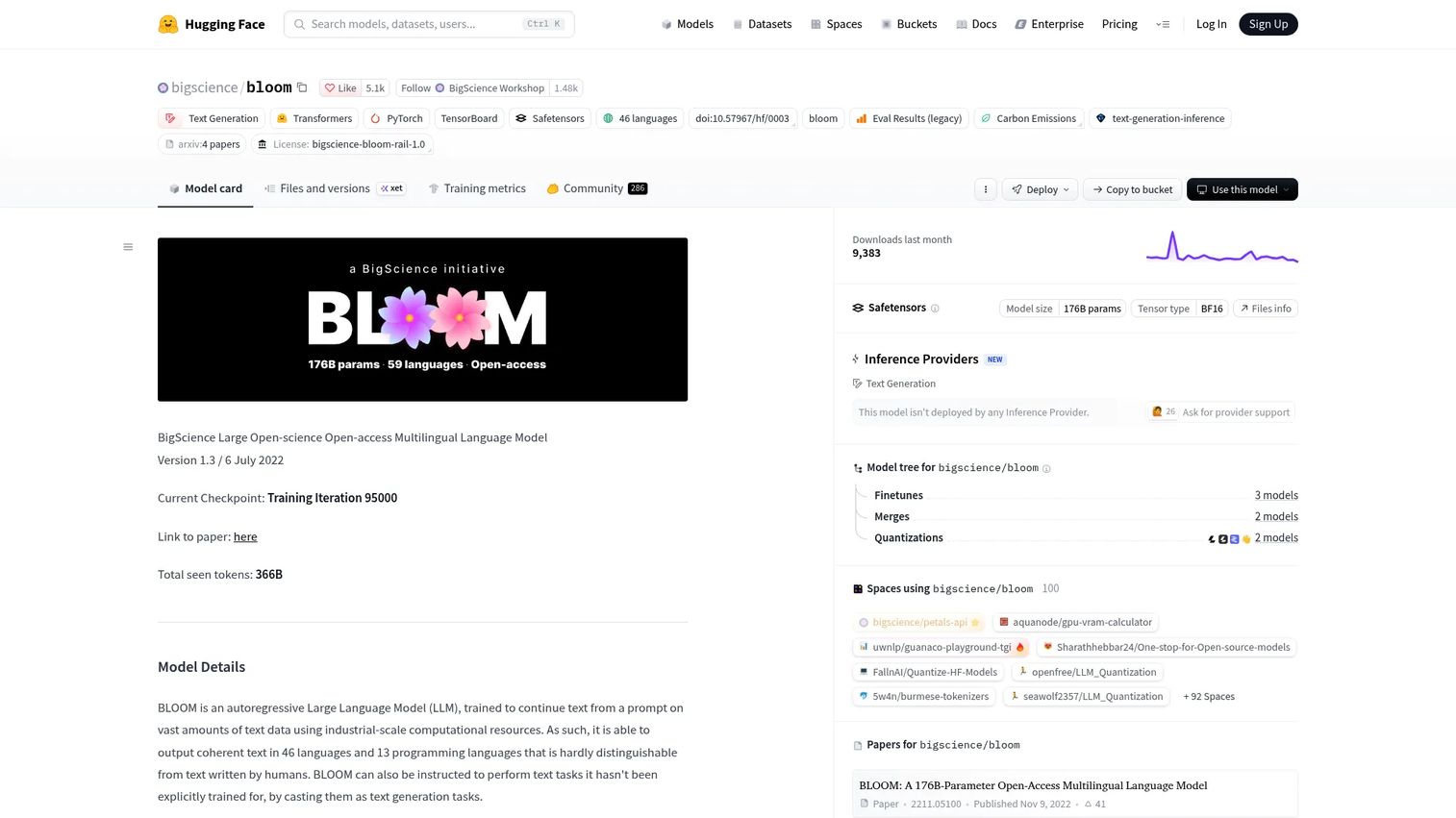
BLOOM is an autoregressive, Transformer-based multilingual large language model developed by the BigScience open research collaboration. It supports text generation in 46 languages and 13 programming languages. For teams evaluating AI model deployment software across multiple regions, BLOOM provides a transparent, multilingual baseline with documented training data and methodology.
Best for: Research teams evaluating multilingual open-model options for conversational interfaces where transparency and language coverage are priorities.
Key features
- Text generation in 46 natural languages and 13 programming languages
- 176B-parameter Transformer architecture
- Open-access model weights and Transformers-format checkpoints
- Multilingual text classification and generation tasks
- Hugging Face ecosystem access
Why choose BLOOM: Choose BLOOM when multilingual coverage and open research lineage are requirements. Validate language quality per target segment before using it in any production-facing experience, since generation quality varies by language.
BLOOM pricing: The model weights are openly available at no cost. Compute and inference costs depend on your hosting environment and usage volume.
G2 rating: N/A (no standalone listing verified)
6. BART
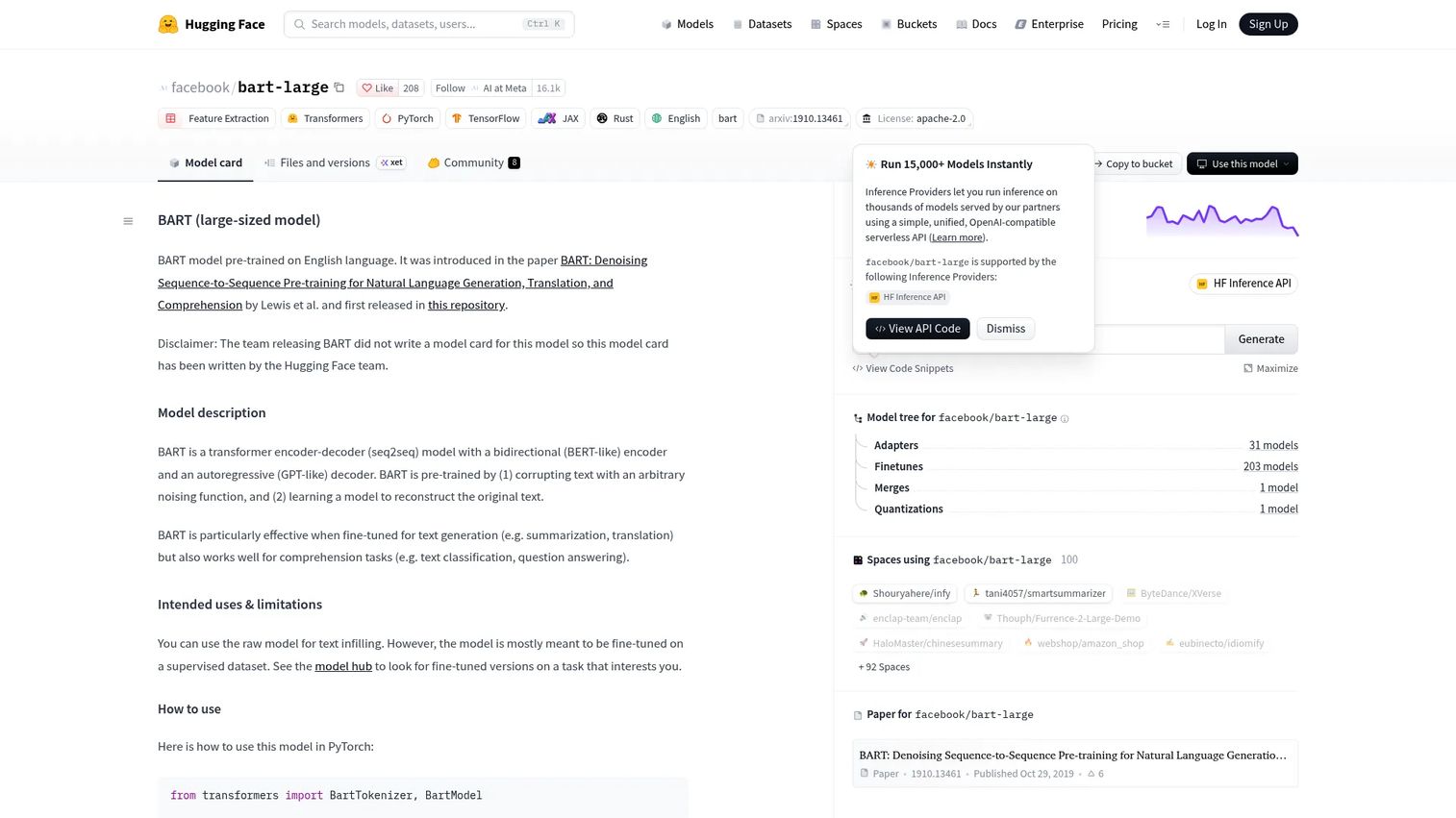
BART is an English Transformer encoder-decoder model trained with a denoising pretraining objective. It performs well on text generation, summarization, translation, and question answering. In a conversational system, BART works best as a component inside a larger architecture rather than a standalone agent, particularly where summarization or response generation is the focused task.
Best for: Developers building retrieval, summarization, or response-generation components inside a larger conversational pipeline.
Key features
- Sequence-to-sequence modeling with denoising pretraining
- Summarization and abstractive text generation
- Text classification and question answering
- Text infilling capability
- PyTorch, TensorFlow, JAX, and Rust support
Why choose BART: BART is the right choice when the product problem is narrower than general conversation. It fits summarization-heavy or retrieval-augmented generation flows where you need a generation layer without a full dialogue system.
BART pricing: The model is free on Hugging Face Hub. Hugging Face's paid plans (PRO at $9/month, Team at $20/month, Enterprise at $50/month) cover additional compute, storage, and collaboration features beyond the free Hub tier.
7. T5
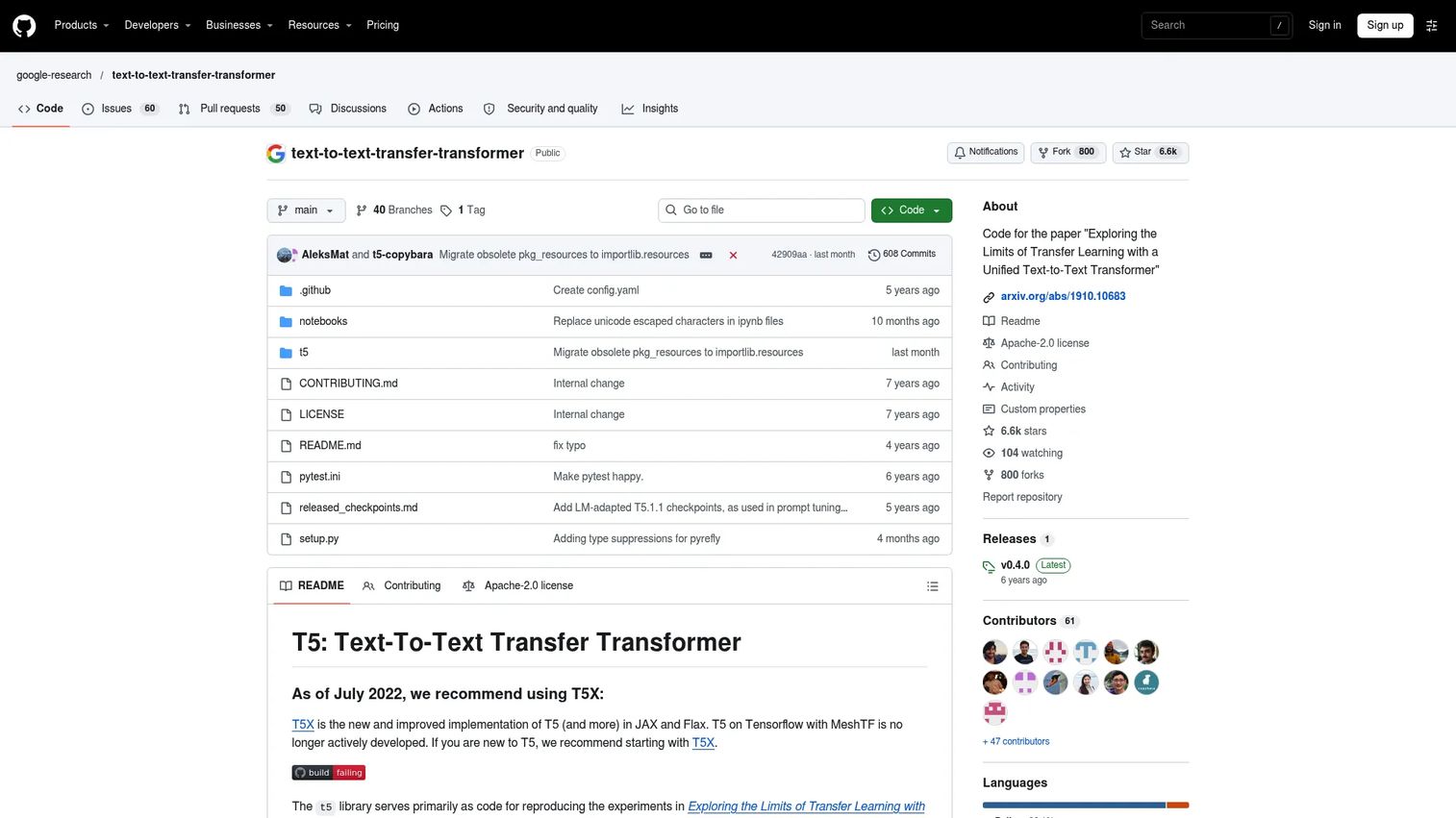
T5 is Google's research codebase for a text-to-text Transformer that handles many NLP tasks within a single format: Everything becomes text-in, text-out. This covers question answering, summarization, translation, and classification. Product teams building structured conversational workflows can use T5 as a flexible NLP backbone, particularly when multiple task types need to share a consistent model interface.
Best for: Teams needing a flexible NLP backbone for structured conversational workflows across multiple task types.
Key features
- Text-to-text task framing for consistent NLP pipelines
- Question answering and reading comprehension support
- Summarization for long-form content
- Translation across languages
- Fine-tuning on custom datasets with released pretrained checkpoints
Why choose T5: Choose T5 for structured language tasks inside a conversational system where multiple task types share the same model. Define the task boundary clearly before building, because T5 is a component, not a complete conversational agent experience.
T5 pricing: The model is available as an open research codebase. Costs depend on compute environment, model size, and inference requirements.
8. UL2
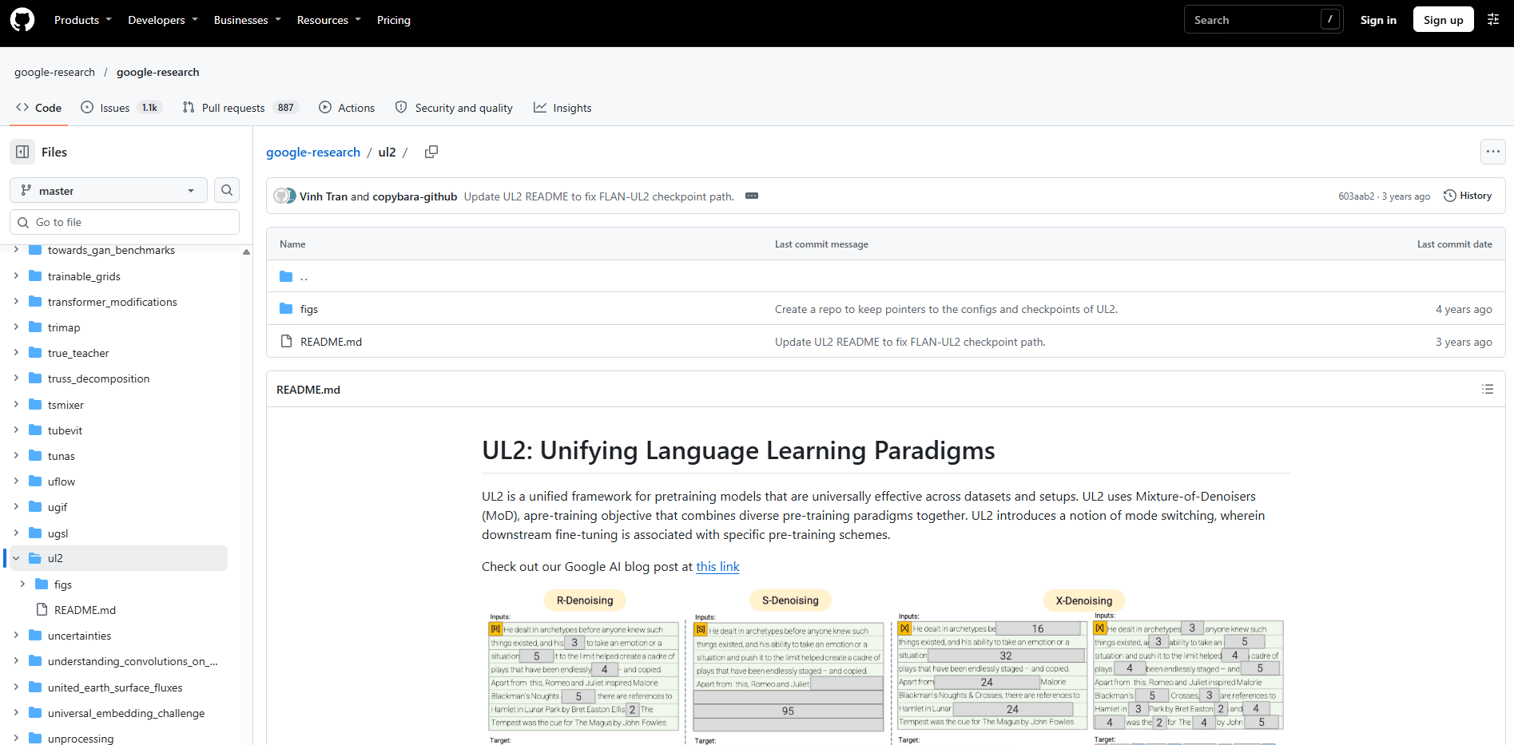
UL2 is a unified framework for pretraining language models using a Mixture-of-Denoisers (MoD) objective and mode switching for downstream tasks. It offers pretrained 20B-parameter checkpoints, including Flan-UL2. UL2 is primarily relevant for AI teams comparing model architectures and pretraining approaches, not for PMs evaluating a turnkey conversational UI.
Best for: AI researchers and engineers studying flexible language model pretraining and multi-task NLP approaches.
Key features
- Mixture-of-Denoisers pretraining objective
- Mode switching for downstream fine-tuning flexibility
- 20B-parameter UL2 and Flan-UL2 pretrained checkpoints
- Multiple NLP task support from a single architecture
- Google Research codebase with open access
Why choose UL2: Use UL2 as a research reference when model architecture and pretraining methodology matter to your team. Product teams should map its capabilities to concrete user-facing tasks before committing engineering time.
UL2 pricing: The model is available through the Google Research GitHub repository. Infrastructure and compute costs depend on your implementation environment.
G2 rating: 4.3/5
9. REA
REA is an embodied, multimodal, real-time conversational agent developed at the MIT Media Lab for real-estate interviews. It coordinates speech, gaze, posture, hand gestures, and facial displays while processing visual, audio, and speech input simultaneously. REA is a foundational reference for anyone designing avatar-based or voice-first interfaces where multiple communication channels must synchronize.
Best for: Teams studying embodied conversational agents and multimodal interaction design for voice-first or avatar-based interfaces.
Key features
- Coordinated eye gaze, posture, and hand gesture output
- Real-time speech, audio, and visual input processing
- Facial display generation synchronized with dialogue
- Turn-taking and interruption handling
- Multi-channel output scheduling for speech and body language
Why choose REA: REA is the right design reference for teams building embodied or avatar-based agents. It makes explicit that conversation design includes timing, body-language cues, repair, and turn synchronization, not just text generation. See also the broader landscape of AI customer service agents for context on how embodied concepts translate to production systems.
REA pricing: Research prototype.
10. Letizia
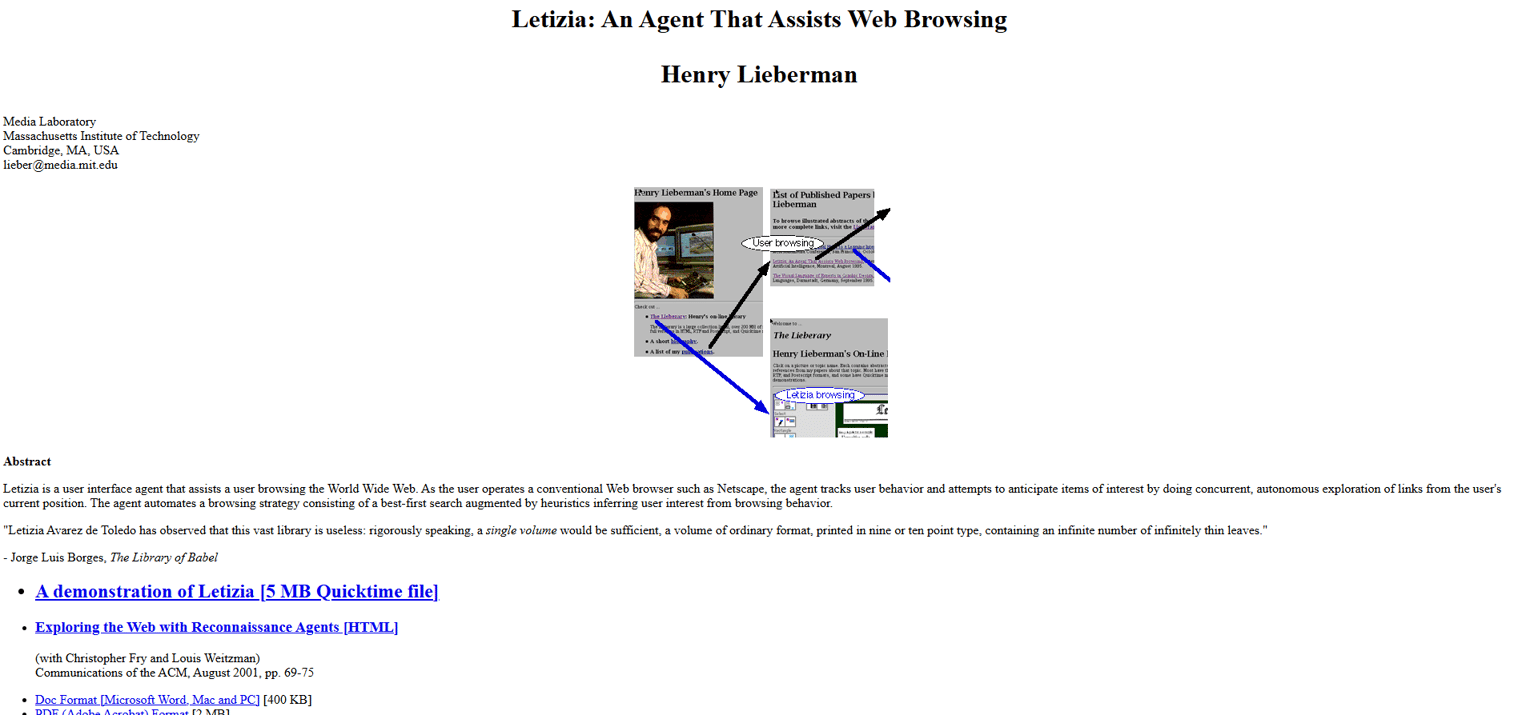
Letizia is a research software agent that observes web browsing behavior and proactively suggests potentially relevant pages. Its core mechanism: The user browses depth-first through chosen pages while Letizia searches breadth-first through linked content during think time. The practical lesson for PMs is durable: Agents should suggest before they act, especially when user trust and cognitive load are at stake.
Best for: Product teams designing recommendation agents that assist without overriding user navigation or decision-making.
Key features
- Continuous observation of browsing behavior
- Page analysis and keyword extraction
- Concurrent breadth-first search while user browses
- Proactive page suggestion based on behavioral signals
- User-controlled navigation throughout
Why choose Letizia: Use Letizia as a framework reference for agent autonomy. The design principle, suggest rather than act, maps directly to consent, interruption cost, and reversibility requirements that any production recommendation agent needs to address. This is relevant to autonomous interface agents more broadly.
Letizia pricing: Research prototype.
11. TFIDF
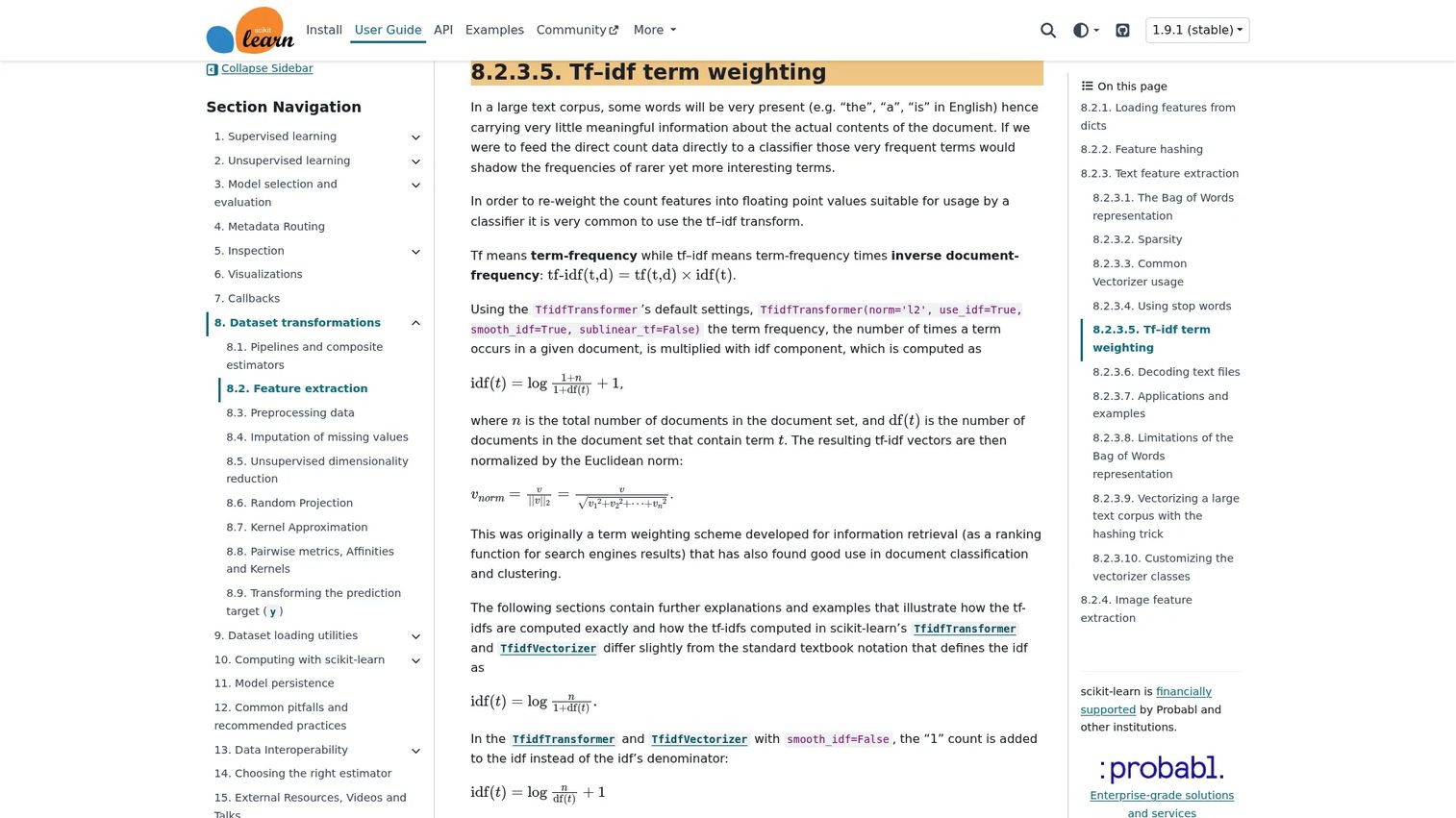
TFIDF (Term Frequency-Inverse Document Frequency) is a text feature extraction method in scikit-learn that transforms documents into weighted numerical representations for machine learning. It is not a conversational agent, but it belongs in this guide because lightweight retrieval signals underpin many conversational systems, including Letizia-style recommendation agents. PMs evaluating AI search and retrieval platforms should understand where TFIDF fits before adding heavier model complexity.
Best for: Developers and data scientists building a transparent retrieval baseline for search, classification, or recommendation workflows.
Key features
- TfidfVectorizer for converting documents to TF-IDF matrices
- TfidfTransformer for normalized TF or TF-IDF representations
- Configurable n-grams, stop words, vocabulary limits, and IDF smoothing
- Word and character-level tokenization options
- Explainable matching logic for auditing why items surfaced
Why choose TFIDF: Choose TFIDF when the product needs a retrieval baseline that engineers and PMs can inspect. TFIDF makes it easy to audit why a document matched a query, which is valuable for early instrumentation before adding opaque neural retrieval.
TFIDF pricing: Open-source scikit-learn functionality. Costs depend on the compute environment, data scale, and your hosting infrastructure.
G2 rating: 4.8/5 (scikit-learn listing, verified November 2026)
12. Google Scholar

Google Scholar is a free scholarly literature search service covering articles, theses, books, abstracts, court opinions, and patents. It sits in this guide as a retrieval-based interface rather than a conversational agent. It demonstrates how conversational interfaces increasingly sit on top of structured retrieval systems, and how citation trails, author credibility, and related-work signals shape user trust in research discovery workflows.
Best for: Researchers, product teams, and engineers validating academic sources, citations, and research context for conversational AI projects.
Key features
- Cross-discipline scholarly literature search
- Citation discovery and citation count tracking
- Author profile pages and citation alerts
- Related-article exploration and full-document linking
- Email alerts for new papers and citation updates
Why choose Google Scholar: Use Google Scholar for research discovery, not for conversation. PMs building research assistant features or question-answering systems should study how citation trails and source credibility influence user trust, because those same dynamics apply when users evaluate AI-generated answers.
Google Scholar pricing: Free to use.
Considerations when choosing conversational interface agents
Start with the product job, not the model
Define the specific job first: Onboarding guidance, support deflection, search, recommendation, or workflow automation. The interaction model that fits onboarding with structured steps differs from the model that fits open-ended question answering. Getting this wrong means rebuilding later under maintenance pressure.
Decide how much autonomy the agent should have
Autonomous action, confirmation-required action, and suggestion are three distinct levels. Each carries different implications for consent, risk, reversibility, and audit logging. For most product contexts, suggestion is the right starting point. Letizia's design shows why agents that act without user confirmation create trust problems that are hard to recover from.
Instrument quality beyond task completion
Activation rate, TTFV, escalation rate, correction rate, hallucination reports, and user satisfaction all require baselines before launch. PMs who skip pre-launch instrumentation cannot distinguish whether a drop in retention after shipping a conversational agent reflects the agent's failure or a separate product change.
Plan for retrieval and grounding
Most useful product agents need access to product docs, customer context, event data, or workflow state. Fluent language output can mask weak retrieval. TFIDF-level baselines are worth running before investing in neural retrieval, because they tell you whether keyword matching already solves a meaningful portion of the query distribution.
Design for repair, fallback, and human handoff
Misunderstood intent, missing context, unsafe requests, and unsupported workflows all happen in production. A conversational interface without graceful recovery creates worse experiences than no interface at all. Build the fallback paths before launch, not as a post-ship fix.
Conclusion
Conversational interface agents are not one category. GPT-4 is the strongest general-purpose modern option when language reasoning quality is the core requirement, though teams must account for its current status on OpenAI's model page and verify the active successor. Llama 2 and BLOOM both suit open experimentation where self-hosting and customization matter more than a managed API.
REA and Letizia remain valuable design references even though neither is a production system. REA makes the case that multimodal embodied conversational agents must coordinate timing, gesture, and repair across channels. Letizia shows why suggestion is the right autonomy model when user trust and cognitive load are on the line.
TFIDF and Google Scholar remind product teams that retrieval still matters. Many conversational interfaces fail not because the language model is insufficient, but because the retrieval layer underneath is weak or absent.
The best choice depends on the interaction model the job requires, the instrumentation plan your team can maintain, and the risk your users are willing to absorb. Start with the job. The model follows from there.
For teams exploring how agentic AI platforms fit into broader product strategy, or evaluating best AI agents across categories, those guides cover adjacent territory worth reviewing alongside this one.
FAQs
Conversational interface agents are systems that allow users to interact with digital products through natural language, multimodal cues, autonomous recommendations, or dialogue-driven task assistance. The category spans modern LLM-powered agents, task-oriented dialogue systems, embodied agents that coordinate speech and gesture, and autonomous systems that observe user behavior and suggest next steps. Some are production software; others are research prototypes that inform how production systems should be designed.
The conversational agent is the system that interprets the user's input, reasons about it, and decides how to respond or act. The conversational user interface is the surface through which the user interacts with that agent, such as a chat window, voice interface, or avatar. A single agent can appear through multiple interface surfaces, and the same surface can host different agents depending on the product context.
No. Chat is only one interface pattern within the category. Some agents use voice and spoken language, others coordinate gaze and gesture in embodied interfaces, and others never produce language at all but instead surface browsing recommendations or ranked retrieval results. The term "chatbot" describes a specific implementation pattern, not the full scope of conversational agent architectures.
The right choice depends on the onboarding job. For open-ended guidance where users need to ask questions in their own words, a grounded LLM like GPT-4 or Llama 2 with retrieval context can work. For structured workflows with defined steps and clear success criteria, a task-oriented dialogue system with explicit state tracking may produce more reliable, measurable results. Measure activation rate and TTFV in both cases before drawing conclusions about which approach works.
Measure task success rate, activation rate, TTFV, escalation rate, correction rate, hallucination reports, and user trust scores. Set baselines before launch by measuring the same flows without the agent. Compare cohorts before and after shipping, and instrument at the step level so drop-off patterns are visible. Avoid treating "user asked a question and got an answer" as a proxy for success without connecting it to downstream retention or support deflection metrics.
Embodied conversational agents coordinate multiple communication channels simultaneously: Speech, eye gaze, posture, hand gestures, and facial displays. This requires synchronizing output across channels and processing multimodal input from the user in real time. REA demonstrates that turn-taking, interruption handling, and repair in an embodied agent involve timing constraints that text-only dialogue systems never face. Teams designing avatar-based or voice-first interfaces need to account for these additional coordination requirements.
The main risks are hallucination (confident but incorrect answers), privacy exposure through user input logging, bias inherited from training data, prompt injection attacks, and overconfident responses that discourage users from verifying critical information. Retrieval grounding, guardrails on output, structured logging, and human handoff paths reduce these risks but do not eliminate them. Any production deployment needs a plan for auditing outputs and handling failure cases.
Not across all use cases. Conversational agents improve access when users do not know the exact query to construct, can explain what they need in natural language, or need a synthesized answer rather than a ranked list of links. Traditional search remains valuable when users need precision filtering, want to inspect sources directly, need repeatable queries across sessions, or are conducting structured research where citation trails matter. Most products benefit from both patterns serving different moments in the user journey.