An incident fires at 2am. Your on-call engineer opens five dashboards, cross-references three chat threads, and spends 40 minutes reconstructing context before they can even hypothesize a cause. By then, customer-impacting downtime has already hit your status page, your support queue, and the product team's roadmap conversation on Monday morning.
The AIOps market reached $11.08 billion in 2025 and is projected to hit $41.6 billion by 2030, according to The Business Research Company (2026). That growth reflects one thing: Engineering teams are reaching their limits with manual investigation loops, and organizations are actively looking for AI to close the gap.
AI SRE tools sit at the center of that shift. They cover a range from fully autonomous incident agents to AI layers inside observability platforms to smarter incident coordination workflows. Picking the wrong category for your reliability bottleneck is as expensive as picking no tool at all.
This guide cuts through the sprawl with 15 tools evaluated for incident context depth, integration fit, remediation controls, and team fit for 2026.
What's inside
This guide compares 15 AI SRE tools for product managers and engineering leaders evaluating reliability investments in 2026.
- Who it's for: Product managers, group PMs, and product leaders who influence platform reliability, incident visibility, and engineering prioritization
- Tool categories covered: AI-native SRE agents, observability AI, AIOps platforms, incident management AI, and DevOps workflow tools
- Selection criteria:
- Incident investigation depth and root-cause analysis capability
- Integration fit with observability, CI/CD, and incident stacks
- Remediation controls and human-in-the-loop safety
- Pricing transparency and team fit
Use this to identify which tool category matches the reliability bottleneck your team is trying to fix, then shortlist from there.
TL;DR
- Best overall AI SRE agent: Resolve AI, for teams that want autonomous incident investigation, root-cause analysis, and remediation workflows
- Best for full-stack observability AI: Datadog Bits AI or Dynatrace, for teams that want AI inside their existing monitoring stack
- Best for incident management workflows: incident.io or PagerDuty, for teams whose bottleneck is coordination, not telemetry depth
- Best for alert noise reduction: BigPanda, for operations teams drowning in unactionable alerts before investigation even starts
- Best for cloud-native causal analysis: Causely, for Kubernetes-heavy environments with complex service dependencies
- Best for tying reliability work to delivery: Atlassian Jira or Azure DevOps, for teams where incidents turn into engineering follow-up work
What is AI SRE software?
AI SRE software uses machine learning, large language models, telemetry, and workflow automation to help reliability teams detect incidents, investigate root causes, prioritize alerts, and recommend or execute remediation.
The category sits at the intersection of several adjacent disciplines. Traditional observability gives you the data. Incident management platforms give you the workflow. AIOps tools give you alert correlation. AI SRE tools connect those layers and apply reasoning to close the gap between signal detection and resolution action.
Key capabilities to look for:
- Incident detection and alert triage
- Root-cause analysis across logs, metrics, traces, and topology
- Service dependency mapping
- Runbook and remediation automation
- Postmortem generation
- Human-in-the-loop approval controls
- Integration with observability and incident tooling
- Audit trails and reasoning evidence
Category boundaries worth understanding:
AI SRE tools are not the same as AIOps tools, though the terms are often used interchangeably. AIOps focuses on event correlation, anomaly detection, and alert enrichment, typically at the operations center level. AI SRE tools go further: They investigate incidents with production context, reason about root causes, and recommend or execute fixes. Some are agentic, meaning they run investigation workflows autonomously rather than waiting for a human to query them.
Similarly, AI SRE agents are distinct from chatbots or copilots. A copilot answers questions when prompted. An SRE agent monitors, detects, investigates, and acts within defined permissions, often before a human opens a dashboard.
Traditional runbook automation is deterministic: If alert X fires, run script Y. AI SRE tools are adaptive: They gather context, reason about what likely caused the alert, and recommend actions based on the specific incident pattern rather than a fixed playbook.
For product managers, the practical framing is: How much engineering time does an incident consume before anyone knows what caused it? AI SRE tools are designed to shrink that window.
You can find related coverage in our guide to AIOps tools and our roundup of agentic AI platforms for broader context on the autonomous AI landscape.
When to use AI SRE tools
Investigate incidents without forcing engineers through five dashboards
Modern production environments spread signal across logs, metrics, traces, deployments, and service ownership records. An AI SRE tool pulls that context automatically, correlates it, and surfaces a reasoned summary. For product managers, the downstream impact is fewer "we're still investigating" status limbo periods and faster clarity on customer impact scope.
Reduce alert fatigue before it burns out on-call teams
Alert fatigue is not about having too many alerts. It is about having too many alerts that require a human to decide whether they matter. AI SRE tools with alert triage capability group related signals, suppress noise from known non-issues, and route only actionable interruptions to on-call engineers. According to Futurum Intelligence (2025), 48% of enterprise AI decision-makers named IT operations among their top GenAI deployment priorities, which reflects how visible this problem has become at the leadership level.
Standardize incident response without hiding risk
Runbooks encode institutional knowledge, but they go stale and they cannot handle novel failure patterns. AI-assisted runbooks and recommended actions give on-call engineers a starting point grounded in current production context. The key safety consideration: Production autonomy needs staged trust. Start with summarize, then recommend, then act with approval, then execute low-risk actions automatically. Any tool that skips those stages deserves scrutiny in your security and platform review.
AI SRE tools comparison
Pricing and G2 ratings in this table are drawn from each vendor's pricing page and G2 listing. Use "Custom pricing" entries as a signal to request a sales quote and ask the vendor about cost drivers such as environment size, alert volume, and integration count. G2 ratings are shown as N/A where the product has no current reviews.
| # | Product | Best for | Key differentiator | Pricing | G2 rating |
|---|---|---|---|---|---|
| 1 | Resolve AI | Autonomous SRE agent workflows | End-to-end incident investigation and remediation agents | Custom pricing | N/A |
| 2 | Datadog Bits AI | Teams standardized on Datadog | Agentic AI across telemetry, code, and security within Datadog | From $500/500 credits/mo | N/A |
| 3 | Dynatrace | Enterprise full-stack observability | Causal AI with topology-driven root-cause analysis | From $7/host/mo | 4.5/5 |
| 4 | incident.io | Incident coordination and postmortems | AI-assisted response in Slack and Teams with agentic investigations | Free tier; paid from $15/user/mo | 4.8/5 |
| 5 | BigPanda | Alert noise reduction | AI-powered event correlation across monitoring tools | Custom pricing | 4.5/5 |
| 6 | Xurrent IMR | Integrated alerting and on-call management | AI-native incident management with alerting through postmortems | From $6/user/mo | 4.5/5 |
| 7 | PagerDuty | Mature on-call and operations automation | Event intelligence, runbook automation, and 700+ integrations | Free tier; paid from $21/user/mo | 4.5/5 |
| 8 | Atlassian Jira | Turning incidents into engineering work | Backlog and delivery workflow connection for incident follow-up | Free tier; paid from $7.91/user/mo | 4.3/5 |
| 9 | Azure DevOps | Microsoft-stack engineering teams | CI/CD and board integration for reliability and release work | Free for 5 users; then $6/user/mo | 4.4/5 |
| 10 | AppDynamics | Application performance and business impact | Business transaction monitoring tied to user experience | Custom pricing | 4.3/5 |
| 11 | Middleware OpsAI | SMB and mid-market teams | Full-stack observability with AI-powered root-cause and fixes | Free tier; usage-based paid plans | 4.7/5 |
| 12 | Cleric | Automated production monitoring and fixes | Credit-based AI agents for change verification and incident investigation | From $700/mo | N/A |
| 13 | NeuBird | Proactive SRE with 50+ tool connections | Live service map with risk sentinel and evidence-cited investigations | Custom pricing | N/A |
| 14 | Causely | Cloud-native causal incident analysis | Deterministic causal modeling for Kubernetes and service graphs | From $2,000/mo | N/A |
| 15 | DrDroid | Guided incident investigation and remediation | Live infrastructure knowledge graph with runbook-based auto-remediation | From $99/mo | N/A |
Best 15 AI SRE tools for 2026
1. Resolve AI

Resolve AI is an AI SRE platform built around agents that handle on-call response, incident investigation, operational tasks, and custom production workflows. Rather than adding a query layer on top of existing dashboards, Resolve deploys agents that gather production context from observability, cloud, CI/CD, and incident systems, run parallel investigation, and produce root-cause summaries with reasoning evidence. Human-in-the-loop controls let teams define which actions require approval and which the agent can execute automatically.
Best for: Engineering and SRE teams that want AI to investigate incidents end-to-end before humans spend an hour reconstructing context.
Key features
- Autonomous incident investigation agents
- Root-cause reasoning with evidence traces
- Production context gathering across observability, cloud, and CI/CD systems
- Remediation recommendations with human approval controls
- Custom agent creation for operational tasks
Why choose Resolve AI: Resolve is the strongest fit for teams with complex, distributed production environments where repeated investigation toil and slow escalation are the core reliability bottleneck. If your on-call engineers spend their first 30 to 45 minutes gathering context before forming a hypothesis, Resolve's agent model directly addresses that opportunity cost.
Resolve AI pricing: Resolve AI prices by sales engagement rather than publishing a standard tier list. Cost will likely reflect environment complexity, the number of integrations, and agent usage volume. Contact sales for a quote.
2. Datadog Bits AI
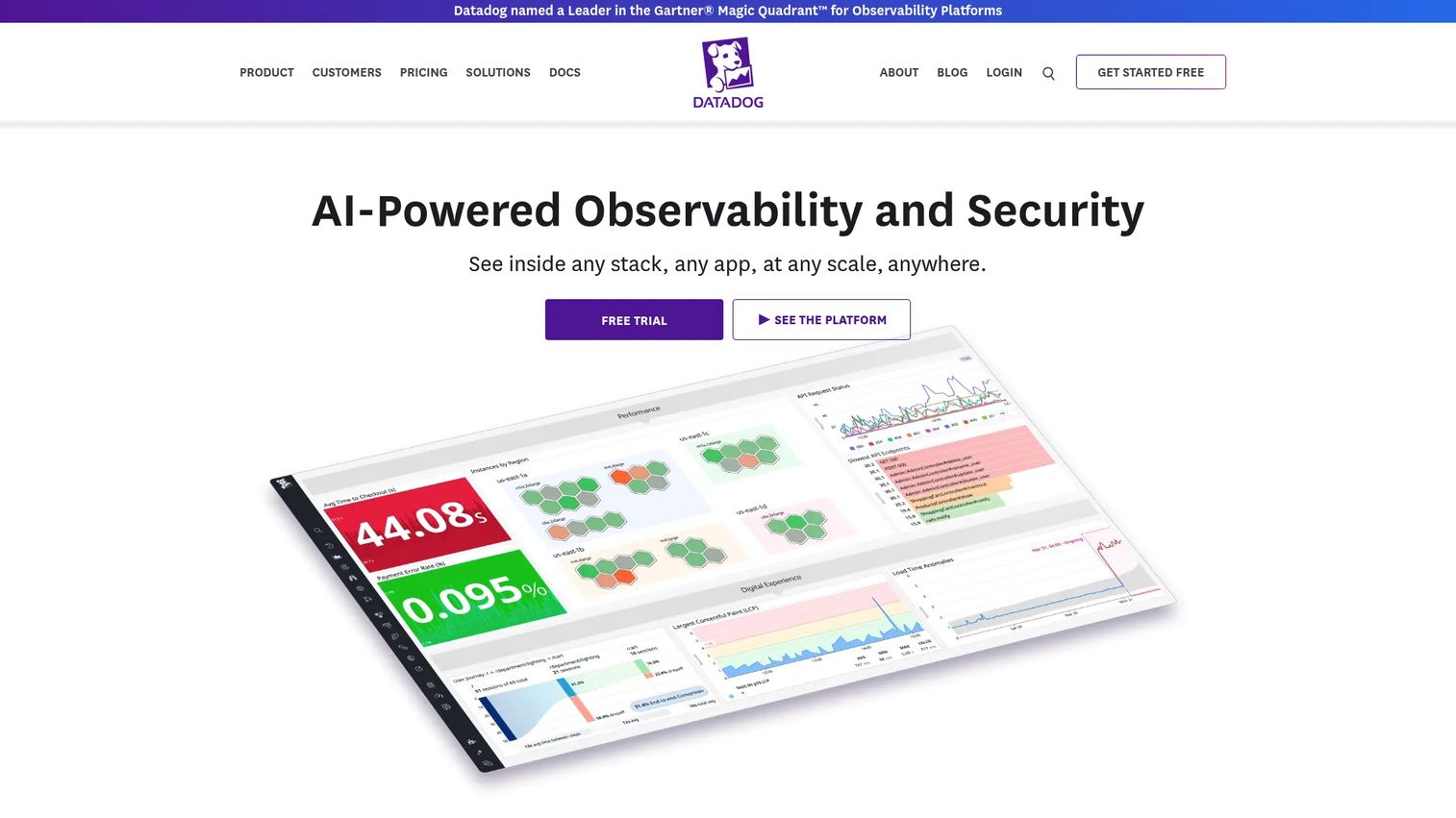
Datadog Bits AI is an agentic AI platform embedded inside the Datadog observability suite. It includes Bits Chat for natural-language telemetry exploration and dashboard creation, Bits Investigation for autonomous alert investigation and remediation, Bits Code for generating production-ready code fixes using observability context, Bits Security Analyst for Cloud SIEM triage, and Bits Agent Builder for creating custom agents using Datadog and third-party data. All capabilities sit inside the Datadog interface teams already use daily.
Best for: SRE and engineering teams already standardized on Datadog who want AI assistance without adopting a separate platform.
Key features
- Natural-language investigation across all Datadog telemetry
- Autonomous alert investigation with root-cause summaries
- Code fix generation using observability context
- Security signal triage via Bits Security Analyst
- Custom agent creation through Bits Agent Builder
Why choose Datadog Bits AI: The strongest argument for Bits AI is instrumentation fit. If your team lives in Datadog, the AI assistance is already where your context lives. Teams that rely on multiple observability tools may find the value narrower, since Bits AI reasons primarily over Datadog data.
Datadog Bits AI pricing: AI Credits cost $500 per 500 credits per month on an annual commit, or $1.30 per credit on demand. Credit consumption varies by feature. A free trial is available.
3. Dynatrace
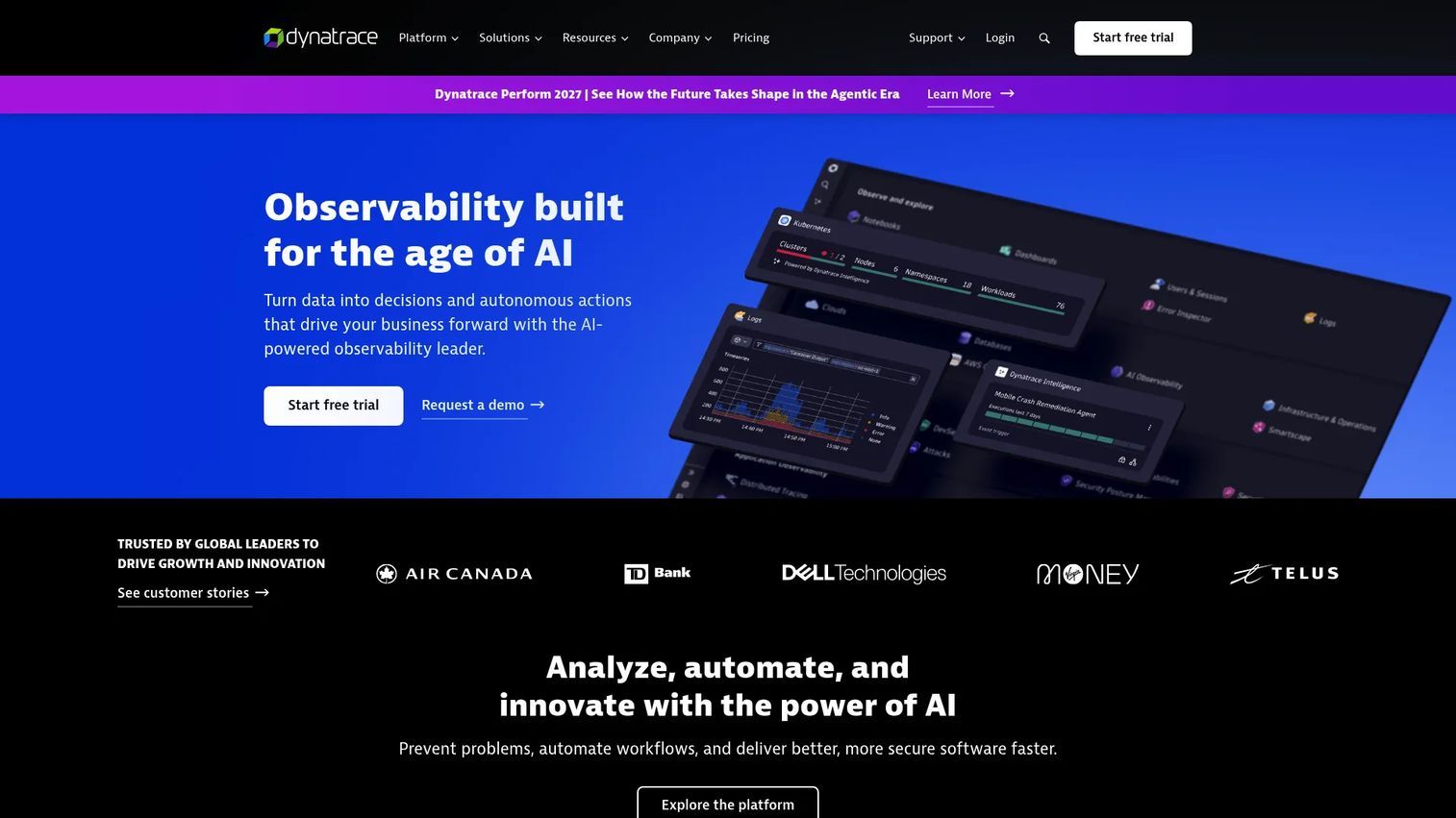
Dynatrace is an enterprise observability and automation platform built around Davis AI, its causal AI engine. Davis maps service topology, correlates anomalies across full-stack telemetry, and identifies root causes by tracing failure through dependency chains rather than relying on static rules. The platform covers application performance monitoring, infrastructure monitoring, digital experience monitoring, log analytics, and cloud security, with OpenTelemetry support for multi-stack environments.
Best for: Large engineering organizations that need enterprise observability with AI-driven causality analysis and topology mapping in a single platform.
Key features
- Causal AI root-cause analysis via Davis AI
- Full-stack service topology mapping
- Anomaly detection across applications, infrastructure, and digital experience
- OpenTelemetry support for multi-stack environments
- Enterprise governance and compliance controls
Why choose Dynatrace: Choose Dynatrace when the team needs deep, topology-aware observability tied to business services. The causal AI approach means fewer false-positive investigations compared to threshold-based alerting, which matters for PMs tracking engineering capacity and release cadence impact.
Dynatrace pricing: Foundation and Discovery starts at $7 per host per month. Infrastructure Monitoring is $29 per host per month. Full-Stack Monitoring is $58 per month per 8 GiB host. All rates are commitment-based with usage-based billing.
G2 rating: 4.5/5.
4. incident.io
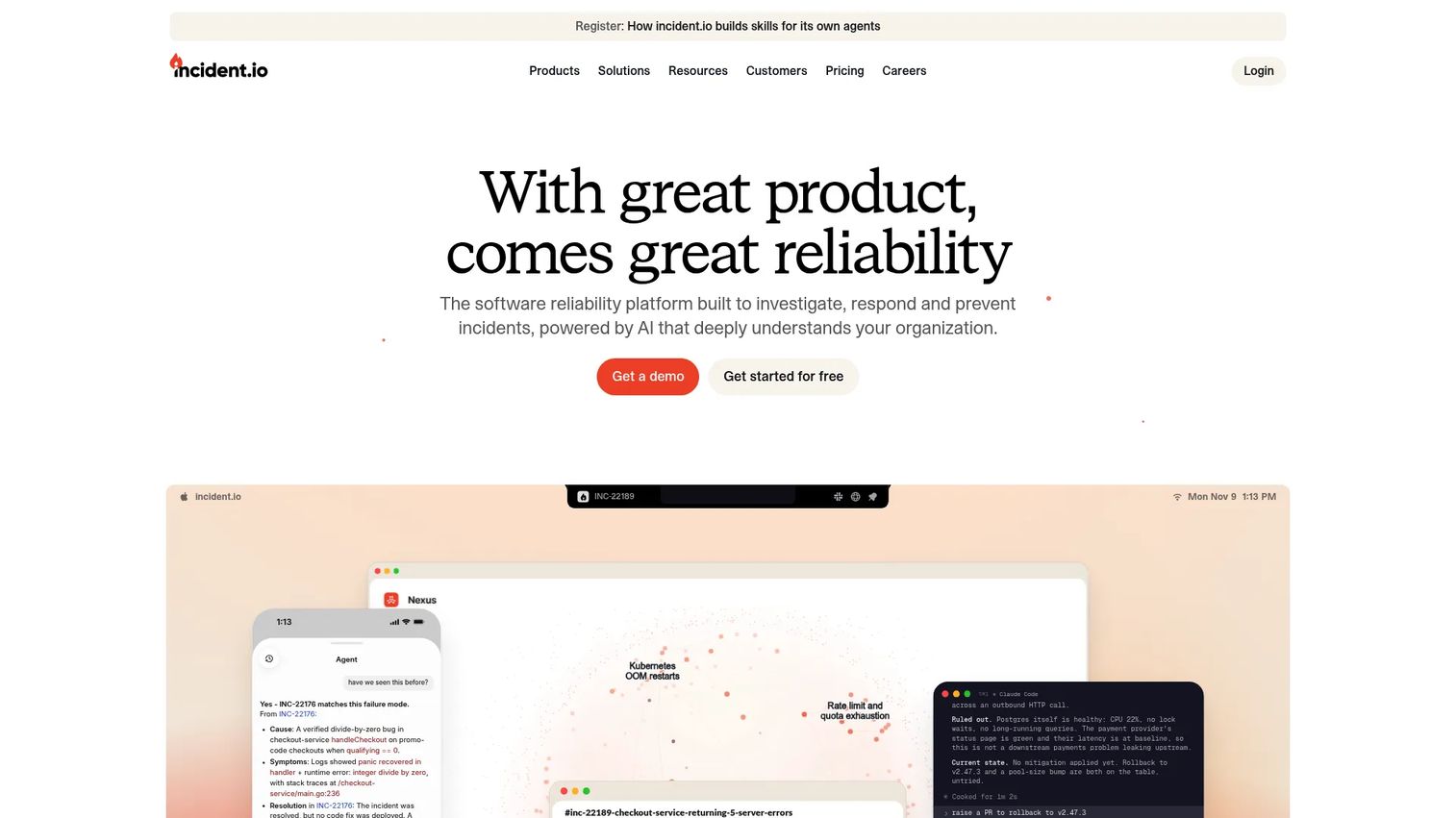
incident.io is an AI-powered software reliability platform covering incident response, on-call management, agentic investigations, automated status pages, and post-incident analysis. Its AI features include agentic root-cause investigations, incident summaries, and automated updates distributed through Slack and Microsoft Teams. The platform is designed to keep incident coordination in the communication tools teams already use, reducing the context switches that slow down response.
Best for: Product and engineering teams whose reliability bottleneck is incident coordination, stakeholder communication, and postmortem quality rather than raw telemetry depth.
Key features
- Agentic investigations with root-cause analysis
- AI incident summaries and automated updates
- Postmortem workflows with follow-up action tracking
- On-call scheduling, alerting, and escalation
- Automated status pages and stakeholder communications
Why choose incident.io: incident.io fits teams where engineers know what's broken faster than they can communicate it. If status updates, incident ownership clarity, and postmortem completion are the persistent reliability gaps, this is the tool to evaluate first. For PMs, cleaner incident communication reduces the customer-impact ambiguity that drives support escalations.
incident.io pricing: Basic is free. Team is $15 per user per month (annual billing) or $19 monthly. Pro is $25 per user per month. Enterprise pricing is custom. On-call is available as a standalone add-on at $20 per user per month.
G2 rating: 4.8/5.
5. BigPanda
BigPanda is an agentic IT operations platform focused on event correlation, alert enrichment, and incident intelligence. It ingests alerts from monitoring tools across your stack, deduplicates and groups related signals, enriches incidents with topology, business context, and change data, and uses AI to assist with triage, root-cause analysis, and remediation guidance. The core value is reducing the number of distinct alert streams a team has to process before investigation begins.
Best for: Enterprise IT operations, NOC, DevOps, and SRE teams managing high alert volumes across many monitoring tools simultaneously.
Key features
- AI-powered alert correlation and noise reduction
- Incident enrichment with topology, business context, and change data
- AI-assisted triage, root-cause analysis, and remediation guidance
- Event intelligence across multiple monitoring sources
- Operations intelligence dashboards
Why choose BigPanda: BigPanda is the right starting point when the incident bottleneck is upstream of investigation. If on-call engineers spend the first part of every incident deciding which of 40 alerts represent one real issue, BigPanda's correlation engine reduces that to a manageable signal before anyone opens a dashboard.
BigPanda pricing: BigPanda prices through tiered credit plans starting at 20,000 credits with one to three year commitments. Contact sales for a quote, since the pricing structure varies by environment size and tool integration count.
G2 rating: 4.5/5.
6. Xurrent IMR
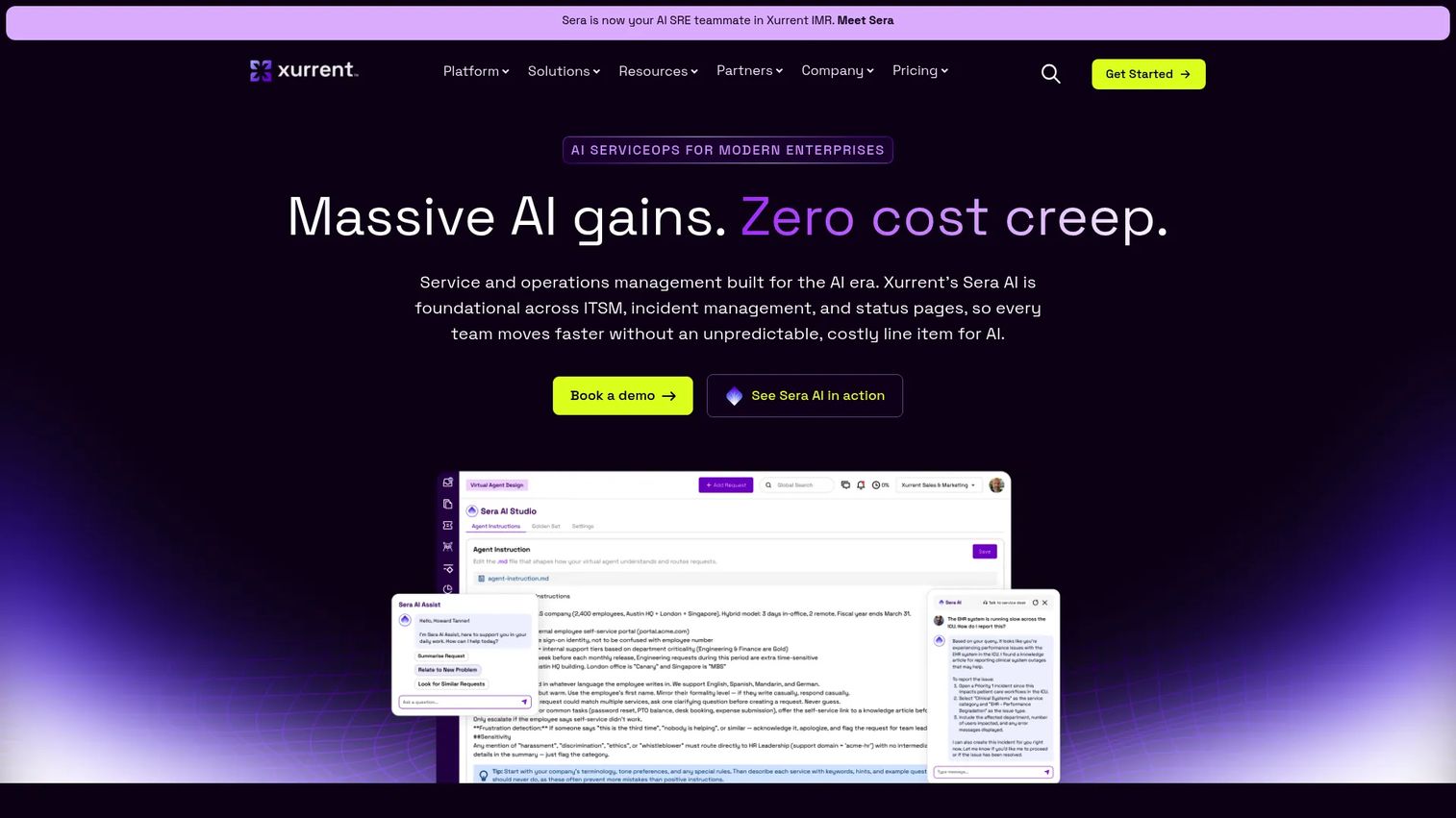
Xurrent IMR is an AI-native incident management and response platform covering alerting, on-call scheduling, incident response coordination, stakeholder communications, postmortem authoring, and service dependency mapping. It integrates with Slack, Microsoft Teams, and Google Chat for in-channel incident response, and includes playbooks and workflow automation for standardizing response steps. The platform is designed to connect incident intake, investigation, and remediation in one workflow rather than across multiple tools.
Best for: SRE, DevOps, and IT operations teams that need integrated alerting, on-call management, incident response, and post-incident analysis without stitching together separate tools.
Key features
- Incident alerting, escalation, and on-call scheduling
- Incident response via Slack, Microsoft Teams, and Google Chat
- Playbooks and workflow automation
- Postmortem authoring and stakeholder communications
- Service dependency mapping and alert correlation
Why choose Xurrent IMR: Xurrent IMR suits teams that want incident management and reliability workflows connected from alert to postmortem without buying multiple point solutions. The tiered pricing makes it accessible for teams scaling from small to mid-market without committing to enterprise contracts immediately.
Xurrent IMR pricing: Starter is $6 per user per month (monthly) or $5 per user per month (annual), supporting up to 5 users. Growth is $16 per user per month (monthly) or $14 per user per month (annual), supporting up to 50 users. Enterprise is custom. A 14-day free trial is available.
G2 rating: 4.5/5.
7. PagerDuty
PagerDuty is an AI-first operations and reliability platform built around incident management, on-call coordination, and event intelligence. Its AIOps layer groups and suppresses alerts before they reach on-call engineers. Incident workflows, runbook automation, and AI-assisted investigation support structured response. With over 700 integrations and mature mobile applications, PagerDuty fits organizations with complex escalation paths across many services and teams.
Best for: Organizations that need mature on-call orchestration, escalation management, event intelligence, and automation across a large engineering organization.
Key features
- On-call scheduling and escalation management
- Event intelligence with alert grouping and noise reduction
- AI-assisted incident investigation and response
- Runbook automation and incident workflows
- Service ownership mapping and 700+ integrations
Why choose PagerDuty: PagerDuty is the right choice when the core reliability pain is response orchestration across people, services, and escalation paths. If incidents stall because ownership is unclear or the right engineer is not in the loop, PagerDuty's service ownership model and escalation engine address that directly. Explore related agentic AI tools for sales and operations for broader context on agentic workflows across teams.
PagerDuty pricing: Free plan available. Professional Incident Management is $21 per user per month (annual) or $25 monthly. The Reliability Platform plans are Starter at $2,800 per year, Essential at $12,000 per year, Plus at $48,000 per year, and Ultimate at custom pricing.
G2 rating: 4.5/5.
8. Atlassian Jira
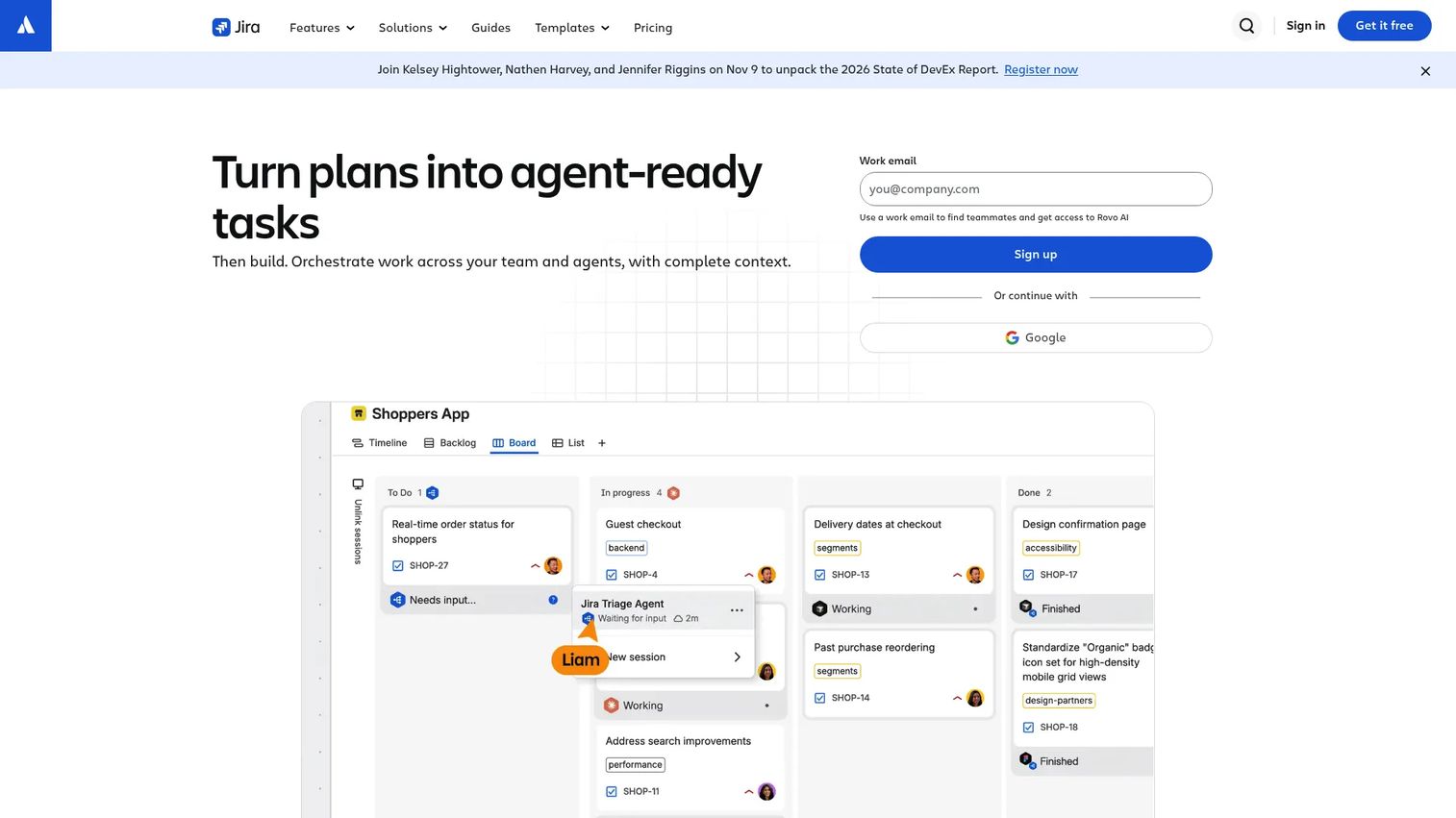
Atlassian Jira is project management and issue-tracking software widely used to plan, track, and release engineering work. For SRE and reliability workflows, Jira's value is in connecting incident learnings to engineering backlogs. Post-incident action items become tracked issues. Reliability debt feeds directly into sprint planning. Jira Service Management extends the platform for service request and incident management, and Atlassian's AI capabilities add automation and summarization across the broader product suite.
Best for: Product and engineering teams that need reliability work, incident action items, and postmortem follow-up to live alongside roadmap and sprint planning work.
Key features
- Incident task tracking and engineering backlog linkage
- Scrum and Kanban boards with customizable workflows
- Postmortem action item tracking
- Jira Service Management for incident and service request workflows
- Atlassian AI features for automation and summarization
Why choose Atlassian Jira: Jira fits teams where incidents generate engineering follow-up work that must be prioritized against the product roadmap. If reliability improvements and incident action items consistently get lost in the gap between on-call tools and development planning, Jira closes that gap. This is a PM-centric argument: Incidents become visible in the same backlog where roadmap work competes for capacity.
Atlassian Jira pricing: Free for up to 10 users. Standard is $7.91 per user per month. Premium is $14.54 per user per month. Enterprise pricing requires contacting sales.
G2 rating: 4.3/5.
9. Azure DevOps
Azure DevOps is a suite of development services covering agile planning with Azure Boards, source control with Azure Repos, CI/CD with Azure Pipelines, testing with Azure Test Plans, and package management with Azure Artifacts. For reliability teams inside a Microsoft stack, Azure DevOps connects remediation work directly to the pipelines and repositories where fixes get deployed. GitHub Advanced Security for Azure DevOps adds native security testing.
Best for: Microsoft-stack engineering teams that need reliability work, incident remediation, and production fixes tied to development and deployment workflows.
Key features
- Agile planning with Azure Boards
- CI/CD build, test, and deployment with Azure Pipelines
- Unlimited cloud-hosted private Git repositories via Azure Repos
- Manual and exploratory testing with Azure Test Plans
- Native security testing through GitHub Advanced Security for Azure DevOps
Why choose Azure DevOps: Choose Azure DevOps when incident remediation consistently turns into code changes, pipeline updates, or deployment actions inside a Microsoft infrastructure environment. For PMs managing release cadence and reliability simultaneously, having incident follow-up work tracked in the same system as development tasks reduces context switching and improves prioritization visibility. Pair it with an upstream incident management tool for the detection and triage layer. See our AI governance tools roundup for guidance on governing AI-assisted development workflows at scale.
Azure DevOps pricing: First five users are free; additional users cost $6 per user per month on the Basic Plan. Basic plus Test Plans is $52 per user per month. Free allowances exist for Pipelines and Artifacts.
G2 rating: 4.4/5.
10. AppDynamics
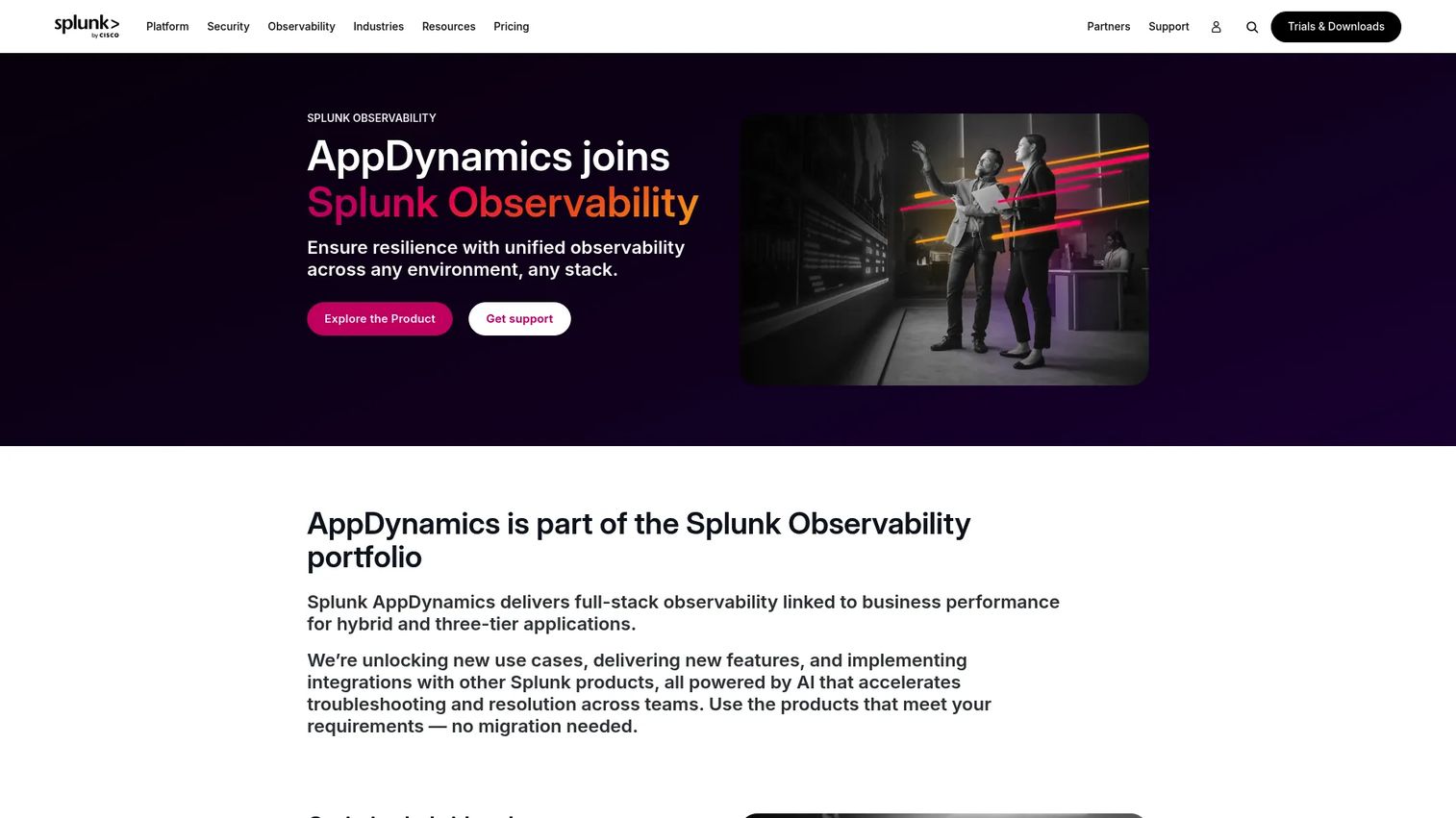
AppDynamics is an application and business observability platform focused on end-to-end visibility across applications, infrastructure, networks, and user experience. Its business transaction monitoring capability maps application performance to customer-facing workflows rather than only to infrastructure metrics. AI-assisted anomaly detection and root-cause analysis surface issues before they become customer-impacting incidents. AppDynamics operates within the Cisco ecosystem, which matters for teams already using Cisco infrastructure.
Best for: Large enterprises that need to connect application performance, user experience monitoring, and business transaction health in a single observability view.
Key features
- Application performance monitoring with business transaction tracing
- Infrastructure and network visibility with application context
- End-user monitoring for web and mobile applications
- AI-assisted anomaly detection and root-cause analysis
- Custom dashboards, analytics, and threshold-based alerts
Why choose AppDynamics: AppDynamics fits teams where the product manager needs to understand not just whether a service is slow, but which customer journeys are affected and by how much. Business transaction monitoring translates infrastructure events into product-level impact, which makes incident prioritization conversations with leadership more concrete.
AppDynamics pricing: AppDynamics does not display a standard tier list. Licensing follows infrastructure or agent-based models and requires sales engagement. A free trial is available to explore the platform before committing.
G2 rating: 4.3/5.
11. Middleware OpsAI
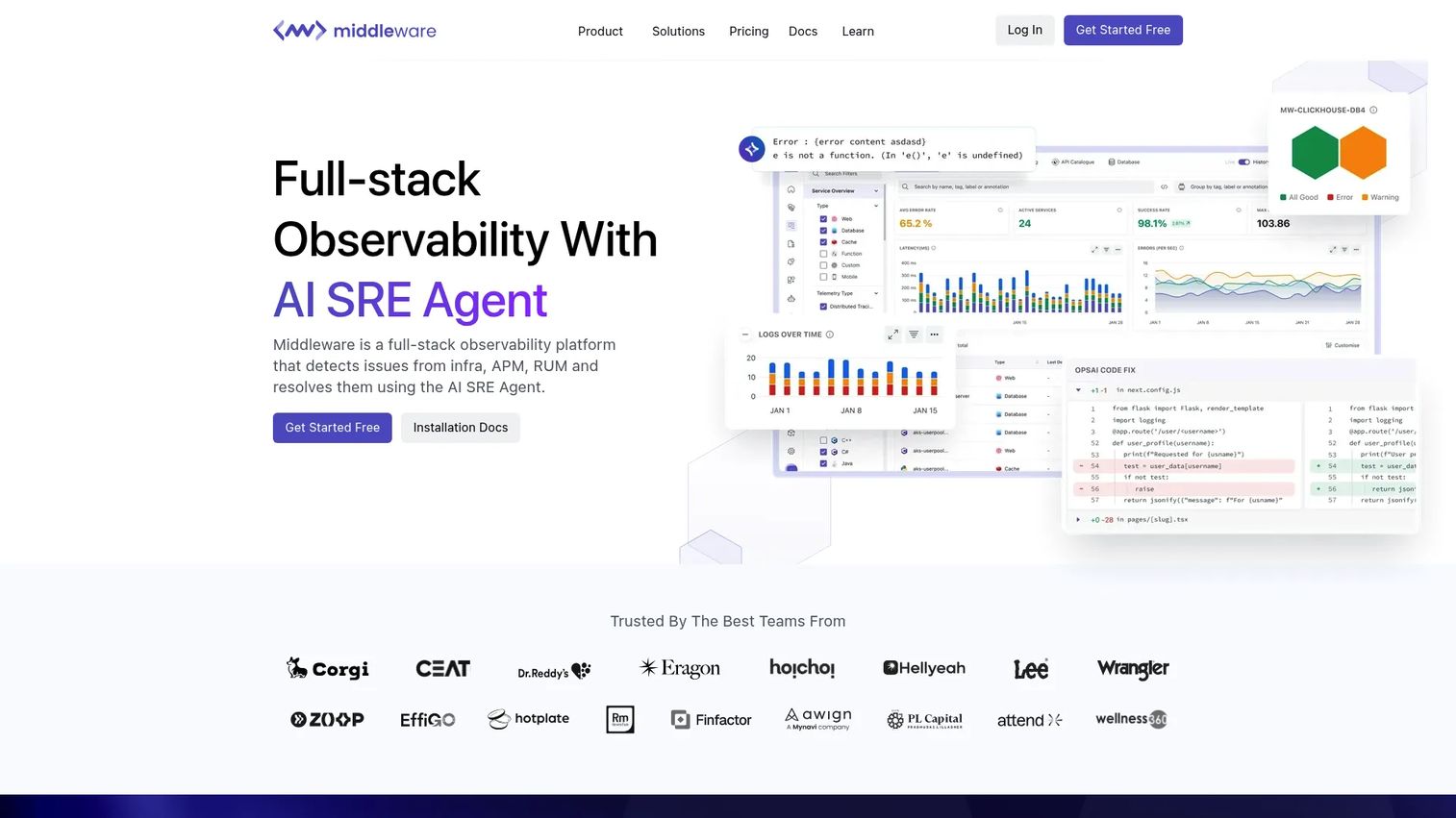
Middleware OpsAI is an AI-powered SRE agent within the Middleware observability platform. It detects production errors, performs root-cause analysis, and proposes or applies fixes across applications, infrastructure, logs, real user monitoring, and Kubernetes environments. Middleware ingests alerts from Datadog and Grafana, so teams do not have to migrate existing monitoring setups to use the AI layer. Slack-based investigation support brings OpsAI into on-call workflows without requiring a separate interface.
Best for: Small to mid-sized engineering teams that want full-stack observability and AI-assisted root-cause analysis without adopting a large enterprise observability suite.
Key features
- Automated error detection, root-cause analysis, and pull-request generation
- Kubernetes debugging with suggested or automatic fixes
- Datadog and Grafana alert ingestion
- AI-powered anomaly detection and log-pattern analysis
- Slack-based issue investigation and remediation
Why choose Middleware OpsAI: Middleware OpsAI is the practical entry point for smaller engineering organizations that want AI-assisted operations without the procurement overhead of enterprise platforms. The free tier with OpsAI tokens makes it possible to validate value before committing to paid usage, which fits a PM's need to prove ROI before scaling a reliability investment.
Middleware OpsAI pricing: Free Forever plan available. Pay As You Go starts at $0.3 per GB of metrics, logs, and traces, with OpsAI tokens charged separately for root-cause analysis and automated fixes. BYOC uses custom pricing.
G2 rating: 4.7/5.
12. Cleric
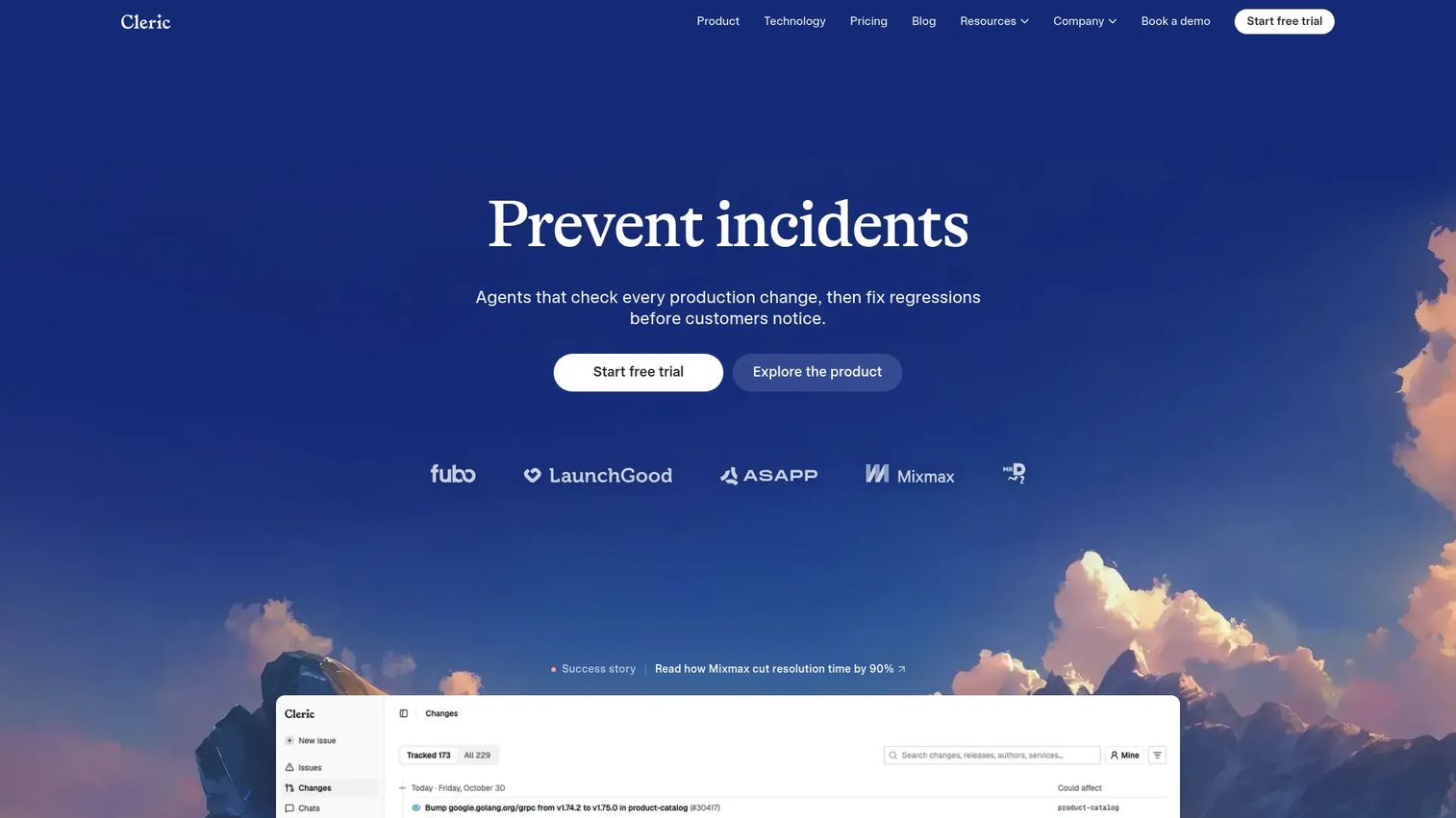
Cleric deploys AI agents that verify production changes, investigate alerts, and prepare fixes for production incidents. The agents use code, logs, infrastructure context, and runtime data to run root-cause analysis, close false-positive alerts automatically, and generate pull requests for proposed fixes. An operational memory layer means Cleric learns from past investigations, which reduces repeated work on recurring incident patterns. Access is available through Slack, Microsoft Teams, a web application, and an MCP server.
Best for: Engineering teams that want automated production monitoring and incident investigation to reduce senior-engineer interruption on recurring issues.
Key features
- Production change verification for regressions
- Alert investigation and root-cause analysis
- Fix recommendations with pull requests
- On-call automation with false-positive closure
- Operational memory for investigation history
Why choose Cleric: Cleric is a strong fit when the same incident patterns surface repeatedly and senior engineers spend investigation time rediscovering context that was already assembled during a previous incident. The credit model means you pay for investigation activity rather than seat count, which can align cost more directly to reliability workload volume.
Cleric pricing: Team is $700 per month (1,400 credits). Pro is $1,500 per month (3,000 credits). Scale is $3,000 per month (6,000 credits). Enterprise uses custom annual pricing. A free evaluation provides 1,000 credits after approval.
13. NeuBird
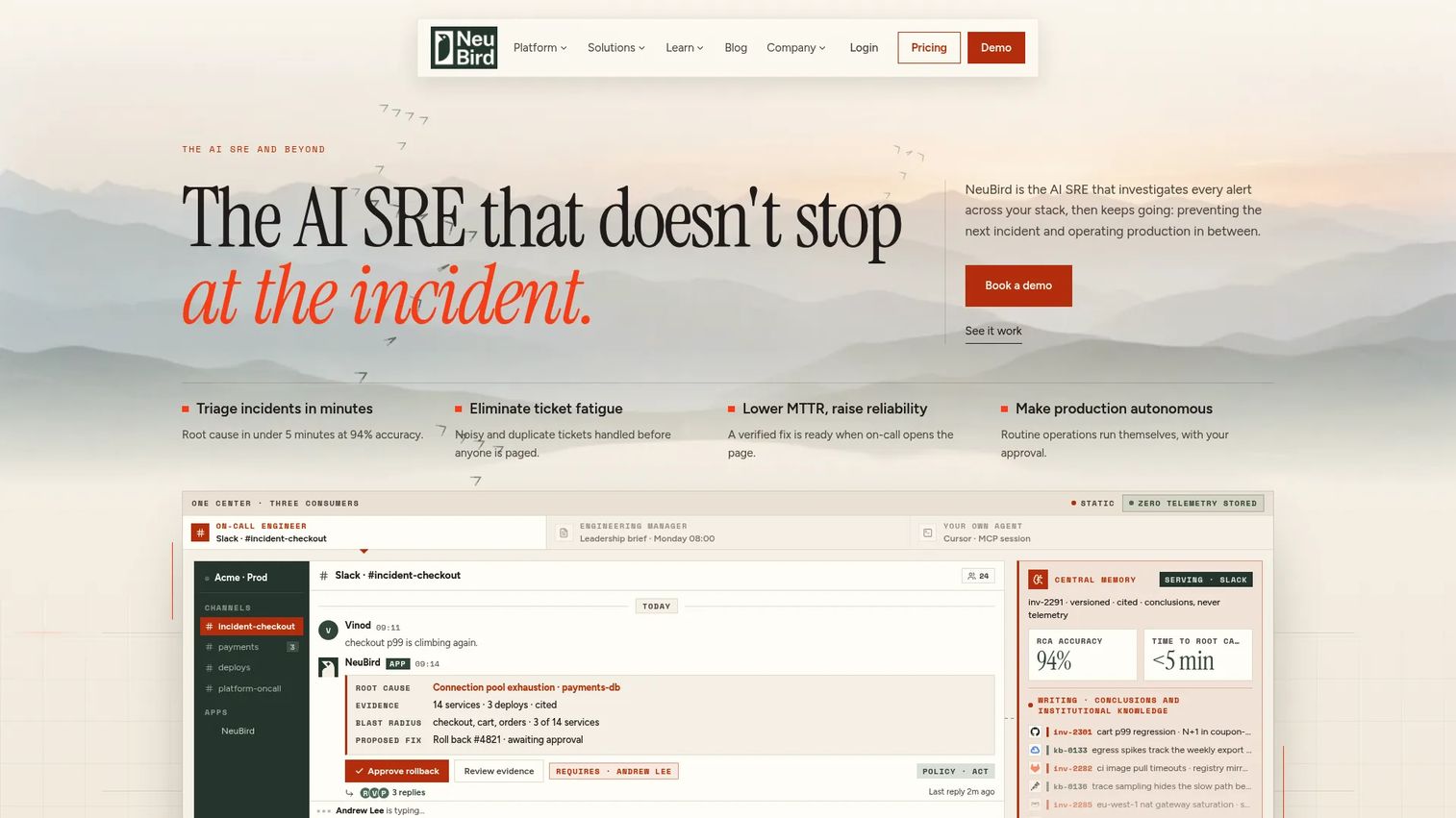
NeuBird is an AI SRE and Production Ops Agent that provides a live production view with a hybrid-cloud service map, groups and triages alerts into actionable signals, runs root-cause investigations with cited evidence, and stages fixes for human approval. Its Risk Sentinel proactively monitors for reliability, cost, and security risks before they cause incidents. NeuBird connects to 50+ tools queried in real time, and a NeuBird Proxy handles PII redaction for in-network data.
Best for: SRE and engineering operations teams that want proactive reliability analysis, evidence-cited investigations, and governed production remediation across a broad tool footprint.
Key features
- Live production service map with hybrid-cloud visibility
- Risk Sentinel for proactive reliability, cost, and security monitoring
- Alert grouping and triage into actionable signals
- Root-cause investigations with cited evidence and proposed fixes
- Connections to 50+ tools queried in real time
Why choose NeuBird: NeuBird's proactive risk monitoring differentiates it from tools that only respond after an alert fires. For product managers tracking reliability metrics, this shifts the conversation from reactive MTTR reduction to incident prevention, which is a more defensible argument for engineering capacity investment. Check our best AI security posture management tools guide if security risk monitoring is also a priority alongside reliability.
NeuBird pricing: NeuBird prices through usage tiers based on monthly alert volume and investigation credits. Monetary pricing is not displayed; contact sales for a quote. A 14-day free trial includes 50 credits, up to 5 users, and Slack and Teams integration.
14. Causely
Causely provides a live causal model of production systems for deterministic incident diagnosis and AI-agent-assisted operations. Rather than correlating symptoms after they appear, Causely maps service dependencies, failure paths, and health signals into a causal graph that persists and updates continuously. This enables root-cause identification that traces failure through dependency chains to its origin, and impact analysis that shows how far a failure has propagated. MCP integration connects Causely's causal context to AI agents including Claude Code, Cursor, and Codex.
Best for: SRE and production-operations teams managing Kubernetes-heavy, cloud-native environments with complex service graphs where causality is the core investigation challenge.
Key features
- Live causal modeling of services, dependencies, and failure paths
- Deterministic root-cause diagnosis and impact analysis
- MCP integration for AI coding agents
- Kubernetes and cloud-native environment support
- Service dependency mapping with continuous updates
Why choose Causely: Causely is the right fit when your reliability problems originate in complex service interactions rather than isolated application errors. Cloud-native environments with many microservices create dependency chains where the symptoms appear far from the cause. Causely's causal model addresses that gap directly. For PMs shipping on Kubernetes infrastructure, reducing the investigation time for dependency-driven incidents directly protects release cadence.
Causely pricing: Professional Edition is $2,000 per month, covering up to 500 services with standard hybrid deployment and 30 days of data retention. Enterprise Edition uses custom pricing for unlimited services, custom integrations, and custom SLAs.
15. DrDroid
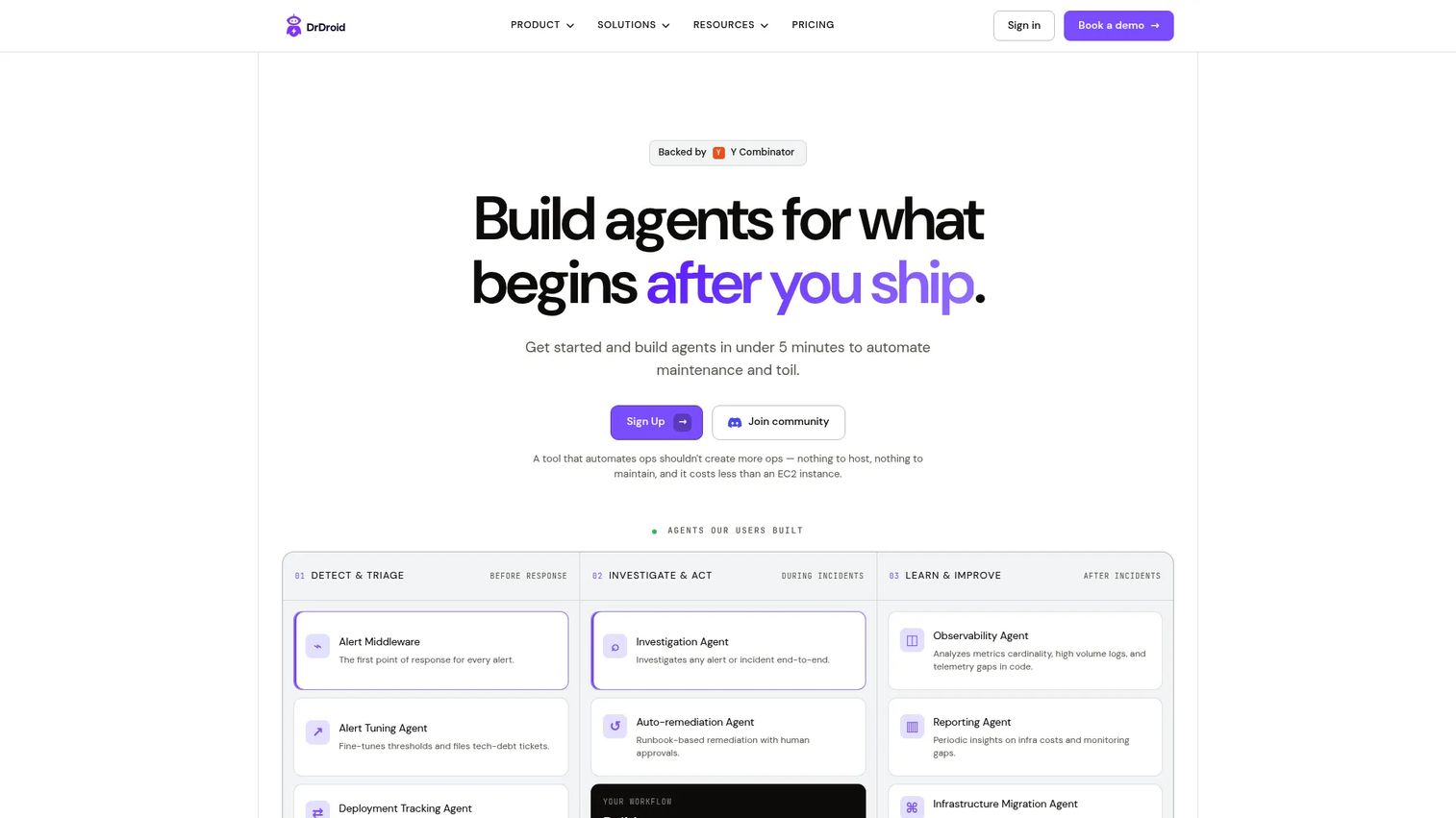
DrDroid is an AI SRE agent that maps infrastructure into a live knowledge graph and helps engineering teams investigate, diagnose, and remediate incidents. It connects cross-tool signals into a single correlated view, supports runbook-based auto-remediation with human approval steps, and generates AI summaries to accelerate handoff between on-call and development teams. Self-hosting options are available for teams with data residency or security requirements that make cloud-hosted tooling difficult to approve.
Best for: SRE and platform engineering teams seeking context-aware incident investigation and structured remediation, particularly where self-hosting is a procurement requirement.
Key features
- Incident investigation and root-cause analysis
- Live infrastructure knowledge graph with cross-tool correlation
- Runbook-based auto-remediation with human approval steps
- AI summaries for incident handoff
- Self-hosting options for data residency requirements
Why choose DrDroid: DrDroid suits teams where recurring incidents involve the same debugging steps being reassembled from scratch each time. The knowledge graph persists context between incidents, and runbook-based remediation encodes institutional knowledge rather than leaving it in Slack threads. The self-hosting option also makes it easier to pass security review in regulated environments. See our autonomous endpoint management software guide for related coverage on autonomous operational tooling.
DrDroid pricing: Startup is $99 per month with 99 investigation credits and a 14-day trial. Business starts from $999 per month with volume credits and self-hosting options. Enterprise uses custom pricing.
Considerations when choosing AI SRE tools
Start with the incident bottleneck
Before evaluating tools, map where reliability work actually stalls. Alert noise upstream of investigation points to BigPanda or PagerDuty's event intelligence. Slow investigation after alert triage points to Resolve AI, Cleric, NeuBird, or DrDroid. Poor coordination and unclear ownership points to incident.io or PagerDuty. Weak postmortem follow-up and backlog connection points to Jira. The wrong tool for the wrong bottleneck adds instrumentation without addressing the actual opportunity cost.
Check the integrations before the demo
An AI SRE tool without access to your production context is another dashboard to maintain. Before any vendor conversation, list the systems that matter: Observability platforms, incident management tools, cloud environments, CI/CD pipelines, code repositories, feature flag systems, ticketing, chat, and identity providers. Tools that cannot connect to your existing stack will force you to centralize data before they can reason over it, which is an engineering investment the brief may not account for.
Require evidence, not just answers
Production teams cannot act on AI conclusions they cannot audit. During evaluation, ask each vendor how the tool explains its reasoning. Look for investigation traces that cite specific log entries, metric anomalies, or deployment events, not just a summary output. This matters especially for PMs making the case to security and platform teams: If the AI recommendation is opaque, the approval process for autonomous action will be much harder to clear.
Roll out autonomy in stages
A trust ladder reduces production risk during adoption. Start with AI that summarizes incidents for human review. Progress to AI that recommends actions for human approval. Then move to AI that drafts and stages changes before human confirmation. Reserve fully autonomous execution for low-risk, well-tested actions only. Any vendor that pushes full automation as the default starting point deserves deeper scrutiny on permissioning, audit logging, and rollback capability.
Measure impact against a baseline
Before deployment, establish baseline metrics for MTTA (mean time to acknowledge), MTTR, alert volume per week, on-call interruptions per engineer, repeated incident rate, postmortem completion rate, and customer-impact minutes per month. Riverbed's Global Survey (2025) found that 87% of organizations reported AIOps ROI met or exceeded expectations, but that result only holds when teams measure against a known pre-tool baseline rather than estimating improvement qualitatively.
Conclusion
The 15 AI SRE tools in this guide span a wide range of approaches, and the right choice is almost always determined by where reliability work slows down rather than by any single feature comparison.
For autonomous incident investigation, Resolve AI is the strongest starting point. For teams already invested in observability platforms, Datadog Bits AI and Dynatrace bring AI directly into the monitoring environment your engineers use every day. incident.io and PagerDuty address the coordination and escalation layer where ownership gaps and communication delays compound downtime. BigPanda clears alert noise before investigation starts. Causely handles causal complexity in cloud-native environments. Atlassian Jira and Azure DevOps connect reliability work to delivery so incident follow-up does not get lost between on-call tools and sprint planning.
For product managers, the practical next step is to run a proof of value against three to five recent incidents using the tool that matches your primary bottleneck. Bring SRE, platform, and security stakeholders into the evaluation early, particularly for any tool that will operate with production system access. Set baseline metrics before you start, so you can measure actual engineering hours recovered and customer-impact minutes reduced rather than relying on vendor-provided benchmarks.
For broader context on autonomous AI tools for engineering workflows, see our agentic AI platforms guide and our AI copilot software roundup.
Start your journey with Guideflow today!
FAQs
An AI SRE tool is software that uses machine learning, large language models, and telemetry to help reliability teams detect incidents, investigate root causes, prioritize alerts, and recommend or execute remediation. The category spans fully autonomous investigation agents, AI layers inside observability platforms, and AI-enhanced incident management workflows. What distinguishes AI SRE tools from basic monitoring is their ability to reason about production context rather than only report on it.
AIOps tools typically focus on event correlation, anomaly detection, and alert enrichment, reducing noise before incidents reach on-call teams. AI SRE tools go further: They investigate incidents with production context, reason about probable root causes, and can recommend or execute remediation steps. Some AI SRE tools are agentic, meaning they run investigation workflows autonomously rather than waiting for a human query. Many platforms combine both capabilities, so the distinction is more about depth and autonomy than a sharp category boundary.
Some tools can recommend or trigger remediation actions, but production changes should follow permission controls, audit trails, and staged rollout. Human approval is typically required for high-risk or novel actions. The safest adoption path is to start with AI that summarizes and recommends, validate that its reasoning is sound, and then progressively extend automation to lower-risk actions with appropriate logging. Any tool that skips human-in-the-loop stages for production changes warrants close review by your security and platform teams before deployment.
Frame evaluation around four dimensions: Customer impact (how quickly does the tool reduce customer-impacting downtime), engineering opportunity cost (how much senior-engineer investigation time does it recover), integration fit (can it connect to your observability, CI/CD, and incident stack without a significant data centralization project), and evidence quality (can you audit why the AI reached a particular conclusion). For PMs specifically, tools that tie incident findings to engineering backlogs, like Atlassian Jira, are worth evaluating alongside pure SRE agents, since reliability work and roadmap work compete for the same engineering capacity.
They can be safe when implemented with appropriate controls. That means limiting the tool's access to only the systems it needs, requiring human approval for any action that modifies production state, logging all AI-generated recommendations and their outcomes, and protecting sensitive data through redaction or in-network proxies. Security and platform teams should review permissioning, data handling, and audit log completeness before any tool operates with production write access. Tools like NeuBird include PII redaction at the network level; others may require you to configure data handling separately.
The best fit depends on your environment. Observability-heavy environments benefit from Datadog Bits AI, Dynatrace, or AppDynamics, which reason over telemetry they already collect. Kubernetes and microservice environments with complex dependency chains are better served by Causely's causal modeling. Teams that need an agentic investigator to assemble context from multiple systems should evaluate Resolve AI, Cleric, NeuBird, or DrDroid. No single tool wins across all environment types, so matching the tool's reasoning model to your infrastructure architecture is more important than any feature comparison.
The mechanisms fall into four areas: Faster context gathering (AI assembles logs, metrics, traces, and topology data in seconds rather than minutes), alert grouping (reducing 40 related alerts to one incident reduces the cognitive overhead of initial triage), dependency mapping (showing which services are affected and in what sequence narrows the investigation scope), and suggested remediation (giving on-call engineers a probable fix to evaluate rather than starting from a blank runbook). Any numeric MTTR reduction claim from a vendor should be tied to a named customer result and evaluated against your specific environment, since improvement depends heavily on baseline investigation complexity.
Building can fit teams with highly specific workflows, proprietary telemetry schemas, or strict data residency requirements that commercial tools cannot meet. The tradeoff is that building requires model selection and evaluation, telemetry connector development, permissioning and security review, maintenance across model and integration updates, and clear accountability when the agent takes a wrong action in production. Buying reduces time-to-value when the platform fits your stack, but you trade some workflow flexibility for faster deployment and vendor-managed maintenance. For most product teams evaluating this in 2026, the opportunity cost of building from scratch is high enough that a proof of value with a commercial tool should come first.