Patient identity resolution is not a back-office cleanup project. It is the identity layer every downstream clinical, operational, analytics, and automation workflow depends on.
A 2022 HIMSS and Patient ID Now survey found that healthcare organizations reported an average 5.5% patient-record duplication rate, and 70% of respondents said identity-management difficulties led to duplicative or unnecessary tests and services. When a patient appears as multiple people, or two patients collapse into one record, every team downstream inherits the problem: Care coordinators, billing staff, data scientists, and the EHR implementations your enterprise customers paid for.
For a Series B founder selling into health systems, payers, or health information exchanges, dirty patient identity data slows deals, weakens integration narratives, and forces implementation teams to carry work the product should solve. This guide gives you a shortlist of 15 patient identity resolution software options, the matching methods each one uses, and a buyer framework to narrow the field fast.
What's inside
This guide covers dedicated patient identity resolution platforms, EMPI vendors, EHR-native identity tools, biometric matching options, and adjacent healthcare identity products. Tools were selected based on:
- Patient matching depth and method (deterministic, probabilistic, referential, or biometric)
- EMPI or master patient index capability
- EHR and interoperability fit (HL7, FHIR, HIE connectivity)
- Privacy and governance posture
- Best-fit healthcare use case (provider, payer, HIE, digital health, or healthcare marketer)
TL;DR
- Best overall for enterprise patient identity resolution: Verato, for referential matching and governed identity across provider, payer, and HIE environments
- Best for cloud MPI and data quality: 4medica, for labs, health systems, and health information networks
- Best for enterprise EMPI and interoperability: NextGate (now within Rhapsody), for multi-system identity management at scale
- Best for biometric patient identification: RightPatient, for providers that want identity assurance at registration
- Best for healthcare engagement identity: Redpoint Global, for connecting patient, member, and consumer data across channels
- Best EHR-native options: Oracle Health, Epic, and MEDITECH for organizations already standardized on those platforms
What is patient identity resolution software?
Patient identity resolution software matches, links, and maintains patient records across healthcare systems so each person is connected to the correct clinical, administrative, and engagement data.
Unlike general identity resolution tools built for marketing or fraud detection, patient identity resolution is designed for the specific constraints of healthcare: Regulated data, fragmented EHR environments, lab feeds, claims systems, HIEs, patient portals, and the high cost of a wrong match. An overlay, where two different patients share one record, can cause clinical harm. A duplicate, where one patient exists as multiple records, undermines analytics, care coordination, and billing accuracy.
Key capabilities the category covers:
- Patient record matching: Linking records across sources using demographic fields, identifiers, or biometrics
- Duplicate detection and deduplication: Finding and resolving duplicate patient records before they propagate downstream
- EMPI or master patient index management: Maintaining a single, authoritative identity record across an enterprise or network
- Matching methods: Deterministic matching uses exact or near-exact rules; probabilistic matching applies statistical weights; referential matching compares records against an external verified identity source; biometric matching uses physiological identifiers like face, fingerprint, or iris
- EHR, HIE, and interoperability connectivity: Integration via FHIR, HL7, batch feeds, APIs, lab systems, and claims data
- Real-time identity updates: Keeping the master index current as new records arrive
- Stewardship and governance workflows: Review queues, merge and unmerge processes, audit trails, and role-based access for managing match decisions
The master patient index software market was valued at $1.45 billion in 2025 and is forecast to reach $2.59 billion by 2031, according to Mordor Intelligence (2025). The buying pressure is real, and the vendor landscape is fragmenting across EMPI specialists, EHR platforms, biometric vendors, and consumer identity graph providers.
When to use patient identity resolution software
Clean up duplicate records before they reach care teams
When registration staff encounter the same patient under multiple records, every downstream team inherits that problem. Labs attach results to the wrong chart. Referrals go to the wrong address. Patient portal access breaks. A dedicated patient identity resolution platform catches duplicates at intake and flags potential overlays before they spread, so the problem stops at the source rather than accumulating across systems.
Connect patient data across systems after growth or acquisition
Acquiring a clinic network or onboarding a new EHR environment almost always produces an identity collision. Two systems have different record formats, different MRNs, and no shared patient index. Connecting them without a patient matching layer means your data team reconciles manually, your implementation team carries the cleanup burden, and your board-level metrics on integrated network value become unreliable.
Build a trusted identity layer for analytics and automation
AI models, risk stratification tools, care management platforms, and patient engagement programs all depend on a stable patient identity layer. If the same patient appears as three people in your data warehouse, your population health model scores them three times. A reliable master patient index turns fragmented records into a foundation that analytics and automation can actually use.
Patient identity resolution software comparison
The 15 tools below cover a range of approaches, from dedicated EMPI vendors to EHR-native identity workflows, biometric platforms, and healthcare-specific consumer identity graphs. Pricing across this category is almost entirely sales-led; most vendors contract by deployment scope, record volume, and modules. G2 ratings reflect current listings and are noted as N/A where no verified rating exists.
| # | Product | Best for | Key differentiator | Pricing | G2 rating |
|---|---|---|---|---|---|
| 1 | Verato | Enterprise patient identity resolution | Referential matching against verified identity data | Contact sales | 4.6/5 |
| 2 | 4medica | Cloud MPI and data quality | Big Data MPI with identity enrichment | Contact sales | 2.5/5 |
| 3 | NextGate | Enterprise EMPI and interoperability | EMPI within the Rhapsody platform | Contact sales | 4.0/5 |
| 4 | RightPatient | Biometric patient identification | Photo and multimodal biometric matching | Contact sales | N/A |
| 5 | Redpoint Global | Healthcare engagement identity | Deterministic and probabilistic identity resolution | Contact sales | 4.6/5 |
| 6 | Oracle Health | EHR-native patient identity workflows | Certified API-based identity and interoperability | From $1,000/year (certified API) | 3.5/5 |
| 7 | Epic | EHR-native identity management | Enterprise EHR patient records and scheduling | Contact sales | 4.2/5 |
| 8 | MEDITECH | EHR-connected patient identity | Expanse EHR with MEDITECH as a Service model | Contact sales | 3.1/5 |
| 9 | McKesson | Healthcare network data workflows | Healthcare infrastructure and distribution services | Contact sales | 4.2/5 |
| 10 | HealthKey | Patient-owned longitudinal records | OMOP CDM normalization and clinical trial matching | From $10/patient/year | N/A |
| 11 | Medchart | Patient-authorized record retrieval | Consent-based digital record request and release | From $30/request | 0.0/5 |
| 12 | Throtle | Healthcare consumer identity | Privacy-focused identity graph and data onboarding | Contact sales | 4.0/5 |
| 13 | Certify Health | Patient access identity verification | Digital intake, check-in, and eligibility workflows | From $150/practice/month | 5.0/5 |
| 14 | Healthcast | Healthcare access management | Single sign-on and proximity-badge clinical access | Contact sales | N/A |
| 15 | Iatric Systems | EHR integration and patient privacy | Patient privacy monitoring and EHR connectivity | From $3,500/year (support) | N/A |
Best 15 patient identity resolution software tools
1. Verato
Verato is a cloud-native master data management and identity intelligence platform built for healthcare, life sciences, and other regulated organizations. Its Referential Matching technology compares patient records against an external, curated identity reference database, which catches duplicates that purely demographic-based algorithms miss. Verato covers provider, payer, HIE, and digital health environments, and supports data integration through APIs, batch connectors, and HL7/FHIR.
Best for: Enterprise healthcare organizations that need a dedicated, governed identity layer across multiple systems and care settings.
Key features
- Referential Matching against verified identity reference data
- AI-powered stewardship and data governance
- Identity enrichment and 360-degree patient views
- HL7, FHIR, API, and batch data integration
- Cohort and audience analysis for population health
Why choose Verato: Verato fits organizations where patient identity accuracy is a strategic infrastructure issue, not just a data hygiene task. The referential matching approach is especially strong in multi-system environments where demographic data quality is inconsistent across sources.
Verato pricing: Verato sells through sales with four annual-subscription packages (Starter, Standard, Enterprise, and Enterprise Plus). Contracts are customized by deployment scope and data volume; request a quote directly at verato.com/pricing.
G2 rating: 4.6/5
2. 4medica
4medica provides healthcare data infrastructure for patient identity management, interoperability, laboratory connectivity, and whole-person care. Its Big Data MPI handles identity matching at scale, with identity assessment, clean-up, and enrichment built into the workflow. The platform also covers consent management, a clinical viewer, and social determinants of health data, making it relevant beyond pure patient matching.
Best for: Hospitals, labs, health information networks, and provider organizations that need cloud-based MPI tied to broader data quality workflows.
Key features
- Master Patient Index with identity assessment and clean-up
- Identity enrichment and referential matching
- Interoperability and healthcare integration services
- Worklist automation for stewardship queues
- Consent management and SDoH platform
Why choose 4medica: Choose 4medica when patient identity resolution needs to connect directly to clinical data quality and lab connectivity. It is not a pure-play EMPI, but its broader data management context suits organizations that need identity and data infrastructure in a combined offering.
4medica pricing: 4medica describes its offerings as modular and subscription-based.
G2 rating: 2.5/5 (based on 1 review)
3. NextGate
NextGate merged with Rhapsody in 2022 and its EMPI capability now lives within the Rhapsody platform. The product supports automated identity resolution and duplicate-record reconciliation using machine learning, with integration through APIs, FHIR, and HL7. It also supports data lineage and versioning, so match decisions are auditable over time.
Best for: Health systems, HIEs, public health networks, and data exchanges that need enterprise-grade identity management with deep interoperability support.
Key features
- Automated identity resolution using machine learning
- Duplicate-record reconciliation and merge workflows
- API, FHIR, and HL7 integration
- Data lineage, versioning, and match-decision traceability
- Configurable matching rules for enterprise environments
Why choose NextGate: NextGate fits organizations that need EMPI capability at enterprise architecture scale, not a point tool. The Rhapsody merger adds interoperability depth, which matters when patient identity updates need to flow across connected systems, not just into a central index.
NextGate pricing: Pricing is based on organization size, record volume, and deployment model. Request a demo through rhapsody.health to get a scoped quote.
G2 rating: 4.0/5
4. RightPatient
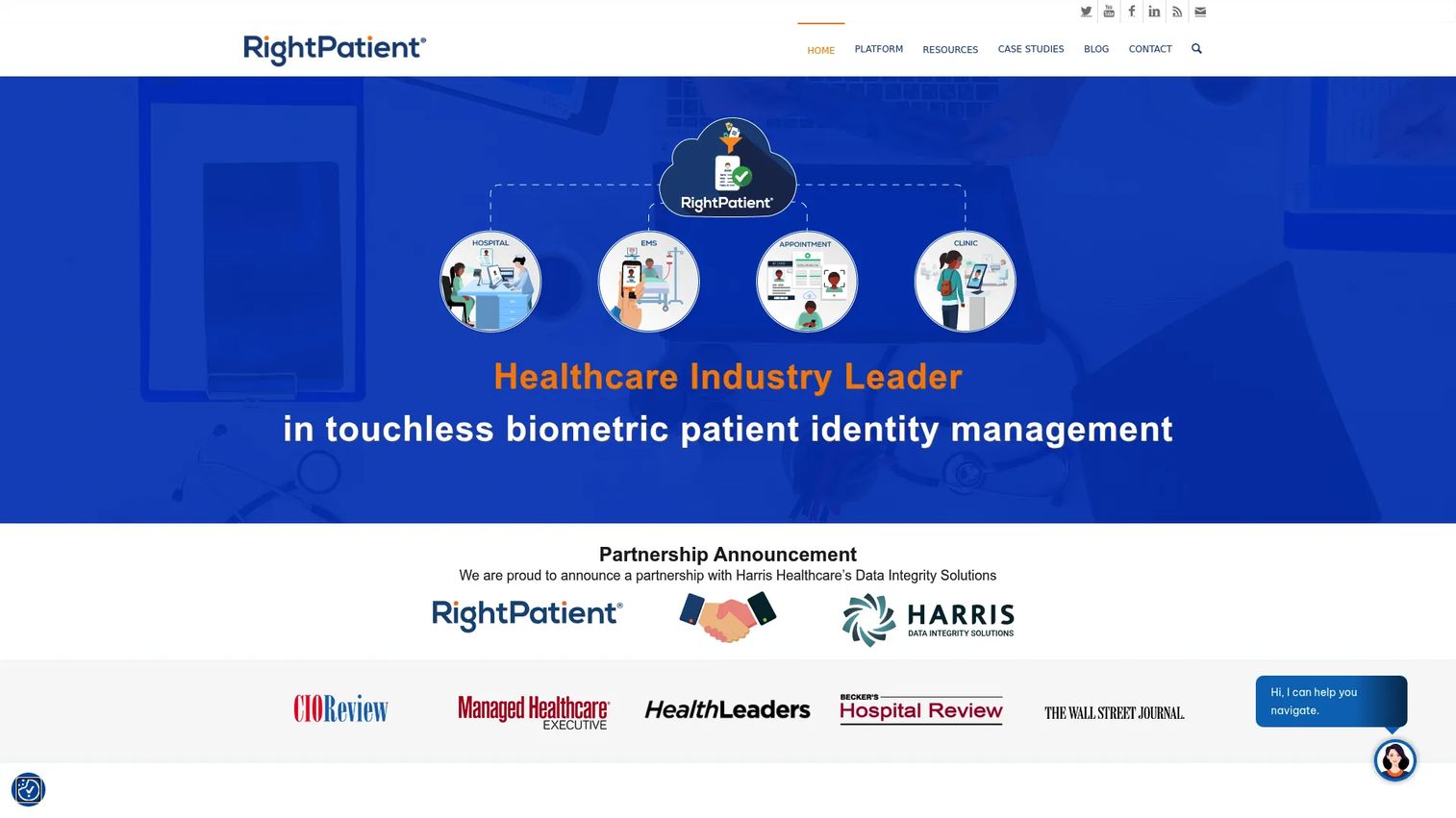
RightPatient is a biometric patient identification platform that uses photo, iris, fingerprint, finger vein, palm vein, and voice recognition to match patients at the point of service. It performs real-time one-to-many biometric matching and integrates with EHR systems through a cloud-hosted, HIPAA-compliant architecture. Mobile verification extends the capability to patient portals, telehealth, and pre-registration workflows.
Best for: Hospitals and health systems that want biometric identity assurance at registration to prevent duplicate records and medical identity theft.
Key features
- Biometric matching: Photo, iris, fingerprint, palm vein, voice
- Real-time one-to-many matching and duplicate prevention
- EHR integration via cloud-hosted architecture
- Mobile identity verification for portals and telehealth
- HIPAA-compliant biometric data handling
Why choose RightPatient: RightPatient fits when identity proofing at the front desk or intake workflow matters more than broad cross-system identity graph management. It is a strong fit for registration-heavy environments where demographic data alone produces too many false matches.
RightPatient pricing: RightPatient describes its cloud offering as an affordable monthly SaaS fee, with cost driven by sites, users, integrations, and deployment model. Contact rightpatient.com for a site-specific quote.
G2 rating: N/A (no verified rating found)
5. Redpoint Global
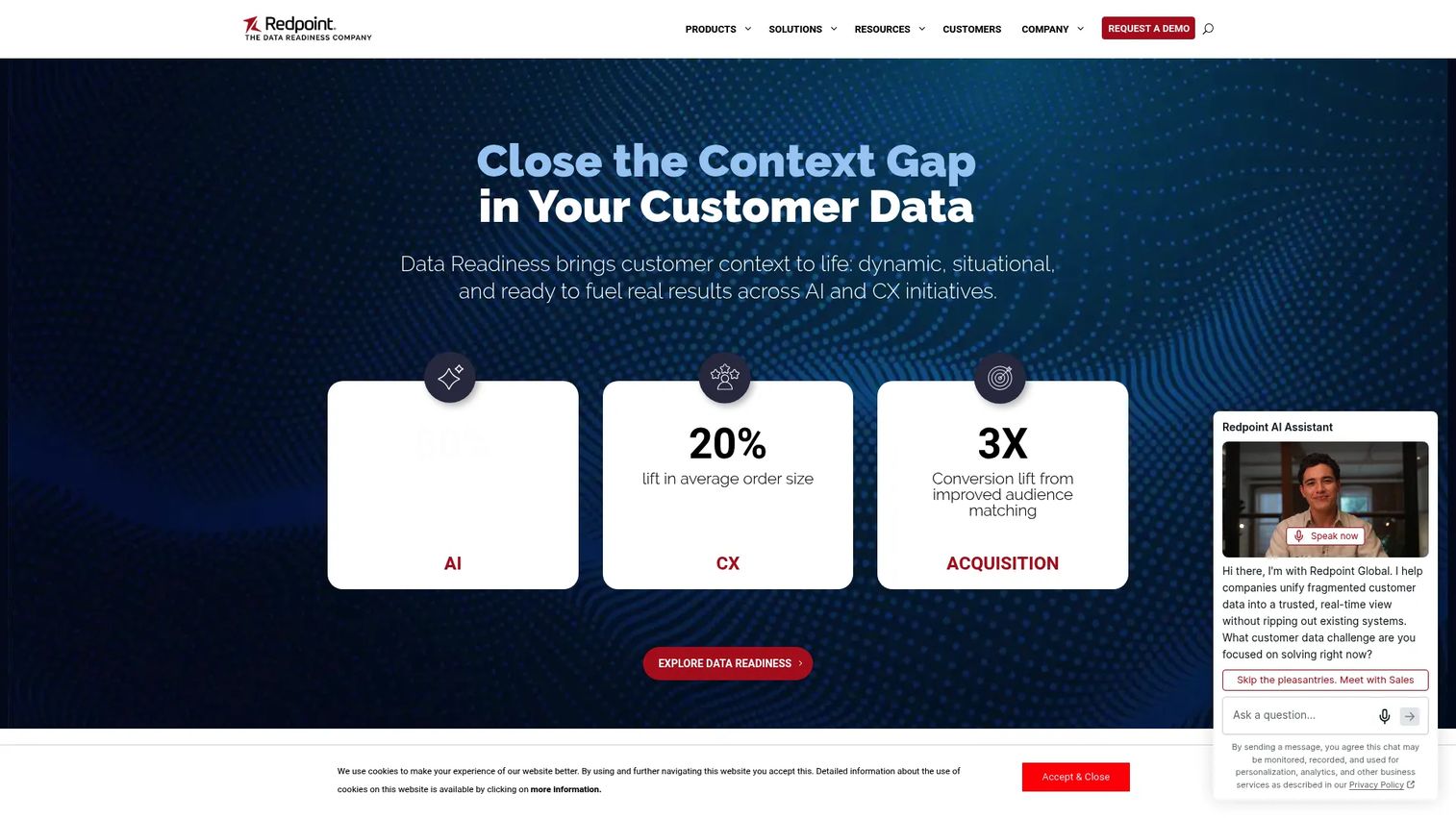
Redpoint Global provides enterprise customer data readiness and customer data platform software for unifying, cleansing, resolving, and activating data. In healthcare, it applies to organizations connecting patient, member, and consumer engagement data across channels. The platform uses deterministic and probabilistic identity resolution, supports customer profile unification, and offers real-time decisioning and journey orchestration.
Best for: Healthcare organizations connecting patient, member, and household data across payer, provider, and consumer engagement channels.
Key features
- Deterministic and probabilistic identity resolution
- Automated data ingestion and data quality management
- Customer and patient profile unification
- Dynamic segmentation and audience activation
- Real-time decisioning and journey orchestration
Why choose Redpoint Global: Redpoint Global is best suited for identity resolution that drives personalization, analytics, and AI readiness rather than clinical EMPI workflows. It belongs in evaluations where the identity problem is engagement and member data, not cross-EHR record deduplication.
Redpoint Global pricing: Contracts go through sales and are shaped by platform scope and data complexity.
G2 rating: 4.6/5
6. Oracle Health
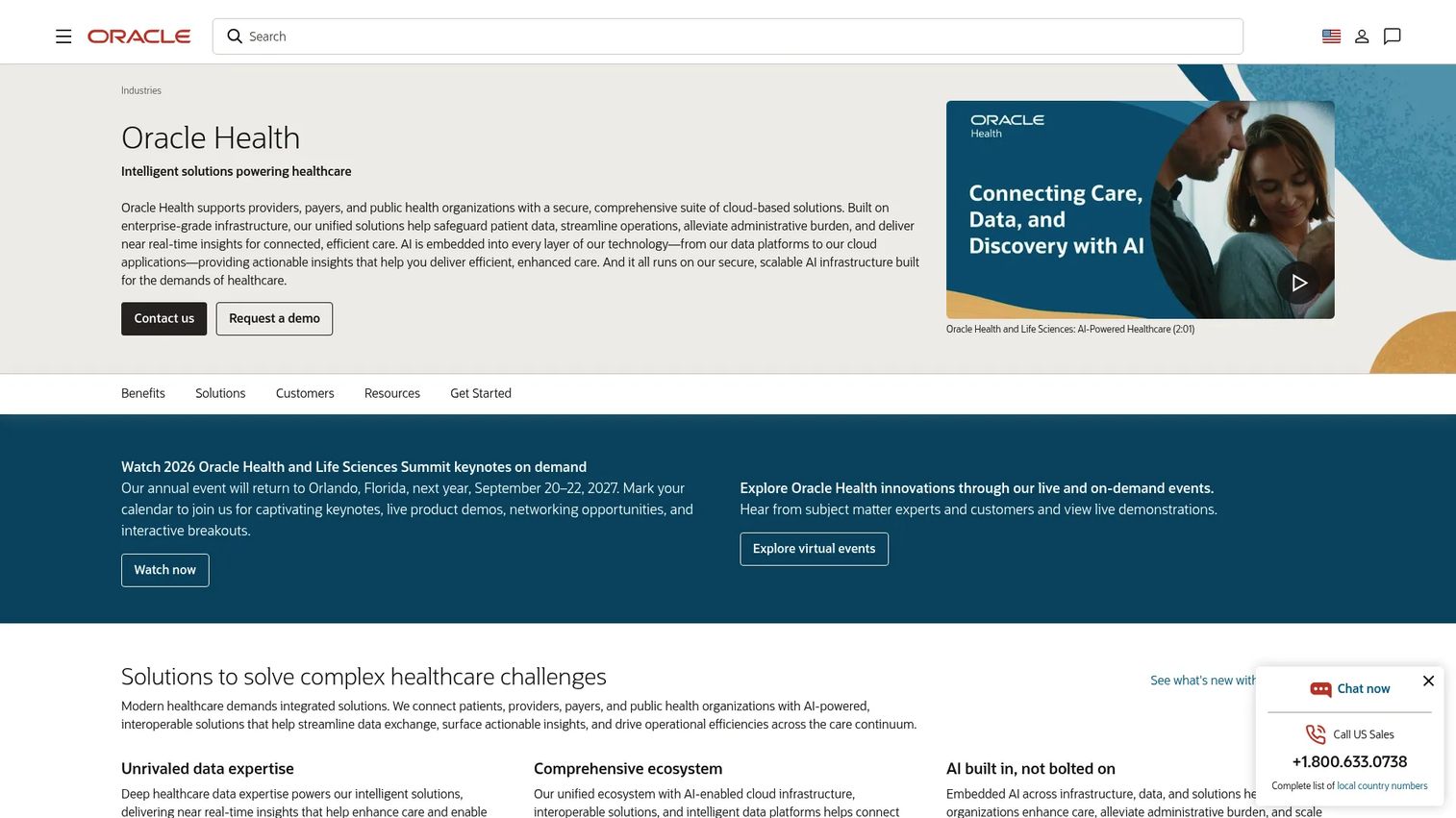
Oracle Health provides cloud-based healthcare solutions for providers, payers, public health organizations, and life sciences companies. Its EHR-native workflows include patient identity and registration management, interoperability, and population health analytics. For organizations already in the Oracle ecosystem, patient identity workflows connect directly to clinical and operational systems of record.
Best for: Enterprise healthcare organizations that want patient identity workflows embedded in a major EHR and connected to Oracle's broader health platform.
Key features
- EHR-native patient registration and identity workflows
- Healthcare interoperability and data exchange
- AI-powered clinical applications
- Financial, operational, and population health analytics
- Oracle ecosystem integration
Why choose Oracle Health: Choose Oracle Health when the buyer wants identity workflows close to the clinical system of record and already operates within Oracle's environment. Organizations with multi-EHR environments or HIE-level identity needs should evaluate whether a dedicated EMPI adds capability that Oracle Health does not cover natively.
Oracle Health pricing: Oracle publishes certified API fees starting at $1,000 per year for Continuum ASP integrations, $1,500 per year for CommunityWorks, and $7,000 per year for Standard-S. Broader product pricing is contract-based through enterprise sales.
G2 rating: 3.5/5
7. Epic
Epic develops electronic health record and healthcare software for providers, payers, patients, and life sciences organizations. Patient identity within Epic is managed through EHR-native registration and scheduling workflows, with interoperability through its health information exchange network. For health systems standardizing on Epic, patient record governance happens inside the clinical operating model.
Best for: Health systems that want patient identity workflows aligned with their Epic EHR governance and clinical operations.
Key features
- EHR-native patient registration, scheduling, and identity
- Interoperability and health information exchange
- Patient engagement through MyChart and remote monitoring
- Specialty clinical workflows across cardiology, oncology, and surgery
- AI for clinical, operational, and patient-facing workflows
Why choose Epic: Epic fits health systems where patient identity governance is inseparable from clinical workflow management. For organizations with multi-vendor EHR environments or cross-network identity needs beyond Epic's footprint, a dedicated EMPI should be evaluated alongside it.
Epic pricing: Epic pricing is volume-based and requires a client-specific proposal. Contact Epic directly; licensing, implementation, and maintenance fees vary significantly by organization size.
G2 rating: 4.2/5
8. MEDITECH
MEDITECH develops the Expanse EHR platform for hospitals, health systems, and ambulatory practices. Its patient identity workflows are embedded in EHR registration and clinical operations, with interoperability through the Traverse Exchange network. MEDITECH as a Service (MaaS) offers a cloud-hosted subscription model for organizations that want managed infrastructure alongside the clinical platform.
Best for: Hospitals and health systems using MEDITECH as a core EHR platform that need patient identity managed within their existing clinical environment.
Key features
- Integrated Expanse EHR spanning acute, ambulatory, and community care
- AI-powered ambient listening and clinical summaries
- Interoperability through Traverse Exchange
- Patient engagement through Expanse Patient Connect and Virtual Care
- Mobile clinician workflows via Expanse Now
Why choose MEDITECH: MEDITECH belongs in this evaluation for organizations already on its platform. Patient identity lives inside EHR operations here. Buyers with multi-EHR or HIE-level matching needs should assess whether Expanse handles cross-system identity sufficiently or whether a dedicated EMPI is warranted.
MEDITECH pricing: MEDITECH uses subscription-based pricing under its MaaS model.
G2 rating: 3.1/5
9. McKesson
McKesson is a large healthcare company spanning pharmaceutical distribution, healthcare technology, medical-surgical distribution, and specialty care services. Its technology offerings include pharmacy management systems and ordering platforms relevant to healthcare data workflows. Identity resolution in a McKesson context typically sits within broader healthcare operational or distribution workflows rather than a standalone EMPI product.
Best for: Healthcare organizations evaluating identity and data workflows inside broader McKesson infrastructure relationships, particularly pharmacy and specialty care settings.
Key features
- Pharmaceutical distribution with data workflow context
- Healthcare technology including pharmacy management systems
- Medical-surgical product distribution and inventory management
- Enterprise healthcare footprint across provider and pharmacy settings
- Data exchange relevance within McKesson network relationships
Why choose McKesson: McKesson is relevant when patient identity management sits inside a broader McKesson operational relationship, not when you need a dedicated enterprise patient matching platform. Verify the specific product and use case with McKesson's technology team before including it in an EMPI evaluation.
McKesson pricing: McKesson prices through sales. The cost depends on the specific product line, implementation scope, and services required.
G2 rating: 4.2/5
10. HealthKey
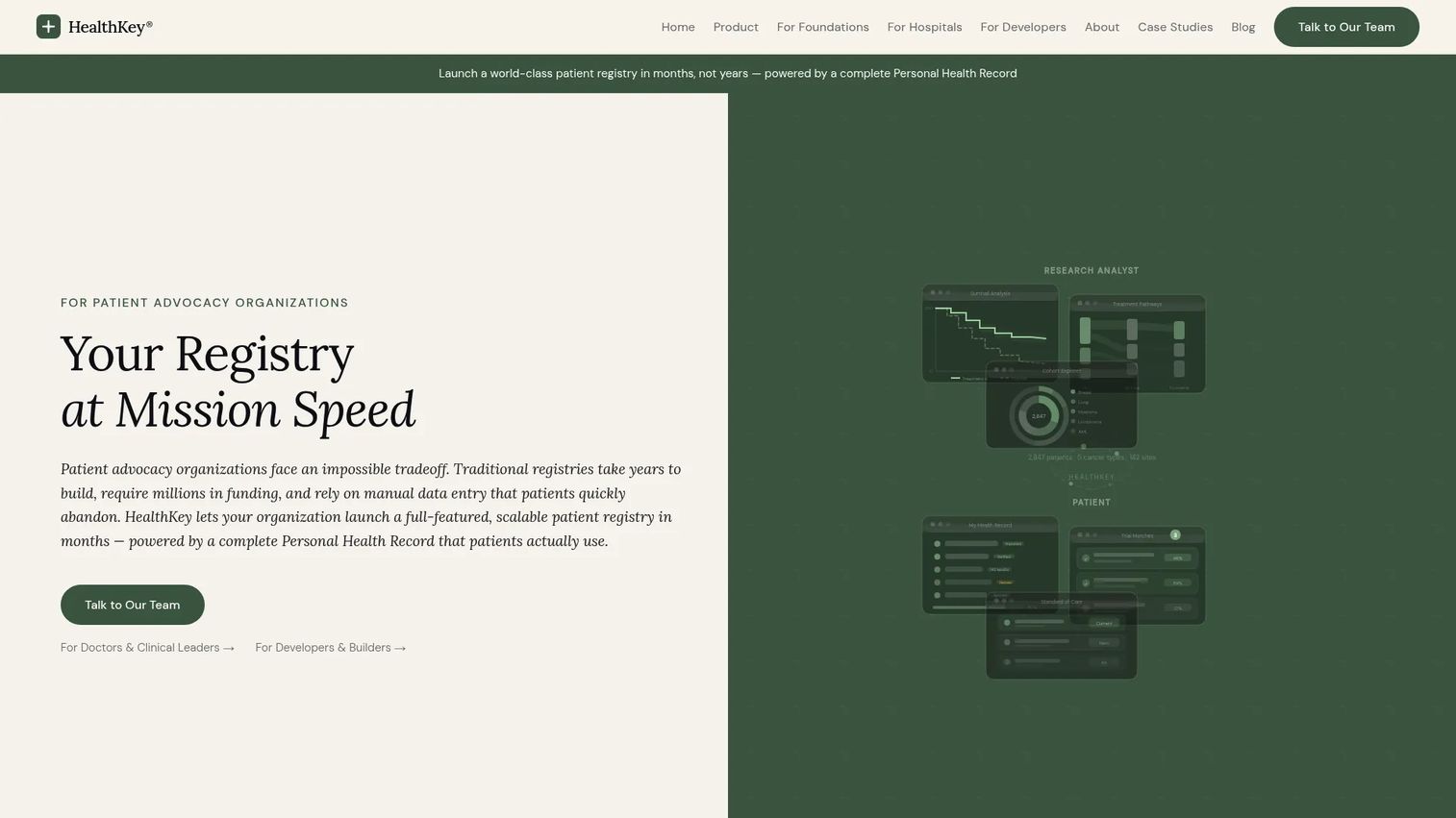
HealthKey provides patient registries and open-source clinical data infrastructure built on patient-owned personal health records. It assembles longitudinal health records from EHRs, labs, specialists, wearables, and surveys, normalizes them to OMOP Common Data Model, and supports explainable clinical trial matching. The model is patient-mediated: Individuals authorize access to their own data.
Best for: Patient advocacy organizations, foundations, HIEs, and health systems needing patient-owned registries and research-ready clinical data infrastructure.
Key features
- Longitudinal PHR assembled from EHRs, labs, wearables, and surveys
- Automatic OMOP CDM normalization and built-in analytics
- Explainable clinical trial matching with per-criterion verdicts
- Patient-authorized data access and consent workflows
- Research-grade data infrastructure for registries
Why choose HealthKey: HealthKey fits when the identity problem is about connecting a patient to their own longitudinal health data for research or trial matching, not about enterprise record deduplication. It is a different buying motion from a traditional EMPI.
HealthKey pricing: Managed deployments charge an annual base fee per component plus $10 per patient per year. Fees increase when HealthKey manages upstream data connections.
11. Medchart
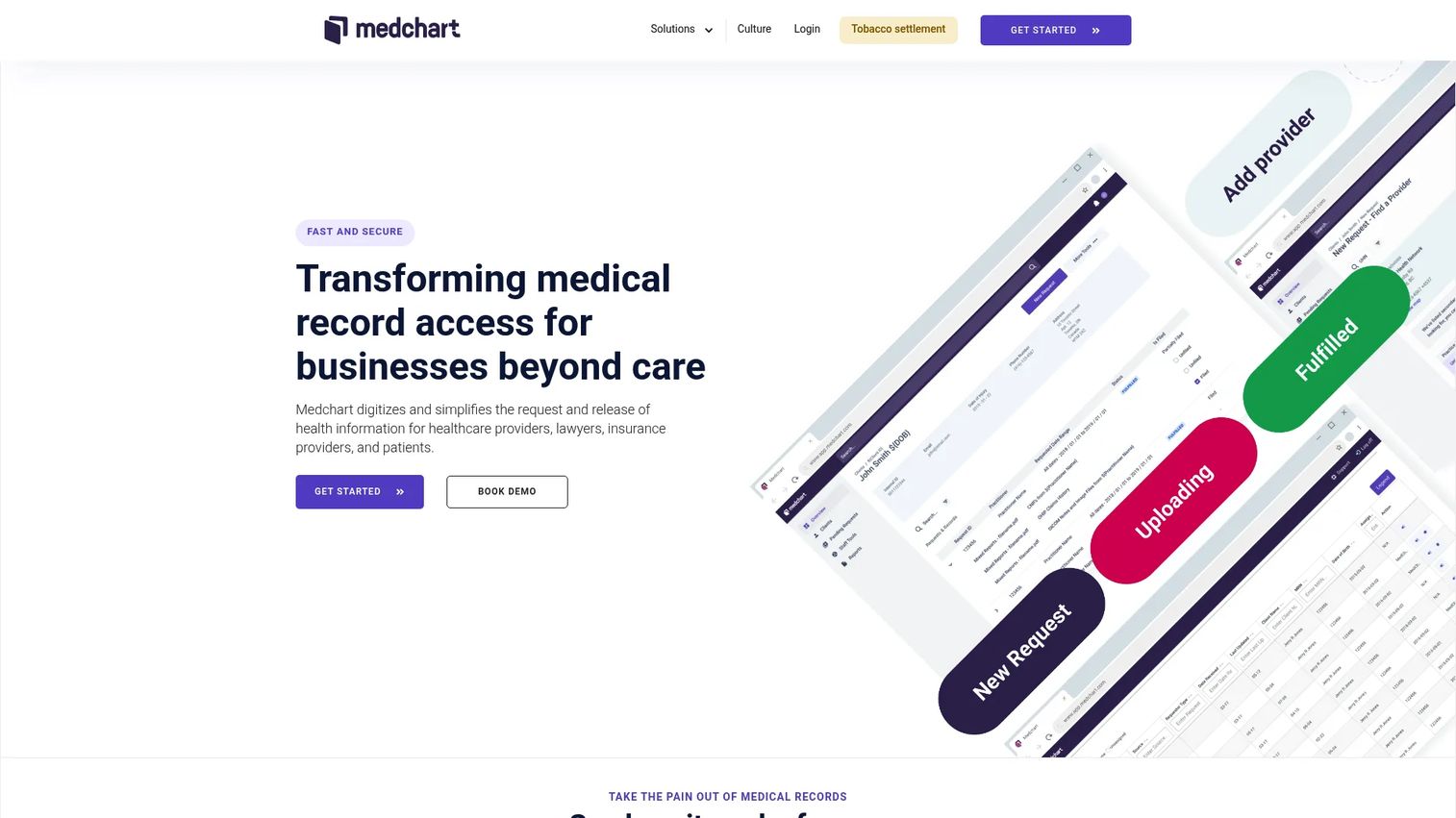
Medchart digitizes the request and release of health information for law firms, insurers, healthcare providers, and patients. Its workflow covers digital record requests, patient consent and electronic-signature authorization, request tracking, optical character recognition, AI-powered document classification, and delivery of searchable records. Identity in Medchart's context means verifying who is authorized to access a patient's records, not matching records across clinical systems.
Best for: Law firms, insurers, and healthcare providers that need patient-authorized digital record retrieval and consent-driven data exchange.
Key features
- Digital medical record request and release workflows
- Patient consent and electronic-signature authorization
- Request tracking, follow-ups, and digital delivery
- OCR and searchable records with AI document classification
- Integrations with Filevine, PC Law, SmartAdvocate, and Primafact
Why choose Medchart: Medchart fits when the identity challenge is obtaining and exchanging patient records with proper consent, not cross-system patient matching. It operates in a legal and insurance context more often than a clinical EMPI evaluation.
Medchart pricing: Standard plans cost $32 per request on a pay-as-you-go basis. Advanced pricing drops to $30 per request for 100 to 300 monthly requests. Premium pricing for 301 or more monthly requests requires a custom quote.
12. Throtle
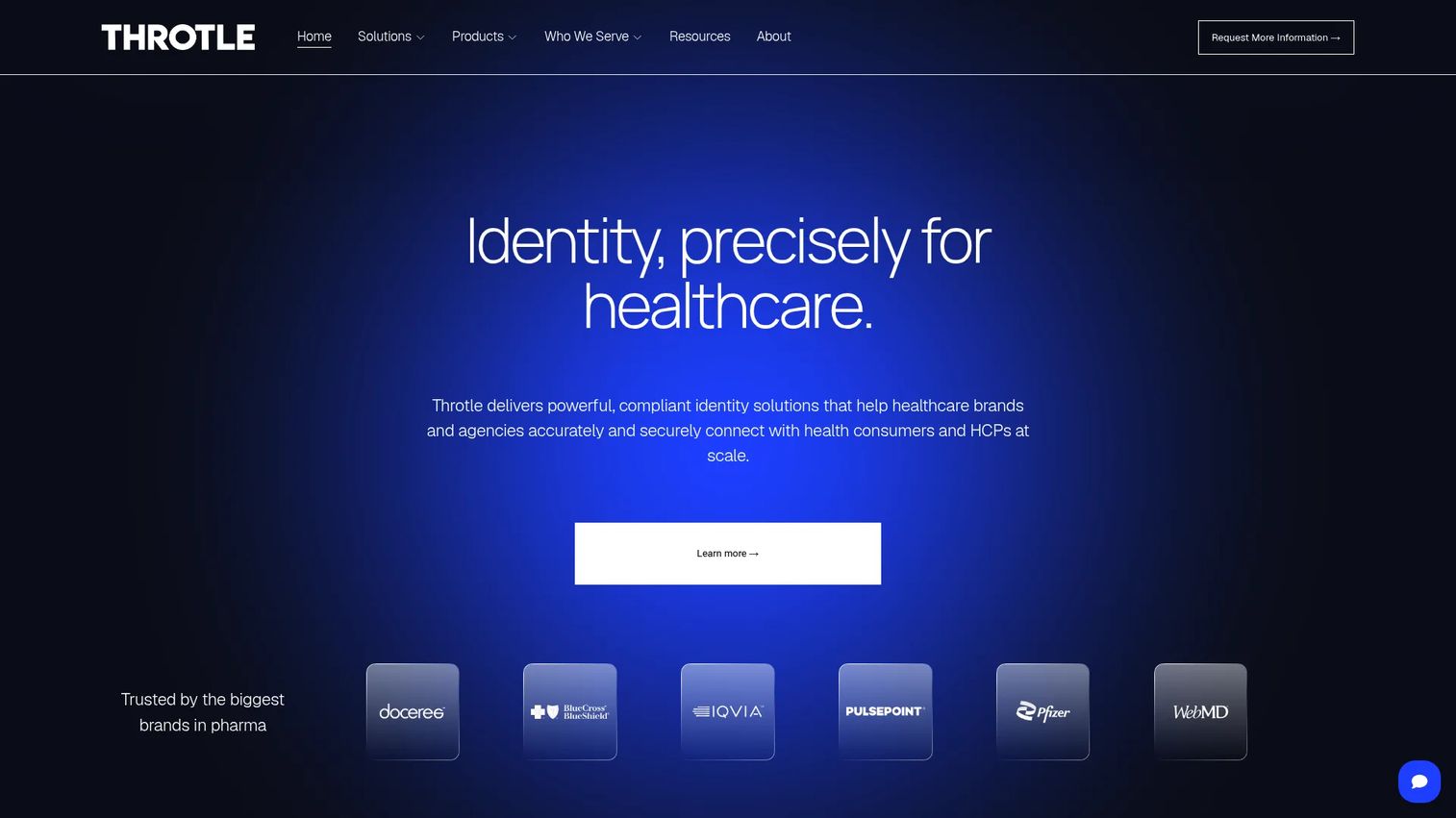
Throtle provides privacy-focused healthcare identity resolution, data onboarding, activation, and measurement for connecting health consumers and healthcare professionals. Its consumer and HCP identity graphs support identity resolution, data enrichment, and crosswalking across programmatic, social, CTV, search, and EHR platforms. It is built for healthcare marketers and data teams, not clinical record deduplication.
Best for: Healthcare marketers, health plans, pharmaceutical brands, and data teams connecting consumer identity to engagement and activation workflows.
Key features
- Consumer and HCP identity graphs
- Identity resolution, enrichment, and crosswalking
- Omnichannel data onboarding and activation
- Privacy-aware data workflows across regulated healthcare contexts
- Measurement across programmatic, social, CTV, and search channels
Why choose Throtle: Throtle belongs in evaluations where patient identity resolution means connecting consumer-level health data for marketing, outreach, or engagement, not for clinical record management. It is not the default choice for EMPI or EHR-based patient deduplication.
Throtle pricing: Pricing is customized per engagement. Contact Throtle to get a quote based on data volume and activation scope.
G2 rating: 4.0/5 (based on 1 review)
13. Certify Health
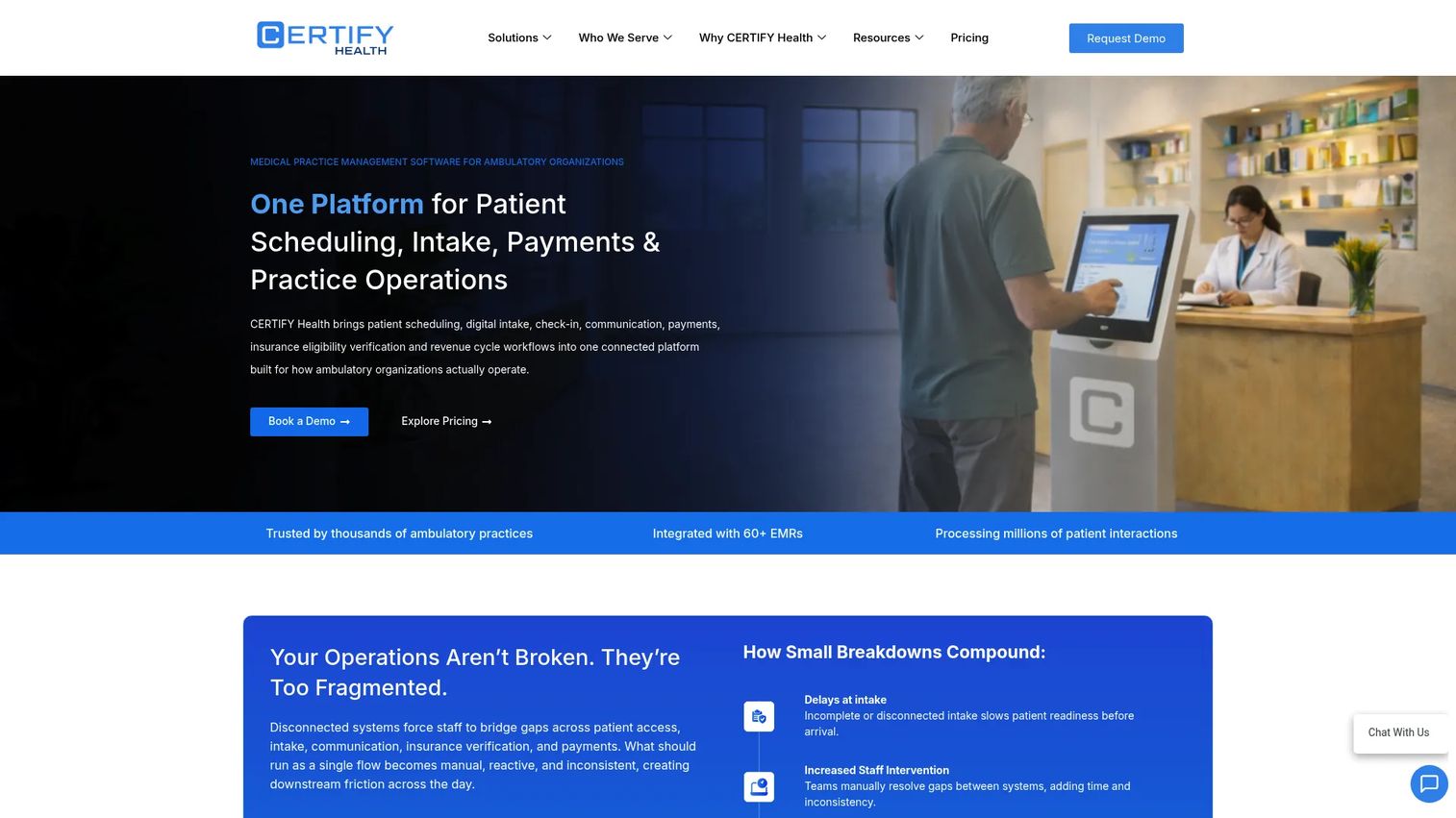
Certify Health is a healthcare operations platform for patient scheduling, digital intake, check-in, communications, payments, eligibility verification, and revenue-cycle workflows. It supports QR, contactless, manual, mobile, email, kiosk, and biometric check-in, plus two-way messaging and insurance eligibility verification. Identity in Certify Health's context is about verifying the patient at the point of access, not managing longitudinal records across systems.
Best for: Ambulatory healthcare organizations that need connected patient-access workflows, from scheduling through check-in and payment.
Key features
- Digital patient intake, pre-registration, and scheduling
- QR, contactless, kiosk, and biometric check-in options
- Automated reminders and two-way patient messaging
- Insurance eligibility verification at intake
- Electronic payments, co-pay collection, and digital statements
Why choose Certify Health: Certify Health is a strong front-end identity and access tool for ambulatory settings. It verifies who is arriving before downstream patient matching occurs, which complements rather than replaces an enterprise EMPI. Evaluate it as part of the access workflow, not as a standalone identity resolution platform.
Certify Health pricing: Patient Intake Platform costs $300 per practice per month. Patient Scheduling, Patient Communications, and Revenue and Payments modules each start at $150 per practice per month. Eligibility verification, kiosk hardware, and third-party integration fees vary separately.
G2 rating: 5.0/5 (based on 1 review)
14. Healthcast
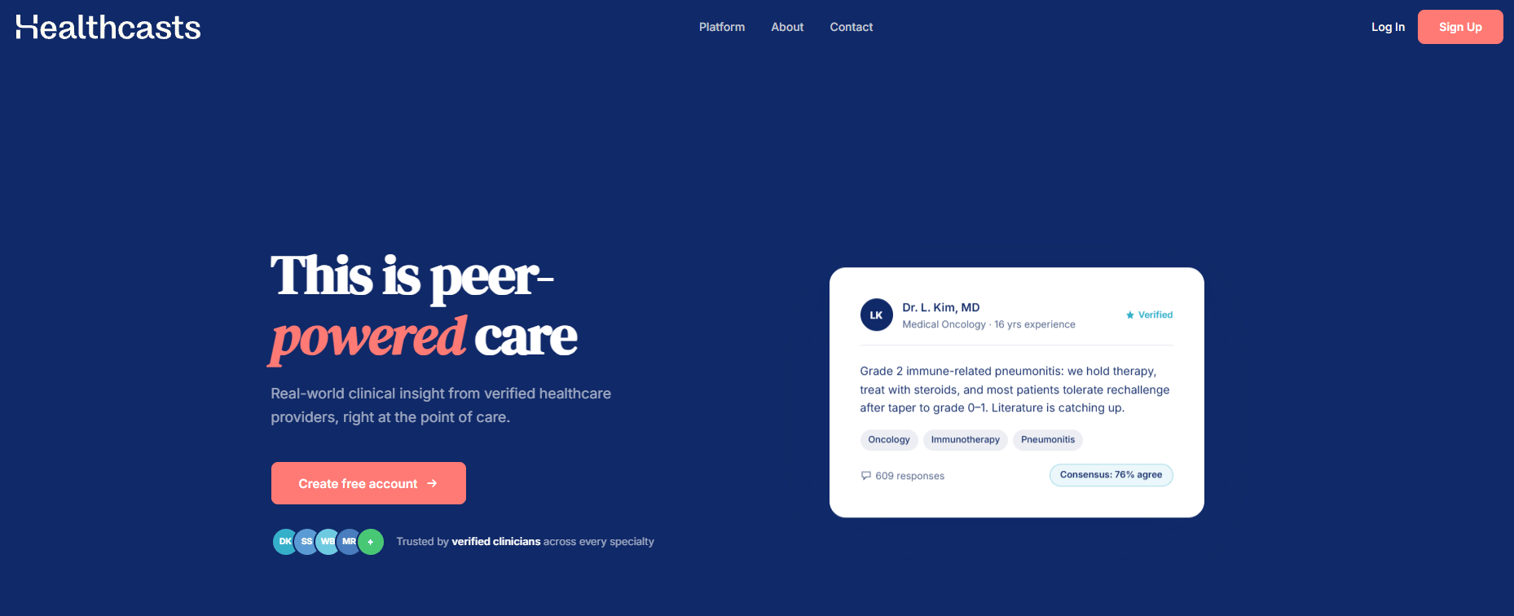
Healthcast provides healthcare identity and access management software, including enterprise single sign-on, proximity-badge access to clinical workstations and virtual desktops, and self-service password reset. It is built for clinical environments where fast, secure access to shared workstations is a daily operational requirement. The product is now offered within Identity Automation's portfolio.
Best for: Healthcare organizations that need secure, fast identity and access management for clinical staff across shared workstations and virtual environments.
Key features
- Enterprise single sign-on with role-based access and roaming sessions
- Proximity-badge access to local, published, and virtual desktops
- Self-service Active Directory password reset
- Clinical workflow support across shared workstation environments
- Security-focused identity controls for care settings
Why choose Healthcast: Healthcast is relevant when the identity problem is staff authentication and clinical access, not patient record matching. These are adjacent categories: Understanding the distinction matters before you put Healthcast in an EMPI evaluation. If your problem is clinicians accessing the right systems quickly, Healthcast fits. If your problem is duplicate patient records, it does not.
Healthcast pricing: Contact sales for pricing. Cost depends on deployment size, integrations, and support requirements.
15. Iatric Systems
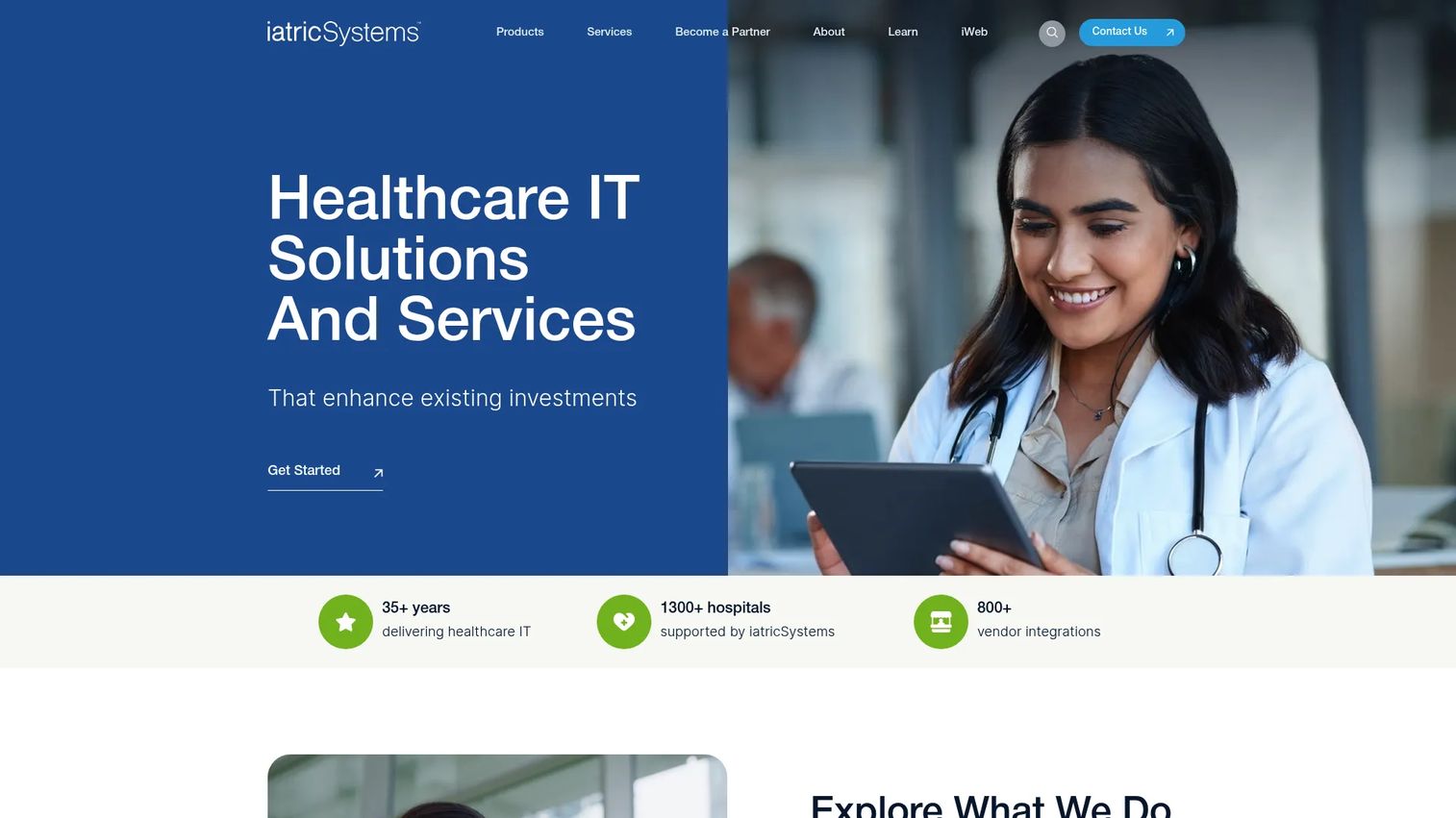
Iatric Systems is a healthcare IT company providing clinical, privacy and compliance, interface, migration, integration, training, and managed services for hospitals and healthcare systems. Its Haystack iS v2 platform delivers AI-powered patient privacy monitoring. The company also covers EHR and medical-device integration, interface monitoring, data archival, and EHR migration services. It is not a standalone EMPI vendor.
Best for: Hospitals and healthcare organizations needing patient privacy monitoring, EHR integration, or healthcare IT managed services alongside identity-adjacent data workflows.
Key features
- AI-powered patient privacy monitoring with Haystack iS v2
- EHR, medical device, and smart-pump integration
- Interface monitoring and management
- Data extraction, archival, and EHR migration services
- EHR report writing and customized training
Why choose Iatric Systems: Iatric Systems fits when patient identity challenges show up inside integration work, compliance monitoring, or EHR migration projects. If you need a full enterprise master patient index, verify which Iatric product addresses that need versus their integration and privacy services.
Iatric Systems pricing: Premium Support services start at $3,500 per year for Standard (up to 10 servers) and $5,000 per year for Advanced. Broader product and services pricing is sales-led and depends on product line, implementation scope, and integration requirements.
Considerations when choosing patient identity resolution software
Match method and explainability
Deterministic matching works on exact or near-exact rules; it is fast and auditable but breaks down with inconsistent data. Probabilistic matching applies statistical weights and handles messier data, but match decisions require a threshold and reviewer judgment. Referential matching compares records against an external verified identity source, which catches mismatches demographic algorithms miss. Biometric matching is deterministic at the physiological level and is best for point-of-care identity assurance. Most enterprise buyers need a combination, so ask each vendor how they explain individual match and no-match decisions to your stewardship team.
EHR and interoperability fit
Confirm whether the platform integrates with your specific EHR version, not just the category. HL7 v2 feeds, FHIR R4 APIs, batch file processing, and direct HIE connections all carry different implementation costs. The more important question: Does identity update bidirectionally, or does the EMPI only receive records and report results? Systems where corrections propagate back to source EHRs are operationally simpler over time.
Stewardship workflow
A match algorithm is only as useful as the process for reviewing questionable matches, merging duplicates, and unmerging overlays. Evaluate the review queue interface, the roles and permissions model, the audit trail depth, and whether the vendor supports role-based stewardship across data steward, clinical analyst, and IT administrator personas. Poor stewardship tools mean your team inherits the cleanup burden regardless of matching accuracy.
Privacy and governance controls
Patient data handling, access controls, auditability, encryption standards, and vendor security documentation all belong in the evaluation, especially for organizations in regulated markets. Ask for SOC 2 documentation, HIPAA Business Associate Agreement terms, and data residency options. This is not a compliance guarantee from any vendor; it is a due-diligence step your security and legal teams own.
Implementation cost and ongoing ownership
Who owns this after go-live: Data engineering, interoperability, RevOps, or IT? Ask vendors for a realistic implementation timeline, the technical skills required for ongoing maintenance, and whether stewardship is a human or automated workflow. Healthcare infrastructure vendors often underquote implementation costs and overestimate automation maturity. A pilot against your actual duplicate and overlay records is worth the discovery investment before full contract.
Conclusion
Patient identity resolution is a category with significant range, from dedicated EMPI vendors to EHR-native workflows, biometric identification, patient-authorized data exchange, and healthcare consumer identity graphs. The right choice depends on where your identity problem actually lives.
For enterprise patient identity resolution across provider, payer, or HIE environments, Verato is the strongest specialized option. 4medica suits labs and health information networks that need MPI tied to data quality infrastructure. NextGate, now within Rhapsody, serves enterprise EMPI and interoperability needs at health system scale. RightPatient fits providers that want biometric identity at registration. Redpoint Global belongs in evaluations where patient identity connects to engagement and analytics rather than clinical records. Oracle Health, Epic, and MEDITECH are the right evaluation path for organizations already standardized on those EHR platforms.
For the category's more adjacent tools: Certify Health handles front-end patient access verification; Healthcast and Iatric Systems cover workforce access management and EHR integration services; Throtle addresses healthcare marketing identity; HealthKey and Medchart focus on patient-mediated record access.
The most useful next step is to shortlist three or four tools and test them against your actual duplicate records, bad demographic data, and cross-system overlap scenarios. No vendor demo will tell you what your data will tell you.
FAQs
Patient identity resolution software matches and links patient records across healthcare systems to ensure each person connects to the correct clinical, administrative, and engagement data. It prevents duplicate records (one patient appearing as multiple people) and overlays (two different patients sharing one record), which undermine care coordination, billing accuracy, and downstream analytics.
An enterprise master patient index, or EMPI, is the system or database that maintains a single authoritative identity record across an enterprise or network. Patient identity resolution describes the process of matching and linking records to populate and maintain that index. Many vendors use the terms together because the matching process and the index are inseparable in practice, but some tools specialize in the matching algorithm while others focus on the index management and stewardship workflow.
Patient matching software compares demographic fields, identifiers, and sometimes biometric or external reference data across source systems to find records that represent the same person. Strong systems flag potential duplicates before they propagate, route questionable matches to a stewardship queue for human review, and support merge and unmerge workflows to correct errors. The best platforms apply matching at the point of registration so duplicates are caught before they spread to downstream systems.
The four main approaches are deterministic matching (exact or near-exact rules on fields like name, date of birth, and social security number), probabilistic matching (statistical weights applied to imperfect data), referential matching (comparing records against an external verified identity source), and biometric matching (physiological identifiers such as face, fingerprint, or iris). Most enterprise platforms combine deterministic and probabilistic methods; referential and biometric approaches add additional layers of confidence where data quality is inconsistent.
Most do, but integration depth varies significantly. Common integration paths include HL7 v2 feeds, FHIR R4 APIs, batch file processing, and direct HIE connections. EHR-native tools like Epic, Oracle Health, and MEDITECH embed identity within the clinical platform. Dedicated EMPI vendors like Verato and NextGate are designed to sit alongside multiple EHRs and serve as the cross-system identity layer. Always verify integration with your specific EHR version and data model before contract.
No, biometric identification is one method used to confirm a patient's identity, typically at registration or point of service. It answers the question "Is this person who they claim to be?" An enterprise EMPI answers a different question: "Are these two records the same patient?" Biometric matching can complement a broader identity resolution program by reducing false matches at intake, but it does not replace the cross-system matching, stewardship, and index management that EMPI software provides.
Start with the hardest workflow your enterprise customers encounter: The scenario with the worst duplicate rates, the most inconsistent demographics, or the most complex cross-system matching. Test vendors against that scenario, not a clean demo dataset. Ask each vendor for their match precision and recall rates on data similar to yours. Evaluate the stewardship interface your team will use daily. Confirm implementation timelines and post-go-live ownership, because patient identity infrastructure that requires ongoing engineering support creates a dependency that is hard to hand off to a VP or operator.
Most dedicated EMPI and patient identity resolution vendors use quote-based pricing. Cost drivers include the number of source systems, record volume, deployment model (cloud versus on-premise), modules selected (matching engine, stewardship tools, interoperability connectors), implementation services, and ongoing support. EHR-native identity tools are typically bundled into larger EHR contracts. Certify Health and HealthKey are among the few vendors with published starting prices. For enterprise EMPI platforms, budget for both software and implementation, as the two are often comparable in first-year cost.