Your cloud footprint has sprawled across AWS, Azure, Google Cloud, a handful of Kubernetes clusters, and data stores you added during last year's migration. Now the security review for your next enterprise deal just landed, and the buyer's questionnaire covers posture management, identity risk, container vulnerabilities, and compliance evidence. Static spreadsheets and point tools cannot answer those questions fast enough.
According to the Check Point 2025 Cloud Security Report, 65% of organizations experienced a cloud-related security incident in the past year, up from 61% the year before. The pressure is not hypothetical. Cloud security buying is genuinely complicated because the category spans several distinct disciplines: CSPM for misconfigurations, CNAPP for application protection end-to-end, CWPP for workloads and runtime, CIEM for identity and entitlement risk, and CDR for detection and response. Picking the wrong tool for your actual job creates shelfware and gaps in technical validation.
This guide cuts through that complexity for presales and SE teams who need to qualify buyers, support security reviews, and run POCs with credible evidence.
What's inside
This guide covers 12 cloud security software tools evaluated for presales-supported technical validation. Items were selected based on:
- Breadth across CNAPP, CSPM, CWPP, CIEM, and runtime security
- Multicloud and Kubernetes depth
- Detection, investigation, and response capability
- Compliance and governance reporting strength
- Fit for POCs, RFPs, and architecture sign-off
It is written for presales engineers, solutions consultants, and sales engineers who help buyers validate technical fit in complex cloud environments. For broader context on AI-driven security tools, see our guide to best AI cybersecurity solutions and best AI security posture management tools.
TL;DR
- Best overall CNAPP shortlist: Wiz, Palo Alto Networks Prisma Cloud, and Microsoft Defender for Cloud cover posture, workload, and compliance in one platform
- Best for endpoint-to-cloud detection: CrowdStrike Falcon Cloud Security or SentinelOne Singularity Cloud Security, when the buyer's motion starts at the endpoint
- Best for Kubernetes and container runtime: Sysdig Secure or Aqua Security, especially when platform engineering teams are the primary stakeholders
- Best for cloud-native provider environments: Google Cloud Security or AWS Cloud Security, for single-cloud buyers who want native controls first
- Best for exposure and vulnerability management: Tenable Cloud Security, when the buyer already runs an exposure management program
- Best for presales-supported validation: Prioritize tools that produce clear attack-path evidence, compliance mapping, and risk prioritization during the POC
- Ownership note: Wiz is now part of Google Cloud, so entries 1 and 11 belong to the same parent company. Treat them as one vendor relationship in any competitive shortlist
What is cloud security software?
Cloud security software helps organizations protect cloud infrastructure, workloads, applications, identities, data, and configurations across public, private, hybrid, and multicloud environments.
The category has expanded significantly as cloud adoption has accelerated. According to the Fortinet State of Cloud Security Report (2025), 78% of organizations now use two or more cloud providers, up from 71% the previous year. That multicloud reality means buyers need platforms that normalize risk across environments rather than siloed tools that cover only one provider.
Key capability areas to map before shortlisting:
- CSPM (cloud security posture management): Detects misconfigurations, policy violations, and drift from security baselines
- CNAPP (cloud-native application protection platform): Unified platform combining CSPM, CWPP, CIEM, code security, and runtime protection
- CWPP (cloud workload protection platform): Protects virtual machines, containers, and serverless workloads at runtime
- CIEM (cloud infrastructure entitlement management): Identifies excessive permissions and identity risk across cloud accounts
- DSPM (data security posture management): Discovers sensitive data and maps exposure paths
- CDR (cloud detection and response): Detects, investigates, and responds to cloud-specific threats
- KSPM (Kubernetes security posture management): Monitors Kubernetes cluster configurations and network policies
- WAAP (web application and API protection): Protects externally facing apps and APIs from attacks
- Compliance reporting: Maps findings to frameworks such as CIS, SOC 2, PCI DSS, and ISO 27001
- DevSecOps integrations: CI/CD pipeline scanning, infrastructure-as-code checks, and secrets detection
For presales and SE teams, the right platform should make technical proof visible. During evaluation, buyers need to see risk paths, remediation steps, compliance evidence, and integration points, not just raw alert counts. Related: Our roundup of best presales software tools covers the broader stack these teams rely on.
When to use cloud security software
Secure multicloud environments
When your buyer runs workloads across AWS, Azure, and Google Cloud simultaneously, native controls from each provider cover their own surfaces well. Unified reporting, policy consistency, and cross-cloud risk correlation require a third-party CNAPP or CSPM layer. This is where tools like Wiz, Prisma Cloud, and Microsoft Defender for Cloud earn their place.
Prove security posture during technical validation
Security reviews, RFPs, and compliance audits all require evidence, not assurances. The right cloud security platform should produce exportable findings, compliance dashboards, and remediation workflows that a buyer's security team can evaluate without a live call. Presales teams use this evidence to accelerate sign-off and reduce back-and-forth during technical diligence.
Detect and remediate cloud threats faster
Runtime threats, suspicious API calls, exposed secrets, and privilege escalation all happen faster than manual reviews catch them. CDR and CWPP capabilities connect detection to prioritized remediation so security teams can act on the highest-risk findings first. For presales, showing this workflow during a POC demonstrates operational value beyond posture scanning alone.
Cloud security software comparison
The table below covers all 12 tools with verified pricing and G2 ratings. Most enterprise platforms price by quote, with cost driven by cloud asset count, selected modules, and contract terms. Native cloud provider tools price by usage, service, and region. More detail on each tool follows in the item sections below.
Two entries share a parent company. Google completed its acquisition of Wiz on 11 March 2026, so Wiz (entry 1) and Google Cloud Security (entry 11) are both Google-owned. Wiz continues to operate under its own brand and still supports AWS, Azure, and Oracle Cloud, but buyers comparing the two should know they are not independent vendors.
| # | Product | Best for | Key differentiator | Pricing | G2 rating |
|---|---|---|---|---|---|
| 1 | Wiz (Google) | Agentless CNAPP and cloud risk prioritization | Security Graph with attack path analysis | Custom quote by asset scope and modules | 4.7/5 |
| 2 | Palo Alto Networks Prisma Cloud | Enterprise CNAPP and DevSecOps | Code-to-cloud posture, workload, and runtime | Custom quote by modules and cloud usage | 4.1/5 (listed as Cortex Cloud) |
| 3 | Microsoft Defender for Cloud | Azure-centric and hybrid teams | Native Azure security plus multicloud connectors | Foundational CSPM free; paid plans metered per resource | 4.4/5 |
| 4 | SentinelOne Singularity Cloud Security | Detection-led cloud and workload security | AI-powered CNAPP with unified cloud and endpoint | Per workload per month; quote for enterprise terms | 4.9/5 |
| 5 | CrowdStrike Falcon Cloud Security | Endpoint-to-cloud detection | Falcon telemetry across endpoint and cloud | Custom quote by cloud scope and modules | 4.5/5 |
| 6 | Check Point CloudGuard | Network, workload, and posture security | Prevention-first across cloud network and apps | Scales with capabilities and protected assets | 4.4/5 (Check Point Cloud Firewall) |
| 7 | Trend Micro Cloud One | Workload and infrastructure security | Usage-based pricing with modular protection | From $0.007 per instance-hour, usage-based | 4.5/5 (successor listing) |
| 8 | Tenable Cloud Security | Exposure and vulnerability management | Cloud risk tied to exposure and identity context | Custom quote by billable cloud resources | 4.5/5 |
| 9 | Sysdig Secure | Kubernetes and container runtime | Runtime insights from live container activity | Custom quote by hosts and events processed | 4.8/5 |
| 10 | Aqua Security | Cloud-native and supply-chain security | Full lifecycle security from code to runtime | Custom quote by repositories or workloads | 4.2/5 |
| 11 | Google Cloud Security (Wiz parent) | Google Cloud-native security operations | Security Command Center with AI threat protection | Standard free; Premium pay-as-you-go or subscription | 4.0/5 |
| 12 | AWS Cloud Security | AWS-native security and compliance | Broad native services across the AWS portfolio | Per-service and per-usage pricing | 4.4/5 (AWS Security Hub) |
How the 12 tools compare in practice
1. Wiz
Wiz is a cloud and AI security platform built around agentless visibility and graph-based risk correlation. It inventories cloud assets without deploying agents, maps relationships between resources, identities, vulnerabilities, and misconfigurations, then surfaces the attack paths that represent real exposure. The platform covers CNAPP capabilities including CSPM, CWPP, CIEM, code security, and runtime protection through the Wiz Sensor.
Ownership: Google completed its acquisition of Wiz on 11 March 2026. Wiz keeps its own brand and remains available for AWS, Azure, Google Cloud, and Oracle Cloud, but it is no longer an independent vendor. If your shortlist also includes Google Cloud Security (entry 11), those two options now share a parent company.
Best for: Security teams that need rapid, agentless visibility across multicloud environments with a focus on prioritized risk over raw alert volume.
Key features
- Agentless cloud asset inventory across multicloud environments
- Security Graph and attack path analysis
- Code-to-cloud correlation and remediation guidance
- Runtime protection with the Wiz Sensor
- Cloud and AI threat detection and response
Why choose Wiz: The Security Graph helps presales teams show buyers exactly how an attacker could chain together a misconfiguration, an overprivileged identity, and an exposed vulnerability. That visual evidence is compelling in POCs and security reviews.
Wiz pricing: Wiz prices by quote, with cost driven by cloud asset scope, selected modules (Wiz Cloud, Wiz Code, Wiz Defend, Wiz Sensor), and contract terms. A Go Bundle exists for smaller organizations. Contact sales or check the Wiz pricing page for a quote against your asset count.
G2 rating: 4.7/5
2. Palo Alto Networks Prisma Cloud
Palo Alto Networks Prisma Cloud is a broad CNAPP spanning infrastructure-as-code scanning, CI/CD security, secrets detection, cloud posture management, workload protection, CIEM, and web application and API security. It covers both a SaaS Enterprise Edition and a self-hosted Compute Edition for teams with specific deployment requirements.
Naming note: Palo Alto Networks introduced Cortex Cloud in February 2025 as the next version of Prisma Cloud, merging it with Cortex CDR on the Cortex platform. Existing Prisma Cloud customers follow an upgrade path to Cortex Cloud, and the G2 listing now carries the Cortex Cloud name. Expect to see both names during an evaluation.
Best for: Enterprise teams that want one platform covering code, posture, workload, identity, and runtime security across hybrid and multicloud environments.
Key features
- IaC, CI/CD, and secrets scanning for DevSecOps workflows
- Cloud security posture management and API visibility
- CIEM with agentless workload scanning
- Runtime threat detection and serverless security
- Host security and web application and API protection
Why choose Prisma Cloud: Strong fit when an RFP asks for broad CNAPP coverage and the buyer wants to see code-to-cloud traceability. The platform's compliance reporting depth helps buyers answer audit questions without running separate tools.
Prisma Cloud pricing: Cost scales with the modules you select, your cloud usage, and enterprise contract terms, and Compute Edition is self-hosted. Licensing structures have changed alongside the Cortex Cloud transition, so confirm the current model and unit of measure with Palo Alto Networks for your cloud scope.
G2 rating: 4.1/5
3. Microsoft Defender for Cloud

Microsoft Defender for Cloud is Microsoft's cloud-native application protection platform. It delivers cloud security posture management, workload protection across virtual machines, containers, storage, databases, and serverless functions, and AI security posture management. Multicloud connectors extend coverage to AWS and Google Cloud workloads alongside native Azure.
Best for: Organizations already standardized on Azure and Microsoft security tooling who want native posture management and workload protection with multicloud reach.
Key features
- Azure-native security posture management
- Workload protection across VMs, containers, databases, and serverless
- Regulatory compliance dashboard with framework mapping
- DevOps security integrations across multipipeline environments
- Multicloud connectors for AWS and Google Cloud workloads
Why choose Microsoft Defender for Cloud: When the buyer's primary cloud is Azure, this is the most integrated starting point. The regulatory compliance dashboard helps SE teams generate evidence for audits and RFPs without exporting data to a separate reporting tool.
Microsoft Defender for Cloud pricing: Foundational CSPM is included at no charge and covers continuous assessments, security recommendations, Secure Score, and the Microsoft cloud security benchmark. Paid plans are metered rather than seat-based, and each plan uses its own unit: servers price per server, containers per vCore in Kubernetes worker nodes, Key Vault per vault per month, and Resource Manager per subscription per month. Pay-as-you-go billing runs on Defender Workload Units, with a one-year pre-purchase option for lower effective rates. Defender for Cloud is free for the first 30 days, though Malware Scanning for Defender for Storage bills from day one. Pricing requires an Azure subscription, so model your own resource mix on the Azure pricing page.
G2 rating: 4.4/5
4. SentinelOne Singularity Cloud Security
SentinelOne Singularity Cloud Security is an AI-powered CNAPP that unifies cloud posture management, cloud workload protection, cloud data security, and cloud detection and response. It connects endpoint and cloud telemetry through the Singularity platform, with Purple AI and Hyperautomation supporting threat investigation workflows.
Best for: Organizations that want detection-led cloud security with AI-assisted investigation, tied to endpoint and identity signals in the same platform.
Key features
- Cloud workload protection for containers, VMs, and AI workloads
- Agentless cloud posture management with exploitable-risk prioritization
- Cloud data security for storage and AI data foundations
- Kubernetes posture management
- AI security posture management with unified cloud and endpoint intelligence
Why choose SentinelOne Singularity Cloud Security: When the buyer already runs SentinelOne for endpoint protection, adding cloud security brings cloud, identity, and endpoint telemetry into one investigation workflow. The AI-assisted investigation layer reduces manual triage time during POCs.
SentinelOne Singularity Cloud Security pricing: Cloud workload protection bills per workload per month, not per endpoint, and the unit depends on what you are protecting. SentinelOne's AWS Marketplace listing prices Cloud Workload Security at $52.75 per container host per month, $16.50 per server per month, and $9.90 per Fargate pod or task per month, with Purple AI and standard support included. Workstation protection under Singularity Complete is a separate line at $13.00 per workstation per month. Direct enterprise agreements are quoted, so a multi-workload estimate should come from SentinelOne or the marketplace calculator rather than a single headline figure.
G2 rating: 4.9/5
5. CrowdStrike Falcon Cloud Security
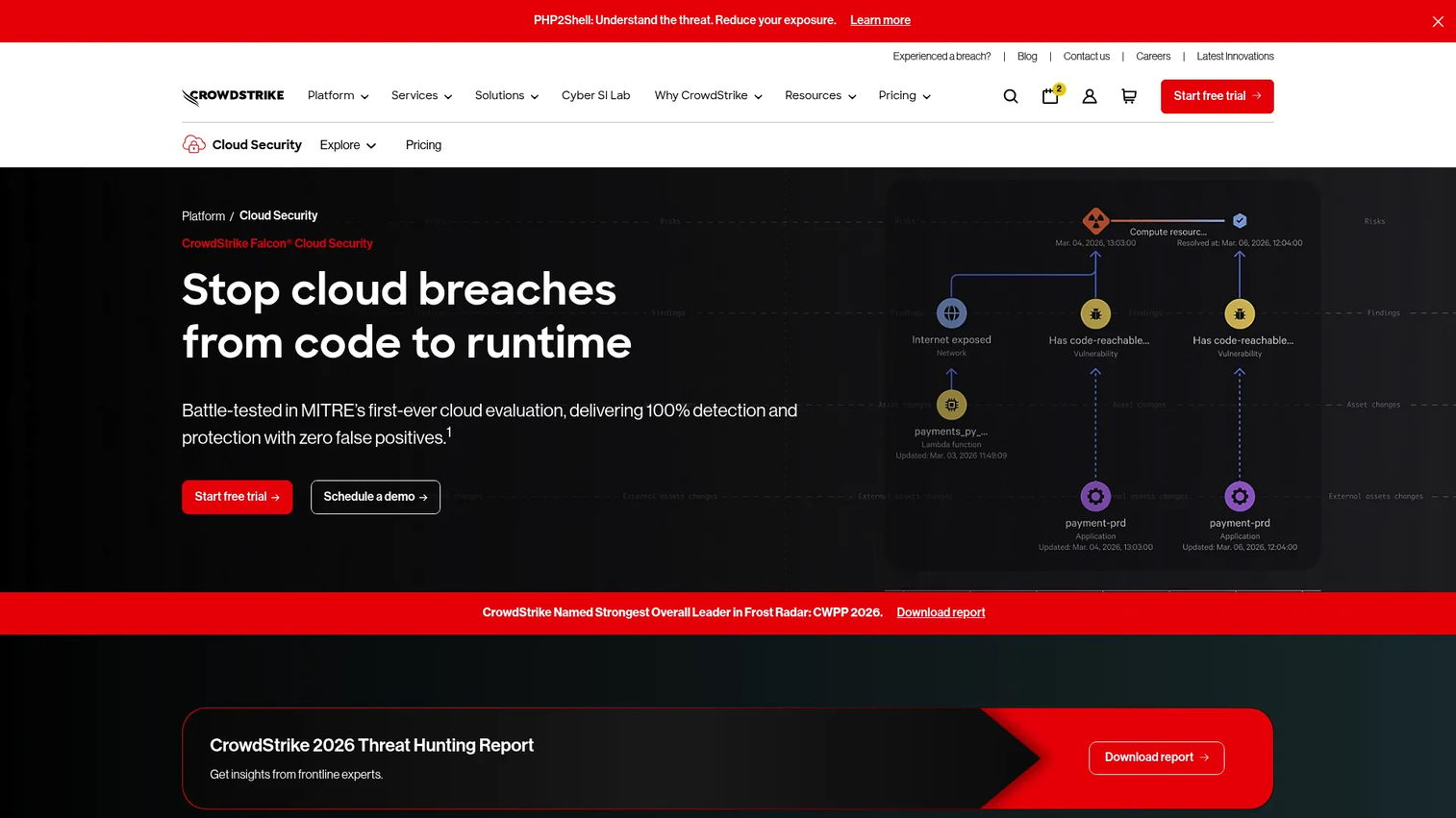
CrowdStrike Falcon Cloud Security extends the Falcon platform's endpoint and threat intelligence capabilities into the cloud. It covers cloud detection and response, agentless cloud posture management, runtime workload protection, container and Kubernetes protection, IaC scanning, CIEM, and AI security posture management.
Best for: Organizations that want cloud security tightly connected to their existing Falcon endpoint and threat intelligence investment.
Key features
- Cloud detection and response with Falcon telemetry
- Agentless cloud security posture management
- Runtime protection for cloud workloads
- Container and Kubernetes security
- Infrastructure-as-code scanning and CIEM
Why choose CrowdStrike Falcon Cloud Security: When the buyer already uses Falcon for endpoint detection, this is a strong addition that reuses existing telemetry and agent infrastructure. Presales teams can show unified investigation timelines spanning endpoint, identity, and cloud events.
CrowdStrike Falcon Cloud Security pricing: All tiers (Proactive Security, Cloud Detection and Response, CNAPP) are priced by custom quote, with cost driven by cloud scope and selected modules. A free trial is offered on the Falcon platform. Contact CrowdStrike sales to confirm current trial length and module specifics.
G2 rating: 4.5/5
6. Check Point CloudGuard
Check Point CloudGuard is Check Point's prevention-first cloud security platform covering cloud-native application protection, web application and API security, cloud network security, and workload protection. It integrates with the broader Check Point security stack for organizations that want consistent policy across cloud and network environments.
Best for: Organizations with existing Check Point infrastructure who want consistent security controls extended into cloud environments.
Key features
- Cloud-native application protection with posture management and risk prioritization
- Cloud-native WAF and API security with AI-based threat prevention
- Cloud network security with centralized gateways and threat prevention
- Workload protection for microservices, containers, and serverless
- DevSecOps integrations with continuous security scanning
Why choose Check Point CloudGuard: The prevention-first approach makes it a good fit for buyers who prioritize blocking threats over post-incident investigation. For presales, the alignment with existing Check Point policies reduces the integration argument during security reviews.
Check Point CloudGuard pricing: CNAPP pricing scales with the capabilities you turn on and the number of protected cloud assets. Network security tiers include pay-as-you-go and bring-your-own-license models on major cloud marketplaces.
G2 rating: 4.4/5
7. Trend Micro Cloud One
Trend Micro Cloud One is a SaaS cloud security platform with modular services covering workload security, cloud compliance and configuration assessment through Conformity, network security, file storage security, and container security. The workload security service includes anti-malware, intrusion prevention, integrity monitoring, and application control.
Lifecycle note: Trend has been consolidating this platform into Trend Vision One. The product is marketed as Trend Cloud One (and appears on AWS Marketplace as TrendAI Cloud One), Workload Security customers are being migrated to Trend Vision One Endpoint Security, and several marketplace pricing dimensions carry end-of-sale dates in 2025. Confirm the current product name, support lifecycle, and migration path with Trend before scoping a POC.
Best for: Teams focused on workload defense and infrastructure compliance who want usage-based pricing through the AWS Marketplace.
Key features
- Workload security with anti-malware, IPS, and application control
- Cloud compliance and configuration assessment via Conformity
- Container security and file storage security
- Network security for cloud environments
- Pay-as-you-go availability through AWS Marketplace
Why choose Trend Micro Cloud One: The usage-based pricing model suits buyers who want to start with a specific service, such as workload security or Conformity, and expand over time. This makes POC cost predictable and scoping conversations simpler.
Trend Micro Cloud One pricing: Workload Security bills per instance-hour, with partial hours counted as full hours, and the rate steps up by instance size. The Essentials tier starts at $0.007 per instance-hour, and Trend's documentation puts the Extra Large and non-cloud rate at $0.045 per instance-hour. File Storage Security and Conformity include free tiers. Marketplace rates and tier availability have both changed recently, so verify current figures on the AWS Marketplace listing or with Trend directly, and ask for annual subscription pricing if you need a committed term.
8. Tenable Cloud Security
Tenable Cloud Security, part of the Tenable One Cloud Exposure platform, is a CNAPP focused on preventing cloud breaches through misconfiguration detection, identity and entitlement management, vulnerability analysis, and attack-path prioritization. It also covers sensitive data discovery, IaC scanning, and AI workload security with DSPM and AI-SPM.
Best for: Security teams that prioritize exposure management and want cloud risk contextualized against vulnerability and identity data in a single view.
Key features
- Multi-cloud asset discovery and visibility
- Cloud security posture management with guided remediation
- CIEM with least-privilege enforcement
- Cloud vulnerability detection across VMs, containers, and Kubernetes
- Attack-path analysis with toxic-combination prioritization
Why choose Tenable Cloud Security: When the buyer already runs Tenable for vulnerability management, this extends that program into cloud-specific risks. Presales teams can use the attack-path and toxic-combination findings to show prioritized, actionable risk rather than an overwhelming alert list.
Tenable Cloud Security pricing: Quoted against the number of billable cloud resources, so the count of assets in scope drives cost rather than user seats. Available standalone or as part of Tenable One Cloud Exposure. Contact Tenable for a quote and ask how it defines a billable resource for your environment.
G2 rating: 4.5/5
9. Sysdig Secure
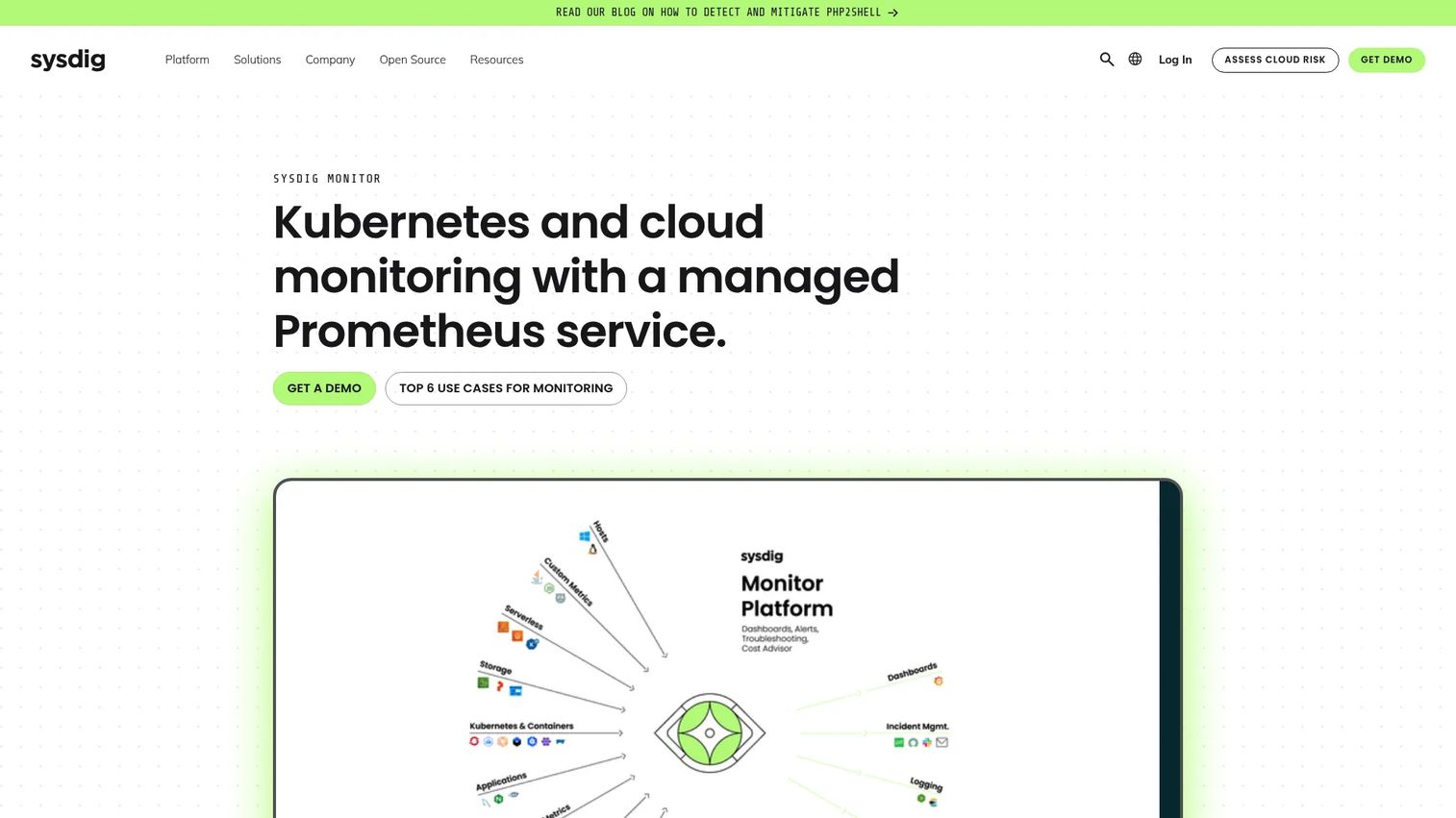
Sysdig Secure is a CNAPP built around real-time runtime insights from container and Kubernetes activity. It covers threat detection and response, vulnerability management and image scanning, cloud and Kubernetes security posture management, CIEM, activity audit, and forensics. Runtime context is its key differentiator: findings are filtered through what is actually running, not just what is deployed.
Best for: DevSecOps and platform engineering teams protecting containerized, Kubernetes, and cloud-native environments where runtime behavior matters.
Key features
- Real-time threat detection and response
- Vulnerability management with image scanning
- Cloud and Kubernetes security posture management
- CIEM and runtime risk prioritization
- Activity audit and forensics
Why choose Sysdig Secure: The runtime-first approach helps buyers cut through vulnerability noise by surfacing only what is actively exploitable in running workloads. For presales, this is a strong demonstration for platform engineering stakeholders who care about false-positive reduction.
Sysdig Secure pricing: Quoted by host count, with cloud-log detection priced on events processed, so a Kubernetes estimate depends on both node count and log volume. Request a quote through Sysdig and confirm free trial availability with sales.
G2 rating: 4.8/5
10. Aqua Security
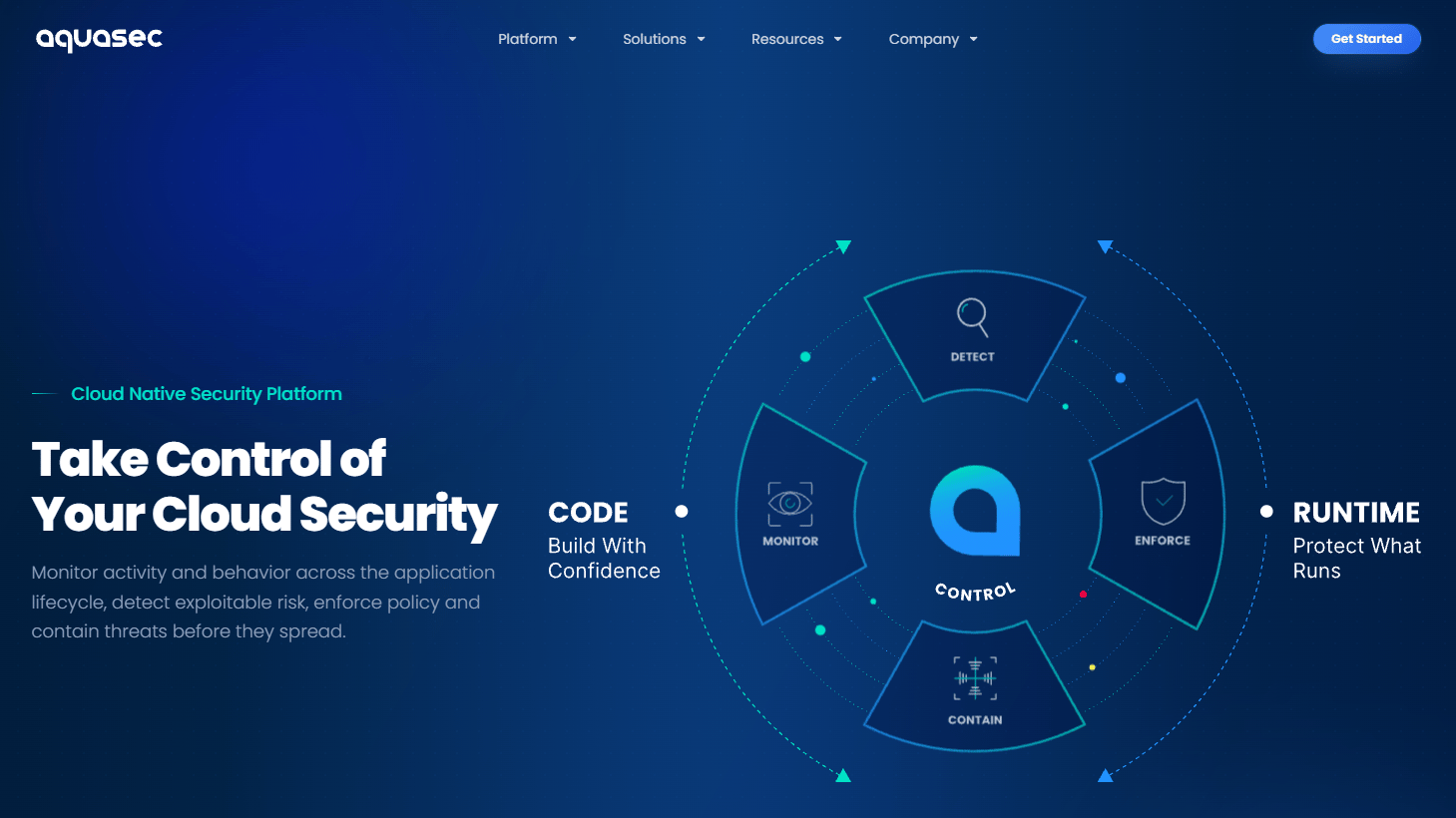
Aqua Security is a CNAPP securing applications from code through runtime. Its focus areas include software supply-chain security, cloud posture management, agentless workload visibility, runtime protection for containers, VMs, serverless, and Kubernetes, plus vulnerability and misconfiguration scanning tied to risk prioritization using runtime context.
Best for: Cloud-native organizations with containerized environments where supply-chain integrity and runtime protection are both evaluation criteria.
Key features
- Software supply-chain and code security
- Cloud security posture management with agentless workload visibility
- Runtime protection for containers, VMs, and serverless
- Vulnerability, secret, malware, and misconfiguration scanning
- Risk prioritization using runtime context and threat intelligence
Why choose Aqua Security: Strong fit for buyers with deep containerized environments where the evaluation covers both the software pipeline and running workloads. The supply-chain coverage helps answer questions about image integrity and third-party risk during architecture reviews.
Open-source note: Aqua maintains Trivy, the widely used open-source scanner for containers, filesystems, and IaC. If your team already standardizes on Trivy in CI, the commercial platform is the same vendor rather than a second supplier.
Aqua Security pricing: Two tiers are listed, Dev Security priced by code repositories and Cloud Security priced by workloads. Neither displays a number directly, so the unit of measure matters more than a headline rate when comparing quotes. Request a trial or quote through Aqua's pricing page.
G2 rating: 4.2/5
11. Google Cloud Security
Google Cloud Security is a portfolio of cloud security capabilities covering AI-powered threat protection, Security Command Center (with posture management, threat detection, compliance, and data security), identity and access management, network and application protection, and sensitive data discovery. Google Security Operations and Mandiant threat intelligence integrate with the platform for security operations teams.
Ownership: Google completed its acquisition of Wiz on 11 March 2026, so Google Cloud Security and Wiz (entry 1) are now part of the same company. If both appear on your shortlist, treat the comparison as one vendor's two offerings rather than a head-to-head between rivals.
Best for: Organizations heavily invested in Google Cloud who want provider-native controls connected to Google Security Operations and Mandiant expertise.
Key features
- AI-powered threat protection and security operations
- Security Command Center with posture, threat detection, and compliance
- Identity and access management
- Network and application protection
- Sensitive data discovery and classification
Why choose Google Cloud Security: When the buyer's environment is primarily Google Cloud, the provider-native integration reduces complexity and implementation time. The Mandiant connection is particularly useful when buyers want threat intelligence backed by incident response expertise.
Google Cloud Security pricing: Security Command Center Standard is offered at no additional charge and covers Google Cloud only. Premium adds advanced posture management, attack paths, threat detection, and compliance monitoring, and is available either pay-as-you-go or by subscription. One planning caveat matters for multicloud buyers: the Enterprise tier, which extended coverage to AWS and Azure, is deprecated and shuts down on 21 May 2027, with those organizations moving automatically to Premium. Some related services bill separately, and Mandiant Threat Defense is quoted through sales. Check the Security Command Center pricing page for current rates.
G2 rating: 4.0/5
12. AWS Cloud Security
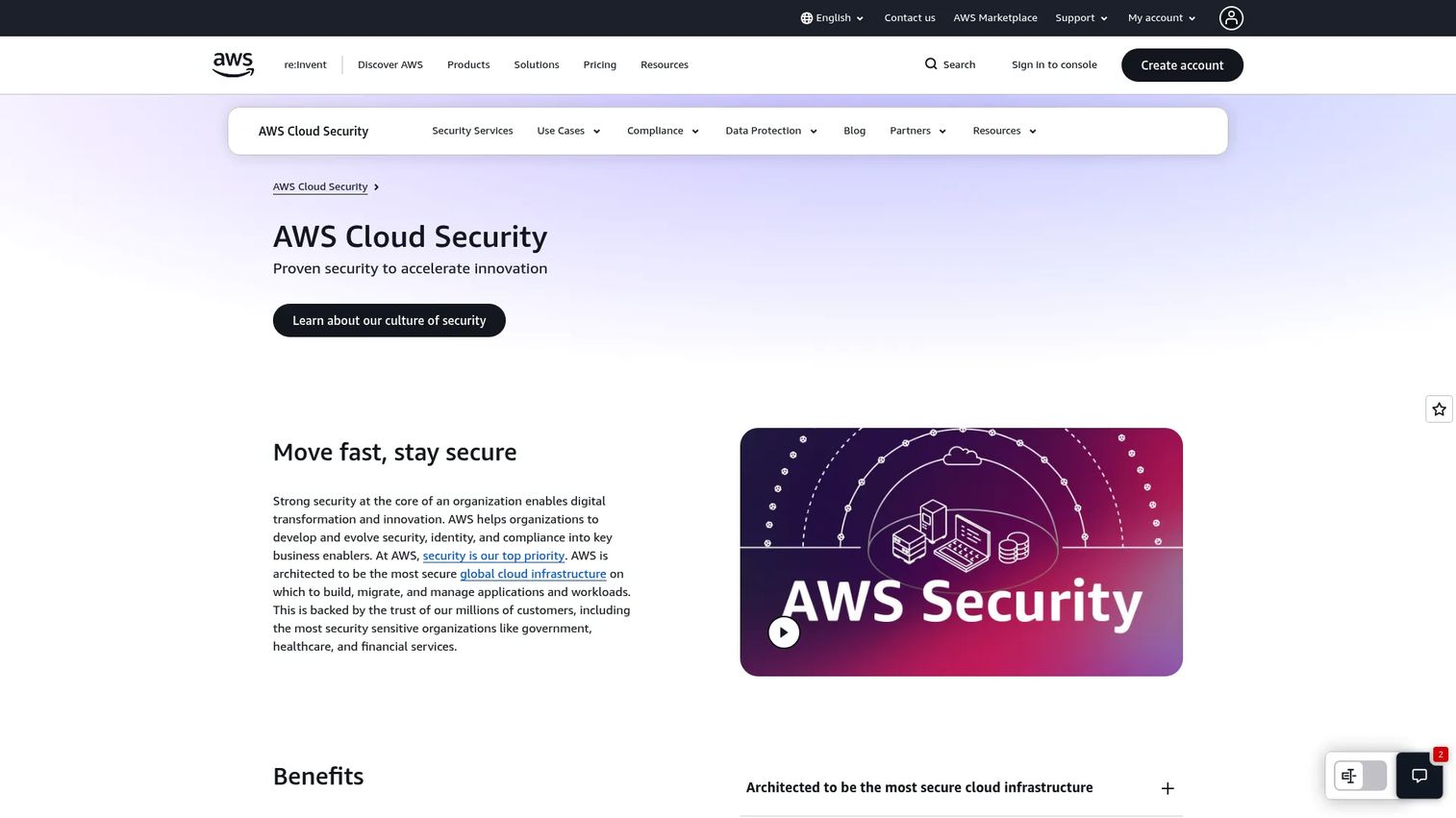
AWS Cloud Security is the native AWS security portfolio covering threat detection (GuardDuty), posture aggregation (Security Hub), identity and access management (IAM), key management (KMS), network protection (Network Firewall), and security data aggregation (Security Lake). It encompasses security automation, risk identification, access control, data encryption, and monitoring across AWS environments.
Best for: AWS-heavy organizations that want native security controls embedded in their existing AWS environment before adding third-party platforms.
Key features
- Threat detection services (GuardDuty)
- Security posture aggregation (Security Hub)
- Identity and access management (IAM)
- Key management and encryption (KMS)
- Network protection and security data aggregation
Why choose AWS Cloud Security: When the organization runs primarily on AWS, native controls are the fastest path to baseline coverage. For presales, AWS evidence often carries weight during architecture reviews because it shows the buyer has used provider-native capabilities before layering in third-party tools.
AWS Cloud Security pricing: Each AWS security service prices independently by usage, service type, region, and data volume. GuardDuty, Security Hub, and Security Lake each have separate usage-based rates, so there is no single platform price to quote. Start with the AWS pricing calculator to estimate cost by service and region.
G2 rating: 4.4/5 (AWS Security Hub)
Considerations when choosing cloud security software
Match the tool to the cloud security job
Before shortlisting, name the primary category your buyer needs: CNAPP, CSPM, CWPP, CIEM, DSPM, CDR, or KSPM. Buying a broad platform without a named primary job creates shelfware. A buyer who needs Kubernetes runtime protection has different requirements than one who needs compliance reporting for a SOC 2 audit.
Check who actually owns your shortlist
This market has consolidated quickly, and two vendors that look like rivals may now share a parent. Google's acquisition of Wiz is the clearest example, and product renames such as Prisma Cloud to Cortex Cloud or Trend Cloud One into Trend Vision One change what you are actually buying. Before a competitive bake-off, confirm current ownership, product naming, and support lifecycle for every tool on the list.
Check multicloud and Kubernetes depth
Validate coverage at the resource and workload level, not just the checkbox. Ask vendors to demonstrate AWS, Azure, and Google Cloud coverage in a live environment during the POC. For Kubernetes, confirm that the tool covers cluster posture, workload runtime, and network policy, not only image scanning.
Compare the pricing unit, not the headline number
Cloud security vendors meter very differently. Some bill per workload or per server per month, some per instance-hour, some by billable cloud resource count, some by hosts plus events processed, and provider-native tools bill per service and region. A quote is only comparable once you normalize it against your own asset inventory, so ask each vendor to define its billable unit in writing.
Evaluate proof quality for audits and RFPs
The best tool for presales-supported deals is the one that produces exportable, auditor-readable evidence. Check that findings map to named compliance frameworks, that remediation steps are specific enough for engineering teams, and that compliance dashboards do not require manual curation before sharing with a buyer's security leadership.
Look at remediation workflows
Detection without remediation guidance creates alert fatigue. Evaluate whether the platform provides prioritization, ticketing integrations, IaC fix suggestions, and developer workflow hooks. A tool that surfaces the top ten exploitable findings and connects them to a Jira ticket is far more useful during a POC than one that generates thousands of ungrouped alerts.
Test adoption during the POC
Setup time, signal quality, and dashboard clarity all determine whether a buyer's team adopts the tool after the sale. Run the same POC scenario through each shortlisted platform. Measure how long onboarding takes, how quickly the first meaningful finding appears, and whether the output is clear enough for a non-security stakeholder to act on.
Conclusion
The cloud security software market covers a wide range of specific jobs, and the right shortlist depends on what the buyer actually needs to prove.
For broad CNAPP coverage and enterprise compliance, Wiz, Prisma Cloud, and Microsoft Defender for Cloud are the most complete starting points. Sysdig Secure and Aqua Security are the strongest choices when Kubernetes, container runtime, and software supply-chain security are the evaluation criteria. Tenable Cloud Security fits buyers running an existing exposure management program who want cloud risk connected to vulnerability context.
For detection-led security programs, SentinelOne Singularity Cloud Security and CrowdStrike Falcon Cloud Security both connect cloud risk to endpoint and threat intelligence signals. Google Cloud Security and AWS Cloud Security are the right starting points for single-cloud environments where native controls come first.
A practical next step: shortlist two broad platforms and one specialist tool, then run the same POC scenario through each. Measure how long the first meaningful finding takes to surface, how clearly the risk is explained, and whether the evidence is ready for a compliance or architecture review without additional work.
For more resources on cloud security and presales enablement, explore our guide on best AI cybersecurity solutions and best AI security posture management tools.
Explaining attack paths, compliance mapping, and runtime coverage to a security buyer is hard to do in a slide deck, and harder still when the reviewer wants to see the product rather than hear about it. An interactive demo lets presales teams walk a security team through the exact evidence a technical review asks for, at the reviewer's own pace.
Start your journey with Guideflow today!
FAQs
Cloud security software protects cloud infrastructure, workloads, applications, identities, data, and configurations across public, private, hybrid, and multicloud environments. The category includes CNAPP, CSPM, CWPP, CIEM, DSPM, CDR, and KSPM platforms, as well as native security services from major cloud providers.
Cloud security software gives your team tools and visibility to manage risk directly. Cloud security services add people, process, and ongoing monitoring, often through a managed security service provider or a vendor's managed detection and response offering. Most enterprise buyers use both: software for continuous visibility and services for incident response or staff augmentation.
CSPM focuses specifically on cloud posture and misconfiguration detection. It checks whether your cloud configurations align with security baselines and compliance frameworks. CNAPP is broader and typically includes CSPM alongside CWPP, CIEM, code security, and runtime protection. If you need posture management only, CSPM tools are sufficient. If you need posture plus workload protection, identity risk, and runtime detection, CNAPP covers the full scope.
The strongest multicloud platforms normalize risk across providers and produce unified reporting. Wiz, Prisma Cloud, and Microsoft Defender for Cloud all support AWS, Azure, and Google Cloud with cross-cloud posture management. SentinelOne Singularity Cloud Security also covers multicloud workloads. Note that Wiz is now Google-owned, though it still supports AWS, Azure, and Oracle Cloud. For any multicloud evaluation, test that the platform handles resource inventory, compliance mapping, and alert correlation across all three providers, not just one.
Sysdig Secure and Aqua Security are the most focused on Kubernetes and container runtime security. Both provide cluster posture management, image scanning, and runtime threat detection built around container activity. Prisma Cloud and Wiz also cover Kubernetes as part of broader CNAPP platforms. During the POC, test runtime visibility specifically: confirm the tool can show active processes inside containers, not only configuration findings.
Pricing models vary significantly across the category, and the billing unit matters more than any headline rate. Enterprise CNAPP platforms (Wiz, Prisma Cloud, CrowdStrike, Sysdig, Aqua) price by custom quote, with cost driven by cloud asset count, selected modules, and contract length. Tenable Cloud Security prices by billable cloud resources, and Sysdig quotes by hosts plus events processed. SentinelOne bills cloud workload protection per workload per month, with published marketplace rates such as $16.50 per server and $52.75 per container host. Trend Micro Cloud One bills per instance-hour starting at $0.007 for the Essentials tier. Microsoft includes foundational CSPM at no charge and meters paid plans per resource. Native cloud provider services from AWS and Google Cloud price per service, usage, and region. Because the units differ, normalize every quote against your own asset inventory before comparing.
Prioritize tools that produce clear, exportable evidence during the evaluation. Key signals include: how quickly the first meaningful finding appears after onboarding, whether risk findings are prioritized rather than listed alphabetically, how well compliance mapping aligns to the buyer's audit frameworks, and whether remediation steps are specific enough for engineering teams to act on. The platform should help the buyer validate technical fit without drowning in unrelated alerts.
Native controls are genuinely strong for single-cloud environments. GuardDuty, Security Hub, and IAM on AWS, or Security Command Center and IAM on Google Cloud, provide solid baseline coverage for buyers running primarily in one provider. Multicloud teams typically add a third-party CNAPP or CSPM layer for unified posture reporting, cross-cloud identity risk analysis, and consistent compliance evidence across providers. One caveat for Google Cloud buyers: Security Command Center's Enterprise tier, which covered AWS and Azure, is deprecated and shuts down on 21 May 2027. Native tools and third-party platforms complement each other rather than compete directly.