Most health organizations have dashboards. They also still have someone exporting spreadsheets every Monday to answer questions the dashboards can't. The data exists, usually across an EHR, a claims system, a billing platform, and at least one operational tool that nobody talks to the others. The gap between having data and having a decision-ready picture of care quality, revenue, or contract performance can cost months and real money.
The global healthcare analytics market reached $65.6 billion in 2025 and is projected to grow at a 13.5% compound annual rate through 2033, according to Grand View Research (2026). That scale reflects how urgently health organizations are trying to close that gap. But market size is not the same as the right platform for your operating context.
The right healthcare analytics software is not the one with the most charts. It is the one that connects the specific data sources behind a recurring decision and gives the responsible team a usable workflow. This guide is designed to help you find that fit.
What's inside
This guide covers ten healthcare analytics software tools selected for clinical, financial, operational, and population health use cases. Vendors were chosen based on:
- Category relevance and depth of healthcare-specific data models
- Evidence of real operating use cases across provider, payer, and employer contexts
- Analytics breadth across clinical, financial, and population health dimensions
- Integration capabilities, governance controls, and implementation ownership
The list covers both specialized healthcare platforms and general analytics tools. The right choice depends on whether you need domain-specific healthcare workflows or a flexible layer on an established data warehouse.
TL;DR
- Best overall for healthcare performance improvement: Health Catalyst, for organizations that need clinical, financial, and operational analytics in one healthcare-focused platform
- Best for population health and value based care: Arcadia, for payer, provider, and risk performance workflows
- Best for a modern healthcare data platform: Innovaccer, for organizations building a connected data foundation across care and engagement programs
- Best for healthcare financial analytics: MedeAnalytics, for revenue cycle, cost, and payer-provider performance analysis
- Best for flexible dashboards on prepared data: Tableau or Sisense, for teams with a mature data model and a clear self-service reporting requirement
What is healthcare analytics software?
Healthcare analytics software collects, standardizes, analyzes, and presents healthcare data so organizations can improve clinical outcomes, operational performance, financial results, population health, or patient access.
What data healthcare analytics platforms analyze
- EHR and clinical documentation data
- Claims and eligibility data
- Revenue cycle and financial systems
- Scheduling, staffing, and operational data
- Pharmacy, lab, and care management data
- Patient engagement and referral data
- Social determinants of health data
What the software helps teams do
- Monitor quality, utilization, and care gaps
- Identify avoidable cost and revenue leakage
- Track provider, service line, or contract performance
- Forecast risk, demand, and capacity
- Build recurring reports for clinical and operating leaders
- Support value based care and population health programs
Core capabilities to evaluate
Strong platforms offer healthcare data integration and normalization, interoperability support (including HL7 and FHIR context), governed dashboards with self-service reporting, and predictive analytics with AI-assisted analysis. Role-based access, auditability, and clear data governance separate platforms built for healthcare from general BI tools dropped into a clinical setting. Workflow support beyond static reporting is increasingly the differentiator.
According to HealthManagement.org (2025), 91% of U.S. hospitals surveyed use diagnostic analytics, while only 32% have adopted predictive analytics for clinical decisions. That gap is where most of the near-term value sits.
When to use healthcare analytics software
Consolidate fragmented healthcare data
If your team exports the same data from three systems every month to answer a question leadership asks every quarter, a healthcare analytics platform earns its place. Start with one repeatable decision, such as care gap prioritization or contract performance, rather than trying to solve every reporting need at once.
Improve value based care and population health performance
Risk stratification, quality measure tracking, attributed lives management, and utilization monitoring each require longitudinal data and operational follow-through. These use cases need more than a dashboard. They need a platform that connects data to the care team workflows that actually close gaps and move metrics.
Find performance gaps across clinical, operational, and financial lines
Service line profitability, avoidable utilization, provider variation, revenue cycle leakage, and staffing trends are all patterns buried in data most organizations already own. The question is whether the platform surfaces them in a form the right person can act on without a data team request for every query. This is where big data analytics software purpose-built for healthcare pays for itself fastest.
Healthcare analytics software comparison
Use this table as a starting point. Healthcare platforms typically price by covered lives, data feeds, implementation scope, modules, and users, so the pricing column reflects the commercial model rather than a published figure. Verify G2 ratings and pricing against each vendor's live pages before making any shortlist decisions.
| # | Product | Best for | Key differentiator | Pricing | G2 rating |
|---|---|---|---|---|---|
| 1 | Health Catalyst | Systemwide clinical, financial, and operational improvement | Healthcare-native data platform with improvement programs | Contact sales | 5.0/5 |
| 2 | Arcadia | Value based care and population health | Risk, quality, network, and care management analytics | Contact sales | N/A |
| 3 | Innovaccer | Healthcare data activation and patient engagement | AI-powered data platform for providers, payers, and care programs | Contact sales | 4.5/5 |
| 4 | MedeAnalytics | Financial and payer-provider analytics | Revenue cycle and performance intelligence | Contact sales | 3.9/5 |
| 5 | Clarify Health | Value based care performance and provider analytics | AI-enabled referral optimization and performance intelligence | Contact sales | 4.7/5 |
| 6 | Atropos Health | Real world evidence and clinical evidence generation | On-demand evidence from real-world healthcare data | Contact sales | N/A |
| 7 | Truven Health Insights | Benefits and employer group reporting | Cohort, utilization, and program evaluation analytics | Contact sales | 4.0/5 |
| 8 | Sisense | Embedded analytics and self-service dashboards | Flexible embedded BI for data products and healthcare applications | Contact sales | 4.2/5 |
| 9 | SAS | Advanced analytics and predictive modeling | Mature statistical and AI tooling for enterprise governance | Contact sales | 4.5/5 |
| 10 | Tableau | Visual analytics on prepared healthcare data | Broad adoption and flexible visualization | From $15/user/month (billed annually) | 4.4/5 |
Best healthcare analytics software tools for 2026
The list includes specialized healthcare analytics vendors alongside general analytics platforms. The choice depends on whether you need domain-specific healthcare data models and care workflows, or a flexible BI layer on top of a warehouse your data team already governs.
1. Health Catalyst
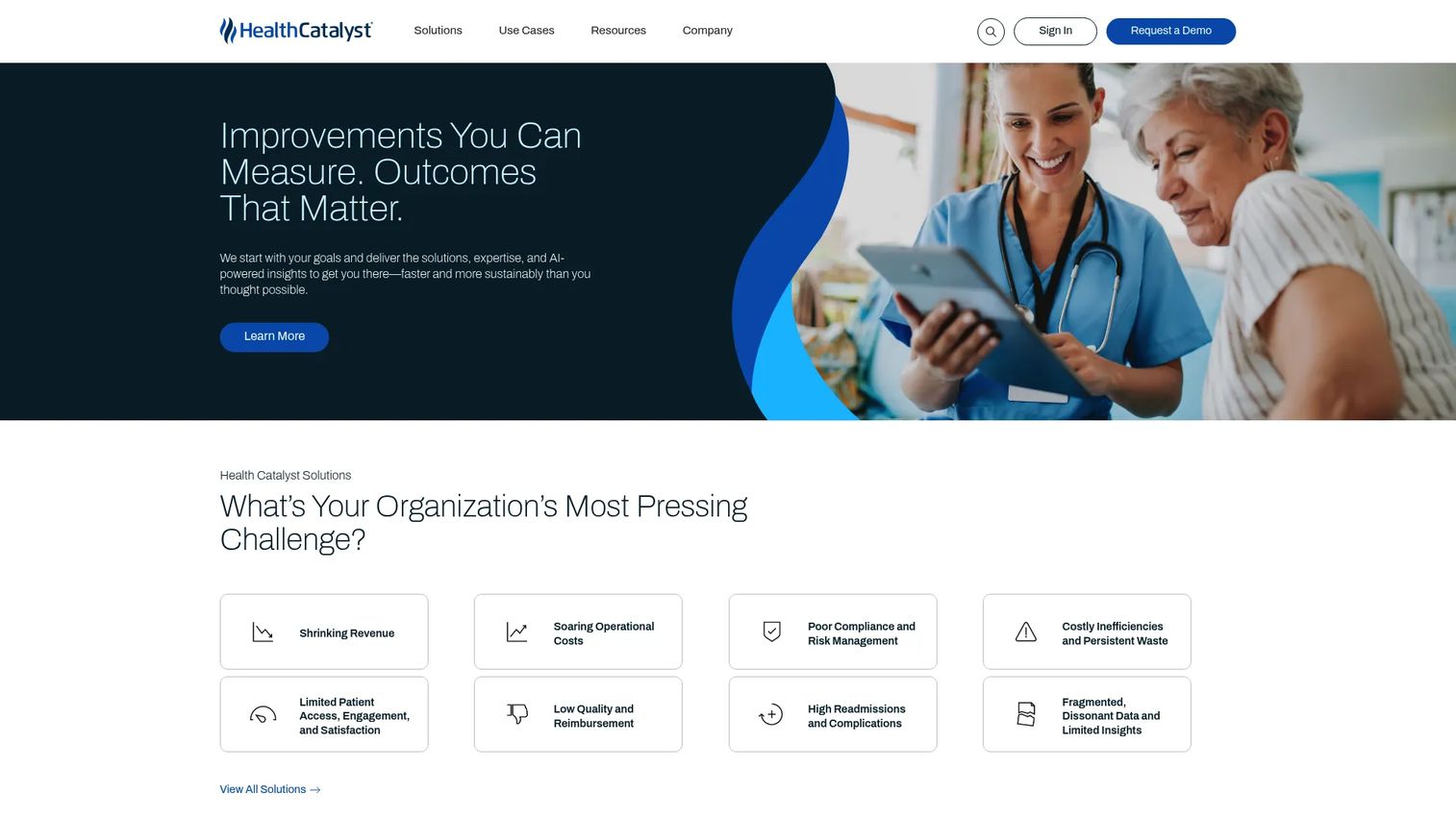
Health Catalyst provides healthcare data, analytics, AI, software, and services to help organizations improve clinical, financial, and operational outcomes. The platform unifies clinical, financial, and claims data into a standardized model, then layers self-service analytics, cohort analysis, embedded AI, and visualization on top of it. It also pairs analytics with advisory services and improvement programs, which distinguishes it from pure software vendors.
Best for: Health systems and provider organizations that need a healthcare-native data platform connected to operational improvement support.
Key features
- Unified clinical, financial, and claims data model
- Self-service analytics, population cohort tools, and embedded AI
- Data profiling, terminology management, and data-quality rules
- Improvement workflows and advisory program support
- Benchmarking against peer organizations
Why choose Health Catalyst: It suits organizations where analytics must connect to action plans, not just reporting. If your team needs to run improvement programs alongside the data work, this is the platform built for that pairing. Match the implementation scope carefully to your team's data maturity and change capacity before committing.
Health Catalyst pricing: Health Catalyst prices by contract. Expect scope to depend on modules, data sources covered, organization size, and implementation services included. Contact sales for a quote.
Health Catalyst holds a 5.0/5 rating on G2.
2. Arcadia
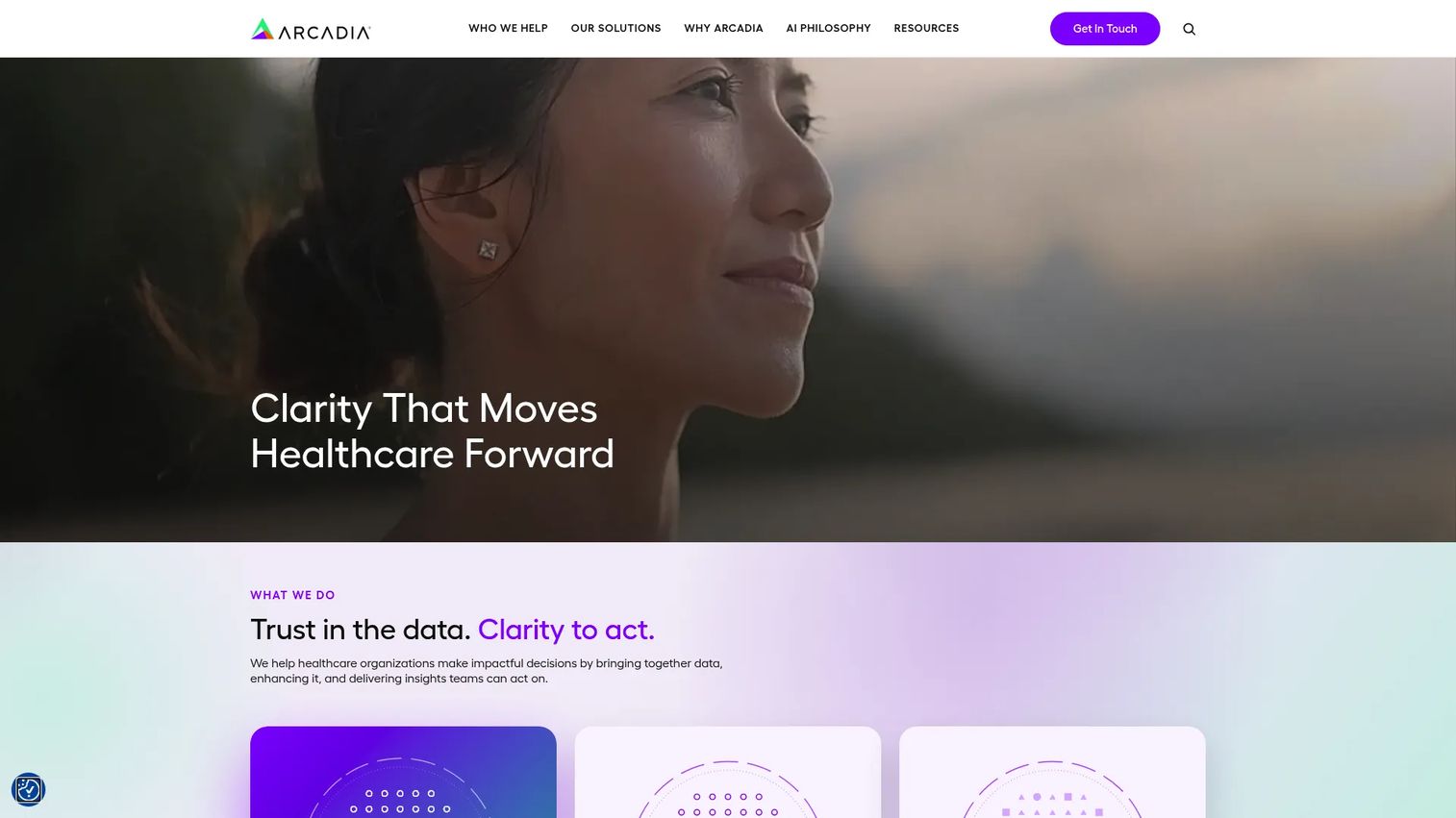
Arcadia provides a healthcare performance and data platform that unifies clinical, claims, operational, and other healthcare data for analytics, AI, and workflows. It is built for organizations managing attributed populations, value based care contracts, and quality performance across provider networks. The platform supports an analytics-ready data foundation, dashboards, registries, and predictive models oriented around population health.
Best for: Provider groups, payers, accountable care organizations, and value based care organizations managing population health and quality performance programs.
Key features
- Healthcare data integration and normalization across clinical and claims sources
- Analytics-ready data foundation and lakehouse architecture
- Population health dashboards, registries, and predictive models
- Care management workflow support
- FHIR-oriented interoperability context
Why choose Arcadia: Population health and value based care analytics are Arcadia's core use case, not an add-on. If payment models and care delivery performance are directly connected for your organization, this is a relevant fit. Validate that your care teams can operationalize the insights, because the platform's value depends on follow-through in the network.
Arcadia pricing: Arcadia prices by contract, with drivers typically including covered lives, care management modules, data feeds, and deployment scope. Contact sales for a quote.
3. Innovaccer
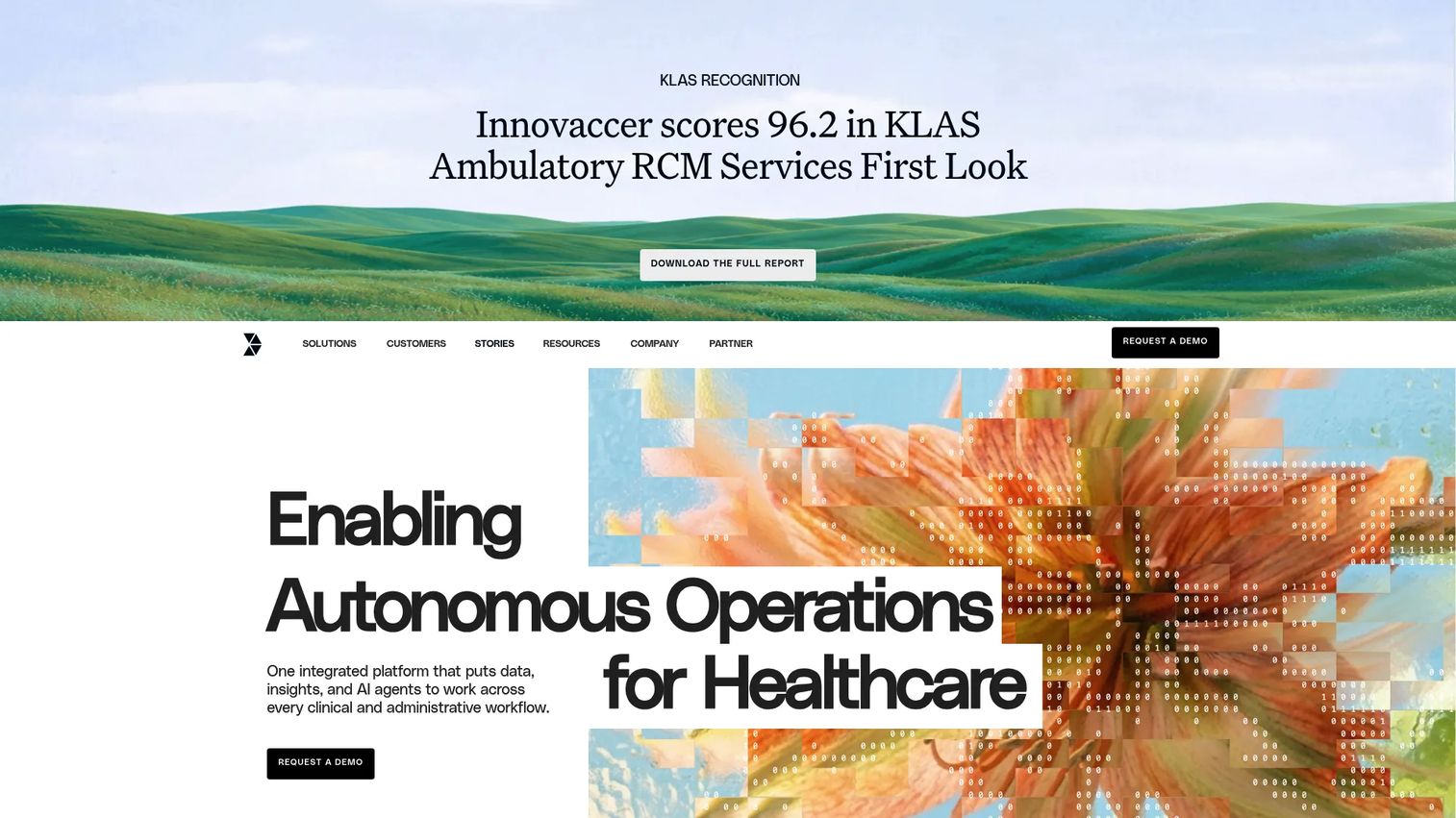
Innovaccer provides an AI-powered healthcare intelligence platform that unifies data and supports clinical, administrative, and financial workflows. The platform covers population health, revenue cycle, patient access, specialty care, and risk and quality workflows through a unified data model. Healthcare-native AI agents and copilots sit on top of that data foundation, making it a fit for organizations that want analytics to feed patient engagement and care management workflows, not stay in a reporting layer.
Best for: Health systems, payers, and care organizations building a connected data foundation across patient engagement, population health, and care delivery programs.
Key features
- Healthcare-native AI agents and copilots
- Data activation and unified healthcare data platform
- Population health intelligence and care gap analytics
- Patient access, revenue cycle, and specialty care workflows
- Care management and engagement program support
Why choose Innovaccer: The platform is a fit when analytics must drive action across teams, not sit in a centralized dashboard. Before buying, validate data model coverage for your specific EHR environment, confirm implementation ownership, and check adoption plans across the care teams expected to use it daily.
Innovaccer pricing: Pricing is determined by Innovaccer based on scope, modules, and organizational context. No public figure is posted. Contact sales for a structured conversation about commercial terms.
Innovaccer holds a 4.5/5 rating on G2.
4. MedeAnalytics
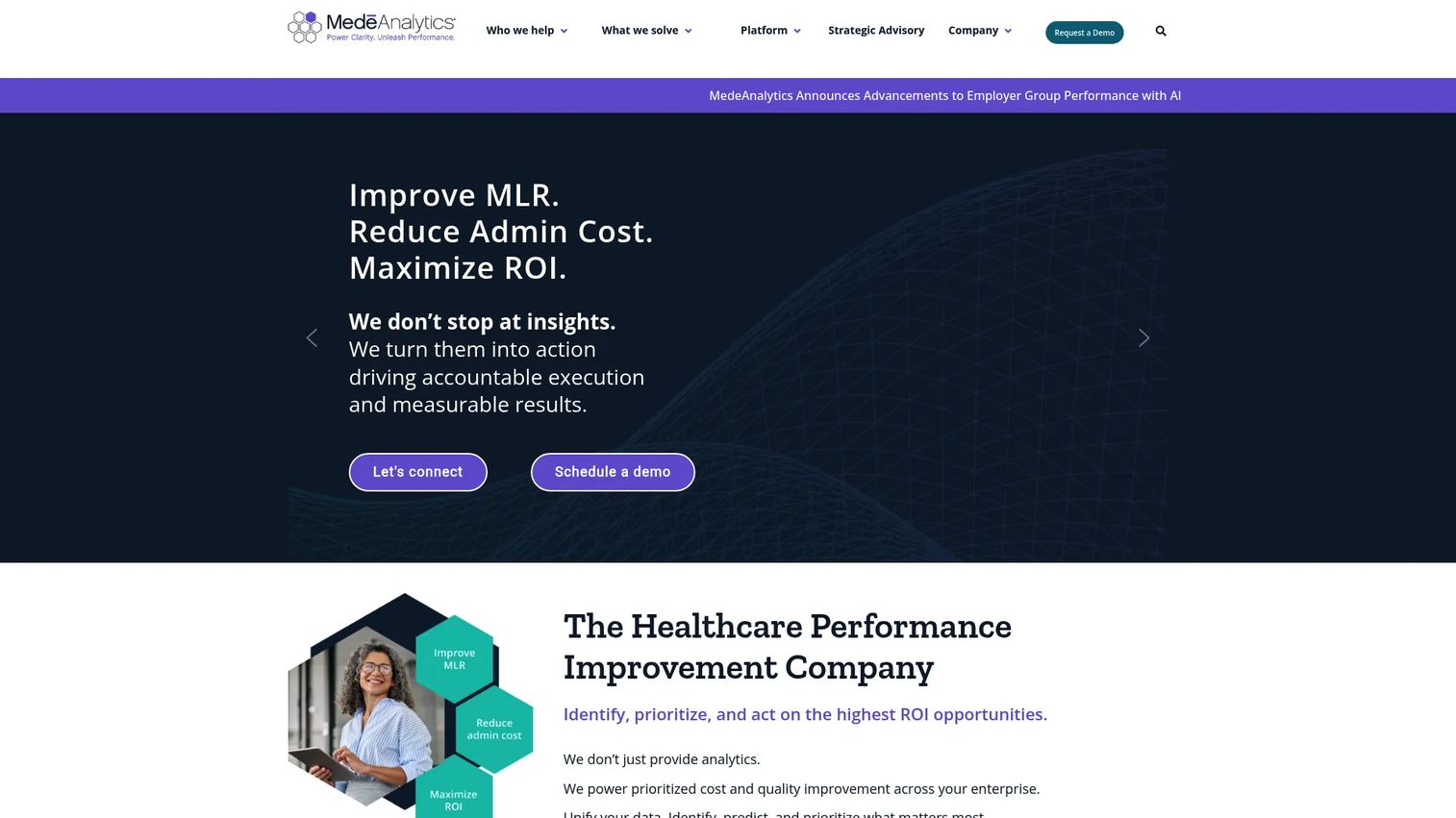
MedeAnalytics is a healthcare analytics and enterprise decision-intelligence platform for payers and providers. It integrates clinical, claims, financial, administrative, enrollment, and social data into a self-service analytics environment with reporting, visualization, drill-downs, benchmarking, and predictive capabilities. AI and machine-learning features support forecasting, anomaly detection, risk assessment, and workflow automation.
Best for: Finance teams, revenue cycle leaders, payer operations, and health system operators who need to connect financial and operational performance metrics to recurring decisions.
Key features
- Integration of clinical, claims, financial, and enrollment data
- Self-service reporting, visualization, and drill-down analytics
- Benchmarking against healthcare-specific comparators
- AI and machine learning for forecasting and anomaly detection
- Payer and provider performance dashboards
Why choose MedeAnalytics: It is a focused option when the primary problem is financial or operational performance reporting with clear payer-provider complexity. It is less relevant when the buyer's central need is clinical evidence generation or a general embedded analytics layer for a data product. The G2 rating reflects a smaller review base, so peer references from similar organizations carry more weight here.
MedeAnalytics pricing: Pricing requires a sales conversation. Contract drivers include organization size, modules, data scope, and deployment model.
MedeAnalytics holds a 3.9/5 rating on G2.
5. Clarify Health
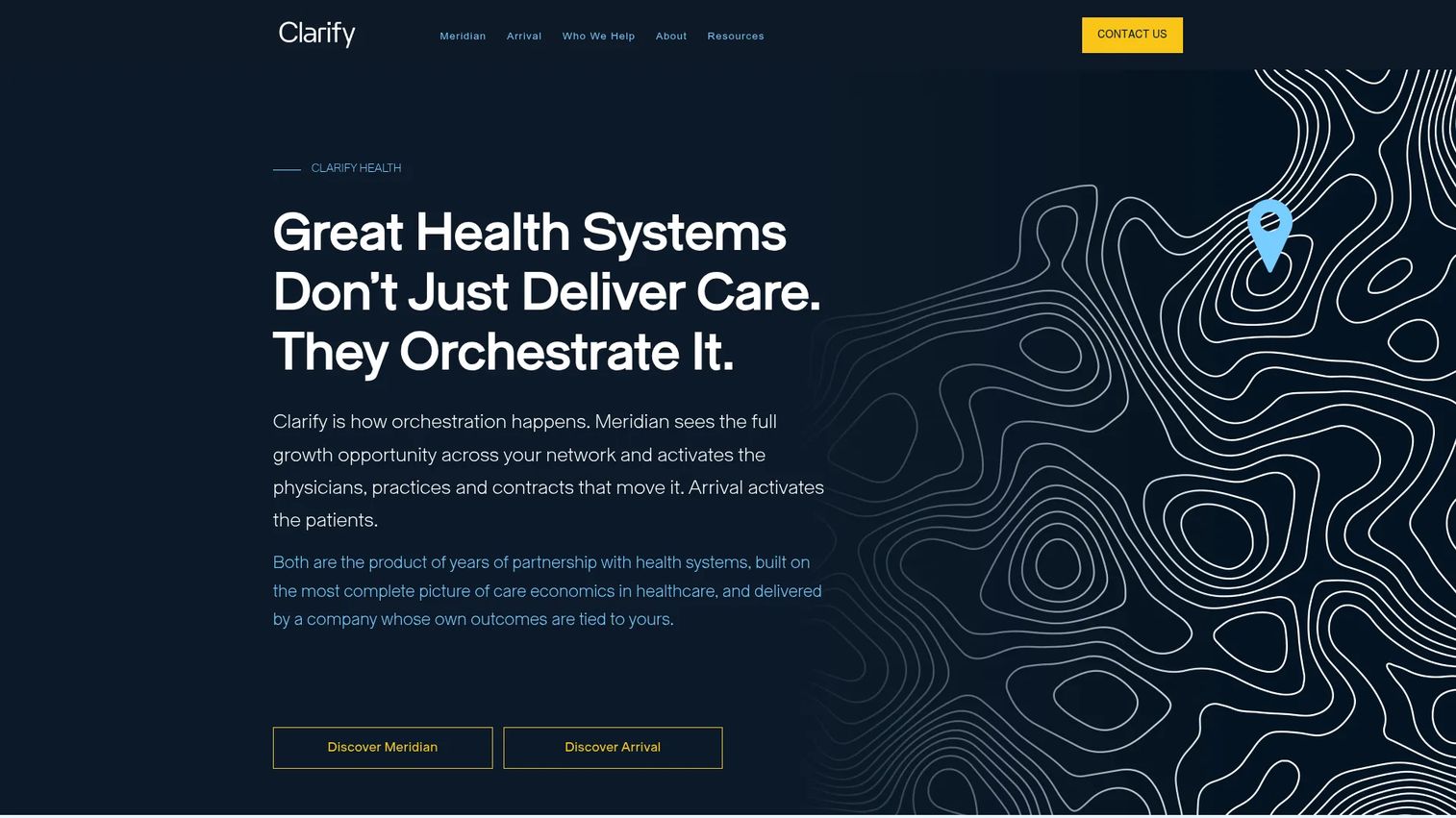
Clarify Health is a healthcare outcomes company providing data, analytics, referral optimization, and patient activation for health systems. Its Clarify Atlas Platform combines claims, prescription, negotiated-rate, quality, capacity, and social determinants data. Clarify Meridian focuses on AI-driven referral optimization with practice-specific playbooks, while Clarify Arrival addresses patient activation across referrals and digital front-door search.
Best for: Value based care organizations and health systems that need performance intelligence across provider groups, referral networks, utilization patterns, and care programs.
Key features
- Clarify Atlas Platform combining claims, quality, and social determinants data
- AI-driven referral optimization through Clarify Meridian
- Patient activation across referrals and outreach through Clarify Arrival
- Provider and network performance intelligence
- Risk and utilization analysis
Why choose Clarify Health: The differentiation is in referral optimization and growth analytics, which is a narrower focus than a broad performance management platform. If the central operational question is how to improve network performance and drive measurable patient volume, this is a fit. Verify exact market segments and data coverage relative to your geography and payer mix.
Clarify Health pricing: Clarify Health structures its engagements as outcomes-based partnerships rather than standard software subscriptions. Contact sales for commercial terms.
Clarify Health holds a 4.7/5 rating on G2, based on 15 reviews.
6. Atropos Health
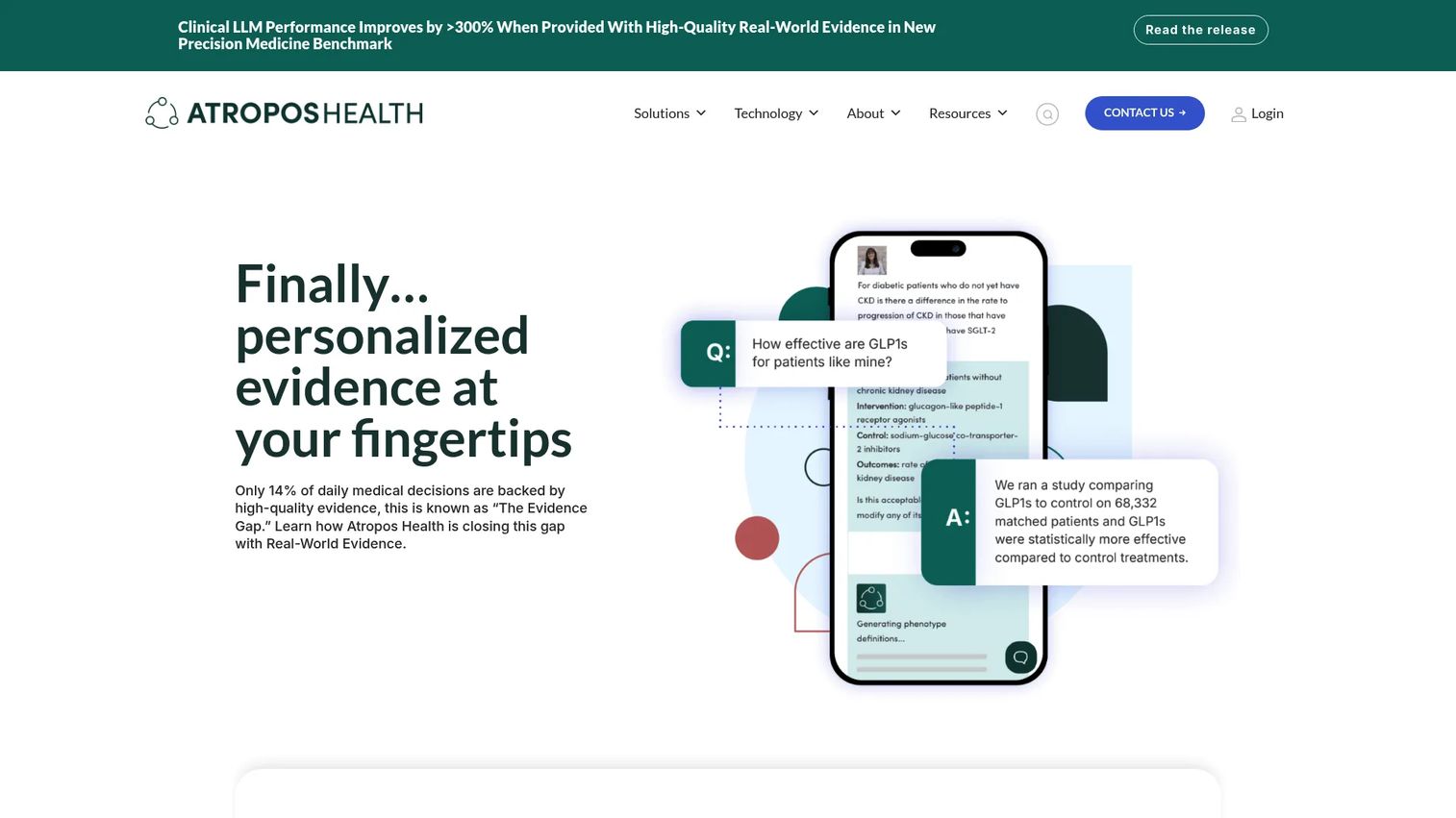
Atropos Health is a healthcare technology company providing real-world evidence generation and evidence-based clinical intelligence for health systems and life sciences organizations. The platform uses AI to answer clinical and operational questions using real-world data, with federated access to multimodal healthcare data and integration into EHR and clinical workflow tools including Microsoft Teams.
Best for: Health systems and life sciences teams that need timely evidence generation to support clinical decisions, quality programs, or value based care performance.
Key features
- AI-powered clinical evidence generation and question answering
- Real-world and observational study generation from federated data
- Evidence Network access with Silver, Gold, and Platinum packages
- Clinical workflow integrations including EHR and ambient documentation tools
- Data quality scoring and evidence assessment
Why choose Atropos Health: This is a more specialized choice than a broad performance management platform. It fits when the central job is generating evidence from real-world data to answer specific clinical or operational questions, rather than building an enterprise-wide reporting environment. Pair it with a broader analytics platform if your needs extend to financial, operational, and population health dashboards.
Atropos Health pricing: Atropos offers Silver, Gold, and Platinum packages for its Evidence Network but does not post prices. Contact sales for a quote.
7. Truven Health Insights
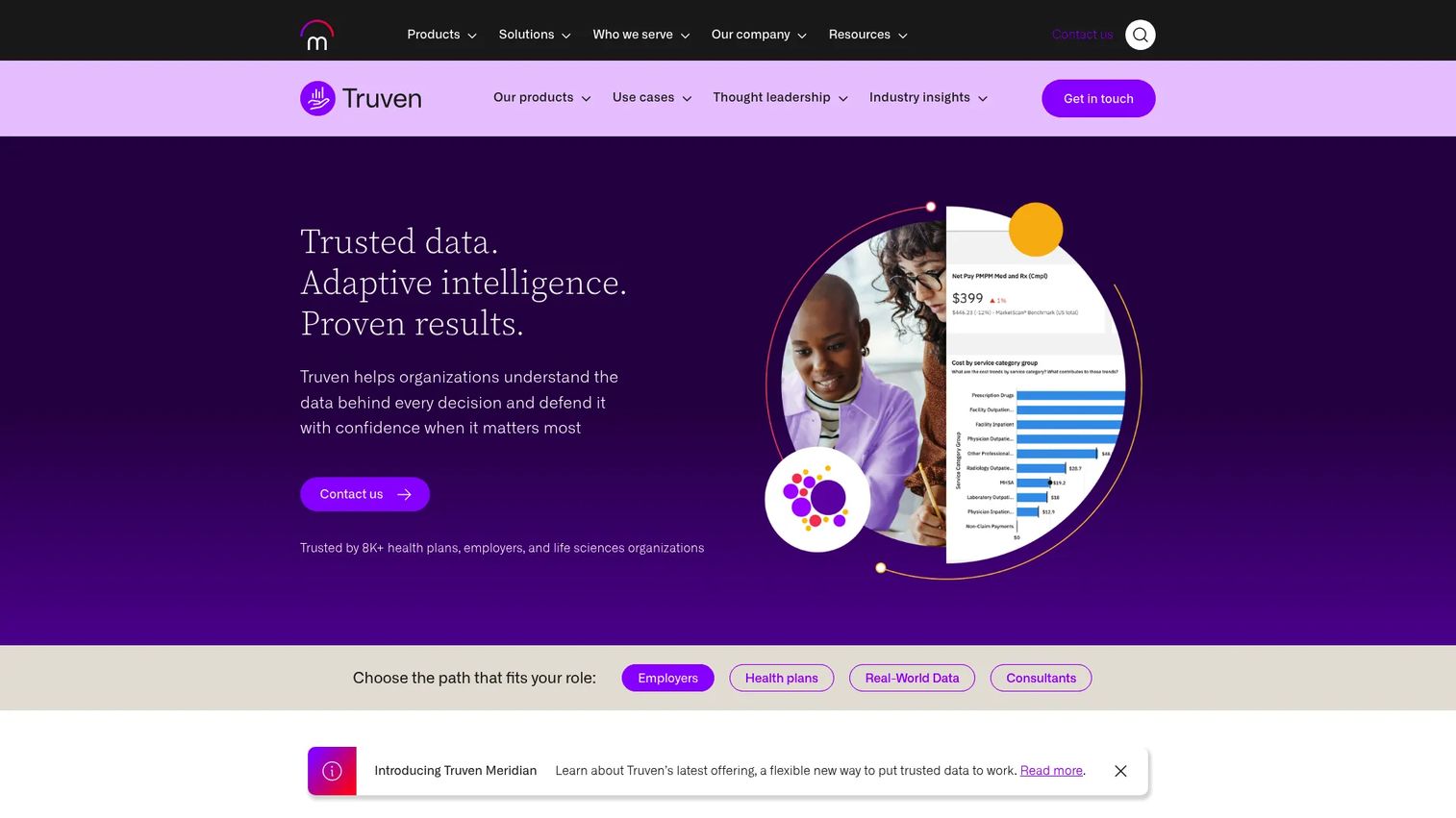
Truven Health Insights is a healthcare analytics platform that helps employers, health plans, and benefits advisors analyze health and wellness program performance, costs, and population trends. The platform offers self-service dashboards for KPIs and population health cost trends, program evaluation and ROI analysis, predictive analytics, risk models, and benchmarking with MarketScan datasets.
Best for: Health plans, benefits advisors, and employers evaluating utilization, cost trends, and program impact across covered populations.
Key features
- Self-service dashboards for KPIs, cost trends, and population health
- Program evaluation and ROI analysis
- Interactive visualizations and no-code ad hoc reporting
- Predictive analytics and risk models
- Benchmarking with MarketScan datasets
Why choose Truven Health Insights: The appeal is in benefits and payer-adjacent analytics, where the recurring question is which population or program is driving cost. This is distinct from clinical workflow platforms or real-world evidence tools. If employer group reporting, utilization analysis, and program savings quantification are the primary outputs your team needs to produce, Truven Health Insights is positioned for that job.
Truven Health Insights pricing: Pricing requires a sales conversation. Contract scope depends on population size, modules, data feeds, and deployment.
Truven Health Insights holds a 4.0/5 rating on G2.
8. Sisense
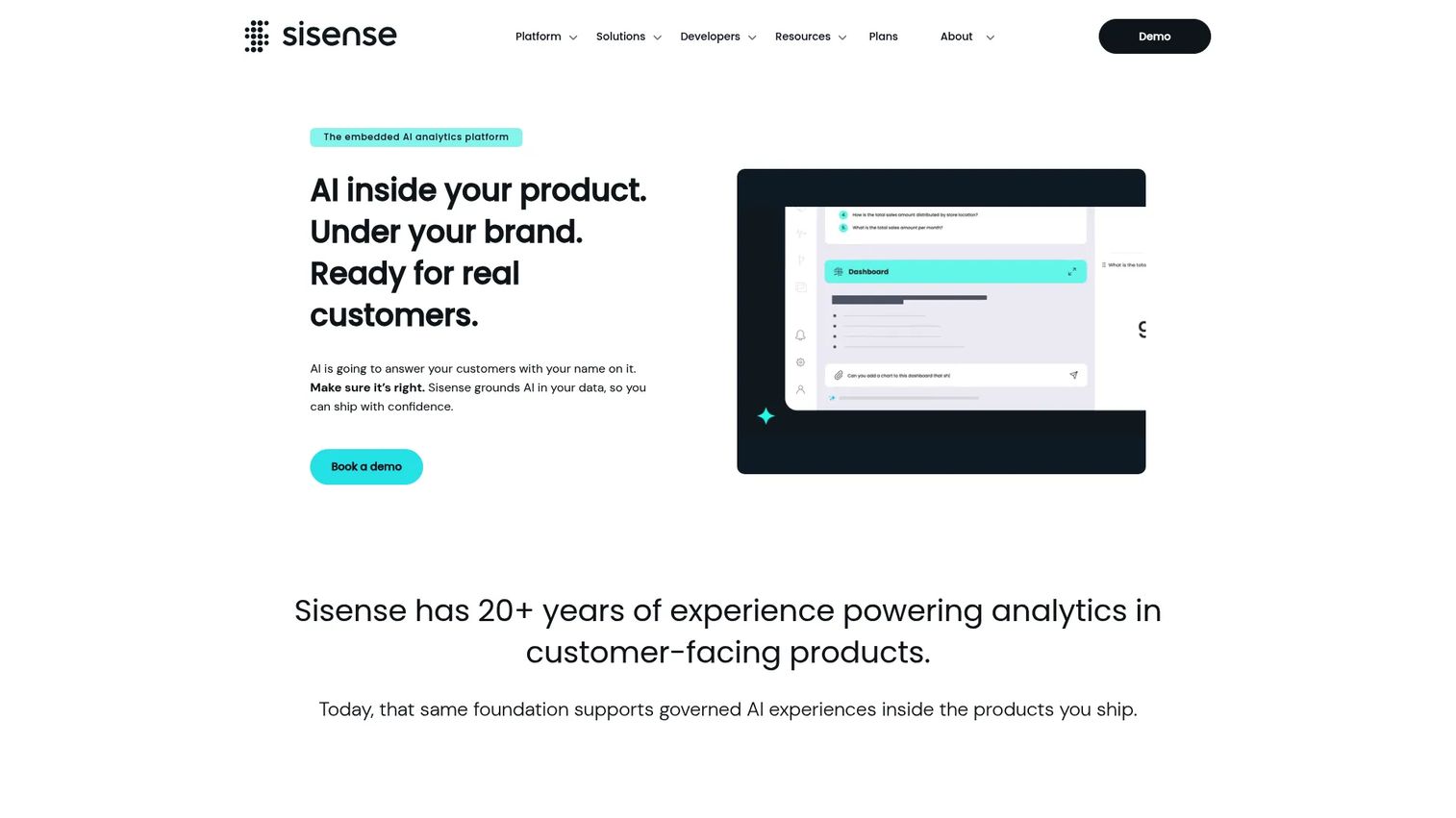
Sisense is an AI-powered analytics platform for building, embedding, and infusing analytics into applications and workflows. It supports data modeling and blending, embedded analytics via iFrame, Embed SDK, and Compose SDK, along with AI-powered conversational analytics and Sisense Intelligence. Deployment options include cloud and on-premises environments with enterprise security controls.
Best for: Health tech companies and internal analytics teams that need customizable embedded analytics experiences inside a product or portal, built on a governed data layer they already own.
Key features
- AI-powered conversational analytics and Sisense Intelligence
- Embedded analytics via iFrames, Embed SDK, and Compose SDK
- Data modeling and blending across multiple sources
- API-first composability for product integrations
- Secure cloud and on-premises deployment options
Why choose Sisense: The build-versus-buy distinction matters here. Sisense is a strong fit when the organization needs a flexible business intelligence software layer inside a product or portal. It does not replace a healthcare-specific data model, care management logic, or population health programs. Bring a usable data layer before evaluating.
Sisense pricing: Sisense offers Self-Serve and Enterprise plans. Neither tier publishes a public price. Contact sales for a quote based on users, deployment model, and integration requirements.
Sisense holds a 4.2/5 rating on G2.
9. SAS
SAS provides enterprise data, analytics, AI, decisioning, governance, and visualization software, primarily through its SAS Viya platform. Core capabilities cover data access, preparation, quality, and management alongside advanced analytics, statistics, machine learning, and optimization. AI governance, model management, and deployment tools make it relevant for organizations that need modeling control alongside enterprise-scale governance.
Best for: Large healthcare organizations with dedicated data science resources and advanced predictive analytics or AI governance requirements.
Key features
- Advanced analytics, statistics, machine learning, and optimization
- Data access, preparation, quality, and management
- Interactive data visualization, reporting, and dashboards
- AI governance, model management, deployment, and monitoring
- Conversational and generative AI capabilities
Why choose SAS: SAS fits organizations with sophisticated analytics teams and a genuine need for deep modeling control, regulated AI deployment, or enterprise data governance at scale. It is more platform than a lean team needs for basic reporting and dashboard requirements. Match the tooling to the team's actual modeling capacity before purchasing.
SAS pricing: SAS directs prospective customers to request a demo or price quote. No public numeric price is posted. Licensing conversations depend on deployment model, modules, and organizational scope.
SAS holds a 4.5/5 rating on G2.
10. Tableau
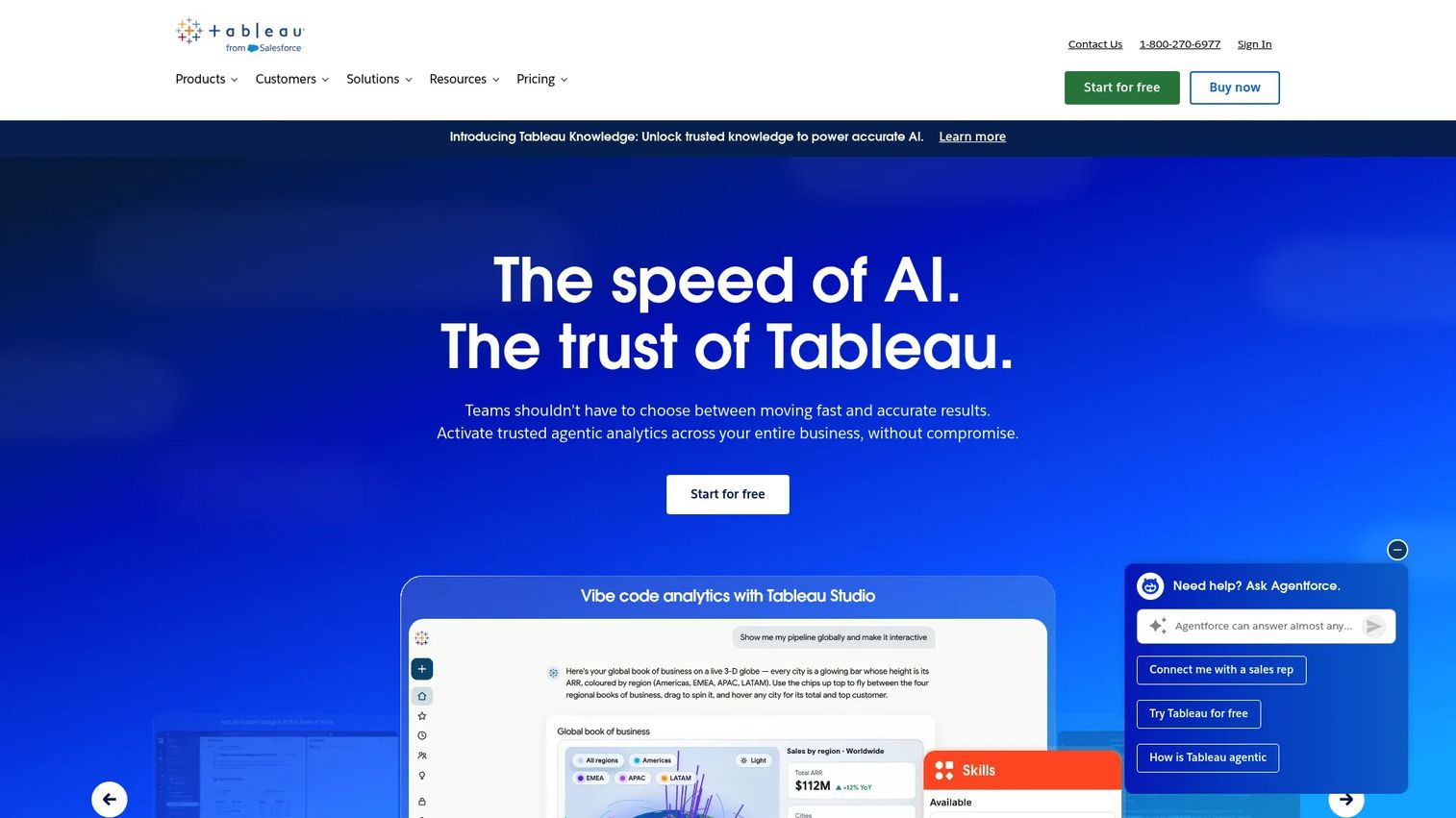
Tableau is a widely adopted visual analytics platform for exploring, managing, and sharing data through interactive visualizations. The platform includes Tableau Prep for data preparation, Tableau Pulse for AI-assisted metrics monitoring, and governance features covering lineage, impact analysis, and data quality warnings. Tableau Public and Tableau Desktop Free Edition offer free access for non-commercial or personal use.
Best for: Organizations with an established, governed data warehouse that need strong self-service dashboarding and broad visualization adoption across executive, analyst, and operating teams.
Key features
- Interactive data visualization and dashboards
- Tableau Prep for data preparation, combining, and shaping
- Tableau Pulse metrics and AI-assisted insights
- Data governance including lineage, impact analysis, and quality warnings
- Cloud-hosted and self-managed deployment options
Why choose Tableau: Tableau delivers strong self-service adoption when the data team has already solved integration and modeling. It is not a replacement for healthcare-specific workflows, care management logic, or population health programs. The most effective Tableau deployments in healthcare sit on top of a governed warehouse with clear data ownership, not directly on raw EHR or claims exports.
Tableau pricing: Standard Viewer starts at $15/user/month (billed annually). Standard Explorer costs $42/user/month and Standard Creator $75/user/month, both billed annually. Enterprise tiers start at $35/user/month for Viewer, $70 for Explorer, and $115 for Creator, billed annually. Cloud+ Edition and Tableau+ Bundle pricing require contacting sales.
Tableau holds a 4.4/5 rating on G2.
Considerations when choosing healthcare analytics software
Start with the operating decision
Choose one recurring decision that matters to your business before evaluating platforms. Reducing readmissions, closing care gaps, improving claims accuracy, and identifying revenue leakage are each distinct use cases with different data requirements. Buying a platform because it has more dashboards than your current stack is the fastest path to a shelfware contract.
Validate data readiness before platform capability
EHR, claims, scheduling, finance, and CRM data often carry different identifiers, definitions, refresh cycles, and ownership. Ask every vendor to show how they handle normalization, lineage, refresh failures, and exception management using your actual source systems. The connector list matters less than how long it takes to get those connectors working reliably.
Separate interoperability standards from implementation reality
Support for HL7 and FHIR context is a floor, not a differentiator. The harder question is how long it takes to connect the specific systems already in use at your organization. Require a source-to-target data map during evaluation, not after signing. This is where most healthcare platform implementations slow down, and where analytics platforms that drive ROI pull ahead of those that don't.
Test governance and access controls
Evaluate role-based access, auditability, user provisioning, deployment model, and data retention policies. Healthcare data carries real governance obligations. Understand the vendor's security posture, but route your specific compliance questions to your own legal and security teams rather than treating vendor documentation as a compliance outcome.
Build a 30, 60, and 90 day adoption plan
- First 30 days: Confirm data sources, owners, baseline metrics, and one initial use case
- By 60 days: Publish a governed dashboard or report for a named operating team
- By 90 days: Measure whether the platform changed the targeted decision or reporting cycle
If a platform cannot show a credible path to that 90-day milestone, the contract is a risk regardless of the feature set.
Conclusion
No single platform wins across every healthcare analytics use case. The right choice depends on the decision you are trying to improve, the data sources behind it, and the team that will own it day to day.
Health Catalyst is the strongest broad option for health systems that want clinical, financial, and operational analytics tied to improvement programs. Arcadia and Innovaccer are the most relevant choices for population health management and care data activation. MedeAnalytics and Truven Health Insights address financial, payer, and employer analytics more directly. Clarify Health and Atropos Health serve more specialized jobs in referral performance and real-world evidence generation. Sisense, SAS, and Tableau each fit organizations with established data foundations that need flexible analytics, advanced modeling, or broad visualization adoption.
Before committing to any of them, pick one recurring decision, map the data needed to answer it, and ask each shortlisted vendor to walk you through the workflow using a representative scenario. Evaluate adoption and governance before signing a long contract.
If you are a health tech company selling analytics products to buyers in this category, let your buying committee explore complex reporting workflows without scheduling multiple calls. An interactive demo lets prospects experience your product on their own terms before a live conversation.
Start your journey with Guideflow today!
FAQs
Healthcare analytics software collects, standardizes, analyzes, and presents healthcare data so organizations can improve clinical, financial, operational, or population health performance. It typically integrates data from multiple source systems and provides governed reporting, dashboards, and predictive analysis to support recurring operating decisions.
The relevant sources depend on the decision being improved. Common integrations include EHR systems, medical and pharmacy claims, billing and revenue cycle platforms, scheduling systems, lab and care management data, and patient engagement tools. Starting with the two or three sources that feed the most important recurring decision is more practical than integrating everything at once.
Healthcare business intelligence software typically focuses on reporting and visualization. Healthcare analytics software may add healthcare-specific data models, clinical quality measures, care management support, predictive models, and operational workflows on top of basic reporting. The distinction matters when evaluating whether a general BI tool can serve clinical or population health use cases without significant custom development.
Value based care analytics requires attributed population management, risk stratification, quality measure tracking, care gap identification, utilization monitoring, and contract performance reporting. Platforms built for this use case connect those data streams and surface the gaps that care teams need to close. Reporting alone is not enough. Execution workflows that connect insight to outreach or care management are what move quality metrics.
Yes. Common uses include forecasting demand and capacity, identifying high-risk patients for outreach, summarizing clinical data, detecting anomalies in financial or claims data, and generating evidence from real-world datasets. Buyers should evaluate governance, model transparency, data quality requirements, and human review expectations for any AI-assisted output before relying on it for clinical or operational decisions.
Most specialized healthcare platforms do not post prices. Contract value depends on covered lives, data sources, implementation services, modules, deployment model, and number of users. General BI platforms like Tableau publish per-user pricing starting at $15/user/month for Viewer access. Specialized platforms such as Health Catalyst, Arcadia, and Innovaccer price by enterprise contract and require a sales conversation.
Building fits organizations with a mature healthcare data engineering team, a stable warehouse, and a differentiated analytics requirement that no vendor covers well. Buying is more practical when the organization needs healthcare-specific data models, clinical quality logic, and vendor support faster than an internal build can deliver. Most Series B health tech companies are better served by buying a governed data layer than by treating data infrastructure as a product investment before the core use case is proven.
Five checks matter most: A defined operating decision the platform will improve, usable source data in the systems the platform connects to, a clear owner for implementation and ongoing maintenance, governance requirements that fit the deployment model, and a measurable 90-day outcome the vendor agrees to help you hit. A platform that cannot show a credible first-quarter win is a long contract risk regardless of its feature depth.