Your company just promoted eight engineers and three account leads into management roles in the last quarter. Now you have eleven people running teams who have never had a formal conversation about performance feedback, career development, or how to handle the moment a direct report stops caring.
That is the problem DDI management addresses. In this article, "DDI management" refers to Development Dimensions International, the leadership development and assessment provider, not real estate, technology financing, or network infrastructure management. The leadership development market reached USD 672.8 million in 2025, on track to more than double by 2030, according to Research and Markets (2026). Organizations across every industry are scaling their investment because ad hoc manager training stops working the moment you have more than a handful of team leads to develop.
When you evaluate providers, you are comparing on different dimensions: Assessment science, coaching access, content breadth, succession data, and measurable behavior change. Which of those dimensions matters most for your operating model and leadership gaps determines which provider fits.
What's inside
This guide compares seven leadership development and assessment providers for 2026, written for product leaders and people managers at scaling SaaS organizations.
- Who it's for: Product managers, people leaders, and program owners evaluating leadership development partners
- Selection criteria: Assessment depth, development delivery model, succession support, and measurable outcomes
- Coverage scope: Frontline manager programs through executive development and succession planning
- Approach: Verified pricing and G2 ratings as of October 2026, sourced from each provider's official site and G2 listings
TL;DR
- Best for integrated assessment, development, and succession: DDI covers the full system in one program, from identifying readiness gaps to measuring behavior change across leadership levels
- Best for executive talent strategy and succession: Korn Ferry ties leadership development to organizational design and senior talent decisions
- Best for scalable coaching access: BetterUp delivers human and AI coaching to managers and emerging leaders at enterprise scale
- Best for standardized manager habits: FranklinCovey gives distributed teams a shared framework and reinforcement model
- Best for research-led development: Center for Creative Leadership builds programs on 50-plus years of leadership research
- Best for strategy-execution learning: BTS runs customized simulations that connect leadership behavior to real business decisions
- Best for academic case-based learning: Harvard Business Publishing Corporate Learning draws on Harvard Business School content for structured cohort experiences
What is DDI management?
DDI management, as a leadership development category, refers to programs and services provided by organizations such as Development Dimensions International (DDI) to help companies identify, develop, and promote effective leaders across all levels.
The core components of a full leadership management program typically include:
- Leadership assessment: Evaluating current capability, potential, and readiness gaps using validated tools
- Development pathways: Role-specific learning for frontline managers, mid-level leaders, and executives
- Succession planning: Identifying candidates for critical roles and tracking readiness over time
- Facilitated learning and coaching: Cohort programs, workshops, simulations, and personalized coaching
- Impact measurement: Connecting program participation to observable manager behavior and business outcomes
The major category splits
Providers in this space approach leadership management from different starting points:
| Category | Primary job | Typical buyer signal |
|---|---|---|
| Assessment-led firms | Identify readiness and development gaps with validated science | Needs succession data or selection support |
| Content and learning platforms | Scale manager capability across large populations | Needs common frameworks, language, and volume |
| Coaching platforms | Personalize development for individual leaders | Managers need behavior change, not just content |
| Simulation and transformation firms | Connect leadership work to strategy execution | Undergoing major operating-model or strategic change |
| Academic learning providers | Deliver research-based content through case method and cohorts | Wants credentialed, intellectually rigorous development |
Knowing which category fits your primary need sharpens the evaluation considerably.
When to use leadership development and assessment providers
Build a first-time manager program
Rapid promotions are a forcing function. When your promotion cadence outpaces your manager-development infrastructure, coaching quality becomes uneven and attrition risk rises. A structured first-manager program delivers a role-based curriculum, practice-based learning with reinforcement, and pre/post assessment so you can measure whether managers actually shift their behavior, not just complete the program.
Prepare high-potential leaders for larger roles
Leadership vacancies and executive transitions create succession pressure. The right provider helps you establish readiness criteria, run potential assessments, build development plans for each candidate, and review movement in succession dashboards across quarterly calibration cycles. Without that infrastructure, bench strength exists in intuition rather than data.
Improve leadership during organizational change
SaaS companies reorganize frequently: Product portfolio shifts, operating-model redesigns, expansion into enterprise segments, and distributed-team growth all put pressure on managers who were developed for a different operating context. The provider you choose for change conditions needs to support behavior change during live work, not deliver a one-time workshop that has no reinforcement once the cohort ends.
DDI management alternatives comparison
Verified pricing and G2 ratings as of October 2026. All enterprise engagement pricing requires direct contact with the provider.
| # | Product | Best for | Key differentiator | Pricing | G2 rating |
|---|---|---|---|---|---|
| 1 | DDI | Integrated assessment, development, and succession | Behavioral-science-led leadership systems | Contact for quote | 4.0/5 |
| 2 | Korn Ferry | Executive assessment and succession strategy | Talent intelligence connected to organizational strategy | Contact for quote | 4.2/5 |
| 3 | BetterUp | Scalable one-to-one and group coaching | Human and AI coaching with workforce analytics | Contact for quote | 4.5/5 |
| 4 | FranklinCovey | Manager habits and enterprise learning content | Leadership frameworks with habit reinforcement | From $449/year (individual); enterprise contact | 4.6/5 |
| 5 | Center for Creative Leadership | Research-led leadership development | 50-plus years of leadership research applied to programs | Contact for quote | 4.5/5 |
| 6 | BTS | Leadership tied to business transformation | Customized simulation-based strategy-execution programs | Contact for quote | Not listed |
| 7 | Harvard Business Publishing Corporate Learning | Academic content and cohort learning | Harvard Business School case-based learning at scale | Contact for quote | 5.0/5 |
Best 7 DDI management alternatives for 2026
1. DDI
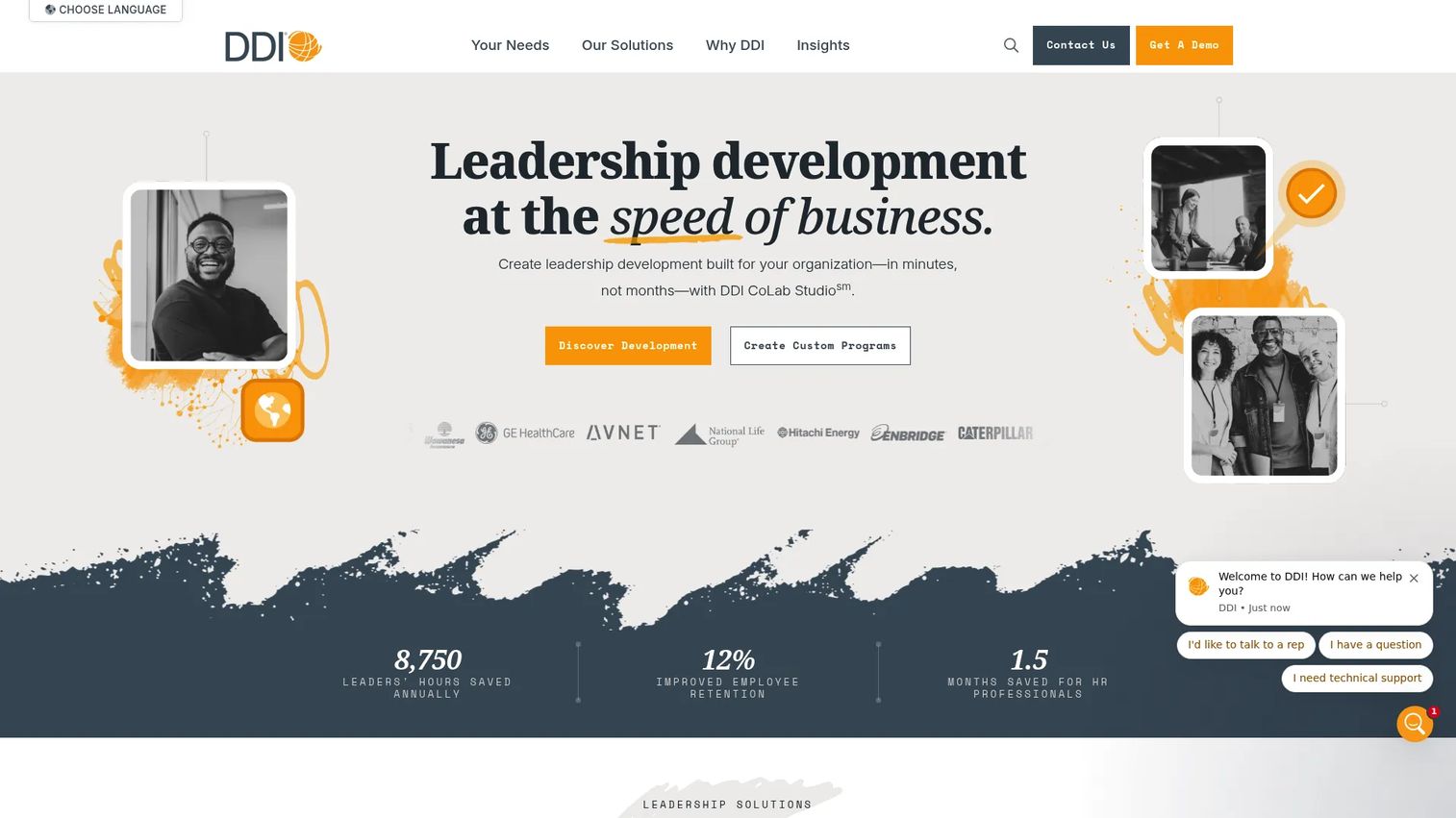
DDI (Development Dimensions International) is a global leadership consulting company offering assessment, development, succession, and facilitation programs. It has operated since 1970 and positions its approach on behavioral science applied across leadership levels. The platform covers the full leadership system rather than isolated components, which matters when you need readiness evidence, structured development, and pipeline planning to operate from a single provider.
Best for: Organizations that need one provider to connect leadership assessment, development pathways, and succession readiness.
Key features
- Leadership assessments and potential evaluation tools
- Virtual and in-person leadership development programs
- Online courses and microlearning modules
- Practice simulations and an AI leadership coaching chatbot
- Impact measurement for behavior change and business outcomes
Why choose DDI: If you are running leadership programs at multiple levels simultaneously and need assessment data to connect directly to succession planning, DDI's integrated model reduces the overhead of stitching separate vendors together.
DDI pricing: DDI directs prospects to request a quote for enterprise engagements. Pricing depends on cohort size, program scope, assessment volume, and facilitation requirements. Contact DDI at ddi.com/lp/request-quote to get a proposal.
G2 rating: 4.0/5
2. Korn Ferry
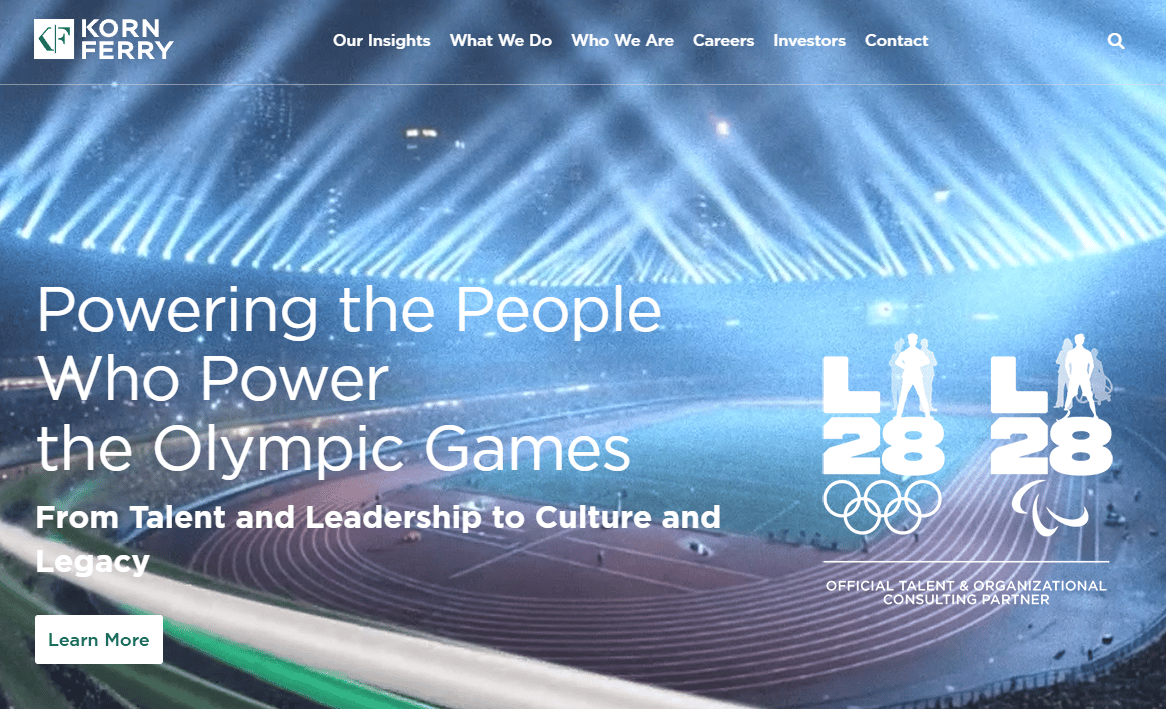
Korn Ferry is a global consulting firm helping organizations improve performance through talent, leadership, and organizational transformation. Its leadership offering spans executive assessment, succession planning, talent architecture, and organizational design, with a proprietary analytics and AI platform connecting people data to strategic decisions.
Best for: Large organizations where leadership development is inseparable from executive talent decisions and enterprise succession planning.
Key features
- Executive assessment programs
- Leadership development journeys and programs
- Succession planning advisory and support
- Talent and competency framework design
- Organizational structure and rewards advisory
Why choose Korn Ferry: Choose Korn Ferry when executive selection, job architecture, and succession are part of the same initiative. It fits SaaS companies preparing for a major leadership hire, an operating-model redesign, or a shift to enterprise go-to-market that requires senior-level bench strength.
Korn Ferry pricing: Korn Ferry does not display pricing on its website. All engagements require a direct conversation with their team. Scope typically varies by advisory depth, assessment volume, and consulting hours.
G2 rating: 4.2/5
3. BetterUp
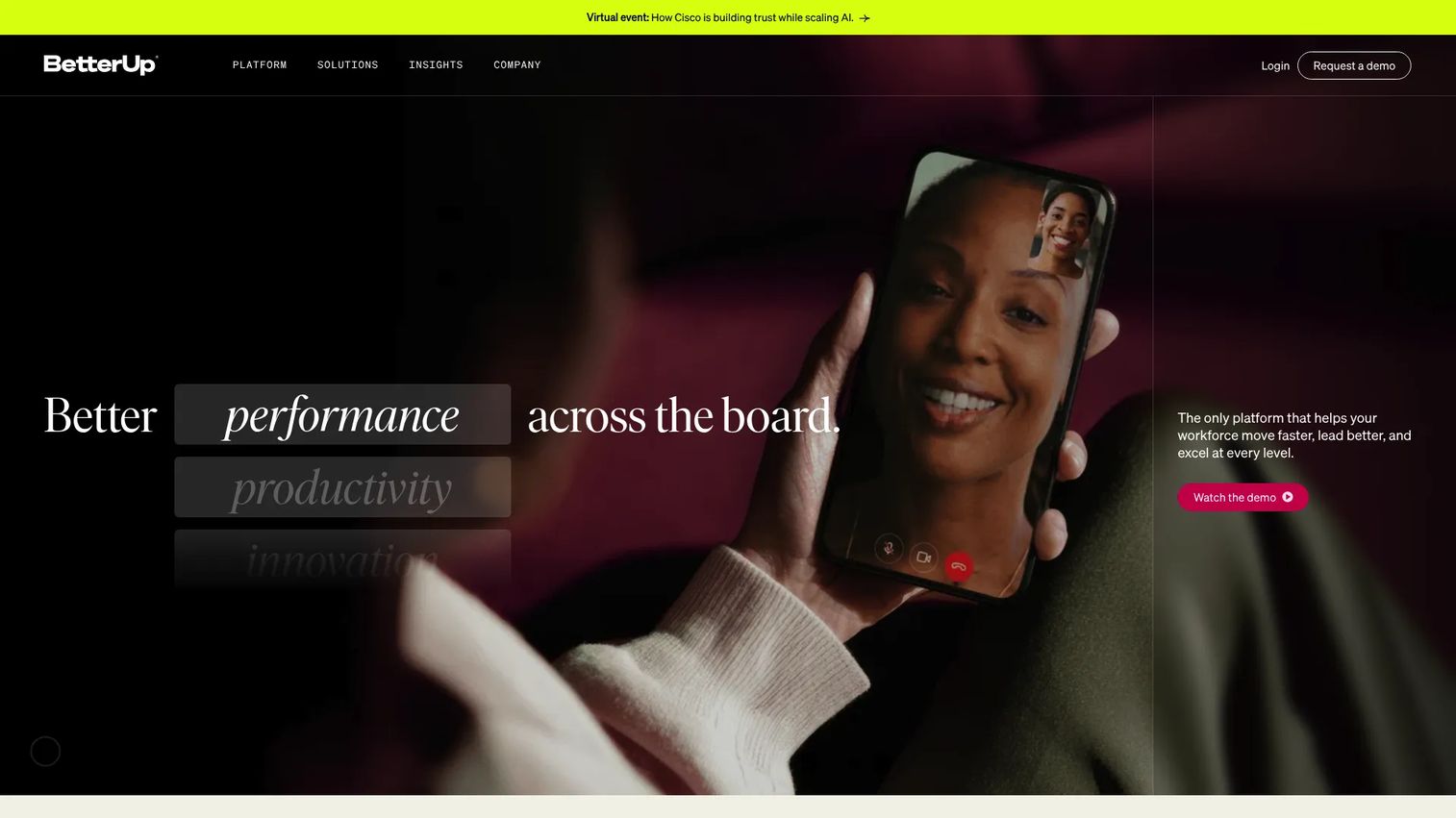
BetterUp provides human and AI-powered coaching for leaders, managers, and workforces. Its platform delivers personalized coaching at enterprise scale, combining one-to-one sessions with professional coaches, group coaching programs, AI coaching available 24/7 via text and voice, and integrations with Slack, Microsoft Teams, and Workday.
Note: BetterUp's individual consumer plans are winding down as of January 31, 2026. The platform is now focused entirely on enterprise and team-based deployments.
Best for: Organizations where the core bottleneck is manager confidence, behavior change, and individualized development rather than a full succession-management system.
Key features
- One-to-one human coaching with professional coaches
- 24/7 AI coaching via text and voice
- Group coaching programs and Coaching Circles
- Personalized assessments and coaching plans
- Program-level analytics and workforce insights
Why choose BetterUp: For product leaders who need help with stakeholder influence, delegation, difficult conversations, and team performance, BetterUp's coaching model addresses the specific behaviors that matter most. It works best when individual manager development is the priority rather than population-level leadership assessment.
BetterUp pricing: Enterprise pricing requires a customized proposal from BetterUp's sales team. Reach them at betterup.com/contact-sales. Contract structure varies by organization size, coaching hours, and program scope.
G2 rating: 4.5/5
4. FranklinCovey
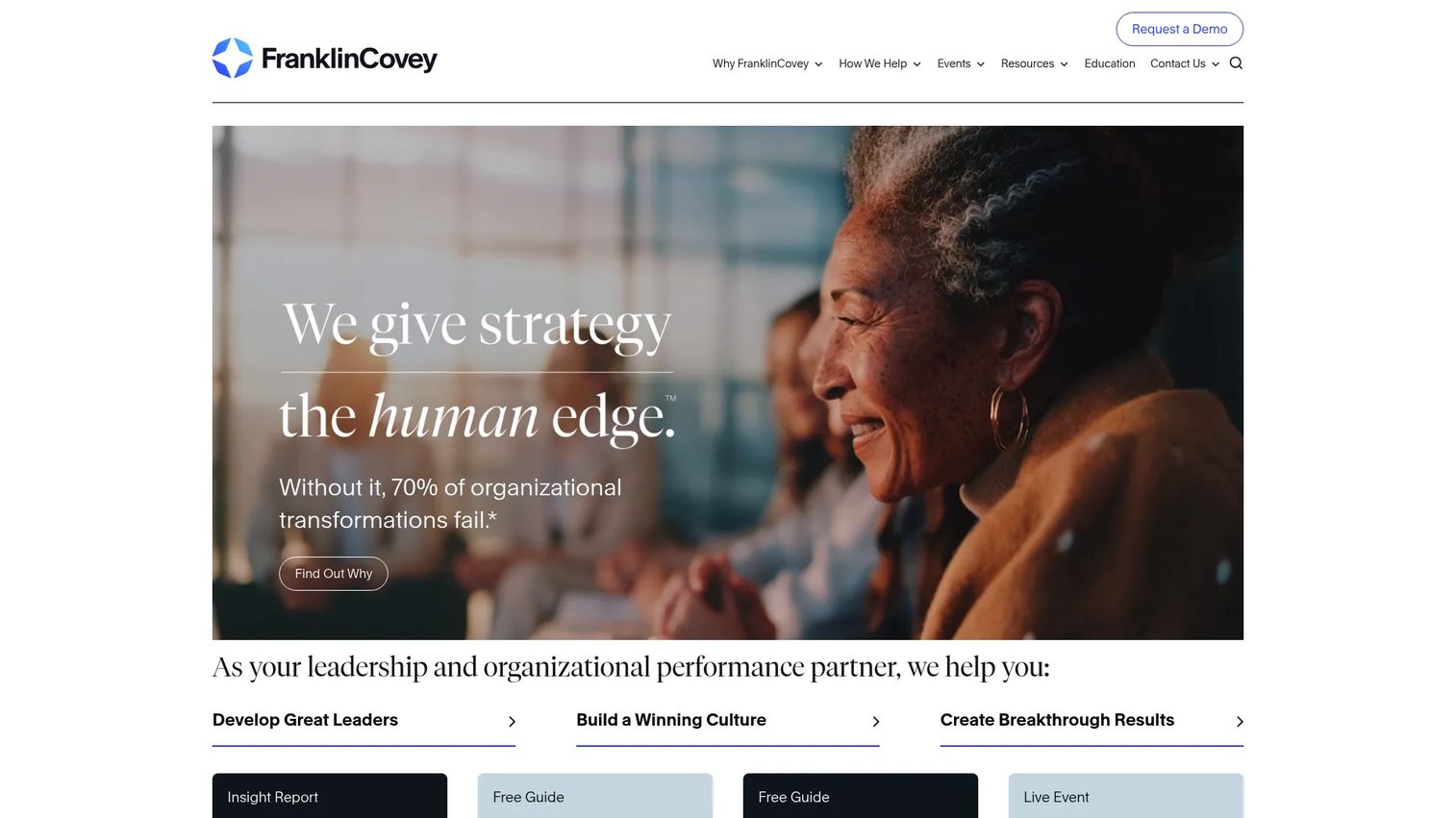
FranklinCovey provides organizational performance programs focused on leadership, culture, execution, trust, and productivity. It has served organizations for more than 40 years and offers facilitator-led programs, an Impact Platform for digital delivery, and content libraries across 16 topic collections covering 88 courses.
Best for: Companies standardizing manager expectations and leadership habits across a distributed employee population.
Key features
- On-demand, live-online, and live in-person delivery
- Impact Platform with learning journeys and progress tracking
- Leadership, culture, trust, and execution programs
- Coaching, consulting, and facilitator certification support
Why choose FranklinCovey: FranklinCovey fits organizations that need a shared leadership language across engineering, product, sales, and customer teams. Its established frameworks give managers a repeatable model for execution and accountability that does not require heavy facilitation to reinforce.
FranklinCovey pricing: Individual On Demand membership starts at $449 for one year of unlimited access to 88 courses across 16 collections. Enterprise All Access Pass pricing requires contacting FranklinCovey directly, as organizational rates are not publicly displayed.
G2 rating: 4.6/5
5. Center for Creative Leadership
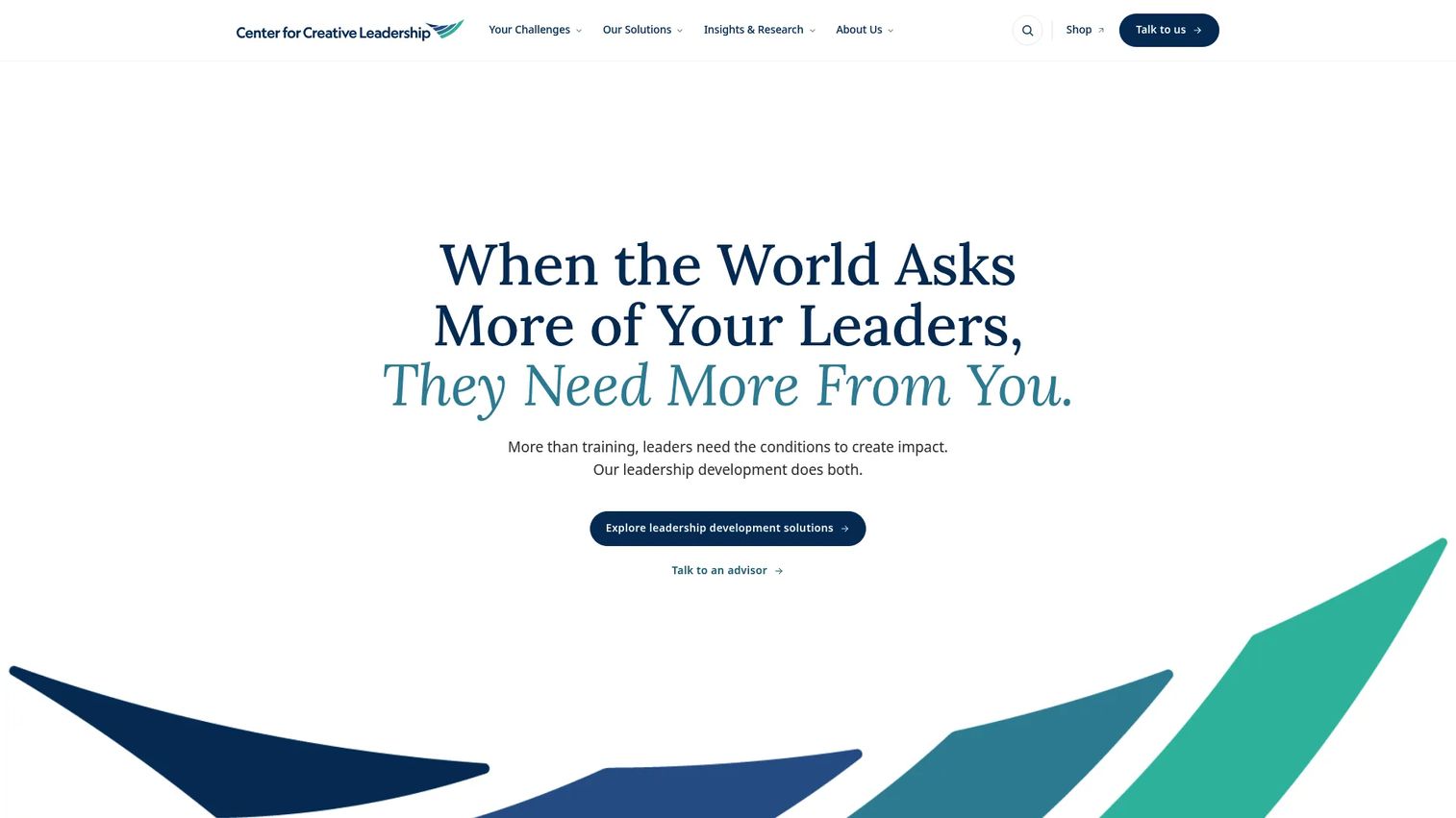
Center for Creative Leadership (CCL) is a nonprofit provider of research-based leadership development programs, assessments, coaching, and enterprise learning. It has operated for more than 50 years and covers frontline through executive leader populations with both open-enrollment programs and custom organizational solutions.
Best for: Organizations seeking research-backed leadership development that goes beyond a content library and includes structured assessment and coaching.
Key features
- Leadership programs for executive, mid-level, frontline, and new managers
- 360-degree leadership assessments
- Individual and team coaching services
- Custom organizational leadership programs
- CCL Passport enterprise content subscription
Why choose Center for Creative Leadership: CCL fits buyers who value a research foundation and need development that is grounded in evidence about what actually changes leadership behavior. It works well when a growing product organization needs newly formed leadership layers to improve decision quality and cross-functional communication.
CCL pricing: Program and enterprise pricing requires contacting CCL. Selected shop items are publicly priced: Individual publications start at $19.95, and assessment components include a $2,000 setup fee plus $380 per participant. Enterprise CCL Passport subscription pricing is available by request.
G2 rating: 4.5/5
6. BTS
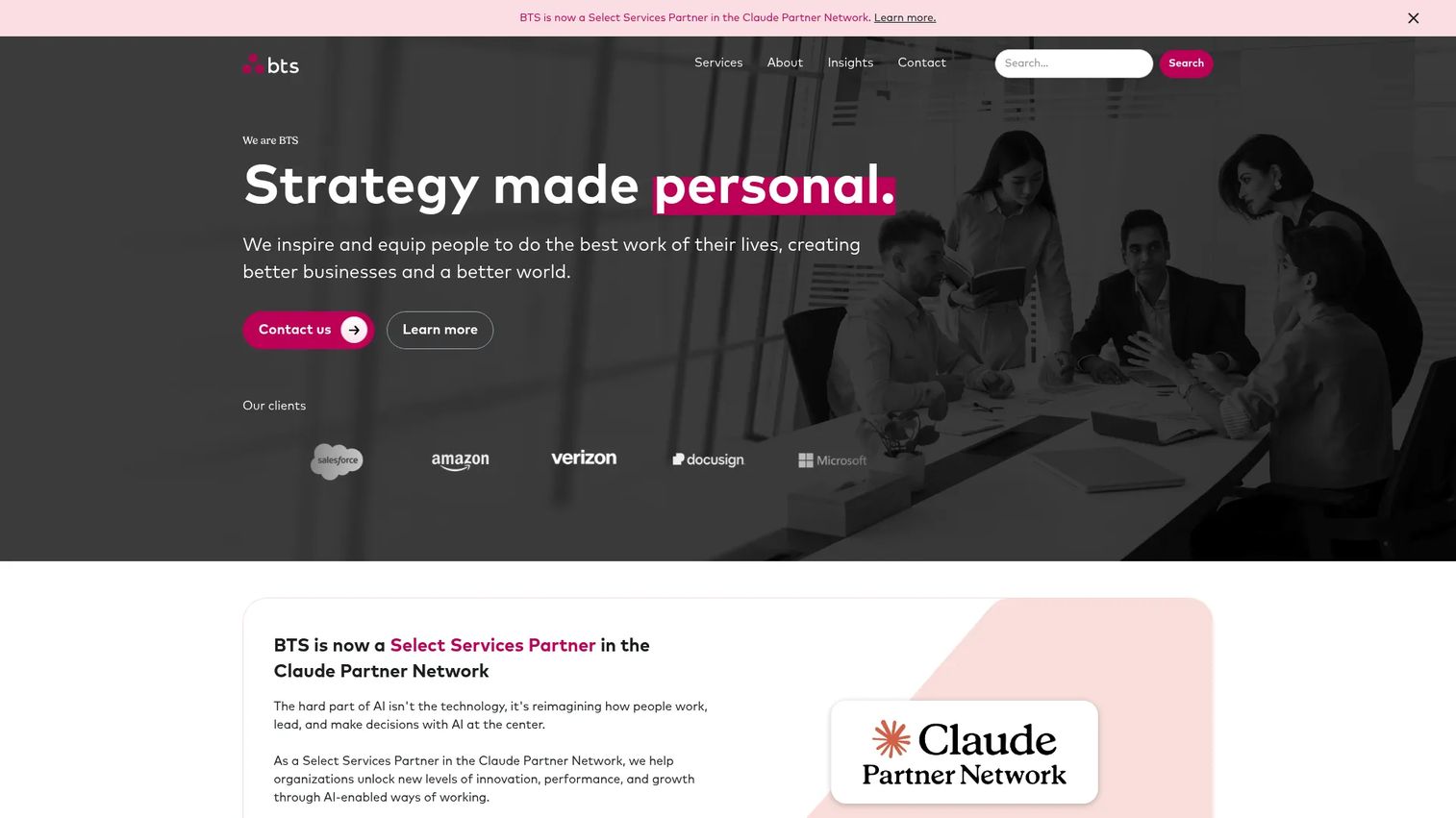
BTS is a global professional services firm providing customized experiential learning, leadership development, and strategy-execution programs. Its approach centers on business simulations, digital and virtual learning, and AI-powered role-play experiences connected to real operating decisions. BTS has more than 30 years of North American market experience and works primarily with large enterprises.
Best for: Organizations working through major transformation, operating-model change, or strategy execution challenges where leadership development must connect to real business decisions.
Key features
- Customized business simulations for leadership, strategy, and culture
- Digital self-paced and virtual simulation experiences
- AI-powered contextual role-play with CRM and Slack integration
- Bite-sized digital learning for distributed teams
- Custom enterprise transformation programs
Why choose BTS: Choose BTS when your leadership teams need to practice decisions, strategic tradeoffs, and cross-functional execution in realistic scenarios. It is most relevant for product-led companies undergoing a shift in market positioning, pricing model, or enterprise operating cadence where behavioral rehearsal matters.
BTS pricing: BTS does not publish standard pricing. All programs are custom engagements designed around cohort size, simulation scope, and facilitation requirements. Contact BTS through bts.com to scope a program.
7. Harvard Business Publishing Corporate Learning
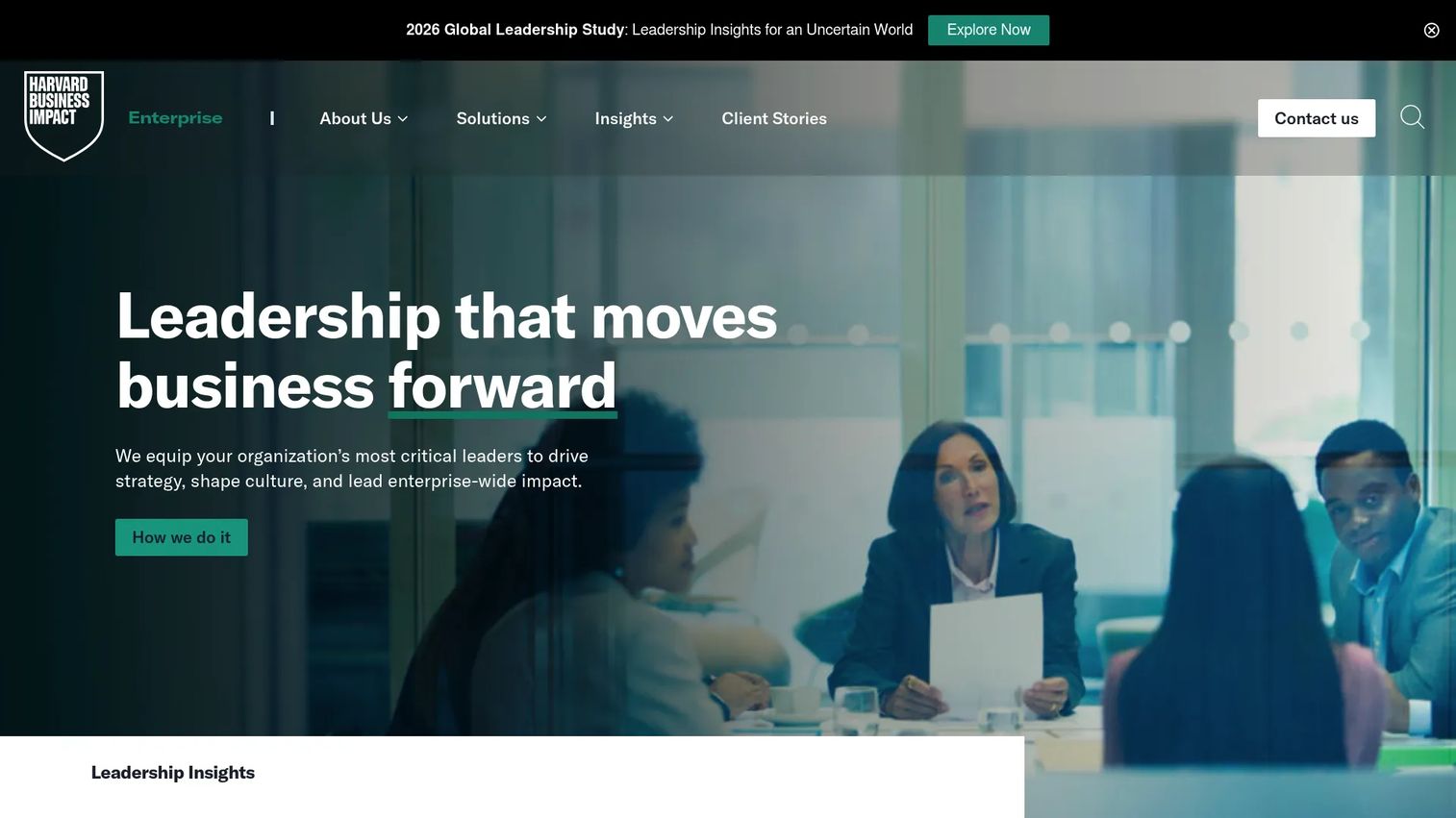
Harvard Business Publishing Corporate Learning delivers research-based, technology-enabled leadership development for organizations. Its corporate learning business, now operating under the Harvard Business Impact brand following a June 2025 rebrand, offers 25,000-plus resources including articles, videos, podcasts, and practice-centric lessons, alongside blended learning experiences that mix on-demand content with cohort-based programs.
Best for: Organizations that want academically grounded leadership content and structured cohort experiences built on Harvard Business School case-based learning.
Key features
- Personalized learning with skill-based and AI-driven recommendations
- 25,000-plus resources across articles, videos, and podcasts
- Custom learning pathways with progress and completion tracking
- Leadership labs and practice-centric interactive lessons
- Blended learning with on-demand, cohort-based, virtual, and onsite delivery
Why choose Harvard Business Publishing Corporate Learning: It fits product managers and new product leaders who benefit from case-based decision-making, business strategy frameworks, and organizational leadership content grounded in research. Cohort-based programs work particularly well for high-potential programs where peer discussion and structured reflection accelerate development.
Harvard Business Publishing Corporate Learning pricing: Enterprise pricing requires contacting the team directly. No pricing tiers are publicly displayed. Reach Harvard Business Publishing Corporate Learning at harvardbusiness.org to discuss program scope and licensing options.
G2 rating: 5.0/5 (rating applies to the Harvard ManageMentor product within the Corporate Learning portfolio)
Considerations when choosing a DDI management alternative
Assessment depth and decision use
Separate programs built for development feedback from those built to support selection, promotion, or succession decisions. Ask each provider whether their assessments are validated for the specific decisions your organization plans to make, and what the evidence base is. Using a development-only assessment for a succession decision introduces risk.
Role-specific learning design
Generic leadership content ignores the context your managers actually work in. Product, engineering, sales, and customer-success leaders need the same leadership principles applied through different scenarios. Evaluate whether the provider builds role-specific paths or expects you to configure them yourself after purchase.
Reinforcement after the workshop
Attendance is not behavior change. Look for what the provider includes after a cohort session: Manager practice assignments, coaching touchpoints, peer accountability structures, and measurement tied to behavior rather than completion. Programs without reinforcement often produce satisfaction scores without producing observable outcomes.
Succession data and governance
If succession is a stated goal, define ownership of readiness criteria, review cadence, and privacy controls before you sign. Confirm how assessment data connects to your existing talent planning systems, who can see which data, and what happens to that data when the engagement ends.
Measurement tied to business outcomes
Require a baseline before the program starts. Track completion and satisfaction as early signals, but connect program results to observable manager behavior, team retention, internal mobility, and promotion readiness over a 6-to-12-month window. A provider that cannot help you establish and measure those outcomes is delivering content delivery, not leadership development.
Conclusion
DDI management, understood as a leadership development and assessment category, gives organizations tools to close the gap between promoting someone into management and actually equipping them to lead. The right provider depends on the change you need to produce.
DDI fits when you want assessment, development, and succession to operate from one integrated system. Korn Ferry is the call when executive talent strategy and organizational design are the central requirements. BetterUp serves organizations where personalized coaching access is the bottleneck. FranklinCovey and Harvard Business Publishing Corporate Learning both work for standardized manager learning, with FranklinCovey built around established frameworks and Harvard oriented toward academic case-based cohorts. Center for Creative Leadership suits buyers who need a research foundation. BTS fits organizations where leadership development must connect directly to strategy execution and real business decisions.
Before scheduling provider conversations, build an evaluation scorecard. Identify your leadership population, the business trigger driving the program, and which two or three outcomes you can measure in the first year. That preparation makes provider conversations faster and vendor proposals easier to compare.
For related reading on best talent management software and tools that support people programs at scale, the Guideflow blog covers adjacent categories that complement leadership development investments.
FAQs
In most contexts, DDI management refers to programs and services from Development Dimensions International, the leadership development and assessment provider. The acronym also appears in real estate and technology-finance organizations, so confirm which entity you are researching before evaluating services.
The strongest alternatives vary by what you need most. Korn Ferry leads on executive assessment and succession strategy. BetterUp is the top option for scalable coaching access. FranklinCovey covers manager habits and standardized learning frameworks. Center for Creative Leadership and Harvard Business Publishing Corporate Learning both offer research-grounded programs, with CCL emphasizing assessments and HBP emphasizing case-based cohort learning. BTS specializes in simulation-based strategy-execution programs.
Assessment evaluates a leader's current capabilities and future potential. Succession planning uses that readiness evidence to identify, prepare, and track candidates for critical roles over time. Assessment is an input to succession; succession is the broader organizational process that uses assessment data alongside performance history, manager feedback, and development progress.
Start with a baseline before the program begins. Track participation and satisfaction as leading indicators, then connect the program to observable manager behavior at 90 days, team-level retention at 6 months, internal mobility and promotion readiness at 12 months. Measuring only completion rates tells you the program ran. Measuring retention and mobility tells you whether it changed anything.
The clearest triggers are rapid manager promotions without a development program, inconsistent management quality showing up in engagement surveys, leadership vacancies creating succession pressure, growth into enterprise markets requiring new leadership capability, restructuring that changes how teams are organized and led, and repeated employee-feedback themes tied to specific manager behaviors.
Coaching helps individual leaders work through specific goals, behaviors, and challenges in a personalized way. A broader manager program adds shared expectations, common skills language, practice across a cohort, reinforcement structures, and population-level measurement. Most organizations benefit from both: A program to set the baseline and coaching to accelerate individual development within that framework.
A complete succession program covers critical role identification, readiness definitions for each role, validated assessment methods, individual development plans for each successor, calibration meetings with defined ownership and cadence, privacy controls on who sees readiness data, and a measurement approach that tracks movement in successor readiness quarter over quarter.
Attendance and completion happen early in the program window. Observable manager behavior shifts typically emerge within 60 to 90 days when the program includes reinforcement and practice. Business outcomes like team retention, internal mobility, and engagement score changes require a 6-to-12-month window with a clear baseline and consistent measurement. Programs without reinforcement or measurement rarely show outcomes at any time horizon.