You have a survey to interpret and a deadline that assumes the software just works. Then the dataset lands. It is bigger than the last one, the horizons cross old faults, and half your team is on a different tool. Tool choice stops being a preference and starts being a bottleneck.
The stakes are not small. The global seismic interpretation software market reached $2.23 billion in 2025 and is forecast to hit $4.44 billion by 2032, according to GII Research (2026). Spending is climbing because datasets are, and because interpretation and processing are converging into one workflow instead of two.
That convergence is the real decision. Some teams need interpretation depth. Some need processing power sitting right next to it. Some need both to scale across a shared environment without breaking collaboration. Pick wrong and you feel it every project.
This guide breaks down eight platforms so you can match the tool to the workflow you actually run.
What's inside
This guide is for geoscientists, geophysicists, subsurface interpretation teams, and the technical buyers comparing platforms in 2026. It covers seismic data interpretation software and seismic processing software across 2D, 3D, and 4D workflows.
We chose and ranked tools on:
- Interpretation depth: horizon and fault tracking, attribute analysis, synthetic modeling
- Processing capability: how much time and depth processing lives in the same workflow
- Scalability: performance on large seismic datasets
- Integrations and extensibility: connected workflows, plugins, scripting, and shared environments
- Team fit: whether the platform matches how your team actually collaborates
TL;DR
- Best open-source pick: OpendTect gives technical teams a free, extensible core for 2D, 3D, and 4D interpretation with a deep plugin and scripting ecosystem.
- Best for integrated platform buyers: GVERSE Geophysics and DecisionSpace Geosciences pull interpretation, attribute analysis, and modeling into one connected environment.
- Best for processing-first teams: Halliburton SeisSpace anchors time and depth processing with strong QC and cloud infrastructure.
- Best enterprise interpretation environment: Petrel handles integrated subsurface interpretation and reservoir modeling at scale.
- Best for focused interpretation teams: Kingdom and SeisWare deliver practical 2D and 3D interpretation without broader suite sprawl.
- Best for attribute-driven insight: GeoTeric leans into AI and visual attribute workflows for subsurface detail.
What is seismic interpretation software
Seismic interpretation software turns raw seismic data into geological and structural insight, letting geoscientists map subsurface features across 2D, 3D, and 4D datasets.
The category sits between acquisition and decision. Processed seismic volumes go in, and structural models, horizon maps, and reservoir insight come out. Modern seismic analysis software increasingly folds processing and interpretation into a single connected workflow rather than separate handoffs.
Core capabilities to expect:
- Seismic visualization: render 2D lines, 3D volumes, and 4D time-lapse cubes for inspection and QC
- Horizon and fault interpretation: track surfaces and structural boundaries across a survey
- Attribute analysis: derive amplitude, frequency, and geometric attributes that reveal features raw amplitude hides
- Synthetic modeling: tie wells to seismic and forward-model expected responses
- Processing and QC: run or check time and depth processing steps inside the workflow
- Collaboration and scalability: share projects, hold performance on large datasets, and keep multi-user teams in sync
Different datasets stress different capabilities. 2D seismic interpretation rewards fast line-based mapping and clean well ties. 3D seismic interpretation demands strong volume rendering, horizon auto-tracking, and attribute depth. 4D seismic data adds change detection across time-lapse surveys, which needs careful normalization and difference workflows.
For a product manager thinking about workflow fit, the useful frame is the same one you apply to any platform decision: does it scale across use cases, hold up as datasets grow, and keep teams aligned without constant manual effort. The best seismic workflow software answers yes to all three.
When to use seismic interpretation software
Interpret 2D survey data
2D interpretation still matters for reconnaissance, frontier exploration, and legacy datasets where full 3D coverage does not exist. Look for fast line loading, clean well-to-seismic ties, and straightforward horizon picking. The priority is speed and clarity over heavy volumetric rendering.
Work through 3D reservoir models
3D datasets carry the detail that reservoir decisions depend on, so they need stronger visualization, deeper attribute analysis, and reliable horizon tracking. Auto-tracking across a full volume saves hours, and geometric attributes surface faults and channels that raw amplitude misses. This is where interpretation depth earns its keep.
Analyze 4D seismic changes
4D seismic data compares repeat surveys over time to track fluid movement and production effects. These time-lapse workflows require careful survey normalization, difference volumes, and change detection that isolates real signal from acquisition noise. Not every platform handles 4D cleanly, so verify it before you commit.
Connect interpretation with processing
Some teams cannot afford a hard wall between processing and interpretation. When reprocessing decisions depend on what interpreters see, or when depth imaging needs interpreter input, a connected seismic processing software and interpretation workflow removes the handoff lag. Integrated platforms and processing suites both address this, from different starting points.
Comparison table
This table compares the eight platforms on who they fit, what sets each apart, pricing where a public figure exists, and G2 rating where one is available. Most vendors in this category price by quote rather than a published number, which is normal for enterprise geoscience software. Where a rating or price is not publicly confirmed, the cell is left open rather than guessed.
| # | Product | Best for | Key differentiator | Pricing | G2 rating |
|---|---|---|---|---|---|
| 1 | OpendTect | Technical teams wanting open-source flexibility | Free open-source core with plugin and scripting extensibility | Free core; Pro and plugins by quote | 5.0/5 |
| 2 | GVERSE Geophysics | Teams wanting a connected geophysics suite | Integrated interpretation, attribute analysis, and modeling | By quote | - |
| 3 | Halliburton SeisSpace | Processing-first geophysics teams | Time and depth processing with cloud infrastructure | By quote | - |
| 4 | Petrel | Enterprise subsurface interpretation teams | Integrated interpretation plus reservoir modeling at scale | By quote | 4.7/5 |
| 5 | Kingdom | Focused interpretation teams | Practical 2D and 3D interpretation workflow | By quote | - |
| 6 | DecisionSpace Geosciences | Enterprise shared geoscience workflows | Connected interpretation, modeling, and well planning | Pay-as-you-go; 15-day free trial | 5.0/5 |
| 7 | GeoTeric | Attribute-driven interpretation teams | AI-assisted attribute and visual interpretation | By quote | - |
| 8 | SeisWare | Lean, focused geoscience teams | Integrated interpretation plus field development planning | By quote | 4.8/5 |
Best seismic interpretation software for 2026
1. OpendTect
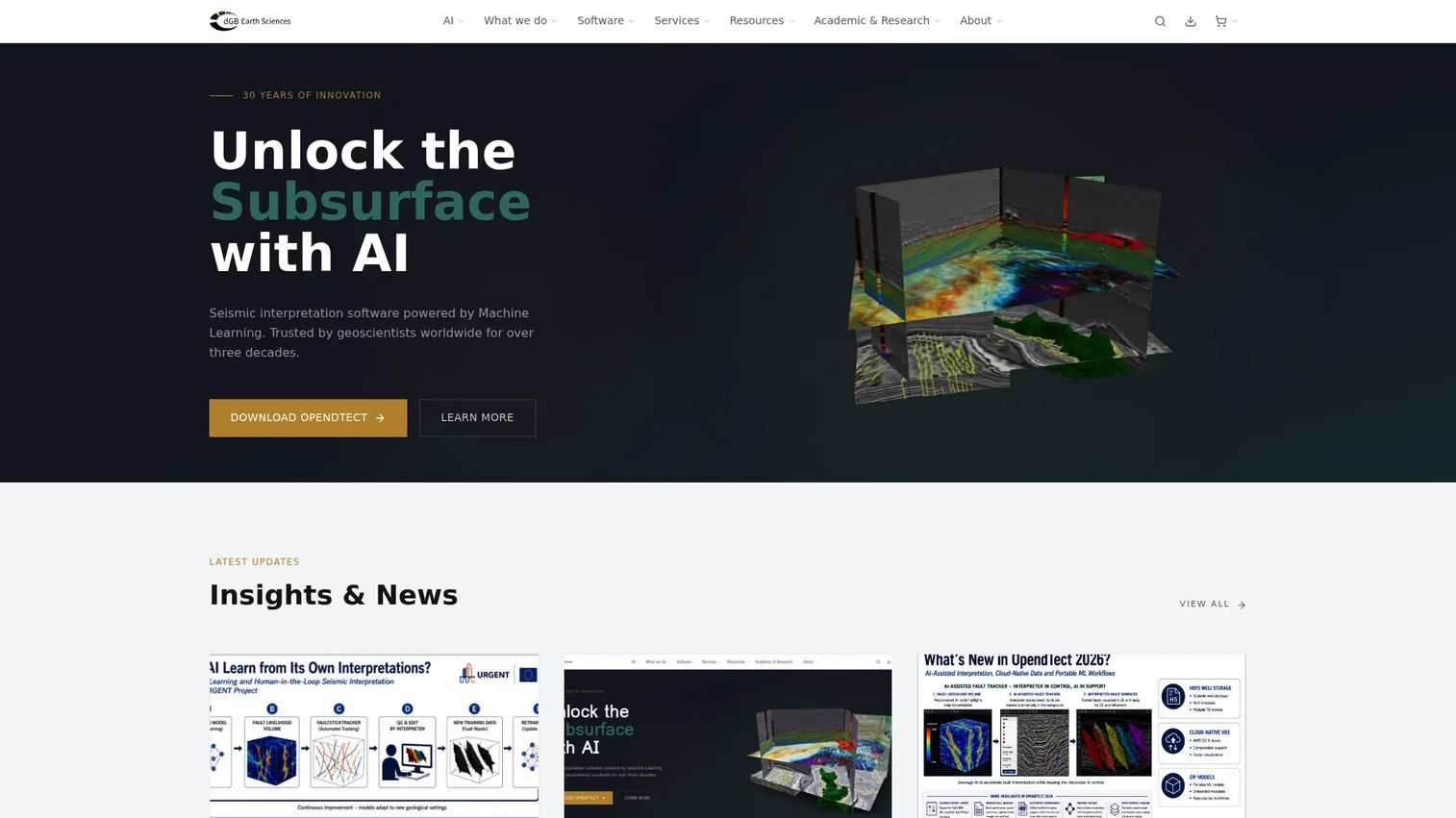
OpendTect is free, open-source seismic interpretation software and a development platform. The core handles 2D, 3D, and 4D seismic visualization and interpretation, with seismic attributes and filters built in. What sets it apart is the plugin architecture and the ability to extend workflows with Python and C++.
For technical teams, that openness is the point. You are not locked to a vendor's roadmap. If a workflow does not exist, you can build it or install a plugin that does. OpendTect Pro and commercial plugins add machine learning and specialized tooling on top of the free base.
Best for: Geoscience teams that want open-source flexibility and want to customize or extend their interpretation workflow.
Key features
- 2D, 3D, and 4D seismic visualization and interpretation
- Seismic attributes and filters
- Plugin-based extensibility
- Python and C++ workflow scripting
- Commercial Pro and machine learning extensions
Why choose OpendTect: Choose it when your team has the technical depth to value customization and openness over a packaged suite. The open-source model fits best when developer-first control matters more than turnkey vendor support.
OpendTect pricing: The core software is free and open source. OpendTect Pro and commercial plugins are quote-based, so contact the vendor for a figure on those.
OpendTect holds a 5.0 out of 5 rating on G2.
2. GVERSE Geophysics Software Solutions

GVERSE Geophysics is a geoscience software suite spanning geology, geophysics, data management, and field development. On the interpretation side, it delivers 2D and 3D seismic interpretation, real-time attribute analysis, and depth conversion and modeling inside a connected environment.
The appeal is a single integrated seismic platform rather than a stack of disconnected tools. Interpretation, attributes, and modeling live together, which cuts the handoff friction that slows multi-step subsurface work. For teams that want a broader platform story, GVERSE frames itself as one connected suite.
Best for: Oil and gas geoscience teams that want integrated subsurface interpretation workflows in one environment.
Key features
- 2D and 3D seismic interpretation
- Real-time attribute analysis
- Depth conversion and modeling
- Connected geoscience suite
- Field development workflow support
Why choose GVERSE Geophysics: Choose it when your team values a single connected environment over assembling separate point tools. It fits teams that want interpretation and modeling in the same workflow.
GVERSE Geophysics pricing: GVERSE doesn't list a price for its geophysics suite. Pricing runs through the vendor by quote.
A verified G2 rating for GVERSE Geophysics was not available at the time of writing.
3. Halliburton SeisSpace Seismic Processing Suite
Halliburton SeisSpace is Halliburton's seismic processing software suite, built for time and depth processing workflows. It covers field QC for seismic surveys, 2D, 3D, 4D, and VSP processing modules, and cloud-based processing on parallel infrastructure.
Processing depth is the reason to look here. In complex environments, the quality of your interpretation depends on the quality of the processing beneath it. SeisSpace puts that processing power alongside interpretation tooling and connects to the broader Halliburton geoscience stack, so reprocessing decisions do not stall in a handoff.
Best for: Oil and gas geophysics teams that need serious seismic processing and imaging workflows.
Key features
- Field QC for seismic surveys
- 2D, 3D, 4D, and VSP processing modules
- Cloud-based processing with parallel infrastructure
- Time and depth processing
- Integration with the broader Halliburton geoscience stack
Why choose Halliburton SeisSpace: Choose it when processing depth is the priority and your workflow needs QC and imaging power sitting close to interpretation. It fits enterprise teams working complex subsurface data.
Halliburton SeisSpace pricing: Halliburton prices SeisSpace by quote rather than a published figure, so contact their team for numbers.
A verified G2 rating for SeisSpace was not available at the time of writing.
4. Petrel
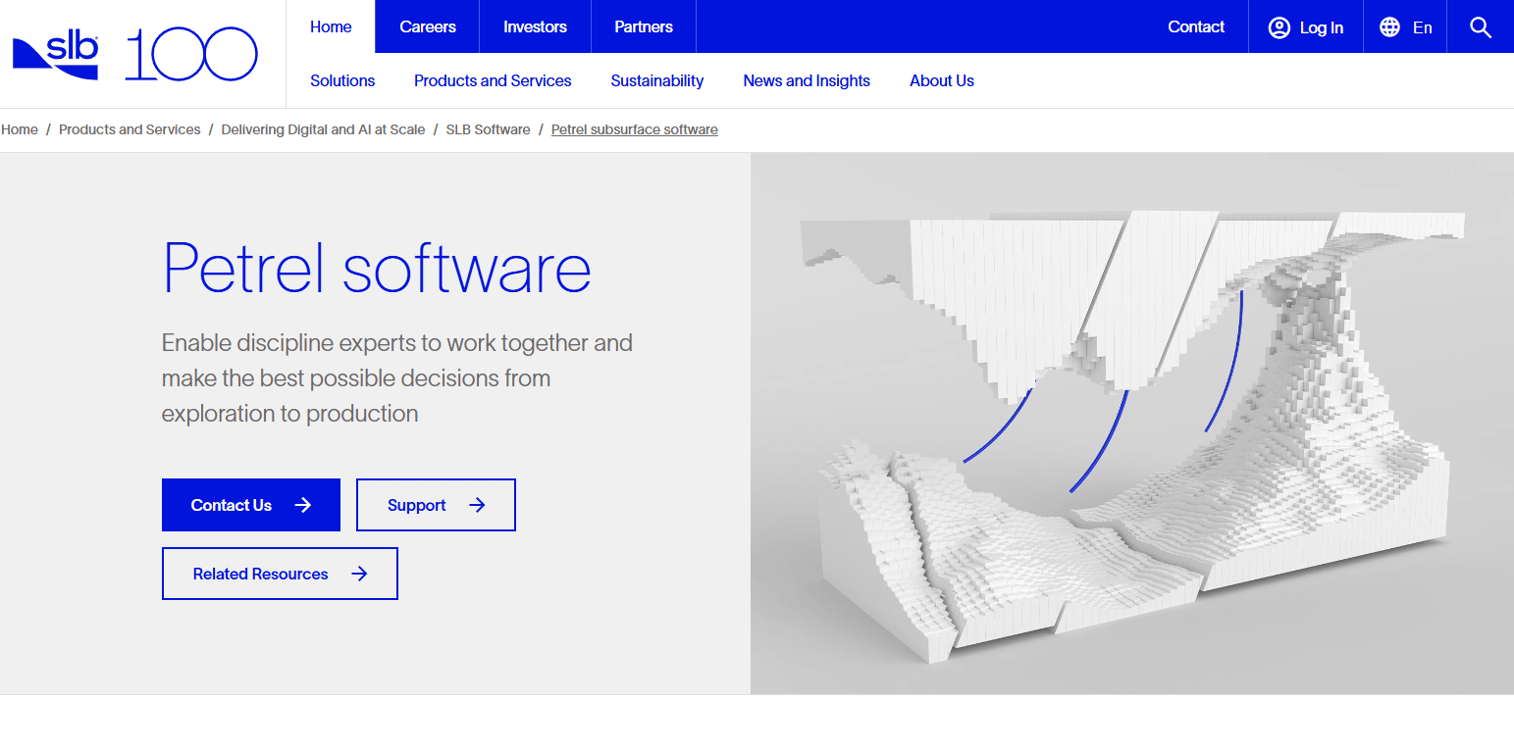
Petrel is SLB's subsurface software for geoscientists and engineers, spanning exploration to production. It is a major interpretation environment that pairs seismic interpretation with reservoir modeling, geological scenario modeling, and fluid migration analysis, available on-premise and through the Delfi digital platform.
For large teams and complex subsurface work, Petrel's strength is breadth plus scale. Live collaboration supports real-time teamwork across a project, and machine learning assists facies modeling. When interpretation feeds directly into modeling and simulation, keeping it in one integrated platform reduces friction across the subsurface workflow.
Best for: Oil and gas teams doing integrated subsurface interpretation and reservoir modeling at enterprise scale.
Key features
- On-premise and Delfi digital platform availability
- Live collaboration for real-time teamwork
- Machine learning for facies modeling
- Geological scenario modeling
- Fluid migration analysis
Why choose Petrel: Choose it when your team needs interpretation and reservoir modeling in one enterprise-grade environment. It fits large, complex subsurface projects where collaboration and scale matter.
Petrel pricing: SLB routes Petrel through contact and quote rather than a published price, so reach out to SLB for figures.
Petrel holds a 4.7 out of 5 rating on G2.
5. Kingdom
Kingdom is a Seequent geoscience product focused on seismic interpretation workflows. It supports 2D and 3D interpretation with an emphasis on a practical, usable environment that focused technical teams can work in without wrestling a sprawling suite.
Some teams do not need every module a large platform ships. They need clean 2D and 3D seismic interpretation, good usability, and a workflow that gets out of the way. Kingdom positions for exactly that: straightforward interpretation over broad suite complexity.
Best for: Focused technical teams that prioritize practical interpretation over a wide platform.
Key features
- 2D and 3D seismic interpretation
- Practical, usable interpretation environment
- Focused workflow over suite sprawl
- Seismic and well data integration
- Team-oriented interpretation workflow
Why choose Kingdom: Choose it when your team wants a focused interpretation package rather than a full geoscience suite. It fits teams that value usability and a lean workflow.
Kingdom pricing: Seequent handles Kingdom pricing directly rather than posting a public figure, so contact them for a quote.
A verified G2 rating for Kingdom was not available at the time of writing.
6. DecisionSpace Geosciences
DecisionSpace Geosciences is Halliburton's geoscience software suite for subsurface interpretation, modeling, and well placement. It brings integrated exploration workflows, assisted interpretation, and well planning into one connected environment.
The value here is continuity. Interpretation and modeling share the same environment, and workflows carry across teams instead of stopping at tool boundaries. For enterprises that need processing and interpretation continuity plus collaboration across groups, a shared geoscience environment keeps everyone working off the same picture.
Best for: Energy companies that need subsurface interpretation and geoscience workflows shared across enterprise teams.
Key features
- Integrated exploration workflows
- Assisted interpretation workflows
- Well planning workflows
- Connected interpretation and modeling
- Cross-team shared environment
Why choose DecisionSpace Geosciences: Choose it when connected tools across multiple teams matter more than a single-purpose interpreter. It fits enterprise workflows that span exploration through well placement.
DecisionSpace Geosciences pricing: The Halliburton Geosciences Essentials offering is pay-as-you-go and includes a free 15-day trial. A specific numeric price is not published, so contact Halliburton for detail.
DecisionSpace Geosciences holds a 5.0 out of 5 rating on G2.
7. GeoTeric
GeoTeric is AI seismic interpretation software built for energy and subsurface geoscience workflows. It centers on attribute-driven analysis and visual interpretation, with an AI Hub for comparing AI networks and parameters, plus AI data conditioning, geological features, and faults.
Where advanced visual workflows help, GeoTeric earns attention. Attribute-driven interpretation surfaces channels, faults, and geobodies that raw amplitude buries, and the AI-assisted conditioning speeds the path from noisy volume to interpretable image. Horizon, fault, and geobody interpretation round out the workflow.
Best for: Subsurface teams that want AI-assisted attribute analysis and visual insight discovery.
Key features
- AI Hub for comparing AI networks and parameters
- AI data conditioning, geological features, and faults
- Horizon, fault, and geobody interpretation
- Attribute-driven analysis
- Visual interpretation workflows
Why choose GeoTeric: Choose it when attribute analysis and visual insight discovery drive your interpretation. It fits teams that want AI-assisted conditioning and detailed feature extraction.
GeoTeric pricing: GeoTeric sells through demo and contact rather than a published price, so request a quote from their team.
A verified G2 rating for GeoTeric was not available at the time of writing.
8. SeisWare
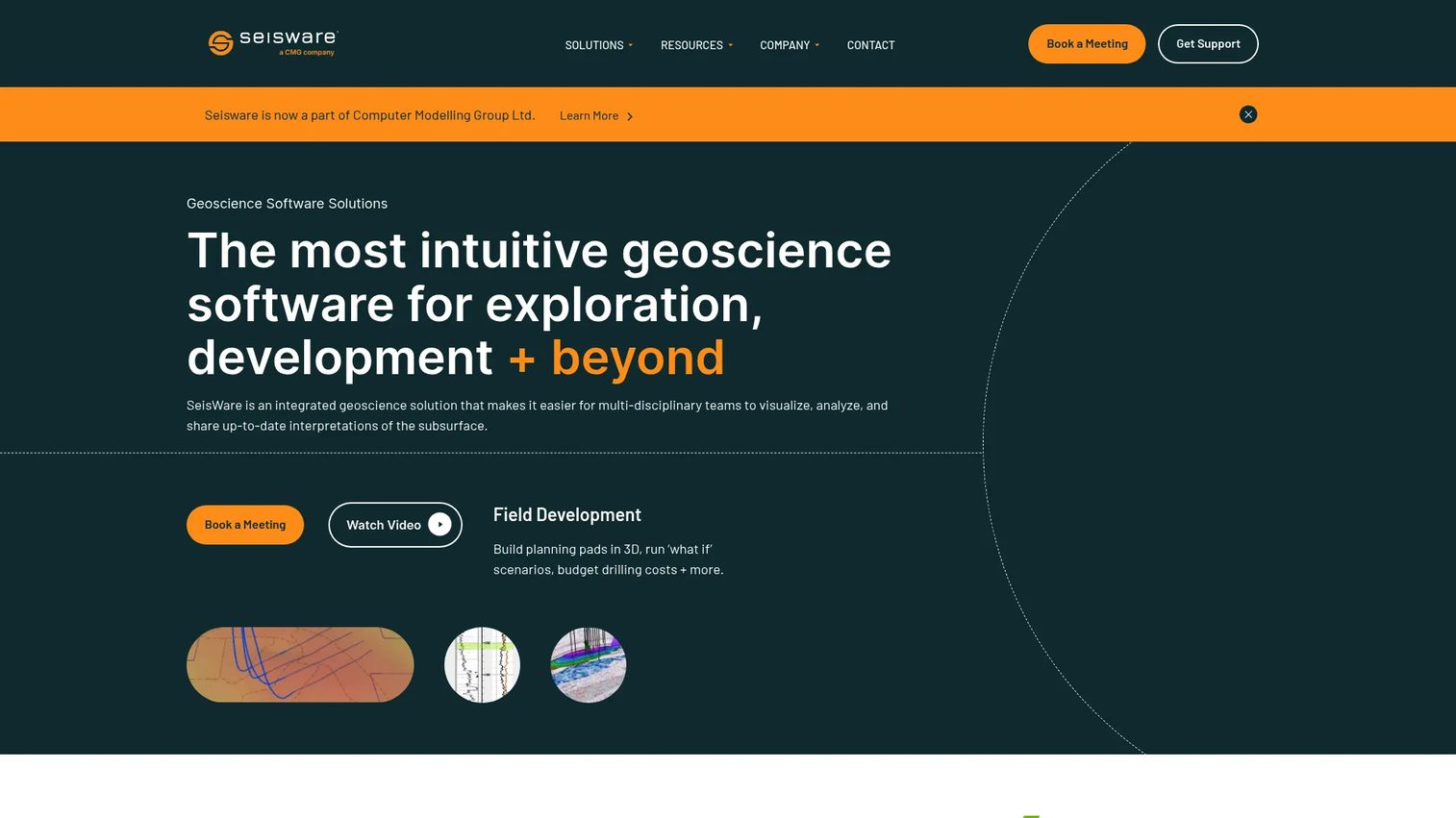
SeisWare is integrated geoscience software for exploration and development workflows. It covers 2D and 3D seismic interpretation, geology workflows with log correlation and cross-sections, and field development planning with 3D pad design and what-if scenarios.
SeisWare is the leaner option for teams that want targeted functionality without platform sprawl. You get solid interpretation plus practical field development tooling in one package, which suits focused teams that would rather not carry modules they never open. The tradeoff is scope: it targets specific workflows rather than trying to be everything.
Best for: Oil and gas geoscience teams that want integrated interpretation and field development in a focused package.
Key features
- 2D and 3D seismic interpretation
- Geology workflows with log correlation and cross-sections
- Field development planning with 3D pad design
- What-if scenario modeling
- Integrated exploration and development workflow
Why choose SeisWare: Choose it when you want a focused interpretation and development package over a broad, module-heavy suite. It fits lean teams with clear, specific workflow needs.
SeisWare pricing: SeisWare doesn't post a price on its site. Pricing runs through the vendor by quote.
SeisWare holds a 4.8 out of 5 rating on G2.
Considerations
Before you shortlist, run each candidate against the criteria that actually decide fit.
2D, 3D, and 4D support
Confirm the platform handles every dataset type your projects touch now and are likely to touch next. 2D interpretation, 3D volume work, and 4D time-lapse each stress different capabilities. A tool strong on 3D may handle 4D awkwardly, so verify time-lapse workflows if you run them.
Processing depth
Decide whether processing needs to live alongside interpretation. If reprocessing and depth imaging decisions depend on interpreter input, a connected processing and interpretation workflow removes handoff lag. If your processing happens upstream and rarely changes, interpretation depth matters more than built-in processing.
Performance at scale
Large seismic datasets punish weak architecture. Verify how the platform handles multi-terabyte volumes, whether it uses cloud or parallel infrastructure, and how rendering and auto-tracking hold up under load. Test with data close to your real project size, not a demo cube.
Integration and collaboration
Multi-user teams need shared environments, not siloed projects. Check how the platform handles concurrent work, version control, and data sharing across groups. A connected workflow keeps interpreters, modelers, and engineers working off the same picture instead of reconciling divergent copies.
Extensibility and automation
For advanced teams, Python, plugins, or scripting turn a fixed tool into a flexible one. Extensibility lets you automate repetitive steps, build custom attributes, and adapt the workflow as needs change. If your team has the technical depth, weigh this heavily.
Conclusion
The right seismic interpretation software depends on the workflow you run, not on which platform has the longest feature list. Three decision lenses cover most teams.
If openness and extensibility matter most, OpendTect gives you a free, scriptable core you can shape to your workflow. If you want an integrated platform, GVERSE Geophysics and DecisionSpace Geosciences pull interpretation and modeling into one connected environment, while Petrel scales that to enterprise reservoir work. If processing depth leads your decision, Halliburton SeisSpace anchors time and depth processing with strong QC. And if you want focused interpretation without suite sprawl, Kingdom, SeisWare, and GeoTeric each deliver targeted subsurface workflows.
The next step is simple. Shortlist two or three platforms that match your dataset mix and team size, then run them hands-on against a real project, not a canned demo. Scale, 4D handling, and collaboration are the factors that surface only under real load, so test them before you commit.
Start your journey with Guideflow today!
FAQs
It turns processed seismic data into geological and structural insight. Geoscientists use it to visualize 2D, 3D, and 4D datasets, track horizons and faults, run attribute analysis, and tie wells to seismic. The output feeds subsurface models and drilling or reservoir decisions.
Processing software conditions raw seismic data into a clean, imaged volume through steps like noise removal, migration, and depth imaging. Interpretation software then reads that volume for geological meaning. Some platforms keep them separate, while integrated ones connect both so reprocessing and interpretation inform each other.
Many platforms do, but not all handle it equally. 4D seismic data compares repeat surveys over time, which requires survey normalization, difference volumes, and change detection. OpendTect and processing suites like Halliburton SeisSpace support 4D workflows, so verify time-lapse handling directly before you buy.
It is a strong fit for technical teams that value customization and control. OpendTect gives you a free core plus Python and C++ extensibility, so you can build or install workflows a fixed suite would not offer. It fits best when your team has the depth to extend it rather than needing turnkey vendor support.
Prioritize scalability on large datasets, shared multi-user environments, and version control. Large teams break on siloed projects and weak collaboration, so a connected workflow that keeps everyone on the same data picture matters. Integrated platforms like Petrel and DecisionSpace Geosciences target this need.
Match it to your workflow span. An integrated seismic platform makes sense when interpretation, modeling, and processing all connect across teams. A focused standalone tool like Kingdom or SeisWare fits when you need clean interpretation without modules you never use. Scope of work decides it, not feature count.
Most platforms here handle both, but focused tools shine for straightforward work. Kingdom and SeisWare deliver practical 2D and 3D seismic interpretation without suite complexity. For heavier 3D volumes with deep attribute analysis, OpendTect, Petrel, and GeoTeric bring more volumetric power.
Visualization quality, horizon and fault tracking, attribute analysis, and synthetic modeling are the core. Beyond those, weigh performance on large seismic datasets, collaboration across teams, and extensibility through scripting or plugins. The right mix depends on whether your projects lean toward exploration, reservoir modeling, or time-lapse monitoring.