
Your best customer references live in five places at once. A spreadsheet nobody updates. A Slack thread from March. CRM notes only one rep can find. An inbox that belongs to whichever PMM ran the last program. And in the head of an AE who left two quarters ago.
This works until it doesn't. Then a rep pings you at 4pm asking for a fintech reference in EMEA for a deal closing Friday. You dig, you guess, you email the same three customers you always email. One says yes. Two ignore you because you asked them last month too.
That is reference burnout, and it costs deals. According to DataHorizzon Research (2024), the customer reference management software market was worth $2.1 billion in 2024 and is projected to hit $5.7 billion by 2033. Teams are buying software because manual reference management stops scaling the moment your pipeline grows past a handful of named accounts.
This guide breaks down seven platforms built to operationalize customer proof, not just store testimonials. If your job is proof, differentiation, and enablement that Sales actually uses, this is your shortlist.
What's inside
This guide is for product marketing managers, customer marketers, and revenue teams evaluating customer reference software in 2026. It covers seven platforms and how each fits a different operating model.
We chose the shortlist on four criteria that matter most for GTM teams:
- Workflow automation: how the tool handles reference requests, routing, and follow-up
- CRM and Salesforce fit: whether reference data lives where your reps already work
- Reference matching: how well it pairs the right advocate to the right prospect
- Scalability and analytics: whether it holds up across segments and proves impact to leadership
TL;DR
- Best overall for reference program operations: Point of Reference, for teams that want a Salesforce-native system of record
- Best for advocacy-heavy programs: Influitive, when references sit inside a broader advocacy motion
- Best for integrated customer reference management: Upland RO Innovation, for proof assets plus reference workflows
- Best for simple reference workflow scale: SlapFive, for a cleaner customer marketing operating layer
- Best for Salesforce-centered teams: crowdvocate, now part of Base
- Best for leaner teams: Base, for AI-driven customer-led growth programs
- Best for reference and advocacy workflow customization: Orca, for teams that need process and routing control
What is customer reference software?
Customer reference software helps teams recruit, organize, match, and activate customer advocates across sales, marketing, and customer success motions. It replaces the scattered spreadsheets and inbox chaos most reference programs start with.
At its core, a customer reference management software platform gives you a single system of record for who your advocates are, what they will vouch for, and how often they have been used. That last point matters more than most teams admit.
Key capabilities to expect:
- Reference pool management: a central, searchable database of advocates tagged by industry, product, use case, and region
- Request workflows: structured intake so Sales requests references through a process, not a panic ping
- Reference matching: logic that pairs a prospect's profile to the right advocate automatically
- Burnout prevention: usage tracking and caps so the same customers are not asked repeatedly
- Analytics: reporting on reference activity, influenced pipeline, and program health for leadership
This category overlaps with customer advocacy software and customer testimonials management, but the defining job is referenceability: knowing, at any moment, which customers are willing and available to speak. Some teams pair reference software with interactive demos as self-serve proof assets, so a prospect can experience the product before a live reference call ever gets scheduled.
When to use customer reference software
Build a reference program from scratch
You have no system, no owner, and no repeatable process. References happen through relationships and luck. This is the moment to add structure before volume makes the chaos permanent. Software gives you a pool, a request workflow, and a clear owner, so the program survives past any single person. It also lets you collaborate across Sales, CS, and marketing on the same advocate data.
Stop last-minute reference scrambling
Sales keeps asking for references ad hoc, and you keep hunting them down by hand. Each request pulls you off strategic work and risks overusing your best advocates. A reference workflow tool lets reps self-serve matched references inside their CRM, so you stop being the human search engine. Reps get faster answers, and you protect your reference pool from burnout.
Scale references across segments and regions
Manual spreadsheets break once you are managing references across verticals, product lines, and geographies. What worked for 20 accounts falls apart at 200. Reference software with matching logic and analytics lets you scale coverage without scaling headcount. You can also analyze which references drive the most influenced revenue and prove program value to leadership.
Customer reference software comparison
The list below is ordered by fit for product marketing and sales enablement workflows, starting with platforms built specifically for reference program operations and moving toward broader customer-led growth suites. Pricing for most tools in this category is quote-based, which is common for programs priced by user volume and term.
| # | Product | Best for | Key differentiator | Pricing | G2 rating |
|---|---|---|---|---|---|
| 1 | Point of Reference | Salesforce-based reference and advocacy programs | Salesforce-native UI with advocate suggestions on the opportunity page | Quote-based | 4.6/5 |
| 2 | Influitive | Advocacy-heavy programs | Advocacy, community, and references in one platform | Quote-based | 4.4/5 |
| 3 | Upland RO Innovation | Integrated reference and content management | Reference management plus sales enablement content | Quote-based | 4.1/5 |
| 4 | SlapFive | Customer marketing operating layer | CMA system of record with AI advocate sourcing | Quote-based | 4.5/5 |
| 5 | crowdvocate | Salesforce-centered reference operations | Customer-led growth workflows, now part of Base | Quote-based | Not listed |
| 6 | Base | Leaner teams and AI-driven programs | AI engagement OS for customer-led growth | Quote-based | 4.4/5 |
| 7 | Orca | Reference and advocacy workflow customization | Configurable routing and process control | Quote-based | Not listed |
Best customer reference software for 2026
1. Point of Reference
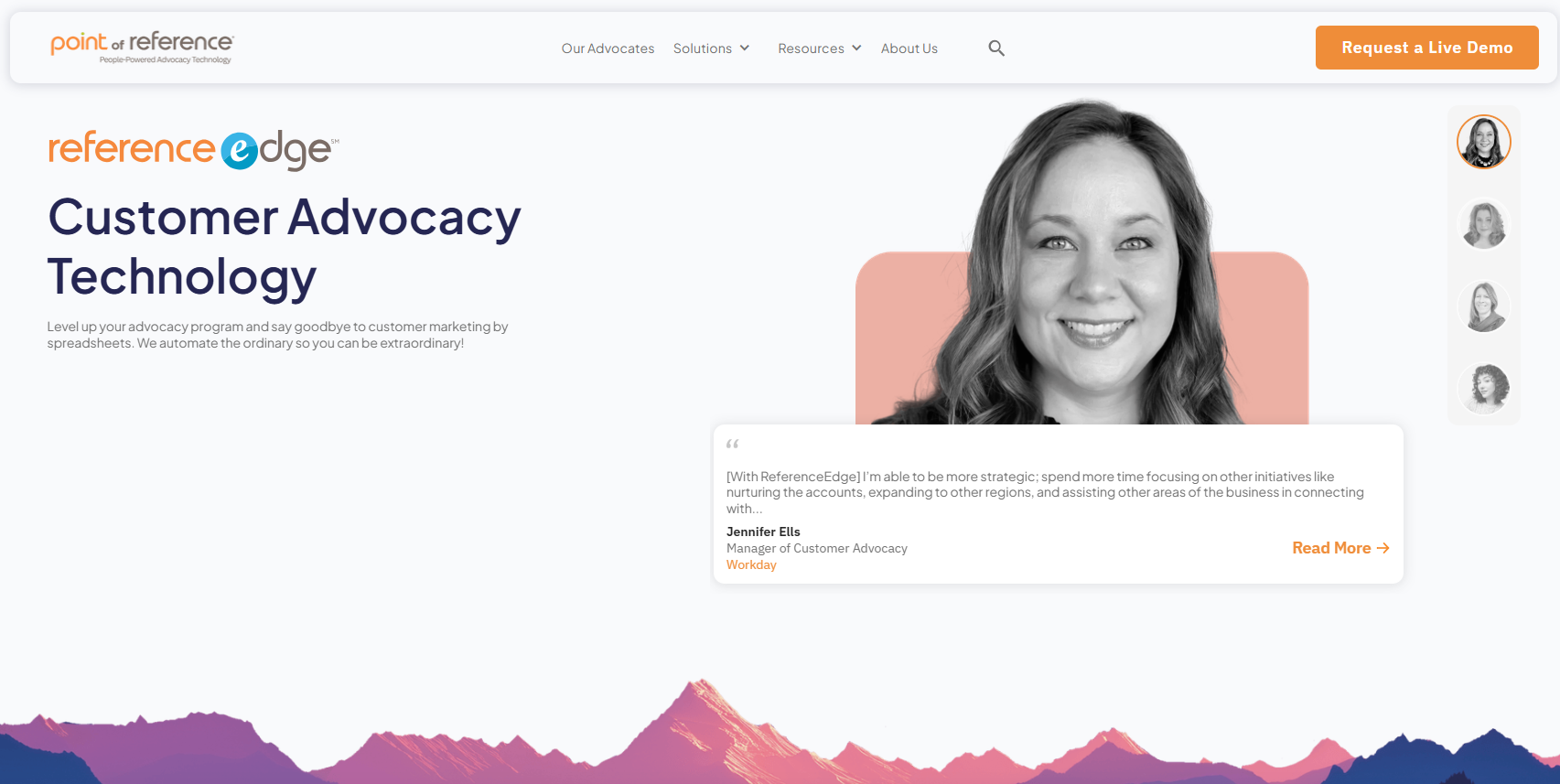
Point of Reference builds customer advocacy technology that runs natively on Salesforce. Its flagship product, ReferenceEdge, manages references, advocates, and related workflows without pulling reps out of the CRM they already live in. For teams that treat Salesforce as the source of truth, that native fit removes a lot of friction.
The platform's standout feature is advocate suggestions surfaced directly on the opportunity page. A rep working a deal sees relevant references matched to that account, so reference matching happens where the work happens, not in a separate tool. That is the difference between a reference program people use and one they route around.
Best for: B2B teams running Salesforce-based customer reference and advocacy programs that want a real system of record.
Key strengths
- Salesforce-native UI, no separate login
- Relevant advocate suggestions on the opportunity page
- Data update automation to keep advocate records fresh
- Request automation for structured reference intake
- Engagement tools for recruiting, communications, polls, and surveys
Why choose Point of Reference: If Salesforce is your operating system and you want references matched and requested inside it, this is the most direct fit. It suits mature programs that need operational control and a defensible system of record.
Point of Reference pricing: Pricing is per user and depends on volume tier, term, and payment cadence, with enterprise pricing available for larger deployments. Contact the vendor for a quote.
2. Influitive

Influitive is a customer advocacy, community, and engagement platform that treats references as one output of a broader advocacy motion. Instead of managing references in isolation, you build an engaged advocate base through challenges, rewards, and community, then draw references from that pool when Sales needs them.
That model fits teams who want more than a reference database. If your advocacy program already runs reviews, referrals, and feedback campaigns, folding references into the same engine keeps everything in one place. The community layer also keeps advocates warm, which matters when you need them to say yes to a reference call.
Best for: B2B teams running customer advocacy, referrals, references, and community programs together.
Key strengths
- Customer advocacy workflows with gamification and rewards
- Digital community tools to keep advocates engaged
- Reviews, referrals, references, and feedback programs in one platform
- Advocate segmentation for targeted requests
- Engagement mechanics that reduce reference fatigue
Why choose Influitive: Choose it when references are part of a wider advocacy strategy, not a standalone need. The engagement layer helps you avoid asking the same customers repeatedly by keeping a larger, active pool ready to help.
Influitive pricing: Public pricing is not listed. The pricing page routes to sales for both the Customer Advocacy and Digital Community products. Contact the vendor for a quote.
3. Upland RO Innovation
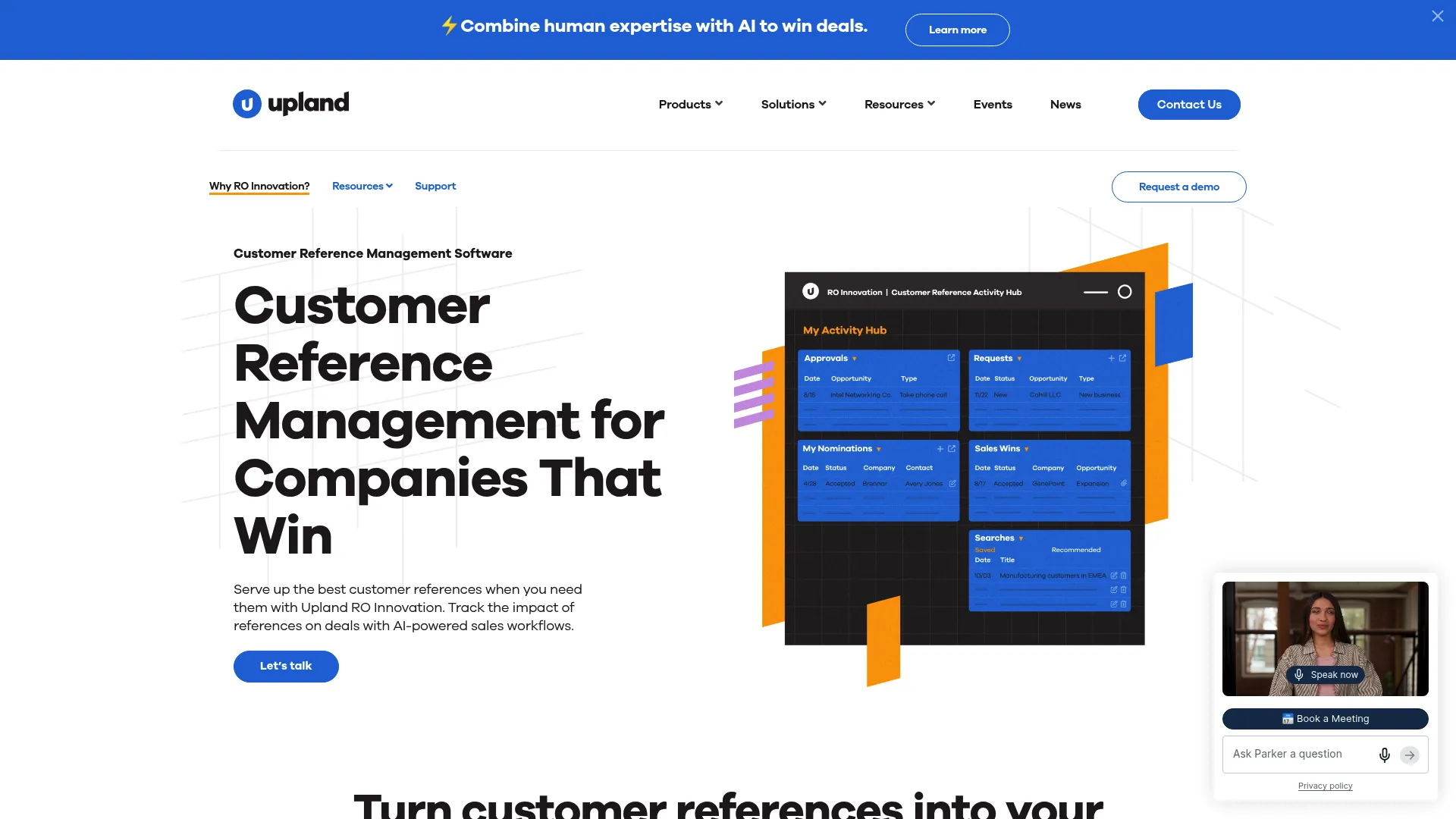
Upland RO Innovation is customer reference management software built for sales teams that need proof assets and reference contacts in one workflow. It connects reference management with content management, so the case study, the testimonial, and the live reference all live in the same operating layer.
That combination fits teams tired of managing customer proof in two systems. When a rep needs a reference, they can also grab the matching customer story, video testimonial, or one-pager without a second search. CRM integrations keep reference activity tied to opportunities, which helps connect references to revenue.
Best for: B2B teams managing customer references and sales enablement content in one place.
Key strengths
- Reference management with request and tracking workflows
- Content management for case studies and proof assets
- CRM integrations to tie references to opportunities
- Automated workflows for requesting and sharing references
- Sales-facing access so reps self-serve proof
Why choose Upland RO Innovation: Pick it when your reference program and your customer story operation are really the same job. Managing references and proof content together reduces the internal handoffs that slow down deals.
Upland RO Innovation pricing: Public pricing is not listed on the site. Product pages direct visitors to request a demo or contact sales for a quote.
4. SlapFive

SlapFive is B2B customer marketing and advocacy software that positions itself as a customer marketing and advocacy (CMA) system of record. It manages customer voice, proof, references, and referrals in one place, with a focus on giving lean teams a cleaner operating layer instead of a heavy process to maintain.
The platform leans on AI to source advocates, which helps when your reference pool needs to grow faster than you can recruit manually. Its reference automation handles the routing and follow-up work that usually eats a PMM's afternoon, so requests move without you as the bottleneck.
Best for: B2B teams running customer marketing, advocacy, and reference programs who want one system of record.
Key strengths
- CMA system of record for customer voice and proof
- AI-charged advocate sourcing to grow the reference pool
- Advanced reference automation for routing and follow-up
- Customer voice capture tied to references and proof
- Workflow built for lean teams, not heavy admin
Why choose SlapFive: Choose it when you want references, proof, and customer voice unified under one operating layer without standing up a large program team. It fits customer marketers who need to move fast with limited headcount.
SlapFive pricing: Public pricing is not listed. The site routes to contact and demo pages. Contact the vendor for a quote.
5. crowdvocate

crowdvocate is a customer-led growth platform for customer marketing, advocacy, references, and community. Worth knowing before you evaluate: crowdvocate rebranded to Base in 2022, so the crowdvocate name and the Base platform now point to the same product line. If you find crowdvocate on a vendor shortlist, you are looking at Base.
The platform was built for revenue teams that want reference operations connected to a wider customer-led growth motion. That means references, advocacy, and community feeding pipeline and expansion, not sitting in a silo. Teams that live in Salesforce and want reference workflows connected to CRM data tend to gravitate here.
Best for: B2B teams running customer marketing, advocacy, and reference programs inside a customer-led growth motion.
Key strengths
- AI-powered customer-led growth workflows
- Customer advocacy and reference management
- Customer-facing journeys and success plans
- Community and engagement programs
- CRM-connected reference operations
Why choose crowdvocate: Choose it when you want references embedded in a broader customer-led growth strategy rather than a standalone reference tool. Just evaluate it under the Base brand, since that is where the product now lives.
crowdvocate pricing: Public pricing is not listed. Pricing is handled through the Base sales team. Contact the vendor for a quote.
6. Base
Base is an AI engagement operating system for customer-led growth that spans onboarding, retention, expansion, references, advocacy, and community. It is the current home of the crowdvocate product, rebuilt around AI agents that automate customer engagement workflows.
For leaner teams, that automation is the draw. AI agents handle repetitive engagement and reference tasks that a small team cannot cover manually, so references stay active without a dedicated program manager. Base treats references as one motion inside a full post-sale lifecycle, which suits teams who want advocacy and references handled alongside retention and expansion.
Best for: Enterprise and lean teams managing post-sale customer-led growth programs, including references and advocacy.
Key strengths
- AI agents for customer engagement workflows
- Customer-facing journeys and success plans
- Advocacy, references, referrals, and community programs
- Reference operations connected to retention and expansion
- Automation built to reduce manual program admin
Why choose Base: Choose it when you want references handled inside a broader AI-driven customer-led growth platform, not as a point solution. It fits teams who want automation to cover the manual work a small team cannot.
Base pricing: Public pricing is not listed on the site. Contact the vendor for a quote.
7. Orca
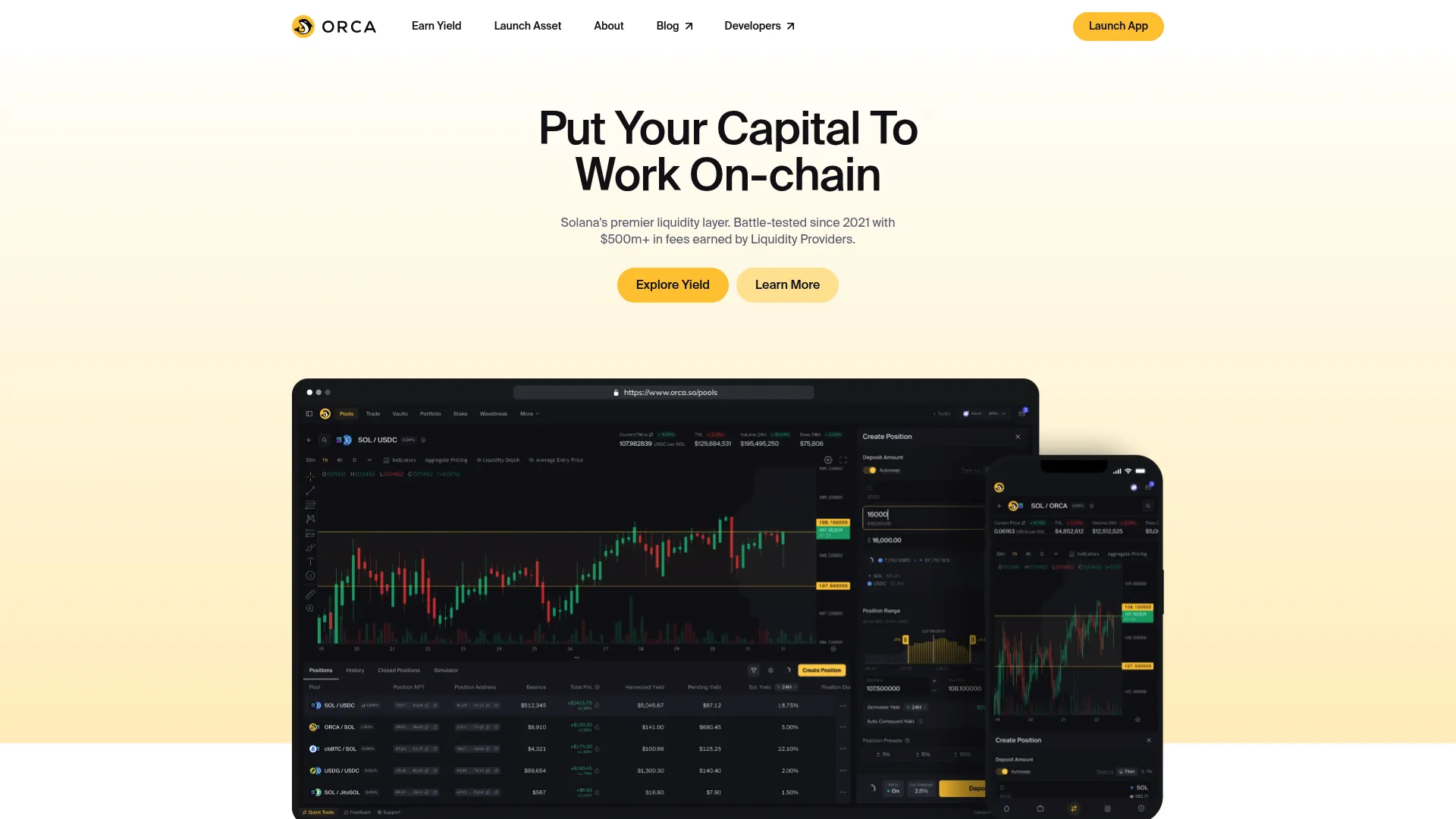
Orca rounds out the shortlist for teams that prioritize workflow customization and operational routing in their reference and advocacy programs. The pull here is process control: teams that need references and advocate requests to follow specific routing rules, approvals, and visibility want a tool they can shape to their motion rather than adapt to.
If your reference program has stakeholders across Sales, CS, and marketing who each need visibility into requests and status, configurable routing keeps everyone aligned. That process layer matters most for teams where reference activity crosses multiple functions and needs an audit trail.
Best for: Teams that need configurable reference workflows, routing, and cross-functional visibility.
Key strengths
- Configurable reference and advocacy workflows
- Operational routing for requests and approvals
- Advocate management with process control
- Cross-functional visibility into request status
- Salesforce integration for CRM-connected operations
Why choose Orca: Choose it when your program needs process and routing you can shape, not a fixed workflow. It fits teams where references cross multiple functions and need clear ownership and visibility.
Orca pricing: Public pricing is not listed. Contact the vendor for a quote.
Considerations before you buy
Before you commit, run your shortlist through this checklist. The right tool depends on your operating model, not the loudest brand.
How many reference requests do you handle monthly?
Volume drives everything. A team fielding a handful of requests a month needs less automation than one processing dozens across regions. Map your current and projected request volume, then match it to a tool built for that scale. Buying for volume you do not have creates admin overhead you do not need.
Does it fit Salesforce or your CRM?
If your reps live in Salesforce, a Salesforce-native tool removes friction and drives adoption. Reference data that sits outside the CRM gets ignored. Confirm the depth of the integration, not just that one exists. Native beats connected when adoption is the goal.
Do you need advocacy features beyond references?
Some teams need only reference management. Others want reviews, referrals, community, and rewards in the same platform. Decide whether you are buying a focused reference tool or a broader advocacy platform, because paying for advocacy features you will not use adds cost and complexity.
How does it prevent reference burnout?
Your best advocates are a finite resource. Look for usage tracking, request caps, and rotation logic that spreads requests across your pool. A tool that surfaces overused references before you ask them again protects the relationships your program depends on.
Do the analytics satisfy leadership?
If you need to prove influenced pipeline and program health to leadership, analytics are not optional. Check whether the tool reports on reference activity, influenced revenue, and pool health in a way you can put in front of a VP without rebuilding it in a spreadsheet.
Conclusion
The strongest fit comes down to your operating model. If Salesforce is your source of truth and you want references matched inside it, Point of Reference is the most direct pick. If references are part of a wider advocacy motion, Influitive keeps advocacy, community, and references in one engine. Teams that want proof assets and reference contacts together should look at Upland RO Innovation.
SlapFive suits lean customer marketing teams who want a clean system of record without heavy admin. crowdvocate and Base fit teams building a full customer-led growth motion, with Base bringing AI automation for programs that outrun manual effort. Orca is the pick when you need configurable routing and cross-functional visibility.
Choose based on how your team actually works, not on brand familiarity. Map your request volume, your CRM, and whether you need advocacy features beyond references, then shortlist the two tools that match. Many teams pair their reference operation with self-serve proof like interactive demos so prospects can evaluate the product before a reference call is ever booked.
Start your journey with Guideflow today!
FAQs
Customer reference software is a platform that helps teams recruit, organize, match, and activate customer advocates across sales, marketing, and customer success. It centralizes your reference pool, automates request workflows, and tracks usage so the right advocate gets matched to the right prospect without manual hunting.
A customer reference program turns satisfied customers into a managed, repeatable source of proof for deals and marketing. It recruits advocates, defines what each is willing to vouch for, routes reference requests through a process, and tracks activity so the program scales past relationships and luck.
You avoid reference burnout by tracking how often each advocate is used and capping requests before you overask. Good customer reference software surfaces overused references, rotates requests across a larger pool, and keeps advocates engaged with rewards or community so saying yes stays easy.
Reference matching pairs a prospect's profile to an advocate on attributes like industry, product, use case, company size, and region. The strongest tools surface matched advocates directly on the opportunity in your CRM, so reps get relevant references without submitting a manual request and waiting.
They overlap but are not identical. Customer advocacy software covers a broad motion including reviews, referrals, community, and rewards. Customer reference software focuses on the specific job of managing who will vouch for you and when. Many platforms do both, so decide whether you need focused reference management or the wider advocacy scope.
Salesforce and CRM integration matter most, because reference data that sits outside the tools reps use gets ignored. Look for native Salesforce support, marketing automation connections, and analytics that tie reference activity to influenced pipeline. Depth of integration drives adoption more than the number of connectors.
Product marketing teams use it to operationalize customer proof for launches, competitive deals, and enablement. It gives them a defensible pool of advocates, feeds proof points and case studies into positioning, reduces last-minute reference scrambling for Sales, and produces analytics that show leadership how references influence pipeline and win rates.