Introduction
Your SDRs sent 400 emails last week. A double-digit chunk bounced. A handful of meetings booked. Most of the rest ghosted. Sound familiar?
Most teams blame the SDRs. Or the messaging. Or the ICP. They're usually wrong. The bottleneck is sitting one layer deeper: the data feeding the outbound machine.
B2B contact data decays fast. Landbase and Bright Data both cite roughly 2.1% monthly B2B data decay, which compounds to around 22.5% per year, with some segments degrading far faster as people switch jobs. That means a contact list you bought 14 months ago is already a quarter wrong. And that's before you account for incomplete fields, mismatched titles, or shell companies with no real buyer behind them.
Bad data isn't an SDR problem. It's a forecast problem. A win-rate problem. A ramp-time problem. When AEs walk into discovery with the wrong stakeholder, deals stall. When RevOps reports off a database where a third of accounts are stale, the forecast becomes fiction. When marketing nurtures contacts who left the company two quarters ago, attribution falls apart.
The B2B data provider you pick (or more accurately, the stack you assemble) determines whether your pipeline is real or imagined. The market is also growing fast: Bright Data projects the B2B data marketplace projected to reach $3.2 billion by 2030, up from $863 million in 2024. There's more choice than ever, and more ways to get it wrong.
What's inside
This guide ranks 11 B2B data providers covering four core data types: contact data, firmographic and company data, intent data, and signal data. It's written for sales leaders, RevOps, SDR managers, AEs running their own prospecting, and enablement leads building a stack for a growing team.
We selected providers based on four criteria:
- Data accuracy and a clear verification methodology
- CRM-native fit, with deep Salesforce and HubSpot integration
- Cross-role value across SDRs, AEs, and RevOps
- Pricing transparency and ROI defendability
TL;DR
- Best overall for sales teams: ZoomInfo, when you need contact data, intent, and enrichment under one contract.
- Best for SMB and mid-market SDR prospecting: Apollo.io, where the free plan and built-in sequencer compress the stack.
- Best for compliant outbound and EMEA coverage: Cognism, with screened phone data and GDPR-built workflows.
- Best for AE-driven account research: LinkedIn Sales Navigator, the source of truth for fresh title and tenure data.
- Best for CRM-native enrichment: Breeze Intelligence by HubSpot, for HubSpot shops that want enrichment without a separate integration layer.
- Best for ABM and intent scoring: 6sense, when sales and marketing need a shared account prioritization layer.
What is a B2B data provider?
A B2B data provider is a vendor that supplies verified company and contact information, including emails, phone numbers, firmographics, technographics, and intent signals, used by sales and marketing teams to identify, qualify, and reach prospects.
That definition matters because B2B data providers are often confused with adjacent categories. Enrichment tools augment existing records. Sales engagement platforms use the data to run outreach. CRMs store it. A B2B data provider is the source of the data itself.
There are five core data types every sales team should understand:
- Contact data: verified emails, mobile and direct dials, job titles, LinkedIn profiles.
- Firmographic data: company name, employee count, industry, revenue, location, corporate hierarchy. Firmographic data providers like Dun & Bradstreet anchor this layer for enterprise accounts.
- Technographic data: the software a company runs, from Salesforce to AWS to HubSpot. Technographic data providers help target by stack rather than by industry alone.
- Intent data: third-party signals showing which companies are researching your category. Intent data providers like Bombora aggregate content consumption across publisher co-ops. For a deeper look at this category, see our guide to the best buyer intent data providers.
- Signal data: event-based triggers (job changes, funding rounds, new hires, layoffs) that create timing for outreach.
Most mature sales teams use at least two of these layers in combination. A contact database tells you who to reach. Intent data tells you which accounts care right now. Signal data tells you when to act. Firmographics tell you whether the account fits at all.
The companies in this guide span all five categories. Some, like ZoomInfo and Apollo, cover multiple layers in one platform. Others, like Bombora and 6sense, specialize in a single layer that complements a contact database.
When sales teams use B2B data providers
Build target account lists from scratch
When entering a new market, refreshing the ideal customer profile (ICP) framework, or spinning up outbound from zero, a b2b contact database is the starting point. SDR managers use providers to filter on firmographics, technographics, and headcount to build the initial target list, then layer signal data on top to prioritize the first 200 accounts. Pairing this with the best AI SDR tools can compress the time from list build to first reply.
Enrich existing CRM records
RevOps teams reach for b2b database providers when the CRM has drifted. If a meaningful share of contacts are missing direct dials, have stale titles, or sit on accounts with no firmographic data, enrichment fills the gaps so reps stop guessing. This is also where compliance review starts, because enrichment touches every record in the database. Many teams plug this layer into one of the best CRM software options to keep the source of truth clean.
Trigger outreach on real-time signals
AEs and SDRs running event-based prospecting use signal feeds to replace static lists. A funding round, a new VP hire, a tech stack change, or a layoff announcement creates a moment to reach out with context. Static b2b contact lists work for volume plays. Signal-driven outreach works for reply rates, especially when layered with the best sales engagement tools.
Comparison table
The table below summarizes the 11 providers covered in this guide. Pricing reflects the most recent published or G2 software review platform figures we could verify. Where a vendor does not publish pricing, we say so.
| # | Product | Intent | Key use case | Pricing | G2 rating |
|---|---|---|---|---|---|
| 1 | ZoomInfo | All-in-one GTM data platform | Enterprise prospecting + RevOps enrichment | Custom (not publicly listed) | 4.5 / 5 |
| 2 | Apollo.io | Sales engagement + contact database | SMB and mid-market SDR prospecting | Free plan; paid tiers (numeric pricing not exposed on pricing page) | 4.7 / 5 |
| 3 | Cognism | Compliant contact + signal data | EMEA outbound, regulated markets | Custom (Standard and Pro packages) | 4.7 / 5 (Capterra) |
| 4 | Lusha | Lightweight contact data | SDR direct dials and mobile lookups | Free plan; Starter, Pro, Premium, Scale tiers | 4.3 / 5 |
| 5 | LinkedIn Sales Navigator | Account research + warm intros | AE account research and outreach | Core $119.99/mo, Advanced $159.99/mo, Advanced Plus custom | 4.4 / 5 |
| 6 | Breeze Intelligence by HubSpot | CRM-native enrichment | HubSpot-centric RevOps teams | Tied to HubSpot subscriptions and Credits | Not listed |
| 7 | 6sense | Account intent + ABM | Enterprise ABM and account scoring | Free tier plus paid configurations (custom) | 4.1 / 5 |
| 8 | Bombora | Third-party intent data | Intent-driven outbound prioritization | Custom | 4.4 / 5 |
| 9 | Dun & Bradstreet | Firmographic + risk data | Enterprise account hierarchy + compliance | Custom | 4.3 / 5 |
| 10 | Clay | Composable data orchestration | RevOps stacking multiple providers | Free; Launch $167/mo; Growth $446/mo; Enterprise custom | 4.7 / 5 |
| 11 | UpLead | Verified contact lists | Budget-conscious SMB prospecting | Essentials from $74/mo (annual); Plus from $149/mo (annual) | 4.7 / 5 |
11 best B2B data providers for sales teams in 2026
1. ZoomInfo, best all-in-one GTM data platform
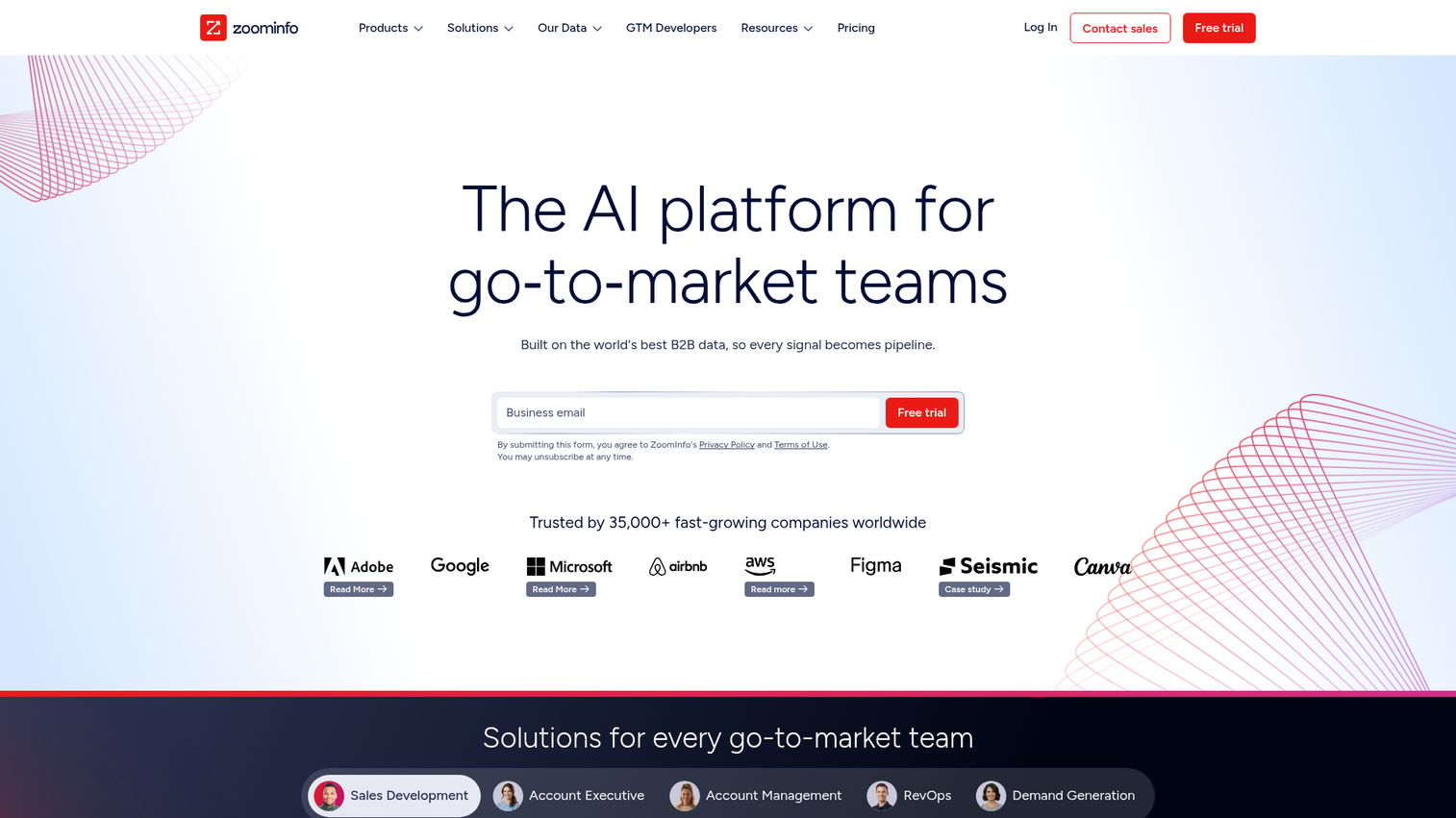
ZoomInfo is an AI-powered go-to-market platform built on B2B data, buyer signals, and automation for revenue teams. It combines contact and company data, buyer intent, and website visitor tracking into a single GTM platform built for sales orgs running coordinated SDR, AE, and RevOps motions.
Best for: Sales teams that want contact data, intent, and CRM enrichment from one vendor and can absorb an enterprise contract.
Key strengths
- Contact and company data: Verified b2b company data and contact records spanning emails, direct dials, and firmographics.
- Buyer intent: Intent signals at the account level, surfacing companies researching specific topics relevant to your category.
- Website visitor tracking: Identifies anonymous visitors at the company level so reps can prioritize outreach to in-market accounts.
Why choose ZoomInfo: ZoomInfo wins when you need everything in one contract and have the budget to justify it. RevOps teams get platform consolidation, SDRs get verified contacts, and AEs get account intelligence in the same workspace. The trade-off is price and contract rigidity.
ZoomInfo pricing: ZoomInfo does not publish numeric pricing on its pricing page. The page exists at zoominfo.com/pricing but contracts are quoted directly through sales. A free trial is referenced on the site.
2. Apollo.io, best for SMB and mid-market SDR prospecting
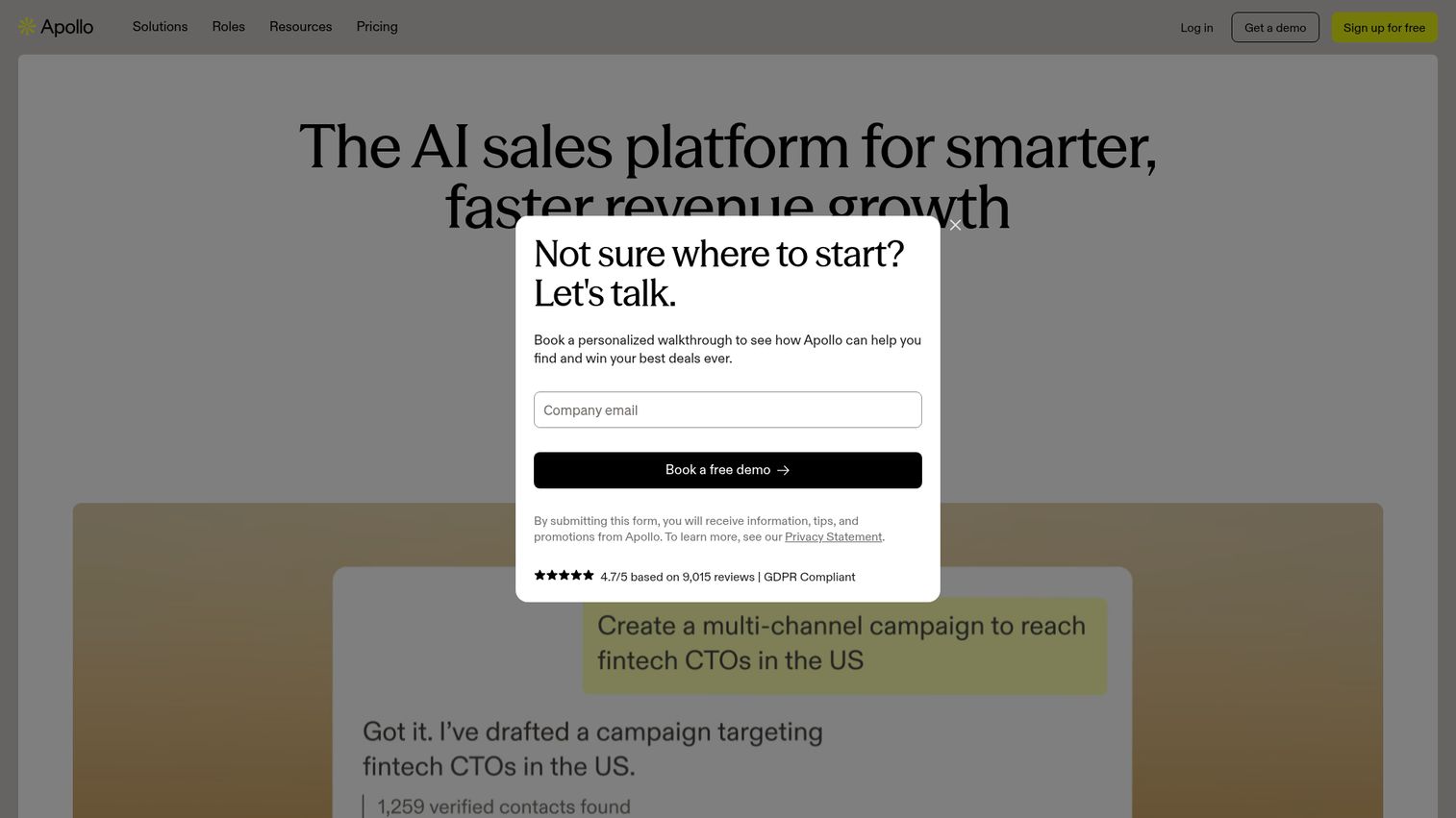
Apollo.io is an AI sales platform for smarter, faster revenue growth that helps modern sales and marketing teams build pipeline, close deals, and simplify their tech stack. It pairs a large contact database with a built-in sales engagement layer, so SDR teams that want prospecting data and outreach in one tab don't need to maintain a separate sequencer.
Best for: SMB and mid-market sales teams where SDRs handle their own prospecting and need contact data, sequences, and a dialer in one workflow.
Key strengths
- Contact and account search: Verified emails and phone numbers across a wide B2B database, searchable through the app or the Chrome extension.
- Multichannel sales engagement: Sequences, calls, LinkedIn tasks, and AI-assisted personalization built directly on top of the data.
- Deal management: Pipeline boards, real-time deal alerts, and AI-powered call summaries and follow-ups, so the same platform supports SDR and AE workflows.
Why choose Apollo.io: Apollo is the price-to-value leader for teams under 50 reps. The workflow consolidation and free tier make it the default starting point for growing teams that don't want to wire up three vendors.
Apollo.io pricing: Apollo offers a Starter plan that is free forever and references Custom plans for large enterprises. Numeric pricing for paid tiers is not currently exposed on the pricing page in a way we can quote with confidence.
3. Cognism, best for compliant outbound and EMEA coverage
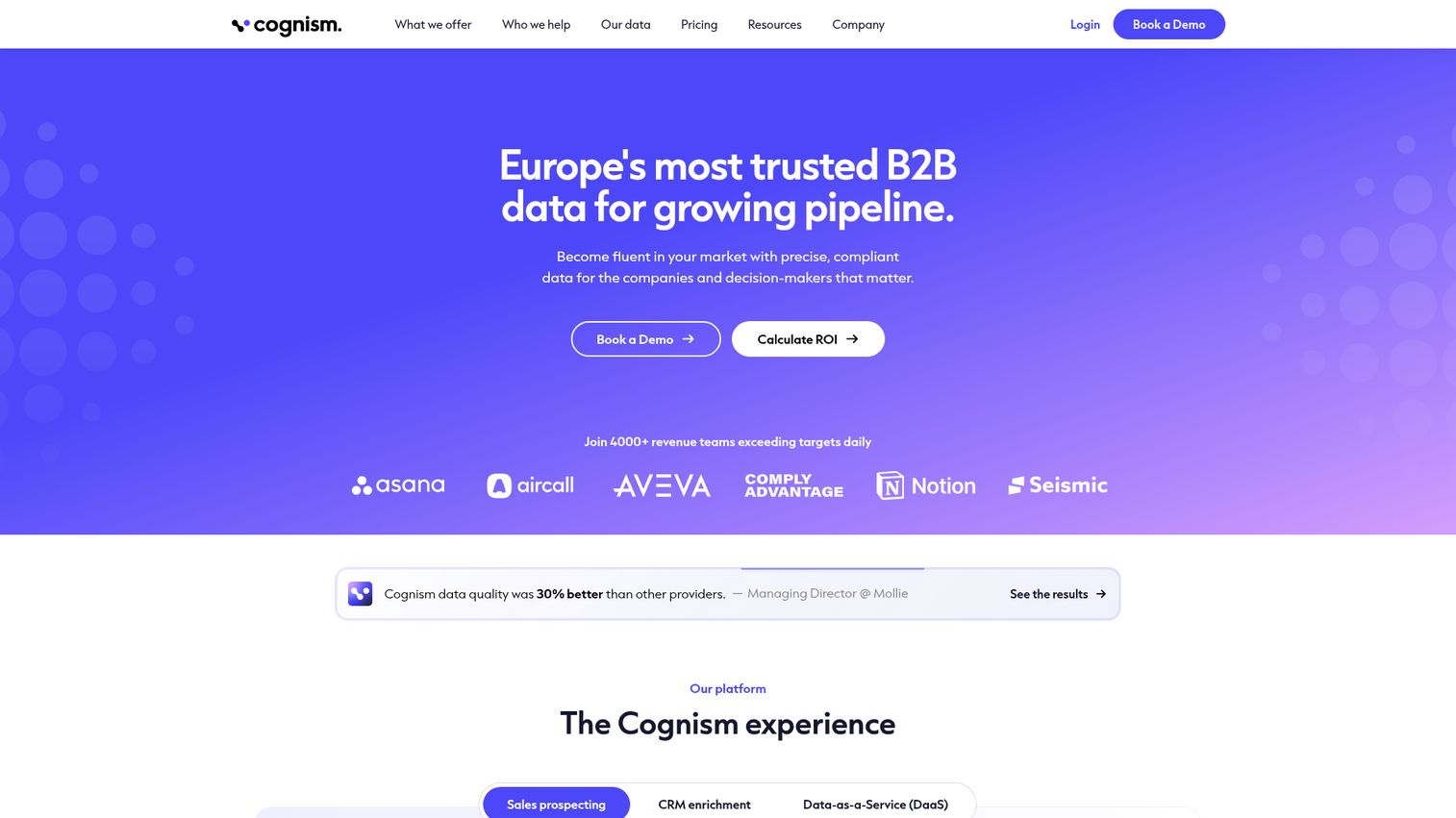
Cognism is a global B2B data company, built for modern revenue teams. Its competitive moat is compliance posture and data sourcing rigor across EMEA, which makes it the default answer when security and legal teams gate vendor decisions.
Best for: Sales teams running outbound in the EU and UK, regulated industries, or any org where compliance review can kill a vendor deal.
Key strengths
- Verified contact data: Find and reach the right contacts with accurate B2B data, including emails and phone numbers.
- Targeted list building: Build lists using firmographic, technographic, and signal-based filters to narrow on real buying moments.
- CRM enrichment: Automatically enrich and maintain CRM records so RevOps stops chasing stale data.
Why choose Cognism: If your security and legal teams have flagged data sourcing as a concern, Cognism is usually the answer. The data is positioned around compliant prospecting at scale, which removes a procurement blocker most other vendors leave unresolved.
Cognism pricing: Cognism offers Sales Prospecting in Standard and Pro packages. CRM Enrichment and Data-as-a-Service are priced based on subscription structure, usage, and delivery requirements. No public numeric pricing is listed.
4. Lusha, best for lightweight contact lookup and direct dials
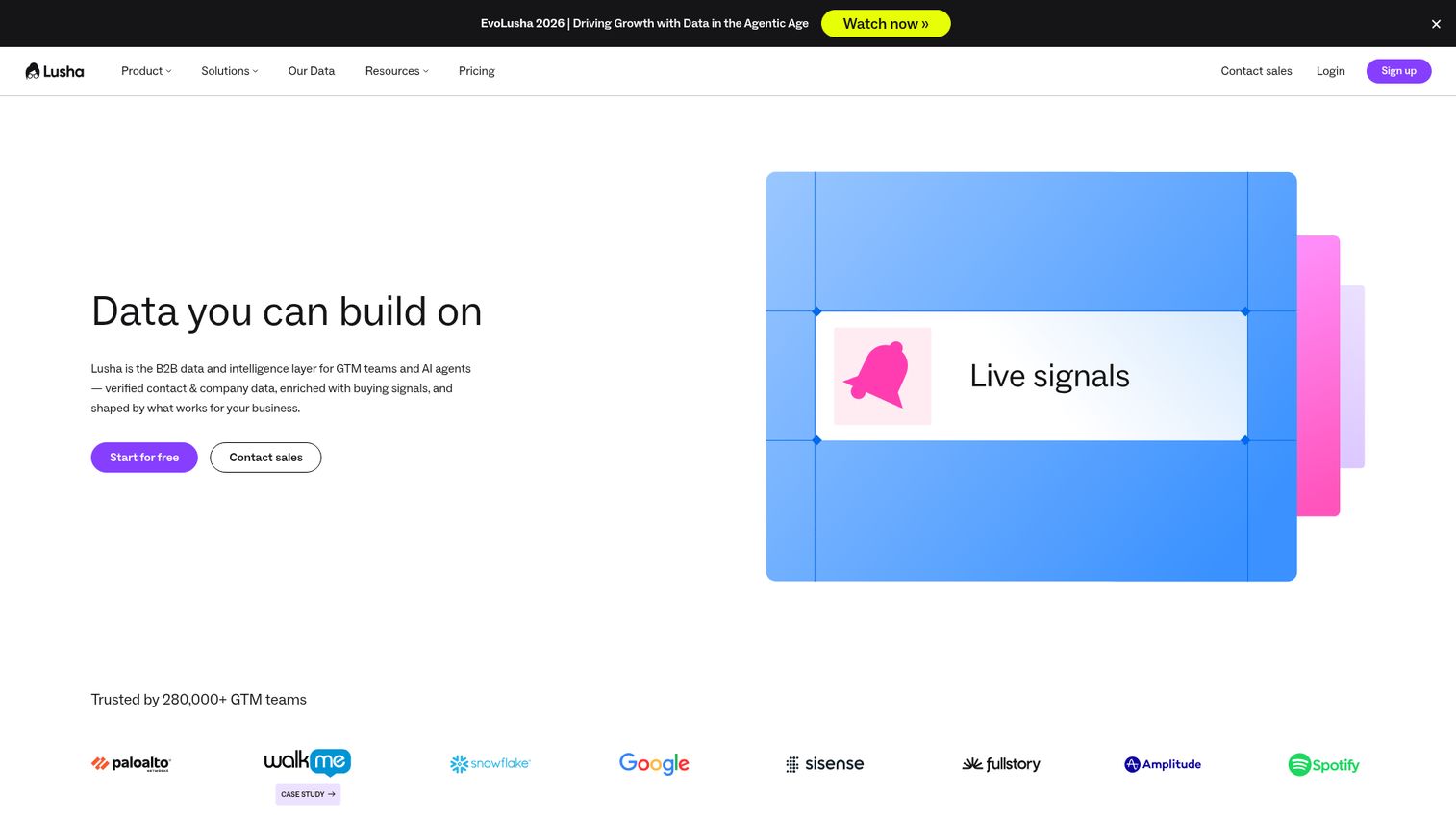
Lusha is a B2B data and sales intelligence system for revenue teams. Built around a browser extension and prospecting workspace, it's the go-to tool for SDRs and AEs who do most of their prospecting one contact at a time on LinkedIn.
Best for: Individual SDRs and AEs who prospect on LinkedIn and need fast, verified contact lookups without a full platform commitment.
Key strengths
- AI-powered Workspace: List building and enrichment in a single workspace, with verified emails and phone numbers attached.
- Prospect Search: Search for verified phone numbers and email addresses, then export to CSV or push directly to the CRM.
- CSV and CRM enrichment: Fill in missing contact and company data across existing records to reduce CRM rot.
Why choose Lusha: Lusha wins on speed and simplicity. It doesn't replace a full database for outbound list-building at scale, but as a "look up this person right now" tool for AEs and SDRs, the workflow is hard to beat.
Lusha pricing: Lusha offers Free, Starter, Pro, Premium, and Scale plans. The pricing page confirms the Free plan includes up to 40 credits per month. Numeric pricing for paid tiers was not exposed on the pricing page in a way we can quote with confidence.
5. LinkedIn Sales Navigator, best for AE account research
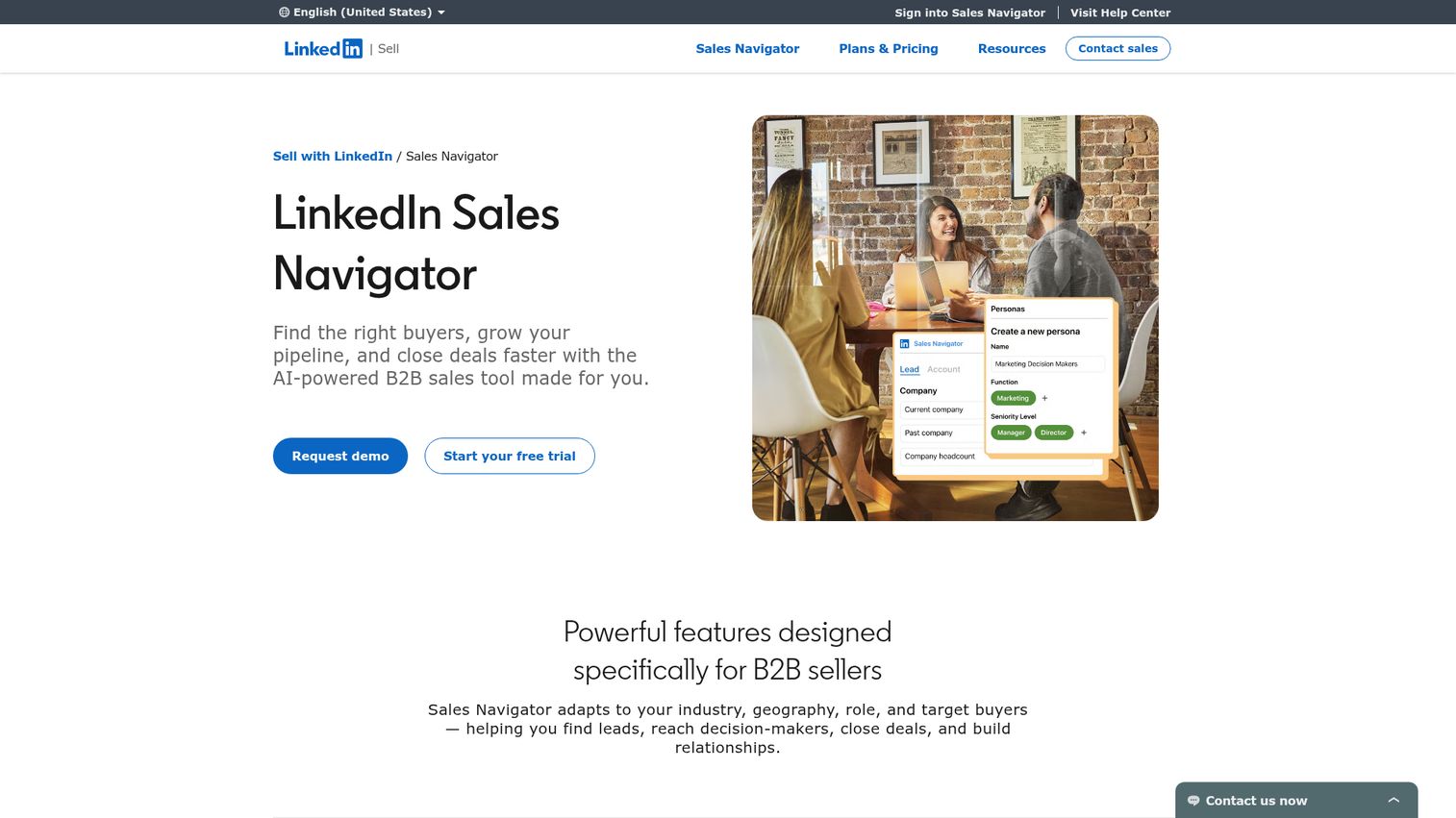
LinkedIn Sales Navigator is a sales platform built specifically for B2B sales professionals and teams to find and engage the right buyers. It's not a traditional contact database. It's the source of truth for professional identity, with self-updated profiles that no third-party provider can match for freshness.
Best for: AEs running enterprise and mid-market deals where account research and relationship mapping matter more than bulk contact volume.
Key strengths
- Advanced Search Filters: Filtered search across LinkedIn's professional graph, narrowed by role, geography, company size, and recent activity.
- InMail: Direct outreach to prospects you aren't connected with, useful when email isn't yielding replies.
- Lead and account recommendations: Surfaces accounts and people likely to fit your saved searches based on platform activity.
Why choose LinkedIn Sales Navigator: Sales Navigator doesn't give you direct dials, but it's the highest-fidelity account research surface in B2B. Most sales teams pair it with a contact database rather than replacing one.
LinkedIn Sales Navigator pricing: Core is $119.99/month per license ($1,079.88/year annual). Advanced is $159.99/month per license ($1,799.88/year annual). Advanced Plus is priced via custom quote and is built for sales teams using integrated CRM. LinkedIn notes listed prices are estimates, may exclude VAT or GST, and are subject to change.
6. Breeze Intelligence by HubSpot, best for CRM-native enrichment
Breeze Intelligence is HubSpot's data enrichment and buyer intent solution for Smart CRM that also includes form shortening. The product enriches HubSpot records natively, identifies high-fit visitors, and hides form fields HubSpot can already enrich.
Best for: Sales teams already running HubSpot as their CRM who want enrichment without a separate integration layer.
Key strengths
- Data enrichment: Enriches company and contact records directly inside the HubSpot Smart CRM.
- Buyer intent: Identifies high-intent, high-fit companies so sales can prioritize outreach.
- Form shortening: Hides fields HubSpot can enrich, reducing form length without losing data capture.
Why choose Breeze Intelligence: If you're a HubSpot shop, this is the lowest-friction enrichment option on the market. Data lands on records inside the CRM you already use. The trade-off is platform fit: it's built for HubSpot, not Salesforce.
Breeze Intelligence pricing: Breeze Intelligence functionality is tied to paid HubSpot subscriptions and HubSpot Credits. Specific Breeze-only pricing is not currently published in a way we can quote directly.
7. 6sense, best for ABM and account intent scoring
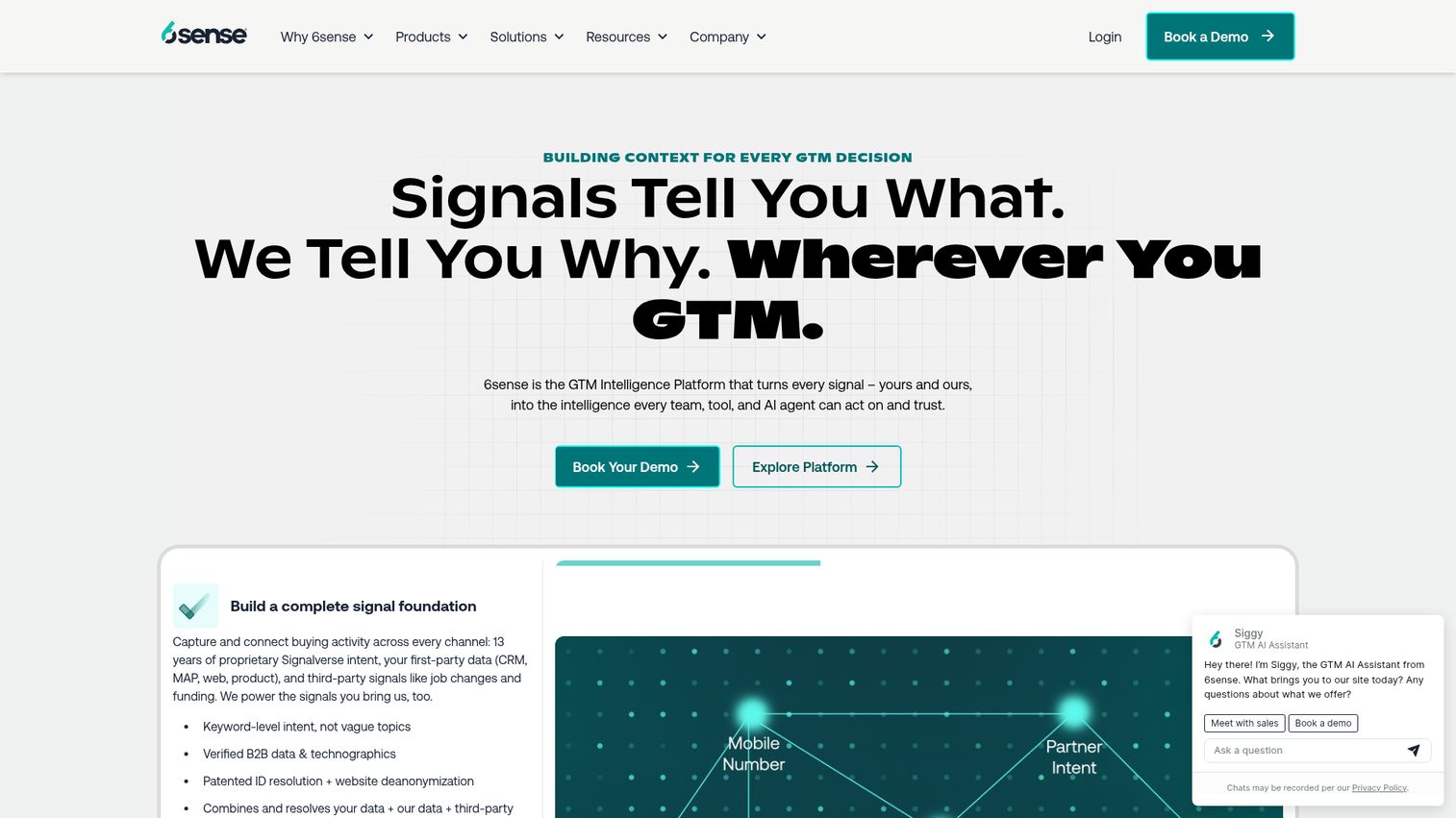
6sense is a GTM Intelligence Platform that turns buying signals into actionable intelligence for revenue teams. It sits upstream of contact databases, identifying in-market accounts before they fill out a form and scoring them for sales prioritization.
Best for: B2B revenue teams with complex, multi-stakeholder sales cycles that need intent data, account prioritization, and coordinated sales and marketing execution.
Key strengths
- Predictive AI model, scores, and dashboards: Predictive scoring ranks accounts by likelihood to engage and convert.
- Web visitor identification: Surfaces anonymous accounts visiting your site so sales can act before forms get filled.
- Company and people search: Built-in search for accounts and contacts inside the platform, with data credits to fuel enrichment.
Why choose 6sense: 6sense wins when sales and marketing need a shared account-based marketing strategy fundamentals account prioritization layer. It's not a contact database. Most customers pair it with ZoomInfo, Cognism, or Apollo on the contact side. If ABM is your motion, also review the best account-based marketing software to round out the stack.
6sense pricing: 6sense offers a Free tier that includes 50 Data Credits per Month, plus three paid Sales Intelligence configurations: Sales Intelligence + Data Credits + Predictive AI, Sales Intelligence + Data Credits, and Sales Intelligence + Predictive AI. Numeric pricing is not published.
8. Bombora, best for third-party intent data
Bombora provides B2B intent data, identity resolution and enrichment, digital audiences, and campaign measurement built on its B2B Data Co-op. Bombora's B2B Data Co-op intent methodology powers intent inside many of the other tools in this guide, which is why it's the default reference layer in the category.
Best for: Sales and marketing teams that want to layer third-party intent on top of an existing contact database to prioritize outreach and ABM campaigns.
Key strengths
- Company Surge intent data: Identify high-potential, in-market accounts for sales, marketing, and advertising.
- Visitor Insights: Identity resolution and enrichment that turns anonymous website visitors into known accounts.
- Premium B2B digital audiences: ABM and omnichannel activation across leading ad platforms.
Why choose Bombora: Bombora is best for teams that already have contact data and need to know which accounts to call first. It's a layer, not a stack, and it's the intent source most other intent products are measured against.
Bombora pricing: Bombora does not publish numeric pricing. The "Get Pricing" path redirects to a product information page with demo CTAs. Pricing is quoted directly through sales.
9. Dun & Bradstreet, best for firmographic depth and risk data
Dun & Bradstreet provides business decisioning data and analytics to help companies grow revenue, manage risk, lower costs, and improve performance. It's the oldest player in the category. The D-U-N-S Number business identifier standard remains a widely used identifier for company identity across procurement, finance, and CRM systems.
Best for: Mid-market and enterprise teams that need large-scale business data, sales intelligence, and third-party risk and compliance monitoring.
Key strengths
- Massive business graph: Data and insights on over 600M organizations and 2B consumers across more than 250 markets.
- Scores and predictive models: Predictive ratings and decisioning models to support sales prioritization, credit, and risk workflows.
- KYC/KYB and risk monitoring: Sanctions and watchlist screening with near real-time third-party risk alerts.
Why choose Dun & Bradstreet: D&B is the right call when you're selling to global enterprises and need the same company identity across sales, finance, and compliance. Contact data is not the strength here. Firmographic depth and risk data are.
Dun & Bradstreet pricing: D&B does not publish a public pricing page with readable numeric prices. Contracts vary based on data licensing scope and are quoted through sales.
10. Clay, best for composable data orchestration
Clay is a go-to-market platform that brings AI agents, enrichment, and intent data together so teams can turn insights into action. Clay isn't a single provider. It's a workflow tool that orchestrates 150+ data sources into waterfall enrichment workflow for RevOps, so RevOps can chain providers, fall back when one misses, and minimize cost per enriched record.
Best for: GTM, sales, and marketing teams running sophisticated outbound where waterfall enrichment and signal-based prospecting matter more than a single vendor relationship.
Key strengths
- Multi-provider data enrichment: Enrichment across 150+ providers, configurable per workflow.
- Claygent AI web research: AI agents that research accounts and people on the open web to fill gaps no provider covers.
- CRM auto-sync and enrichment: Push enriched records directly to Salesforce or HubSpot without scripting.
Why choose Clay: Clay wins for technical RevOps teams that want to optimize cost-per-enriched-record across multiple providers. There's a learning curve, but the ceiling is the highest in the category. Teams stitching Clay together with predictive models often layer in the best AI sales tools for scoring and personalization.
Clay pricing: Clay offers a Free plan, Launch at $167/month, Growth at $446/month, and a custom Enterprise tier. The pricing page also references higher Launch and Growth figures in its FAQ section, so confirm the current rate at signup.
11. UpLead, best for budget-conscious SMB prospecting
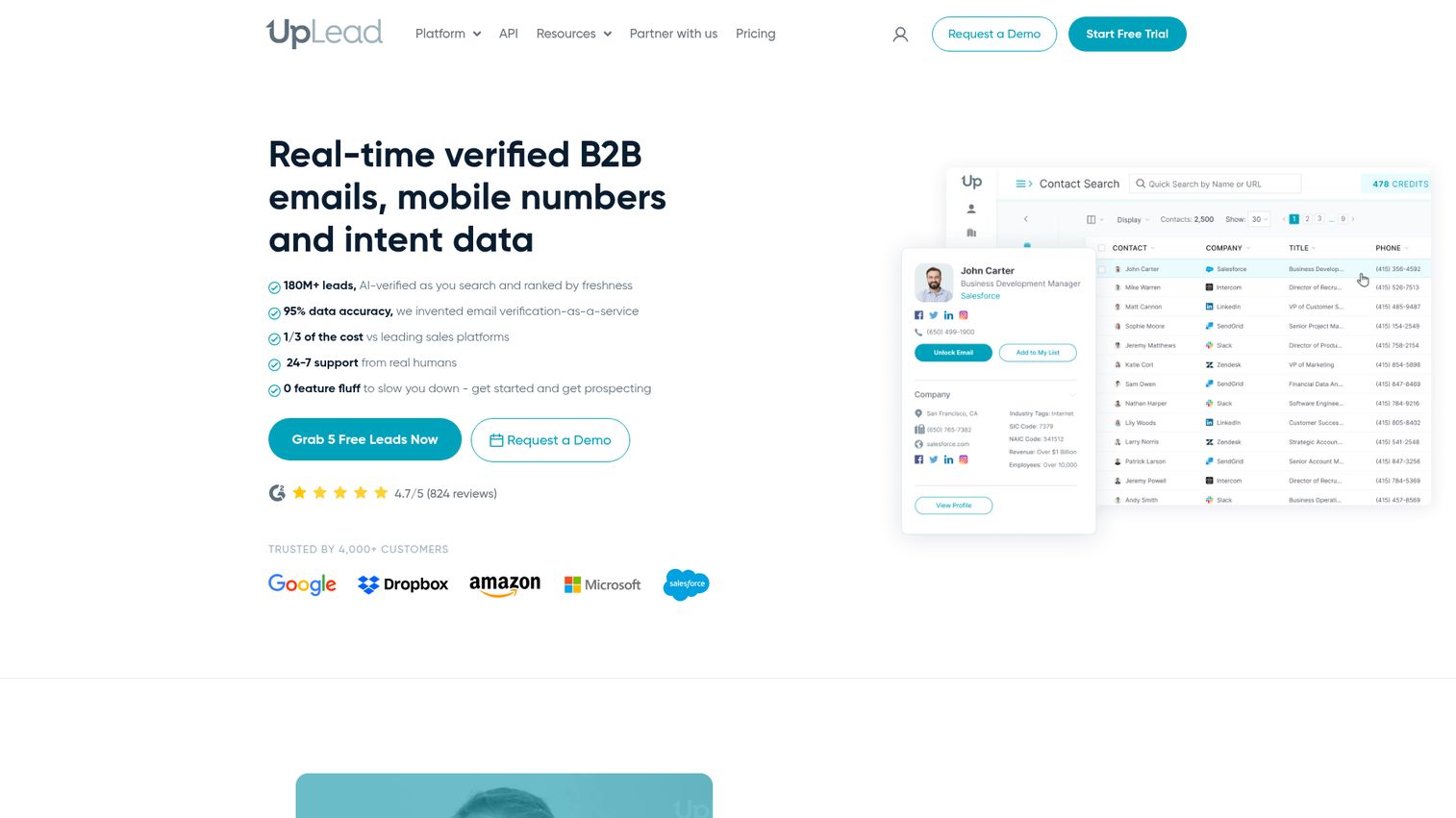
UpLead is a B2B database and business contact data provider with real-time verified emails, mobile numbers, and intent data. The pitch is simple: transparent monthly plans, verified contacts, and an accessible entry point for small teams.
Best for: SMB sales and outbound teams that need verified contact data, mobile numbers, and intent data for prospecting and CRM workflows.
Key strengths
- Real Time Verification: Email verification at the moment of export, not at database build time.
- Chrome Extension: Pull contact data directly from the browser into UpLead and the CRM.
- API: Programmatic access for RevOps teams that want to enrich records inside their own workflows.
Why choose UpLead: UpLead wins on price transparency and contract flexibility. The database is smaller than ZoomInfo or Apollo, but for small teams running targeted outbound, the data-per-dollar ratio is strong.
UpLead pricing: A 7-day Free Trial is available. Essentials is $99/month (or $74/month billed annually). Plus is $199/month (or $149/month billed annually). Professional is custom pricing through sales.
Considerations for sales teams evaluating B2B data providers
Data verification methodology
How does the provider source and verify data? Web crawling, community contribution, human verification, partnerships, or a co-op? Ask for the methodology, not just the accuracy number. Real-time verification at export typically holds up better than database-time verification.
CRM and stack integration depth
Native two-way sync with Salesforce or HubSpot is table stakes. Look for identity resolution (does the provider merge records or create duplicates?), field mapping flexibility, and trigger-based workflows. "Native integration" varies wildly in practice. Demand a working demo against your actual CRM schema before signing. Guideflow's own integrations with Salesforce, HubSpot, and other GTM tools follow the same rule: the depth matters more than the badge.
Compliance posture
GDPR compliance requirements for B2B outbound, CCPA consumer privacy compliance for sales data, and DNC compliance aren't optional for sales teams operating in regulated markets. Confirm the provider's sourcing methodology meets your legal team's bar before signing. The compliance badge on the marketing site is not the same as a defensible methodology.
Pricing model and contract terms
Per-seat pricing that scales aggressively is a flag for growing teams. Credit-based or platform pricing scales more predictably. Annual contracts are standard, but monthly options exist when you need flexibility. Ask about mid-term seat changes before signing a multi-year deal.
Cross-role adoption
Will SDRs, AEs, and RevOps all use it? The shelf-ware tax on data providers is real. If only one role uses the data, you're paying enterprise prices for departmental value. Pilot with all three roles before rolling out.
How to build a B2B data stack that actually works
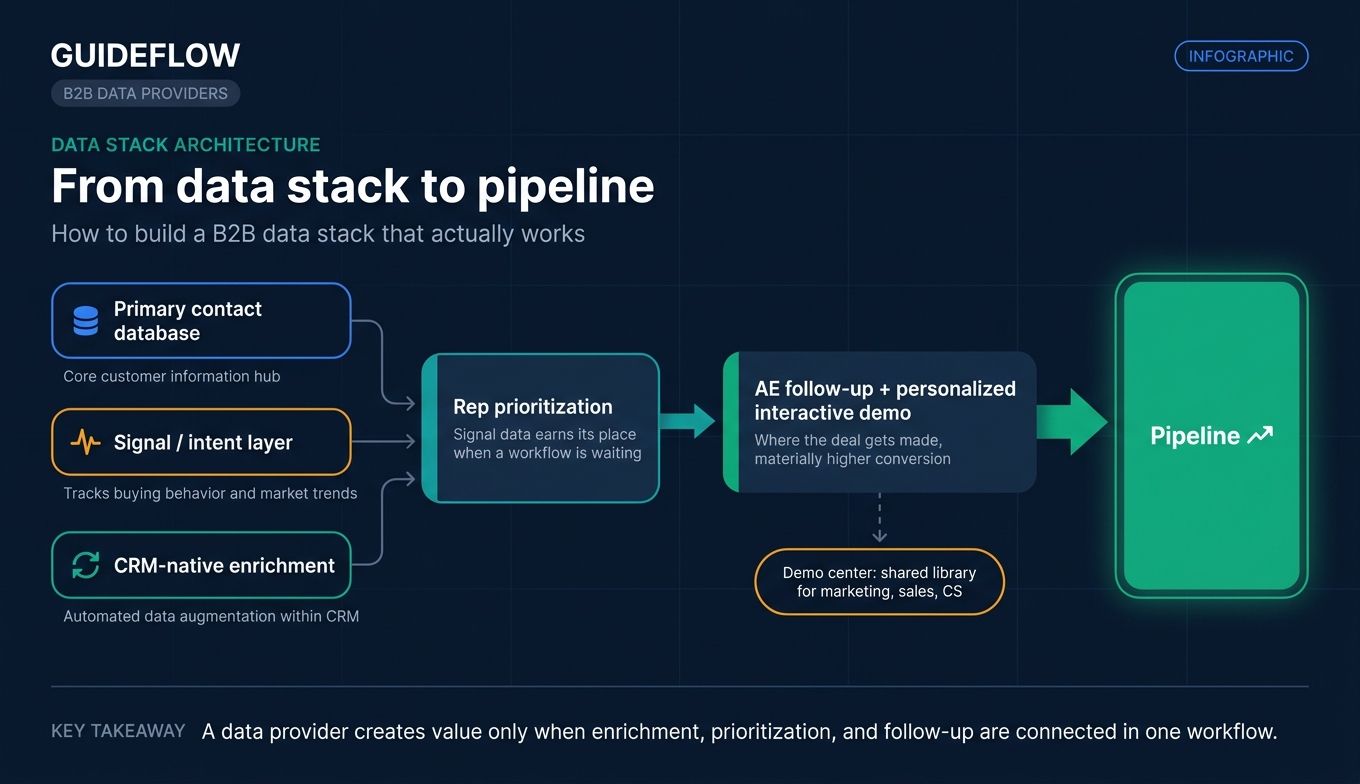
Most SERP competitors recommend a single vendor. That's not how mature sales teams operate. The right answer is usually a stack: a primary contact database, a signal or intent layer, and CRM-native enrichment that keeps the database from rotting.
A few patterns that work:
- The 80/20 stack: One contact database (ZoomInfo, Apollo, or Cognism) plus one signal layer (Bombora or LinkedIn Sales Navigator) plus CRM-native enrichment (Breeze Intelligence if you run HubSpot). Covers most outbound and RevOps needs without overpaying.
- The startup stack: Apollo plus Lusha plus LinkedIn Sales Navigator. Apollo handles list building and sequencing. Lusha covers one-off direct dial lookups. Sales Navigator anchors account research. Lightweight, scalable.
- The ABM stack: 6sense plus ZoomInfo plus Bombora, layered through Clay for orchestration. 6sense scores accounts, ZoomInfo and Bombora feed the data, Clay stitches it together with waterfall enrichment.
- The compliance-first stack: Cognism plus LinkedIn Sales Navigator plus Dun & Bradstreet for corporate hierarchy. Built for regulated industries and EMEA-heavy motions.
Signal data only earns its place when there's a workflow waiting for it. A funding round or a new VP hire creates timing, but timing alone doesn't convert. The AE's follow-up is where the deal gets made.
That follow-up converts at materially higher rates when paired with a personalized interactive demo that shows the product in the prospect's exact context. Interactive demos work across the buyer journey: embedded on landing pages, sent in cold outreach, attached as pre-call leave-behinds, used live in discovery, and shared as post-meeting follow-ups for champions to circulate inside their buying committee. The same asset library, organized inside a demo center, serves marketing, sales, and CS, so the signal you paid for actually compounds into pipeline.
Common mistakes sales teams make when buying B2B data providers
- Buying for data volume instead of data accuracy. A massive database at 60% accuracy is worse than a smaller one at 95%. Volume looks good in a sales pitch. It looks bad on a bounce report.
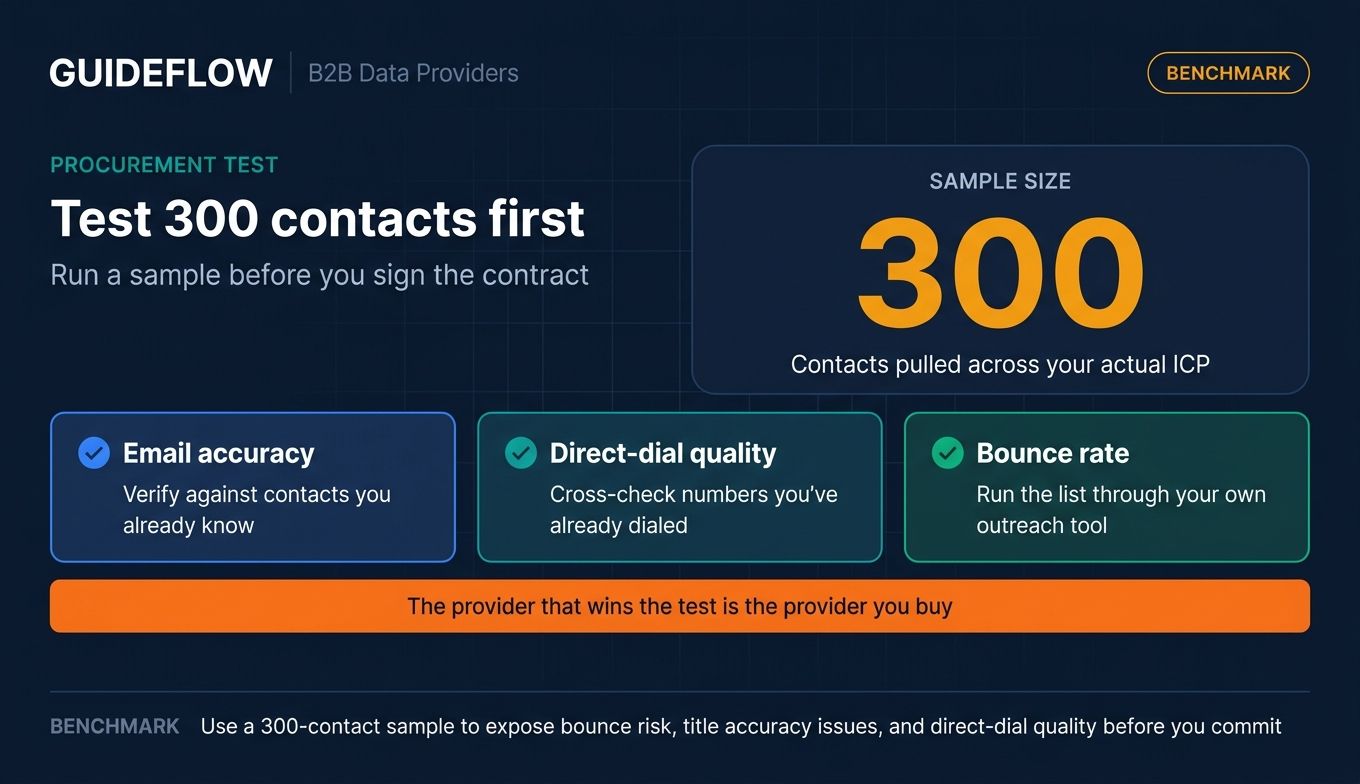
- Skipping the sample test. Run a 200 to 500 contact sample before signing. Verify against your existing data and check bounce rates and title accuracy. Every reputable provider will agree to this.
- Underestimating the integration tax. "Native Salesforce integration" varies wildly. Some providers push duplicate records. Some lose enrichment on field updates. Demand a working demo against your actual CRM schema.
- Locking into a multi-year contract before adoption is proven. Negotiate an opt-out clause on first contracts, ideally at the six-month mark. If the data lands well, renew on better terms. If it doesn't, you walk.
- Buying intent data without an action plan. Intent without sequences, scoring, and rep workflows is shelfware. Buy intent only when you have a clear playbook for what happens when an account lights up. Pair it with the best outreach software so the signal turns into a sequence the same day.
Conclusion
The best b2b data providers in 2026 aren't one tool. They're the right stack for your motion.
For enterprise sales orgs, ZoomInfo remains the most complete single-vendor option. For SMB and mid-market teams, Apollo plus LinkedIn Sales Navigator covers most ground at a fraction of the cost. For compliance-driven outbound, Cognism is the default. For HubSpot shops, Breeze Intelligence is the lowest-friction enrichment layer on the market. For RevOps teams that want to optimize cost-per-record, Clay orchestrates the rest.
The honest framing: most sales teams need two or three providers, not one. The "best" B2B data provider is the right combination for your motion, your stack, and your compliance posture.
Don't sign a contract before you've run a sample test. Pull 300 contacts across your actual ICP, verify the emails and direct dials against what you already know, and check the bounce rate inside your own outreach tool. The provider that wins that test is the provider you should buy. The pitch deck is a distant second.
FAQs
There's no single best. ZoomInfo leads for enterprise sales orgs that want one platform. Apollo.io is the strongest pick for SMB and mid-market SDR teams. Cognism is the default for compliance-driven outbound in EMEA. The right choice depends on team size, CRM, and primary motion.
Entry-level platforms like Apollo offer a free plan and scale into paid tiers from there. UpLead starts at $74/month on annual billing. Mid-tier and enterprise providers like ZoomInfo, Cognism, 6sense, and Dun & Bradstreet do not publish numeric pricing and quote contracts through sales. Expect mid-five figures and up for enterprise deployments.
Contact data is who to reach: emails, phone numbers, titles. Intent data tells you which accounts are researching your category, usually sourced from co-ops like Bombora. Signal data is event-based: job changes, funding rounds, hiring spikes. Most mature outbound motions use all three together.
Compliance varies by provider and by sourcing methodology. Cognism, Lusha, and Apollo all publish documentation on how they source and verify data. The compliance badge on a marketing site is not enough. Always validate the sourcing methodology with your legal team before signing.
Yes, and most mature sales teams do. Tools like Clay let you waterfall multiple providers for cost optimization and coverage. A typical stack pairs one primary contact database with one intent or signal layer plus CRM-native enrichment. Combining providers improves coverage and reduces single-vendor risk.
Methods vary across the category. Common sourcing approaches include web crawling, community contribution (where users share contacts in exchange for credits), AI inference, publisher co-ops (Bombora's model), and human verification of phone numbers. Ask each vendor for their specific methodology and verification cadence.
B2B contact data decays at roughly 2.1% per month, which compounds to about 22.5% per year according to Bright Data and Landbase. That means even high-accuracy databases degrade quickly without refresh cycles. Real-time verification at export typically outperforms database-time verification for active prospecting.
Usually yes. Sales Navigator is the highest-fidelity research surface in B2B because profiles are self-updated, but it doesn't surface verified emails or direct dials. Most sales teams pair Sales Navigator with a contact database like Apollo, Cognism, or ZoomInfo to cover both research and outreach.