You run the numbers at the end of the month and the food cost line is higher than it should be. Prep looks tight. Ordering looks disciplined. But something is leaking margin, and nobody on the floor can point to exactly where.
That gap is the problem. Most kitchens throw away a measurable slice of every purchase order, and almost none of them know which ingredients, stations, or shifts are doing the damage. You can't fix what you can't see. The global food waste management software market was valued at USD 1.5 billion in 2024 and is projected to reach USD 4.2 billion by 2033, growing at a 10.8% CAGR, according to DataHorizzon Research (2024). That growth is not sentiment. It is operators finally putting a meter on waste the same way they meter labor and revenue.
The right food waste software turns a vague suspicion into a line item you can act on. It tells you what got binned, what it cost, why it happened, and where. For a hospitality group running five, fifty, or five hundred kitchens, that visibility is the difference between guessing and managing. This guide compares seven tools built to give you that visibility, so you can cut cost, standardize reporting, and prove impact without stitching together spreadsheets.
What's inside
This guide is for operators, procurement leads, sustainability managers, and hospitality executives choosing food waste management software for one site or a multi-location group. We looked at how each tool actually fits a working kitchen, not just how it markets itself.
We selected and ranked the seven tools on four criteria:
- Capture method: how waste gets measured (AI vision, scale-based, or manual logging)
- Reporting depth: whether data breaks down by item, category, site, and time
- Scalability: how well the food waste tracking system handles multi-site rollout
- ROI signals: food cost savings, labor time saved, and payback clarity
The list spans AI camera systems, computer-vision platforms, and broader food waste management systems that connect prevention to sourcing.
TL;DR
- Best for enterprise multi-site operators: Winnow and Leanpath both bring deep multi-site dashboards, benchmarking, and years of large-scale deployment.
- Best for AI-driven waste capture: Orbisk and Kitro use camera-based recognition to log discards automatically with minimal staff effort.
- Best for sustainability reporting: Positive Carbon leads on carbon visibility, live dashboards, and automated impact reports.
- Best for broader reduction workflows: Phood connects computer-vision waste tracking to production planning.
- Best where waste meets sourcing: Full Harvest sits a little differently, tackling surplus and procurement efficiency rather than in-bin kitchen tracking.
- Bottom line: pick your capture method first, then judge reporting depth and rollout support against your food cost savings target.
What is food waste software
Food waste software is a system that tracks, analyzes, and helps reduce the food a kitchen throws away, then ties that waste to cost and sustainability impact. It replaces the clipboard and the end-of-shift guess with data you can trust.
There are four main product types. AI camera systems photograph and recognize each discard automatically. Scale-based systems weigh waste and prompt the user to tag it. Manual capture tools log waste through a tablet or app. Reporting layers sit on top of all three and turn raw capture into dashboards, benchmarks, and exports.
Most food waste tracking software shares a core set of features:
- Waste capture: automatic or prompted logging of every discard
- Category tagging: by ingredient, station, or reason (spoilage, prep, plate return)
- Cost analysis: attaching a dollar value to what got binned
- Benchmarking: comparing sites, shifts, or periods against each other
- Sustainability reporting: carbon avoided, meals saved, water impact
- Multi-site dashboards: rolled-up views with property-level drill-down
The strongest systems make capture nearly invisible to staff while making the resulting data rich enough for a finance or sustainability team to act on. That balance, low friction at the bin and high resolution in the report, is what separates a food waste management system that sticks from one that gets abandoned after a month.
When to use food waste software
Reduce food cost in a commercial kitchen
High-volume kitchens lose money in three places: over-prep, spoilage, and plate waste. Each one hides inside the food cost percentage, and none of them show up on an invoice. Commercial kitchen food waste software makes those losses visible by item and by station, so you can adjust par levels, prep quantities, and portioning with evidence instead of instinct. That same data feeds labor efficiency, because staff stop over-producing food that goes straight to the bin.
Standardize reporting across multiple properties
A hotel group with a dozen kitchens has a dozen ways of measuring waste, which means it effectively has none. Hospitality food waste software centralizes capture into one dashboard so head office can compare properties on the same terms. Benchmarking surfaces the top and bottom performers, turns anecdotes into rankings, and gives regional managers a consistent scorecard. Multi-site reporting is where these platforms earn their keep for groups.
Prove sustainability and ESG progress
Boards, procurement partners, and investors increasingly ask for numbers on environmental impact, not intentions. A food waste tracking system quantifies meals saved, carbon avoided, and water impact, then exports it in a format that survives scrutiny. Sustainability reporting only matters if the underlying operation can act on it, so the best tools pair the ESG output with the operational insight that produced it.
Comparison table
Here is how the seven tools compare on fit, capture method, and pricing. Pricing and ratings reflect what each vendor and public source showed at the time of writing. Several vendors quote per site, so treat contact-sales entries as a signal to ask for assumptions.
| # | Product | Best for | Key differentiator | Pricing | G2 rating |
|---|---|---|---|---|---|
| 1 | Orbisk | Hotels and multi-site kitchens | Automated AI camera tracking with a photo log of every discard | Contact sales | Not rated |
| 2 | Winnow | High-volume commercial kitchens | Automatic identification and weighing, pre- and post-consumer | Subscription, quoted per site | Not rated |
| 3 | Leanpath | Enterprise multi-site foodservice | Guided workflows plus large-scale reporting | Subscription, custom | Not rated |
| 4 | Kitro | Professional kitchens wanting automation | In-bin image processing with coaching | From CHF349/month | Not rated |
| 5 | Positive Carbon | Sustainability-forward operators | AI sensors with carbon and price calculation | From €299/month per sensor | Not rated |
| 6 | Phood | Foodservice and campus dining | Computer vision tied to production planning | Contact sales | Not rated |
| 7 | Full Harvest | Sourcing and surplus reduction | B2B produce marketplace for imperfect and surplus produce | From $0.33/lb (FOB) | Not rated |
1. Orbisk
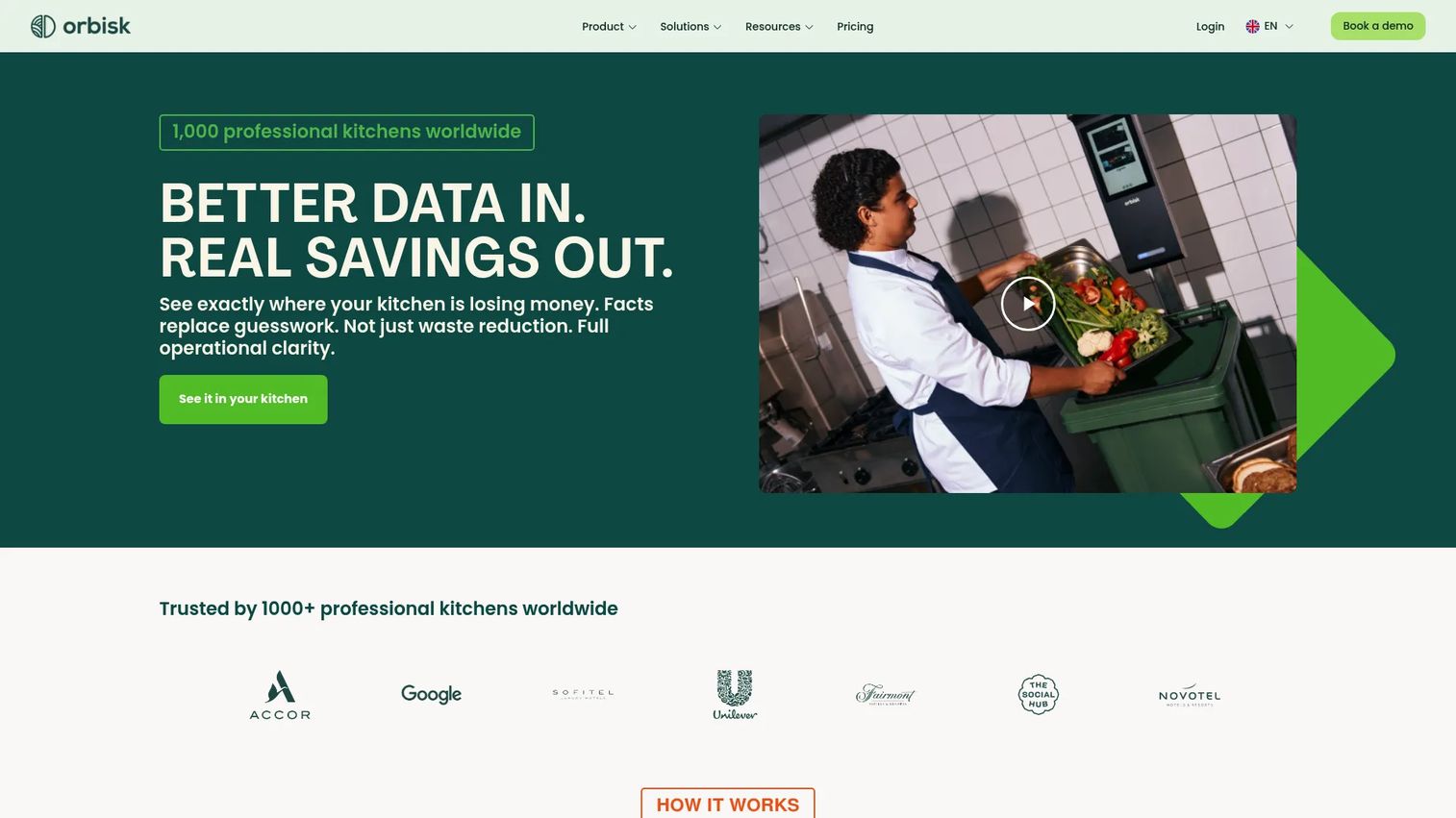
Orbisk is an AI-powered food waste tracking platform built for hospitality kitchens. A camera above the bin recognizes what gets thrown away and logs it automatically, so the measurement happens without staff stopping to weigh or tag anything. That photo log of every discard is the detail operators tend to fixate on, because it turns a monthly waste number into a searchable record of exactly what left the pass.
For a hospitality group comparing properties, Orbisk's value is ingredient-level insight rolled up across sites. You can see which items drive waste at each kitchen, then act on the recommendations the platform surfaces. The automated capture keeps friction low in a busy service, which is usually what determines whether a food waste management system survives past the pilot.
Best for: Hotels, restaurants, and multi-site kitchens that want automated tracking with minimal staff effort.
Key strengths
- Automated waste tracking with no manual weighing
- Photo log of every discard for full traceability
- Ingredient-level insights and recommendations
Why choose Orbisk: Choose Orbisk when you want capture to disappear into the workflow and reporting to stay rich. It fits groups that need consistent, low-effort measurement across kitchens rather than a tool that depends on staff remembering to log.
Orbisk pricing: Orbisk lists three tiers, Insights, Excellence, and Enterprise, all on contact-sales pricing. Ask what each tier includes for hardware, sites, and reporting before you compare.
2. Winnow
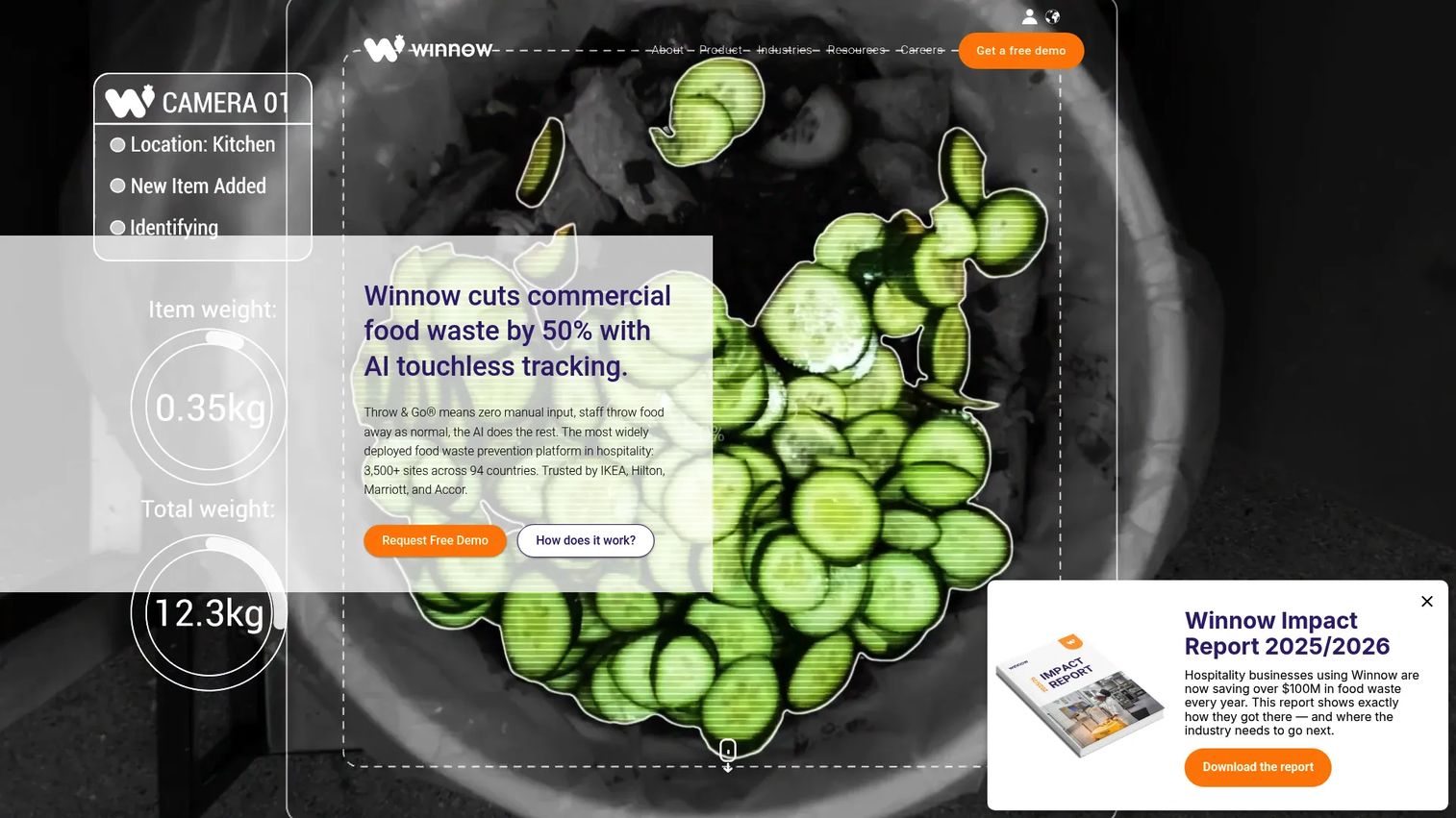
Winnow is one of the most established AI food waste prevention systems for commercial kitchens. It automatically identifies and weighs discarded food, then feeds that into analytics that separate pre-consumer waste (prep and spoilage) from post-consumer waste (plate returns). That split matters, because the fix for each is completely different, and lumping them together hides the real story.
Winnow's credibility comes from scale. It runs in hotels, resorts, and high-volume caterers where the waste numbers are large enough to move a P&L. The multi-site dashboards and benchmarking give a group the same scorecard across every kitchen, and the target-measure-act framing keeps teams focused on change rather than just observation. For enterprise operators, that operational adoption story is often the deciding factor.
Best for: Hotels, resorts, caterers, and other high-volume commercial kitchens that need serious analytics.
Key strengths
- Automatic identification and weighing of discarded food
- Pre- and post-consumer waste tracking
- Multi-site dashboards and benchmarking
Why choose Winnow: Choose Winnow when you run high-volume kitchens and need proof at scale. Its pre- and post-consumer split and benchmarking suit groups that want to standardize measurement across many properties.
Winnow pricing: Winnow prices on a subscription basis, quoted per site based on kitchen size and product tier across its Track, VisionControl, VisionAI, and VisionAI+ plans. No public price list is published, so request a per-site quote.
3. Leanpath
Leanpath is a long-standing enterprise food waste management platform used across restaurants, hospitals, universities, and hotels. What sets it apart is the emphasis on guided workflows and alerts, not just measurement. The platform nudges staff toward the actions that reduce waste, which pushes it closer to a coaching system than a passive tracker.
For operators who want guidance rather than raw data, that prescriptive layer is the draw. Leanpath pairs AI-powered tracking with multi-site reporting and analytics, so a group gets both the day-to-day behavior change on the line and the rolled-up view for head office. It positions itself as a partner in a reduction program, which fits organizations running formal sustainability commitments alongside food cost goals.
Best for: Restaurants, hospitals, universities, hotels, and other multi-site foodservice operators seeking structured reduction.
Key strengths
- AI-powered food waste tracking
- Multi-site reporting and analytics
- Guided workflows and alerts
Why choose Leanpath: Choose Leanpath when you want a system that tells staff what to do next, not just what happened. Its guided workflows suit large operators building a formal, outcome-oriented reduction program.
Leanpath pricing: Leanpath prices on a subscription basis tailored to the organization's needs, with no public numeric price shown. Ask for a scope based on site count and reporting requirements.
4. Kitro
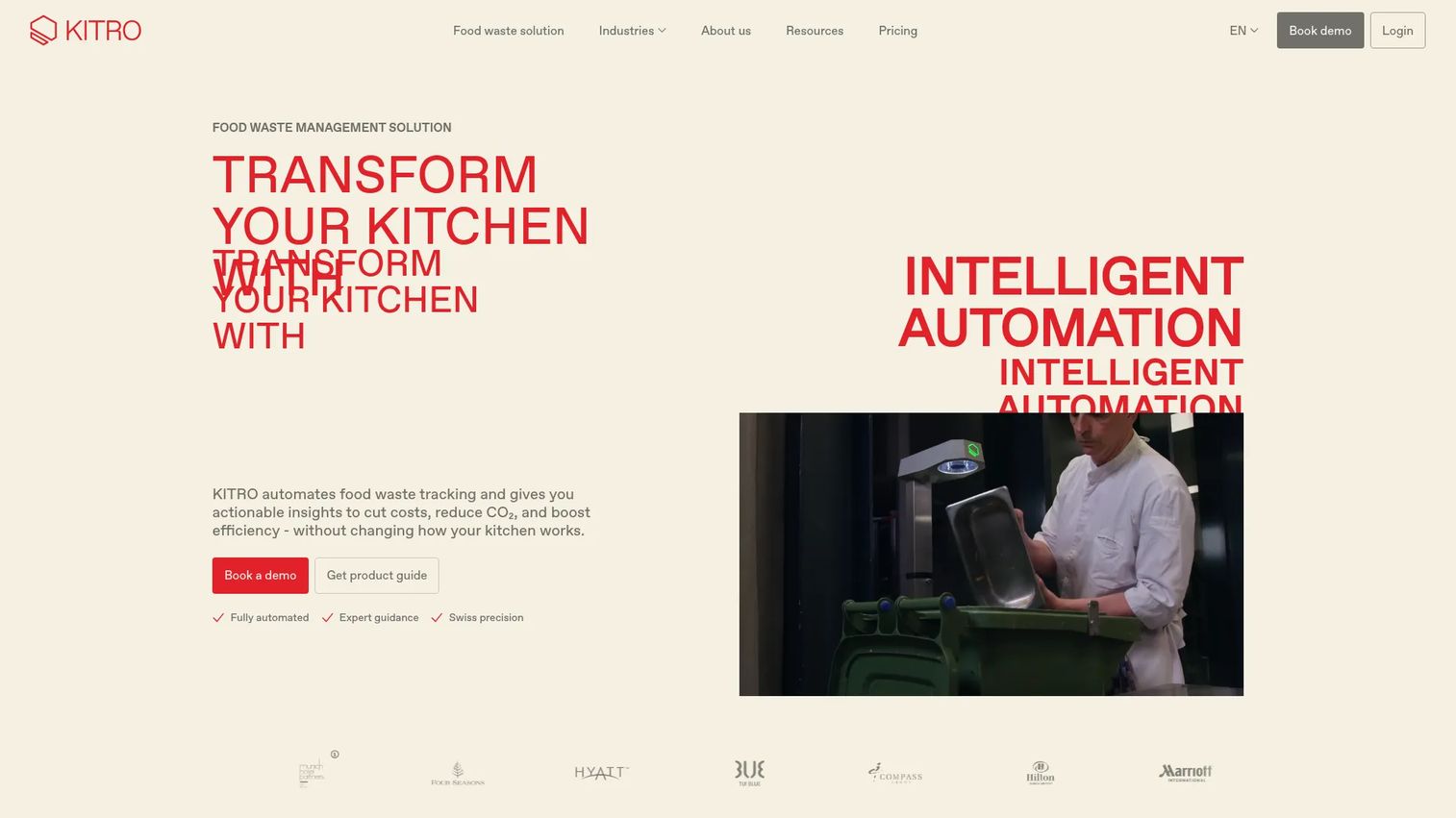
Kitro is an AI-powered food waste tracking and management platform for professional kitchens. It uses automated in-bin tracking with image processing to identify edible and non-edible waste, ingredients, and portions, so the measurement stays hands-off during service. The dashboard then turns that capture into waste analytics paired with expert coaching.
Kitro's appeal is ease of adoption. The automated capture means staff don't have to change their workflow, and the coaching component helps teams interpret the data rather than drown in it. A kitchen would pick Kitro over a larger incumbent when it wants strong automated tracking with published, predictable pricing rather than a fully custom enterprise engagement. That transparency makes budgeting simpler for single sites and smaller groups.
Best for: Hospitality and foodservice operators that want automated food waste measurement with clear pricing.
Key strengths
- Automated in-bin tracking with image processing
- AI identification of edible and non-edible waste, ingredients, and portions
- Dashboard with waste analytics and expert coaching
Why choose Kitro: Choose Kitro when you want automated capture and coaching with a published starting price. It fits operators who prefer pricing clarity over a fully bespoke enterprise quote.
Kitro pricing: Kitro offers a Business plan from CHF349 per month and an enterprise plan with custom, quote-based pricing. There is no free tier.
5. Positive Carbon
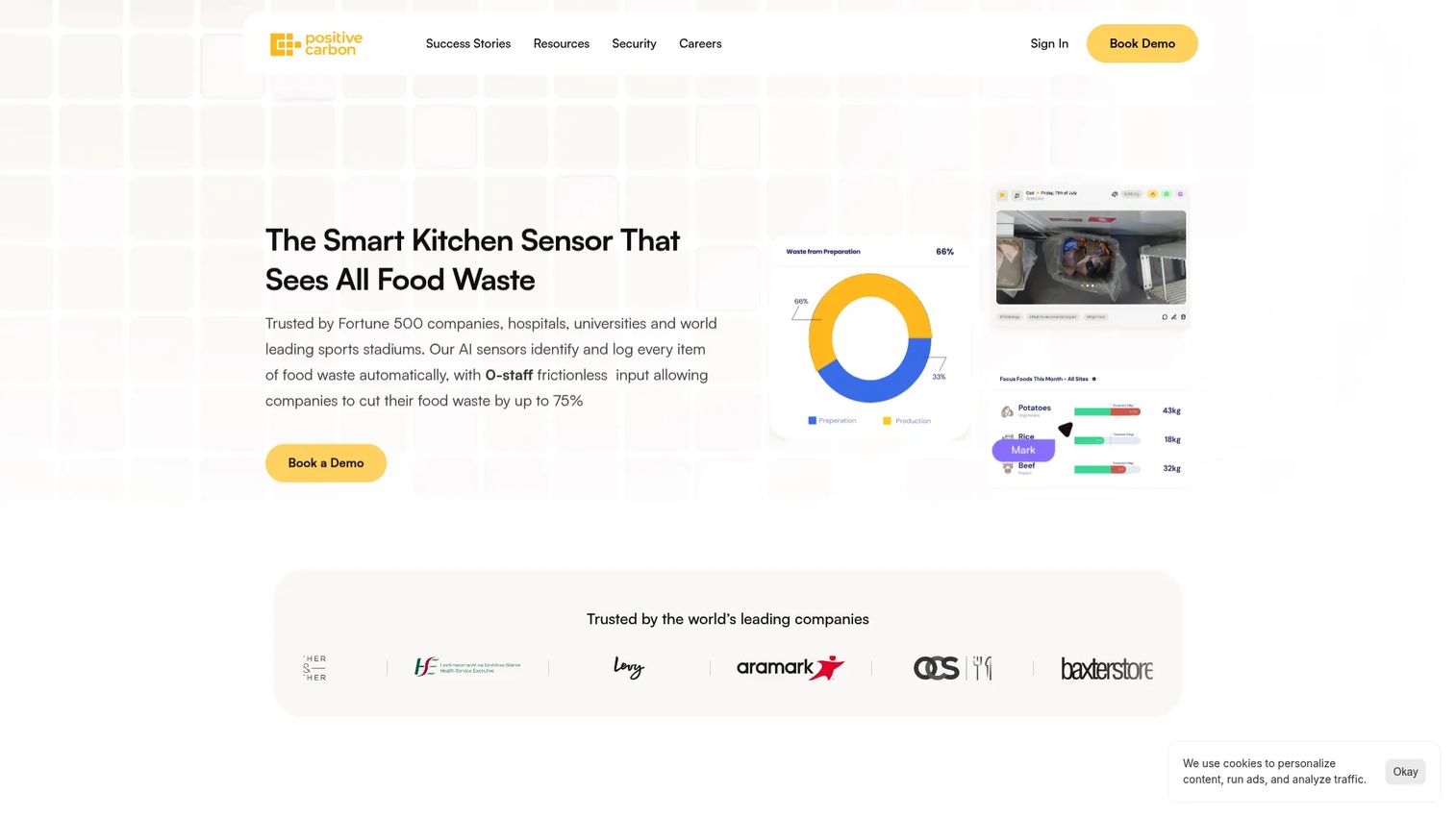
Positive Carbon is an AI food-waste monitoring platform with a clear sustainability tilt. AI sensors identify and log food waste automatically, and the platform layers on real-time tracking with live dashboards and automated reports. Where it stands out is the built-in carbon and price calculation, which translates every discard into both a cost and an emissions figure without a separate spreadsheet.
That makes it a strong fit for operators whose reporting has to satisfy an ESG mandate as well as a food cost target. Features like event planning and occupancy-based forecasting help kitchens anticipate demand and prevent over-production before it happens, which is the more valuable side of any waste analytics dashboard. Buyers who care most about defensible sustainability reporting, and who want it tied directly to operational action, are the natural audience here.
Best for: Hospitality operators that want to measure and reduce kitchen food waste with carbon visibility.
Key strengths
- AI sensors that identify and log food waste automatically
- Real-time tracking with live dashboards and automated reports
- Event planning, occupancy-based forecasting, and carbon and price calculation
Why choose Positive Carbon: Choose Positive Carbon when carbon and cost need to sit in the same view. Its forecasting and automated reports fit operators reporting to boards or procurement on ESG progress.
Positive Carbon pricing: Positive Carbon offers Weight Only at €299 per month per sensor, AI Food identification at €599 per month per sensor, and a custom Enterprise plan. There is no free tier.
6. Phood
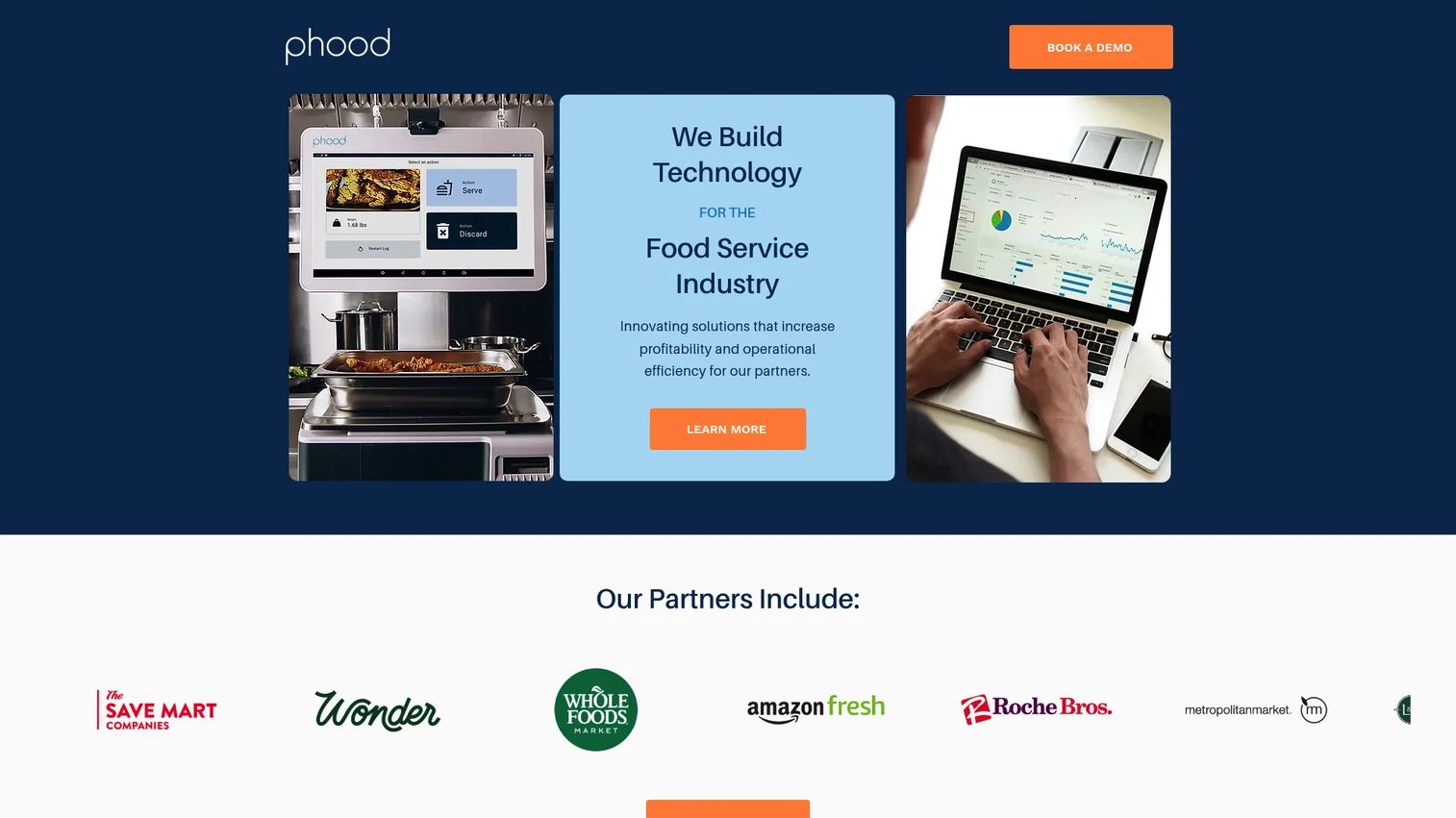
Phood is a foodservice technology platform that connects food waste tracking to the decisions that prevent it. It combines waste tracking with computer-vision insights and demand-based production planning, which is what pushes it beyond pure measurement. Instead of only telling you what got wasted, Phood feeds that data into how much to produce next time.
That production planning angle fits prepared-food stations especially well, where over-production at the hot line or grab-and-go case is the main source of loss. Cafeteria, campus, and larger foodservice settings benefit most, because those environments produce in batches and can adjust output based on demand patterns. For operators who see waste as a symptom of production decisions rather than a standalone metric, Phood's workflow lines up with how the kitchen actually runs.
Best for: Foodservice operators, campus dining, and cafeterias that want to cut waste through smarter production.
Key strengths
- Waste tracking across stations
- Computer vision-based insights
- Demand-based production planning
Why choose Phood: Choose Phood when your waste problem is really a production problem. Its demand planning suits prepared-food and batch environments where output can be tuned to forecast.
Phood pricing: Phood does not publish public pricing; its site uses demo and contact calls to action. Request a demo and ask for pricing scoped to your station count and volume.
7. Full Harvest
Full Harvest sits a little differently from the rest of this list, and it is worth being clear about that. It is not an in-bin kitchen tracker. It is a B2B produce marketplace for buying and selling surplus, imperfect, and all grades of produce direct from farms. The waste it targets happens upstream, before food ever reaches your prep station.
That makes it the right pick when your waste-reduction strategy connects to sourcing and inventory discipline rather than plate-level tracking. Buyers use it to source imperfect or surplus produce at lower cost, which cuts on-farm waste and often food cost at the same time. It offers spot, program, and contract buying, end-to-end logistics with order traceability, and a marketplace pricing and sales metrics dashboard. If your bigger lever is procurement, Full Harvest complements a kitchen tracker rather than replacing it.
Best for: Food and beverage buyers or growers sourcing direct-from-farm produce with sustainability goals.
Key strengths
- Spot, program, and contract buying and selling
- End-to-end logistics and order traceability
- Marketplace pricing and sales metrics dashboard
Why choose Full Harvest: Choose Full Harvest when waste reduction starts at sourcing. It pairs well with a kitchen tracking tool for operators tackling both surplus and in-kitchen loss.
Full Harvest pricing: Full Harvest uses marketplace listing pricing, with some harvests shown from $0.33 per pound FOB. Other items require contract terms or account sign-up to view availability and pricing.
Considerations
Capture method
The capture method decides whether your data is complete or full of holes. AI vision systems photograph and recognize discards automatically, which keeps friction near zero in a busy kitchen. Scale-based systems weigh waste and prompt a tag. Manual logging depends entirely on staff discipline. Match the method to your volume and staffing: high-throughput kitchens usually need automated capture, because manual logging tends to drop off the moment service gets busy.
Reporting depth
Ask exactly how the platform slices data. Can it report by item, category, property, time of day, and location? Item-level and reason-level reporting is what lets you forecast, adjust par levels, and rework menus. A waste analytics dashboard that only shows a total weight tells you a problem exists without telling you what to do about it. Push vendors to show the deepest breakdown, not the headline number.
Multi-site rollout
For a hospitality group, rollout is as important as the software. Look for property-level views, role-based permissions, and benchmarking that ranks sites on the same terms. Ask how onboarding and staff training work across locations, because a food waste tracking system only pays off when every kitchen uses it consistently. Consistency across sites is what makes multi-site reporting trustworthy.
ROI and payback
Expect savings from three sources: reduced food cost, less labor spent over-producing, and better forecasting. Payback period depends on your waste baseline, kitchen volume, and how disciplined the team stays. Ask every vendor for the assumptions behind their ROI claims, then run the numbers against your own baseline rather than their averages.
ESG and sustainability outputs
If sustainability reporting matters, confirm which impact metrics the platform surfaces: carbon avoided, meals saved, water impact. Check that these export cleanly for board, procurement, or investor reporting. Sustainability reporting is only useful if operations can act on it, so favor tools that pair the ESG output with the operational insight behind it.
Conclusion
The safest way to shortlist is to start with capture method, then judge reporting depth and rollout support.
For enterprise scale and multi-site proof, Winnow and Leanpath are the established picks, with deep dashboards, benchmarking, and years of large deployments behind them. For automated, low-friction AI capture, Orbisk and Kitro log discards with almost no staff effort, and Kitro adds published pricing for easier budgeting. For sustainability visibility, Positive Carbon puts carbon and cost in the same view. Phood fits operators whose waste is really a production problem, and Full Harvest tackles the upstream sourcing side that in-bin trackers do not touch.
Your next step is practical: draw up a two- or three-tool shortlist based on your capture needs, then ask each vendor for a live kitchen trial and the assumptions behind their ROI numbers. Measure against your own baseline, not their averages. The tool that reduces waste while making reporting easier, and does it without creating a mess across your sites, is the one worth buying.
FAQs
Food waste software measures what you throw away, including what it cost and why. Inventory software manages stock levels and usage across purchasing and prep. They complement each other: inventory tells you what you bought and used, while food waste tracking software tells you what you lost, so together they close the loop on food cost.
A camera mounted above the bin captures an image of each discard, and computer vision classifies the item, estimates its weight, and often assigns a cost and a reason. The system logs this automatically, so staff don't stop to weigh or tag. Over time it builds a record of waste by item, station, and time that you can act on.
Prioritize multi-site dashboards, benchmarking that ranks properties on the same terms, and role-based permissions so head office and site managers see the right views. Add sustainability reporting if you report on ESG. The goal is one consistent food waste management system across every kitchen, not a dozen local ones.
Payback depends on your waste baseline, kitchen volume, labor savings, and how consistently the team logs and acts. High-volume kitchens with a large waste baseline typically see savings faster, because there is more to recover. Ask vendors for the assumptions behind their ROI claims and model the payback period against your own numbers.
Touchless capture usually improves adoption and consistency, especially in busy kitchens where stopping to log gets skipped. Because the measurement happens automatically, the data stays complete even during peak service. Manual logging can work well in lower-volume settings or where budget is the primary constraint, so match the method to your kitchen's reality.
Yes, if the platform exports carbon avoided, meals saved, water impact, or related metrics in a clean, verifiable format. Several tools calculate carbon and cost alongside each discard. Confirm that the outputs export in a form your board, procurement, or investors will accept, and that operations can act on the same data.
Look for platforms with centralized dashboards, cross-site benchmarking, and property-level controls. These features let a group compare kitchens fairly, spot outliers, and standardize reporting across teams. Automated capture also helps, because it keeps data consistent when staffing and discipline vary from site to site.
Ask to see waste broken down by item, reason, cost, site, and time period, plus the reporting exports your team will actually use. Request a live view rather than a polished sample, so you can judge how the waste analytics dashboard handles real, messy data. Then ask for the assumptions behind any ROI numbers.