A homeowner requests a quote on Tuesday morning. By Thursday, two competitors have already sent theirs. If your estimate is still stuck between a measurement report and a spreadsheet, that lead is gone. The job was never lost on price. It was lost on speed.
Most roofing teams treat estimating as a math problem. Measure the roof, add material, add labor, add markup. But the real bottleneck sits between those steps: pulling supplier pricing from one place, measurements from another, and rebuilding the same proposal from scratch every time. That friction is where margin leaks and where deals go cold.
The numbers back this up. Roughly 60% of roofing contractors now use digital estimating platforms, with more than 55% shifting to cloud-based tools and reporting 30%-plus reductions in manual measurement errors, according to Global Growth Insights (2025). Teams are moving off spreadsheets because the old way does not scale past a handful of jobs a week.
Good roofing estimating software fixes the whole chain, not just the math. It connects roof measurements, material pricing, and proposal creation into one motion, so estimate accuracy stays consistent no matter which rep is quoting. This guide compares seven roof estimating software tools through five lenses: speed from measurement to quote, estimate accuracy, supplier pricing depth, proposal automation, and mobile usability. Whether you run a two-truck residential crew or a commercial roofing operation, the right roofing software estimating stack turns quoting from a bottleneck into a repeatable system.
What's inside
This guide compares seven roofing estimate software tools built for contractors, estimators, sales managers, and roofing operators who want to move faster from measurement to signed job. We evaluated each tool on estimating depth, takeoff or measurement workflow, proposal generation, pricing and margin control, and mobile usability in the field.
Some picks are all-in-one platforms that carry a job from lead to payment. Others are specialists: precise commercial takeoff, remote roof measurements, or fast quoting for small crews. We also flag residential versus commercial fit throughout, because a tool built for a five-tab spreadsheet replacement rarely suits a commercial bid, and the reverse is just as true.
TL;DR
Short on time? Here are the quick decision rules:
- Best all-in-one workflow: Roofr carries a job from CRM to measurement report to proposal to payment in one system.
- Best AI-driven proposals: XBuild turns job photos and scopes into estimates with Good/Better/Best tiers and margin control built in.
- Best commercial takeoff: STACK handles precise quantity, labor, and material takeoff for commercial roofing teams.
- Best for small crews: RoofSnap pairs remote measurements with fast estimates and simple online payments.
- Best measurement-first workflow: EagleView delivers accurate aerial reports that feed any estimating tool downstream.
- Best visual capture: Hover builds 3D property models for cleaner measurement inputs and sales conversations.
What is roofing estimating software?
Roofing estimating software is a digital tool that turns roof measurements and material costs into accurate, professional estimates and proposals, replacing manual spreadsheet quoting. Modern platforms in 2026 do far more than calculate a subtotal.
The strongest roofing estimate software now combines several capabilities buyers should expect:
- Roof measurements: built-in measurement services or clean import of third-party aerial reports, so estimators start from accurate square footage, pitch, and facet data.
- Material and supplier pricing: live or synced supplier pricing and material pricing, so line items reflect real costs instead of stale numbers.
- Proposal generation: branded proposals with Good/Better/Best options, photos, and scope detail that reps can send without rebuilding from scratch.
- Digital signatures and payments: e-sign, deposit collection, and invoicing that close the loop between quote and cash.
- Margin and markup controls: standardized markups and pricing rules that protect margin across every estimator on the team.
- Mobile workflow: field-ready apps so reps can measure, quote, and present on a tablet or phone at the property.
The global roofing estimating software market reflects this shift, projected to grow from USD 420.5 million in 2024 to USD 950.3 million by 2032 at a 10.5% CAGR, according to Future Market Report (2024). Residential roofing drives about 41.3% of that demand, making it the top application segment. North America leads adoption, with the United States alone accounting for 21.7% of global market share.
The core idea: a good roofing estimator software tool is not a calculator. It is the operating layer between a measurement and a signed contract.
When to use roofing estimating software
Replace manual spreadsheet estimating
Spreadsheets work when you close a few jobs a month. They break down the moment quote volume climbs. Every estimator builds pricing a little differently, formulas get copied and quietly corrupted, and no two proposals look alike. If your team is quoting repetitive residential jobs and the output is inconsistent, roofing software standardizes the math and the presentation in one move.
Speed up bids after roof measurements
The window between a measurement report and a sent proposal is where deals are won or lost. Teams use roof estimating software the moment an aerial report or completed takeoff lands. The report feeds directly into pricing, the estimate populates, and a branded proposal goes out the same day. Faster turnaround means your bid reaches the homeowner before the competition, and the handoff from measurement to proposal stays clean.
Improve margin control and consistency
When margins tighten or reps quote the same job at different prices, software becomes a margin protection tool. Supplier pricing keeps material costs current, markup rules enforce your target margin on every line, and standardized Good/Better/Best tiers stop reps from underbidding to close. Consistency across estimators matters as much as speed. One rogue quote can erase the profit from three clean ones.
Comparison table
Here is how the seven tools stack up. Ranking follows fit for the core keyword, not alphabetical order. Residential all-in-one platforms sit at the top, with measurement-first and commercial specialists filling specific roles.
| # | Product | Intent | Key differentiation | Pricing | G2 rating |
|---|---|---|---|---|---|
| 1 | XBuild | AI estimates and proposals | Photo-to-estimate with Good/Better/Best tiers and insurance scopes | From $80/mo | Not yet rated |
| 2 | Roofr | All-in-one roofing platform | CRM, measurements, proposals, and payments in one system | Free plan; paid from $109/mo | 4.9/5 |
| 3 | STACK | Commercial takeoff and estimating | Precise quantity, labor, and material takeoff | From $249/user/mo | 4.1/5 |
| 4 | RoofSnap | Fast quoting for small crews | Remote measurements plus estimates and payments | From $13/report | Not listed |
| 5 | EagleView | Measurement-first reports | High-resolution aerial imagery and property data | From $13.75/report | 3.6/5 |
| 6 | Hover | Visual measurement capture | 3D property models from smartphone photos | Free start; Pro $99/mo | 3.5/5 |
| 7 | GAF QuickScope | Quick scope and measurement | Measurement reports plus insurance scope estimates | From $18/report | Not listed |
The split is clear: Roofr and XBuild own the end-to-end workflow, STACK anchors commercial takeoff, and EagleView, Hover, and GAF QuickScope specialize in the measurement layer that feeds everything else.
1. XBuild
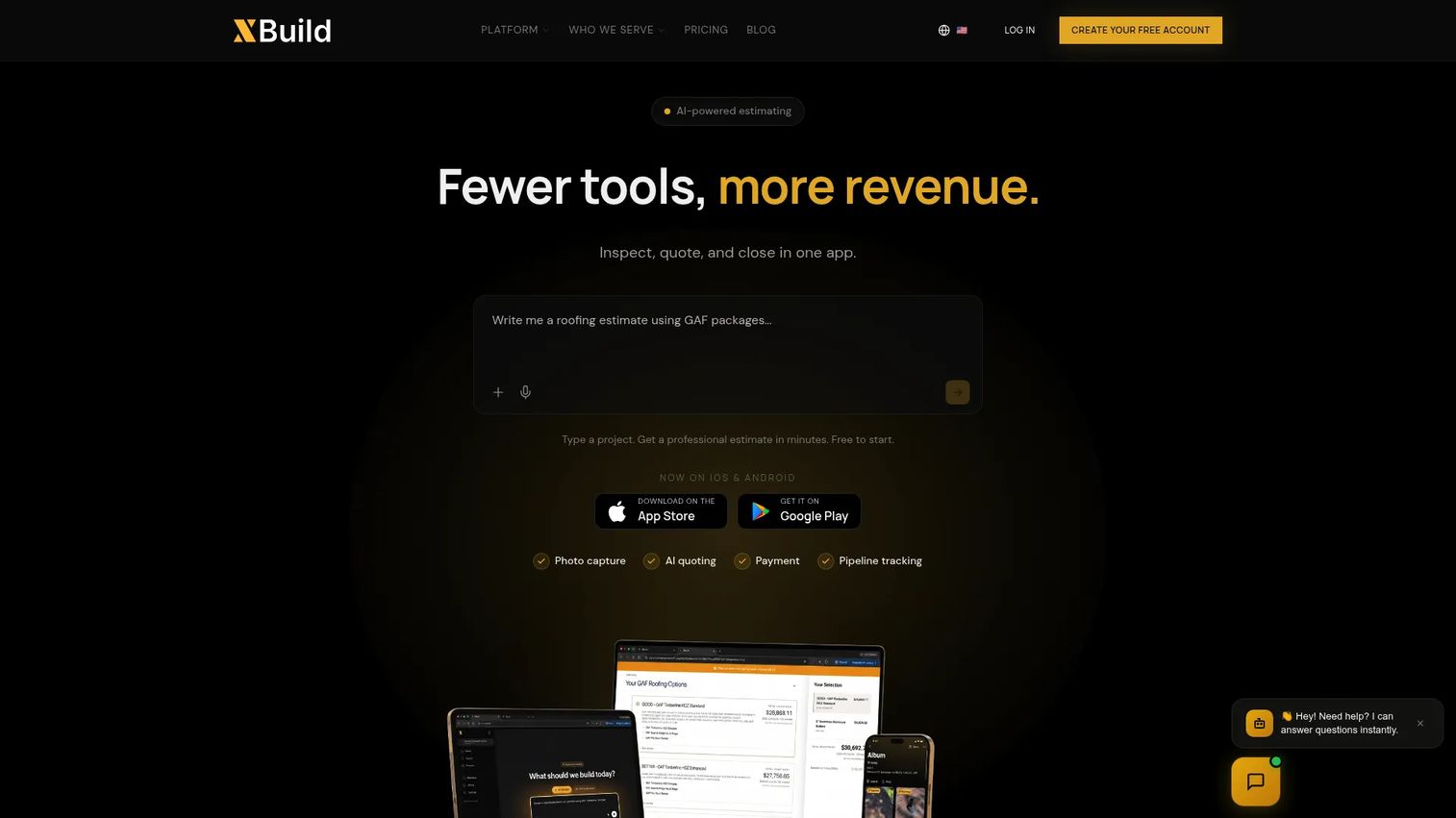
XBuild is an AI-powered estimating and proposal platform built for contractor sales teams that want faster proposals without giving up margin control. It leans hard into automation: feed it job photos and scope details, and it generates an estimate with tiered proposals and payment collection attached. For teams tired of rebuilding every quote by hand, that photo-to-estimate flow is the headline feature.
Best for: Contractor sales teams that need AI estimates, roofing proposals, and payments in one connected workflow.
Key strengths
- AI estimates and proposals: Turns job photos and scope inputs into complete estimates, cutting proposal prep from hours to minutes.
- Full scope editing: Lets estimators adjust line items, Good/Better/Best tiers, and real-time pricing before a proposal goes out.
- E-sign and payments: Closes the loop with digital signatures and payment collection, so a signed proposal moves straight to deposit.
Why choose XBuild: If proposal automation and margin protection are your two priorities, XBuild is built for that intersection. Supplier pricing and material pricing flow into the estimate, markup rules hold your margin, and insurance restoration scopes are supported for storm-work teams. It suits sales-led operations that live in proposals and want AI to remove the manual grind.
XBuild pricing: Plans are tiered by usage and include token allotments. Standard starts at $80/mo (200 tokens), Pro at $150/mo (500 tokens), and Elite at $300/mo (1,200 tokens). Enterprise pricing is custom. A free trial with 100 trial tokens is available, so teams can test the photo-to-estimate flow before committing.
2. Roofr
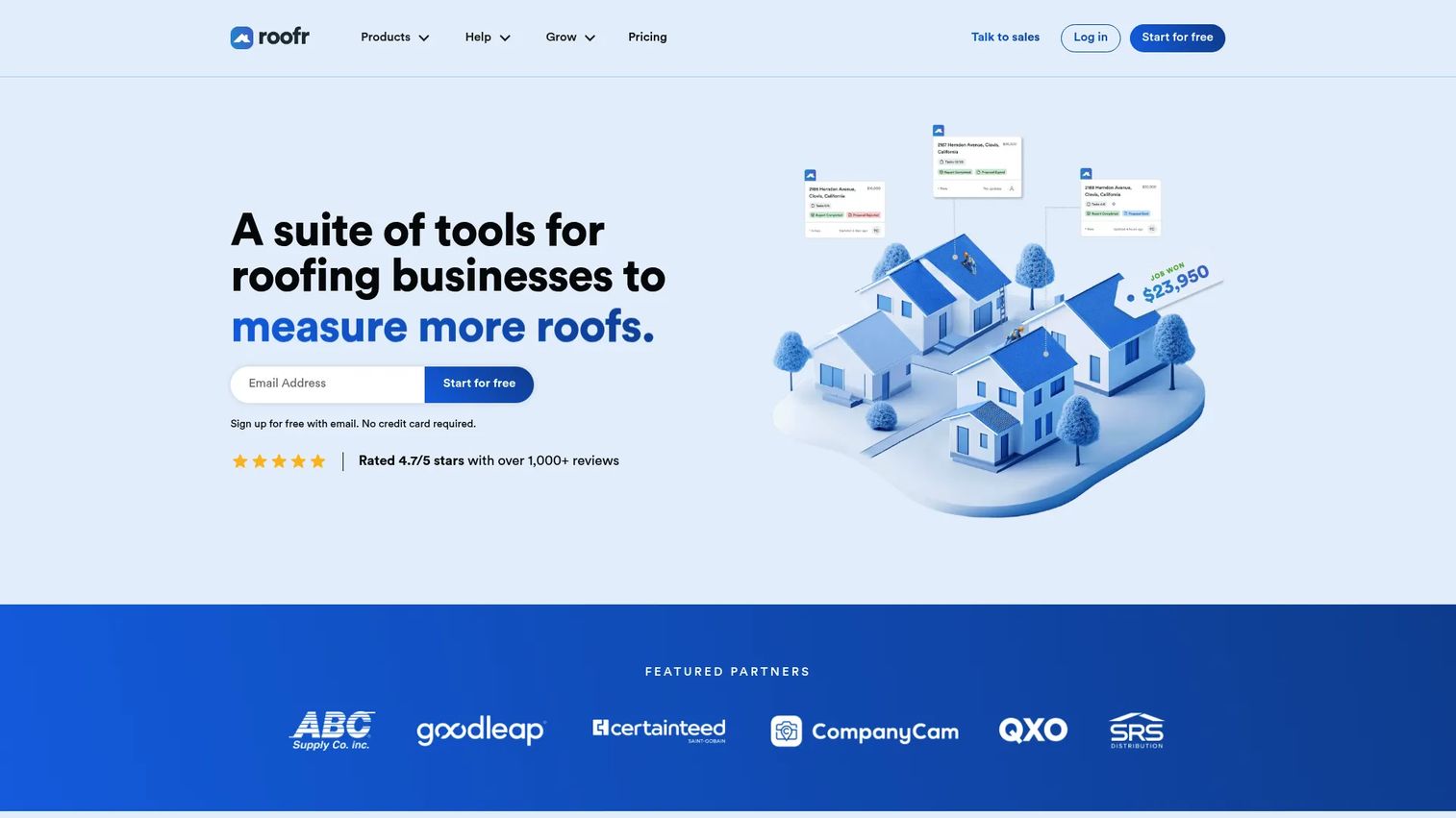
Roofr is the all-in-one pick. It runs the full job lifecycle: CRM, roof measurement reports, an Instant Estimator, proposals, material ordering, invoicing, and payments in one platform. For teams that want a single system from lead to close instead of stitching four tools together, this is the most complete roofing software on the list.
Best for: Roofing contractors who want one platform covering estimates, proposals, and measurement reports without tool sprawl.
Key strengths
- Roof measurement reports: Pay-as-you-go measurement reports feed directly into estimates, so pricing starts from accurate data.
- Instant Estimator: Generates fast, consistent estimates that reps can turn into branded proposals in minutes.
- Proposals, payments, and job management: Handles digital signatures, deposit collection, and job tracking, closing the loop from quote to cash.
Why choose Roofr: Roofr wins on breadth and mobile workflow. Reps can measure, quote, and collect payment from the field, and the CRM keeps every job in one place. Supplier pricing and proposal automation reduce the manual quoting that eats field time. With a 4.9/5 G2 rating, it earns strong marks from contractors who consolidated their stack onto it.
Roofr pricing: Roofr offers a free Starter plan at $0/mo, then paid base plans: Measure+ at $109/mo, Essentials at $249/mo, and Scale at $349/mo. Measurement reports are pay-as-you-go, priced at $19/report on Starter and $13/report on paid plans. Add-ons like Instant Estimator and Roofr Sites are available. Annual billing lowers the monthly cost.
3. STACK
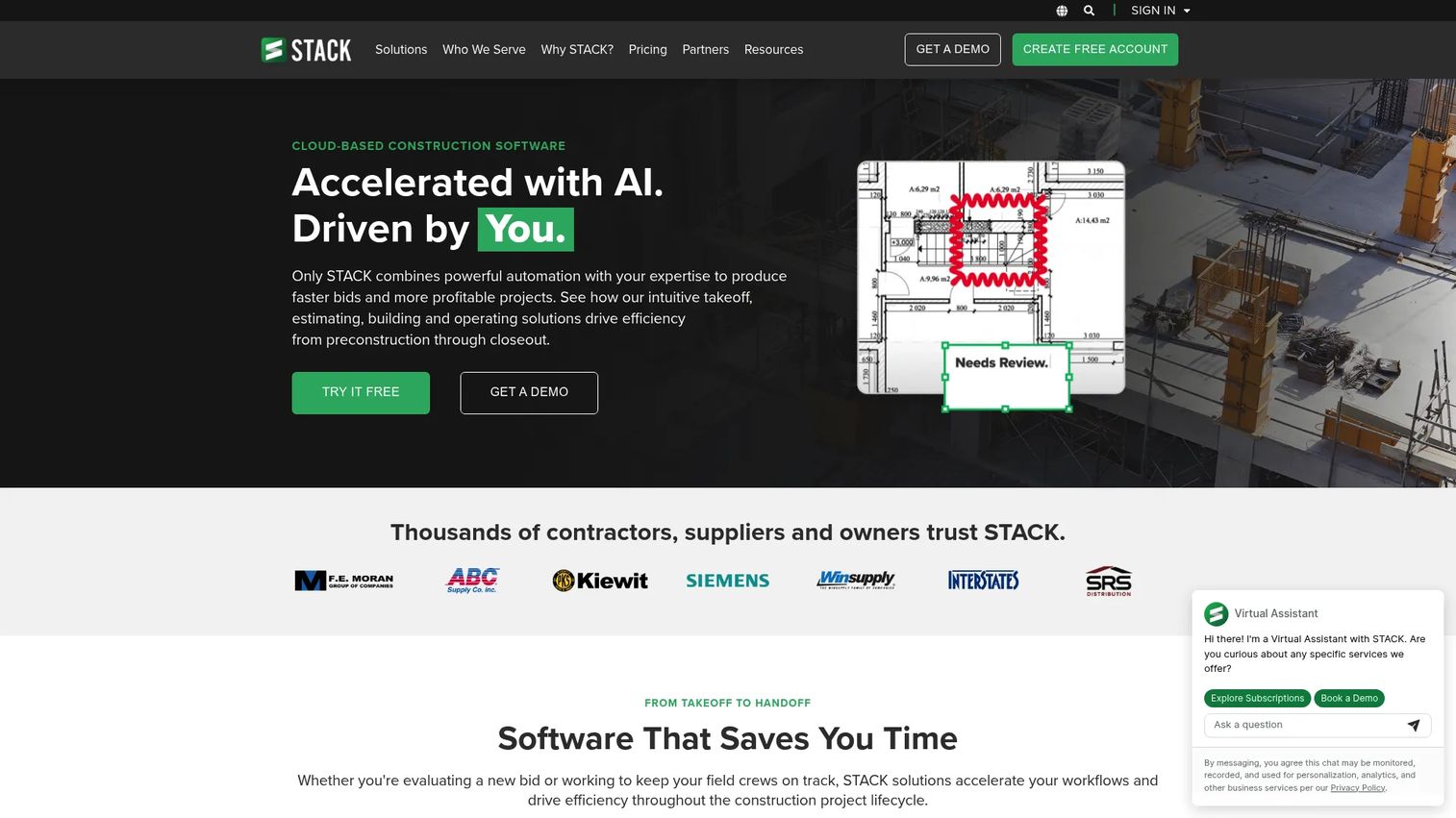
STACK is the commercial roofing software pick. It is built for precise digital takeoff: quantity, labor, and material takeoff on complex plans, with flexible estimating and proposal output on top. Where residential tools lean on aerial reports, STACK gives estimators granular control over roof takeoff software workflows on large commercial jobs.
Best for: Commercial roofing and construction teams that need accurate roofing takeoff software and field collaboration.
Key strengths
- Quantity, labor, and material takeoff: Measures directly on PDF and image plans for detailed, defensible commercial estimates.
- Flexible estimates and proposals: Builds worksheets and proposals from takeoff data, keeping the estimate tied to the measured scope.
- Field and project tools: Adds issues, punch lists, daily reports, workflows, and SSO/API on higher plans for larger operations.
Why choose STACK: For commercial roof estimating software, takeoff precision beats speed. STACK gives estimators the control to measure complex roofs accurately and defend those numbers in a bid. Collaboration and device access let estimating and field teams work from the same data. It is the strongest fit when the job is too large and too detailed for an aerial-report shortcut.
STACK pricing: Takeoff & Estimate offers Premium at $249 per user/month and Pro at $299 per user/month, billed annually, with a free account and trial available. The Build & Operate line adds Essential, Pro, Enterprise, and a custom Build Your Own option with USD and CAD toggles. Enterprise plans are contact-sales.
4. RoofSnap
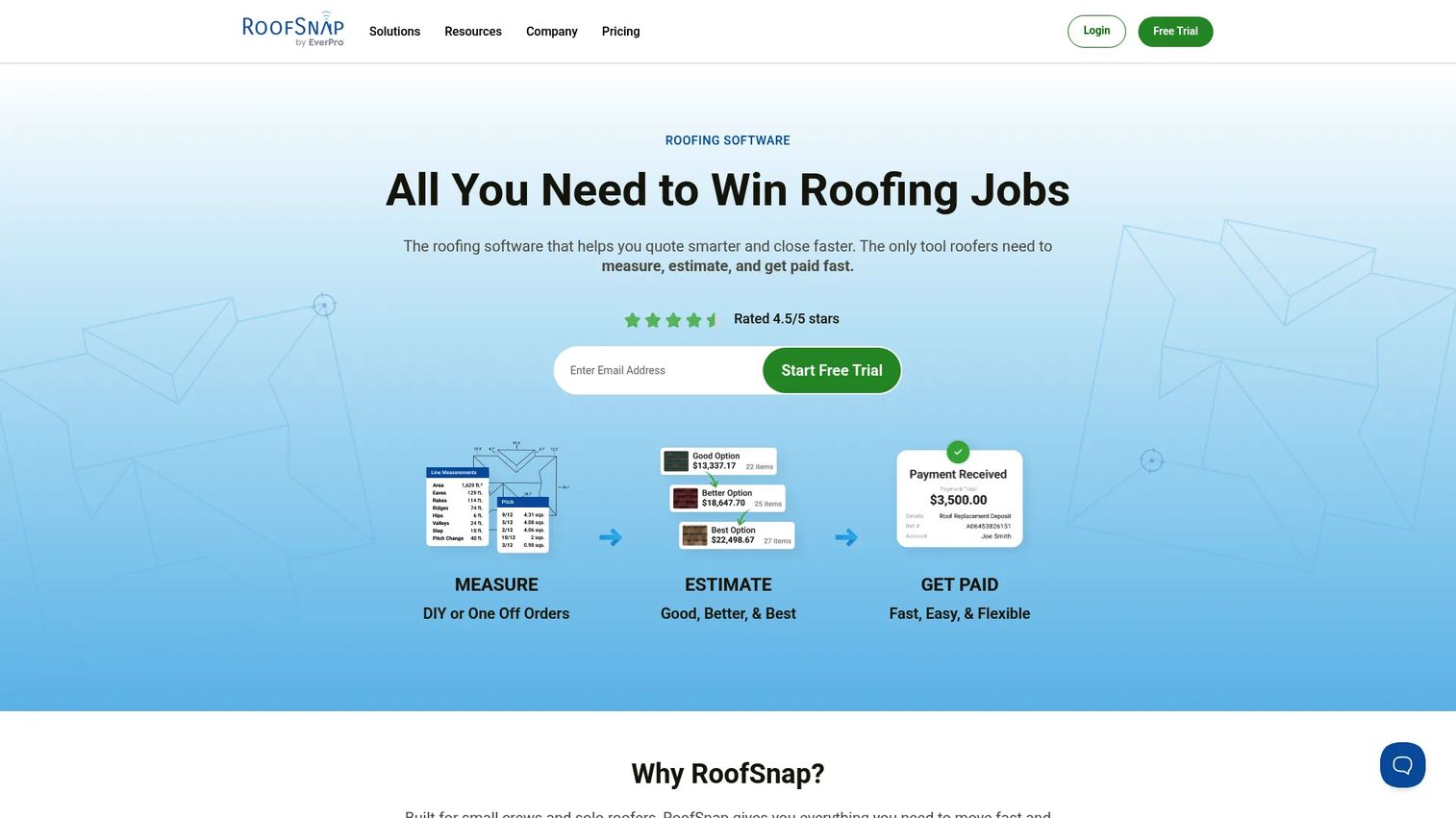
RoofSnap is built for speed and simplicity. It pairs remote roof measurements with fast estimate creation, contracts, and online payments, all in a workflow small crews and owner-operators can run without training. If you want to measure, quote, and collect without an enterprise learning curve, this is the practical pick.
Best for: Roofing contractors and small crews who need measurement reports, estimates, and payments in one simple platform.
Key strengths
- Roof and gutter measurement reports: Delivers measurement data plus a draw-it-yourself option for reps who want to measure on their own.
- Fast estimates and contracts: Builds Good/Better/Best proposals with markups and discounts, then converts them to contracts.
- Payment collection: Collects deposits and payments in-app, keeping the mobile workflow tight for field sales.
Why choose RoofSnap: RoofSnap performs best when speed and ease matter more than deep configuration. Owner-operators and small teams get from a driveway measurement to a signed contract in one sitting. The pay-as-you-go option keeps costs low for crews that quote in bursts rather than at high steady volume.
RoofSnap pricing: RoofSnap offers a 7-day free trial. Pay-As-You-Go starts at $13 per measurement report order. The Monthly Subscription runs $105/mo per user, and the Annual Subscription drops to $52/mo per user, with team-size pricing available. That flexibility suits both occasional and full-time quoting.
5. EagleView
EagleView is a measurement-first tool, not a full estimating suite, and that is exactly why estimators rely on it. It provides high-resolution aerial imagery, property measurement reports, and 3D models that feed directly into whatever estimating tool you already use. When accurate roof measurements are the starting point, EagleView is the input the rest of the workflow depends on.
Best for: Teams that need precise aerial measurement data to drive roofing, insurance, and solar estimating workflows.
Key strengths
- High-resolution aerial imagery: 1-inch and 2-inch imagery captures roof detail without a rep climbing a ladder.
- Measurement reports and 3D models: Delivers square footage, pitch, and facet data plus 3D models for accurate estimate inputs.
- API and software access: Connects through EagleView One, Cloud, Explorer, and MyEagleView, so reports flow into downstream tools.
Why choose EagleView: EagleView plays the measurement role in your stack. It does not replace your estimating platform, it makes it accurate. Feed a clean report into any roofing estimate software and the numbers downstream get more reliable. For teams where estimate accuracy starts with the measurement, it earns its place. Its 3.6/5 G2 rating reflects a report-heavy product used across multiple industries.
EagleView pricing: Pricing is per-report and varies by product and membership tier. Gutter Residential reports start at $13.75, Bid Perfect Residential at $18, Walls Residential at $40, and Premium Small (20 sq) at $32.75. Silver, Gold, and Platinum membership tiers offer savings, though many Platinum prices are quoted on request. There is no free tier.
6. Hover
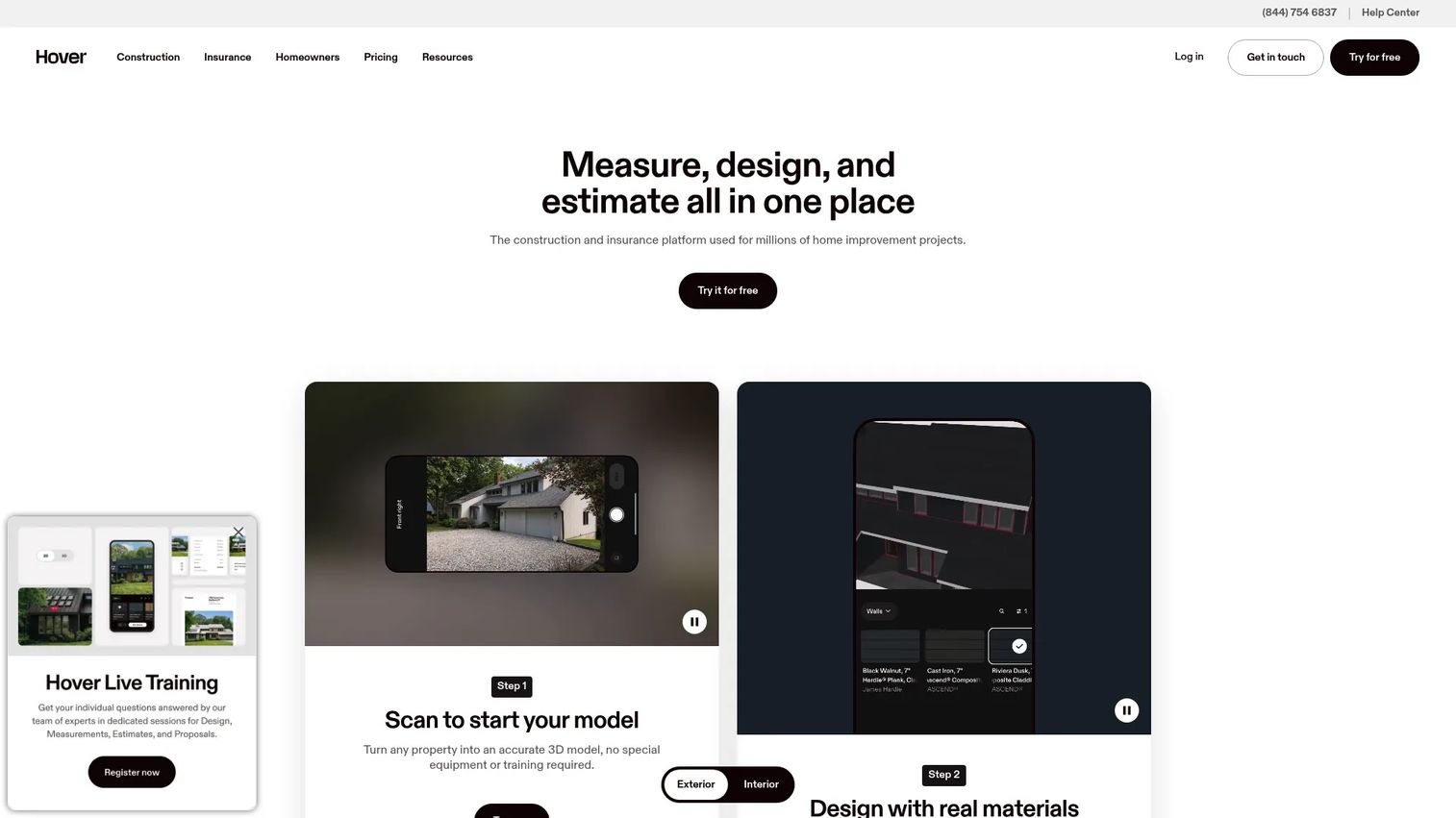
Hover turns smartphone photos into 3D property models. A rep walks the house, snaps a set of photos, and Hover builds a 3D measurement model plus design and proposal tools on top. It shines where visual confidence matters, letting reps show homeowners exactly what the finished roof will look like while pulling accurate measurements from the same capture.
Best for: Contractors and insurers who need residential measurement, visual design, and estimating in a sales-friendly workflow.
Key strengths
- 3D property measurements: Builds an accurate 3D model from smartphone photos, no ladder or specialized hardware needed.
- 2D design and proposals: Lets reps visualize materials and colors, turning roof measurements into a persuasive sales conversation.
- Estimates and pricing integrations: Connects measurement and design data into estimating and pricing workflows.
Why choose Hover: Hover is the field sales pick when the visual sell closes the deal. Showing a homeowner a rendered 3D model of their own house builds confidence that a spreadsheet cannot. Reps capture measurements and a sales tool in one visit. Its 3.5/5 G2 rating rests on a small review base, so weigh it against a trial on your own jobs.
Hover pricing: Hover offers a Starter option that is pay-as-you-go with the first 3 projects free. The Pro membership runs $99/month or $999/year and includes $20 off every project plus access to premium features. The free-project start makes it easy to test the 3D capture on real homes before subscribing.
7. GAF QuickScope
GAF QuickScope is a GAF roofing business service focused on measurement and insurance scope workflows. In practice it delivers through GAF QuickMeasure and ScopeConnect: measurement reports for residential, multifamily, and commercial properties, editable 3D renderings, a bill of materials, and insurance scope-of-work estimates. It fits teams that want a straightforward measurement-to-scope path without a full software subscription.
Best for: Roofing contractors who need quick, per-report measurements and insurance scope estimates on demand.
Key strengths
- Measurement reports for any property type: Covers residential, multifamily, and commercial roofs from a single service.
- Editable 3D renderings and bill of materials: Provides visual outputs and a materials list that speed the move to a quote.
- Insurance scope of work estimates: ScopeConnect generates insurance scope estimates, useful for storm and restoration work.
Why choose GAF QuickScope: This is the pick for teams that want reports on a per-use basis rather than a monthly platform commitment. Pay for a measurement when you need one, get an editable rendering and materials list, and move to your quote. It suits contractors already in the GAF ecosystem who need dependable measurement and scope output without adopting a new all-in-one system.
GAF QuickScope pricing: GAF QuickMeasure single-family reports start at $18. Commercial QuickMeasure reports are $54 or $60 per report depending on user type and certification level. ScopeConnect insurance estimates are $99 per estimate. Pricing is per-report with no subscription, which keeps costs tied directly to volume.
Considerations
Before you commit, run each tool against the criteria that actually decide whether it earns a place in your stack.
Measurement workflow
Decide whether you need built-in measurements or clean import of third-party reports. All-in-one platforms like Roofr bundle measurements; specialists like EagleView, Hover, and GAF QuickScope supply the report your estimating tool consumes. Check that report data flows cleanly into your quoting step without manual re-entry.
Proposal and pricing depth
Look for proposal automation, Good/Better/Best tiers, and supplier pricing that stays current. The point is consistency: every rep should produce the same quality proposal at the same margin. Confirm that markup rules and material pricing are enforceable across the team, not optional per rep.
Mobile and field usability
Your reps sell in driveways, not at desks. Test the mobile workflow on a real job: can a rep measure, quote, present, and collect a deposit from a phone or tablet? If the field experience is clunky, adoption stalls no matter how strong the back office is.
Residential versus commercial fit
Match the tool to your work. Commercial roof estimating software like STACK is built for detailed takeoff; residential platforms lean on aerial reports and speed. Buying the wrong side of that line means fighting the tool on every job.
Payments and closing
Some tools stop at the estimate; others carry through digital signatures, invoicing, and payments. If collecting deposits faster matters, prioritize the end-to-end platforms over estimating-only tools.
Conclusion
The right roofing software estimating stack depends on how your team works, not on which tool has the longest feature list.
If you want one system from lead to payment, start with Roofr. If proposals and AI-driven speed are your priority, shortlist XBuild. Commercial teams that live in detailed takeoff should evaluate STACK first. Small crews and owner-operators who need fast, simple quoting will move fastest with RoofSnap. And if your workflow starts with accurate measurements feeding an existing tool, EagleView, Hover, or GAF QuickScope fill that layer well.
The decision framework is straightforward: all-in-one workflow, commercial takeoff, fast quoting, measurement-first input, or payment-ready proposals. Pick the category that matches your bottleneck, then trial two tools inside it. The goal is not more features. It is turning measurement into a signed, profitable job before your competitor sends their quote.
For teams building repeatable go-to-market motions in adjacent software categories, the same show-don't-tell logic applies to how you present your own product. Interactive product experiences from Guideflow let prospects explore a product at their own pace across landing pages, sales follow-ups, onboarding flows, help centers, and partner enablement. You can capture a flow in a few clicks, personalize it for each buyer, share it anywhere, and analyze engagement in real time.
FAQs
Small contractors usually need speed, ease of use, and quick proposal output more than deep enterprise workflow. Tools like RoofSnap and Roofr simplify the move from roof measurements to a sent quote and support mobile work in the field. Look for pay-as-you-go pricing so costs track your job volume rather than a fixed monthly commitment.
Commercial teams need takeoff precision, file support, collaboration, and worksheet controls more than one-click aerial reports. STACK is the strongest commercial roof estimating software here, built for detailed quantity, labor, and material takeoff on complex plans. If your bids depend on measuring large, irregular roofs accurately, prioritize a dedicated commercial roofing software tool over a residential all-in-one.
It depends on the tool. All-in-one platforms like Roofr and RoofSnap include measurement services, while EagleView, Hover, and GAF QuickScope specialize in producing reports that feed your estimating tool. This is an important buying criterion: confirm whether the tool measures roofs itself or expects you to import a third-party report, and check that the handoff is clean.
Yes, several tools go well beyond the estimate. XBuild, Roofr, and RoofSnap include digital signatures, payment collection, and invoicing, so a signed proposal moves straight to a deposit. Estimating-only or measurement-only tools stop earlier in the workflow, so if closing and collecting matter, choose an end-to-end platform over a single-purpose one.
Margin protection comes from standardized pricing, supplier integrations, markup controls, and reducing underbidding. When supplier pricing and material pricing stay current, line items reflect real costs instead of guesses. Consistency across estimators matters as much as speed: enforced markup rules and Good/Better/Best tiers stop reps from quoting the same job at different prices and quietly eroding profit.
Prioritize measurement workflow, proposal automation, supplier pricing, mobile usability, and support quality. Then match the tool to your work, since residential and commercial needs differ sharply. A roofing estimator software tool that fits your crew size, quote volume, and closing process will earn adoption; one that fights your workflow will sit unused no matter how strong its feature list looks.
Spreadsheets work early, but they break down when quote volume climbs, labor pricing drifts between reps, and margin control gets loose. Roof estimating software standardizes the math and the presentation, so every quote looks professional and holds the same margin. The time saved per estimate and the consistency across your team usually justify the cost well before you hit high volume.