
Headcount climbed from 30 to 90 in eighteen months. Revenue is up. But the all-hands feels flatter. Decisions take longer. Two of your best engineers left in a quarter, and you only found out why in their exit interviews.
Growing teams do not automatically become aligned teams. The connective tissue that held a 20-person company together, shared context, trust, the founder in every room, stops scaling somewhere around 50 people. Communication fragments. Recognition gets inconsistent. Feedback that used to surface over lunch now disappears until it shows up as churn.
The numbers back this up. Only 32% of U.S. employees were engaged at work in 2025, according to Speakwise (2026). Globally, engagement sat at 21% in 2024, a gap Speakwise links to roughly $438B in lost productivity. For a Series B founder trying to prove the business runs without founder heroics, disengagement is not a soft problem. It is a retention and execution problem hiding in plain sight.
That is where team building software earns its place. The category covers engagement platforms, recognition tools, survey systems, and team management software that help growing companies keep people aligned, connected, and heard. The hard part is not finding options. It is picking the one your team will actually use, that plugs into your existing stack, and that produces signal you can act on instead of another dashboard nobody opens.
This guide breaks down the eight best team building software tools for 2026, what each does well, and which one fits the problem you are actually solving.
What's inside
This guide covers eight team building software platforms across three categories: engagement and recognition tools, feedback and survey systems, and team management software. We chose tools that growing SaaS companies actually buy, weighting four factors: adoption likelihood, integration depth with tools like Slack and Microsoft Teams, quality of reporting and signal, and fit for remote and hybrid teams. Each entry covers what the tool does, who it fits, pricing where it is public, and the trade-offs worth knowing before you commit. The goal is a decision, not a definition.
TL;DR
- Best all-around for culture and trust: Workleap combines pulse surveys, recognition, performance, and feedback in one human-centered platform.
- Best engagement-focused option: 15Five pairs structured check-ins with engagement signals and manager workflows.
- Best for team management: Clockify gives operationally minded founders time visibility, scheduling, and coordination dashboards.
- Best for survey and feedback depth: Qualtrics offers advanced sentiment analysis and experience management for data-serious organizations.
- Best for event-led remote team building: Confetti runs virtual team-building activities for distributed teams.
- Best lightweight survey option: SurveyMonkey delivers fast pulse surveys with broad adoption and a free tier.
Background: what is team building software?
Team building software is any tool that improves engagement, recognition, trust, feedback, or alignment across a team, rather than just managing projects or tasks. It sits between pure project management and HR systems, focused on the human side of how a team works together.
The category splits into a few core capability buckets. Most tools lean into one or two:
- Engagement and recognition: Peer-to-peer recognition, rewards, and lightweight ways to celebrate wins that keep morale visible as teams scale.
- Surveys and sentiment analysis: Pulse surveys, eNPS, and sentiment reporting that surface how people actually feel before it becomes attrition.
- One-on-ones and alignment: Structured check-ins, goal setting, and manager workflows that keep cadence and accountability consistent.
- Collaboration and communication integrations: Native ties into Slack, Microsoft Teams, calendars, and your HR stack so the tool meets people where they already work.
- Reporting and adoption visibility: Dashboards that show participation, response rates, and engagement trends, the difference between useful signal and vanity metrics.
- Support for remote and hybrid teams: Asynchronous, lightweight features that work when people are not in the same building, or the same time zone.
The team collaboration software market hit roughly $27.89B in 2025 and is projected to reach $68.20B by 2034, per Fortune Business Insights (2026). The category is growing because the problem is growing: more distributed teams, more hybrid schedules, and more pressure to retain talent without in-person glue.
When to use team building software
Not every company needs a dedicated platform on day one. Here is when it earns the line item.
Improve engagement in a growing team
When you cross 40 or 50 people, the informal systems break. The founder can no longer read the room because they are not in every room. Morale, trust, and connection start slipping in ways you only catch in retrospect. Team engagement tools give you a structured way to measure and maintain those things before a strong quarter is followed by a weak one with no obvious cause.
Make remote and hybrid teams feel connected
Remote team building runs on different mechanics than in-office bonding. You cannot rely on hallway conversations or shared lunches. Asynchronous, lightweight tools matter most here, recognition that works across time zones, pulse surveys people answer on their own schedule, and integrations that live inside Slack or Microsoft Teams. For hybrid teams, the goal is parity: making sure remote employees get the same recognition and feedback loops as the people in the office.
Surface feedback before problems become churn
Internal engagement is a leading indicator of execution quality. When sentiment drops, retention and output usually follow. Employee engagement tools give founders visibility into signal they would otherwise miss, the quiet disengagement, the manager who is struggling, the team that is overloaded. Catching it early is the difference between a coaching conversation and a resignation letter.
Comparison table
The table below separates engagement-first, feedback-first, and management-first tools. Pricing reflects publicly listed figures at the time of writing and should be confirmed live before you buy, since plans change.
| # | Product | Intent | Key use case | Pricing | G2 rating |
|---|---|---|---|---|---|
| 1 | Workleap | Engagement + performance | All-in-one culture, surveys, recognition, performance | From $4,999/yr | 4.4/5 |
| 2 | Confetti | Virtual events | Hosted team-building activities for distributed teams | From $5,000/yr | Not rated |
| 3 | Clockify | Team management | Time tracking, scheduling, coordination dashboards | Free; paid from $3.99/seat/mo | 4.5/5 |
| 4 | 15Five | Engagement + performance | Check-ins, engagement surveys, manager workflows | From $4/user/mo | 4.6/5 |
| 5 | Lattice | Performance + engagement | OKRs, engagement surveys, people analytics | From $8/seat/mo | Not listed |
| 6 | Motivosity | Recognition | Peer recognition, rewards, employee community | Custom | 4.7/5 |
| 7 | Qualtrics | Survey + experience | Advanced sentiment analysis, feedback programs | Custom | Not listed |
| 8 | SurveyMonkey | Surveys | Fast pulse surveys, quick feedback loops | Free; paid from $49/mo | 4.4/5 |
1. Workleap
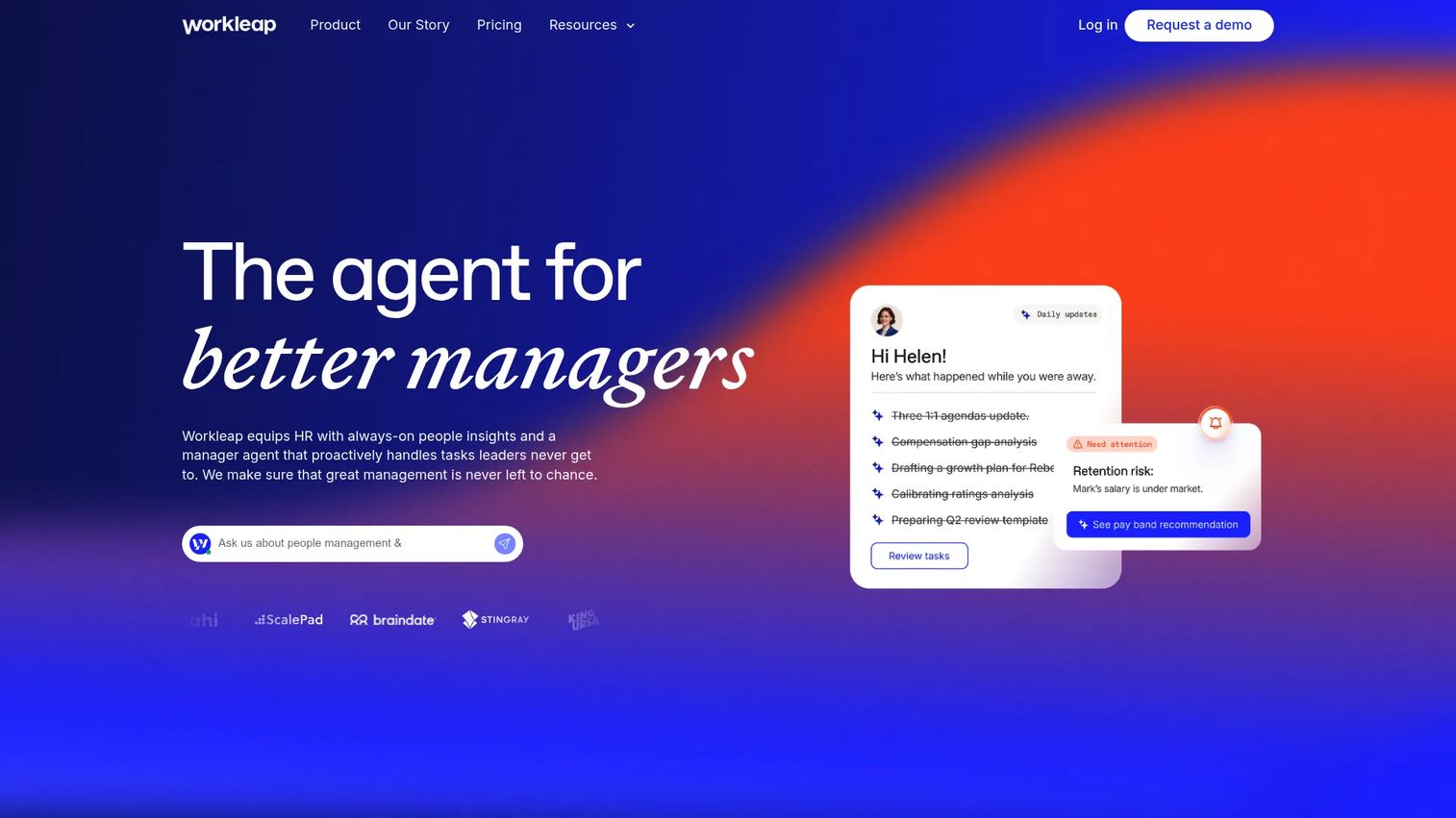
Workleap is an AI-powered people management platform built for HR teams and managers who want engagement, performance, and recognition in one place instead of stitched across three tools. It handles essential people management workflows, including performance reviews, compensation, goal setting, engagement, and recognition. For a founder trying to improve culture and trust without adding a separate stack, this is the most complete single option on the list.
Best for: HR teams and founders who want an all-in-one platform for engagement, performance, compensation, and manager support.
Key strengths
- Engagement surveys and feedback: Pulse surveys and feedback loops that show how the team actually feels, not just how the last all-hands went.
- Performance and goals: Reviews, goal setting, and compensation analytics that keep managers aligned as headcount grows.
- Manager agent with proactive insights: AI-driven summaries and action plans that flag issues before they become resignations.
Why choose Workleap: If your problem is that culture, feedback, and recognition are fragmenting as you scale, Workleap consolidates them. It is the right call for teams that want one platform managers actually log into, rather than separate survey, recognition, and review tools nobody keeps current. The breadth is the point: it earns its place by replacing several line items.
Workleap pricing: Workleap publishes annual pricing. The Standard plan starts at $4,999/yr, Pro is $11,999/yr, and Enterprise is custom for organizations over 250 employees. A separate Manager Agent add-on is listed at $99 per manager per month. There is no free tier. G2 rates Workleap 4.4/5.
2. Confetti
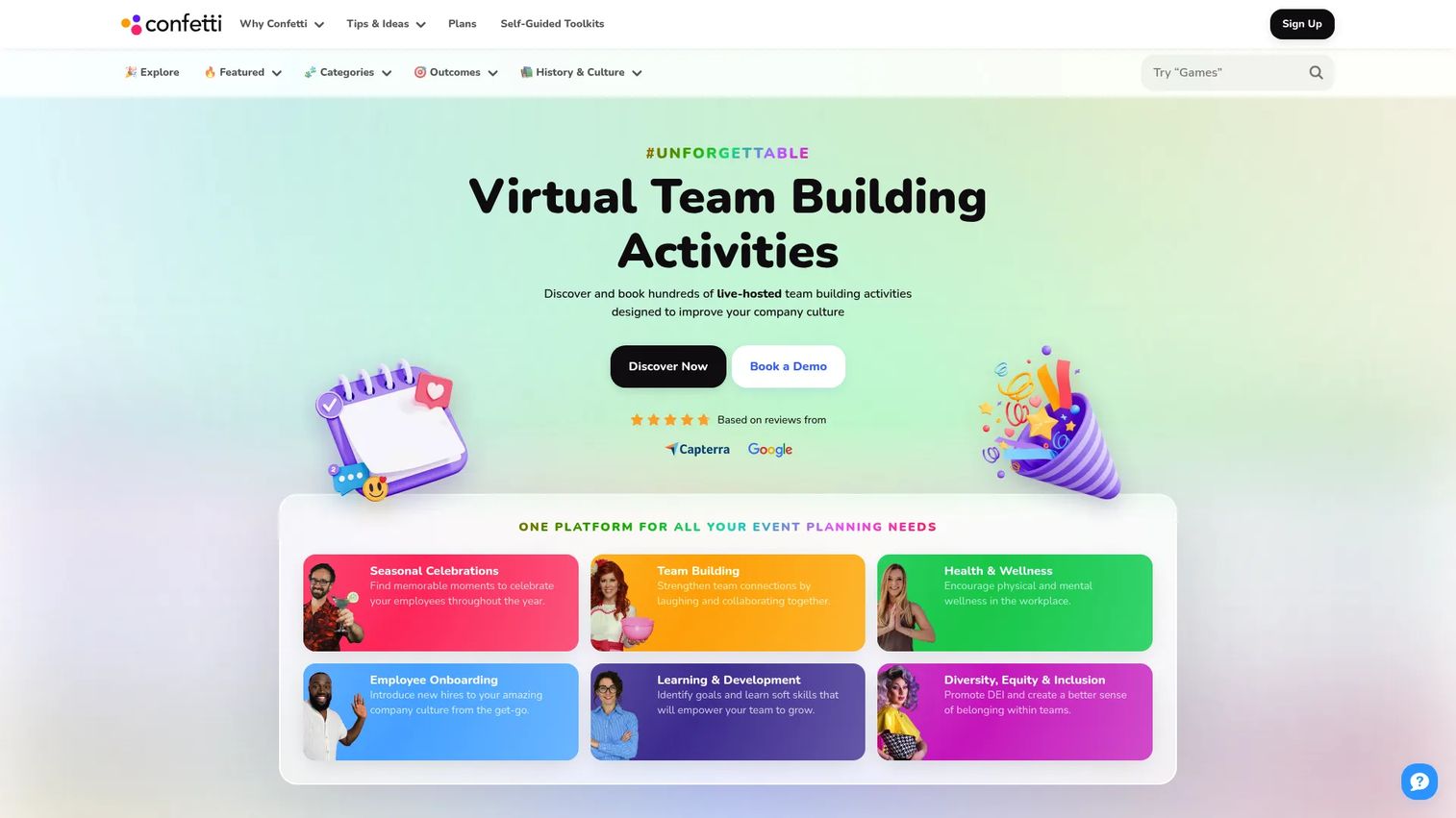
Confetti takes a different angle: instead of surveys and dashboards, it is a platform for planning and booking corporate team events and engagement experiences. You browse a catalog of live-hosted and self-guided activities, then book them for your team. Confetti creates moments that help employees feel connected, supported, and seen, which fuels morale and long-term engagement, especially for distributed teams that rarely meet in person.
Best for: HR and culture teams planning corporate team-building and employee engagement events.
Key strengths
- Curated experience catalog: Discover, plan, and book team events without building activities from scratch.
- Live and self-guided formats: Hosted experiences for team bonding plus self-guided options for professional development.
- Enterprise controls: SSO, RBAC, MFA, and custom branding for larger organizations that need governance.
Why choose Confetti: Event-led connection makes sense when your distributed team needs shared moments, not another dashboard. It pairs well with an engagement or survey tool rather than replacing one. If your remote team feels disconnected and you want a low-lift way to create real interaction, Confetti handles the logistics so people ops does not have to.
Confetti pricing: Confetti offers pay-as-you-go with no minimums, plus a Pre-Fund plan starting from $5,000 per year and an Unlimited tier with tailored pricing. A free option is available to get started. Public numeric pricing beyond the Pre-Fund entry point is not displayed, so confirm with their team. Confetti's G2 seller page does not currently show an aggregate rating.
3. Clockify
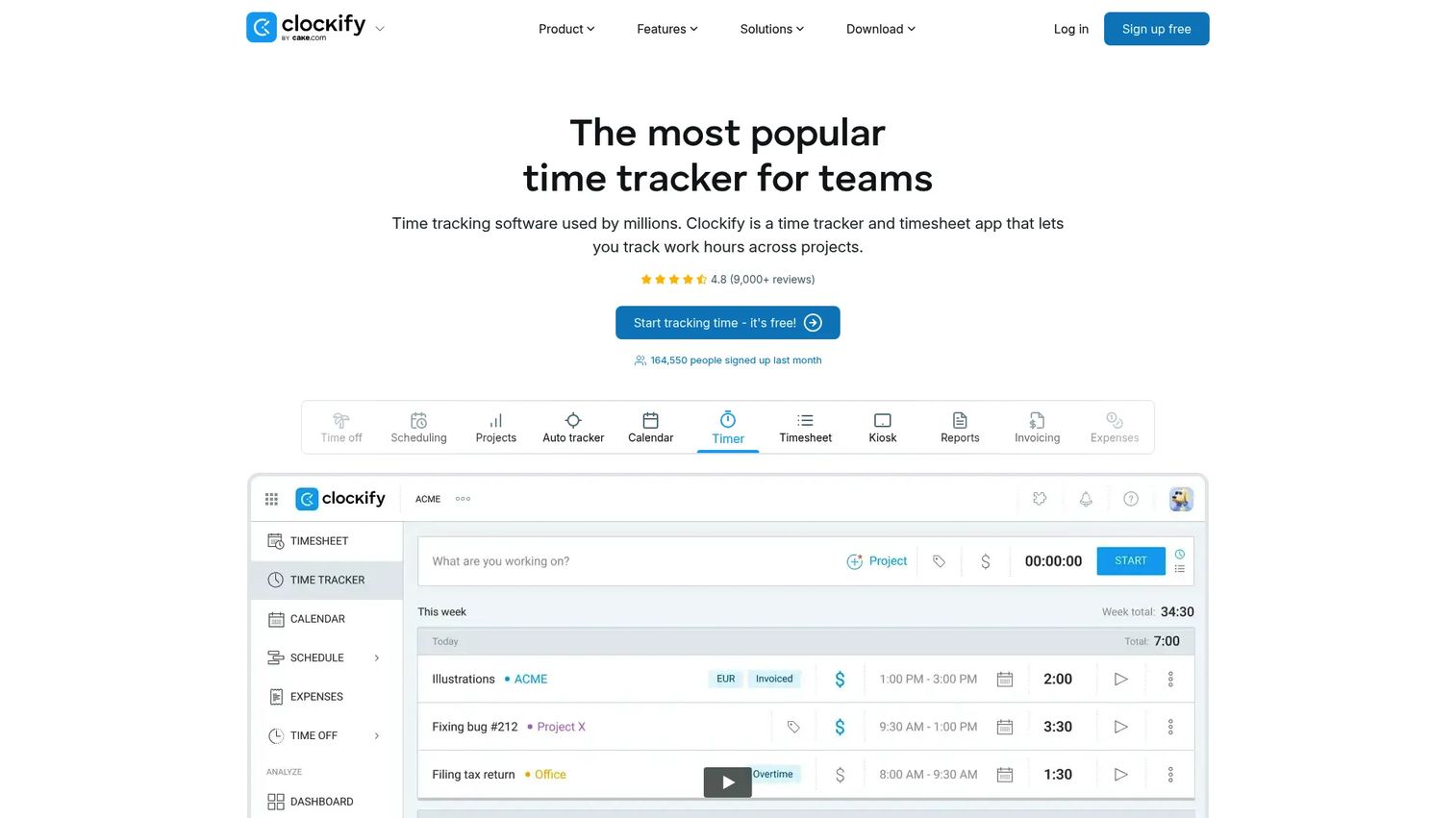
Clockify is time tracking and timesheet software for teams, and it represents the management-first end of this list. Where the engagement tools focus on how people feel, Clockify focuses on how work moves: time visibility, scheduling, task coordination, and reporting. For operationally minded founders who want the team to run more predictably, it is a practical piece of team management software.
Best for: Teams needing straightforward time tracking with timesheets, scheduling, and reporting.
Key strengths
- Time tracking and timesheets: A time tracker and auto tracker that show where hours actually go across the team.
- Scheduling and coordination: Scheduling, kiosk clock-in, and location tracking to coordinate distributed and hybrid teams.
- Reports and invoicing: Dashboards, reports, expenses, and invoicing that turn activity into visibility leadership can act on.
Why choose Clockify: Clockify fits founders who define "team health" partly as operational predictability, not just morale. It will not run your engagement surveys, but it gives you the coordination layer that keeps a growing team coordinated. It pairs well with an engagement or recognition tool to cover both the operational and human sides.
Clockify pricing: Clockify has a genuinely useful free plan for up to five users. Paid plans start at Basic ($3.99 per seat/month billed annually, $4.99 monthly), then Standard ($5.49), Pro ($7.99), and Enterprise ($11.99 per seat/month annually). G2 rates Clockify 4.5/5.
4. 15Five
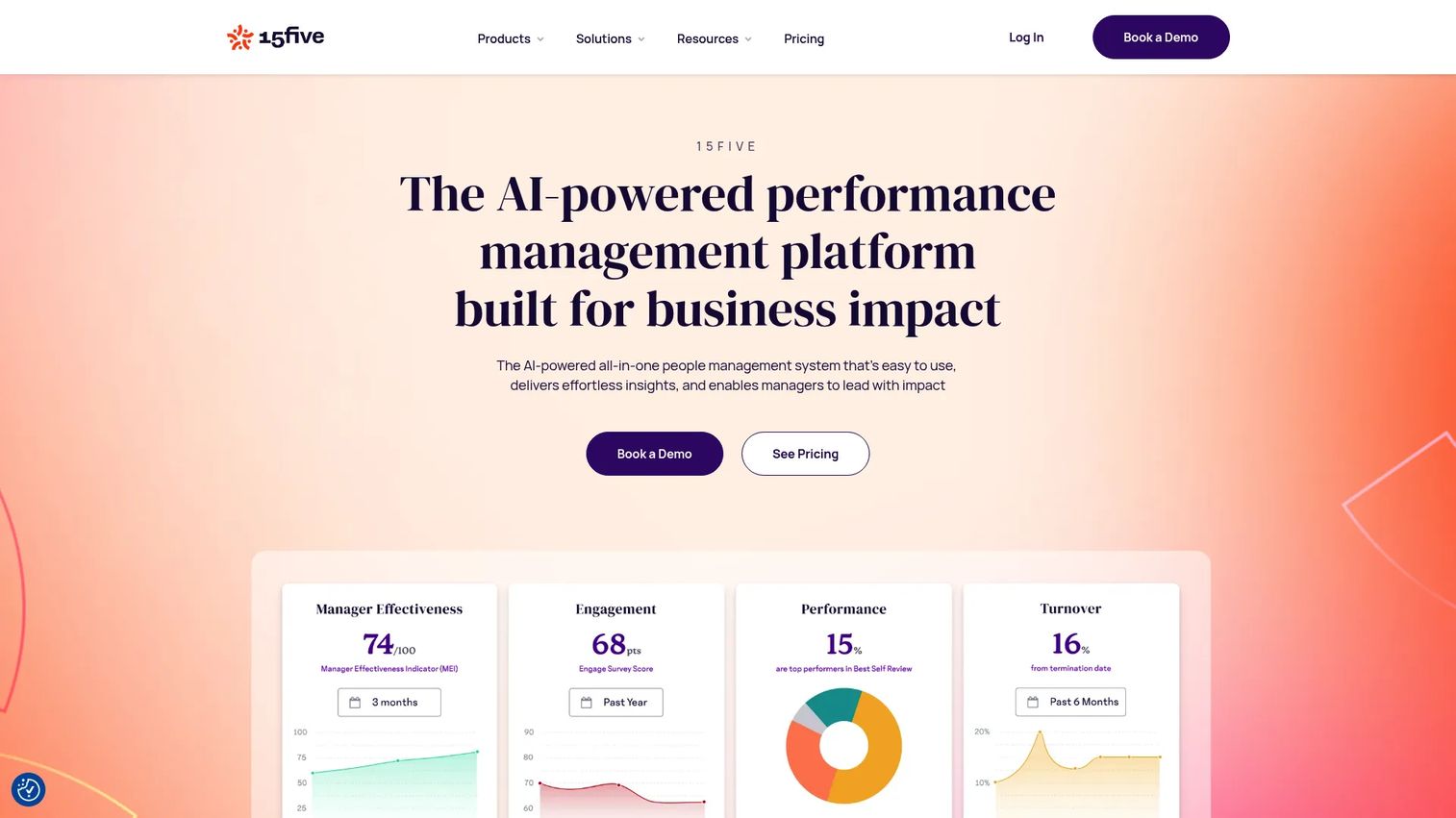
15Five is a performance management platform built around employee engagement, reviews, goals, feedback, and manager effectiveness. Its core mechanic is the structured check-in: a lightweight weekly rhythm that surfaces engagement signals, keeps one-on-ones consistent, and gives managers something to act on. For teams that need better cadence and accountability without heavy process, it hits a sweet spot.
Best for: Mid-market and growing teams wanting an all-in-one performance, engagement, and manager effectiveness platform.
Key strengths
- Employee engagement surveys: Engagement measurement that turns sentiment into trends managers can read week over week.
- Performance reviews and 360° feedback: Structured reviews and peer feedback that scale beyond founder-led check-ins.
- Goals, OKRs, and continuous check-ins: A consistent cadence that keeps accountability tight as the team grows.
Why choose 15Five: If the problem is that one-on-ones are inconsistent and managers lack a rhythm, 15Five installs one. It is built for the moment a founder hands off people management to a new layer of managers and needs that handoff to actually work. The check-in cadence is the differentiator.
15Five pricing: 15Five offers three core annual plans. Engage is $4 per user per month, Perform is $11 per user per month, and Total Platform is $16 per user per month, all billed annually. Add-ons cover manager content, coaching, compensation, and AI meeting assistance. G2 rates 15Five 4.6/5.
5. Lattice
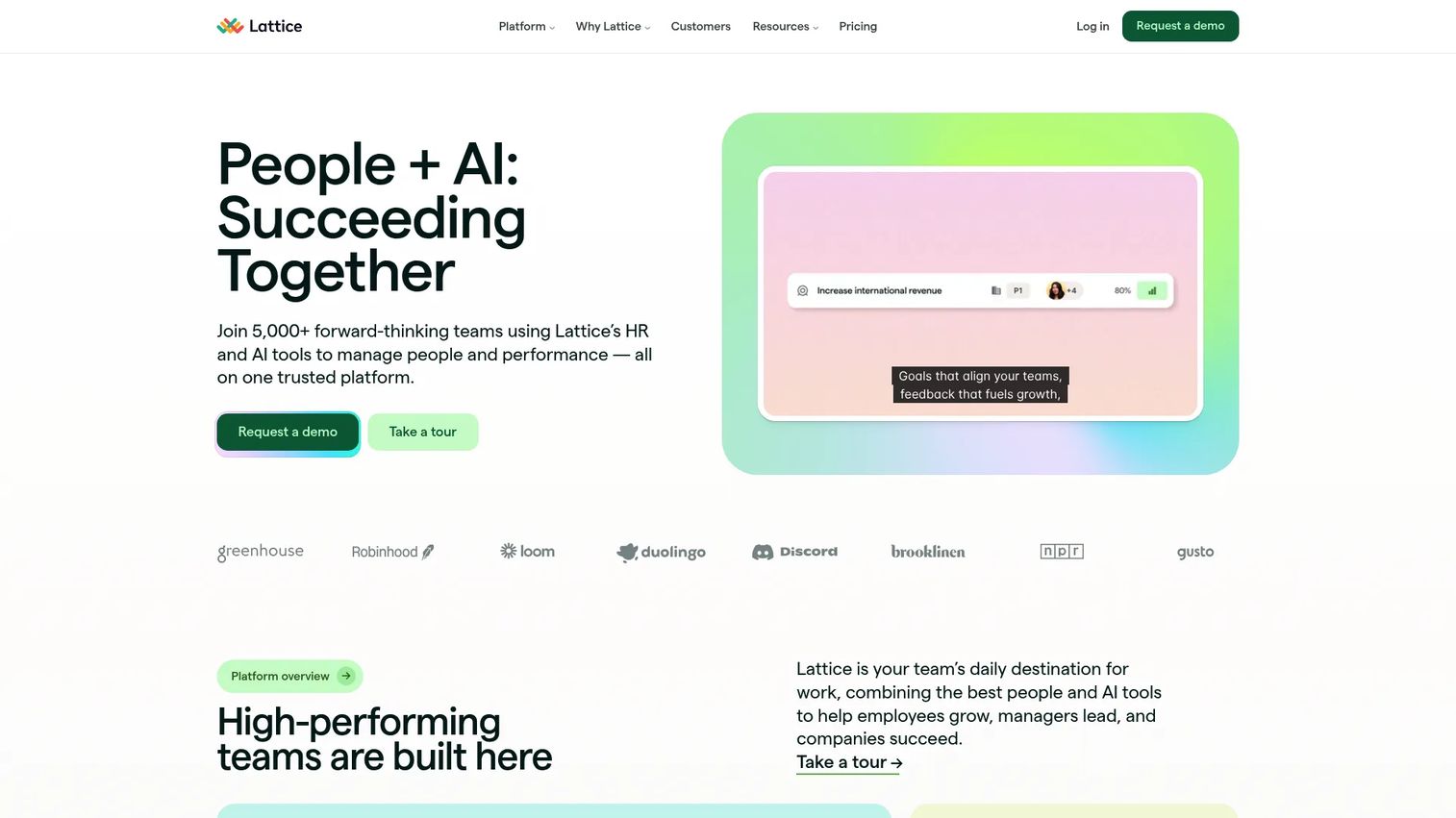
Lattice is an AI-powered people platform spanning performance, engagement, goals, compensation, and growth. It leans toward leadership visibility and people analytics, the formal operating rhythm a company adopts when it wants managers equipped with real tooling rather than spreadsheets. Lattice's engagement solutions include pulse surveys, onboarding and exit surveys, eNPS measurement, and engagement benchmarking powered by Mercer data.
Best for: Mid-market and growing HR teams managing performance and employee growth at scale.
Key strengths
- Performance and talent reviews: Structured reviews and talent reviews that give leadership a clear read on the team.
- Goals and OKRs: Goal and OKR tracking with progress updates that connect daily work to company direction.
- Engagement surveys with AI analysis: Pulse, onboarding, and exit surveys with benchmarking and AI-driven analysis.
Why choose Lattice: Lattice suits companies that want a more formal operating rhythm and stronger manager tooling than a lightweight check-in tool provides. It is the choice when the board wants people analytics clean enough to survive scrutiny, and when you are building the management layer to run quarters without constant course correction.
Lattice pricing: Lattice bills annually with a stated $4,000 minimum annual agreement. The Foundations plan is $11 per seat/month, while Performance and Goals & OKRs are available separately at $8 per seat/month each. Engagement, Grow, and Compensation modules are priced on request. There is no free tier.
6. Motivosity
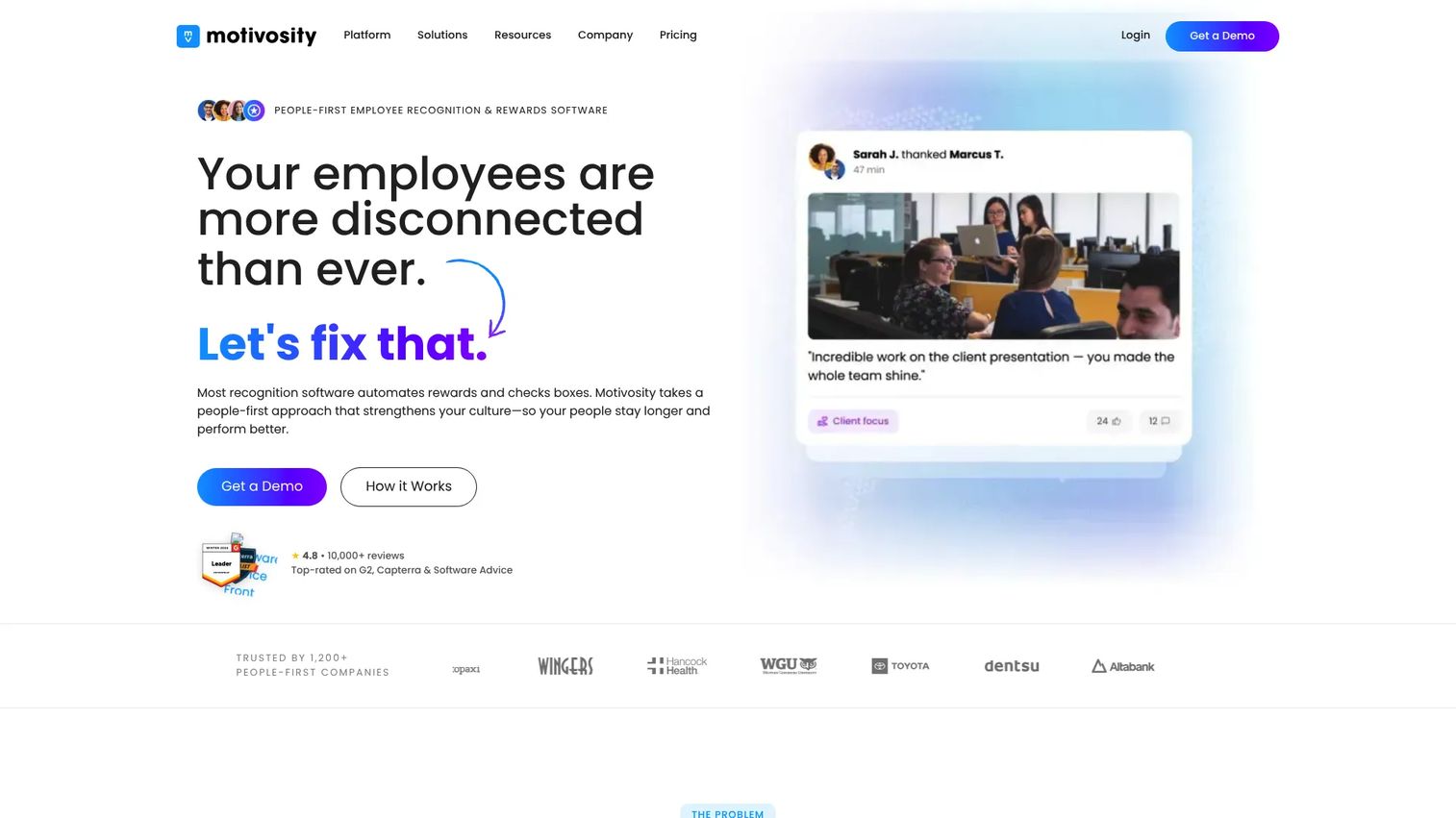
Motivosity is employee recognition and rewards software focused on peer connection, engagement, and culture. The core idea is simple: make recognition frequent, visible, and peer-driven so morale stays high as the team grows. In a distributed company, that visibility matters, recognition that everyone can see does more for culture than a private thank-you ever will.
Best for: Growing and mid-market teams that want frequent, lightweight employee recognition.
Key strengths
- Multi-directional recognition: Peer-to-peer, manager-to-employee, and company-wide recognition that keeps appreciation flowing.
- Internal community and social platform: Employee spaces and an internal social layer that build connection across remote teams.
- Reporting, pulse surveys, and rewards: Dashboards, pulse surveys, and a rewards marketplace that tie recognition to engagement.
Why choose Motivosity: Recognition is one of the cheapest, highest-leverage ways to keep morale and retention healthy in a scaling team. Motivosity makes it a habit rather than an afterthought, and it builds a community employees actually want to participate in. G2 rates Motivosity 4.7/5, the highest score on this list.
Motivosity pricing: Motivosity uses a custom, modular per-employee-per-month model that scales with the business. The site matches organizations to a plan and shows real pricing on request, with solution bundles for celebrating people, building culture, and scaling globally. No public dollar figure is displayed, so request a quote.
7. Qualtrics
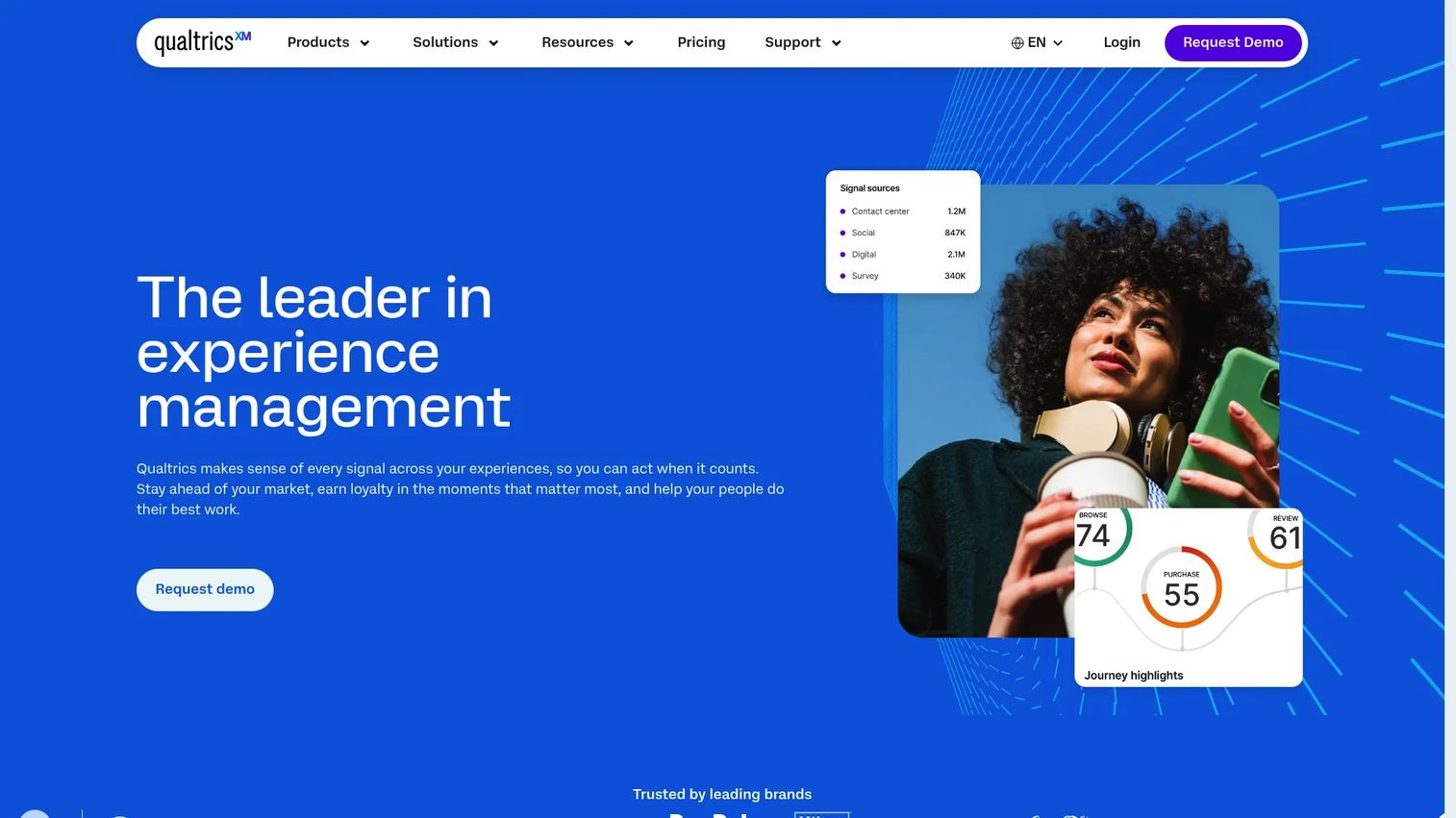
Qualtrics is experience management software covering customer, employee, product, and market research insights. It is the deepest measurement option on this list, built for organizations that treat feedback as a formal program rather than an occasional pulse check. If you care about sentiment analysis depth, statistical rigor, and the ability to slice employee experience data many ways, Qualtrics is built for that.
Best for: Larger organizations needing unified experience management, survey, and feedback analytics.
Key strengths
- Employee experience analytics: Deep employee experience measurement that goes well past a basic engagement score.
- Omnichannel experience management: A unified view across customer, employee, and product feedback in one platform.
- Voice of Customer and research: Advanced survey logic and analysis for organizations running formal feedback programs.
Why choose Qualtrics: Qualtrics fits when measurement depth is the priority and you have the team to act on it. It is more platform than a growing 60-person company may need, but for organizations scaling toward enterprise with serious people-analytics ambitions, the depth pays off. Pair it with a lighter recognition or check-in tool for the day-to-day human layer.
Qualtrics pricing: Qualtrics uses suite-based, interaction-based pricing and directs prospects to request a demo rather than publishing public prices. There is no public starting figure, so treat pricing as a sales conversation scoped to your team size and use case.
8. SurveyMonkey
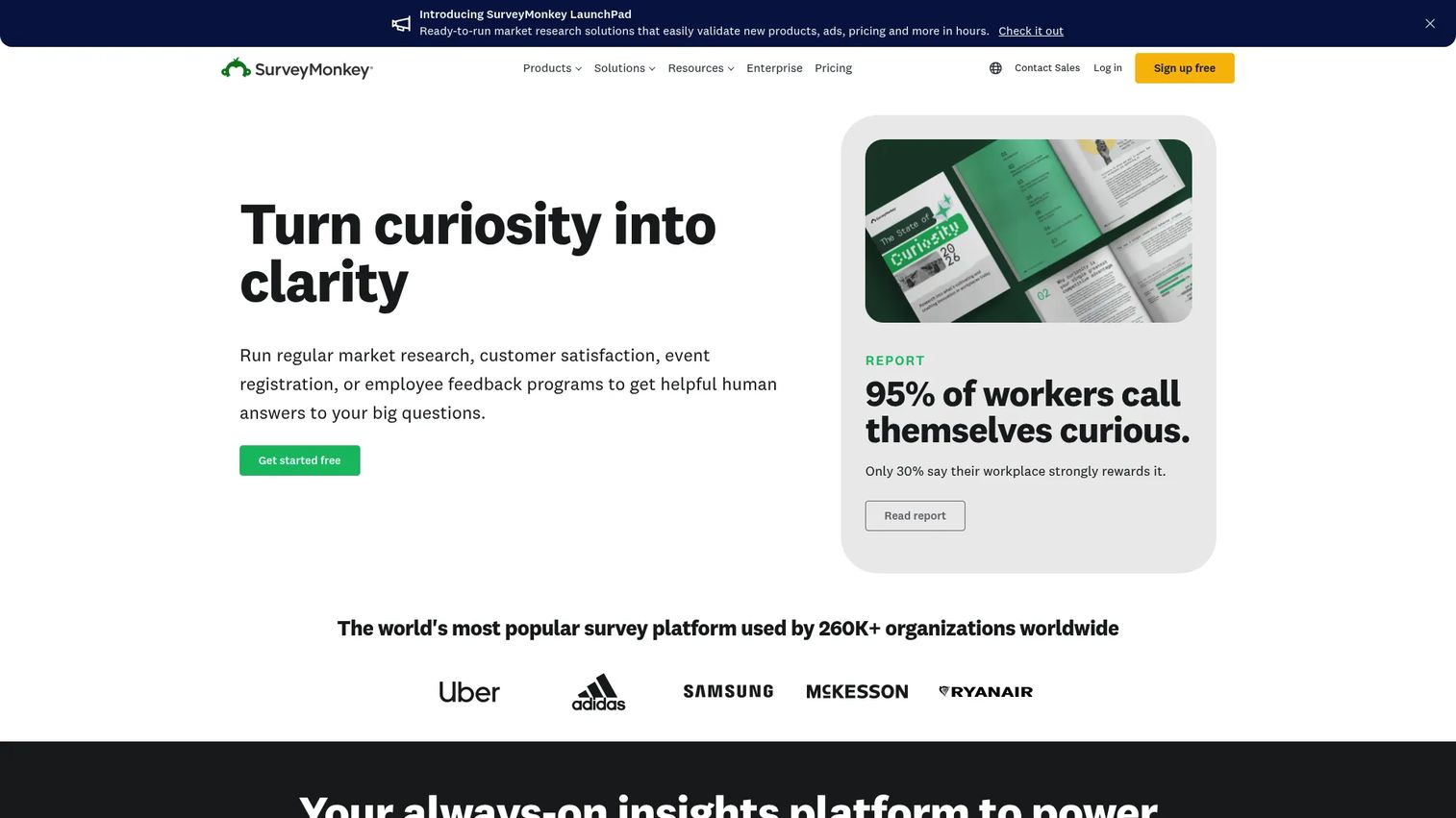
SurveyMonkey is an online survey platform for creating, distributing, and analyzing surveys, and it is the lowest-friction feedback option here. When you just need a fast pulse survey, a quick feedback loop, or broad participation without standing up a full engagement platform, it does the job. Its familiarity is an asset: most employees have used it, so adoption barriers are low.
Best for: Teams that need surveys plus reporting and AI-assisted analysis without heavy setup.
Key strengths
- Survey builder with templates: A fast builder with templates and multiple question types for quick pulse surveys.
- AI-assisted analysis: Thematic and sentiment analysis that turns open responses into readable signal.
- Reporting and integrations: Dashboards, exports, and integrations that move results into the rest of your stack.
Why choose SurveyMonkey: When the goal is speed and adoption over depth, SurveyMonkey wins on both. It is a lower-friction entry point than a full experience platform, and a sensible starting move for a founder who wants engagement signal this quarter without a procurement cycle. You can graduate to a deeper tool later if needs grow.
SurveyMonkey pricing: SurveyMonkey has a free Basic plan plus paid tiers. FLEX is $49 per month and Standard is $99 per month billed monthly; annual individual plans include Advantage at $46 per month and Premier at $139 per month. Team plans start at Team Advantage ($30 per month) and Team Premier ($92 per month) for three or more users, billed annually. G2 rates SurveyMonkey 4.4/5.
Considerations before you buy
The best team building software is the one your team uses and you act on. Here is the checklist before you commit budget.
Define the outcome first
Decide what you are actually solving: engagement, recognition, feedback, or operational coordination. Each maps to a different tool. A recognition platform will not fix inconsistent one-on-ones, and a time tracker will not surface sentiment. Naming the outcome first stops you from buying a tool that solves a problem you do not have.
Check adoption risk
The most capable platform is worthless if managers and employees ignore it. Look for tools that live where people already work, inside Slack or Microsoft Teams, not a separate login they will forget. Run a pilot with one team before a company-wide rollout. If a single team will not adopt it voluntarily, the whole company never will.
Verify integrations
Confirm the tool ties into your real stack: Slack integration and Microsoft Teams integration for daily use, calendar sync for check-ins, and your HR or people system for the source of truth. Integration is not a nice-to-have, it is the difference between a tool people use and one they abandon. Collaboration software that lives outside the flow of work gets ignored.
Evaluate reporting quality
Ask whether the reporting gives you signal you can act on, or vanity metrics that look good in a board deck and tell you nothing. Participation rates, response trends, and sentiment over time are useful. A single engagement score with no breakdown is not. The point is visibility a founder can act on weekly.
Balance budget and scale
Price the tool against team size, expected usage, and the payoff in retention and execution. A $16-per-user platform that prevents two regretted departures pays for itself fast. A cheaper tool nobody uses is the more expensive choice. Frame ROI in terms of the problem solved, not the sticker price.
Conclusion
The right team building software depends entirely on the problem in front of you. If culture, feedback, and recognition are fragmenting as you scale, Workleap is the most complete all-in-one pick. If the gap is inconsistent manager cadence, 15Five installs the check-in rhythm. For a formal operating rhythm with people analytics, Lattice fits. If you need operational predictability, Clockify covers the management side. For event-led connection on a distributed team, Confetti handles the moments. And for feedback, Qualtrics goes deep while SurveyMonkey keeps it fast and low-friction. Motivosity is the pick if recognition is your highest-leverage lever.
The practical next step: do not roll anything out company-wide on day one. Pick the one tool that matches your actual problem, pilot it with a single team, and watch whether people use it without being told to. Adoption in one team is the only proof that predicts adoption across the company. Once it sticks, scale it.
If your evaluation work also extends to showing your own product to buyers and new hires, Guideflow helps teams build interactive demos, sandboxes, and demo centers that let people experience a product through a guided path, free up internal training time, and meet audiences wherever they are. Start your journey with Guideflow today!
FAQs
Team building software is any tool that improves engagement, recognition, trust, feedback, or team alignment, rather than just managing projects or tasks. It usually includes capabilities like pulse surveys, peer recognition, structured one-on-ones, and sentiment reporting. The focus is the human side of how a team works together, not the work itself.
Remote teams are best served by asynchronous, lightweight tools rather than purely event-based activities. Look for recognition that works across time zones, pulse surveys people answer on their own schedule, and native Slack or Microsoft Teams integration. Workleap, 15Five, and Motivosity all fit distributed teams well, while Confetti adds shared moments through hosted events.
Start with the outcome you are solving, engagement, feedback, recognition, or coordination, then weigh adoption, integration, and measurable impact. The best tool is the one managers and employees use without being told to, so prioritize low friction and a fit with your existing workflow. Pilot one tool with a single team before any company-wide rollout.
They overlap but are not identical. Employee engagement tools are broader, covering surveys, recognition, and performance across the whole organization. Team building software often emphasizes connection, trust, and collaboration specifically, sometimes through events or peer recognition. Many platforms, like Workleap and 15Five, span both categories.
Slack and Microsoft Teams integrations matter most because they put the tool where people already work. Calendar integration keeps one-on-ones and check-ins on schedule, and a connection to your HR or people system keeps employee data as a single source of truth. Integration drives usage; a tool that lives outside the flow of work tends to get abandoned.
Look at participation rates, survey response rates, manager adoption, and engagement scores over time. Tie those leading indicators to lagging outcomes like retention, reduced regretted attrition, and less communication friction. The clearest ROI signal is whether the tool surfaces a problem early enough to fix it before it costs you a hire.
Look for fit with your stage and budget, low adoption friction, real integrations, and reporting you can act on weekly. Confirm the tool solves a real problem instead of adding another unused system to the stack. The test is simple: if one team will not adopt it voluntarily in a pilot, it is not the right tool, no matter how strong the feature list looks.