The audit rarely creates the problem. It exposes the work that lived in spreadsheets, inboxes, and someone's memory.
An FAA safety inspector walks in, asks for the corrective action record on a finding from six months ago, and the quality manager opens three different folders before admitting the closure evidence was never formally documented. That gap existed before the audit. The audit just made it visible.
The FAA's Safety Management Systems guidance for regulated entities explicitly requires that internal audit findings are documented, tracked to closure, and reported to senior management as part of an active safety assurance program. Spreadsheets and shared drives do not create that audit trail automatically. They create the illusion of one.
Aviation compliance monitoring software is built to replace that illusion with a controlled, traceable operating system. According to SITA's Aviation IT Insights (2025), 83% of airlines now prioritize data-driven decision-making, and airline IT investment reached $36 billion. The pressure to move compliance work out of manual processes and into auditable systems is not theoretical.
This guide helps aviation founders, operators, and operations leaders build a shortlist from 10 verified platforms, mapped to the operating model where each one actually fits.
What's inside
This guide is for aviation operators, MRO executives, quality and safety managers, and founders evaluating whether their current compliance process can survive growth.
- 10 tools compared across aviation safety, quality, MRO, document control, and flight operations software
- Selection criteria: audit evidence quality, corrective action workflows, regulatory traceability, pricing transparency, and fit by operator type
- Segment routing that separates SMS platforms, QMS systems, MRO compliance suites, and flight operations tools
- Buyer questions a founder should ask before adding a system to an already-fragmented operations stack
TL;DR
- Best for aviation safety and quality programs: QMSmart covers audits, safety reporting, risk registers, document control, and corrective actions in one configurable system
- Best for configurable SMS programs: SMS Pro offers a broad module library with a free entry tier and plans for operators at every maturity level
- Best for manual control and regulatory monitoring: Web Manuals connects operational manuals to regulatory requirements with revision-controlled workflows
- Best for compliance audits and action tracking: Skylegs keeps audit findings, assignments, and closure evidence organized without replacing your maintenance platform
- Best for MRO maintenance compliance: CORRIDOR, Veryon Work Center, CAMP Systems, and TRAX serve Part 145 repair stations and fleet operators with maintenance-execution traceability
- Best for flight department operations: myFLIGHTDATA and SAFEJETS embed compliance into the daily scheduling and release workflow for Part 135 and Part 91 operators
What is aviation compliance monitoring software?
Aviation compliance monitoring software is a system used by aviation organizations to track regulatory obligations, safety controls, training and qualifications, maintenance requirements, audit findings, documentation, and corrective actions in a controlled and traceable environment.
It is not one tool type. The category covers four distinct problem areas, and most platforms specialize in one or two of them.
What these platforms typically monitor
- Internal audit schedules, checklists, evidence submissions, and approvals
- Findings, root-cause records, corrective actions, and formal closure dates
- Crew and technician qualifications, training completion, and certificate expiry
- Aircraft maintenance intervals, airworthiness directives (ADs), service bulletins (SBs), inspections, and airworthiness records
- Manuals, document revisions, regulatory change notifications, and controlled distribution
- Hazards, incidents, risk assessments, safety performance indicators, and management review actions
How the four platform types differ
| Software type | Primary focus |
|---|---|
| SMS software | Safety reporting, hazards, risk registers, safety assurance, safety performance indicators |
| QMS software | Audits, document control, nonconformities, corrective actions, management of change |
| MRO compliance software | Work orders, maintenance records, parts traceability, regulatory directives, technician authorization |
| Flight operations software | Crew currency, pilot legality, trip release, eSMS, eCASS, maintenance surveillance |
These overlap, but the buying decision should start with the primary compliance problem. An operator whose biggest exposure is an inconsistent corrective action trail needs a different system than an MRO whose risk is untracked AD compliance or a flight department whose scheduler lacks visibility into pilot duty limits.
Key capabilities to look for
- Traceable finding-to-closure records with evidence attachments
- Role-based ownership and escalation for overdue actions
- Regulatory mapping to FAA, EASA, ICAO, Part 91, Part 135, Part 145, or IS-BAO requirements
- Exportable audit-ready reports for inspections
- Alerts for expiring qualifications, upcoming maintenance, or open findings
When to use aviation compliance monitoring software
Replace spreadsheet-led audit follow-up
An auditor identifies five findings. One action owner changes jobs. Two due dates pass without closure. The evidence files are in a personal inbox. When the follow-up audit arrives, there is no complete record to present. Software creates the controlled trail from finding assignment through evidence review to formal closure, with time stamps and approval history that survives personnel changes.
Keep maintenance and airworthiness obligations visible
Fleet growth brings more aircraft types, more ADs, more SBs, and more scheduled maintenance intervals competing for the same hangar time. A single missed compliance event can ground an aircraft or trigger a regulatory finding. MRO and maintenance compliance platforms provide due lists, traceable work completion records, and historical documentation that turns reactive maintenance into a controlled schedule.
Scale safety and qualification oversight
A growing operation adds pilots, technicians, contractors, and locations faster than a manual tracking system can follow. Certificates expire, training records go unverified, and incident reports sit unreviewed. Aviation safety management software and flight operations platforms track qualification status, incident submissions, risk assessments, and training completion across the organization in one view.
Aviation compliance monitoring software comparison
These tools overlap, but they serve different operating models. Use this table as a first filter before reading each profile.
| # | Product | Best for | Key differentiator | Pricing | G2 rating |
|---|---|---|---|---|---|
| 1 | QMSmart | Airlines, airports, MROs, business aviation with safety and quality programs | Configurable audit, SMS, risk, document, and CAPA workflows | Custom pricing | 4.4/5 |
| 2 | SMS Pro | Aviation SMS programs across operator types and maturity levels | 27 to 77 modules by plan tier; free entry option | Free; paid from $200/month | 4.0/5 |
| 3 | Web Manuals | Document control and regulatory monitoring | Manual authoring, revision control, and regulation-linked monitoring | From €4,000/year | 4.4/5 |
| 4 | Skylegs | Operators needing audit execution and corrective action tracking | Findings assignment, status tracking, and audit history | From €60/month (EUR) | Not listed |
| 5 | CORRIDOR | Part 145 MRO and repair station operations | Maintenance, inventory, and compliance in one workflow | Custom pricing | 4.4/5 |
| 6 | Veryon Work Center | Repair stations and MRO maintenance teams | Work order management and compliance tracking | Custom pricing | Not listed |
| 7 | CAMP Systems | Business aviation operators and managed fleets | Maintenance tracking, airworthiness, and fleet planning | Custom pricing | 4.4/5 |
| 8 | TRAX | Airlines and enterprise MROs | Integrated maintenance, engineering, and mobile workflows | Custom pricing | Not listed |
| 9 | myFLIGHTDATA | Part 135 charter and Part 91 flight departments | Scheduling, crew legality, eSMS, and eCASS in one system | From $45/month | 4.5/5 |
| 10 | SAFEJETS | Business aviation with safety, duty time, and training needs | Safety management, flight-duty monitoring, and risk analysis | Contact sales | Not listed |
Best 10 aviation compliance monitoring software tools for 2026
1. QMSmart
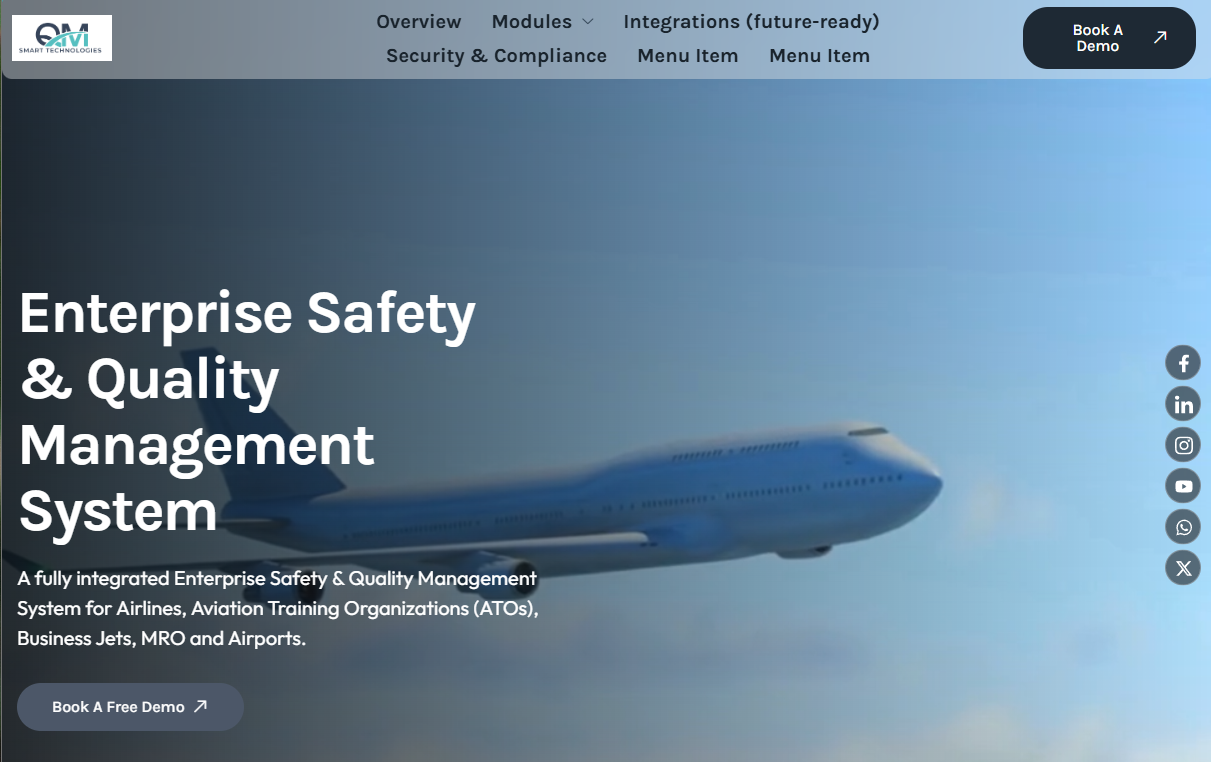
QMSmart is an aviation-focused enterprise safety and quality management system built for airlines, training organizations, business aviation operators, MROs, and airports. It centralizes audit management, safety reporting, risk registers, document control, investigation workflows, and corrective and preventive actions (CAPA) in one configurable platform, with ISO 9001-compliant workflows and AI-powered analytics built in.
Best for: Aviation organizations that need a single, configurable system connecting safety, quality, audit evidence, and corrective action management.
Key features
- Audit planning, checklists, and evidence management
- Findings and CAPA tracking with closure workflows
- Hazard, incident, and investigation records
- Risk registers and assessment tools
- Controlled documents and revision history
Why choose QMSmart: This fits teams where safety and quality governance must share the same evidence trail. If your current audit workflow ends with a spreadsheet and an email chain, QMSmart provides the controlled environment that makes a follow-up inspection answerable.
QMSmart pricing: QMSmart operates on custom pricing under its Pro plan, which includes all safety and quality modules, AI dashboards, online and offline mobile access, and dedicated onboarding support. Contact the vendor for a quote based on organization size and module requirements.
G2 rating: 4.4/5 on G2.
2. SMS Pro
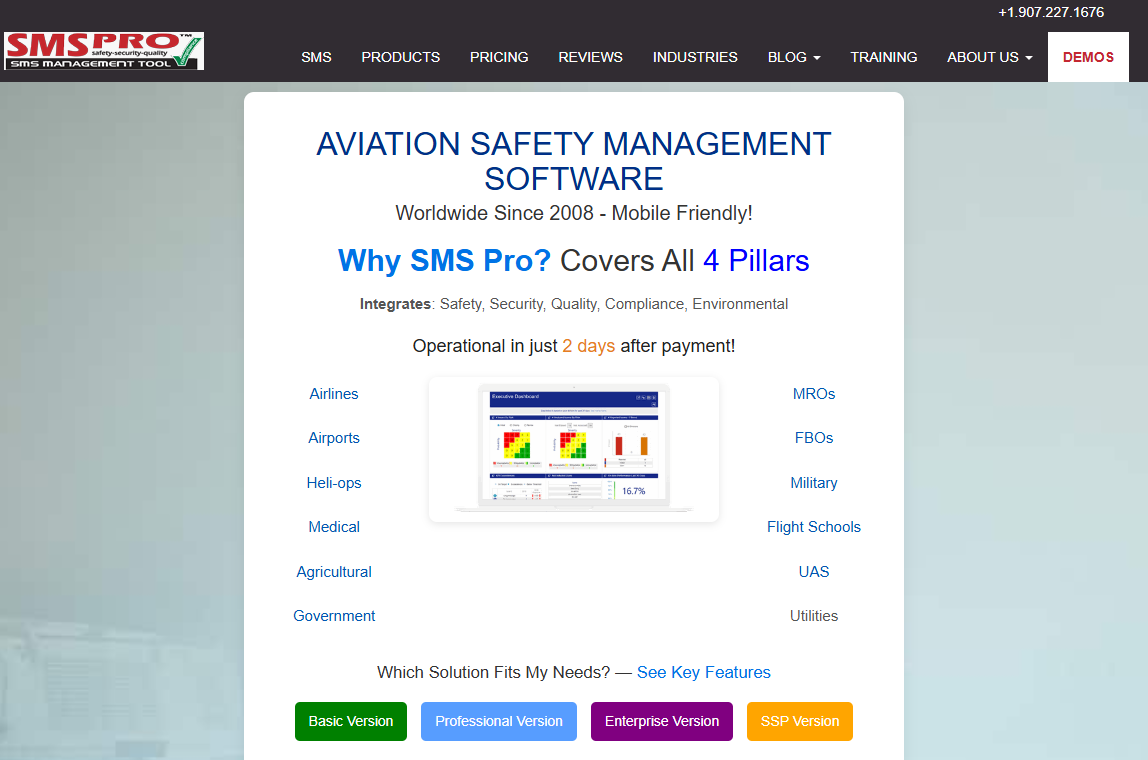
SMS Pro is an aviation safety management platform serving airlines, airports, FBOs, MROs, flight schools, and aviation authorities. It supports incident and hazard reporting, safety performance monitoring, risk register management, training tracking, audit workflows, and compliance documentation across a module library that scales with plan tier.
Best for: Aviation organizations that want a broad SMS module set with defined plans for different safety program maturity levels, including a no-cost entry option.
Key features
- Incident, accident, and near-miss reporting
- Hazard and risk management with register and assessment tools
- Safety audits and inspections with corrective action tracking
- Training and competency management
- Safety performance dashboards and analytics
Why choose SMS Pro: It fits organizations where SMS maturity, regulatory mapping, and organization-wide safety reporting are the primary requirements. The tiered module structure lets a small operator start with 27 modules and expand without switching platforms.
SMS Pro pricing: The Basic plan is free for up to 5 users and 20 reports per month. Paid plans start at $200/month (plus a $1,500 setup fee) for a mid-size operator on the standard Basic paid tier, and $400/month (plus $1,500 setup) for Professional with 41 modules. Enterprise pricing starts at $3,100/month (plus $6,500 setup) with 77 modules. All prices are billed monthly. Verify current figures at asms-pro.com/Pricing.aspx before committing.
G2 rating: 4.0/5 on G2.
3. Web Manuals
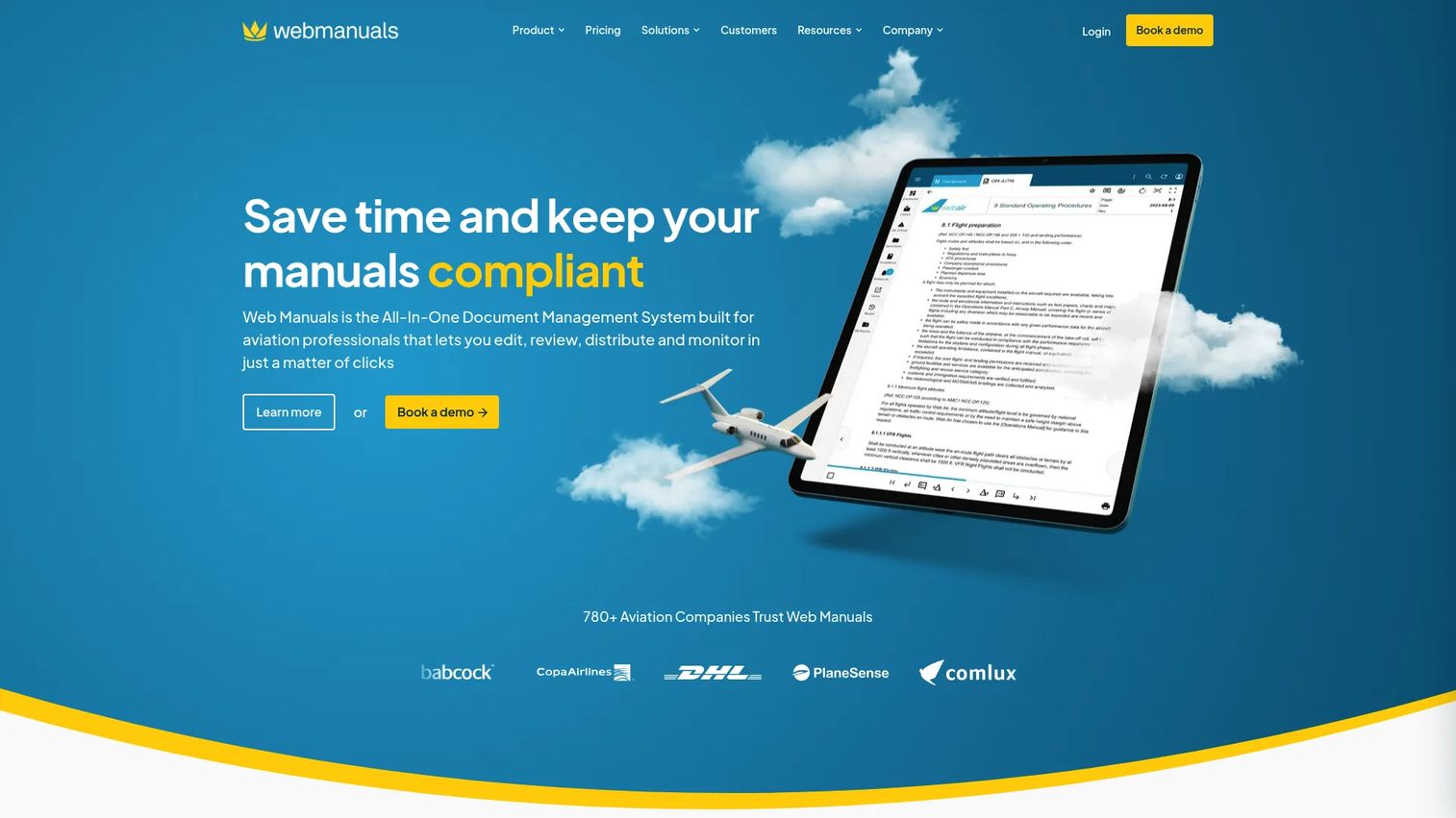
Web Manuals is an aviation document management platform built for operators, airports, MROs, and aviation service companies that need controlled operational manuals, revision tracking, approved distribution, and direct links between manual content and regulatory requirements. Its Amelia AI assistant supports natural-language search across documentation.
Best for: Regulated aviation teams whose primary compliance risk is outdated manuals, inconsistent procedures, or unclear revision ownership.
Key features
- Digital manual authoring and editing
- Revision and approval workflows
- Controlled document distribution via web, iOS, and Android
- Regulation-linked compliance monitoring
- Reviewer workflows and reader change requests
Why choose Web Manuals: Choose it when the recurring audit finding is a procedure that wasn't updated after a regulatory change, or a manual revision that reached some crew members but not others. It solves the document control problem before it becomes an airworthiness problem.
Web Manuals pricing: The Essentials package starts at €4,000 per year. The Professional plan is billed at €170 per editor per month annually (or €200 monthly). Enterprise pricing requires a sales conversation. The price reflects the number of editors, not total users.
G2 rating: 4.4/5 on G2.
4. Skylegs

Skylegs is an online aviation management platform for commercial, charter, corporate, cargo, and special-operations aircraft operators. Its compliance module handles internal audits, compliance checklists, findings assignment, corrective action tracking, and audit history, making it a practical choice for operators that need structured audit follow-up without replacing their existing maintenance system.
Best for: Aircraft operators that need a controlled system for internal audit execution, finding ownership, and closure documentation.
Key features
- Custom compliance checklists
- Findings assignment with due dates and status tracking
- Corrective action workflows
- Auditor and auditee conversation history
- Activity and change tracking
Why choose Skylegs: It addresses the gap between identifying a noncompliance issue and proving it was resolved. For operators that want internal audit management without a full ERP replacement, Skylegs provides the workflow layer their spreadsheet tracking currently lacks.
Skylegs pricing: Packages are priced per aircraft and start at €60/month for EFB-only access. Full-featured plans (MACH 1, 2, and 3) run from €150 to €340/month depending on modules selected. A first month is included at no charge. Enterprise pricing requires a custom quote. All prices are in EUR and vary by fleet size.
G2 rating: No verified G2 listing was found at time of publication.
5. CORRIDOR
CORRIDOR is aviation maintenance and service software purpose-built for MROs, Part 145 repair stations, FBOs, operators, component repair organizations, and completion businesses. It connects work-order management, inventory tracking, procurement, regulatory compliance, and warranty management in a single workflow, available through cloud or on-premise deployment.
Best for: Part 145 repair stations and MRO organizations whose compliance obligations are inseparable from the work order, parts record, and technician authorization.
Key features
- Work order management through invoicing
- Inventory tracking from receipt to disposition
- Procurement, purchase orders, and fulfillment workflows
- Regulatory compliance and warranty management
- Cloud or on-premise deployment with accounting integrations
Why choose CORRIDOR: This is the right fit when audit readiness depends on maintenance traceability, not a separate compliance database. CORRIDOR ties the regulatory record directly to the work executed, which is what an FAA or EASA inspection of a Part 145 station actually evaluates.
CORRIDOR pricing: CORRIDOR does not publish a subscription price. Deployment is available through cloud subscription or an on-premise standard license. Contact the vendor directly for a quote based on facility type, modules, and user count.
G2 rating: 4.4/5 on G2.
6. Veryon Work Center
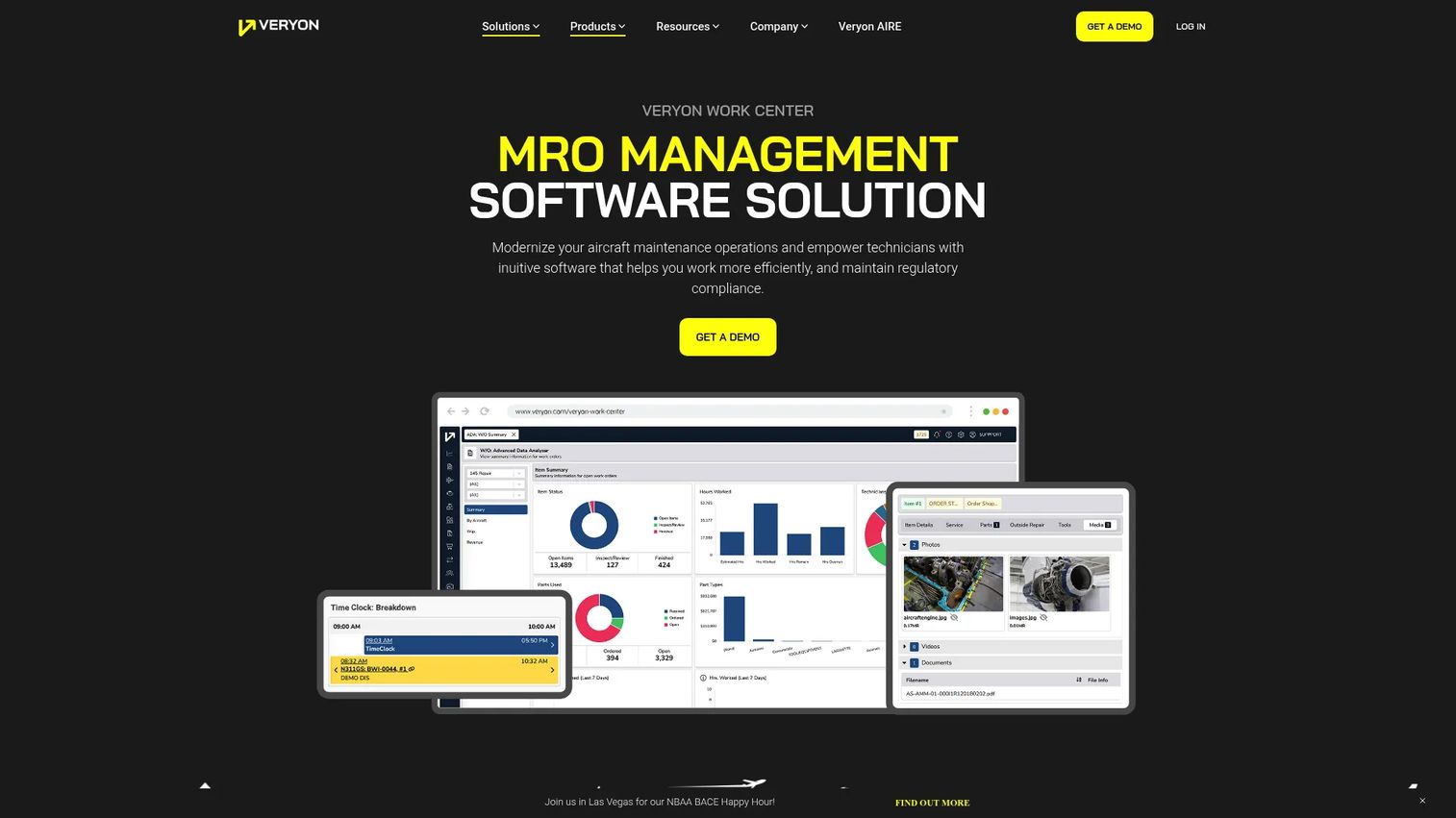
Veryon Work Center is aviation MRO management software for repair stations, MRO providers, FBO maintenance teams, and aviation service organizations. It manages work orders, compliance tasks, inspections, inventory, and purchasing through a single workflow visualization interface.
Best for: Maintenance teams that need to centralize aircraft requirements, move from calendar reminders to controlled due-list workflows, and maintain traceable compliance records.
Key features
- Work order management and workflow visualization
- Compliance management for inspections and regulatory requirements
- Real-time inventory, purchasing, and parts management
- Inspection and interval tracking
- Traceable maintenance history
Why choose Veryon Work Center: It fits operations where the maintenance team needs proactive compliance visibility, not just a record-keeping system. When a tech asks "what's due next week?" the answer should come from a controlled list, not a personal spreadsheet.
Veryon Work Center pricing: Veryon does not display pricing on its website. Request a quote directly, as pricing reflects facility type, modules selected, and user count.
7. CAMP Systems

CAMP Systems provides aviation software and services for tracking, planning, and managing aircraft maintenance and operations. It covers aircraft maintenance tracking, airworthiness management, engine health monitoring, inventory workflows, flight scheduling, and AI-powered maintenance record search, backed by 24/7 aviation analyst support.
Best for: Business aviation operators, corporate flight departments, managed fleets, and CAMO services that need established aircraft maintenance tracking software and airworthiness planning.
Key features
- Aircraft maintenance tracking and airworthiness management
- Engine health monitoring with analytics and alerts
- Inventory management and parts workflows
- Flight scheduling and trip logistics
- AI-powered maintenance record search
Why choose CAMP Systems: Put it on the shortlist when the primary question is "what is due next, and do we have a defensible record that it was completed?" CAMP's combination of analyst support and tracking depth fits operators that want a managed compliance service alongside the software.
CAMP Systems pricing: Pricing is customized by aircraft type, fleet size, and selected solutions. Contact CAMP directly for a quote.
G2 rating: 4.4/5 on G2.
8. TRAX
TRAX is a web-based aviation maintenance ERP and mobile workflow platform serving airlines, MROs, and cargo operators. It covers engineering, planning, production, inventory, quality, documentation, technical records, and financials through 14 role-based iOS and web applications designed for paperless maintenance operations.
Best for: Airlines and larger MROs with complex, multi-location maintenance operations that need integrated engineering, planning, and maintenance execution in one platform.
Key features
- Aircraft maintenance management across engineering, planning, and production
- 14 role-based iOS and web applications for paperless workflows
- Compliance and technical records management
- Materials, inventory, and financial process integration
- Cloud hosting with monitoring and disaster recovery
Why choose TRAX: Its fit increases with operational complexity. A founder evaluating TRAX should first assess process maturity, implementation capacity, and integration requirements. This is not a quick-start compliance tool; it is an enterprise maintenance operating system.
TRAX pricing: TRAX does not publish pricing. Reach out directly for a quote based on fleet size, locations, and modules.
9. myFLIGHTDATA
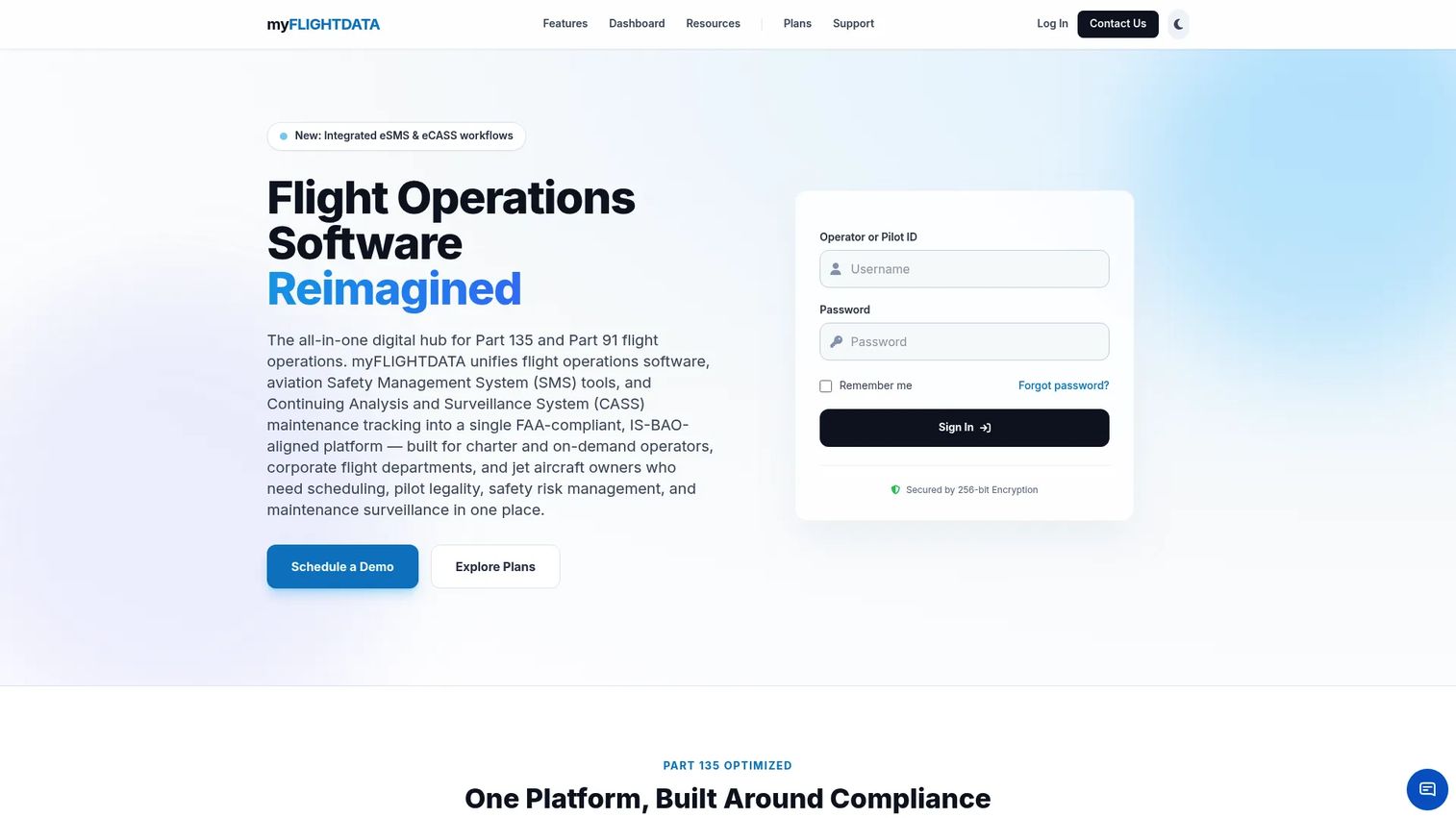
myFLIGHTDATA is a flight operations, safety management, and maintenance platform built specifically for Part 135 charter operators and Part 91 flight departments. It connects fleet scheduling, pilot legality, duty-time tracking, flight risk assessment (FRAT) workflows, eSMS, eCASS, aircraft maintenance surveillance, and an Electronic Flight Bag (EFB) in one system.
Best for: Charter operators and corporate flight departments that need compliance to appear in the scheduler's daily decision flow, not in a separate quality system.
Key features
- Fleet scheduling and operational control
- Pilot currency, duty time, and training tracking
- Flight Risk Assessment (FRAT) workflows
- Electronic Safety Management System (eSMS) and eCASS
- Aircraft maintenance and inspection tracking
Why choose myFLIGHTDATA: It closes the gap between dispatch and compliance. When a scheduler needs to confirm crew legality, aircraft status, and risk before releasing a trip, myFLIGHTDATA surfaces all three from the same screen. For Part 135 operators evaluating checklist management software alongside their flight ops platform, this integration matters.
myFLIGHTDATA pricing: Monthly baseline pricing for operators with one to three aircraft starts at $45/month for eSMS Only, $105/month for the Flight Ops Suite, and $195/month for the Full Ops Suite. Fleets of ten or more aircraft require a sales quote. All prices are billed monthly.
G2 rating: 4.5/5 on G2.
10. SAFEJETS
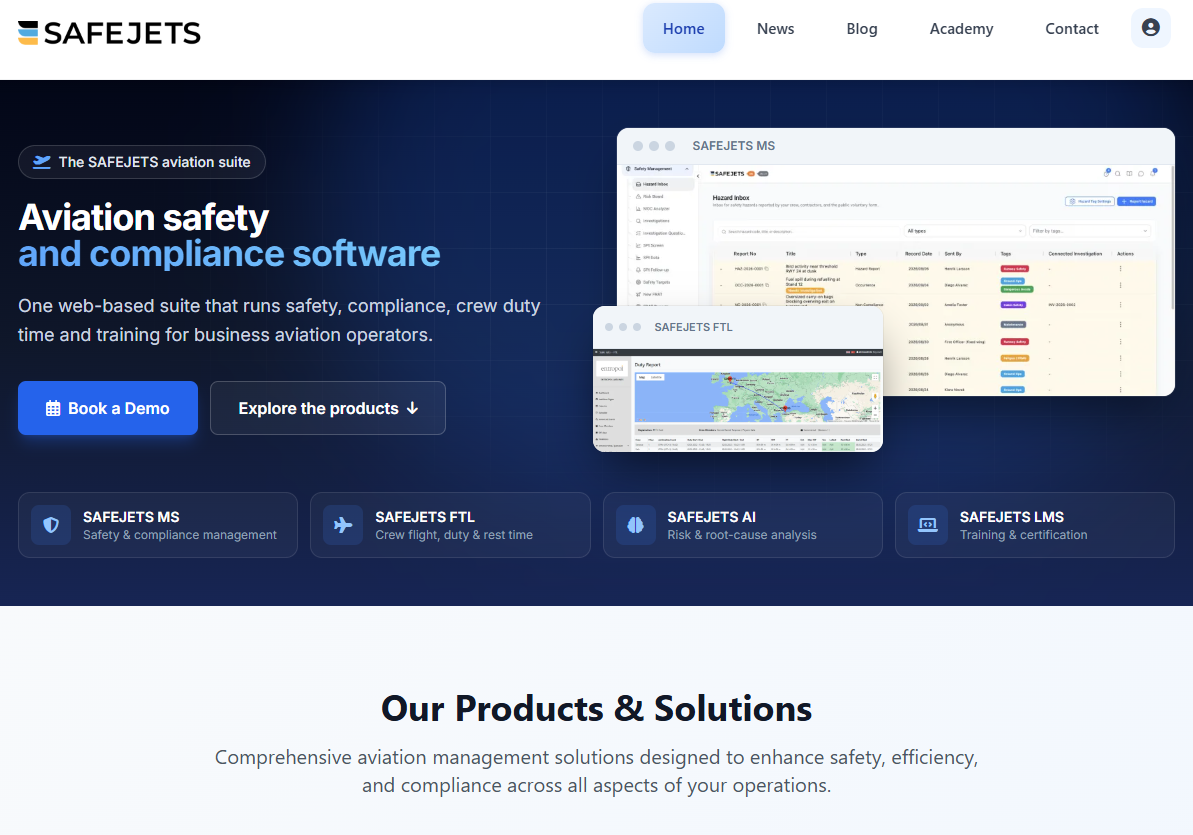
SAFEJETS is a web-based aviation management suite combining safety and compliance management with flight-duty monitoring, fatigue risk management, training and certification tracking, and AI-assisted root-cause and corrective action analysis. It is built for business aviation operators, charter companies, and AOC holders that need safety, compliance, flight time, and training reviewed together.
Best for: Business aviation operators and AOC holders that need safety management, crew compliance, training oversight, and operational risk controls connected in one platform.
Key features
- Compliance monitoring and audit management
- Safety management with hazard reporting, risk assessment, and safety-performance tracking
- Flight, duty, and rest-time monitoring
- Training and certification tracking
- AI-assisted root-cause, corrective-action, and risk analysis
Why choose SAFEJETS: Choose it when flight and duty time, safety reporting, and training records all need to appear in the same management review. The AI-assisted analysis is a practical differentiator for teams that currently pull root-cause data manually from separate systems.
SAFEJETS pricing: Current pricing is not displayed on the active SAFEJETS website. An older first-party price list from the predecessor QMS product showed tiers from $250/month to $1,200/month, but those figures predate the November 2024 rebrand to SAFEJETS MS. Contact sales for current pricing.
Considerations when choosing aviation compliance monitoring software
Match the platform to your operating model
An MRO needs maintenance execution and traceability built into the same record. A flight department needs crew currency and aircraft status visible at trip release. A quality team needs audit checklist software with formal evidence trails. Buying a broad suite to solve a narrow document-control problem creates maintenance burden without proportional value.
Test the evidence trail, not the dashboard
Ask the vendor to walk through a complete record from audit finding to formal closure, including ownership assignment, due date changes, evidence attachments, approval history, and escalation. A dashboard that shows "findings open: 3" is not the same as an inspector-ready record. The trail is what matters during a regulatory visit.
Map your regulations and operating certificates
Confirm that the platform supports the specific frameworks governing your operation: FAA, EASA, ICAO, Part 91, Part 135, Part 139, Part 145, IS-BAO, or internal quality standards. The goal is a usable connection between your requirements and the evidence your team produces, not a vendor claim about general regulatory alignment.
Check integrations and system boundaries
Clarify what stays in your existing maintenance system, scheduling platform, learning management system, or document repository. Every manual reconciliation point between systems is a future audit gap. Before signing, map exactly which data moves between tools and who owns that transfer.
Budget for implementation ownership
The software will not fix unclear accountability. Assign specific owners for audit templates, document review cycles, corrective action closures, qualification records, and release-cycle updates before the contract is signed. A system without internal ownership produces the same unresolved findings as the spreadsheet it replaced.
Conclusion
The right aviation compliance monitoring software is determined by where your compliance gaps actually live: In safety and quality governance, in maintenance traceability, in manual control, or in the daily flight operations workflow.
QMSmart and SMS Pro fit organizations building or strengthening structured safety and quality programs. Web Manuals and Skylegs address document control, audit workflows, and corrective action discipline. CORRIDOR, Veryon Work Center, CAMP Systems, and TRAX serve MRO and maintenance-centered operations where compliance lives inside the work order. myFLIGHTDATA and SAFEJETS fit flight departments and operators that need daily operational compliance visible at the dispatch decision.
The practical next step: Shortlist two or three platforms based on your operating model. Then run a proof-of-work evaluation using one real audit finding, one upcoming maintenance event, one expiring qualification, and one controlled document revision. Any platform worth buying should handle all four without requiring a manual workaround. If it cannot, that gap will show up in your next inspection before it shows up in your vendor conversation.
FAQs
Aviation compliance monitoring software is a system used by aviation organizations to centralize regulatory obligations, audit management, maintenance requirements, qualification status, documentation, findings, and corrective actions in a controlled environment. It creates a traceable record that supports internal management reviews and external regulatory inspections. The category spans SMS platforms, QMS systems, MRO compliance suites, and flight operations tools.
SMS software focuses specifically on safety reporting, hazard management, risk assessment, safety performance monitoring, and safety assurance processes. Aviation compliance software is a broader category: It may include SMS modules, but it also covers audit evidence, controlled manuals, qualification tracking, maintenance requirements, and regulatory traceability. Some platforms, such as QMSmart and SAFEJETS, combine both in one system, while others specialize in one function.
It can organize the records, checklists, findings, corrective actions, training evidence, and maintenance history that an FAA inspector asks to see. A well-configured platform gives your quality manager a traceable record for every open and closed finding. Using aviation regulatory compliance software does not guarantee regulatory compliance or replace the responsibility of accountable management and quality leadership. This article is not regulatory or legal advice.
Part 145 repair stations should prioritize platforms that tie compliance directly to the work order: Technician authorization, technical data traceability, inspection records, parts documentation, and AD and SB tracking. CORRIDOR and Veryon Work Center are built for this operating model. TRAX serves larger MRO and airline repair operations. All three provide the maintenance-execution traceability that a Part 145 audit evaluates.
Flight departments should prioritize pilot legality, crew currency, aircraft airworthiness status, trip release controls, flight risk assessment workflows, eSMS, and eCASS integration. myFLIGHTDATA is purpose-built for Part 135 charter operators and Part 91 corporate flight departments. SAFEJETS adds duty-time monitoring and training tracking for operators that need safety management alongside flight operations.
Core capabilities include audit management with evidence attachments, corrective action tracking with ownership and due dates, controlled document workflows, role-based access and approval routing, qualification and training monitoring, regulatory mapping, alerts for overdue actions and expiring certificates, and exportable records for inspections. Analytics and reporting that surface open findings, upcoming obligations, and fleet risk complete the picture.
Cost is driven by fleet size, aircraft type, user count, locations, modules selected, implementation services, and integration requirements. myFLIGHTDATA is the only platform on this list with transparent per-aircraft monthly pricing starting at $45/month. SMS Pro starts free and scales to $3,100/month for enterprise programs. Web Manuals starts at €4,000/year. Most MRO and enterprise platforms require a custom quote. Compare total first-year cost including setup fees, not only subscription price.
It can replace spreadsheet-led tracking when the system creates a controlled record of ownership, changes, approvals, due dates, and evidence. Spreadsheets generate data; compliance platforms generate audit trails. The switch is worth making when a single missed action or an undocumented closure could produce a regulatory finding. Retain spreadsheets for ad hoc analysis where appropriate, but not as the system of record for audit-critical work.