You hired fast. The first 30 people came together through Slack threads, spreadsheets, and a founder who personally interviewed everyone. Then you hit 60, then 90, and the cracks showed. Onboarding lives in one doc. Performance reviews live in another. Nobody can answer who is due for a promotion or why your best engineer just gave notice.
That is the moment a talent management system stops being a nice-to-have and becomes infrastructure. The global talent management software market sits at roughly USD 12.69 billion in 2026 and is projected to reach USD 29.48 billion by 2034, a 11.10% CAGR, according to Fortune Business Insights (2026). The category is growing because more companies are hitting the same wall you are: people processes that worked at 20 employees break at 100.
The problem is not that founders ignore people ops. It is that they bolt on a hr talent management software tool only after the pain gets loud. By then, data is scattered, managers have their own habits, and retention is already leaking. A real talent management platform unifies the employee lifecycle, recruiting, onboarding, performance, development, and succession planning, so the right work gets done without you in every loop.
This guide cuts through the noise. If you are mapping out adjacent systems, you may also find our roundups on AI recruiting software and AI customer service software useful, since talent tools rarely live alone in your stack. We also reference how analytics platforms drive ROI because the reporting layer is where most of these decisions get won or lost.
What's inside
This guide is for founders, people ops leads, and ops-minded buyers narrowing a shortlist of talent management tools. We focused on systems that cover the employee lifecycle, not single-purpose point tools. Each pick was evaluated on five criteria: lifecycle breadth (recruiting through succession), manager adoption and UX, analytics and reporting depth, integrations across your HR stack, and fit by company stage. We verified pricing and ratings against first-party pages and live G2 listings where available. Where a vendor gates pricing behind sales, we say so plainly instead of guessing.
TL;DR
- Best for SMBs and first all-in-one HRIS: BambooHR, approachable, fast to adopt, strong onboarding and time-off.
- Best for performance-heavy teams: Lattice, deep performance management, goals, and engagement in one place.
- Best for learning and development at scale: Cornerstone OnDemand, enterprise learning and talent marketplace.
- Best for broad HCM with talent inside it: UKG Pro, Paycor, and Dayforce pair payroll and workforce management with talent workflows.
- Best for large enterprise: Workday HCM, SAP SuccessFactors, and Oracle Talent Management Cloud for global scale, governance, and process depth.
- Best for recruiting-to-development continuity: ClearCompany, strong talent acquisition flowing into ongoing development.
What is talent management software?
Talent management software is a system that manages the full employee lifecycle, from recruiting and onboarding through performance management, learning and development, and succession planning, in one connected platform. It replaces the scattered docs, spreadsheets, and one-off tools most companies use before they scale.
The category spans a set of core capability areas. Here is what a complete talent management platform typically covers:
- Recruiting: Sourcing, applicant tracking, interview workflows, and offer management.
- Onboarding: Structured first-90-day workflows, document collection, and role-specific paths.
- Performance management: Reviews, continuous feedback, goals and OKRs, and calibration.
- Learning and development: Course delivery, skill building, certifications, and talent development software for career growth.
- Succession planning: Identifying high-potential employees, mapping critical roles, and building internal mobility paths.
- Analytics and reporting: Workforce analytics, retention signals, and predictive insights leadership can act on weekly.
- Integrations: Connections to HRIS, payroll, ATS, identity, and your analytics stack.
Some buyers distinguish between lightweight talent management tools and full talent management suites. The lightweight end handles a slice, performance or onboarding alone. Suites handle the whole lifecycle and add AI and automation across workflows. For a scaling SaaS company, the suite usually wins because it consolidates signal instead of fragmenting it further. If you are also evaluating governance for AI features inside these tools, our guide to AI governance tools is a useful companion read.
When to use talent management software
When you need one system across the employee lifecycle
Scattered tools feel fine until they don't. You have an ATS, a separate onboarding doc, a performance spreadsheet, and a learning tool nobody opens. Each holds a fragment of the truth, and none talk to each other. A unified talent management system pulls recruiting, onboarding, performance, and development into one place so you stop reconciling data by hand. The payoff is not tidiness. It is faster decisions and cleaner reporting when your board asks why retention dipped.
When manager adoption matters as much as HR control
HR can buy the most capable platform on earth, but if managers ignore it, nothing changes. Distributed teams and fast-moving managers need tools they actually open. Usability and adoption determine whether performance reviews happen on time, whether feedback gets logged, and whether onboarding sticks. The best talent development software is the one your managers use without being chased. Weight UX heavily, especially if your team is remote or scaling past 100 people.
When retention and internal mobility are strategic goals
Hiring is expensive. Replacing a strong employee is more expensive. Once retention becomes a board-level metric, you need development paths, growth conversations, and succession planning that show people a future inside your company. Internal mobility keeps institutional knowledge and reduces churn. Platforms that connect performance to learning and to clear career paths give you leverage no amount of recruiting spend can match. This is where talent management stops being admin and starts being strategy. Tools like the ones in our AI content creation tools roundup can support the comms layer around growth programs too.
Comparison table
Here is a fast scan of all 10 platforms by intent, differentiation, pricing posture, and current G2 rating where verified. Use it to narrow to two or three, then validate fit with demos and references.
| # | Product | Intent | Key differentiation | Pricing | G2 rating |
|---|---|---|---|---|---|
| 1 | BambooHR | SMB all-in-one HRIS | Approachable onboarding and time-off | From $10/employee/mo | 4.4/5 |
| 2 | Lattice | Performance and engagement | Deep reviews, goals, and OKRs | From $4/seat/mo | 4.7/5 |
| 3 | Cornerstone OnDemand | Enterprise learning and talent | Talent marketplace and L&D depth | Custom | 4.0/5 |
| 4 | UKG Pro | Connected HCM suite | HR, payroll, and workforce management | Custom | 4.3/5 |
| 5 | Paycor | HR, payroll, and talent | All-in-one for growing teams | Custom | 3.9/5 |
| 6 | ClearCompany | Recruiting to development | Talent acquisition continuity | Custom | 4.6/5 |
| 7 | Dayforce | Enterprise HCM | Unified workforce management | Custom | Not listed |
| 8 | Workday HCM | Enterprise HR at scale | Process depth and governance | Custom | Not listed |
| 9 | SAP SuccessFactors | Global enterprise suite | Talent depth across the lifecycle | Custom | 4.1/5 |
| 10 | Oracle Talent Management Cloud | Large-enterprise talent | End-to-end Oracle ecosystem fit | Custom | Not listed |
1. BambooHR
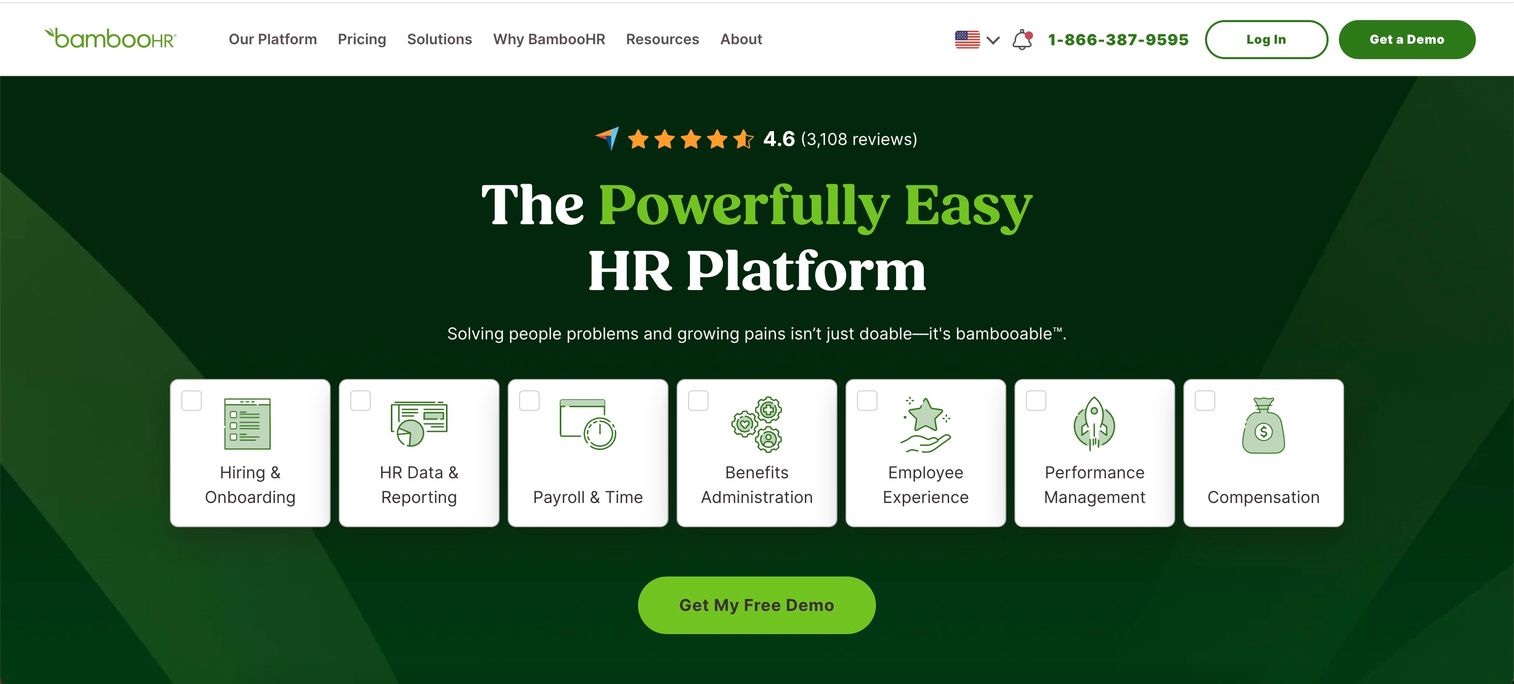
BambooHR is cloud HR software for managing employee records, onboarding, time off, reporting, payroll, and benefits. It is the platform most small and mid-sized teams reach for first because it does not require an HR department to run. For a founder who needs a real system without a six-month rollout, BambooHR is often the cleanest starting point for an all-in-one HRIS.
Best for: Small to midsize companies wanting an all-in-one HRIS with onboarding and time-off tracking.
Key strengths
- Employee records and reporting: Custom reports give leadership a single source of truth on headcount and data.
- Onboarding and offboarding: Structured workflows make first days repeatable instead of improvised.
- Time-off management: Included in every plan, so requests and approvals stop living in Slack.
Why choose BambooHR: If you are scaling from 20 to 100 employees and your people data lives in spreadsheets, BambooHR gives you structure without enterprise overhead. It is approachable enough that managers actually adopt it, which is the part most platforms miss. The trade-off is depth: heavy performance and succession programs may eventually push you toward a suite.
BambooHR pricing: BambooHR offers Core, Pro, and Elite plans. For companies with more than 25 employees, pricing is per employee per month: Core starts at $10, Pro at $17, and Elite at $25 per employee per month. For teams of 25 or fewer, pricing starts at $250 per month. There is no free tier. BambooHR holds a 4.4/5 rating on G2.
2. Lattice
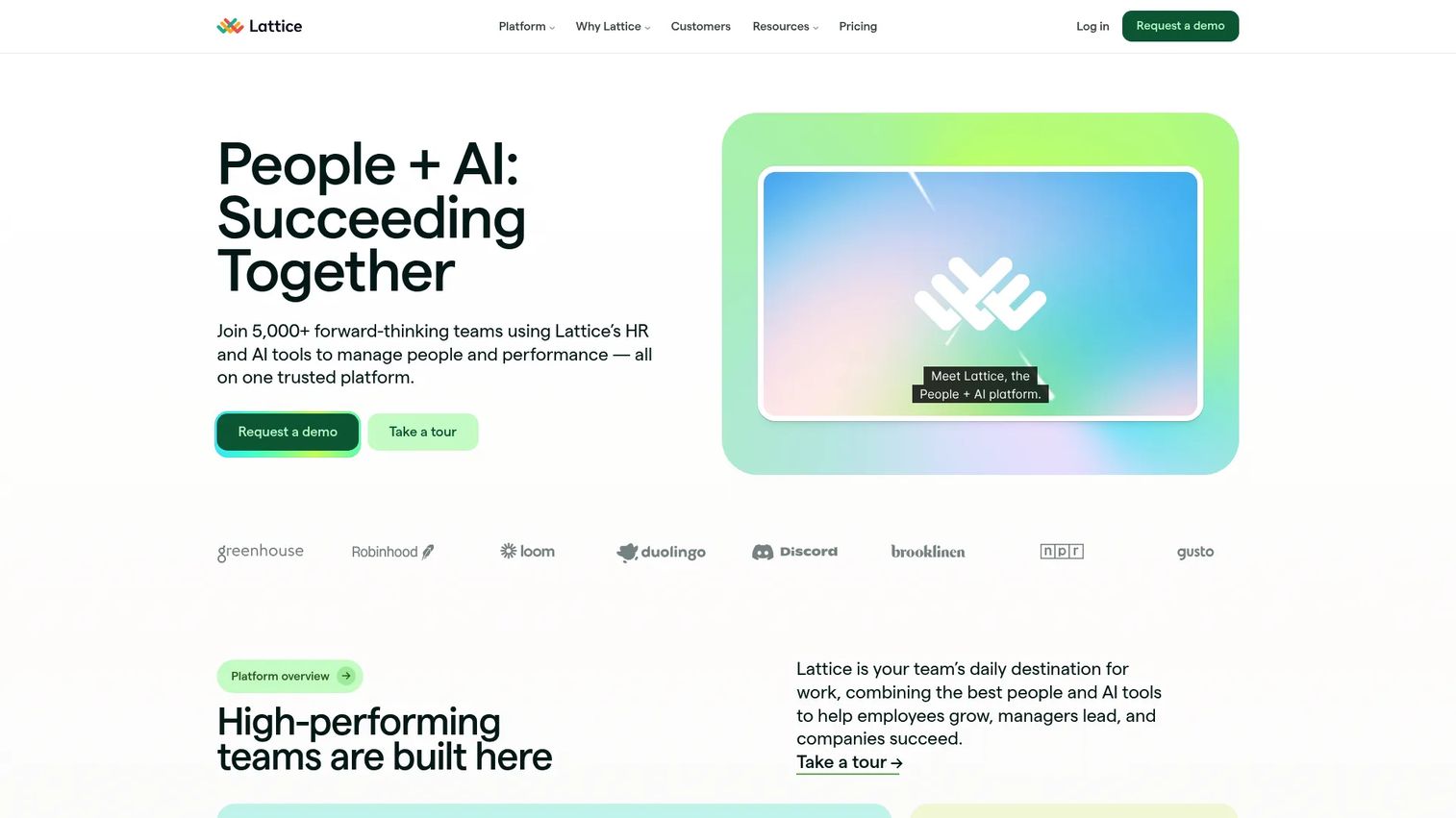
Lattice is an AI-powered people management platform for performance, goals, engagement, growth, compensation, and analytics. Where BambooHR anchors on records, Lattice anchors on performance and the manager relationship. If reviews, feedback, and goal-setting are where your scaling pain shows up, Lattice is built for exactly that motion.
Best for: Mid-market to enterprise HR teams needing an integrated people management suite.
Key strengths
- Performance management: Reviews, continuous feedback, and calibration in one connected flow.
- Goals and OKRs: Keep company, team, and individual goals visible and aligned.
- People analytics and engagement: Surveys and analytics surface retention risk before it becomes churn.
Why choose Lattice: Lattice fits teams that treat performance management as a system, not a yearly scramble. It gives managers a structured place to run feedback and growth conversations, which is exactly the manager adoption problem most founders underestimate. Pair it with an HRIS if you need deeper records and payroll.
Lattice pricing: Lattice uses modular, annually billed pricing in USD. Foundations runs $11 per seat per month, base products start at $4 per seat per month, the Compensation add-on is $6 per seat per month, and Grow is $4 per seat per month. Performance or Goals and OKRs can be purchased separately for $8 per month. The minimum annual agreement is $4,000. Lattice holds a strong 4.7/5 on G2.
3. Cornerstone OnDemand
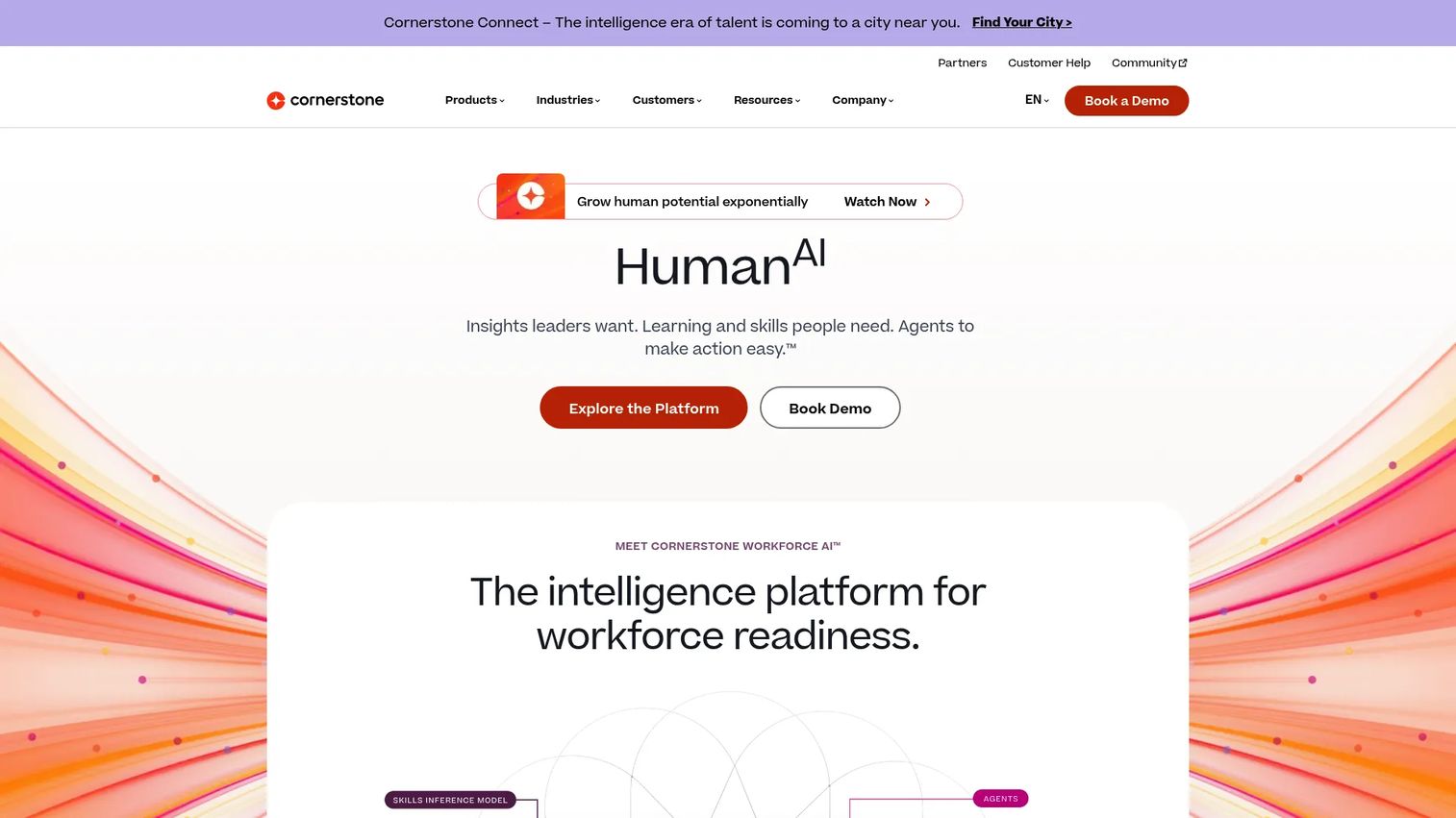
Cornerstone OnDemand is an enterprise workforce readiness platform for learning, talent, skills, and recruiting. It leans hard into learning and development, which makes it a strong fit when structured upskilling and succession planning are central to how you retain people. For organizations where development is a strategic lever, Cornerstone goes deeper than most.
Best for: Mid-to-large organizations needing an enterprise learning and talent platform.
Key strengths
- AI-powered learning: Personalized course delivery and content recommendations at scale.
- Talent marketplace and succession: Connect skills to internal mobility and succession planning.
- Content subscriptions and authoring: Build or buy learning content without a separate LMS.
Why choose Cornerstone OnDemand: Choose Cornerstone when learning and development is not a checkbox but a retention strategy. Its talent marketplace ties skills to internal opportunities, which is how you keep strong people instead of watching them leave for growth elsewhere. It is built for complexity, so it rewards organizations with real L&D ambition.
Cornerstone OnDemand pricing: Cornerstone does not publish numeric pricing on its site. Pages route visitors to book a demo or request a consultation, and the company notes flexible packaging by need. Cornerstone holds a 4.0/5 rating on its G2 seller page. Verify current packaging and pricing directly with their sales team during evaluation.
4. UKG Pro
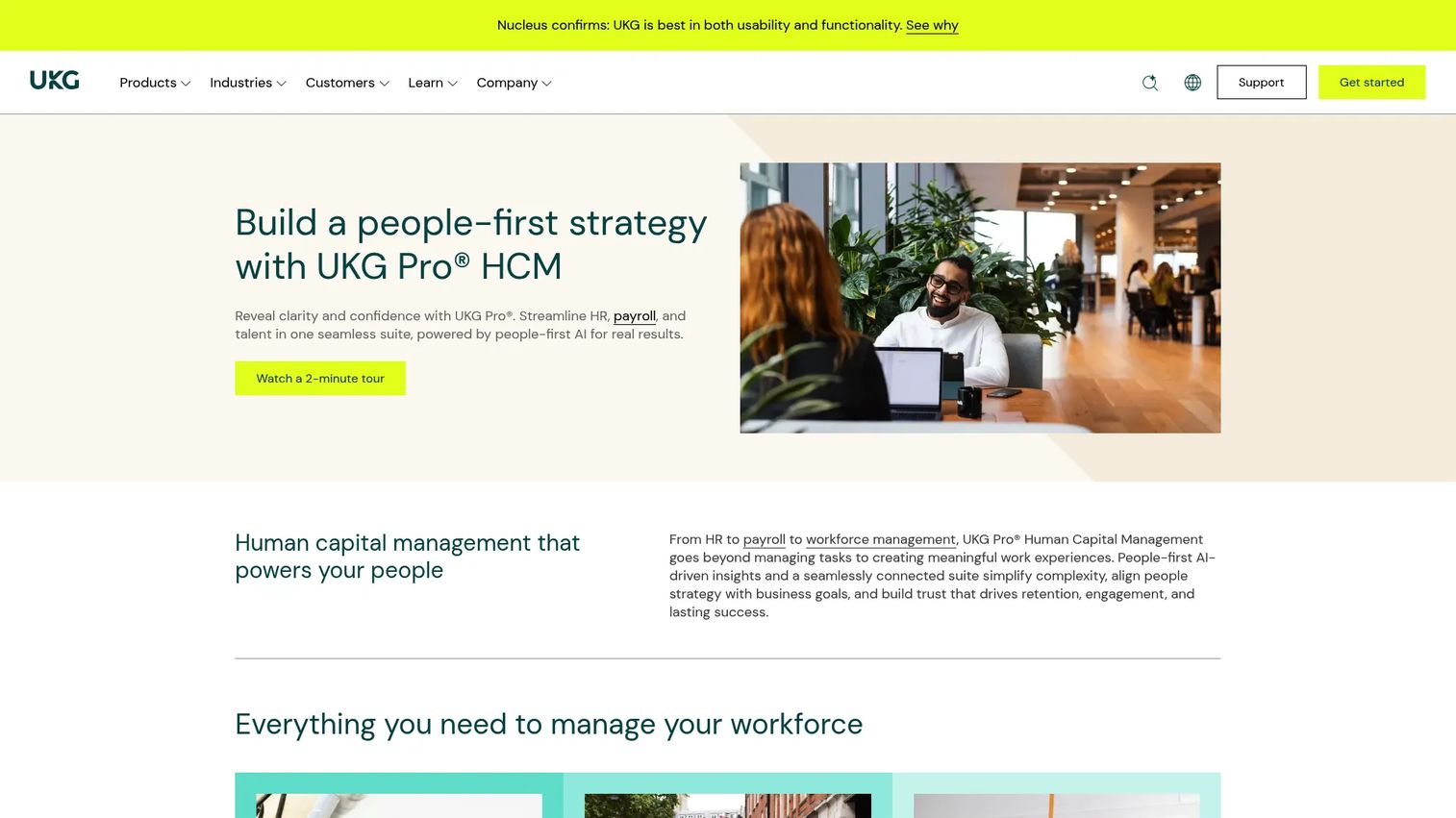
UKG Pro is cloud human capital management software for HR, payroll, talent, and workforce management. It fits organizations that want talent workflows sitting inside a broader HCM context, where payroll, scheduling, and workforce analytics matter as much as performance. For operationally complex teams, that breadth is the draw.
Best for: Mid-to-large organizations needing a connected HR, payroll, and workforce management suite.
Key strengths
- AI-driven insights: Bryte AI surfaces workforce patterns and recommendations.
- HR and employee self-service: Employees and managers handle routine tasks without HR in the loop.
- Workforce management: Time, attendance, and scheduling connect to talent data.
Why choose UKG Pro: UKG Pro suits organizations where talent cannot be separated from payroll and workforce operations. If you run shift-based or distributed teams, the connected suite reduces the integration headaches of stitching point tools together. It is a heavier platform, so it pays off most at scale and operational complexity.
UKG Pro pricing: UKG does not display public pricing, plan names, or a free tier on its product page. Pricing is handled through sales conversations and scoped to your organization. UKG Pro holds a 4.3/5 rating on its G2 product reviews page. Request a scoped quote during evaluation rather than relying on third-party estimates.
5. Paycor
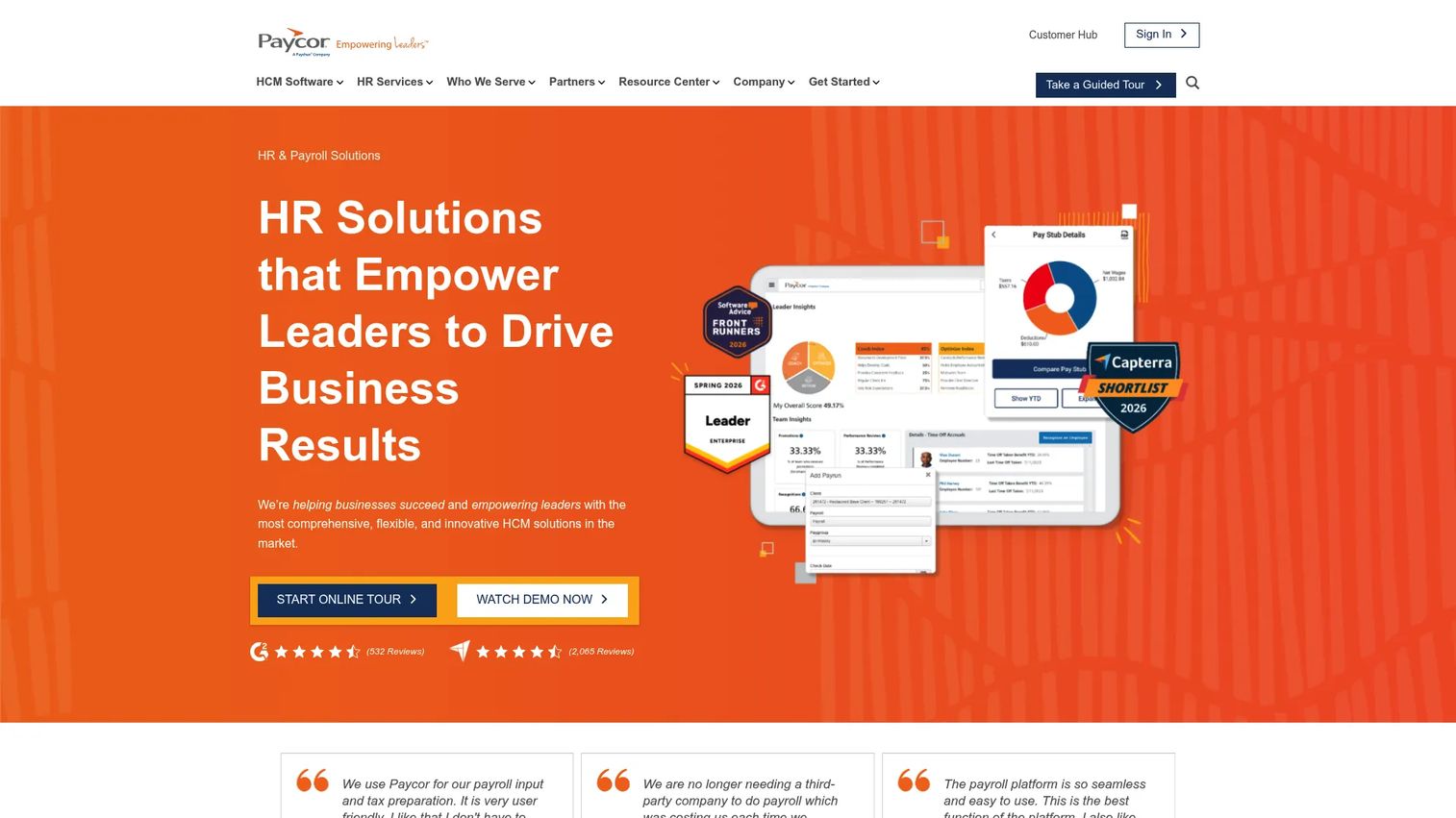
Paycor is cloud-based HR and payroll software for businesses. It hits a useful middle ground: more than a lightweight HRIS, but lighter to adopt than a heavyweight enterprise suite. For growing teams that want HR, payroll, and talent workflows in one place without a long enterprise rollout, Paycor is a practical pick.
Best for: Businesses wanting an all-in-one HR, payroll, and workforce platform.
Key strengths
- Payroll and HR management: Core HR and payroll run in one connected system.
- Workforce management: Scheduling and time tracking for hourly and distributed teams.
- Talent and compliance: Talent workflows paired with compliance tooling built in.
Why choose Paycor: Paycor fits founders who want operational clarity without committing to an enterprise platform on day one. It balances HR, payroll, and talent in a way managers can navigate, which keeps adoption high. If your priority is one clean system for a growing team rather than deep, configurable talent modules, it earns its place.
Paycor pricing: Paycor's pricing page indicates small businesses can request a custom quote, while mid-market customers can view product plans. No public numeric starting price is shown on the page. Paycor holds a 3.9/5 rating on its G2 seller page. Confirm current plan structure and pricing directly with Paycor before purchase.
6. ClearCompany
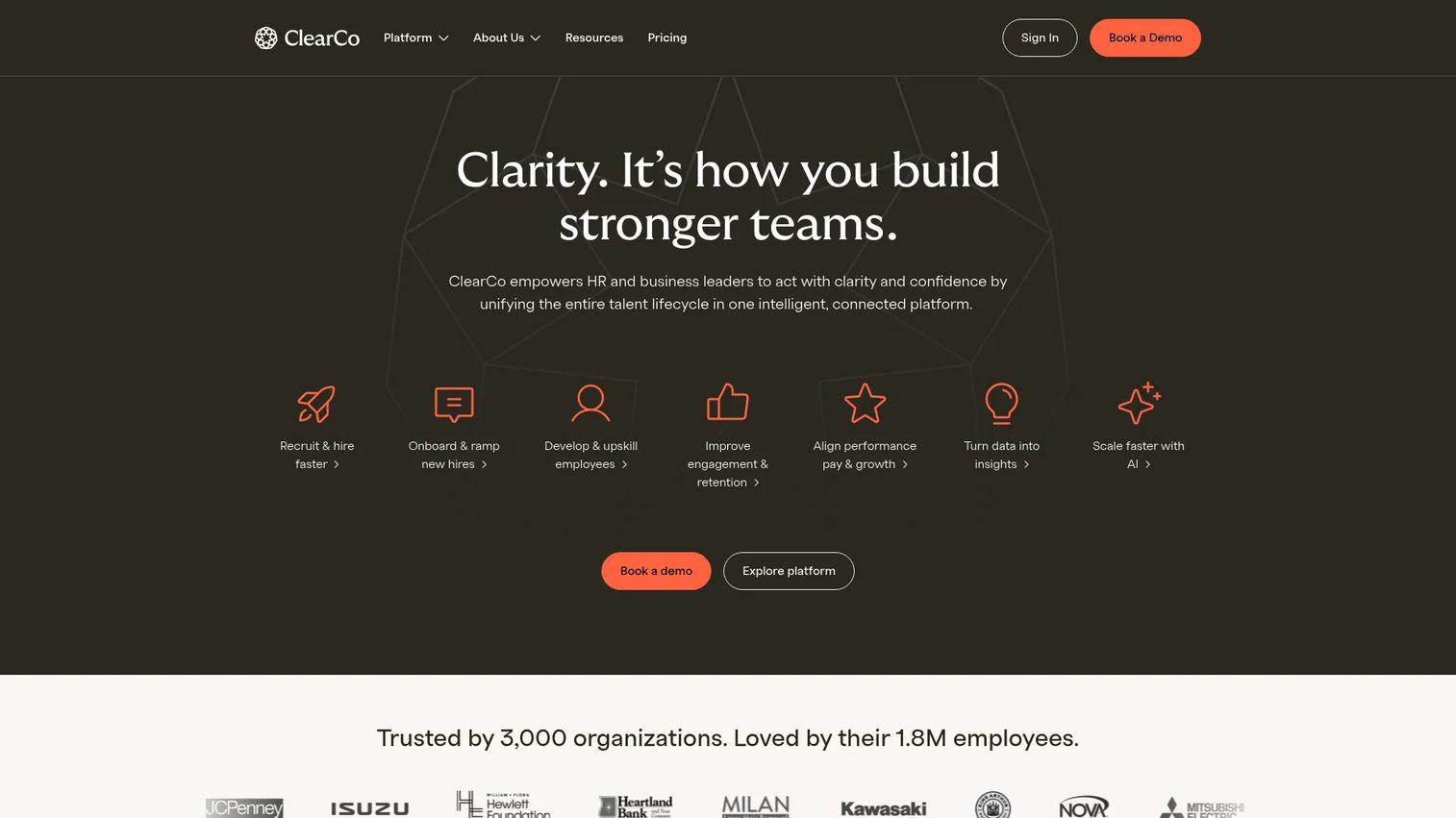
ClearCompany is a unified talent management platform for hiring, onboarding, learning, performance, engagement, and compensation. Its strength is continuity: candidates flow from recruiting into onboarding and ongoing development without the data handoffs breaking. For teams where hiring volume is high and you want that momentum to carry into retention, it is a strong fit.
Best for: Mid-market and enterprise HR teams needing an end-to-end talent platform.
Key strengths
- Candidate attraction and recruiting: A polished hiring experience that feeds the rest of the lifecycle.
- Onboarding and background checks: Structured onboarding with compliance handled in flow.
- Performance, learning, and compensation: Continuity from hire through development and pay.
Why choose ClearCompany: ClearCompany is built for organizations that see recruiting and talent development as one continuous motion, not two disconnected functions. The workflow cohesion from hire to growth reduces the dropped context that usually kills new-hire momentum. Choose it when talent acquisition is a core growth lever and you want it tied to development.
ClearCompany pricing: ClearCompany offers packaged modules including ClearRecruit, TotalTalent, ClearTalent, ClearGrow, ClearLearn, and ClearCare, each with request-pricing options. No public numeric prices are shown on the site. ClearCompany holds a 4.6/5 rating on its G2 seller page. Request pricing for the specific modules you need during evaluation.
7. Dayforce
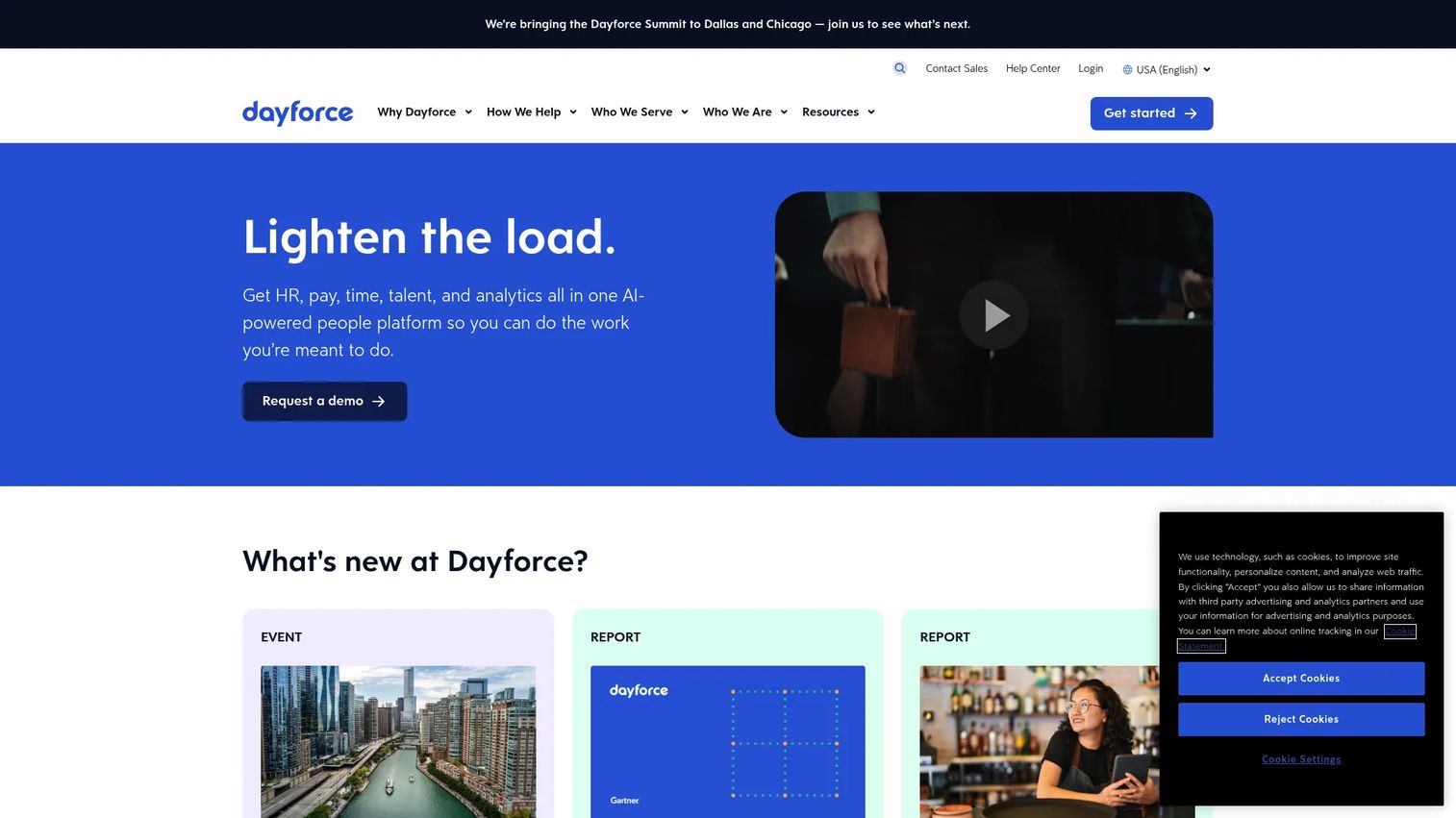
Dayforce is a cloud HCM platform for HR, payroll, workforce management, talent, and analytics. It is built for organizations that want talent needs sitting inside a broader labor, payroll, and compliance stack. When your people operations are complex enough that talent cannot be separated from scheduling and global payroll, Dayforce unifies them.
Best for: Mid-market to enterprise organizations needing an all-in-one HCM suite.
Key strengths
- HR software: Core HR records and workflows in a single platform.
- Payroll and global payroll: Domestic and international payroll handled natively.
- Workforce management: Time, scheduling, and attendance tied to talent data.
Why choose Dayforce: Dayforce suits enterprises and complex mid-market teams that need one continuous system spanning payroll, workforce management, and talent. The unified data model reduces reconciliation across functions, which matters when compliance and global operations are in play. It is a substantial platform, best suited to organizations with real operational complexity.
Dayforce pricing: Dayforce does not display public pricing on its website and directs visitors to request a demo or contact sales. Pricing is scoped per organization. Request a quote and a tailored demo during your evaluation to understand fit and total cost for your team's size and needs.
8. Workday HCM
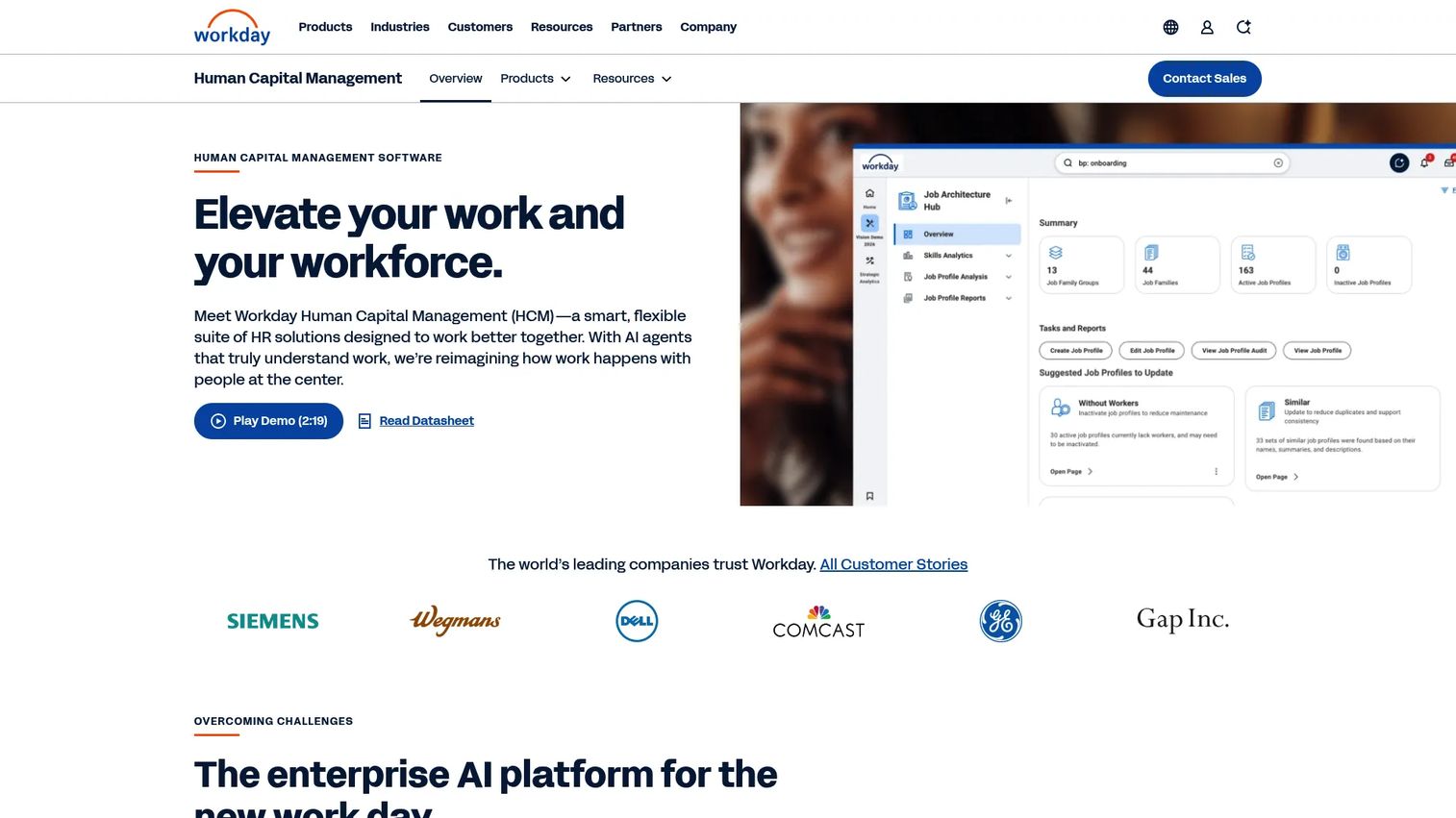
Workday HCM is cloud-based human capital management software for HR, talent, workforce, and employee experience management. It is enterprise infrastructure: organizations choose it for process depth, governance, and integrated people data at scale. Workday reports adoption across 10,000 organizations, including a majority of the Fortune 500.
Best for: Midmarket and enterprise organizations needing a unified HR and talent platform.
Key strengths
- Core HCM: A single system of record for the full workforce.
- Workforce planning and analytics: Plan headcount and model scenarios with integrated data.
- Talent management: Performance, development, and skills connected to core HR.
Why choose Workday HCM: Workday is the choice when governance, process depth, and clean people data at scale are non-negotiable. Its workforce planning and analytics give leadership the board-grade visibility enterprise organizations require. Implementation and procurement are a real commitment, so it fits companies ready to invest in infrastructure that lasts.
Workday HCM pricing: Workday does not display public pricing; the product page directs visitors to contact sales. Pricing is scoped to organization size and module needs through a sales process. Plan for a structured procurement cycle and request a tailored proposal during evaluation rather than expecting list pricing.
9. SAP SuccessFactors
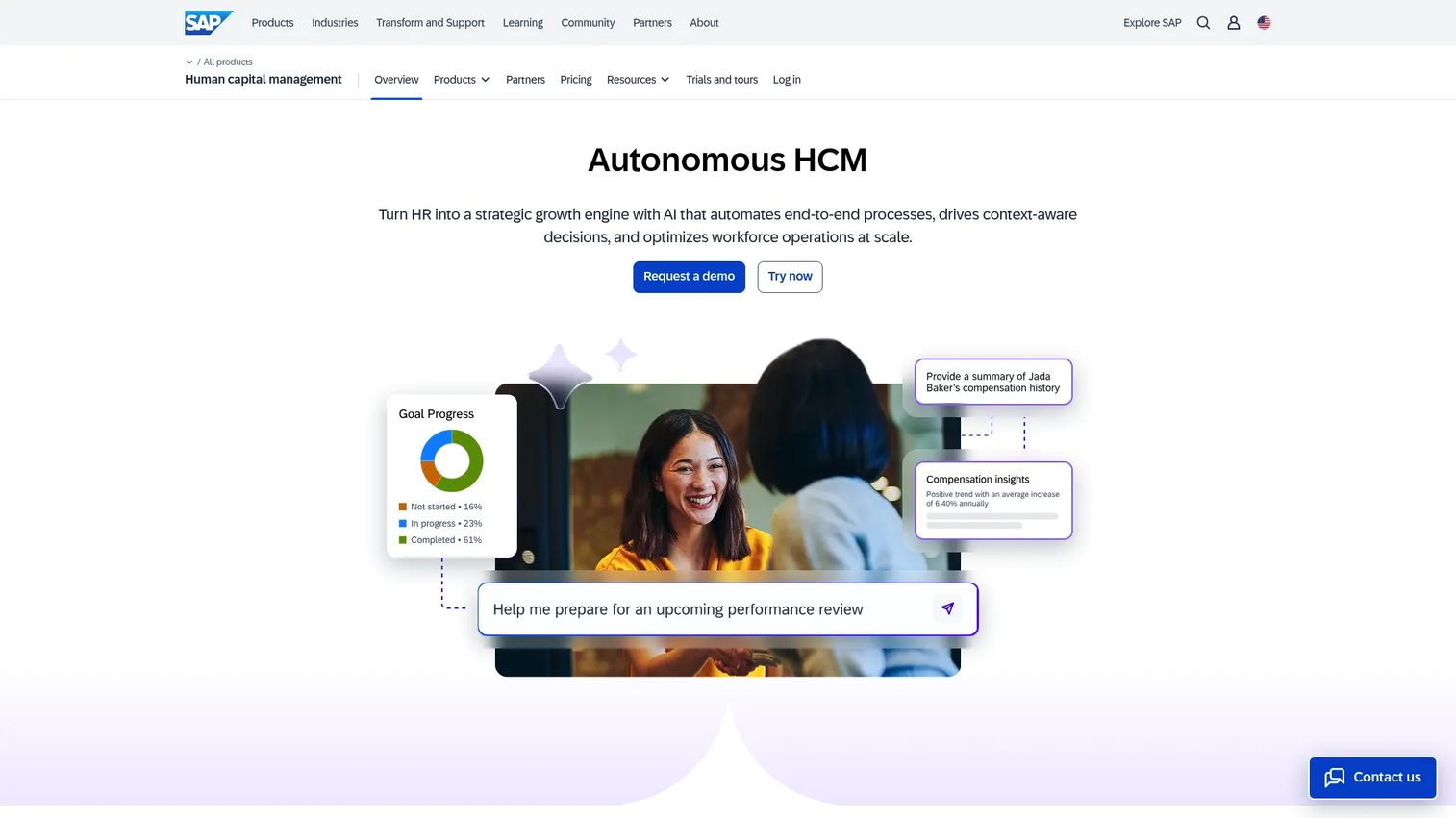
SAP SuccessFactors is a cloud HCM suite for HR, talent, analytics, and workforce planning. It offers broad lifecycle coverage with the global scale large and multinational organizations need. Its talent depth across recruiting, onboarding, learning, performance, and compensation makes it a serious contender for highly governed enterprises.
Best for: Large organizations needing an enterprise HCM suite.
Key strengths
- Core HR and payroll: Foundational HR and payroll built for global operations.
- Talent management: Recruiting, onboarding, learning, performance, and compensation in one suite.
- HR analytics and workforce planning: AI-enabled insights for strategic people decisions.
Why choose SAP SuccessFactors: SAP SuccessFactors fits multinational or highly governed organizations that need depth across the full talent lifecycle and global compliance. SAP positions it as the only HR management solution provider meeting all of the World Benchmarking Alliance's responsible AI criteria, which matters for enterprises focused on AI governance. Implementation is enterprise-scale, so plan accordingly.
SAP SuccessFactors pricing: SAP's HCM pricing page shows modular packages and add-ons and prompts users to contact sales or request a demo. No public numeric price is displayed. SAP SuccessFactors holds a 4.1/5 rating on G2. Scope the specific modules and global requirements you need during a sales conversation.
10. Oracle Talent Management Cloud
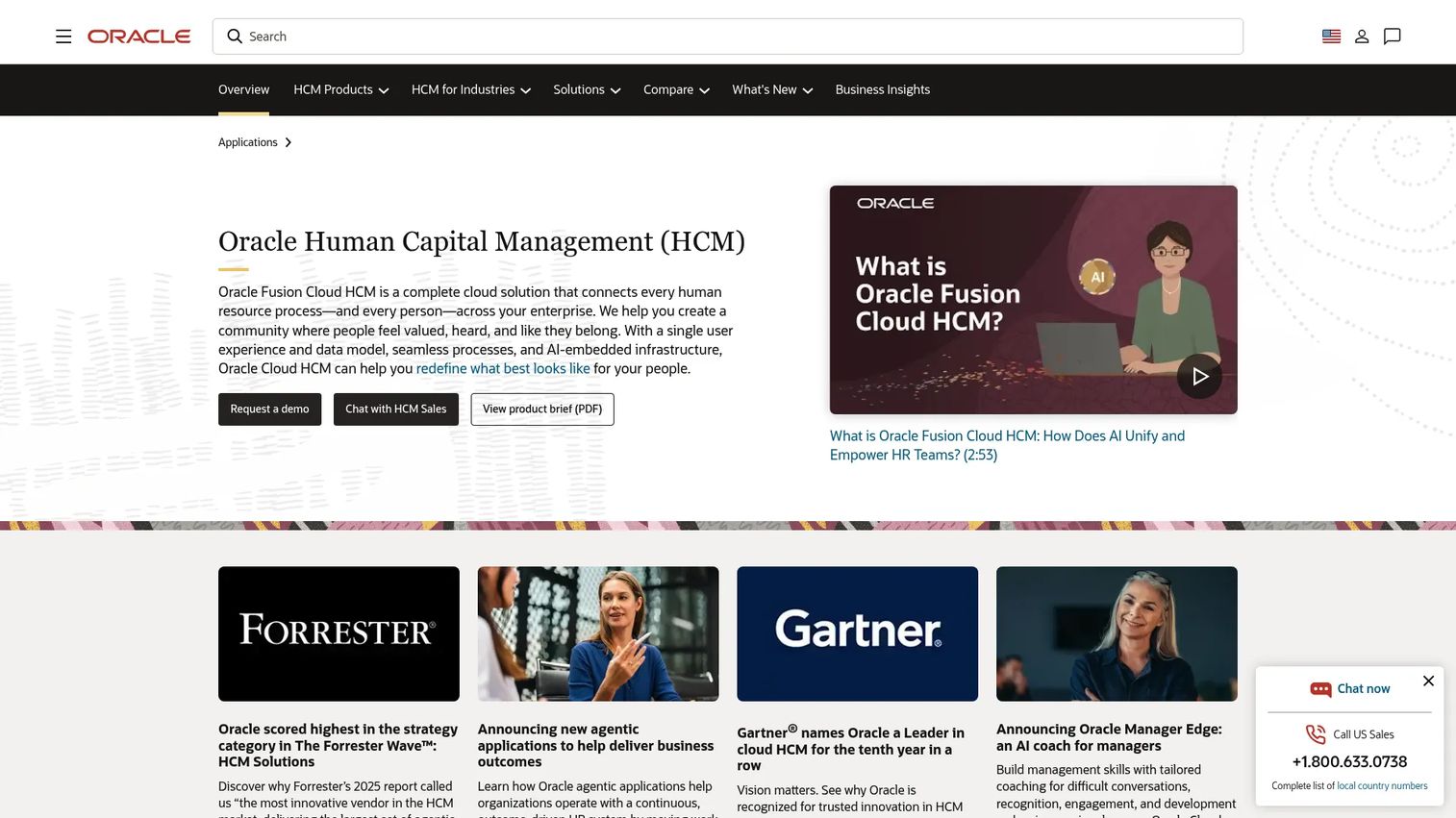
Oracle Talent Management Cloud is Oracle's talent-management suite for sourcing, recruiting, onboarding, performance, development, succession, and related HCM workflows. It manages the entire talent lifecycle in one place and fits organizations already invested in the Oracle ecosystem or needing deep HR process coverage at large-enterprise scale.
Best for: Mid-to-large organizations needing an integrated enterprise talent-management suite.
Key strengths
- End-to-end talent lifecycle: Source, recruit, onboard, manage performance, develop, and plan succession in one suite.
- Deep talent modules: Recruiting, Onboarding, Learning, Career Development, Opportunity Marketplace, Performance, Compensation, Succession Planning, and Dynamic Skills.
- Fusion Cloud HCM integration: Integrated analytics and global workforce workflows.
Why choose Oracle Talent Management Cloud: Oracle is the choice for large enterprises that want a single suite covering the entire talent lifecycle with deep reporting and global workflows. Its strongest fit is organizations already standardized on Oracle Fusion Cloud, where stack alignment removes integration friction. As with any enterprise suite, weigh implementation complexity against the depth you actually need.
Oracle Talent Management Cloud pricing: Oracle does not expose a clear standalone public price for Talent Management on its product pages; pricing appears within a broader global price list and is typically scoped through sales. Confirm current pricing and the specific modules you need directly with Oracle during evaluation.
Considerations
Integration depth
A talent management platform is only as useful as the data flowing into it. Before you buy, verify integrations across your HRIS, payroll, ATS, identity provider, and analytics stack. Ask whether connections are native or rely on middleware, and how clean the data sync actually is. Broken integrations create the same scattered-data problem you bought the platform to solve.
Usability and manager adoption
The platform managers ignore is worthless, no matter how capable. Test the manager experience directly, not just the HR admin view. If logging feedback or completing a review takes more than a few clicks, adoption suffers and your performance management process quietly stalls. UX and adoption are not soft criteria; they decide whether the system works.
Analytics and reporting
Evaluate reporting depth against the decisions you actually make. Can leadership see retention trends, time-to-fill, and engagement by team without exporting to a spreadsheet? Look for workforce analytics and predictive insights that surface risk early. The reporting layer is where talent data becomes board-level visibility, so weight it heavily if metrics scrutiny is part of your reality.
Scalability and governance
What works at 80 employees may strain at 400, across new geographies, or under tighter policy requirements. Check how the platform handles multi-entity structures, regional compliance, and role-based permissions. Governance matters more as you grow, and migrating later is painful, so factor in where you will be in three years, not just today.
AI and automation
AI and automation help most where they remove repetitive work: screening, scheduling, drafting reviews, surfacing skills gaps. Be skeptical of vague AI claims with no specifics. Ask what the model actually does, what data it uses, and how outputs are governed. Useful automation is concrete and measurable, not a marketing line. Our guide to agentic AI platforms covers how to evaluate this layer critically.
Support and implementation
Implementation quality often determines whether a platform delivers. Ask about onboarding timelines, dedicated support, and the resources available during rollout. Enterprise suites carry longer implementations, so confirm the vendor's track record with companies your size. A capable platform with poor implementation support still fails to deliver value on schedule.
Conclusion
The right talent management software depends on your stage and what is actually breaking. For a scaling SaaS company moving from spreadsheets to structure, BambooHR is the cleanest all-in-one starting point. If performance management is your pain, Lattice is built for it. When learning and development drives retention, Cornerstone OnDemand goes deepest. Teams that need talent inside a broader HCM context should weigh UKG Pro, Paycor, and Dayforce. And large enterprises with governance and global scale requirements land on Workday HCM, SAP SuccessFactors, or Oracle Talent Management Cloud. ClearCompany stands out when recruiting-to-development continuity is the priority.
Your next step is simple: shortlist two or three platforms that match your stage, then validate fit with live demos and customer references at companies your size. Pressure-test manager adoption, integration depth, and reporting before you commit. The goal is repeatable people operations that run without you in every loop, so choose the system your team will actually use.
Start your journey with Guideflow today!
FAQs
An HRIS is the system of record for core HR data: employee records, payroll, benefits, and time off. A talent management system focuses on the development side of the employee lifecycle, recruiting, onboarding, performance, learning, and succession planning. Many modern platforms combine both, but if you are choosing, an HRIS handles administration while talent management drives growth, engagement, and retention.
At minimum, look for recruiting and applicant tracking, structured onboarding, performance management with goals and feedback, learning and development, succession planning, and analytics and reporting. Integrations with your HRIS, payroll, and identity stack are essential. AI and automation features can help, but only when they remove concrete work rather than adding marketing gloss.
Yes, once founder-led people processes start breaking. The value shows up in retention, internal mobility, and manager leverage. When development paths, growth conversations, and performance reviews run in one system, you keep strong people longer and reduce the founder bottleneck. For a Series B company under board scrutiny, clean people data and visibility alone often justify the investment.
A suite consolidates data and reduces integration overhead, which usually wins for scaling teams that value visibility and clean reporting. A best-of-breed stack gives you deeper, specialized capability in each area but more integration and maintenance work. Weight consolidation and usability if you want fewer tools and more signal; weight flexibility if a single function, like performance, is your dominant need.
Performance-heavy teams should weight feedback, goals, and calibration capabilities most heavily. Lattice is purpose-built for performance management, goals and OKRs, and engagement, which makes it a strong fit when reviews and manager effectiveness are the priority. Enterprise suites like SAP SuccessFactors and Oracle also offer deep performance modules within a broader lifecycle platform.
Enterprise teams should prioritize scale, governance, and global process depth. Workday HCM, SAP SuccessFactors, and Oracle Talent Management Cloud are built for complex, multinational organizations with strict compliance and reporting requirements. Cornerstone OnDemand is a strong enterprise choice when learning and development is central to the strategy.
Care about scale fit, visibility, adoption, and the founder-to-team handoff. The platform should give leadership board-grade reporting, get adopted by managers without chasing, and run without you in every loop. Check first-week setup and integration with your existing stack. The goal is repeatable people operations that prove the business scales without founder heroics.
Pricing models vary widely. Lightweight platforms like BambooHR start around $10 per employee per month, and Lattice runs from $4 per seat per month with modular add-ons. Most enterprise suites, including UKG Pro, Dayforce, Workday HCM, SAP SuccessFactors, and Oracle, gate pricing behind sales conversations scoped to your organization. Always verify live vendor pricing before purchase rather than relying on third-party estimates.