You can ship the same feature in half the time, or spend six months fighting your framework. The choice depends less on which framework is most popular and more on which one fits the shape of your application.
PHP still powers 68.9% of websites with a known server-side programming language, according to W3Techs (2026). That reach spans everything from simple business sites to complex SaaS platforms, government portals, and API-driven backends. But modern PHP development has changed. Teams now care about queue workers, authentication layers, security patching cadence, OpenAPI documentation, and how easy it is to hire someone who already knows the stack.
For presales engineers and solutions consultants, this topic comes up during technical discovery more often than you might expect. A buyer's choice of PHP web framework shapes how integrations get built, how POC environments get spun up, and how much engineering overhead a security review will generate. Understanding what each framework does well helps you ask better questions and anticipate blockers before they stall a deal.
This guide compares 11 PHP web frameworks across architecture type, typical use case, maintenance posture, and developer experience.
What's inside
This guide covers 11 PHP web frameworks for teams making a stack decision in 2026. It's written for developers, engineering managers, and technical GTM readers who need to evaluate options quickly.
Frameworks were selected and evaluated based on:
- Project fit: Which application types each framework handles well
- Ecosystem maturity: Community size, package depth, documentation quality
- Security and maintenance: Release cadence, patch discipline, long-term support
- API and integration support: REST, GraphQL, PSR standards, Composer compatibility
- Developer experience: Learning curve, CLI tooling, hiring availability
Most PHP frameworks are open source. The comparison table uses license type and commercial support availability rather than SaaS pricing tiers, and flags G2 ratings where verified listings exist.
TL;DR
- Best overall PHP framework: Laravel, for teams that want fast product development, a large package ecosystem, and strong hiring availability
- Best for enterprise architecture: Symfony, for long-term maintainability, reusable components, and predictable release discipline
- Best for standards-based middleware: Mezzio, for PSR-driven applications and teams that prefer decoupled architecture
- Best lightweight PHP microframework: Slim, for REST APIs and small services where a full-stack framework adds unnecessary overhead
- Best for simpler web apps: CodeIgniter, for small teams that want a minimal learning curve and a focused feature set
- Best for performance-sensitive services: Phalcon, for teams comfortable managing a compiled C extension runtime
What is a PHP web framework?
A PHP web framework is a reusable application structure that gives developers built-in patterns for routing, request handling, database access, templating, security, testing, and deployment.
Without a framework, every developer on a team makes independent decisions about how to handle HTTP requests, validate input, connect to a database, or structure authentication. That inconsistency compounds over time into maintenance debt and security gaps.
Frameworks solve this by standardizing the decisions that matter most across a codebase.
Framework types you will encounter
PHP frameworks split into four main architectural categories:
- Full-stack frameworks: Include routing, ORM, templating, queuing, authentication, and CLI tooling out of the box. Laravel and CakePHP fall here.
- Component-based frameworks: Built around independently installable packages that can be mixed across projects. Symfony and Laminas work this way.
- Middleware frameworks: Organized around HTTP request and response handling, PSR-7 and PSR-15 standards, and composable pipeline architecture. Mezzio is the primary example.
- Microframeworks: Provide just enough structure for routing and request handling, leaving everything else to the developer. Slim and FlightPHP are the clearest examples.
- API-first frameworks: Built specifically for generating REST and GraphQL APIs with automatic documentation. API Platform fits here.
Key capabilities to look for
When evaluating any PHP web development framework, check for the following:
- Routing and middleware pipeline
- ORM or database abstraction layer
- Templating engine or view system
- CLI tooling and code generation
- Security defaults for input validation and CSRF protection
- Testing support and integration with PHPUnit
- REST or GraphQL API support
- Long-term release and security patch policy
- Composer package compatibility
- Documentation quality and depth
The best PHP framework for a given project depends on the application shape, the team's existing experience, the hosting environment, and how long the codebase needs to be maintained.
When to use PHP web frameworks
Build web applications faster
Full-stack PHP frameworks are the right tool when a team needs authentication, routing, database access, form handling, email, and queuing from day one. SaaS admin panels, customer portals, marketplaces, and internal tools all fit this pattern. Assembling those layers from scratch is slower and more error-prone than starting with a framework that ships them pre-configured.
Create APIs and microservices
Lightweight frameworks and API-first tools fit cleanly when the application's primary job is to receive requests, apply business logic, and return structured responses. For presales engineers supporting technical validation, this matters: API architecture comes up constantly in discovery calls when buyers are evaluating integration paths. A team running Slim or API Platform will have different integration constraints than one running full-stack Laravel.
Standardize long-term maintenance
Frameworks reduce maintenance risk on any codebase that multiple developers will touch over time. They standardize how code is organized, how dependencies are managed, and where security patches land. For enterprise buyers going through security review or procurement, the framework choice often determines how easy it is to demonstrate patch hygiene and dependency management. This is worth surfacing during technical validation.
PHP web frameworks comparison
Most PHP frameworks are free, open-source software distributed under MIT or BSD-3-Clause licenses. "Pricing" in this table refers to the license model and whether commercial support is available. G2 ratings are included where a verified listing exists for the framework itself. Several frameworks have no active G2 listing, so N/A reflects that accurately rather than a gap in research.
| # | Product | Best for | Key use case | Pricing | G2 rating |
|---|---|---|---|---|---|
| 1 | Laravel | Full-stack PHP development | SaaS apps, portals, admin tools | Free, open source (MIT) | 4.7/5 |
| 2 | Symfony | Enterprise PHP applications | Complex web apps, APIs, CLI tools | Free, open source (MIT) | 4.3/5 |
| 3 | Laminas | Component-based enterprise PHP | Modular systems and reusable packages | Free, open source | N/A |
| 4 | Mezzio | PSR middleware applications | Middleware-first APIs and services | Free, open source | N/A |
| 5 | CodeIgniter | Lightweight web applications | Small business sites and lean apps | Free, open source (MIT) | 4.4/5 |
| 6 | CakePHP | Convention-driven apps | CRUD-heavy products and admin systems | Free, open source (MIT) | 3.9/5 |
| 7 | Phalcon | Performance-sensitive services | High-throughput APIs and web apps | Free, open source (BSD-3) | 4.4/5 |
| 8 | Slim | Minimal REST APIs | Webhooks, microservices, prototypes | Free, open source (MIT) | 4.2/5 |
| 9 | API Platform | API-first products | REST and GraphQL API generation | Free, open source | N/A |
| 10 | Yii 3 | Modular PHP applications | Modern component-based PHP dev | Free, open source | 4.2/5 |
| 11 | FlightPHP | Tiny PHP applications | Simple APIs and compact tools | Free, open source | N/A |
Best 11 PHP web frameworks for 2026
1. Laravel
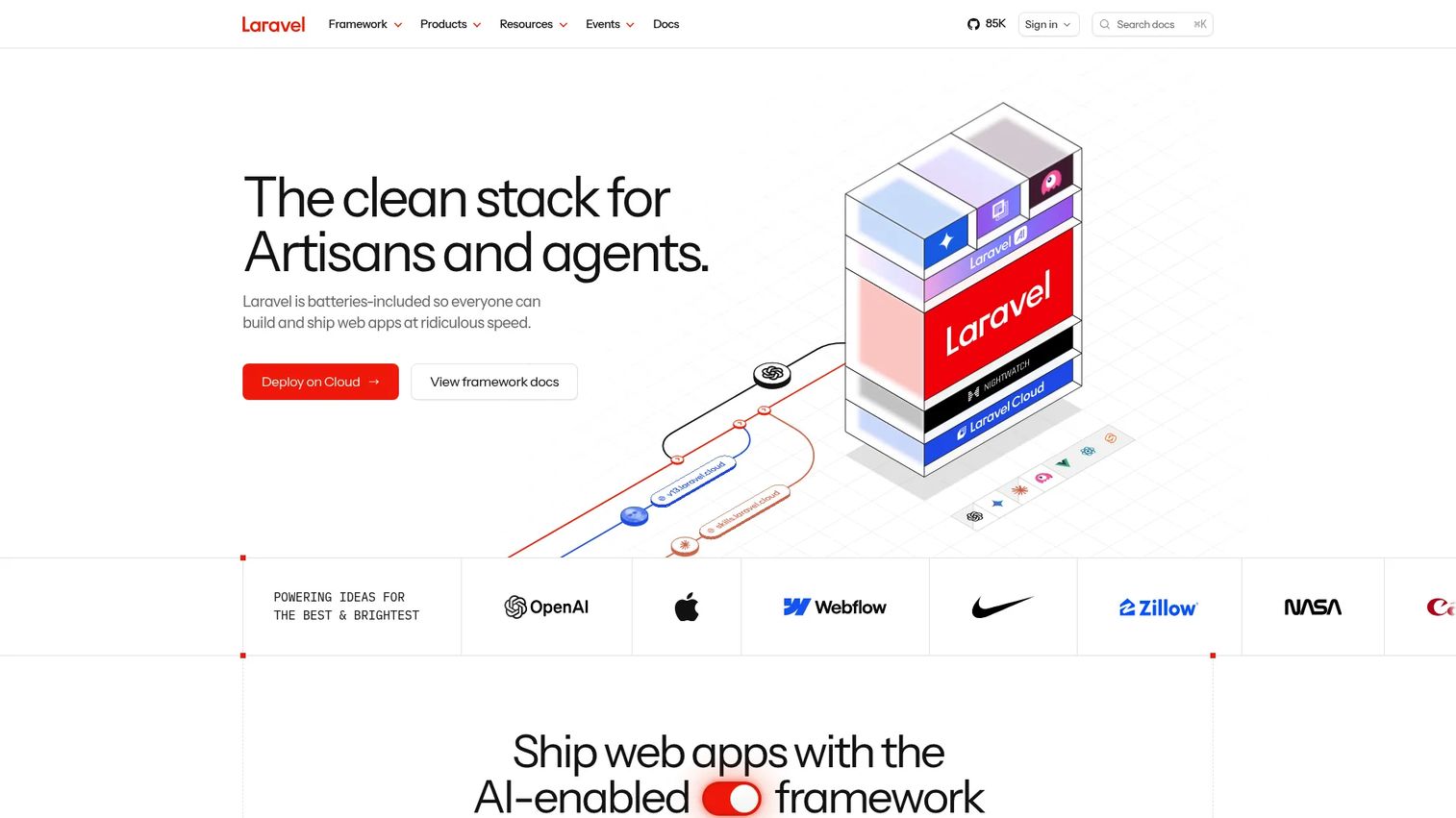
Laravel is the most widely adopted PHP web application framework for building modern full-stack products. It provides an MVC application structure with Eloquent ORM, Blade templating, Artisan CLI, built-in queuing, event broadcasting, and a testing layer that integrates with PHPUnit. The ecosystem extends through tools like Laravel Forge for server provisioning, Vapor for serverless deployment, Horizon for queue monitoring, and Livewire for reactive UI without a separate JavaScript framework.
Best for: Teams building SaaS products, customer portals, ecommerce applications, and admin panels where development speed and hiring availability matter.
Key features
- MVC architecture with expressive routing and controllers
- Eloquent ORM with query builder, migrations, and seeders
- Blade templating with components and layouts
- Artisan CLI for code generation and task automation
- Queue workers, scheduled jobs, and event-driven architecture
Why choose Laravel: Laravel makes sense when the team wants strong defaults and a rich package ecosystem rather than assembling every application layer manually. For presales engineers, Laravel's wide adoption means your buyers' engineering teams are likely familiar with it, which reduces onboarding friction during POC phases. The tradeoff is that its full-stack scope can feel heavy for teams that need only a lightweight API service.
Laravel pricing: Laravel itself is free and open source under the MIT license. Laravel Cloud, a managed hosting and deployment platform, starts at $5 per month plus usage on the Starter plan, with Growth at $20 per month plus usage and Business at $200 per month plus usage. Enterprise pricing on Laravel Cloud is custom.
G2 rating: 4.7/5
2. Symfony
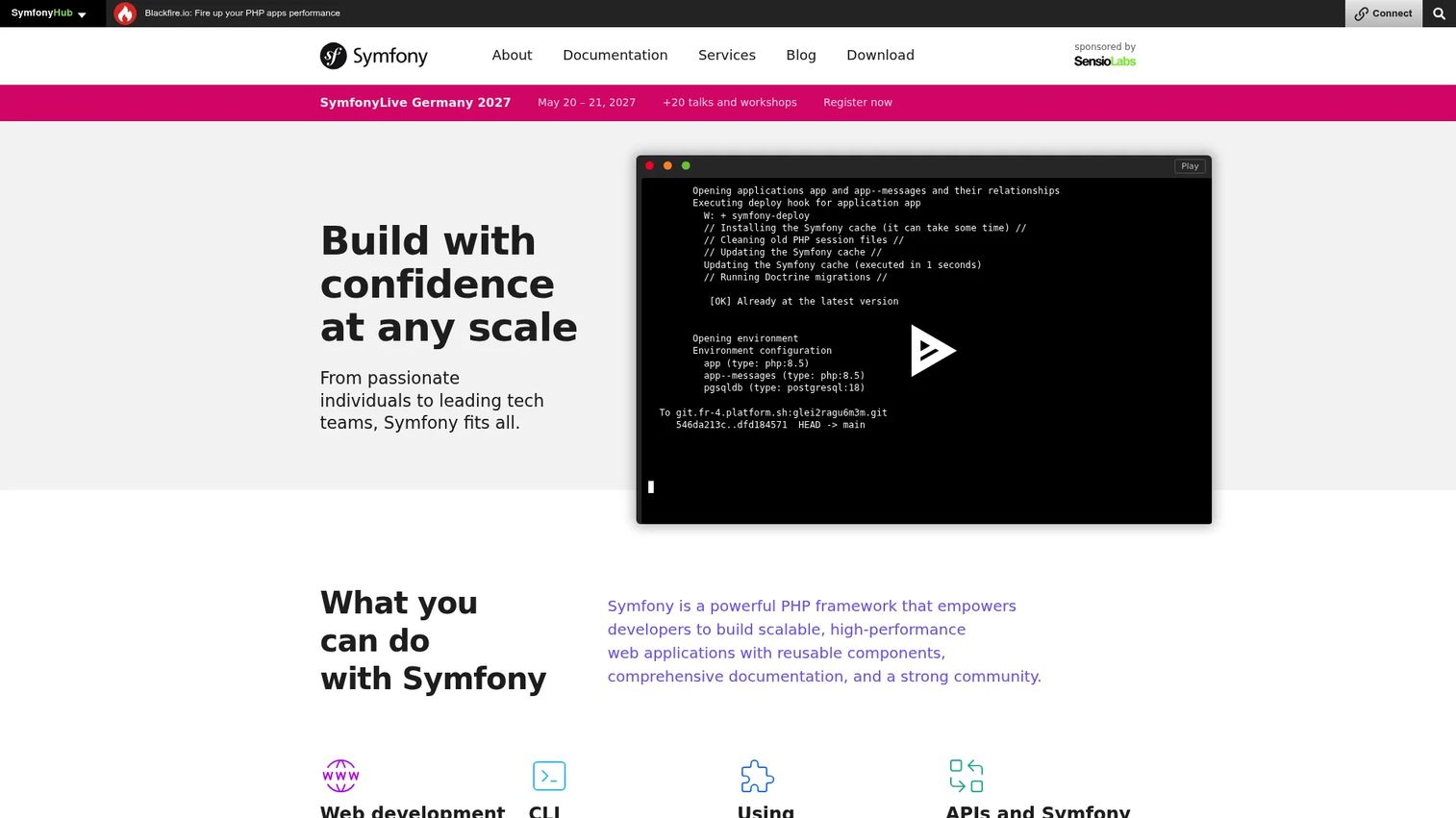
Symfony is an open-source PHP framework and collection of independent, reusable components that power much of the PHP ecosystem, including several other frameworks on this list. It covers full-stack web development with security, routing, Twig templating, Doctrine ORM integration, validation, email handling, console tooling, and testing. Symfony follows a predictable release cadence with clearly defined long-term support versions, which matters significantly for enterprise maintenance planning.
Best for: Enterprise teams building complex, long-lived web applications, RESTful APIs, microservices, and CLI tools where architecture and testability are primary concerns.
Key features
- Reusable, independently installable PHP components
- Dependency injection container for clean service management
- Twig templating engine with inheritance and blocks
- Symfony Console for building CLI commands and tools
- Long-term support releases with defined security patch windows
Why choose Symfony: Symfony fits teams where architecture discipline and long-term maintainability outweigh the speed of an initial build. It is also the foundation for API Platform and integrates cleanly with Doctrine ORM. For presales engineers handling enterprise deals, Symfony's LTS model and dependency injection patterns are easier to defend during security reviews than frameworks with less structured release policies.
Symfony pricing: The Symfony PHP framework is free and open source under the MIT license. SymfonyInsight, a code analysis product in the Symfony ecosystem, starts at 19 euros per month per project on the Individual plan, billed yearly. The Team plan is 29 euros per month per project.
G2 rating: 4.3/5
3. Laminas
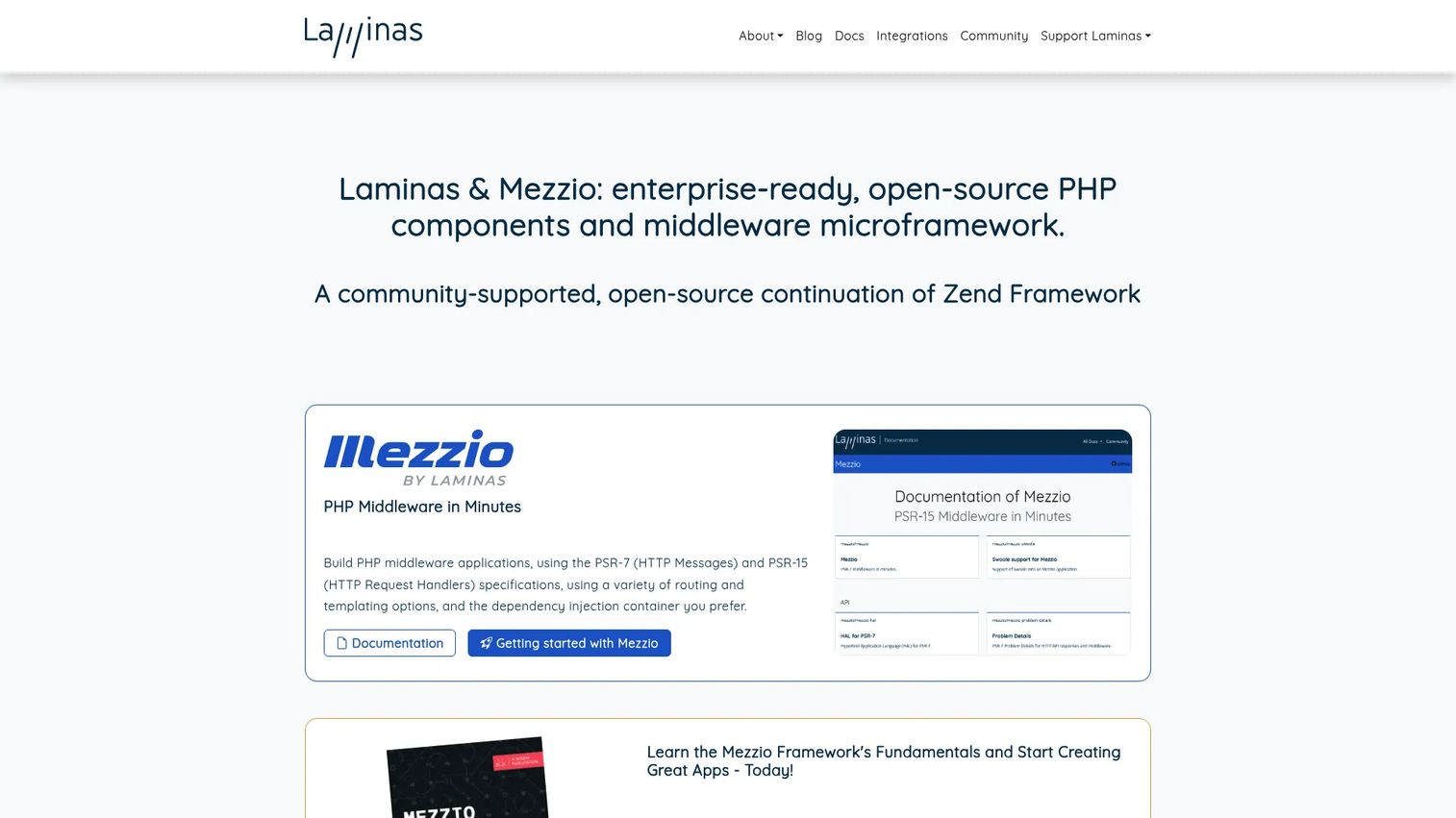
Laminas is the successor to Zend Framework, one of the oldest enterprise PHP ecosystems. Rather than functioning as a monolithic framework, Laminas operates as a collection of independent PHP components covering dependency injection, event dispatching, input validation and filtering, PSR-7 HTTP message handling, PSR-15 request handlers, pagination, navigation, and feed generation. Teams use individual packages in existing projects or combine them to build full applications.
Best for: Enterprise PHP teams maintaining long-lived systems, migrating from Zend Framework, or building modular applications that require independently versioned, standards-compliant components.
Key features
- PSR-7 HTTP Messages support across components
- PSR-15 HTTP Request Handlers for middleware pipelines
- Dependency injection, event dispatching, input validation, and filtering
- MVC support for building structured web applications
- Enterprise migration path from Zend Framework codebases
Why choose Laminas: Laminas is the right choice when the team values explicit architecture, standards compliance, and compatibility with an existing PHP investment. It is less beginner-friendly than Laravel, and the component-first model requires more architectural decisions upfront. For presales and solutions engineers, Laminas often appears in legacy PHP enterprise accounts that are modernizing rather than rebuilding from scratch.
Laminas pricing: Laminas components are free, open-source software. Enterprise support options may be available through ecosystem vendors, so verify current offerings before recommending them in a commercial conversation.
4. Mezzio
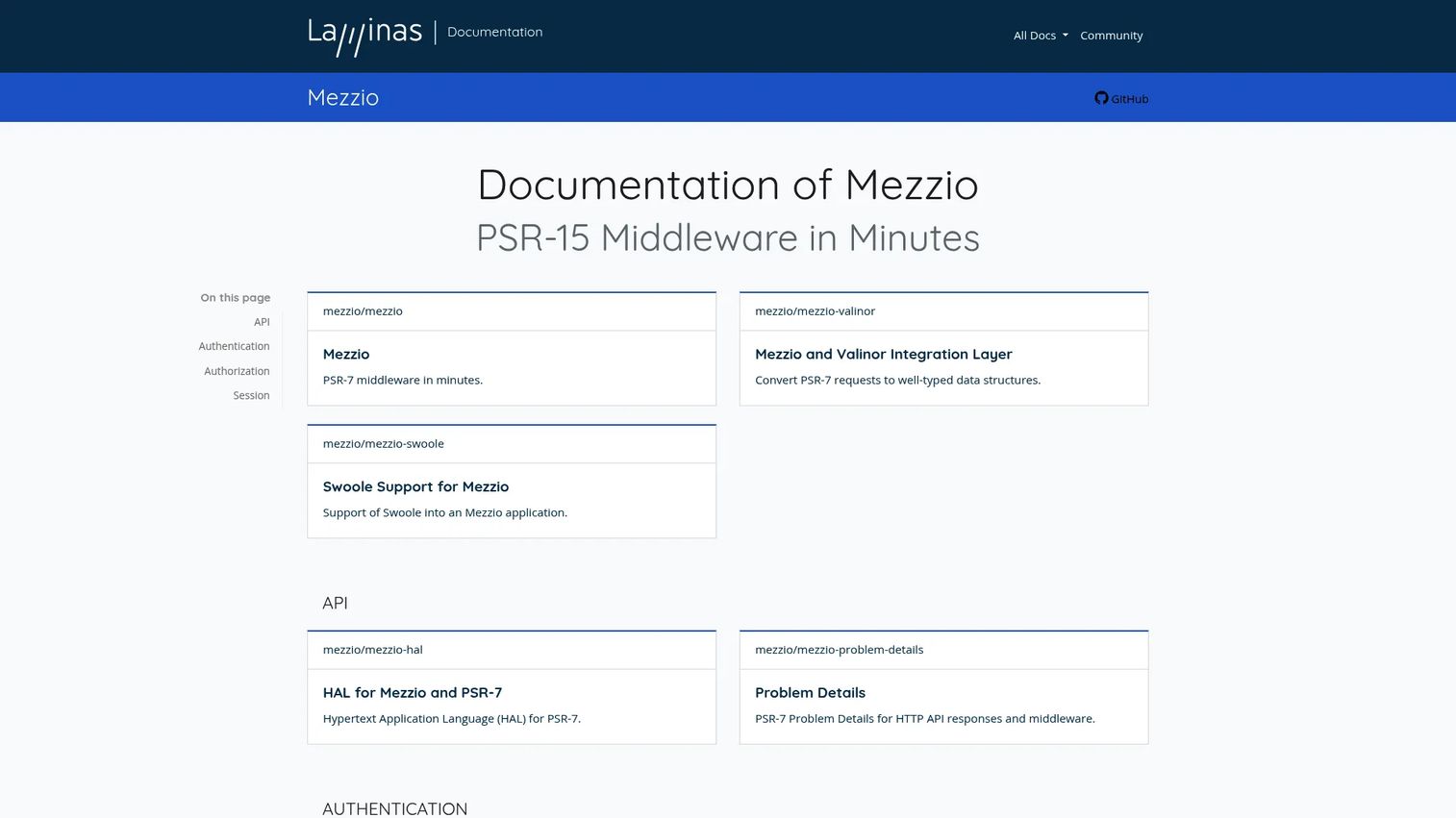
Mezzio is a PHP middleware framework from the Laminas ecosystem, built entirely around PSR-7 HTTP message handling and PSR-15 middleware pipelines. It treats the application as a stack of composable middleware layers, where each layer receives a request, optionally modifies the response, and passes control to the next layer. Mezzio lets teams choose their own router, dependency injection container, and template renderer rather than locking in defaults.
Best for: PHP developers building middleware-first APIs, service boundaries, and applications that require explicit, decoupled HTTP handling using PSR standards.
Key features
- PSR-15 middleware architecture as the application core
- PSR-7 HTTP message support throughout the request pipeline
- Selectable router implementations for routing flexibility
- PSR-11 dependency injection container compatibility
- Templating abstraction with support for multiple rendering engines
Why choose Mezzio: Mezzio fits experienced PHP teams that want full control over each application layer without inheriting a full-stack framework's assumptions. The flexibility is real, but so is the setup investment. Teams comfortable composing PSR-compliant packages from scratch will find Mezzio highly capable. Teams that want opinionated defaults should look at Symfony or Laravel instead.
Mezzio pricing: Mezzio is free, open-source software from the Laminas project.
5. CodeIgniter
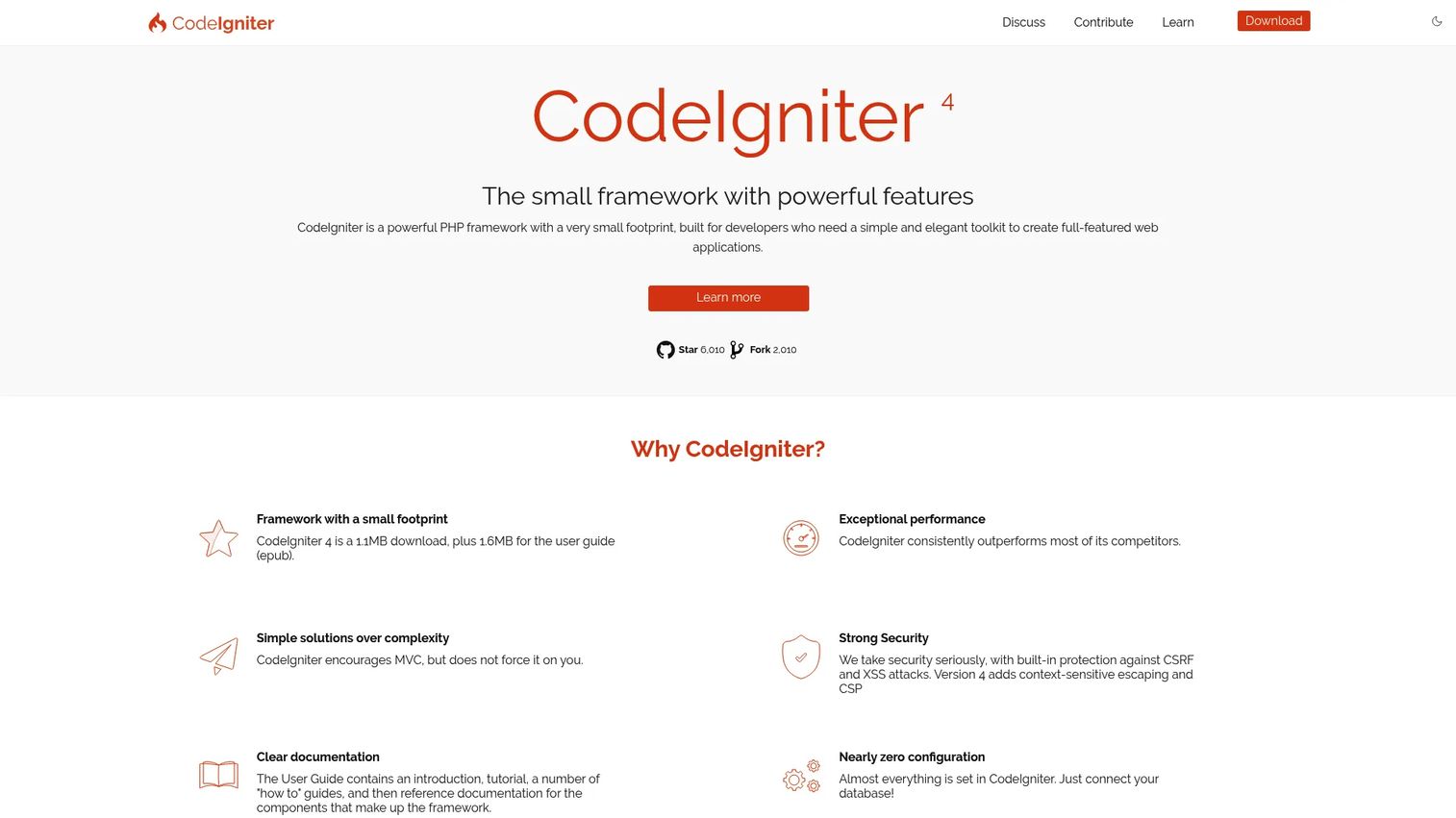
CodeIgniter is a lightweight PHP web development framework with a small footprint and a minimal learning curve. The current version, CodeIgniter 4 (v4.7.6), introduced a modernized architecture with improved MVC conventions, flexible URI routing, a database query builder, form validation, security helpers, and caching support. It runs quickly out of the box and requires minimal configuration to get a working application running.
Best for: Small teams, agencies, and individual developers building straightforward PHP web apps without the overhead of a large application platform.
Key features
- Lightweight MVC structure with minimal configuration
- Database query builder and multiple driver support
- Form validation and built-in security utilities (CSRF, XSS filtering)
- Flexible URI routing for clean URL structures
- Caching and error logging built into the core
Why choose CodeIgniter: CodeIgniter works best when the project needs a PHP web application framework but not a comprehensive application platform. The small surface area makes it fast to onboard new developers and easy to understand end to end. For presales and solutions engineers, CodeIgniter appears most often in SMB accounts and agency-built products where the engineering team prioritized speed of delivery over long-term architectural sophistication.
CodeIgniter pricing: CodeIgniter is free and open source under the MIT license, available directly from codeigniter.com/download.
G2 rating: 4.4/5
6. CakePHP
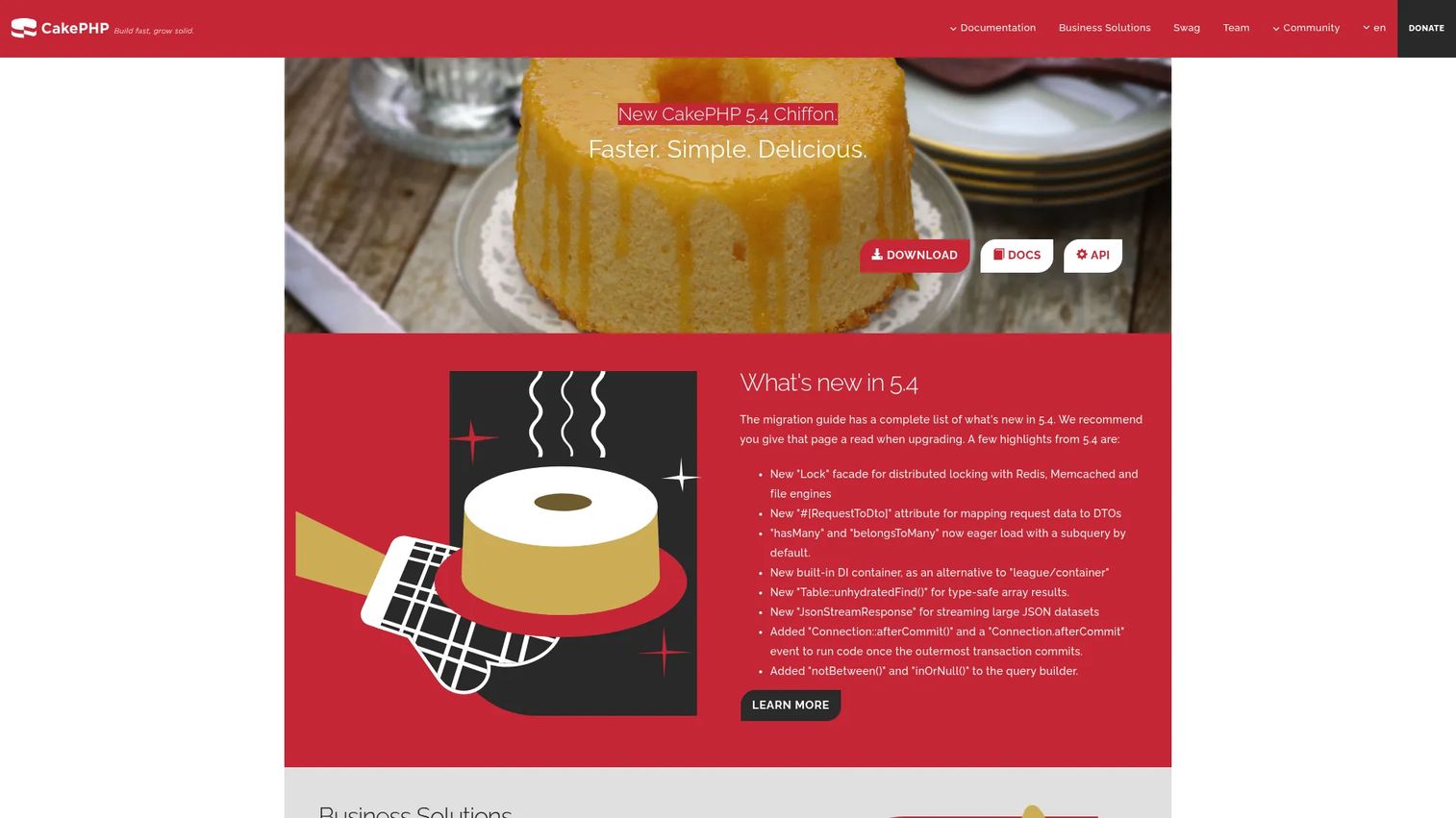
CakePHP is a convention-driven PHP MVC framework focused on rapid application development. It includes a built-in ORM, scaffolding, Bake code generation, validation, database migrations, authentication support, Redis and Memcached caching backends, and an integrated testing framework. CakePHP's conventions reduce the number of configuration decisions a team needs to make, which accelerates development on CRUD-heavy applications.
Best for: Teams building database-backed admin systems, internal tools, and content management applications where convention-driven structure accelerates delivery.
Key features
- Convention-over-configuration MVC architecture
- Built-in ORM with associations, behaviors, and query builder
- Bake CLI for scaffolding models, controllers, views, and tests
- Validation, security helpers, and authentication plugins
- Integrated testing framework with fixtures and mocking support
Why choose CakePHP: CakePHP fits when the application shape matches its conventions and the team wants clear structure from the start. The framework's opinions can feel restrictive for applications that deviate significantly from standard CRUD patterns, but that structure is often exactly what smaller teams need to maintain consistency. G2 reviewers rate CakePHP at 3.9/5, with feedback often pointing to its convention-heavy approach as both a strength and an occasional constraint.
CakePHP pricing: CakePHP is free and open source under the MIT license. No paid software tiers exist.
G2 rating: 3.9/5
7. Phalcon
Phalcon takes a different architectural approach from every other framework on this list. It is an open-source, full-stack PHP framework delivered as a C extension, which means the framework itself compiles into the PHP runtime rather than loading as PHP class files. The result is a significantly lower resource footprint per request. For teams where that tradeoff is acceptable, Phalcon also offers a pure PHP distribution via Composer for environments where extension installation is not practical.
Best for: Performance-sensitive teams building high-throughput PHP web applications, APIs, or microservices who are comfortable managing the runtime requirements of a C extension.
Key features
- C-extension delivery for low-overhead request handling
- Pure PHP Composer distribution for restricted environments
- Full MVC and ADR (Action Domain Responder) architecture support
- Built-in routing, ACL, dependency injection, caching, and ORM
- Encryption, logging, forms, and translation included in the core
Why choose Phalcon: Phalcon makes sense when memory efficiency and request throughput are hard constraints. The tradeoff is operational: Installation requires server-level access to add the C extension, and not all managed hosting environments support custom PHP extensions. For presales engineers, Phalcon adoption signals a team with strong infrastructure control, which can be relevant context during POC environment planning.
Phalcon pricing: Phalcon is free, open-source software licensed under BSD-3-Clause.
G2 rating: 4.4/5
8. Slim
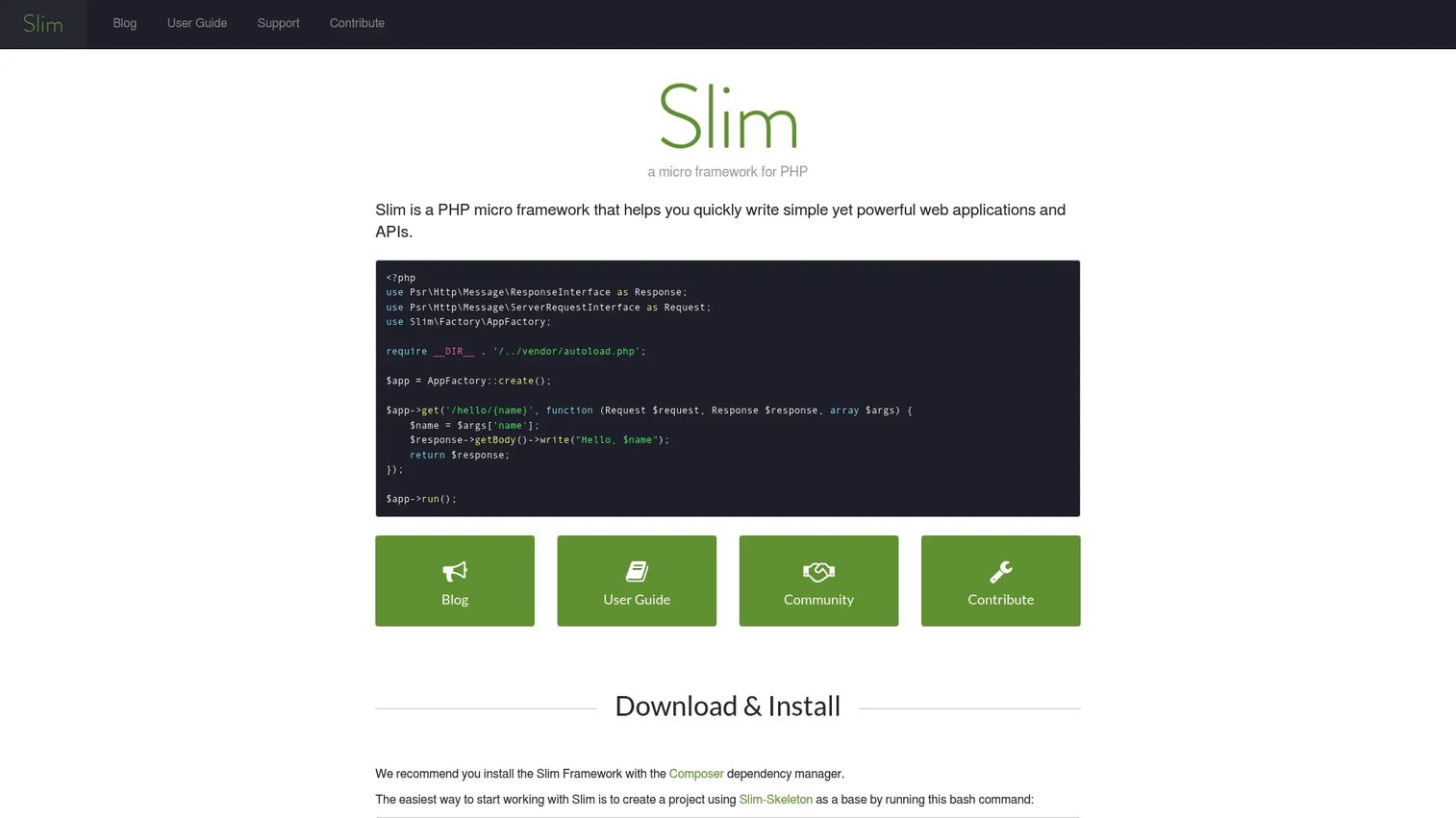
Slim is a PHP microframework for building web applications and APIs quickly. It provides HTTP routing with named parameters and pattern matching, a middleware pipeline, PSR-7 HTTP message support, and PSR-11 dependency injection container compatibility. Slim does not include an ORM, templating engine, or authentication layer. Those decisions are left to the developer, which keeps the framework focused and predictable.
Best for: Developers building REST APIs, webhook handlers, rapid prototypes, and small services that need routing and middleware without full-stack overhead.
Key features
- HTTP router with parameter matching and route groups
- Middleware architecture for request and response modification
- PSR-7 HTTP message support throughout
- PSR-11 dependency injection container compatibility
- Minimal application footprint with focused, stable API
Why choose Slim: Slim works best when the application's primary job is to receive HTTP requests, apply business logic, and return structured responses. It is not trying to be a full-stack product platform, and that focus keeps it reliable and easy to understand. For presales engineers supporting API-first evaluation discussions, Slim is a common choice for companies building webhook endpoints, integration layers, and internal microservices that sit alongside larger applications. G2 reviewers rate it at 4.2/5.
Slim pricing: Slim is free, open-source software. It is available through Composer under the MIT license.
G2 rating: 4.2/5
9. API Platform
API Platform is an API-first framework for creating web APIs using PHP, built on top of Symfony and Doctrine. It generates REST and GraphQL APIs from PHP classes or database schemas, and automatically produces OpenAPI documentation, Swagger UI, and GraphiQL interfaces. JSON-LD and Hydra support are built in, making it a strong fit for hypermedia APIs. An admin interface generator is also included for building management panels from API definitions.
Best for: Teams building API-first products, structured headless backends, and developer platforms where API contracts and documentation need to exist from the first commit.
Key features
- Automatic REST and GraphQL API generation from PHP entities
- OpenAPI, Swagger UI, and GraphiQL documentation out of the box
- JSON-LD and Hydra support for hypermedia APIs
- Automatic pagination and filtering on collections
- Symfony and Doctrine integration with the full component ecosystem
Why choose API Platform: API Platform is the strongest choice when the API itself is the deliverable, not a supporting layer for a web application. It is especially useful when buyers or integration partners need to inspect and test API contracts during technical validation, because the documentation is generated automatically and stays in sync with the actual implementation. This reduces one common friction point in enterprise security and integration reviews.
API Platform pricing: API Platform is described on its official site as free software. An enterprise subscription is also offered, but specific pricing is not publicly displayed. Contact API Platform directly for enterprise pricing details.
10. Yii 3
Yii 3 is the next-generation architecture for the Yii PHP framework ecosystem, built around independently installable packages, PSR standards support, and a modern dependency injection container. Yii has historically been recognized for speed, Gii code generation, Active Record ORM, and practical MVC development across a wide range of PHP applications. Yii 3 modernizes that foundation with improved package decoupling and PHP standards compliance. Teams evaluating Yii 3 should verify the current production stability of individual packages before committing to it for high-traffic or long-lived enterprise systems.
Best for: Developers already familiar with the Yii framework ecosystem who want to evaluate its next-generation architecture, or teams building modular PHP applications with PSR-compliant component dependencies.
Key features
- Component-based architecture with independently versioned packages
- Dependency injection container with PSR-11 compliance
- Database abstraction with query builder, Active Record, and migrations
- PSR standards support throughout the framework core
- Code generation tools drawing from Gii's heritage
Why choose Yii 3: Yii 3 is worth evaluating for teams with existing Yii experience or for projects that benefit from a highly modular package structure. The active development trajectory reflects a thoughtful modernization of the ecosystem. That said, check the release maturity of the specific Yii 3 packages you need before choosing it over Symfony or Laravel for a production system. G2 currently rates the broader Yii framework category at 4.2/5, though that figure reflects the full Yii ecosystem rather than Yii 3 specifically.
Yii 3 pricing: Yii 3 is free and available through Composer at no cost.
G2 rating: 4.2/5 (G2 PHP web frameworks category; not Yii 3 exclusively)
11. FlightPHP
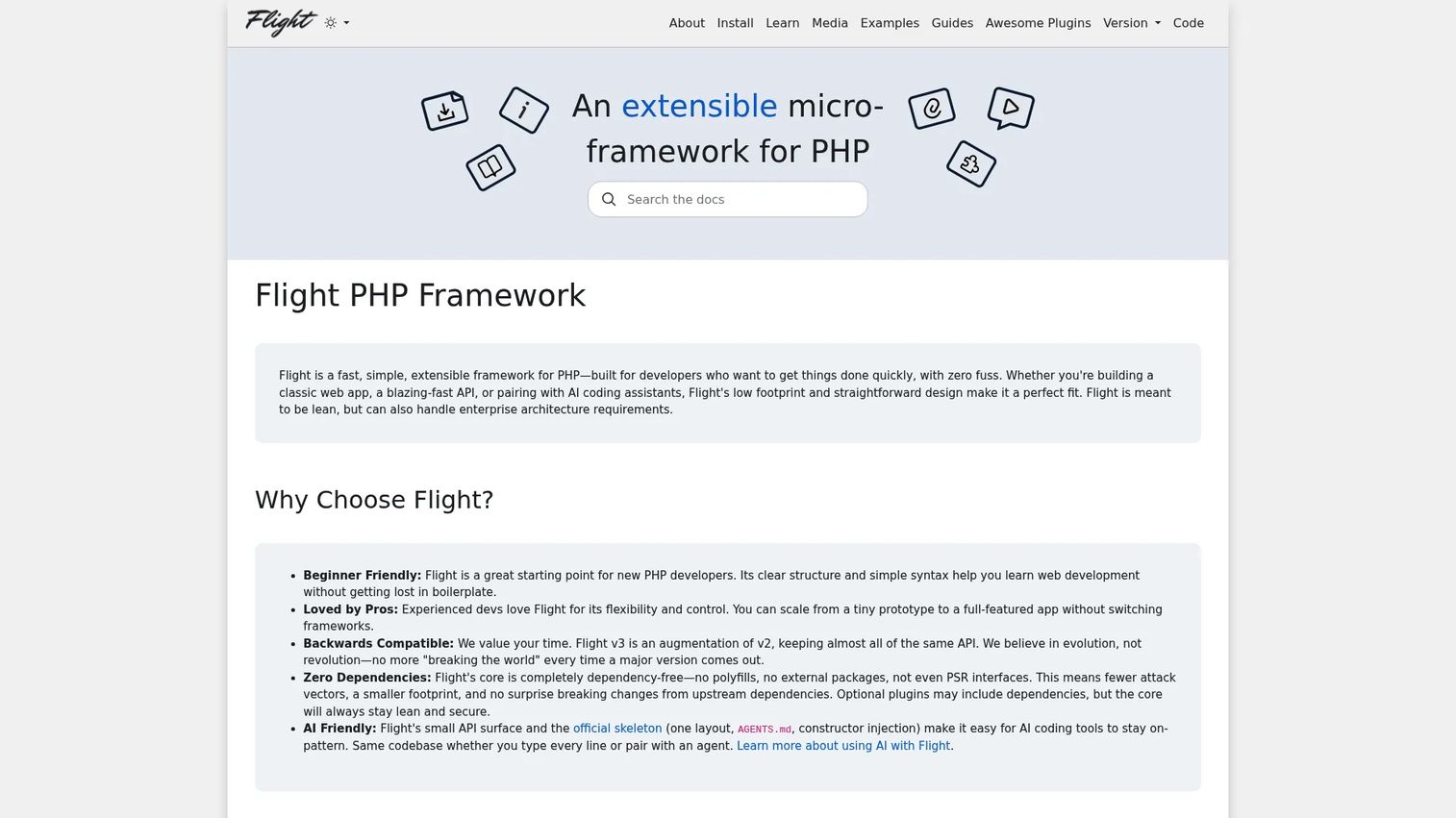
FlightPHP is a fast, simple, extensible PHP microframework for building compact web applications and APIs. It supports routing, middleware, JSON responses, configuration management, database helpers through its SimplePdo integration, and AI-assisted development tooling. FlightPHP installs through Composer and is designed to get a working API or small application running in minutes with minimal boilerplate.
Best for: Developers building small PHP APIs, internal tools, webhook endpoints, and prototypes where a larger framework would add more structure than the project needs.
Key features
- Simple route definitions for GET, POST, PUT, DELETE, and PATCH
- Middleware pipeline for request and response processing
- JSON response helpers for clean API output
- Configuration management and SimplePdo database helpers
- Small framework core with predictable, stable behavior
Why choose FlightPHP: FlightPHP fits projects where the application is genuinely small and the team wants to avoid the setup cost of a full PHP web app framework. It is not the right default for complex enterprise applications or systems that will grow significantly over time. For presales engineers, FlightPHP typically appears in internal tooling, demo environments, and integration scaffolding rather than in production buyer-facing products.
FlightPHP pricing: FlightPHP is free, open-source software available through Composer.
Considerations when choosing PHP web frameworks
Match the framework to the application shape
A SaaS platform with authentication, billing, queuing, and admin panels needs something like Laravel or CakePHP, not Slim. Conversely, a lightweight webhook receiver or API proxy will perform better with less setup using a microframework. Choosing a full-stack framework for a tiny service, or a microframework for a large product, creates friction in both directions.
Check maintenance and release cadence
Stale frameworks create security and procurement friction. Before committing, check the framework's current release version, security patch history, defined support windows, and how dependencies are managed. For presales engineers helping a buyer through a security review, a framework with a documented LTS policy and an active security advisory process is easier to defend than one with sporadic releases. Symfony and Laminas both publish structured release timelines.
Evaluate ecosystem and hiring risk
Laravel and Symfony have significantly deeper hiring pools than niche frameworks. That matters when a company needs to bring in contractors, replace a developer, or scale a team. Smaller frameworks like FlightPHP or Mezzio can still be excellent choices, but the team needs a plan for long-term maintenance if the ecosystem is thin. For API development tools and integration-heavy projects, the ecosystem also determines how many ready-made packages cover common needs.
Review standards and interoperability
PSR-7, PSR-11, PSR-15, and PSR-17 compliance determines how well a framework interoperates with the broader PHP package ecosystem. For teams integrating with third-party SDKs, API platforms, or enterprise authentication systems, standards compliance reduces the custom glue code required. Check which PSR interfaces the framework implements before assuming compatibility with the packages your project depends on.
Test developer experience before committing
Build one route, one database query, one authentication flow, and one test before choosing. No framework reveals its friction points in a marketing summary. A short proof of concept is the fastest way to surface whether the developer experience matches your team's workflow. For presales engineers supporting technical evaluations, this is the equivalent of a sandbox: The only way to know if something works is to run it. Well-structured application security testing software reviews often start the same way.
Conclusion
Framework choice is a long-term architectural decision. The right answer depends on what you are building, who will maintain it, and how long the codebase needs to live.
Laravel is the safest default for most teams: Broad hiring availability, strong documentation, and a full-stack feature set that handles the majority of web application needs. Symfony is the stronger choice for enterprise applications where component modularity, LTS releases, and strict dependency management are non-negotiable.
Laminas and Mezzio fit standards-driven teams building modular PHP systems or migrating from older Zend Framework codebases. Slim and FlightPHP fit small APIs and lightweight services. API Platform fits teams where the API contract is the product, not a supporting detail.
CodeIgniter and CakePHP remain practical for smaller or convention-driven applications where the team values a focused feature set over ecosystem depth. Yii 3 and Phalcon reward teams that do extra verification: Yii 3 on package-level production maturity, Phalcon on extension installation requirements and hosting compatibility.
For more related reading on the developer tooling ecosystem, see the Guideflow guides on API documentation tools, API monitoring tools, application security software, application performance monitoring tools, and API testing tools.
Start your journey with Guideflow today!
FAQs
Laravel is the best default for most teams because of its ecosystem depth, documentation quality, and hiring availability. Symfony is often the stronger choice for enterprise applications that require strict architectural control, defined long-term support, and reusable component libraries. The right best PHP framework depends on the application's complexity, the team's existing experience, and the maintenance horizon.
Laravel and Symfony optimize for different things. Laravel prioritizes developer speed and a full-stack experience with strong conventions and an accessible learning curve. Symfony prioritizes modularity, reusable components, and enterprise-grade control over application architecture. Teams building SaaS products quickly often favor Laravel; teams building complex, long-lived enterprise systems often favor Symfony. Both are mature, well-maintained PHP web development frameworks.
Slim is the strongest choice for minimal REST APIs where the goal is routing and response handling without full-stack overhead. API Platform is the right choice when the API is the primary deliverable and automatic OpenAPI documentation matters from day one. Laravel and Symfony both support REST APIs within larger applications and are good fits when the API is one part of a broader product rather than the entire surface area.
Laravel and CodeIgniter are typically the easiest starting points. Laravel has the broader learning resource base, including official documentation, Laracasts video courses, and a large community forum. CodeIgniter has a smaller feature surface area, which makes it easier to understand end to end without feeling overwhelmed. Both support MVC architecture and provide enough structure for beginners to follow consistent patterns.
Symfony, Laminas, and Mezzio are the strongest enterprise PHP web application framework options because of their standards compliance, component-level versioning, and structured release cadence. Symfony's LTS releases make it particularly defensible during enterprise security reviews. Laravel can also work well in enterprise contexts, especially when the team already has deep Laravel experience and the organization accepts its full-stack opinionation.
Yes. PHP powers 68.9% of websites with a known server-side programming language, according to W3Techs (2026), and that footprint spans modern API-driven products, not just legacy CMS deployments. PHP frameworks remain relevant because they standardize routing, authentication, database access, security patterns, and testing in ways that plain PHP does not provide. The frameworks on this list continue to receive active maintenance, security patches, and new capability development.
A full-stack PHP web framework includes many built-in application layers: ORM, templating, authentication, queuing, CLI tooling, and testing. Laravel and CakePHP are full-stack frameworks. A PHP microframework provides routing and request handling, leaving database access, templating, and authentication to the developer's discretion. Slim and FlightPHP are microframeworks. The right choice depends on how much of the application stack the team wants to manage independently.
Use plain PHP for tiny scripts, simple file processors, or single-page output with no routing needs. Use a PHP web application framework when the project requires routing across multiple endpoints, a database layer, user authentication, input validation, security controls, or multiple developers working on the same codebase. Frameworks pay for their setup cost quickly once a project grows beyond a few hundred lines of logic.