Security reviews are getting longer. Buyer questionnaires are getting deeper. And the attack surface your product ships into keeps growing, across code, open-source dependencies, APIs, containers, and production traffic.
According to Checkmarx's Future of Application Security Report (2025), 98% of organizations experienced a breach caused by a vulnerable application in the past year. The same report found that 27% suffered four or more breaches from vulnerable apps, up from 16% the year before.
The problem is rarely a shortage of scanners. Most teams already have findings. What they lack is a clear view of which findings are exploitable, who owns remediation, and how to prove the program is working before a buyer audit or a runtime incident surfaces the gap.
This guide cuts through the noise. It covers 15 application security testing tools across enterprise platforms, developer-first scanners, runtime protection, and open-source options, so you can match the right tool to your actual risk surface.
What's inside
This guide is for security engineers, DevSecOps teams, presales practitioners supporting security diligence, and procurement stakeholders evaluating AppSec coverage.
Tools were selected and assessed on:
- Risk coverage: Which testing methods does the tool support? (SAST, DAST, SCA, ASPM, WAF, runtime)
- Developer workflow fit: Does it integrate into CI/CD, IDEs, and pull requests without friction?
- Remediation support: Does it route findings, assign ownership, and track fixes?
- Pricing visibility and G2 rating: Each figure below was checked against the vendor's current pricing page and the product's live G2 listing in October 2026
TL;DR
- Best overall AppSec platform: Cycode for unified ASPM and code-to-cloud risk correlation
- Best enterprise AppSec testing suite: Checkmarx One or OpenText Fortify for broad multi-method coverage
- Best developer-first security tool: Snyk for dependency, container, and code scanning inside Git workflows
- Best open-source code scanning: Semgrep for lightweight, customizable SAST with free tier
- Best automated web app DAST: Burp Suite Enterprise Edition for scalable web vulnerability scanning
- Best open-source starter stack: ZAP for free DAST and Trivy for container and IaC scanning
What is application security software?
Application security software helps teams find, prioritize, and remediate security risks in software across code, open-source dependencies, APIs, infrastructure, runtime environments, and web-facing attack surfaces.
The category covers several distinct testing methods and protection layers:
- SAST (static application security testing): Scans source code or compiled artifacts before the application runs, catching injection flaws, hardcoded secrets, and insecure patterns early in the secure SDLC
- DAST (dynamic application security testing): Tests running applications from the outside, simulating how an attacker would probe a live web app or API
- SCA (software composition analysis): Analyzes open-source dependencies for known vulnerabilities, license risk, and supply chain exposure
- ASPM (application security posture management): Aggregates findings across multiple scanners, assigns ownership, and prioritizes remediation based on business context
- IAST (interactive application security testing): Instruments running applications to detect vulnerabilities during functional testing
- WAF and runtime protection: Blocks malicious traffic against exposed applications in production, and detects exploits in real time
- Container and IaC scanning: Identifies misconfigurations and vulnerabilities in infrastructure-as-code, Kubernetes manifests, and container images
- SBOM support: Documents software components and their provenance for governance and compliance
Modern AppSec programs don't rely on a single method. Application security testing spans the full development lifecycle: from pull request to production, and from first-party code to third-party packages. The tools below reflect that range.
For teams managing a broader software portfolio, application portfolio management software can help track which applications carry the highest risk exposure across the estate.
When to use application security software
Secure code before it reaches production
SAST, SCA, and secrets scanning integrate directly into CI/CD pipelines and IDEs. Developers get feedback inside pull requests, where fixing a vulnerability costs minutes instead of weeks. This is where CI/CD tools and AppSec scanners intersect most directly. The goal is developer ownership: findings routed to the engineer who wrote the code, with enough context to fix it without an AppSec ticket in the backlog.
Validate running applications before buyers do
DAST, API testing, and WAF telemetry help teams understand what an attacker would find before the buyer's security team does. For presales practitioners supporting technical validation, this is the layer that answers RFP questions about OWASP Top 10 coverage, runtime monitoring, and production-facing risk controls. Runtime and IAST tools add execution context that static analysis cannot see.
Prove remediation across teams
AppSec programs stall when findings pile up in dashboards with no owner and no SLA. ASPM platforms solve this by deduplicating across scanners, scoring by exploitability, routing tickets to Jira, and tracking fix timelines. This is the proof layer: not just "we scan," but "we fixed it, here's the evidence."
Application security software comparison
The table below is a shortlist, not a universal ranking. The best tool depends on your risk surface, engineering workflow, and compliance pressure. Pricing figures come from each vendor's current pricing page, and G2 ratings come from each product's live G2 listing, both checked in October 2026.
One relationship to keep in mind while reading the table: ZAP (row 11) left the OWASP Foundation in 2023 and has been backed by Checkmarx (row 2) since September 2024, so those two rows are not independent of each other.
| # | Product | Best for | Key differentiator | Pricing | G2 rating |
|---|---|---|---|---|---|
| 1 | Cycode | ASPM and unified AppSec posture | Code-to-cloud risk correlation across 120+ connectors | Custom pricing | 4.0/5 |
| 2 | Checkmarx One | Enterprise AppSec testing | SAST, SCA, API, IaC, and DAST in one platform | Custom pricing | 4.2/5 |
| 3 | Veracode | Enterprise secure SDLC programs | Mature testing suite with policy and governance | Custom pricing | 3.8/5 |
| 4 | Snyk | Developer-first security | IDE, repo, and dependency workflow integration | Free tier; Team $25 per contributing developer/month, 5-seat minimum ($125/month) | 4.5/5 |
| 5 | Mend.io | Open-source dependency governance | SCA, license management, and automated dependency updates | Up to $1,000/dev/year for AppSec; up to $250/dev/year for Renovate Enterprise | 4.3/5 |
| 6 | SonarQube | Code quality and security in CI/CD | Combines maintainability and security rules | Free tier; Team from $34/month | 4.4/5 |
| 7 | Contrast Security | Runtime and IAST coverage | Detects vulnerabilities from inside running applications | Free tier; Pro from $750/month | 4.5/5 |
| 8 | Burp Suite Enterprise Edition | Automated web app DAST | Scales Burp-style scanning across application portfolios | Custom pricing | 4.8/5 |
| 9 | Black Duck | Software composition analysis | Deep open-source risk and license governance with SBOM | Custom pricing | 4.1/5 |
| 10 | Semgrep | Code scanning and custom rules | Lightweight SAST with developer-owned detection logic | Free tier; Teams from $15/contributor/month | 4.6/5 |
| 11 | ZAP (backed by Checkmarx) | Free web app testing | Open-source DAST proxy for baseline scanning | Free | 4.7/5 |
| 12 | Trivy | Container and cloud-native scanning | Open-source scanner for containers, IaC, and SBOMs | Free | Not listed on G2 |
| 13 | Imperva Web Application Firewall | Production web app protection | WAF with ML-powered attack analytics and bot defense | Custom pricing | 4.7/5 |
| 14 | Oligo | Runtime open-source risk detection | Prioritizes exploitable vulnerabilities by runtime behavior | Custom pricing | Not listed on G2 |
| 15 | OpenText Fortify | Enterprise SAST, DAST, and SCA portfolio | Long-running multi-method AppSec suite for regulated environments | Custom pricing | 4.1/5 |
Application security tools reviewed in detail
1. Cycode
Cycode is an agentic development security platform that unifies code security, software supply chain protection, AI development security, and application security posture management. It correlates findings across repositories, CI/CD pipelines, cloud environments, and runtime deployments through 120+ connectors, giving security teams a single view of where risk actually lives. The platform's Cycode Maestro feature adds agentic orchestration for automated triage and remediation routing.
Best for: Security teams that need one posture management layer across multiple existing scanners and SDLC tools.
Key features
- ASPM with risk correlation across code, cloud, and pipeline
- SAST, SCA, secrets, container, and IaC scanning
- CI/CD security and code leak detection
- SBOM generation and software supply chain security
- Cycode Maestro agentic orchestration and AI teammates
Why choose Cycode: Cycode fits teams that already have several scanners but lack a unified view of prioritized, ownable risk. It's particularly strong when security and engineering leadership need to align on what matters most.
Cycode pricing: Cycode prices by active developer count and AI usage. Plans span Code Security, Software Supply Chain Security, Posture Management, and Cycode Complete. Contact sales for a quote.
G2 rating: 4.0/5 from 3 reviews,
2. Checkmarx One
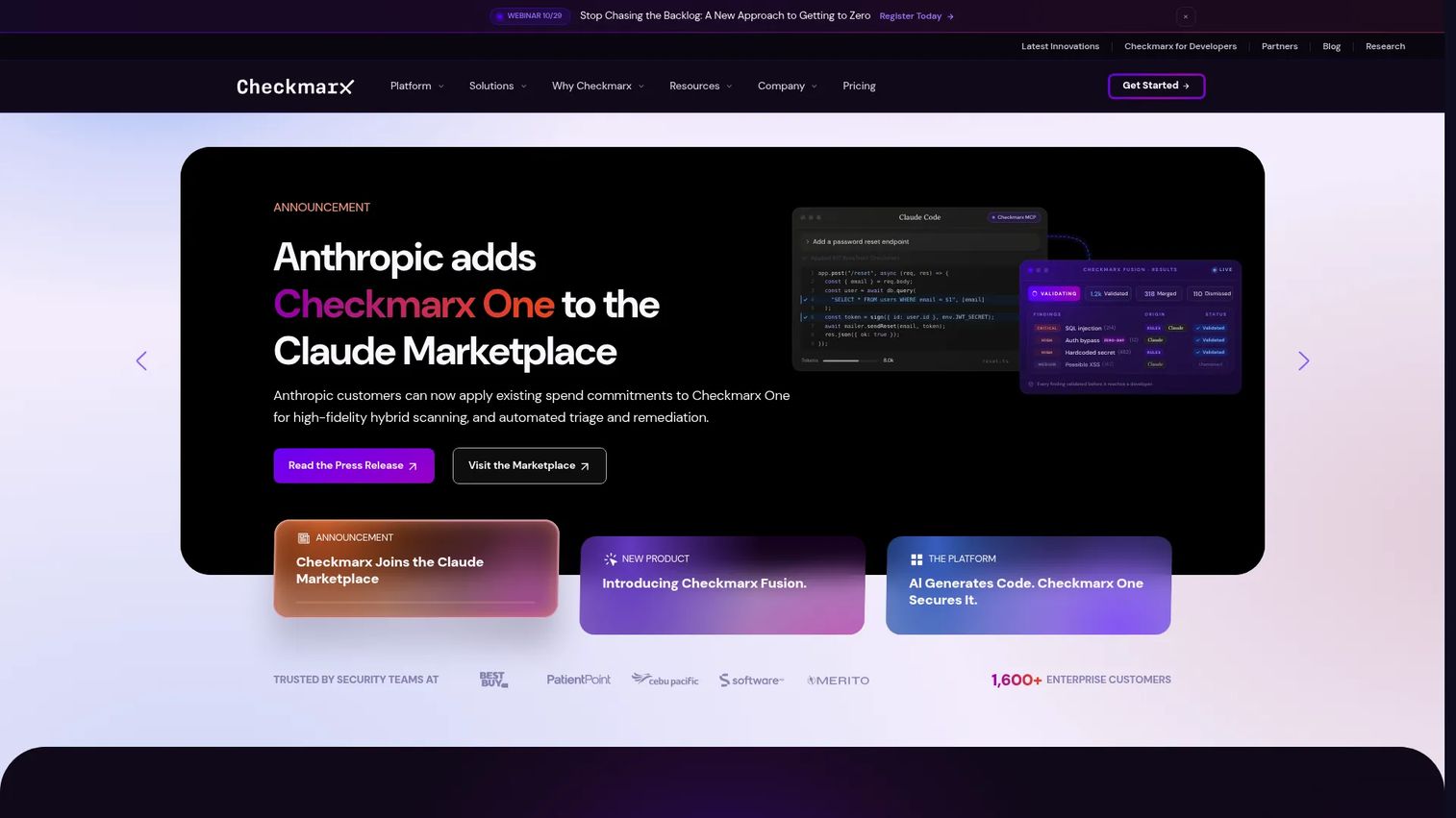
Checkmarx One is a cloud-based enterprise AppSec platform that consolidates SAST, SCA, DAST, API security, IaC scanning, container security, and secrets detection into a single interface. It supports centralized policy, AI-assisted triage and remediation guidance, and tight integration with CI/CD systems and IDEs. The platform is designed for large engineering organizations that need both governance control and distributed developer adoption.
Best for: Enterprises standardizing application security testing across many teams, languages, and code repositories.
Key features
- SAST, SCA, DAST, and API security testing
- IaC and container scanning with secrets detection
- AI-assisted triage and remediation guidance
- Unified risk orchestration and vulnerability prioritization
- CI/CD and IDE integrations
Why choose Checkmarx One: Choose it when policy, governance, and broad AppSec coverage matter more than a narrow point tool. It suits security programs that need auditability across many engineering teams simultaneously.
Vendor relationship to note: Checkmarx has backed the open-source ZAP project (entry 11) since September 2024, so a shortlist that pairs Checkmarx One with ZAP concentrates DAST coverage with one vendor rather than diversifying it.
Checkmarx One pricing: Checkmarx One prices by modules, developer scope, and deployment model. Plans include Essentials, Professional, and Enterprise tiers. Contact sales for a quote.
G2 rating: 4.2/5 from 48 reviews
3. Veracode
Veracode is a cloud-based application security and risk management platform with a long track record in enterprise secure SDLC programs. It covers static analysis (SAST), dynamic analysis (DAST), software composition analysis (SCA), container and IaC scanning, and AI-powered remediation. Policy management and detailed reporting make it a strong fit for organizations where auditability and compliance consistency are non-negotiable.
Best for: Large organizations with formal secure development programs, compliance requirements, and a need for policy-level auditability.
Key features
- Static analysis (SAST) and dynamic analysis (DAST)
- Software composition analysis (SCA)
- Container and IaC scanning
- Policy management and compliance reporting
- AI-powered remediation guidance and developer fix support
Why choose Veracode: Veracode suits teams that want an established AppSec program with deep governance. It's particularly useful when procurement, legal, or compliance stakeholders need evidence of consistent policy enforcement across the SDLC.
Veracode pricing: Veracode directs buyers to contact sales.
G2 rating: 3.8/5 from 26 reviews
4. Snyk
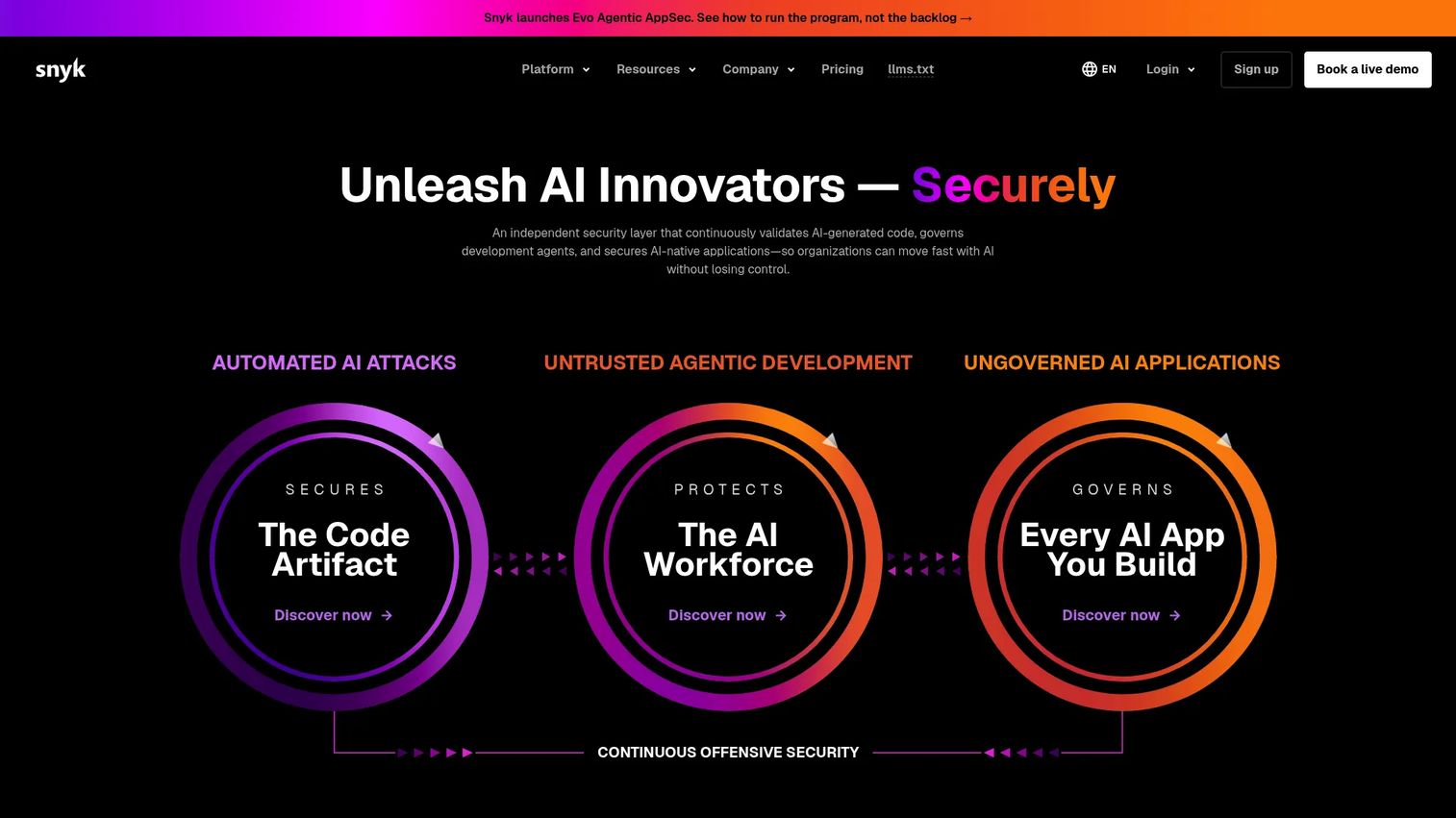
Snyk is a developer-first application security platform covering open-source dependency scanning, container vulnerability analysis, IaC scanning, and code security checks. Its strongest differentiator is workflow fit: Snyk integrates directly into GitHub, GitLab, Bitbucket, popular IDEs, and CI/CD pipelines so developers see findings where they already work, with actionable fix guidance attached. The free tier makes it accessible for small engineering teams and individual contributors.
Best for: Engineering-led teams that want developers to catch and fix security issues early, before code reaches security review.
Key features
- Open-source dependency scanning with license risk detection
- Container and IaC vulnerability analysis
- Code security checks with IDE and CLI support
- AI-native fix suggestions in developer workflows
- GitHub, GitLab, and CI/CD integrations
Why choose Snyk: Snyk is the right call when developer adoption is the primary challenge. If the AppSec program lives only in a security dashboard nobody opens, moving scanning into the IDE and pull request changes that dynamic.
Snyk pricing: A free plan is available with 5 projects and monthly test caps per product. The Team plan is $25 per contributing developer per month with a 5-seat minimum and a 10-seat ceiling, so the real entry cost is $125 per month rather than $25. Snyk counts a contributing developer as anyone who committed to a monitored private repository in the last 90 days. Teams above 10 contributing developers move to Enterprise, which is quoted by sales and billed through prepaid credits at $1 per credit.
G2 rating: 4.5/5 from 135 reviews.
5. Mend.io
Mend.io is an enterprise platform focused on application security, AI security, and automated dependency management. Its SCA engine scans open-source components, containers, and AI-generated code for vulnerabilities and license risk. Mend Renovate automates dependency updates to reduce the manual overhead that causes organizations to fall behind on patch cycles. The platform also includes AI-BOM generation and shadow AI discovery for teams adopting AI-assisted development.
Best for: Teams that need strong open-source risk management, automated dependency remediation, and license governance across large codebases.
Key features
- SCA scanning with container and AI component support
- SAST for first-party code analysis
- Automated dependency updates via Mend Renovate
- AI-BOM and shadow AI discovery
- License compliance management
Why choose Mend.io: Mend.io fits organizations where open-source and AI-generated code create most of the risk. It's especially relevant when legal, compliance, and engineering teams all need a shared view of dependency exposure.
Mend.io pricing: Mend publishes ceilings rather than fixed rates: up to $1,000 per developer per year for Mend AppSec, up to $300 per developer per year for Mend AI, and up to $250 per developer per year for Mend Renovate Enterprise. Pricing is based on contributing developer count, and buyers request a quote for their actual rate.
G2 rating: 4.3/5 from 125 reviews.
6. SonarQube
SonarQube is a code quality and security analysis platform that combines maintainability rules with security hotspot detection across 30+ programming languages. Quality gates block code that fails standards from merging, making security and quality checks a structural part of the CI/CD process rather than a late-stage review. It integrates with GitHub Actions, GitLab CI/CD, Azure DevOps, and Bitbucket Pipelines.
Best for: Engineering teams that want code quality and security analysis running in the same CI/CD workflow, with pull request feedback developers trust.
Key features
- Static code analysis with security hotspot detection
- Quality gates that block non-compliant code from merging
- Pull request review integration for 30+ languages
- GitHub Actions, GitLab, and Azure DevOps integrations
- Community edition and SaaS deployment options
Why choose SonarQube: Choose SonarQube when engineering teams need to treat quality and security as the same problem. It's a strong fit when developers already take quality gates seriously and AppSec wants to join that workflow.
SonarQube pricing: SonarQube Cloud is free for private projects up to 50,000 lines of code. The Team plan starts at $34 per month for up to 100,000 lines of code, and the listed rate has moved recently, so confirm it on the live pricing page before budgeting. Enterprise pricing is sales-led.
G2 rating: 4.4/5 from 155 reviews.
7. Contrast Security
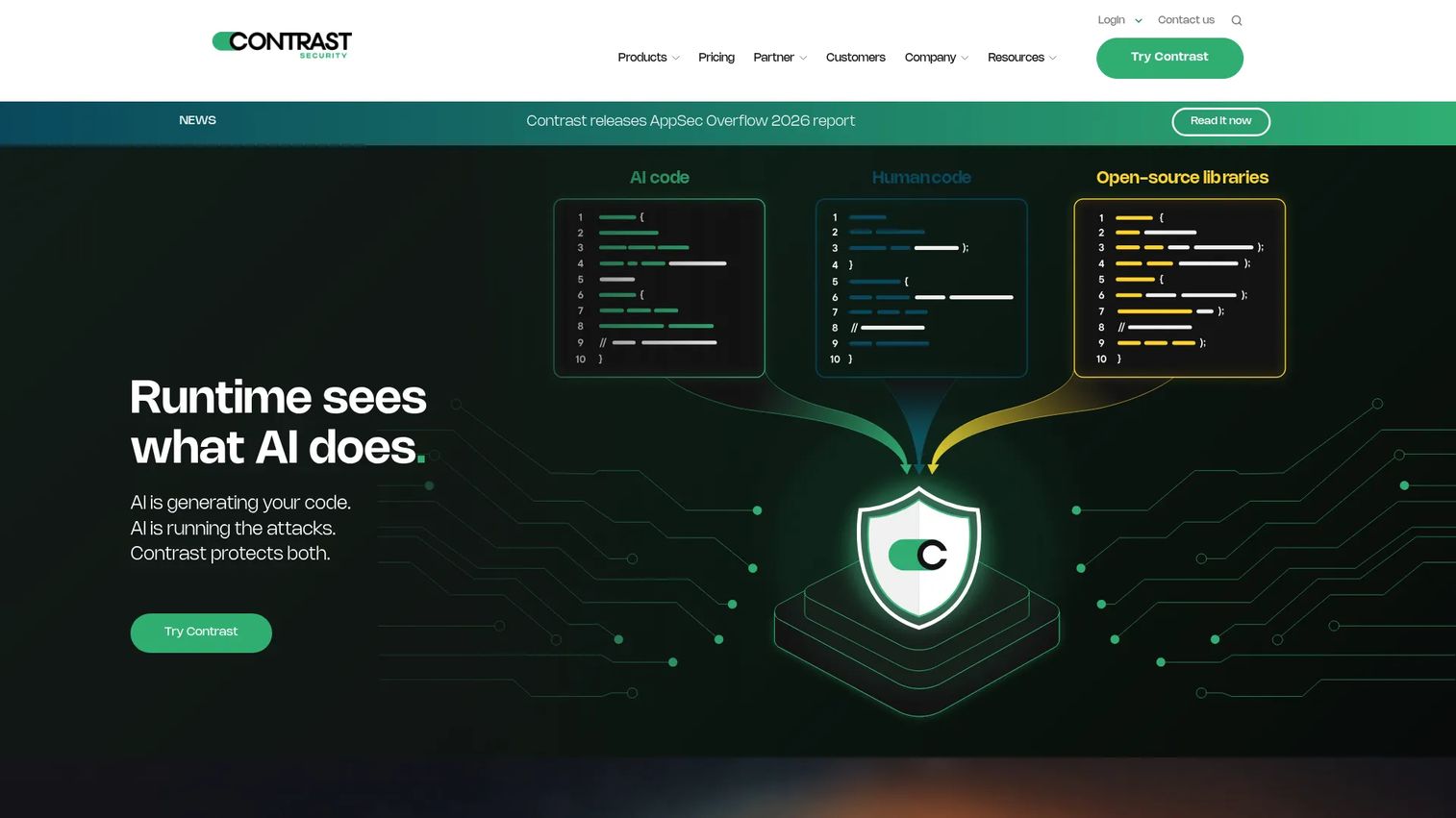
Contrast Security is a runtime application security platform that uses IAST, RASP, and DAST techniques to detect vulnerabilities from inside running applications. Unlike static analysis, it observes how code actually executes and which paths are reachable during testing, giving teams exploitability context that reduces false-positive triage. The platform also provides runtime attack detection and blocking, making it relevant across both the testing and production phases.
Best for: Development, AppSec, and security operations teams that need runtime vulnerability context and real-time attack detection alongside traditional scanning.
Key features
- IAST analysis with runtime vulnerability detection
- RASP protection and runtime attack blocking
- Runtime SCA with dependency-tree visibility
- Exploitability context and route coverage mapping
- SIEM, ticketing, and SAML SSO integrations
Why choose Contrast Security: Contrast Security fits teams where static scanners produce too much noise. Runtime context tells you which vulnerabilities are actually reachable in your application paths, which narrows the remediation list significantly.
Contrast Security pricing: A free CVE Shield plan covers 2 applications and up to 12 services with a single user, currently limited to Java applications on Linux. The Pro plan is listed at $750 per month billed annually ($9,000 per year) for 8 applications and up to 50 services, and Contrast's pricing page still labels Pro as not yet released. Enterprise pricing is contact-only.
G2 rating: 4.5/5 from 49 reviews.
8. Burp Suite Enterprise Edition
Burp Suite Enterprise Edition (now marketed as Burp Suite DAST) is PortSwigger's scalable automated DAST solution. It brings the depth of Burp's manual web testing capabilities into a scheduled, CI/CD-integrated scanning engine that works across large application portfolios. Chromium-based scanning handles modern JavaScript applications and single-page apps, while API scanning covers Postman Collections, OpenAPI, SOAP, and GraphQL.
Best for: Security teams moving from ad-hoc manual web testing to repeatable, automated DAST coverage across many applications.
Key features
- Browser-powered scanning for modern JavaScript and SPA applications
- API scanning for OpenAPI, GraphQL, Postman, and SOAP
- Scheduled, on-demand, and CI/CD-triggered scans
- Role-based access control, audit trails, and SAML SSO
- Cloud, self-hosted, and Kubernetes deployment options
Why choose Burp Suite Enterprise Edition: Burp Suite is the right choice when web application testing is central to the AppSec program and teams want the depth of Burp's scanner at scale. It's especially useful for organizations moving from pen-test-only coverage to continuous automated DAST.
Burp Suite Enterprise Edition pricing: PortSwigger directs buyers to contact sales for a quote. No public pricing is displayed on the product page.
G2 rating: 4.8/5 from 129 reviews.
9. Black Duck
Black Duck is a long-standing software composition analysis and open-source governance platform. It scans dependencies for known vulnerabilities, identifies license risk across the codebase, generates SBOMs in SPDX and CycloneDX formats, and enforces open-source policy across CI/CD and IDE workflows. For regulated industries and organizations with formal software supply chain requirements, Black Duck's depth in license compliance and SBOM governance is a meaningful differentiator. Black Duck became a standalone company when Synopsys divested its Software Integrity Group, so older coverage may still describe these products under the Synopsys name.
Best for: Enterprises with strict open-source compliance requirements, M&A diligence needs, or formal software supply chain governance programs.
Key features
- Dependency, binary, snippet, and source-code scanning
- Open-source license identification and policy governance
- SBOM generation in SPDX and CycloneDX formats
- Vulnerability detection with remediation prioritization
- CI/CD, IDE, and issue-tracker integrations
Why choose Black Duck: Black Duck fits teams where open-source risk is both a security and a legal concern. It's particularly relevant for regulated industries, acquirers conducting software due diligence, and organizations publishing SBOMs for customers or government buyers.
Black Duck pricing: Black Duck offers a Standard package and an à-la-carte option. Contact sales for pricing.
G2 rating: 4.1/5 from 32 reviews on the Black Duck SCA listing.
10. Semgrep
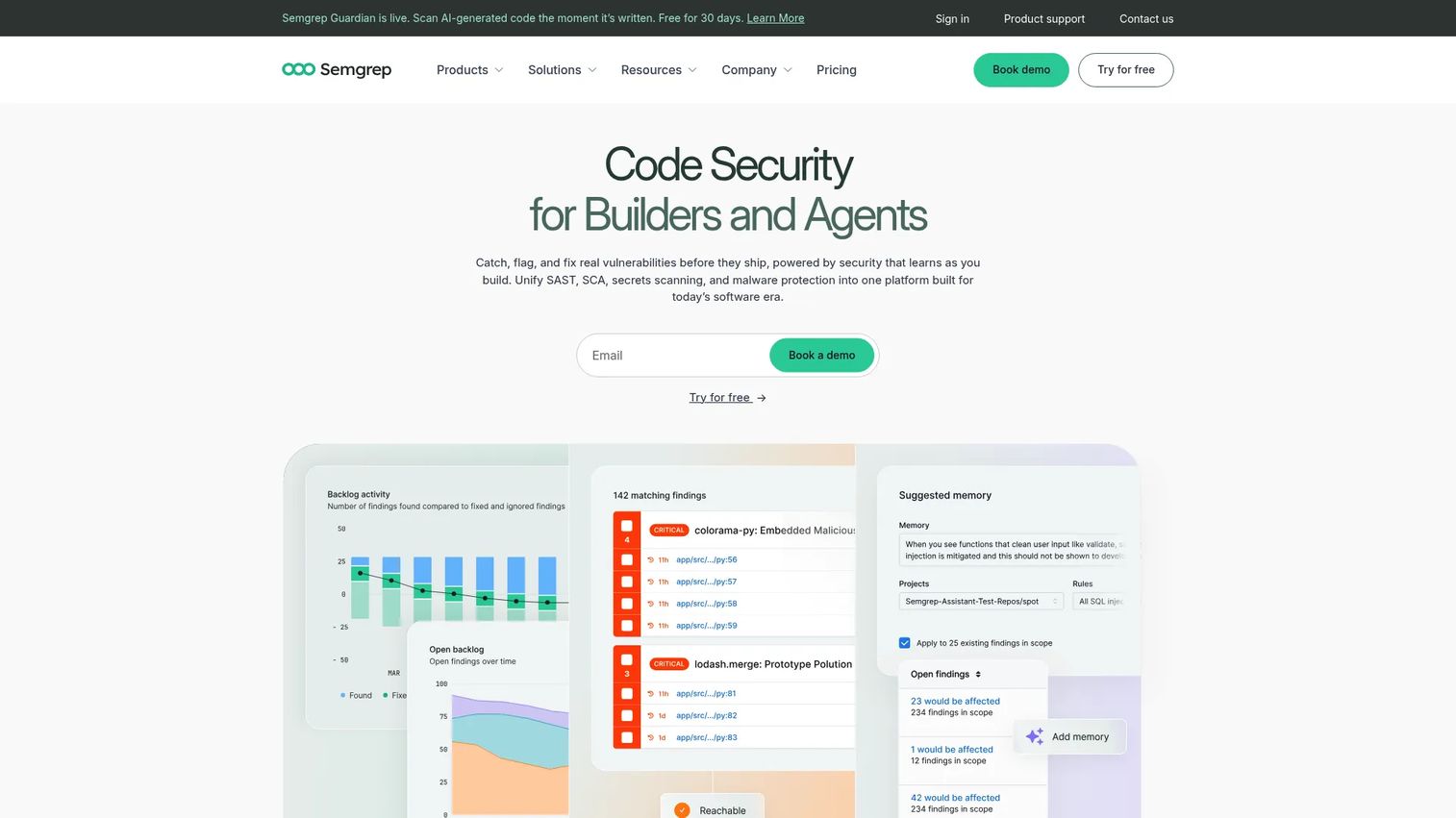
Semgrep is an application security platform for automating code, supply-chain, and secrets security. Its static analysis engine uses cross-file and cross-function analysis, and its rule format is readable enough that security engineers and developers can write and maintain their own detection logic without deep language expertise. The free tier covers SAST and SCA for up to 10 repositories, making it a practical starting point for teams that want code scanning without a major procurement cycle.
Best for: Security engineers who want customizable code scanning that developers can contribute to and understand.
Key features
- SAST with cross-file and cross-function analysis
- SCA with reachability and malicious dependency detection
- Secrets detection using semantic and entropy analysis
- AI-powered autofix and remediation guidance
- CI/CD, pull-request, IDE, Jira, and Slack integrations
Why choose Semgrep: Semgrep is a strong fit when the AppSec team wants detection logic tailored to the organization's specific patterns and coding standards. It gives security engineers meaningful control over what gets flagged and why.
Semgrep pricing: Free Edition available for up to 10 repositories and 10 contributors. Teams pricing is per module: $15 per contributor per month for Secrets, and $30 per contributor per month each for Code and Supply Chain. Enterprise pricing is contact-only.
G2 rating: 4.6/5 from 56 reviews.
11. ZAP (backed by Checkmarx)
ZAP is a free, open-source web application security scanner and penetration-testing proxy. It supports active scanning, passive scanning, proxy-based interception, and automation through a flexible framework. ZAP is widely used as a baseline DAST tool in CI/CD pipelines, particularly by teams that need free coverage before investing in a commercial scanner. The add-on marketplace extends functionality at no cost.
Vendor relationship to note: The name "OWASP ZAP" is out of date. The project left the OWASP Foundation in 2023 and has been backed by Checkmarx (entry 2) since September 2024, where it is listed as ZAP by Checkmarx. The code remains open source, but the project is no longer vendor-neutral, which matters if your evaluation shortlist also includes Checkmarx One or if a buyer questionnaire asks you to name independent testing tools.
Best for: Teams that need a free DAST starting point, supplemental web testing capability, or a learning environment for security engineers.
Key features
- Active and passive web application scanning
- Intercepting proxy for manual and automated testing
- AJAX spider for modern JavaScript-heavy applications
- Automation framework for CI/CD integration
- Free extensible add-on marketplace
Why choose ZAP: ZAP is the right choice when budget is the primary constraint or the team needs a flexible testing utility alongside commercial tools. Ownership and tuning are still required to get useful signal from it.
ZAP pricing: Free and open source. No paid tier.
G2 rating: 4.7/5 from 14 reviews, under the listing title "ZAP by Checkmarx."
12. Trivy
Trivy is an open-source all-in-one security scanner for container images, filesystems, Git repositories, IaC manifests, and Kubernetes clusters. It detects vulnerabilities, misconfigurations, secrets, and SBOM data in a single CLI tool, making it a popular choice for DevSecOps teams that need fast scanning inside CI/CD pipelines without a commercial rollout.
Vendor relationship to note: Trivy is maintained by Aqua Security, which develops the project in the open and sells commercial products built on the same scanning engine. The license is permissive, but the roadmap sits with a commercial vendor rather than a foundation.
Best for: Engineering and DevSecOps teams that need open-source cloud-native scanning with no licensing cost and fast CI/CD integration.
Key features
- Container image and filesystem vulnerability scanning
- IaC misconfiguration and secrets scanning
- Kubernetes cluster and workload scanning
- SBOM generation from container images and repositories
- CLI-native and CI/CD-integrated workflow support
Why choose Trivy: Trivy is the best starting point for cloud-native scanning when the team needs breadth without procurement friction. It works best when paired with clear ownership over findings and a defined remediation process.
Trivy pricing: Free and open source under Apache-2.0 license.
13. Imperva Web Application Firewall
Imperva Web Application Firewall protects web applications and APIs across cloud, on-premises, and hybrid environments. It applies managed rules covering the OWASP Top 10, SQL injection, XSS, and other common attack patterns. Its ML-powered Attack Analytics engine correlates security events into incident narratives, reducing the alert volume that overwhelms security operations teams. Deployment options include cloud-based WAF and on-premises hardware or virtual appliances.
Best for: Organizations that need production-layer protection for public-facing web applications and APIs, particularly across hybrid or multi-cloud environments.
Key features
- Managed WAF rules for OWASP Top 10 and common attack patterns
- ML-powered Attack Analytics correlating events into incident narratives
- Bot mitigation and API protection
- DDoS protection and enterprise SSL management
- Terraform-based deployment automation
Why choose Imperva Web Application Firewall: Imperva WAF fits teams where the immediate concern is protecting exposed applications in production. It complements application security testing tools but does not replace secure development practices earlier in the pipeline.
Imperva Web Application Firewall pricing: Imperva offers a free trial and demo. Contact sales for pricing.
G2 rating: 4.7/5 from 41 reviews.
14. Oligo
Oligo is a runtime application security platform that monitors application behavior at library and function level to identify which vulnerabilities are actively loaded and exploitable. Rather than treating every CVE in a dependency as equally urgent, Oligo surfaces only the risks that are actually reachable and in use at runtime. The platform also covers Cloud Application Detection and Response (CADR), blocking exploits in real time, and extends runtime AI security for models and agent workflows.
Best for: Security and application teams with dependency risk overload who need runtime exploitability context to focus remediation effort.
Key features
- Runtime vulnerability management with library-level execution visibility
- Cloud Application Detection and Response with real-time blocking
- Runtime AI security for models, frameworks, and agent workflows
- Exploitability prioritization based on actual runtime behavior
- Application context mapping and security team alerts
Why choose Oligo: Oligo fits teams where SCA tools generate more CVEs than engineers can triage. Runtime visibility answers the question every security team asks: which of these vulnerabilities is actually reachable in our application?
Oligo pricing: Contact sales for pricing.
G2 rating: Not listed on G2. Oligo has no product profile, so plan on reference calls and a technical pilot rather than peer review scores.
15. OpenText Fortify
OpenText Fortify is an enterprise application security portfolio covering SAST, DAST, mobile application security testing (MAST), and SCA. Fortify on Demand uses Assessment Units for consumption-based pricing. The platform integrates with CI/CD systems, IDEs, version control, and issue-tracking tools, and it includes AI-powered auditing and remediation support. Fortify is widely used in regulated industries and government environments where formal compliance gates require documented testing at every SDLC phase. For teams also working on AI security posture management, Fortify's enterprise depth makes it a natural companion.
Best for: Large organizations standardizing application security across multiple teams and regulatory requirements, particularly in public sector and regulated industries.
Key features
- Static application security testing (SAST) with Fortify SAST
- Dynamic application security testing (DAST) with Fortify DAST
- Mobile application security testing (MAST)
- Software composition analysis (SCA)
- AI-powered auditing and remediation guidance
Why choose OpenText Fortify: OpenText Fortify suits enterprises that need a documented, multi-method AppSec program with formal compliance support. It's particularly relevant when procurement and audit teams require evidence of testing at every phase of the secure SDLC.
OpenText Fortify pricing: OpenText directs buyers to contact sales.
G2 rating: 4.1/5 from 34 reviews.
Considerations when choosing application security software
Match coverage to your risk surface
A SaaS company with heavy open-source usage, API exposure, and Kubernetes workloads needs different coverage than a traditional web application team. Map your primary risk vectors first: code quality, dependency risk, web-facing attack surface, or runtime behavior. Then select tools that address the highest-priority layers rather than buying coverage for risks you don't carry.
Check developer workflow fit
Evaluate IDE support, pull request integration, CI/CD gate configuration, ticket routing, and fix guidance quality. If developers ignore the tool's output, the AppSec program becomes a dashboard that nobody trusts and nobody acts on. The best scan results land where the engineer already works, with enough context to act immediately.
Look for prioritization, not only detection
Ask how each tool ranks findings. Strong tools score by exploitability, reachability, business context, and asset importance, not just CVSS severity. A tool that surfaces 800 medium findings without prioritization creates more workload than it removes. AI software testing tools are increasingly relevant here for automated triage assistance.
Check who owns each tool before you shortlist
Several names in this category are less independent than they look. ZAP is backed by Checkmarx, Trivy is maintained by Aqua Security, and Black Duck's products were divested from Synopsys. If your plan is to pair a commercial scanner with an open-source second opinion, confirm the two are not funded by the same company before you present the stack as diversified coverage.
Validate governance and reporting
Security leaders need policy controls, audit trails, compliance dashboards, and SLA tracking. Presales and procurement stakeholders also need proof that the organization can articulate its secure development process, particularly during enterprise evaluations and RFP responses. Look for tools that produce the evidence buyers actually ask for.
Model total cost of ownership
Licensing is only part of the cost. Add implementation time, tuning effort, developer training, false-positive triage overhead, and ongoing tool administration. Seat minimums matter too: several plans in this category quote a per-developer rate but enforce a floor, so the real entry price is a multiple of the headline figure. Open-source tools carry lower licensing cost but higher operational overhead. Enterprise platforms often include support and onboarding that meaningfully reduces time-to-value.
Conclusion
Application security software covers a wide range of risk surfaces, and no single tool handles all of them equally well.
For unified posture management, Cycode correlates risk across the entire SDLC. For broad enterprise AppSec testing, Checkmarx One, Veracode, and OpenText Fortify each offer mature multi-method coverage. Software supply chain risk is best addressed by Snyk, Mend.io, Black Duck, or Trivy depending on depth and budget. Developer-friendly code scanning lands with Semgrep or SonarQube, where findings reach engineers before code merges. Web application testing and production protection belong to Burp Suite Enterprise Edition, ZAP, and Imperva WAF. Runtime context comes from Contrast Security and Oligo.
The practical next step: shortlist tools by your primary risk surface, run a pilot on two or three high-value applications, and measure developer remediation speed over 30 days. That gives you real data before committing to a program-wide rollout.
Security diligence runs in both directions. The same buyers who send you AppSec questionnaires also want to see how your product works before they sign, and standing up a trial environment with real credentials starts another security review on their side. An interactive demo lets presales and product marketing teams show the product in a controlled environment, with no sandbox to provision and no production data exposed.
Start your journey with Guideflow today!
FAQs
Application security software helps teams detect, prioritize, and fix security risks across code, open-source dependencies, web applications, APIs, infrastructure, and runtime environments. It supports the secure software development lifecycle by catching vulnerabilities before and after release, not only during penetration testing.
SAST scans source or compiled code for vulnerabilities before the application runs. DAST tests a running application from the outside, the way an attacker would. SCA analyzes open-source dependencies for known CVEs and license risk. Most mature AppSec programs use more than one method because each catches issues the others miss.
Application security testing tools find vulnerabilities through scanning methods like SAST, DAST, and SCA. ASPM platforms like Cycode sit above individual scanners, aggregating findings, assigning ownership, and prioritizing remediation based on business context. Testing tools generate the data; ASPM makes it actionable at scale.
Developer-first teams typically prioritize CI/CD integration, pull request feedback, low false-positive rates, and fix guidance developers can act on without an AppSec ticket. Snyk and Semgrep are strong starting points. Teams that also need container and IaC coverage often add Trivy. The right combination depends on your primary language stack and pipeline tooling.
No. AppSec tools provide continuous, automated coverage and repeatable checks at scale. Penetration testing delivers deeper human analysis for high-risk systems, pre-release validation, and compliance requirements that mandate manual testing. The two approaches are complementary, with tools handling routine scanning and pen testers focusing on complex attack scenarios.
Presales practitioners supporting security-heavy evaluations should focus on secure SDLC evidence, OWASP Top 10 coverage, dependency governance, runtime monitoring, and proof of ongoing vulnerability remediation. Buyers asking security questionnaire questions want evidence that risk is found, owned, and fixed, not just scanned. Map your product's security controls to those three stages, and reference the specific AppSec tools your engineering team uses where that's part of the story.
Open-source tools like ZAP, Trivy, and Semgrep's free tier are genuinely strong for specific jobs. Note that open source does not always mean vendor-neutral: ZAP is backed by Checkmarx and Trivy is maintained by Aqua Security. The gaps typically emerge around governance, compliance reporting, enterprise support, SLA tracking, and cross-team prioritization. Most enterprise programs use open-source tools for specific layers and add commercial platforms for the governance and workflow integration that reduces overall risk at scale.
Useful metrics include reduction in critical vulnerabilities per release cycle, faster time-to-remediation for high-severity findings, lower late-stage security blocker rate, fewer environment resets during presales POCs, and improved audit readiness scores. Avoid unsupported dollar claims. Baseline your current remediation time and defect escape rate before running a pilot, then compare the numbers after 60 to 90 days of using the new tool in real workflows.