You found a product that sells. Then a supplier raised the price overnight, an item went out of stock without warning, and three orders shipped late while you were asleep. None of that showed up in a dashboard until a customer emailed.
That is the real problem dropshipping software solves. Not "automation" as a buzzword, but the gap between what your store promises and what your suppliers actually do behind the scenes. As stores scale, product sourcing, inventory sync, order routing, and repricing stop being tasks you can eyeball. They become failure points.
The numbers say this is not a niche concern. The global dropshipping market reached USD 543.53 billion in 2026, accounting for 6.5% of global ecommerce, with roughly 7.7 million online stores running dropshipping as their main model, according to CompaniesHistory (2026). Around 27% of online retailers use dropshipping as their primary fulfillment method, per Carro (2026). When that many sellers compete on the same suppliers, margin protection and operational reliability decide who survives.
For a founder or operator, the question is not "which tool has the most features." It is "which tool removes the manual work that breaks when I am not watching." The best drop shipping software is rarely one feature. It is the stack that handles sourcing, sync, ordering, repricing, and fulfillment without you re-checking every step. If you think about operational tooling the way you'd evaluate the best marketing automation software tools, the lens is the same: does this make the workflow repeatable, or does it add another tab to babysit?
What's inside
This guide covers nine dropshipping platforms across the full operating workflow: product sourcing, inventory sync, auto-ordering, repricing, order fulfillment, and product research. Some tools own one layer deeply. Others try to handle the whole chain.
We selected and ordered tools based on four criteria that actually change outcomes:
- Automation depth: how much of sourcing, ordering, tracking, and stock control runs without you.
- Marketplace coverage: support for Shopify, eBay, Amazon, WooCommerce, and other channels.
- Supplier network quality: breadth, fulfillment speed, and reliability of sourcing.
- Pricing transparency: clear, verifiable plans rather than hidden gates.
Tools are organized so you can match the pick to your current bottleneck, not to a generic "best overall" ranking.
TL;DR
- Best for full automation: AutoDS handles sourcing, listing, auto-ordering, and price optimization across multiple channels.
- Best for eBay and Amazon repricing: Easync focuses on dynamic repricing, auto-ordering, and account-health protection.
- Best for beginners on Shopify: DSers offers a free tier and streamlined AliExpress order automation.
- Best for fast shipping and branding: Zendrop pairs US fulfillment with a large catalog and custom branding.
- Best for product research: Dropship.IO finds winning products, tracks competitors, and analyzes ads before you spend.
- Best for supplier variety: Syncee and CJdropshipping give you wide supplier networks plus catalog and fulfillment automation.
If you are choosing dropship software for one job, start with the tool that matches the workflow that is breaking right now.
What dropshipping software does
Dropshipping software is the set of tools that automate the operating workflow of a dropshipping store, from finding products to fulfilling orders, without holding inventory yourself.
In practice, automated dropshipping spans six connected jobs. Strong dropshipping automation software handles most of them; specialized tools handle one extremely well.
- Product sourcing: finding products and suppliers, importing listings, and building a catalog from networks like AliExpress or vetted supplier directories.
- Inventory sync: keeping stock levels accurate across your store and your suppliers, so you stop selling items that just went out of stock.
- Auto-ordering: placing orders with suppliers automatically when a customer buys, removing manual copy-paste fulfillment.
- Repricing: adjusting prices in real time to protect margin when supplier costs or competitor prices shift.
- Fulfillment logistics: routing orders, syncing tracking numbers, and managing shipping times and returns.
- Marketplace coverage: connecting to Shopify, eBay, Amazon, WooCommerce, and other channels so one back end serves every storefront.
The dropshipping automation software market reflects how seriously sellers now take this. It was valued at USD 0.67 billion in 2024 and is projected to reach USD 1.67 billion by 2033, a roughly 10% CAGR, according to Business Research Insights (2024). The takeaway: automation is moving from optional to expected, especially as more sellers compete for the same products.
A simple way to picture the flow: source product, sync catalog, customer buys, auto-order from supplier, sync tracking, monitor stock and price, protect margin. Where a tool sits on that chain tells you what it is really for.
When to use dropshipping software
Build a store that runs without constant manual checks
If you are still placing supplier orders by hand, copying tracking numbers, and checking stock screenshots every morning, manual management has already broken. Automated dropshipping makes sense the moment your order volume outpaces your attention. For founders and operators, the value is repeatability: fewer exceptions, fewer late-night fixes, and a workflow your team can run without you in every order. Real-time monitoring of stock and price is the difference between catching a problem and refunding an angry customer.
Sell across multiple marketplaces
If you sell on more than one channel, multi-channel selling support changes which software fits. A Shopify-only seller has different needs than someone running Shopify, eBay, and Amazon at once. Channel coverage determines whether you manage one back end or three. Tools built for marketplace breadth, like AutoDS and Easync, sync listings, inventory, and orders across platforms so a stockout updates everywhere at once.
Protect margins and reduce stock mistakes
Dropshipping margins are thin, and supplier prices move. Repricing and stock monitoring exist to protect profit you would otherwise lose to a silent cost increase or an oversold item. The business case is simple: a single mispriced bestseller can erase a week of profit, and a stockout that ships late costs you a customer and a review. Profit protection through automated repricing matters most when you sell at volume or in competitive categories.
Comparison table
The table below compares all nine dropshipping platforms in a consistent order. Pricing and ratings reflect each vendor's first-party pages as of mid-2026; verify current figures before you buy, since plans change. Note that these tools specialize in different layers: some lead on repricing, others on supplier networks or product research.
| # | Product | Intent | Key differentiation | Pricing | G2 rating |
|---|---|---|---|---|---|
| 1 | Easync | Repricing and auto-ordering | Dynamic repricing and account-health tools for eBay/Amazon | From $49.99/mo | 4.5/5 |
| 2 | AutoDS | All-in-one automation | Sourcing, listing, auto-ordering, price optimization across channels | From $19.90/mo (billed annually) | 4.1/5 |
| 3 | DSers | AliExpress order automation | Bulk ordering, supplier optimizer, free tier | Free; paid from $19.9/mo | 5.0/5 |
| 4 | Zendrop | Fulfillment and branding | US fulfillment, large catalog, custom branding | Free; paid from $29/mo | Not listed |
| 5 | Dropship.IO | Product research | Winning products, ad library, competitor tracking | From $39/mo | Not listed |
| 6 | Syncee | Supplier marketplace | B2B supplier network, catalog sync, AI tools | Free; paid from $39.99/mo | 5.0/5 |
| 7 | Inventory Source | Supplier automation | Inventory, pricing, and order sync with catalog manager | Free; paid from $199/mo | 4.6/5 |
| 8 | CJdropshipping | Sourcing and fulfillment | End-to-end sourcing, 3PL fulfillment, POD | Free to join | 5.0/5 |
| 9 | Dropified | Import and automation | AI store builder, unlimited imports, multi-source import | From $50/mo | 3/5 |
1. Easync
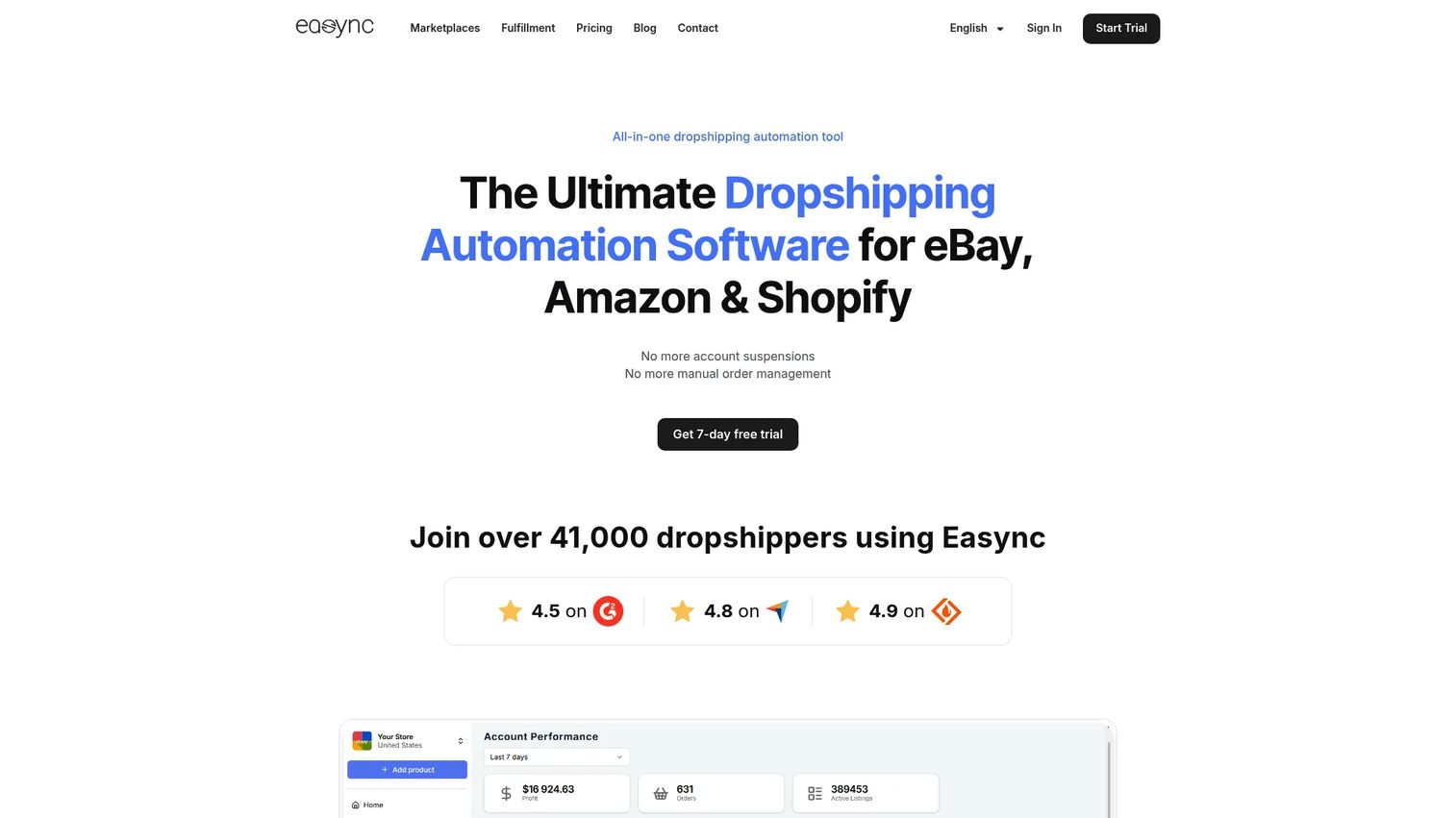
Easync is dropshipping automation software built around repricing, auto-ordering, listing, and order tracking. It targets sellers who live on marketplaces, especially eBay and Amazon, where competitor prices and supplier costs shift constantly and account health is fragile. The platform pairs hands-free fulfillment with dynamic repricing so your margin stays intact without manual monitoring.
Best for: eBay and Amazon dropshippers who want automated repricing and order fulfillment with account-health protection.
Key strengths
- Dynamic repricing and inventory sync: prices adjust in real time as supplier costs and competition move, with stock kept in sync to avoid overselling.
- Auto-ordering: orders route to suppliers automatically, removing manual fulfillment for high-volume sellers.
- Product lister, finder, reports, and tracking: a full toolkit for sourcing, listing, and monitoring orders end to end.
Why choose Easync: If your bottleneck is margin erosion and account standing on marketplaces, Easync is built for exactly that. The repricing engine and profit protection focus make it a fit for multi-marketplace operators who need real-time monitoring rather than a broad catalog tool. Sellers running eBay-heavy operations get the most from its account-health framing.
Easync pricing: Plans start at Basic for $49.99/mo, then Progressive at $65.99/mo, Advanced at $89.99/mo, and Expert at $109.99/mo. There is a 7-day trial with no credit card required, but no permanently free tier. Easync holds a 4.5/5 rating on G2.
2. AutoDS
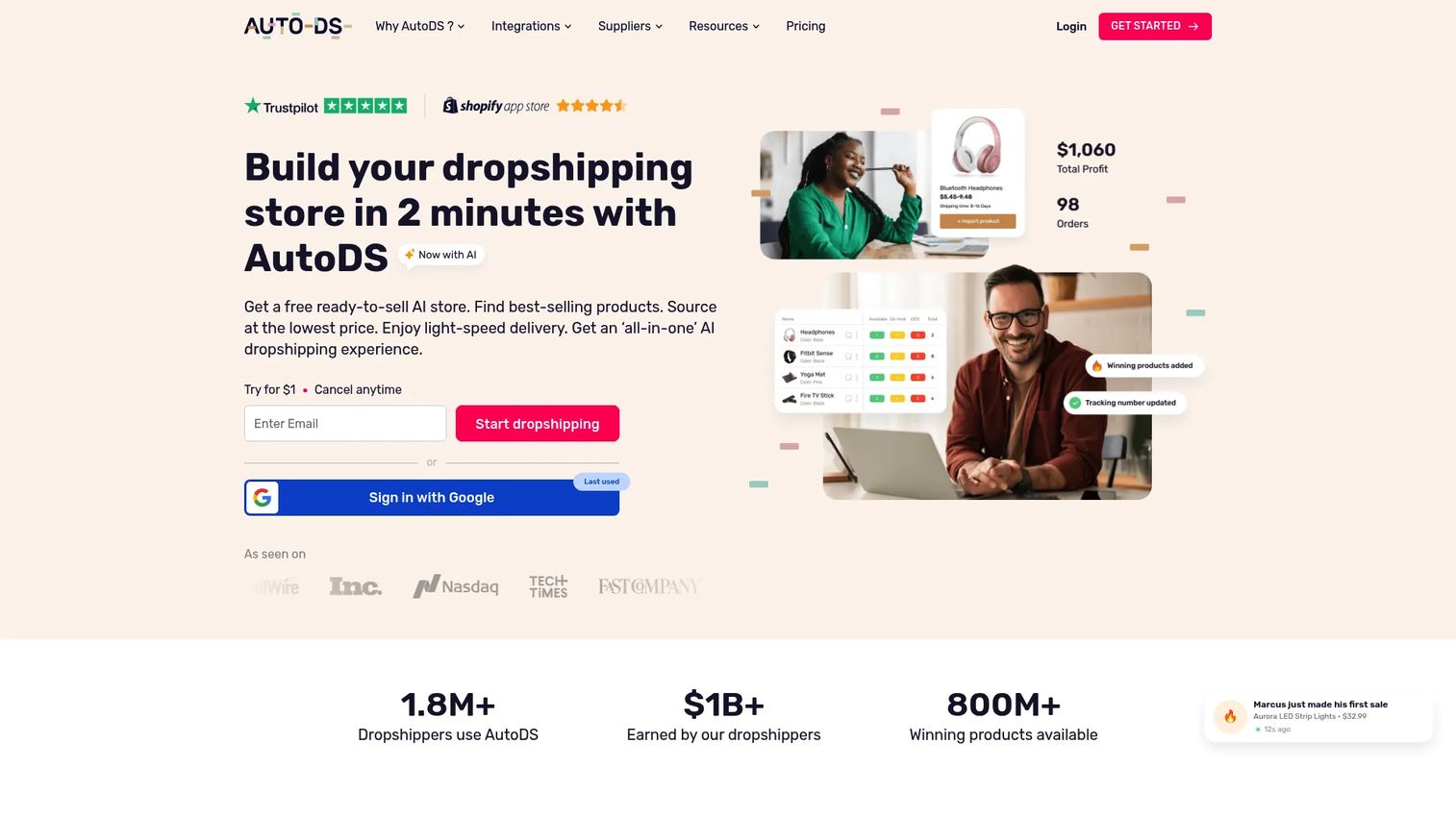
AutoDS is a dropshipping automation platform that covers product sourcing, listing, pricing, inventory, and order management in one place. It is positioned for sellers who want a broad automation layer across multiple ecommerce channels rather than a single-purpose tool. The breadth makes it a common starting stack for operators scaling past manual fulfillment.
Best for: dropshippers who want automation for sourcing, listing, and fulfillment across multiple ecommerce channels including Shopify, eBay, and Amazon.
Key strengths
- Products importer: find and import products from supplier sources directly into your store catalog.
- Automatic orders: fulfillment runs hands-free when a customer buys, with tracking synced back.
- Automatic price optimization: prices adjust to protect margin as costs and competition change.
Why choose AutoDS: AutoDS is the pick when you want one automation layer handling the whole workflow instead of stitching together separate sourcing, ordering, and repricing tools. Its multi-channel breadth suits sellers who run more than one storefront and want consistent automation across them. For operators consolidating their stack, that single back end is the main draw.
AutoDS pricing: Public pricing shows a $1 trial for 3 days, then annual and monthly options. Visible annual prices start at Import for $19.90/month, Starter at $29.90/month, and Advanced at $49.90/month, with an Enterprise tier at custom pricing. There is no permanently free tier. AutoDS holds a 4.1/5 rating on G2.
3. DSers
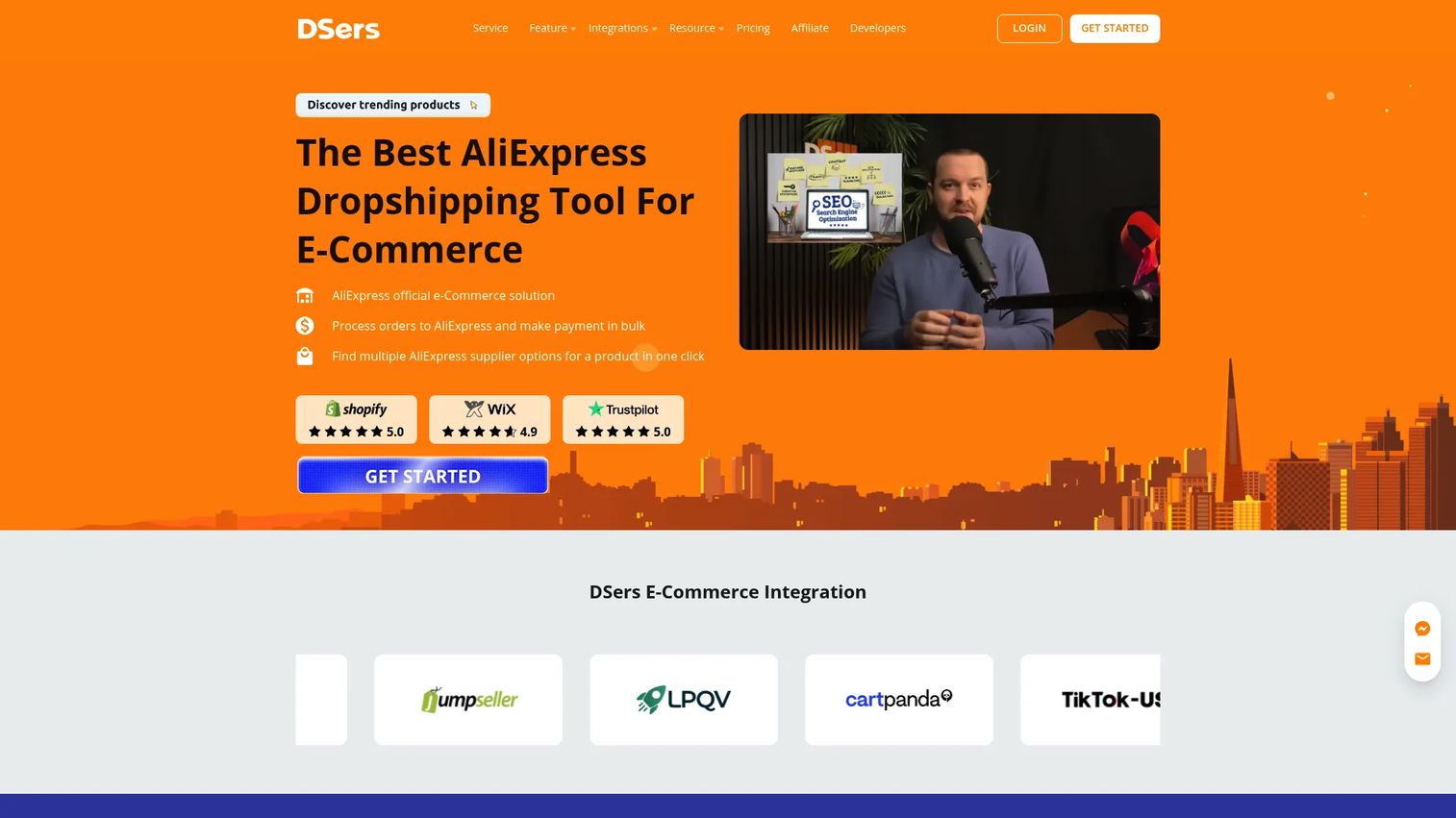
DSers is AliExpress-focused dropshipping and order-automation software for ecommerce stores. It is built for sellers who want a clean, streamlined starting point: bulk order processing, supplier optimization, and automatic tracking sync without a heavy learning curve. That makes it one of the more beginner-friendly entries on this list.
Best for: Shopify, WooCommerce, and Wix merchants using AliExpress dropshipping who want fast, low-friction order automation.
Key strengths
- Bulk order processing and supplier optimizer: place many orders at once and find better suppliers for the same product.
- Variants mapping: match product variants cleanly so orders route to the right supplier SKU.
- Auto-sync tracking and order status: tracking numbers and order updates flow back to your store automatically.
Why choose DSers: DSers fits sellers who source primarily from AliExpress and want order automation that works on day one. The free Basic tier lowers the barrier to entry, and the AliExpress focus means product sourcing and ordering feel native rather than bolted on. For a new Shopify store, it is a practical first automation tool.
DSers pricing: The Basic plan is free. Paid plans run Advanced at $19.9/month, Pro at $49.9/month, and Enterprise at $499/month, with a 14-day free trial on paid tiers. DSers holds a 5.0/5 rating on G2, though from a small review sample.
4. Zendrop
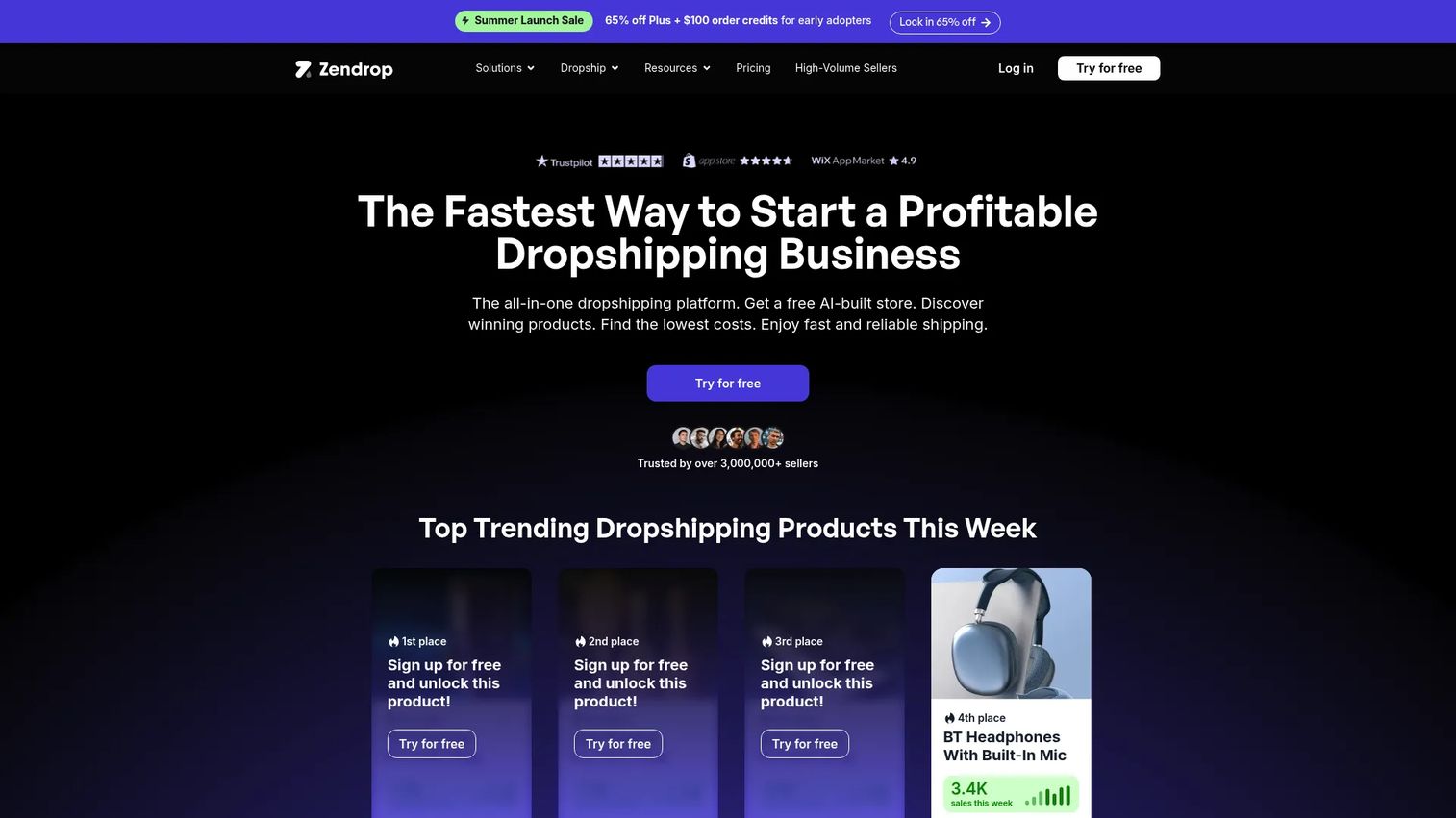
Zendrop is a dropshipping and fulfillment platform built for sellers who care about shipping speed and margin. It combines product discovery, supplier access, automated fulfillment, and custom branding, with US fulfillment options that cut the long shipping times that sink customer reviews. The supplier network and large catalog make sourcing winning products straightforward.
Best for: ecommerce sellers who want dropshipping fulfillment automation, fast shipping, and branding support in one platform.
Key strengths
- Automated fulfillment: orders process and ship without manual handling, with tracking handled for you.
- US fulfillment and fast shipping: domestic options shorten delivery windows compared with overseas-only sourcing.
- Custom branding: branded packaging and inserts help build a repeat brand rather than a one-off store.
Why choose Zendrop: If shipping speed and brand experience are where you compete, Zendrop's fulfillment focus and supplier network are the draw. Sellers chasing high-margin products with believable delivery times get more from it than from a pure sourcing tool. The branding layer supports operators trying to build something durable, not just flip products.
Zendrop pricing: Zendrop runs a Free plan at $0/month, then Beginner at $29/month, Pro at $49/month, and Plus at $79/month. A free AI-built store is available to get sellers started quickly. A current G2 rating was not listed at the time of writing.
5. Dropship.IO
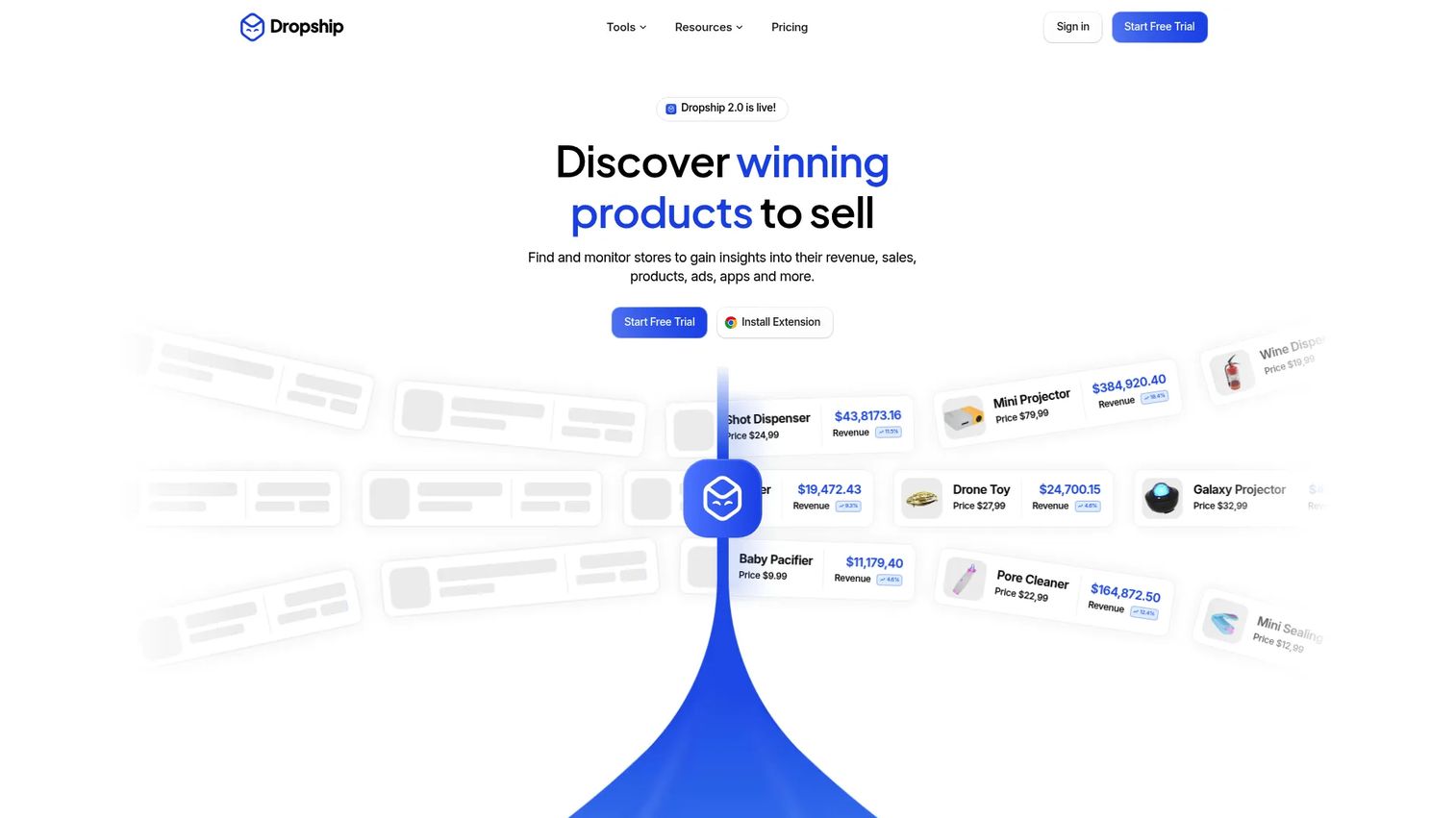
Dropship.IO is a dropshipping product research platform focused on finding winning products, analyzing ads, and tracking competitors before you commit ad spend. Where most tools on this list automate operations, Dropship.IO automates the decision that comes first: what to sell. That research-first angle is its differentiator.
Best for: dropship sellers who want product and ad research with competitor tracking before scaling spend.
Key strengths
- Ad library and ad search: find and filter the ads competitors are running to spot demand early.
- Competitor research: track what other stores sell and how they grow.
- Product portfolio and Shopify import: save promising products and push them into your store.
Why choose Dropship.IO: Dropship.IO fits operators who would rather validate demand with data than guess and burn ad budget. The business-intelligence framing makes it complementary to fulfillment tools: pick winners here, then fulfill elsewhere. For founders who treat product selection as the highest-leverage decision, it earns its place before scaling.
Dropship.IO pricing: Three paid plans run Basic at $39/month, Standard at $59/month, and Premium at $99/month, with a 7-day free trial. A current G2 rating was not listed at the time of writing.
6. Syncee
Syncee is a B2B dropshipping and wholesale marketplace connecting retailers with a large supplier network. It pairs supplier sourcing with catalog sync, inventory and order tracking, and AI tools, so stores that need supplier variety can scale inventory updates without manual catalog work. It supports multiple ecommerce platforms, making it flexible across stacks.
Best for: online stores that want to source from a broad supplier network and automate dropshipping or wholesale product imports.
Key strengths
- Dropshipping and wholesale marketplace: browse and connect with a large pool of vetted suppliers in one place.
- Product import and inventory sync: import catalogs and keep stock, pricing, and orders synced automatically.
- AI tools and bulk upload: speed up catalog management and reach suppliers directly.
Why choose Syncee: Syncee is the pick when supplier variety is the constraint. Rather than locking you to one source, it opens a wide supplier network with automated inventory sync behind it. Stores that need scalable catalog updates across many products and a flexible multi-platform fit get the most value here.
Syncee pricing: Syncee offers a Free plan, then Basic at $39.99/month, Pro at $59.99/month, and Business at $99.99/month, with a 7-day free trial on monthly plans and no credit card required to start. Syncee holds a 5.0/5 rating on G2, from a small review sample.
7. Inventory Source
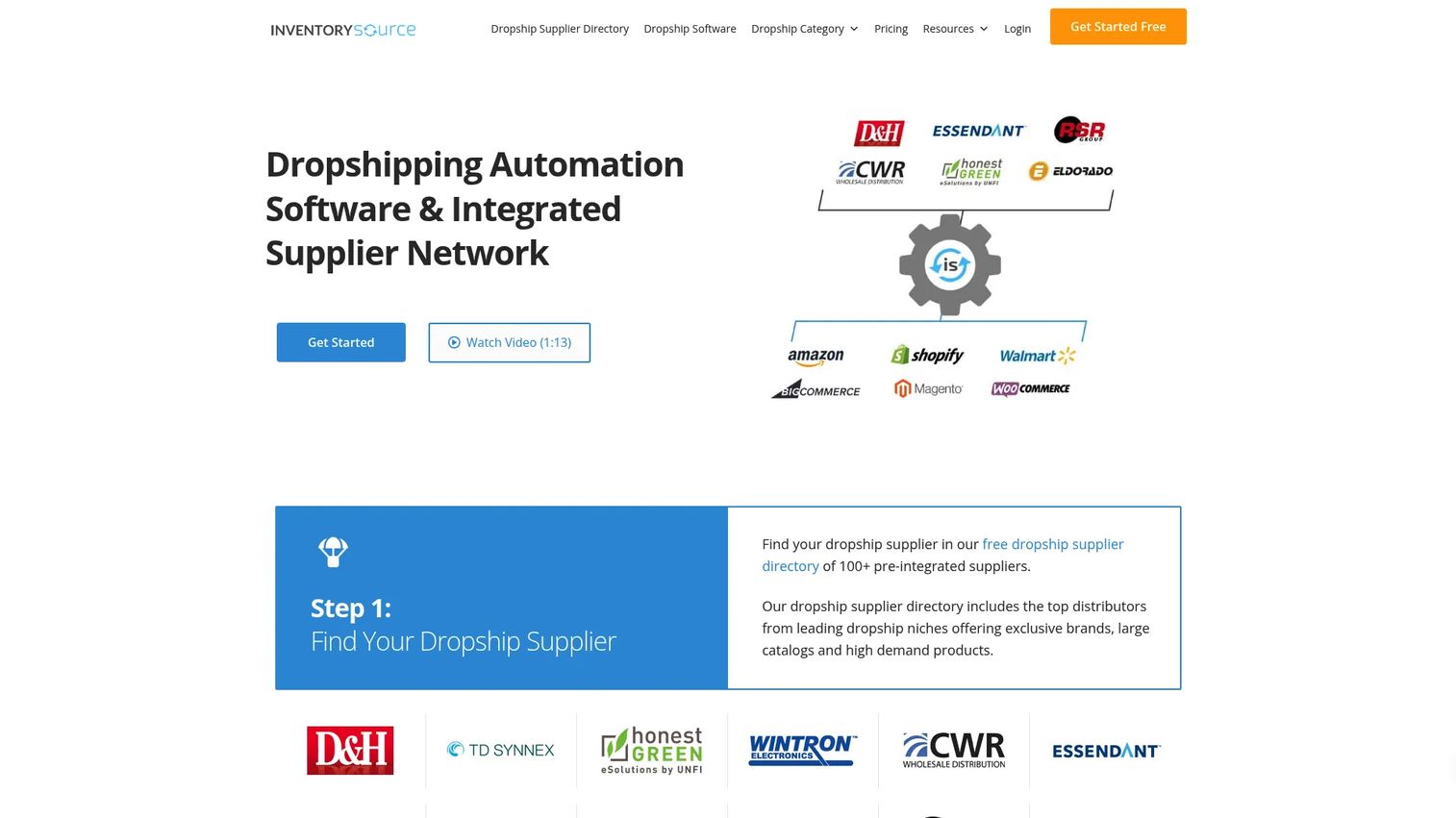
Inventory Source is dropshipping automation software focused on syncing supplier product data, inventory, pricing, and orders. It is built for sellers with a more established supplier workflow who need reliable inventory sync and order automation across integrations, plus a catalog manager for product data, category mapping, and pricing rules.
Best for: ecommerce sellers who need dropship inventory, pricing, and order automation across an existing supplier base.
Key strengths
- Inventory and pricing automation: keep stock and prices synced from suppliers to your store in real time.
- Order and tracking automation: route orders and sync tracking without manual handling.
- Catalog Manager: control product data, category mapping, and pricing rules at scale.
Why choose Inventory Source: Inventory Source fits operators who already have suppliers and need a dependable automation layer connecting supplier feeds to their storefronts. The catalog manager and pricing rules suit sellers managing large, structured catalogs. It is more of an operations backbone than a discovery tool, which is exactly what an established seller wants.
Inventory Source pricing: A free Supplier Directory Search tier is available. Paid plans include Inventory Automation Starter at $199/month and Power Seller at $499/month, plus Full Automation Starter at $299/month and Power Seller at $599/month. Additional integrations run $50/month. Inventory Source holds a 4.6/5 rating on G2.
8. CJdropshipping
CJdropshipping is an all-in-one dropshipping platform combining product sourcing, fulfillment, logistics, and branding. It appeals to sellers who want a single partner for both supplier sourcing and order fulfillment, with sourcing requests, 3PL fulfillment, print on demand, and custom packaging under one roof. It integrates with a wide range of storefronts including Shopify, WooCommerce, and eBay.
Best for: ecommerce sellers who need product sourcing plus fulfillment in one system.
Key strengths
- Product sourcing requests: ask CJ to source specific products you cannot find in the catalog.
- Store integrations and automatic order fulfillment: connect your store and fulfill orders automatically.
- Print on demand and custom packaging: add branded packaging and POD products to differentiate.
Why choose CJdropshipping: CJdropshipping fits sellers who want sourcing and fulfillment handled by the same provider, reducing the number of handoffs in the chain. The 3PL logistics and POD options support operators who want fast shipping and a broader product range. It works well as the supplier-and-fulfillment backbone behind a research or store tool.
CJdropshipping pricing: The platform is free to join and install, with no public subscription fee on the reviewed pages; costs come through service and fulfillment fees instead. CJdropshipping holds a 5.0/5 rating on G2.
9. Dropified
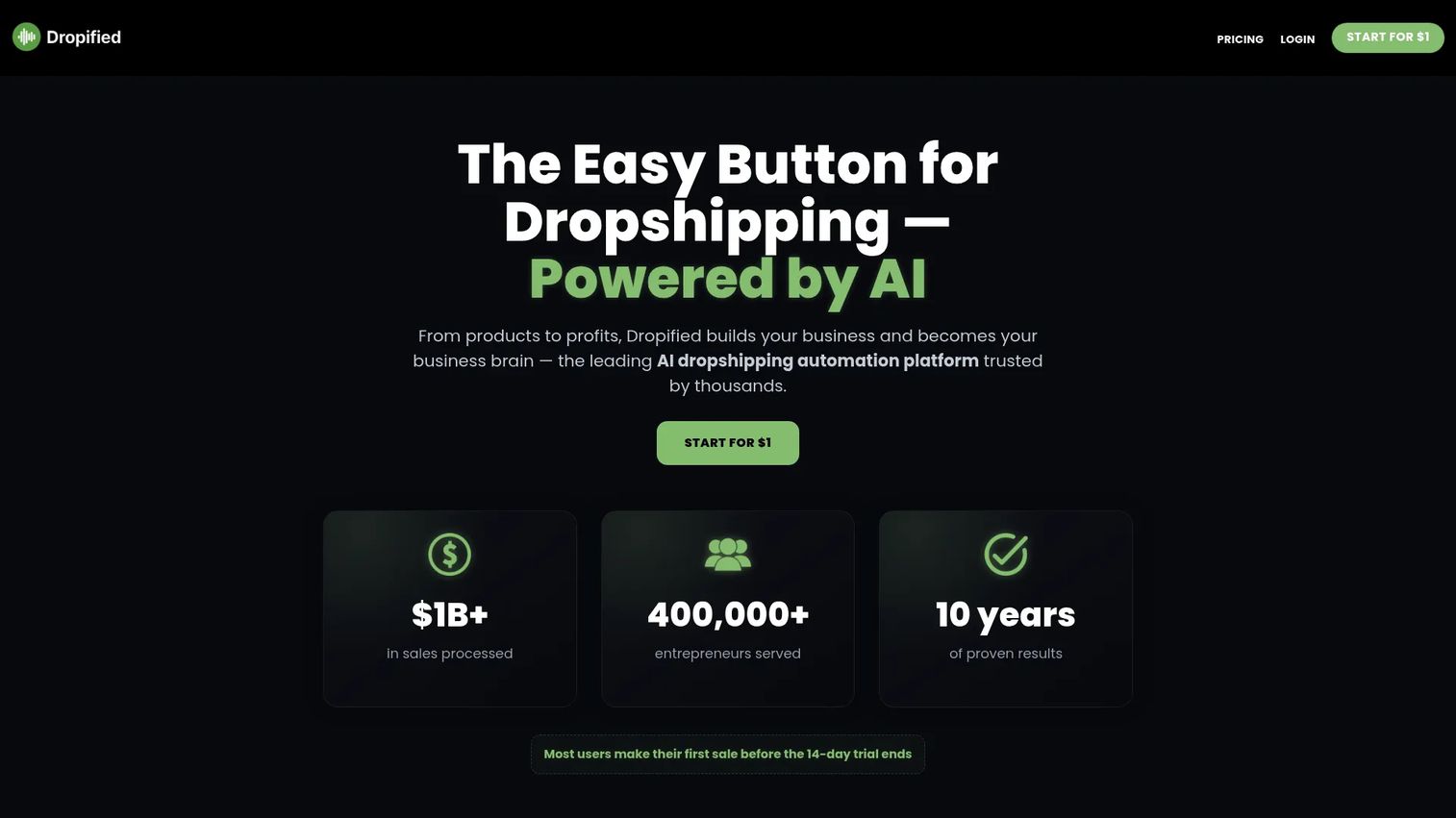
Dropified is dropshipping automation software for product import, order automation, catalog management, and store sync. It stands out from simpler starter tools through unlimited product imports and an AI store builder, plus the ability to import profitable products from AliExpress, eBay, Alibaba, and dozens of other sources into one catalog.
Best for: ecommerce sellers who want AI-assisted dropshipping automation with broad multi-source product import.
Key strengths
- Unlimited product imports: add products without a per-import cap as your catalog grows.
- AI store builder and automation suite: spin up and automate a store with built-in tooling.
- 24/7 live chat support: get help at any hour, which matters when fulfillment runs around the clock.
Why choose Dropified: Dropified suits sellers who want one automation suite that imports from many sources, not just AliExpress, and who value unlimited imports as their catalog expands. The AI store builder helps operators stand up a store quickly. It is a fit when multi-source sourcing and import volume are the priority.
Dropified pricing: Dropified uses single-plan pricing at $50/month, or $41.66/month billed annually ($500/year, advertised as two months free). A $1 trial for 14 days is available on the pricing page. Dropified holds a 3/5 seller rating on G2.
How to choose the right tool
The right pick depends on the bottleneck in front of you, not on which tool tops a generic list. A few decision shortcuts:
Start with your weakest workflow link
If margin is leaking on marketplaces, repricing tools like Easync or AutoDS solve that first. If you cannot decide what to sell, Dropship.IO's product research comes before any fulfillment tool. Buy for the problem you have this quarter.
Match the tool to your channels
Single-channel Shopify sellers can start lean with DSers. Multi-marketplace operators across Shopify, eBay, and Amazon get more from AutoDS or Easync, which sync listings and stock across channels. Channel fit narrows the field fast.
Weigh supplier network against control
If supplier variety is the constraint, Syncee and CJdropshipping open wide networks. If you already have suppliers and need reliable sync, Inventory Source connects existing feeds. Decide whether you are sourcing or operating.
Check pricing against your stage
Free and low-cost entries (DSers, Syncee, Zendrop's free plan, CJdropshipping's free join) let you validate before committing. Higher tiers like Inventory Source's automation plans make sense once volume justifies them.
Conclusion
There is no single best drop shipping software, only the best fit for the job you need done. If your problem is margin and account health on marketplaces, Easync is built for repricing and profit protection. If you want one broad automation layer across channels, AutoDS covers sourcing through fulfillment. New Shopify sellers get a clean, beginner-friendly start with DSers, while Zendrop wins on fast shipping and branding.
For deciding what to sell before you spend, Dropship.IO leads on product research. When supplier variety is the constraint, Syncee and CJdropshipping open wide networks, and Inventory Source is the operations backbone for established supplier workflows. Dropified fits sellers who want AI-assisted, multi-source import at scale.
The practical move is to start with the dropship automation tools that match your current bottleneck, prove the workflow out, then layer in more automation only when the volume justifies it. Buy for the problem in front of you, not the feature list.
FAQs
For most beginners, DSers and Zendrop are the easiest to start with. DSers offers a free tier and streamlined AliExpress order automation, while Zendrop pairs a free plan with a free AI-built store and simple fulfillment. Both keep operational overhead low. More advanced suites like AutoDS or Inventory Source add depth you can grow into once manual work becomes the bottleneck.
Automated dropshipping follows a chain: import products from a supplier or marketplace, sync your catalog, then let the software auto-order from the supplier when a customer buys. The tool syncs tracking numbers back to your store and updates stock levels in real time. Repricing tools can also adjust prices automatically to protect margin. The goal is to remove every manual copy-paste step between a sale and fulfillment.
Shopify sellers should prioritize native app integration and clean store sync. DSers works well for AliExpress-based Shopify stores, Zendrop adds fulfillment and branding, and AutoDS offers broad automation if you also sell on other channels. The right choice depends on whether you need simple order automation or full multi-channel coverage. Check that inventory sync and order routing run automatically with your theme.
eBay sellers usually need strong repricing, real-time stock updates, and account-health protection. Easync is built around exactly these needs, with dynamic repricing and auto-ordering for eBay and Amazon. AutoDS also supports eBay within its broader automation layer. Prioritize tools that monitor competitor prices and supplier stock continuously, since marketplace standing depends on accurate listings.
Reliable suppliers come from vetted supplier networks, not random sourcing. Platforms like Syncee, CJdropshipping, and Inventory Source curate supplier directories and handle fulfillment speed, product quality, and order sync. Look for fast shipping options, responsive support, and consistent stock data. Remember that any dropshipping software is only as good as the supplier coverage behind it, so evaluate the network before the features.
Yes. Tools like Easync and AutoDS include real-time repricing that adjusts your prices as supplier costs and competitor prices change. This protects margin automatically instead of forcing you to monitor listings by hand. Repricing matters most when you sell at volume or in competitive marketplace categories, where a silent cost increase can quietly erase profit on a bestseller.
It depends on how much manual work you are doing. If you place a handful of orders a week, manual fulfillment may be fine. Once you are copying tracking numbers, checking stock daily, or missing price changes, automation pays for itself in saved time and fewer errors. Many tools, including DSers and Syncee, have free or low-cost tiers, so you can automate the painful parts before committing to a higher plan.
The features that change outcomes are product sourcing, inventory sync, auto-ordering, repricing, fulfillment, and reporting. Sourcing and sync keep your catalog accurate, auto-ordering and fulfillment remove manual work, and repricing protects margin. Reporting and real-time monitoring tell you what is working. Match these against your bottleneck rather than chasing the longest feature list, since the best dropshipping tools are the ones that fix the workflow that is breaking now.