Mobile already accounts for about 60% of global e-commerce sales, according to Capital One Shopping (2026). Yet most brands still run checkout flows that weren't designed for a 6-inch screen, attribution stacks that can't connect app opens to revenue, and storefronts that load too slowly on LTE to hold attention. The gap isn't traffic. Mobile traffic is easy to win.
The real problem is conversion. A responsive storefront with a clunky checkout, or a branded app with no retention strategy, doesn't move the revenue number. It just adds another line to the tool budget and another platform to report on. Growth marketers need to answer one question before they sign anything: Does this replace work, or create more?
The answer depends entirely on which type of mobile commerce software you actually need. The options aren't interchangeable. A full ecommerce platform, a composable commerce stack, and a native app builder all serve different jobs. This guide helps you find the right fit.
What's inside
This guide compares 21 mobile e-commerce software options across full commerce platforms, enterprise commerce clouds, composable architectures, and native app builders. Tools were selected from recurring mentions in commercial SERPs and verified against mobile commerce capability.
Selection criteria:
- Mobile conversion capability: Checkout performance, page speed, wallet support
- Integration depth: CRM, email, analytics, ERP, and fulfillment connections
- Pricing transparency and total cost of ownership
- Scalability: From SMB storefronts to enterprise omnichannel programs
- Analytics and attribution quality for growth teams
TL;DR
- Best overall mobile commerce platform: Shopify, with fast setup, a deep app marketplace, and multichannel selling built in
- Best for growing mid-market brands: BigCommerce, with native B2B features and lower add-on dependency
- Best for WordPress stores: WooCommerce, free to install with full plugin flexibility
- Best for enterprise operations: Salesforce Commerce Cloud, Adobe Commerce, SAP Commerce Cloud, or VTEX, depending on your existing tech stack
- Best for composable commerce: commercetools or Elastic Path, for engineering-led teams building custom experiences
- Best for branded mobile apps: Tapcart, Appbrew, Shopney, or Vajro for Shopify merchants; Poq for enterprise retailers
What is mobile e-commerce software?
Mobile e-commerce software helps businesses sell products through mobile-optimized storefronts, native shopping apps, mobile checkout flows, and connected commerce operations.
The category spans several distinct software types. Understanding which one you need before shortlisting saves significant time and budget:
- Responsive ecommerce platforms: Full-stack store builders with mobile-ready themes, checkout, payments, and order management. Examples include Shopify, BigCommerce, and WooCommerce.
- Mobile-first store builders: Simplified platforms like Wix, Squarespace, and Square Online, suited to smaller catalogs and local commerce.
- Native app builders: No-code or low-code tools that create iOS and Android shopping apps for brands with existing stores. Examples include Tapcart, Appbrew, Shopney, and Vajro.
- Enterprise commerce clouds: Full-scale platforms with CRM integration, order orchestration, multi-region support, and procurement-grade security. Examples include Salesforce Commerce Cloud, Adobe Commerce, and SAP Commerce Cloud.
- Headless and composable commerce platforms: API-first architectures where product, cart, checkout, and catalog services are assembled independently. Examples include commercetools, Elastic Path, and VTEX.
Key capabilities to evaluate across all types:
- Mobile-optimized product pages and performance
- Fast checkout with wallet support and guest options
- Product catalog management and search
- Inventory and order synchronization
- Native app or progressive web app support
- Push notifications and in-app messaging
- Personalization and merchandising tools
- Analytics tied to campaign and revenue data
- Integrations with marketing, fulfillment, and CRM tools
- Security, fraud protection, and compliance controls
The boundary that matters most for growth marketers: A responsive storefront and a native app are not the same investment. A storefront is part of your commerce platform. An app is a separate channel with its own installation, retention, and attribution mechanics.
When to use mobile e-commerce software
Sell through mobile-optimized storefronts
Your paid traffic lands on a mobile page. If that page loads slowly, shows misaligned layout, or drops users at checkout, your CAC increases without any change to ad spend. A commerce platform with mobile-first themes and a fast, wallet-enabled checkout directly improves paid conversion rates. This is the entry point for most brands and the highest-leverage fix for teams losing revenue between click and purchase.
Launch a branded shopping app
An app makes sense when your customer buys more than once and has a reason to install. Repeat purchase brands, subscription merchants, and loyalty-driven retailers see the strongest returns. Push notifications, in-app merchandising, and exclusive offers keep installed users buying without paying for every touchpoint. If most of your revenue comes from one-time buyers, invest in the storefront first.
Scale omnichannel commerce operations
Enterprise teams managing multiple regions, wholesale and retail channels, or complex catalog hierarchies need more than a storefront. Inventory, payments, customer data, and campaign performance need to connect across channels, or your reporting becomes a spreadsheet project. Enterprise commerce platforms and composable architectures solve this by connecting the stack. Growth teams get cleaner attribution and less time fixing data gaps. For teams exploring best ecommerce platforms at scale, the architecture decision comes before the vendor decision.
Mobile e-commerce software comparison
Use this table to shortlist by platform type and budget. Pricing and G2 ratings are sourced from vendor pricing pages and live G2 listings.
| # | Product | Best for | Key differentiator | Pricing | G2 rating |
|---|---|---|---|---|---|
| 1 | Shopify | SMB to mid-market mobile commerce | Fast setup with deep app ecosystem | From $29/mo (annual) | 4.4/5 |
| 2 | BigCommerce | Growing brands and B2B commerce | Strong native commerce features, lower add-on reliance | From $29/mo (annual) | 4.2/5 |
| 3 | WooCommerce | WordPress-based stores | Free open-source plugin, full plugin flexibility | Free core; hosting extra | 4.4/5 |
| 4 | Adobe Commerce | Complex enterprise storefronts | Deep customization and Adobe stack fit | Custom pricing | N/A |
| 5 | Salesforce Commerce Cloud | Enterprise retail commerce | CRM-connected commerce suite | Custom pricing | N/A |
| 6 | commercetools | Composable commerce teams | API-first headless architecture | Custom pricing | 4.6/5 |
| 7 | VTEX | Enterprise marketplace and omnichannel | Commerce, marketplace, and order orchestration | Custom pricing | 4.5/5 |
| 8 | SAP Commerce Cloud | SAP-environment enterprises | Commerce tied to SAP operations | Custom pricing | 4.3/5 |
| 9 | Elastic Path | Composable commerce programs | Modular product and checkout services | From $49,500/year | N/A |
| 10 | Wix | Small business mobile storefronts | Drag-and-drop store builder | Free plan; paid from \~$29.77/mo | 4.2/5 |
| 11 | Squarespace | Design-led small stores | Polished templates and content commerce | From $25/mo | 4.4/5 |
| 12 | Square Online | POS-connected local commerce | Square POS and online store in one | Free plan; Plus at $29/mo | N/A |
| 13 | SHOPLINE | Social and omnichannel commerce | Storefront, POS, and social selling combined | From $24/mo (annual) | 4.5/5 |
| 14 | Tapcart | Shopify mobile apps | No-code native app builder for Shopify | Custom pricing | 4.2/5 |
| 15 | Appbrew | Growing Shopify brands | Personalized native shopping app with AI growth tools | From $199/mo | 4.7/5 |
| 16 | MobiLoud | Website-to-app conversion | Converts existing sites into managed native apps | From $1,499/mo | 4.9/5 |
| 17 | Shopgate | Retail mobile app programs | Apps plus omnichannel retail features | From €299/mo | 4.0/5 |
| 18 | Shopney | Shopify app launches | Shopify-native drag-and-drop app builder | From $149/mo | 4.8/5 |
| 19 | Vajro | Live selling and mobile apps | Mobile app with live commerce and loyalty features | From $1,000/mo | N/A |
| 20 | GoodBarber | Small business app commerce | No-code app builder with eCommerce plan | From $40/mo (annual) | 4.2/5 |
| 21 | Poq | Enterprise retail apps | High-scale retail app platform with omnichannel support | Custom pricing | 4.6/5 |
Best 21 mobile e-commerce software tools for 2026
1. Shopify

Shopify is the default starting point for most brands launching a mobile-ready online store. It combines product management, inventory, checkout, payments, and multichannel selling in one platform, with mobile-optimized themes and a massive app marketplace to extend functionality. Growth teams value it for the speed to launch and the breadth of integrations into email, SMS, analytics, and advertising.
Best for: Startups, SMBs, and mid-market brands that need a fast mobile commerce launch with room to grow.
Key features
- Mobile-optimized storefront themes out of the box
- Shop Pay for accelerated mobile checkout
- App marketplace with thousands of extensions
- Inventory and order management across channels
- Multichannel selling across web, social, and marketplaces
Why choose Shopify: The ecosystem depth is unmatched for mid-market teams. The tradeoff is that costs compound through apps, premium themes, and transaction fees on non-Shopify payments.
Shopify pricing: Plans start at $29/month (billed annually) for the Basic plan, $79/month for Grow, and $299/month for Advanced. Shopify Plus starts at $2,300/month on a 3-year annual term. A free trial is available.
G2 rating: 4.4/5
2. BigCommerce
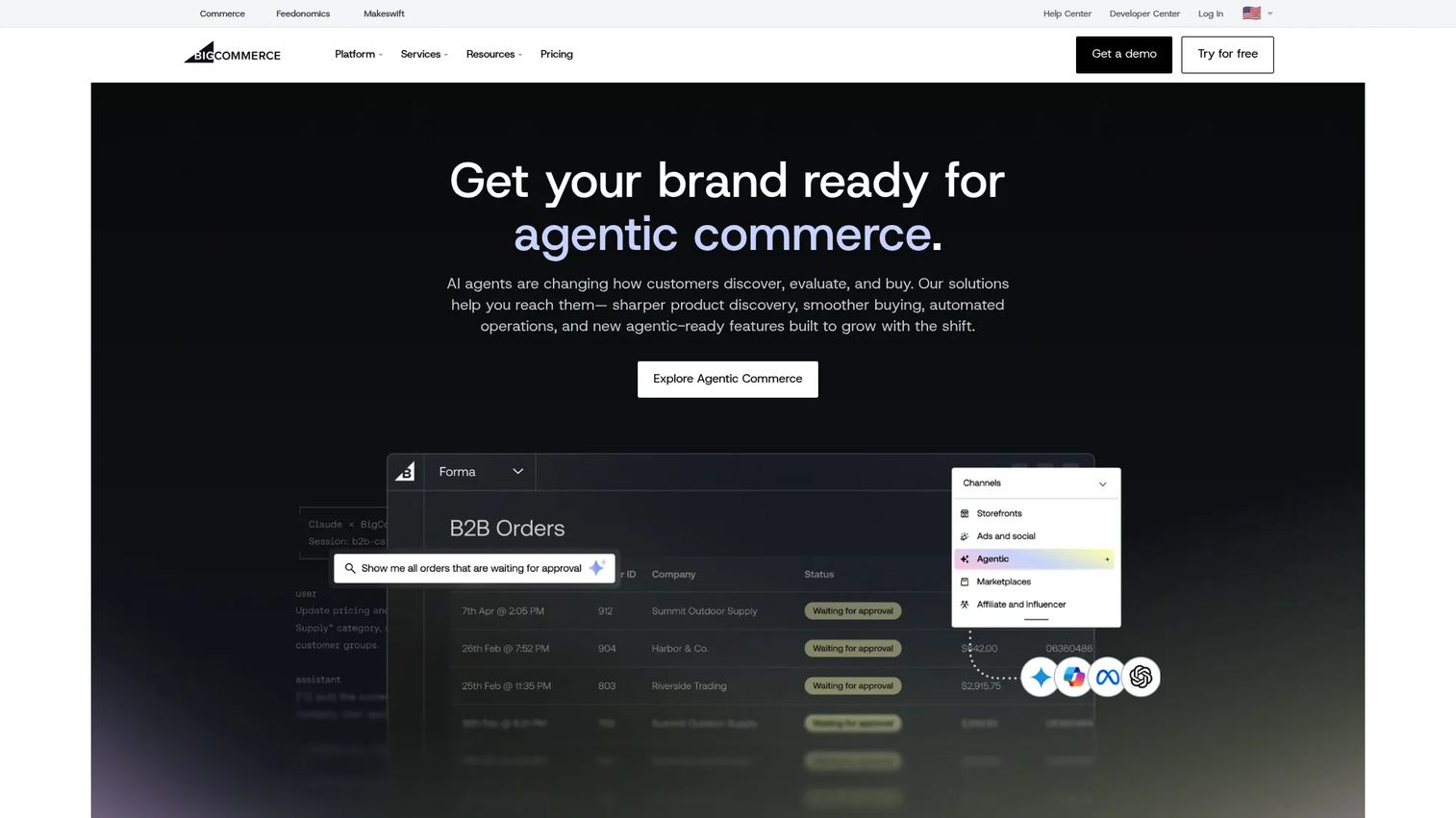
BigCommerce is built for brands that want more native commerce functionality without bolting on as many third-party apps. It includes B2B quoting, multi-storefront management, and headless commerce support as part of the platform, which reduces add-on costs for teams with complex catalogs or wholesale channels.
Best for: Growing ecommerce brands that need scalable mobile storefronts and native B2B or multi-storefront capabilities.
Key features
- Responsive storefront themes with mobile optimization
- Native B2B: Quoting, purchase orders, net terms, company accounts
- Multi-storefront management for different brands or regions
- Headless commerce with REST and GraphQL APIs
- Advanced product options and catalog management
Why choose BigCommerce: Teams moving away from app-heavy Shopify setups often find that BigCommerce covers more natively. Complex catalog builds and B2B workflow setup still require planning, but the platform's cost structure scales more predictably.
BigCommerce pricing: Core plan starts at $29/month billed annually, Growth at $79/month, Scale at $299/month, and Performance from $1,499/month for $1M+ annual sales. A 15-day free trial is available.
G2 rating: 4.2/5
3. WooCommerce
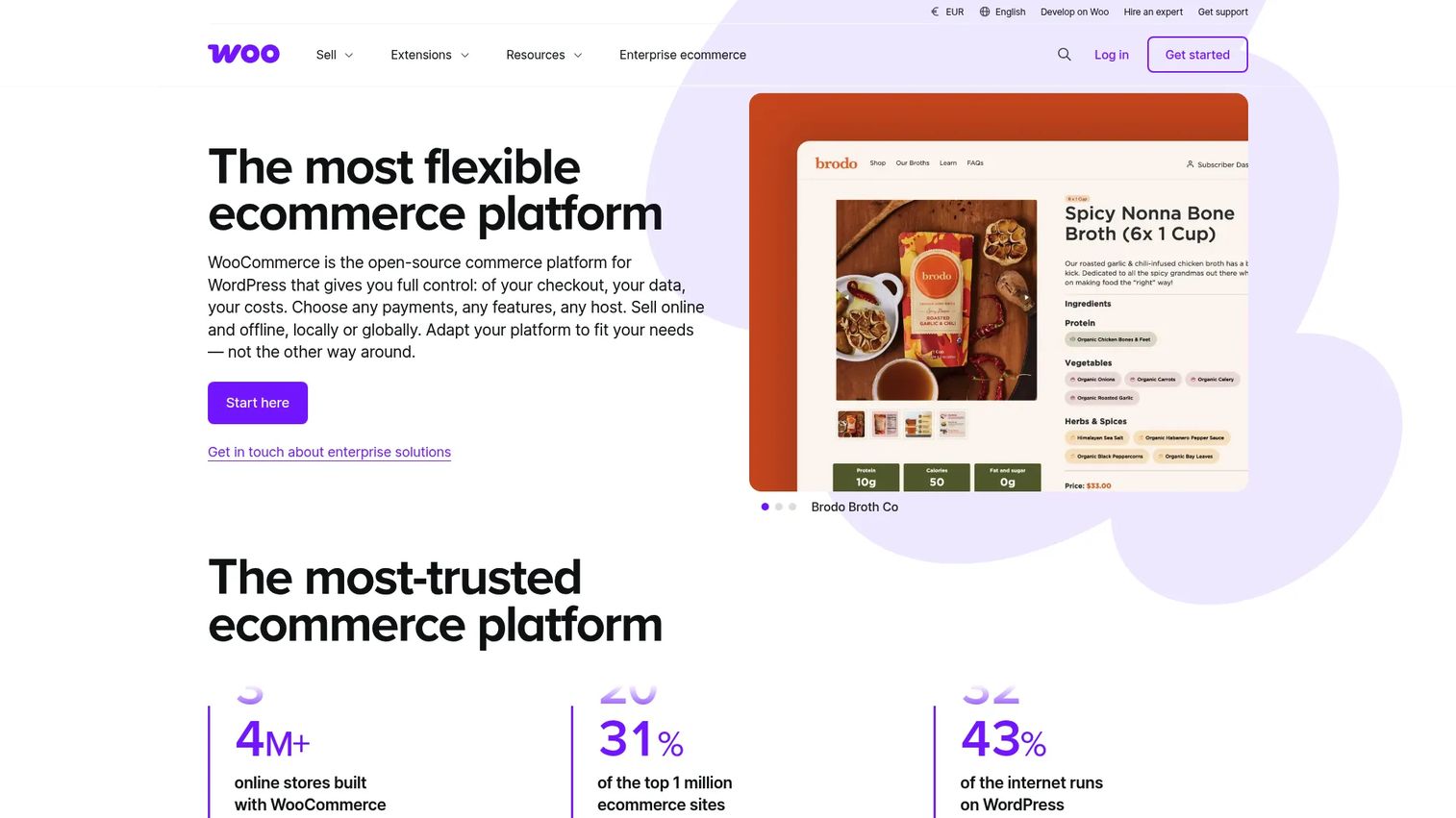
WooCommerce is a free, open-source ecommerce plugin for WordPress. It gives teams full control over their codebase, hosting environment, and data, with an extension marketplace covering payments, subscriptions, shipping, and analytics. The mobile storefront depends on the WordPress theme and hosting performance you choose.
Best for: WordPress teams that want flexible ecommerce control and already have the technical resources to manage hosting, performance, and plugin maintenance.
Key features
- Free WordPress ecommerce plugin with no platform fees
- Extensive extension marketplace for payments and functionality
- Product variations, subscriptions, bundles, and digital products
- REST API for custom integrations and headless builds
- Mobile management app for orders and inventory
Why choose WooCommerce: Full ownership of data and code is the draw. Growth marketers without developer support should budget for hosting, performance tuning, and mobile speed optimization, which add to the actual cost.
WooCommerce pricing: The core plugin is free. Hosting typically runs $25 to $350/month, and paid extensions range from $29 to $299/year depending on functionality.
G2 rating: 4.4/5
4. Adobe Commerce
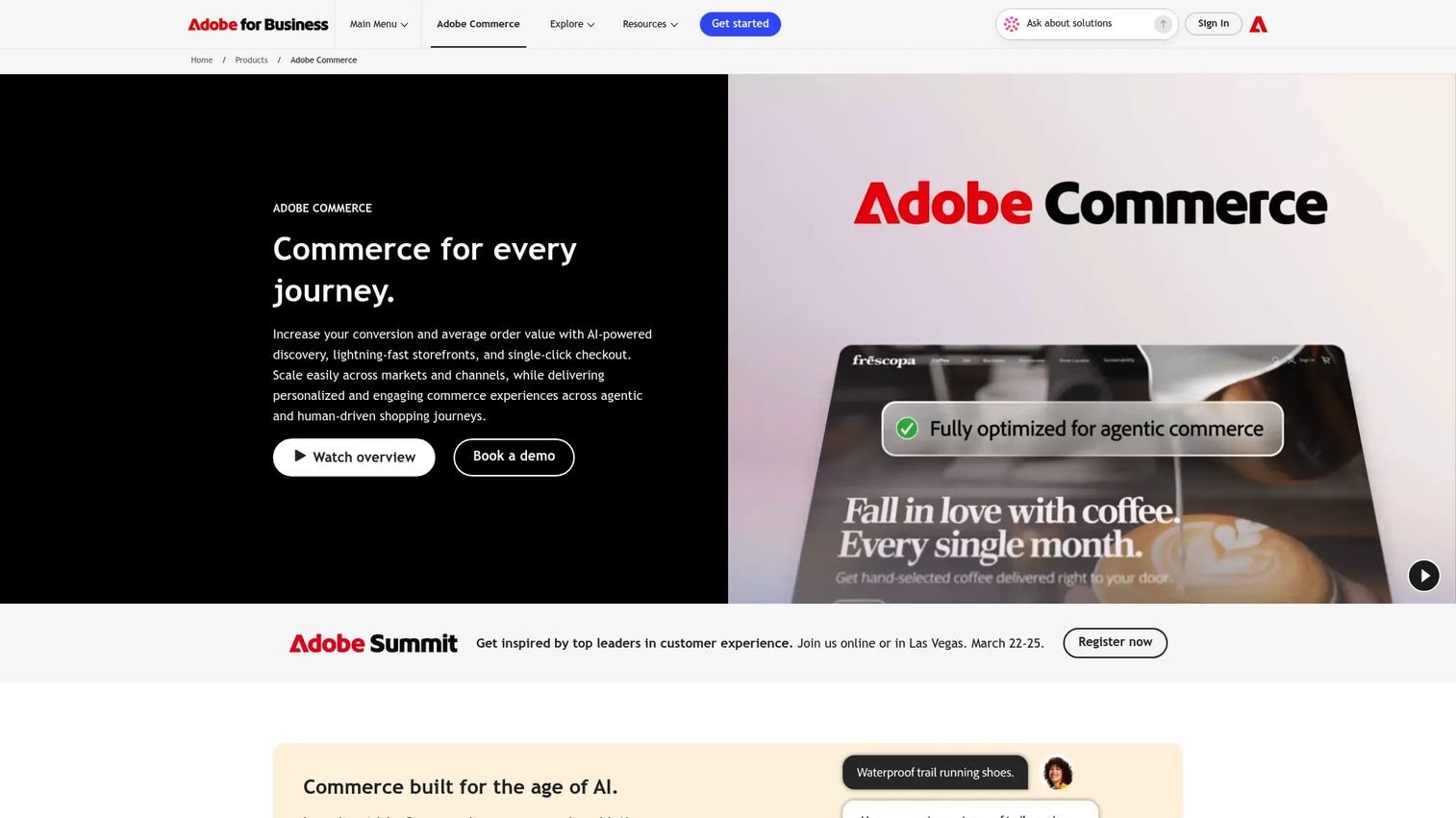
Adobe Commerce is an enterprise commerce platform for brands managing complex catalogs, multiple storefronts, and personalized buying experiences at scale. It integrates with Adobe Experience Cloud for content, analytics, and AI-powered personalization, making it a strong fit for retailers already invested in the Adobe stack.
Best for: Enterprise retailers with complex catalogs, multiple storefronts, and deep customization requirements.
Key features
- AI-powered product discovery and merchandising
- Lightning-fast and headless storefront options
- B2B commerce support alongside B2C
- Advanced promotions engine
- API extensibility for custom integrations
Why choose Adobe Commerce: The Adobe ecosystem alignment is the real advantage. Budget conversations should include implementation partner costs and ongoing maintenance, both of which are substantial.
Adobe Commerce pricing: Adobe offers SaaS, PaaS, and Commerce Optimizer editions. Contact Adobe for pricing on all editions.
5. Salesforce Commerce Cloud
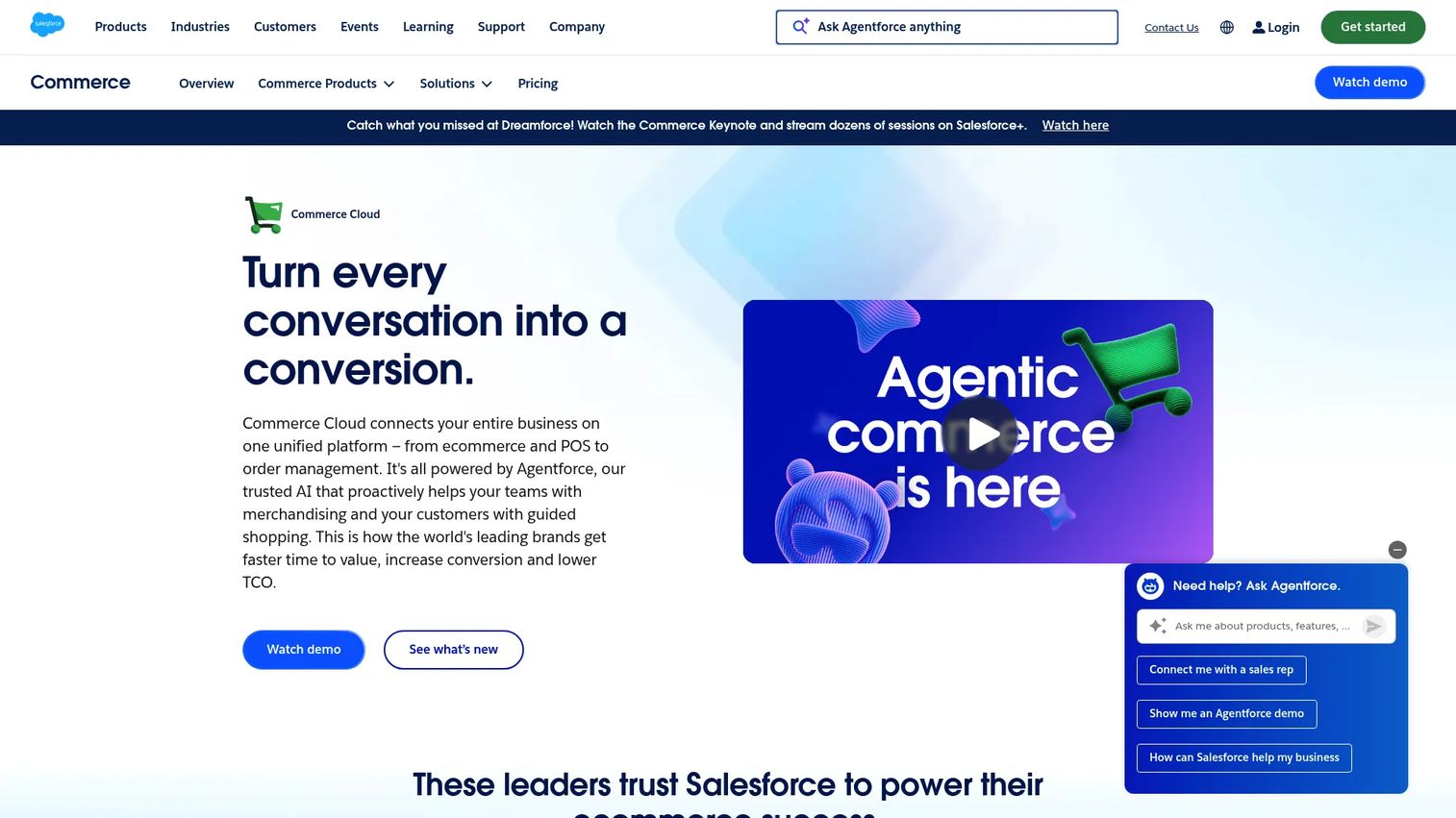
Salesforce Commerce Cloud, now also referred to as Agentforce Commerce, is an AI-powered enterprise commerce suite connecting B2C and B2B storefronts with CRM, order management, payments, and point of sale. For retailers already running Salesforce, it eliminates the integration work between commerce and customer data.
Best for: Enterprise retail teams already invested in Salesforce and needing commerce connected to customer, service, and marketing operations.
Key features
- B2C and B2B storefront support
- Order management with fulfillment routing, returns, and shipping
- AI-powered personalization, product recommendations, and page design
- Retail point-of-sale integration
- Enterprise-grade security and compliance controls
Why choose Salesforce Commerce Cloud: The CRM data connection is what separates it from standalone platforms. Procurement, implementation, and admin complexity require significant planning before sign-off.
Salesforce Commerce Cloud pricing: All editions are quote-based. B2B pricing is based on gross merchandise value. Contact Salesforce for a tailored quote.
6. commercetools
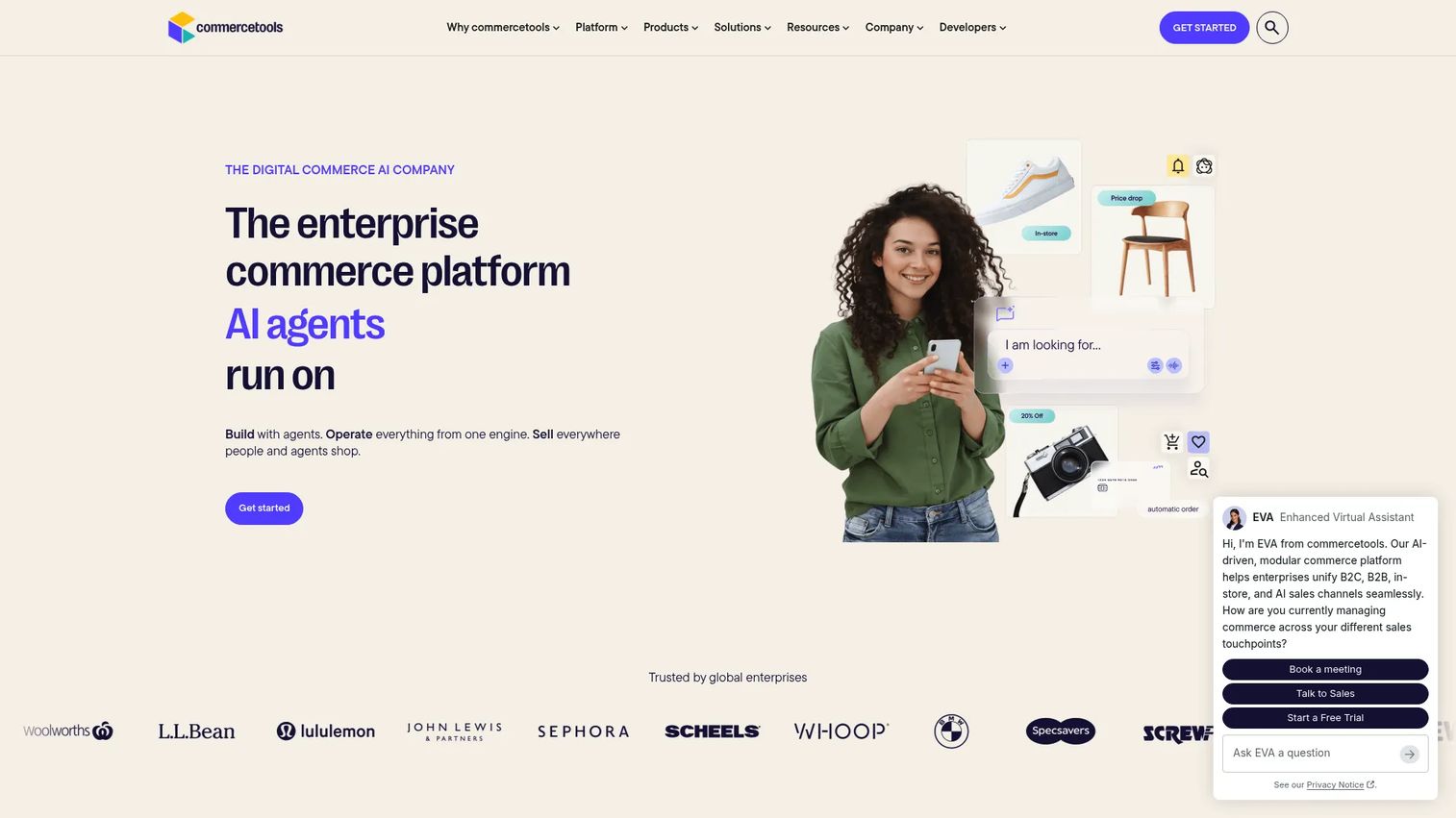
commercetools is an API-first composable commerce platform built for enterprise teams that want to assemble custom mobile and omnichannel experiences from independent services. Product catalog, cart, order management, checkout, and payment integrations are all exposed as separate APIs, so front-end teams can build any experience they need.
Best for: Enterprise teams building custom mobile commerce experiences across multiple front ends and channels.
Key features
- API-first architecture with REST and GraphQL APIs
- Product catalog management as a standalone service
- Cart, checkout, and order management APIs
- Composable integrations through the Merchant Center
- B2B, B2C, and B2X commerce support
Why choose commercetools: The flexibility to build differentiated buyer journeys is real. Teams need strong engineering and architecture ownership to get the most from it. This isn't a tool you configure; it's one you build on. Teams evaluating B2B ecommerce platforms with composable architectures will find commercetools a strong candidate.
commercetools pricing: Custom pricing. Contact commercetools directly. Free trials are mentioned on the site but prices are not shown.
G2 rating: 4.6/5
7. VTEX
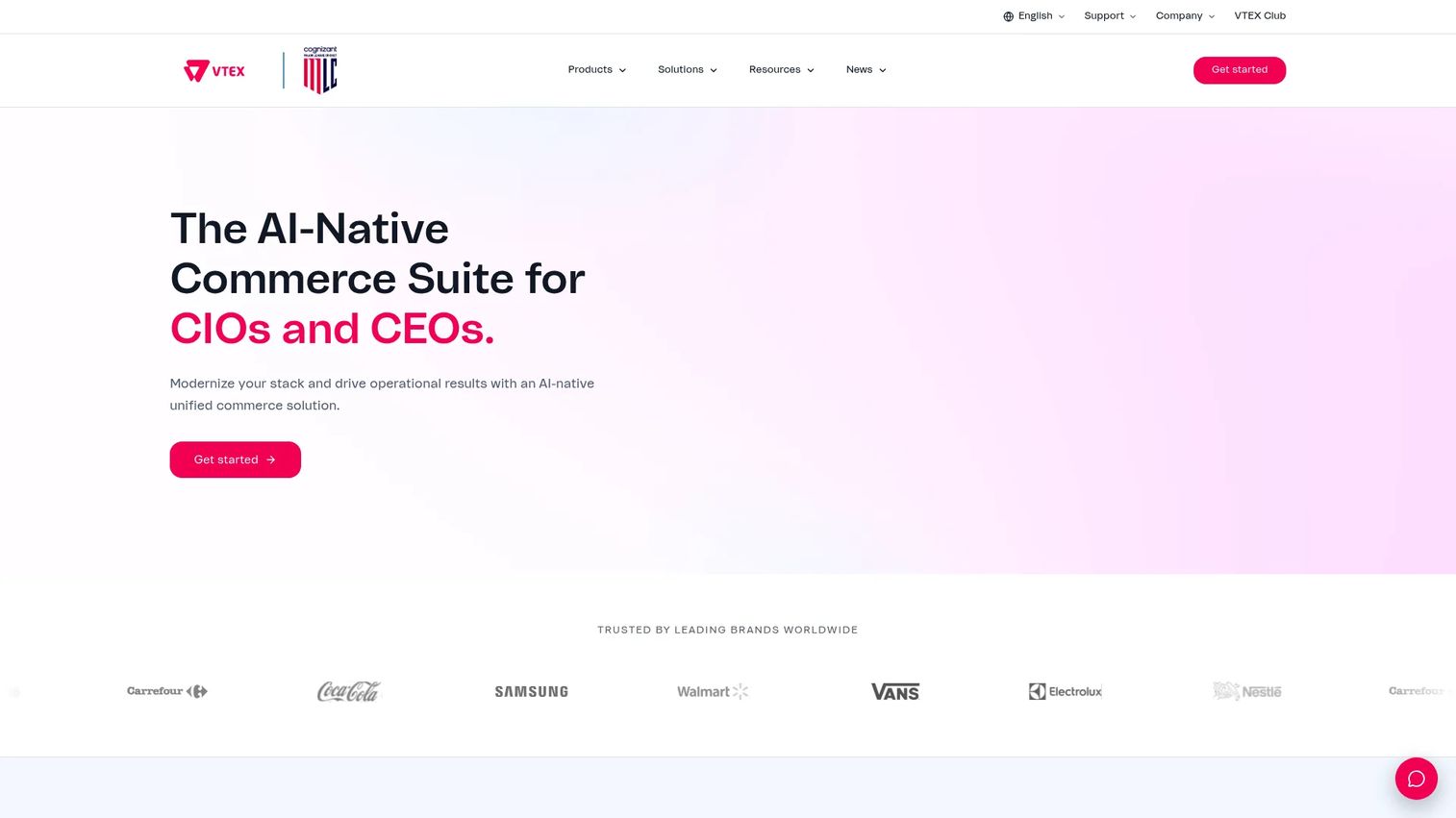
VTEX is an enterprise AI-native commerce suite covering B2B, B2C, marketplace, omnichannel, and retail media operations. Its native marketplace functionality, order orchestration, and headless front-end options (FastStore) make it suited for retailers operating across regions and seller models.
Best for: Large brands, retailers, manufacturers, and distributors that need scalable marketplace, B2B/B2C, and omnichannel commerce.
Key features
- Unified B2B and B2C commerce in one platform
- Native marketplace with seller management
- Headless commerce with FastStore
- Order orchestration and omnichannel operations
- AI-powered search and customer experience tools
Why choose VTEX: The marketplace capabilities are a genuine differentiator for retailers building multi-seller commerce programs. Implementation planning matters significantly for multi-region or multi-seller deployments.
VTEX pricing: Custom pricing. Contact VTEX sales for tailored implementation and subscription details.
G2 rating: 4.5/5
8. SAP Commerce Cloud
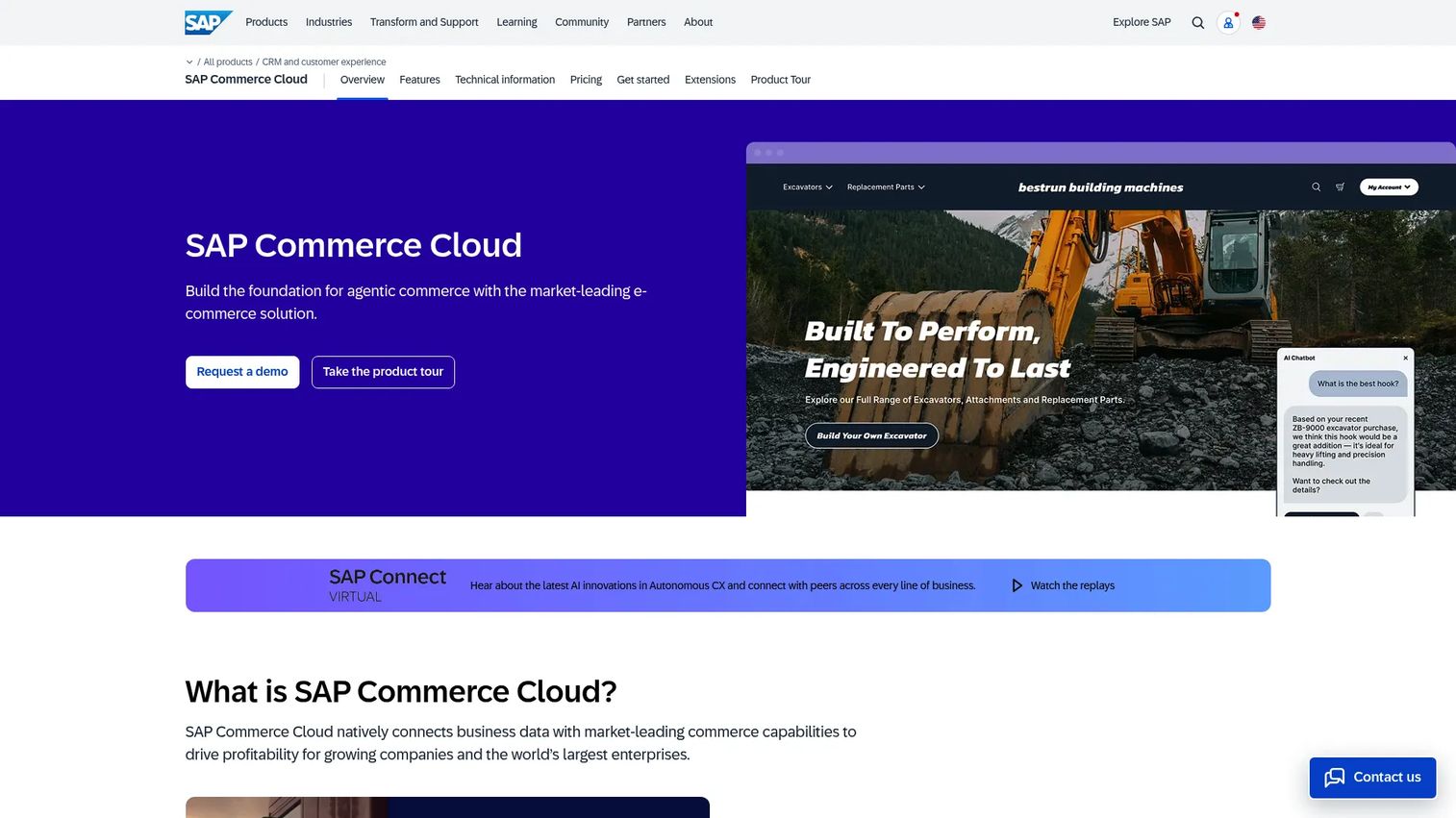
SAP Commerce Cloud is enterprise digital commerce software for companies already running SAP systems across finance, procurement, and supply chain. It handles B2B, B2C, and B2B2C business models with product catalogs, customer-specific pricing, promotions, and order workflows connected to SAP operations.
Best for: Large businesses that need commerce tied directly to SAP ERP, procurement, and supply chain operations.
Key features
- Enterprise catalog and product content management
- B2B commerce workflows with customer-specific pricing
- Composable storefronts with API-enabled front ends
- AI-enabled search, discovery, and recommendations
- Multi-business-model support across B2B, B2C, and B2B2C
Why choose SAP Commerce Cloud: For companies with deep SAP infrastructure, it reduces the integration work that standalone platforms require. Stakeholder alignment and implementation planning are major factors in any evaluation.
SAP Commerce Cloud pricing: Pricing is by request. SAP lists it under the Digital Selling and Engagement package with contract durations of 3 to 36 months.
G2 rating: 4.3/5
9. Elastic Path
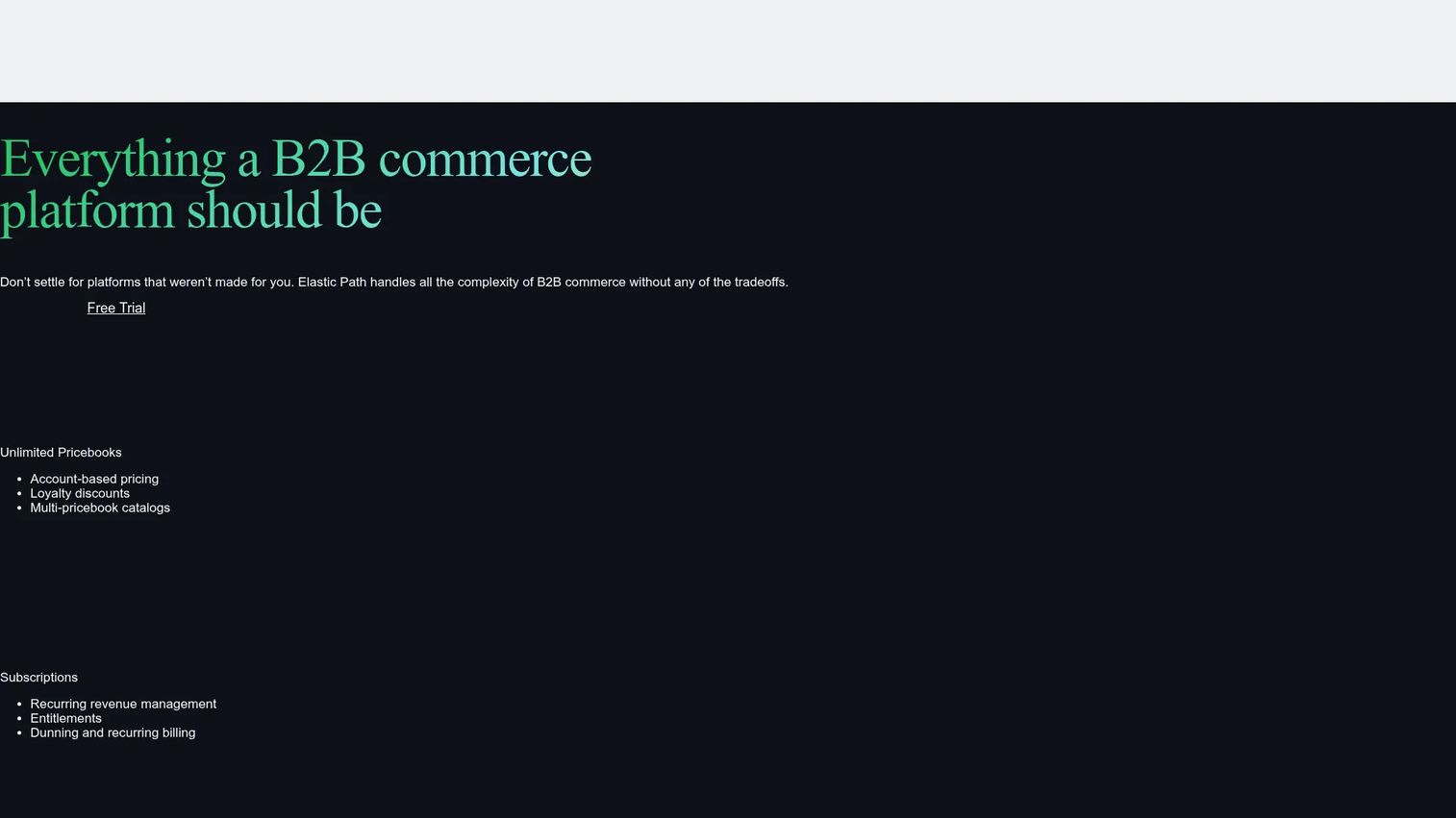
Elastic Path is a modular, API-first composable commerce platform for teams that need to build custom B2B, B2C, distributor, marketplace, and multi-geo commerce experiences. Its Product Experience Manager handles catalogs, bundles, variations, and pricing rules, while Composer connects integrations across the stack.
Best for: Mid-market and enterprise businesses building custom commerce journeys with complex catalogs, pricing, or B2B purchasing workflows.
Key features
- API-first, cloud-native MACH architecture
- Product Experience Manager: Catalogs, bundles, variations, pricing rules
- Composer integration and orchestration platform
- Flexible front-end support for any storefront framework
- Cart and checkout APIs for custom buyer journeys
Why choose Elastic Path: The modular approach lets teams adopt specific services without committing to a monolithic platform. Composable commerce requires disciplined architecture and integration planning to deliver on that promise.
Elastic Path pricing: Entry plan starts at $49,500/year for up to 15,000 orders or $5M GMV. Professional and Enterprise tiers are priced by volume. Contact Elastic Path for details.
10. Wix
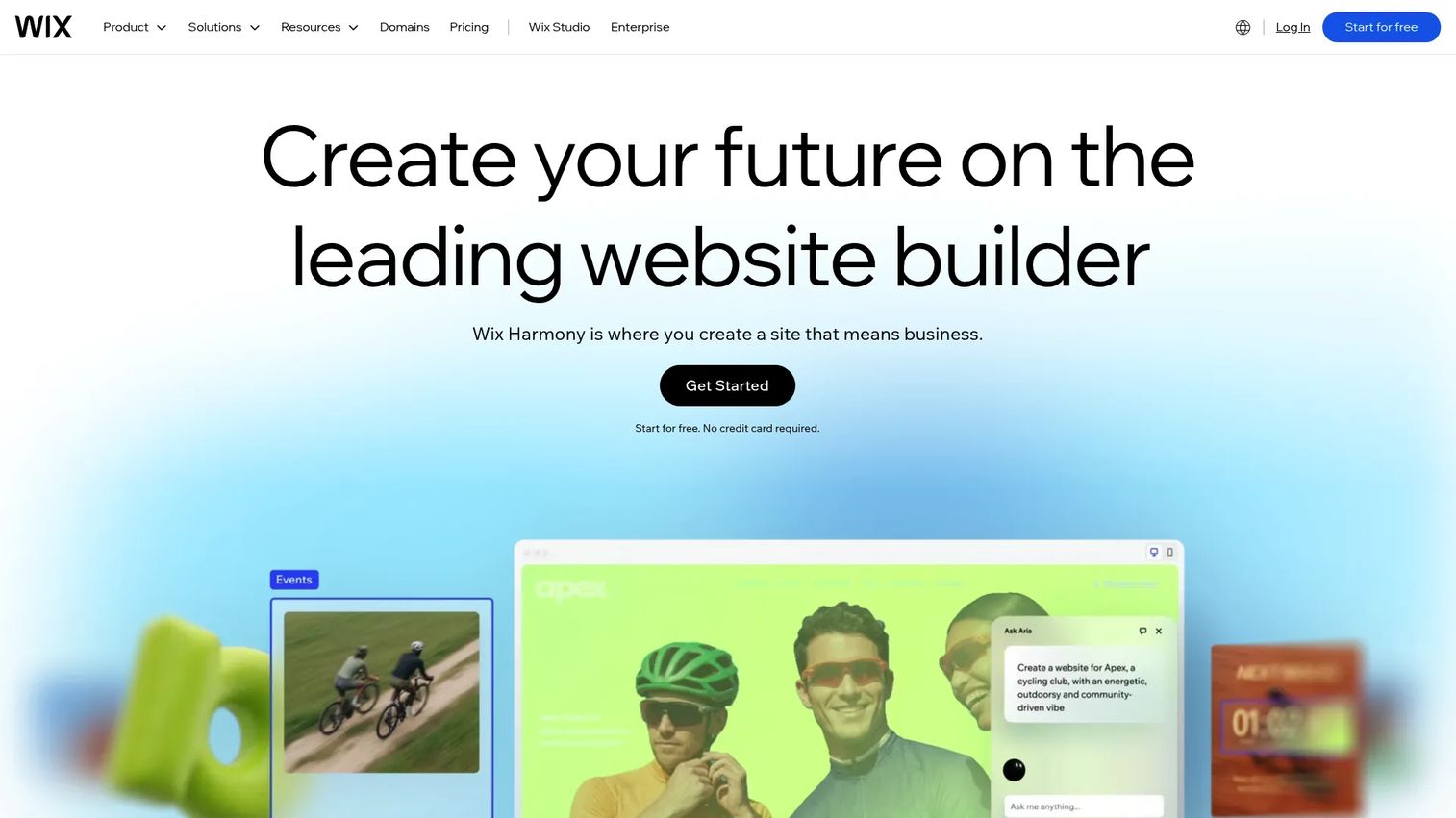
Wix is an AI-powered website and online store builder for small businesses and creators who need a mobile-ready storefront without development work. It includes a drag-and-drop editor, built-in ecommerce, payments, bookings, and marketing automations, all from a single platform. For teams evaluating the best ecommerce platform for small business, Wix is a strong starting point.
Best for: Small businesses and creators launching a mobile-friendly store quickly, without technical resources.
Key features
- Drag-and-drop site and store editor
- Mobile-ready templates and AI website builder
- Built-in ecommerce, bookings, and payments
- App Market integrations for marketing and analytics
- Built-in SEO tools
Why choose Wix: Speed to launch is the clear advantage for smaller teams. Scaling to complex catalogs, advanced B2B workflows, or high-volume operations will push teams toward a more specialized platform.
Wix pricing: Free plan available. Paid plans start from approximately $29.77/month (Business, billed annually). Prices vary by location and include GST.
G2 rating: 4.2/5
11. Squarespace

Squarespace is a design-led website and commerce platform for brands that prioritize visual presentation. Its templates are polished and mobile-responsive out of the box, and it handles physical goods, digital products, services, and subscriptions under one plan structure.
Best for: Design-led small businesses selling physical goods, services, or digital products where visual presentation drives conversion.
Key features
- Mobile-responsive templates and Blueprint AI website creation
- Website and store builder with no-code editor
- Product management, subscriptions, and service bookings
- Email campaign tools built in
- Built-in SEO and analytics
Why choose Squarespace: Strong visual defaults remove the need for a designer on day one. Teams needing advanced ecommerce operations, deep third-party integrations, or high-volume catalog management will outgrow it.
Squarespace pricing: Basic plan starts at $25/month (monthly billing) or $19/month billed annually. A 14-day free trial is available.
G2 rating: 4.4/5
12. Square Online
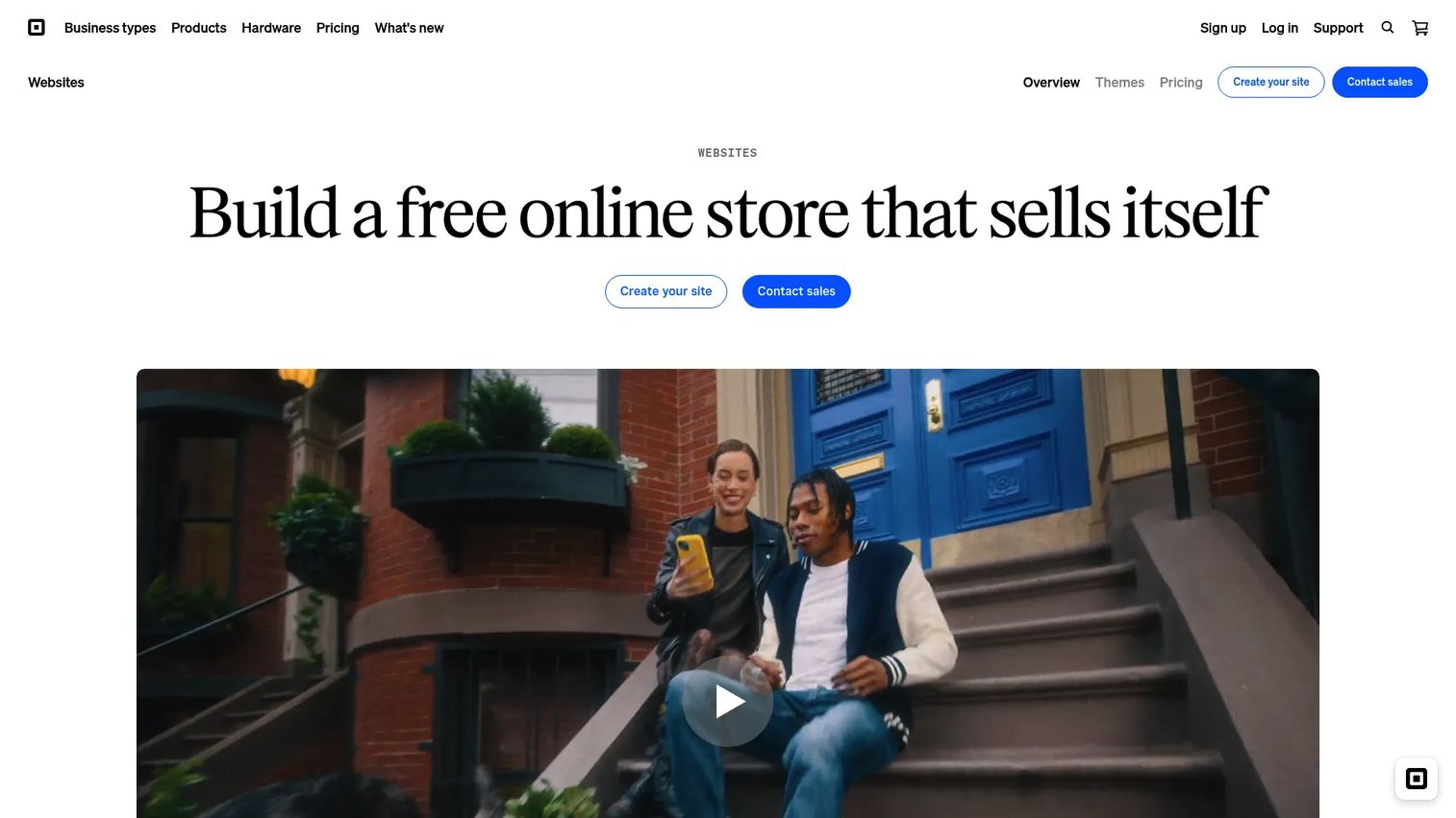
Square Online connects an online storefront directly to Square's payment and point-of-sale infrastructure. For local retailers, restaurants, and service businesses already using Square in person, it removes the need for a separate ecommerce platform and keeps inventory synchronized across channels.
Best for: Local retailers, restaurants, and service businesses connecting in-person Square POS with online sales.
Key features
- Square POS and inventory synchronization
- Online ordering with local pickup and delivery support
- Customer accounts and multiple payment types
- Social selling through Facebook and Instagram
- Subscriptions and advanced item settings on paid plans
Why choose Square Online: The POS connection is the primary reason to choose it. Teams outside the Square ecosystem should compare the platform against purpose-built ecommerce solutions before committing.
Square Online pricing: Free plan includes core online store features with a 2.9% + 30¢ per transaction fee. Plus plan is $29/month billed annually; Premium is $79/month billed annually with a lower processing rate of 2.6% + 30¢.
13. SHOPLINE
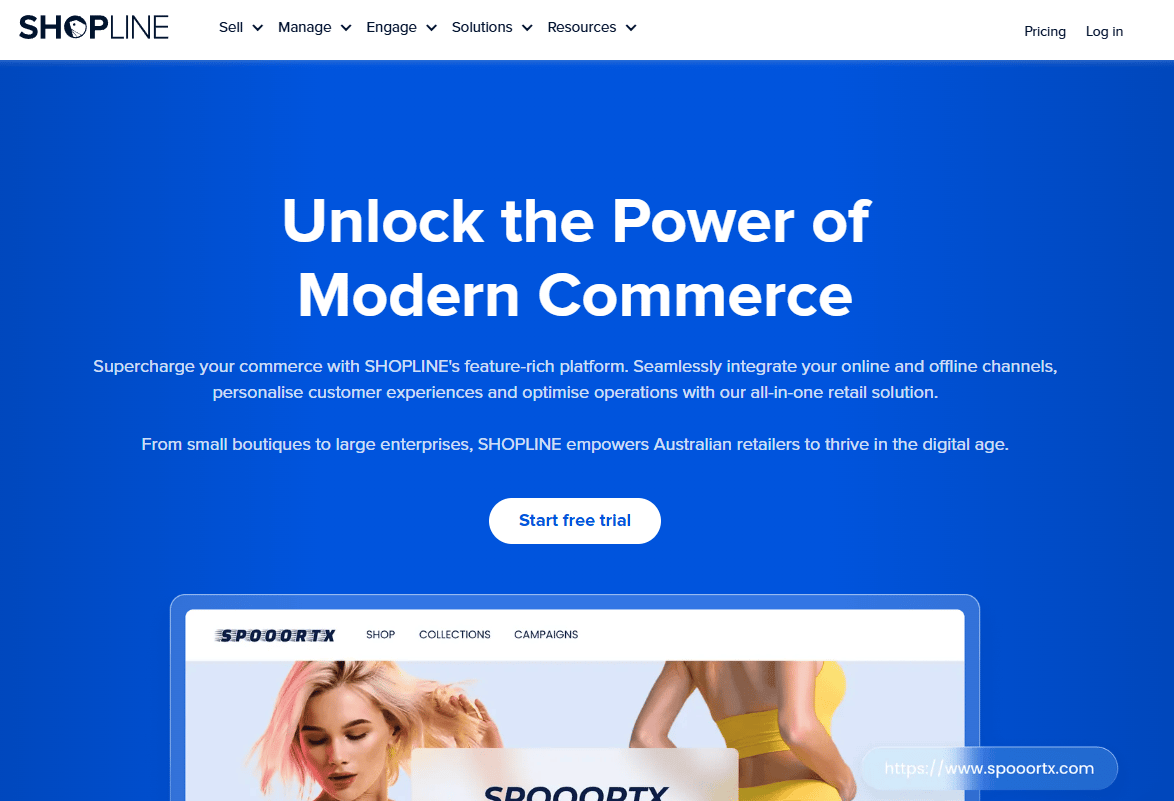
SHOPLINE is an all-in-one commerce platform that brings together online storefronts, social selling, POS, and marketplace channels in one system. Its built-in SmartPush marketing automation and AI tools support campaigns across channels without requiring a separate marketing platform.
Best for: Brands that want online store, social commerce, and omnichannel selling capabilities under one subscription.
Key features
- Online store, checkout, and inventory management
- Multi-channel selling across social, POS, and marketplaces
- SmartPush built-in marketing automation
- Built-in AI tools for store management
- Payments and checkout included
Why choose SHOPLINE: The combination of storefront, social selling, and POS in one plan appeals to brands trying to reduce tool count. Verify regional availability and integration depth before committing, as coverage varies by market.
SHOPLINE pricing: Starter plan starts at $24/month billed annually ($29/month monthly). Essential is $66/month annual ($79 monthly). Premium is $224/month annual ($269 monthly). Enterprise is custom. A 14-day free trial is available.
G2 rating: 4.5/5
14. Tapcart
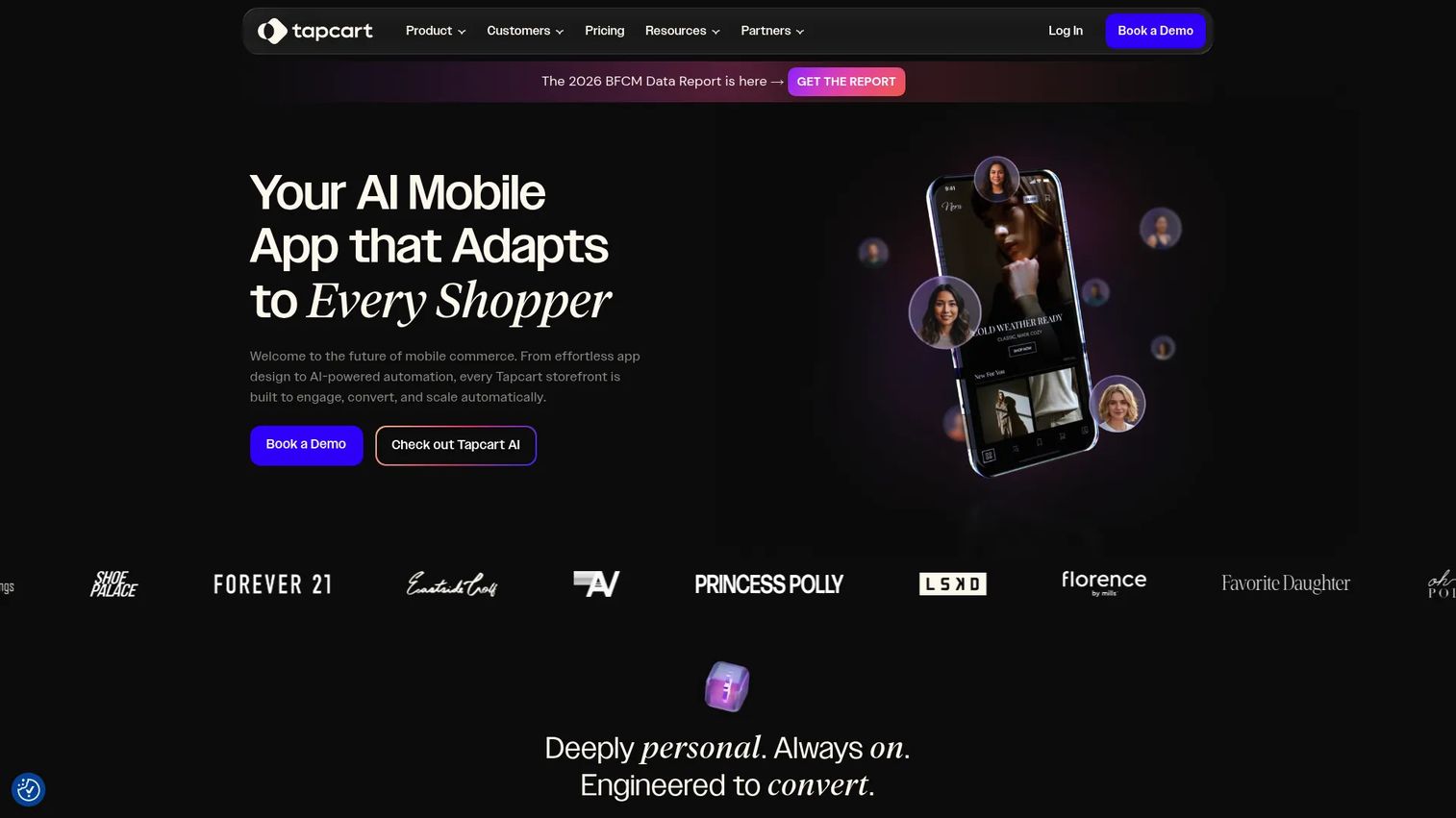
Tapcart is a no-code mobile app builder built specifically for Shopify merchants. It lets brands create branded iOS and Android shopping apps without development work, with push notifications, audience segmentation, and in-app order tracking included.
Best for: Shopify brands with repeat customers and a clear reason for users to install a dedicated app.
Key features
- No-code drag-and-drop app builder for Shopify
- Push notifications with automated campaigns
- Audience segmentation for personalized content
- In-app order tracking and loyalty experiences
- Developer tools including Tapcart CLI and App Studio SDK
Why choose Tapcart: Speed to a branded app is the main draw for Shopify merchants. A mobile app needs a retention strategy, ongoing creative upkeep, and a genuine reason for customers to install it. Teams exploring best mobile marketing software alongside an app builder will find push notification strategy critical to app ROI.
Tapcart pricing: Custom pricing. Visit tapcart.com/pricing or contact their team for current plan details and feature tiers.
G2 rating: 4.2/5
15. Appbrew
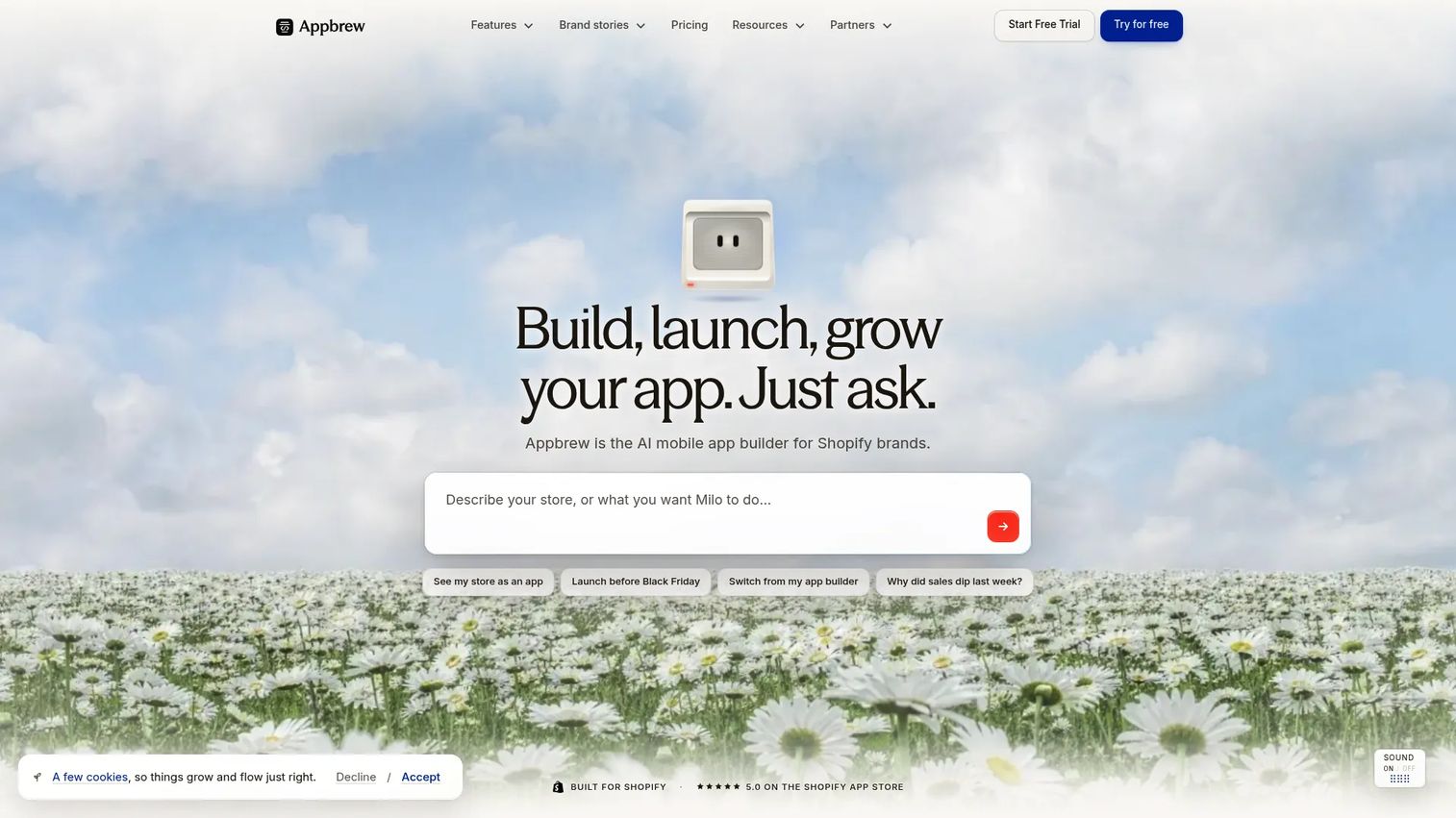
Appbrew is an AI-powered Shopify mobile app builder that turns Shopify and Shopify Plus stores into native iOS and Android apps. Its AI growth assistant Milo adds personalization, A/B testing, and AI-powered search on top of the native app experience.
Best for: Shopify and Shopify Plus brands seeking a managed native shopping app with AI-powered personalization and growth tools.
Key features
- Native iOS and Android apps with real-time Shopify sync
- AI growth assistant (Milo) for personalization and recommendations
- Push notifications included on all plans
- A/B testing and app analytics
- Subscriptions and post-purchase experiences
Why choose Appbrew: The AI personalization layer on top of a native app is a differentiator for brands with enough data to run experiments. Marketers need enough repeat traffic and retention potential to justify the monthly investment.
Appbrew pricing: Starter plan is $199/month, Pro is $599/month, and Enterprise is custom. A free plan is available via the Shopify App Store.
G2 rating: 4.7/5
16. MobiLoud

MobiLoud converts existing ecommerce or content websites into branded native iOS and Android apps. Rather than rebuilding a product from scratch, it wraps your existing site into a managed app with push notifications, custom branding, and full feature parity with the web version.
Best for: Brands that want an app version of an existing ecommerce site without rebuilding from scratch or hiring app developers.
Key features
- Website-to-app conversion for iOS and Android
- Push notifications and audience targeting
- Single-codebase sync between website and app
- Multi-language and multi-currency support
- App Store and Google Play submission support
Why choose MobiLoud: The fastest path to a native app for brands satisfied with their current site experience. The app quality is directly tied to how well the existing site performs on mobile, so fix the storefront first.
MobiLoud pricing: Business plan starts at $1,499/month (or $1,274/month billed annually), including up to 10,000 monthly active users. A one-time development and submission fee also applies. Enterprise pricing is custom based on active-user volume.
G2 rating: 4.9/5
17. Shopgate
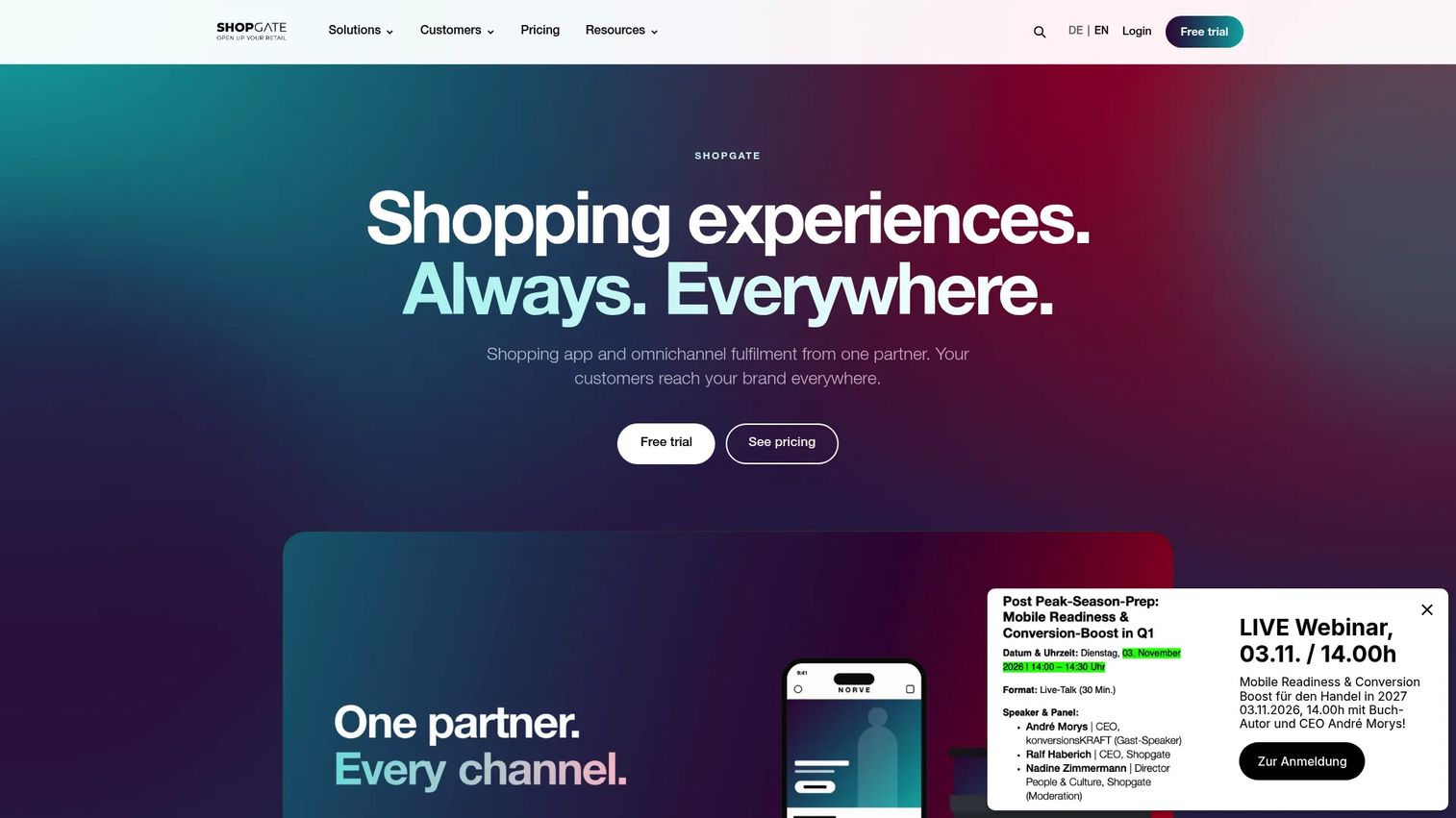
Shopgate provides shopping apps and omnichannel commerce software for retailers that need branded mobile apps alongside in-store capabilities like Click & Reserve, Click & Collect, and ship-from-store. It supports Shopify, Shopify+, Shopware, and Adobe on different plan tiers.
Best for: Retailers that need a mobile shopping app connected to in-store operations and omnichannel commerce workflows.
Key features
- iOS and Android shopping apps
- Push notifications and marketing tools
- Click & Reserve and Click & Collect functionality
- In-store availability and ship-from-store support
- Clienteling and in-store fulfillment tools
Why choose Shopgate: The omnichannel retail features beyond push notifications are the differentiator. Evaluate integration fit with your existing commerce platform and assess ongoing app management requirements before signing.
Shopgate pricing: Starter plan is €299/month (excluding VAT, billed monthly). Growth is €799/month. Enterprise starts from €1,499/month. A 30-day free trial is available.
G2 rating: 4.0/5
18. Shopney
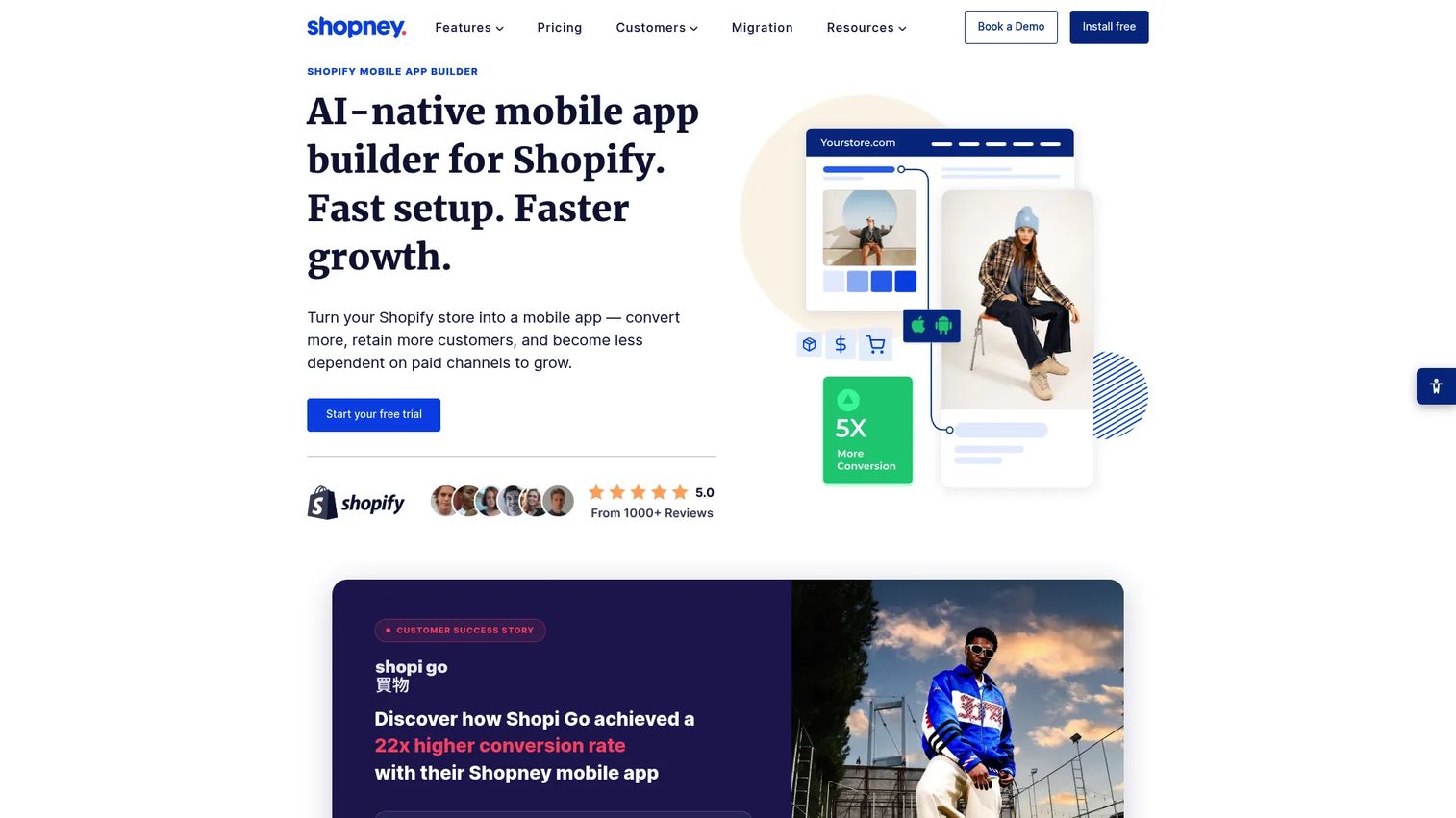
Shopney is a Shopify and Shopify Plus mobile app builder for creating branded native iOS and Android shopping apps using a drag-and-drop editor. It includes segmented push notifications, in-app chat, multi-currency support, and product recommendation integrations.
Best for: Shopify merchants launching a branded app without heavy development work, particularly those with loyalty or repeat-purchase audiences.
Key features
- Drag-and-drop mobile app design editor
- Segmented and AI-powered push notifications
- In-app chat and marketing automation
- Shopify integrations with multi-currency and localization
- Product recommendation integrations with Rebuy and Nosto
Why choose Shopney: Accessible app creation for Shopify merchants is the core pitch. App ROI depends on repeat purchase frequency and a clear retention plan, so model that before committing to a monthly subscription.
Shopney pricing: Silver plan starts at $149/month. Gold is $299/month. Platinum is $599/month. Enterprise starts from $1,299/month. No commissions or long-term commitments. A 30-day free trial is available.
G2 rating: 4.8/5
19. Vajro
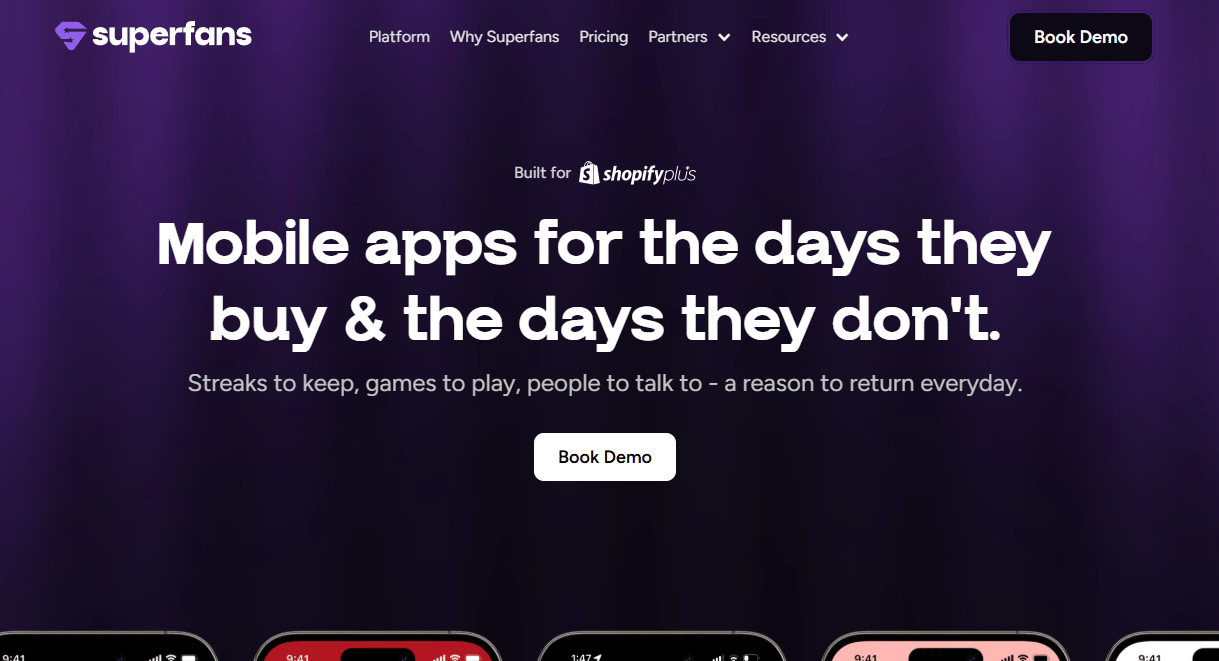
Vajro, now presented as Superfans, is a mobile app builder for Shopify merchants focused on branded shopping apps with live selling, loyalty, and behavioral push notifications. The platform positions around high-engagement mobile commerce with a single unlimited plan.
Best for: Shopify merchants that want mobile apps with live selling and loyalty engagement features.
Key features
- Branded mobile shopping app for Shopify
- Behavior-based push notifications
- Interactive live selling with livestream replays
- Drag-and-drop app design with customizable themes
- Loyalty and engagement features
Why choose Vajro: The live selling capability is a differentiator for brands running product drops or community-driven commerce. Brands need a content cadence and a clear retention strategy to make live selling features pay off at this price point.
Vajro pricing: One unlimited plan at $1,000/month covering the full feature set, unlimited push notifications, integrations, and dedicated support.
20. GoodBarber
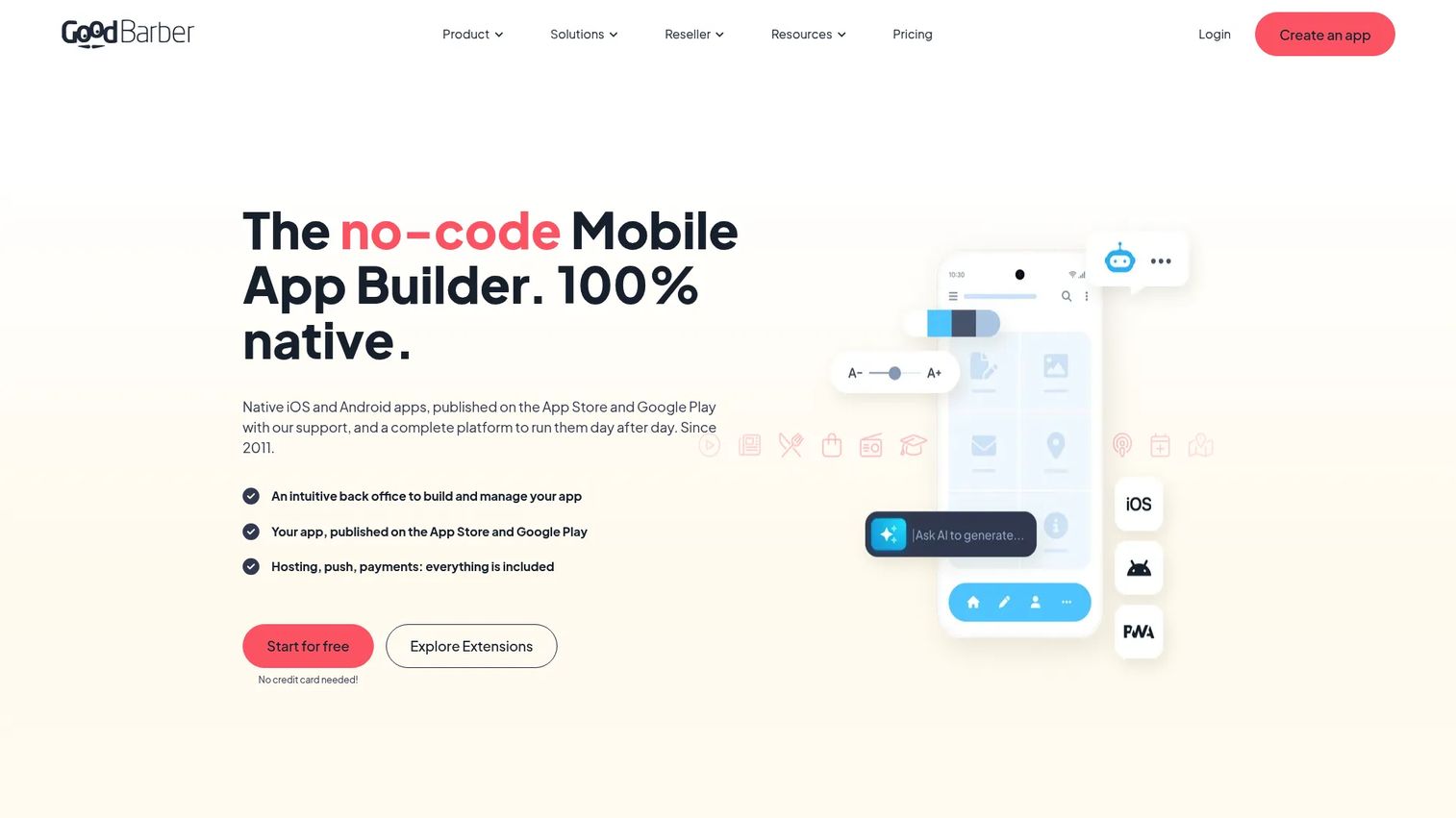
GoodBarber is a no-code platform for building native iOS and Android apps plus progressive web apps. The eCommerce plan adds a shopping app layer with product catalog, payments, push notifications, and 190+ extensions. It suits small businesses and agencies that want app publishing without custom development.
Best for: Small businesses, publishers, and agencies that need a shopping app without coding or a large monthly budget.
Key features
- Native iOS, Android, and progressive web app creation
- Drag-and-drop back office and CMS
- Push notifications and eCommerce capabilities
- 190+ extensions for added functionality
- Built-in AI tools
Why choose GoodBarber: Accessible entry point for small teams wanting a branded app. Larger commerce teams with deep platform integrations may find the extension ecosystem limiting compared to Shopify-native builders.
GoodBarber pricing: eCommerce plan is $40/month billed annually. Content plan is $30/month annually. Reseller plan is $215/month annually. A 30-day free trial is available. Prices may vary by location.
G2 rating: 4.2/5
21. Poq
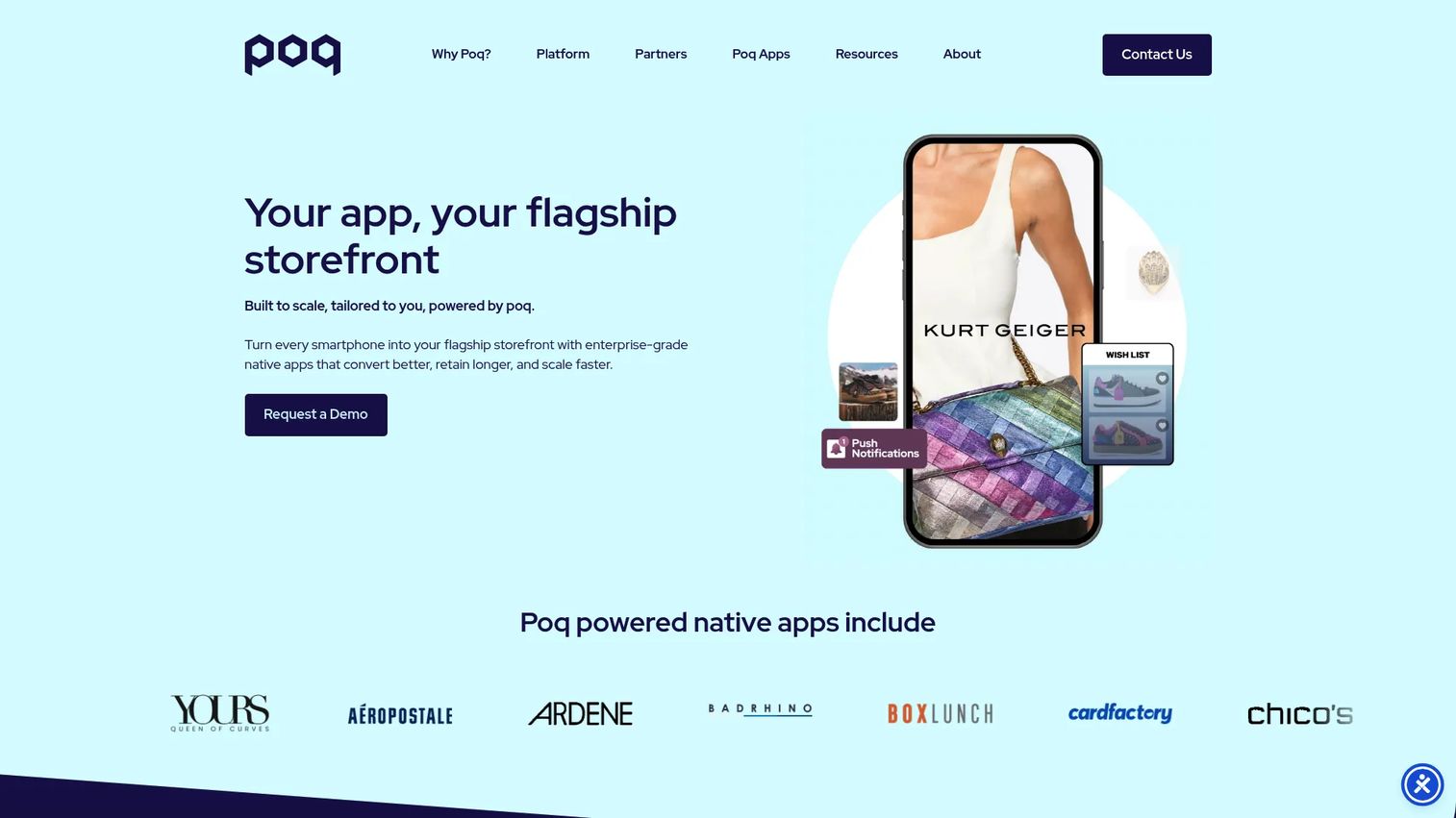
Poq is an enterprise native mobile app platform for established retailers investing in mobile as a strategic revenue channel. It handles product listings, cart, checkout, search, wishlist, reviews, BOPIS, store finder, and push notification management, with personalization integrations built for high-volume retail.
Best for: Enterprise retailers building a high-scale branded native shopping app with omnichannel retail features.
Key features
- Native iOS and Android commerce apps
- Dynamic content and journey orchestration
- BOPIS, store finder, and in-store mode
- Push notification management and personalization integrations
- App performance analytics
Why choose Poq: The platform is built for retailers with enough mobile revenue potential to justify enterprise-grade investment. It fits mature teams with a clear app strategy, dedicated technical resources, and a multi-year mobile roadmap.
Poq pricing: Custom pricing. Contact Poq for implementation model and subscription details.
G2 rating: 4.6/5
Considerations when choosing mobile e-commerce software
Start with the software type
Before evaluating individual vendors, decide which category you need. A full commerce platform, a native app builder, a composable architecture, and a POS-connected storefront serve completely different jobs. Choosing the wrong type wastes budget and creates tech debt. Map your primary revenue driver first, then shortlist vendors within that category.
Check mobile checkout performance
Checkout is where mobile revenue is won or lost. Evaluate wallet support (Apple Pay, Google Pay), guest checkout, address autocomplete, abandoned cart recovery, and payment method breadth. Slow checkout pages or mandatory account creation before purchase are conversion killers that no amount of marketing spend can overcome.
Map the integration workload before demos
List every required connection: CRM, email, SMS, analytics, ERP, inventory, shipping, loyalty, reviews, and customer support. Integration gaps surface as hidden costs after signing. A platform with great checkout but no native connection to your attribution stack means another custom build or middleware subscription.
Calculate total cost of ownership honestly
Subscription fees are the floor, not the ceiling. Add transaction fees, app marketplace subscriptions, premium themes, implementation partner hours, developer time, app-store maintenance, and annual renewals on extensions. Enterprise platforms add procurement, legal review, and dedicated implementation costs. Marketers defending spend to leadership need the full number, not just the advertised plan price. For a deeper look at best ecommerce personalization software costs as add-ons, factor those in separately.
Verify analytics and attribution quality
Growth teams need reporting that connects mobile sessions, app opens, campaign clicks, checkout events, and revenue in one view. If the platform's analytics can't do that natively, you're adding another tool to bridge the gap. Ask vendors specifically how their data connects to your existing attribution stack before signing. Teams already evaluating best mobile attribution platforms should confirm compatibility early.
Conclusion
The 21 tools in this guide cover distinct jobs. Shopify and BigCommerce handle the broadest range of mobile commerce needs for SMB through mid-market brands. WooCommerce gives WordPress teams full ownership. Adobe Commerce, Salesforce Commerce Cloud, SAP Commerce Cloud, and VTEX serve enterprise operations with different ecosystem advantages. commercetools and Elastic Path suit engineering-led teams building composable architectures.
For branded native apps, Tapcart, Appbrew, Shopney, and Vajro cover Shopify merchants at different price points. MobiLoud and Shopgate offer broader platform compatibility. GoodBarber suits smaller teams with tighter budgets. Poq handles enterprise-scale retail apps. Wix, Squarespace, Square Online, and SHOPLINE serve smaller or social-first commerce programs where simplicity and channel breadth matter more than customization depth.
Shortlist by platform type first, then validate pricing against total cost of ownership, check integration depth against your existing stack, and request mobile conversion data from current customers before finalizing. The right tool reduces execution dependency and proves revenue impact. The wrong one adds a channel that can't be attributed and a subscription that's hard to cancel.
Start your journey with Guideflow today!
FAQs
Mobile e-commerce software helps businesses sell products through mobile-optimized storefronts, native shopping apps, checkout flows, and connected commerce operations. The category spans full ecommerce platforms, native app builders, enterprise commerce clouds, and headless or composable architectures, each solving a different job in the commerce stack.
A full ecommerce platform manages the entire store backend: Product catalog, inventory, checkout, payments, and order management, with a mobile-responsive storefront included. A native app builder creates a separate iOS and Android shopping app that typically connects to an existing platform like Shopify. The two are complementary, not interchangeable, and most brands need a platform before they need an app.
A native app makes sense when your customers buy more than once and have a reason to install. Strong candidates include subscription brands, loyalty-program retailers, and mobile-first audiences with high repeat purchase rates. If most revenue comes from one-time purchases or paid acquisition, improving the mobile storefront checkout will deliver faster ROI.
Shopify, Wix, Squarespace, Square Online, WooCommerce, and SHOPLINE all suit small businesses, with different strengths. Shopify offers the broadest ecosystem. Wix and Squarespace prioritize speed and design. Square Online fits businesses already using Square for in-person payments. WooCommerce works well for teams with WordPress expertise. SHOPLINE combines online and social selling in one plan.
Adobe Commerce, Salesforce Commerce Cloud, SAP Commerce Cloud, VTEX, commercetools, Elastic Path, and Poq serve enterprise commerce at different layers. Salesforce Commerce Cloud fits teams already on Salesforce. SAP Commerce Cloud suits companies running SAP operations. VTEX handles multi-seller marketplace programs. commercetools and Elastic Path work for composable builds. Poq covers enterprise retail apps. Enterprise buyers should prioritize integrations, governance, and implementation partner fit above feature lists.
Costs vary widely by type. Responsive commerce platforms start from $24 to $39/month and scale into thousands for enterprise tiers. Composable platforms can start at $49,500/year for entry-level volume. Native app builders range from $40/month to $1,499/month or more. Enterprise platforms are quote-based. Add transaction fees, extension subscriptions, implementation, hosting, and app-store maintenance to any headline price before budgeting.
Page speed and checkout performance matter most. Specifically: Wallet payment support (Apple Pay, Google Pay), guest checkout, address autocomplete, abandoned cart recovery, mobile-optimized product search, and product media quality. Push notifications and personalization improve retention but only after the base conversion rate is solid.
Connect the choice to revenue metrics before shortlisting. The relevant numbers are conversion rate on mobile traffic, average order value, repeat purchase rate, CAC, ROAS, and LTV. Evaluate integration quality against your attribution stack, calculate total cost of ownership including all add-ons, and ask each vendor how their analytics connect campaign spend to mobile revenue. If they can't answer that clearly, the tool becomes another reporting gap. For broader context on commerce software options, the best ecommerce platforms guide covers the full market beyond mobile-specific tools.