Your buyers stopped waiting for a sales rep. In 2026, 67% of B2B buyers will spend $50,000 or more online without ever talking to a salesperson, according to McKinsey-reported market data cited by Uncap. The global B2B ecommerce market hit $24.1 trillion in 2025 and is growing at a 20.9% CAGR through 2033, per Grand View Research.
That shift breaks most commerce stacks. A B2C-first cart can take an order, but it cannot handle a 14-step approval chain, customer-specific pricing across 400 accounts, or a quote that needs to sync back into your ERP. The real question is not "can this platform sell." It is "can this platform handle B2B complexity without forcing a rebuild in 18 months."
This guide is a buying framework, not a directory. We compare eight B2B ecommerce platforms by business model fit, integration readiness, and operational reality. If you are evaluating tools further down the funnel, our roundups of the best CPQ software and the best CRM software pair well with this one, since pricing logic and account data live in those systems. For lead and account targeting, our guide to account based marketing is a useful companion.
Sales enablement and RevOps teams should care here too. The commerce stack shapes rep talk tracks, demo flows, and competitive positioning. Pick wrong, and enablement inherits the confusion.
What's inside
This is a B2B ecommerce platform comparison for teams replatforming or buying their first dedicated B2B commerce platform. It is built for operators at wholesalers, manufacturers, distributors, and B2B2C sellers who need pricing logic, account hierarchies, and deep integrations, not just a checkout.
We selected and evaluated each platform on four criteria that decide real outcomes: native B2B functionality (RFQ, CPQ, account-specific pricing, approvals), integration depth (ERP integration, CRM integration, PIM integration, WMS integration), architecture model (native, headless, or composable commerce), and fit by business model. Pricing and G2 ratings are included where publicly verifiable.
TL;DR
- Best for fast deployment and mid-market B2B: BigCommerce, with B2B Edition, account-level pricing, and self-service ordering.
- Best for enterprise customization depth: Adobe Commerce, when you have strong internal development resources.
- Best B2B-native platform for manufacturers, wholesalers, and distributors: OroCommerce, built around RFQ, account hierarchy, and multi-org.
- Best for composable and B2B2C flexibility: Virto Commerce and commercetools, both API-first.
- Best for blended B2C and B2B teams: Shopify Plus, for speed and ease of use.
- Best for SAP-native enterprises: SAP Commerce Cloud.
- Best simple wholesale ordering portal: B2B Wave, the fastest path to value for lean teams.
What is a B2B ecommerce platform?
A B2B ecommerce platform is commerce software built to sell products and services to other businesses, handling the pricing logic, account structures, and approval workflows that B2C carts were never designed for. It is the difference between taking an order and operating a buying relationship.
Unlike consumer ecommerce, B2B commerce platforms must support buying committees, negotiated pricing, and back-office systems that hold the real source of truth. That means tight ERP, CRM, PIM, and WMS connections, not bolt-ons.
Core capabilities of B2B ecommerce software include:
- Account hierarchy and role-based access: parent and child accounts, buyer roles, spending limits, and delegated purchasing with granular access control.
- Customer-specific pricing: contract pricing, price lists, volume tiers, and pricing and quoting workflows per account.
- RFQ and CPQ: request-for-quote flows, configure-price-quote logic, and quote-to-order conversion.
- Self-service ordering: quick order, bulk upload, saved lists, reorders, and approval routing.
- Integration depth: native or API-first connections to ERP, CRM, PIM, and WMS systems.
- Architecture options: native, headless commerce, or composable commerce, plus multi-storefront and B2B2C support.
- Security and compliance: access control, data protection, and audit-ready governance.
The strongest platforms treat these as first-class features, not plugins you maintain forever.
When to use each type of B2B commerce platform
Choose native B2B when the buying motion is complex
If RFQ, account hierarchies, and customer-specific pricing are core to how you sell, a B2B-first platform saves you from rebuilding standard features. Manufacturers and distributors with delegated purchasing and multi-org structures usually land here. The platform already speaks B2B.
Choose composable or headless when you have multiple channels and teams
If you run multiple brands, regions, or a B2B2C model, an API-first architecture lets you compose the stack you need. This fits enterprises with developer resources who want to swap components without a full rebuild. Headless commerce decouples the front end so you can ship faster across channels.
Choose fast-deploy native when speed matters more than deep customization
If you need to launch self-service ordering quickly and your pricing logic is moderate, a deployment-friendly platform gets you live in weeks. Lean teams and businesses balancing B2C and B2B often prioritize time-to-value and lower TCO over maximum flexibility.
B2B ecommerce platform comparison
Here is the shortlist at a glance. Use it to narrow by intent and business model, then read the full sections below. Pricing reflects publicly listed figures as of mid-2026; several enterprise platforms publish pricing only on request.
| # | Product | Intent | Key use case | Pricing | G2 rating |
|---|---|---|---|---|---|
| 1 | BigCommerce | Mid-market, fast deploy | Self-service ordering, account pricing, B2B + B2C | From $39/mo; Performance from $1,499/mo | 4.2/5 |
| 2 | Adobe Commerce | Enterprise customization | Highly tailored B2B/B2C at scale | Custom (contact sales) | 4.0/5 |
| 3 | OroCommerce | B2B-native | RFQ, account hierarchy, multi-org | Custom (GMV-based) | 4.3/5 |
| 4 | Virto Commerce | Composable enterprise | Marketplaces, portals, B2B2X | From 0.5% of GMV or $2/order | 4.6/5 |
| 5 | commercetools | Composable enterprise | Headless, API-first, omnichannel | Custom (order-based) | 4.6/5 |
| 6 | Shopify Plus | Blended B2C + B2B | Speed to launch, checkout customization | From $2,300/mo | 4.4/5 |
| 7 | SAP Commerce Cloud | SAP-native enterprise | Large-scale, ERP-deep operations | Price upon request | 4.3/5 |
| 8 | B2B Wave | Lean wholesale | Branded ordering portal, price lists | From £135/mo | 4.7/5 |
1. BigCommerce
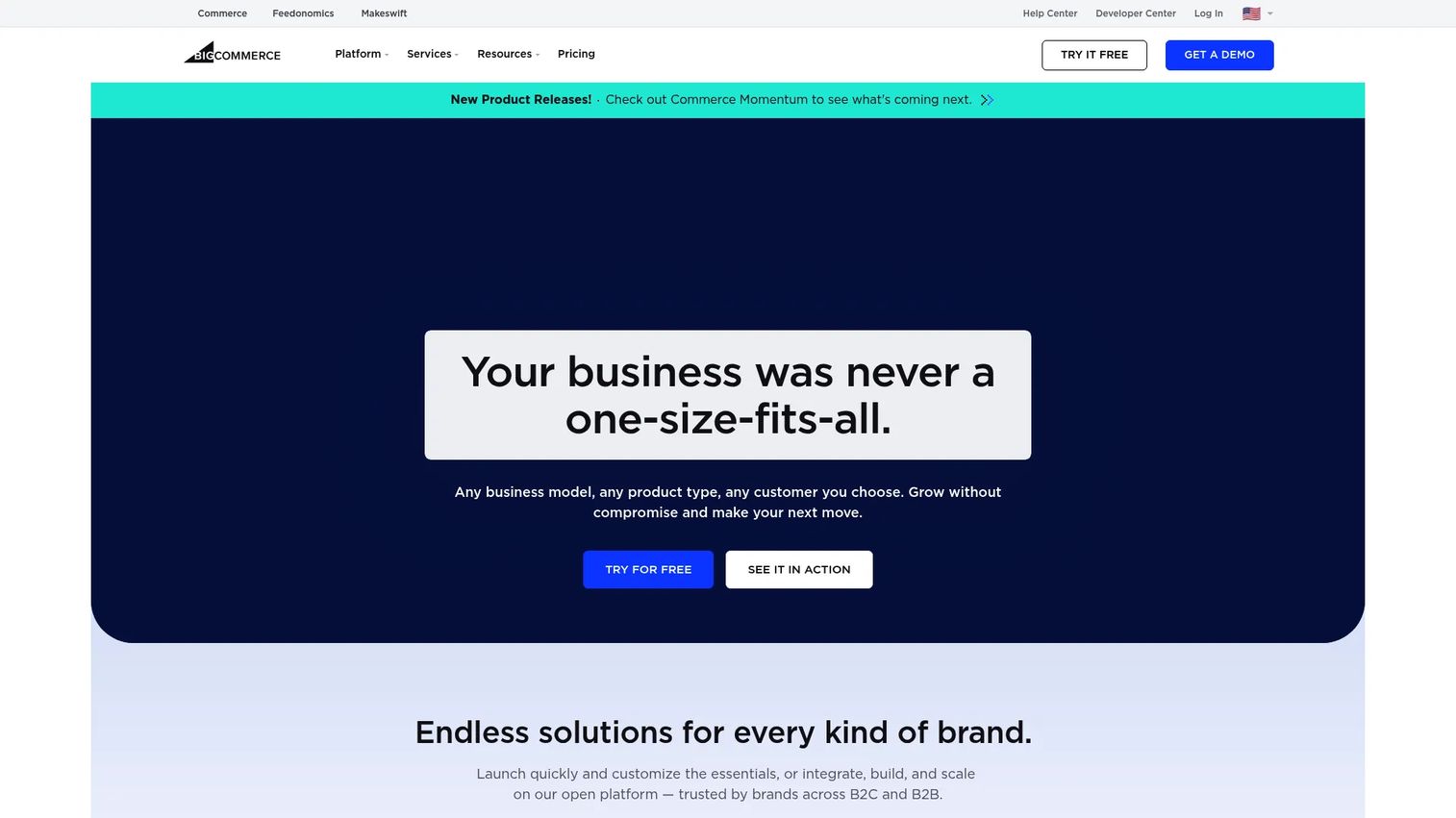
BigCommerce is an ecommerce platform for building, managing, and scaling online stores across both B2C and B2B channels. Its B2B Edition layers buyer-facing features on top of a mature commerce engine, so teams get account-specific pricing, quotes, reorders, and approval workflows without stitching together third-party apps. For mid-market sellers who want B2B capability fast, it hits a practical balance between depth and speed.
The appeal for a B2B ecommerce platform for wholesalers and manufacturers is the self-service buying experience. Buyers log into accounts with role-based access, see their negotiated pricing, place quick and bulk orders, and route purchases through approvals. Multi-channel selling across marketplaces and social rounds it out for teams running blended motions.
Best for: growing wholesalers, manufacturers, and B2B2C sellers that want strong native commerce plus B2B features without a long build.
Key strengths
- B2B Edition: account-specific pricing, quotes, reorders, and approvals built in, not bolted on.
- Customizable checkout: one-page checkout with digital wallets and BNPL for checkout customization.
- Multi-channel selling: sell across marketplaces and social platforms from one back end.
Why choose BigCommerce: It fits teams that need real B2B functionality without enterprise-grade complexity or cost. The open SaaS model gives you flexible APIs and a strong app ecosystem, which matters for ERP integration and CRM integration as you scale. If your buying motion is moderately complex and time-to-value is a priority, it is a strong default.
BigCommerce pricing: Public plans include Core at $39/month, Growth at $105/month, and Scale at $399/month, all billed without a contract. The Performance plan starts at $1,499/month, billed annually and contract-based. A 15-day free trial is available. B2B Edition capabilities are positioned for higher tiers, so confirm which features map to your plan before buying.
2. Adobe Commerce
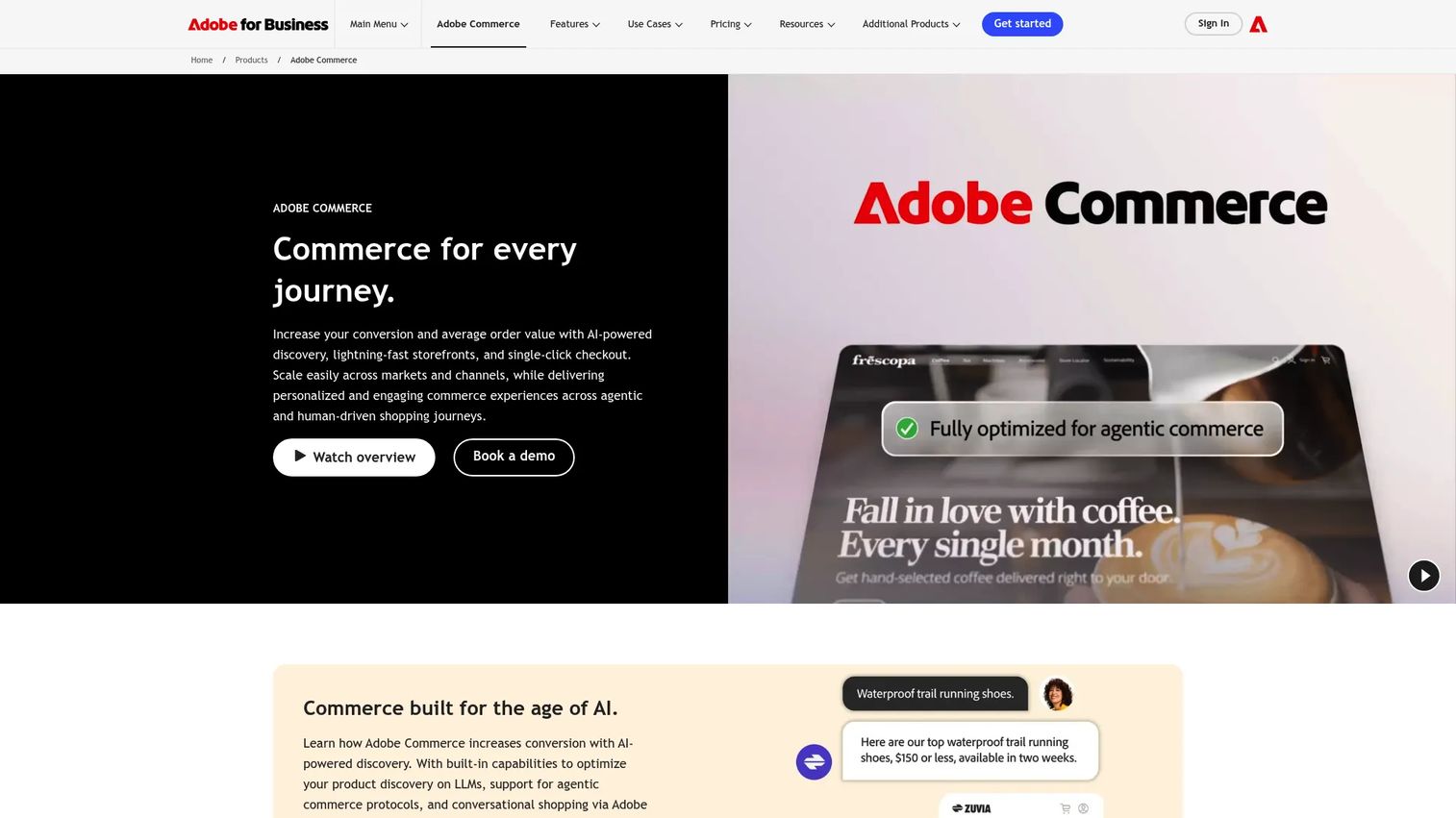
Adobe Commerce, formerly Magento, is Adobe's enterprise commerce platform for B2B and B2C brands, with AI-driven merchandising, a composable architecture, and scalable storefront experiences. It is the deep-customization option: if you can imagine a workflow, you can usually build it. That flexibility is the draw and the commitment.
For complex B2B requirements, Adobe Commerce supports company accounts, shared catalogs, negotiated quotes, and requisition lists. Its API-first and extensible architecture means you can wire it into ERP, CRM, PIM, and WMS systems and tailor pricing logic to your exact contracts. Multi-site, multi-brand, and global commerce are first-class.
Best for: large B2B and B2C merchants needing highly customizable, scalable commerce infrastructure and the internal development resources to run it.
Key strengths
- AI-powered merchandising: search and product discovery tuned by AI across catalogs.
- API-first architecture: extensible and composable, built for deep ERP integration and PIM integration.
- Multi-site and global: multi-brand, multi-region commerce from one platform.
Why choose Adobe Commerce: Choose it when your requirements outrun what packaged B2B features can deliver and you have the engineering capacity to build and maintain. Teams with strong internal development resources get near-unlimited control over pricing and quoting workflows, catalogs, and checkout customization. Plan governance carefully; this much flexibility rewards disciplined teams.
Adobe Commerce pricing: Adobe does not publish prices. The pricing page directs buyers to contact sales for customized quotes across its cloud service (SaaS), cloud (PaaS), and Optimizer offerings. Total cost depends on order volume, hosting, and implementation scope, so build a full TCO model that includes development time.
3. OroCommerce
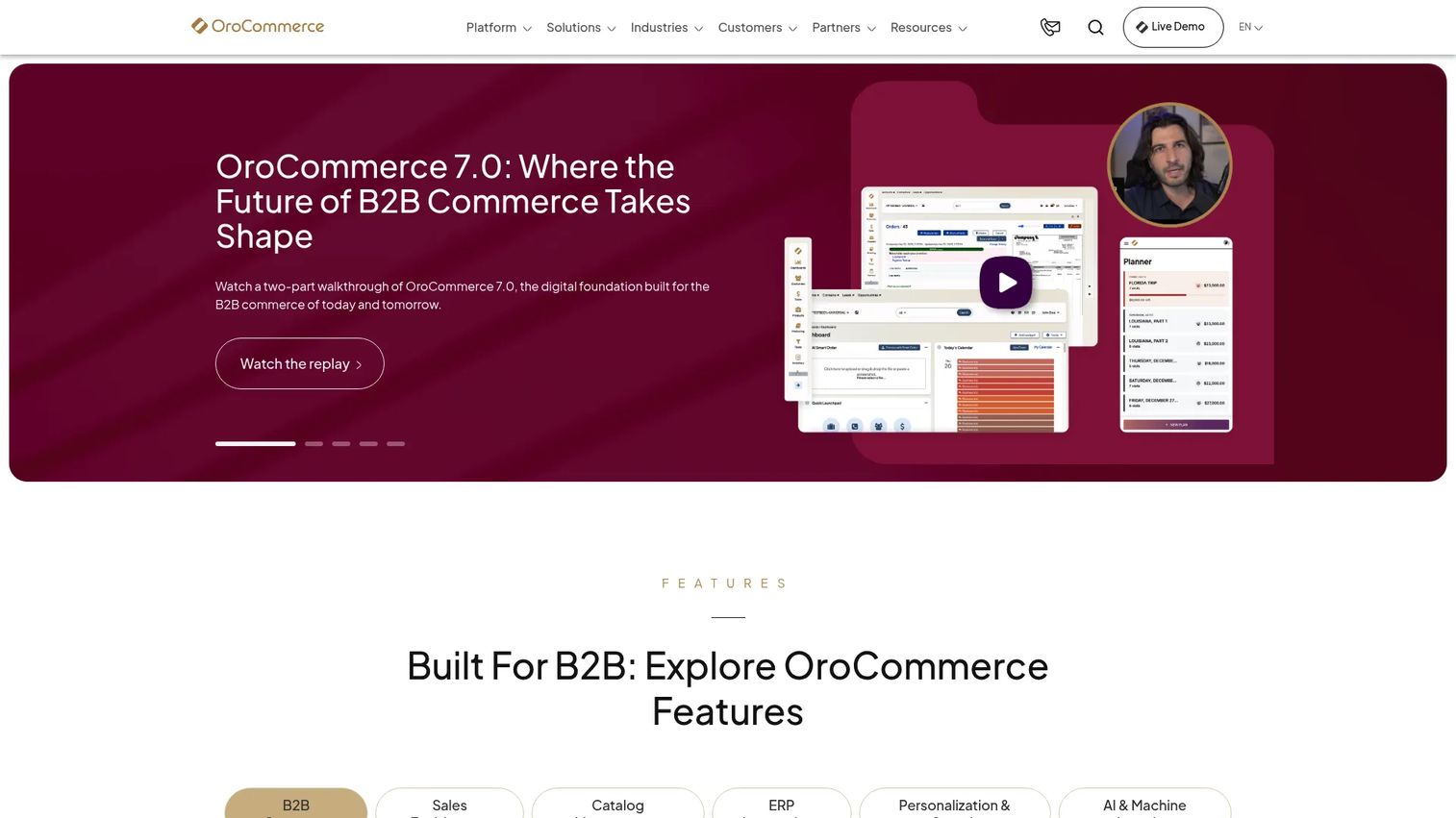
OroCommerce is a B2B commerce platform built for manufacturers, distributors, and wholesalers, where B2B is the core motion rather than a feature add-on. That focus shows in the workflows: corporate account hierarchy, delegated purchasing, multiple catalogs and price lists, and native RFQ. If your buying process is genuinely B2B, you spend less time recreating standard features.
OroCommerce supports multi-org and multi-site structures, which matters for distributors selling across regions or operating B2B2X models. RFQs, quick order, and reorders are built in, and a CRM ships as part of the platform. For complex buying workflows, this is often the shortlist anchor.
Best for: mid-market and enterprise B2B sellers, especially manufacturers and distributors, with complex account structures and quoting needs.
Key strengths
- Account hierarchy: corporate accounts with delegated purchasing and role-based access.
- Pricing flexibility: multiple catalogs and price lists for customer-specific pricing.
- RFQ and ordering: native RFQ, quick order, and reorder workflows.
Why choose OroCommerce: It is purpose-built for the B2B selling motion, so the features you would otherwise custom-build are already there. That suits manufacturers and distributors with intricate pricing and approval logic. It supports both open-source and enterprise deployments, giving teams a path to customize while keeping core B2B workflows intact.
OroCommerce pricing: OroCommerce does not list public prices. The vendor describes licensing based on GMV bands, admin users, and deployment or hosting choices, with quotes provided through sales. Because pricing scales with revenue and structure, model your expected GMV and user count before the conversation.
4. Virto Commerce
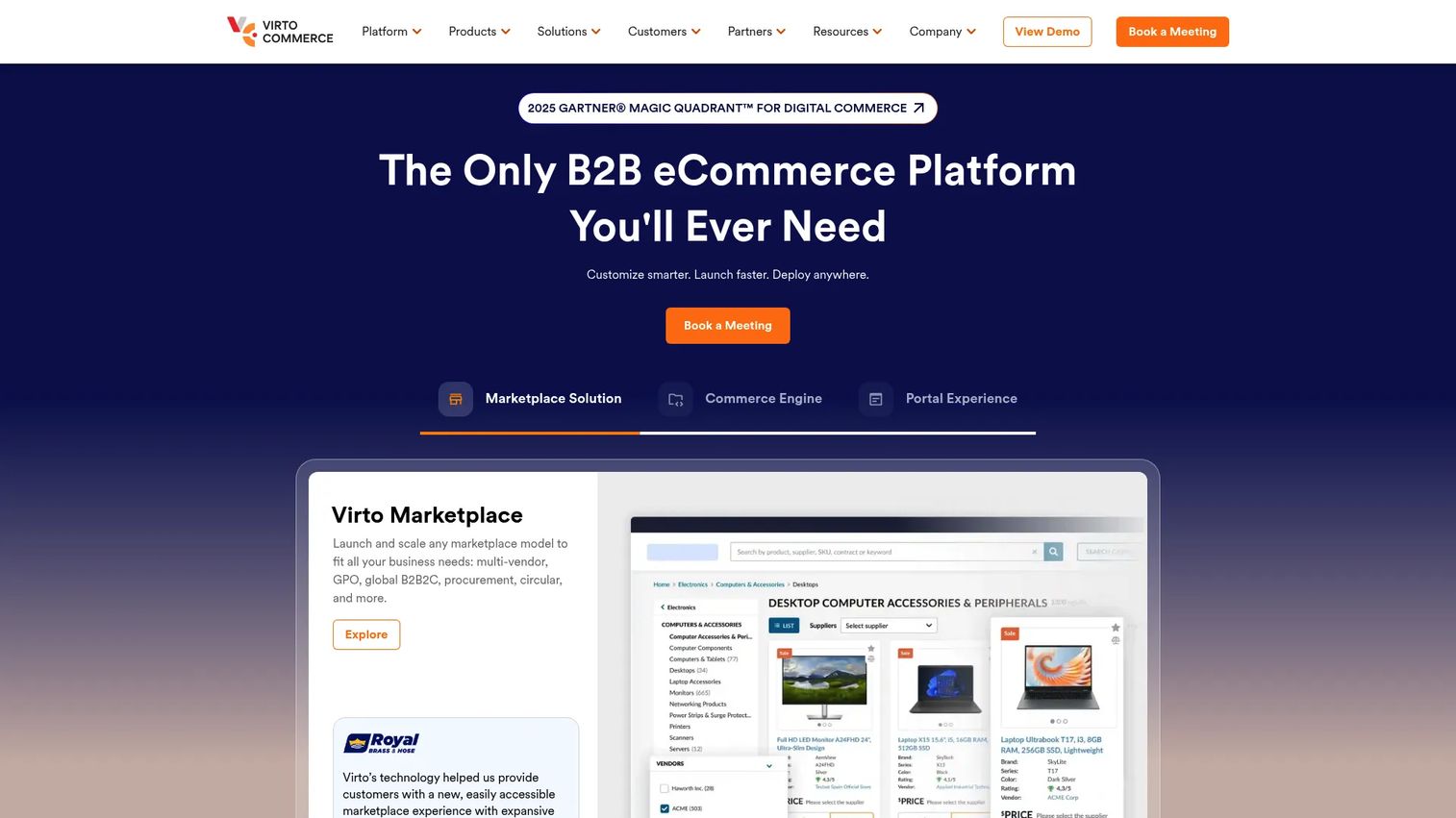
Virto Commerce is a composable, API-first B2B commerce platform aimed at complex enterprise and marketplace use cases. It leans fully into composable commerce: a headless engine you assemble and extend, with flexible deployment options. For distributed operations spanning brands, regions, and channels, that modularity is the point.
The platform stands out for marketplace and vendor management, so businesses building B2B2X models or operating multi-vendor portals get native tooling. Personalized catalogs and pricing handle customer-specific pricing, and the headless architecture supports multi-storefront rollouts. It carries one of the higher G2 ratings on this list.
Best for: enterprises needing a composable B2B commerce platform with marketplace, portal, and B2B2C capabilities.
Key strengths
- Headless engine: API-first, composable commerce you extend to fit your stack.
- Marketplace management: native vendor and marketplace tooling for B2B2X models.
- Personalized catalogs: account-level catalogs and pricing at scale.
Why choose Virto Commerce: It fits organizations that have outgrown packaged platforms and want to compose their own stack without sacrificing B2B depth. The flexible deployment and open architecture suit teams running complex, multi-region, or multi-brand operations. If a marketplace or portal model is on your roadmap, it is built for that from the start.
Virto Commerce pricing: Virto publishes two starting models: a GMV-based model starting at 0.5% of GMV with 10K SKUs, and an order-based model at $2 per order with 10K SKUs. Actual cost is custom and varies by project scale and implementation strategy, so the model that wins depends on your order volume and margins.
5. commercetools
commercetools is an enterprise platform for composable, headless, API-first commerce. It is one of the names that defined the composable category, and it shows: a modular set of APIs and services you assemble rather than a monolith you configure around. For large teams that want to build the exact stack their channels demand, that flexibility is the core value.
The platform supports B2C, B2B, and B2X commerce, with Merchant Center, Checkout, Connect, and GraphQL and REST APIs as building blocks. That modularity suits omnichannel sellers and B2B2C operations that need consistent commerce logic across many front ends. Like other composable options, it rewards teams with engineering capacity.
Best for: large enterprises needing flexible, composable commerce infrastructure across B2C, B2B, and B2B2C.
Key strengths
- API-first modularity: assemble commerce from headless, modular services.
- Multi-model support: B2C, B2B, and B2X from one platform.
- Developer tooling: Merchant Center, Connect, and GraphQL/REST APIs.
Why choose commercetools: Choose it when omnichannel flexibility and long-term extensibility matter more than out-of-the-box B2B features. Teams with strong development resources use the modular architecture to ship across channels and adapt fast as requirements change. It pairs naturally with a best-of-breed stack, including dedicated PIM integration and CRM integration.
commercetools pricing: commercetools does not publish numeric pricing. Its pricing page describes order-based, growth-friendly pricing and directs buyers to contact sales, while offering a free path to start building. Because cost scales with orders and components, scope your architecture and volume before requesting a quote.
6. Shopify Plus
Shopify Plus is Shopify's enterprise commerce platform for high-growth brands, and it brings the platform's signature speed and ease of use to larger operations. Its B2B tools, headless commerce options, and checkout customization make it a real contender for teams that sell both B2C and B2B and want one system for both.
Shopify Plus handles B2B through company profiles, customer-specific catalogs and pricing, net payment terms, and wholesale ordering. For lean teams or brands where B2B is a growing share of a primarily DTC business, the speed to launch and low operational overhead are compelling. It performs best when your B2B requirements are moderate rather than deeply customized.
Best for: high-volume merchants and blended B2C/B2B brands needing enterprise commerce, B2B tools, and checkout customization.
Key strengths
- Speed to launch: fast deployment with low operational overhead.
- B2B tools: company accounts, customer-specific pricing, and net terms.
- Checkout customization: flexible, high-converting checkout and headless options.
Why choose Shopify Plus: It works well for teams balancing B2C and B2B who want one platform, fast launch, and a deep app ecosystem. The ease of use lowers the learning curve for non-technical teams. When B2B complexity grows toward intricate multi-org hierarchies and heavy RFQ workflows, weigh it against the B2B-native platforms above.
Shopify Plus pricing: Shopify Plus starts at $2,300 USD/month on a three-year term or $2,500 USD/month on a one-year term, billed monthly. More complex businesses may move to a variable platform fee. There is no free tier, so factor the entry cost into your TCO against your B2B revenue plan.
7. SAP Commerce Cloud
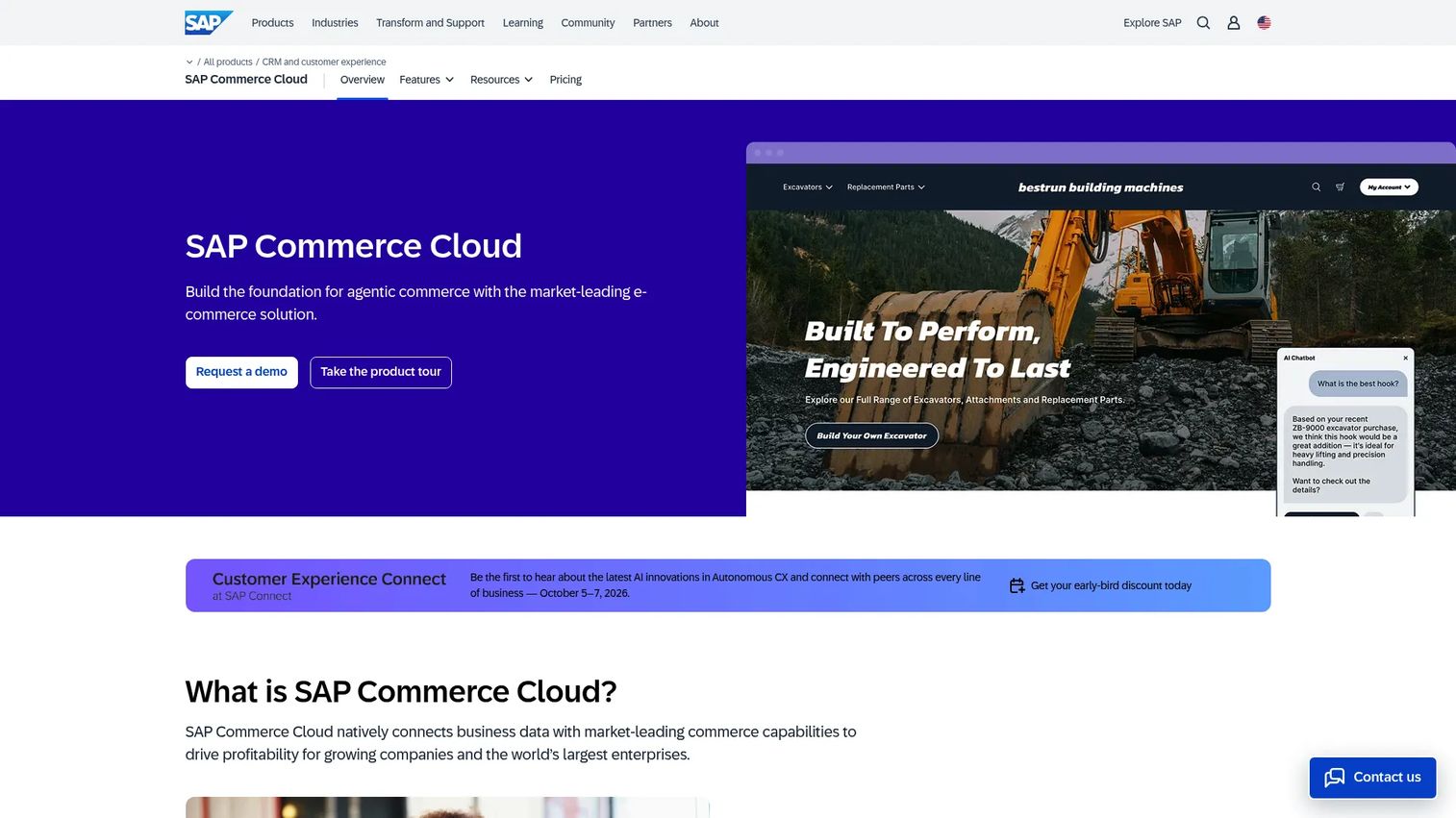
SAP Commerce Cloud is an enterprise digital commerce platform for B2B, B2C, and B2B2C commerce. It is built for scale and complexity, with unified commerce experiences, order management, and product content management at its core. For large organizations, especially those already running SAP, the ecosystem fit is the headline.
The platform shines in deep integration scenarios. If your ERP, finance, and supply chain already run on SAP, native data flows reduce the friction that derails many replatforming projects. It supports large catalogs, complex pricing, and global multi-storefront operations, which suits enterprise manufacturers and distributors with heavy back-office requirements.
Best for: large organizations needing scalable, SAP-integrated commerce across B2B and B2B2C.
Key strengths
- Unified commerce: consistent experiences across B2B, B2C, and B2B2C.
- Order management: enterprise-grade order orchestration at scale.
- Product content management: robust catalog and PIM-style capabilities.
Why choose SAP Commerce Cloud: It is the natural choice when you are already invested in the SAP ecosystem and want commerce that aligns with your ERP integration and WMS integration. Enterprise governance, IT alignment, and a phased rollout plan matter here, so involve IT early. The payoff is unified data across commerce and back office at significant scale.
SAP Commerce Cloud pricing: SAP lists composable, premier, and cloud ERP editions priced in blocks of orders per year, with figures shown as price upon request. There is no general free tier; the test and demo tenant is partner-only and non-commercial. Build a detailed TCO model with SAP and your implementation partner.
8. B2B Wave
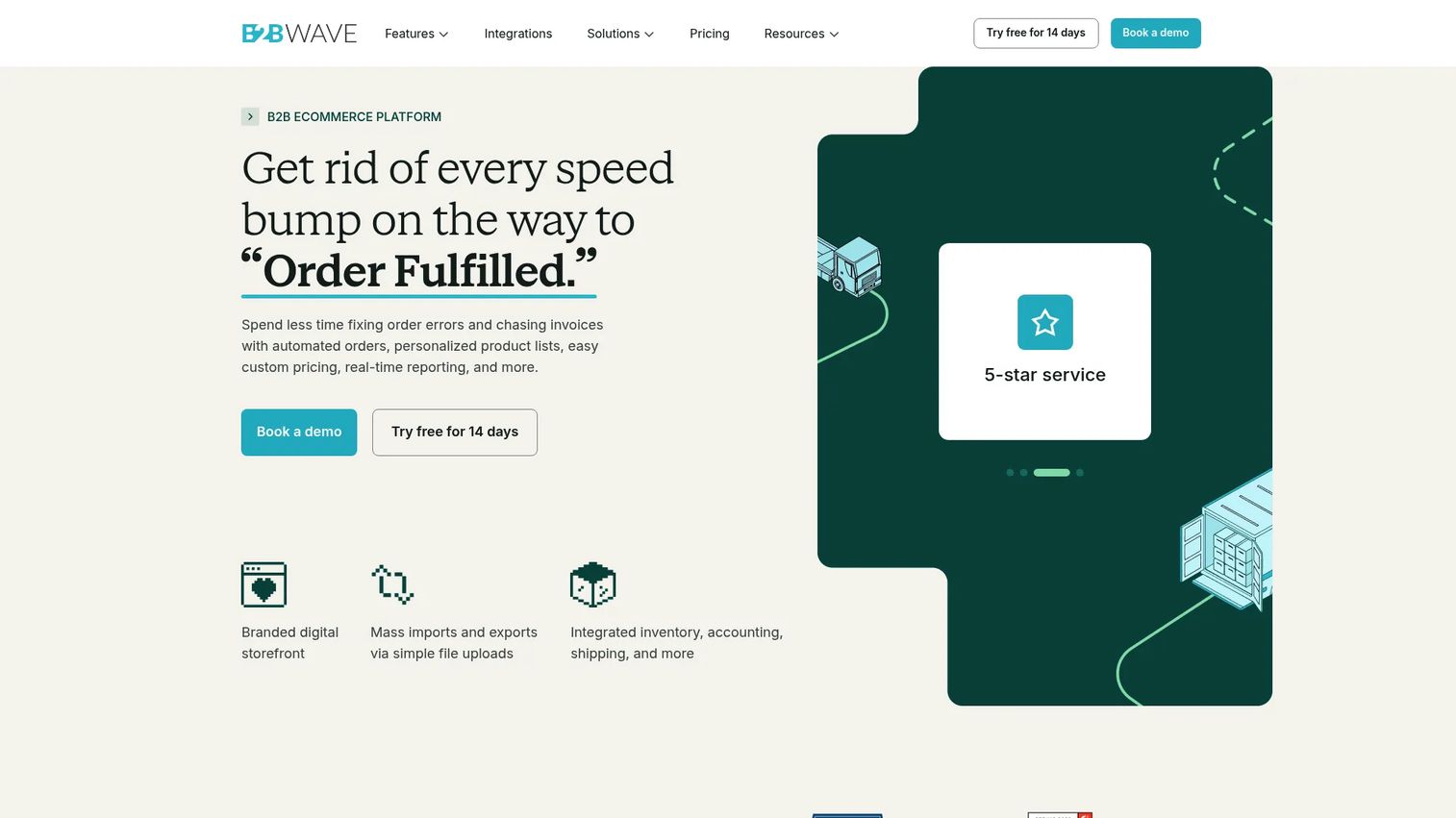
B2B Wave is a B2B ecommerce platform for wholesale businesses to manage online ordering, pricing, catalogs, and customer accounts. It is the practical option for lean teams that need real B2B capability without enterprise complexity. You get a branded wholesale ordering portal up and running quickly, with the workflows wholesalers actually use day to day.
For a B2B ecommerce platform for distributors and wholesalers operating without a large IT team, B2B Wave covers the essentials well: customer-specific pricing and price lists, orders, quotes, and reorders, plus access control over who sees what. It is the simplest path to value when your priority is selling, not building.
Best for: wholesale distributors, brands, manufacturers, and suppliers needing a branded B2B ordering portal without heavy overhead.
Key strengths
- Branded portal: custom domain and branded wholesale website out of the box.
- Customer pricing: customer-specific pricing and price lists per account.
- Order management: orders, quotes, and reorders in one place.
Why choose B2B Wave: It is attractive for smaller teams that want practical B2B functionality fast, with a low learning curve and the highest G2 rating on this list. The trade-off versus enterprise platforms is depth of customization, but for straightforward wholesale ordering that is rarely the bottleneck. When operational simplicity and speed matter most, it earns its place.
B2B Wave pricing: B2B Wave's public pricing page lists Pro and Scale at £135 GBP/month, shown with 50% off the first three months, and an Enterprise tier available on request. A trial is available with no credit card required. Confirm current standard pricing with the vendor, since promotional and standard figures appear together on the page.
Considerations before you buy
Use this checklist to pressure-test any shortlist before you commit. Replatforming is expensive, so the goal is choosing once.
Integration depth, not just integration presence
A logo on an integrations page is not the same as deep ERP integration. Ask how orders, inventory, pricing, and customer data sync, in which direction, and how often. Confirm native or API-first support for your specific ERP, CRM, PIM, and WMS integration needs.
B2B functionality you will actually use
Map RFQ and CPQ, account hierarchy, role-based access, and customer-specific pricing to your real buying process. If a feature is "available" but requires heavy custom development, treat it as a build, not a feature.
Architecture fit for your team
Composable commerce and headless commerce reward teams with engineering capacity and punish teams without it. Native platforms deploy faster. Be honest about your developer bandwidth before choosing an API-first stack.
Total cost of ownership
Look past the license. Factor implementation, development, maintenance, and the cost of internal resources into your TCO and ROI model. The cheapest license can carry the highest total cost.
Security, compliance, and governance
Confirm access control, data protection, and audit capabilities meet your security and compliance requirements. For multi-org and B2B2C models, verify how permissions cascade across account hierarchies.
Conclusion
There is no single best B2B ecommerce platform. There is the right fit for your business model, integration stack, and operational reality.
If you sell B2B as your core motion with complex pricing and account structures, OroCommerce and B2B Wave anchor the native end, the latter for leaner wholesale teams. If you need maximum flexibility across brands, regions, or a B2B2C model, Virto Commerce and commercetools lead the composable category for teams with engineering depth. BigCommerce balances B2B features with fast deployment for mid-market sellers, Shopify Plus suits blended B2C and B2B teams that value speed, Adobe Commerce serves merchants who need deep customization, and SAP Commerce Cloud fits enterprises already standardized on SAP.
Your next step: shortlist two or three platforms against the four criteria in this guide, then run a structured evaluation that includes integration testing and a real TCO model. Bring sales enablement and RevOps into the conversation early, since the platform you pick shapes how reps sell for years. Choose for the buying motion you actually run, and you avoid the replatforming you would otherwise repeat.
FAQs
Manufacturers with complex catalogs, customer-specific pricing, and RFQ workflows are usually best served by a B2B-native platform like OroCommerce or an enterprise platform like SAP Commerce Cloud or Adobe Commerce. The right pick depends on your ERP and PIM stack and how much customization your buying process demands. If your requirements are moderate, BigCommerce offers strong native B2B features with faster deployment.
Wholesalers who want a branded ordering portal without heavy complexity often choose B2B Wave for its speed to value and customer-specific price lists. Larger wholesale operations with multi-org structures and delegated purchasing lean toward OroCommerce or BigCommerce B2B Edition. Match the platform to your account hierarchy and integration needs rather than features alone.
Look for account hierarchy and role-based access, customer-specific pricing, RFQ and CPQ workflows, and self-service ordering with approvals. Integration depth matters just as much: native or API-first connections to your ERP, CRM, PIM, and WMS. Security, compliance, and the ability to support your business model (wholesale, manufacturing, distribution, or B2B2C) round out the must-haves.
B2C software optimizes for individual shoppers and fast checkout. A B2B ecommerce platform handles buying committees, negotiated pricing, account hierarchies, approval workflows, and deep back-office integration. The complexity lives in pricing logic, role-based access, and ERP and CRM sync, which most consumer-first platforms were never designed to support.
OroCommerce, Adobe Commerce, SAP Commerce Cloud, and BigCommerce B2B Edition all support request-for-quote workflows natively, with varying depth. For advanced configure-price-quote logic, many teams pair their commerce platform with dedicated quoting tools; our roundup of the best CPQ software covers those options. Confirm whether the platform handles quote-to-order conversion and approval routing for your process.
ERP integration is usually the most critical, since it holds orders, inventory, and pricing as the source of truth. CRM integration keeps account and contact data aligned with sales, PIM integration manages product data at scale, and WMS integration handles fulfillment. Prioritize platforms with native or API-first support for the specific systems you already run.
Composable commerce excels when you need flexibility across multiple brands, regions, or a B2B2C model and have the engineering resources to assemble and maintain the stack. Platforms like Virto Commerce and commercetools lead here. Native B2B platforms deploy faster and require less development, so the better choice depends on your team's capacity and how much customization you genuinely need.
Implementation timelines range widely, from a few weeks for a fast-deploy native platform with moderate requirements to six to twelve months or more for an enterprise or composable build with deep ERP integration. The biggest drivers are integration complexity, data migration, customization scope, and internal resource availability. Build a realistic timeline and TCO model before committing, and stage the rollout where you can.