You ran a livestream last quarter. Hundreds of people showed up. The chat was busy. And then almost nobody bought.
That gap, between attention and revenue, is the exact problem live commerce software exists to close. Most marketers blame the audience or the offer. The real issue is friction: viewers loved the video, but adding an item to cart meant leaving the stream, opening a new tab, hunting for the product, and re-entering payment details. By the time they finished, the moment was gone.
The numbers say this market is moving fast. U.S. live shopping GMV is projected to reach $55 billion by 2026, according to Firework (2023), and the global live commerce market is forecast to grow from $230.3 billion in 2026 to $2,546.5 billion by 2033, a 41.0% CAGR per Grand View Research (2025). That growth is why the software underneath these streams matters: it decides whether real-time attention turns into measurable conversion or evaporates.
If you are building out a wider social commerce motion or layering live shopping onto an existing ecommerce video marketing program, the platform you pick determines how clean your checkout, catalog, and analytics end up being. The same way marketers compare ab testing tools before committing budget, live commerce deserves a side-by-side look before you sign.
What's inside
This guide is for marketers, ecommerce leads, and digital commerce managers evaluating live commerce software for 2026. We looked at nine platforms and judged each on four criteria that actually move the needle: checkout and product catalog integration, real-time engagement features like interactive chat, analytics depth, and mobile compatibility. We also weighed setup speed and use-case fit across retail, beauty, fashion, and grocery. Pricing and G2 ratings reflect each vendor's public sources at the time of writing. The goal is a buyer-first shortlist, not a vendor pitch.
TL;DR
- Best for video commerce at scale: Bambuser, with shoppable video, live shows, and video consultation across markets.
- Best for turning every video shoppable: eStreamly, which makes live, recorded, and AI-generated video a revenue surface.
- Best for fast live show setup: Channelize.io, with live streaming, interactive chat, and shopping cart integration.
- Best for commerce measurement: MikMak, built around omnichannel attribution and where-to-buy enablement.
- Best for simpler live selling: Boutir, a mobile-first omnichannel platform for smaller merchants.
- Best for human-led selling: Salesfloor and Tulip, for retail teams running clienteling and associate-driven commerce.
What is live commerce software?
Live commerce software is a live commerce platform that lets brands broadcast shoppable live video where viewers can browse a product catalog, ask questions in interactive chat, and buy without leaving the stream. It merges livestream shopping, real-time engagement, and checkout into a single experience.
Unlike a generic streaming tool, live shopping software ties video to commerce infrastructure. That distinction is what separates true live shopping platforms from a webcam pointed at a webinar.
Core features to expect from live video commerce tools:
- Product catalog sync: pull SKUs, prices, and inventory directly into the stream so viewers see live availability.
- In-stream checkout and payment processing: one-click purchase or in-video cart so buyers never leave the moment.
- Interactive chat and moderation: real-time Q&A, polls, and reactions that drive engagement and surface buying intent.
- Shoppable video and shoppable clips: turn the live stream into on-demand, shoppable clips after the broadcast ends.
- Analytics: track viewers, watch time, add-to-cart rate, conversion rate, and revenue per session.
- Mobile compatibility: mobile-first playback and checkout, since most live shopping happens on phones.
- Integrations: connections to Shopify, CRM, email, and social platforms so live commerce fits your existing stack.
The strongest live shopping platforms treat video as a conversion layer, not a content format. They measure the customer experience the way a paid channel gets measured, with clear attribution from view to purchase.
When to use live commerce software
Live commerce earns its place in the stack at specific moments. Here is when it pays off.
Launch a product to an engaged audience
A product launch lives or dies on the first impression. Live commerce lets you demo a new SKU in real time, answer objections in chat, and capture the buying spike while interest peaks. Beauty and fashion brands use this to show texture, fit, and motion that static images cannot.
Turn social attention into sales
If your brand is already building an audience on Instagram, TikTok, or YouTube, live shopping closes the loop. Instead of sending followers to a separate site, you let them buy inside or beside the stream. This works best for retail, beauty, and grocery brands where impulse and demonstration drive purchases.
Reduce returns through better demonstration
A live shopping app that shows the real product, fielded by a host answering sizing and usage questions, sets accurate expectations. Fewer surprises at delivery means fewer returns, which protects margin in categories like apparel and home goods.
Comparison table
Here is a side-by-side view of the nine platforms, sorted by relevance to a live commerce buyer. Use it to shortlist before reading the full sections. Pricing and ratings reflect each vendor's public sources at the time of writing.
| # | Product | Intent | Key use case | Pricing | G2 rating |
|---|---|---|---|---|---|
| 1 | Bambuser | Video commerce at scale | Shoppable video, live shows, video consultation | Free; Essential $79/mo; Pro $249/mo; Enterprise custom | 4.6/5 |
| 2 | eStreamly | Shoppable video everywhere | In-video checkout, multichannel live shopping | Starter $39/mo; Shoppable Video $425/mo; Live Shopping $850/mo | 4.8/5 |
| 3 | Channelize.io | Fast live show setup | Live streaming, interactive chat, cart integration | Free; Basic $49/mo; Standard $99/mo | 4.9/5 |
| 4 | MikMak | Commerce measurement | Shoppable media, omnichannel analytics | Custom | Not listed |
| 5 | Lengow | Multichannel commerce ops | Feed management, marketplace distribution, pricing intelligence | Quote-based | 4.4/5 |
| 6 | Videowise | Video as conversion layer | Shoppable video, live shopping, AI clips | From $99 one-time; Live Shopping from $239/mo | 4.8/5 |
| 7 | Tulip | Associate-led commerce | Clienteling apps, frontline workflows | Essentials $100/mo per interface; Professional $250/mo | 4.5/5 |
| 8 | Boutir | Simpler live selling | Mobile-first storefront, social selling, mPOS | Essential SGD 380/yr; Live Commerce SGD 1,890/yr | 4.0/5 |
| 9 | Salesfloor | Human-led clienteling | Virtual selling, live chat/video shopping | Request pricing | 4.5/5 |
1. Bambuser
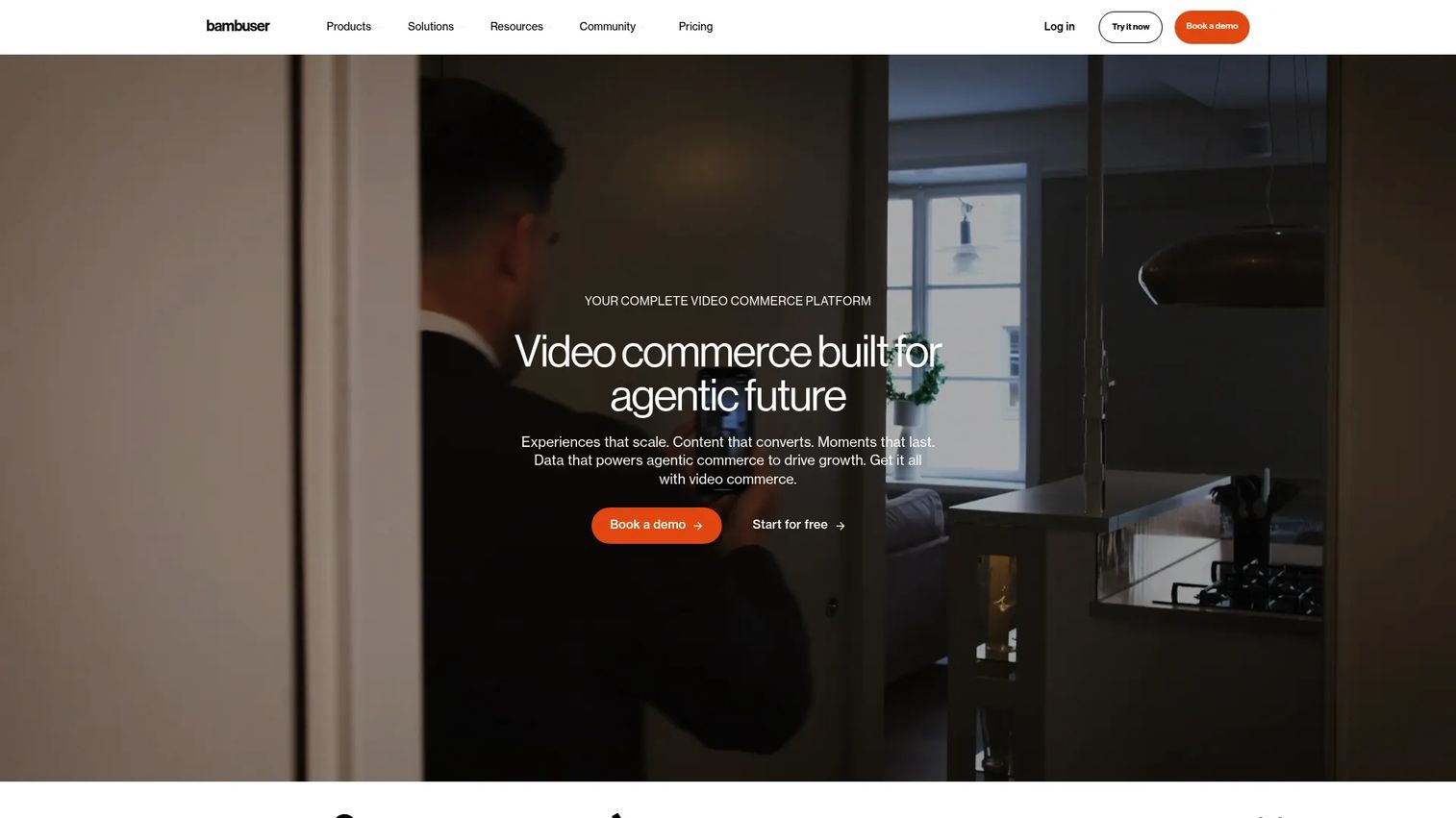
Bambuser is a video commerce platform built for shoppable live and on-demand video experiences. It powers live shows, one-to-one video consultation, and shoppable clips for retail brands that want video to drive measurable sales. The platform syncs your product catalog into the stream and reports on engagement and conversion, so marketing teams can treat live shopping like any other performance channel.
Best for: Retail brands that want shoppable video, live selling, and video consultation in one platform.
Key strengths
- Shoppable video and live shows: Run scheduled live events with catalog-synced products viewers can buy without leaving the stream.
- Video consultation and clienteling: Offer one-to-one or one-to-few video sessions for high-consideration purchases in beauty and fashion.
- Catalog sync and analytics: Connect SKUs, pricing, and inventory, then track watch time, add-to-cart, and conversion in real time.
Why choose Bambuser: If your brand sells products that benefit from demonstration, like cosmetics, apparel, or home goods, Bambuser gives you both the broadcast format and the intimate consultation format under one roof. It suits mid-market and enterprise retail teams that need video commerce to scale across markets and domains while keeping clean analytics for attribution.
Bambuser pricing: Bambuser publishes a free plan that includes 250 views per month, 2 users, 1 domain or market, and 10 GB of storage. The Essential plan is $79 per month billed annually. The Pro plan is $249 per month with custom usage and viewing allotments, and the Enterprise plan is custom. The free tier makes it easy to test live shopping before committing budget. Bambuser holds a 4.6/5 rating on G2.
2. eStreamly
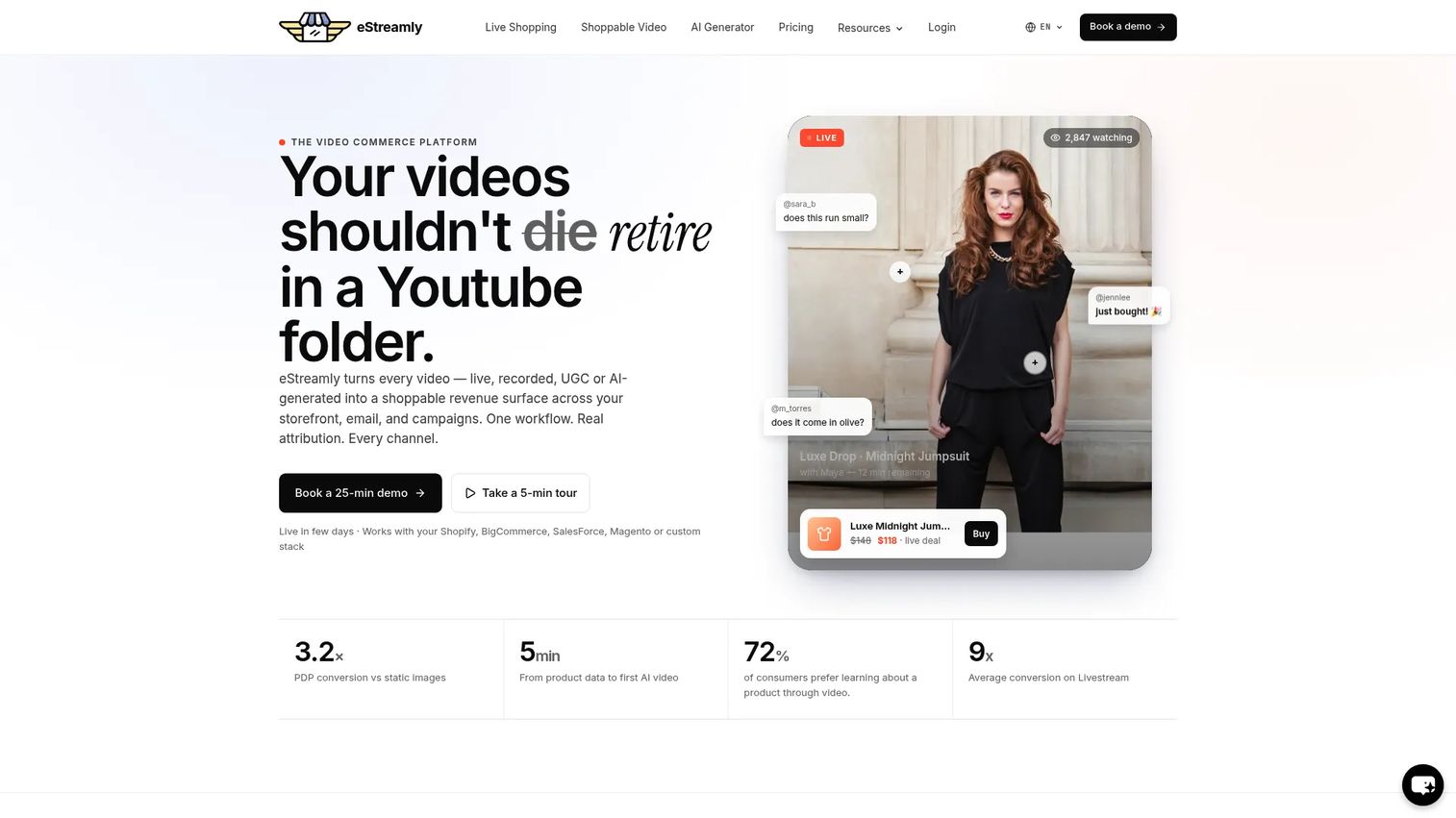
eStreamly is a video commerce and livestream shopping platform built to make shoppable video work across your own storefronts and external channels. Its core promise is that every video, whether live, recorded, user-generated, or AI-generated, becomes a shoppable revenue surface. In-video checkout keeps the purchase inside the experience, which is exactly where conversion friction usually appears.
Best for: Brands that want shoppable video and livestream commerce running on their own storefronts.
Key strengths
- Shoppable video with in-video checkout: Buyers complete payment without leaving the video, supporting one-click purchase behavior.
- Multichannel live shopping: Broadcast a single live stream to several channels at once to maximize reach.
- AI video generation: Produce shoppable clips and product videos at higher velocity without a full studio workflow.
Why choose eStreamly: eStreamly fits brands that want to own the shoppable video experience on their own domain rather than rent it on a marketplace. The in-video checkout is the differentiator for marketers chasing a cleaner conversion path. Because it spans live, recorded, and AI-generated formats, it suits teams reusing one shoot across many shoppable clips.
eStreamly pricing: eStreamly's public pricing page shows a Starter plan at $39 per month billed quarterly, a Shoppable Video plan at $425 per month, and a Live Shopping plan at $850 per month, both billed quarterly with a 14-day free trial. An Enterprise tier covers custom volume and SLAs. AI video production is available as an add-on. eStreamly holds a 4.8/5 rating on G2.
3. Channelize.io
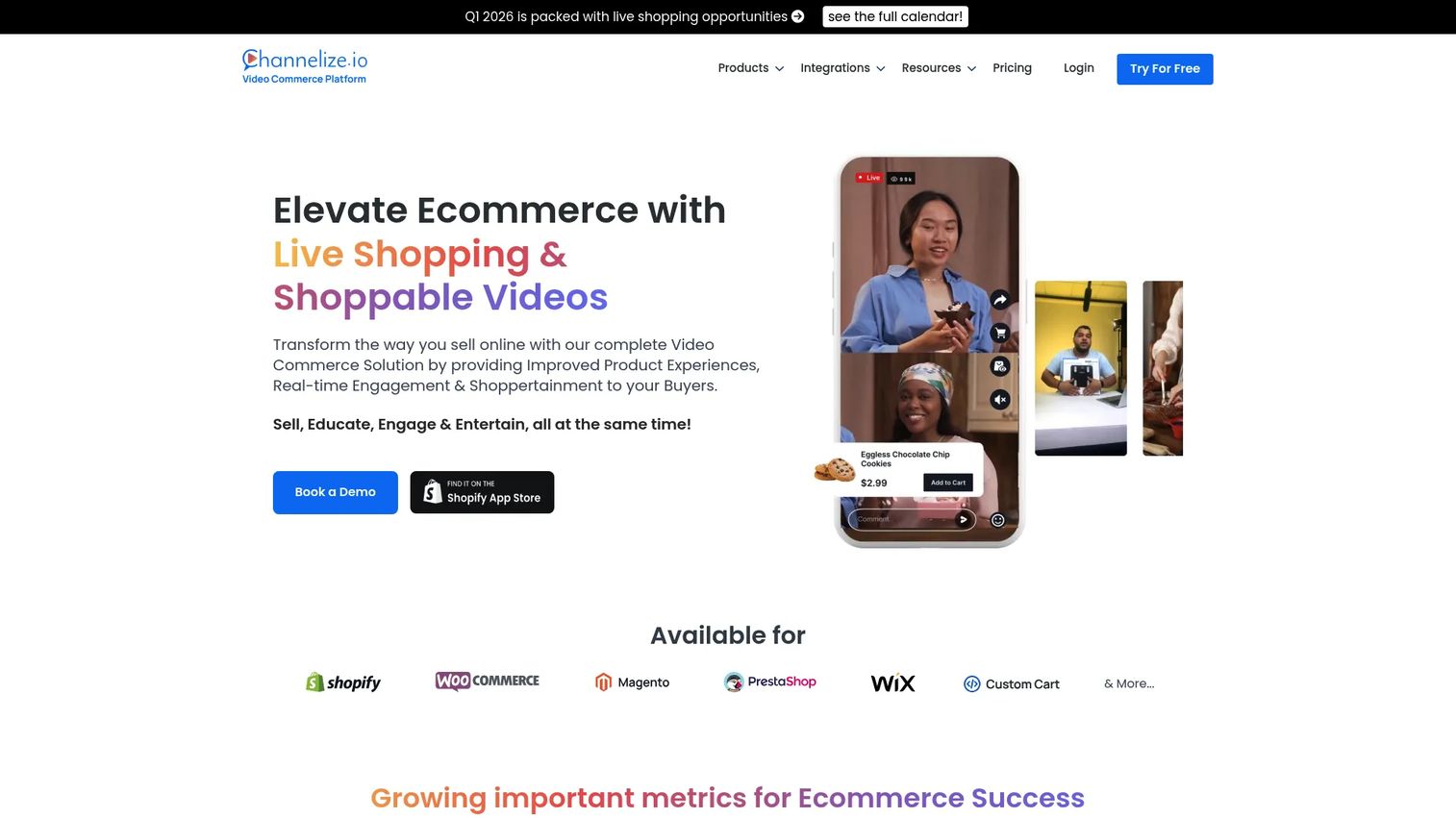
Channelize.io is a live shopping and shoppable video platform aimed at ecommerce brands that want to run live shows quickly. It pairs live streaming with interactive chat and shopping cart integration, so a host can demo products while viewers add to cart in real time. The setup is straightforward enough that a small team can launch a first live show without heavy production support.
Best for: Ecommerce brands wanting live shopping and shoppable video commerce with fast setup.
Key strengths
- Live streaming: Broadcast scheduled or spontaneous live shows tied to your catalog.
- Live chat discussions: Drive real-time engagement and surface buying intent through interactive chat.
- Shopping cart integration: Let viewers add products and check out without breaking the stream.
Why choose Channelize.io: Channelize.io is a strong pick for retail and merchandising teams that want to test live commerce without a long implementation. The combination of live streaming, chat, and cart integration covers the core live shopping loop, and the free plan lowers the barrier to a first event. It fits brands prioritizing speed to first show over deep enterprise customization.
Channelize.io pricing: Channelize.io offers a free plan, a Basic plan at $49 per month, and a Standard plan at $99 per month, with monthly and annual billing options visible on the public pricing page. The free tier and flat-rate pricing make it one of the more accessible entry points for smaller commerce teams. Channelize.io holds a 4.9/5 rating on G2.
4. MikMak
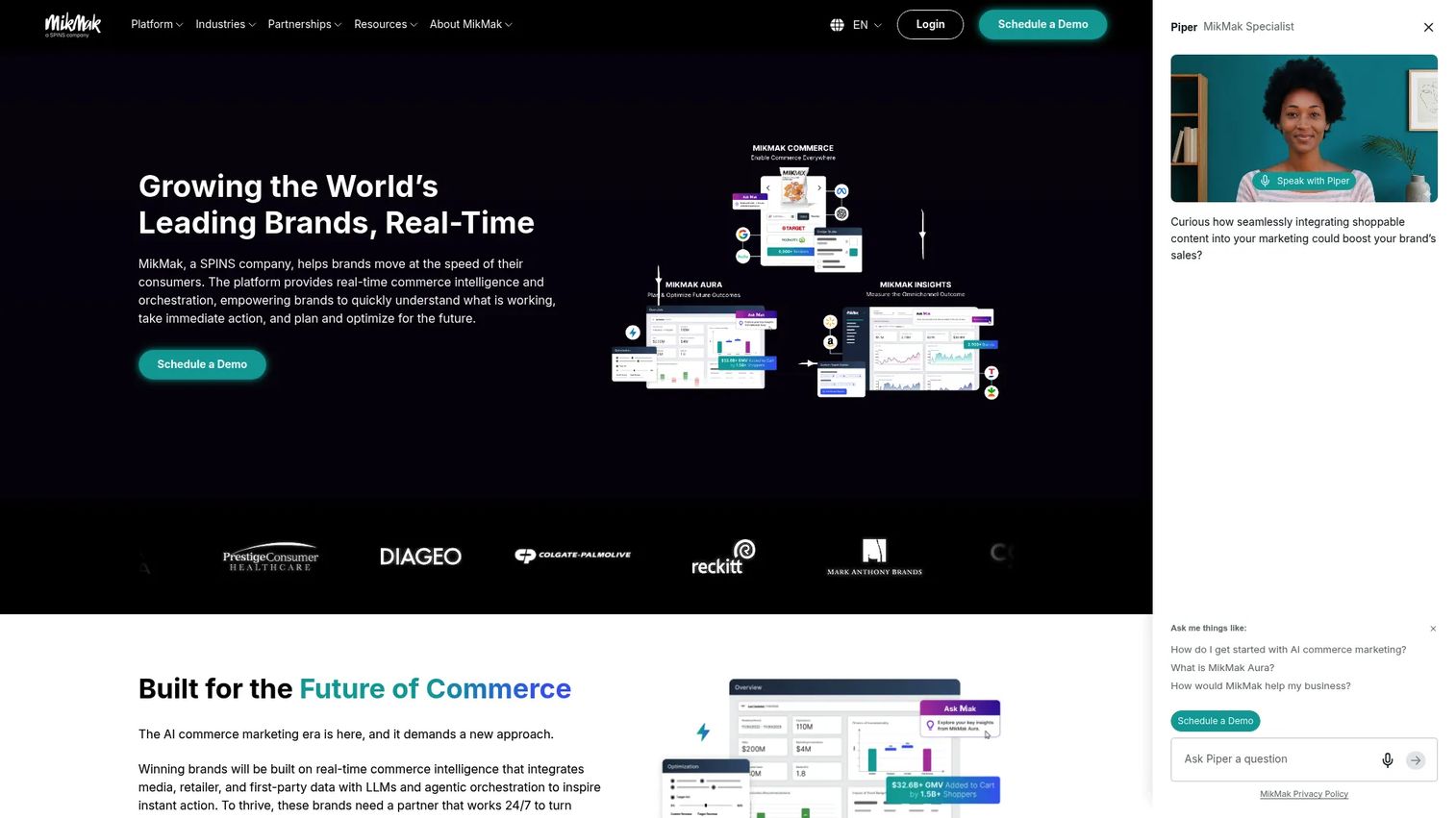
MikMak is commerce intelligence and orchestration software built for large consumer brands. Rather than hosting the live stream itself, MikMak focuses on the layer marketers usually struggle with: shoppable media, where-to-buy enablement, and omnichannel measurement. If your live commerce question is less "how do I broadcast" and more "where did the revenue actually come from," MikMak speaks that language.
Best for: Large consumer brands that need shoppable commerce enablement plus omnichannel measurement.
Key strengths
- Shoppable media and where-to-buy: Connect content and media to the retailers where customers actually purchase.
- Omnichannel measurement and analytics: Track commerce performance across channels and retailers in one view.
- Media planning with predictive intelligence: Optimize spend using predictive signals tied to commerce outcomes.
Why choose MikMak: MikMak is the pick for marketers whose biggest pain is attribution, not production. For a digital marketer who owns a number they only partially control, the value is defensible measurement across a fragmented retail landscape. It pairs well with brands that sell through many retailers and need to connect shoppable content to where-to-buy outcomes.
MikMak pricing: MikMak does not publish pricing on its site, and plans are quote-based. Brands evaluating it should expect an enterprise sales conversation scoped to channel coverage and measurement needs. A current overall G2 star rating was not available at the time of writing.
5. Lengow
Lengow is an ecommerce automation platform for multichannel feed management, marketplace distribution, pricing intelligence, and reseller monitoring. It is not a live streaming tool in itself, but it solves the operational layer that surrounds a live shopping program: keeping product feeds, pricing, and availability consistent across every channel where commerce happens. For teams running live shopping alongside marketplaces and ads, that consistency matters.
Best for: Brands and retailers needing multichannel product feed distribution plus pricing and reseller intelligence.
Key strengths
- Ads feed management: Manage product feeds across more than 400 advertising channels from one place.
- Marketplace management: Distribute and sync catalogs across more than 70 marketplaces in over 40 countries.
- Competitive price intelligence: Apply no-code dynamic pricing and monitor reseller pricing in real time.
Why choose Lengow: Lengow fits commerce operations teams that need broader channel management wrapped around live shopping rather than the broadcast itself. If your live events drive demand but your catalog data is scattered across marketplaces and ad platforms, Lengow keeps that data clean and synced. It suits retail brands operating at international scale where feed accuracy directly affects revenue.
Lengow pricing: Lengow lists Essential, Pro, and Scale plans, but pricing is quote-based and not publicly displayed. Brands should request a quote scoped to channel count and catalog size. Lengow holds a 4.4/5 rating on G2.
6. Videowise
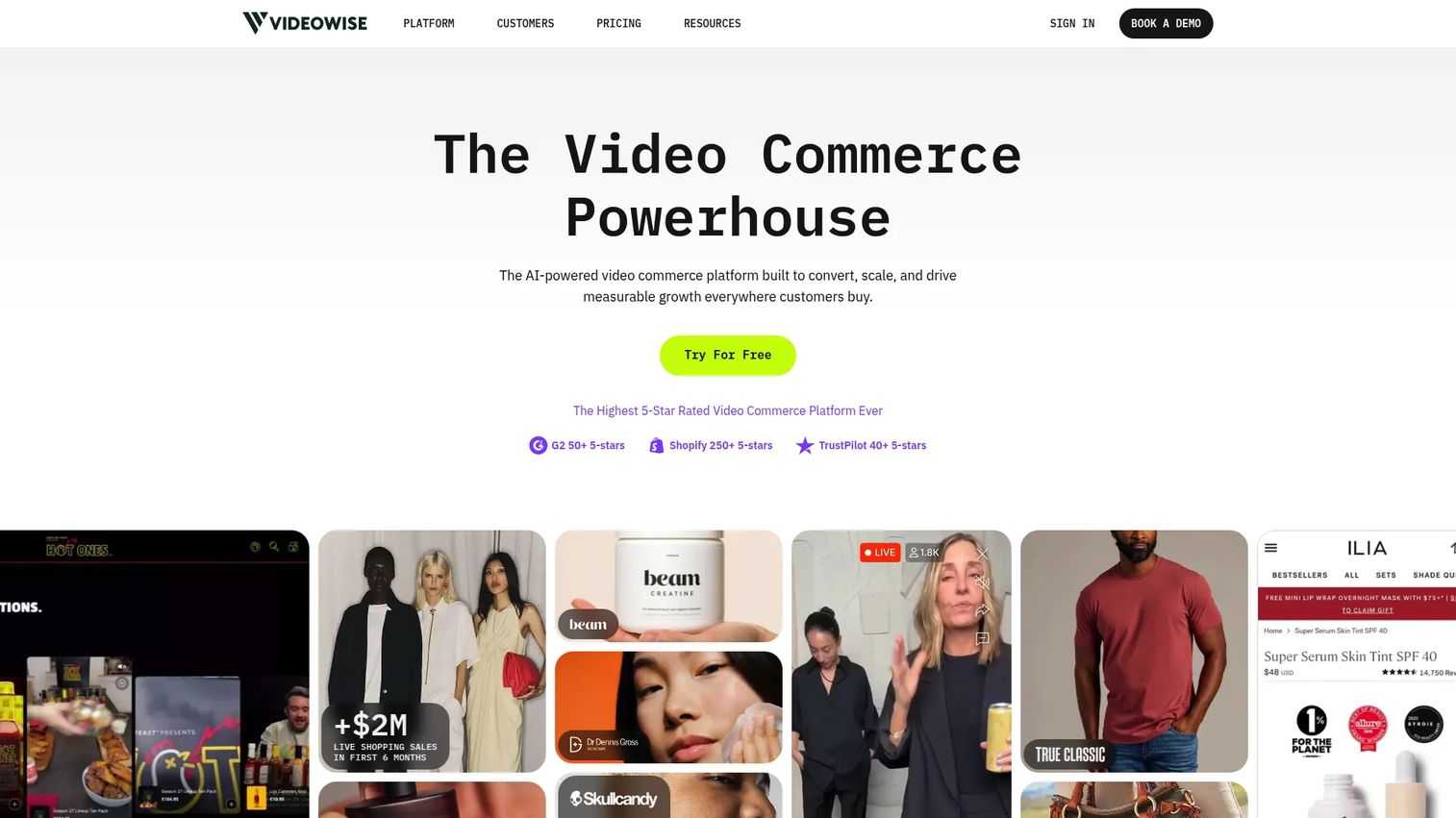
Videowise is an end-to-end video commerce platform for ecommerce brands and retailers that treat video as a primary conversion layer. It combines shoppable video, live shopping, AI clips, and social commerce in one place, so a single asset can move from live broadcast to on-demand shoppable clips to social posts. For brands that already know video converts, Videowise focuses the whole stack on turning watch time into revenue.
Best for: Ecommerce teams that want shoppable video, live shopping, and AI video workflows in one platform.
Key strengths
- Shoppable videos and live shopping: Run live shows and convert them into shoppable on-demand video.
- AI media library and AI clips: Generate and organize short shoppable clips from longer video at scale.
- Social commerce and UGC management: Curate user-generated content into a shoppable, on-brand experience.
Why choose Videowise: Videowise is for the marketer who wants video conversion analytics tightly coupled to the video experience itself. The modular pricing lets teams start with one capability and expand as live shopping proves out. It fits retail and DTC brands that want both the live event and the long tail of shoppable clips working together.
Videowise pricing: Videowise uses modular pricing on its public page. Content Creation starts from $99 for 80 AI videos as a one-time purchase, AI Clips from $159 per month, Live Shopping and Shoppable Video from $239 per month each, and the full platform from $479 per month. Annual billing carries a 20% discount, and custom enterprise plans are available. Videowise holds a 4.8/5 rating on G2.
7. Tulip
Tulip is a frontline operations platform for building connected apps, automations, and AI-enabled workflows. In a retail context, that means equipping store associates with the tooling to run clienteling and associate-led selling motions that connect in-store teams to digital commerce. Tulip is the broadest of these platforms, which makes it a fit for retailers that want to build custom workflows rather than buy a fixed live shopping app.
Best for: Manufacturing and frontline operations teams, and retailers, needing configurable connected workflows.
Key strengths
- No-code app authoring: Build apps for mobile, desktop, touchscreens, and wearables without engineering.
- Tulip Tables, Analytics, and AI features: Combine data, reporting, and AI inside frontline workflows.
- Edge connectivity and governance: Connect devices and systems with integration and compliance controls.
Why choose Tulip: Tulip suits retail teams that want to design their own associate-led selling experience rather than adopt an off-the-shelf format. The no-code authoring means a frontline team can shape workflows around how its associates actually sell. It fits organizations with operational complexity that want one platform spanning store, digital, and connected workflows.
Tulip pricing: Tulip prices per interface, billed annually, with a 10-interface minimum. The Essentials plan starts at $100 per month per interface and Professional at $250 per month per interface. Enterprise and Regulated Industries plans require contacting sales. Tulip holds a 4.5/5 rating on G2.
8. Boutir
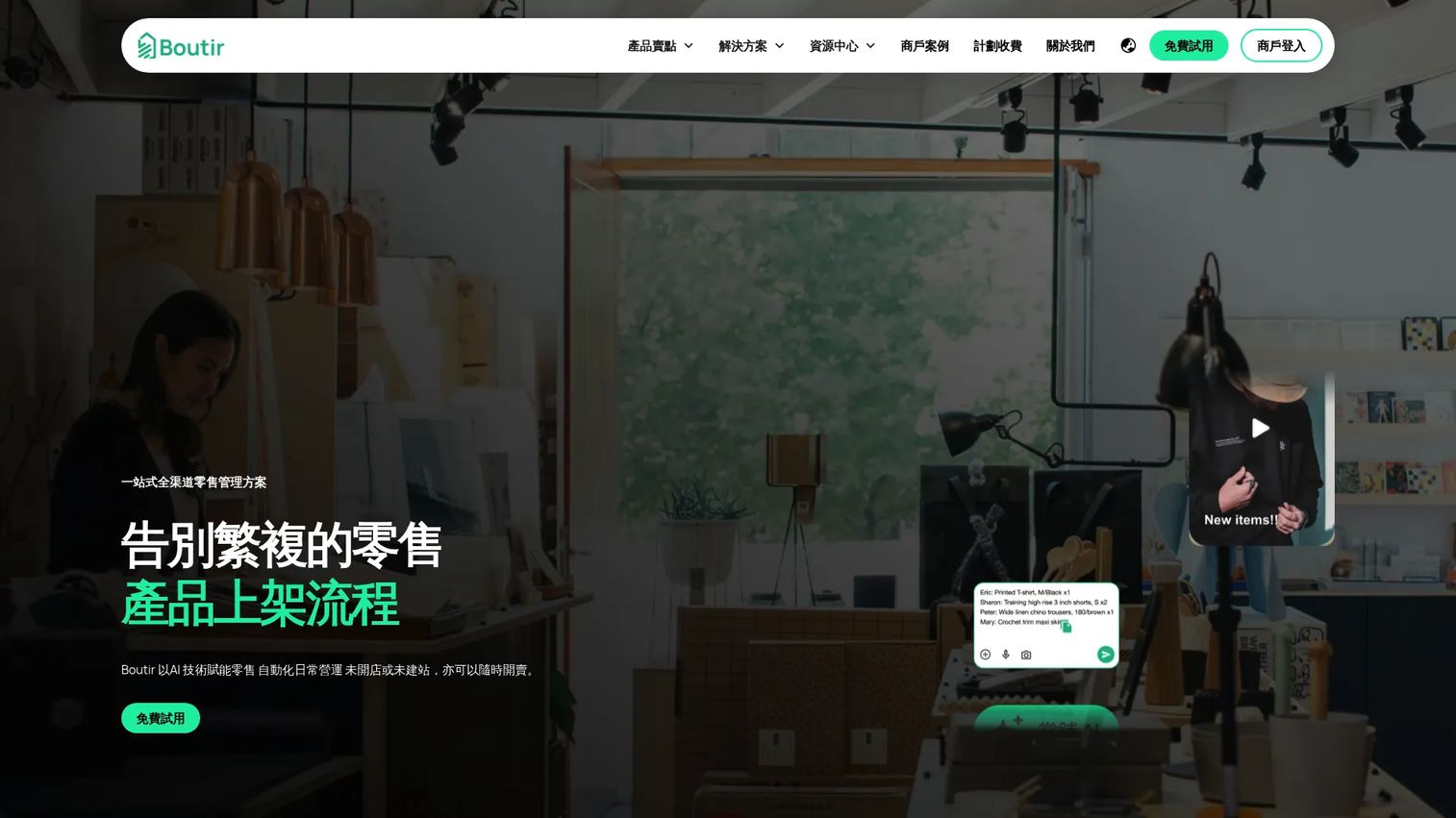
Boutir is an omnichannel retail management platform for building and operating online and offline stores. It leans mobile-first and is built for smaller merchants who want shoppable video, live commerce, and social selling without a heavy enterprise setup. With storefront management and an mPOS unifying online and offline inventory, Boutir packages the essentials of live selling into one simpler workflow.
Best for: SMBs that want one platform for ecommerce, social selling, and POS.
Key strengths
- AI-powered listing and sales assistant: Speed up product listing and selling with built-in AI support.
- Shoppable video and live commerce: Run live selling and social media commerce from a mobile-first storefront.
- mPOS for unified inventory: Keep online and offline inventory and orders in sync from one system.
Why choose Boutir: Boutir is the pick for smaller teams that want simpler live selling workflows without standing up a full enterprise commerce stack. The mobile-first design matches how many small merchants actually run their business and their live streams. It fits SMB retailers that need ecommerce, social selling, and POS unified rather than stitched together.
Boutir pricing: Boutir publishes plans in SGD. The Essential plan is SGD 380 per year, the Advanced OMO Commerce plan is SGD 1,280 per year, and the Live Commerce plan is SGD 1,890 per year. A custom solution is available by contacting sales, and a 14-day free trial covers the Essential plan. Boutir holds a 4.0/5 rating on G2.
9. Salesfloor

Salesfloor is a retail clienteling, virtual shopping, and AI-assisted selling platform built for human-led commerce at scale. Instead of a one-to-many broadcast, Salesfloor centers on associate-driven selling: live chat, video shopping, appointment booking, and the customer insights store teams need to sell with context. For retailers whose advantage is their people, this is the model that matters.
Best for: Enterprise retail teams needing clienteling and assisted selling.
Key strengths
- Clienteling and customer insights: Give associates the customer context to personalize every conversation.
- Virtual selling and appointment booking: Let shoppers book and join one-to-one virtual sessions.
- Live chat, video shopping, and AI assisted selling: Blend human selling with AI support across channels.
Why choose Salesfloor: Salesfloor matters for retail teams that want human-led commerce rather than purely broadcast live shopping. The clienteling and virtual selling tools let store associates extend their relationships into digital channels, which protects the high-touch experience that drives loyalty. It fits enterprise retailers in fashion, beauty, and specialty goods where associate expertise closes the sale.
Salesfloor pricing: Salesfloor does not publish numeric prices. Its site lists Xperience, Engage, Connect, and Maestro plans, each on a request-pricing basis. Retailers should expect an enterprise sales conversation scoped to store count and clienteling needs. Salesfloor holds a 4.5/5 rating on G2.
Considerations before you buy
Before committing to any live commerce platform, run each candidate through this checklist. These are the criteria that separate a tool you keep from one you churn out of in a quarter.
Checkout and payment processing
The single biggest conversion lever is whether buyers can complete a purchase without leaving the stream. Confirm whether the platform supports in-video checkout or one-click purchase, and which payment processors it works with. A clean payment path is the difference between a busy chat and a closed sale.
Product catalog integration
Your catalog has to sync cleanly. Check how the platform pulls SKUs, pricing, and live inventory, and whether it connects to your commerce backend like Shopify or a headless stack. Stale inventory data during a live event is a fast way to lose trust.
Analytics and attribution
Treat live commerce like a paid channel. You want session-level analytics: viewers, watch time, add-to-cart rate, conversion rate, and revenue per stream. Confirm the data exports cleanly and matches the attribution model your CFO already believes.
Mobile compatibility and integrations
Most live shopping happens on phones, so mobile playback and checkout must feel native, not bolted on. Then map the integrations you need, from CRM and email to social platforms, and verify they exist before you sign. Run an RFI or RFP if multiple vendors clear the bar.
Conclusion
The right live commerce platform depends on what you are optimizing for. If you want video commerce at scale with both broadcast and consultation, Bambuser is the strongest fit. For shoppable video everywhere with in-video checkout, eStreamly leads. For the fastest path to a first live show, Channelize.io and its free plan make sense. If attribution is your real problem, MikMak focuses there, while Lengow keeps multichannel catalog data clean around your program.
Videowise suits teams that want video as a dedicated conversion layer. And for human-led selling, Tulip, Boutir, and Salesfloor cover associate-driven and mobile-first motions across retail scale.
Pick based on your priority: engagement, checkout, measurement, or implementation speed. Shortlist two or three, run a free trial where one exists, and measure conversion against your existing channels before you commit. The platforms that earn a permanent place in your stack are the ones that turn watch time into revenue you can defend.
FAQs
Live commerce software lets brands broadcast shoppable live video where viewers can browse a product catalog, chat in real time, and buy without leaving the stream. It connects video streaming to commerce infrastructure, so a host can demo products while the platform handles cart, checkout, and payment processing. Analytics then report watch time, conversion rate, and revenue per session.
Live commerce is a real-time, video-led format where selling happens during a broadcast. Social commerce is the broader practice of selling across social platforms, which may include static posts, shoppable tags, and messaging, not just live video. Live commerce often runs inside a social commerce strategy, but it is specifically the livestream shopping piece.
Look for product catalog sync, in-stream checkout and payment processing, interactive chat, shoppable clips for post-event replay, mobile compatibility, and session-level analytics. Strong integrations with your commerce backend, CRM, and social channels matter too. These features are what turn real-time engagement into measurable conversion.
Bambuser, eStreamly, Channelize.io, Videowise, and Boutir all support shoppable video with catalog integration, and several offer in-stream or in-video checkout. eStreamly highlights in-video checkout specifically, while Channelize.io includes shopping cart integration. Always confirm which payment processors and commerce backends a platform supports for your specific stack.
It works across all three, but the fit varies. Beauty and fashion brands benefit most from demonstration and one-to-one video consultation, which platforms like Bambuser and Salesfloor support well. Grocery and general retail often lean on fast, high-volume live shows. Match the platform's strengths to how your category actually sells.
No. Conversion rate per viewer matters more than raw audience size, and a smaller, engaged audience often outperforms a large passive one. Many platforms offer free or low-cost entry tiers so you can test live shopping with your existing followers before scaling. Start small, measure conversion, then invest in reach.
Verify checkout and payment processing, product catalog integration, analytics depth, and mobile compatibility against your real requirements. Confirm the integrations you need actually exist, and run a free trial or RFP across a short-list of two or three vendors. The decision should come down to which platform turns watch time into revenue you can attribute.