
Your brokerage runs on tabs. A load board in one window, a spreadsheet for margins in another, an inbox full of rate confirmations, a separate portal for tracking, and an accounting tool that never quite matches what your reps typed in an hour ago. Every load touches five systems, and every system needs the same data retyped by hand.
That fragmentation is not a minor annoyance. It is where margin leaks, where check calls pile up, and where a new rep takes three months to become useful instead of three weeks. The freight broker software market reached USD 1.35 billion in 2025 and is projected to hit USD 2.66 billion by 2032, growing at a 10.25% CAGR, according to PW Consulting (2026). Brokers are not buying software for fun. They are buying it to stop paying the fragmentation tax.
Cloud deployment now dominates the category. PW Consulting (2026) reports that 76.4% of worldwide freight broker software revenue in 2025 came from cloud-based tools, and Business Research Insights (2025) found that 62% of logistics firms report efficiency gains from automation and real-time tracking. The direction is clear. The question is which broker TMS actually fits how your team moves freight, from quoting to load management to billing, without forcing you to run three tools where one should do.
This guide ranks six freight brokerage software platforms by workflow fit, not brand familiarity. We picked tools brokers actually use, verified pricing from first-party sources, and organized everything so you can choose by operating model.
What's inside
This is a decision framework, not a vendor showcase. It is built for freight brokerages and 3PLs choosing tms software for brokers to handle load management, quoting, tracking, billing, and integrations in one connected workflow.
We evaluated each tool against four criteria that matter for broker operations:
- Broker specificity: built for brokerage workflows, not retrofitted from a carrier or shipper product.
- Workflow coverage: how much of the quote-to-cash cycle it handles in one place.
- Integrations: load board connectivity, accounting sync, EDI and API connectivity, and tracking feeds.
- Visibility and automation: real-time tracking, rate intelligence, and automated billing that cut manual re-entry.
Each tool section includes verified pricing, key strengths, and a clear note on which operating model it fits best.
TL;DR
Short on time? Here are the fast picks for freight broker software in 2026:
- Best for broker-first back-office coverage: DAT Broker TMS, which ties operations, accounting, load board, tracking, and document management into one system starting at $100/mo.
- Best for quoting and rate workflows: Tai TMS, with instant quoting, load coverage, and billing automation across four public plans.
- Best for automation and integrations: Alvys, a cloud-native TMS with native EDI, open API, and 120+ integrations.
- Best for straightforward brokerage ops: EZ Loader TMS, a unified system for load ops, SMS tracking, documents, and accounting.
- Best for multi-leg and consolidated loads: FreightBoard, built for consolidators and brokered fleets managing per-leg workflows.
What is freight broker software?
Freight broker software is a transportation management system (TMS) built specifically for brokerage operations, connecting load sourcing, carrier management, dispatch, tracking, billing, and accounting in one workflow instead of scattered tools. It differs from a generic TMS in one important way. A generic TMS is often designed for shippers or asset-based carriers managing their own fleets. Freight broker TMS software is designed for the middle: matching customer freight to third-party carriers, protecting margin on every load, and keeping the back office clean while doing it at volume.
The category exists because brokerage has a specific shape. You quote, you book, you cover, you track, you bill, and you settle. Each step generates data that the next step needs. When those steps live in separate tools, the data gets retyped, and every retype is a chance to lose money or lose a load.
Core workflow categories in tms for freight brokers include:
- Load sourcing and management: posting and searching a load board, building load records, and managing lanes and load lists in one place.
- Carrier management and compliance: onboarding carriers, checking authority and insurance, and running carrier compliance without leaving the system.
- Quoting and rate intelligence: instant quoting, lane history, and rate intelligence that helps reps price fast and protect margin.
- Tracking and visibility: live tracking, automated check calls, and shareable status links that cut inbound "where's my load" calls.
- Billing and settlement: automated invoicing, carrier rate confirmations, and accounting sync so billing does not lag behind operations.
- Integrations: EDI and API connectivity, load board feeds, and document management that tie the stack together.
Adoption is accelerating. Business Research Insights (2025) reports that nearly 74% of logistics firms now use digital freight platforms, and roughly 44% of mid-sized freight firms have adopted SaaS-based freight management. The move from spreadsheets to software for freight brokers is no longer early. It is the norm.
When to use freight broker software
Not every brokerage needs the same tool at the same time. Here is how to pattern-match your situation to the capability that matters most.
Centralize loads, carriers, and billing
If your team is retyping the same load details into a load board, a spreadsheet, and an accounting tool, you have outgrown the manual approach. This usually happens somewhere between a solo broker doing 30 loads a month and a multi-rep desk doing hundreds. Transportation broker software with single-entry workflows means a load record you build once feeds carrier confirmations, tracking, and invoicing automatically. The value shows up as fewer errors and faster settlement, not just tidier screens.
Improve pricing and quoting speed
When a customer emails for a quote and your rep opens four tabs to build a number, you are losing deals to whoever answered faster. Freight broker TMS software with rate intelligence, lane history, and instant quoting lets reps price in seconds with margin visibility built in. Speed protects both the win and the margin, which matters most when capacity and rates swing week to week.
Reduce check calls and improve visibility
If your team spends afternoons calling drivers for status updates, live tracking and automated updates give that time back. Automated tracking, shareable customer links, and real-time visibility cut inbound calls from customers and outbound calls to carriers at the same time. The result is a better customer experience and reps who spend their hours covering freight instead of chasing it.
Comparison table
Here is the shortlist for freight brokerage software in 2026, sorted by relevance to broker-focused operations. Pricing reflects first-party sources verified in July 2026. Where a G2 rating was not confirmed from a primary source, the cell is left blank rather than estimated.
| # | Product | Intent | Key use case | Pricing | G2 rating |
|---|---|---|---|---|---|
| 1 | DAT Broker TMS | Broker-first back office | Ops, accounting, load board, tracking, documents in one system | From $100/mo | - |
| 2 | Tai TMS | Quoting and rate depth | Instant quoting, load coverage, billing automation | From $995/mo | - |
| 3 | Alvys | Automation and integrations | Cloud TMS with native EDI, open API, 120+ integrations | From $514/mo | 4.7/5 |
| 4 | EZ Loader TMS | Straightforward broker ops | Load ops, SMS tracking, documents, accounting | From $500/mo | - |
| 5 | FreightBoard | Multi-leg and consolidation | Split, dispatch, track, invoice multi-leg loads | From $299/mo | - |
| 6 | BrokersEdge TMS | All-in-one operational hub | Load creation, dispatch, tracking, billing, reporting | Custom | - |
1. DAT Broker TMS
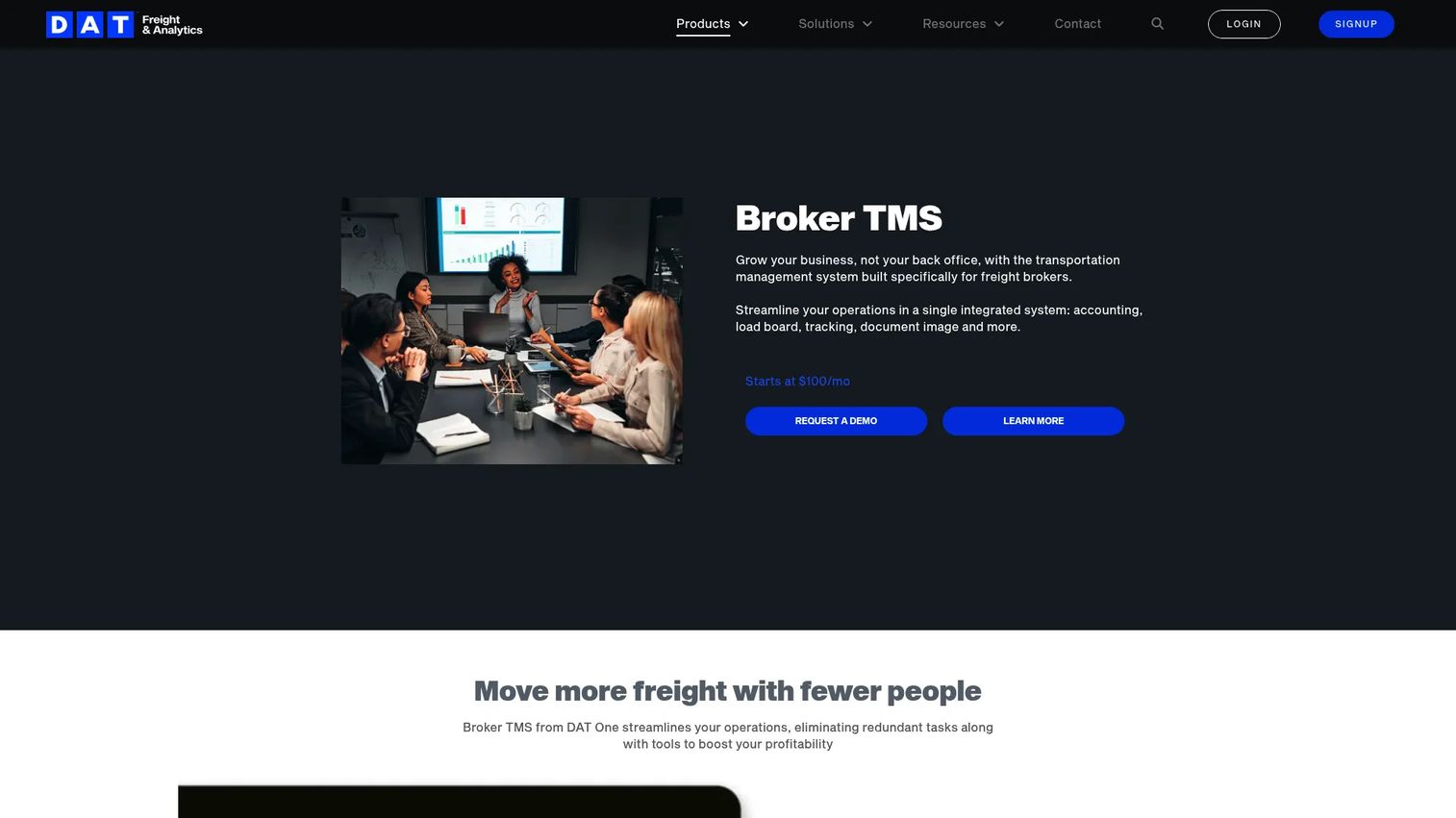
DAT Broker TMS is a freight broker transportation management system that combines operations, accounting, load board access, tracking, and document management in one workflow. It sits inside the DAT ecosystem, which means the load board tools brokers already rely on connect directly to the operational side of the business. For brokers who want a connected back office rather than a stack of point tools, that ecosystem tie-in is the core argument.
The single-entry model is the practical draw. You build a load once, and cost, accounting, and carrier rate confirmations flow from that record instead of getting retyped. Automated invoicing and load tracking round out a system designed to keep the back office in step with operations rather than a day behind it.
Best for: Freight brokers and 3PLs that want an all-in-one broker TMS with native DAT load board integration.
Key strengths
- Integrated accounting and operations: load, cost, and accounting live in one single-entry workflow, cutting duplicate data entry.
- Load board and carrier network tools: DAT's load board connects directly to the operational side for sourcing and coverage.
- Document management and automated billing: automated invoicing and carrier rate confirmations keep billing current with operations.
Why choose DAT Broker TMS: If your brokerage already uses DAT for load sourcing, running operations on the same platform removes the seams between finding freight and managing it. It fits brokers who value ecosystem consolidation over stitching together separate best-of-breed tools.
DAT Broker TMS pricing: DAT states the Ops tier starts from $100/mo, billed monthly, with additional modules available as brokerage needs grow. There is no free tier listed. Pricing is published on DAT's freight broker software page.
2. Tai TMS

Tai TMS is a transportation management system for freight brokers centered on quoting, load coverage, carrier management, and billing automation. Its strongest angle is the pricing and quoting workflow: instant quoting and rating let reps generate numbers fast, which matters when quote speed decides who wins the load. It is a more opinionated, workflow-heavy system for brokerages that want structure around how loads move from quote to invoice.
Shipment tracking and billing automation extend the workflow past the quote. The platform is built to reduce the manual steps between booking and getting paid, which is where a lot of brokerages quietly lose hours every week.
Best for: Freight brokerages that want an all-in-one TMS with quoting, tracking, and billing automation as the backbone.
Key strengths
- Instant quoting and rating: reps price loads fast with rating built into the workflow, protecting response speed.
- Load coverage and carrier management: covering freight and managing carriers happens inside one system.
- Shipment tracking and billing automation: tracking and automated billing cut the manual work between booking and settlement.
Why choose Tai TMS: Tai fits brokerages that treat quoting speed and billing accuracy as competitive levers, not afterthoughts. The tiered plan structure lets a growing desk start smaller and scale into more capability as volume climbs.
Tai TMS pricing: Tai publishes four plans on its pricing page: Growth at $995/month, Premium at $2,465/month, Premium + at $4,595/month, and Pro at $7,925/month. Enterprise pricing is custom. There is no free tier. All figures are billed monthly and come from Tai's first-party pricing page.
3. Alvys
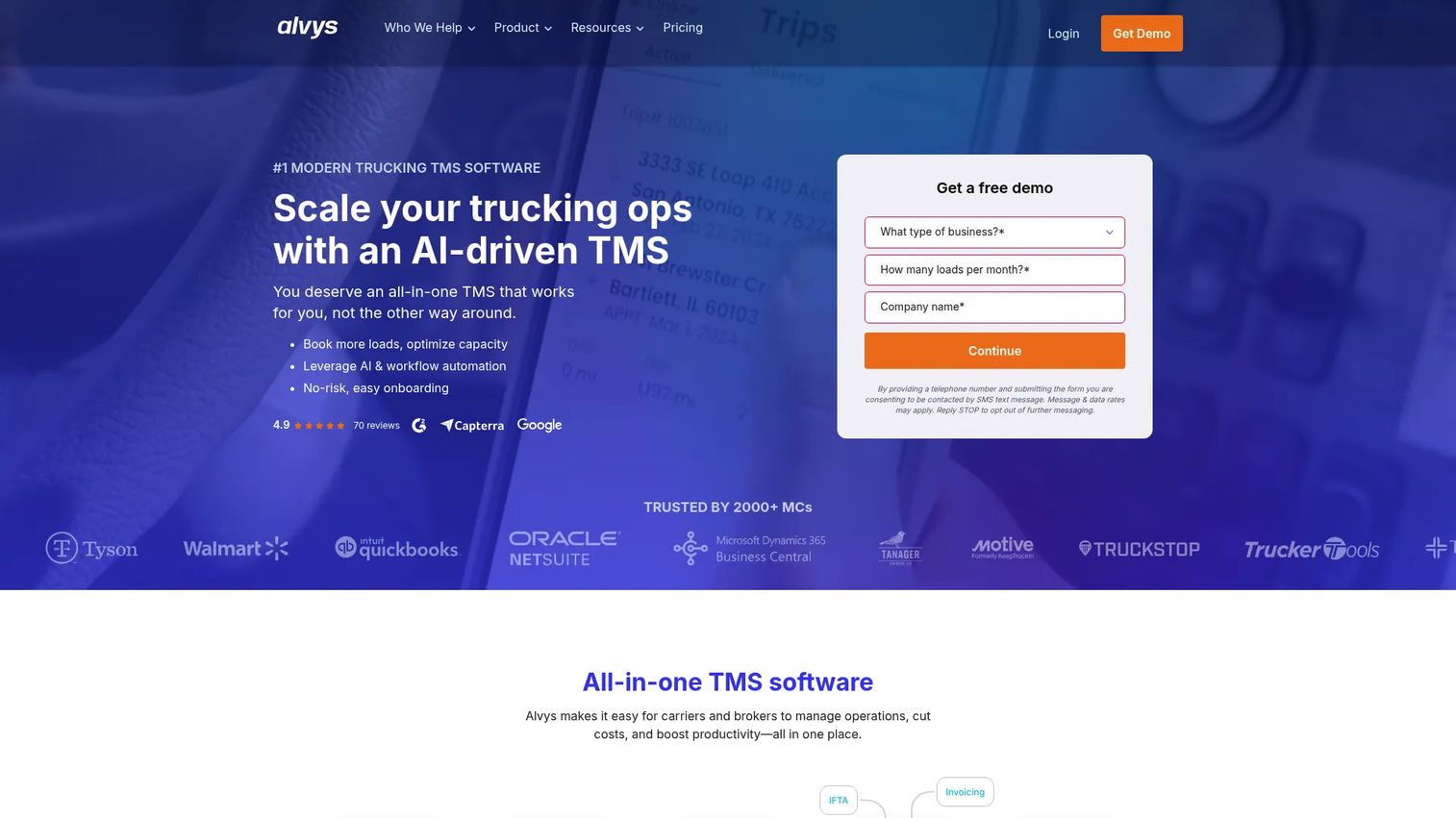
Alvys is an all-in-one trucking TMS for carriers, brokers, hybrids, enterprise fleets, and 3PLs, built cloud-native with a heavy emphasis on integrations and automation. Its standout feature is connectivity: native EDI, an open API, and 120+ integrations mean it slots into existing stacks instead of forcing a rip-and-replace. For brokers who live and die by how their systems talk to each other, that breadth matters.
The platform covers dispatching, load management, documentation, a marketplace, and real-time visibility, plus a driver app, compliance, accounting, reporting, and IFTA. The usage-based pricing with no long-term contracts is designed for operators who want to scale spend with volume rather than commit to seat counts up front.
Best for: Trucking operators and brokers that want a usage-based, cloud-native TMS with deep integration coverage.
Key strengths
- End-to-end operations: dispatching, load management, documentation, and real-time visibility in one platform.
- Native EDI, open API, and 120+ integrations: connects to existing tools without heavy custom work.
- Driver app, compliance, and accounting: operations, compliance, and finance covered across one system.
Why choose Alvys: Alvys fits brokers and hybrids who prioritize automation and integration depth, especially those running EDI with larger shippers. The usage-based model with unlimited users suits teams that expect to grow headcount without pricing friction.
Alvys pricing: Alvys uses usage-based pricing starting at $514/month, with monthly or annual billing, no long-term contracts, and unlimited users and business divisions. There is no free tier. Alvys holds a 4.7/5 rating on G2.
4. EZ Loader TMS
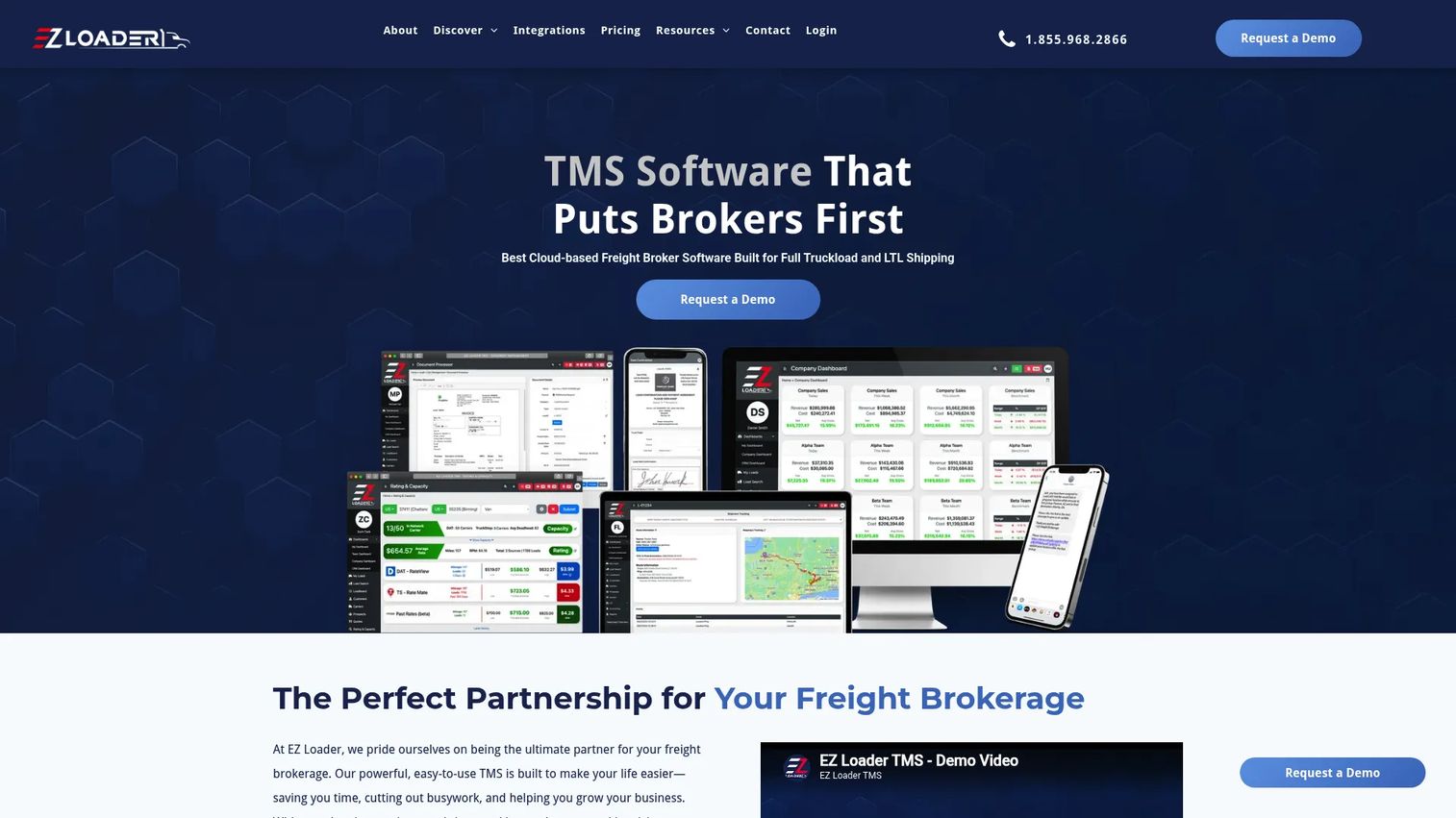
EZ Loader TMS is freight broker transportation management software focused on load management, tracking, documentation, and accounting automation. It positions itself as a straightforward operational TMS: a unified system for load ops, visibility, documents, and settlement without excess complexity. For brokerages that want a clean workflow rather than a sprawling feature set, that simplicity is the appeal.
Customizable load lists let teams shape the interface around how they actually work. SMS-based tracking gives visibility without demanding driver app installs, and digital documents with e-signatures move paperwork off the fax and into the system.
Best for: Freight brokers needing a unified TMS for load ops, visibility, documents, and accounting without a steep ramp.
Key strengths
- Load management and customizable load lists: shape load views around your team's workflow.
- SMS-based tracking and visibility: track loads without requiring driver app downloads.
- Digital documents and e-signatures: move rate confirmations and paperwork into the system.
Why choose EZ Loader TMS: EZ Loader fits brokerages that want practical, everyday operational software over a maximalist platform. The single-plan pricing model keeps evaluation simple, which appeals to smaller desks that do not want to decode a tier matrix.
EZ Loader TMS pricing: EZ Loader offers one plan at $500/month, billed monthly, including three user seats. Enterprise pricing starts at 10+ users. Add-on packages include an LTL Portal and EDI with monthly fees and setup fees. There is no free tier. Pricing is published on the EZ Loader pricing page.
5. FreightBoard
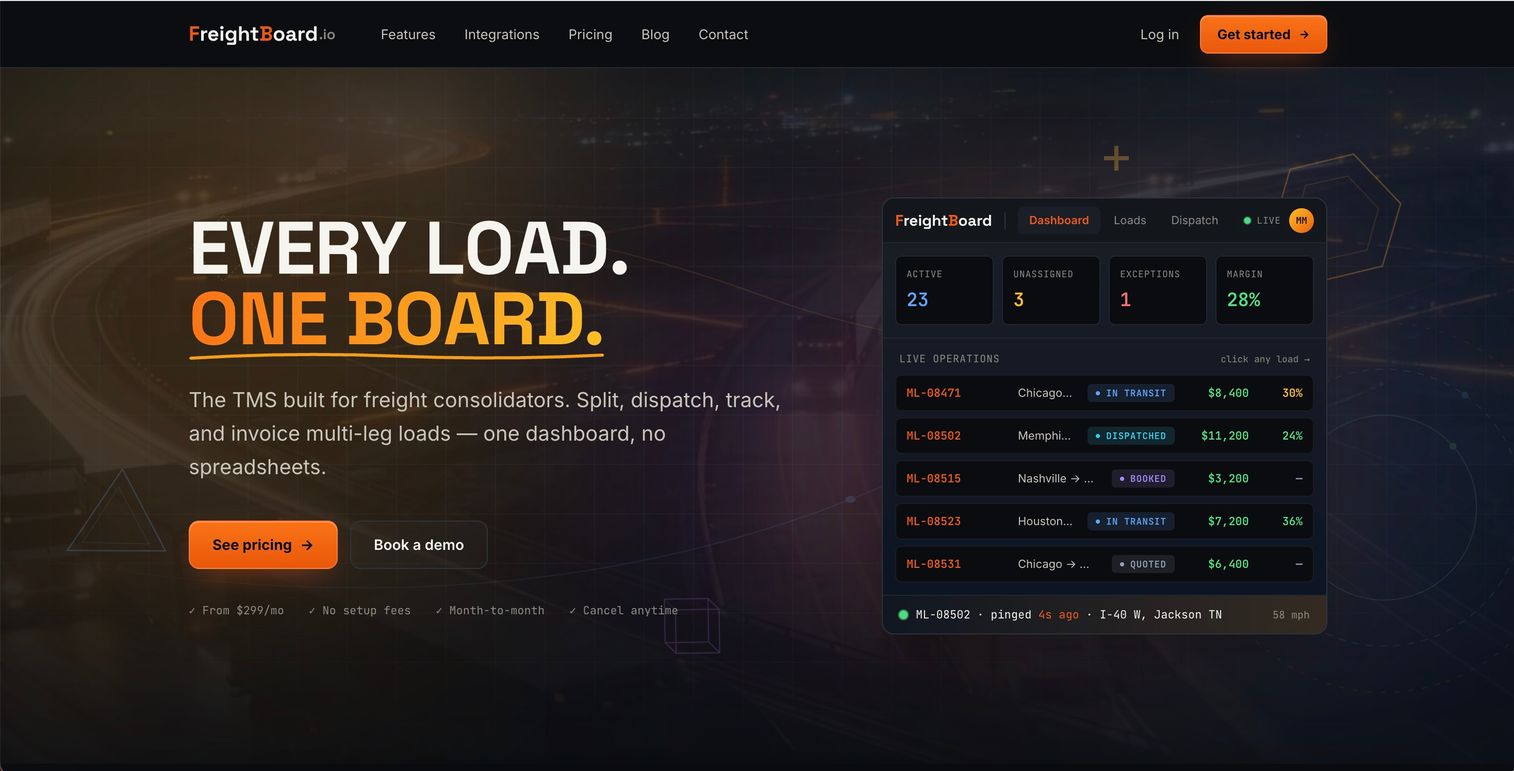
FreightBoard is an operational TMS for freight consolidators, brokers, and asset carriers, built around multi-leg and consolidated-load workflows. Where most broker TMS platforms assume one load equals one movement, FreightBoard is designed to split, dispatch, track, and invoice loads that move across multiple legs. For consolidators and brokered fleets, that per-leg model is the reason to look.
Lane history with DAT benchmark data and margin-fit visibility help price consolidated freight accurately. Live GPS tracking with certified audit logs and shareable customer links gives per-leg visibility that a single-load system cannot cleanly represent.
Best for: Freight consolidators and brokered or asset fleets managing multi-leg loads.
Key strengths
- Multi-leg load handling: split, dispatch, track, and invoice loads across multiple legs.
- Lane history and margin fit: DAT benchmark data and margin visibility support accurate consolidated pricing.
- Certified GPS tracking: live tracking with audit logs and shareable customer links for per-leg visibility.
Why choose FreightBoard: FreightBoard is the specialist pick when your freight does not fit the one-load, one-move mold. Consolidators and fleets running complex, multi-leg movements get a system built for that reality rather than one bent to fit it.
FreightBoard pricing: FreightBoard offers customized plans built around lanes, load volume, and entities, starting from $299/mo on a month-to-month basis with no setup fees and cancel-anytime terms. There is no free tier. Pricing detail is available on the FreightBoard site.
6. BrokersEdge TMS
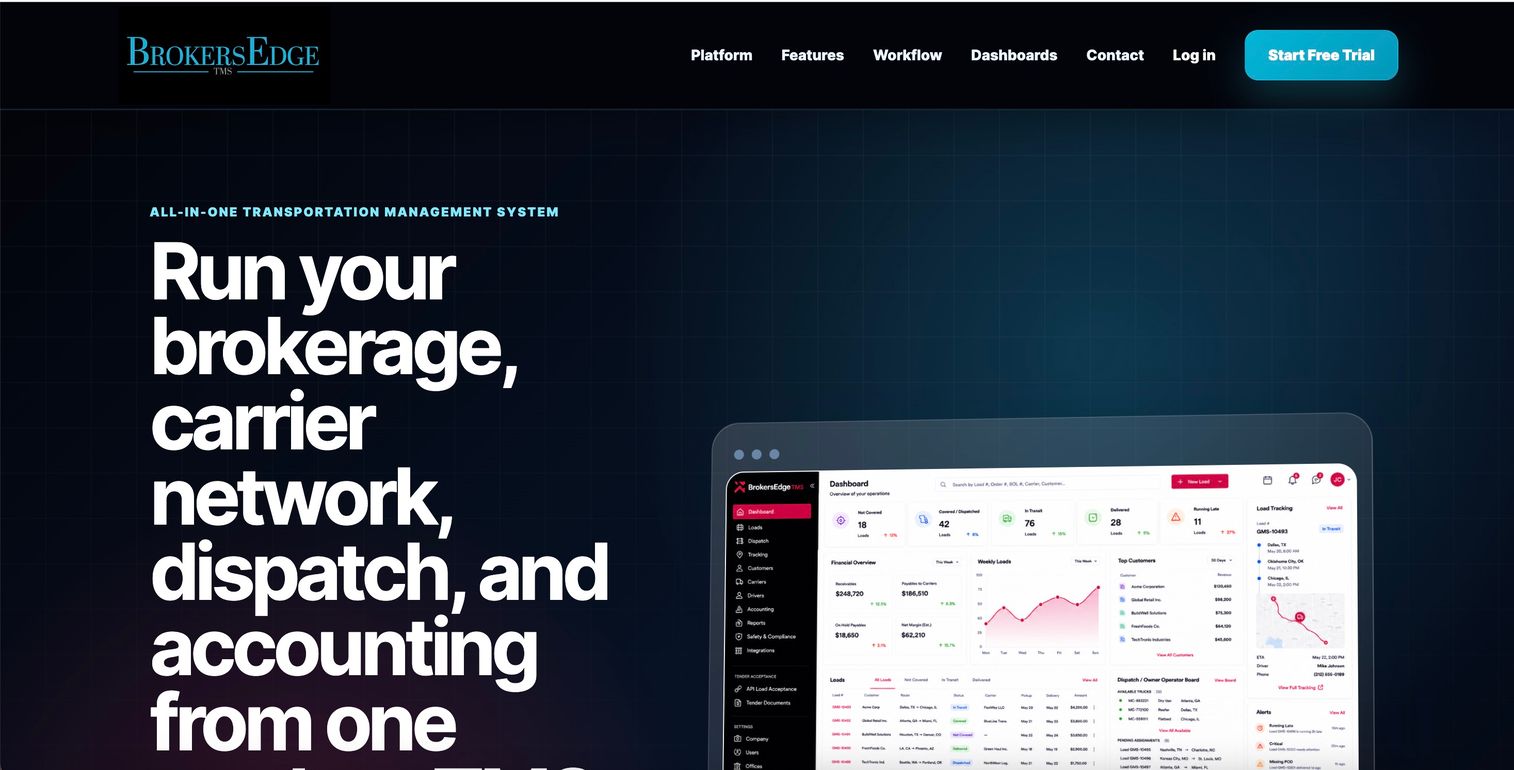
BrokersEdge TMS is an all-in-one transportation management system for freight brokerages, carrier networks, dispatch, and accounting. It brings load creation, tender acceptance, dispatch, shipment tracking, billing, and reporting into one system, positioned as a clean operational hub for brokers who want a single place to run the desk. The modern, department-oriented layout is the differentiator here.
Department dashboards for admin, dispatch, accounting, and carrier workflows mean each function gets a view built for its job. A built-in load board with sortable columns, saved views, filters, exports, and margin visibility keeps sourcing and margin management inside the same tool as everything else.
Best for: Freight brokerages and carrier-friendly operations that want a modern all-in-one TMS.
Key strengths
- End-to-end broker workflow: load creation, dispatch, tender acceptance, tracking, billing, and reporting in one system.
- Built-in load board: sortable columns, saved views, filters, exports, and margin visibility.
- Department dashboards: dedicated views for admin, dispatch, accounting, and carrier workflows.
Why choose BrokersEdge TMS: BrokersEdge suits brokers who want a clean, modern operational hub with role-specific dashboards rather than a one-size-fits-all screen. The department-oriented design fits desks where dispatch, accounting, and admin have distinct daily workflows.
BrokersEdge TMS pricing: BrokersEdge does not publish pricing on its site. The vendor offers a Request Demo and Start Free Trial path, so the practical next step is a direct conversation to scope pricing to your operation.
Considerations before you buy
The right freight broker software depends on how your desk actually operates, not on which name you recognize. Here is a checklist to run before you commit.
Broker specificity
Confirm the tool is built for brokerage, not retrofitted from a carrier or shipper product. A broker TMS should assume third-party carrier matching, margin protection, and quote-to-cash flow as its default shape, not as add-ons.
Workflow coverage
Map the tool against your full cycle: quoting, load management, carrier compliance, tracking, billing, and settlement. Gaps mean you keep a side tool alive, and every side tool reintroduces the re-entry problem you were trying to solve.
Integrations and connectivity
Check load board feeds, accounting sync, document management, and EDI and API connectivity against the systems you already run. If you trade EDI with larger shippers, native support matters more than a promised roadmap.
Visibility and automation
Evaluate live tracking, rate intelligence, and automated billing against your manual pain points. The goal is fewer check calls and faster settlement, so weigh automation depth over feature counts.
Pricing model and scale
Understand whether pricing is per-seat, usage-based, or flat, and how it grows with volume. A model that punishes headcount growth becomes a tax on scaling the exact way a usage-based or flat plan does not.
Conclusion
Freight broker software is no longer optional infrastructure. With 74% of logistics firms already on digital platforms per Business Research Insights (2025), the spreadsheet-and-tabs era is closing. The real decision is fit.
For an integrated back office with native load board access, DAT Broker TMS is the clean pick, especially if you already live in the DAT ecosystem. For quoting and rate workflows where speed protects margin,