The manual was updated. The mechanic still opened the old version.
That is not a file-storage problem. It is a document distribution problem. According to IATA's 2024 digital aviation survey, only 51% of aviation organizations use software specifically designed to create, store, and secure digital operational data. The rest are patching together shared folders, email threads, and paper-backed processes that fail the moment a revision ships or an auditor asks for proof.
Version control failures create real operational exposure. Approval records that live in email inboxes are nearly impossible to reconstruct. And pilots, mechanics, and field teams often operate in environments where internet connectivity is unreliable, making a cloud-only document system a liability rather than an asset.
If you are building or operating an aviation software business, the right document distribution platform removes this bottleneck without creating a new one. It ensures the correct controlled document reaches the right person, in the correct version, with a traceable record of who received it and when.
This guide compares 8 platforms that aviation teams use to manage that job in 2026.
What's inside
This guide covers 8 aviation document distribution platforms for operations teams that need current manuals and controlled records without relying on manual follow-up.
- Who it is for: Airline operators, MRO leaders, flight department managers, technical publications teams, and founders evaluating vertical aviation infrastructure
- Selection criteria: Offline access capability, document control and version management, approval and acknowledgement workflows, audit management depth, and integration fit
- How tools were chosen: Verified against current vendor product pages, G2 listings, and category-specific research as of October 2026
- Scope: Covers manual authoring platforms, technical publication libraries, maintenance records systems, and broader MRO platforms with document modules
TL;DR
- Best overall for controlled aviation manuals: Web Manuals, for teams that need the full editorial and distribution lifecycle in one place
- Best for airline operational content programs: Comply365, built for cross-department document management across flight, cabin, and ground operations
- Best for OEM technical publications access: Veryon Publications, strong on multi-manufacturer documentation and mobile access
- Best for configurable document circulation and mobile teams: Awery Documents Library, for operators that need status tracking and acknowledgement without a full MRO suite
- Best for aircraft records and lifecycle documentation: Flydocs, for airlines and lessors managing asset history at scale
- Best for complex aerospace technical content: Flatirons Solutions, for organizations with structured documentation programs and engineering-linked content
What is aviation document distribution software?
Aviation document distribution software controls how approved manuals, technical publications, maintenance records, flight documents, and procedures are published, accessed, acknowledged, updated, and audited across aviation teams.
Types of documents typically managed
- Flight operations manuals (FOM, OM-A, OM-B)
- FCOMs (Flight Crew Operating Manuals) and MELs (Minimum Equipment Lists)
- Maintenance manuals and task cards
- Airworthiness directives (ADs) and service bulletins (SBs)
- Flight releases and dispatch documents
- Inspection forms and technical records
- Quality procedures and controlled policies
- OEM documentation and revision notices
Core capabilities to look for
- Version control: Ensures users access the current approved document, not a superseded copy
- Role-based access: Limits document visibility by job function, fleet type, base, or department
- Offline availability: Keeps essential content accessible in cockpit, hangar, and remote environments
- Approval workflows: Records review, signoff, publication, and crew acknowledgement
- Audit trails: Preserves evidence of changes, access, and distribution status
- Search and OCR: Enables retrieval within PDFs, scanned records, and technical publications
- Mobile access: Supports pilots and mechanics outside a desk environment
- Integrations: Connects to maintenance, flight operations, EFB, and quality systems
What it does not replace
| What it does | What it does not replace |
|---|---|
| Controls who gets which document version | Generic cloud file storage (Dropbox, SharePoint) |
| Tracks acknowledgement and approval | Full MRO maintenance planning and work order execution |
| Manages revision history and distribution logs | OEM authoring tools or IETP viewers on their own |
| Provides audit-ready records | Quality management systems as standalone platforms |
When to use aviation document distribution software
Distribute revised manuals to crews and operations teams
Airline operators, charter companies, and corporate flight departments push manual revisions on a regular cycle. Without a controlled distribution system, version mismatches appear across crew devices. A proper platform ensures everyone receives the current version, confirms acknowledgement, and prevents access to superseded content, regardless of base or connectivity.
Give maintenance teams current technical publications
MRO teams and line maintenance crews need fast access to AMMs (Aircraft Maintenance Manuals), IPCs (Illustrated Parts Catalogs), and service bulletins, often in hangars or remote locations with limited connectivity. Offline access and multi-manufacturer search capability determine whether a mechanic uses the system or finds a workaround.
Prepare audit evidence without reconstructing history
EASA and FAA oversight involves document evidence: Who received a revision, when, and whether they confirmed receipt. A platform with permission histories, approval workflows, distribution logs, and user acknowledgements makes that evidence retrievable without a manual reconstruction effort the week before an audit.
Aviation document distribution software comparison
The right platform depends on whether your first constraint is manual authoring, publication access, technical publications research, wider MRO operations, or controlled records management. Use this table to identify which tools match your operating model before reading the detailed sections.
| # | Product | Best for | Key differentiator | Pricing | G2 rating |
|---|---|---|---|---|---|
| 1 | Web Manuals | Controlled manual authoring and distribution | Full editorial and distribution lifecycle in one aviation platform | From €4,000/year | 4.4/5 |
| 2 | Comply365 | Airline operational content and training management | Connected content, safety, and training across regulated operations | Contact sales | 4.7/5 |
| 3 | Veryon Publications | OEM technical publications and maintenance documentation | Multi-manufacturer library with AI-assisted search and offline access | Contact sales | 4.9/5 |
| 4 | Awery Documents Library | Configurable document circulation and mobile distribution | Status tracking, reminders, approvals, and mobile apps | Contact sales | N/A |
| 5 | Flydocs | Aircraft records and asset lifecycle documentation | Digital records management with lifecycle asset tracking | Contact sales | N/A |
| 6 | Flatirons Solutions | Aerospace technical content and structured documentation | IETP viewing, digital work cards, and content transformation | Contact sales | N/A |
| 7 | TRAX | MRO operations needing integrated maintenance records | Full MRO ERP with documentation tied to maintenance execution | Contact sales | 2.5/5 |
| 8 | TrustFlight | Aviation safety, quality, and document management | Integrated safety intelligence with AI-powered document and regulatory management | Contact sales | N/A |
Best 8 aviation document distribution software for 2026
1. Web Manuals
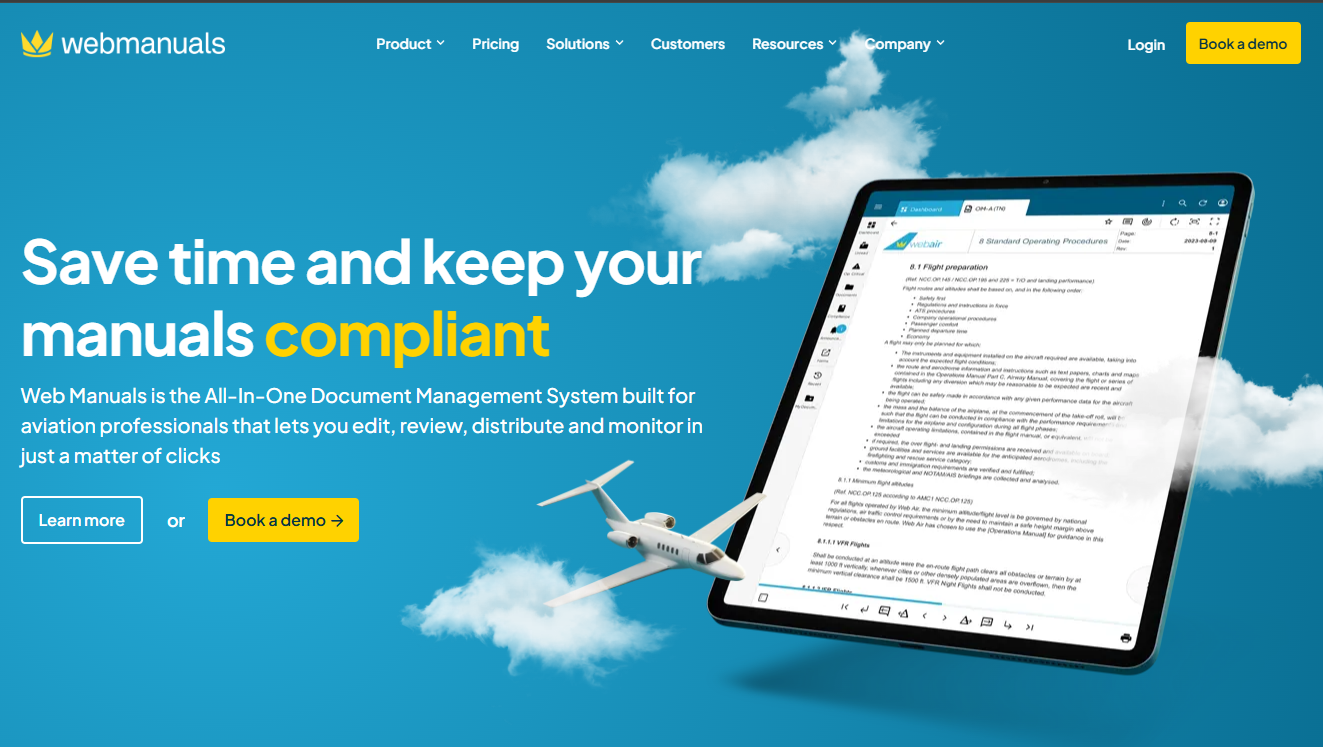
Web Manuals is an aviation-specific document management platform covering manual authoring, compliance monitoring, review workflows, and controlled distribution. It is built for the full editorial lifecycle, from first draft through approval, publication, and crew acknowledgement. Teams manage both online and offline access from the same platform, which matters when the people who need documents are in the cockpit or hangar rather than at a desk.
Best for: Airlines, charter operators, business aviation teams, and helicopter operators that own the manual creation process and need traceable distribution.
Key features
- Smart editing modules with real-time content mirroring and approval routing
- Compliance monitoring with live-linked regulatory libraries and traceability
- Online and offline distribution with role-specific permissions
- Amelia AI search across aviation manuals
- Revision history and acknowledgement tracking
Why choose Web Manuals: It fits organizations where the document lifecycle is the operating system. If your team authors, reviews, publishes, and monitors manuals rather than just distributing pre-built OEM content, Web Manuals is built for that workflow.
Web Manuals pricing: The Essentials Package starts at €4,000 per year. The Professional plan runs €170 per editor per month. Enterprise pricing requires a sales conversation. Pricing is shown in EUR on the official page, with a USD view also available.
G2 rating: 4.4/5
2. Comply365
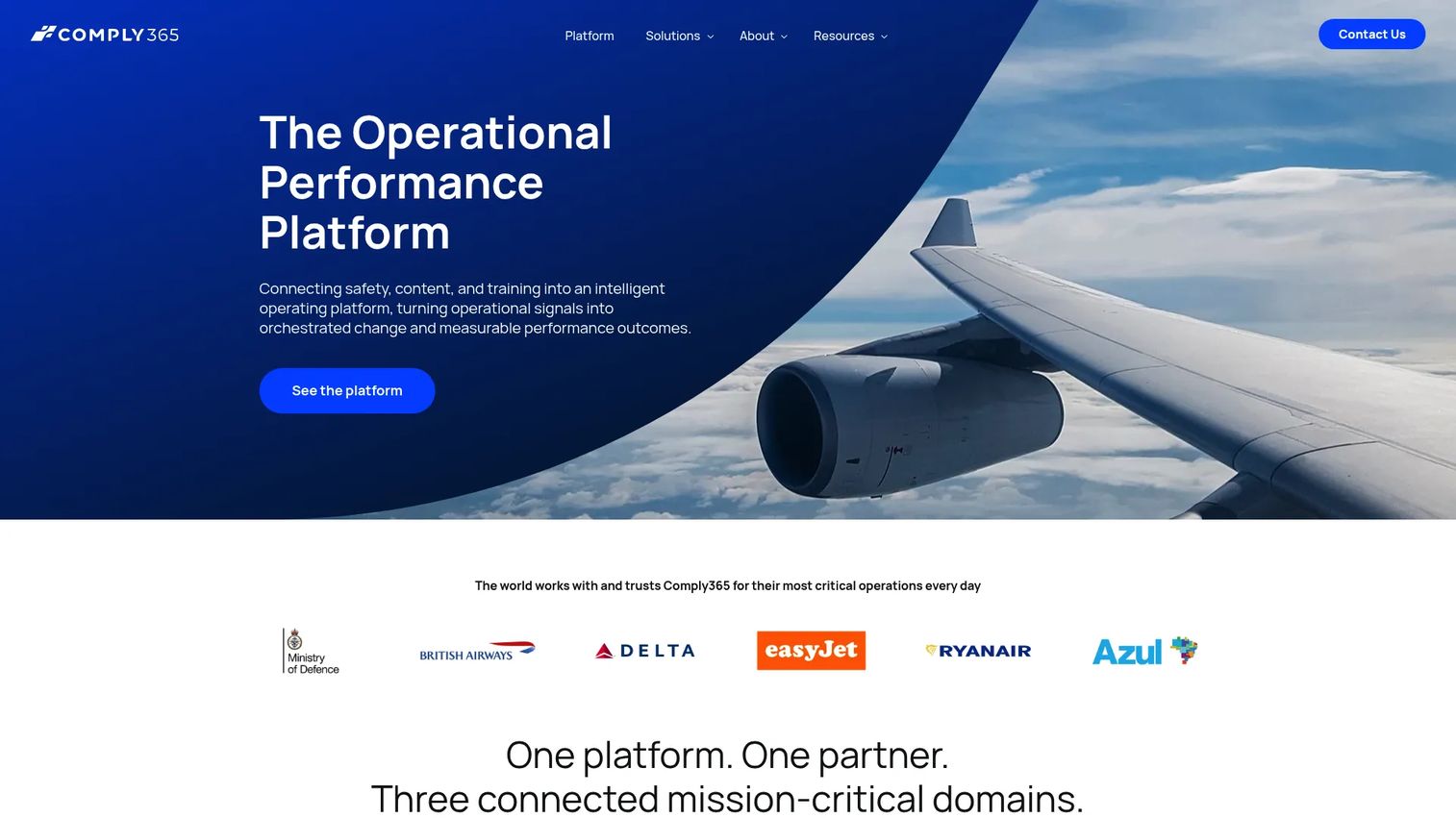
Comply365 positions itself as an AI-powered operational performance platform that connects content management, safety and risk management, and training management for regulated organizations. Airlines, defense operators, and rail companies use it to manage operational documentation across flight, cabin, maintenance, and ground departments from one system. The platform also covers operational forms, bulletin distribution, and content filtering.
Best for: Airlines and larger aviation organizations with cross-department document workflows that span operational content, safety reporting, and crew training.
Key features
- Operational content authoring, publishing, and controlled distribution
- Safety, quality, and risk management with offline access
- Training management with scheduling, qualifications, and automated grading
- Revision and bulletin distribution across departments
- Content filtering, annotations, and forms management
Why choose Comply365: It makes sense when document distribution needs to connect directly to safety workflows and training records. Teams that manage content, safety, and training in separate systems often find value in consolidating under one platform with shared data.
Comply365 pricing: The core platform pricing requires a sales conversation. Comply365 does publish pricing for its Discover365 training courses, which start at $50 per course per learner. Contact the vendor for platform contract terms.
G2 rating: 4.7/5
3. Veryon Publications
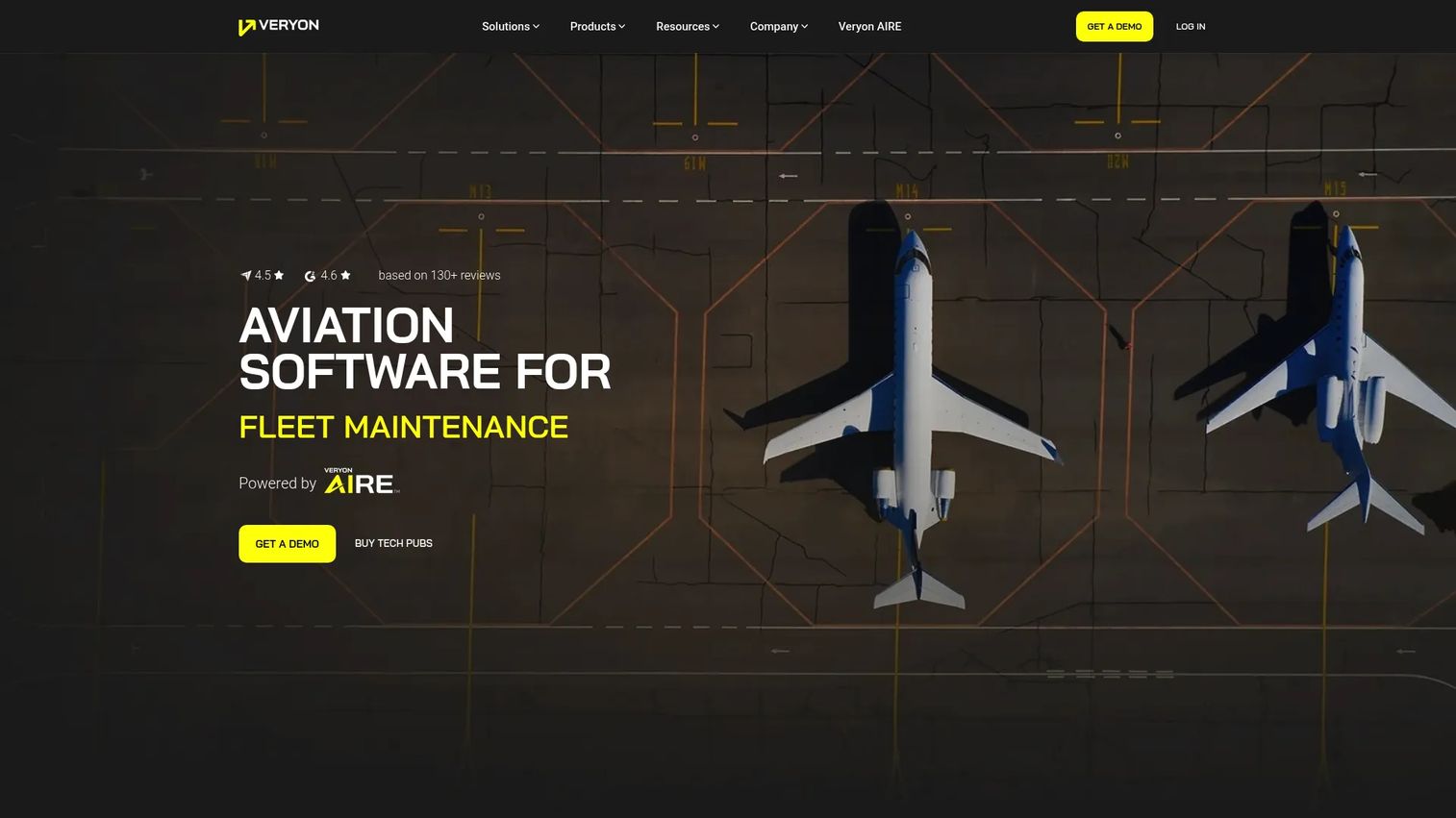
Veryon Publications is a centralized technical publications hub providing access to aircraft maintenance manuals, airworthiness directives, service bulletins, IPCs, and AMMs across multiple OEM and regulatory sources. The platform includes advanced search by aircraft profile and document terms, real-time updates, and the Veryon AIRE AI assistant for navigating complex technical content. A 7-day free trial covers the profile and compliance feature.
Best for: Maintenance organizations, MROs, and business aviation teams that need fast access to OEM technical documentation across a mixed fleet without building a separate library.
Key features
- Multi-OEM technical publications with centralized subscription management
- Advanced search by aircraft type, document category, and keyword
- Mobile and offline access for hangar and remote use
- Automated compliance reporting tied to aircraft profiles
- Veryon AIRE AI-assisted navigation and answers
Why choose Veryon Publications: It fits teams whose core challenge is accessing and searching technical publications across several aircraft types, rather than authoring or approving internal manuals. The compliance reporting feature is useful for tracking AD and SB status without manual spreadsheets.
Veryon Publications pricing: Annual subscriptions with pricing tied to the publications required, including aircraft types and OEM content libraries. Contact the vendor for a quote. A 7-day free trial is available for the profile and compliance feature.
G2 rating: 4.9/5
4. Awery Documents Library
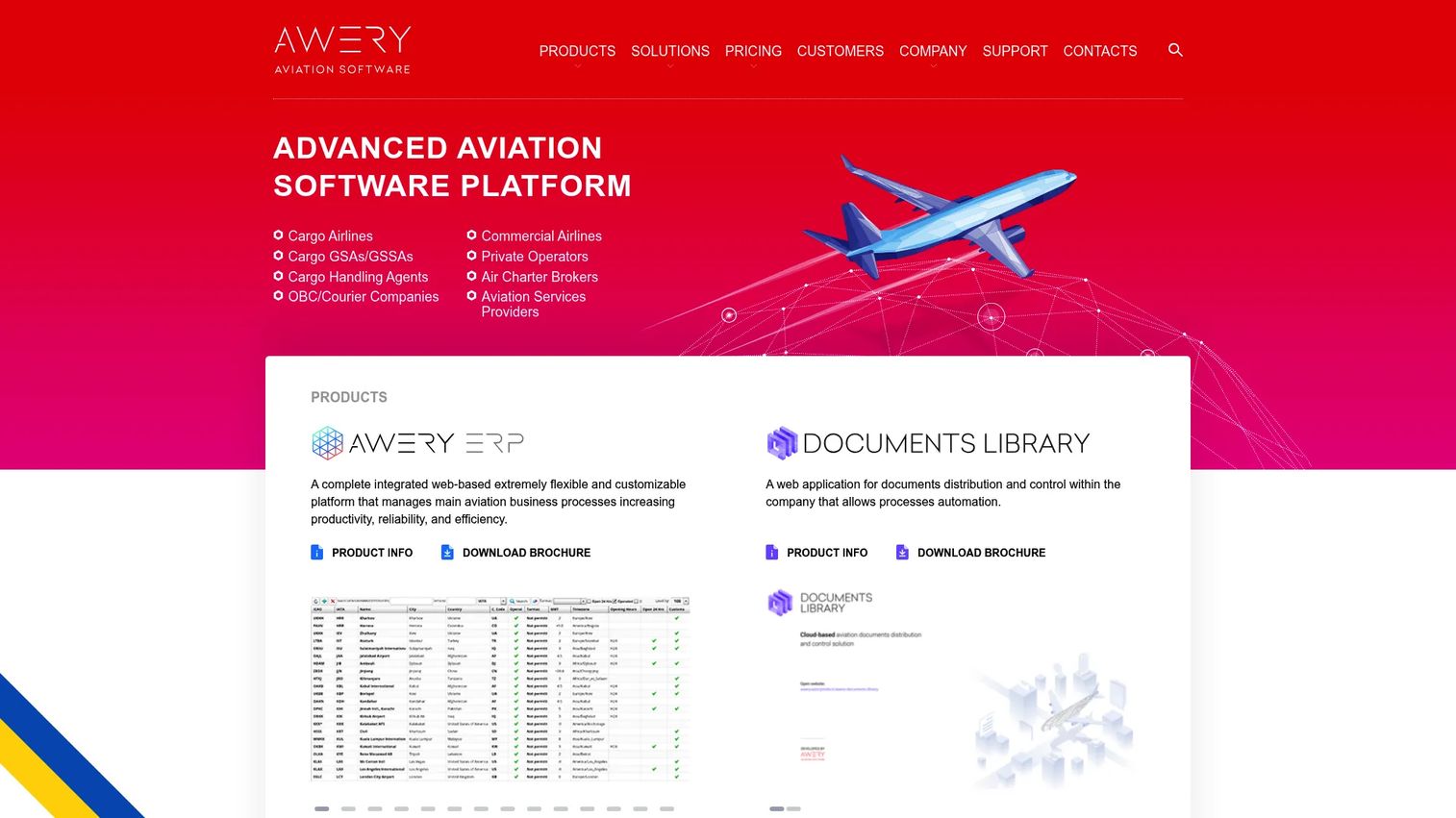
Awery Documents Library is a cloud-based document distribution and control product focused on circulation, revision tracking, approvals, status reporting, and automated reminders. It supports draft, active, and obsolete document statuses, electronic receipt tracking, and distribution lists by department, position, and user. iOS and Android apps support mobile access for crew and field personnel.
Best for: Aviation operators that need visible document status and acknowledgement workflows without purchasing a broader MRO suite.
Key features
- Document revision control with draft, active, and obsolete status tracking
- Approval workflows with auditor review and electronic acceptance
- Distribution lists by department, position, and individual user
- Automated reminders and notifications for pending acknowledgements
- iOS and Android mobile apps for crew and field teams
- Multi-language document distribution
Why choose Awery Documents Library: It suits operators who need controlled circulation and acknowledgement proof without the complexity of a full maintenance operations system. The status reporting and reminder functionality reduces the manual follow-up that typically falls on a quality or publications manager.
Awery Documents Library pricing: A 15-day free trial is available. Paid plans require a quote from the vendor. The pricing calculator on the product page does not display a numeric figure without a vendor conversation.
5. Flydocs
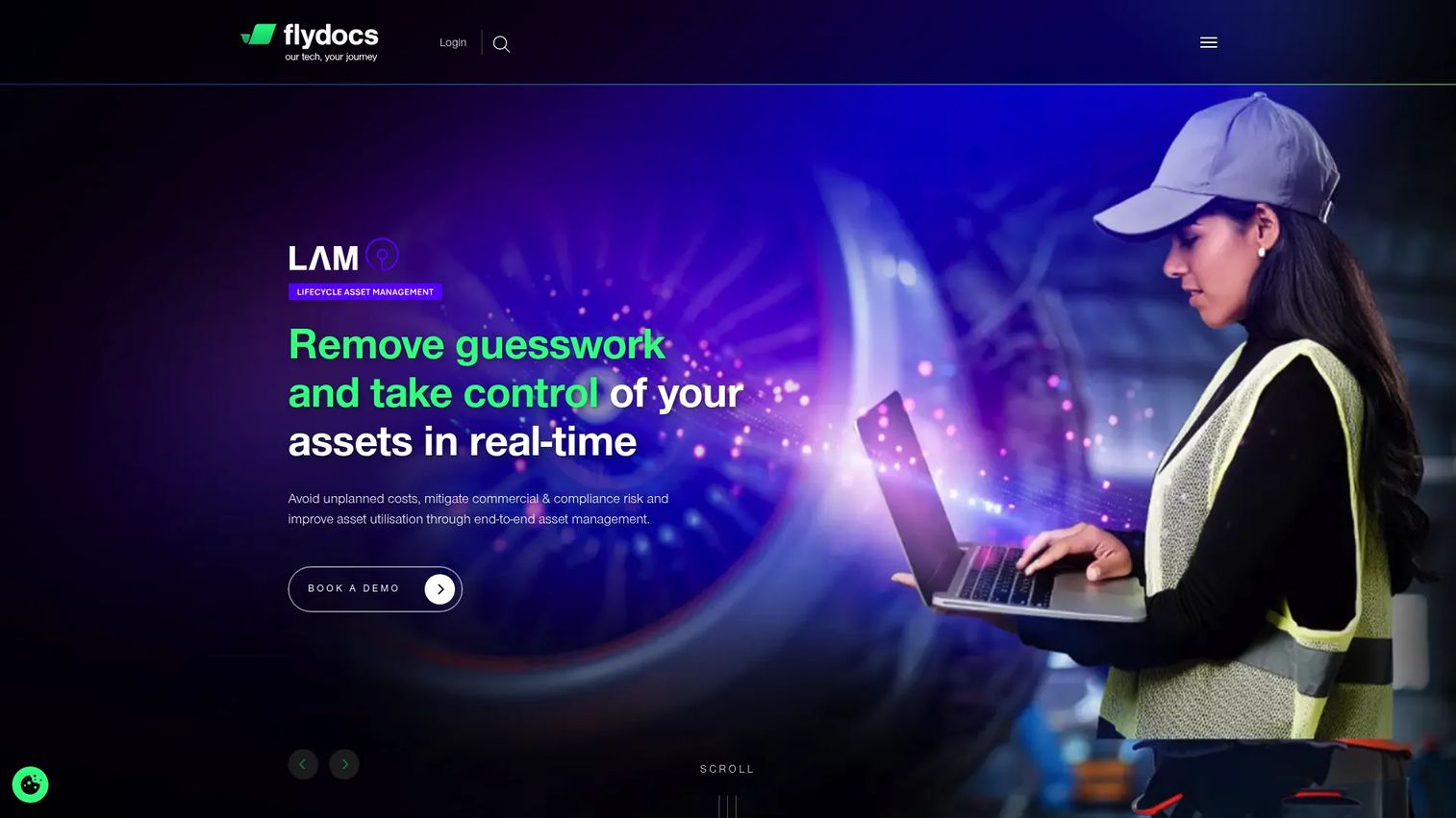
Flydocs provides digital aircraft records, asset management, component management, and aviation lifecycle solutions. Airlines, lessors, OEMs, and MROs use it to manage centralized cloud-based records storage, scanning, search, and asset trading documentation. The platform covers asset history, maintenance reserves, leases, utilization dashboards, and back-to-birth component certification.
Best for: Airlines and lessors managing aircraft records, compliance documentation, asset lifecycles, and aircraft transitions at scale.
Key features
- Digital records management with centralized cloud storage, scanning, and search
- Lifecycle asset tracking across history, maintenance reserves, and leases
- Asset Trading Solution for component documentation and certification management
- Fleet documentation visibility across aircraft types
- Data exchange and reporting for lessors and MRO partners
Why choose Flydocs: It fits document-heavy maintenance operations where records integrity and lifecycle management matter as much as crew manual distribution. If your primary challenge is proving aircraft history during a lease return or transition, this platform is built around that problem.
Flydocs pricing: Contact the vendor for pricing. Cost factors include fleet size, record digitization requirements, and modules. No pricing is displayed on the vendor's official pages.
6. Flatirons Solutions

Flatirons Solutions is an aerospace technical content and task-management platform for MROs, airlines, manufacturers, and defense operators. It covers technical content authoring, IETP (Interactive Electronic Technical Publication) viewing and search across S1000D and ATA iSpec 2200 formats, digital work cards with electronic sign-offs, workflow automation, and ERP and MRO integrations. The platform handles content transformation from legacy formats into structured documentation environments.
Best for: Aerospace organizations with complex technical publications programs, especially those managing structured content standards, engineering-linked documentation, and digital work card execution.
Key features
- Technical content authoring, management, and publishing for aerospace standards
- IETP viewing and search across S1000D, ATA iSpec 2200, and service bulletins
- Digital work cards with electronic sign-offs and production tracking
- Workflow automation tied to maintenance execution
- ERP, PLM, and MRO ecosystem integrations
Why choose Flatirons Solutions: It fits buyers with large or complex technical content estates where documentation standards, publishing quality, and integration into engineering systems drive the decision. The combination of IETP support and digital work cards makes it more relevant to manufacturers and large MROs than to operators focused primarily on crew manuals.
Flatirons Solutions pricing: Contact the vendor for pricing. Contracts reflect implementation scope, content volume, and deployment model. Flatirons operates as both a software platform and a services provider, so the engagement model affects total cost.
7. TRAX
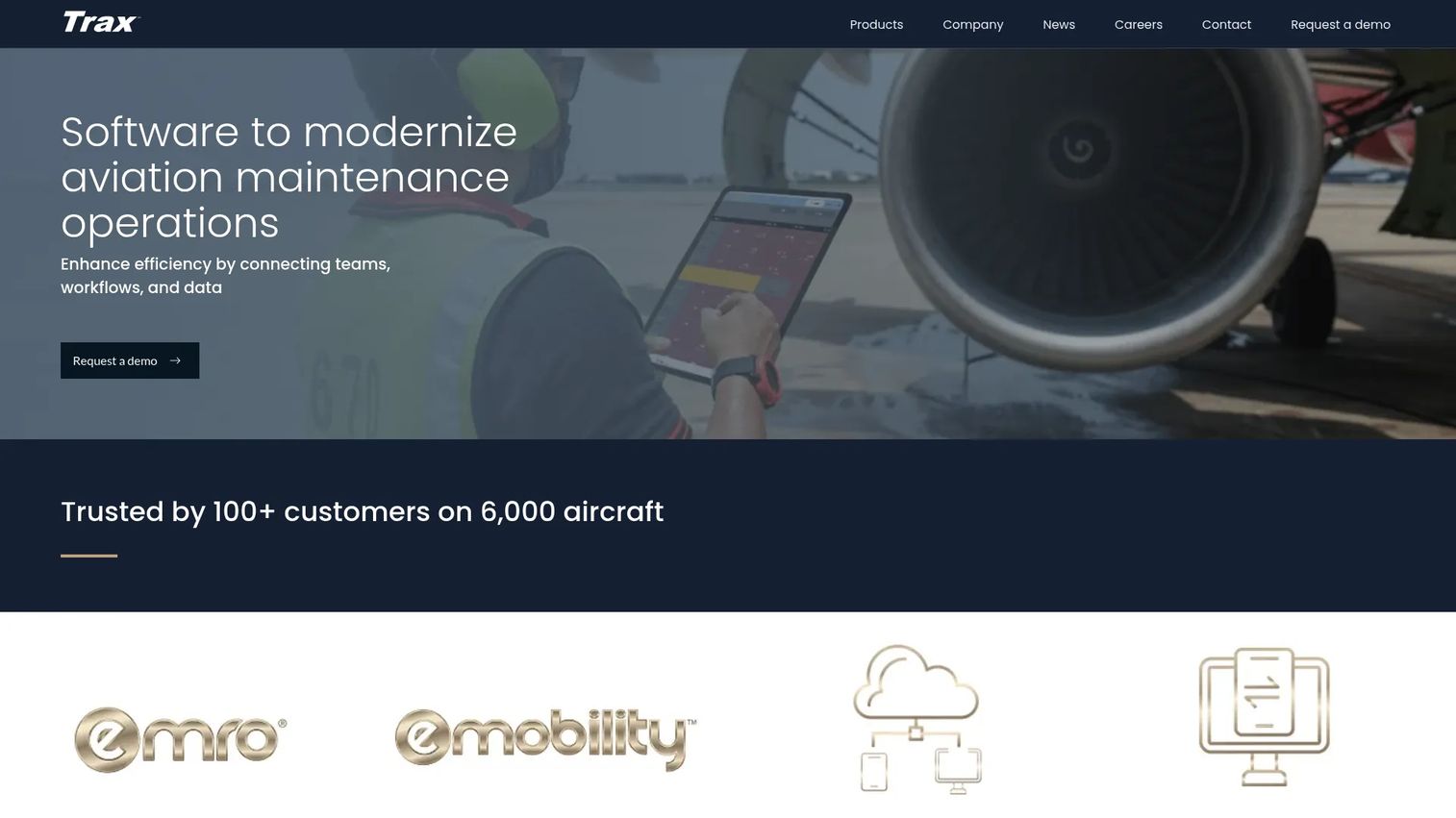
TRAX is a broader aviation maintenance and MRO platform. Its eMRO module covers engineering, planning, production, inventory, quality, technical records, and financial processes in a web-based ERP. The eMobility application supports mobile and paperless workflow execution. Cloud hosting includes monitoring, backups, and disaster recovery. Document workflows in TRAX sit within the wider maintenance operations context rather than as a standalone document control module.
Best for: Airlines, lessors, and MRO providers that need documentation tied directly to maintenance planning, work order execution, and enterprise operations records.
Key features
- eMRO web-based ERP covering engineering, planning, production, and quality
- Technical records management integrated with maintenance operations
- eMobility mobile and web apps for paperless workflow execution
- Cloud hosting with automatic updates and disaster recovery
- Document-linked maintenance processes across the MRO lifecycle
Why choose TRAX: Evaluate it when document distribution needs to connect directly to maintenance execution and enterprise MRO records. For teams that need a standalone manual publishing or crew acknowledgement tool without the full ERP context, TRAX may be more than the job requires.
TRAX pricing: Contact the vendor for pricing. Pricing factors include fleet size, selected modules, and implementation scope. No numeric pricing is shown on the vendor's site.
G2 rating: 2.5/5
8. TrustFlight
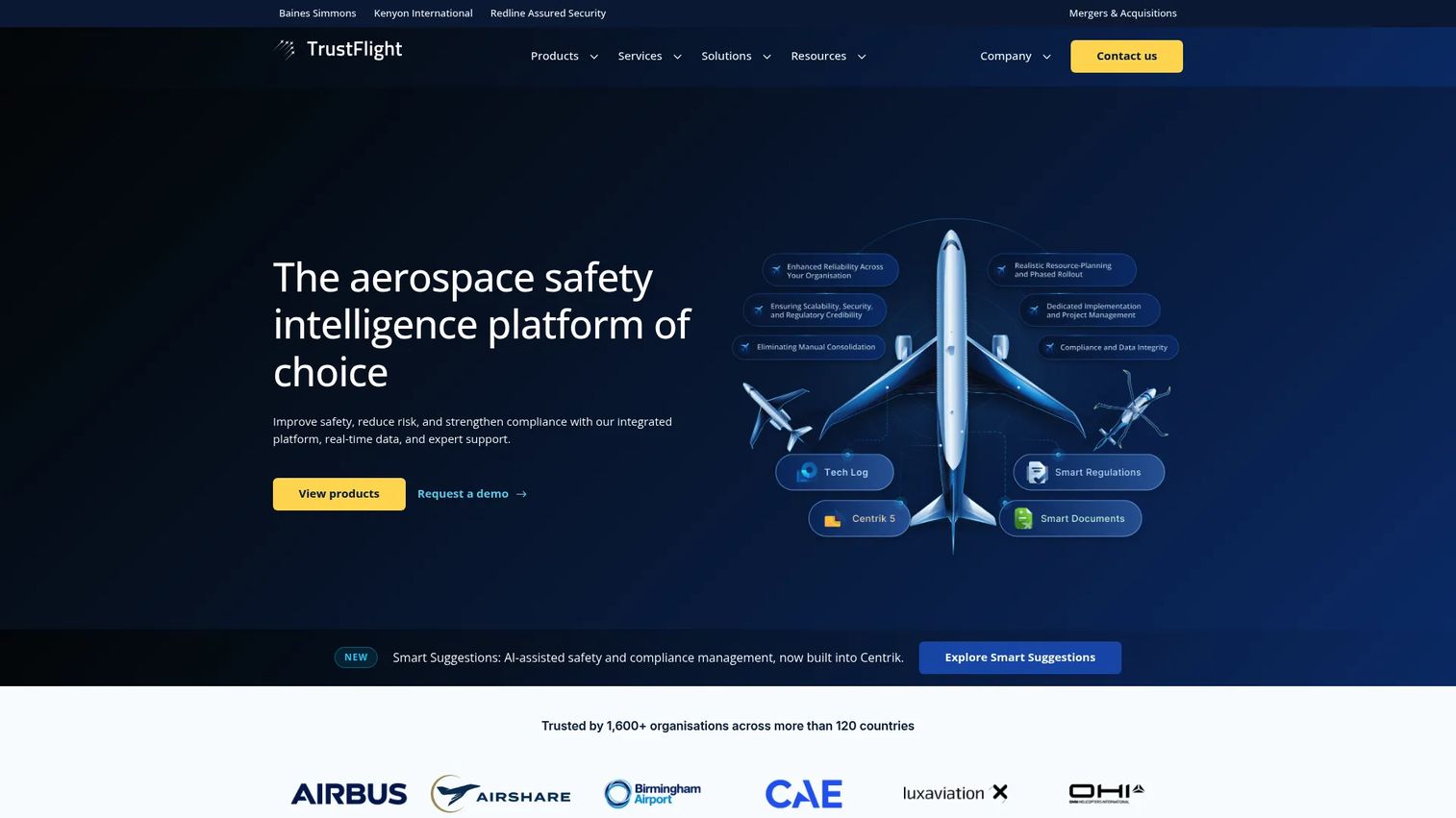
TrustFlight provides an integrated aerospace safety intelligence platform covering safety, quality, risk, airworthiness, document management, and regulatory management. Its Smart Documents module uses AI for document creation, management, and compliance. Smart Regulations connects regulatory content directly to internal documents. The Tech Log module handles electronic technical logbooks, maintenance workflows, and defect reporting. Centrik 5 covers quality, safety, and risk management.
Best for: Aerospace organizations including airlines, airports, MROs, and flight schools that need safety, quality, and document workflows in one integrated platform.
Key features
- Smart Documents: AI-powered document creation, management, and compliance
- Smart Regulations: AI-driven regulatory management with document integration
- Tech Log: Electronic technical logbook with maintenance workflows and defect reporting
- Centrik 5: Quality, safety, and risk management
- Aviation-focused authoring with revision control and controlled distribution
Why choose TrustFlight: It suits teams where document management, safety reporting, and regulatory alignment need to share data rather than operate in separate systems. The AI-assisted document and regulatory features reduce manual cross-referencing work for quality and compliance managers.
TrustFlight pricing: Pricing is organization-specific. Contact the vendor for a quote. No standard tier pricing is displayed on their official pages.
Considerations when choosing aviation document distribution software
Offline access is an operating requirement, not a feature
Ask what users can access without connectivity, how local copies synchronize when a connection returns, and how the system prevents access to superseded versions on offline devices. A document platform that fails in a hangar or cockpit will lose adoption to workarounds. Verify offline behavior for each device type your teams actually use.
Document approval and acknowledgement must produce provable records
Evaluate approval routing, revision history, signoff timestamps, acknowledgement reminders, and reports showing who received each revision. IATA's 2024 survey found that 36% of airlines permitted to use electronic technical logs still do not, often because the evidence architecture does not hold up to scrutiny. Your platform's audit output determines whether that evidence is retrievable in minutes or requires reconstruction.
Permissions should reflect actual aviation roles and operating certificates
Check whether access control can reflect fleet type, base, operating certificate, maintenance role, department, and third-party access. Generic folder permissions do not scale as operations expand across multiple bases or aircraft types. Role-based distribution that mirrors your org structure reduces the risk of crews accessing documents outside their authorizations.
Integrations determine whether the platform becomes a system of record
Evaluate connections to EFB systems, MRO platforms, flight operations software, ERP, quality management, identity providers, and data export paths. A document platform that requires duplicate manual entry alongside your maintenance or flight operations system will not maintain adoption after implementation.
Content migration determines the first year of value
Assess how the vendor handles legacy PDFs, scanned records, XML content, OEM publications, metadata, and version history. The migration plan is often the difference between a platform that delivers value in month one and one that sits unused because the content is still in the old system. Ask specifically about scanned records, OCR validation, and how historical revision history transfers.
Conclusion
Aviation document distribution covers a wide operating range. Web Manuals suits teams managing the full manual lifecycle from authoring through acknowledgement. Comply365 fits larger airline organizations connecting content management to safety and training data. Veryon Publications is the strongest option when the primary need is fast access to OEM technical publications across a mixed fleet. Awery Documents Library covers controlled circulation and mobile acknowledgement without a full MRO commitment.
For records-heavy operations, Flydocs handles aircraft lifecycle documentation and asset transitions. Flatirons Solutions fits organizations with structured aerospace technical content programs. TRAX belongs in the evaluation when document workflows must connect to a full maintenance ERP. TrustFlight suits teams that need safety, quality, and document management to share one data model.
The right choice removes manual version chasing, creates clear ownership of approvals and distribution, and produces evidence without a scramble when an auditor asks for it. That criterion, more than feature count, determines whether a platform earns its place in the stack.
If you sell aviation document software and want prospects to experience your product before a sales call, Start your journey with Guideflow today!
FAQs
Aviation document distribution software controls how approved manuals, technical publications, maintenance records, and operational procedures are published, accessed, acknowledged, updated, and audited across aviation teams. It differs from generic cloud storage by enforcing version control, role-based permissions, approval workflows, and audit trails specific to regulated aviation operations. The goal is ensuring the right person receives the correct document version, with traceable proof that they received and confirmed it.
The document list depends on the organization's operating certificate and scope, but typically includes flight operations manuals, FCOMs, MELs, maintenance manuals, airworthiness directives, service bulletins, flight releases, inspection forms, quality procedures, and OEM revision notices. MRO organizations add task cards, component records, work orders, and back-to-birth documentation. Charter and business aviation teams focus primarily on operations manuals, MELs, and regulatory publications relevant to their fleet.
Many platforms support offline access, but behavior varies significantly. Verify which device types are supported, how the sync process works when connectivity returns, whether superseded documents are blocked from offline access, and how quickly updates reach offline devices after a revision publishes. Offline access that does not enforce version control can create the same risk as no system at all.
Version control and revision history are foundational. Beyond those, approval workflows with timestamp records, role-based permissions mapped to actual aviation roles, crew acknowledgement tracking with reminders, offline mobile access, and integration with flight operations or maintenance systems determine whether the platform holds up operationally. Technical search capability matters when content volumes are large or documentation spans multiple OEM sources.
Platforms with audit trails, revision histories, permission records, acknowledgement logs, and approval timestamps make document evidence retrievable rather than reconstructed. When an auditor asks who received a specific revision and when, a well-configured system produces that report directly. This article does not constitute regulatory or legal advice, and compliance with FAA, EASA, or other authority requirements depends on how each organization implements and maintains its systems.
Yes. Document distribution platforms focus on controlling who receives which version of which document, with traceable proof of receipt and approval. MRO platforms connect records and documentation to maintenance planning, work orders, inventory, parts tracking, and financial operations. Some products span both areas. TRAX and Flatirons Solutions are examples where document workflows sit inside a broader maintenance operations context. Web Manuals and Awery Documents Library focus primarily on the document control and distribution job.
Start with a document inventory and ownership map before touching any content. Clean up superseded versions before migration rather than importing the full archive. Define your access model and distribution lists in advance so the platform is configured correctly from day one. Run a test migration with a subset of documents to validate metadata, version history, and OCR quality on scanned records. Plan a phased rollout by document type or department rather than a single cutover, and verify that offline devices sync correctly before going live.
Cost factors include fleet size, number of users or editors, modules selected, technical publication subscription scope, content volume, mobile access requirements, integration work, and implementation support. Web Manuals publishes EUR-based pricing starting at €4,000 per year for the Essentials tier. Most other platforms in this list price by quote, with contracts shaped by operating scale and module selection. Compare trial terms, implementation timelines, and migration costs alongside the software price when building a total cost of ownership picture.