Your quality data lives in six places and none of them talk to each other. CAPA records sit in one spreadsheet. Document control runs through a shared drive. Audit findings live in someone's inbox. Nonconformance reports get logged in a tool the ops team bought two years ago. When an auditor asks you to trace a defect from complaint to corrective action, you spend three days reconstructing a story that should take three clicks.
That fragmentation is the real cost. Not the license fee, not the implementation timeline, but the manual handoffs, the lost traceability, and the near-impossibility of proving to leadership that quality work actually moved a metric.
The market has noticed. The global quality management software market is projected to reach USD 28.82 billion by 2033, up from USD 13.41 billion in 2026, a compound annual growth rate of 11.5% according to Grand View Research (2026). North America alone accounted for over 41.1% of global revenue in 2025. Buyers are spending because the disconnected approach stops scaling the moment you add a second site, a new standard, or a supplier network.
The question for a buyer is not whether to systematize quality. It is which system fits your operating model. A life sciences team under FDA scrutiny needs validation support and airtight audit trails. A manufacturer running IATF 16949 needs shop-floor audit discipline and ERP-connected traceability. A lean ops team needs adoption, not a two-year rollout. Those are three different tools. This guide sorts them.
If your evaluation touches adjacent systems, you may also find our roundups of audit management software and contract lifecycle management software useful for mapping the full compliance stack.
What's inside
This guide covers the nine best quality management software platforms for regulated, manufacturing, and operations-led teams in 2026. It includes enterprise eQMS suites, life sciences cloud platforms, configurable no-code systems, ERP-embedded quality, and lighter shop-floor tools.
We selected platforms on five criteria that matter for a real buying decision:
- Core QMS modules: document control, CAPA, audit management, nonconformance, training, supplier quality, and risk management
- Compliance coverage: support for ISO 9001, IATF 16949, AS9100D, FDA, and related standards
- Integrations: connectivity to ERP, MES, PLM, LIMS, and CRM
- Usability and adoption: whether frontline and quality teams will actually use it
- Fit by company size and operating model: from mid-market to global enterprise
Pricing and G2 ratings reflect verified values as of mid-2026.
TL;DR
- Best for regulated life sciences: MasterControl, for connected quality, manufacturing, and validation depth
- Best for fast-adopting life sciences teams: Qualio, for cloud QMS with compliance rigor and quicker time-to-value
- Best for configurability: Octave Reliance, for no-code workflow design across 40+ quality applications
- Best for SAP-centric enterprises: SAP Cloud ERP, for quality tied directly to ERP and supply chain data
- Best for cost-conscious mid-market manufacturers: QT9 QMS, for pre-validated, all-in-one modules
- Best for shop-floor execution and lighter operational quality: Redzone, SafetyCulture, and EASE, depending on whether you prioritize frontline productivity, mobile inspections, or layered process audits
What is quality management software?
Quality management software (QMS software) is a system of record that digitizes and connects the processes a company uses to control product and process quality, meet compliance standards, and drive continuous improvement.
Where spreadsheets and point tools scatter quality data, a modern quality management system software platform centralizes it. An electronic QMS (eQMS software) adds electronic signatures, validation support, and audit trails that regulated industries need for FDA, ISO, and similar frameworks.
Modern platforms typically include a core set of connected modules:
- Document control: version-controlled SOPs, work instructions, and controlled records with approval routing
- CAPA: corrective and preventive action workflows tied to root cause analysis
- Nonconformance management: logging, dispositioning, and closing quality events
- Audit management: internal, supplier, and certification audit scheduling and findings tracking
- Training management: role-based training assignment tied to document changes
- Supplier quality management: supplier scorecards, incoming inspection, and corrective actions
- Risk management: risk registers, FMEA, and control tracking
What buyers should expect from a 2026-grade QMS: connected workflows across modules, exportable reporting and dashboards, AI readiness for trend detection, validation support for regulated use, and clean integrations into ERP, MES, PLM, and LIMS. The best quality control software also makes traceability effortless, so a single defect can be followed from complaint through CAPA to closure.
On the compliance side, these platforms map to standards including ISO 9001, IATF 16949 (automotive), AS9100D (aerospace), ISO 14001 (environmental), ISO 45001 (health and safety), ISO/IEC 17025 (testing labs), plus FDA and FAR requirements in regulated sectors.
When to use quality management software
Standardize quality processes across teams
When your CAPA log lives in a spreadsheet, your SOPs live in a shared drive, and your audit findings live in email, you no longer have a process. You have a collection of artifacts nobody can reconcile. The operational signs are familiar: duplicate records, missed training assignments after a document change, and quality reviews that stall because no one can find the current version. A QMS becomes the single system of record that ends the reconstruction work.
Support regulated and audited environments
Life sciences, medical devices, aerospace, food and beverage, and regulated manufacturing all share one demand: prove it. Auditors want traceability, controlled documentation, electronic signatures, and validation evidence. An eQMS software platform bakes these into the workflow, so audit readiness is a continuous state rather than a fire drill every certification cycle. In global surveys, 83% of chemicals and food and beverage firms expect increased quality budgets over the next year, per Verdantix (2025), and regulated pressure is a large reason why.
Connect quality data to ERP, MES, PLM, and LIMS
Quality data that sits isolated is quality data that arrives late. When your QMS connects to ERP for supplier and part data, MES for production events, PLM for design changes, and LIMS for test results, corrective action gets faster and root cause gets clearer. Connected workflows mean a nonconformance on the line can trigger a supplier CAPA and a document update without a single manual handoff. That visibility is what turns quality from a lagging report into an operational lever.
Comparison table
The table below sorts the nine platforms by relevance to a QMS buying decision, from deep regulated eQMS suites to lighter operational quality tools. Pricing reflects what vendors publish; several route to sales for a tailored quote, which is standard in this category.
| # | Product | Intent | Key use case | Pricing | G2 rating |
|---|---|---|---|---|---|
| 1 | MasterControl | Regulated eQMS | Connected quality, manufacturing, and validation for life sciences | Contact sales | 4.3/5 |
| 2 | Qualio | Cloud eQMS | Fast-adopting life sciences QMS with compliance rigor | Quote-based | 4.4/5 |
| 3 | Octave Reliance | Configurable eQMS | No-code quality workflows across 40+ applications | Contact sales | 4.3/5 |
| 4 | SAP Cloud ERP | Enterprise ERP quality | Quality tied to ERP, supply chain, and manufacturing data | Contact sales | 4.4/5 |
| 5 | QT9 QMS | Mid-market eQMS | Pre-validated all-in-one modules for regulated manufacturers | Quote-based | 4.8/5 |
| 6 | Redzone | Connected workforce | Frontline productivity plus quality visibility | Quote-based | 4.8/5 |
| 7 | Ideagen Quality Management | Enterprise QMS | Multi-site, multi-standard governance | Contact sales | 4.0/5 |
| 8 | SafetyCulture | Operational quality | Mobile inspections, checklists, and corrective actions | Free / $24/mo | 4.6/5 |
| 9 | EASE | Manufacturing audits | Layered process audits and plant-floor inspections | From $720/site/mo | 4.6/5 |
1. MasterControl
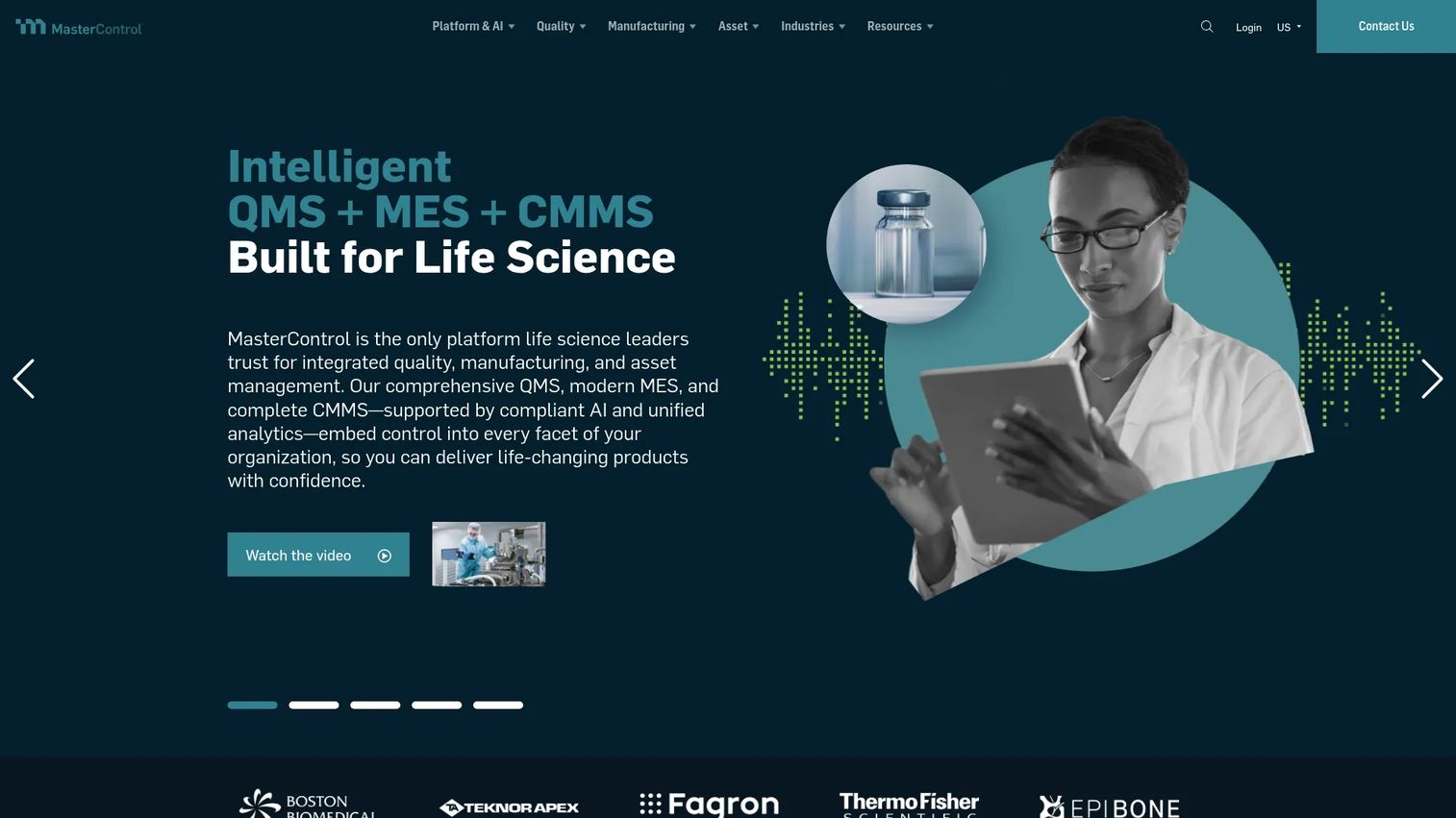
MasterControl is cloud software for regulated life sciences companies, spanning quality, manufacturing, and asset management in one connected platform. It is built for organizations where governance and traceability are non-negotiable, and where a document change has to cascade into training, CAPA, and audit records automatically. For a PM or quality lead in a regulated environment, it treats quality as a system rather than a stack of disconnected tools.
Best for: Regulated life sciences teams needing a connected QMS platform with deep validation support.
Key strengths
- Document control: Version-controlled SOPs and records with approval routing that ties directly into training assignments.
- Training management: Role-based training that triggers automatically when a controlled document changes, closing a common audit gap.
- CAPA and quality event management: Structured corrective and preventive action workflows linked to root cause and nonconformance records.
Why choose MasterControl: Teams pick MasterControl when the cost of a compliance gap dwarfs the cost of the platform. It is the choice for organizations that value airtight traceability, validation evidence, and connected quality-to-manufacturing workflows over a lightweight, minimal-config rollout. If you operate under FDA scrutiny and need to prove control across the product lifecycle, it earns its place.
MasterControl pricing: MasterControl does not publish numeric pricing. The vendor directs prospects to contact sales for a tailored quote based on modules, users, and validation scope. That is typical for regulated eQMS platforms, where implementation and validation services factor heavily into total cost. MasterControl holds a 4.3/5 rating on G2.
2. Qualio
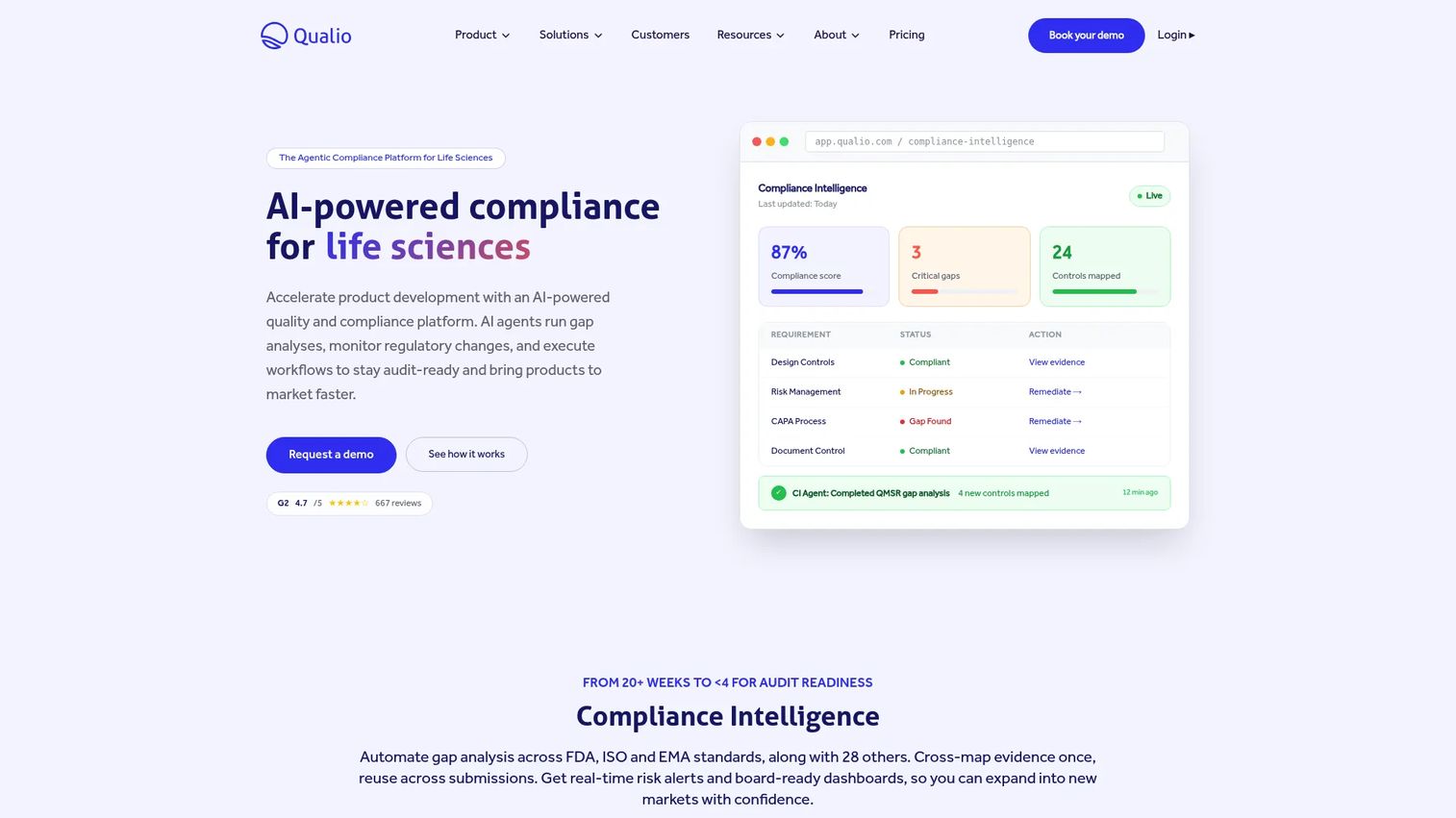
Qualio is an AI compliance platform built for life sciences, delivering a cloud QMS with an emphasis on audit-readiness and faster time-to-value. It targets teams that need FDA and GxP rigor without a multi-year implementation, which makes it a strong fit for growing companies scaling their quality function. The platform covers the full compliance workflow while staying usable enough that quality teams adopt it quickly.
Best for: Life sciences teams needing a cloud QMS with compliance and audit-readiness workflows and quicker deployment.
Key strengths
- Document control and design controls: Controlled documentation and design history support for medical device and pharma teams.
- CAPA and NCR management: Corrective action and nonconformance workflows connected to risk and audit records.
- Supplier quality and compliance intelligence: Supplier management plus built-in compliance guidance that reduces the interpretation burden on lean teams.
Why choose Qualio: Qualio fits teams that want regulatory rigor and speed in the same package. It suits companies where the quality function is small but the compliance stakes are high, and where a lighter, cloud-native rollout beats a heavy enterprise deployment. The compliance intelligence layer helps smaller teams punch above their headcount.
Qualio pricing: Qualio uses quote-based pricing across its Foundation, Growth, and Scale plans, with an implementation fee applying to all plans. The vendor does not publish numeric prices and asks buyers to request a quote. Qualio holds a 4.4/5 rating on G2.
3. Octave Reliance
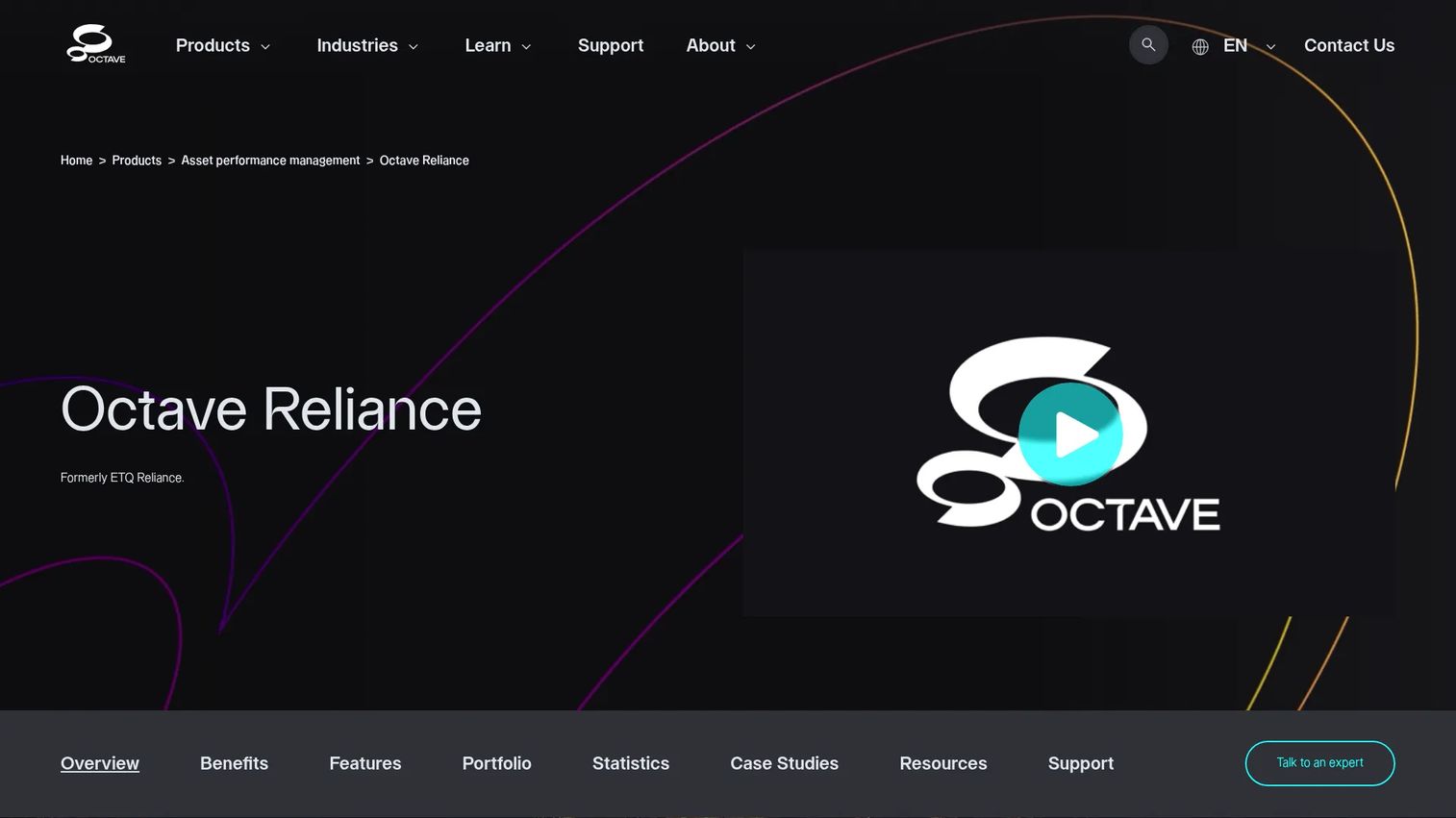
Octave Reliance is a cloud-native quality management platform built for configurability, with more than 40 integrated quality applications and a no-code application designer. It appeals to teams that want to shape workflows to their processes rather than bend their processes to fit the software. For a PM who values maintainability across frequent process changes, the codeless designer means quality can iterate without an engineering ticket.
Best for: Large manufacturers needing a configurable eQMS for quality, compliance, and audit workflows across use cases.
Key strengths
- 40+ integrated quality applications: Broad module coverage including CAPA, audits, nonconformance, supplier quality, and document control in one connected system.
- Codeless application designer: Build and adjust workflows without development resources, so process changes stay in the quality team's hands.
- Advanced analytics and predictive AI dashboards: Trend detection and predictive insight that turn quality data into leading indicators.
Why choose Octave Reliance: Choose Octave Reliance when adaptability is the deciding factor. It fits large, complex manufacturers whose quality processes do not fit a template and who want a platform that flexes across multiple standards and business units. The analytics depth also supports leadership reporting without exporting to a separate tool.
Octave Reliance pricing: Octave Reliance does not display public pricing. The product page routes prospects to a sales contact form for its Core Applications offering, with pricing tailored to scope. It holds a 4.3/5 rating on G2.
4. SAP Cloud ERP
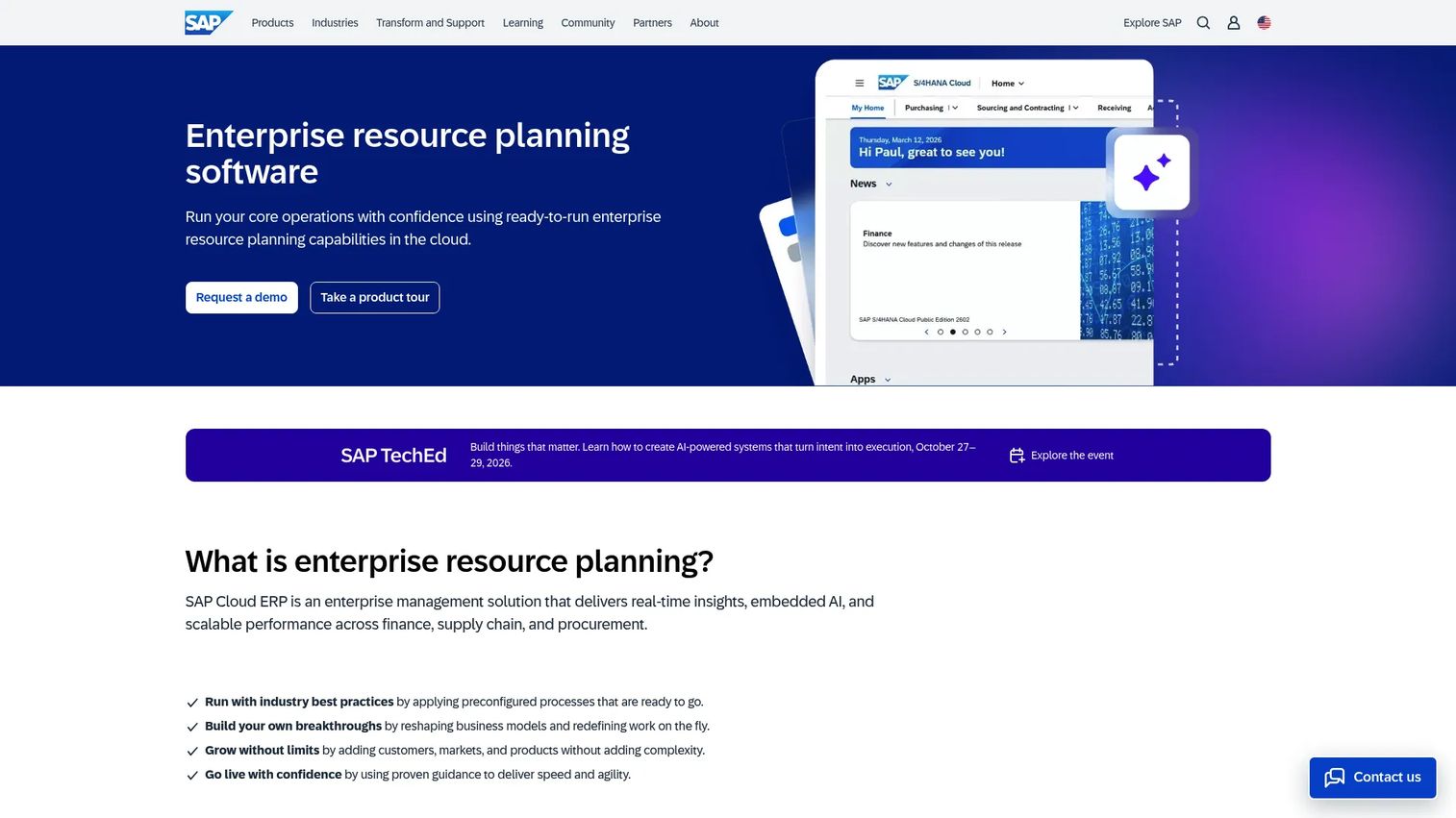
SAP Cloud ERP is SAP's cloud ERP suite covering finance, supply chain, procurement, and related business processes, with quality management embedded in the broader enterprise system. It is the option for organizations already running SAP-centric operations, where the value comes from quality data living in the same system as production, procurement, and finance. That system-wide integration is the whole point.
Best for: Mid-market to enterprise teams needing a cloud ERP backbone with SAP ecosystem integration and connected quality.
Key strengths
- Real-time insights and analytics: Quality events surface alongside supply chain and production data in one reporting layer.
- Embedded AI across core processes: AI applied across finance, supply chain, and quality for faster anomaly detection.
- Finance, supply chain, and procurement in one suite: Quality tied directly to supplier data, purchase orders, and production events without integration middleware.
Why choose SAP Cloud ERP: Choose SAP Cloud ERP when system-wide integration outweighs best-of-breed depth in any single module. For enterprises standardizing on SAP, having quality inside the ERP eliminates the handoffs that a standalone QMS still has to bridge. It fits organizations that prioritize a single source of truth across the entire operation.
SAP Cloud ERP pricing: SAP publishes packages across Finance, Supply chain, Procurement, and Cloud ERP Private editions, but does not show public numeric pricing on its pricing and packaging page. Buyers contact SAP for tailored quotes. SAP Cloud ERP (S/4HANA Cloud) holds a 4.4/5 rating on G2.
5. QT9 QMS
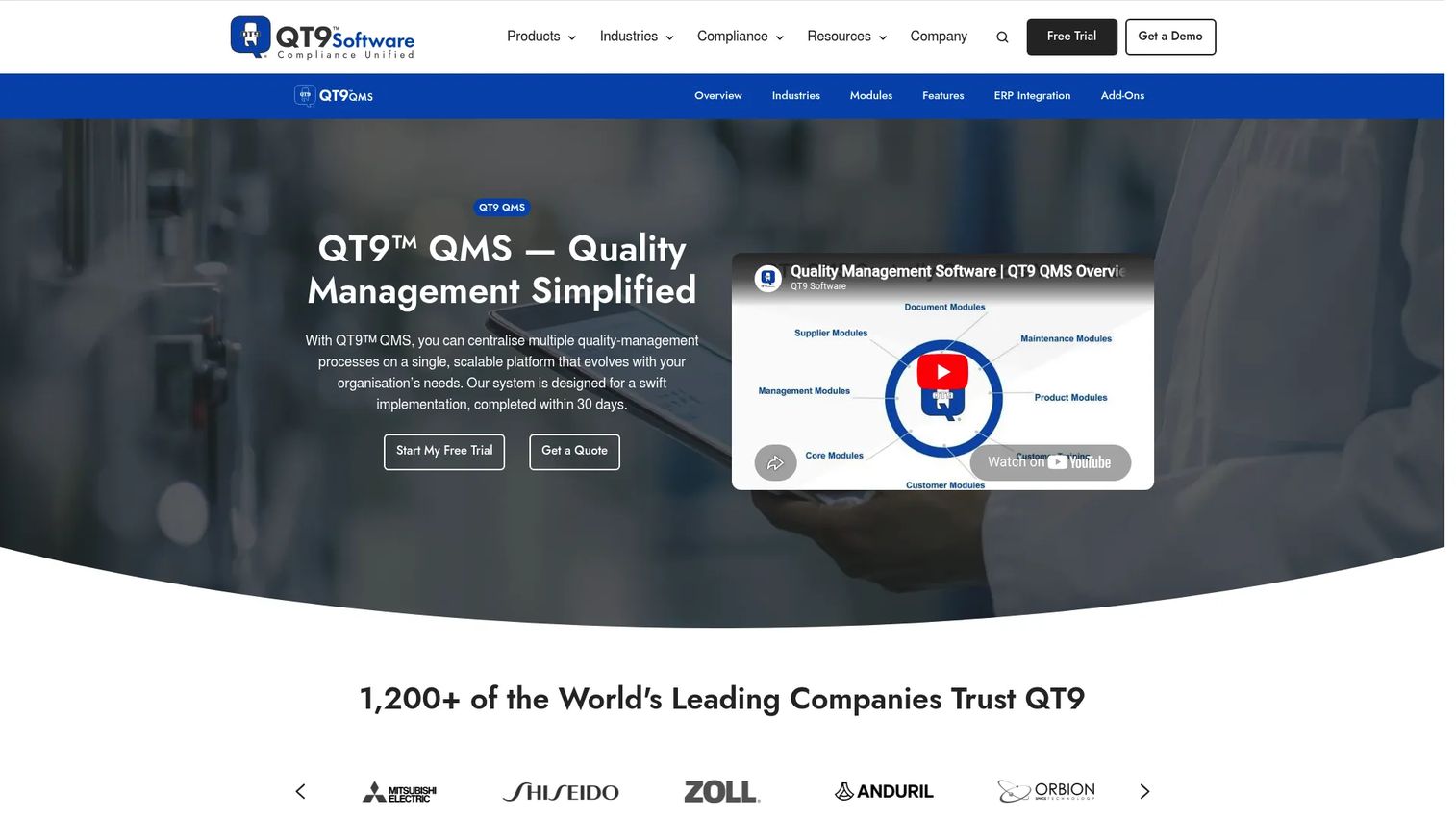
QT9 QMS is pre-validated quality management software for regulated organizations, available in cloud or on-premise deployments, with more than 25 integrated modules. It appeals to cost-conscious mid-market teams that need enterprise breadth without enterprise sprawl. The pre-validated (IQ/OQ/PQ) foundation is a meaningful head start for regulated buyers who would otherwise carry validation as a project cost.
Best for: Regulated manufacturers needing an all-in-one eQMS with audit readiness and traceability.
Key strengths
- 25+ integrated modules: Document control, CAPA, audit management, training, and more in a single connected platform.
- Pre-validated (IQ/OQ/PQ): Installation, operational, and performance qualification support that shortens validation effort for regulated teams.
- Customer, supplier, and employee portals: External and internal stakeholders work in the same system, keeping supplier quality management connected.
Why choose QT9 QMS: Choose QT9 QMS when you want broad module coverage and audit readiness without a heavy enterprise price tag. It fits mid-market manufacturers who need real traceability and validation support but do not want to fund a global-scale rollout. The ERP integration and portals keep quality connected to the wider operation.
QT9 QMS pricing: QT9 uses customized pricing that scales with concurrent users and deployment requirements, and does not publish a public number. Buyers request a quote. QT9 QMS holds a strong 4.8/5 rating on G2, among the highest on this list.
6. Redzone
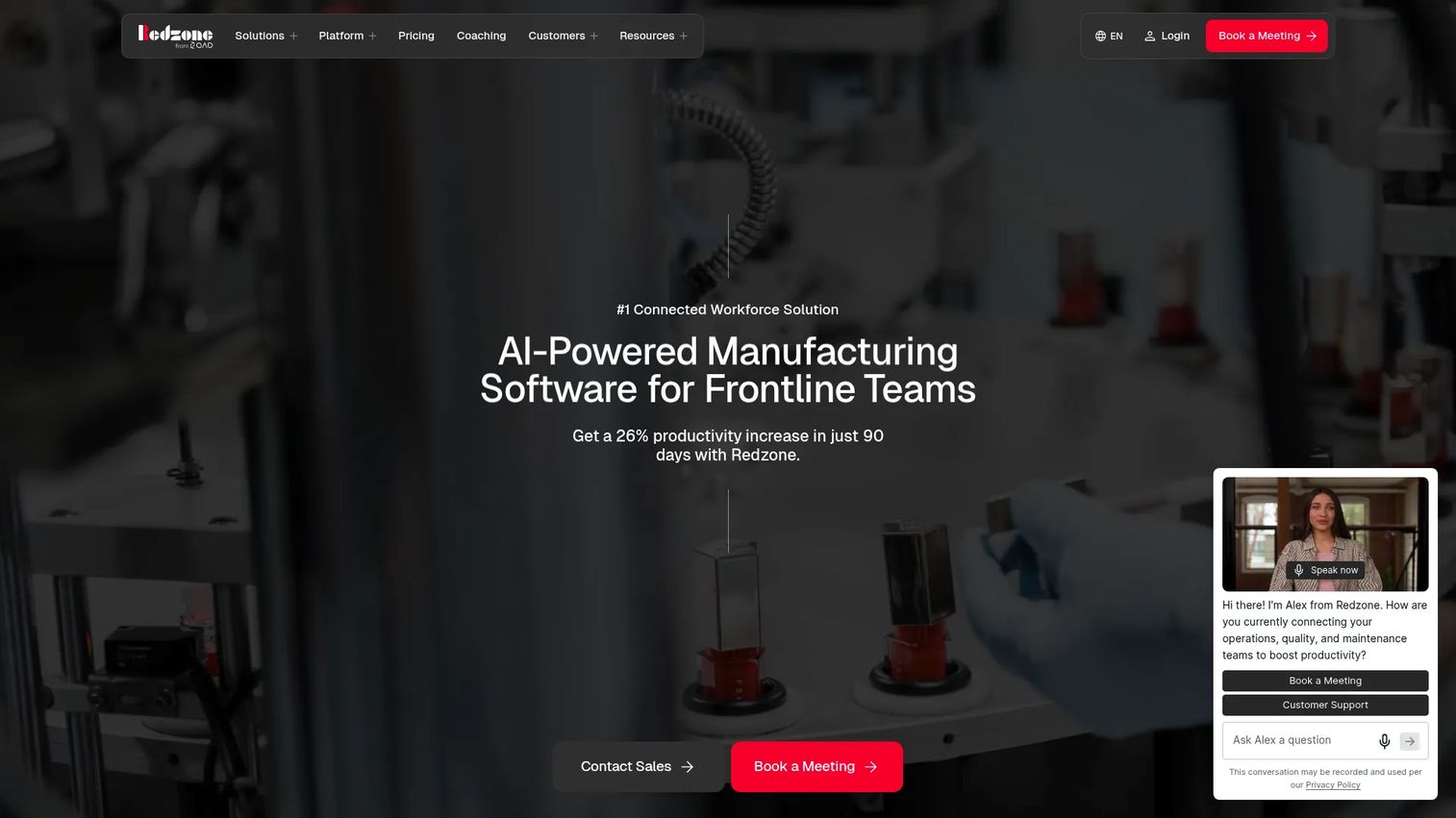
Redzone is connected workforce software for manufacturers, pairing frontline productivity with quality and reliability workflows. It is less a traditional eQMS and more a shop-floor operating system where quality visibility lives alongside OEE tracking and maintenance. For operational teams, that frontline-first design often drives adoption where a document-heavy QMS struggles to reach the floor.
Best for: Manufacturers wanting a connected workforce platform for frontline operations with quality built in.
Key strengths
- Productivity and OEE dashboards: Real-time tracking that gives supervisors live visibility into line performance.
- Compliance and quality management: Quality checks and compliance workflows embedded directly in the frontline experience.
- Reliability and CMMS workflows: Maintenance and reliability tracking that connects equipment health to quality outcomes.
Why choose Redzone: Choose Redzone when frontline adoption and operational execution matter more than a formal document-control-first QMS. It fits manufacturers who want quality visibility where the work happens, on the floor, rather than in a separate compliance system. The productivity and reliability layers make it a broader operations play than a standalone quality tool.
Redzone pricing: Redzone uses quote-based pricing and directs prospects to contact sales for a custom quote based on plant size and deployment. It does not publish numeric pricing. Redzone holds a 4.8/5 rating on G2.
7. Ideagen Quality Management
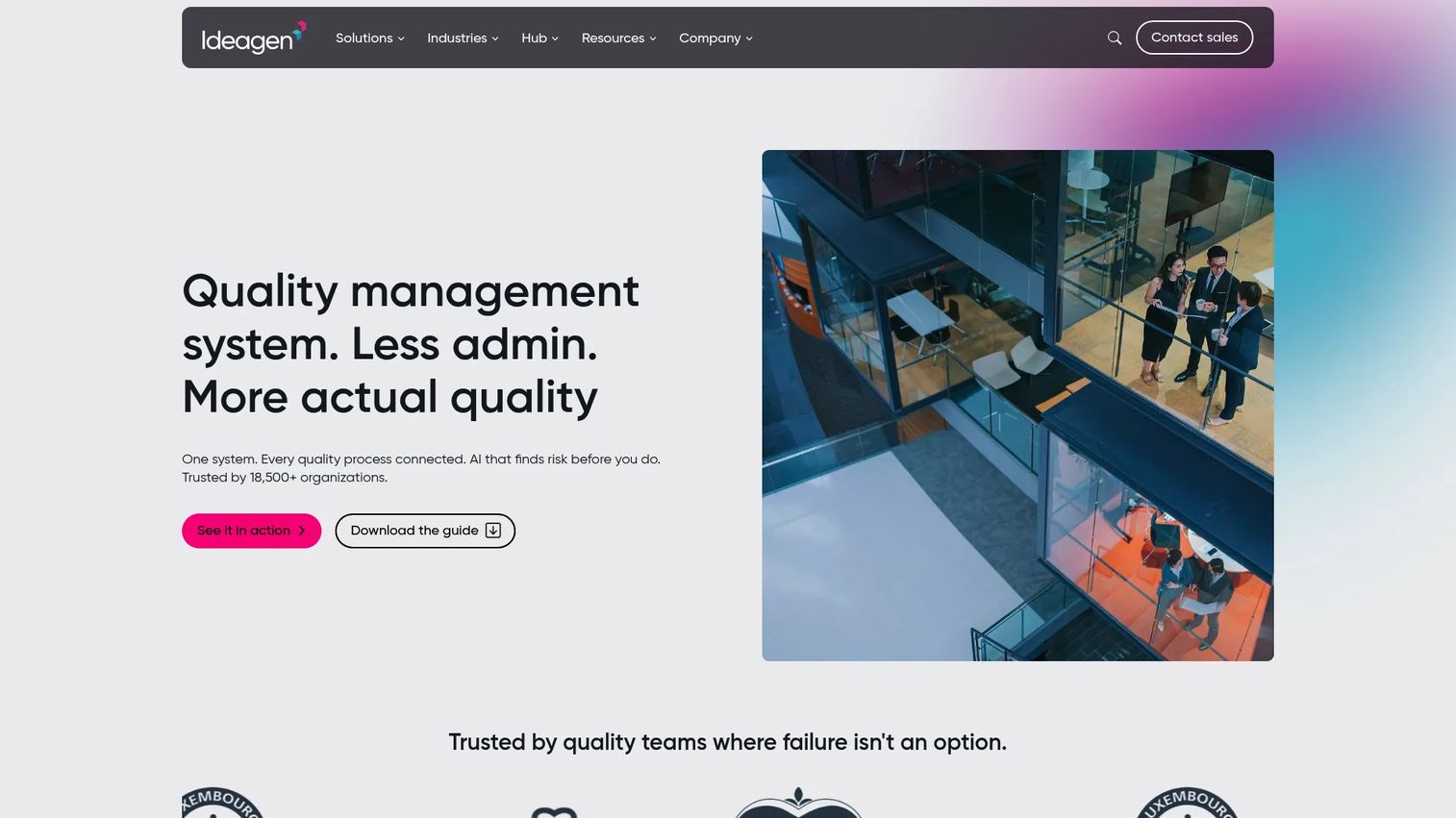
Ideagen Quality Management is an integrated quality management system for regulated industries, built for organizations that need connected quality across multiple sites and standards. It is an established option for compliance-heavy operations that need breadth and governance rather than a lightweight setup. For enterprises juggling several certifications at once, the multi-standard support is the draw.
Best for: Regulated organizations needing a connected QMS across sites and standards.
Key strengths
- Document control: Centralized, controlled documentation with governance across sites and business units.
- CAPA management: Corrective and preventive action workflows tied to nonconformance and audit findings.
- Audit management: Internal, supplier, and certification audit scheduling and tracking in one place.
Why choose Ideagen Quality Management: Choose Ideagen when you operate multiple sites under multiple standards and need one governed system to hold them together. It fits enterprises that value breadth, established compliance workflows, and multi-site consistency over a minimal, single-team tool. The industry-specific workflows reduce the customization burden for regulated sectors.
Ideagen Quality Management pricing: Ideagen does not publish public pricing on its site, and buyers engage sales for a quote based on scope and site count. Ideagen Quality Management holds a 4.0/5 rating on G2 across a large review base.
8. SafetyCulture
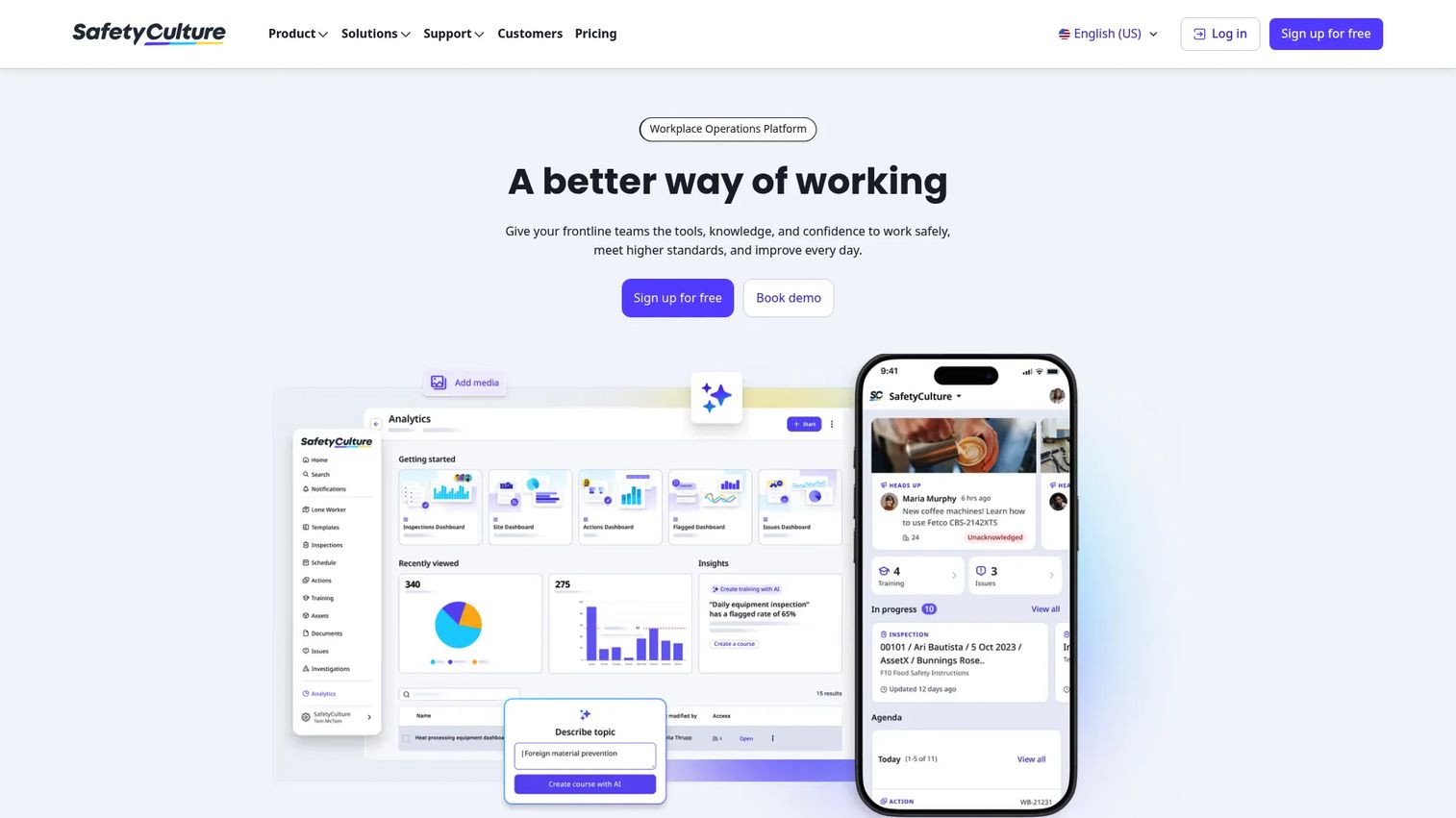
SafetyCulture is a workplace operations platform for inspections, training, actions, and safety and compliance workflows, built mobile-first. It is the lighter-weight option for teams that need speed and frontline adoption rather than a heavy validation program. Where a full eQMS can take months to stand up, SafetyCulture gets checklists and inspections running fast, which matters when the goal is field-level quality discipline.
Best for: Teams that need a mobile-first platform for inspections, training, and operational compliance.
Key strengths
- Digital inspections and checklists: Configurable, mobile-friendly inspections that field teams complete on any device.
- Actions and issue reporting: Corrective actions and issue tracking that follow up on failed inspections automatically.
- Training and workplace communications: Role-based training and comms delivered to the frontline where the work happens.
Why choose SafetyCulture: Choose SafetyCulture when adoption and speed matter more than deep regulated validation. It fits operations teams that need inspection discipline, task follow-up, and frontline visibility without the weight of a full document-control eQMS. It also scales from a free tier upward, which lowers the barrier to a first rollout.
SafetyCulture pricing: SafetyCulture publishes three editions: Free at $0, Premium at $24 per seat per month, and Enterprise with custom pricing. A 30-day free trial is available, plus a separate Lite seat option billed annually. SafetyCulture holds a 4.6/5 rating on G2.
9. EASE
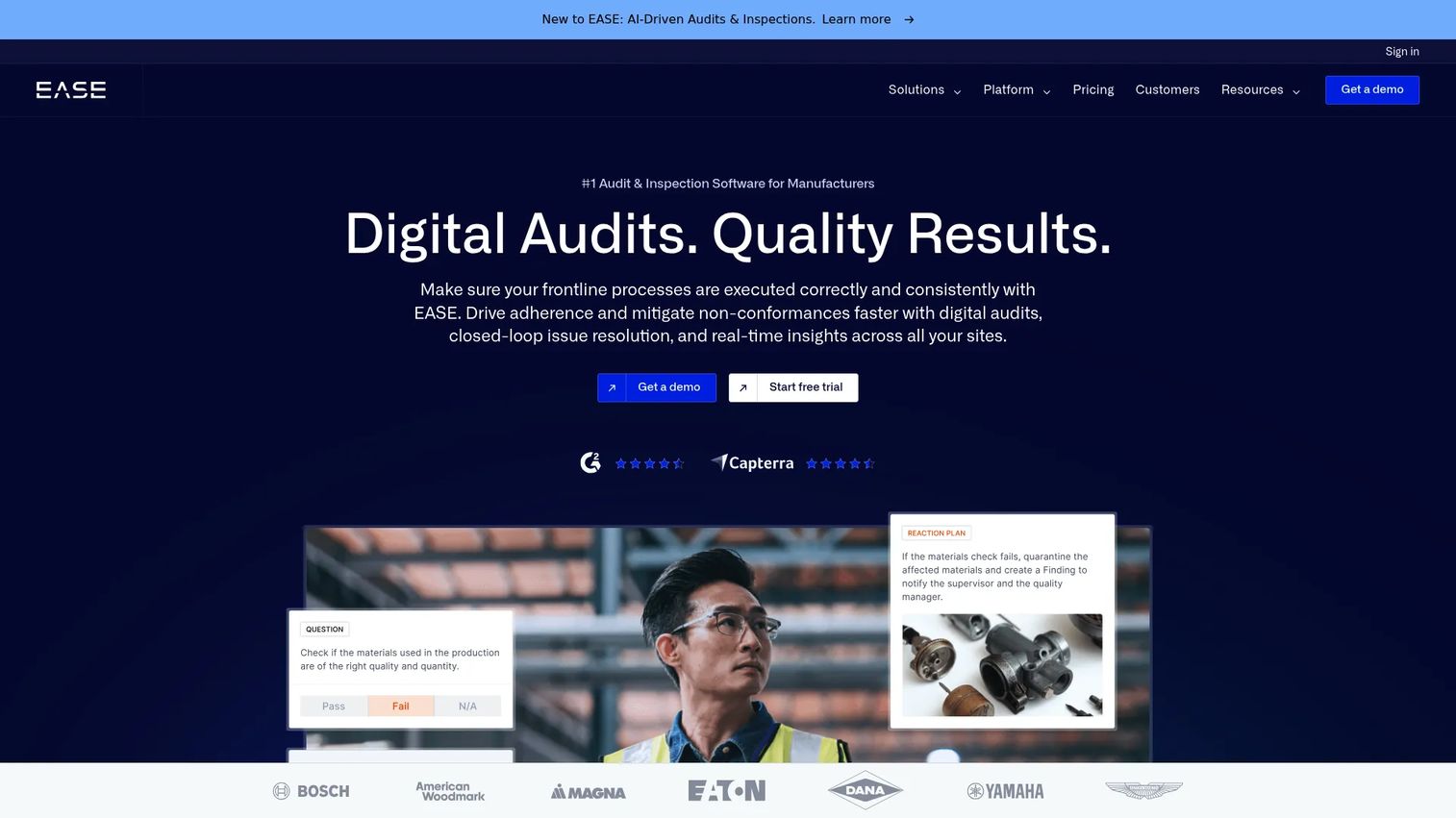
EASE is manufacturing audit and inspection software built for plant-floor audits, layered process audits, corrective actions, dashboards, and training. It is a focused tool for manufacturing teams that want to optimize audit execution and process discipline at the plant level. For quality leads running LPA programs, EASE turns audit routines from a paper exercise into a tracked, data-backed workflow.
Best for: Manufacturers needing a site-based audit and inspection platform for plant-floor quality routines.
Key strengths
- Audit and inspection scheduling: Layered process audit scheduling that keeps frontline quality routines on cadence.
- Corrective actions and root cause analysis: Problem-solving workflows that close the loop on audit findings.
- Offline mobile auditing: Audits that run on the plant floor without connectivity, syncing when back online.
Why choose EASE: Choose EASE when your priority is audit execution and process discipline on the manufacturing floor. It fits plant-level teams optimizing layered process audits and corrective action follow-through, especially in automotive and discrete manufacturing. The reporting and dashboards give quality managers visibility into audit compliance across sites.
EASE pricing: EASE offers three site-based plans, all priced per site with unlimited users and billed annually: EASE at $720 per site per month, EASE PLUS at $890, and EASE PRO at $1,290. Implementation fees apply. EASE holds a 4.6/5 rating on G2.
Considerations before you buy
Compliance and validation
For regulated environments, verify that the platform delivers what auditors expect: electronic signatures, tamper-evident audit trails, and controlled SOP management. Ask specifically about validation support. Some platforms ship pre-validated (IQ/OQ/PQ), which can remove months from a regulated rollout. If you operate under FDA, IATF 16949, AS9100D, or ISO/IEC 17025, make validation and audit-trail depth a gating criterion, not a nice-to-have.
Integration depth
A QMS that cannot connect to your ERP, MES, PLM, LIMS, and CRM leaves you with the same manual handoffs you started with. Check which systems are supported natively versus through custom API work, and probe the quality of the API itself. Ask about supplier data sync, production event triggers, and design change propagation. Integration depth is what turns connected workflows from a slide into reality.
Reporting and visibility
Leadership does not read CAPA logs. They read dashboards. Evaluate whether the platform offers exportable reporting, trend analysis, and role-based dashboards out of the box. For a PM proving quality's impact, this is where you demonstrate ROI: fewer recurring nonconformances, faster CAPA closure, cleaner audit outcomes. Weak reporting means you export to a separate tool and lose the single-source-of-truth advantage.
Usability and adoption
The best QMS is the one your team actually uses. Assess workflow friction, training burden, and whether frontline staff will engage with it or route around it. Mobile-friendly inspection and audit tools tend to see higher floor-level adoption. A powerful platform nobody uses is a failed rollout, so weight usability heavily if adoption is your risk.
Scalability and change management
Consider multi-site growth, new standards, and process changes over the next three years. Ask how much admin overhead a workflow change requires and whether it needs vendor services or can be done in-house. No-code configuration keeps quality iterating without engineering interrupts, which matters as your operating model evolves. Factor ongoing maintainability into total cost, not just the initial license.
Conclusion
The best quality management software depends entirely on your operating model. If you run a regulated life sciences operation where traceability and validation are existential, MasterControl and Qualio lead, with Qualio favoring faster adoption and MasterControl favoring connected depth. If configurability across a complex enterprise is your priority, Octave Reliance and its no-code designer stand out. SAP-centric organizations get the most from SAP Cloud ERP's system-wide integration.
For mid-market manufacturers, QT9 QMS delivers pre-validated breadth at a friendlier scale, while Ideagen anchors multi-site, multi-standard governance. When frontline execution and adoption matter most, Redzone, SafetyCulture, and EASE each win a different lane: connected workforce operations, mobile inspections, and layered process audits respectively.
Shortlist based on three questions: What compliance rigor do you actually need, which systems must it integrate with, and will your teams adopt it? Answer those honestly and the field narrows fast. Start with a focused pilot on your highest-friction process, whether that is CAPA, document control, or audits, and prove the value before you scale it across the operation.
Start your journey with Guideflow today!
FAQs
Quality management software is a system of record that digitizes and connects the processes a company uses to control quality, meet compliance standards, and drive continuous improvement. It replaces scattered spreadsheets and point tools with connected modules for document control, CAPA, audits, nonconformance, training, and supplier quality. The core job is traceability: following any quality event from origin to resolution without manual reconstruction.
A capable QMS should cover document control, CAPA, nonconformance management, audit management, training management, supplier quality management, and risk management at minimum. Regulated buyers should also look for electronic signatures, validation support, and tamper-evident audit trails. The value comes from these modules being connected, so a document change cascades into training and an audit finding triggers a corrective action automatically.
A QMS is the overall system for managing quality, which historically could be paper-based or manual. An eQMS (electronic quality management system) is the software version, adding electronic signatures, automated workflows, audit trails, and validation support. In practice, most modern quality management software is eQMS software, and the terms are often used interchangeably when discussing platforms.
Regulated and quality-critical industries rely on it most heavily: life sciences, pharmaceuticals, medical devices, aerospace, automotive, and food and beverage. These sectors face standards like FDA regulations, IATF 16949, AS9100D, and ISO 9001 that demand documented, traceable quality processes. Manufacturing broadly benefits too, since defect control and supplier quality directly affect cost and reputation.
QMS platforms support ISO 9001 by structuring the documented processes the standard requires: controlled documents, defined responsibilities, corrective action, internal audits, and management review. Built-in workflows keep records current and audit-ready, so demonstrating conformance becomes continuous rather than a scramble before each audit. Many platforms also map their modules directly to ISO 9001 clauses to simplify certification.
Manufacturers should prioritize QMS software for manufacturing that connects to ERP and MES, supports supplier quality management, and handles nonconformance and CAPA on the shop floor. Layered process audit support matters for automotive under IATF 16949, and offline mobile auditing helps plant-floor adoption. Reporting that surfaces recurring defects and supplier performance turns quality data into operational decisions.
They are often decisive. ERP integration connects quality to supplier, part, and purchase data, while MES integration ties quality events to real production activity. Without these, quality data arrives late and root cause analysis relies on manual data pulling. Strong native integrations or a well-documented API are what make connected workflows real rather than aspirational.
Start with three questions: what compliance rigor you genuinely need, which systems it must integrate with, and whether your teams will adopt it. Regulated life sciences teams weight validation and audit trails heavily; manufacturers weight ERP and MES integration and shop-floor usability. Run a focused pilot on your highest-friction process, whether CAPA, document control, or audits, and validate the impact before rolling it out across the operation.