Your enterprise customer does not care that their purchase order came from an ERP, their ASN needs EDI, and their fulfillment updates live in a warehouse system. They expect the data to move correctly. When it does not, they blame the product.
Integration brokerage software exists because that expectation breaks constantly. Every trading partner runs a different protocol. Every retailer mandates a different document format. According to SAPinsider Benchmark Research (2025), organizations surveyed were integrating an average of 36 applications with SAP and using more than four integration tools simultaneously. That scale of fragmentation is what this category is designed to absorb.
For product managers, the stakes are clear: Every enterprise customer that becomes a custom integration project pulls engineering away from the roadmap. Every failed EDI transaction creates a support ticket. The right integration brokerage platform reduces that opportunity cost by standardizing the exchange of purchase orders, invoices, shipment notices, and catalog feeds across your entire partner network.
This guide compares 15 tools so you can build a shortlist grounded in transaction model, partner coverage, and implementation ownership, not the longest feature list.
What's inside
This guide covers 15 integration brokerage software options for 2026, evaluated for teams in product, operations, IT, and supply chain.
- Who it is for: Product, IT, and operations teams managing B2B data exchange and trading-partner connectivity
- How tools were chosen: Presence in integration brokerage search results, category fit, and verified vendor research
- What we compare: EDI depth, API integration capability, partner onboarding model, automation, pricing, and G2 rating
- How to use it: Shortlist by integration model first, then validate pricing drivers and implementation effort before any vendor conversation
TL;DR
- Best for retail suppliers: SPS Commerce Fulfillment EDI, built around retailer compliance and trading-partner workflows
- Best for managed EDI plus commerce integrations: TrueCommerce EDI, for teams that want both EDI network coverage and business-system connectivity
- Best for API-first EDI: Stedi or Orderful EDI, depending on whether you want healthcare-focused clearinghouse APIs or a broader trading-partner network
- Best for enterprise B2B orchestration: Cleo Integration Cloud or Adeptia, depending on how much iPaaS-style orchestration your team needs
- Best for marketplace and dropship operations: Logicbroker, purpose-built for supplier, retailer, and marketplace order workflows
- Best managed service model: ecosio or Cognizant Cloud Integration Brokerage, for teams that want vendor-managed EDI operations rather than a self-serve platform
What is integration brokerage software?
Integration brokerage software helps companies exchange, translate, validate, and route business data between internal systems and external partners. It sits between organizations that do not share the same data formats, protocols, or system architectures.
At its core, the category handles EDI, APIs, flat files, XML, JSON, AS2, SFTP, and value-added network (VAN) connections. It connects ERPs, warehouse management systems (WMS), transportation management systems (TMS), e-commerce platforms, marketplaces, suppliers, retailers, carriers, and customers. The result is a managed layer that handles trading-partner onboarding, data mapping, validation, exception handling, and workflow automation without requiring a custom build for every connection.
Delivery models vary. Some vendors offer self-serve SaaS platforms. Others combine software with managed services. Some operate as value-added networks. Many are hybrids.
Core capabilities to look for
- EDI translation and compliance (X12, EDIFACT, and regional standards)
- API and file-based connectivity
- Data mapping and transformation
- Trading-partner onboarding workflows
- Monitoring, alerting, and exception handling
- ERP, WMS, TMS, and e-commerce integrations
- Security, access control, and audit trails
- Analytics for integration performance and transaction visibility
How integration brokerage differs from iPaaS
iPaaS platforms typically focus on application-to-application integration across SaaS and cloud tools, connecting internal systems like CRMs, marketing automation platforms, and analytics tools. Integration brokerage focuses on business-to-business transaction exchange: Purchase orders, invoices, shipment notices, and similar structured documents moving between companies. Some platforms overlap both categories. Choose based on transaction requirements, partner network, compliance needs, and whether you need self-serve speed or service-backed operations.
When to use integration brokerage software
Onboard trading partners without custom builds
Every retailer, supplier, distributor, carrier, or customer may use different formats and protocols. Integration brokerage reduces one-off engineering work by standardizing mapping, validation, and document routing. For product managers, this is the difference between turning every enterprise customer into a bespoke integration project and having a repeatable onboarding path. The right platform absorbs the complexity so your engineering team can focus on the roadmap.
Automate EDI and order workflows
EDI handles the high-volume, structured transactions that keep supply chains running: Purchase orders, invoice acknowledgments, advance ship notices, inventory updates, and catalog feeds. When these workflows fail, customers often blame the product even when the issue is outside the core application. Integration brokerage automates these flows and surfaces exceptions before they become support tickets or chargebacks.
Connect ERP, e-commerce, and supply-chain systems
Integration brokerage becomes essential when data must flow across internal systems and external business networks simultaneously. An ERP needs to send purchase orders, a WMS needs to receive fulfillment updates, a marketplace needs inventory feeds, and a supplier portal needs acknowledgments. Maintaining that connectivity across release cadence changes and partner requirement updates is where the ongoing maintenance cost concentrates.
Integration brokerage software comparison
The table below is a shortlist, not a universal ranking. Validate pricing, supported protocols, partner network coverage, and implementation model directly with each vendor before creating a final shortlist. For several tools in this category, pricing requires a sales conversation because the cost depends on trading partners, document volume, integrations, and service scope.
| # | Product | Best for | Key differentiator | Pricing | G2 rating |
|---|---|---|---|---|---|
| 1 | SPS Commerce Fulfillment EDI | Retail suppliers and distributors | Large retail trading-partner network | Contact sales | 4.3/5 |
| 2 | TrueCommerce EDI | Managed EDI with commerce integrations | Broad EDI network plus business-system connectors | Contact sales | 4.4/5 |
| 3 | Cleo Integration Cloud | Enterprise B2B integration teams | EDI, API, and application integration in one platform | Custom pricing | 4.4/5 |
| 4 | Stedi | API-first healthcare EDI teams | Headless clearinghouse with usage-based APIs | From $0.05/transaction | 4.9/5 |
| 5 | Lobster Data Platform | Complex supply-chain data integration | No-code data integration with EDI and automation | Contact sales | 4.6/5 |
| 6 | Logicbroker | Marketplace, dropship, and supplier ops | Order orchestration across retailers and suppliers | Contact sales | 4.0/5 |
| 7 | Adeptia | Enterprise partner onboarding and integration | Self-service partner onboarding with AI-assisted mapping | Contact sales | 4.3/5 |
| 8 | EDICOM | Global EDI and e-invoicing programs | International EDI, e-invoicing, and compliance coverage | Contact sales | 4.0/5 |
| 9 | ecosio | Managed EDI and B2B automation | Fully managed EDI service with cloud integration support | Contact sales | 4.6/5 |
| 10 | Orderful EDI | Modern API-based EDI workflows | API-first EDI network with real-time validation | From $189/month per trading partner | 4.7/5 |
| 11 | 1 EDI Source, an Epicor solution | Retail and manufacturing EDI teams | EDI management, mapping, and partner compliance | Contact sales | N/A |
| 12 | eZCom Software EDI | Small and midsize retail suppliers | Web-based EDI for retail compliance workflows | Contact sales | 4.7/5 |
| 13 | APIANT | No-code integration and automation teams | Deep API integrations with white-label support | From $99/month | N/A |
| 14 | Sync Ezy | SMB teams connecting business apps | Deep point-to-point integrations with service support | Contact sales | N/A |
| 15 | Cognizant Cloud Integration Brokerage | Enterprises wanting managed cloud integration | Service-led B2B integration brokerage | Contact sales | N/A |
Best 15 integration brokerage software tools for 2026
Pick the integration model first. Retail EDI, API-first exchange, enterprise orchestration, and managed-service brokerage solve different problems. The right tool depends on the systems, partners, and transaction volume your team needs to support, not the longest capability checklist.
1. SPS Commerce Fulfillment EDI
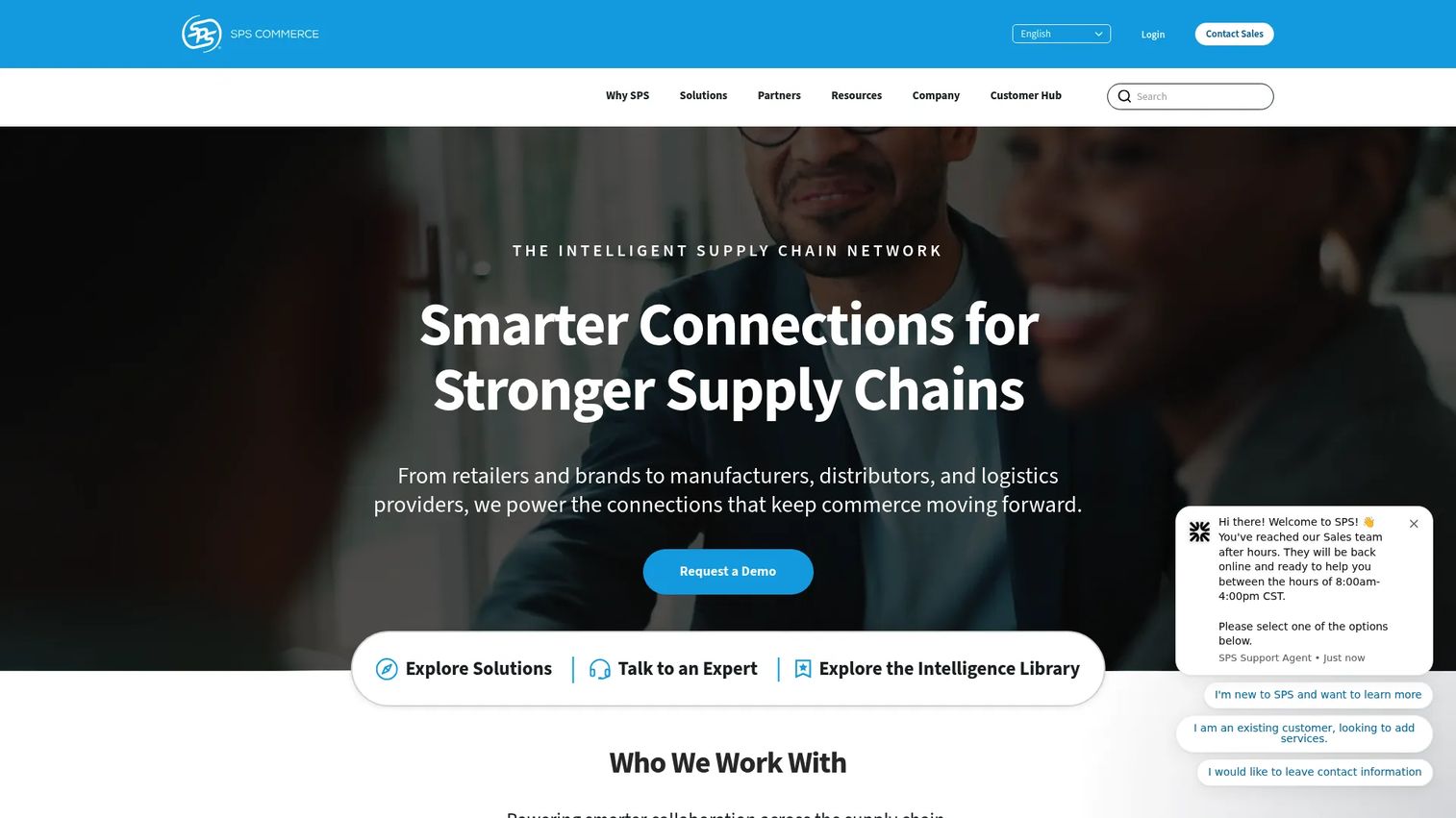
SPS Commerce Fulfillment EDI is a cloud-based, full-service EDI solution built around retail trading-partner connectivity. It connects suppliers, distributors, and brands with retailers through pre-mapped EDI connections that cover purchase orders, invoices, advance ship notices, and acknowledgments. SPS Commerce manages the mapping, compliance updates, and partner onboarding, so the engineering team does not own ongoing EDI maintenance.
Best for: Retail suppliers and distributors that need established trading-partner connectivity with major retailers.
Key features
- Pre-mapped EDI connections with retailer-specific requirements
- Automated purchase orders, acknowledgments, advance ship notices, and invoices
- ERP integrations including NetSuite, SAP, QuickBooks, and Microsoft Dynamics
- Transaction monitoring to surface errors before chargebacks occur
- 24/7 support and managed partner onboarding
Why choose SPS Commerce Fulfillment EDI: The main case for SPS is network depth. If your customers or suppliers already trade with major retailers, SPS likely has existing maps. That reduces onboarding time and mapping debt compared to building connections from scratch.
SPS Commerce Fulfillment EDI pricing: SPS directs buyers to sales for a plan built around trading partners, connected systems, and business needs. Pricing is quote-based; expect cost drivers to include the number of trading partners, document volume, ERP connectors, and service level.
G2 rating: 4.3/5
2. TrueCommerce EDI
TrueCommerce EDI is a managed EDI integration platform for automating business-document exchange across trading partners and business systems. It combines web-based EDI translation with ERP integrations, marketplace connections, and managed onboarding support. Teams use it to handle EDI compliance without maintaining mapping expertise internally.
Best for: Teams that need managed EDI connectivity alongside business-system integrations and ongoing compliance support.
Key features
- Web-based EDI document translation and mapping
- Trading-partner network connectivity and sync
- ERP, marketplace, and accounting integrations
- Managed onboarding, compliance updates, and maintenance
- API access for transaction data and workflow triggers
Why choose TrueCommerce EDI: TrueCommerce suits teams that want a platform-plus-service combination. If your team lacks internal EDI expertise and cannot afford to own ongoing mapping changes, the managed model keeps operational ownership with the vendor.
TrueCommerce EDI pricing: TrueCommerce does not display pricing on its website. Buyers engage sales for a quote. Cost typically reflects trading partners, document volume, integrations, and the level of managed-service support included.
G2 rating: 4.4/5
3. Cleo Integration Cloud
Cleo Integration Cloud is an enterprise B2B integration platform covering EDI, API, file transfer, and application integration in one environment. It uses AI-assisted trading-partner onboarding and mapping, provides transaction visibility across all integration flows, and supports managed-service options for teams that need vendor involvement in operations.
Best for: Mid-market and enterprise organizations automating complex EDI, API, application, and supply-chain workflows together.
Key features
- EDI and API integration with AI-assisted mapping
- Managed file transfer across AS2, SFTP, and other protocols
- Business process automation and supply-chain orchestration
- Transaction visibility and intelligent exception management
- ERP, WMS, TMS, and SaaS connectors
Why choose Cleo Integration Cloud: Breadth is the main argument. When EDI is one part of a wider integration strategy involving applications, files, and business processes, Cleo handles all three in one platform rather than requiring separate tools.
Cleo Integration Cloud pricing: Cleo states there is no universal public per-partner or per-map price. Pricing is custom and depends on systems, document flows, transaction volume, capabilities, and service needs. Request a quote from sales and ask about deployment model and managed-service scope.
G2 rating: 4.4/5
4. Stedi
Stedi is a headless clearinghouse and healthcare revenue-cycle-management engine. It provides APIs and services for eligibility checks, claims submission, ERA processing, payer enrollment, and related workflows. Stedi is purpose-built for healthcare organizations and software teams that need API-first infrastructure rather than a traditional EDI service model.
Best for: Healthcare organizations and software teams building eligibility, claims, ERA, and revenue-cycle workflows on programmable API infrastructure.
Key features
- Real-time and batch eligibility checks with insurance discovery
- Electronic claim submission (professional, institutional, and dental)
- Electronic remittance advice (ERA) processing
- Real-time claim-status checks and payer API
- Usage-based pricing with no monthly minimums on the pay-as-you-go plan
Why choose Stedi: Stedi fits teams that want developer-owned infrastructure rather than a managed service. The API-first design means faster iteration and direct integration into existing systems. The sandbox account lets teams test without committing to a production plan.
Stedi pricing: A free sandbox account is available for testing. Production usage runs on a pay-as-you-go model with no monthly minimums; transactions start at $0.05 per validation. Custom plans with volume discounts are available for larger programs.
G2 rating: 4.9/5
5. Lobster Data Platform
Lobster Data Platform is a no-code supply-chain data integration platform for connecting partners, systems, formats, and protocols. It combines EDI data exchange with API connectivity, cloud-app integrations, and legacy-system support in a single environment. Teams managing complex, high-volume supply-chain integrations across many partner formats use Lobster to centralize data flows.
Best for: Organizations handling complex, high-volume supply-chain integrations across diverse partners, formats, and systems.
Key features
- No-code data integration and workflow automation
- EDI, API, cloud-app, and legacy-system connectivity
- Pre-built connectors and integration templates
- Real-time dashboards, alerts, and exception handling
- Cloud, on-premises, and hybrid deployment options
Why choose Lobster Data Platform: The combined data integration and business-process automation in one environment reduces the number of tools in the stack. For product teams managing multiple customer or partner data formats, centralization lowers the ongoing maintenance cost per connection.
Lobster Data Platform pricing: Buyers contact sales for a quote. Expect cost to reflect modules, integrations, user count, transaction volume, and support needs.
G2 rating: 4.6/5
6. Logicbroker
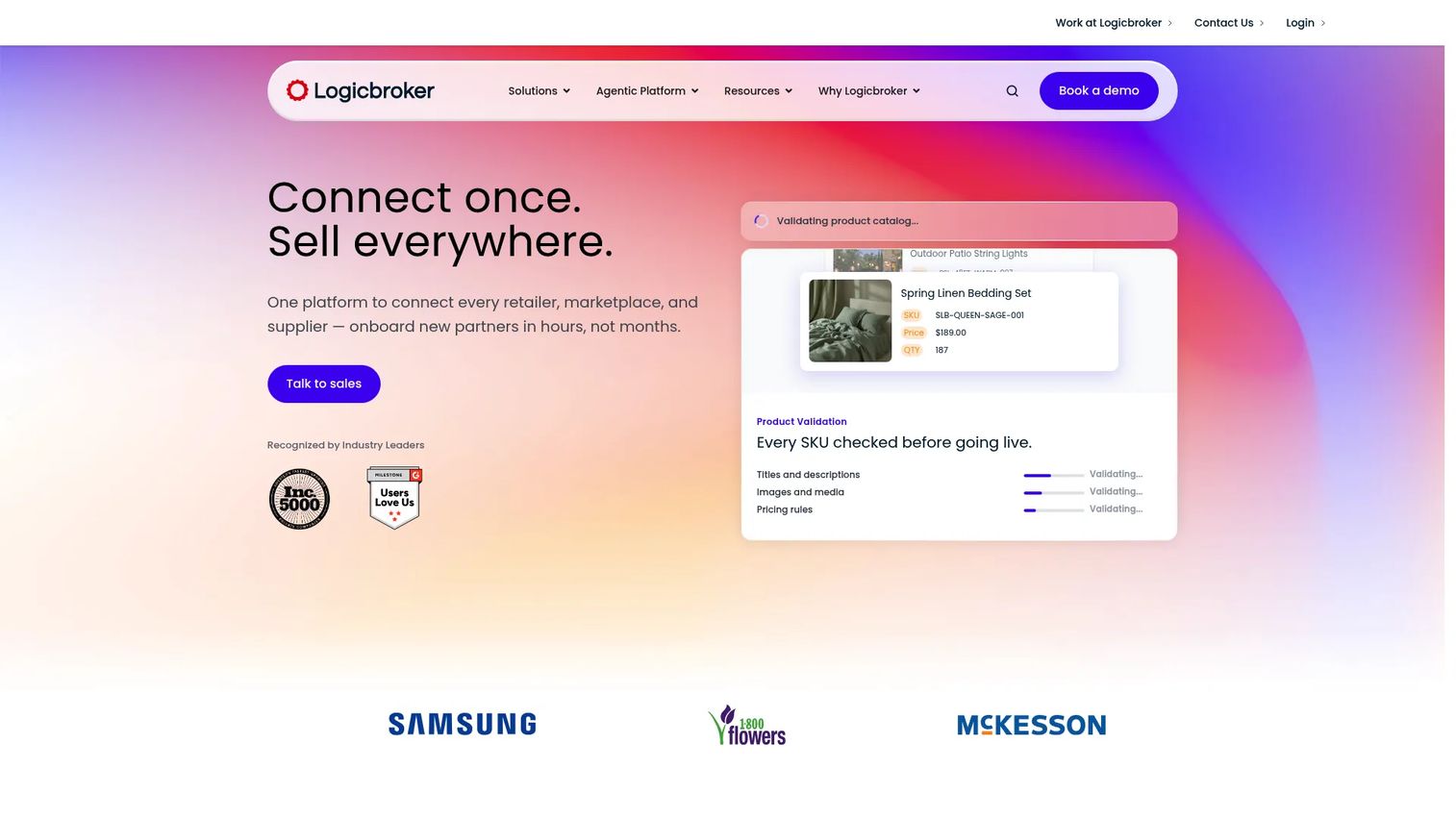
Logicbroker is an agentic commerce orchestration platform connecting retailers, brands, suppliers, marketplaces, and logistics providers. It centers on automated order routing, rapid supplier onboarding, centralized catalog management, and real-time inventory visibility. Logicbroker fits retail and e-commerce teams dealing with supplier networks and complex fulfillment workflows.
Best for: Enterprise retailers, marketplaces, brands, and suppliers managing dropship, wholesale, and multi-channel commerce operations.
Key features
- Automated and optimized order routing across partners
- Rapid supplier onboarding with self-service tools
- Centralized catalog management and price visibility
- EDI connectivity and marketplace integrations
- Compliance tracking and analytics reporting
Why choose Logicbroker: Order workflow orchestration and supplier collaboration are the primary reasons to choose Logicbroker. If the core problem is coordinating orders across a large supplier network, the platform's commerce-specific design handles the routing and compliance logic that general integration tools require custom configuration to match.
Logicbroker pricing: Logicbroker does not display pricing. Buyers request a quote from sales. Pricing reflects suppliers, transaction volume, integrations, and order workflow complexity.
G2 rating: 4.0/5
7. Adeptia
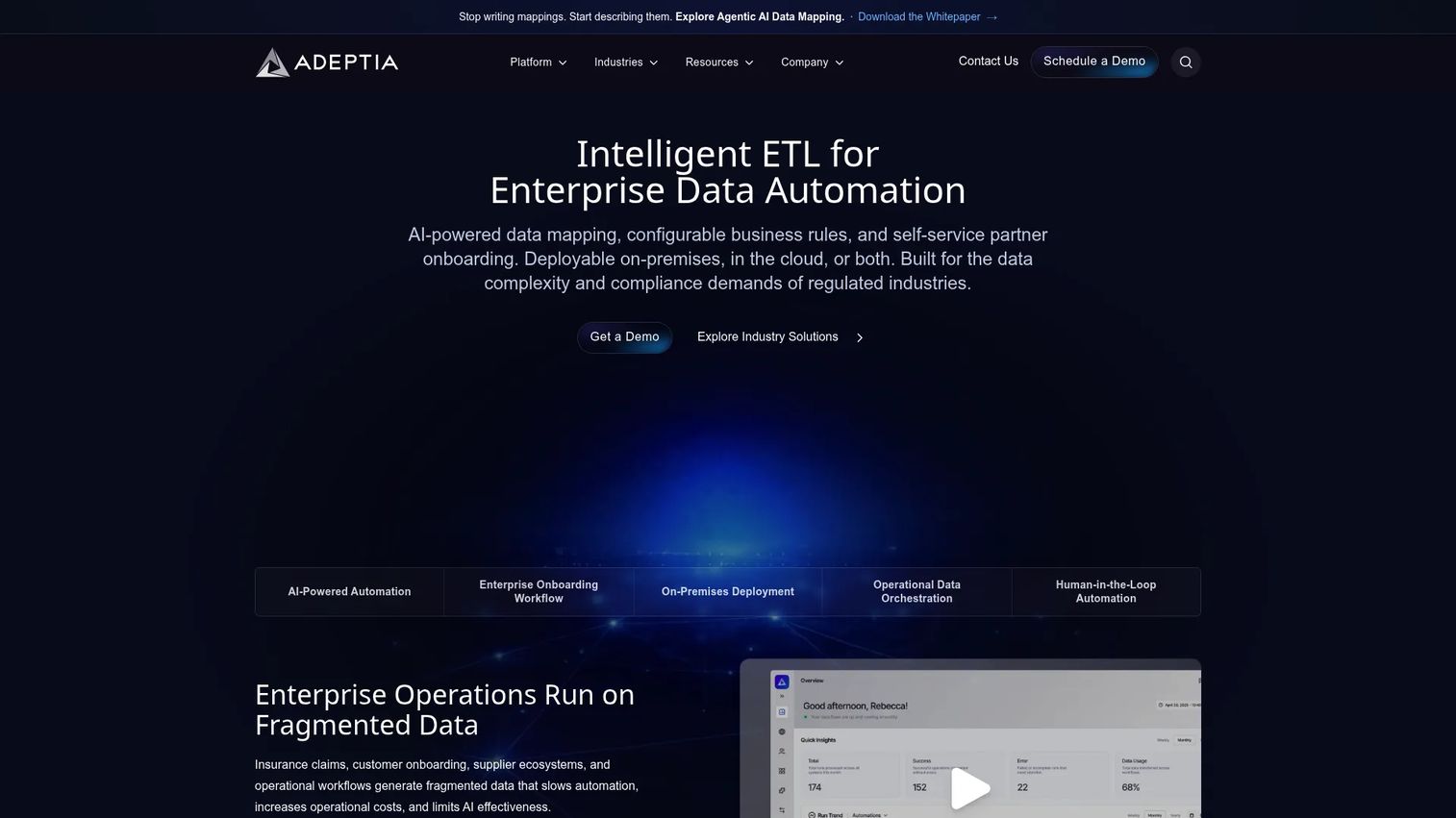
Adeptia is an AI-powered enterprise data integration platform with self-service partner onboarding. It covers partner, supplier, and customer data onboarding, REST APIs, a connector library, EDI automation, and no-code workflow orchestration. Teams use it to reduce implementation bottlenecks without routing every new integration through engineering.
Best for: Regulated enterprises that need complex data integration, partner onboarding, and operational automation across cloud, on-premises, or hybrid environments.
Key features
- AI-powered data mapping with mapping copilot assistance
- Self-service integration portals for partner and customer onboarding
- No-code automation and operational workflow orchestration
- REST APIs, connector library, and EDI automation
- On-premises, cloud, hosted, and hybrid deployment
Why choose Adeptia: The self-service partner onboarding design directly addresses the PM concern about implementation bottlenecks. If the problem is that every new enterprise customer creates repetitive engineering work around data mapping and partner setup, Adeptia's self-service model moves that work out of the engineering queue.
Adeptia pricing: Adeptia offers Basic, Professional, and Enterprise plans. Pricing is based on workloads and varies by configuration, add-ons, deployment model, and contract terms. No prices are displayed; buyers contact sales. Clarify partner count, integration patterns, and support model when requesting a quote.
G2 rating: 4.3/5
8. EDICOM
EDICOM provides SaaS solutions for global EDI, electronic invoicing, tax reporting, system integration, and trust services across more than 80 countries. It supports multi-standard and multi-protocol EDI connectivity, e-invoicing compliance with tax authorities, and long-term document archiving with electronic signatures and timestamps.
Best for: International businesses with EDI and e-invoicing requirements across multiple markets and regulatory environments.
Key features
- Global electronic invoicing and tax compliance (80+ countries)
- Multi-standard, multi-protocol EDI connectivity
- ERP, CRM, marketplace, and tax-authority integrations
- Electronic signatures, timestamps, and long-term archiving
- Managed services and 24/7 platform support
Why choose EDICOM: International e-invoicing compliance is the main differentiator. When selling into markets with regulated electronic invoicing requirements (the EU, Latin America, and others), EDICOM handles the country-specific compliance updates that general EDI platforms do not maintain as a core capability.
EDICOM pricing: EDICOM directs visitors to request a personalized demo for pricing. Cost reflects countries covered, transaction types, partner volume, and compliance modules required.
G2 rating: 4.0/5
9. ecosio
ecosio provides managed EDI, e-invoicing, supplier activation, and B2B data-exchange services through a cloud-based Integration Hub. It connects to ERP systems with real-time message visibility and monitoring, supports common EDI protocols and formats including Peppol, and provides Web EDI for suppliers without their own EDI infrastructure.
Best for: Enterprise organizations that want fully managed EDI operations and cloud-based B2B integration without internal EDI specialist teams.
Key features
- Managed EDI with a single connection point to trading partners
- ERP integration with real-time message visibility and monitoring
- Support for common EDI protocols, formats, and Peppol
- Web EDI for suppliers without EDI infrastructure
- Global e-invoicing compliance and regulatory updates
Why choose ecosio: Service-backed EDI reliability is the primary argument. For product leaders who do not want to stretch internal teams across specialist EDI maintenance and compliance updates, ecosio keeps operational ownership with the vendor while providing visibility into message status and exceptions.
ecosio pricing: ecosio describes message-based pay-per-use billing and directs buyers to contact sales. Clarify ERP environment, documents, trading partners, transaction volume, and service scope when engaging sales.
G2 rating: 4.6/5
10. Orderful EDI
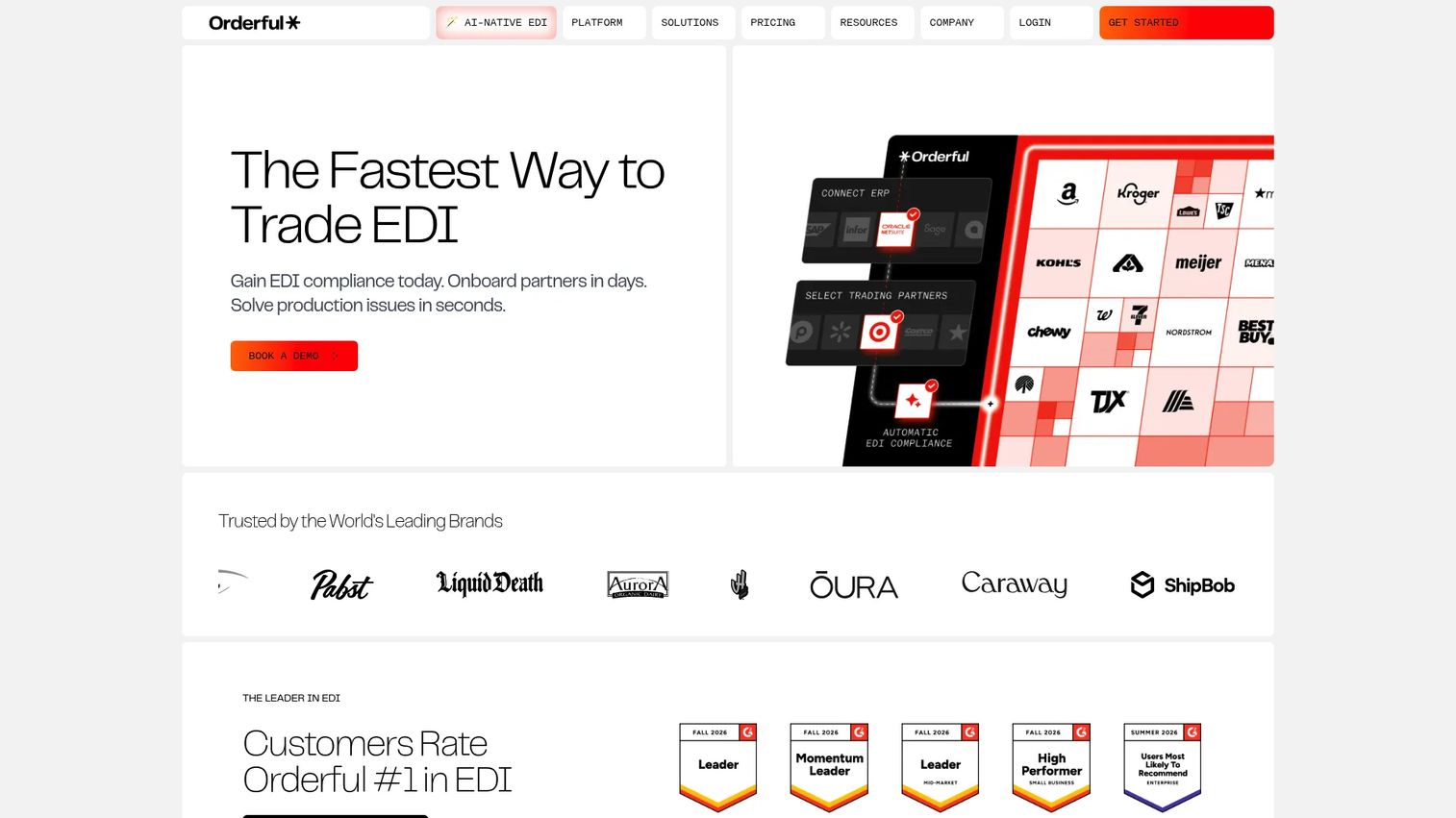
Orderful EDI is a modern EDI platform for connecting, testing, validating, transforming, and exchanging business data with trading partners. It provides a RESTful API for EDI, real-time transaction validation, a Business Rules Engine, X12 and EDIFACT support, and AS2, SFTP, and VAN connectivity. Teams use it to modernize EDI with API-based transaction workflows.
Best for: Businesses that need scalable EDI connectivity and faster trading-partner onboarding through API-first workflows.
Key features
- RESTful API for EDI with real-time validation
- Business Rules Engine for transaction routing
- X12 and EDIFACT support with AS2, SFTP, and VAN connectivity
- Webforms for trading partners without EDI systems
- SAML-based SSO and role-based access control
Why choose Orderful EDI: The API-first design suits teams with developer ownership that want faster partner onboarding and transaction visibility. The Web EDI Fulfillment plan at $189 per month per trading partner provides a concrete entry point for teams ready to test before scaling.
Orderful EDI pricing: Orderful publishes four plans. Labels starts at $99/month for retail-compliant labels. Web EDI Fulfillment runs $189/month per trading partner. Integrated starts at $399/month and adds a full EDI API and system-of-record connectors. Enterprise pricing is custom with managed testing and dedicated support.
G2 rating: 4.7/5
11. 1 EDI Source, an Epicor solution
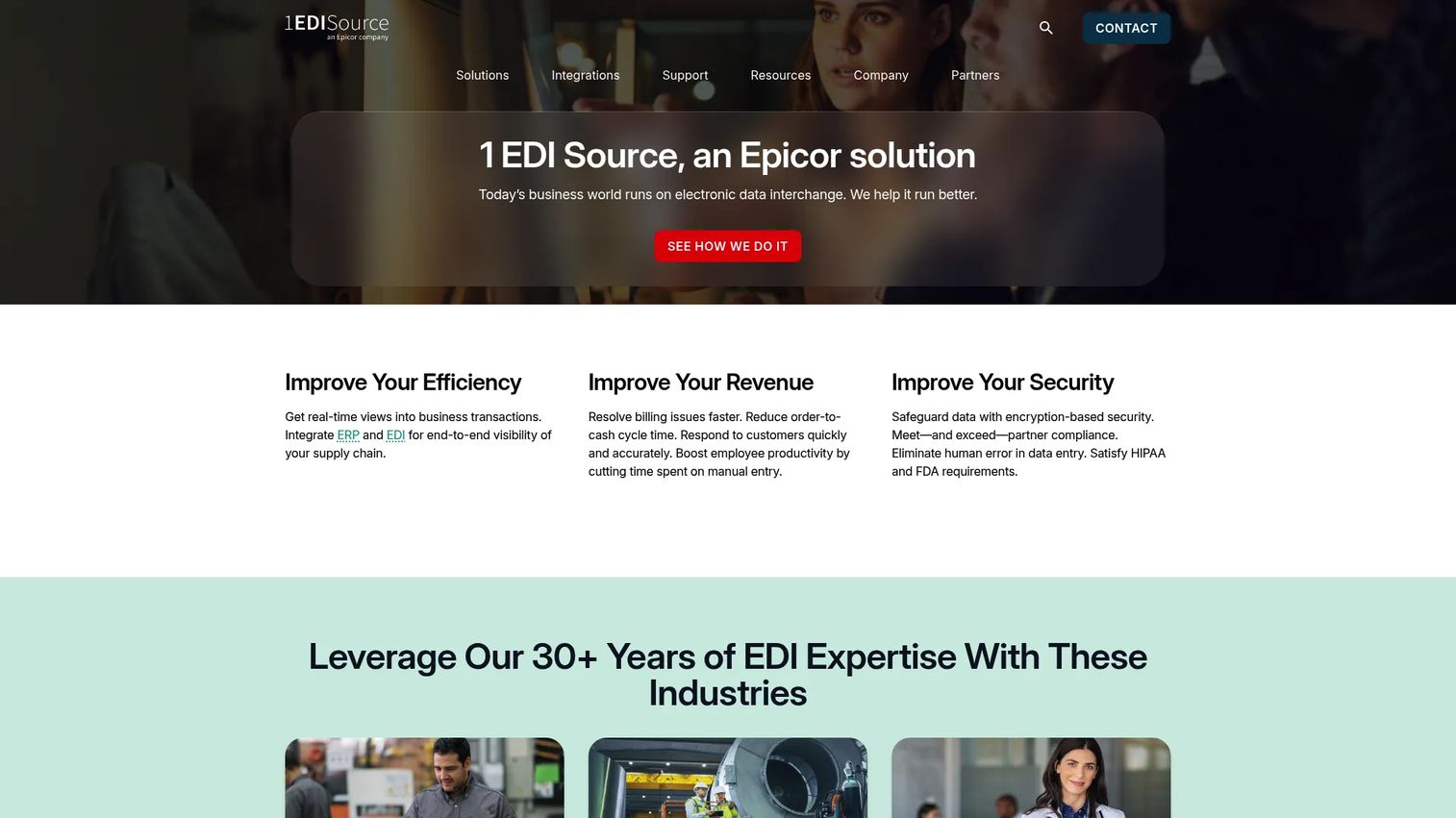
1 EDI Source is an EDI software and services platform for integrating ERP systems with trading-partner networks and providing supply-chain transaction visibility. Now part of Epicor, it offers HQX Professional and HQX Enterprise subscription tiers covering EDI mapping, translation, partner compliance, and transaction monitoring.
Best for: Organizations in retail and manufacturing that need managed or self-managed EDI, ERP integration, and supply-chain transaction visibility.
Key features
- EDI mapping, translation, and trading-partner compliance
- ERP integration with real-time business-transaction visibility
- Encryption-based security with configurable alerts
- Configurable transaction logs and audit trails
- HQX Professional and HQX Enterprise subscription tiers
Why choose 1 EDI Source: The combination of EDI management and ERP connectivity suits teams where customer or partner requirements must be met without custom code per connection. The Epicor relationship is relevant primarily if your ERP environment already includes Epicor products.
1 EDI Source pricing: The site lists HQX Professional and HQX Enterprise tiers on a subscription model, but no numeric prices are displayed. Contact the vendor to understand pricing based on trading partners, documents, deployment model, and support level.
12. eZCom Software EDI
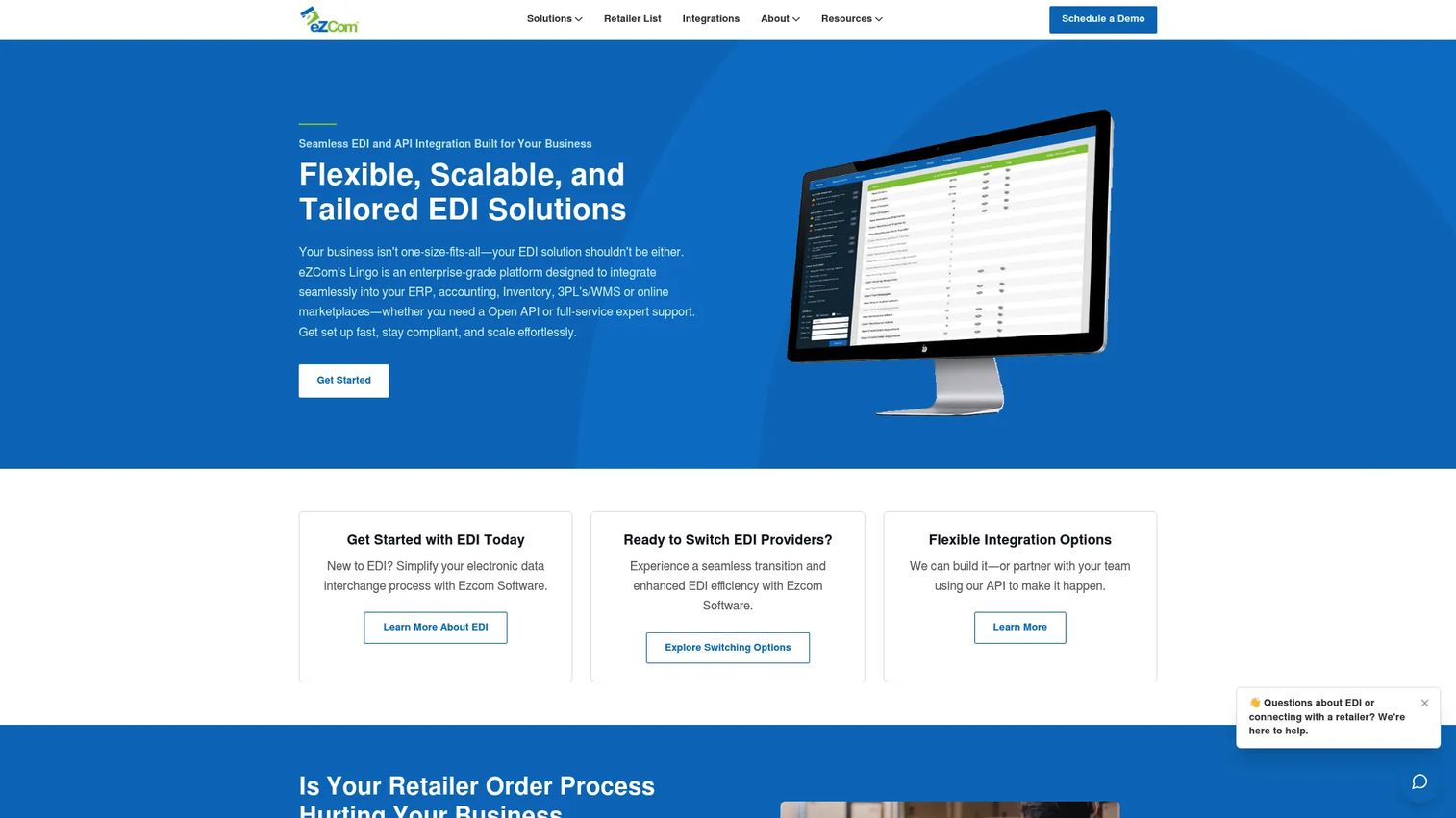
eZCom Software EDI is an enterprise-grade EDI platform (branded as Lingo) for retailer connections, e-commerce processing, and integrations with ERP, accounting, inventory, WMS, and 3PL systems. It includes EDI compliance with double-validation checks and retailer-mapping updates, GS1 label printing, and RESTful API and webhooks for custom integration.
Best for: Retail suppliers, brands, and wholesalers that need managed EDI connections and retailer-compliant order processing.
Key features
- EDI compliance with double-validation and retailer-mapping updates
- e-Commerce and online marketplace connections
- ERP, accounting, inventory, WMS, and 3PL integrations
- RESTful API and webhooks for custom connectivity
- GS1 label printing and shipping-provider integrations
Why choose eZCom Software EDI: Double-validation checks and ongoing retailer-mapping updates reduce the chargebacks that commonly hit suppliers when retailer requirements change. For smaller suppliers, the web-based design keeps setup accessible without requiring specialist EDI knowledge.
eZCom Software EDI pricing: Buyers contact sales. Expect pricing to reflect retailer count, document volume, integrations needed, and user requirements.
G2 rating: 4.7/5
13. APIANT
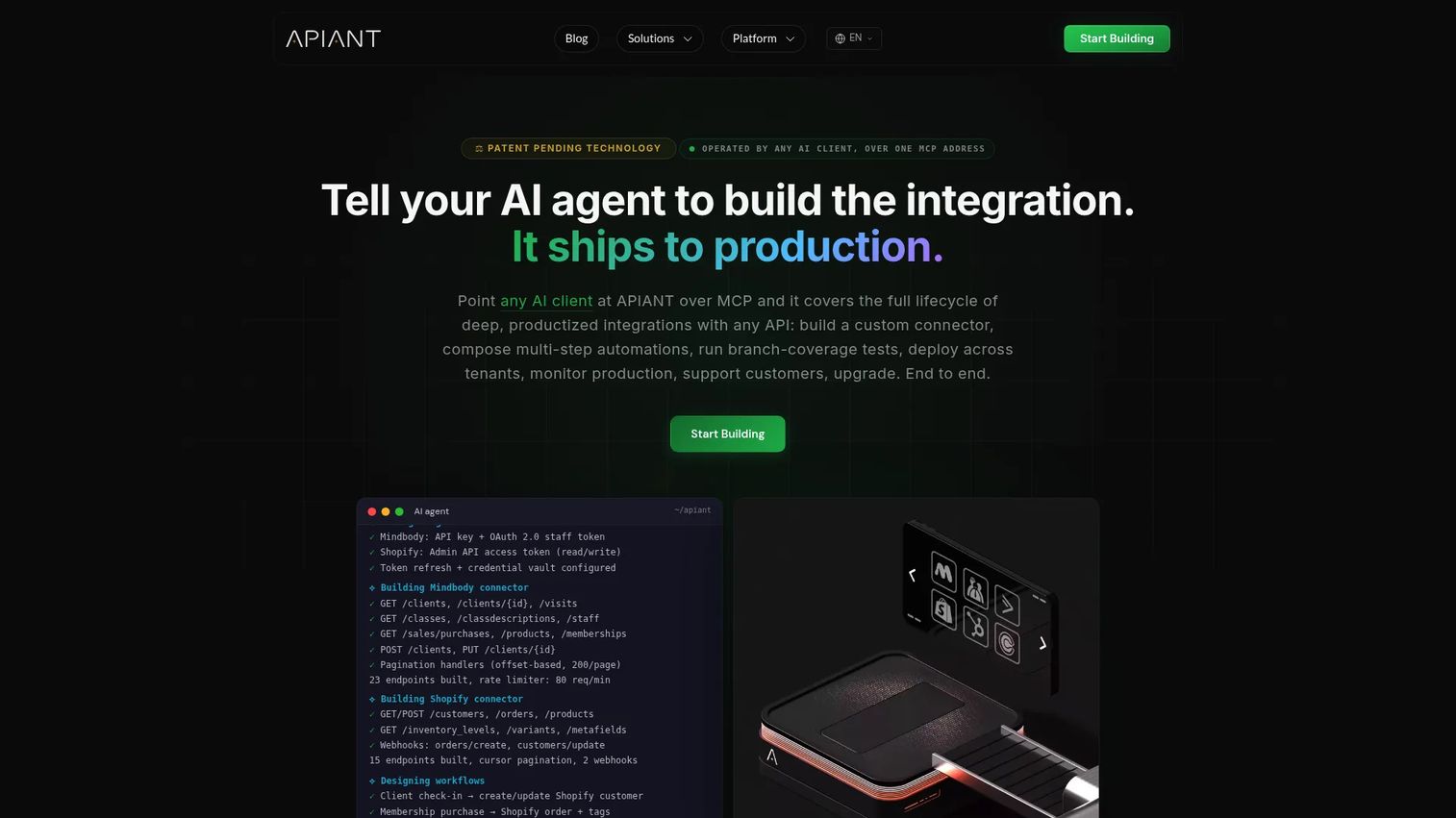
APIANT is an integration platform for building, testing, deploying, monitoring, and upgrading deep API integrations and multi-step automations. It offers custom connectors with OAuth, API keys, webhooks, and throttling support, plus multi-tenant deployment with versioning, rollback, and tenant isolation. APIANT positions toward SaaS companies, system integrators, and enterprises that need customizable, white-label API integrations.
Best for: SaaS companies, system integrators, and enterprises that need deep, customizable, white-label API integrations rather than off-the-shelf EDI brokerage.
Key features
- Custom API connectors with OAuth, API keys, and webhooks
- Multi-step automations with branching, mapping, and scheduled triggers
- Multi-tenant deployment with versioning and rollback
- White-label integration builder for SaaS products
- Sandbox, Pro, Scale, and Enterprise plan tiers
Why choose APIANT: APIANT suits teams building integration capabilities into a SaaS product rather than teams managing supplier EDI networks. Buyers should validate EDI-specific requirements carefully; APIANT handles API automation well but is not a traditional EDI platform with pre-mapped trading-partner connections.
APIANT pricing: Sandbox starts at $99/month. Pro runs $499/month. Scale is $1,500/month. Enterprise starts from $3,500/month. A free starting option is also available. Pricing is monthly.
14. Sync Ezy
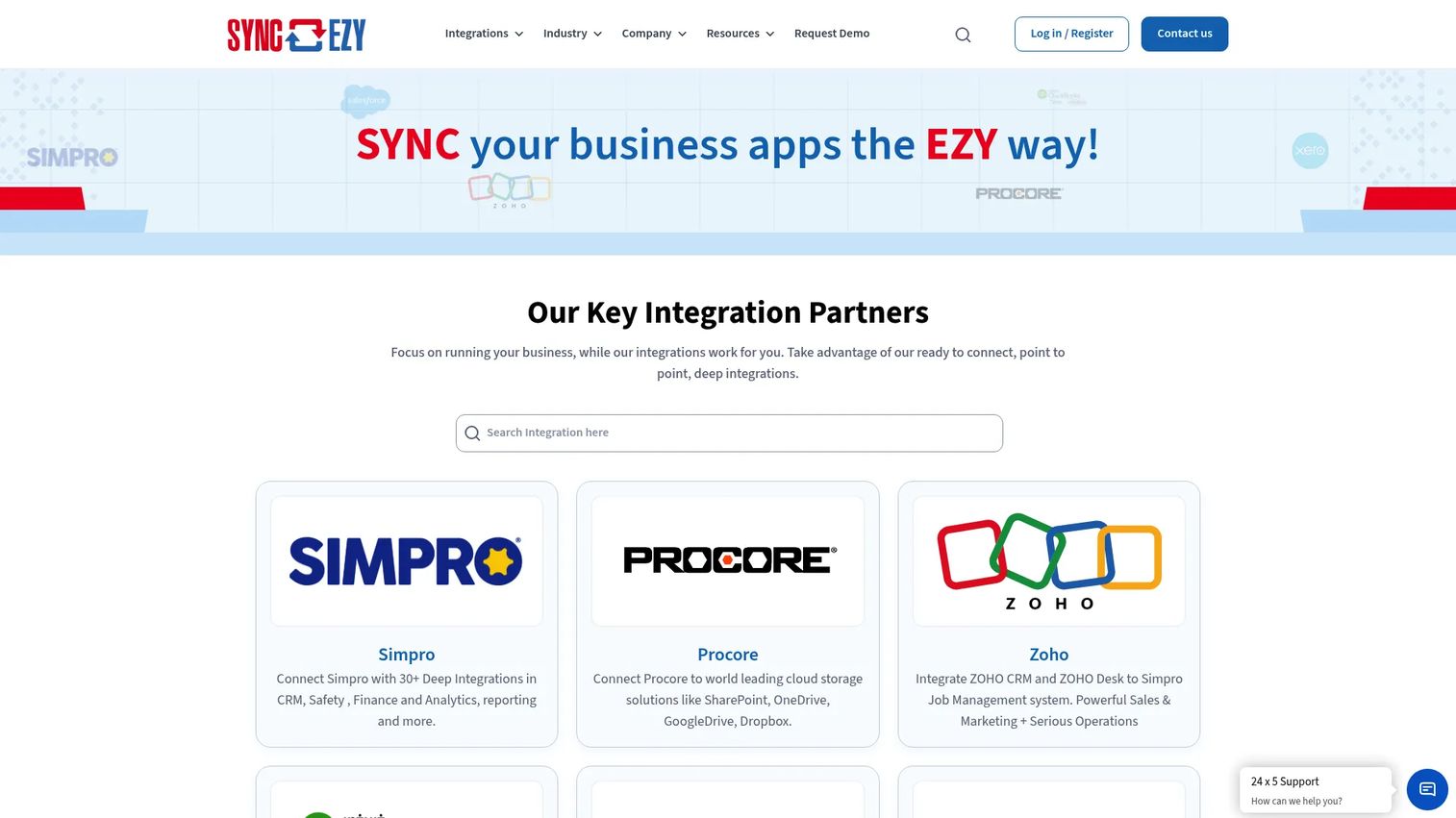
Sync Ezy provides deep, point-to-point integrations that connect business applications and automate workflows. It focuses on job management, CRM, storage, payroll, reporting, and other operational applications, with 24/5 support by phone, email, and live chat. Sync Ezy holds SOC 2 Type 2 certification and CASA approval.
Best for: SMB teams needing deep, supported integrations between job-management, CRM, payroll, and operational business applications.
Key features
- Deep point-to-point integrations with integration maintenance
- Automated syncing across business applications
- 24/5 support by phone, email, and live chat
- SOC 2 Type 2 certified and CASA approved
- API update management included in service
Why choose Sync Ezy: Sync Ezy fits teams that need supported, maintained app-to-app integrations without an internal integration engineer. Teams with complex EDI, VAN, or high-volume trading-partner requirements should evaluate fit carefully; Sync Ezy centers on operational app connectivity rather than B2B transaction exchange.
Sync Ezy pricing: Pricing varies by integration, records, employees, and business scale. Buyers create a free account and select an integration to view pricing.
15. Cognizant Cloud Integration Brokerage

Cognizant Cloud Integration Brokerage is a cloud-based B2B platform-as-a-service designed to help enterprises onboard trading partners faster and scale business integrations. It supports near-real-time file processing with priority queues, multiple file-transfer protocols, and preconfigured, customizable B2B software running on scalable cloud infrastructure. Cognizant states that pay-per-use pricing models are available.
Best for: Large enterprises that need a managed cloud integration brokerage partner rather than a self-serve SaaS platform.
Key features
- Near-real-time file processing with priority queues
- Support for multiple file-transfer protocols
- Preconfigured, customizable B2B software on cloud infrastructure
- Partner onboarding support with service-led operations
- Data translation capacity with scalable cloud infrastructure
Why choose Cognizant Cloud Integration Brokerage: The service-led model fits enterprises where integration brokerage is part of a broader digital transformation initiative or shared platform program. For product managers, the relevant question is whether integration operations should live with an internal team or a managed partner. Cognizant answers that question with a full operating model, not a self-serve tool.
Cognizant Cloud Integration Brokerage pricing: Cognizant offers pay-per-use pricing models but publishes no figures or tier names. Buyers engage Cognizant for a proposal. Cost is driven by scope, integration estate size, transaction volume, and service model.
Considerations when choosing integration brokerage software
Start with the transaction model
List the specific transactions your team needs to support: Purchase orders, invoices, ASNs, inventory feeds, catalogs, carrier updates, acknowledgments, and e-invoices. The right platform depends on those documents and protocols, not a generic integration checklist. A platform optimized for retail EDI handles retailer-specific requirements differently from one built for API-first healthcare transaction exchange.
Validate partner and network coverage
Partner coverage directly affects time to value. When the vendor already supports your retailers, suppliers, marketplaces, or carrier networks, onboarding moves faster because existing maps and compliance rules transfer rather than requiring custom builds. Ask vendors specifically which trading partners are pre-mapped and how long new partner onboarding typically takes.
Measure implementation burden
Low software cost does not equal low implementation cost. Ask who owns mappings, testing, exception handling, and change requests when a trading partner updates requirements. A self-serve platform that shifts mapping work onto your engineering team may carry higher opportunity cost than a managed-service model at a higher price point.
Check exception handling and observability
Integration failures are inevitable. Evaluate dashboards, alerts, retry logic, and audit trails before buying. The team needs to know when a document failed, where in the flow the failure occurred, and who owns resolution. Poor observability means support tickets and chargeback investigations, not dashboards.
Match pricing to operating reality
Pricing in this category typically depends on trading partners, transaction volume, connectors, managed services, and compliance modules. Model year-one setup costs alongside ongoing change costs. When a retailer updates mapping requirements or a new ERP version changes output format, understand who absorbs that work and at what price.
Conclusion
Integration brokerage software is not a single category. Retail EDI networks, API-first platforms, enterprise orchestration tools, and service-led brokerage models solve different problems for different teams.
For retail suppliers and distributors, SPS Commerce Fulfillment EDI and TrueCommerce EDI offer deep trading-partner coverage with managed compliance. Cleo Integration Cloud and Adeptia suit enterprise teams that need broader B2B orchestration beyond EDI alone. Stedi and Orderful EDI fit API-first teams that want programmable transaction infrastructure. Logicbroker is built specifically for marketplace and dropship order coordination. EDICOM and ecosio address global e-invoicing and managed EDI operations. Cognizant provides a service-led model for enterprises treating integration brokerage as a managed platform initiative.
Build your shortlist around the transaction model first. Then validate partner coverage, pricing drivers, implementation ownership, and observability before any contract conversation. The platforms that reduce integration debt and customer onboarding friction are worth the extra diligence upfront.
If your team also needs to explain complex integration workflows to buyers, customers, or internal stakeholders, interactive product experiences make those workflows easier to understand without scheduling a live call.
Start your journey with Guideflow today!
FAQs
Integration brokerage software is a category of tools that helps organizations exchange, translate, validate, and route structured business data between internal systems and external trading partners. It manages EDI, APIs, flat files, and other formats so that purchase orders, invoices, shipment notices, and similar documents move correctly between companies running different protocols and systems. The category includes self-serve SaaS platforms, managed-service models, value-added networks, and hybrid operating models.
EDI is often a core capability within integration brokerage platforms, but the category is broader. Integration brokerage can include APIs, file transfer, ERP connectivity, partner onboarding workflows, monitoring, and managed-service operations alongside traditional EDI. Some platforms focus almost entirely on EDI; others treat EDI as one protocol within a wider integration architecture. When evaluating, check whether the platform's EDI depth matches your specific document types and trading-partner compliance requirements.
iPaaS platforms typically focus on application-to-application integration across SaaS and cloud tools, connecting CRMs, marketing platforms, analytics tools, and internal systems. Integration brokerage focuses on business-to-business transaction exchange between companies, handling structured documents like purchase orders, invoices, and shipment notices under specific EDI or compliance standards. Some platforms overlap both categories, so the distinction is less about the label and more about whether your primary need is internal application connectivity or external partner transaction exchange.
Retail suppliers, manufacturers, logistics providers, distributors, marketplaces, healthcare networks, and financial institutions use integration brokerage software to manage partner data exchange. Within those organizations, the primary users span IT and integration teams, operations teams managing order and fulfillment workflows, and product managers responsible for enterprise readiness and customer implementation. SAPinsider Benchmark Research (2025) found that surveyed organizations were using more than four integration tools simultaneously, reflecting how fragmented this operational layer has become.
EDI translation and compliance, API monitoring and connectivity, data mapping, trading-partner onboarding, exception handling, ERP integration, and observability dashboards matter most across most use cases. For product managers, the features that reduce implementation burden and integration maintenance are the highest priority: Self-service onboarding portals, automated mapping tools, exception alerts, and audit trails that surface failures before they create customer support issues.
Pricing in this category varies significantly. Cost depends on the number of trading partners, transaction volume, connectors, managed-service scope, compliance modules, and deployment model. Most enterprise platforms require a sales conversation to get pricing. Orderful EDI publishes plans starting at $189/month per trading partner for Web EDI Fulfillment. APIANT starts at $99/month for a Sandbox tier. Stedi uses usage-based pricing from $0.05 per transaction with no monthly minimum. For every other platform in this list, request a detailed pricing breakdown that separates setup cost, usage cost, support cost, and ongoing change-request cost.
API-first EDI suits teams with developer ownership, an existing integration strategy built on modern APIs, and the internal capacity to design and maintain integration logic. Tools like Stedi and Orderful EDI offer faster experimentation and direct programmatic control. Traditional managed EDI suits teams that want vendor support for partner onboarding, mapping, testing, compliance updates, and day-to-day EDI operations. The managed model costs more in absolute terms but reduces the engineering opportunity cost of maintaining integration infrastructure.
Evaluate time to value, engineering effort per new trading partner, maintainability across release cadence changes, partner network coverage, exception observability, security controls, and direct impact on customer onboarding. The goal is to find a platform that absorbs partner complexity without creating a parallel engineering workload. Ask vendors how they handle mapping changes when a retailer updates requirements, how exceptions surface in the product, and what the typical onboarding timeline looks like for a new trading partner. Those answers reveal the real operational cost better than any feature comparison table.