Your product needs to send an appointment reminder by SMS, verify a login with a one-time passcode, place an outbound voice call, and drop a transactional email into an inbox. Building that from scratch means stitching together carrier relationships, deliverability logic, retry handling, and compliance rules across every region you operate in. Then maintaining it forever.
That is the problem a communications platform as a service solves. A CPaaS platform gives you programmable APIs for voice, messaging, email, and verification, so you embed communications into your application without owning the underlying telecom plumbing. The market reflects the demand. Juniper Research (2025) forecasts CPaaS revenue growing from USD 30 billion in 2025 to USD 34 billion in 2026, a 13% annual increase. Global Market Statistics (2024) reports that around 54% of CPaaS deployments now use omnichannel messaging and 61% include AI features, so buyers are past basic SMS and into orchestration.
For presales teams and technical buyers, choosing a CPaaS provider is a validation exercise. You are checking channel coverage, developer experience, reliability at scale, security posture, and whether the pricing model survives contact with real volume. This guide breaks down eight platforms so you can build a shortlist and defend it in an RFP.
What's inside
This is a vendor-neutral comparison of eight CPaaS platforms for teams evaluating programmable communications. We selected providers based on four criteria that matter to technical buyers: channel coverage across voice, SMS, messaging, email, and verification; developer experience and documentation depth; scale, reliability, and security posture; and pricing transparency. The audience is presales, solutions consultants, RevOps, and GTM teams who own or contribute to communications platform evaluations. You will find a comparison table, honest per-platform notes on where each fits, and practical selection guidance you can carry into a security review or a proposal.
TL;DR
- Best for breadth and developer ecosystem: Twilio, with wide channel coverage across messaging, voice, email, and verification plus mature docs.
- Best for transparent usage-based pricing: Plivo, with published per-message and per-minute rates and $10 in free credits to start.
- Best for global enterprise omnichannel: Infobip and Sinch, both built for multi-country messaging and customer engagement at scale.
- Best for carrier-grade voice and emergency services: Bandwidth, running on its own direct-to-carrier network.
- Best for cloud-native teams: AWS Communication Developer Services and Azure Communication Services, if you already build inside those clouds.
- Best for straightforward programmable APIs: Vonage Communications APIs, with pay-as-you-go voice, messaging, and verification.
What is a CPaaS platform?
A CPaaS platform is a cloud communications platform that delivers voice, messaging, email, and verification capabilities through APIs and SDKs, so developers can embed real-time communications directly into applications and workflows.
Instead of running your own carrier connections and deliverability infrastructure, you call an API. The platform handles routing, delivery, retries, and compliance across regions. Your engineers ship a feature; the provider owns the telecom layer underneath.
Core capabilities across most CPaaS providers:
- Voice API: programmable inbound and outbound calling, IVR, call recording, SIP trunking.
- SMS API: transactional and marketing messages, delivery reports, opt-out handling, long-message concatenation.
- Messaging API: WhatsApp, RCS, MMS, and other over-the-top channels through a single interface.
- Email API: high-scale transactional and marketing email with deliverability tooling.
- Verification API: OTP, 2FA, and identity checks for authentication and fraud prevention.
- Video: real-time audio and video calling and screen sharing.
- Routing and orchestration: journey logic that moves a conversation across channels.
- Automation and AI: increasingly, AI agents and intelligent routing baked into the stack.
CPaaS vs UCaaS in plain English
CPaaS and UCaaS get confused because both live in cloud communications. The difference is who the tool serves. A CPaaS platform gives developers building blocks to embed communications into a product or customer-facing workflow. UCaaS (unified communications as a service) is a packaged internal collaboration suite, think business phone, video meetings, and team chat for your own employees. CPaaS is programmable and app-facing. UCaaS is turnkey and workforce-facing.
When to use a CPaaS platform
Embed notifications and alerts into products
Product events, appointment reminders, payment alerts, shipment updates, delivery confirmations, and other transactional messages all need to reach users reliably and on time. A CPaaS platform lets you trigger these programmatically off application events rather than running manual messaging workflows or building carrier integrations yourself. You fire an API call when the event happens; the platform handles delivery and reporting. That beats a manual process on both consistency and scale, and it gives you delivery data you can act on.
Add voice, messaging, and verification without building from scratch
OTP and 2FA flows, call verification, inbound and outbound voice, and omnichannel threads that move a customer from SMS to WhatsApp to a call are exactly the kind of capability a CPaaS platform ships as an API. For a technical buyer, this collapses months of build into a fast rollout you can validate in a sandbox before committing. A verification API in particular is a common first use case because authentication and fraud prevention are high-stakes and expensive to build in-house.
Standardize communications across regions and teams
A single communications platform gives multi-country teams governance, centralized pricing control, unified reporting, and predictable scale. Enterprises and regulated industries lean on this because fragmenting communications across a dozen point tools creates compliance gaps and cost sprawl. One platform means one place to enforce data handling rules, one billing model to forecast against, and one set of analytics to report on.
CPaaS comparison table
Scan this table by intent first, then by channel fit and pricing model. Ratings are from G2 where a current listing was available. Pricing for CPaaS is usage-based and product-specific, so treat starting prices as entry points, not full quotes.
| # | Product | Intent | Key use case | Pricing | G2 rating |
|---|---|---|---|---|---|
| 1 | Twilio | Broad developer platform | Messaging, voice, email, and verification in one stack | Free to start, pay-as-you-go (Voice example $0.0140/min) | 4.1/5 |
| 2 | Vonage Communications APIs | Programmable communications APIs | Voice, messaging, and verification at scale | Usage-based; Verify from ~$0.06/verification | 4.2/5 |
| 3 | Plivo | Transparent usage-based CPaaS | Programmable SMS and voice infrastructure | $10 free credits; Enterprise from $1,000/mo | 4.5/5 |
| 4 | Sinch | Global omnichannel messaging | SMS, voice, and verification across channels | Pay-as-you-go (public numeric prices via sales) | 4.4/5 |
| 5 | Infobip | Enterprise omnichannel engagement | Messaging, voice, email, and CDP at global scale | Calculator-based, from €0 pay-as-you-go | Not listed |
| 6 | Bandwidth Communication APIs | Carrier-grade voice and messaging | Voice, messaging, and emergency calling on own network | From $0.004/message | 4.4/5 |
| 7 | AWS Communication Developer Services | Cloud-native communications | Email, SMS, push, chat, voice, and video on AWS | Pay-as-you-go (usage-based) | Not listed |
| 8 | Azure Communication Services | Microsoft cloud communications | Voice, video, chat, SMS, and email in Azure | From $0.0008/chat message | Not listed |
Best CPaaS platforms for 2026
1. Twilio
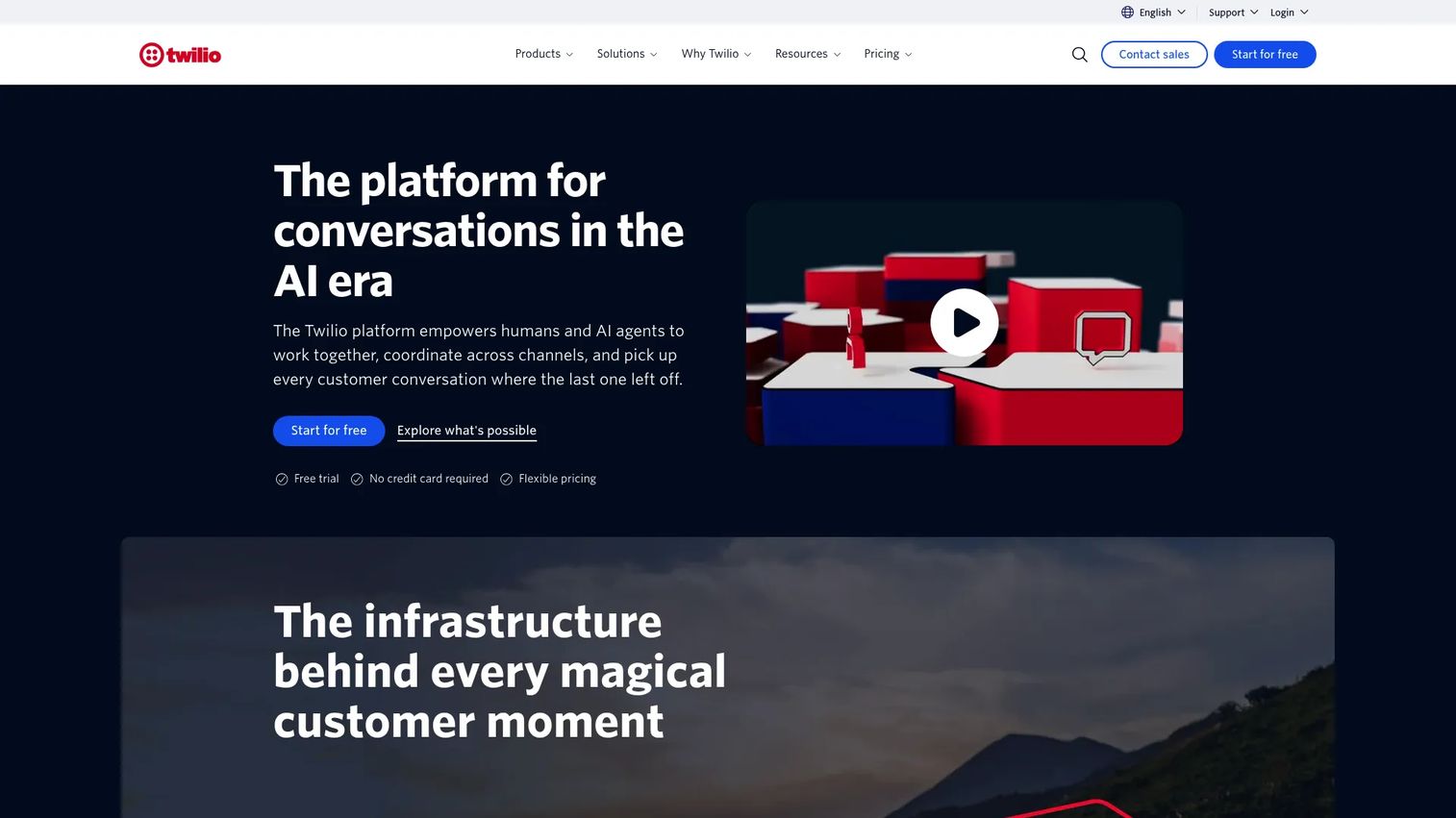
Twilio is the reference point most technical buyers start from when they evaluate CPaaS providers. It is a customer engagement platform spanning communications, customer data, and AI, with programmable APIs for messaging, voice, email, and verification, plus higher-level products like Conversations for threading channels together. The breadth is the story: one account covers most communication needs a product team will hit.
Best for: Developers building scalable messaging, voice, and customer engagement workflows across multiple channels.
Key strengths
- Channel breadth: Messaging, voice, email, and verification APIs under one platform, so you consolidate vendors.
- Conversation Intelligence and Orchestrator: Tools for threading conversations and layering AI on top of raw channels.
- Documentation and ecosystem: Deep, well-maintained docs and SDKs that shorten a proof of concept.
Why choose Twilio: For presales teams, Twilio is the safe, defensible shortlist entry. The maturity, documentation depth, and community mean a technical validation rarely stalls on missing capability or thin docs. It fits teams that want one platform to grow into rather than a narrow point solution.
Twilio pricing: Twilio starts free with no credit card required and charges pay-as-you-go, so you pay only for what you use. Pricing is product-specific rather than a single plan. Public examples on the Voice pricing page include $0.0140 per minute for calls and $1.15 per month for a phone number. Verify the exact rates for your channels, regions, and volume before you model costs.
2. Vonage Communications APIs
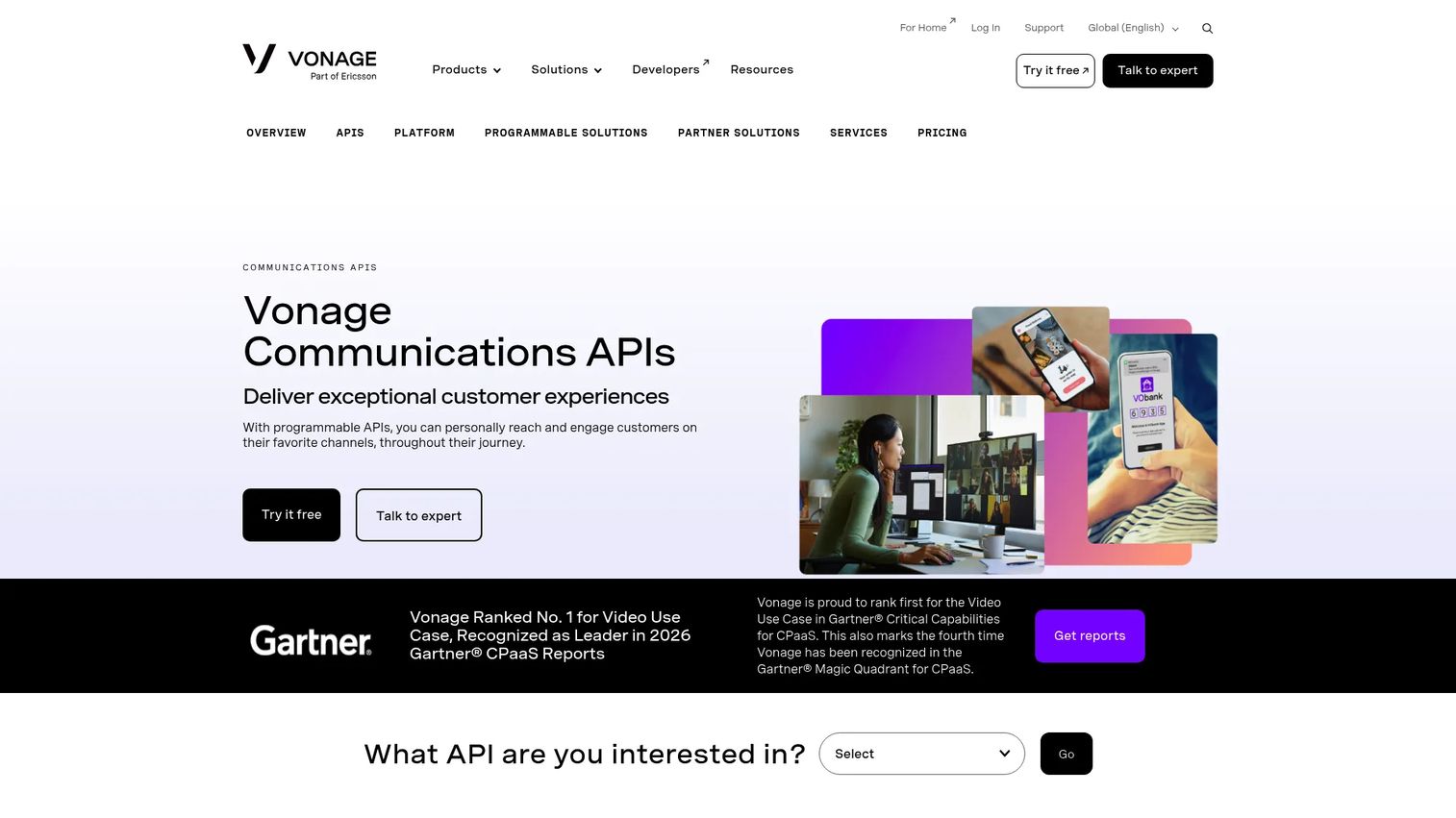
Vonage Communications APIs deliver programmable voice, messaging, verification, and video through a usage-based model. The pitch is straightforward: clean communications APIs you can wire into an app without overcommitting to a heavy enterprise contract up front. It covers the core channels a product team needs and adds a free trial credit to test with.
Best for: Businesses needing programmable voice, messaging, and verification APIs with a clear pay-as-you-go structure.
Key strengths
- Pay-as-you-go pricing: Usage-based API pricing across products, so cost tracks with actual traffic.
- Core channel coverage: Voice, messaging, and verification APIs that cover the common CPaaS use cases.
- Free trial credit: A free credit to run a proof of concept before committing.
Why choose Vonage: Vonage fits teams that want dependable communications APIs without overselling themselves into an enterprise-only motion. It covers breadth well and keeps pricing legible for the products that publish rates. Presales teams evaluating a mid-market build will find it easy to reason about.
Vonage pricing: Vonage publishes usage-based pricing across its APIs. Verify Conversion is listed at €0.052 (about $0.06084) per successful verification. Cloud Runtime tiers run from €0/month (Standard) to €75/month (Advanced) and €250/month (Premium). Several APIs, including some voice and messaging rates, direct you to sales or a dashboard for country-specific figures, so confirm those for your regions.
3. Plivo
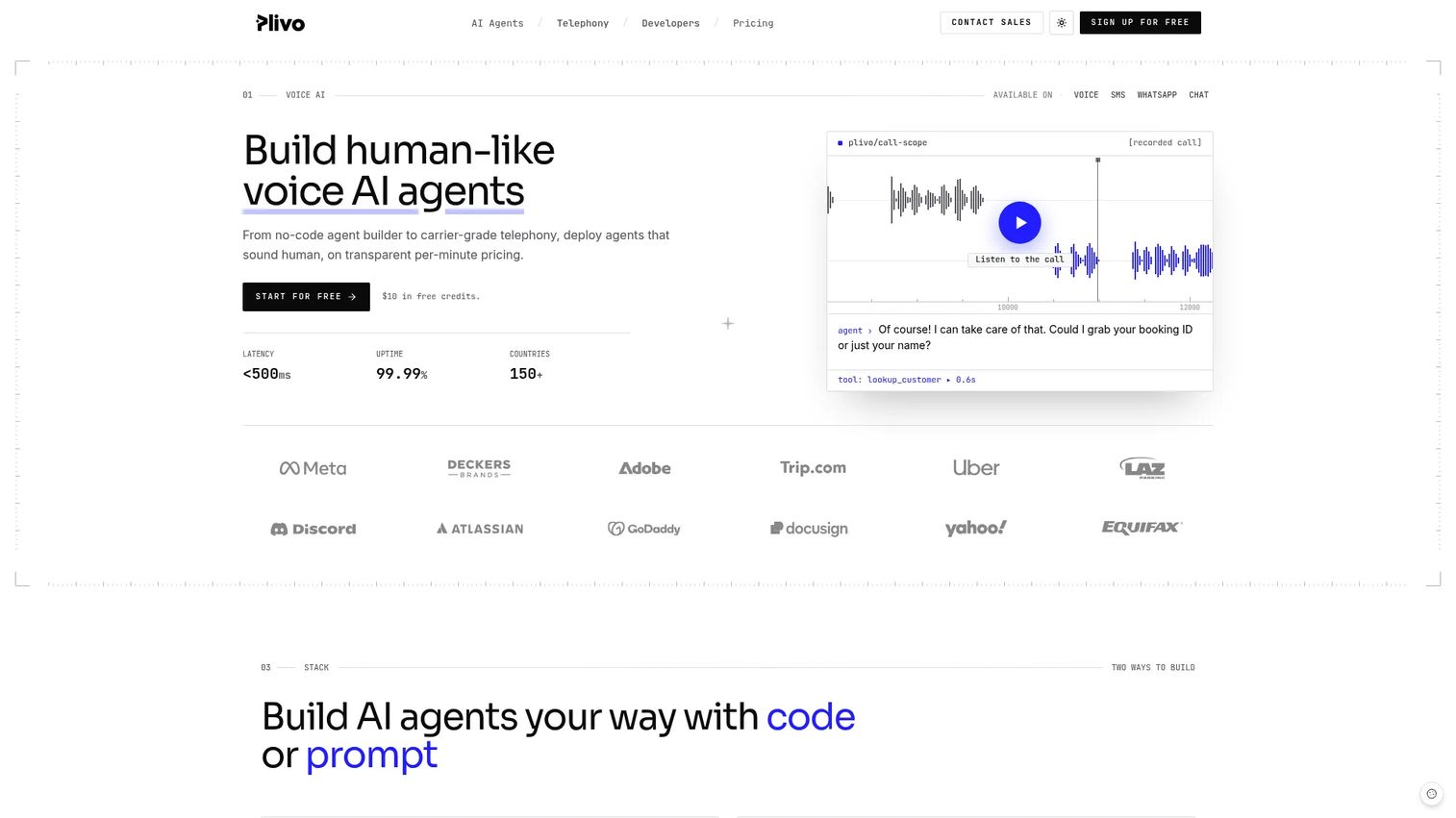
Plivo is a cloud communications platform built around programmable voice, SMS, WhatsApp, SIP trunking, and verification, with a newer no-code AI Agent builder layered on top. It leans hard on published, usage-based pricing, which makes it a favorite of developer teams that want to model costs before they commit. The country-level rate transparency is a genuine differentiator when you are forecasting volume.
Best for: Teams needing programmable messaging and voice infrastructure with published usage pricing.
Key strengths
- Voice API depth: Call queueing, conferencing, IVR, DTMF, speech recognition, call recording, and voicemail transcription.
- SMS platform controls: Unicode support, message queuing, long-message concatenation, delivery reports, and opt-out handling.
- AI Agent platform: No-code agent builder with a knowledge base, multichannel deployment, and real-time testing.
Why choose Plivo: For a presales engineer who has to defend a cost model, Plivo's published pricing removes a lot of guesswork. It fits straightforward communications builds where you want developer-friendly APIs and predictable economics rather than a heavy managed-services relationship.
Plivo pricing: Plivo offers a pay-as-you-go plan with $10 in free credits and no credit card required. The Enterprise plan starts at $1,000 per month. Voice AI Agents are priced at $0.04 per minute, all-inclusive. Rates are region-sensitive; the published US view is the reference, and specific per-country rates vary, so check your target markets.
4. Sinch
Sinch is a global cloud communications platform covering messaging, voice, and verification through enterprise-grade APIs. Its strength is channel breadth at scale: SMS, MMS, WhatsApp, RCS, programmable voice, SIP trunking, and identity verification all under one roof. It is built for organizations running high-volume, multi-country communications rather than a single-channel use case.
Best for: Enterprises needing global omnichannel communications infrastructure and APIs.
Key strengths
- Messaging breadth: SMS, MMS, WhatsApp, RCS, and more through a unified messaging layer.
- Voice capabilities: Programmable voice, SIP trunking, IVR, call recording, and analytics.
- Verification APIs: Identity and verification services for authentication and fraud prevention.
Why choose Sinch: Sinch suits verification-heavy and omnichannel customer engagement workflows where global reach matters. For presales teams supporting an enterprise deal, the channel coverage and scale posture make it a credible shortlist entry when messaging volume spans many markets.
Sinch pricing: Sinch's main pricing page describes pay-as-you-go pricing for SMS, Voice API, and RCS but does not display public numeric prices; you engage sales for rates tied to your volume and regions. A separate product, Sinch Engage, publishes plan pricing starting at $49/month, but that is a distinct offering from the core communications APIs, so treat it separately when you scope.
5. Infobip
Infobip is a global cloud communications platform for customer engagement across messaging, voice, and email, with an omnichannel orientation and a customer engagement suite (AgentOS) layered on top of the raw channels. It supports SMS, email, WhatsApp, Viber, voice, RCS, MMS, and WebRTC, plus CDP capabilities. If your requirement is a broad, global communications layer with orchestration, Infobip is built for it.
Best for: Enterprises needing omnichannel customer communications and messaging infrastructure at global scale.
Key strengths
- Channel coverage: SMS, email, WhatsApp, Viber, and voice with pricing calculators per channel.
- Advanced channels: RCS, MMS, and WebRTC products for richer engagement.
- Engagement suite and CDP: AgentOS and customer data capabilities for orchestration beyond single messages.
Why choose Infobip: Infobip fits teams that need scale, security, and journey orchestration in one platform. For presales evaluations at enterprise, the omnichannel breadth and CDP angle support a customer-engagement story that goes past transactional messaging into full journeys.
Infobip pricing: Infobip shows pricing through per-channel calculators, with programmable channels starting from €0 on a pay-as-you-go basis and a free trial available. AgentOS is described as a predictable monthly fee, though the amount is not publicly listed. Numbers and senders are quote-based. Because a single universal starting price is not published across all products, model costs channel by channel using the calculators.
6. Bandwidth Communication APIs
Bandwidth Communication APIs let businesses build voice, messaging, emergency calling, and WebRTC experiences on Bandwidth's own direct-to-carrier network. That network ownership is the differentiator: instead of reselling connectivity, Bandwidth runs the infrastructure, which appeals to buyers who want deeper control and reliability over the telecom layer.
Best for: Enterprises that need programmable voice, messaging, and emergency communications with volume-based pricing.
Key strengths
- Messaging API: SMS, MMS, and RCS through a programmable interface.
- Voice API: Programmable calling, IVR, and media streaming.
- Emergency Calling API: Flexible emergency services support, a capability many CPaaS providers do not offer.
Why choose Bandwidth: For buyers who prioritize reliability and telecom depth, Bandwidth's direct-to-carrier network and emergency calling capability are genuine differentiators. It fits presales scenarios where a security or reliability review scrutinizes the underlying network, not just the API surface.
Bandwidth pricing: Bandwidth publishes volume-based rates for selected usage types. Examples include $0.004 per message for US 10DLC SMS outbound, $0.015 per message for 10DLC MMS outbound, $0.0100 per minute for US local outbound voice, and $0.0500 per authentication for two-factor authentication. Some products and custom integrations still require a quote, so confirm full pricing for your specific build.
7. AWS Communication Developer Services
AWS Communication Developer Services is Amazon's set of APIs and SDKs for embedding customer communications into applications. It covers email, SMS, push notifications, chat, audio, video, and voice over the PSTN, all designed to plug into the broader AWS environment. For teams already building on AWS, the appeal is architectural fit rather than a standalone feature race.
Best for: Teams building embedded customer messaging, voice, video, and email features on AWS.
Key strengths
- Channel range: Email, SMS, push notifications, chat, audio, video, and PSTN voice.
- Scale for email and messaging: High-scale inbound and outbound email plus flexible mobile SMS and push.
- Real-time communications: Messaging, audio, video, and screen sharing that integrate natively with AWS services.
Why choose AWS Communication Developer Services: If your stack already lives in AWS, the value is integration and consolidated billing rather than a novel channel set. Cloud-native teams get communications that sit inside their existing IAM, monitoring, and data services, which simplifies a security review.
AWS pricing: AWS describes the service as pay-as-you-go, consistent with its usage-based model across services. A single standalone starting price for AWS Communication Developer Services is not clearly published as one number; pricing routes through the individual communication services and the broader business applications page. Model costs per underlying service and confirm current rates in the AWS console.
8. Azure Communication Services
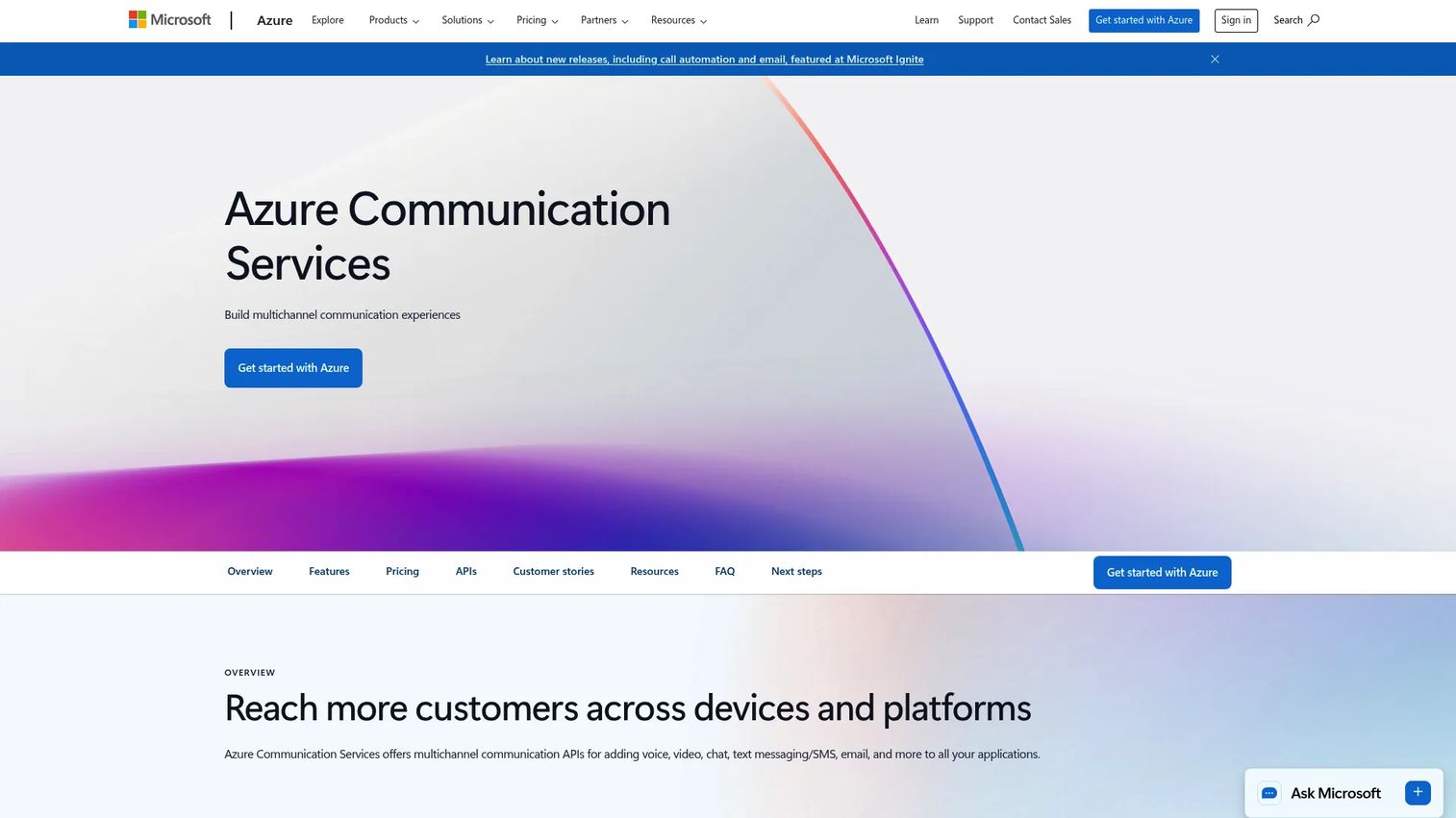
Azure Communication Services is Microsoft's communications platform for adding voice, video, chat, SMS, email, and Teams interoperability to applications. For Microsoft-centric organizations, the draw is ecosystem alignment: communications that build inside Azure and interoperate with Teams, governed by the same enterprise controls your org already uses.
Best for: Teams building custom customer communication workflows inside Azure.
Key strengths
- Voice and video calling: Programmable real-time calling built into the Azure platform.
- Chat and Teams interoperability: In-app chat plus interoperability with Microsoft Teams.
- SMS and email: Programmable messaging and email alongside the real-time channels.
Why choose Azure Communication Services: For enterprises already standardized on Azure and Microsoft governance, this keeps communications inside the same identity, compliance, and billing framework. That ecosystem alignment often matters more than a feature-by-feature comparison for teams that have committed to the Microsoft cloud.
Azure pricing: Azure Communication Services uses pay-as-you-go, usage-based pricing. Published examples include $0.0008 per chat message, $0.004 per participant leg per minute for voice and video calling, and $0.0075 per message segment for US short-code SMS send and receive. Some phone-number and registration fees also apply, so include those when you model total cost.
What to evaluate before you commit
Before you sign, work through a short checklist that maps to how a real evaluation and security review will go.
Channel and geographic coverage
Confirm the platform supports every channel you need (SMS API, voice API, messaging API, email API, verification API) in every region you operate. Coverage that looks complete globally often has gaps or higher rates in specific countries. Validate rates and deliverability in your actual target markets, not just the headline list.
Developer experience and integration depth
Documentation quality, SDK breadth, and sandbox availability decide how fast a proof of concept moves. Check that the platform integrates with your existing stack, CRM, data warehouse, and any orchestration tooling, and that the API design fits how your engineers work.
Reliability and scale
Ask about uptime history, routing redundancy, and how the platform behaves under volume spikes. For voice especially, network architecture matters. Providers that run their own carrier connections give you more control over reliability than pure resellers.
CPaaS security and compliance
For regulated industries, evaluate compliance certifications, data residency options, identity and fraud prevention capabilities, encryption, and logging. A verification API and authentication features are part of this, but so is how the provider handles PII, audit trails, and regional data rules.
Pricing model and total cost
Usage-based pricing is standard, but the details differ. Per message, per minute, per API call, plus number rental and support tiers all add up. Model realistic volume across your channels and regions, and confirm any figure with the vendor before you present a cost case.
Choosing the right CPaaS platform
There is no single best CPaaS platform, only the best fit for your channels, geography, and stack. If you want breadth and a mature developer ecosystem, Twilio and Vonage Communications APIs are natural shortlist entries. If transparent, published usage pricing drives your model, Plivo makes cost forecasting straightforward. For global enterprise omnichannel at scale, Infobip and Sinch are built for multi-country messaging and journey orchestration. If carrier-grade voice, reliability, and emergency services top your list, Bandwidth's owned network stands out. And if you already build in a specific cloud, AWS Communication Developer Services and Azure Communication Services win on architectural fit and governance alignment.
Your next step is practical: shortlist two or three platforms against your must-have channels and regions, run a proof of concept in each sandbox, and validate pricing, compliance, and support terms before you commit. Bring the security team in early, model realistic volume, and confirm every rate with the vendor. That process turns a crowded CPaaS comparison into a defensible recommendation.
FAQs
A CPaaS platform, short for communications platform as a service, is a cloud communications platform that delivers voice, messaging, email, and verification through APIs and SDKs. Developers embed real-time communications into their own applications while the provider handles carrier connections, routing, and delivery underneath.
CPaaS is programmable communications that developers embed into apps and customer-facing workflows using APIs. UCaaS is a packaged internal collaboration suite, business phone, video meetings, and team chat for your own employees. In short, CPaaS is app-facing and built for developers, while UCaaS is turnkey and built for your workforce.
At minimum, look for SMS, voice, messaging (WhatsApp, RCS, MMS), email, and verification. Many enterprise deployments also add video. Match the channel list to your actual use cases: a transactional notification build has different needs than an omnichannel customer engagement platform.
There is no one-size-fits-all answer. Evaluate by governance, scale, compliance certifications, global channel coverage, and support terms. Providers built for global omnichannel messaging suit multi-country enterprises, while cloud-native options win when you have already standardized on a specific cloud. The right choice depends on your existing stack and regulatory requirements.
Weigh channel coverage, developer experience and documentation, reliability at scale, CPaaS security and compliance, pricing transparency, and integration with your stack. Shortlist two or three, run a proof of concept in each, and validate pricing and compliance before committing. Treat it as a technical validation, not just a feature comparison.
It can be, but you have to verify it. Evaluate the provider's compliance certifications, data residency options, encryption, audit logging, and identity and fraud prevention capabilities. A strong verification API supports authentication needs, but regulated industries should also scrutinize how the platform handles PII and regional data rules. Involve your security team early in the evaluation.
CPaaS pricing is almost always usage-based: per SMS message, per voice minute, per API call, plus phone-number rental and support tiers. Some providers publish per-country rates while others route pricing through sales for volume-based quotes. Model realistic volume across your channels and regions, and confirm every figure with the vendor before you build a cost case.