Your firewall lives in one console. VPN access sits in another. Web filtering runs through a third tool nobody remembers configuring. When your new Head of Infrastructure asks for a security briefing, there's no single answer.
That's the problem unified threat management software solves. Instead of a patchwork of controls that nobody fully owns, UTM consolidates firewall inspection, intrusion prevention, malware protection, VPN, content filtering, and centralized policy management into one management layer. The operational overhead drops, and the visibility improves.
The market reflects real urgency here. Global cybersecurity spending is forecast to reach $244.2 billion in 2026, up 13.3% year over year, according to Gartner (2026). Meanwhile, the unified threat management market itself is projected to hit $10.56 billion in 2026, growing to $19.75 billion by 2031 at a 13.34% CAGR, per Mordor Intelligence (2026).
The harder question isn't whether you need better network security. It's which platform fits your traffic volume, team size, cloud footprint, and growth trajectory.
What's inside
This guide is for Series B SaaS founders, Heads of Infrastructure, and security owners evaluating UTM platforms and related security architectures. Entries were selected based on:
- Category relevance to unified threat management and adjacent security architectures
- Documented capabilities verified against current vendor information
- Deployment fit for growing SaaS environments
- Customer feedback and available review data
The list covers software platforms, management layers, managed services, and adjacent architectural categories. Not every entry is a direct UTM appliance; the distinctions are called out clearly in each section.
TL;DR
- Best overall UTM platform: Fortinet FortiGate NGFW for broad integrated protection across mixed environments
- Best for Cisco environments: Cisco Secure Firewall for teams already running Cisco networking or security infrastructure
- Best for distributed networks: Barracuda CloudGen Firewall for multi-site and cloud-connected deployments
- Best for SMBs: WatchGuard UTM for organizations that need manageable gateway security without a large security team
- Best managed option: Managed UTM when your company lacks 24-hour monitoring or firewall administration capacity
What is unified threat management software?
Unified threat management (UTM) software combines multiple network security controls into a single platform, covering firewall inspection, intrusion prevention, malware protection, VPN access, content filtering, and centralized policy management.
The category emerged to address a specific operational problem: Separate security tools managed in separate consoles created gaps, duplication, and overhead. UTM consolidates those functions behind shared administration and consistent logging.
Core UTM capabilities
- Stateful firewall inspection
- Intrusion detection and prevention
- Antivirus and anti-malware scanning
- Web and content filtering
- Application control and visibility
- VPN and secure remote access
- Email or spam filtering (where supported)
- Network access control
- Centralized logging and policy management
- Sandboxing or advanced threat analysis (where supported)
How UTM software detects threats
UTM systems use signature matching to identify known threats, heuristic analysis to flag suspicious behavior, and packet inspection to examine network traffic. Where sandboxing is included, files are analyzed in an isolated environment before execution. Bidirectional inspection covers both inbound and outbound traffic, which matters when a compromised internal host attempts to exfiltrate data.
UTM software versus a traditional firewall
A traditional firewall controls network traffic through policy rules. UTM software wraps additional security services around that firewall function and manages them through a shared console. The difference is operational as much as technical.
UTM software versus an NGFW
The terms overlap significantly in modern markets. Next-generation firewall (NGFW) platforms typically emphasize application awareness, identity-aware policy controls, deep packet inspection, and enterprise policy depth. Many vendors market the same product under both labels. Evaluate capabilities, not category names.
When to use unified threat management software
Consolidate a fragmented security stack
If your team manages separate firewalls, VPN systems, web filters, and intrusion prevention tools in separate consoles, the overhead is real. UTM reduces the number of systems requiring daily attention, centralizes logging, and creates a shared policy layer that's faster to audit and update.
Protect a distributed SaaS workforce
Branch offices, remote employees, cloud-connected infrastructure, and contractor access all create policy complexity. UTM can centralize those controls, though it doesn't replace endpoint security or identity governance. Think of it as the network perimeter layer in a broader security program.
Add security operations without hiring a large team
Self-managed UTM requires firewall expertise, ongoing policy updates, and alert triage. If your team lacks those skills or the coverage hours, managed UTM transfers daily administration to a provider. The decision turns on staffing capacity, not preference.
Unified threat management software comparison
The table below is a shortlist for evaluation, not a universal ranking. Entries include UTM platforms, management tools, managed service categories, and adjacent architectures. Service categories and architectural frameworks are noted where they don't represent a single standalone product. Pricing verified against vendor pages; G2 ratings verified against current listings.
Pricing and ratings verified September 2026 from vendor pricing pages and G2 listings.
| # | Product | Best for | Key differentiator | Pricing | G2 rating |
|---|---|---|---|---|---|
| 1 | Fortinet FortiGate NGFW | Broad UTM and NGFW deployment | AI-powered threat detection across hybrid environments | Custom pricing | 4.6/5 |
| 2 | Cisco Secure Firewall | Cisco-centered network environments | Talos threat intelligence and encrypted traffic inspection | Custom pricing | 4.2/5 |
| 3 | SonicWall Network Security Manager | SonicWall fleet administration | Centralized multi-site management for SonicWall appliances | Custom pricing | N/A |
| 4 | Sophos SG UTM | Legacy and SMB gateway security evaluation | Integrated multi-module gateway protection (legacy product, EOL June 2026) | AWS PAYG from $0.123/hr | N/A |
| 5 | Barracuda CloudGen Firewall | Distributed and cloud-connected networks | Secure SD-WAN with centralized firewall management | Custom pricing | 4.5/5 |
| 6 | WatchGuard UTM | SMB network security | Appliance-based protection with cloud-managed administration | Custom pricing | 4.7/5 |
| 7 | Arista NG Firewall | Mid-market gateway security | Modular, all-in-one gateway platform with free tier | From $25/month | 4.7/5 |
| 8 | Huawei Network Security | Large infrastructure environments | AI-based threat detection integrated with Huawei infrastructure | Custom pricing | 4.8/5 |
| 9 | Smoothwall UTM | Education-sector web filtering | Firewall, IPS, and VPN purpose-built for schools and colleges | Custom pricing | 4.3/5 |
| 10 | Cisco Meraki | Cloud-managed distributed networks | Centralized cloud dashboard across sites, devices, and security | Custom pricing | 4.3/5 |
| 11 | Managed UTM | Teams without dedicated security operations | Provider-managed monitoring, policy administration, and response | Custom pricing | N/A |
| 12 | Managed firewall | Companies outsourcing firewall administration | Operational ownership with 24/7 monitoring and policy support | Custom pricing | 4.5/5 |
Best 12 unified threat management software tools for 2026
1. Fortinet FortiGate NGFW
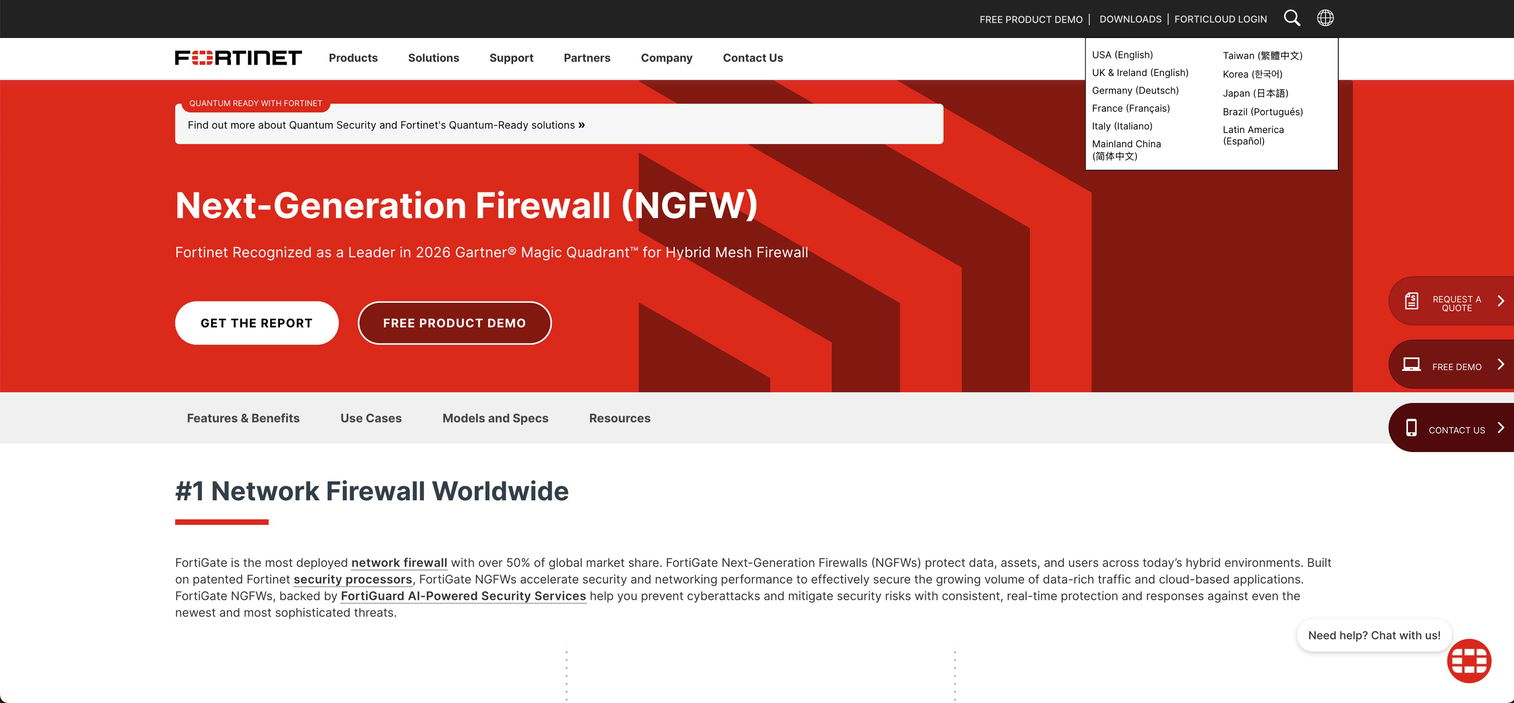
Fortinet FortiGate NGFW is one of the most widely deployed firewall platforms across data centers, campus networks, cloud environments, and distributed branches. It combines firewall inspection, intrusion prevention, VPN, web filtering, application control, and security analytics through FortiGuard AI-powered threat services. ASIC-accelerated processing means security services run without the throughput drop that software-only platforms often create.
Best for: Mid-market and enterprise SaaS companies needing a mature firewall platform with broad security services across mixed environments.
Key features
- AI-powered threat detection via FortiGuard security services
- Integrated secure SD-WAN and zero-trust network access
- SSL inspection and deep packet inspection
- Unified management across hybrid environments
- ASIC-accelerated security and networking performance
Why choose Fortinet FortiGate NGFW: FortiGate's coverage across hardware, virtual, and cloud-native deployments means it can grow with your infrastructure without requiring a platform swap. Licensing and configuration require careful planning, especially when enabling multiple security services simultaneously.
Fortinet FortiGate NGFW pricing: Fortinet doesn't post purchase prices on its product pages and directs buyers to request a quote or contact sales. Pricing varies by appliance model, security subscription bundles, and support tier. G2 reviewers on the Fortinet Firewalls listing rate it 4.6/5.
2. Cisco Secure Firewall
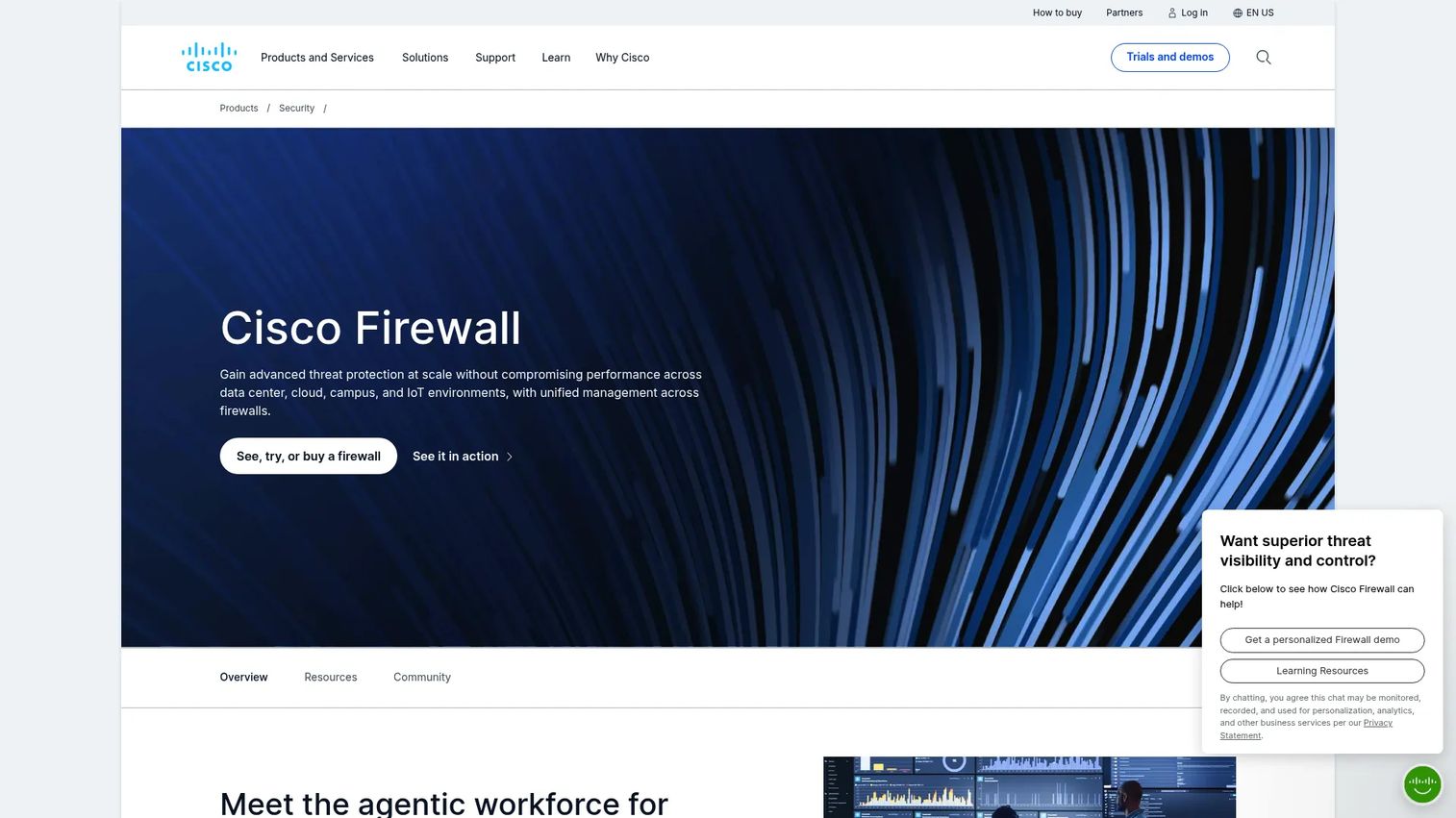
Cisco Secure Firewall provides enterprise firewall capabilities with deep integration into the broader Cisco security portfolio. It covers advanced threat protection, application visibility and control, VPN, SSL/TLS decryption, URL filtering, and centralized management through Cisco Security Cloud Control and the Firewall Management Center. The SnortML engine provides zero-day protection, and the Encrypted Visibility Engine detects encrypted-traffic threats without requiring decryption.
Best for: SaaS companies with existing Cisco networking or security infrastructure who need consistent policy management across that environment.
Key features
- Talos-powered threat intelligence and advanced threat protection
- SnortML zero-day and intrusion prevention
- Encrypted Visibility Engine for encrypted-traffic threat detection
- Remote access VPN and SSL/TLS decryption
- Centralized management through Cisco Security Cloud Control
Why choose Cisco Secure Firewall: Teams already running Cisco switching, routing, or identity tools will find integration cleaner than introducing a separate vendor. Administration complexity is real; internal Cisco expertise reduces adoption risk significantly.
Cisco Secure Firewall pricing: Cisco does not display appliance or subscription pricing on its public product pages. Contact Cisco sales for appliance, software, and support costs specific to your environment. G2 rates Cisco Secure Firewall Threat Defense Virtual at 4.2/5.
3. SonicWall Network Security Manager
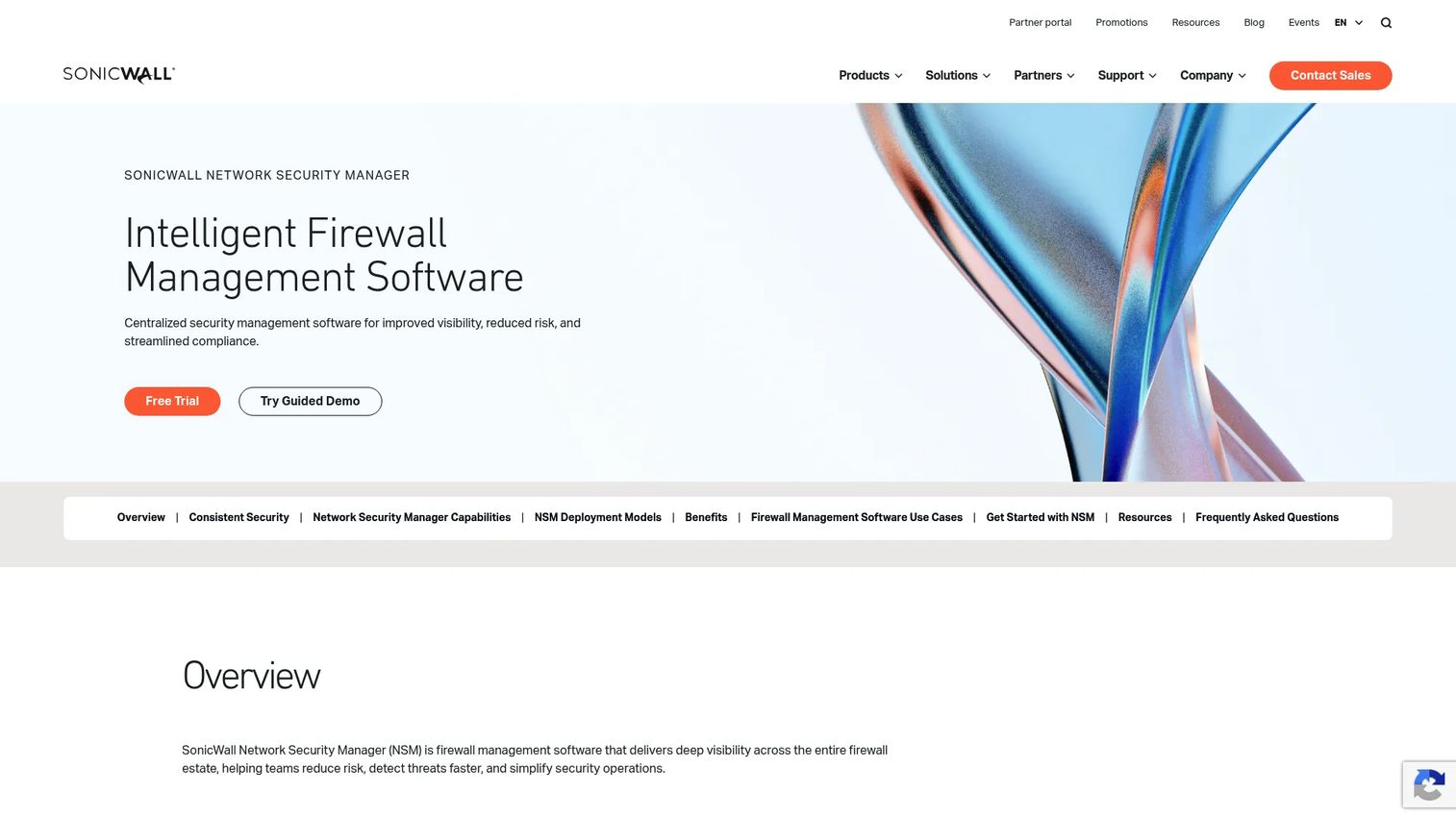
SonicWall Network Security Manager is a centralized management platform for SonicWall firewall environments. It handles deployment, configuration synchronization, multi-tenant administration, reporting, and analytics across distributed SonicWall appliances. NSM is a management layer, not a standalone UTM appliance. Its value depends entirely on the SonicWall deployment it sits above.
Best for: Teams standardizing administration and reporting across multi-site SonicWall security deployments.
Key features
- Centralized management of firewalls, switches, and access points
- Zero-touch deployment and provisioning
- Policy templates and configuration synchronization
- Multi-tenant management with per-tenant isolation
- Dashboards, analytics, and API support
Why choose SonicWall Network Security Manager: If your organization has standardized on SonicWall appliances, NSM reduces the per-device management overhead significantly. Buyers should evaluate NSM Essential versus NSM Advanced based on reporting depth and analytics retention requirements.
SonicWall Network Security Manager pricing: SonicWall offers NSM in Essential and Advanced tiers, with Advanced adding up to 365-day reporting and 30-day analytics. Specific prices are not displayed publicly; contact SonicWall or a reseller for current subscription rates. No G2 product-specific rating for Network Security Manager was verifiable at publication.
4. Sophos SG UTM

Sophos SG UTM is an integrated gateway security platform that combines firewall, VPN, web protection, email security, malware filtering, wireless protection, and centralized reporting across hardware, software, virtual, and cloud deployments. Sophos classifies SG UTM as a legacy product, with end of life confirmed for June 30, 2026. Teams evaluating this product should focus on migration planning to current Sophos offerings rather than new deployment.
Best for: Organizations researching legacy UTM context or planning migration away from existing SG UTM deployments.
Key features
- Network, web, email, wireless, and endpoint protection modules
- Firewall, NAT, intrusion prevention, and VPN
- Application control and web filtering
- Sandstorm sandboxing for advanced threat analysis
- Centralized logging and reporting
Why choose Sophos SG UTM: This is a migration-context entry. Sophos UTM reached end-of-life status, so active SG UTM users should evaluate Sophos's current firewall portfolio for replacement paths.
Sophos SG UTM pricing: On AWS, Sophos UTM 9 Auto Scaling PAYG starts at $0.123/hr for a t2.small instance and scales to $0.55/hr for a c4.large. On-premises licensing requires a quote. No current G2 rating was verifiable for this product at publication.
5. Barracuda CloudGen Firewall
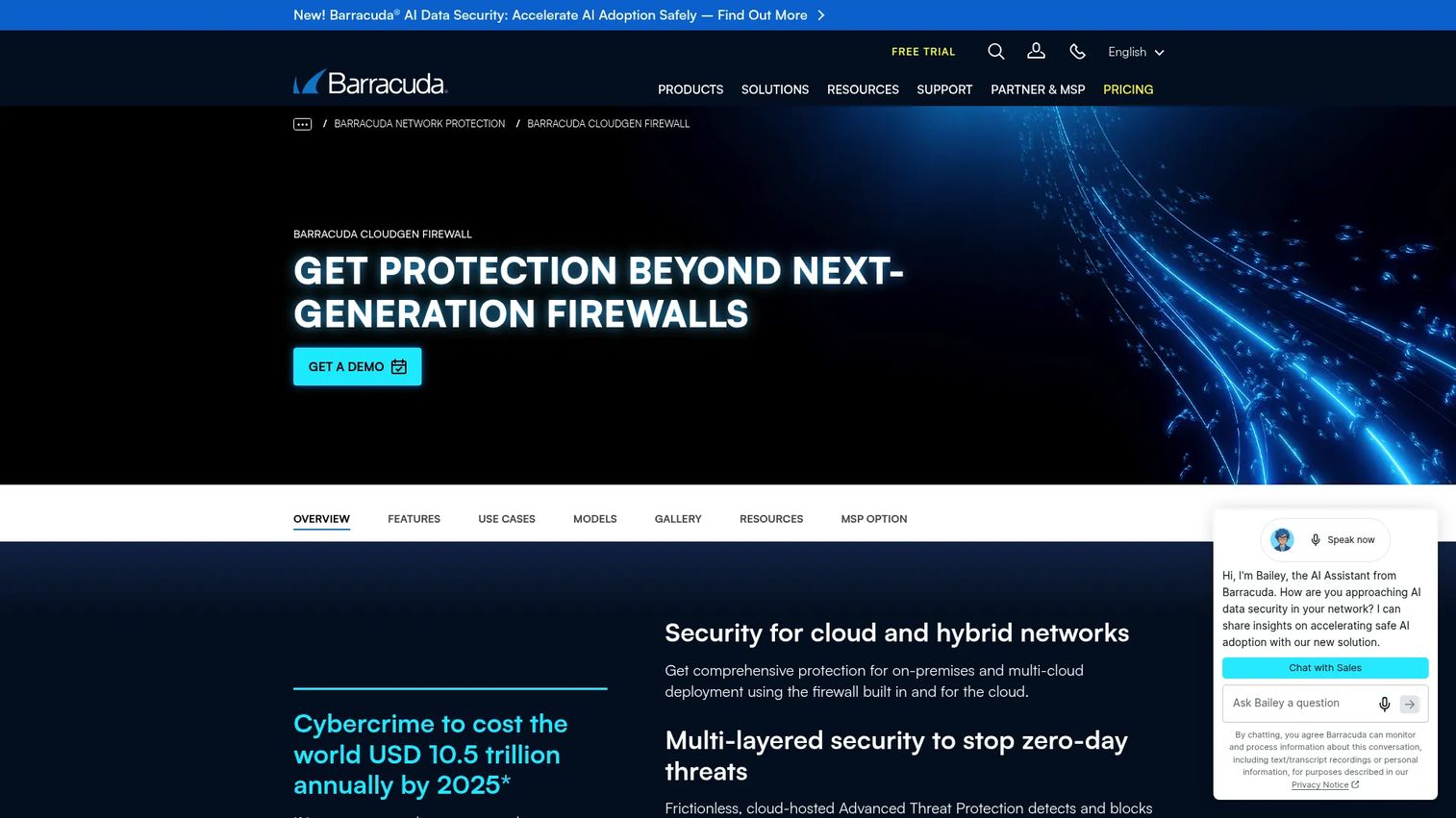
Barracuda CloudGen Firewall is a next-generation firewall built for distributed and cloud-connected environments. It combines advanced threat protection, intrusion detection and prevention, SSL interception, botnet and spyware protection, and secure SD-WAN with application-based routing and multi-uplink VPN load sharing. The Barracuda Firewall Control Center handles centralized management across all deployed appliances. Options include hardware, virtual, AWS, and Azure deployments.
Best for: Distributed SaaS infrastructure with multiple offices, cloud regions, or complex WAN traffic patterns requiring coordinated policy and routing.
Key features
- Advanced Threat Protection and malware protection
- Intrusion detection and prevention with botnet and spyware filtering
- Secure SD-WAN with application-based routing and multi-uplink VPN
- Centralized management through Barracuda Firewall Control Center
- SSL and IPsec VPN for secure remote access
Why choose Barracuda CloudGen Firewall: The integrated SD-WAN and firewall management in one platform is the differentiator for teams running multiple locations or cloud regions. Implementation requires clear network architecture ownership from the start.
Barracuda CloudGen Firewall pricing: Barracuda does not post numeric pricing on its product pages and directs buyers to request a quote through sales or authorized partners. Licensing options include hardware, virtual, and cloud-based subscriptions covering security service bundles. G2 rates Barracuda CloudGen Firewall at 4.5/5.
6. WatchGuard UTM
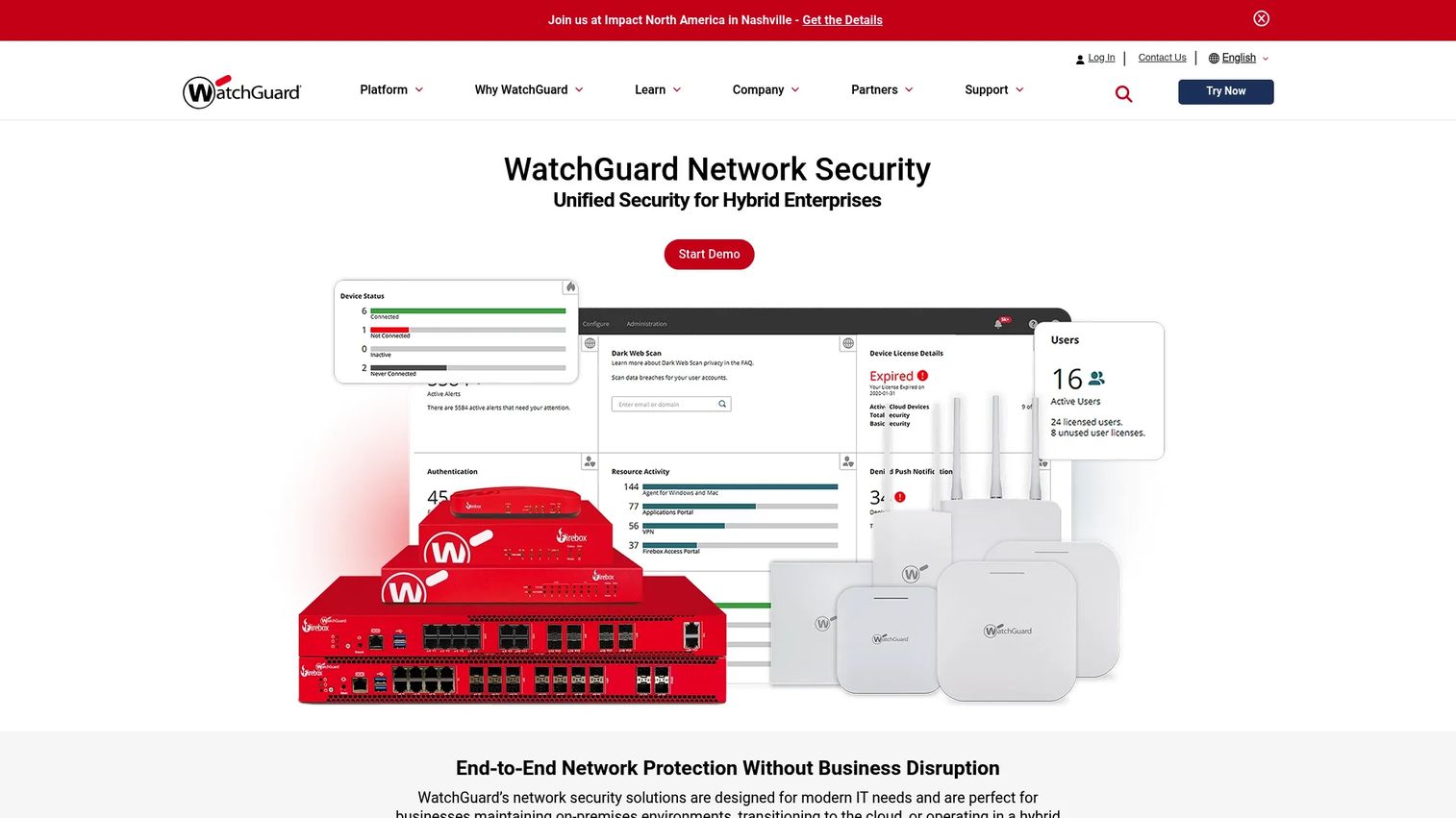
WatchGuard network security delivers its UTM and NGFW capabilities through Firebox appliances available in physical, virtual, cloud, and hybrid configurations. The platform covers stateful firewall inspection, VPN, intrusion prevention, application control, URL filtering via WebBlocker, gateway antivirus, spam blocking, and SD-WAN. Centralized administration runs through WatchGuard Cloud, with the Total Security Suite adding AI-powered malware detection and sandboxing.
Best for: SMBs needing integrated gateway security and centralized administration without requiring a dedicated security operations team.
Key features
- Stateful firewall with VPN and SD-WAN
- Intrusion Prevention Service (IPS)
- Application control and URL filtering
- Gateway antivirus and AI-powered malware detection
- Centralized management through WatchGuard Cloud
Why choose WatchGuard UTM: WatchGuard targets resource-constrained teams that need layered security without enterprise licensing complexity. Evaluate the difference between the Basic Security Suite and Total Security Suite before committing, as the more advanced threat capabilities require the higher tier.
WatchGuard UTM pricing: WatchGuard lists Standard Support, Basic Security Suite, and Total Security Suite tiers but does not display numeric pricing on its public pages. Contact WatchGuard or a reseller for appliance and subscription costs. G2 rates WatchGuard Network Security at 4.7/5.
7. Arista NG Firewall
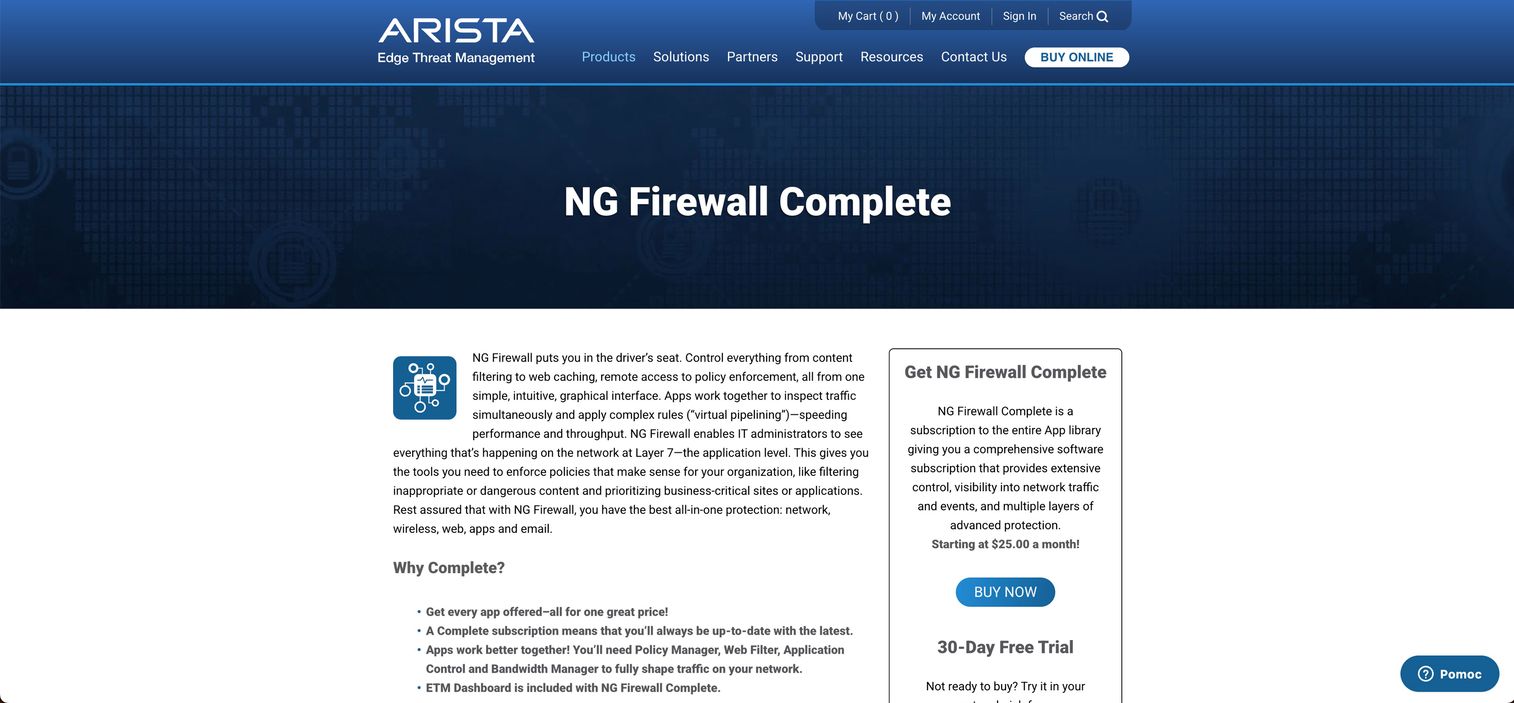
Arista NG Firewall is a modular gateway security platform providing firewall, intrusion prevention, threat prevention, virus blocking, phishing protection, web filtering, application control, SSL inspection, VPN (IPsec, OpenVPN, WireGuard), WAN balancing, and centralized management through the ETM Dashboard. Despite Arista branding, this product line operates under Arista's Edge Threat Management division and is distinct from Arista's campus networking portfolio.
Best for: Mid-market organizations needing a modular, all-in-one gateway security platform with a free entry tier.
Key features
- Firewall, IPS, virus blocking, and phishing protection
- Web filtering, application control, and SSL inspection
- IPsec, OpenVPN, and WireGuard VPN
- WAN balancing and failover
- Centralized management via ETM Dashboard
Why choose Arista NG Firewall: NG Firewall Complete starts at $25/month, making it one of the few platforms in this category with a published starting price. A free tier is available with limited capabilities, which lets teams evaluate before committing.
Arista NG Firewall pricing: NG Firewall Complete starts at $25/month. A free tier (NG Firewall Free) is available with basic security and connectivity features. G2 rates Arista NG Firewall at 4.7/5.
8. Huawei Network Security
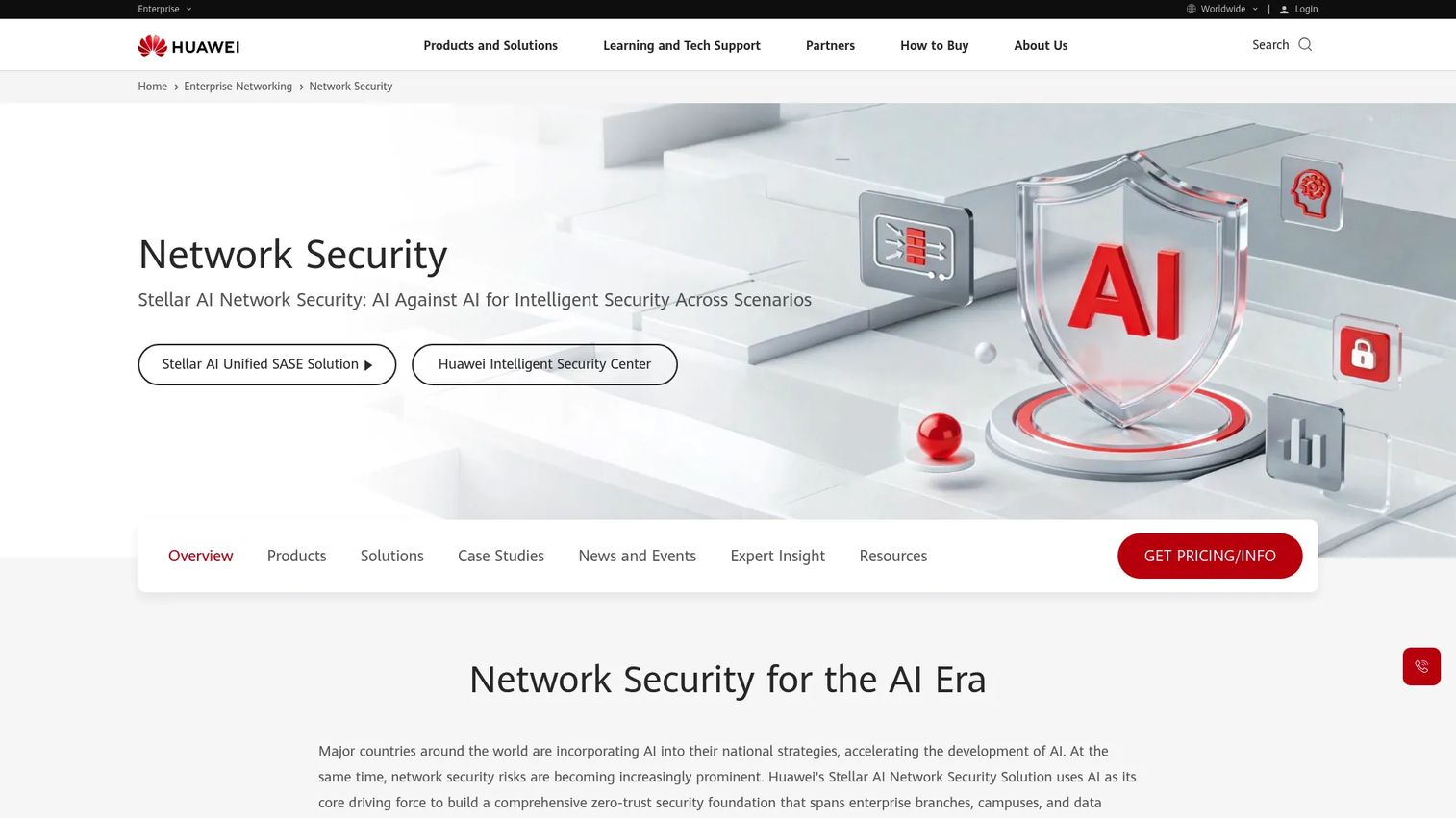
Huawei Network Security covers AI-based proactive threat detection, integrated protection across cloud, network, edge, and endpoint layers, and automated security policy orchestration and threat response. The portfolio includes firewalls, endpoint security, DDoS mitigation, APT defense, security management platforms, and security operations tooling. This is an infrastructure-scale security portfolio rather than a single UTM appliance.
Best for: Large enterprises or organizations already operating Huawei network infrastructure who want integrated security management across that environment.
Key features
- AI-based proactive threat detection
- Integrated protection across cloud, network, edge, and endpoint
- Firewalls, DDoS mitigation, and APT defense
- Automated security policy orchestration
- Network-wide log management and service orchestration
Why choose Huawei Network Security: Infrastructure alignment is the core reason to evaluate Huawei here. Geographic availability, channel support, and procurement constraints vary significantly by region and should be verified before progressing a shortlist.
Huawei Network Security pricing: Huawei does not display numeric pricing on its product pages and directs buyers to contact sales or a regional channel partner. G2 rates Huawei Security at 4.8/5.
9. Smoothwall UTM

Smoothwall UTM is a unified threat management platform purpose-built for schools, colleges, and multi-academy trusts. It covers a next-generation perimeter and internal-segmentation firewall, Layer 7 application control with deep packet inspection, intrusion detection and prevention, site-to-site IPsec and remote-user SSL/L2TP VPN, and link and load balancing. Smoothwall operates in a specific vertical context; it is not a general-purpose enterprise UTM platform.
Best for: Education organizations needing integrated web filtering, gateway security, and UTM controls in a sector-specific deployment.
Key features
- Next-generation perimeter and internal-segmentation firewall
- Layer 7 application control and deep packet inspection
- Intrusion detection and prevention
- Site-to-site and remote-user VPN
- Link and load balancing
Why choose Smoothwall UTM: Smoothwall's positioning targets education compliance and content control requirements specifically. Organizations outside the education sector should evaluate whether a general-purpose UTM platform serves them better.
Smoothwall UTM pricing: Smoothwall provides pricing through a quote request form and does not display rates publicly. Contact Smoothwall for per-site or per-device pricing. G2 rates Smoothwall UTM at 4.3/5 from a small review set.
10. Cisco Meraki
Cisco Meraki is a cloud-managed networking and security platform covering wireless LAN, switching, security appliances, SD-WAN, cellular, mobile device management, cameras, and sensors. The Meraki Dashboard provides zero-touch provisioning, remote monitoring, and centralized policy management across distributed sites. Meraki is a cloud-managed networking platform, not a traditional UTM appliance, though its security appliances deliver firewall, VPN, and content filtering capabilities.
Best for: Distributed organizations that need centralized cloud administration across multiple sites without on-premises management infrastructure.
Key features
- Centralized cloud management through the Meraki Dashboard
- Zero-touch provisioning and remote monitoring
- Site-to-site VPN and policy templates
- Security appliances with firewall and filtering capabilities
- Network automation through APIs and marketplace integrations
Why choose Cisco Meraki: Meraki's strength is operational simplicity for distributed teams. License continuity matters here; hardware without an active license loses management access, so budget for ongoing subscription costs.
Cisco Meraki pricing: Meraki does not publish hardware or license pricing publicly. Contact Cisco or a Meraki partner for appliance and license costs specific to your site count and device mix. G2 rates Cisco Meraki at 4.3/5.
11. Managed UTM
Managed UTM is a service category, not a single software product. Providers offer cloud-based or on-premises UTM infrastructure administered by an external team. Coverage typically includes next-generation firewall management, intrusion prevention, antivirus and anti-spyware controls, web content and application control, VPN management, data leakage protection, vulnerability management, and 24/7 monitoring with automatic threat updates. MCK Networks is one example of a provider in this category; other managed security service providers offer comparable services under different names.
Best for: SMBs and mid-market SaaS companies that need UTM capability without hiring or training an internal security operations team.
Key features
- Provider-managed next-generation firewall policies
- Intrusion prevention and antivirus controls
- Web content and application control
- VPN management and data leakage protection
- 24/7 monitoring and automatic threat updates
Why choose Managed UTM: The decision rests on one variable: Whether your internal team can realistically own daily firewall administration, alert triage, and incident escalation. If the honest answer is no, managed UTM is often cheaper than the incident cost of understaffed security.
Managed UTM pricing: Managed UTM pricing is custom and typically depends on site count, device count, bandwidth, monitoring coverage, and contract length. Request proposals from multiple providers and compare response times, escalation paths, and reporting depth explicitly.
12. Managed firewall
Managed firewall is a service category covering outsourced administration of existing or provider-supplied firewall infrastructure. Check Point's Managed Firewall service is one well-known example, offering 24/7 monitoring, firewall policy management, patching, upgrades, and incident handling across Check Point and third-party NGFWs. The key distinction from managed UTM: Managed firewall typically covers the firewall layer only, without the broader threat management services (endpoint protection, threat hunting, MDR) that a full managed UTM program may include.
Best for: Companies with firewall infrastructure already in place that lack the internal capacity to manage daily administration and policy updates.
Key features
- 24/7 monitoring and incident handling
- Firewall policy management, exclusions, and tuning
- Patching, upgrades, and change control
- Integrated threat prevention
- Centralized management across supported NGFW platforms
Why choose Managed firewall: If daily firewall administration is the specific gap, managed firewall addresses it without requiring a full managed security program. Define the responsibility matrix clearly before signing, particularly around who handles policy changes, escalation decisions, and reporting.
Managed firewall pricing: Managed firewall pricing varies by provider, device count, coverage hours, and contract terms. Check Point does not post pricing publicly; contact sales for current rates. G2 rates Check Point Software Technologies overall at 4.5/5.
Considerations
Match the platform to your traffic profile
Throughput figures on vendor datasheets typically reflect best-case conditions, not full-inspection performance. Enabling SSL inspection, malware scanning, and IPS simultaneously can reduce throughput by 50% or more on some platforms. Get vendor throughput numbers under the specific combination of security services you plan to run.
Decide who owns daily administration
Self-managed UTM requires internal firewall expertise, ongoing policy updates, and alert triage. If your infrastructure team is small or split across product and DevOps work, managed UTM or managed firewall services may reduce risk faster than hiring. Be honest about coverage hours, not just headcount.
Check integration and migration requirements
Review your identity provider, endpoint tools, cloud network configuration, SIEM platform, ticketing system, and logging requirements before selecting a platform. Require a migration plan that addresses existing firewall rules, VPN profiles, and policy templates. Migration complexity is consistently underestimated.
Separate licensing from hardware
UTM total cost includes appliance cost, security subscription bundles, support contracts, virtual instance fees, bandwidth, and managed service fees where applicable. Ask every vendor to model a three-year cost, not only year one. Subscription renewals after the first contract period frequently represent the larger cost.
Test usability under real conditions
Run a proof of concept that includes realistic traffic volumes, VPN access, policy changes, alert triage, and reporting. Measure how quickly your team can investigate and contain a simulated event. A platform that performs well in a vendor demo but requires hours of administration per alert is not a good fit for a lean team. Reviewing application security testing software and AI security posture management tools alongside your UTM evaluation can round out the picture of your full security stack.
Conclusion
Unified threat management software gives growing SaaS companies a way to consolidate network security without building a large security operations team. The right choice depends on your traffic profile, team capacity, cloud footprint, and three-year cost tolerance.
For most Series B SaaS companies, Fortinet FortiGate NGFW covers the broadest range of deployment scenarios with mature licensing and strong vendor support. Cisco Secure Firewall is the logical choice if Cisco is already central to your network stack. Barracuda CloudGen Firewall fits distributed environments with complex WAN requirements. WatchGuard UTM suits smaller teams that need integrated protection without enterprise licensing overhead.
If your team can't absorb daily firewall administration, managed UTM or managed firewall services are worth pricing before assuming internal ownership.
Start with a requirements matrix covering traffic volume, user count, site count, cloud environments, identity integrations, support coverage requirements, and three-year cost. That matrix will narrow 12 options to a workable shortlist of two or three for a proof of concept.
For additional context on access review software and endpoint protection software that complements your UTM selection, those guides cover adjacent layers of your security stack in the same practical format.
FAQs
Unified threat management (UTM) software is an integrated network security platform that combines firewall inspection, intrusion detection and prevention, malware protection, VPN, content filtering, and centralized policy management into a single system. The goal is to reduce the number of separate security consoles your team operates while maintaining coordinated protection across network traffic.
A traditional firewall enforces access policies based on traffic rules, controlling which connections are allowed or denied. UTM software adds malware scanning, intrusion prevention, content filtering, VPN, and centralized logging around that firewall function. The firewall component is still present in a UTM system; it simply operates alongside additional security services under shared administration.
The terms overlap significantly in current markets, and many vendors apply both labels to the same product. NGFW platforms typically emphasize application-layer awareness, identity-based policy controls, deep packet inspection, and enterprise policy depth. Evaluate the specific capabilities of each platform rather than relying on the label a vendor applies to it.
UTM fits SaaS companies with moderate network complexity, lean security teams, mixed office and remote connectivity, and a need for centralized administration. It works well when your primary problem is fragmented security tools with no shared logging or policy layer. For organizations with very large remote workforces or cloud-native infrastructure, a SASE architecture may be a better starting point than a traditional UTM appliance.
The decision turns on internal staffing capacity, coverage hours, and incident response capability. Self-managed UTM requires someone who can own policy updates, alert triage, and escalation decisions. If your infrastructure team is split across product, DevOps, and security work without a dedicated security function, managed UTM often reduces total risk at comparable cost to the incident exposure from understaffed administration.
A complete UTM firewall should provide stateful firewall inspection, intrusion detection and prevention, malware protection, VPN, web filtering, application control, centralized logging, policy management, access control, and reporting. Some platforms add email filtering, sandboxing, and identity-aware policies. The specific combination matters more than the count; align features to your actual traffic and threat profile.
UTM pricing varies by appliance model, throughput capacity, security subscription bundle, support tier, site count, and whether managed services are included. Hardware appliances carry separate costs from security service subscriptions, which renew annually or per contract term. Three-year total cost typically looks different from year-one cost once support renewals are included. Managed UTM adds provider fees on top of infrastructure costs. Request itemized multi-year quotes from any vendor you're seriously evaluating.
UTM protects network gateways and traffic flows. It does not protect individual devices from threats that arrive through email, browser vulnerabilities, or compromised credentials. Endpoint security handles device-level protection. MDR provides the human-led detection and response layer that investigates threats that bypass gateway controls. Most mature security programs use UTM, endpoint security, and MDR as complementary layers rather than alternatives to each other.