A single rejected claim costs a provider organization real money before anyone sees a dollar of reimbursement. Staff re-key data, chase payer requirements, resubmit, and wait. Multiply that across thousands of claims a month and you get the quiet drain most billing teams live with: delayed cash, growing days-in-A/R, and people spending their week fixing preventable errors.
About 73% of commercial and government healthcare claims in the U.S. move through electronic clearinghouses as of 2026, according to MarketIntelo. That number tells you the plumbing is standard. What is not standard is how well each clearinghouse routes claims, catches errors before they leave the door, and hands your team clean data on the way back.
The right claims clearinghouse software decides whether your revenue cycle runs on rework or on automation. Payer connectivity, claims scrubbing, eligibility verification, ERA posting, denial management, and secondary claims are the workflow spine of any billing operation. Get them right and cash arrives faster with fewer touches. Get them wrong and every downstream metric suffers.
This guide compares 10 platforms that provider organizations and billing teams actually evaluate. Some are focused clearinghouses. Others bundle clearinghouse function into a broader revenue cycle management platform. We rank them by how directly they solve the claims routing problem, not by brand size.
What's inside
This guide is for revenue cycle leaders, billing managers, and practice administrators comparing medical clearinghouse software for provider organizations. We looked at tools that route claims between provider systems and payers, then measured them on the workflows that move cash.
We selected each platform on four criteria:
- Payer connectivity: breadth and reliability of the payer network
- Claims automation: scrubbing, edits, and submission speed
- ERA and posting: how electronic remittance flows back into your ledger
- Denials and secondary claims: rework, worklists, and downstream routing
We prioritized workflow fit over feature counts. A long feature list means nothing if it does not shorten your days-in-A/R.
TL;DR
- Best for large revenue cycle operations: TriZetto, with deep payer connectivity and enterprise-grade administration tooling.
- Best for claims management depth: ClaimSource and Waystar, both built around edits, tracking, and full revenue cycle workflows.
- Best for low-cost access: Office Ally, widely used by small and mid-size billing teams for broad payer reach.
- Best for concrete billing workflows: PracticeSuite, covering claims submission, eligibility, ERA auto-posting, denial worklists, and secondary claims.
- Best for simple, transparent pricing: Claim.MD, with public monthly tiers and unlimited claims on its top plan.
The best medical claims clearinghouse for your organization depends on billing volume, whether you want a standalone clearinghouse or an embedded one, and how much automation you need across denials and ERA.
What claims clearinghouse software is
Claims clearinghouse software is the intermediary layer that validates, formats, and routes healthcare claims between provider billing systems and payers, then returns responses like acceptances, rejections, and remittances.
Think of it as the switchboard for your revenue cycle. Your practice management or EHR system creates a claim. The clearinghouse checks it against payer rules, converts it into the correct EDI format, and transmits it to the right payer. When the payer responds, the clearinghouse routes that answer back to you.
This matters because payers each have their own requirements. A claim that passes one payer's edits may fail another's. A good EDI clearinghouse catches those problems before submission, so you fix them once instead of waiting days for a rejection.
Core functions of medical billing clearinghouse software include:
- Claims submission: batch or real-time transmission to payers
- Payer connectivity: connections to commercial, Medicare, and Medicaid payers
- Claims scrubbing: automated edits that flag errors before submission
- Eligibility verification: real-time checks on patient coverage and benefits
- ERA posting: electronic remittance advice pulled back and posted to your ledger
- Denial management: worklists and tracking for rejected or denied claims
- Secondary claims: automated routing to secondary payers after primary adjudication
Clearinghouse vs direct payer submission
Some payers accept claims directly. So why use a clearinghouse at all? The table below shows the practical difference.
| Approach | What it means | Best for |
|---|---|---|
| Clearinghouse | One connection routes claims to hundreds of payers with unified scrubbing and tracking | Organizations billing many payers who want one workflow and one report |
| Direct payer submission | You connect to and format claims for each payer individually | Very low-volume billers with one or two dominant payers |
For most provider organizations, a clearinghouse removes the maintenance burden of managing dozens of separate payer connections.
When to use claims clearinghouse software
Submit cleaner claims at scale
When you file thousands of claims a month, manual review does not scale. Claims scrubbing runs automated edits against payer rules and catches missing modifiers, invalid codes, and eligibility gaps before submission. A billing team filing 4,000 claims monthly that raises its clean-claim rate from 85% to 95% cuts hundreds of rejections and the rework behind them.
Reduce manual eligibility and payment follow-up
Eligibility verification confirms coverage before the visit, so you catch inactive plans and benefit limits early. ERA posting pulls remittance data back automatically and posts payments to the correct claims. Together they remove two of the most repetitive tasks in the billing day, freeing staff from phone trees and manual data entry.
Route denials and secondary claims more efficiently
Denials are inevitable. What matters is how fast you work them. Denial management surfaces rejected claims in a worklist with reason codes, so staff act instead of hunt. Secondary claims routing sends the balance to the next payer automatically once the primary adjudicates, closing the loop without a manual resubmission.
Comparison table
Below is a side-by-side view of the 10 platforms, sorted by relevance to claims clearinghouse workflows. Pricing and ratings reflect verified values where publicly available; where a vendor uses custom or modular pricing, we note that instead of guessing.
| # | Product | Best for | Key differentiator | Pricing | G2 rating |
|---|---|---|---|---|---|
| 1 | TriZetto | Large revenue cycle operations | Deep payer administration and connectivity | Custom | 4.3/5 |
| 2 | ClaimSource | Claims management depth | Claim edits and end-to-end tracking | Custom | N/A |
| 3 | Office Ally | Small to mid-size billing teams | Broad payer reach at low cost | Free to custom | 4.4/5 |
| 4 | Waystar | Unified RCM plus clearinghouse | One-database revenue cycle platform | Request pricing | 4.4/5 |
| 5 | PracticeSuite | Concrete billing workflows | Claims, eligibility, ERA, denials, secondary | Custom/modular | 4.3/5 |
| 6 | AdvancedMD | Embedded clearinghouse in a billing suite | Scrubbing inside a full EHR/PM stack | From $130/mo per provider | 3.6/5 |
| 7 | Availity | Payer network access | Networked eligibility and authorizations | Free to $25/mo | N/A |
| 8 | Claim.MD | Independent billers, small orgs | Transparent monthly pricing | From $30/mo | N/A |
| 9 | Tebra | Independent practices | All-in-one PM, billing, and engagement | From $49/mo per provider | 4.1/5 |
| 10 | CollaborateMD | Cloud billing workflows | Unlimited eClaims with scrubbing | Request pricing | 4.4/5 |
Best 10 claims clearinghouse tools for 2026
1. TriZetto
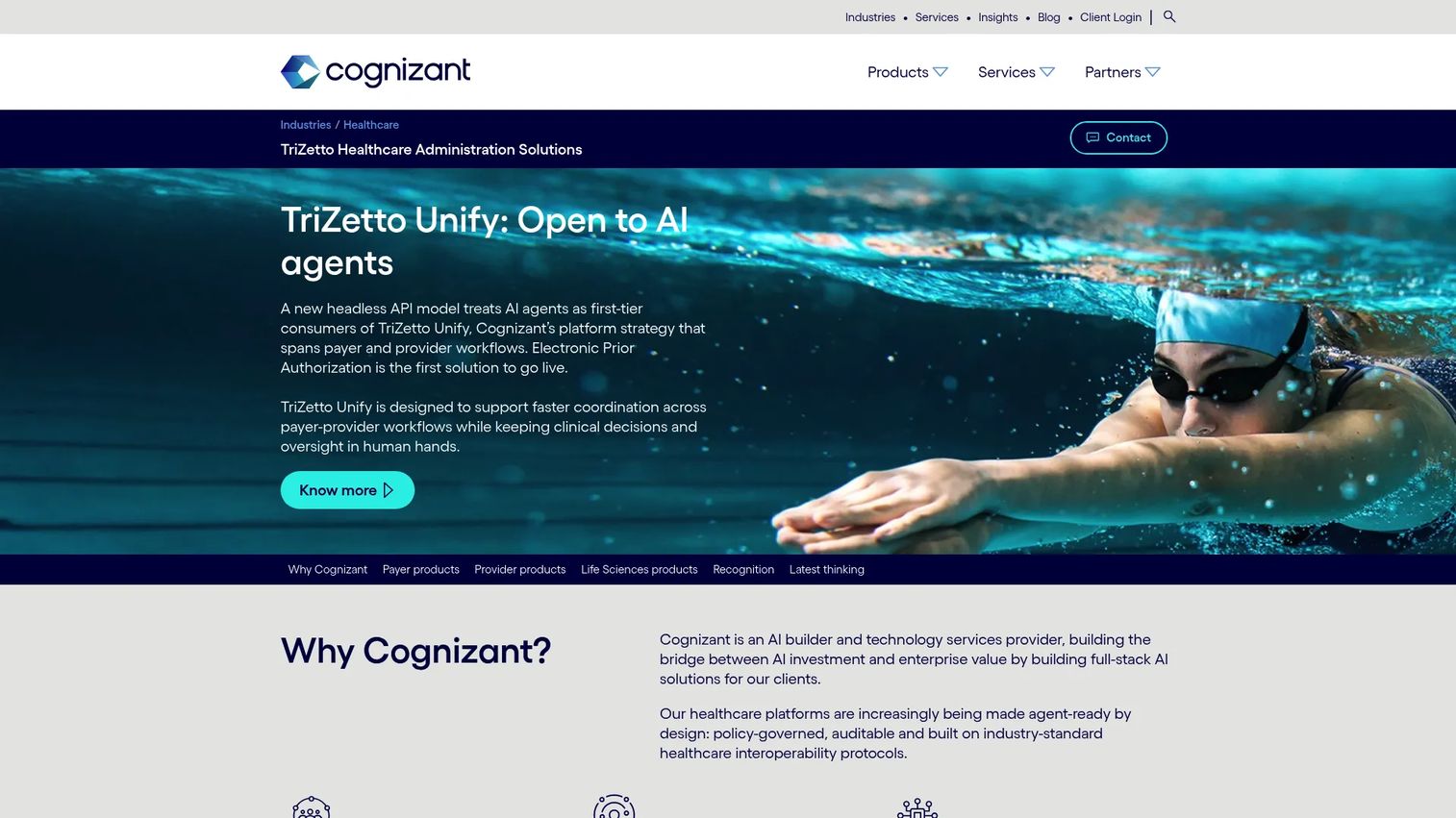
TriZetto, part of Cognizant, is a suite of healthcare administration software and services built for both payers and providers. Its core administration platforms, Facets and QNXT, sit at the center of large-scale claims and reimbursement operations. For provider organizations, TriZetto brings deep payer connectivity and the kind of interoperability tooling that heavy claims volume demands.
TriZetto suits larger revenue cycle operations more than a two-provider practice. The strength here is scale: member and provider portals, interoperability solutions, and administration platforms that handle complex payer relationships. If your organization processes high claim volume across many payers and needs enterprise-grade infrastructure, TriZetto is built for that reality.
Key strengths
- Core administration platforms: Facets and QNXT
- Interoperability solutions across payer and provider systems
- Member and provider portals
Why choose TriZetto: It fits health plans and large healthcare organizations that need payer-grade administration alongside provider reimbursement tools, not small practices looking for a quick clearinghouse.
TriZetto pricing: Pricing is not published publicly and is quoted based on scope. The G2 rating for TriZetto Facets is 4.3/5.
2. ClaimSource
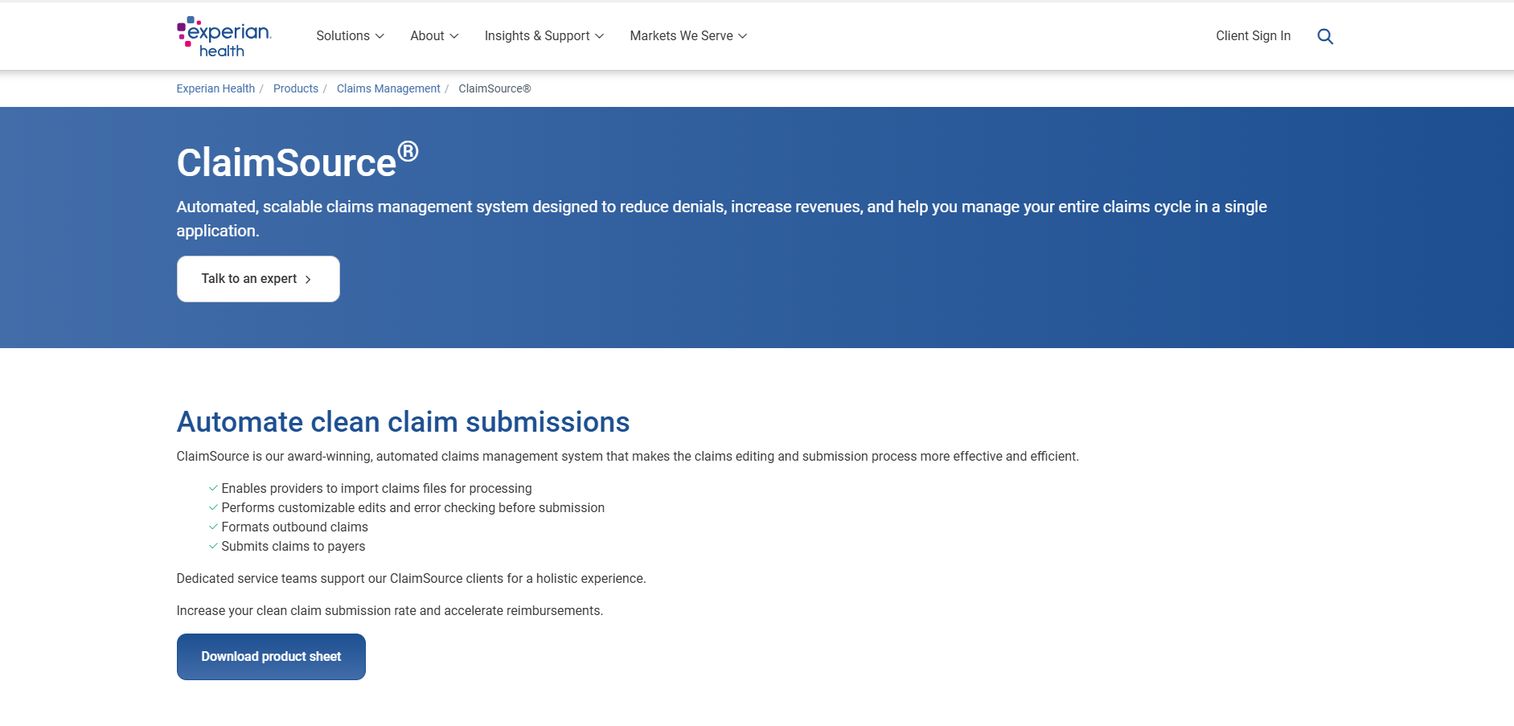
ClaimSource is a claims management platform oriented toward the full arc of the claim: edits, outbound formatting, submission, and tracking. Rather than positioning itself narrowly as a clearinghouse, it leans into claims management depth, giving billing teams visibility from creation through payer response and into follow-up.
That depth is the reason ClaimSource shows up on evaluation lists for larger billing operations. Teams that need to manage claim edits, watch claims move through the pipeline, and tie those workflows into broader revenue cycle management tend to value the tracking and outbound control it provides. Implementation is worth scoping early, since claims management platforms of this depth reward careful workflow mapping.
Key strengths
- Claim edits and outbound formatting
- End-to-end claims tracking and status visibility
- Workflows that connect into broader revenue cycle management
Why choose ClaimSource: It best serves billing teams that want claims management depth and tracking rather than a lightweight submission-only tool.
ClaimSource pricing: Pricing is quoted directly and is not published publicly. Scope the implementation and workflow requirements during evaluation.
3. Office Ally
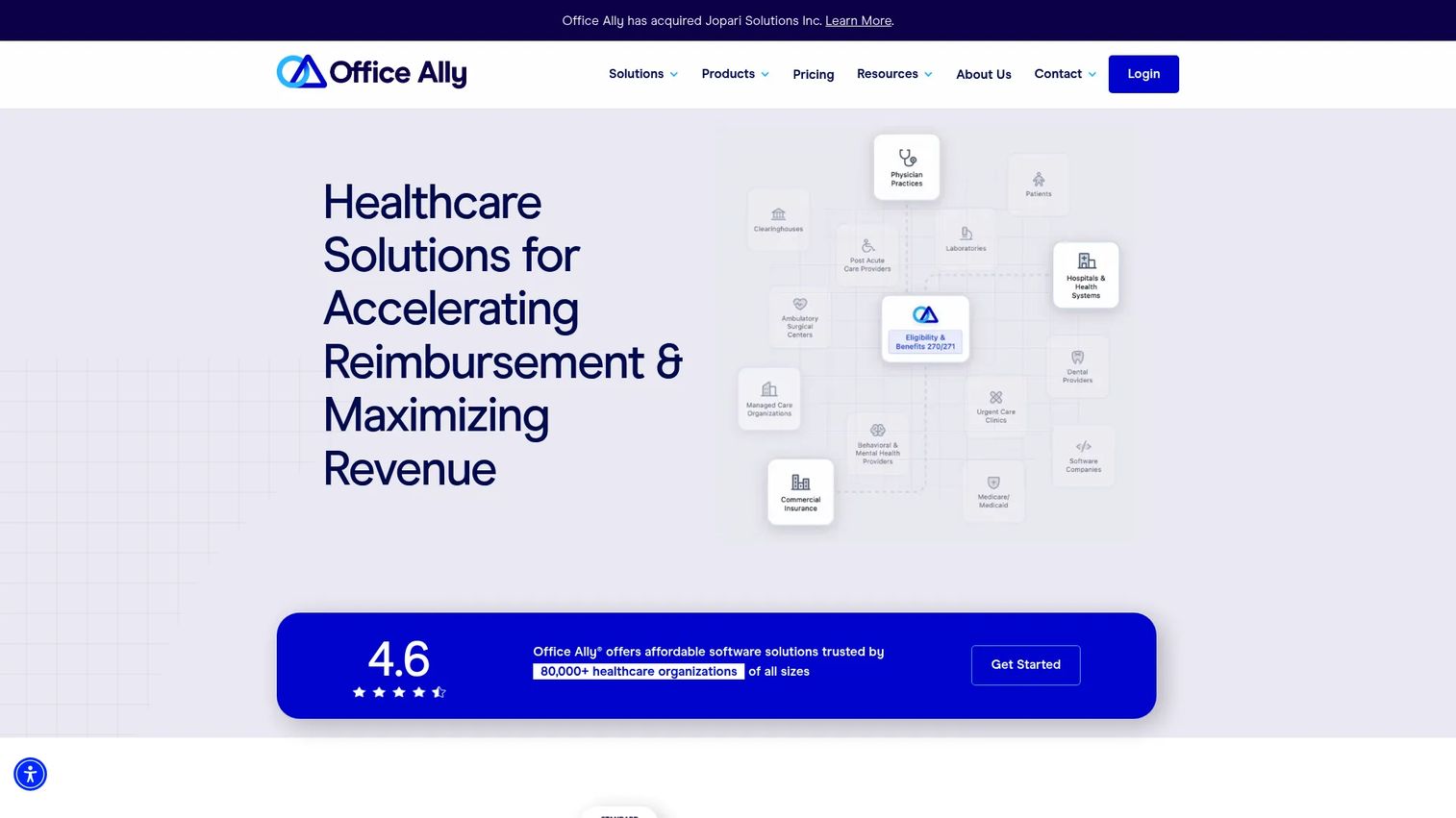
Office Ally is one of the most widely used clearinghouses among smaller and mid-size billing teams, largely because of its accessibility and broad payer reach. It bundles claims submission and status tracking, eligibility and benefits verification, and practice management and EHR tools into a low-cost package that lowers the barrier to electronic claims.
That price point and payer breadth are exactly why Office Ally shows up on almost every clearinghouse comparison list. A small practice can start with Practice Mate at no cost and layer on claims workflows as volume grows. The EDI clearinghouse itself uses customized pricing, but the entry path is unusually low for a medical clearinghouse software provider.
Key strengths
- Claims submission and status tracking
- Eligibility and benefits verification
- Practice management and EHR tools
Why choose Office Ally: It fits practices that want a low-cost entry into electronic claims with broad payer connectivity, without committing to an enterprise contract.
Office Ally pricing: Practice Mate is $0 per provider, EHR 24/7 is $44.95 per month per provider, and the EDI Clearinghouse uses customized pricing. G2 rating is 4.4/5.
4. Waystar

Waystar is a healthcare payments and revenue cycle management platform that folds clearinghouse function into a broader unified system. Its claim management runs on one database, covering claim submission, monitoring, and the payer connectivity that keeps claims moving, alongside price transparency and patient financial experience tools.
Waystar fits teams that want more than a standalone clearinghouse. If you are consolidating revenue cycle workflows and want claims, monitoring, and patient payments in one platform, the single-database architecture reduces the seams between steps. Larger provider organizations and health systems tend to be its natural buyers.
Key strengths
- Unified revenue cycle platform on one database
- Claim management and claim monitoring
- Price transparency and patient financial experience tools
Why choose Waystar: It suits organizations that want clearinghouse function inside a broader revenue cycle platform rather than a point solution.
Waystar pricing: The packages page lists Starter, Core, Performance, and Premium tiers under Claim Management, with request-pricing rather than public numbers. G2 rating is 4.4/5.
5. PracticeSuite
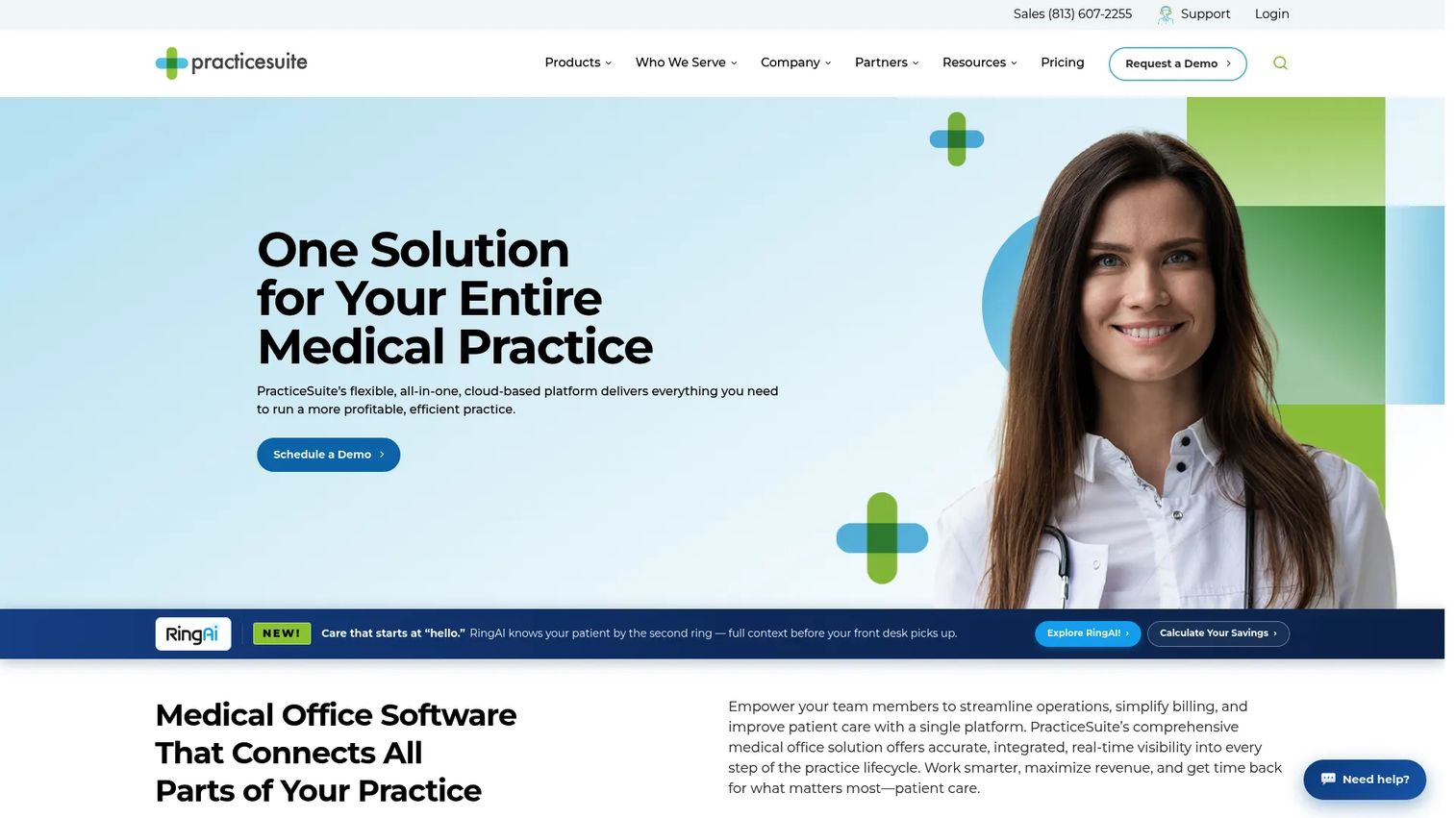
PracticeSuite is a cloud-based practice management, billing, EHR, and patient engagement platform with a strong claims workflow underneath. This is the most concrete, workflow-driven option on the list: it covers claims submission, eligibility verification, ERA auto-posting, denial worklists, and electronic secondary claims across a wide payer network.
That end-to-end coverage is what billing teams want to see spelled out. Claims go out scrubbed, eligibility is checked in real time, remittances post automatically, denials land in a worklist with reason codes, and secondary claims route without a manual resubmission. For a billing team that lives inside these workflows daily, PracticeSuite maps closely to the actual job.
Key strengths
- Medical billing and revenue cycle management
- Scheduling and practice management
- EHR/EMR and patient engagement tools
Why choose PracticeSuite: It fits billing teams that want a customizable, cloud-based platform where claims, eligibility, ERA, denials, and secondary claims live in one place.
PracticeSuite pricing: Pricing is customized and modular, quoted per organization rather than published as a single starting price. G2 rating is 4.3/5.
6. AdvancedMD
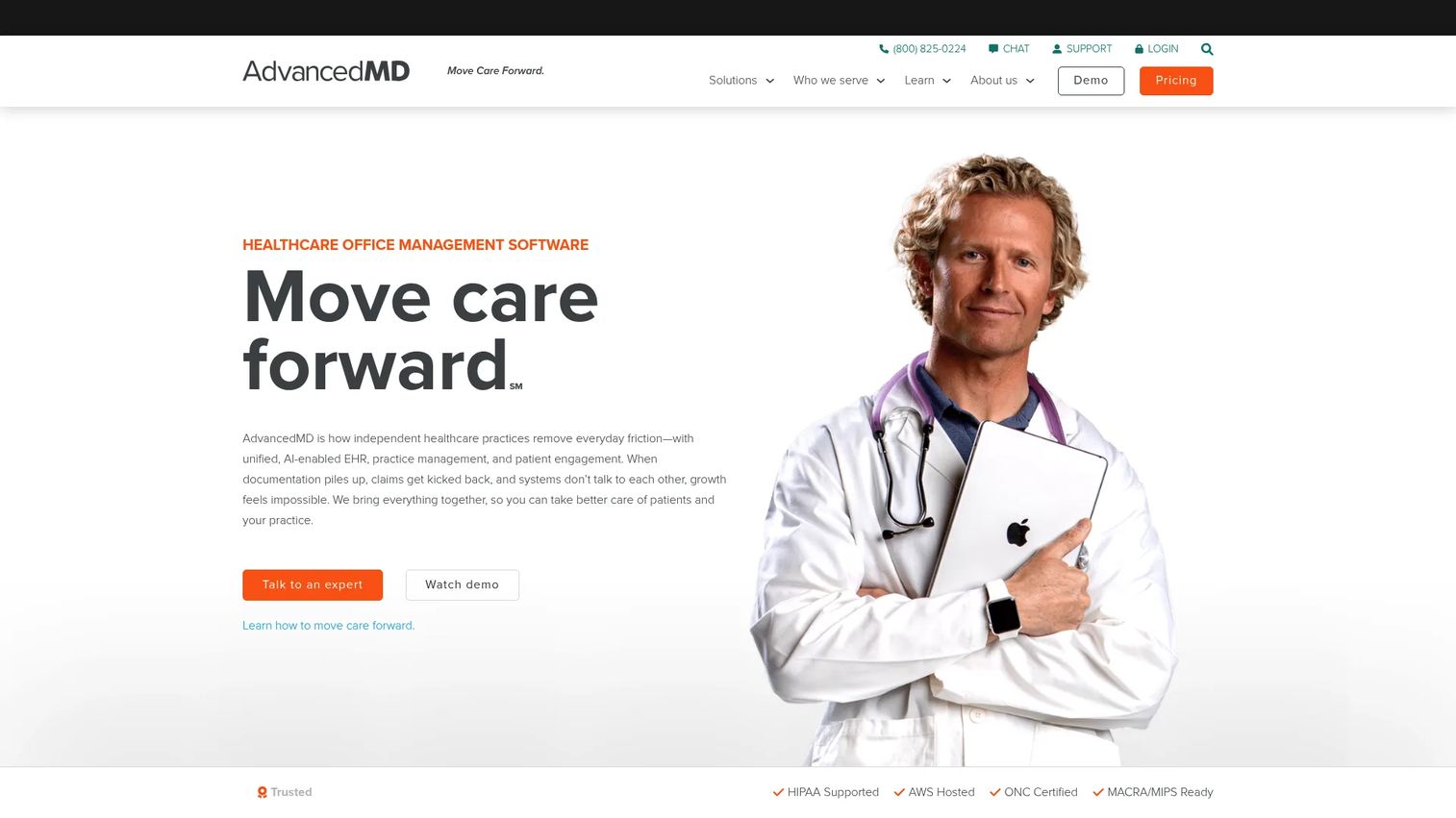
AdvancedMD is a cloud-based practice management, EHR, patient engagement, and billing platform for independent healthcare practices, with clearinghouse function embedded in the billing workflow. Claims scrubbing, eligibility verification, and ERA processing run inside the same stack that handles charting and scheduling.
Embedded clearinghouse function matters when your team already lives in one system. Claims scrub against payer edits before they leave, eligibility checks happen at the point of scheduling, and remittances flow back into the same ledger. For a practice already committed to the AdvancedMD ecosystem, keeping claims routing inside the platform removes handoffs between separate tools.
Key strengths
- EHR and charting
- Practice management and scheduling
- Patient engagement tools
Why choose AdvancedMD: It gets the most value for independent practices that want scrubbing and claims workflows embedded inside a full EHR and billing suite.
AdvancedMD pricing: Pricing varies by specialty and provider count, starting around $130 per month per provider for small mental health practices and scaling to $429 to $1,070 per month per provider for medical specialties. RCM services run 4 to 8% of collections. G2 rating is 3.6/5.
7. Availity

Availity is a healthcare information network and workflow platform connecting providers, payers, and technology partners. Its value sits in payer network reach: eligibility and coverage verification, claims submission and status, and prior authorizations flow across a large connected network of payers.
For claims routing, Availity's network effects are the draw. Many payers use Availity as their front door, which means providers get direct, reliable access to eligibility and authorization workflows. Teams that spend significant time on coverage checks and prior authorizations often find the network access alone justifies the platform.
Key strengths
- Eligibility and coverage verification
- Claims submission and claim status
- Prior authorizations and payer connectivity
Why choose Availity: It fits providers and payer-facing teams that need networked eligibility, claims, and authorization workflows across a large payer network.
Availity pricing: Essentials is free, and Essentials Plus carries early-adopter pricing of $25 per month, including unlimited transactions with sponsored payers plus 250 non-sponsored transactions.
8. Claim.MD
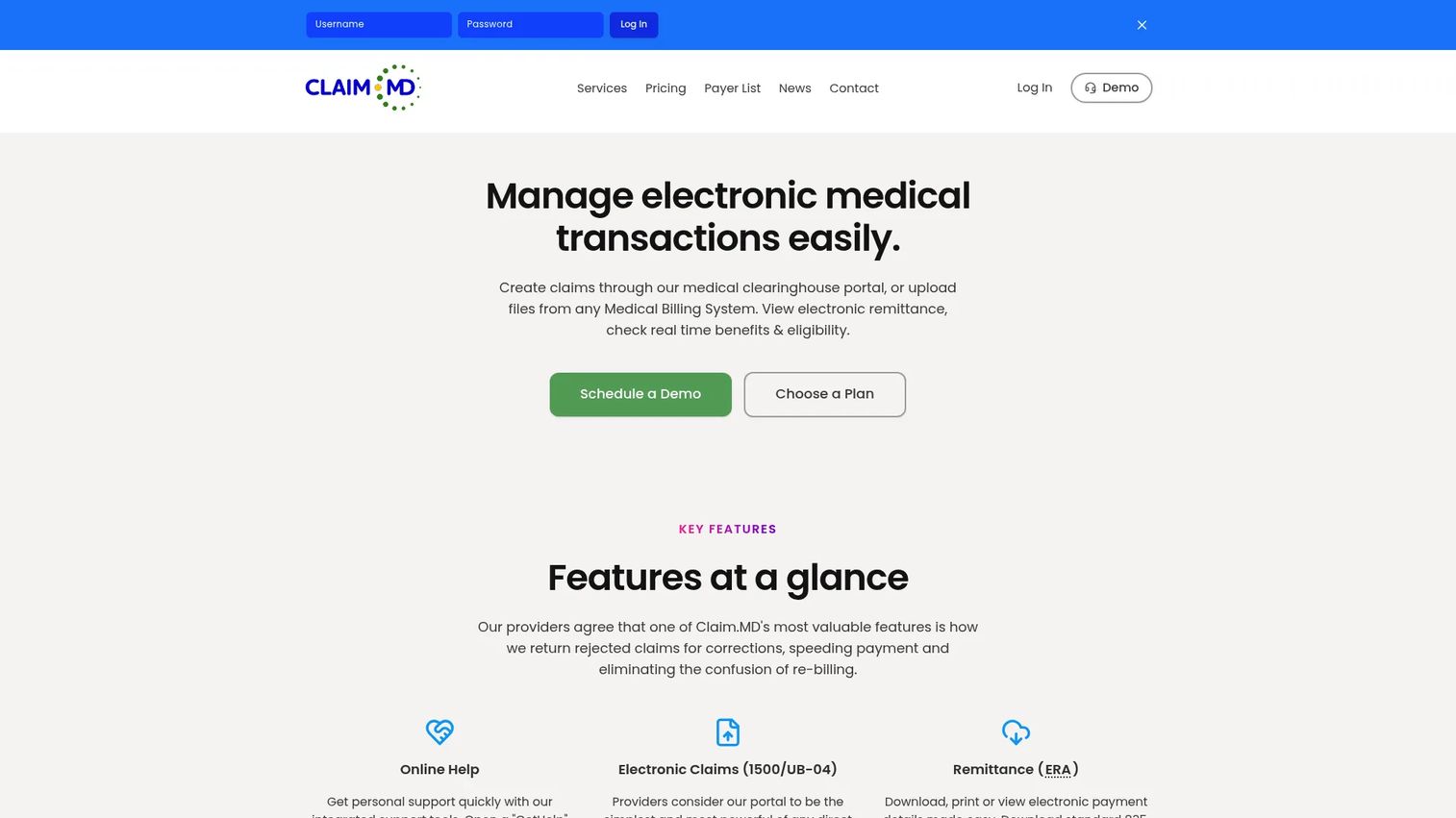
Claim.MD is a healthcare claims clearinghouse built for providers, software vendors, and payers, with an emphasis on simplicity and transparent pricing. It handles claim submission, status tracking, and corrections, and its top plan includes unlimited claims, ERA, and eligibility.
Claim.MD fits independent billing teams and smaller organizations that want a straightforward clearinghouse without an enterprise contract. The public monthly tiers make budgeting easy, and the workflow stays focused on the core job: get claims out, track them, correct rejections, and pull remittances back. For a billing service or small practice, that clarity is the selling point.
Key strengths
- Unlimited claims, ERA, and eligibility on the top plan
- Claim submission, status tracking, and corrections
- Provider, software vendor, and payer services
Why choose Claim.MD: It suits independent billers and smaller organizations that want a focused clearinghouse with transparent monthly billing.
Claim.MD pricing: Three public monthly plans: Basic at $30, Small Volume at $60, and Unlimited at $120 per month.
9. Tebra
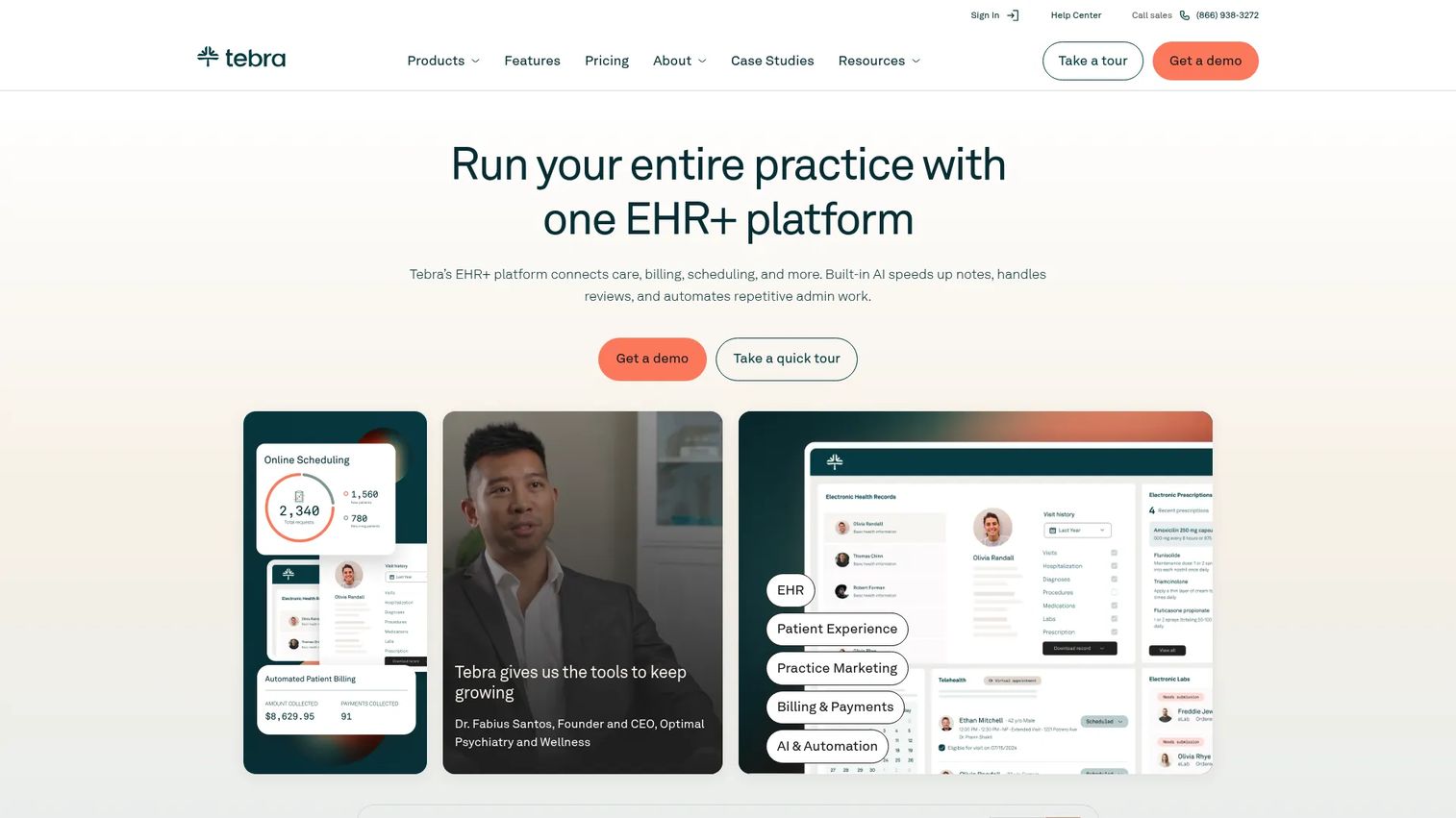
Tebra is practice management software for independent medical practices, combining EHR, billing, telehealth, scheduling, patient engagement, and marketing. Claims handling lives inside a broader practice operations stack rather than as a standalone clearinghouse.
Tebra works best as part of a full practice management platform. If an independent practice wants billing, charting, scheduling, and patient engagement in one place, claims flow naturally through that stack. AI-powered charting, electronic prescriptions, and online scheduling round out the daily workflow, so the clearinghouse function is one piece of a larger operational picture rather than the headline.
Key strengths
- AI-powered charting
- Electronic prescriptions
- Online scheduling
Why choose Tebra: It fits independent practices that want an all-in-one EHR, billing, and patient engagement platform with claims handling built in.
Tebra pricing: Pricing is per provider, per month, and varies by provider type and volume. Practice Essentials bundles start around $225 per month for therapists and $599 per month for physicians, with single-solution starter plans from $49 per month. G2 rating is 4.1/5.
10. CollaborateMD
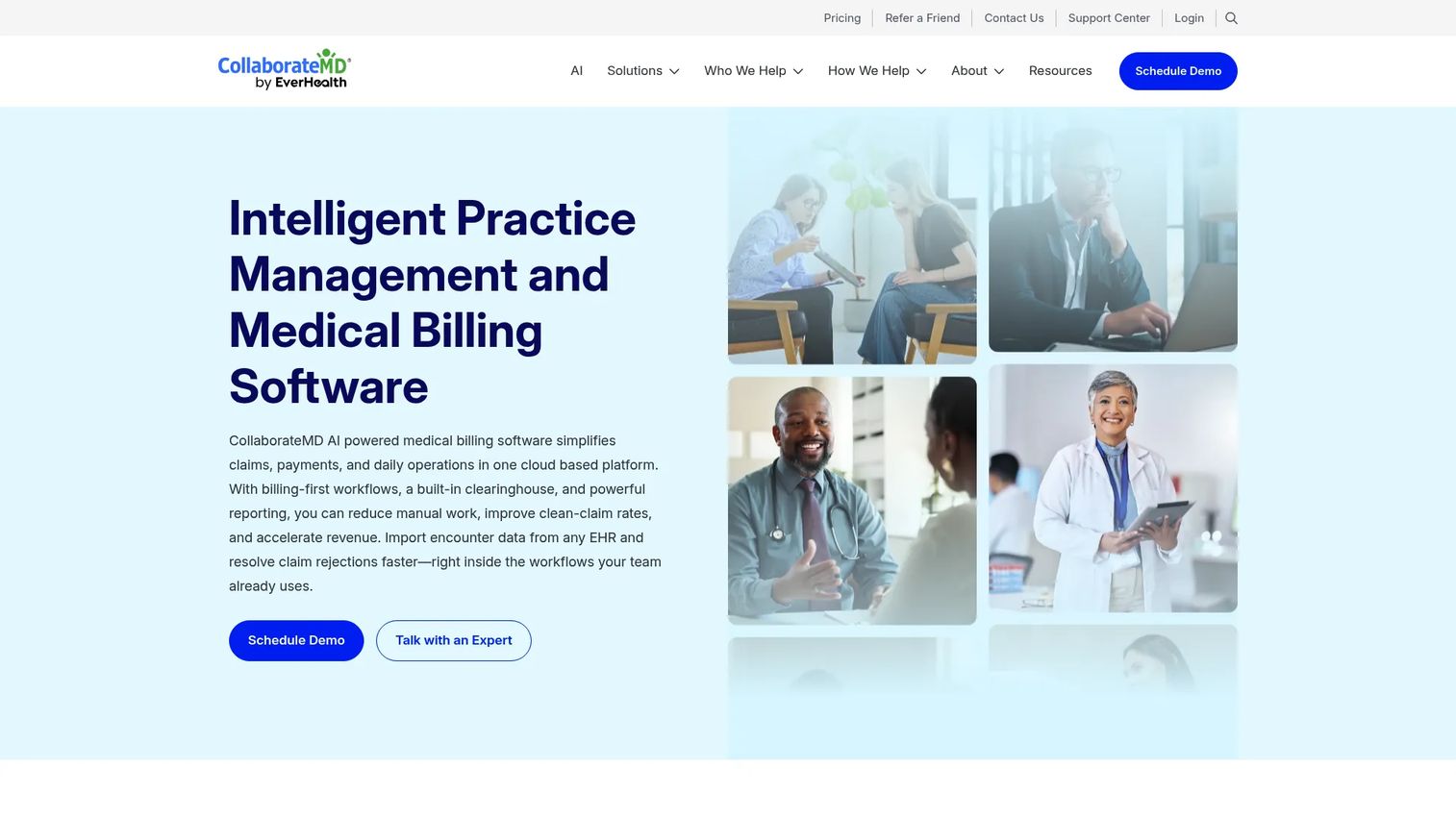
CollaborateMD is cloud-based medical billing and practice management software focused on billing workflow efficiency. It offers unlimited eClaims with real-time submission, claim scrubbing, real-time eligibility, appointment scheduling, a patient payment portal, and reporting.
CollaborateMD suits medical practices and billing teams that want cloud-based claims, scheduling, and payments in one workflow. The unlimited eClaims model with built-in scrubbing keeps submission volume predictable, and real-time eligibility catches coverage issues before they become denials. Practices and billing services that want a clean, cloud-native billing operation should put it on the shortlist.
Key strengths
- Unlimited eClaims with real-time submission
- Claim scrubbing and real-time eligibility
- Appointment scheduling, patient payment portal, and reporting
Why choose CollaborateMD: It fits practices and billing teams that want efficient cloud billing with unlimited claims and integrated scrubbing.
CollaborateMD pricing: Public plan names are Starter, Basic, Growth, Unlimited, and a Medical Billing Package, with request-pricing rather than public numbers for core plans. G2 rating is 4.4/5.
Considerations
Choosing a clearinghouse is really about matching workflow depth to your billing reality. Here is what to verify before you sign.
Payer reach and network coverage
Confirm the clearinghouse connects to every payer you bill, including your regional Medicaid plans and any workers' comp or specialty payers. Ask for the actual payer list, not a headline count. A gap in coverage means you fall back to manual submission for those payers, which erodes the value of the platform.
Claims scrubbing and edit controls
Ask how scrubbing edits are maintained and updated as payer rules change. The best medical claims clearinghouse tools update edits continuously and let you add custom rules for your specialty. Verify your clean-claim rate expectations against what the vendor's edits actually catch.
ERA and payment posting workflow
Check how ERA posting flows back into your ledger and whether posting is truly automatic or semi-manual. Auto-posting saves hours weekly, but only if it maps remittances to the right claims cleanly. Confirm it handles adjustments, denials, and partial payments without manual cleanup.
Denials and secondary claims handling
Look at how denials surface. A worklist with reason codes and clear next steps beats a raw rejection report. Confirm secondary claims route automatically after primary adjudication, since manual secondary submission is a common hidden time sink.
Integration and reporting depth
Verify the clearinghouse integrates with your existing practice management or EHR system without heavy custom work. Then check the reporting: you want visibility into clean-claim rate, days-in-A/R, denial rate by payer, and rework volume. Without that instrumentation, you cannot prove the platform is moving your numbers.
Conclusion
The best claims clearinghouse software is the one that matches your billing volume and workflow depth, not the one with the longest feature list. For large revenue cycle operations, TriZetto and Waystar bring enterprise payer connectivity and unified platforms. For claims management depth, ClaimSource and PracticeSuite give billing teams the edits, tracking, ERA, and secondary claims routing that move cash faster.
Smaller organizations and independent billers have strong options too. Office Ally and Claim.MD offer accessible, transparent entry points, while AdvancedMD, Tebra, and CollaborateMD embed clearinghouse function inside broader practice management stacks. Availity stands out when payer network access and authorizations are your bottleneck.
Anchor your decision on three factors: payer connectivity that covers every payer you bill, workflow automation across scrubbing, ERA, and denials, and operational fit with your existing systems. Your next step: pull the actual payer list and run a scrubbing test against a sample batch of your own claims before you commit. That test tells you more than any demo.
FAQs
It validates, formats, and routes healthcare claims between provider billing systems and payers, then returns responses like acceptances, rejections, and remittances. Along the way it scrubs claims against payer rules, checks eligibility, posts ERAs, and helps manage denials and secondary claims. The goal is faster reimbursement with fewer manual touches.
A clearinghouse gives you one connection that routes claims to hundreds of payers with unified scrubbing and tracking. Direct payer submission means connecting to and formatting claims for each payer individually. For most provider organizations, a clearinghouse removes the maintenance burden of managing dozens of separate payer connections.
Payer connectivity, claims scrubbing, eligibility verification, ERA posting, denial management, and secondary claims routing. Payer reach determines coverage, scrubbing determines your clean-claim rate, and ERA and denial workflows determine how much manual work stays in your day. Weigh these against your actual billing volume.
Office Ally and Claim.MD are common picks for small practices because of low-cost, accessible entry points and broad payer reach. Office Ally lets you start with free practice management and add claims workflows, while Claim.MD offers transparent monthly tiers starting at $30. Tebra and CollaborateMD also fit small practices wanting billing inside a broader platform.
Denial management surfaces rejected claims in a worklist with reason codes, so staff work them instead of hunting through reports. ERA posting pulls electronic remittance back automatically and posts payments to the correct claims, including adjustments and partial payments. Together they cut the two most repetitive tasks in the billing day.
Ask for the actual payer list and confirm coverage for every payer you bill, including regional Medicaid and specialty payers. Verify reliability and how quickly new payer connections are added. A gap in coverage forces manual submission for those payers, which undercuts the value of the whole platform.
Not always. Some clearinghouses are focused on claims routing, while platforms like Waystar, PracticeSuite, and AdvancedMD bundle clearinghouse function into full revenue cycle management. If you want claims, ERA, denials, and reporting in one system, choose a platform. If you already have strong RCM tooling, a focused clearinghouse may be enough.
Map your billing workflow end to end: claim creation, scrubbing, submission, eligibility, ERA posting, denials, and secondary claims. Then test each vendor against those steps with a sample batch of your own claims. Compare clean-claim rate, auto-posting accuracy, and how denials surface, since those numbers tell you more than any feature list.