


A request lands in a shared inbox on a Friday afternoon. Someone wants a copy of every piece of personal data you hold on them. The clock starts now. GDPR gives you one month. CCPA/CPRA gives you 45 days.
Then the real work begins. That person's data lives in your CRM, your support tool, three separate databases, a marketing platform, Slack history, and an S3 bucket nobody has touched since 2023. You have to find all of it, confirm the requester is who they say they are, review what you pull, redact anyone else's data caught in the same records, and package it into a response you can defend later.
Most privacy teams handle the first few requests by hand. Then volume climbs. The Cognitive Market Research report from 2025 valued the global DSAR software market at $1.504 billion, with North America accounting for 37% of it, and projected 12.32% annual growth through 2033. That growth tracks one thing: manual DSAR handling stops scaling fast.
This guide breaks down seven data subject request software platforms built to run that workflow end to end. Not just search and export. Intake, identity verification, discovery, review, redaction, secure delivery, and the audit trail that proves you did it right.
What's inside
This guide is for privacy managers, legal ops, compliance leads, and SaaS founders overseeing privacy operations who need to compare vendors and validate workflow fit before buying.
We chose these seven dsar tools against four criteria that separate real DSAR management software from a glorified ticket queue:
- Workflow coverage: intake through secure delivery, not just one step
- Automation depth: how much of discovery, verification, and redaction runs without manual effort
- Auditability: whether every action lands in a defensible log
- Integration coverage: how many of your actual data sources the tool can reach
Pricing and ratings reflect verified vendor and G2 sources as of the date of writing.
TL;DR
Short on time? Here is how the shortlist breaks down.
- Best for regulated enterprise governance: OneTrust Privacy Automation and TrustArc, both built for large privacy programs with deep compliance workflows.
- Best for all-in-one privacy operations: Osano and DataGrail combine DSAR handling with consent, data mapping, and vendor risk.
- Best for AI-driven discovery: Securiti maps and classifies data across sprawling environments before a request ever arrives.
- Best for communications data: Mimecast excels at finding personal data buried in email, Slack, and Teams.
- Best for consent-plus-rights orchestration: Ketch pairs data subject request management with consent across systems, and it publishes a free tier.
What is data subject request software?
Data subject request software is a privacy operations tool that automates how organizations intake, verify, fulfill, and document requests from individuals exercising their data rights under laws like GDPR, UK GDPR, and CCPA/CPRA.
A data subject access request (DSAR) is the most common type, but the same category of dsar management software also handles deletion requests, right to be forgotten requests, correction, and opt-out. The point of the software is to turn a chaotic manual scramble into a repeatable, timed, auditable process.
Core capabilities you should expect from any serious platform:
- Request intake: branded web forms or portals that log every request with a timestamp
- Identity verification: confirming the requester is the actual data subject before releasing anything
- Data discovery: locating personal data across connected systems, databases, and files
- Review and redaction: flagging third-party data and sensitive fields, then masking or removing them
- Secure response delivery: encrypted packaging so the response does not leak on the way out
- Audit trail creation: a defensible log of who did what, when, and why
- Deadline tracking: countdown timers mapped to each jurisdiction's statutory window
Strong data subject request management ties all of these together so nothing falls through a gap between tools.
When to use data subject request software
Centralize requests across fragmented systems
Personal data does not sit in one place. It sits in your CRM, your billing system, your support desk, your data warehouse, and a dozen SaaS tools your teams adopted without telling IT. When a request arrives, someone has to find every copy. DSAR software connects to those systems and runs discovery automatically, so you are not emailing five department heads asking them to grep their own databases. That is where dsar automation earns its keep.
Meet legal response timelines without manual chaos
GDPR sets a one-month clock. CCPA/CPRA sets 45 days. Miss those windows and you expose the company to complaints, fines, and regulator scrutiny. Software tracks each deadline, assigns tasks, and escalates when a request stalls. Instead of a spreadsheet nobody updates, you get a queue with countdown timers and clear ownership.
Handle deletion and right to be forgotten requests defensibly
Deletion is harder than access. You have to erase data across systems while preserving what you are legally required to retain, like tax records or fraud logs. Right to be forgotten requests need proof that deletion actually happened and that retention obligations were respected. Good software orchestrates the deletion, records the outcome, and keeps an audit trail you can hand a regulator.
Comparison table
Seven platforms, ordered by relevance to teams searching for dsar software. Pricing across this category is mostly quote-based, so treat the pricing column as a guide to model rather than exact cost. G2 ratings come from each vendor's current listing.
| # | Product | Best for | Key differentiator | Pricing | G2 rating |
|---|---|---|---|---|---|
| 1 | Mimecast | Finding personal data in communications | AI search across email, Slack, and Teams | Contact sales | 4.3/5 |
| 2 | Osano | All-in-one privacy compliance | Subject rights plus consent and data mapping | Free tier, then custom | 4.5/5 |
| 3 | OneTrust Privacy Automation | Enterprise privacy governance | Broad privacy operations suite | Contact sales | 4.4/5 |
| 4 | TrustArc | Enterprise compliance automation | DSR automation with privacy governance | By inquiry | 4.2/5 |
| 5 | DataGrail | Privacy automation with live data mapping | Live Data Map plus Request Manager | Custom | 4.7/5 |
| 6 | Securiti | AI-driven discovery and classification | Agentic data intelligence across environments | Custom quote | 4.7/5 |
| 7 | Ketch | Consent-plus-rights orchestration | Consent and DSR in one platform | Free, Plus from $499/mo | 4.6/5 |
Best 7 data subject request software tools for 2026
1. Mimecast
Mimecast approaches DSARs from the angle most teams underestimate: communications data. When someone requests every record you hold, the hardest data to locate is usually buried in email threads, Slack channels, and Teams messages. Mimecast is a cloud-based human risk management and email security platform, and it applies AI search and filtering to surface personal data across exactly those systems.
Best for: mid-market to enterprise organizations that hold significant personal data inside email and collaboration tools.
Key strengths
- Advanced email security across the whole message stream
- Incydr data protection for insider risk
- Security awareness training built into the platform
- AI search that surfaces personal data across communications
- Coverage for GDPR, CCPA/CPRA, and PIPEDA response pressure
Why choose Mimecast: If most of your risk sits in unstructured communications data, Mimecast reaches where structured DSAR tools struggle. It fits teams that already treat email as a primary system of record and want discovery, security, and training under one roof.
Mimecast pricing: Mimecast lists multiple plans across threat protection, insider risk management, and security behavior management, including Critical, Advanced, Premium, Professional, Enterprise, and Core tiers. Pricing is contact-sales across all plans, so you request a quote based on scope.
2. Osano
Osano is a data privacy management platform that covers consent, DSARs, data mapping, assessments, and vendor risk in one place. For DSARs specifically, it focuses on operational simplicity: one-click intake, secure messaging with the requester, and reporting that holds up under audit. If you want subject rights handled inside a broader privacy program rather than as a standalone tool, Osano fits.
Best for: teams that want an all-in-one privacy compliance platform rather than a point solution.
Key strengths
- Cookie consent management out of the box
- Subject rights management with secure messaging
- Data mapping to track where personal data lives
- Vendor risk monitoring alongside DSAR handling
- Reporting built for audit defensibility
Why choose Osano: Osano suits privacy leads who want fewer tools and a single source of truth. The trade-off is breadth over depth in any one area, which works well for teams building a program from scratch rather than optimizing an existing one.
Osano pricing: Osano offers a free cookie consent tier, self-service paid plans, and custom enterprise pricing. Public numeric pricing is not published, so paid and enterprise tiers require a conversation with their team.
3. OneTrust Privacy Automation
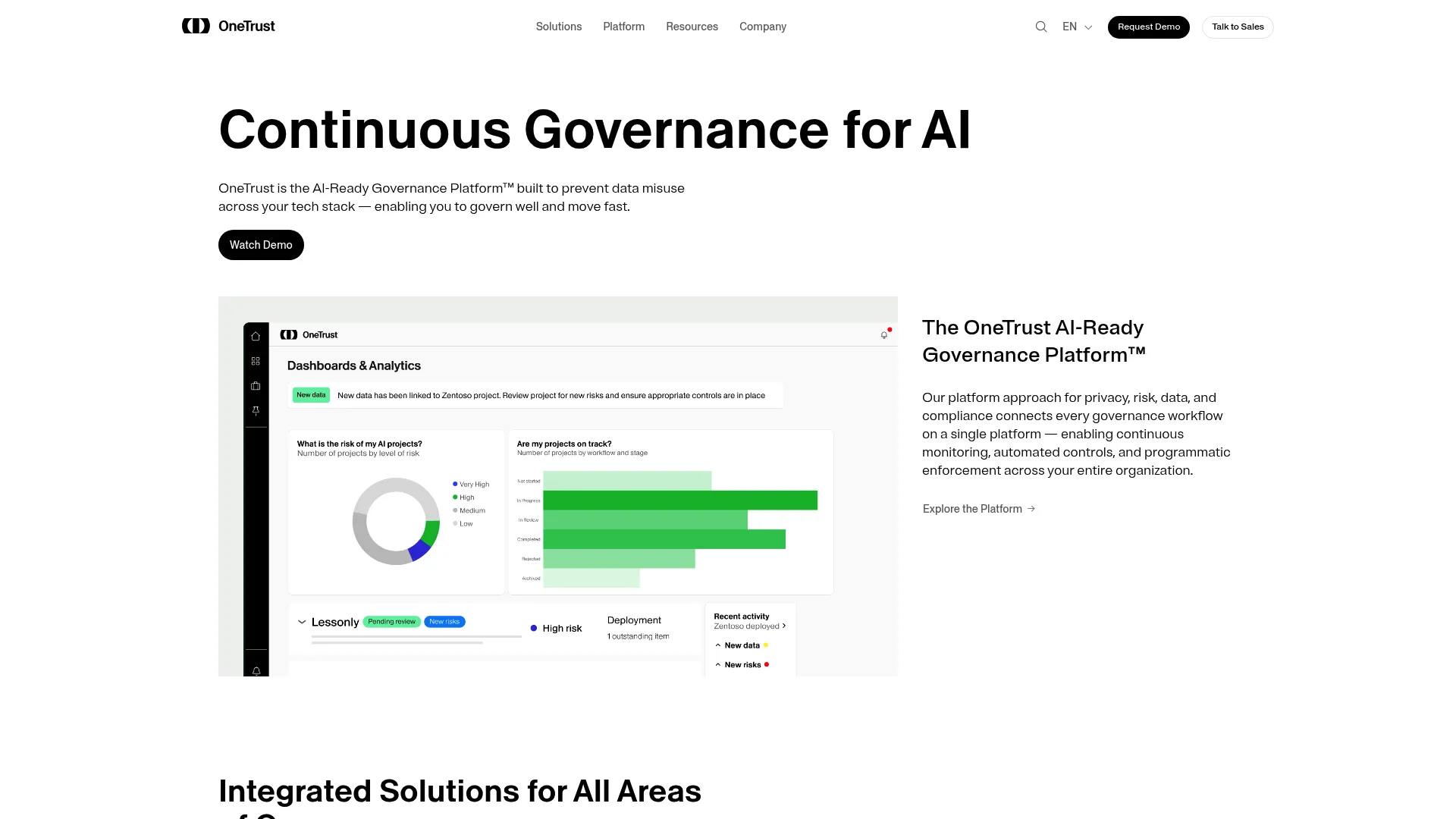
OneTrust Privacy Automation is privacy operations software built to automate compliance workflows and risk management at enterprise scale. It handles automated data and activity mapping, privacy impact assessments, DSR fulfillment, incident management, and vendor privacy risk. For large organizations running a mature privacy program, OneTrust is often the reference platform other tools get measured against.
Best for: enterprises that need to automate privacy operations across many jurisdictions and business units.
Key strengths
- Automated data and activity mapping across the org
- Privacy impact assessment and mitigation workflows
- DSR fulfillment with deadline tracking
- Incident and breach management
- Vendor privacy risk management
Why choose OneTrust Privacy Automation: OneTrust makes sense when your privacy program spans regions, entities, and regulations, and you need one governance layer over all of it. The depth that serves large teams can feel heavy for a lean startup, so the fit tracks with program maturity.
OneTrust Privacy Automation pricing: OneTrust lists Privacy Automation in Base and Suite editions, priced by number of users and privacy asset inventory. Public prices are not shown, so you request pricing based on your scope.
4. TrustArc
TrustArc is enterprise privacy management software covering consent, DSRs, privacy governance, and trust and compliance workflows. Its individual rights automation handles the DSAR lifecycle from intake through fulfillment, wrapped in the broader governance tooling large organizations need. TrustArc leans into the compliance and audit side, which matters when you have to prove process to regulators.
Best for: large organizations that need enterprise privacy compliance automation with strong governance.
Key strengths
- Cookie consent management
- Consent and preference management across channels
- Individual rights (DSR) automation
- Privacy governance workflows
- Audit trails built for regulator scrutiny
Why choose TrustArc: TrustArc fits teams that treat privacy as an ongoing governance discipline, not just a request queue. It rewards organizations willing to invest in configuration up front in exchange for defensible, repeatable process.
TrustArc pricing: TrustArc makes pricing available by inquiry only, with no public prices published. You engage their team to scope a plan against your requirements.
5. DataGrail
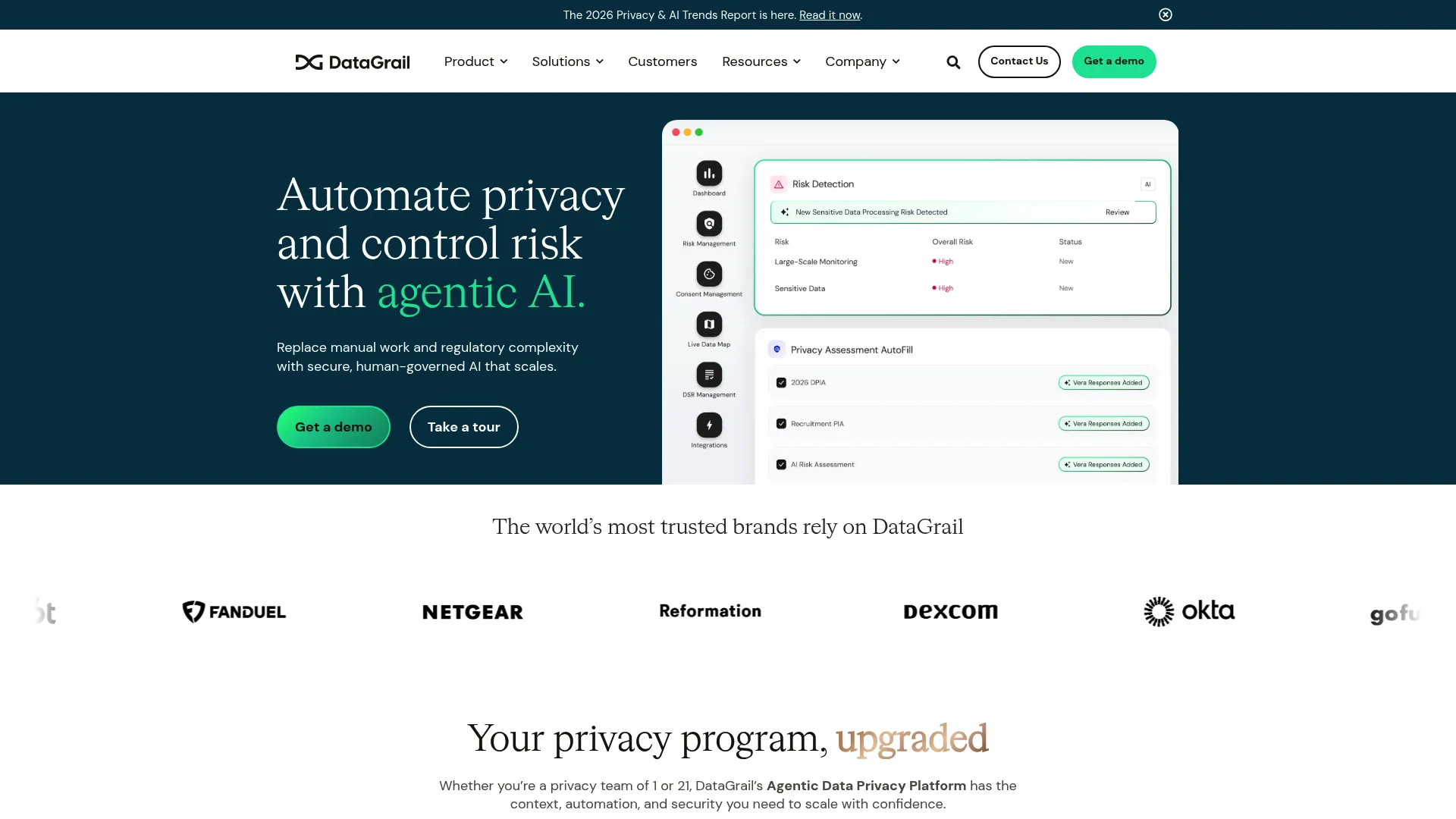
DataGrail is an agentic data privacy platform for managing discovery, DSARs, consent, and privacy assessments. Its Live Data Map keeps an up-to-date picture of where personal data lives, and its Request Manager runs the DSAR workflow against that map. The combination means discovery is not a one-time scan but a continuously refreshed view, which cuts the manual chase when a request arrives.
Best for: enterprises that need privacy automation tying data discovery directly to DSAR fulfillment.
Key strengths
- Live Data Map for continuous data discovery
- Request Manager for the full DSAR lifecycle
- Consent management across systems
- Broad integration coverage into SaaS tools
- Self-service Privacy Control Center
Why choose DataGrail: DataGrail suits teams whose main pain is finding data fast across a sprawling SaaS stack. If discovery is your bottleneck, the Live Data Map is the differentiator worth evaluating closely.
DataGrail pricing: DataGrail describes pricing as available for all company sizes, with a self-service Privacy Control Center and à la carte options. No public numeric pricing is shown, so scope-based quotes apply.
6. Securiti
Securiti is an AI-powered data security, privacy, governance, and compliance platform. It leads with data discovery and sensitive data intelligence, then layers DSR automation on top. Because it classifies data across structured and unstructured environments first, DSAR fulfillment inherits an accurate map rather than starting from scratch. Securiti also extends into AI security and data governance, which matters as more personal data flows through AI systems.
Best for: enterprises that want a unified platform for data privacy, security, governance, and AI controls.
Key strengths
- Data discovery and sensitive data intelligence
- Data privacy operations with DSR automation
- AI security and LLM firewalls
- Data governance across environments
- Classification that feeds accurate DSAR discovery
Why choose Securiti: Securiti fits organizations that see privacy, security, and AI governance as one problem rather than three tools. The breadth rewards teams consolidating their data controls onto a single platform.
Securiti pricing: Securiti uses personalized pricing, with modules procured based on the use cases you need. No public price is displayed, so you request a quote tailored to your environment.
7. Ketch
Ketch is privacy management software for consent, data rights, data mapping, and AI governance. It pairs DSR automation with consent orchestration, so opt-out signals and rights requests flow through one system rather than two disconnected ones. For teams that treat consent and subject rights as the same operational surface, Ketch keeps them together and publishes real pricing, which is rare in this category.
Best for: enterprises that need privacy compliance and consent orchestration across systems.
Key strengths
- Consent management across web and app
- DSR automation for access and deletion
- Data mapping and discovery
- AI governance controls
- Published pricing with a free entry tier
Why choose Ketch: Ketch fits teams that want consent and data rights orchestrated together, plus the budgeting clarity of a public price. The free tier lets smaller teams start without a sales cycle, which suits earlier-stage companies.
Ketch pricing: Ketch publishes a Free plan at $0 per month and a Plus plan from $499 per month, billed annually. An Enterprise tier is listed without a public price, so larger deployments get a custom quote.
Considerations
Before you commit, pressure-test any dsar management software against the criteria that actually determine whether it survives a real request under deadline.
Data source coverage
The tool is only as good as the systems it can reach. Map your actual data landscape first: CRM, support desk, data warehouse, billing, marketing platform, and every SaaS tool holding personal data. Then confirm the vendor has native connectors, not just an API you have to build against. A DSAR tool that misses a data source is a compliance gap wearing a nice dashboard.
Audit trails and defensibility
If you cannot prove what you did, you did not do it, at least not in a regulator's eyes. Check that the platform logs every action with a timestamp and actor: intake, identity verification, discovery, redaction, and delivery. Audit trails are what turn a stressful inspection into a five-minute export.
Identity verification and intake controls
Releasing someone's personal data to the wrong person is a breach. Evaluate how the tool verifies identity before fulfillment and how intake forms capture requests cleanly. Weak verification is the fastest way to turn a compliance tool into a liability.
Redaction and secure response delivery
Access requests routinely surface third-party data caught in the same records. Confirm the platform can redact that data reliably and package the final response with encryption. Secure response delivery matters as much as the discovery that precedes it.
Implementation effort and governance
Every platform here rewards up-front configuration. Be honest about the internal ownership required, who administers the tool, who reviews requests, and how it fits your existing privacy operations. The best tool is the one your team will actually run, not the one with the longest feature list.
Conclusion
The right pick depends on where your workflow breaks today.
If your privacy program spans regions and business units, OneTrust Privacy Automation and TrustArc give you the governance depth enterprise scale demands. If you want subject rights handled inside a broader program, Osano and DataGrail combine DSAR handling with consent and data mapping. If discovery is your bottleneck, Securiti and DataGrail lead with classification and live data mapping that make fulfillment faster. If most of your personal data lives in email and chat, Mimecast reaches communications data other tools miss. And if you want consent and rights orchestrated together with public pricing, Ketch is the clearest starting point.
Whichever you choose, the goal is the same: less manual review time, stronger defensibility, and dsar automation that fits your existing privacy operations instead of fighting them. Start by mapping your real data sources and your typical request volume, then shortlist the two tools that cover both without gaps. Book demos, run a real request through each, and pick the one your team can operate under deadline.
FAQs
A DSAR, or data subject access request, is when a person asks a company for a copy of all the personal data it holds about them. Under GDPR you generally have one month to respond, and under CCPA/CPRA you have 45 days. The company must locate the data, confirm the requester's identity, and deliver a response securely.
Any individual whose personal data a company processes can submit one, often called the data subject. Under GDPR that includes customers, employees, prospects, and website visitors in the applicable jurisdiction. Authorized agents can also submit requests on someone's behalf, which is why identity verification matters so much.
The software tracks each request's statutory deadline with a countdown mapped to the relevant law, so nothing slips past the one-month GDPR window or the 45-day CCPA/CPRA window. It assigns tasks, escalates stalled requests, and keeps audit trails that prove you responded in time. That turns deadline management from a spreadsheet gamble into a governed process.
Yes. Most platforms in this category orchestrate deletion across connected systems while preserving data you are legally required to retain. For right to be forgotten requests, the software records that deletion actually happened and logs the retention decisions, giving you a defensible trail for regulators.
At minimum, a timestamp and actor for every step: intake, identity verification, data discovery, review, redaction, secure response delivery, and closure. It should also capture any retention decisions and communications with the requester. The point is to reconstruct exactly what happened if a regulator ever asks.
Start with your actual data sources and confirm the tool has native connectors for each one. Then weigh automation depth, audit trail quality, identity verification, and redaction against your request volume. For a lean team, a tool with strong integrations and clear pricing usually beats a heavier enterprise suite you will not fully use.
No. The software automates intake, discovery, redaction, delivery, and audit trails, but a human still makes the judgment calls on edge cases, exemptions, and retention obligations. Think of it as removing the manual grind so your legal and privacy team can focus on the decisions that actually need human judgment.
Prioritize the systems holding the most personal data and the highest risk: your CRM, support desk, billing system, marketing platform, and data warehouse. Then add communications tools like email and chat, where personal data hides in unstructured records. Coverage of these first materially reduces the manual effort on every request.