A car used to ship complete. You bought it, you drove it, and the feature set you got on day one was the feature set you kept until you traded it in. That model is gone. Today the vehicle is a rolling compute platform, and connected car software is the layer that keeps improving it long after it leaves the lot.
That shift is why product leaders and mobility teams are suddenly deep in architecture questions they never used to own. How does telematics data flow from the vehicle to the cloud? What actually happens during an OTA update? Where does vehicle-to-everything (V2X) communication fit, and what does the move to a software-defined vehicle mean for roadmap planning over the next five years?
The stakes are real. The connected car software market sat at roughly USD 30 billion in 2026 and is projected to grow at a 13.6% CAGR through 2033, according to the Connected Car Softwares Market Report (2026–2033). Broader connected vehicle technology figures run even larger. Future Market Insights values that market at USD 44.14 billion in 2026, climbing toward USD 124.20 billion by 2036. The category is not a niche. It is the operating layer of modern mobility.
The problem is that the best material on connected car software is scattered. OEM pages sell an ecosystem. Enterprise pages read like capability decks. Explainers stay surface-level. So we pulled together four references that each answer a different part of the question, from OEM ecosystem depth to enterprise telematics systems to business use cases. If you build products in a world where interactive product experiences increasingly matter, the same clarity you'd expect from a well-built interactive demo is what these resources deliver for the automotive stack.
What's inside
This guide is for product managers, automotive product leaders, and mobility platform teams evaluating the software layer behind connected vehicles. It is not a consumer app roundup. It covers the software that enables OTA updates, telematics, V2X, personalization, and the transition to software-defined vehicles.
We chose these four resources on five criteria: clarity of explanation, technical depth, credibility of the source, business usefulness, and direct relevance to connected car software buyers. Each entry helps you evaluate a different dimension, the capabilities, the operating model, or the roadmap implications, so you can match the resource to wherever your own evaluation is stuck.
TL;DR
- Best for OEM ecosystem depth: BMW Group Connected Car Technology, the strongest real-world example of connected car software running at production scale.
- Best for architecture and SDV transition framing: HERE, the clearest bridge between connectivity and internal software-defined vehicle architecture.
- Best for enterprise mobility and telematics capabilities: LTTS, the deepest systems-level view of connectivity, V2X, cloud, and validation.
- Best for business use cases and connected services overview: Salesforce Automotive Cloud, the most business-facing look at how vehicle data drives customer lifecycle outcomes.
If you only have time for one, start with the resource that matches your current gap: concept, ecosystem, architecture, or business outcomes.
What connected car software actually is
Connected car software is the in-vehicle and cloud software layer that links a vehicle to networks, backend services, and other systems so it can send data, receive updates, and deliver digital services over its lifetime.
That definition sounds simple, but the category is a stack of interacting building blocks. Here is what sits inside it.
- Telematics systems: The onboard modules and software that capture vehicle data (location, diagnostics, driving behavior) and transmit it to the cloud.
- Cloud connectivity: The backend that ingests, stores, and processes vehicle data at fleet scale, and serves data back to the vehicle and to apps.
- OTA updates: Over-the-air delivery of new software and firmware to vehicles already on the road, so features and fixes ship without a dealer visit.
- Vehicle-to-everything (V2X): Communication between the vehicle and other vehicles, infrastructure, pedestrians, and the network, feeding safety and traffic use cases.
- Data analytics: The layer that turns raw telematics into remote diagnostics, predictive maintenance, and product insight.
- Personalization: Driver profiles, preferences, and adaptive in-car entertainment and services tuned to the individual.
- Lifecycle services: Subscriptions, feature-on-demand, and connected services that extend the vehicle's value after purchase.
Put together, these blocks are what let an automaker treat a car the way a SaaS team treats a product: instrument it, learn from it, and improve it continuously. That is also why the term overlaps with the software-defined vehicle, where core functions are decoupled from fixed hardware and delivered through software you can update.
When to use each resource
Different evaluation moments call for different reading. Here is how to pattern-match your situation to the right entry.
Understand the category before buying
If you are new to connected mobility or need to brief stakeholders who are, start with a broad category overview before you touch any vendor material. You want plain-language framing of what connected car software includes, how the pieces fit, and why the shift matters now. Salesforce and HERE both serve this well.
Map architecture and data flows
When your goal is to understand sensors, telematics modules, connectivity, cloud ingestion, and update mechanics end to end, reach for the systems-level references. LTTS and HERE go deepest on how data actually moves and where the software-defined vehicle boundary sits.
Evaluate business outcomes
When you need to connect software features to customer experience, dealer workflows, subscription revenue, and OEM value, the business-facing framing matters more than the wiring diagram. Salesforce Automotive Cloud is built around exactly this question, and BMW shows what mature execution looks like in market.
Comparison table
The table below compares these four references, not four interchangeable software vendors. Each entry sits in a different slot: an OEM ecosystem, a location and architecture platform, an enterprise engineering pillar, and a business CRM platform. Pricing reflects what each source publishes for the relevant offering, and many of these are platform or reference pages without a public list price.
| # | Resource | Intent | Key use case | Pricing | G2 rating |
|---|---|---|---|---|---|
| 1 | BMW Group Connected Car Technology | OEM ecosystem reference | See connected car software at production scale | Not publicly listed | Not listed |
| 2 | HERE | Architecture and SDV framing | Map connectivity to software-defined vehicle architecture | Usage-based, get-started tier | Not listed |
| 3 | LTTS | Enterprise mobility capabilities | Understand telematics, V2X, cloud, and validation | Contact for pricing | Not listed |
| 4 | Salesforce Automotive Cloud | Business and connected services | Tie vehicle data to customer lifecycle outcomes | From $350/user/month | Not listed |
Read the table as a map of intents. You are not choosing one resource to the exclusion of the others. You are picking the one that closes your current knowledge gap fastest.
1. BMW Group Connected Car Technology
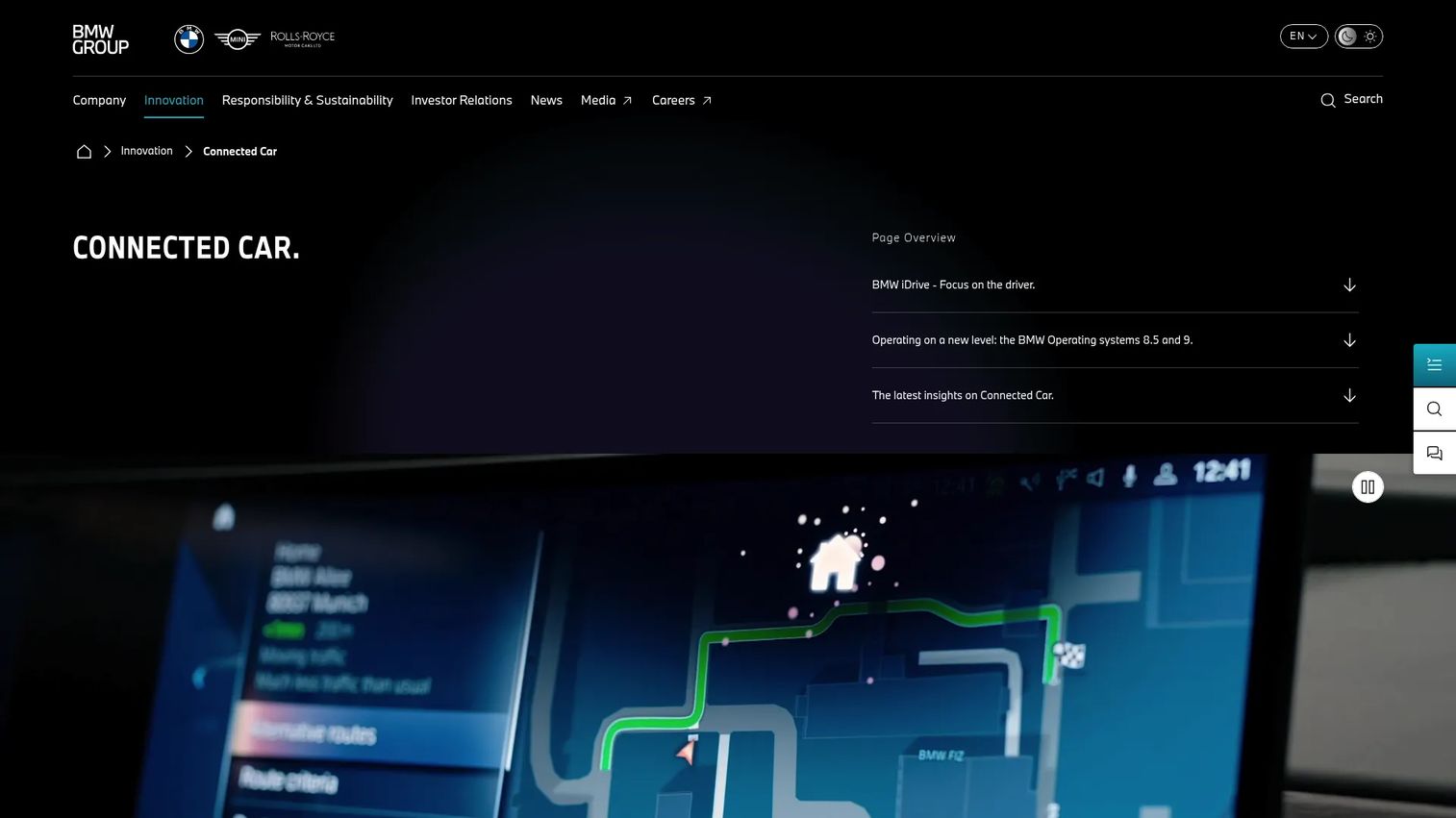
BMW Group Connected Car Technology is the strongest OEM-native example of connected car software running at real scale. It documents BMW's in-vehicle software, connectivity, and digital services across BMW and MINI, and it reads less like a definition and more like a live case study. If you want to see how the category's building blocks come together in a shipping product, this is the reference to open first.
The page centers on BMW iDrive and the shift toward a software-defined in-car experience. iDrive combines touch, voice, gesture, and physical controls, and it evolves through over-the-air software updates rather than staying frozen at delivery. That is the connected car thesis made concrete: the car you bought keeps getting better because the software keeps shipping.
Best for: Product leaders who want to see connected car software architecture and OTA delivery working at production scale inside a mature OEM ecosystem.
Key strengths
- OTA updates at scale: BMW pushes new software and firmware to vehicles already on the road, so features and fixes reach drivers without a dealer visit.
- Cloud-linked fleet: A large connected fleet is tied to the BMW Cloud, generating real-time traffic and vehicle data that feeds services back into the car.
- Integrated digital services: The My BMW app connects remote services, vehicle management, and personalization into one driver-facing layer.
Why choose this reference: BMW is the answer when a stakeholder asks "what does mature connected car software actually look like in the wild?" It shows telematics, cloud connectivity, OTA, and personalization operating together, not as isolated features but as a coherent ecosystem. For a product manager, that end-to-end view is worth more than any abstract architecture diagram, because it exposes how the pieces reinforce each other over the vehicle's life.
Pricing: This is an OEM platform and innovation reference page, not a purchasable product. BMW does not publish list pricing for its connected car technology here, and no public price or tier is available. Treat it as an educational and strategic reference rather than a vendor quote.
2. HERE
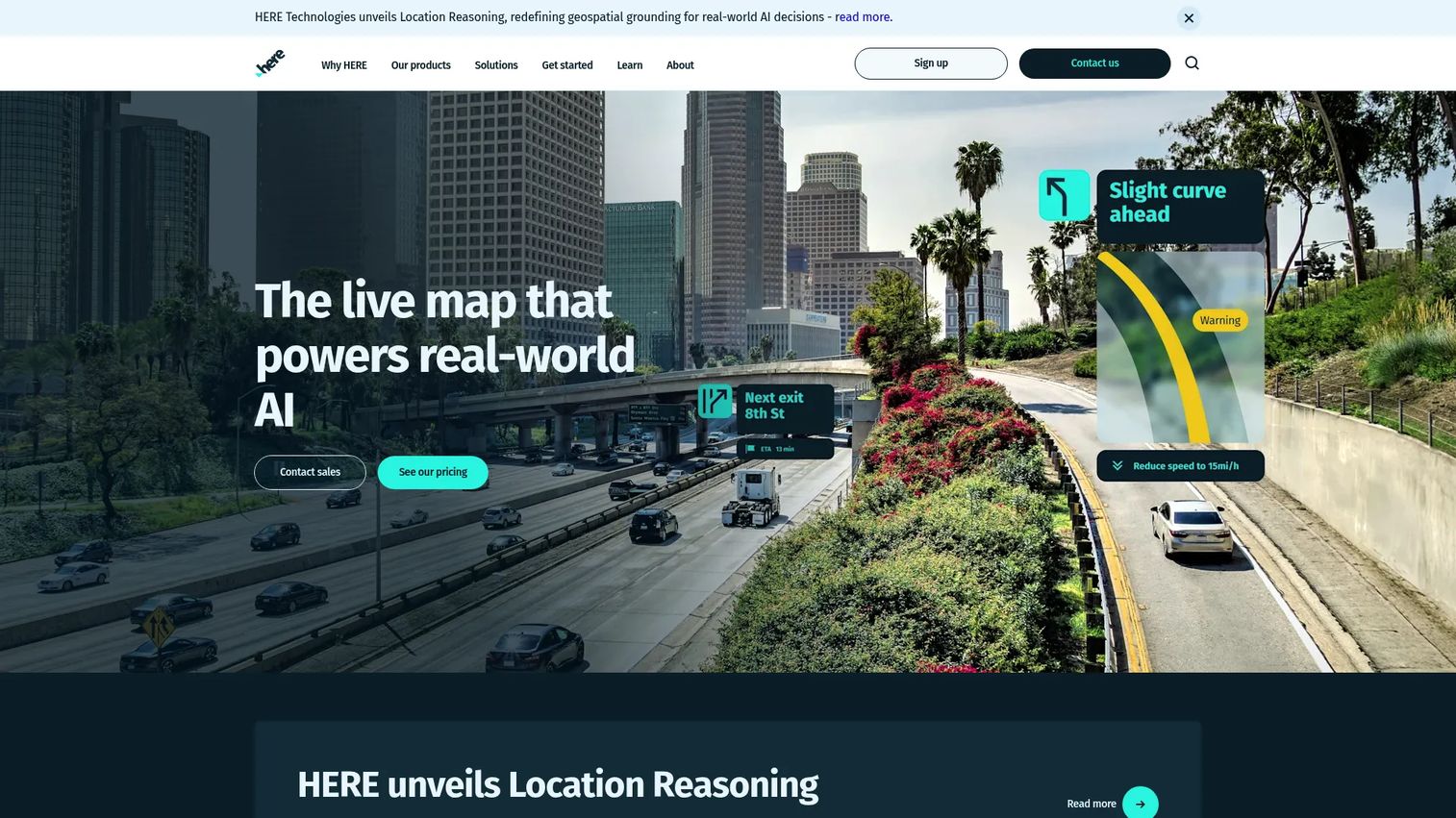
HERE is the best bridge between connected cars and software-defined vehicles. It is a location technology and mapping platform for developers, enterprises, and mobility applications, and its material is unusually good at drawing the line between connectivity (the car talks to the network) and internal software architecture (the car's functions are decoupled from fixed hardware). If your team keeps confusing "connected car" with "software-defined vehicle," HERE clears it up.
The platform's substance sits in maps and routing. HERE provides map data and rendering, dynamic map content, routing APIs, and location intelligence tools that connected vehicles rely on for navigation, live traffic, and hazard awareness. That grounds the abstract SDV conversation in something concrete: the vehicle consumes and contributes location data continuously, which is exactly the always-on data loop connected car software is built to support.
Best for: Product managers who need a systems-level framing that separates connectivity from software-defined vehicle architecture before they evaluate any stack.
Key strengths
- Maps and routing APIs: Road geometry, route profiles, and traffic signs delivered on a global scale for navigation and ADAS use cases.
- Dynamic location content: Live traffic and hazard detection that keep the vehicle's picture of the world current in real time.
- SDK and location intelligence: Developer tools that let teams build location-aware features into connected vehicle and mobility apps.
Why choose this reference: HERE is more of a platform and thought-leadership resource than a packaged product list, and that is the point. When you need to explain to a roadmap committee why the SDV transition changes how software is built and updated, not just how the car connects, HERE gives you the vocabulary and the concrete example. It is the conceptual scaffolding many PMs are missing.
Pricing: HERE publishes a base plan on its pricing page and signals a get-started tier with usage-based pricing. Exact public figures were not readable from the page at review time, so treat pricing as usage-based and confirm current numbers directly with HERE before you budget.
3. LTTS
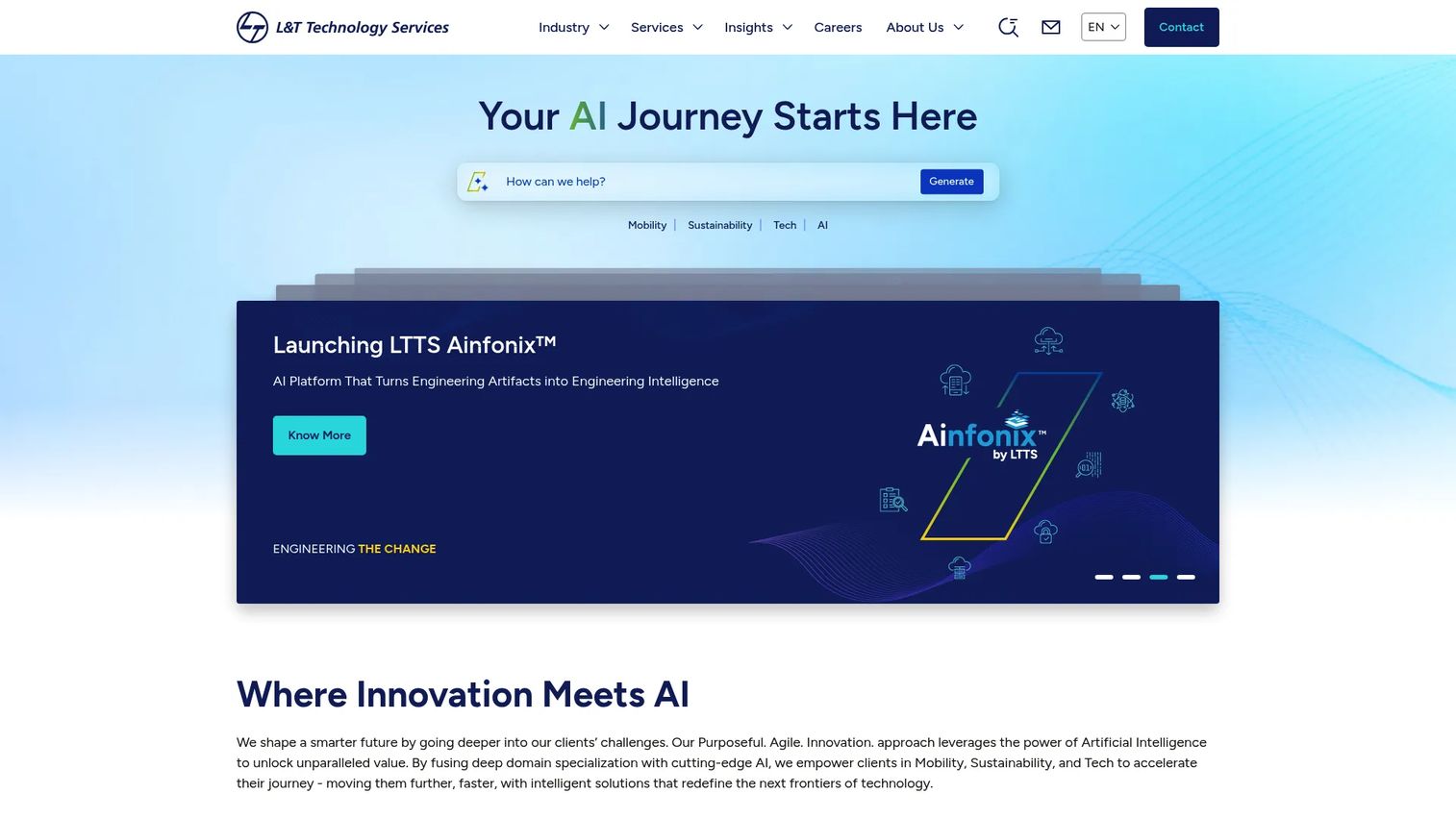
LTTS is the enterprise mobility and telematics pillar of this list. It is a global engineering and R&D services company, and its connected mobility material takes the broadest systems view of any resource here. Where an OEM page shows one ecosystem and a CRM page shows the business layer, LTTS covers the full engineering stack: connectivity management, V2X, cloud migration, security, OTA, analytics, and validation.
That breadth is what makes it valuable for a product manager evaluating an automotive software stack. LTTS speaks in enterprise language, framework references, and validation rigor, which is exactly the register you need when you move from "what is connected car software" to "how do we architect, secure, and verify it across a fleet." The material treats connectivity and safety as engineering problems with testable outcomes, not marketing bullet points.
Best for: Product and platform leaders who need an enterprise-grade view of telematics, V2X, cloud, security, and validation before scoping a build or a vendor engagement.
Key strengths
- Digital engineering depth: End-to-end coverage from connectivity management through cloud migration and analytics.
- V2X and safety framing: Vehicle-to-everything communication treated as a validated engineering discipline, not a buzzword.
- Validation and security: Explicit attention to testing, verification, and securing connected systems at scale.
Why choose this reference: LTTS is strongest as an enterprise capability reference rather than a consumer explainer. If your job is to align engineering, security, and product on how a connected vehicle platform is actually built and proven, the architecture and validation language here gives you shared vocabulary. It helps you ask sharper questions about OTA safety, data pipelines, and V2X readiness.
Pricing: LTTS sells enterprise engineering services and does not publish public list pricing. Its pages direct prospective clients to contact the company directly to scope an engagement, so pricing is quote-based and depends on project scope.
4. Salesforce Automotive Cloud
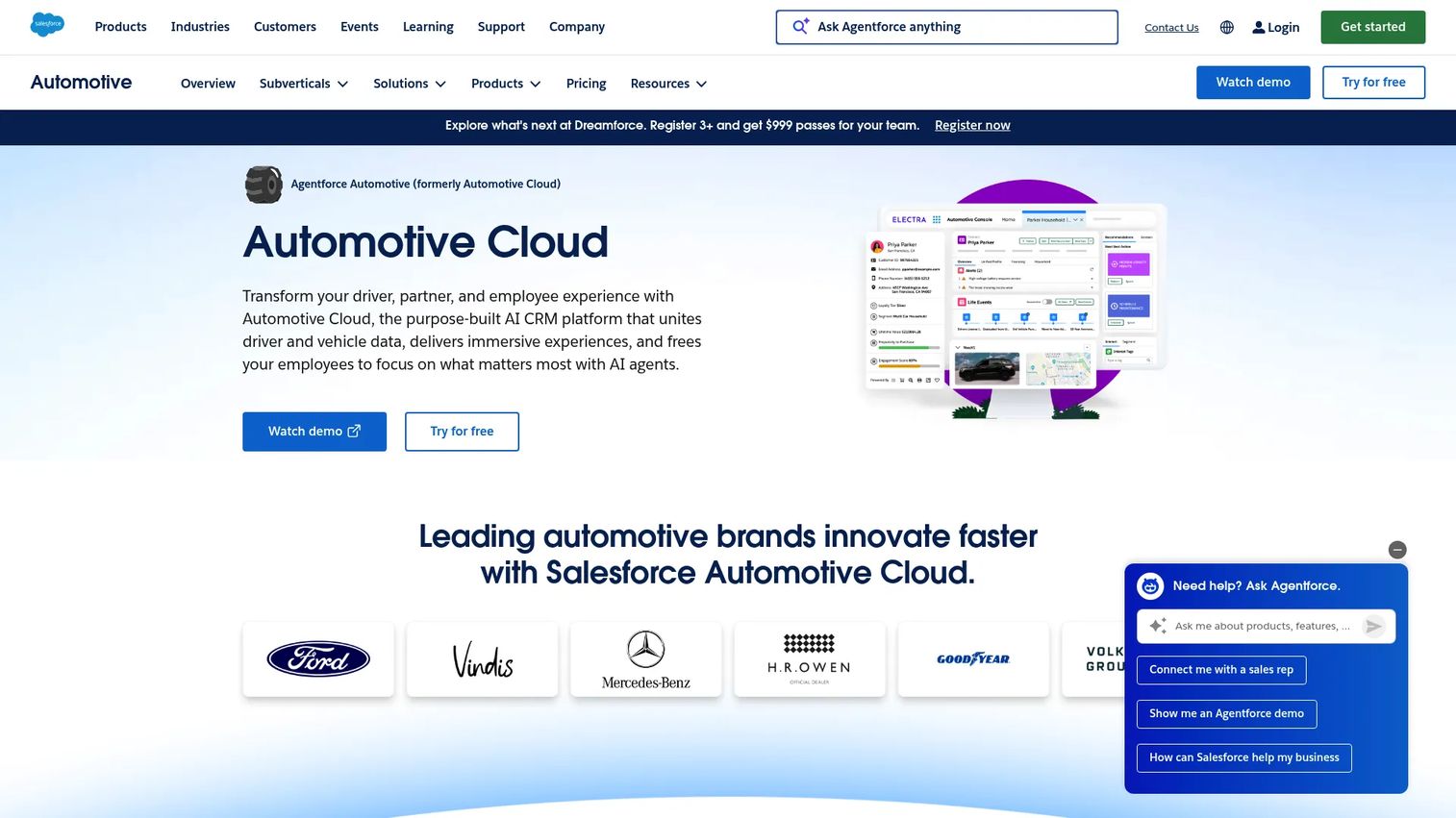
Salesforce Automotive Cloud is the most business-facing connected car software reference on this list. It is an automotive CRM platform built on Salesforce for OEMs, dealers, and captive finance arms, and it reframes the whole conversation around a question the other resources touch only lightly: what do you do with all this vehicle data once you have it?
The answer, in Salesforce's framing, is to bring vehicle and telematics data into the CRM and turn it into offers, services, and personalized experiences. It harmonizes driver and vehicle data so OEMs and dealers work from one connected view of vehicles, customers, and financial relationships. That is where connected car software stops being a wiring question and becomes a customer lifecycle question, which is precisely the translation many product managers need to make for their commercial stakeholders.
Best for: Product leaders who need to connect connected car software to customer experience, dealer workflows, subscription revenue, and OEM value.
Key strengths
- Unified driver and vehicle data: One connected view of vehicles, customers, and financial relationships across OEM and dealer.
- Telematics-driven services: Turns vehicle data into offers, personalization, and connected services rather than raw signal.
- Sales, service, and finance workflows: Automotive-specific consoles and lead management that tie software features to business motions.
Why choose this reference: Salesforce is the resource that helps you argue the business case. It shows how telematics and personalization feed marketing, service, and expansion, which is the language leadership responds to. Salesforce also indicates the offering is now known as Agentforce Automotive, reflecting its move toward AI-assisted, agent-driven workflows on top of the connected data foundation.
Pricing: Salesforce publishes pricing for Automotive Cloud, with the Enterprise edition starting at $350/user/month billed annually, the Unlimited edition at $525/user/month, and Agentforce 1 Service and Sales editions at $750/user/month, all on annual contracts. Related connected-vehicle add-ons are priced separately, and there is no free tier.
What to evaluate before you commit
A resource roundup only takes you so far. Once you move from reading to building or buying, here is the checklist that matters for connected car software.
Architecture clarity
Understand where the software boundary sits. In a software-defined vehicle, functions are decoupled from fixed hardware, which changes how you update, test, and version. Make sure any resource or vendor can explain that separation cleanly, because it drives everything downstream.
Data flow and instrumentation
Connected car software lives or dies on data. Map how telematics moves from vehicle to cloud, what gets stored, and how analytics turns raw signal into remote diagnostics and personalization. If you cannot trace the data path, you cannot prove ROI or plan segmentation.
OTA and update cadence
OTA updates are the mechanism that makes the vehicle a continuously improvable product. Evaluate how updates are packaged, delivered, verified, and rolled back. Update safety and release cadence are as important in a car as they are in any SaaS product.
V2X and safety readiness
Vehicle-to-everything communication feeds safety and traffic use cases, and it carries real validation weight. Check how a platform handles V2X, security, and verification, not just the feature list.
Business outcome mapping
Finally, tie the software layer to outcomes. Connected car software should support OEM, dealer, and fleet use cases: subscription revenue, service efficiency, personalized experiences, and retention. If a resource cannot connect features to those outcomes, it is a spec sheet, not a strategy.
Conclusion
Connected car software is the enabling layer for OTA updates, telematics systems, V2X, personalization, and the shift toward the software-defined vehicle. These four resources each illuminate a different face of it.
Read HERE and Salesforce when you need conceptual and business framing. Open BMW Group Connected Car Technology when you want to see a mature connected car platform executing at scale. Go to LTTS when you need enterprise architecture, telematics, and validation depth. Together they cover the education, the ecosystem, the engineering, and the business case across OEM, dealer, and fleet use cases.
The next step is simple: pick the resource that matches where your evaluation is stuck. If you cannot explain the SDV transition, start with HERE. If leadership wants the business case, start with Salesforce. If engineering needs shared vocabulary, start with LTTS. And if you just need to see it all working, start with BMW.
FAQs
Connected car software is the in-vehicle and cloud software layer that links a vehicle to networks, backend services, and other systems. It lets the car send telematics data, receive OTA updates, and deliver digital services over its lifetime. For a product manager, it is the layer that turns a vehicle into a continuously improvable product rather than a fixed asset.
Telematics systems are the onboard modules and software that capture vehicle data such as location, diagnostics, and driving behavior. Connected car software transmits that data to the cloud, where analytics turn it into remote diagnostics, predictive maintenance, and personalized services. Telematics is the sensing layer; connected car software is what makes the data useful.
Connected car software is about connectivity: the vehicle talking to networks, the cloud, and other systems. A software-defined vehicle is about internal architecture: core functions decoupled from fixed hardware so they can be updated and versioned through software. A connected car sends and receives data; a software-defined vehicle is built so that software, not hardware, defines what the car can do. Most modern programs pursue both at once.
OTA updates let automakers ship new features, fixes, and security patches to vehicles already on the road, without a dealer visit. That keeps the vehicle improving after purchase and supports subscription and feature-on-demand models. For product teams, OTA is the release mechanism, so update cadence, verification, and rollback matter as much as they do in any SaaS release process.
Vehicle-to-everything (V2X) is communication between the vehicle and other vehicles, infrastructure, pedestrians, and the network. Connected car software manages those exchanges and feeds them into safety and traffic use cases such as hazard warnings and traffic optimization. V2X is one of the highest-stakes parts of the stack because it carries real safety and validation weight.
It turns vehicle data into revenue and relationships. Connected car software supports subscriptions and feature-on-demand, improves service through remote diagnostics, and enables personalized experiences that drive retention. It also gives OEMs and dealers a unified view of vehicles, customers, and financial relationships, which supports better service, marketing, and expansion across the vehicle's life.
Telematics and usage data flow from the vehicle to the cloud, where analytics build a picture of the driver and the vehicle. Connected car software uses that picture to tailor in-car entertainment, services, offers, and driver profiles to the individual. Done well, personalization runs on a real-time data loop, so the experience adapts as the driver's behavior and preferences change over time.