A property can be fully booked and still lose money. Disconnected rates, manual payment reconciliation, reporting that arrives after month-end, and staff who need three systems to complete one guest task all eat into margins that looked fine on paper.
The global hotel and hospitality management software market reached $4.2 billion in 2025, according to Grand View Research (2026), and cloud deployment now accounts for 44.8% of that. Yet the Hotel Yearbook's State of Hospitality Tech Survey (2025) found that only 45% of hotel companies consider themselves tech-mature. Most operators are still running on a patchwork of systems that don't talk to each other well enough to give a GM a clean answer before a board call.
Hospitality management software is the operating layer that connects reservations, guest records, revenue decisions, distribution, payments, and daily service delivery. Getting that layer wrong means the business runs on individual memory instead of a repeatable system. Getting it right means your Head of Operations can own the room, not you.
This guide cuts through seven platforms across different operating models so you can build a shortlist that fits your property type and hand the decision to your team with confidence.
What's inside
This guide is for hotel operators, multi-property founders, and hospitality SaaS builders who need a practical shortlist. Items were chosen based on four criteria:
- Operational scope: What workflows does the platform actually cover?
- Property and portfolio fit: Which property models does it serve well?
- Integration depth: How does it connect to payments, distribution, and adjacent systems?
- Pricing and implementation transparency: What are the real cost drivers?
TL;DR
- Best for cloud-first hotel operations: Mews, with per-room pricing and 1,000+ marketplace integrations
- Best all-in-one stack for independent hotels: Cloudbeds, covering PMS, distribution, and payments in one platform
- Best for enterprise hotel chains and resorts: Oracle Hospitality OPERA PMS, with deep operational breadth
- Best for hospitality groups with broad back-office requirements: Infor Hospitality, connecting property ops to finance, HR, and analytics
- Best for resort and casino environments: Agilysys PMS, purpose-built for complex guest service operations
- Best for independent operators wanting a unified platform: roommaster, covering PMS, direct bookings, revenue, and guest engagement
- Best for diverse accommodation portfolios: RMS, with configurable cloud PMS across hotels, parks, and serviced apartments
The right choice depends on property type, number of locations, existing integrations, and how much operational change your team can absorb this year.
What is hospitality software?
Hospitality software is a set of cloud or on-premise systems that help hotels, resorts, restaurants, venues, and other accommodation businesses manage reservations, guest operations, revenue, payments, distribution, staff workflows, and reporting.
The PMS is usually the operational core
A hotel property management system (PMS) stores reservations, guest profiles, room inventory, room assignments, folios, check-in and check-out activity, and daily audit data. It's the system of record for a property. Every other tool either feeds into it or pulls from it.
A complete hospitality stack extends beyond the PMS
Most operators need more than a PMS alone. A full hotel software stack typically includes:
- Reservation and booking engine: Direct booking capability, rate management, and availability controls
- Channel management: OTA distribution, inventory synchronization, and rate parity across platforms
- Revenue management: Dynamic pricing, demand forecasting, and pace reporting
- Payment processing: Card settlement, deposits, chargebacks, and folio reconciliation
- Housekeeping and maintenance: Task assignment, room status, and workflow management
- POS and food and beverage: Restaurant, bar, and amenity operations
- Guest experience: Mobile check-in, messaging, upsells, loyalty, and personalization
- Reporting and analytics: Owner, GM, finance, and portfolio-level views
- APIs and integrations: Connections to door locks, CRM, accounting, and revenue tools
| Core system | Typical role |
|---|---|
| PMS | Reservations, guest records, folios, daily operations |
| Channel manager | OTA distribution, rate and inventory sync |
| Revenue management | Dynamic pricing, demand signals, forecasting |
| Payment processor | Settlement, deposits, chargebacks |
| POS | Food, beverage, retail, and amenity transactions |
| Guest messaging | Pre-arrival, in-stay, and post-stay communication |
| Reporting | Occupancy, ADR, RevPAR, portfolio analytics |
Hospitality software versus hotel management software
The terms overlap but aren't identical. Hotel management software typically means PMS-led tools built for a property's daily operations. Hospitality software is broader, covering restaurants, casinos, resorts, event venues, finance, HR, procurement, and cloud infrastructure. When this guide uses "hospitality software," it means the full stack a property or portfolio needs to operate.
When to use hospitality software
Replace disconnected front-desk and reservation workflows
Signs of operational fragmentation include duplicate guest records, manual availability updates across channels, delayed payment reconciliation, and staff switching between a PMS, spreadsheets, and OTA extranets. The underlying problem is that the business runs on individual memory. A unified hotel operations platform replaces that with a repeatable system your GM can own without a daily briefing from you.
Standardize operations across multiple properties
Multi-property operators need central reporting, shared operating standards, multi-property permissions, and portfolio visibility. Without a platform built for this, each property becomes its own data island. A good hotel software system makes it possible to onboard a new location without rebuilding the operational model from scratch.
Tighten pricing, distribution, and revenue controls
Rate changes across channels, demand signals, room-type inventory management, and OTA distribution should not require manual coordination. Hotel revenue management software and integrated channel management give operators pace-and-performance visibility before month-end, not after. For a founder preparing for a board conversation, that timing difference matters.
Hospitality software comparison
These seven platforms cover distinct operating models. Start with the row that matches your property complexity, then validate integrations, implementation scope, and commercial terms in a live evaluation.
| # | Product | Best for | Key differentiator | Pricing | G2 rating |
|---|---|---|---|---|---|
| 1 | Mews | Cloud-first hotels and growing groups | Guest-centric cloud PMS with payments, operations, and 1,000+ marketplace integrations | Per-room, quote-based | 4.8/5 |
| 2 | Cloudbeds | Independent hotels and multi-property operators | Unified PMS, distribution, payments, and 400+ integrations | Quote-based (Flex, One, Experience, Enterprise) | 4.2/5 |
| 3 | Oracle Hospitality OPERA PMS | Large hotels, chains, and complex enterprise operations | Deep hospitality operating breadth and enterprise integration coverage | Quote-based enterprise pricing | 4.2/5 |
| 4 | Infor Hospitality | Enterprise groups with broad back-office requirements | Hospitality operations connected to finance, HR, analytics, and cloud platform | Quote-based enterprise pricing | 4.4/5 |
| 5 | Agilysys PMS | Resorts, casinos, and complex guest-experience environments | Purpose-built hospitality PMS for resort and casino operations | Quote-based pricing | Not available |
| 6 | roommaster | Independent hotels seeking a unified platform | PMS, direct bookings, channel management, revenue, and guest experience | Quote-based pricing | Not available |
| 7 | RMS | Hotels, parks, and multi-property accommodation operators | Configurable cloud PMS for varied accommodation models | Quote-based (Accelerate, Elevate) | Not available |
The 7 best hospitality software platforms for 2026
1. Mews
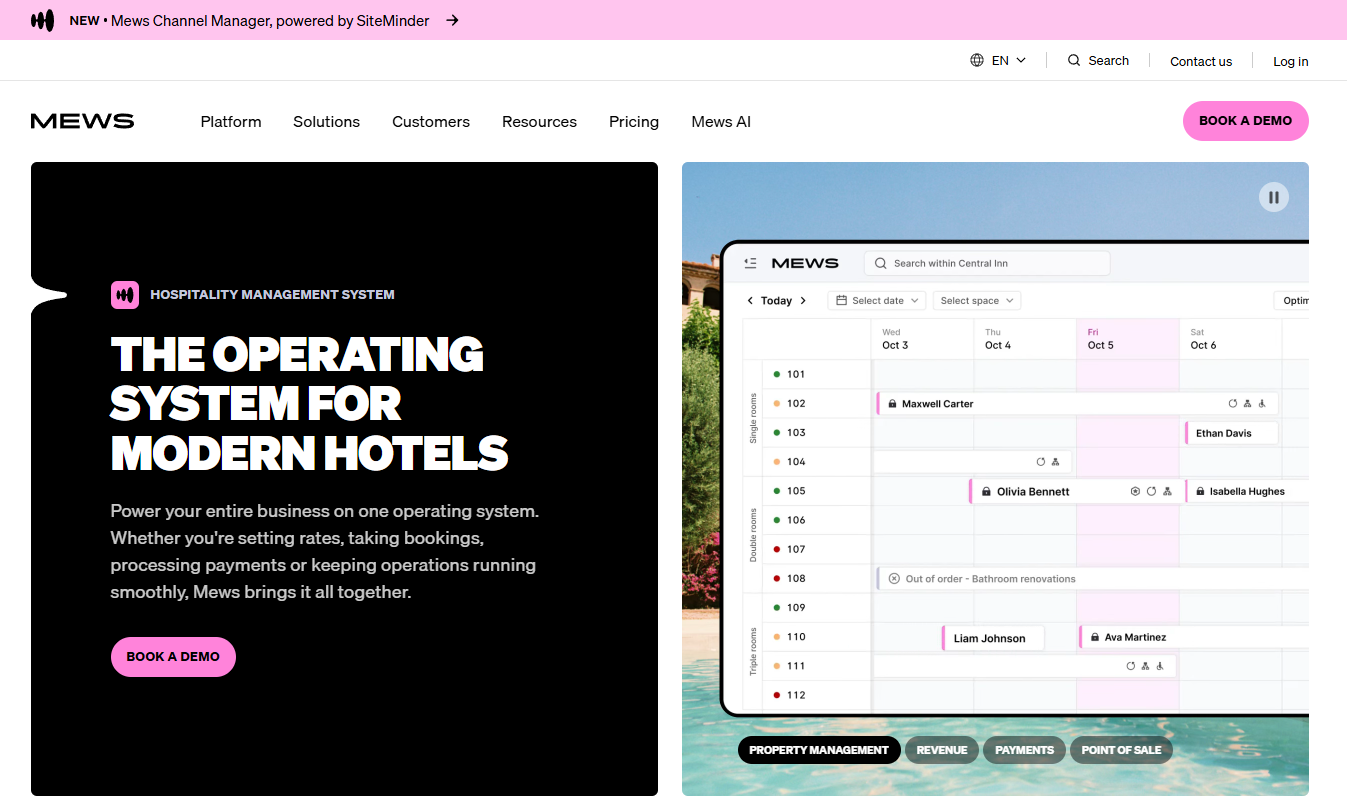
Mews is a cloud-native hospitality operating system that combines property management, guest experience, payments, revenue, and distribution under one platform. It's built around a connected guest profile and positions itself as an alternative to legacy PMS software that requires heavy IT involvement for updates or integrations.
Best for: Independent hotels, boutique groups, and multi-property operators that want a modern cloud PMS with strong automation and marketplace connectivity.
Key features
- Cloud property management with reservations, folios, and guest profiles
- Integrated payment processing with card-on-file and settlement
- Revenue management with automated pricing and forecasting
- AI guest messaging across WhatsApp, SMS, OTA messaging, and email
- 1,000+ marketplace integrations via open API
- Business intelligence with custom dashboards
Why choose Mews: Choose Mews if your priority is reducing isolated operational tools and giving your team a unified guest record they can act on in real time. It fits groups standardizing on a modern platform without starting with an enterprise ERP project.
Mews pricing: Mews prices per room and tailors quotes to each property. Payment processing and some add-ons carry separate fees. The vendor shows indicative per-room figures on its pricing page based on a 10-room property configuration. Request a quote through mews.com/en/pricing to confirm current rates for your room count, selected modules, and implementation costs.
G2 rating
4.8/5
2. Cloudbeds
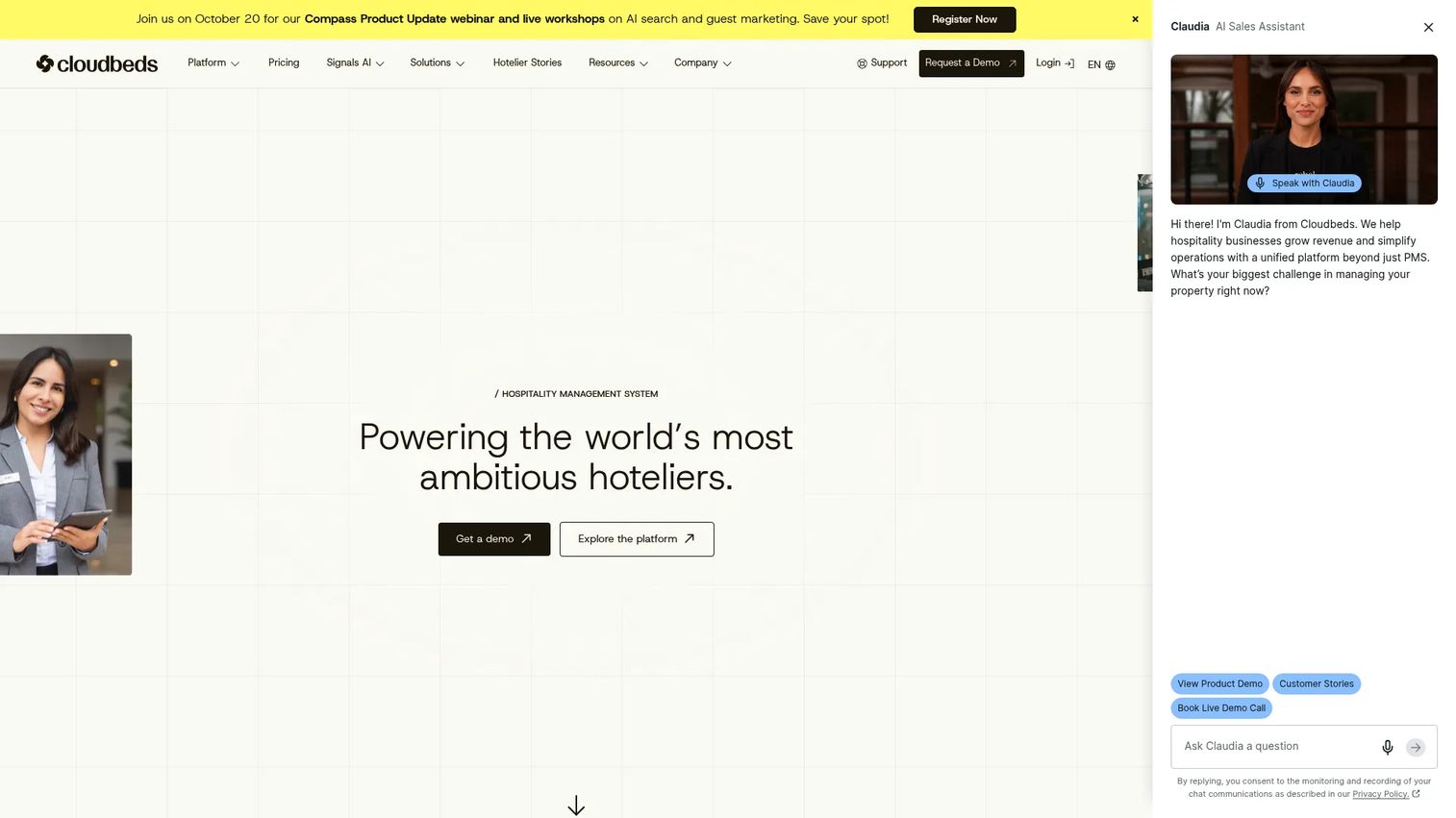
Cloudbeds is a unified hospitality management platform that brings property management, channel distribution, direct booking, payments, guest messaging, and revenue management into one interface. It serves hotels, hostels, vacation rentals, and accommodation groups that want to cut manual coordination across reservations, OTAs, and payment workflows.
Best for: Independent hotels and boutique operators with multi-channel distribution needs and limited appetite for multi-vendor integration work.
Key features
- Cloud PMS with reservations, calendar, housekeeping, and multi-property management
- Real-time channel manager with commission-free direct booking engine
- Integrated payments with guest profiles and chargeback workflows
- Revenue management tools with demand signals and reporting
- Marketplace with 400+ integration partners
Why choose Cloudbeds: Cloudbeds earns a spot on shortlists for founders who want a unified operational stack without managing a separate channel manager, payment processor, and PMS. Push it further in evaluation if the business has complex corporate billing, highly customized reporting requirements, or specialized maintenance workflows.
Cloudbeds pricing: Cloudbeds offers four plans: Flex, One, Experience, and Enterprise. All are quote-based with no public price shown. The price drivers are property type, room count, selected distribution channels, payment features, and contract length. Contact the Cloudbeds sales team through cloudbeds.com/pricing to get current figures for your property configuration.
G2 rating
4.2/5
3. Oracle Hospitality OPERA PMS
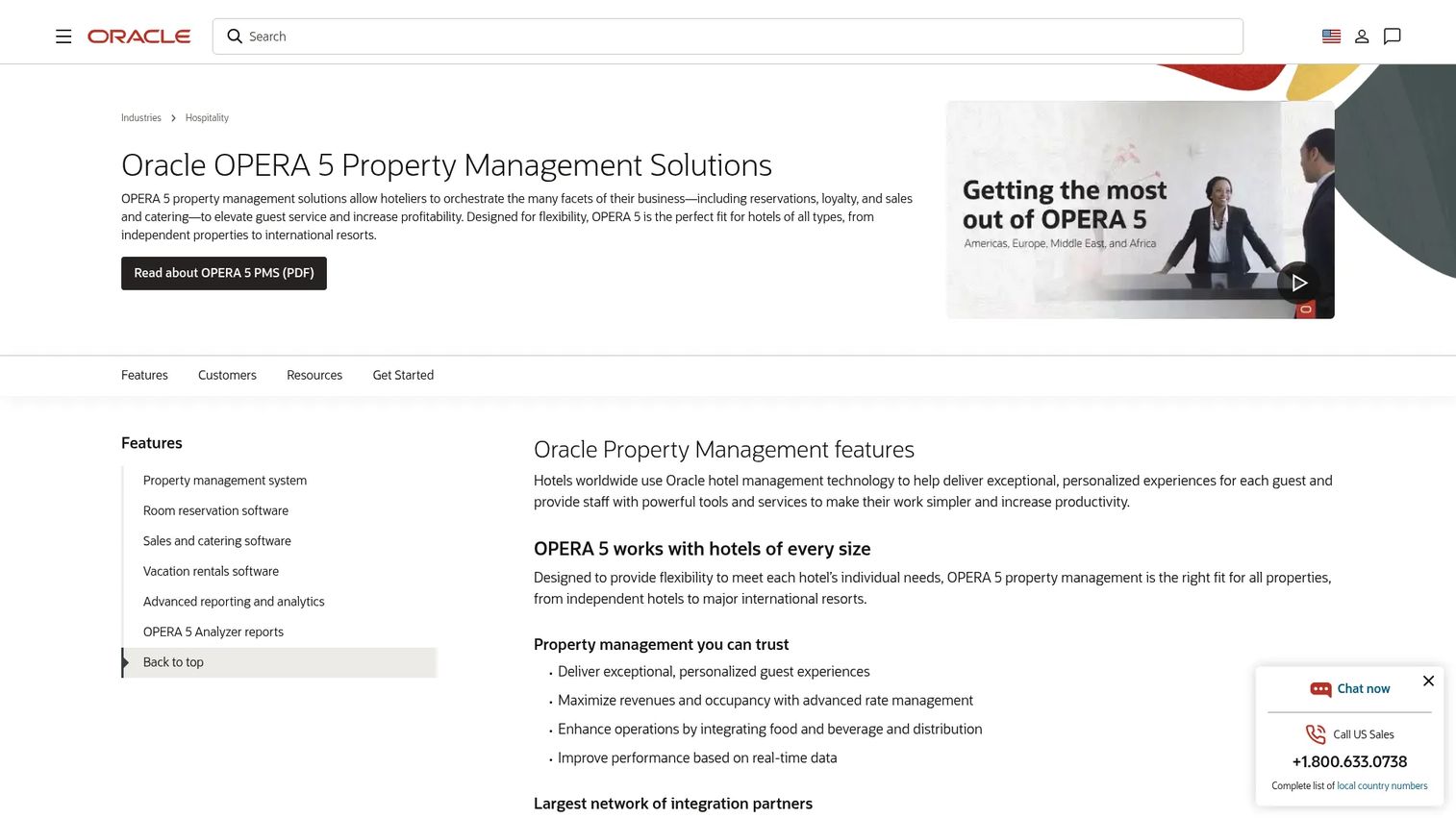
Oracle Hospitality OPERA PMS is a cloud-based hotel property management system for enterprise hotel operations. It covers reservations, rate and inventory management, guest profiles, loyalty, mobile operations, and integrations with Oracle's broader hospitality portfolio, including food and beverage, sales and events, and distribution systems.
Best for: Large hotels, branded chains, global resorts, and multi-property operators with layered integrations, formal governance requirements, and complex portfolio reporting needs.
Key features
- Cloud PMS with reservations, rates, availability, and revenue management
- Guest, company, group, and travel-agent profile management
- Loyalty program management with tiers, points, and promotional rates
- Customizable operational dashboards and reporting
- Open APIs and integration platform for third-party applications
- Mobile-enabled operations for front desk and housekeeping
Why choose Oracle Hospitality OPERA PMS: The operating breadth here is difficult to match for complex environments. A property running multiple brands, managing group blocks across dozens of properties, or requiring deep back-office integration to Oracle ERP will find OPERA Cloud a natural fit. For a single boutique property or a small group, it can be more than the operation needs.
Oracle Hospitality OPERA PMS pricing: Oracle sells OPERA PMS through a sales-led model across Professional and Enterprise service editions, in Standard and Premium tiers. Request pricing through Oracle's hospitality sales team. The cost structure depends on edition, property count, selected modules, implementation services, and ongoing support terms.
G2 rating
4.2/5
4. Infor Hospitality
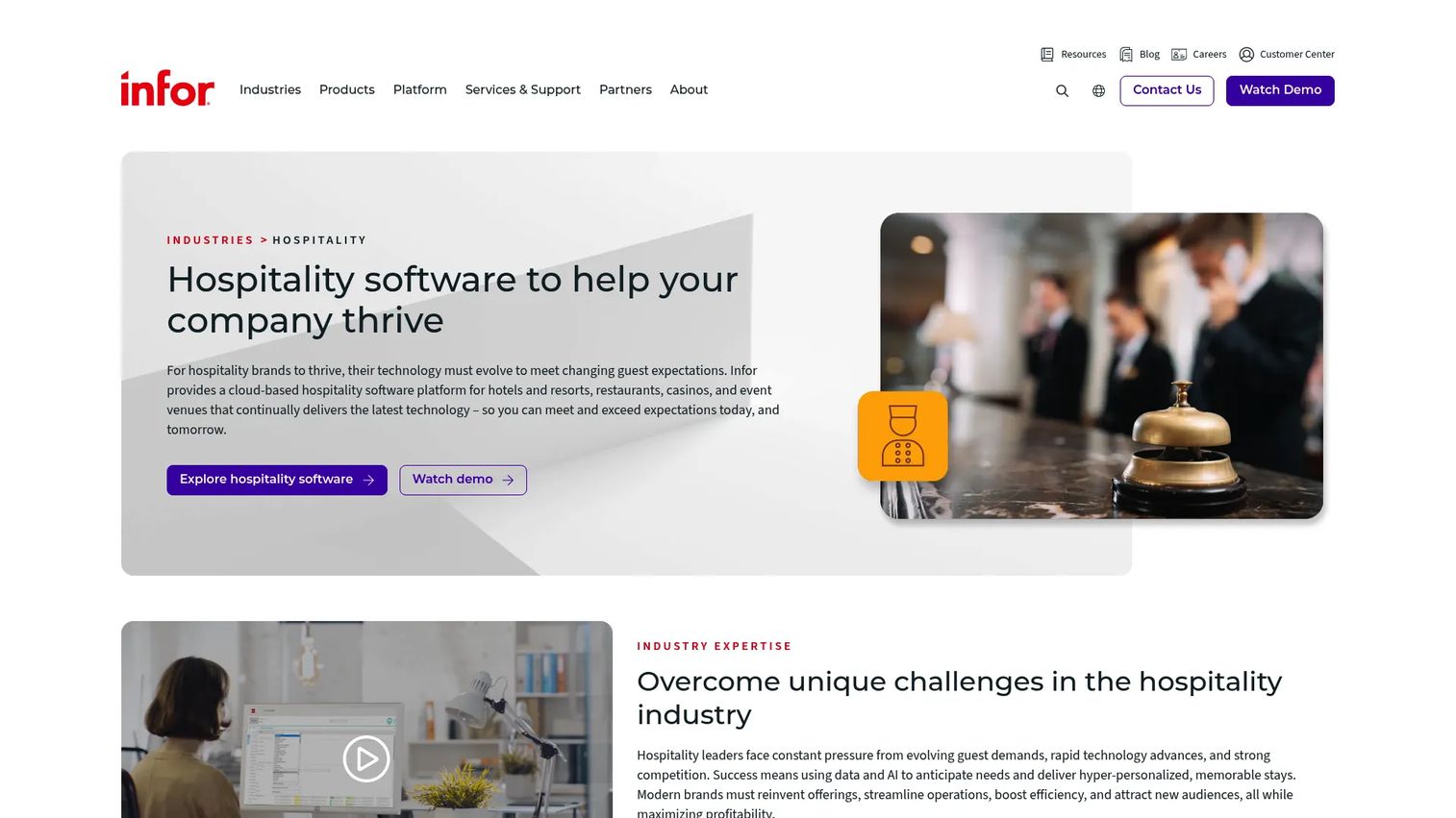
Infor Hospitality covers hotel property management, AI-driven revenue management, sales and catering, restaurant POS and operations, hospitality analytics, and an enterprise cloud platform. It's the widest-scope option in this shortlist, connecting hospitality operations to finance, HR, procurement, and enterprise analytics systems.
Best for: Large hospitality companies and mixed-use operators that need hotel operations connected to enterprise back-office functions, not just property-level workflows.
Key features
- Hotel PMS with mobile check-in/check-out, digital keys, and multi-property analytics
- AI-driven revenue management with dynamic pricing and competitor rate shopping
- Sales, catering, and event management from inquiry through invoicing
- Restaurant POS and operations with menu, labor, and inventory management
- Hospitality analytics with natural-language AI and customizable dashboards
Why choose Infor Hospitality: The value here is fewer handoffs between property systems and corporate functions. For founders whose bottleneck is not just front desk operations but the gap between property data and finance, procurement, or workforce reporting, Infor Hospitality reduces that translation work.
Infor Hospitality pricing: Infor uses a sales-led pricing model. Quote drivers include the specific product modules selected, deployment model (cloud versus hybrid), implementation services, data migration scope, and ongoing support. Contact Infor's hospitality sales team through infor.com for current figures. Factor implementation services into any total-cost comparison.
G2 rating
4.4/5
5. Agilysys PMS
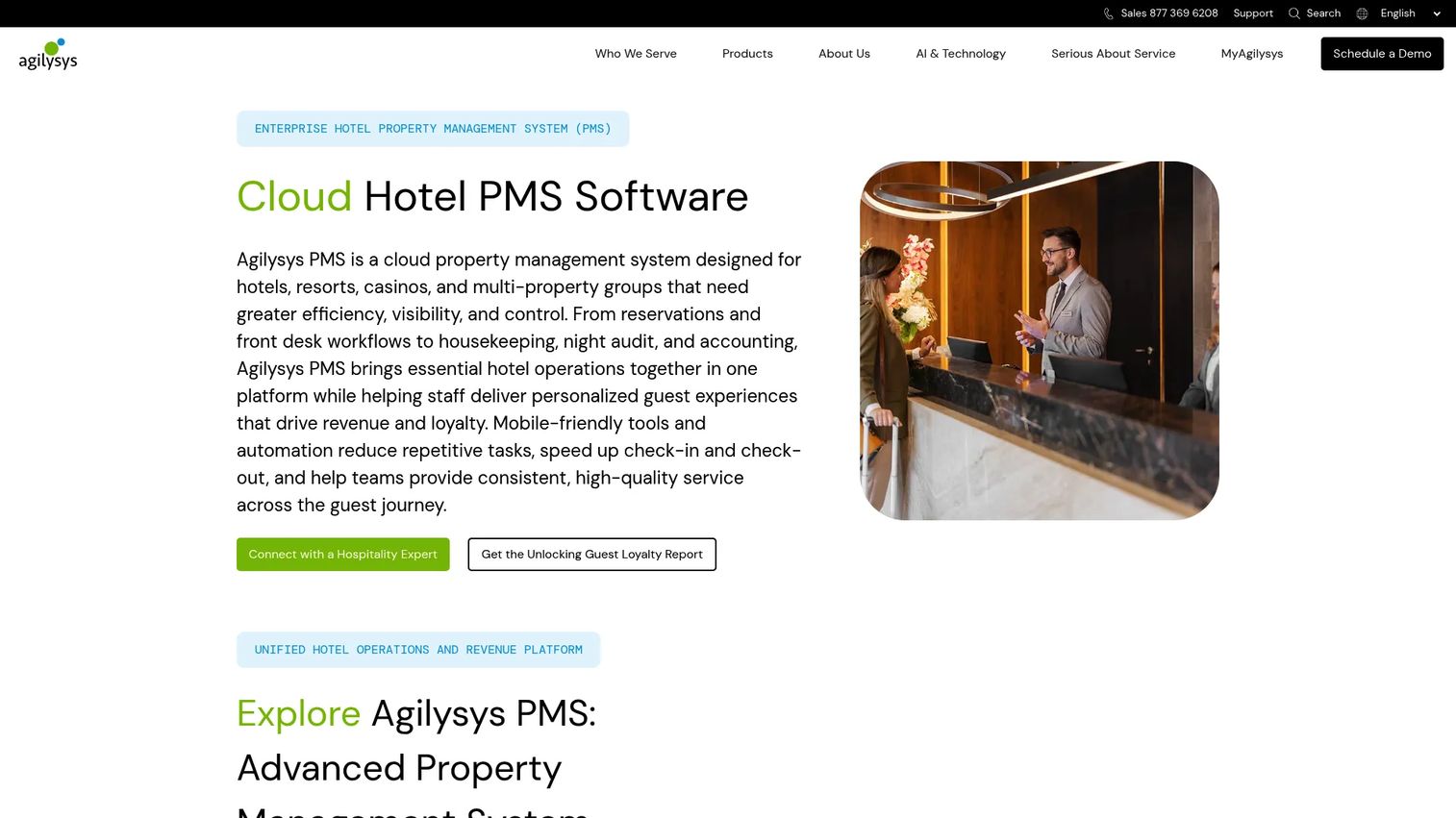
Agilysys PMS is a cloud property management system built specifically for hotels, resorts, casinos, and complex guest-service environments. It covers front desk operations, reservations, housekeeping, sales, finance, dynamic pricing, and integrations with POS, channel managers, payments, and loyalty systems.
Best for: Resorts, casinos, and properties where guest service, centralized profiles, and specialized hospitality workflows need tighter coordination than a standard hotel PMS provides.
Key features
- Front desk, reservations, housekeeping, sales, and billing workflows
- Mobile check-in/check-out and mobile staff task management
- Dynamic pricing, intelligent upselling, and package management
- Multi-property reporting and centralized guest profiles
- Integrations with POS, CRS/RMS, channel managers, payments, and loyalty systems
Why choose Agilysys PMS: Agilysys belongs on the shortlist when the property model is complex enough that a generic cloud PMS doesn't reflect how the operation actually works. Resort amenity management, casino player tracking integration, and multi-venue billing coordination are good tests. Verify current product module names with the Agilysys team before signing, as hospitality suites evolve frequently.
Agilysys PMS pricing: Agilysys does not show pricing on its product pages. The sales process determines cost based on module selection, property count, implementation services, required hardware or integrations, and support model. Engage Agilysys sales through agilysys.com to get a scoped quote.
6. roommaster
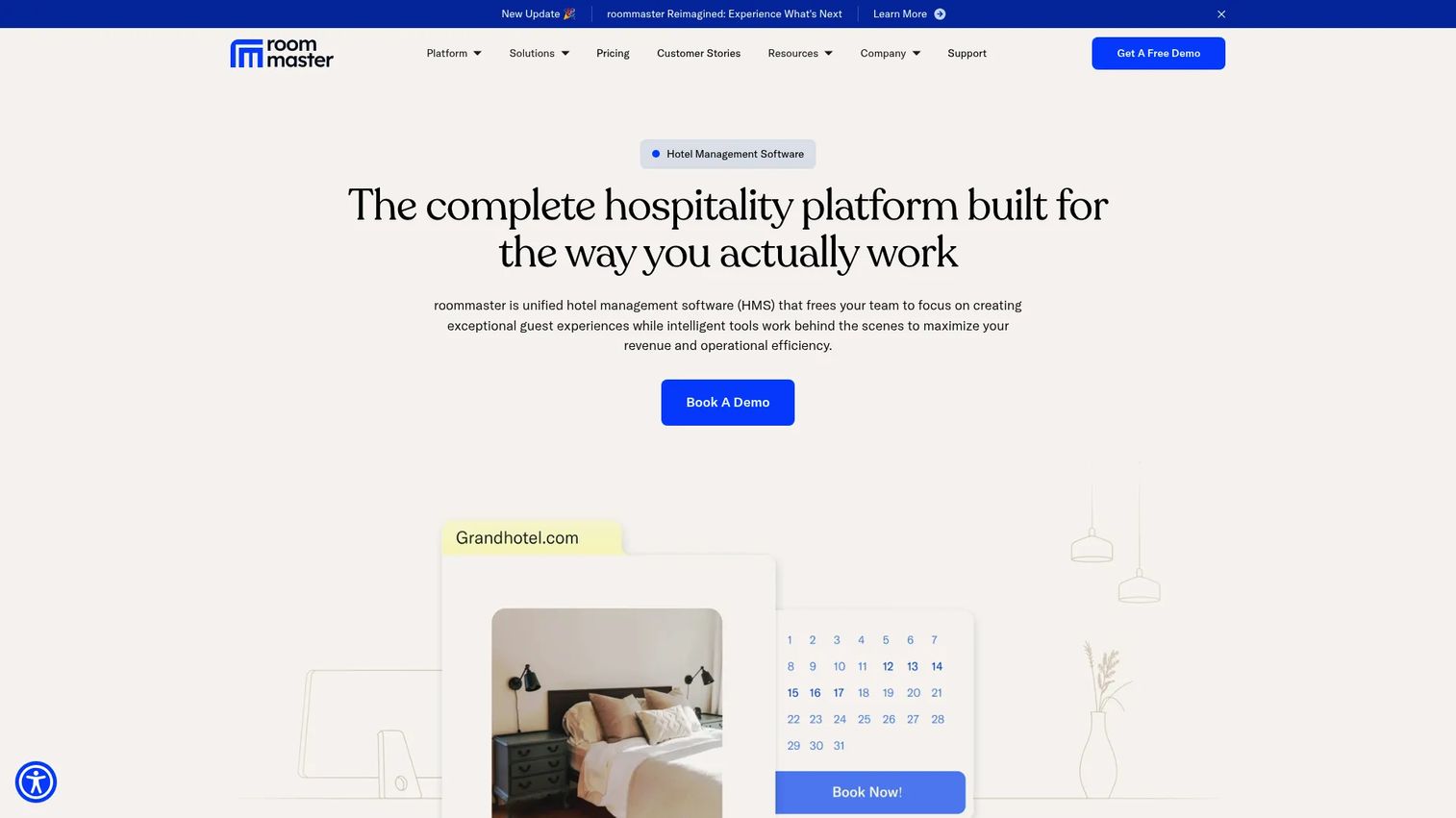
roommaster is a cloud hotel management platform designed for independent hotels, motels, resorts, bed and breakfasts, and smaller groups. It combines PMS, a commission-free direct booking engine, channel management with real-time OTA synchronization, integrated payments, AI-powered revenue management, guest messaging, mobile guest app, and digital keys in one platform.
Best for: Independent hoteliers who want to consolidate day-to-day operations without adopting enterprise ERP complexity.
Key features
- Cloud PMS with reservations, front desk, housekeeping, and billing
- Commission-free direct booking engine
- Channel management with real-time OTA inventory and rate synchronization
- AI-powered revenue management and pricing optimization
- Integrated payment processing and guest digital key access
- Guest profiles, messaging, and mobile guest app
Why choose roommaster: roommaster fits founders replacing a patchwork of operational tools at a single property or small group. The platform covers the workflows that matter most for independent operators without requiring a large implementation project. During evaluation, test reporting depth, local support availability, and payment workflow coverage against your specific property needs.
roommaster pricing: roommaster customizes pricing by property size and operational requirements. The official pricing page shows no standard rate and directs to a personalized quote. Expect the quote to reflect room count, selected modules, channel connections, and implementation support. Request current figures through roommaster.com/pricing.
7. RMS
RMS is cloud-based property management software for hotels, serviced apartments, holiday parks, campgrounds, motels, and other accommodation operators. It offers two base plans, Accelerate and Elevate, designed for different property scales, and supports multi-site enterprise management through open API and integrations.
Best for: Operators managing mixed accommodation portfolios or businesses that need configurable workflows across property formats that don't fit a standard hotel template.
Key features
- Cloud PMS with reservations, housekeeping, and maintenance management
- Built-in channel manager and direct booking engine
- Rate and revenue management tools
- Guest services and portals with payment processing
- Multi-site and enterprise management with centralized reporting
Why choose RMS: RMS makes the shortlist when the portfolio includes serviced apartments, holiday parks, extended stay, or regional multi-property businesses that standard hotel PMS platforms don't handle well. The Accelerate tier targets small-to-medium properties; Elevate covers enterprise and multi-property operators. Require a workflow demo using your actual property type before committing.
RMS pricing: Both RMS plans are quote-based with no published rates. Pricing depends on property type, unit count, selected modules, channel connections, payment integrations, and support terms. Contact RMS through rmscloud.com/pricing-plans to get a scoped quote for your configuration.
Considerations when choosing hospitality software
Match the platform to your property model
A 40-room boutique hotel, a multi-property resort group, and a mixed accommodation portfolio covering hotels and serviced apartments all have different operational requirements. Start with your operating model and staff workflows before evaluating feature scope. A platform that fits a small independent property may not handle enterprise governance for 20 locations.
Audit integrations before migration
Identify every system that exchanges operational data before you talk to vendors. This includes payment processors, accounting tools, door locks, POS, guest messaging platforms, revenue tools, channel managers, and ownership reporting. A platform that covers your core PMS workflows but requires custom development to connect your accounting system adds implementation cost and timeline risk.
Price the operating model, not just the subscription
Calculate recurring platform fees, per-room or per-property charges, payment processing fees, setup costs, data migration work, staff training, and module add-ons. Quote-based enterprise platforms often look comparable at the subscription level but diverge significantly when implementation services and required integrations are included.
Test reporting with your real management questions
Ask each vendor to demonstrate portfolio performance, occupancy, ADR, RevPAR, channel mix, guest revenue, payment reconciliation, and operational exceptions using a realistic property configuration. Generic dashboard tours don't tell you whether the reporting you need for a board call or an investor update is natively available or requires custom exports.
Plan implementation as an operating change
Historical data migration, reservations mapping, rate setup, channel connections, payment configuration, staff training, test stays, and parallel runs all take time. A realistic implementation plan is part of the buying decision. Platforms with a strong implementation partner network reduce risk for complex properties.
How to choose the right hospitality software platform
If you run an independent hotel or small group
Start with Mews, Cloudbeds, roommaster, and RMS. All four cover booking, distribution, payment, and reporting workflows without requiring a large IT project. Evaluate whether each platform covers your OTA connections, direct booking capability, and payment reconciliation natively before checking what requires a paid add-on.
If you are standardizing several properties
Multi-property controls, centralized reporting, user roles, centralized reservations, and repeatable onboarding for new locations matter more than single-property feature depth. Mews, Cloudbeds, and RMS each approach multi-property management differently. Oracle Hospitality OPERA PMS and Infor Hospitality come into consideration when the group has complex governance or back-office integration requirements.
If you operate enterprise hotels, resorts, casinos, or venues
Start with Oracle Hospitality OPERA PMS, Infor Hospitality, and Agilysys PMS. Validate the implementation partner model, enterprise reporting, integration architecture, data governance, and regional support. Confirm which systems must remain in place and how each platform connects to them.
If you are a hospitality SaaS founder selling into this market
Understanding the buyer's stack is prerequisite to any sales conversation. Your prospect likely has a PMS, a payment processor, a channel manager, and a revenue tool already in place. Your sales process needs to show clearly where your product fits alongside those systems. An interactive product demo that walks through a specific integration or workflow scenario is more persuasive to a committee of hotel operators than a slide deck describing the same thing.
Hospitality software buyers also tend to evaluate tools across multiple stakeholders with different priorities, which makes a self-serve product experience valuable before a live evaluation. If you're building or selling hospitality technology, consider how you organize and distribute product demonstrations across property types and buyer roles, a Demo Center can support that kind of structured distribution. Similarly, a sandbox demo lets technical buyers explore a simulated workflow without requiring a live environment or provisioned account.
For further reading on adjacent software categories relevant to hospitality operations and revenue teams, see our guides to best revenue operations software and best payment processing software.
Conclusion
The hospitality software decision is an operating system decision. Get it wrong and your team runs on workarounds. Get it right and your GM owns the operation without a daily briefing from you.
Here's the shortlist in plain terms:
- Mews: Cloud-first hotel operations with modern payments and a large integration marketplace
- Cloudbeds: Unified PMS, distribution, and payments for independent hotels
- Oracle Hospitality OPERA PMS: Enterprise complexity, branded chains, and global resorts
- Infor Hospitality: Broad enterprise hospitality connected to finance and back-office systems
- Agilysys PMS: Resorts and casinos with specialized guest service and operational requirements
- roommaster: Independent operators wanting a consolidated platform without enterprise overhead
- RMS: Diverse accommodation portfolios across hotels, parks, and serviced apartments
Choose two platforms that fit your operating model, then require both vendors to demonstrate your real workflows, integrations, and reporting questions before you sign a migration plan. The implementation plan is as much a part of the buying decision as the feature list.
FAQs about hospitality software
Hospitality software is the category of tools used to run hospitality operations, including property management, reservations, distribution, payments, revenue management, guest experience, reporting, and integrations. The term covers everything from a single-property hotel PMS to enterprise platforms connecting property operations to finance, HR, and procurement systems.
A PMS, or hotel property management system, is the core operational system for guest stays and property workflows, covering reservations, check-in, folios, and housekeeping. Hospitality software is the broader category that may also include POS, revenue management, channel distribution, CRM, guest messaging, finance, and enterprise systems. Most operators use a PMS as the foundation and add other tools around it.
The essential features are reservations, room inventory management, guest profiles, front desk workflows, housekeeping, payment processing, reporting, channel connections, and integrations with adjacent systems. The right feature set shifts by property type: A resort needs amenity management and multi-venue billing; a hostel needs bed-level inventory; an extended-stay property needs long-stay rate structures and invoice workflows.
Hospitality software pricing uses several different models: Per room per month, per property, selected modules, payment volume fees, implementation fees, and annual contract minimums. Most enterprise platforms in this guide are quote-based with no public pricing. Model total cost over the contract period, including implementation, training, integrations, and ongoing support, not just the base subscription figure.
Cloud hospitality platforms make updates, remote access, integrations, and multi-property visibility operationally easier for most operators. On-premise systems may still suit operators with specific local infrastructure requirements, highly customized legacy workflows, or regional connectivity constraints that affect cloud reliability. The deployment decision depends on your IT environment and the operational complexity of the integration requirements.
Implementation timelines vary based on portfolio size, data quality, integration requirements, staff training needs, reservation migration complexity, payment configuration, and go-live strategy. A single independent property with clean data can go live in weeks. A multi-property group migrating historical reservation data and connecting multiple OTAs, a payment processor, and accounting software may take several months. A phased implementation plan with test transactions and clear ownership reduces go-live risk.
Independent hotels typically prioritize simple front desk workflows, direct booking capability, OTA distribution, payment processing, and accessible support. Mews, Cloudbeds, roommaster, and RMS each address those requirements at different price points and with different integration depths. Evaluate each against your specific channel mix, room count, reporting needs, and how much implementation effort your team can absorb.
Multi-property groups need centralized reservations, portfolio reporting, user role management, repeatable configurations for new locations, integration governance, and change management support during rollout. Validate each platform's multi-property capabilities in a live demo using your actual group size and reporting requirements, not a simplified demo configuration. Confirm how the platform handles properties on different operating standards or brands within the same group.