Your product roadmap says global expansion. Your network still runs on hardware refresh cycles, fragmented VPN policies, and a branch rollout process that takes months to complete.
Network as a service platforms change the consumption model, letting teams provision connectivity, security, and WAN through subscriptions or usage-based billing instead of owning every appliance. But picking the wrong platform type can leave your engineering team wrestling with the same operational burden in a different vendor console.
According to Futurim Research (2026), 62% of enterprises were already using, evaluating, or planning to evaluate NaaS platforms. Demand is outpacing the clarity of most buying guides. Most comparison pages stop at category education. They define NaaS, describe the shift from CapEx to OpEx, and leave buyers without a workable shortlist.
This guide gives you both: A clear definition of the category and ten platforms mapped to the specific job each one does best, whether that is branch connectivity, multi-cloud interconnection, managed SASE, or carrier-backed WAN.
What's inside
This guide is for Product Managers, infrastructure leads, and platform engineers evaluating network as a service providers in 2026. Items were selected based on:
- Platform type coverage: Cloud WAN, SASE, SD-WAN, cloud interconnection, and carrier-based NaaS are each represented
- Verified pricing: Only confirmed commercial models from first-party pages are included
- Operating model clarity: Each entry distinguishes between self-operated and managed service delivery
- Enterprise fit: All platforms target mid-market to large enterprise workloads
TL;DR
- Best for broad enterprise networking consumption: Cisco+ for organizations standardizing across networking, security, and hybrid cloud services
- Best for AI-assisted network operations: Juniper NaaS for teams that need experience monitoring tied to measurable user outcomes
- Best for programmable multi-cloud interconnection: Megaport for architectures spanning multiple cloud providers or colocation environments, with published starting prices from $450/month
- Best for global cloud WAN and integrated security: Cloudflare WAN for teams replacing MPLS with a cloud-native approach
- Best for managed WAN with provider-led operations: Aryaka Unified SASE as a Service for distributed enterprises that want the networking stack operated on their behalf
- Best for carrier-backed on-demand connectivity: Lumen NaaS for enterprises where geographic service reach and carrier accountability drive the decision
What is network as a service?
Network as a Service, or NaaS, is a cloud-delivered model for consuming networking capabilities such as WAN connectivity, routing, security, cloud interconnection, and network management through subscriptions, usage-based billing, or managed service agreements, rather than buying and operating all infrastructure outright.
The shift matters because traditional networking locks teams into hardware refresh cycles, manual provisioning, and long lead times for new sites. NaaS replaces that with software-defined controls, centralized policy, and consumption billing that scales with actual demand.
Core NaaS capabilities to look for
- Cloud-managed WAN and branch connectivity
- SD-WAN routing with application-aware traffic steering
- Secure remote access and SASE services
- Cloud and data-center interconnection
- Firewall, segmentation, and zero-trust access controls
- Network observability, SLA reporting, and incident support
- APIs for provisioning and workflow automation
- AI-assisted analysis or operational recommendations
NaaS, SD-WAN, SASE, and cloud networking
These terms are related but not interchangeable. Understanding the boundaries helps you shortlist faster.
| Term | What it describes | How it relates to NaaS |
|---|---|---|
| NaaS | Subscription or consumption model for networking | The broader operating and commercial model |
| SD-WAN | Software-defined WAN control and routing | Often a capability inside a NaaS offering |
| SASE | Converged networking and cloud-delivered security | Often delivered through NaaS platforms for distributed access |
| Cloud networking | Connectivity and controls for cloud workloads | A common NaaS use case and capability area |
| MPLS | Private WAN transport model | Often replaced or supplemented by NaaS and SD-WAN |
When to use network as a service platforms
Replace slow branch and site deployments
Organizations opening offices, retail sites, or field locations face long infrastructure planning cycles when every site requires hardware procurement, configuration, and physical installation. NaaS platforms with centralized policy and remote provisioning reduce that cycle. A new site can come online through a cloud console rather than a truck roll and a week of configuration work.
Connect hybrid cloud environments without building a private network
SaaS product organizations with workloads spread across multiple cloud providers, colocation facilities, and on-premise data centers often backhaul traffic through a central site. Direct cloud interconnection and cloud WAN platforms eliminate that dependency, cutting latency and reducing the engineering cost of maintaining routing tables manually.
Modernize VPN and MPLS operating models
When application performance and security policies no longer match the network's topology, NaaS can supplement or replace parts of the legacy architecture. Validate underlay connectivity, legacy protocol support, and migration sequencing before committing. Testing critical application paths before full cutover is not optional.
Network as a service platform comparison
The 10 platforms below span several distinct categories. Comparing a cloud interconnection service against a full managed SASE offering as if they are interchangeable leads to evaluation errors. Read the "Best for" column first to confirm a platform solves the job you actually need to change.
| # | Product | Best for | Key differentiator | Pricing | G2 rating |
|---|---|---|---|---|---|
| 1 | Cisco+ | Broad enterprise networking consumption | Cisco portfolio delivered as flexible subscription | Custom pricing | N/A |
| 2 | HPE GreenLake for Networking | Scalable campus and branch infrastructure | Monthly subscription, no upfront CapEx | Custom pricing | 4.5/5 |
| 3 | Juniper NaaS | AI-driven network operations and experience monitoring | Mist AI with pay-as-you-go or subscription model | Custom pricing | N/A |
| 4 | Cloudflare WAN | Cloud-native MPLS replacement with integrated security | Global edge network with Layer 3/4 firewall | Custom pricing | 4.6/5 |
| 5 | Megaport | Multi-cloud and data-center interconnection | Published port and connection pricing from $450/month | From $450/month | 4.8/5 |
| 6 | Aryaka Unified SASE as a Service | Managed global WAN and SASE | Provider-operated SD-WAN, ZTNA, NGFW, and observability | Custom pricing | 4.6/5 |
| 7 | Fortinet Secure SD-WAN | Security-led branch and WAN modernization | SD-WAN integrated with FortiOS firewall and security | Basic SD-WAN included with FortiGate; advanced bundles by quote | 4.6/5 |
| 8 | Cato SASE Cloud | Single-vendor SASE for mid-market and enterprise | Converged SD-WAN, SSE, and XDR on one platform | Custom pricing | 4.5/5 |
| 9 | VersaONE Universal SASE Platform | Flexible SASE and SD-WAN across complex environments | Unified SD-WAN, SSE, and SD-LAN with AI analytics | Custom pricing | 4.5/5 |
| 10 | Lumen NaaS | Carrier-backed on-demand connectivity | Published pay-as-you-go rates from $0.30/hour | From $0.30/hour | N/A |
Best 10 network as a service platforms for 2026
1. Cisco+
Cisco+ is Cisco's as-a-service strategy, delivering networking, security, compute, storage, applications, and observability through flexible consumption models. Organizations can choose pay-as-you-use or pay-as-you-grow arrangements, with usage dashboards to monitor spend and capacity. The offering covers Cisco's full networking and hybrid cloud portfolio, delivered through Cisco and its partner network.
Best for: Enterprises with an existing Cisco infrastructure footprint that want to shift toward subscription or consumption billing without switching vendors.
Key features
- Pay-as-you-use and pay-as-you-grow consumption options
- Unified, cloud-first management with usage dashboards
- AI/ML-assisted analytics and network optimization
- Cisco networking and security portfolio access
- Partner-led delivery and configuration options
Why choose Cisco+: Cisco+ fits organizations that need enterprise-grade support, predictable operational ownership, and a commercial model that can cover a broad infrastructure program. The value comes from continuity. If your team already operates Cisco hardware and management tooling, this path lowers the architectural disruption of moving to a consumption model.
Cisco+ pricing: Cisco+ pricing is configured through Cisco and its partner network based on configuration, location, term, workload, and consumption model. There is no free tier. Contact Cisco or an authorized partner to receive a configured quote.
2. HPE GreenLake for Networking
HPE GreenLake for Networking packages HPE Aruba Networking hardware, software, and services into a monthly subscription with no upfront capital expenditure. Modular service packs cover wired, wireless, SD-Branch, network policy, and user-experience monitoring. Digital insights across performance, security, and user experience are included in the subscription.
Best for: Organizations modernizing campus, branch, or data-center networking under a consumption model with 3-year or 5-year term commitments.
Key features
- Modular service packs: Wired, wireless, SD-Branch, network policy, user-experience monitoring
- Monthly billing with no upfront CapEx requirement
- Digital insights for performance, security, and experience optimization
- Capacity planning and enterprise lifecycle services
- Flexible deployment options across campus and branch
Why choose HPE GreenLake for Networking: This platform fits teams under pressure to eliminate hardware refresh cycles. A structured route from capital purchases to managed consumption billing is the core proposition. Buyers should evaluate deployment responsibilities carefully, since this is not a fully managed service. Internal operations teams still own day-to-day configuration and incident management.
HPE GreenLake for Networking pricing: Commercial terms depend on infrastructure configuration, capacity, service scope, and contract structure. Terms are available in 3-year or 5-year commitments. Request a quote directly from HPE or an authorized reseller.
G2 rating: HPE GreenLake holds a 4.5/5 rating on G2
3. Juniper NaaS
Juniper NaaS is a flexible, consumption-based networking offering covering wired, wireless, security, and SD-WAN environments. Mist AI sits at the center of the operational model, delivering automated issue investigation, root-cause analysis, and proactive operational insights. Customers access the platform through web portals or open APIs, and can scale resources on demand.
Best for: Enterprises and managed network providers that need scalable, outsourced enterprise networking with AI-assisted operations across wired, wireless, and WAN environments.
Key features
- Mist AI for automated issue investigation and root-cause analysis
- Experience-focused network visibility across wired, wireless, and SD-WAN
- On-demand scaling through web portals or APIs
- Multitenant dashboard for monitoring device and service usage
- Open APIs and proactive operational insights
Why choose Juniper NaaS: For a Product Manager, the core value is tracing user experience issues to specific network conditions before they become customer-impacting incidents. Mist AI gives operations teams faster triage paths rather than requiring them to correlate telemetry manually. Confirm hardware, subscription, managed service, and provider terms during evaluation, since pricing and delivery vary by Juniper NaaS provider.
Juniper NaaS pricing: Juniper describes NaaS as pay-as-you-go or subscription-based. Pricing and ownership arrangements are handled through managed network providers or financing partners. Contact Juniper or a certified NaaS provider to receive commercial terms.
4. Cloudflare WAN

Cloudflare WAN is an enterprise WAN-as-a-Service offering that connects offices, data centers, and cloud resources through Cloudflare's global edge network. It supports IPsec and GRE tunnel connectivity, BGP peering, automatic cloud on-ramps, and Cloudflare Network Interconnect. The Cloudflare Network Firewall provides integrated Layer 3 and Layer 4 traffic filtering across connected sites. It is positioned as a cloud-native replacement for MPLS and hub-and-spoke routing.
Best for: Global organizations replacing MPLS or traditional branch WAN infrastructure with cloud-native connectivity and integrated network security.
Key features
- Any-to-any connectivity: Branches, data centers, and cloud resources
- IPsec, GRE, and Cloudflare Network Interconnect support
- Integrated Cloudflare Network Firewall for Layer 3/4 filtering
- BGP peering and automatic cloud on-ramps
- Cloud-native MPLS and hub-and-spoke replacement
Why choose Cloudflare WAN: Organizations that want to reduce backhaul through central appliances while gaining policy consistency across distributed sites benefit most here. Validate existing device compatibility before committing, and confirm regional performance requirements against Cloudflare's point-of-presence coverage for your key user locations.
Cloudflare WAN pricing: Cloudflare WAN is enterprise-only and requires contacting Cloudflare directly to configure and acquire. There is no self-serve price for the WAN product.
G2 rating: Cloudflare One, which includes WAN capabilities, holds a 4.6/5 rating on G2.
5. Megaport
Megaport is a software-defined infrastructure platform delivering on-demand private connectivity across data centers, cloud providers, partners, compute, and storage environments. Virtual Cross Connects run from 1 Mbps to 100 Gbps. The Megaport Cloud Router provides private Layer 3 routing between clouds and data centers. Megaport Virtual Edge supports on-demand SD-WAN, virtual routing, and firewall deployment at the edge.
Best for: Product and infrastructure teams that need flexible multi-cloud connectivity, private links, and programmatic control over cloud network topology.
Key features
- Private Layer 2 Virtual Cross Connects from 1 Mbps to 100 Gbps
- Managed Cloud Router for private Layer 3 cloud-to-cloud routing
- Virtual Edge for on-demand SD-WAN and virtual firewall deployment
- Ethernet Ports from 1G to 400G
- API and portal-based provisioning and management
Why choose Megaport: Megaport is purpose-built for interconnection, not full branch networking or SASE. The platform delivers clear value when application architecture spans multiple cloud providers or colocation facilities and engineering teams need a programmable layer to manage topology without raising tickets with carrier account teams.
Megaport pricing: MegaIX internet exchange starts at $450/month. Data Center to Cloud connectivity starts at $615/month, Cloud to Cloud at $780/month, and Virtual Connectivity Hub at $885/month. All billed monthly. VXC, data-center interconnect, and internet exchange peering pricing is available through the Megaport portal. Global WAN requires contacting Megaport directly.
G2 rating: Megaport holds a 4.8/5 rating on G2.
6. Aryaka Unified SASE as a Service
Aryaka Unified SASE as a Service is a cloud-delivered platform converging networking, security, observability, and application performance for global enterprises. The OnePASS single-pass architecture processes traffic once for all network and security functions. The platform includes Zero Trust WAN, integrated NGFW, SWG, IPS, anti-malware, universal ZTNA, and the MyAryaka monitoring portal. Aryaka operates the service, distinguishing it from self-managed SD-WAN products.
Best for: Distributed enterprises with international sites that want global WAN, security services, and provider-led operations under one commercial relationship.
Key features
- OnePASS single-pass architecture for unified traffic processing
- Zero Trust WAN with global private network connectivity
- Integrated NGFW, SWG, IPS, and anti-malware
- Universal ZTNA with identity and posture-aware access control
- MyAryaka monitoring, alerting, and reporting portal
Why choose Aryaka: Aryaka changes accountability and escalation paths relative to self-managed platforms. If your team has limited internal network operations capacity or needs consistent service delivery across regions without building out an NOC, the managed model is the right fit. Evaluate configuration control tradeoffs during the proof of concept, since managed services restrict some self-service customization.
Aryaka Unified SASE as a Service pricing: Aryaka documents Standard and Enterprise Flex pricing models, with optional elastic consumption on the Enterprise Flex tier. Commercial terms are handled through Aryaka's sales team. Contact Aryaka for a configured quote covering bandwidth commitments, site count, security modules, and managed service scope.
G2 rating: Aryaka Networks holds a 4.6/5 rating on G2 across its portfolio.
7. Fortinet Secure SD-WAN
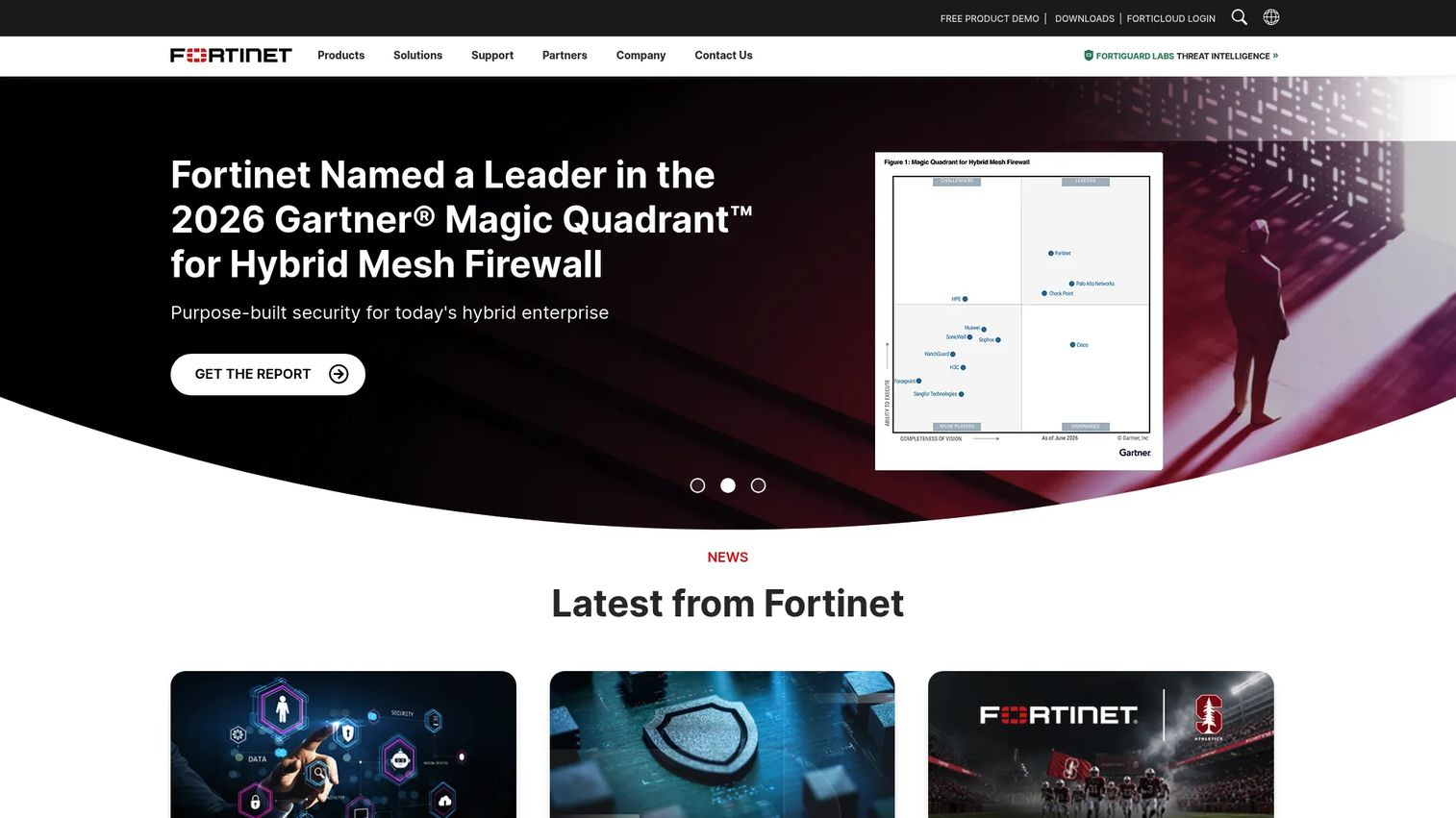
Fortinet Secure SD-WAN converges WAN controls and security on FortiOS, delivered through FortiGate appliances. Application-aware traffic steering and SLA-based path selection run alongside an integrated next-generation firewall, SSL inspection, intrusion prevention, antivirus, web filtering, and DLP. Centralized management, zero-touch provisioning, analytics, and reporting are handled through FortiManager and FortiAnalyzer.
Best for: Security-led IT teams standardizing branch connectivity and WAN policy around an existing Fortinet firewall environment.
Key features
- Application-aware traffic steering with SLA-based path selection
- Integrated NGFW: SSL inspection, IPS, antivirus, web filtering, DLP
- Centralized management and zero-touch provisioning
- Branch security policy enforcement at the WAN edge
- Secure remote and branch connectivity
Why choose Fortinet Secure SD-WAN: The case is strongest for teams already operating Fortinet firewalls who want networking and security decisions to share a management plane rather than running separate consoles. Validate management complexity, licensing structure, hardware requirements, and cloud integration depth during evaluation. Basic SD-WAN functionality is included with FortiGate devices without additional licensing.
Fortinet Secure SD-WAN pricing: Basic SD-WAN capability ships with FortiGate hardware at no additional licensing cost. Advanced SD-WAN capabilities are available through paid Service Bundles. Bundle pricing varies by appliance model, subscription term, and feature scope. Contact Fortinet or a partner for a current price list.
G2 rating: FortiGate SD-WAN holds a 4.6/5 rating on G2.
8. Cato SASE Cloud
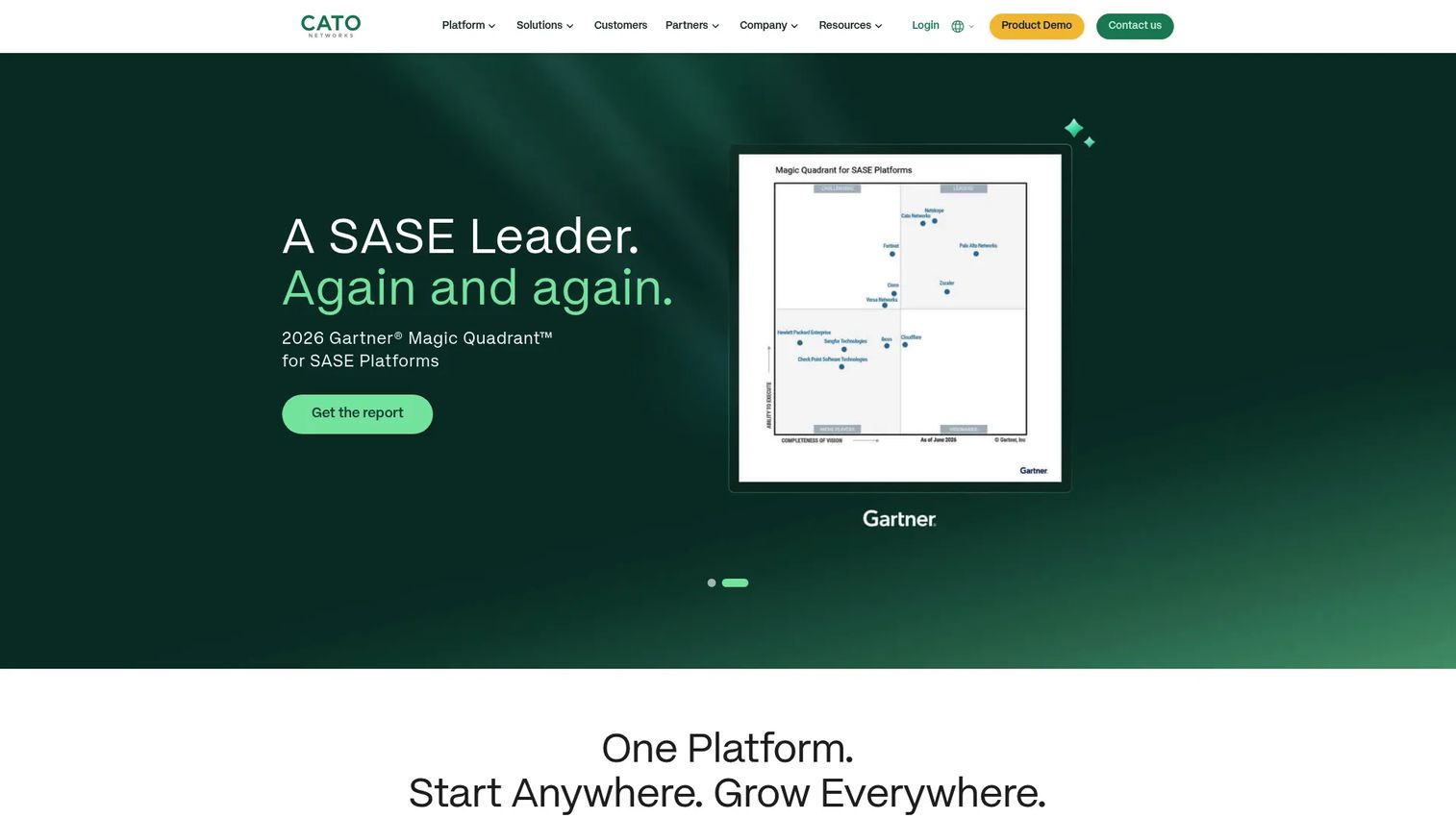
Cato SASE Cloud is a cloud-native platform converging enterprise networking and security on one centrally managed service. SD-WAN and a global private backbone handle connectivity. The SSE 360 security stack covers FWaaS, SWG, IPS, malware prevention, DNS security, RBI, CASB, DLP, and ZTNA. AI/ML-driven XDR handles threat detection and incident investigation. The Cato Client extends protection to remote users and endpoints.
Best for: Mid-market and enterprise organizations consolidating SD-WAN, network security, remote access, and security operations into one cloud platform.
Key features
- SD-WAN and global private backbone for site connectivity
- SSE 360 stack: FWaaS, SWG, IPS, CASB, DLP, ZTNA, RBI
- AI/ML-driven XDR and incident investigation
- Cato Client for secure remote and endpoint access
- Centralized management, analytics, and monitoring
Why choose Cato SASE Cloud: Cato addresses operational fragmentation between WAN management, remote access, and cloud security policy. Validate regional points of presence against your key user locations, confirm data-handling requirements for your compliance environment, and review integration depth with identity providers and observability tools before committing.
Cato SASE Cloud pricing: Cato uses user-based and site-bandwidth licensing with modular products. Commercial terms are handled through Cato or its authorized representatives. Contact Cato to receive a quote based on site count, user count, security modules, and contract duration.
G2 rating: Cato SASE Cloud holds a 4.5/5 rating on G2.
9. VersaONE Universal SASE Platform
VersaONE is an AI-powered platform unifying networking and security across users, devices, locations, applications, and workloads. The architecture covers SD-WAN, Security Service Edge, and SD-LAN under centralized orchestration. AI-powered analytics support threat detection and network automation. The platform supports deployment through direct enterprise agreements and service providers.
Best for: Enterprises and service providers that need broad SASE and SD-WAN flexibility across variable deployment models and customer environments.
Key features
- Unified SD-WAN, SSE, and SD-LAN architecture
- Zero Trust access and security across all traffic
- AI-powered analytics, threat detection, and automation
- SD-LAN management for campus and branch environments
- Centralized orchestration across deployment models
Why choose VersaONE: Flexibility is the defining characteristic. The platform fits organizations with complex environments that cannot standardize on a single network design across every location. Deployment architecture, security policy design, operations ownership, and integration mapping require careful planning. VersaONE is not a simple out-of-the-box setup, and that breadth is the point when the use case calls for it.
VersaONE Universal SASE Platform pricing: VersaONE pricing is licensed through service providers, partners, or direct enterprise agreements. Contact Versa Networks or an authorized partner to configure commercial terms for your deployment model and security scope.
G2 rating: Versa Networks holds a 4.5/5 rating on G2 across its portfolio.
10. Lumen NaaS

Lumen NaaS is a programmable Network-as-a-Service platform for on-demand internet, private connectivity, multi-cloud connections, and integrated security. Network provisioning and bandwidth scaling are controlled through API and portal. Built-in security draws on Black Lotus Labs threat intelligence. The platform publishes hourly pay-as-you-go rates for internet bandwidth tiers, making it one of the few NaaS providers to surface granular pricing.
Best for: Enterprises that need carrier-backed WAN, on-demand connectivity scaling, and service-provider accountability across multiple locations.
Key features
- On-demand provisioning and bandwidth scaling via API and portal
- Public and private connectivity across sites, data centers, and cloud providers
- Built-in security powered by Black Lotus Labs threat intelligence
- Usage-based, pay-as-you-go billing for internet services
- Term-based pricing available for predictable contract structures
Why choose Lumen NaaS: Carrier reach and service accountability drive this decision. Organizations with many locations across the United States, or those that need direct carrier relationships for SLA enforcement, fit this model. Review SLA specifics, implementation boundaries, and the separation between hourly internet services and broader managed WAN before engaging a contract.
Lumen NaaS pricing: Lumen publishes hourly pay-as-you-go rates for Intelligent Internet services. A 1 Mbps backup tier starts at $0.30/hour, 50 Mbps at $0.37/hour, 100 Mbps at $0.47/hour, 1 Gbps at $1.06/hour, and 10 Gbps at $3.93/hour. Term-based and broader enterprise WAN pricing is available by contacting Lumen directly.
Considerations when choosing a network as a service platform
Match the platform type to the workflow you need to change
Start with the job: Branch rollout, cloud connectivity, remote access, security convergence, or infrastructure procurement. A cloud interconnection platform and a managed SASE service are different products. Evaluating them against the same criteria produces the wrong outcome.
Measure application outcomes, not only link uptime
Ask how the platform exposes latency, packet loss, application-path performance, and incident history in reporting you can act on. A 99.9% uptime commitment does not tell you whether a critical customer workflow performed within acceptable bounds during a degradation event.
Validate the security and identity model end to end
Review segmentation, firewall capabilities, zero-trust access controls, encryption, logging, and identity-provider integration. For a Product Manager supporting enterprise customers, the security model must align with the product's own compliance commitments. A platform that cannot support identity-aware access or detailed audit logging may create compliance gaps.
Check integration and automation depth
Evaluate APIs, event exports, observability integrations, and cloud-provider compatibility. If your engineering team cannot connect network signals to existing monitoring workflows, the platform becomes another isolated console that generates alerts nobody acts on.
Read the commercial and exit terms before shortlisting
Cover bandwidth commitments, appliance requirements, minimum contract terms, connection fees, SLA credits, and migration support. NaaS changes the payment model, but it does not eliminate architectural lock-in. Understanding exit conditions before you sign is an engineering opportunity cost question as much as a procurement one.
Conclusion
The right NaaS platform depends on the operating model your organization wants to adopt, not on which vendor has the most capabilities listed on a product page.
Cisco+ and HPE GreenLake for Networking fit broad infrastructure consumption programs for teams with existing vendor relationships. Juniper NaaS connects consumption-based networking with AI-assisted operational visibility. Cloudflare WAN, Aryaka, Cato SASE Cloud, Fortinet Secure SD-WAN, and VersaONE address different combinations of WAN modernization and security convergence. Megaport fits programmatic multi-cloud interconnection. Lumen NaaS is the right call when carrier reach and service accountability across many locations drive the decision.
The most useful next step is not to schedule ten vendor demos. Shortlist two platforms that match your architecture, then run the evaluation around one live application path, one branch or remote access workflow, and one operational incident scenario. That exercise exposes whether a platform actually improves the work your teams do every week, or just replaces one management interface with another.
For teams evaluating complex software infrastructure, the way you demonstrate and explain that infrastructure to buyers and internal stakeholders matters as much as the technical selection. If your team needs to communicate the value of complex networking decisions to a buying committee or executive audience, Start your journey with Guideflow today!
FAQs
A network as a service platform delivers networking capabilities such as WAN connectivity, routing, security, and cloud interconnection through subscriptions, usage-based billing, or managed service agreements. The model shifts organizations away from purchasing and operating all network hardware themselves. Different platform types cover different jobs, from cloud interconnection to managed SASE to carrier-backed enterprise WAN.
SD-WAN is a technology and control model for managing WAN routing and application traffic. NaaS is a broader delivery and commercial model. Many NaaS offerings include SD-WAN as a core capability, but NaaS also covers cloud interconnection, wireless subscriptions, managed security services, and carrier-based connectivity that go well beyond SD-WAN routing alone.
SASE combines wide-area networking and cloud-delivered security into one architecture. It can be delivered as part of a NaaS offering, but NaaS includes other models that SASE does not address, such as cloud exchange interconnection, carrier-backed internet services, and hardware consumption programs. Treat SASE as one delivery pattern inside the broader NaaS category.
NaaS can replace or supplement MPLS depending on application requirements, site locations, underlay connectivity, latency tolerances, and security architecture. The replacement is not automatic. Teams should test critical application paths before migration and validate that the chosen NaaS platform's underlay coverage and SLA terms meet the performance commitments MPLS currently provides at each affected location.
Platforms support hybrid cloud through private interconnection between cloud providers and on-premise infrastructure, cloud routing, centralized policy management, application-aware traffic steering, and network visibility across public-cloud and private environments. The specific capability set varies significantly by platform type: Cloud interconnection services like Megaport focus on the connectivity layer, while SASE platforms add security policy and access control on top of the WAN.
Review application performance instrumentation, regional availability commitments, customer-impacting SLA terms, security and identity controls, API access for provisioning automation, observability integrations with your existing monitoring stack, and which team owns incident resolution. The operating model question matters as much as the feature set: Understand whether your team is operating the platform or the vendor is.
Pricing models vary across the category. Common structures include per-site subscriptions, bandwidth commitments, port and connection charges, hardware bundles, and managed-service contracts. Megaport publishes granular starting prices by service type. Lumen publishes hourly rates for internet bandwidth tiers. Most enterprise WAN and SASE platforms require a configured quote because pricing depends on site count, bandwidth, security modules, and term length.
NaaS can reduce manual provisioning work and hardware lifecycle management overhead. It does not remove the need for network architecture, security design, incident ownership, vendor management, and ongoing performance validation. Managed NaaS services shift more operational responsibility to the provider, but your team still owns SLA accountability, security policy governance, and integration with the broader platform and observability stack.