Your login endpoint took 400,000 requests overnight. Your activation cohort looks great on paper until you realize a third of those "signups" never attempted a real workflow. Your paid campaigns are burning budget on clicks that convert to nothing. Each of these problems has the same root cause: Automated traffic that your stack treats as human.
According to the Imperva 2025 Bad Bot Report, 37% of internet traffic in 2024 came from malicious bots, up from 32% the year before. For product and growth teams, that number lands in the worst possible places: Corrupted activation metrics, bloated trial lists, and support queues full of account-abuse tickets.
The harder problem is that most bot mitigation tools are built for security teams. Product managers get handed the bill in the form of user friction, bad analytics, and engineering firefighting. The right bot detection and mitigation software blocks automated abuse while keeping legitimate signup, checkout, and onboarding flows intact. That balance is what this guide helps you find.
What's inside
This guide compares 15 bot detection and mitigation software tools for 2026, covering enterprise bot management platforms, WAF-native controls, and specialized ad-fraud tools.
- Who it's for: Security, fraud, growth, and product teams dealing with login abuse, fake signups, scraping, or invalid paid traffic
- How tools were chosen: Category relevance, repeated SERP presence, and use-case coverage across websites, apps, and APIs
- What we compare: Detection methods, mitigation controls, pricing, and G2 ratings
- How to use it: Start by identifying your primary abuse pattern, then match to the deployment model that fits your stack
TL;DR
- Best for enterprise bot management: HUMAN Bot Defender or Akamai Bot Manager, depending on traffic scale and stack
- Best for API and web application protection: Cloudflare Bot Manager, Imperva Advanced Bot Management, or AWS WAF Bot Control
- Best for ecommerce abuse: DataDome, Radware Bot Manager, Arkose Labs, or Netacea
- Best for paid media fraud: CHEQ or ClickCease
- Best for teams inside a WAF stack: AppTrana, FortiWeb, Barracuda Advanced Bot Protection, or F5 Distributed Cloud Bot Defense
- Best evaluation rule: Identify the attack pattern first, then check false-positive handling and implementation effort before comparing pricing
What is bot detection and mitigation software?
Bot detection and mitigation software identifies automated traffic, separates malicious automation from legitimate users, and applies controls such as blocking, rate limiting, challenges, throttling, or workflow-specific defenses.
Three related terms are worth distinguishing before you evaluate vendors:
Bot detection is the identification layer. Tools evaluate signals to decide whether a request comes from a human or a script.
Bot mitigation is the action layer. After detection, the tool blocks, challenges, rate-limits, or routes traffic based on risk score and policy.
Bot management is the full operational layer: Detection, mitigation, policy tuning, reporting, analytics, and incident response over time.
Bot protection is the broader category term describing defense across websites, apps, APIs, and paid traffic.
Common signals bot detection tools evaluate
- Behavioral patterns (mouse movement, click cadence, session flow)
- Device fingerprinting
- IP reputation and proxy detection
- Session anomalies
- Traffic velocity and request rate
- Browser and automation signals (headless browsers, WebDriver)
- Login and transaction behavior
- API request patterns and authentication abuse
Common mitigation actions
- Block requests outright
- Challenge suspicious sessions (CAPTCHA, cryptographic, interactive)
- Rate-limit abusive traffic
- Throttle high-risk workflows
- Route traffic for human review
- Serve decoy or fake data to scrapers
- Protect login and checkout flows specifically
- Preserve access for legitimate users while filtering automation
Why false positives matter
A product manager's concern here is specific: If the bot mitigation tool blocks real users, it creates a conversion problem that looks like a product problem. Activation drops. Support tickets rise. A/B test results become untrustworthy. Strong anti bot software reduces automated abuse while keeping legitimate signup, checkout, and API usage intact. That's the bar worth holding vendors to.
When to use bot detection and mitigation software
Protect login and signup flows from abuse
Credential stuffing, password spraying, fake account creation, and trial abuse all hit login and signup endpoints. For a product manager, the operational cost shows up in distorted activation cohorts, inflated trial-to-paid denominators, and support queues full of account-abuse tickets. Bot mitigation at these endpoints cleans the funnel before the data reaches your instrumentation.
Stop scraping and inventory abuse
Price scraping, content scraping, inventory hoarding, and scalping hit ecommerce, ticketing, marketplaces, and SaaS catalog pages. Automated bots can clear inventory faster than human buyers, corrupt pricing signals, and reverse-engineer your product catalog. Tools in this category provide scraping prevention at the application layer, often without requiring changes to your product code.
Clean up paid acquisition and analytics
Invalid clicks, fake form fills, and campaign pollution corrupt CAC calculations and attribution models. When growth teams can't trust their funnel data, prioritization decisions suffer. Click fraud and invalid traffic tools address the ad-spend side of this problem, while broader bot management platforms protect the product analytics layer. Fixing data quality here is a prerequisite to reliable experimentation.
Bot detection and mitigation software comparison
Each tool below serves a different segment of the bot problem. The table uses verified pricing and G2 ratings from vendor pages and G2 listings at time of publication. Tools with no published numeric pricing show "Custom pricing."
| # | Product | Best for | Key differentiator | Pricing | G2 rating |
|---|---|---|---|---|---|
| 1 | Radware Bot Manager | Web, mobile, and API bot defense | AI behavioral detection with CAPTCHA-less challenges | Custom pricing | 4.6/5 |
| 2 | DataDome | Ecommerce and SaaS bot and fraud protection | Real-time detection with published tier pricing | From $3,830/mo | 4.7/5 |
| 3 | Cloudflare Bot Manager | Edge-based bot scoring inside Cloudflare stack | Per-request bot score with WAF rule integration | Enterprise add-on | 4.5/5 |
| 4 | AWS WAF Bot Control | AWS-native teams with existing WAF | Usage-based pricing with no seat fees | From $10/mo per Web ACL | 4.3/5 |
| 5 | Imperva Advanced Bot Management | Enterprise web, app, and API protection | Multilayered detection with behavioral and ML signals | Custom pricing | 4.1/5 |
| 6 | Akamai Bot Manager | High-traffic enterprise and global apps | Edge bot scoring at Akamai CDN scale | Custom pricing | 4.5/5 |
| 7 | HUMAN Bot Defender | Enterprise fraud and bot defense | Behavior-based detection across web, mobile, API | Custom pricing | 4.5/5 |
| 8 | Arkose Labs Bot Manager | High-risk signup and transaction flows | Adaptive challenges tied to fraud deterrence | Custom pricing | 4.7/5 |
| 9 | Netacea | Intent-driven bot management for digital platforms | Agentless AI detection with intent analytics | Custom pricing | 4.6/5 |
| 10 | AppTrana | Managed WAAP with bundled bot protection | WAF plus bot defense in a managed service | From $99/FQDN | N/A |
| 11 | F5 Distributed Cloud Bot Defense | Distributed apps across web, mobile, and API | Agent-aware classification across app surfaces | Custom pricing | 4.5/5 |
| 12 | Barracuda Advanced Bot Protection | Teams using Barracuda WAF | 10,000+ bot signature database with ML layer | Custom pricing | 4.4/5 |
| 13 | FortiWeb | Fortinet security stack teams | WAF plus bot mitigation in one Fortinet platform | Custom pricing | 4.8/5 |
| 14 | CHEQ | Marketing and growth teams protecting paid channels | Invalid traffic, fake leads, and analytics integrity | Custom pricing | 4.8/5 |
| 15 | ClickCease | SMB and mid-market PPC fraud protection | Google, Meta, and Microsoft Ads bot blocking | From $99/mo | 4.6/5 |
Best 15 bot detection and mitigation software tools for 2026
1. Radware Bot Manager
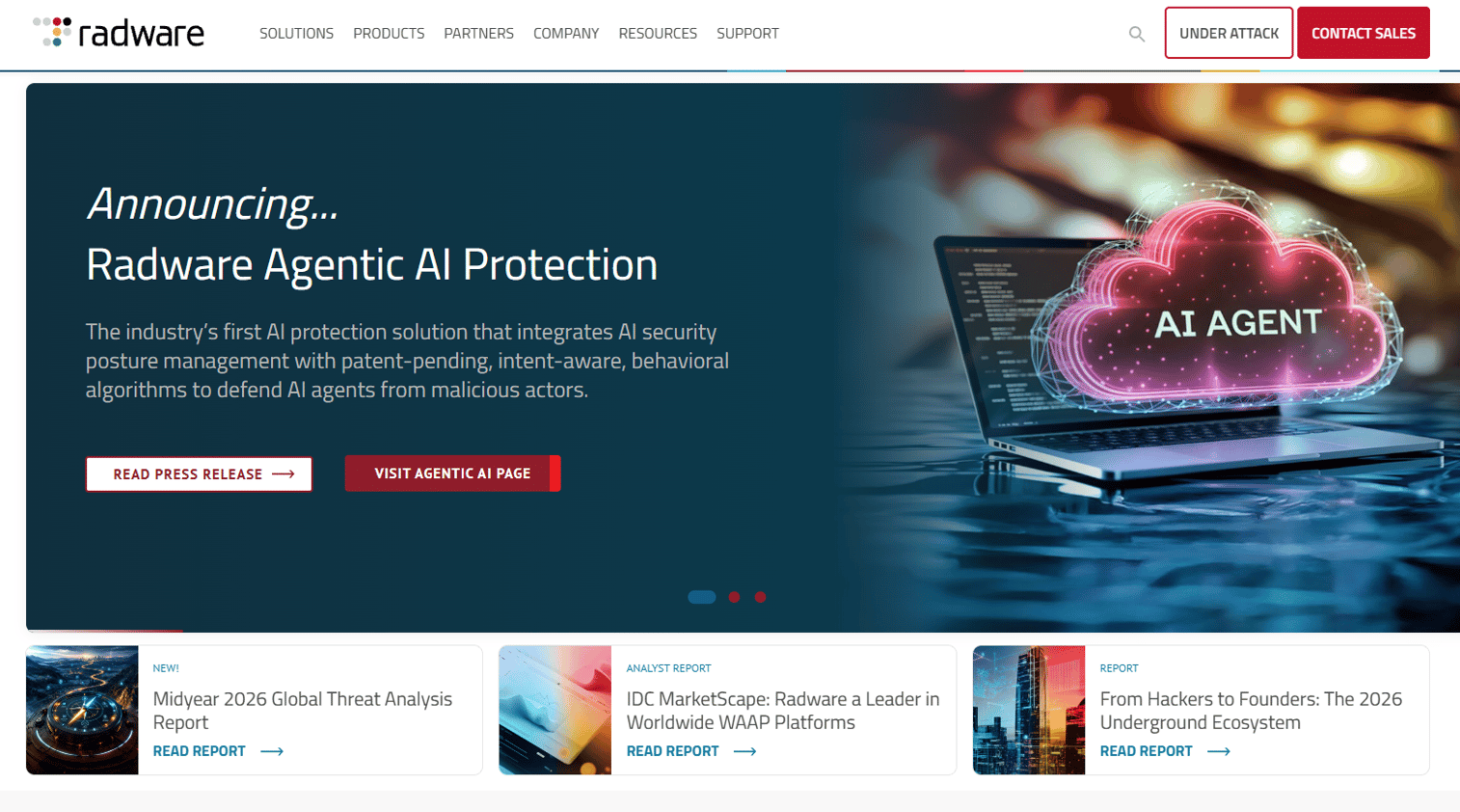
Radware Bot Manager is an AI-powered bot management platform for websites, mobile applications, and APIs. It detects sophisticated automated threats including account takeover, credential stuffing, scraping, and application abuse using behavioral analysis and device fingerprinting. The platform includes AI crawler management and visibility into AI agent traffic, which matters as automated AI-driven requests grow in volume. A 30-day complimentary trial is available for teams evaluating the platform.
Best for: Enterprises protecting web, mobile, and API surfaces from sophisticated bots and AI-driven threats.
Key features
- AI-based behavioral bot detection
- CAPTCHA-less cryptographic challenge mitigation
- Native mobile app protection
- AI crawler and AI agent visibility
- Transparent reporting and analytics
Why choose Radware Bot Manager: Product teams dealing with account-takeover attempts or scraping across multiple digital surfaces will find value in Radware's behavioral detection depth. It suits security-led teams that need granular controls and managed support options.
Radware Bot Manager pricing: Commercial pricing requires a sales conversation. Radware offers a 30-day trial to evaluate the platform before committing.
G2 rating: 4.6/5
2. DataDome
DataDome is a cyberfraud protection platform that covers bot detection, account fraud, L7 DDoS mitigation, and AI-agent traffic management across websites, mobile apps, and APIs. It publishes transparent tier pricing, which is unusual in this category and makes initial budget conversations with engineering and finance easier. The platform also includes a virtual waiting room for high-demand events and ad-fraud protection for marketing teams.
Best for: Ecommerce, marketplace, and SaaS teams that need real-time bot protection with strong user-experience controls and predictable monthly pricing.
Key features
- AI-powered bot and fraud detection
- Account takeover and fake-account prevention
- L7 DDoS protection
- AI-agent detection and policy control
- Virtual waiting room for traffic spikes
Why choose DataDome: The published pricing model makes DataDome easier to evaluate against budget than most enterprise bot platforms. Ecommerce and growth teams will particularly care about its checkout and signup protection, where false positives carry direct conversion cost.
DataDome pricing: Plans start at $3,830/month (Essentials), with Advanced at $8,670/month, Premium at $10,160/month, and Enterprise from $13,270/month. Pricing scales with request volume, detection models, and support level.
G2 rating: 4.7/5
3. Cloudflare Bot Manager
Cloudflare Bot Manager adds per-request bot scoring and enforcement to Cloudflare's existing application security stack. Every request receives a bot score from 1 to 99, and WAF rules or Cloudflare Workers can act on that score with blocking, challenging, or rate-limiting. The platform includes bot analytics, verified-bot handling, and controls for AI-agent traffic. Teams already running Cloudflare for CDN or WAF get bot management as a natural extension of their existing toolchain.
Best for: Teams already on Cloudflare Enterprise that want bot detection integrated into the same platform they use for WAF and CDN policy.
Key features
- Per-request bot scoring (1 to 99)
- Custom WAF rules and Workers actions based on score
- Bot analytics and traffic analysis
- Verified-bot and AI-bot controls
- Path-specific and static-resource protection
Why choose Cloudflare Bot Manager: For product and security teams that want centralized policy management without adding another vendor, Cloudflare's bot scoring integrates directly into existing firewall rules. The tradeoff is that it's an enterprise add-on and requires the broader Cloudflare contract.
Cloudflare Bot Manager pricing: Bot Management is a paid add-on to Cloudflare Enterprise plans. Specific pricing requires contacting the Cloudflare account team.
G2 rating: 4.5/5
4. AWS WAF Bot Control
AWS WAF Bot Control adds managed bot detection to existing AWS WAF deployments. It offers two rule groups: Common Bot Control for signatures, TLS fingerprinting, and known-bot categories, and Targeted Bot Control for behavioral heuristics and machine learning against more sophisticated automation. AWS also includes AI traffic monetization at no additional charge, which lets teams set policy and pricing for authorized AI-agent access to their content.
Best for: AWS-native teams that want bot control as part of existing WAF infrastructure, without introducing a new security vendor.
Key features
- Common and targeted managed bot rules
- Bot classification labels with request-level visibility
- CloudWatch dashboards and visibility
- AI traffic monetization with configurable pricing
- Web Bot Authentication for verified AI agents
Why choose AWS WAF Bot Control: If your application already routes through AWS WAF, this is the lowest-friction path to bot detection. The usage-based pricing model means costs scale with actual traffic, and infrastructure teams avoid a separate vendor onboarding process.
AWS WAF Bot Control pricing: Common Bot Control costs $10/month per Web ACL, with the first 10 million requests/month free, then $1.00 per million requests. Targeted Bot Control is also $10/month per Web ACL, with the first 1 million requests/month free, then $10.00 per million requests.
G2 rating: 4.3/5
5. Imperva Advanced Bot Management
Imperva Advanced Bot Management protects websites, mobile apps, and APIs from automated threats including scraping, account takeover, credential stuffing, and API abuse. Detection uses a multilayered approach combining device fingerprinting, browser validation, behavioral analysis, machine learning, and threat intelligence. Mitigation actions include block, allow, CAPTCHA, challenge, rate-limit, monitor, and delay, giving security teams granular response options per endpoint. The platform also covers OWASP Automated Threats categories.
Best for: Enterprises in regulated industries or high-traffic verticals that need mature bot mitigation alongside broader application and data security.
Key features
- Multilayered detection: Fingerprinting, behavioral, ML, and threat intel
- OWASP Automated Threat coverage
- Granular mitigation responses per endpoint
- API abuse protection
- Account abuse prevention
Why choose Imperva Advanced Bot Management: Security teams running complex application environments with high fraud sensitivity will value Imperva's depth of detection and customizable response policies. Product managers should ask specifically about false-positive rates and allowlist management during evaluation.
Imperva Advanced Bot Management pricing: Contact their sales team with traffic volume, app count, API scope, and support requirements to get a quote.
G2 rating: 4.1/5
6. Akamai Bot Manager
Akamai Bot Manager is an edge-based bot management product for detecting and mitigating sophisticated automated traffic. It assigns a bot score from 0 (human) to 100 (bot) and supports nuanced mitigation actions including challenges, slowing, denial, and serving alternate responses. The platform includes known-bot directories, custom bot categorization, real-time and historical reporting, and SIEM integrations. It comes in Standard and Premier tiers, with a mobile protection module available separately.
Best for: Large enterprises with high-traffic websites, global applications, and existing Akamai contracts that need bot management at the edge.
Key features
- Edge bot detection and scoring (0 to 100)
- Known-bot directories and custom bot categories
- Nuanced mitigation: Challenge, slow, deny, alternate response
- Real-time and historical bot-traffic reporting
- SIEM and API integrations
Why choose Akamai Bot Manager: For brands where downtime, latency, and abusive automation all carry revenue impact, Akamai's global edge network is a meaningful advantage. Teams should come to pricing conversations with traffic volume, app count, and mobile surface requirements.
Akamai Bot Manager pricing: It depends on traffic volume, product tier (Standard or Premier), and Akamai contract scope.
G2 rating: 4.5/5
7. HUMAN Bot Defender
HUMAN Bot Defender (now part of HUMAN Sightline Cyberfraud Defense) uses machine learning and behavioral analysis to detect and mitigate automated attacks across web, mobile, and API applications. It evaluates hundreds of signals including behavioral patterns, browser fingerprinting, mobile telemetry, and network characteristics. The platform targets sophisticated bots that mimic human behavior, which is the category Imperva's 2025 Bad Bot Report identified as making up 45% of malicious bot traffic in 2024.
Best for: Enterprise security and fraud teams that need bot defense tied to fraud prevention and require third-party recognition and customer proof.
Key features
- Machine-learning detection using hundreds of signals
- Behavioral analysis and browser, mobile, and network fingerprinting
- Configurable policies: Block, challenge, allow, deny
- Fraud-prevention signal integration
- API abuse protection
Why choose HUMAN Bot Defender: Product managers protecting high-value user journeys, particularly login, account creation, and transaction flows, will value HUMAN's focus on sophisticated bot behavior rather than known signatures. Licensing is based on monthly requests.
HUMAN Bot Defender pricing: HUMAN licenses by monthly request volume; contact their team with protected app count and traffic details.
G2 rating: 4.5/5
8. Arkose Labs Bot Manager
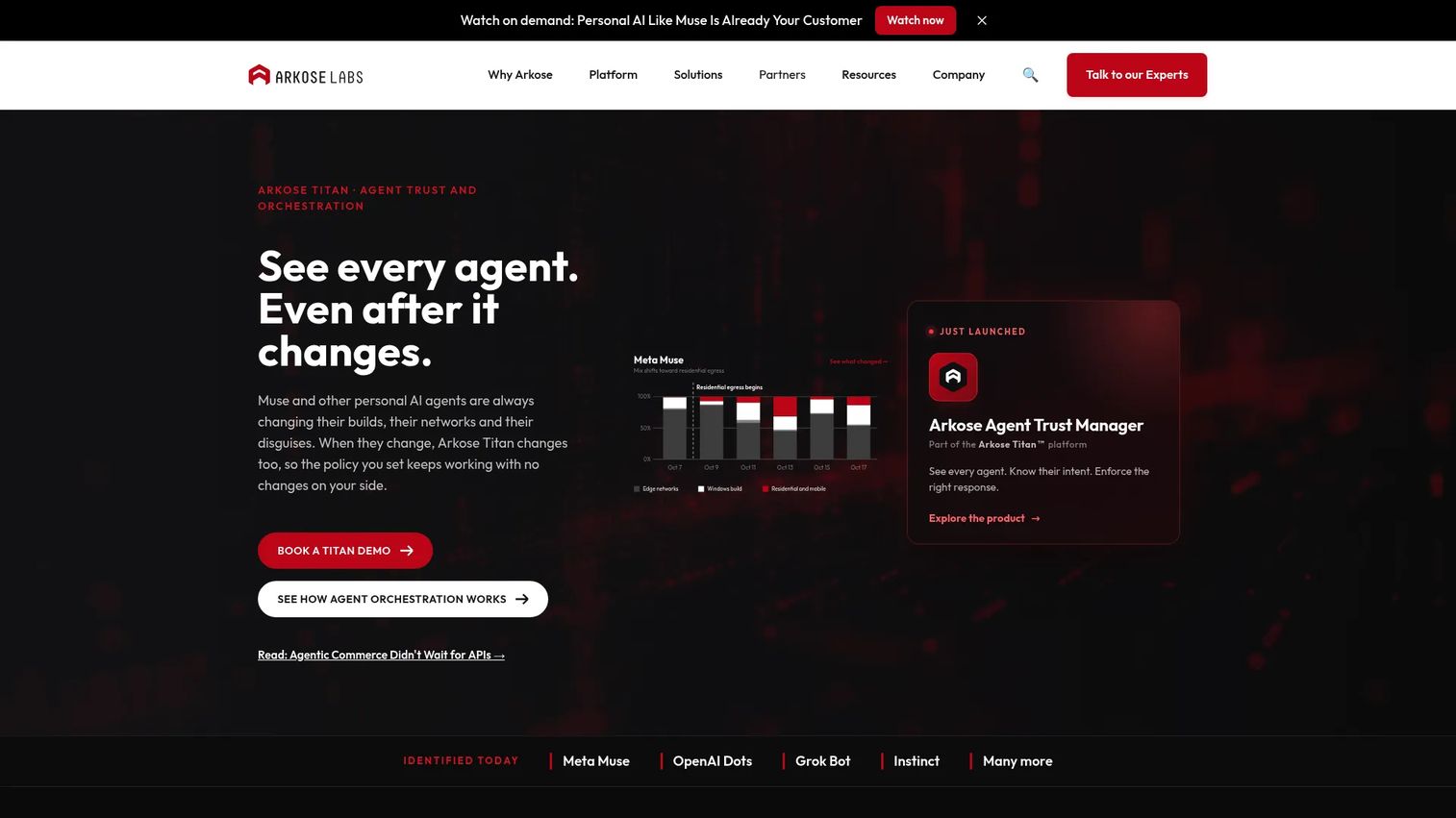
Arkose Labs Bot Manager combines bot detection with fraud deterrence through adaptive, risk-based challenges. It draws on 225+ risk signals and the Arkose Global Intelligence Network to distinguish legitimate users from automated abuse. Rather than relying on static rules, the platform applies challenges in real time against emerging attack vectors. It targets high-value flows including login, signup, checkout, and transaction endpoints, with specific coverage for credential stuffing, SMS toll fraud, and account creation abuse.
Best for: Enterprises where bots attack valuable, high-consequence workflows rather than broad traffic volume.
Key features
- 225+ risk signals and global threat intelligence
- Adaptive, real-time challenge enforcement
- Low-friction differentiation of users and bots
- Fraud deterrence for signup, login, and transaction flows
- Business-insight dashboards
Why choose Arkose Labs Bot Manager: Teams whose product depends on clean account creation and login integrity, particularly those facing sophisticated credential abuse, should evaluate Arkose's challenge model. Product managers should assess challenge friction carefully during a proof-of-concept, since the enforcement model directly affects user experience.
Arkose Labs Bot Manager pricing: Bring attack volume, protected workflow count, and enforcement model requirements to the sales conversation.
G2 rating: 4.7/5
9. Netacea
Netacea provides agentless bot management using AI-driven real-time detection and intent analytics. The agentless integration model means no code changes are required on your application side; Netacea connects to websites, APIs, and apps without an agent or SDK. The platform covers credential stuffing, scraping, scalping, fake account creation, and account takeover, with active attack intelligence and managed bot expertise backing its threat response.
Best for: Ecommerce, travel, ticketing, and digital platforms facing abuse across high-value workflows, particularly where deployment simplicity matters.
Key features
- Agentless integration across web, API, and apps
- AI-driven real-time bot detection
- Intent analytics for understanding attack objectives
- Active attack intelligence
- Managed bot expertise and threat response
Why choose Netacea: The agentless model reduces implementation friction, which is valuable for product teams trying to avoid a long engineering engagement. For PMs who want to understand which user journeys are under attack, Netacea's intent analytics provide more context than a raw block/allow count.
Netacea pricing: Contact Netacea with traffic volume, protected surface count, and managed service requirements.
G2 rating: 4.6/5
10. AppTrana
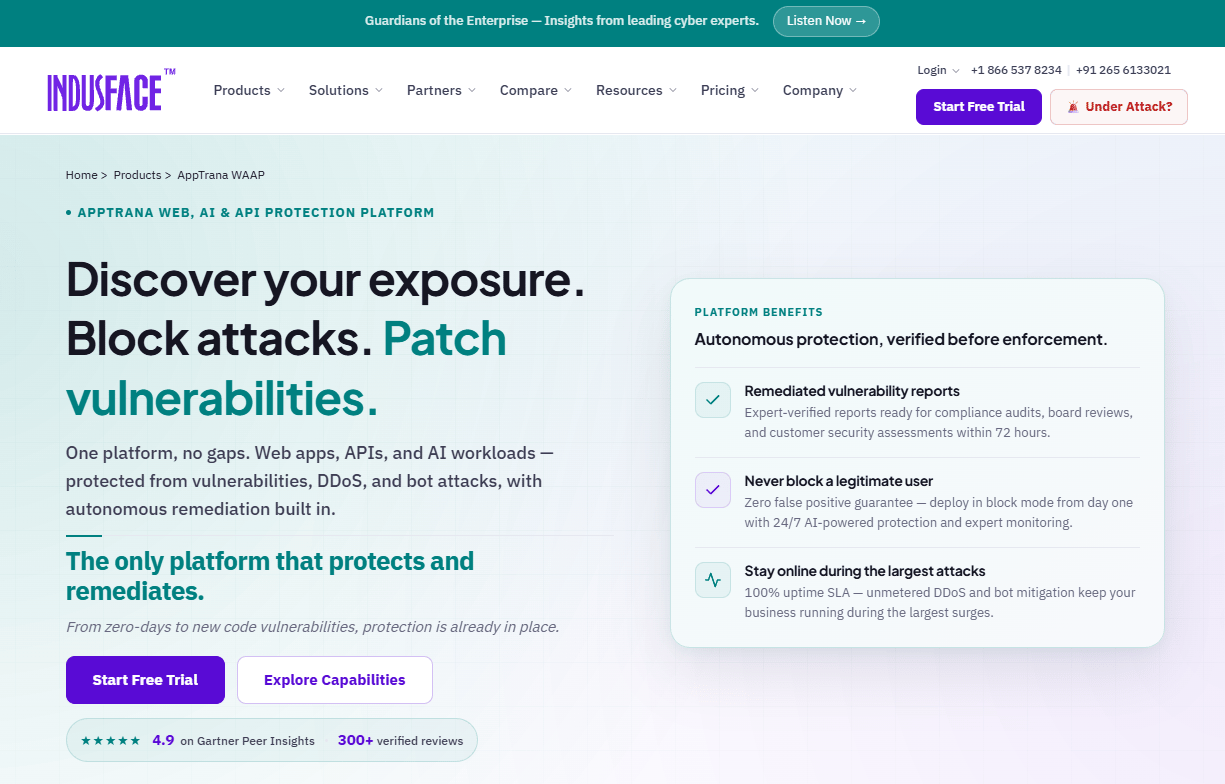
AppTrana is Indusface's web application and API protection platform, bundling WAF, bot mitigation, DDoS protection, API security, and vulnerability scanning into a managed service. It includes SwyftComply for autonomous vulnerability remediation and 24x7 managed security operations. Teams that want bot protection but lack a dedicated security operations function will find the managed-service model valuable. For API security tools needs bundled with bot defense, AppTrana covers both in one platform.
Best for: Organizations that want fully managed application security rather than a standalone bot-only product, particularly those with lean security operations.
Key features
- Managed web application firewall
- Bot and DDoS protection
- API security with shadow API discovery
- DAST/application security scanning
- 24x7 managed security services
Why choose AppTrana: Teams without a dedicated security operations team get a fully managed layer for bot protection alongside WAF and API security. The tradeoff is less customization compared to pure-play bot platforms.
AppTrana pricing: The Advanced plan starts at $99 per FQDN. Premium and Enterprise plans use custom pricing.
11. F5 Distributed Cloud Bot Defense
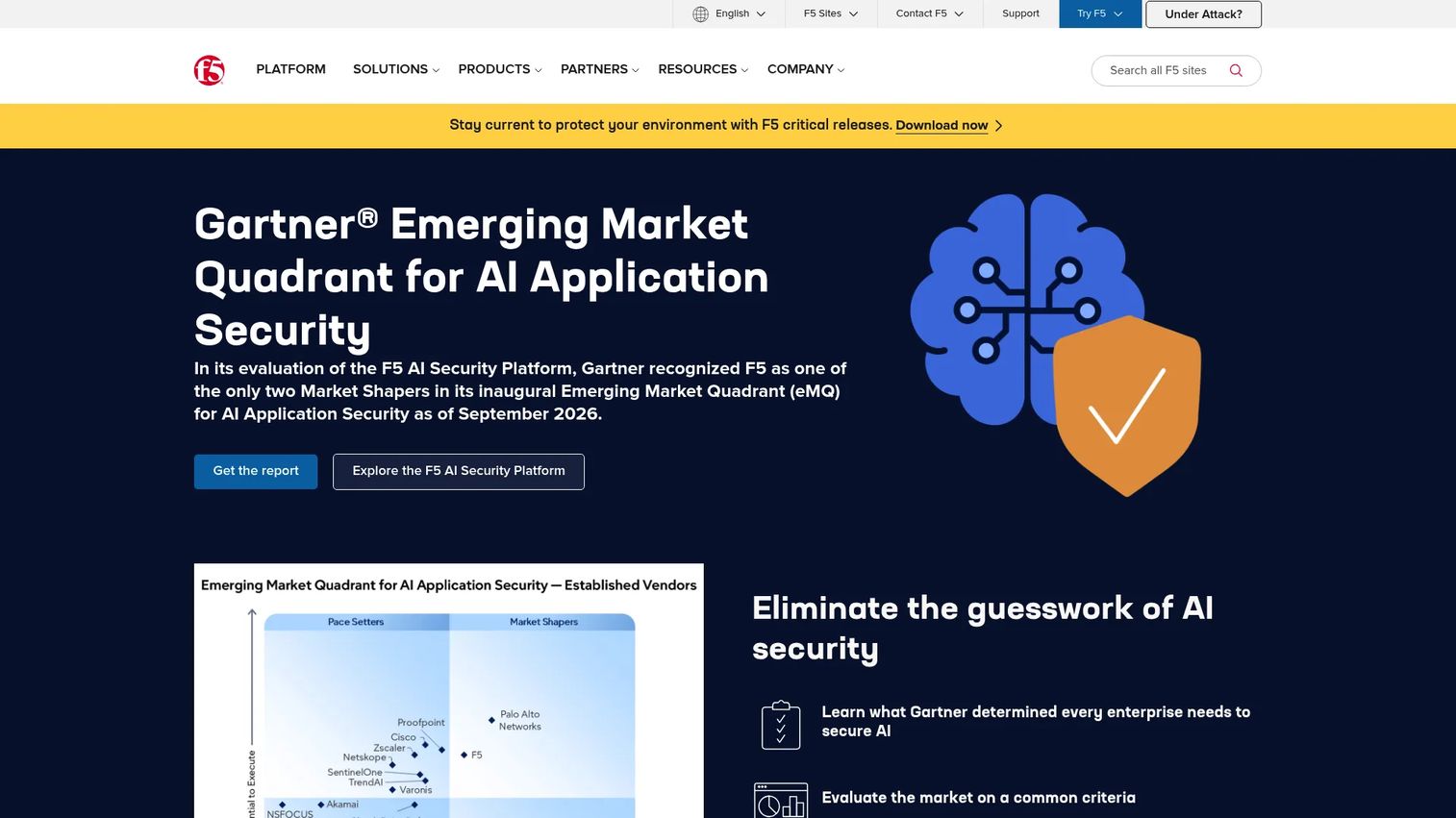
F5 Distributed Cloud Bot Defense protects web applications, mobile apps, and APIs from sophisticated automated abuse. It uses agent-aware classification to distinguish humans, trusted AI agents, and malicious automation, drawing on real-time behavioral analysis and client-side telemetry. Coverage spans credential stuffing, fake account creation, scraping, and account takeover. The platform offers self-service Web and Mobile tiers, plus Advanced and Premium managed bundles for teams that need broader bot-defense orchestration.
Best for: Enterprises with distributed apps spanning web, mobile, and API surfaces, particularly those already using F5 infrastructure.
Key features
- Agent-aware classification of humans, trusted AI, and malicious bots
- Real-time behavioral analysis and client-side telemetry
- Mobile SDK support
- Credential stuffing and account takeover defense
- Advanced and Premium managed bundles
Why choose F5 Distributed Cloud Bot Defense: Product teams running complex environments across web, mobile, and API should evaluate F5's distributed coverage model. Engineering teams should assess the mobile SDK integration requirements early in the evaluation.
F5 Distributed Cloud Bot Defense pricing: F5 offers Web Defense and Mobile Defense self-service tiers, plus Advanced and Premium managed bundles.
G2 rating: 4.5/5
12. Barracuda Advanced Bot Protection
Barracuda Advanced Bot Protection connects bot mitigation to Barracuda's web application firewall and application protection platform. The Advanced plan covers machine-learning bot detection, web scraping and bot spam defense, credential stuffing prevention, CAPTCHA and JavaScript challenges, and a signature database of over 10,000 bot patterns. The Premium plan adds automated API discovery and client-side protection for teams protecting more complex surfaces.
Best for: Teams already using Barracuda security products that want bot mitigation inside the same management layer.
Key features
- Machine-learning bot detection
- 10,000+ bot signature database
- Credential stuffing and brute-force prevention
- CAPTCHA and JavaScript challenges
- Client fingerprinting and control
Why choose Barracuda Advanced Bot Protection: Organizations that already standardize on Barracuda get bot mitigation as a natural extension of their existing WAF setup, reducing vendor sprawl. IT-led security teams will find the unified management layer easier to operate than a separate bot platform.
Barracuda Advanced Bot Protection pricing: Advanced and Premium plans are available; both use customized price quotes. Contact Barracuda for details.
G2 rating: 4.4/5
13. FortiWeb
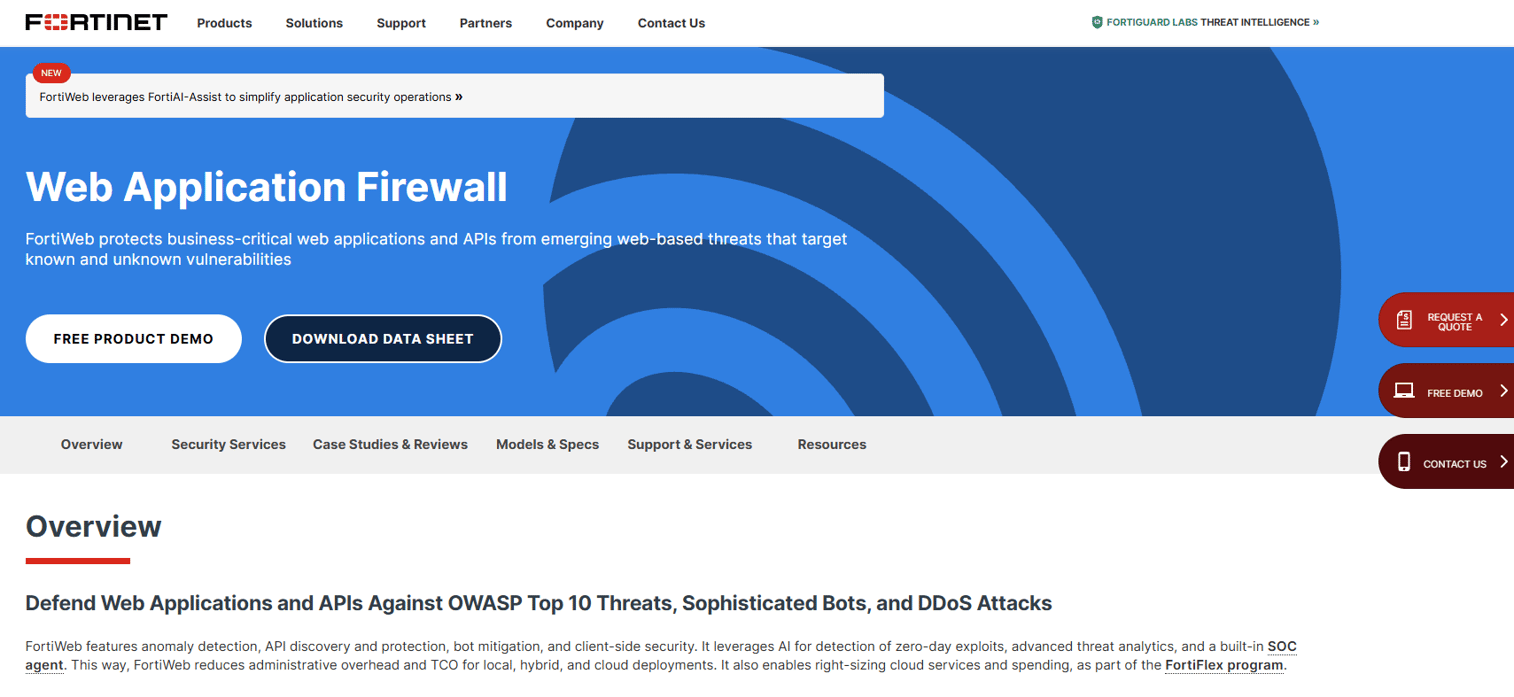
FortiWeb is Fortinet's web application firewall with integrated bot mitigation, API protection, machine-learning anomaly detection, and client-side security. It deploys as hardware, virtual appliance, container, public cloud instance, or SaaS WAF across FortiAppSec Cloud Standard, Advanced, and Enterprise tiers. Teams that have standardized on the Fortinet security fabric get FortiWeb as a consistent policy layer alongside their broader infrastructure.
Best for: Fortinet-centered security teams that want bot mitigation bundled with WAF protection in a familiar management environment.
Key features
- Web application firewall covering OWASP Top 10 and zero-day threats
- Advanced bot mitigation and machine-learning anomaly detection
- API discovery and protection
- Client-side security
- Deployment across hardware, virtual, container, cloud, and SaaS
Why choose FortiWeb: Teams already in the Fortinet ecosystem get bot mitigation as part of a unified platform without introducing a new vendor or management console. Buyers comparing FortiWeb to standalone bot platforms should check the depth of bot-specific analytics and tuning capabilities against their specific attack patterns.
FortiWeb pricing: Subscription pricing varies by tier (Standard, Advanced, Enterprise) and deployment model.
G2 rating: 4.8/5
14. CHEQ
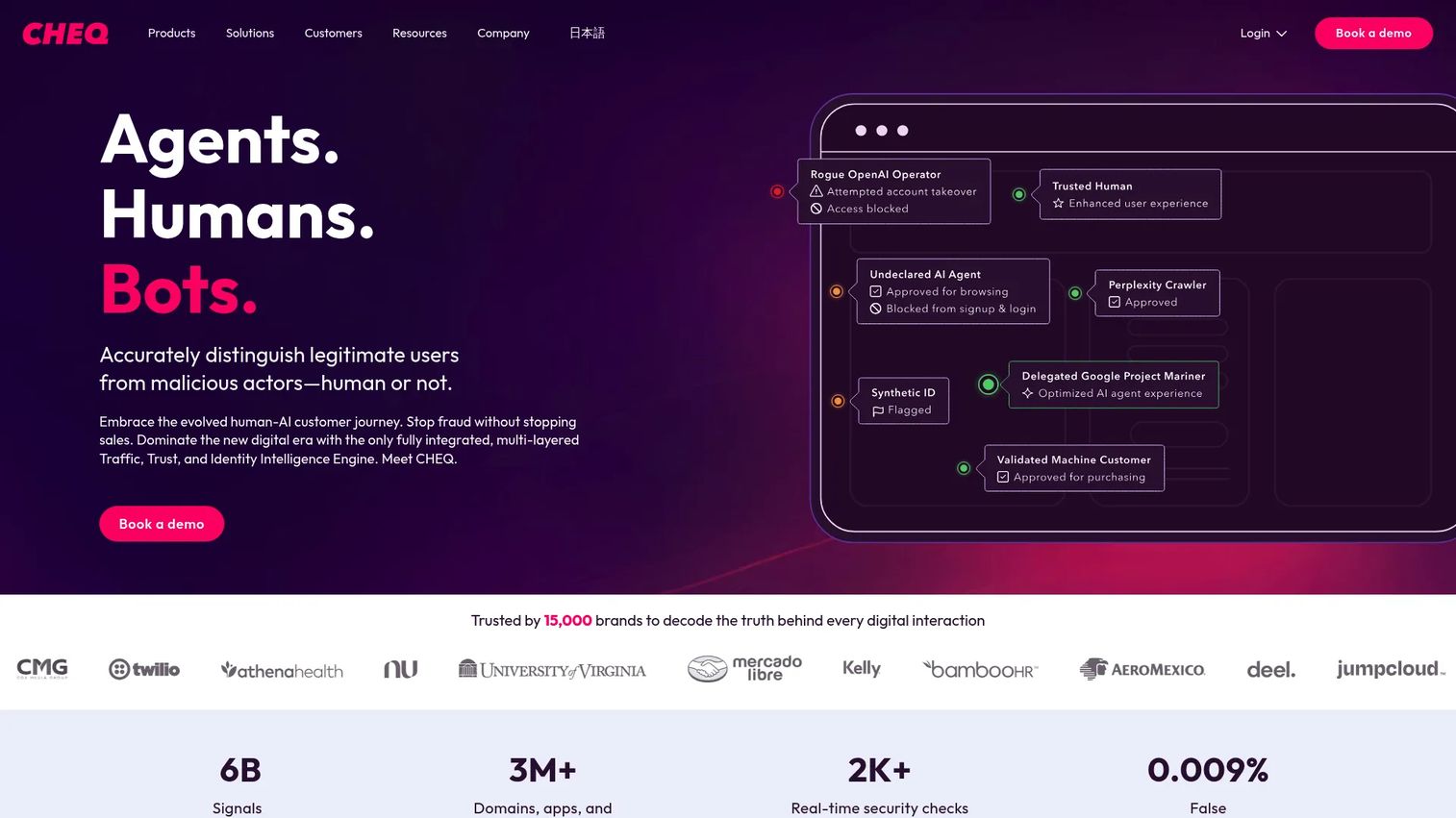
CHEQ is a go-to-market security platform that identifies and governs bots, AI agents, fraudulent activity, and other invalid traffic across paid media, websites, forms, and APIs. It applies policy-based controls including allow, monitor, step-up, rate-limit, redirect, and block across digital channels. CHEQ specifically addresses the marketing-side of the bot problem: Invalid traffic polluting CAC metrics, fake leads entering CRM, form spam clogging revenue workflows, and bot clicks burning paid acquisition budgets.
Best for: Marketing and growth teams protecting paid acquisition, lead quality, and funnel analytics from bot-driven pollution.
Key features
- Bot and AI-agent detection and classification
- Paid-media and invalid-traffic protection
- Form and funnel protection against fake users
- Analytics integrity and traffic-quality reporting
- Client-side script, tag, privacy, and data-leakage protection
Why choose CHEQ: Product and growth teams whose primary bot problem shows up in CAC, lead quality, and attribution data will find CHEQ's marketing-layer focus more relevant than a broad application security platform. This is distinct from enterprise web application bot defense.
CHEQ pricing: CHEQ directs buyers to request a personalized demo for pricing. Bring ad spend volume, protected channels, and traffic details to the conversation.
G2 rating: 4.8/5
15. ClickCease
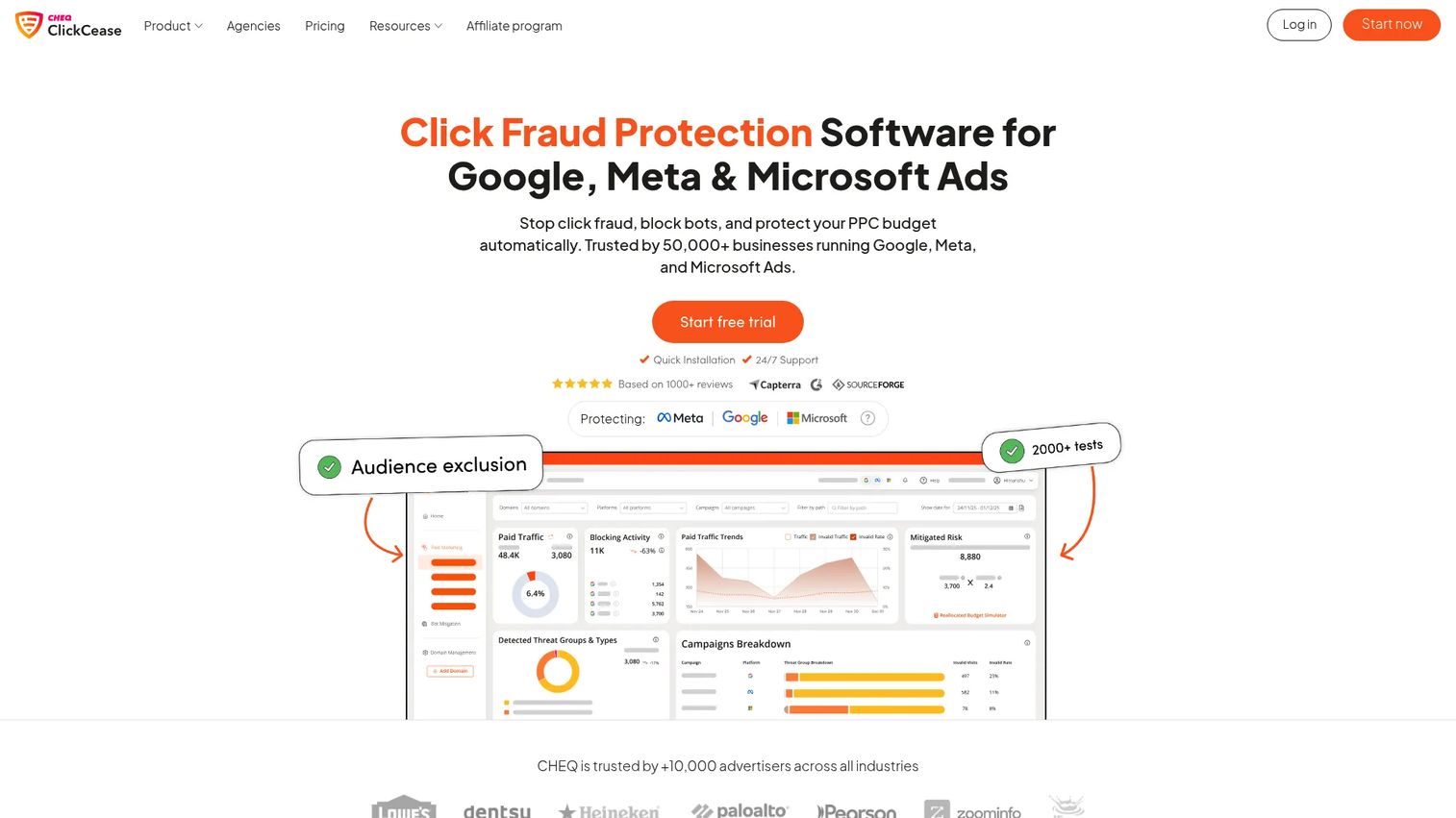
ClickCease is an ad-protection tool that detects and blocks invalid traffic across Google, Meta, and Microsoft Ads. It runs over 2,000 behavioral and technical tests per visit and automatically pushes exclusion lists to ad platforms to block detected invalid sources. It includes Lead Shield for HubSpot lead validation and Pixel Guard Connector for data-quality protection. A 7-day free trial is available.
Best for: Small and mid-sized marketing teams focused on PPC fraud protection across paid advertising campaigns.
Key features
- Real-time invalid-traffic detection and blocking
- Protection across Google, Meta, and Microsoft Ads
- 2,000+ behavioral and technical tests per visit
- Lead Shield for HubSpot lead validation
- Competitor click blocking
Why choose ClickCease: Teams whose immediate problem is wasted paid spend and degraded lead quality have a focused, affordable tool here. ClickCease is not a broad application security platform, so teams dealing with login abuse, API scraping, or account takeover should look further up this list.
ClickCease pricing: Starter plan starts at $99/month (1 website, up to 5k monthly traffic). Pro is $149/month (up to 10 websites, 40k traffic). Advanced is $349/month (up to 20 websites, 80k traffic). A 7-day free trial is available.
G2 rating: 4.6/5
Considerations when choosing bot detection and mitigation software
Match the tool to the abuse pattern
Credential stuffing, scraping, ad fraud, API abuse, fake account creation, and inventory hoarding each require different controls. A tool built for click-fraud prevention won't stop credential stuffing on a login endpoint. Before shortlisting vendors, map the specific attacks hitting your product and paid channels, then filter to tools that explicitly cover those patterns.
Check false-positive handling
A bot mitigation tool that blocks real users creates a conversion problem that shows up in your activation and retention metrics before it shows up in a security report. Ask every vendor about challenge frequency, allowlist management, risk threshold tuning, reporting on blocked legitimate requests, and rollback paths when a rule misfires. This question matters more for product teams than for security-only buyers.
Evaluate deployment fit
CDN or edge deployment, WAF-native controls, JavaScript tags, SDKs, reverse proxy, and API integration each carry different engineering costs. Teams with existing Cloudflare, AWS WAF, or Fortinet stacks can extend bot controls without new vendor onboarding. Teams without an existing WAF may find a managed WAAP like AppTrana faster to implement than a standalone enterprise platform. Check the mobile surface requirements separately.
Review reporting and analytics integration
Product and growth teams need reporting that maps to their instrumentation. Look for account-level signals, event exports, dashboard visibility, and integrations with analytics platforms, CRM, and alerting tools. A tool that only reports to a security dashboard won't serve the PM who needs to understand which signup cohorts contain bot-inflated activation rates.
Understand managed support and tuning expectations
Bot mitigation is not set-and-forget. Attack patterns evolve, rules need tuning, and false-positive incidents require rapid response. Ask vendors about onboarding support, attack-response SLAs, who owns policy changes, and how much engineering involvement is expected during steady-state operation. For lean teams, managed-service tiers reduce that overhead significantly.
Conclusion
Bot traffic hit 37% of the internet in 2024 (Imperva 2025 Bad Bot Report), and product teams absorb much of that damage in the form of corrupted cohorts, inflated trial lists, and unreliable experimentation data.
The right tool depends on where the problem hits your stack. For enterprise web and API defense, start with HUMAN Bot Defender, Akamai Bot Manager, or Cloudflare Bot Manager. For cloud-native AWS teams, AWS WAF Bot Control is the lowest-friction path. For ecommerce and high-risk transaction flows, evaluate DataDome, Radware, or Netacea's false-positive controls carefully. For paid acquisition and lead quality, CHEQ and ClickCease address the marketing layer. For teams inside an existing WAF stack, AppTrana, FortiWeb, Barracuda, or F5 extend protection without adding a new vendor.
The practical next step: Shortlist three vendors by abuse pattern, run a proof-of-concept against real traffic, and measure both bot-block rate and legitimate-user impact before committing. False-positive rate during the POC tells you more than any benchmark.
Start your journey with Guideflow today!
FAQs
Bot detection and mitigation software identifies automated traffic on websites, apps, and APIs, then applies controls to block, challenge, or rate-limit that traffic. Detection evaluates signals like behavioral patterns, device fingerprints, IP reputation, and session anomalies. Mitigation takes action after detection, ranging from outright blocking to serving decoy data to scrapers.
Bot detection is the identification layer: Determining whether a request comes from a human or a script. Bot management is the full operational discipline, which includes detection, mitigation policy, analytics, tuning, and ongoing incident response. Most enterprise platforms cover both; simpler tools may focus on detection without deep management workflows.
Risk scoring, behavioral analysis, allowlists, progressive challenges, and policy tuning all reduce false-positive rates. Rather than applying a binary block to any flagged request, risk-based tools assign a confidence score and escalate the response accordingly. Product teams should ask vendors specifically about false-positive rates during proof-of-concept testing, since blocked legitimate users show up as activation drops, not security alerts.
API-heavy teams should look for tools that provide API-specific visibility, authentication abuse detection, rate limiting per endpoint, WAF integration, and reporting tied to API traffic patterns. Cloudflare Bot Manager, AWS WAF Bot Control, Imperva Advanced Bot Management, and F5 Distributed Cloud Bot Defense all cover API protection explicitly. AppTrana includes API security alongside bot defense in a managed service.
Ecommerce teams dealing with inventory hoarding, scalping, checkout abuse, and price scraping should evaluate DataDome, Radware Bot Manager, Netacea, and Arkose Labs. Each addresses ecommerce-specific abuse patterns. Latency impact and false-positive rates at checkout are the two metrics most likely to affect revenue directly, so request ecommerce-specific references during vendor evaluation.
Some tools significantly reduce CAPTCHA reliance through risk-based scoring and low-friction challenge mechanisms. Radware uses CAPTCHA-less cryptographic challenges. Cloudflare offers Turnstile as a CAPTCHA alternative. High-risk flows, such as login or account creation under active attack, may still trigger challenges. The goal for most platforms is to minimize challenge friction for legitimate users while maintaining enforcement against automation.
Pricing scales primarily with traffic volume, number of protected domains or endpoints, API coverage, and managed-service level. ClickCease starts at $99/month for small PPC campaigns. AWS WAF Bot Control starts at $10/month per Web ACL plus request fees. DataDome publishes tier pricing starting at $3,830/month for enterprise bot protection. Most enterprise platforms, including Radware, Akamai, HUMAN, Arkose, and CHEQ, use custom pricing based on traffic, apps, and support scope.
PMs should evaluate bot protection through the lens of product health rather than security posture. The key questions: Does this tool reduce fake signups without creating friction for legitimate users? Will it clean up the activation and retention data that drives prioritization? How much engineering does implementation require? Does it integrate with the analytics stack and alert on incidents that affect product metrics? Run any candidate tool through a proof-of-concept that measures both the bot-block rate and the impact on legitimate-user conversion before committing.