A signup spike looks like growth. Until your activation rate drops, support tickets pile up, and your infrastructure bill jumps 40% with no corresponding revenue. That's the problem with malicious bots: They look like users until the metrics tell you otherwise.
According to Thales (2025), 37% of global internet traffic came from malicious bots in 2024, up from 32% the year before. The hard part is not blocking all automation. Search crawlers, monitoring agents, and legitimate integrations all generate automated requests. The real challenge is separating harmful traffic from useful traffic without creating false positives that hurt real customers.
For a Series B founder, this decision affects gross margin, CAC, NRR, and board confidence. A bot protection gap that goes unaddressed can inflate paid traffic costs, distort activation metrics, and create security incidents that demand engineering time you don't have.
This guide covers 19 bot detection software tools, explains the category, and helps you match each tool to the business problem it actually solves.
What's inside
This guide is written for Series B SaaS founders and the security, product, and growth leaders they delegate to. Tools were selected based on four criteria:
- Coverage: Does the tool protect websites, APIs, mobile apps, or all three?
- Mitigation depth: Can it block, challenge, rate-limit, or serve alternate content?
- Use case fit: Does it address account abuse, ad fraud, scraping, or infrastructure attacks?
- Pricing transparency: Are costs verifiable without a six-week sales process?
No tool preview here. Use the comparison table to shortlist, then read the relevant entries.
TL;DR
- Best broad bot management platform: DataDome, with real-time detection across web, mobile, and API surfaces
- Best for enterprise bot mitigation: Radware Bot Manager, with behavioral analysis and WAF integration
- Best for device and visitor intelligence: Fingerprint, for persistent identification and fraud signals
- Best for edge security teams: Cloudflare Bot Management, integrated with CDN and WAF controls
- Best for account abuse prevention: Arkose Labs, using adaptive challenges and fraud workflows
- Best for paid traffic and click fraud: ClickCease, CHEQ, Lunio, Anura, or Fraudlogix depending on channel mix
- Best free starting point: IPQS offers a free tier with 1,000 lookups per month, scaling to paid plans
What is bot detection software?
Bot detection software identifies automated requests, assigns traffic classifications, and triggers actions based on risk. It sits between your infrastructure and incoming traffic, analyzing signals to determine whether a visitor is a person, a legitimate crawler, or a malicious script.
The main detection signals include:
- IP reputation and network origin
- Device fingerprinting
- Browser and device consistency checks
- Request velocity and session patterns
- Mouse, touch, and navigation behavior
- Account and transaction context
- Known bot signatures and behavioral analysis
- Machine learning models trained on traffic patterns
- Threat intelligence feeds
Common attack types bot detection software addresses:
- Credential stuffing and account takeover
- Fake account creation
- Web scraping of pricing, content, or product data
- Inventory hoarding and ticket scalping
- Carding and transaction abuse
- Click fraud on paid advertising
- API abuse and request floods
- DDoS-related automation targeting infrastructure
Detection versus mitigation
Detection identifies and classifies the traffic. Mitigation determines what happens next. Many buyers confuse the two, but buying a detection tool without mitigation controls gives you a dashboard, not protection.
| Capability | Detection | Mitigation |
|---|---|---|
| Primary job | Classify traffic | Apply an action |
| Typical signals | IP, device, behavior, velocity | Risk score, policy, endpoint |
| Output | Bot classification or score | Allow, challenge, throttle, block |
| Success measure | Detection accuracy | Reduced abuse with acceptable false positives |
Mitigation actions range from monitoring and rate limiting to challenge presentation, alternate content, manual review routing, and blocking. The right mix depends on your traffic profile and tolerance for false positives.
When to use bot detection software
Protect signups and authentication
Automated credential abuse distorts your activation and retention numbers. A signup spike driven by bots looks like growth until your onboarding completion rate collapses and support tickets rise. Bot detection at login and registration lets you confirm whether your cohort metrics reflect real users, which matters when a board asks about activation rate by cohort.
Protect revenue events
Checkout flows, promotional campaigns, inventory drops, and limited-access releases all attract automation. Scripts can hoard inventory before legitimate customers reach it, test stolen card numbers at checkout, or exhaust promotional credits in seconds. Bot protection at these points prevents direct financial losses and the customer frustration that follows.
Protect infrastructure and APIs
Web scraping, API flooding, and expensive-endpoint abuse inflate infrastructure costs without generating revenue. For a company managing gross margin toward a fundraise, uncontrolled bot traffic is a hidden cost center. Bot mitigation at the API layer also removes a common source of engineering escalations that pull your team away from product work.
Bot detection software comparison
The 19 tools below cover seven distinct use case categories: Broad bot management, device and visitor intelligence, account abuse prevention, edge and application security, high-demand access control, paid traffic and ad fraud, and IP and transaction risk intelligence.
Pricing and G2 ratings were verified on September 30, 2026. Security software packaging changes frequently, so confirm current pricing directly with each vendor before committing.
| # | Product | Best for | Key differentiator | Pricing | G2 rating |
|---|---|---|---|---|---|
| 1 | DataDome | Broad bot management | Real-time detection across web, mobile, and API | From $3,830/mo | 4.7/5 |
| 2 | Radware Bot Manager | Enterprise bot mitigation | Behavioral analysis with WAF integration | Custom pricing | 4.6/5 |
| 3 | Fingerprint | Device intelligence | Persistent visitor identification and bot signals | From $200/mo | 4.7/5 |
| 4 | Cloudflare Bot Management | Edge security teams | Bot controls integrated with CDN and WAF | Enterprise add-on | Not listed |
| 5 | Arkose Labs | Account abuse prevention | Adaptive challenges and fraud workflows | Custom pricing | 4.7/5 |
| 6 | Reblaze | Managed bot protection | WAF and DDoS with configurable traffic policies | Custom pricing | 4.7/5 |
| 7 | HUMAN Sightline | Sophisticated automated fraud | Actor-level visibility and adaptive trust decisioning | Custom pricing | 4.5/5 |
| 8 | Queue-it Virtual Waiting Room | High-demand access control | Fair access during launches and inventory drops | From $1,499/event | 4.7/5 |
| 9 | ClickCease | Click fraud prevention | Paid advertising traffic monitoring and blocking | From $69/mo | 4.6/5 |
| 10 | GeeTest CAPTCHA | CAPTCHA and challenge flows | Risk-based verification with invisible and challenge modes | Custom pricing | 4.5/5 |
| 11 | AppTrana | Managed application security | WAF and bot protection with managed monitoring | Custom pricing | 4.8/5 |
| 12 | IPQS | IP and fraud intelligence | IP reputation, proxy detection, and fraud scoring | Free tier; from $99/mo | 4.6/5 |
| 13 | Opticks | Transaction fraud detection | Invalid-traffic detection for digital advertising | From €50/mo | 4.7/5 |
| 14 | CHEQ | Marketing fraud prevention | Invalid traffic detection for paid campaigns | Custom pricing | 4.8/5 |
| 15 | Lunio | Paid traffic quality | Machine-learning click fraud and ad traffic protection | Custom pricing | 4.6/5 |
| 16 | Anura | Advertising fraud detection | SIVT and GIVT detection for ad traffic | Custom pricing | 4.6/5 |
| 17 | Castle | Account and identity abuse | Behavioral risk scoring for logins and signups | Free tier; from $200/mo | 3.7/5 |
| 18 | Imperva Sonar | Application security teams | Data activity monitoring within broader protection stack | Custom pricing | Not listed |
| 19 | Fraudlogix | Ad fraud and traffic filtering | IP risk scoring and programmatic IVT detection | Free tier; $2,500/mo (Pro) | 4.4/5 |
Pricing and ratings verified September 30, 2026, from each vendor's pricing page and G2 listing.
19 best bot detection tools reviewed
1. DataDome
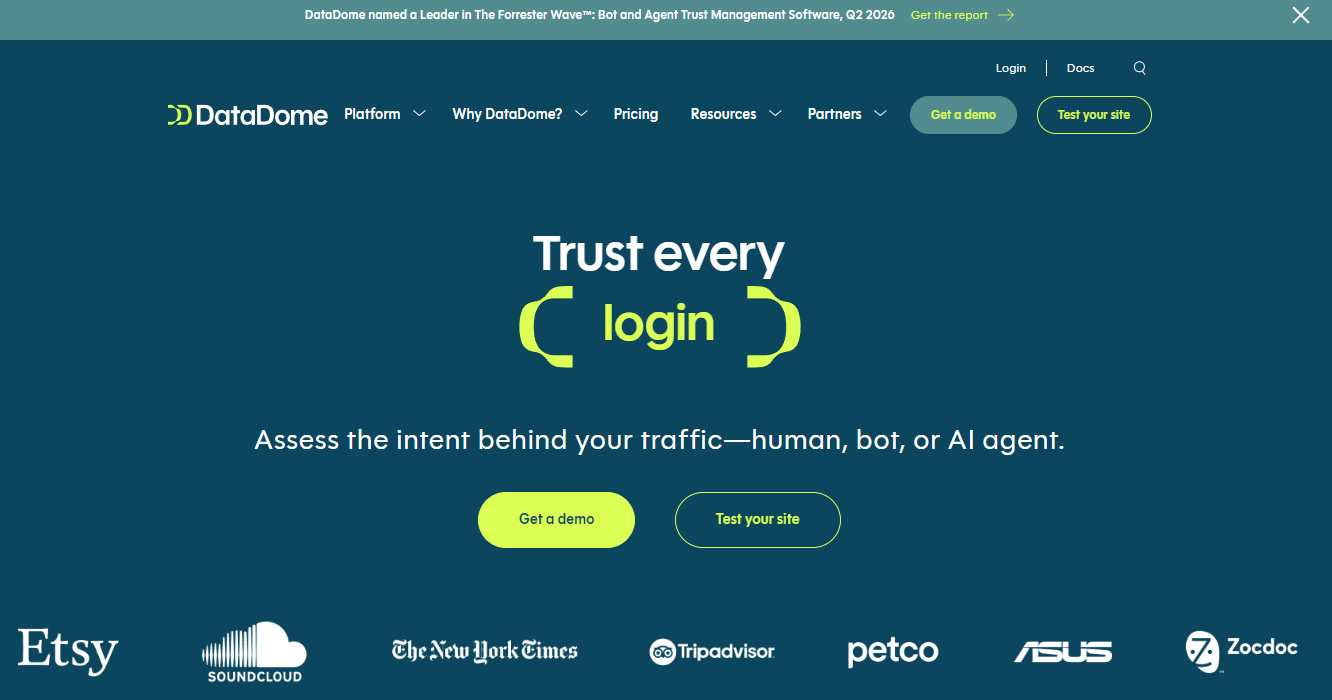
DataDome is a real-time cyberfraud protection platform covering websites, mobile apps, APIs, and MCP servers. It classifies every request in under two milliseconds at the edge and includes a dedicated 24/7 security operations team. The platform protects against account takeover, web scraping, scalping, carding, and Layer 7 DDoS attacks.
Best for: SaaS companies that need coverage across multiple customer-facing surfaces from one platform.
Key features
- Real-time AI-powered bot detection and mitigation across web, mobile, and API
- Agent Trust for governing AI-agent and MCP server traffic
- Account takeover, scraping, scalping, carding, and DDoS protection
- Sub-2-millisecond edge detection and enforcement
- 24/7 dedicated security operations support
Why choose DataDome: If you want broad coverage without building internal detection infrastructure, DataDome handles the operational burden. It fits teams that need a single vendor protecting all traffic surfaces rather than assembling a layered stack.
DataDome pricing: Plans start at $3,830/month (Essentials), with Advanced at $8,670/month, Premium at $10,160/month, and Enterprise from $13,270/month. Essentials covers websites and web APIs; higher tiers add mobile protection, enterprise SLAs, SSO, and custom detection models.
DataDome carries a G2 rating of 4.7/5.
2. Radware Bot Manager
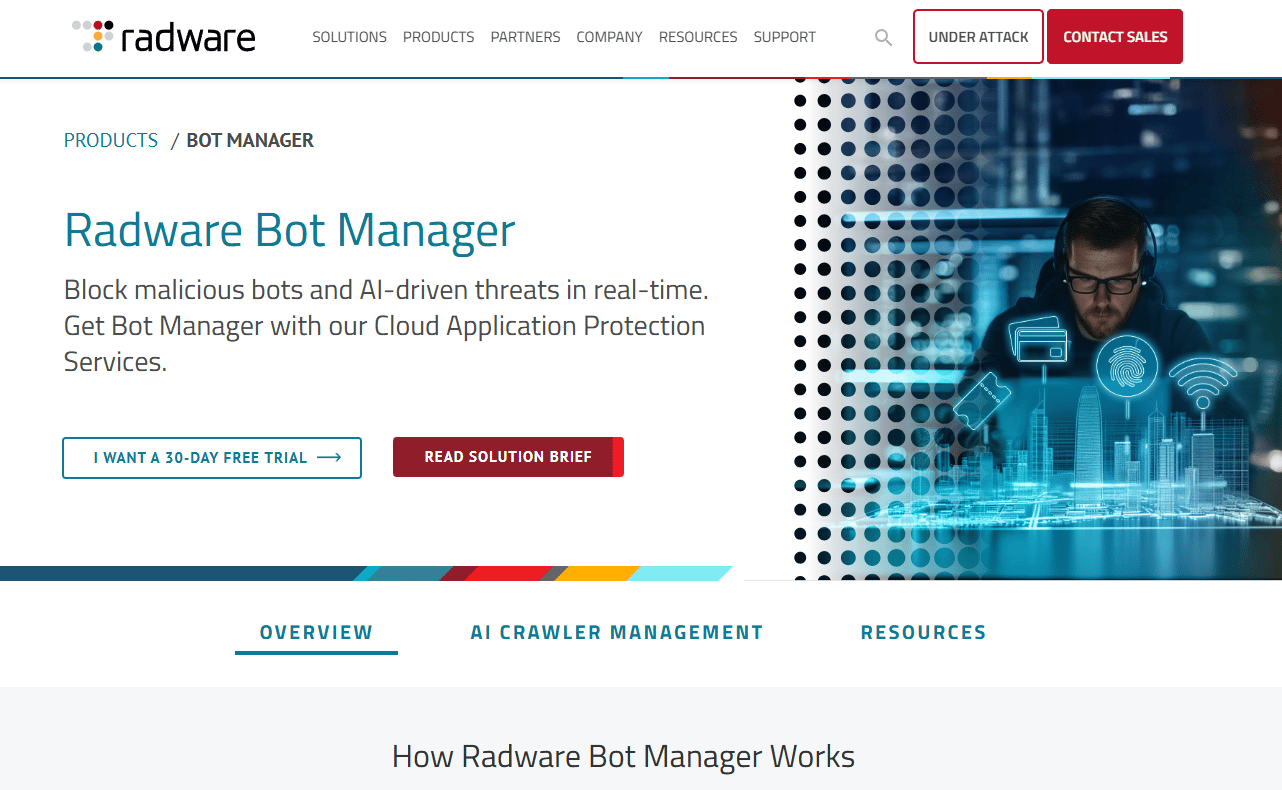
Radware Bot Manager provides AI-powered bot protection for web applications, mobile apps, and APIs, with behavioral analysis designed for high-traffic enterprise environments. It integrates with existing application security infrastructure, including WAF deployments, and offers CAPTCHA-less mitigation options for reducing user friction.
Best for: Security teams managing complex application environments with high request volumes.
Key features
- AI-based behavioral detection across web, mobile, and API
- CAPTCHA-less mitigation workflows
- AI crawler management and agent visibility
- Native mobile app protection
- Attack investigation and policy management
Why choose Radware Bot Manager: The behavioral detection depth and WAF integration make it a strong fit for security teams that already operate Radware infrastructure or want to consolidate application protection. A 30-day free trial is available.
Radware Bot Manager pricing: Radware directs all pricing inquiries to their sales team. Contact Radware for a quote based on traffic volume and deployment scope.
Radware Bot Manager carries a G2 rating of 4.6/5.
3. Fingerprint
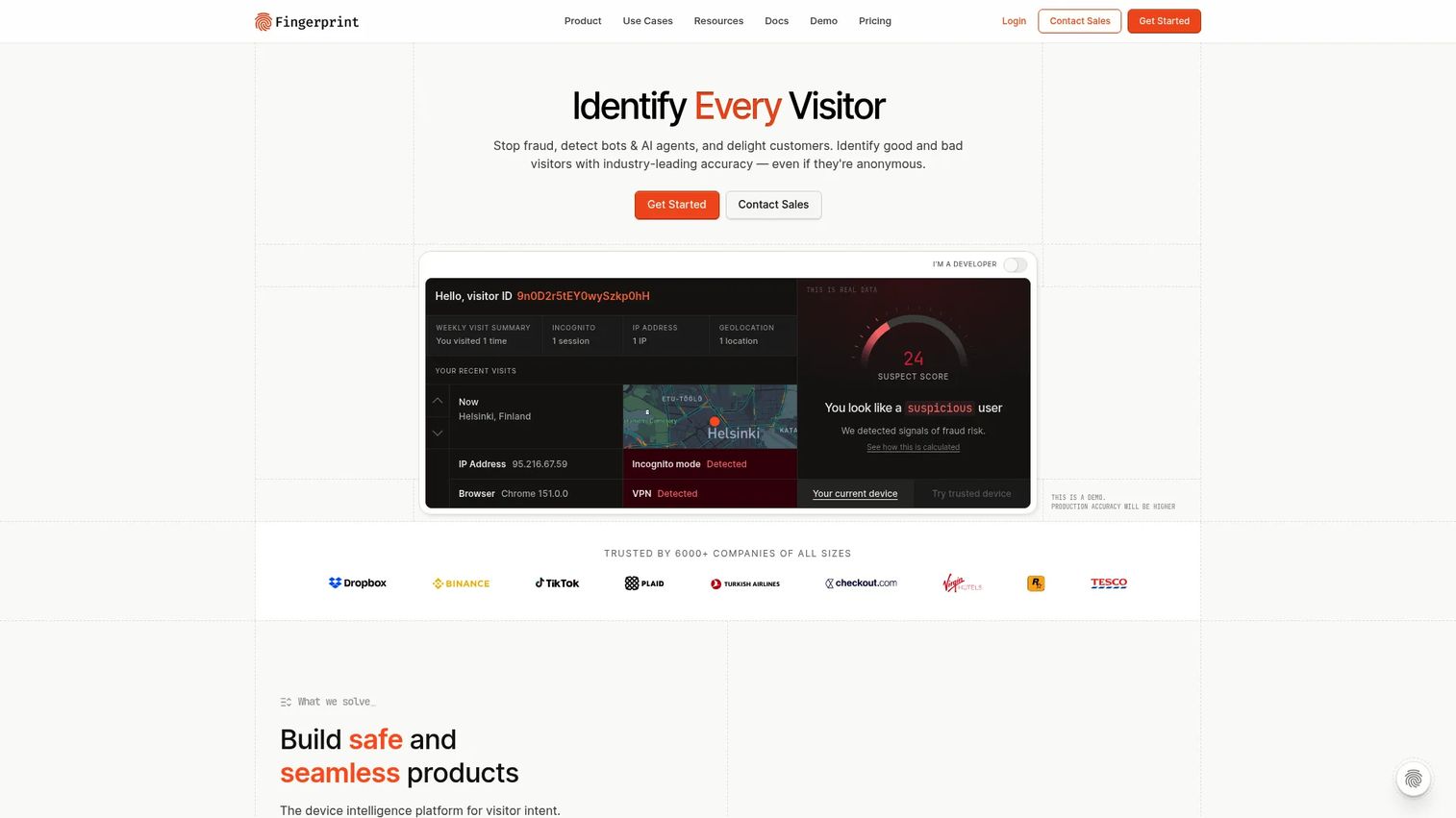
Fingerprint is a device intelligence and fraud prevention platform that generates persistent visitor identifiers for web and mobile. It provides bot detection signals, smart signals covering 100+ device and network attributes, and risk data via API. Teams use it to prevent account takeover, payment fraud, repeated fake signups, and bot abuse.
Best for: Engineering and fraud teams that need persistent visitor context to power downstream decisions.
Key features
- Persistent visitor identification across browsers and devices
- Bot and AI-agent detection
- Smart Signals with 100+ device, network, and behavioral attributes
- VPN, proxy, and browser-tampering detection
- Web and mobile SDKs plus server-side API
Why choose Fingerprint: Fingerprint operates as a signal layer rather than a full bot management platform. It pairs well with rule engines, fraud platforms, or custom enforcement logic, making it a strong choice when you want to own policy decisions but need reliable identification data.
Fingerprint pricing: The Pro plan starts at $200/month for 100,000 API calls. Pro Plus starts at $400/month at the same call volume. Enterprise pricing requires contacting sales.
Fingerprint carries a G2 rating of 4.7/5.
4. Cloudflare Bot Management
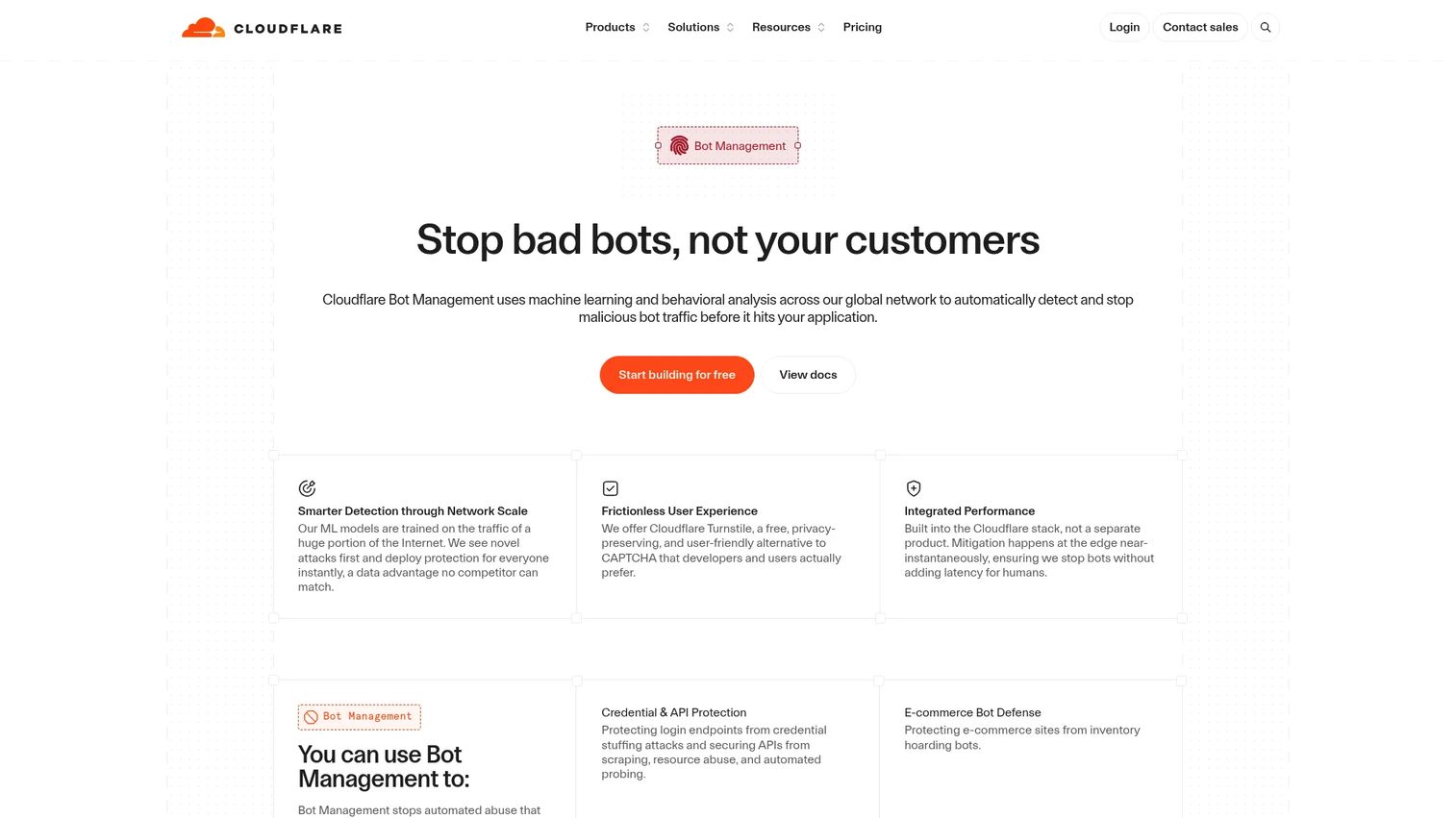
Cloudflare Bot Management assigns a bot score from 1 to 99 to every request, integrating directly with Cloudflare's WAF, CDN, and edge services. Teams write custom rules and Workers actions based on that score, creating enforcement logic close to the request origin without adding latency. Bot Analytics and detailed traffic logs support investigation.
Best for: SaaS companies already operating on Cloudflare's edge who want bot controls within their existing stack.
Key features
- Per-request bot scoring (1 to 99)
- Custom WAF rules and Workers actions based on bot score
- Controls for verified bots, AI bots, and headless browsers
- Bot Analytics and detailed traffic logs
- Domain-specific anomaly detection
Why choose Cloudflare Bot Management: Stack consolidation is the primary argument. If your team runs Cloudflare for CDN and application security, adding bot management keeps policy enforcement in one control plane. Standalone bot platforms offer deeper investigation workflows, but Cloudflare wins on integration simplicity.
Cloudflare Bot Management pricing: Bot Management for Enterprise is a paid add-on for eligible Enterprise plans. Cloudflare does not publish a product-specific price; contact your account team to enable and price it.
Cloudflare Bot Management does not have a standalone G2 listing. Capterra reports a platform-level Cloudflare rating of 4.7/5, though this reflects the broader Cloudflare product suite.
5. Arkose Labs
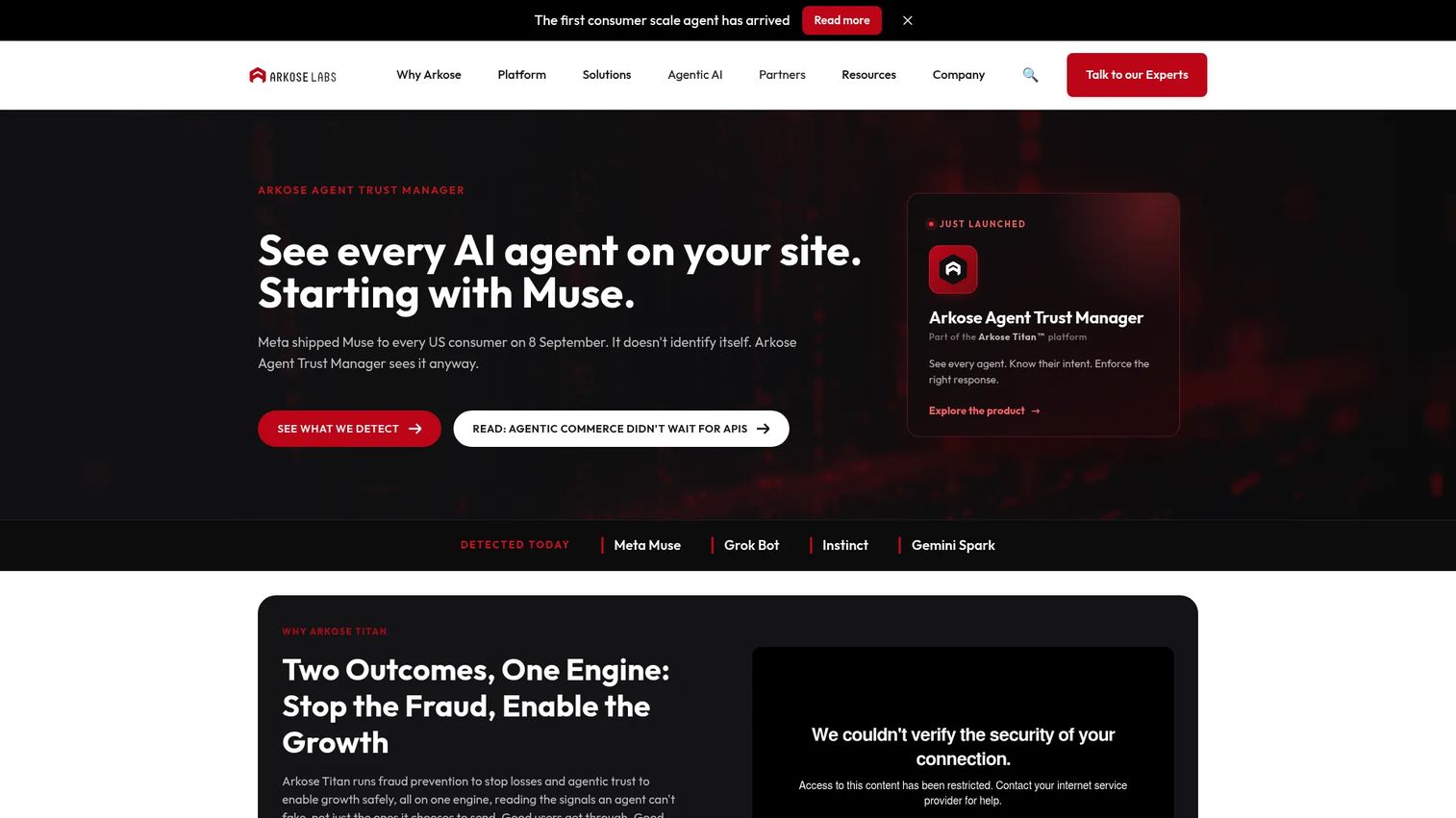
Arkose Labs is an enterprise fraud-prevention platform focused on account takeover, fake account creation, SMS toll fraud, scraping, and AI-agent abuse. Its adaptive challenge system presents friction only when risk signals justify it, reducing false positives while disrupting automated attacks. The platform covers bot detection, AI-agent classification, device identification, email risk intelligence, and phishing protection.
Best for: Large companies where account abuse, fake registrations, or fraud network activity represent direct revenue risk.
Key features
- Bot detection and mitigation with adaptive challenges
- AI-agent detection, classification, and control
- Email risk intelligence and phishing protection
- Scraping protection and API edge controls
- Device identification and risk scoring
Why choose Arkose Labs: Challenge-based mitigation works well when you need to impose cost on attackers without blocking legitimate users outright. It fits organizations where false positives carry high customer trust risk, such as financial services, gaming, and marketplace platforms.
Arkose Labs pricing: Enterprise pricing only, handled through sales. Request a demo at arkoselabs.com to start a pricing conversation.
Arkose Labs carries a G2 rating of 4.7/5 from 60 reviews.
6. Reblaze
Reblaze is a cloud-native, fully managed web application and API security platform. It combines a next-generation WAF, DDoS protection, bot management, API security, and account takeover prevention with machine-learning-based threat detection. Multi-cloud, hybrid, and service-mesh deployments are supported.
Best for: Teams that want managed security coverage without building an internal security operations function.
Key features
- Next-generation WAF with custom mitigation rules
- DDoS protection and bot management
- API security and account takeover prevention
- Real-time traffic analytics
- Machine-learning threat detection across multi-cloud environments
Why choose Reblaze: The managed operations model is the key differentiator. Teams without dedicated security engineering capacity get continuous monitoring and policy tuning without hiring for it. The tradeoff is less direct control over detection logic compared to self-managed platforms.
Reblaze pricing: Contact Reblaze directly for pricing. The platform is quote-based and varies by deployment scope and traffic volume.
Reblaze carries a G2 rating of 4.7/5.
7. HUMAN Sightline
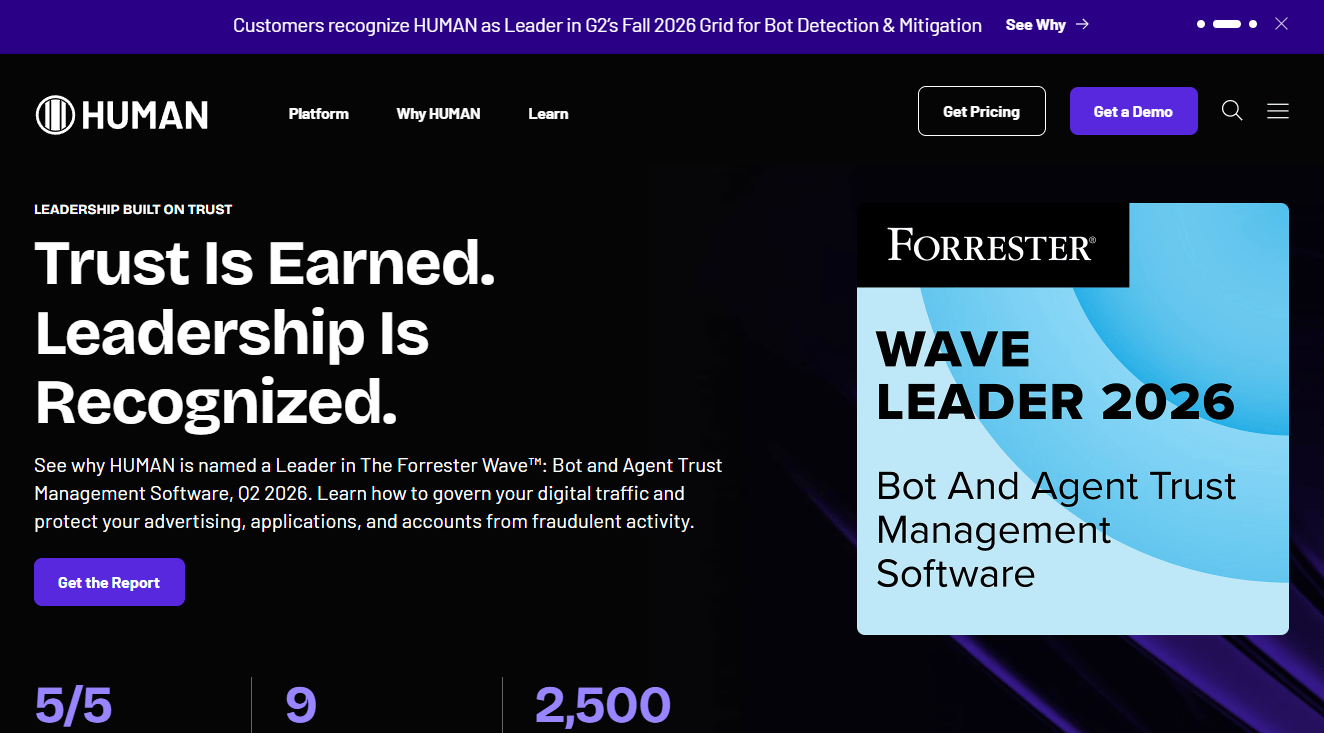
HUMAN Sightline provides cyberfraud defense with actor-level visibility into humans, bots, and AI agents across the customer journey. It combines adaptive trust decisioning, real-time governance, customizable mitigation policies, and investigation dashboards for account takeover, fake accounts, and traffic abuse. AI-agent traffic monitoring and control is included.
Best for: Enterprise security and fraud teams facing large-scale automated fraud or sophisticated botnet activity.
Key features
- Actor-level visibility into humans, bots, and AI agents
- Adaptive trust decisioning based on behavior, context, and intent
- Investigation dashboards for account takeover and fake account detection
- Real-time governance with customizable mitigation policies
- Monitoring and control of AI-agent traffic
Why choose HUMAN Sightline: The intelligence depth and investigation workflows go beyond basic bot scoring. Teams dealing with coordinated fraud networks or advanced persistent automation benefit from the threat investigation capabilities that lighter tools don't provide.
HUMAN Sightline pricing: Contact HUMAN Security for pricing. The platform is sold through enterprise sales with no public pricing tier.
HUMAN Sightline carries a G2 rating of 4.5/5.
8. Queue-it Virtual Waiting Room
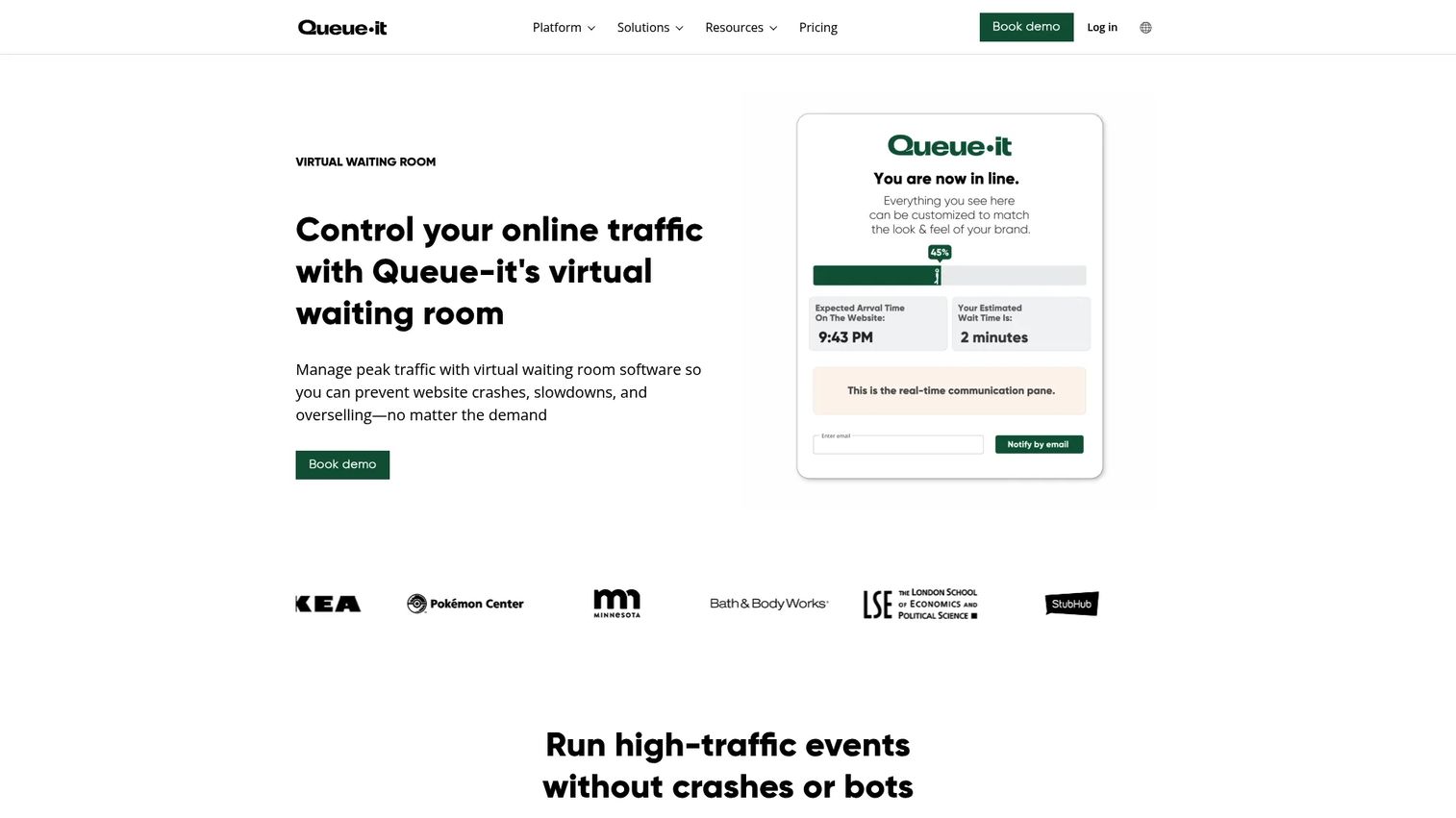
Queue-it is virtual waiting room software that controls traffic during peak demand events: Ticket releases, product launches, promotional drops, and registration openings. It prevents site crashes, overselling, and bot-driven inventory hoarding by metering access with adjustable throughput and fair-access policies.
Best for: SaaS companies running high-demand events where uptime and fair access matter more than broad bot detection.
Key features
- Real-time traffic-flow control with adjustable throughput
- Scheduled waiting rooms with FIFO access, randomization, and countdowns
- 24/7 peak protection that activates during unexpected surges
- Bot and abuse mitigation with traffic rules and visitor validation
- 25+ edge, server-side, and mobile integrations
Why choose Queue-it: Queue-it solves a specific problem: Controlling access during demand spikes. It does not replace a full bot intelligence platform, but it prevents the inventory hoarding and site overload that broad bot tools may not directly address during concentrated traffic events.
Queue-it pricing: Queue-it Essentials starts at $1,499 per event with one scheduled waiting room and 5,000 visitors via queue. Standard, Pro, and Enterprise plans are quote-based.
Queue-it carries a G2 rating of 4.7/5.
9. ClickCease
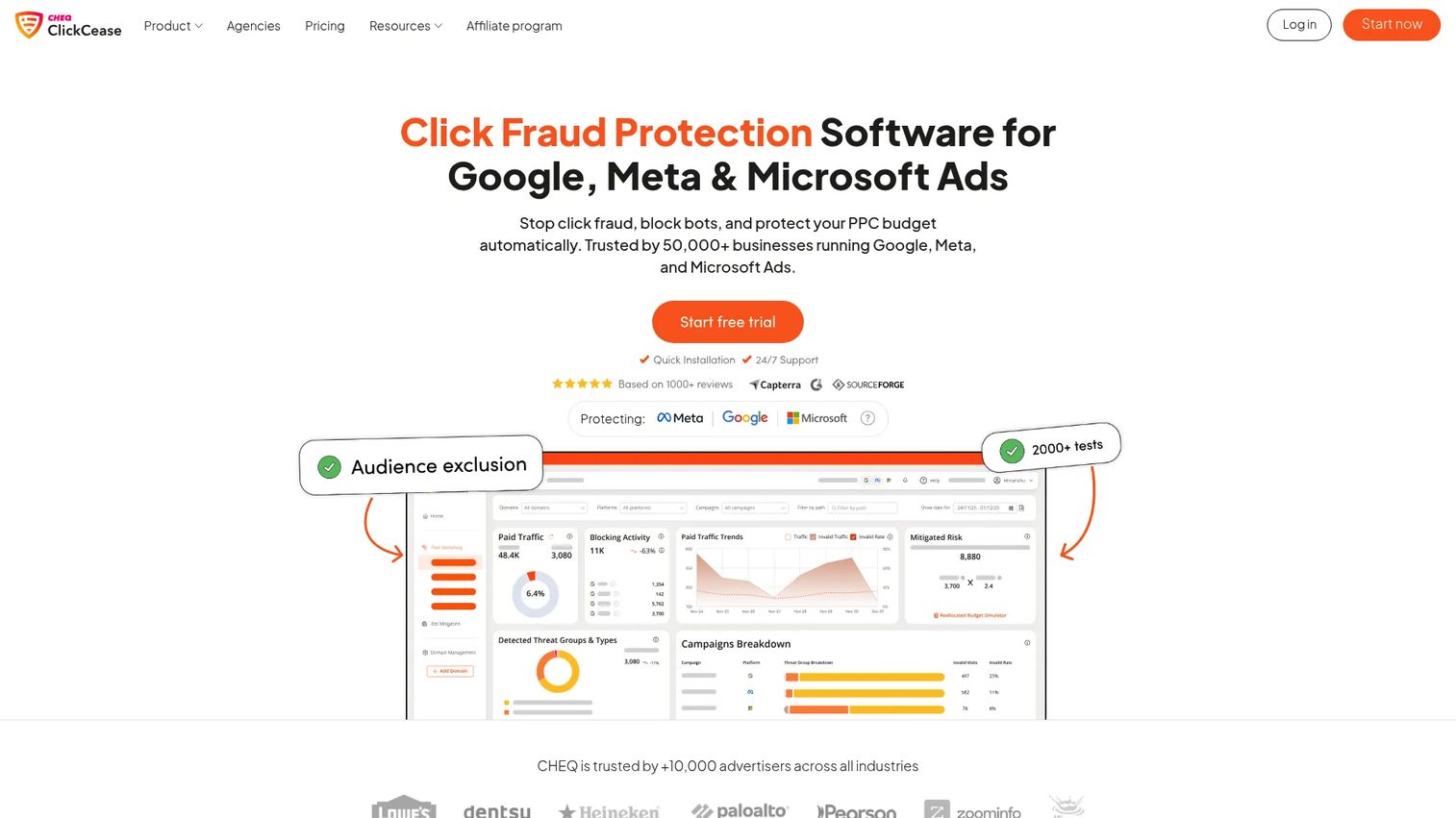
ClickCease detects and blocks invalid traffic across Google, Meta, and Microsoft Ads. It runs more than 2,000 behavioral and technical tests per visit, identifies click fraud patterns, and automatically blocks offending IPs from your campaigns. WordPress bot protection, Pixel Guard for preventing invalid session pixel fires, and Lead Shield for HubSpot are included.
Best for: Growth teams protecting paid search and social budgets from click fraud and invalid traffic.
Key features
- Real-time ad fraud detection and blocking across Google, Meta, and Microsoft Ads
- 2,000+ behavioral and technical tests per visit
- WordPress bot protection
- Pixel Guard to prevent invalid pixel triggers
- Traffic analytics and fraud reporting
Why choose ClickCease: The narrower advertising focus means faster setup and clearer CAC impact reporting compared to broad bot platforms. It earns its place in your stack if paid acquisition is a meaningful growth channel and you're losing budget to invalid clicks.
ClickCease pricing: Starter plans are $69/month billed annually (regular price from month four: $99/month). Pro is $104/month annually ($149 regular). Advanced is $244/month annually ($349 regular). All plans include a 7-day free trial.
ClickCease carries a G2 rating of 4.6/5.
10. GeeTest CAPTCHA
GeeTest CAPTCHA is an adaptive CAPTCHA and bot-management platform protecting websites, mobile apps, and APIs from automated attacks. It offers multiple verification modes, including slide, icon, audio, and invisible verification, selected based on real-time risk scoring. The dashboard provides traffic analysis and customizable security settings.
Best for: Product teams that need challenge flows at signup, login, or form submission without relying on traditional CAPTCHA approaches.
Key features
- Adaptive risk-based verification with intelligent, invisible, and challenge modes
- Multiple CAPTCHA types: Slide, icon, audio, and no-CAPTCHA
- Dashboard with traffic analysis and customizable security settings
- Developer integration for web and mobile
- Signup and login protection against credential stuffing
Why choose GeeTest: It sits between a full bot management platform and a basic CAPTCHA widget. Teams that need friction-based control at specific risk points without deploying an entire bot detection infrastructure will find GeeTest a proportionate choice.
GeeTest CAPTCHA pricing: Pricing is customized by use case, traffic volume, and deployment model. A free trial is available. Contact GeeTest for a quote.
GeeTest CAPTCHA carries a G2 rating of 4.5/5.
11. AppTrana
AppTrana is a managed application security platform combining WAF services, bot protection, and vulnerability monitoring with ongoing managed security support. It is designed for teams that need application-layer coverage without building internal security operations capacity.
Best for: Teams that need managed WAF and bot protection under a single service agreement.
Key features
- Managed WAF with bot protection
- Vulnerability monitoring and traffic analytics
- Managed security support included
- Application-layer coverage across web surfaces
- Security policy management
Why choose AppTrana: The managed service model covers both detection and ongoing policy maintenance. Teams at Series B without a dedicated security team get enterprise-grade application protection without the hiring requirement.
AppTrana pricing: Contact AppTrana for current pricing. Plan details vary by application count and support level.
AppTrana carries a G2 rating of 4.8/5.
12. IPQS
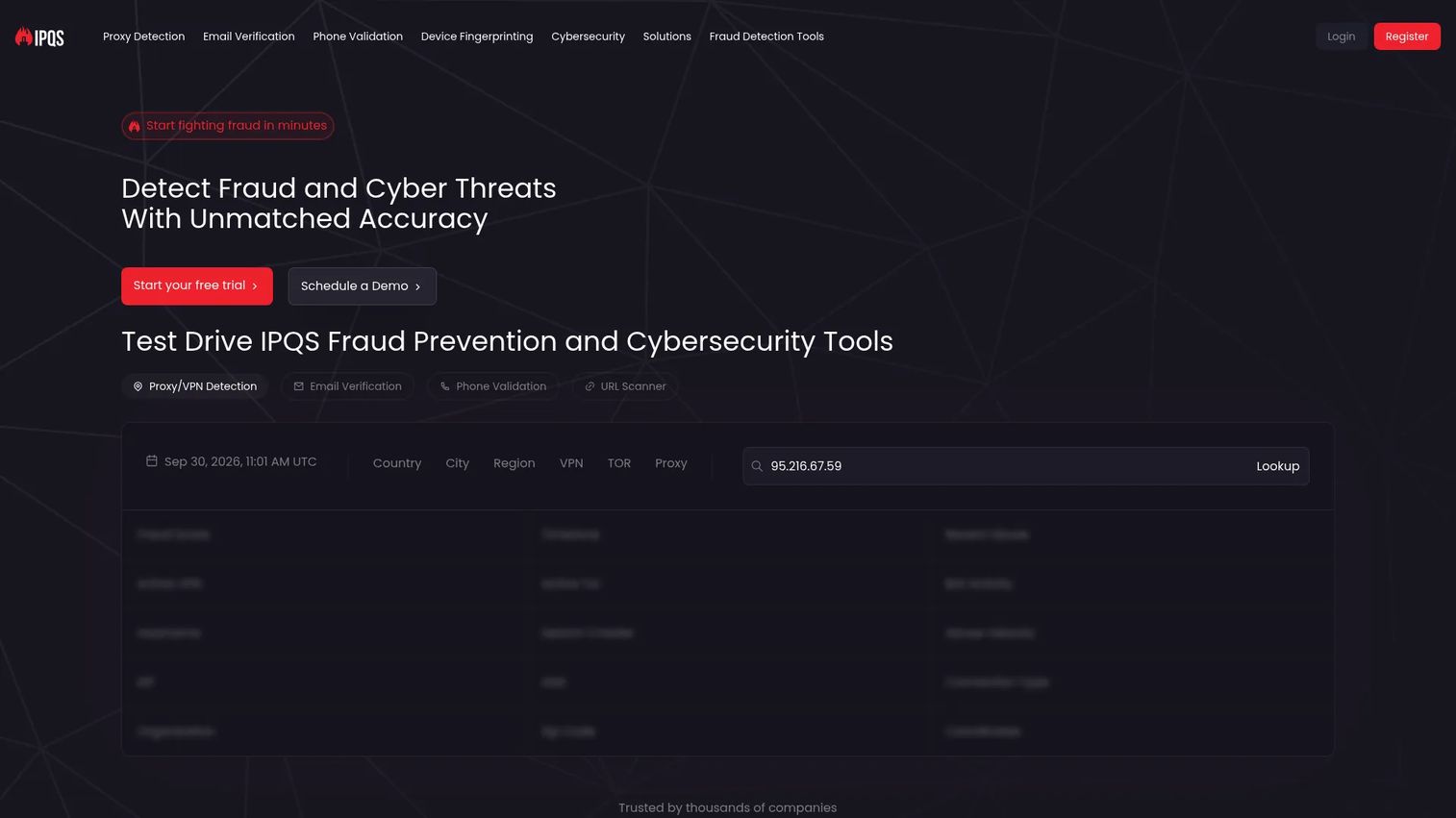
IPQS (IPQualityScore) is a fraud prevention and cybersecurity platform providing real-time risk intelligence for IPs, devices, emails, phone numbers, URLs, and transactions. It detects proxies, VPNs, Tor nodes, and data center traffic, and exposes device fingerprinting and behavioral fraud scoring through a well-documented API.
Best for: SaaS teams adding risk signals to signup, login, checkout, or API workflows via API integration.
Key features
- IP reputation, proxy, VPN, and Tor detection
- Email and phone validation with fraud-risk scoring
- Device fingerprinting and behavioral fraud analysis
- Fraud scoring for transactions and account events
- Real-time API with high-volume throughput
Why choose IPQS: The free tier gives your engineering team a fast way to evaluate signal quality before committing to paid volume. The API-first design fits teams that want to embed risk data into existing workflows rather than deploying a standalone portal.
IPQS pricing: A free tier is available with 1,000 lookups per month. Paid plans start at $99/month (Startup), $499/month (SMB Basic), and $999/month (SMB+). Enterprise pricing is custom.
IPQS carries a G2 rating of 4.6/5.
13. Opticks
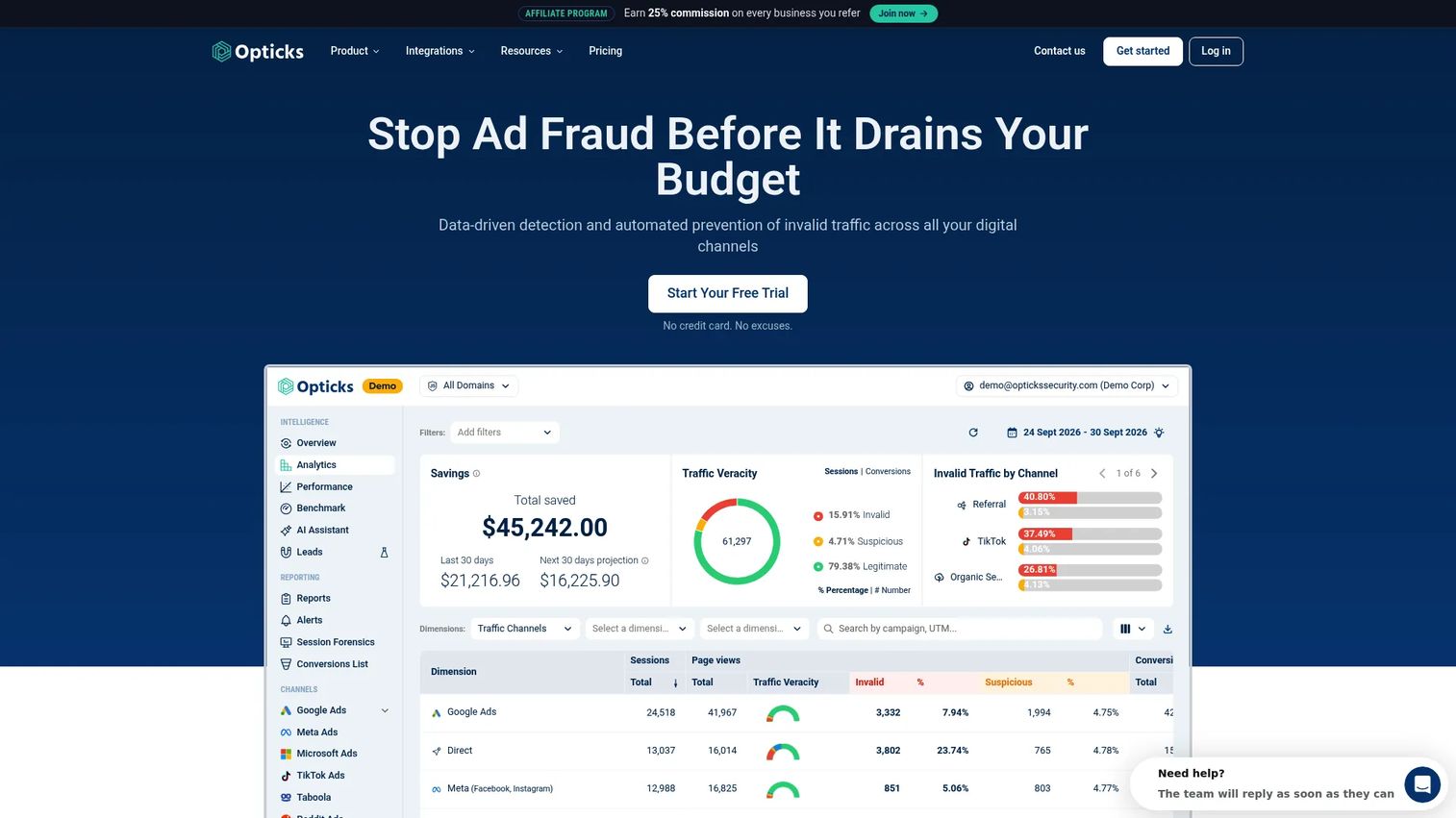
Opticks is a digital marketing fraud detection and prevention platform that analyzes advertising traffic to identify and block invalid activity across Google, Meta, Microsoft, and TikTok. It provides real-time invalid-traffic detection, automated prevention, conversion analysis, click-level forensics, and custom alert workflows.
Best for: Marketing teams, agencies, and advertisers managing multi-channel paid campaigns who need granular invalid-traffic analysis.
Key features
- Real-time invalid-traffic detection and automated prevention
- Click-level forensics and conversion analysis
- Custom alerts and watchlists
- Performance and benchmark dashboards
- API integration for custom reporting
Why choose Opticks: The click-level forensics make it easier to trace fraud to specific campaigns, placements, or traffic sources rather than relying on aggregate blocking. The free trial is meaningful: 1,000 scans with detection-only functionality before you commit.
Opticks pricing: A 7-day free trial is available with up to 1,000 monthly scans. Paid plans: Lite at €50/month (10,000 scans), Pro at €200/month (100,000 scans), Max at €699/month (300,000 scans). Annual billing includes a discount.
Opticks carries a G2 rating of 4.7/5.
14. CHEQ
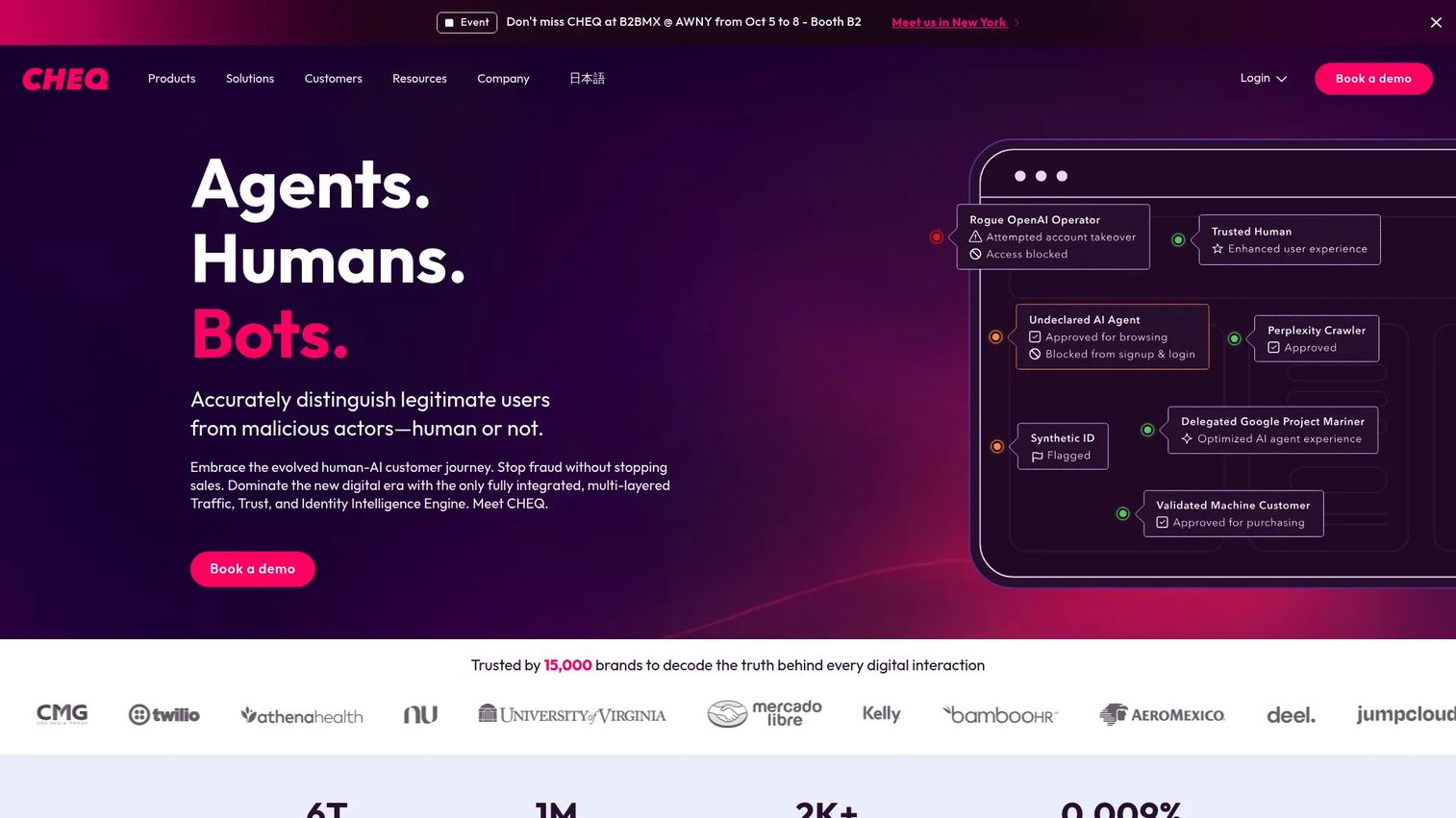
CHEQ provides Traffic, Trust, and Identity Intelligence to help organizations separate legitimate users from malicious actors, bots, and AI agents. It covers invalid traffic detection across paid search, social, and display; malicious script and skimmer detection; privacy and consent enforcement; and Agent Intent detection for identifying suspicious entity behavior.
Best for: Enterprise demand generation teams measuring whether paid traffic represents genuine prospects.
Key features
- Bot and invalid-traffic detection across paid search, social, and display
- Malicious script and unauthorized-vendor detection
- Privacy and consent enforcement
- Real-time behavioral, device, browser, and network analysis
- Agent Intent detection for AI-driven abuse
Why choose CHEQ: CHEQ sits at the intersection of ad fraud prevention and broader marketing security. Teams worried about both CAC inflation from invalid clicks and data integrity from malicious scripts on their marketing properties get broader coverage than a click fraud tool alone provides.
CHEQ pricing: Contact CHEQ for pricing. The platform is sold through enterprise sales with no publicly displayed tier structure.
CHEQ carries a G2 rating of 4.8/5 from 63 reviews.
15. Lunio
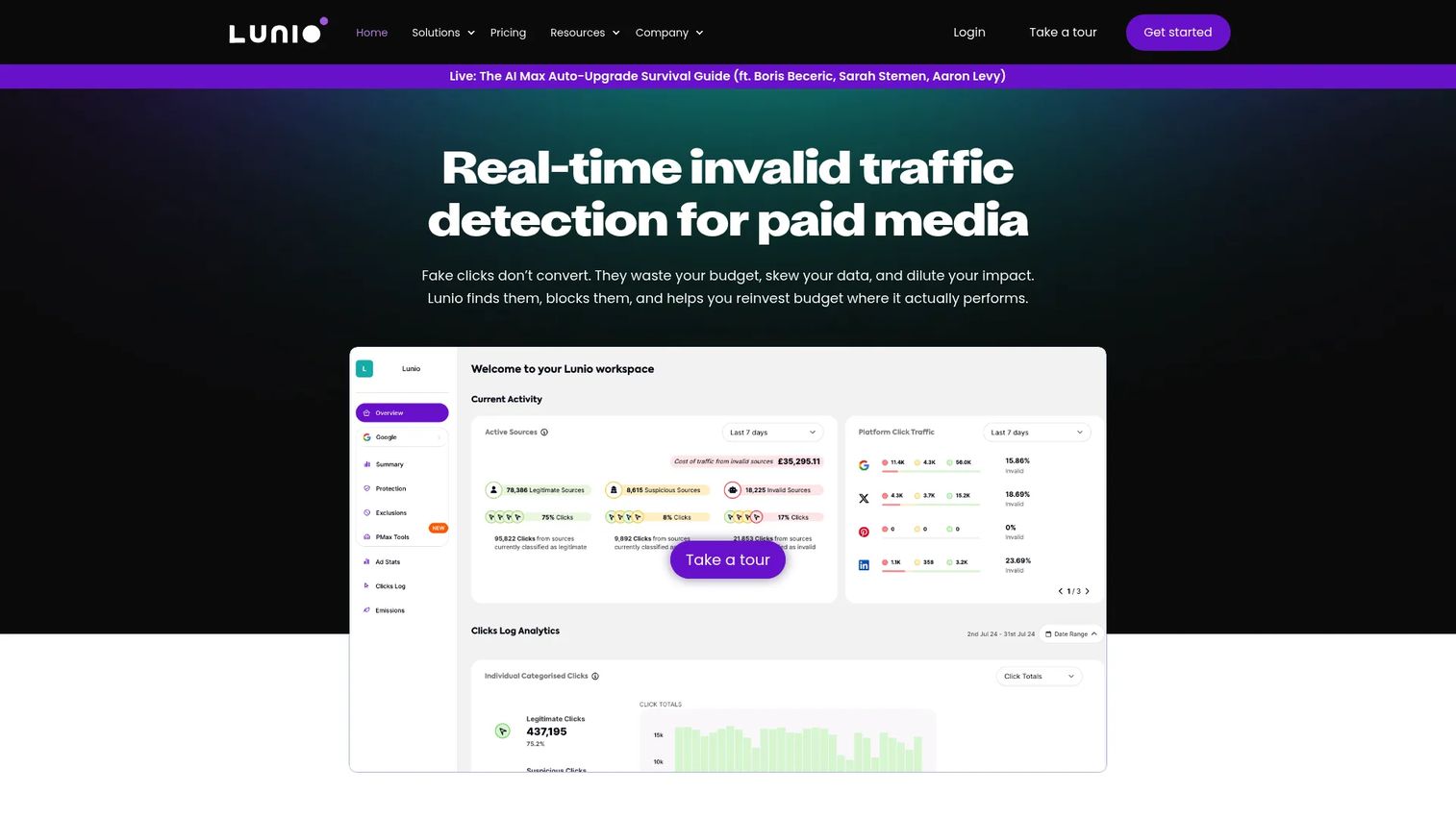
Lunio uses machine learning to detect and block invalid traffic across paid media channels in real time. It classifies clicks as legitimate, suspicious, or invalid, provides click-level analytics by campaign and keyword, and automates IP exclusions across multiple ad platforms.
Best for: Performance marketing teams managing significant paid acquisition budgets across multiple channels.
Key features
- Real-time machine-learning detection of invalid clicks
- Click-level analytics by campaign, keyword, placement, and location
- Automatic IP and custom audience exclusions across ad platforms
- Invalid traffic reporting and campaign alerts
- Advertising platform integrations
Why choose Lunio: The multi-channel coverage across paid platforms gives growth teams a consolidated view of traffic quality rather than managing exclusion lists per channel. A 14-day free traffic audit lets you see invalid traffic volume before signing a contract.
Lunio pricing: Pricing is custom, set by ad spend and channel coverage. Request a 14-day free traffic audit at lunio.ai to get started.
Lunio carries a G2 rating of 4.6/5.
16. Anura
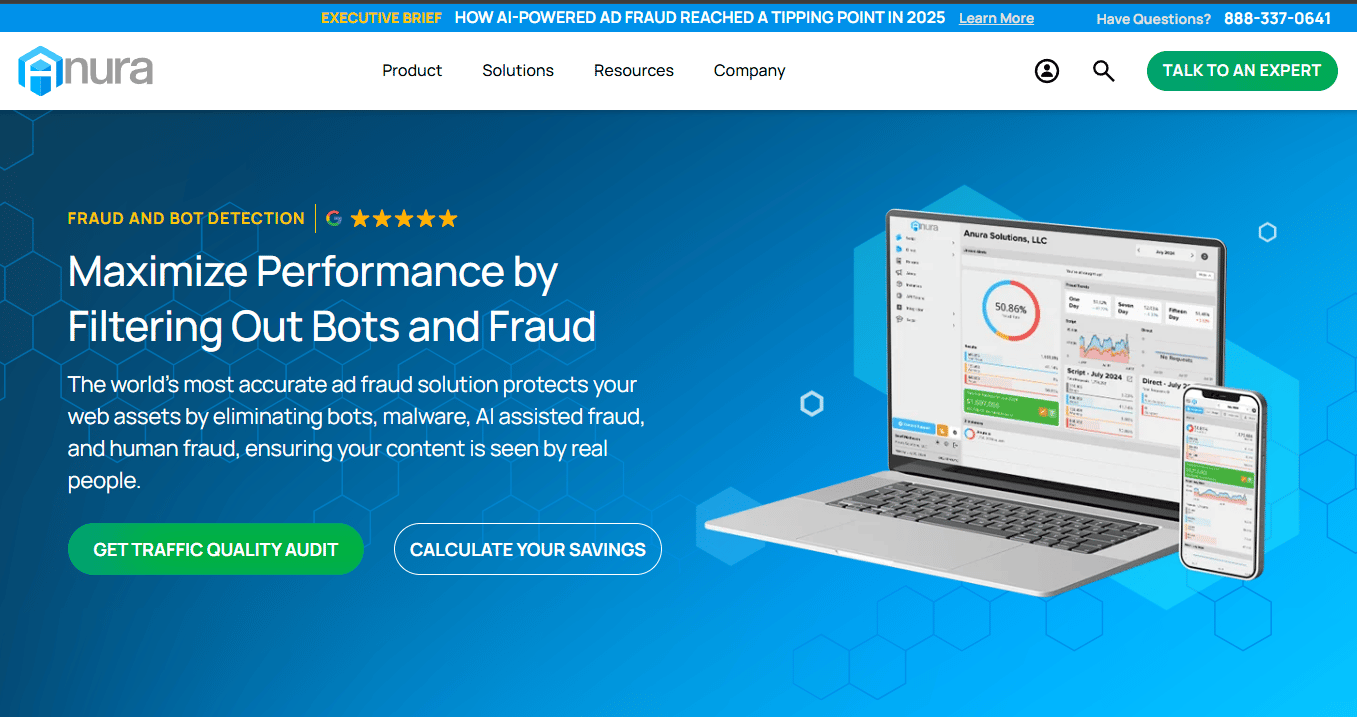
Anura is an ad fraud prevention platform that detects and blocks sophisticated invalid traffic (SIVT) and general invalid traffic (GIVT), including bots, malware, AI-assisted fraud, and human fraud. It integrates via JavaScript (Anura Script) or REST API (Anura Direct) and provides a real-time reporting dashboard with fraud-source identification.
Best for: Advertisers, agencies, and affiliate marketers who need real-time SIVT and GIVT detection at the conversion level.
Key features
- Real-time SIVT and GIVT detection and blocking
- JavaScript and REST API integration options
- Real-time reporting dashboard and fraud-source identification
- Anura IPDB local IP intelligence database with unlimited queries
- Conversion quality monitoring and fraud reporting
Why choose Anura: The IPDB local database means IP lookups don't add latency or depend on external API availability. Teams with high-volume affiliate or performance programs who need reliable fraud data at the conversion event will find this approach more dependable than cloud-only lookups.
Anura pricing: A 15-day fully functional free traffic audit is available. Full-engagement pricing is usage-based and requires contacting sales.
Anura carries a G2 rating of 4.6/5.
17. Castle
Castle is a fraud and abuse prevention platform focused on account protection. It provides bot detection, device fingerprinting, IP intelligence, behavioral analysis, and risk scoring for logins, signups, and transactions. Custom signals, policies, lists, and webhooks let engineering teams build enforcement logic on top of Castle's risk data.
Best for: SaaS security and trust-and-safety teams that need API-based risk scoring for account events.
Key features
- Bot detection and device fingerprinting
- IP intelligence and behavioral analysis
- Risk scoring for account takeover, fake signups, and bot activity
- Custom policies, lists, and webhooks
- Analytics and account abuse investigation
Why choose Castle: The free tier and API-first design let a small engineering team validate the signal quality quickly without a lengthy procurement process. It's a practical starting point for teams that don't yet have dedicated fraud infrastructure but need account takeover protection.
Castle pricing: A free tier is available at $0/month with $5 of included API usage. Pro is $200/month with $200 of API usage. Enterprise starts at $4,000/month with dedicated support.
Castle carries a G2 rating of 3.7/5 from 3 reviews. G2 notes there are not enough reviews to provide reliable buying insight at this volume.
18. Imperva Sonar
Imperva Sonar is a data security and analytics platform for monitoring, analyzing, and protecting data activity across enterprise environments. It provides data activity monitoring, machine-learning-based anomaly detection, User and Entity Behavior Analytics (UEBA), data discovery and classification, and SIEM integrations.
Best for: Enterprise security teams standardizing application and data protection across multiple surfaces within the Imperva stack.
Key features
- Data activity monitoring and aggregation
- Machine-learning anomaly and threat detection
- User and Entity Behavior Analytics (UEBA)
- Data discovery, classification, and risk assessment
- Reporting, workflow, and SIEM integrations
Why choose Imperva Sonar: Sonar makes the most sense as part of a broader Imperva deployment. Teams already using Imperva for application security will find Sonar adds data-layer visibility and behavioral analytics without adding a new vendor relationship.
Imperva Sonar pricing: Imperva's current plans (Data Assure, Data Secure, Data 360) are all contact-based. Reach Imperva sales for current pricing and packaging.
Imperva Sonar does not currently have a standalone G2 listing verified at time of writing.
19. Fraudlogix
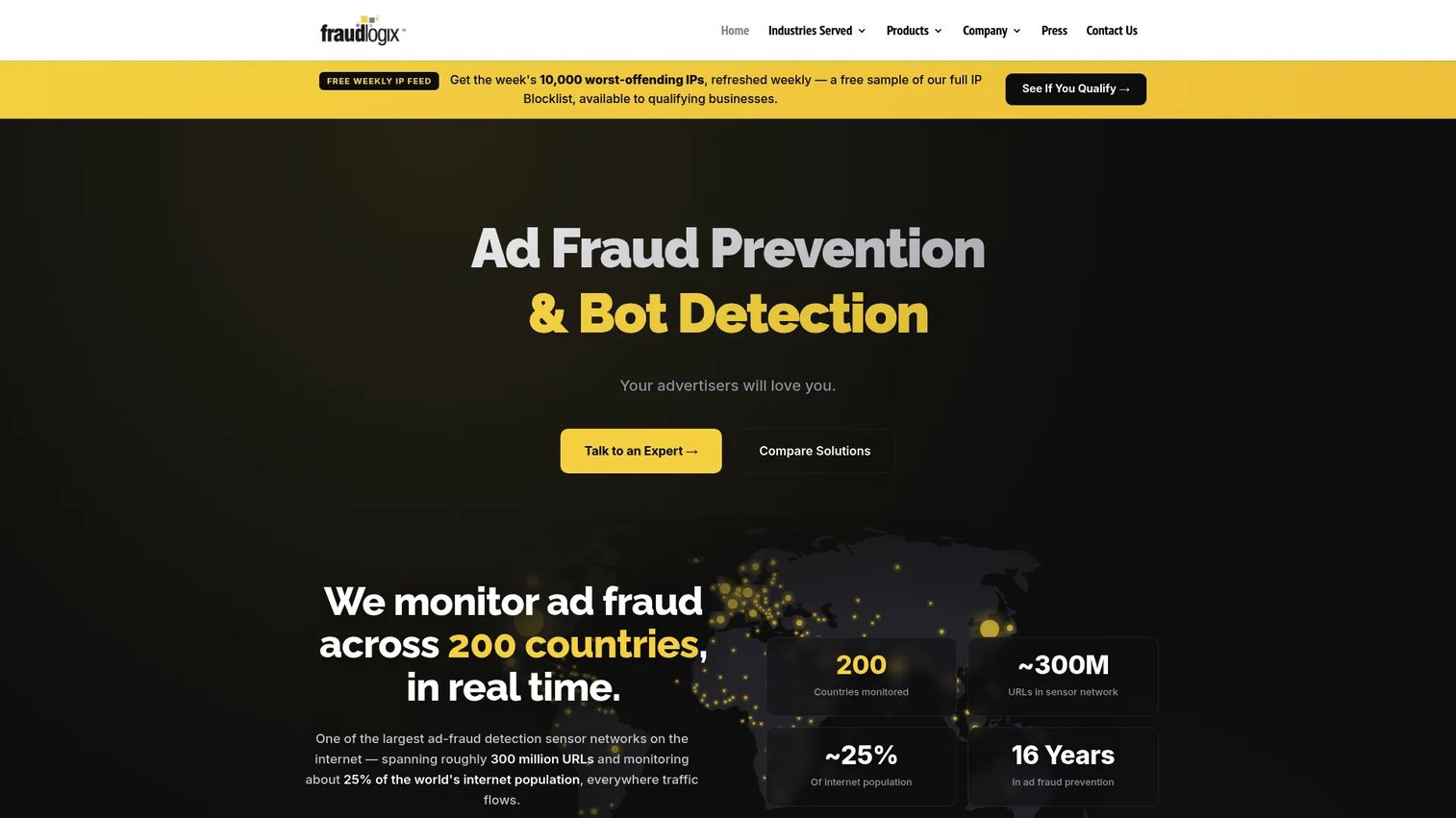
Fraudlogix provides real-time fraud prevention, bot detection, IP risk scoring, IP blocklists, and programmatic invalid-traffic detection. Its core use case is advertising traffic: Pre-bid blocklists prevent fraudulent impressions from serving, and post-bid analytics measure campaign quality after delivery. Bot, proxy, VPN, Tor, and data-center traffic are flagged.
Best for: AdTech, affiliate, and performance-marketing teams filtering invalid traffic from programmatic campaigns.
Key features
- Real-time IP risk scoring and fraud detection
- Bot, proxy, VPN, Tor, and data-center traffic detection
- Programmatic IVT detection with pre-bid blocklists
- Post-bid analytics for campaign quality measurement
- Free Lite tier for low-volume testing
Why choose Fraudlogix: The pre-bid blocklist approach stops invalid inventory from entering the ad stack before a bid is placed, rather than cleaning up after the fact. For programmatic buyers, this is a fundamentally different model than post-click analysis tools.
Fraudlogix pricing: Lite is free. Pro is $2,500/month. Enterprise is $10,000/month. A free account registration is available at fraudlogix.com.
Fraudlogix carries a G2 rating of 4.4/5.
Considerations when choosing bot detection software
Coverage across websites, APIs, and mobile apps
A platform protecting only web pages leaves API abuse and mobile traffic exposed. Map each vendor's coverage to your highest-value attack surfaces before shortlisting. For a SaaS product with a public API, verify whether the tool provides API-specific enforcement or just web-layer detection.
Detection accuracy and false positives
Ask every vendor how they handle legitimate crawlers, integrations, accessibility tools, and real customers who trigger behavioral signals. A tool that blocks 99% of bots but creates a 2% false positive rate on real users will damage conversion and create support escalations. Request documentation on false positive handling and policy tuning workflows.
Mitigation controls
Evaluate whether the platform supports a range of actions: Monitoring, rate limiting, challenge presentation, alternate content serving, manual review routing, and blocking. Detection without enforcement gives you visibility but not protection. The right mitigation mix depends on whether your priority is fraud prevention, infrastructure cost, or conversion integrity.
Implementation and ownership
Clarify who deploys the tool, tunes policies, handles incidents, and produces reports. For a 50-person company, the difference between a managed service and a self-serve platform is the difference between a one-week deployment and a three-month project. Factor your engineering capacity into the vendor selection, not just the product capability.
Cost and measurable payback
Compare total operating cost against the losses you're mitigating. Add up infrastructure overload from scraping, paid media waste from click fraud, support investigation hours, and engineering time on incident response. A $3,000/month bot protection tool that eliminates $15,000/month in wasted ad spend pays back within the first quarter. Tools covering application security testing may overlap with your existing stack, so verify what you're replacing before adding a new line item.
Conclusion
Bot detection is not one decision. It's seven, depending on which attack pattern is most expensive for your business.
For broad bot management across customer-facing surfaces, DataDome is the most complete option. Radware Bot Manager suits enterprise security teams already operating WAF infrastructure. Fingerprint provides the device intelligence layer for teams building custom fraud logic. Cloudflare Bot Management consolidates controls for teams already on Cloudflare's edge.
For account abuse and fake signup prevention, Arkose Labs uses adaptive challenges where silent blocking creates too much false positive risk. Queue-it solves the specific problem of fair access during high-demand events, separate from ongoing bot detection.
For paid traffic quality, ClickCease is the fastest to deploy for Google and Meta campaigns. CHEQ adds marketing security alongside ad fraud protection. Lunio and Anura suit performance-heavy programs. Fraudlogix fits programmatic and affiliate use cases through pre-bid blocking.
For API-first risk signal enrichment with a free starting tier, IPQS is the practical first step. Castle provides account-level behavioral risk scoring with a free tier suited to early-stage validation.
The practical next step: Identify your highest-cost abuse pattern, measure current volume and business impact, confirm the deployment surfaces you need to protect, and shortlist two vendors. Run a controlled evaluation using false positive rate and mitigation effectiveness as your primary metrics, not just detection claims.
Evaluate these tools alongside your broader security and API monitoring tools to confirm there's no coverage overlap before signing a contract.
FAQs
Bot detection software analyzes requests, sessions, devices, and behavior to identify automated traffic. It assigns classifications or risk scores, then triggers configured actions such as monitoring, challenge presentation, rate limiting, or blocking based on those scores.
Detection identifies and classifies traffic as human, automated, or unknown. Mitigation applies an action based on that classification: Allowing, monitoring, rate limiting, challenging, serving alternate content, or blocking. Both are required for protection. Detection without mitigation produces a reporting dashboard, not a security control.
It can significantly reduce automated credential abuse by identifying suspicious login behavior, flagging credential stuffing patterns, and triggering challenges or blocks at authentication points. Pair it with strong authentication controls, credential monitoring, and account recovery processes for full coverage.
The main signals are device fingerprinting, IP reputation, browser consistency checks, request velocity, session behavior patterns, known bot signatures, and threat intelligence feeds. Machine learning models trained on large traffic datasets identify patterns that don't match human behavior, even when bots are designed to mimic it.
CAPTCHA addresses a narrow set of attack scenarios at specific risk points. It does not provide detection across your full traffic surface, cannot apply mitigation to API abuse or scraping, and creates user friction that affects conversion. Modern bot traffic detection requires behavioral analysis, IP intelligence, and policy-based enforcement beyond what any challenge widget provides on its own. CAPTCHA alternatives and invisible verification flows are worth evaluating alongside full bot mitigation platforms.
Pricing varies by traffic volume, protected surfaces, API call volume, campaign spend, or enterprise contract scope. Broad bot management platforms like DataDome start at $3,830/month. API intelligence tools like IPQS start at $99/month. Ad fraud tools like ClickCease start at $69/month. Compare total operating cost against the losses you're mitigating, not just the subscription line item.
Some platforms cover all three surfaces; others focus on one. DataDome covers web, API, and mobile. Fingerprint provides web and mobile SDKs with a server-side API. Cloudflare Bot Management applies to traffic routed through Cloudflare's edge. Verify SDK availability, mobile-specific signals, and API enforcement options before selecting a vendor for mobile app protection or bot detection at the API layer.
Track malicious traffic blocked, false positive rate, account abuse incidents, invalid signups per cohort, infrastructure cost trend, support ticket volume related to account issues, and conversion impact before and after deployment. The false positive rate matters as much as detection rate. A tool blocking legitimate users reduces conversion and generates support escalations that offset the security benefit.
Ad fraud tools like ClickCease, Lunio, and Anura focus on paid campaign traffic quality. Full bot management platforms like DataDome cover your entire application surface, including signups, authentication, checkout, and API endpoints. Both categories use automated traffic detection, but they address different attack vectors. Most companies with significant paid acquisition and a SaaS product need tools from both categories, evaluated against their specific application performance monitoring and security requirements.
Properly configured bot protection should not block verified search crawlers from Google, Bing, or other major search engines. Most platforms maintain allowlists for verified bots. Confirm that your vendor's verified bot list includes the crawlers you depend on, and test crawler behavior in monitoring mode before enabling blocking policies on your main domain.