A prospect says they need "a blockchain platform." You start scoping. Halfway through discovery, you realize three people in the room mean three different things. One wants a public network for tokenized assets. One wants a permissioned ledger their compliance team will sign off on. One wants an Ethereum-compatible stack their developers already know. Same phrase, three architectures, three governance models, three security reviews.
That gap is where projects stall. Pick the wrong platform and you inherit governance headaches, a permission model that fails an audit, integration work that never ends, or a pilot that never reaches production. The stakes are real and rising. The global blockchain platform market is projected to reach USD 20 to 25 billion by 2025, growing at an estimated 25 to 30% CAGR through 2030, according to Research and Markets (2025). Roughly 70% of enterprises report adopting blockchain for supply chain transparency and digital payment efficiency, per Business Research Insights (2025).
So the question is not "should we use blockchain." It is "which platform matches this business case, this governance requirement, and this deployment reality." That is a selection problem, and it is harder than it looks because the options span open public networks, permissioned enterprise frameworks, and financial-grade transaction platforms that share almost nothing beyond the word "blockchain."
What's inside
This guide compares nine blockchain platforms used for business networks, digital assets, and enterprise deployments. It is written for presales, sales engineers, and technical evaluators who need to explain tradeoffs, support discovery, and map a platform to a real use case.
We selected platforms based on four criteria: ecosystem maturity, smart contract support, governance model, and enterprise readiness. The list deliberately mixes public and permissioned options so you can match architecture to need rather than defaulting to whatever is most familiar. Each entry includes what it does well, who it fits, and how to position it in a technical conversation.
TL;DR
- Best overall for broad ecosystem support: Ethereum, the default reference point for smart contracts and tooling.
- Best for permissioned enterprise workflows: Hyperledger Fabric, with private channels and role-based membership.
- Best for financial services and business agreements: Corda, built for known counterparties.
- Best for enterprise Ethereum compatibility: Quorum, when teams want Ethereum tooling with permissioned controls.
- Best for high-throughput public use cases: Solana, when speed and volume matter.
- Best for payments and cross-border movement: Stellar, for remittances and asset transfer.
- Best for scaling within Ethereum ecosystems: Polygon, for lower-cost, Ethereum-compatible settlement.
- Best for formal verification and protocol flexibility: Tezos, with on-chain governance.
- Best for IBM-led enterprise deployments: IBM Blockchain Platform, for Fabric networks on Kubernetes.
What a blockchain platform actually is
A blockchain platform is the infrastructure used to build, deploy, and run blockchain-based networks and applications. It gives developers the consensus rules, ledger structure, and execution environment they need without rebuilding the plumbing from scratch.
Here is the blockchain definition in plain terms, broken into the concepts that matter when you evaluate a platform:
- Blocks and hashes: Transactions are grouped into blocks. Each block carries a cryptographic hash of the previous one, so tampering with an old record breaks the chain and gets detected.
- Distributed ledger: The record is replicated across many nodes rather than held in one database. No single party controls the full copy.
- Immutability: Once data is confirmed, it is extremely hard to alter. This is the source of auditability and trust and traceability that business buyers actually want.
- Consensus mechanisms: The rules nodes use to agree on the state of the ledger. Proof of work relies on computational effort. Proof of stake relies on economic stake. Permissioned networks often use faster, vote-based consensus among known validators.
- Smart contracts: Programmable rules that execute automatically when conditions are met. They automate settlement, approvals, and multi-party workflows without a middleman.
- Network types: A public blockchain is open to anyone. A private blockchain restricts access to one organization. A permissioned blockchain grants role-based access to approved participants. A consortium blockchain is a permissioned network jointly governed by several organizations.
Blockchain vs protocol
People conflate these. A blockchain protocol is the underlying rule set and consensus logic, for example the Ethereum protocol. A blockchain platform is the broader environment, including tooling, deployment, developer frameworks, and often managed services, that lets teams build on top of that protocol. When a buyer says "platform," clarify whether they mean the raw protocol, a managed offering, or an enterprise framework. That single question resolves a surprising amount of confusion in discovery.
When to use each type
Matching architecture to need beats chasing features. Three quick decision paths cover most business cases.
Use a public blockchain platform when openness matters
A public network fits when you want broad participation, open validation, token ecosystems, or composability with other applications. If the value depends on anyone being able to verify transactions or build on top without permission, a public chain is the natural home. Digital assets, tokenization, and open developer ecosystems all point here.
Use a permissioned blockchain platform when governance matters
Enterprises that need restricted access, role-based participation, privacy controls, and operational oversight should look at permissioned or consortium networks. When a compliance team needs to know exactly who can read, write, and validate, and when data confidentiality is non-negotiable, a permissioned model gives you the governance surface to pass review. This is the common pattern for regulated industries and multi-party business networks.
Use smart contracts when business logic needs automation
Whenever settlement, approvals, or multi-step workflows need to run without manual intervention, programmable rules earn their place. Smart contracts turn a business agreement into auditable, self-executing logic. They matter most when transactions involve multiple parties and you want the process, not just the record, to be verifiable.
Comparison table
Read this table top to bottom by relevance to business and enterprise use, not alphabetically. The Intent column tells you the primary fit, Key differentiation tells you why teams pick it, and ratings reflect current G2 listings where available.
| # | Product | Intent | Key differentiation | Pricing | G2 rating |
|---|---|---|---|---|---|
| 1 | Ethereum | Smart contract ecosystem | Largest developer ecosystem and tooling for smart contracts | Network gas fees in ETH; no plan pricing | 4.3/5 |
| 2 | Hyperledger Fabric | Enterprise permissioned | Modular permissioned architecture with private channels | Open source; no public pricing | 4.1/5 |
| 3 | Corda | Financial services | Peer-to-peer transactions between known parties | Free to start; no public pricing | 4.3/5 |
| 4 | Quorum | Enterprise Ethereum | Ethereum compatibility with permissioned controls | No public pricing | Not published |
| 5 | Solana | High throughput | Sub-second finality for high-volume use cases | No public pricing | 2.8/5 |
| 6 | Stellar | Payments | Payment rails and stablecoin infrastructure | No public pricing | 4.6/5 |
| 7 | Polygon | Scaling and interoperability | Low-cost, Ethereum-compatible settlement | Quote-based | 5.0/5 |
| 8 | Tezos | Governance-forward | On-chain governance and protocol self-upgrades | No public pricing | 3.6/5 |
| 9 | IBM Blockchain Platform | Enterprise platform | Managed Hyperledger Fabric on Kubernetes | Quote-based | 4.0/5 |
A note on ratings: several of these platforms are protocols rather than conventional SaaS products, so review counts are thin and pricing is not sold in plans. Treat the ratings as directional, not decisive, and weight architecture and governance fit more heavily.
1. Ethereum
Ethereum is a public blockchain and open-source protocol for decentralized applications and transactions. It is the default reference point for smart contract platforms, and for good reason: the ecosystem, tooling, and developer mindshare around it dwarf most alternatives. When a buyer or a developer says "smart contracts," they are usually picturing Ethereum semantics whether they name it or not.
The strength here is network effects. The volume of libraries, standards, wallets, auditing tools, and hiring-ready developers means a team rarely has to solve a problem nobody has solved before. Composability is another draw. Applications can build on each other, which matters for tokenization and open financial models. Ethereum runs on proof of stake, which lowered its energy profile and shifted validation to economic stake rather than raw computation.
Best for: Developers and teams building decentralized apps or smart contracts who want the deepest ecosystem and broadest compatibility.
Key strengths
- Smart contract support: The most mature environment for programmable, auditable business logic.
- Decentralized application platform: A vast base of tooling, standards, and libraries reduces build risk.
- Native ETH token: Powers network fees and staking, aligning economic incentives across validators.
Why choose Ethereum: Pick it when the buyer prioritizes ecosystem depth and broad compatibility over a controlled, private environment. If the project needs open participation, tokenization, or the ability to hire developers who already know the stack, Ethereum removes friction that newer chains still carry.
Ethereum pricing: Ethereum is a protocol, not a SaaS product, so there is no plan-based pricing. Costs come from network gas fees paid in ETH. G2 shows a 4.3/5 rating across a modest number of reviews and does not list pricing.
2. Hyperledger Fabric
Hyperledger Fabric is an open-source, enterprise-grade permissioned distributed ledger platform for building private blockchain networks. It is the reference choice when the requirement starts with "only approved participants" rather than "open to anyone." Governed under the Linux Foundation umbrella, it carries the kind of neutral stewardship that enterprise procurement teams find reassuring.
Fabric's modular architecture is its signature. You can swap consensus components, plug in identity providers, and isolate data using channels and private data collections. That means one physical network can support several confidential sub-networks, which maps cleanly to consortium arrangements where competitors share infrastructure but not data. Membership is identity-based, so every participant is known and access is role-controlled.
Best for: Enterprises building permissioned blockchain networks with privacy and modular governance needs.
Key strengths
- Modular architecture: Pluggable consensus and identity components let teams tailor the network to policy.
- Permissioned networks: Identity and access control satisfy compliance and blockchain governance requirements.
- Privacy features: Channels and private data keep confidential transactions isolated between specific parties.
Why choose Hyperledger Fabric: On governance and deployment fit, Fabric is hard to beat for supply chain, consortium networks, enterprise data sharing, and regulated environments. Choose it when access control, auditability, and confidentiality drive the decision more than open ecosystem reach. Its permission model is built to survive a security review rather than work around one.
Hyperledger Fabric pricing: Fabric is open source, so there is no public license price; costs are tied to hosting, integration, and operations. G2 shows a 4.1/5 rating on the closest available Hyperledger listing.
3. Corda

Corda is an open, permissioned distributed application platform for tokenizing assets and currencies in regulated markets. Its design choice is distinctive: rather than broadcasting every transaction to the entire network, Corda shares data only with the parties who need it. That point-to-point model fits how financial institutions actually work, where a transaction is a private agreement between known counterparties, not a public announcement.
That architecture makes Corda a natural fit for financial services and workflow-heavy enterprise networks. Developers build applications, called CorDapps, in Java and Kotlin, and the platform supports cloud-native deployment. Because participation is permissioned and identities are known, it slots into regulated markets where anonymity would be a non-starter.
Best for: Financial institutions and regulated-market teams building private tokenization and DLT applications.
Key strengths
- Java and Kotlin development: Familiar languages lower the barrier for enterprise engineering teams.
- Cloud-native deployment: Fits modern infrastructure and managed hosting patterns.
- Peer-to-peer architecture: Private, need-to-know transaction sharing suits regulated multi-party workflows.
Why choose Corda: Compared with general-purpose public chains, Corda trades broad composability for privacy and regulatory alignment. Choose it for trade finance, digital asset settlement, and regulated multi-party workflows where transaction confidentiality between named parties is the core requirement.
Corda pricing: R3 invites teams to start building for free, but no public price or plan table is published on the first-party site. G2 shows a 4.3/5 rating.
4. Quorum
Quorum is an enterprise-oriented, Ethereum-compatible blockchain platform. It exists to answer a specific question that comes up constantly in enterprise discovery: "Can we get Ethereum tooling and smart contracts without running on a fully public network?" Quorum's answer is a permissioned, Ethereum-derived stack that keeps the developer experience familiar while adding the access controls enterprises need.
Because it shares Ethereum's foundations, teams can reuse Ethereum smart contract skills, tooling, and standards. Layered on top are permissioning and private transaction capabilities, so sensitive data stays visible only to intended participants. That combination appeals to organizations that have Ethereum expertise in-house but cannot deploy sensitive business logic to a public chain.
Best for: Enterprises that want Ethereum compatibility with permissioned-network characteristics.
Key strengths
- Ethereum compatibility: Reuse existing smart contracts, tooling, and developer skills.
- Permissioning: Role-based access suits internal business networks and consortium models.
- Private transactions: Keep confidential business data restricted to the right parties.
Why choose Quorum: It is the pragmatic middle path for teams that value Ethereum's ecosystem but need permissioned controls, private transaction needs, and internal governance. Choose it for enterprise Ethereum deployments and financial services where public exposure is not acceptable.
Quorum pricing: No public pricing is published for the enterprise Ethereum offering, and a current G2 rating for this specific product is not confirmed. Treat cost as engagement-based and validate scope directly with the vendor.
5. Solana
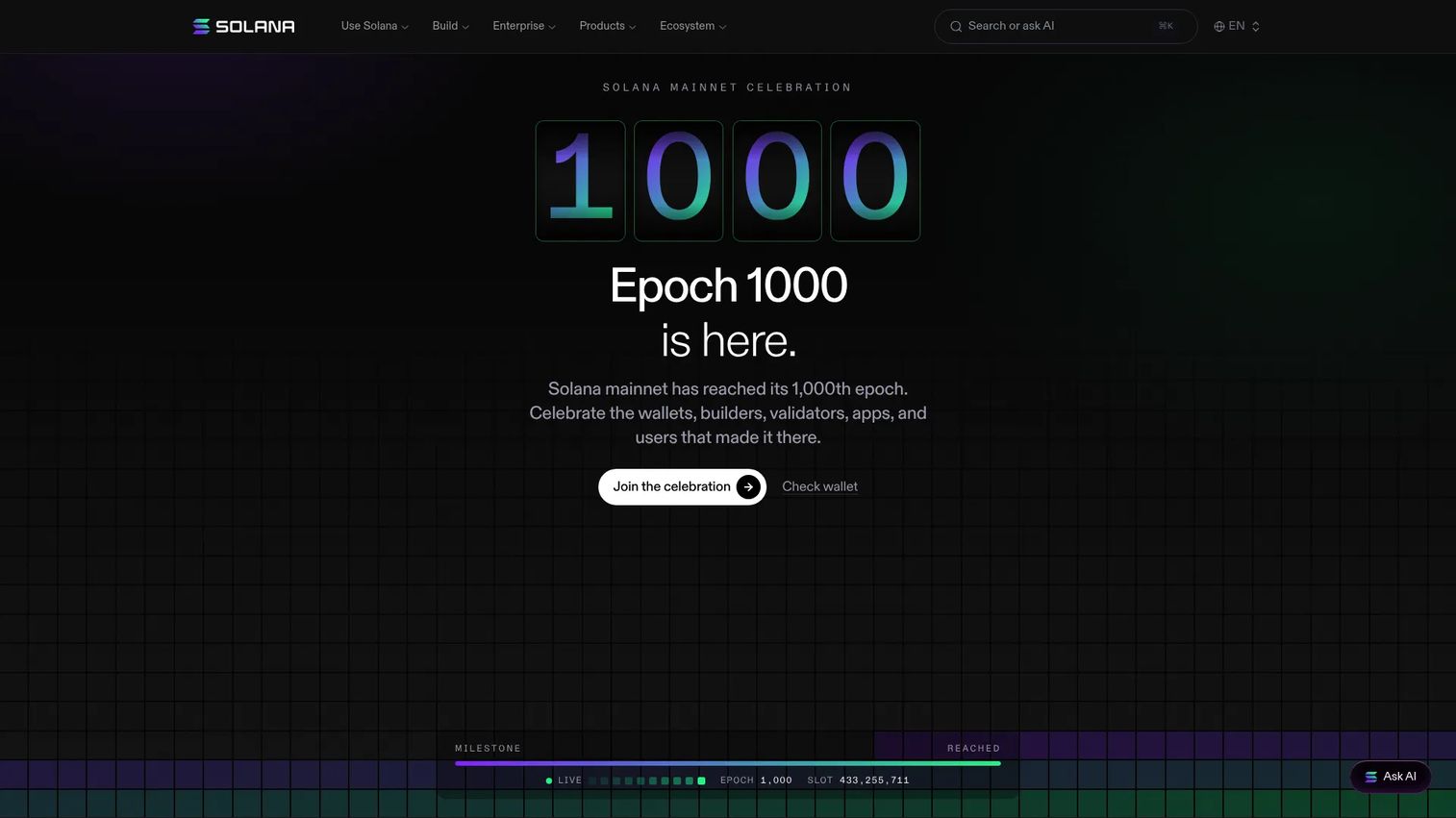
Solana is a high-performance Layer 1 blockchain and ecosystem for payments, tokens, and developer infrastructure. Its positioning is speed. When a use case is sensitive to transaction volume and latency, Solana enters the conversation because of its high throughput and sub-second finality. For applications where users expect near-instant responsiveness, that performance profile is the differentiator.
The right time to care about Solana is when scale is the constraint. Consumer-facing applications, high-frequency token activity, and payment-like flows all benefit from a chain built to process many transactions quickly and cheaply. It also ships payments tooling and support for onchain recurring billing, which broadens its fit beyond pure token projects.
Best for: Teams building onchain payments, tokenized products, or developer infrastructure that value speed and volume.
Key strengths
- High throughput: Sub-second finality supports high-volume, latency-sensitive workloads.
- Payments tooling: Send and accept SOL and stablecoin transfers with built-in support.
- Recurring billing: Subscriptions and allowances enable onchain recurring payment flows.
Why choose Solana: Choose it when performance and transaction volume are the deciding factors and the use case is consumer-facing or payment-like. It suits token projects and systems that need to scale throughput without pricing out everyday transactions.
Solana pricing: As a Layer 1 protocol, Solana does not sell plan-based pricing; costs come from low network transaction fees. G2 shows a 2.8/5 rating from a very small number of reviews, so weight it lightly.
6. Stellar
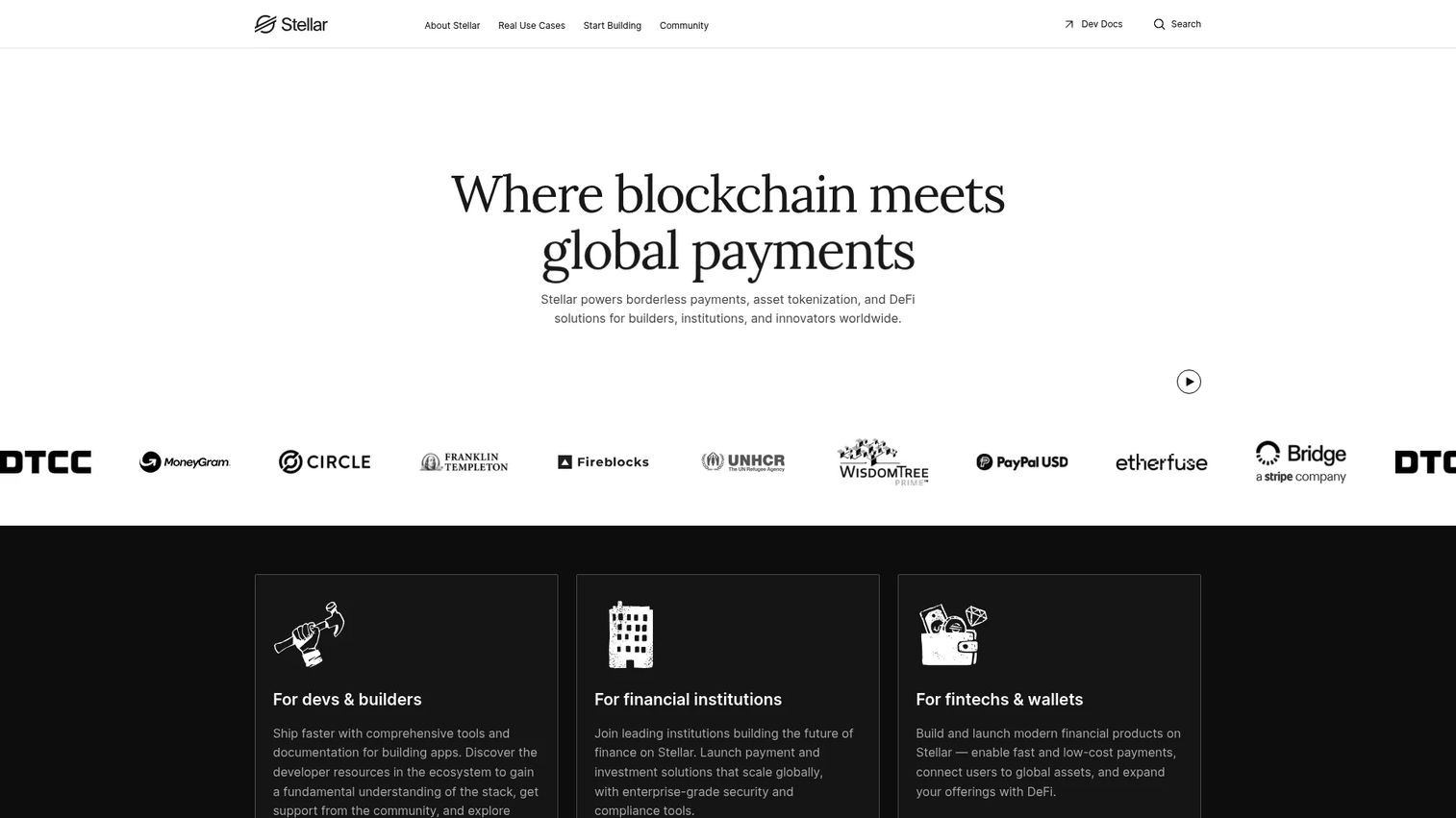
Stellar is an open-source blockchain network for payments, remittances, and asset issuance. It gets evaluated most often when the core job is moving value across borders efficiently. Rather than positioning as a general-purpose smart contract platform, Stellar leans into financial rails: fast, low-cost transfers and stablecoin infrastructure that supports assets like USDC and EURC.
That focus is why it appeals to financial and transfer-focused use cases. Remittances, payment rails, and lightweight financial workflows all map to what Stellar is optimized for. It ships wallet SDKs and developer tools aimed at teams building payment applications, so the path from concept to a working money-movement flow is well-trodden.
Best for: Teams building payment rails or stablecoin-enabled financial applications.
Key strengths
- Payments and remittances: Purpose-built for fast, low-cost cross-border value transfer.
- Stablecoin infrastructure: Native support for USDC, EURC, and other issued assets.
- Wallet SDK and tooling: Developer resources built for financial application flows.
Why choose Stellar: Choose it when the business case is payments, remittances, or asset transfer rather than complex programmable logic. For financial workflows that prioritize speed and cost per transaction, Stellar's narrow focus is a feature, not a limitation.
Stellar pricing: No public first-party pricing figure was verified; Stellar operates as a network rather than a plan-based SaaS product. G2 shows a strong 4.6/5 rating.
7. Polygon
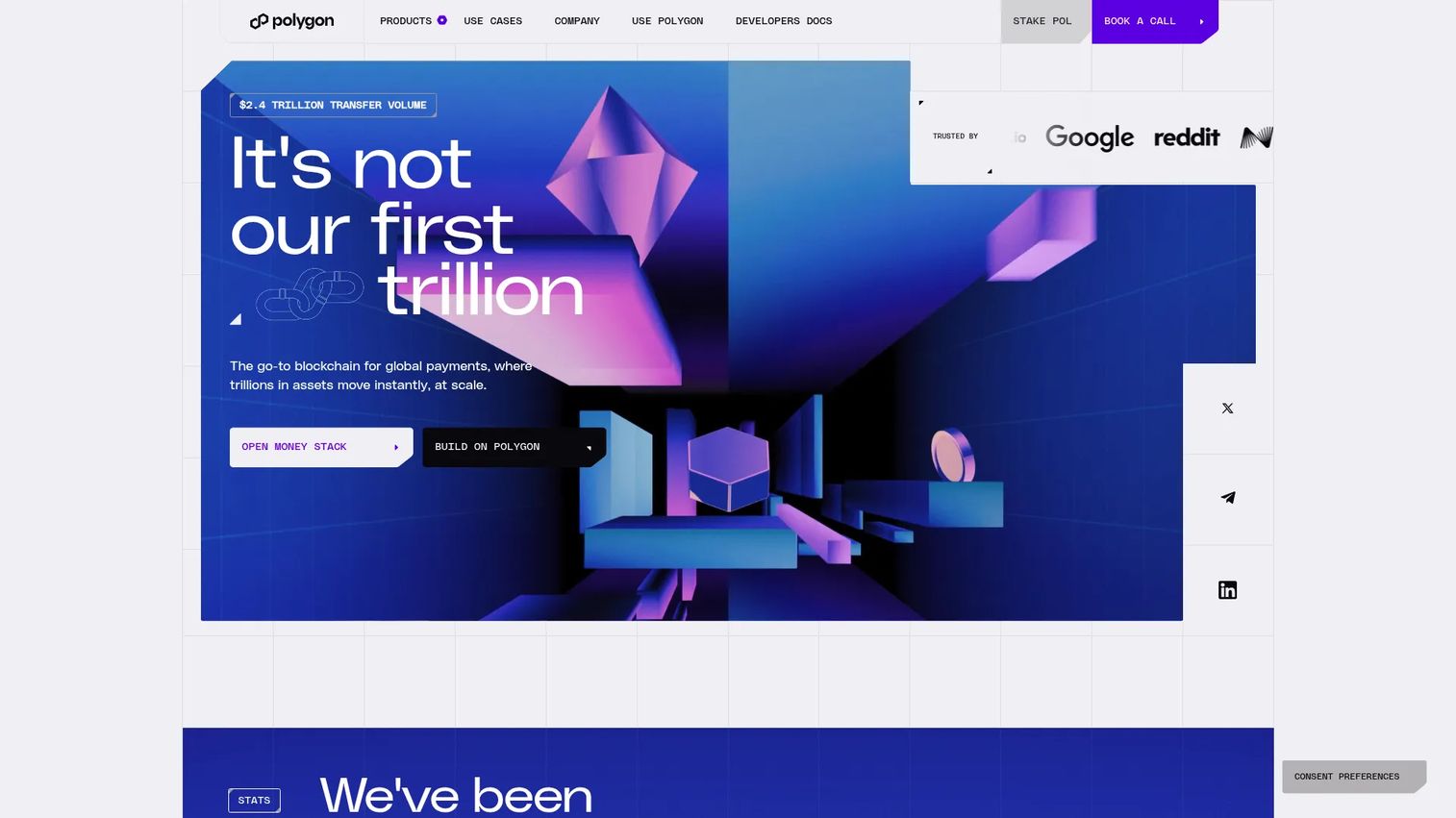
Polygon is blockchain-based payments infrastructure for stablecoin settlement and global money movement, positioned as a scaling and interoperability option in the Ethereum ecosystem. Teams consider it when they want Ethereum compatibility with better cost and speed characteristics than they would get on the base layer. The pitch is straightforward: keep Ethereum's tooling and standards, gain roughly five-second settlement and low transaction cost.
That makes it a practical bridge for applications that need Ethereum interoperability without the cost profile that can price out high-volume consumer use. Wallet infrastructure and stablecoin payments round out a stack aimed at instant settlement flows. For teams already committed to the Ethereum ecosystem, Polygon offers a lower-friction path to scale.
Best for: Enterprises building stablecoin payments and instant settlement flows on Ethereum-compatible infrastructure.
Key strengths
- Fast settlement: Roughly five-second settlement suits payment and consumer use cases.
- Low transaction cost: Economics that support high-volume flows without pricing out users.
- Wallet and stablecoin infrastructure: Built for stablecoin settlement and global money movement.
Why choose Polygon: Choose it when you want Ethereum compatibility with stronger scaling economics, particularly for consumer apps, loyalty programs, token experiences, and payment flows. It is the natural pick for teams that value the Ethereum ecosystem but need lower cost per transaction.
Polygon pricing: Public pricing is not shown on the brand site; pages direct users to contact sales, and support materials describe pricing as quote-based. G2 shows a 5.0/5 rating, though the profile has very few reviews.
8. Tezos
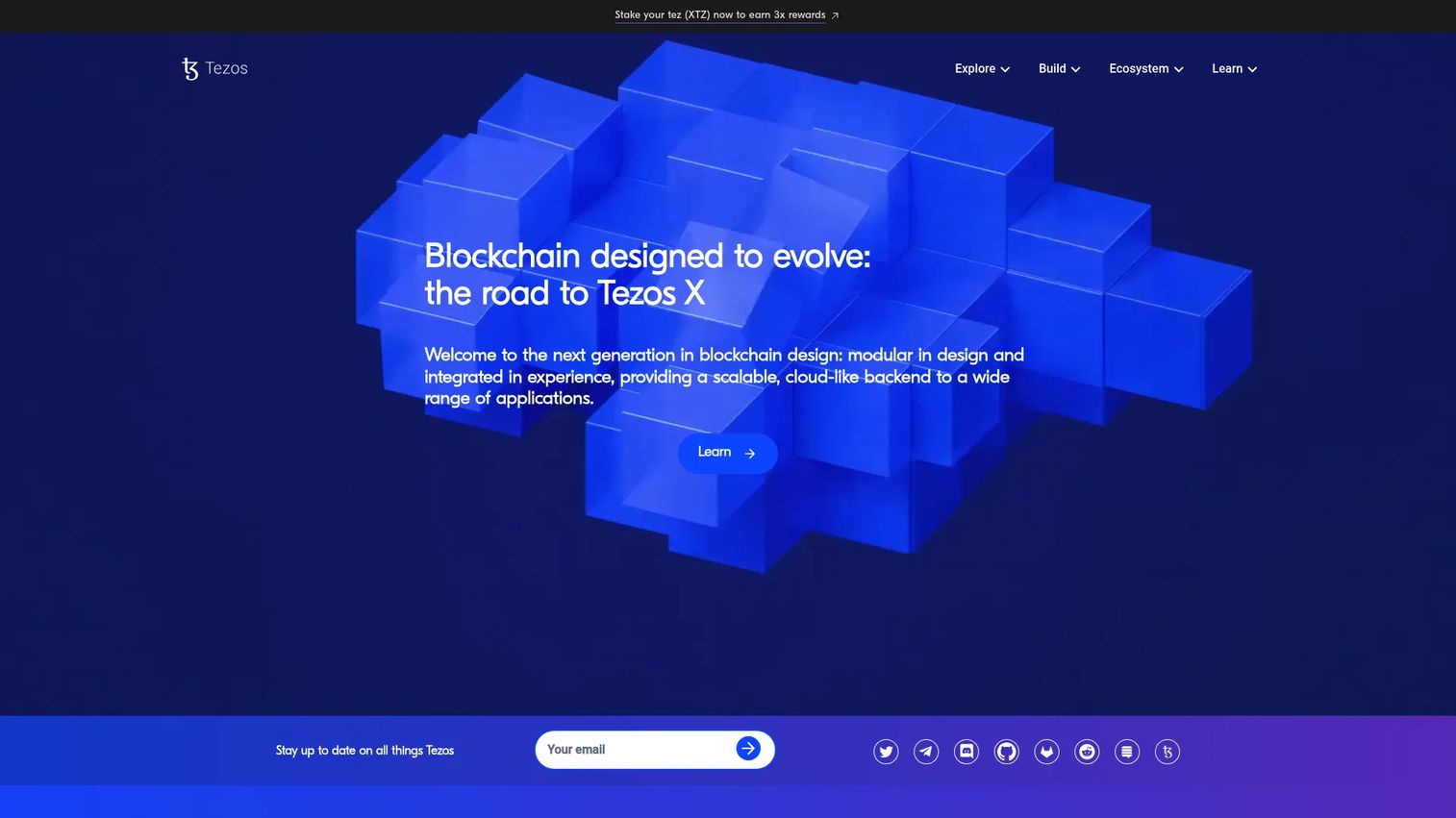
Tezos is an open-source, decentralized blockchain ecosystem with on-chain governance and self-upgrading protocol capabilities. Its differentiator is how it evolves. Instead of contentious hard forks, Tezos upgrades itself through an on-chain governance process where stakeholders vote on protocol changes. For teams that worry about long-term maintainability and control, that self-amending model is genuinely distinctive.
Tezos runs on proof of stake and has drawn attention for formal verification, the practice of mathematically proving that smart contract logic behaves as intended. That appeals to regulated tokenization and enterprise experimentation where correctness and governance carry more weight than raw ecosystem size. Teams that prioritize upgradeability and long-term protocol governance tend to shortlist it.
Best for: Teams building decentralized apps, tokenization, or DeFi use cases that prioritize governance and formal correctness.
Key strengths
- On-chain governance: Stakeholders vote on protocol changes through a formal process.
- Protocol self-upgrades: Amendments ship without disruptive hard forks.
- Proof of stake: Energy-efficient consensus with staking-based validation.
Why choose Tezos: Choose it when governance, upgradeability, and formal verification matter more than the size of the developer ecosystem. It fits enterprise experimentation, regulated tokenization, and applications that need a governance-forward foundation built to evolve over time.
Tezos pricing: Tezos is a protocol rather than a SaaS product, so there is no public subscription pricing. G2 shows a 3.6/5 rating based on a small number of reviews.
9. IBM Blockchain Platform
IBM Blockchain Platform is IBM's enterprise blockchain offering for deploying and managing Hyperledger Fabric networks on Kubernetes. It matters for organizations that want the governance and privacy of Fabric with the operational support and familiarity of a major enterprise vendor. Instead of assembling and operating a Fabric network from parts, teams get a management console and a supported deployment path.
The value here is enterprise confidence. A management console handles network deployment and maintenance, smart contracts run in Node.js, Golang, Java, or JavaScript, and multicloud and distributed network support runs on Kubernetes. For buyers already committed to IBM infrastructure or navigating heavy governance and compliance requirements, that combination reduces the operational risk of standing up a production blockchain network.
Best for: Enterprises building permissioned blockchain networks on Hyperledger Fabric with vendor-backed support.
Key strengths
- Management console: Deploy and maintain blockchain networks through a supported interface.
- Fabric smart contracts: Write logic in Node.js, Golang, Java, or JavaScript.
- Multicloud on Kubernetes: Distributed network support across cloud environments.
Why choose IBM Blockchain Platform: Choose it when enterprise support, governance confidence, and ecosystem familiarity are priorities. It fits enterprise consortia, regulated workflows, and organizations already standardized on IBM infrastructure that want Fabric without operating it unaided.
IBM Blockchain Platform pricing: IBM's documentation describes an entitlement-key model referencing Passport Advantage, which indicates quote-based, non-public licensing. G2 shows a 4.0/5 rating.
How to choose
Start from the business problem, not the feature list. The mistake that stalls blockchain projects is picking a platform for its ecosystem buzz and then discovering it fails a governance or privacy requirement three months in. Map governance, privacy, and ecosystem fit before you compare features.
A short decision path covers most cases:
- Choose Ethereum when broad ecosystem reach, tooling, and smart contract maturity outweigh the need for a private environment.
- Choose Hyperledger Fabric when you need a controlled, permissioned enterprise network with strong privacy and blockchain governance.
- Choose Corda when the use case is regulated financial workflows between known counterparties.
- Choose Solana or Polygon when throughput or scaling economics drive the decision, with Polygon adding Ethereum compatibility.
- Choose Stellar when payments and cross-border transfer are the core job.
- Choose Tezos when governance and upgradeability are non-negotiable.
- Choose IBM Blockchain Platform when enterprise support and vendor-backed Fabric operations are priorities.
The single best predictor of a successful deployment is honest scoping up front. Get the network type, governance model, and privacy requirement right, and the platform choice mostly makes itself. Get them wrong and no amount of ecosystem depth will save the project from a failed security review.
FAQs
A blockchain platform is the infrastructure teams use to build and run blockchain networks and applications. It provides the ledger structure, consensus rules, and execution environment so developers do not have to build those foundations from scratch. Think of it as the operating layer that turns blockchain technology into something you can actually deploy.
A protocol is the core rule set and consensus logic, such as the underlying Ethereum protocol. A platform is the broader environment around it: tooling, deployment options, developer frameworks, and often managed services. In practice, a platform makes a protocol usable for real projects, which is why the distinction matters during technical scoping.
For permissioned, governance-heavy enterprise networks, Hyperledger Fabric and IBM Blockchain Platform are the common choices because they offer role-based access, privacy controls, and auditability. Quorum fits teams that want Ethereum compatibility with permissioned controls. The best choice depends on your governance model, privacy requirements, and whether you want vendor-backed operations.
Ethereum is the default answer because it has the most mature smart contract environment and the deepest developer ecosystem. Quorum and Polygon extend that ecosystem with permissioned or lower-cost options while keeping Ethereum tooling. Tezos is worth evaluating when formal verification and on-chain governance matter for contract correctness.
A public blockchain is open to anyone to read, write, and validate, which supports broad participation and composability. A permissioned blockchain grants role-based access only to approved participants, which supports privacy, compliance, and operational oversight. A consortium blockchain is a permissioned network jointly governed by multiple organizations, common in shared business networks.
Corda is purpose-built for financial workflows between known counterparties, with private, need-to-know transaction sharing that suits regulated markets. Stellar excels at payments, remittances, and stablecoin transfer. For financial teams with Ethereum expertise that need permissioned controls, Quorum is a practical fit.
Start with the business problem, then assess network type, governance model, privacy and compliance requirements, ecosystem maturity, smart contract support, and enterprise readiness. Weight architecture and governance fit above ecosystem buzz, because a platform that fails a security review or a compliance check will stall regardless of its developer community size. Validate the deployment and support model before committing.
No. While digital assets are the most visible use case, enterprises adopt blockchain for supply chain transparency, digital payments, trust and traceability, tokenization, and multi-party business networks. Roughly 70% of enterprises report adopting blockchain for supply chain transparency and payment efficiency, per Business Research Insights (2025), which shows the value extends well beyond cryptocurrency.