The electric distribution network your operations team manages today looks fundamentally different from the one your control systems were designed to handle. Distributed solar, battery storage, EV charging load, and automated switching have added real-time decision volume that disconnected SCADA, OMS, and DMS applications struggle to absorb. At the same time, storm response pressure and regulator scrutiny make outage restoration speed a boardroom issue.
An advanced distribution management system, or ADMS software, addresses this by bringing monitoring, network modeling, outage workflows, and DER coordination into a unified operating environment. The global ADMS market was estimated at $3.52 billion in 2025 and is projected to reach $7.41 billion by 2030 at a 16.0% compound annual growth rate, according to MarketsandMarkets (2025). The market signal reflects how seriously utilities are treating this modernization decision.
What makes the selection hard is not understanding the acronym. Selecting a platform that fits your grid model, integration architecture, operating model, and modernization timeline is the difficult part. This guide gives you a practical framework for doing exactly that.
What's inside
This guide covers eight ADMS platforms shortlisted for electric utility distribution operations in 2026. Each entry reflects documented vendor capabilities, pricing approach, and available third-party review data.
- Who it's for: Utility technology leaders, distribution operations managers, grid modernization program managers, OT product managers, and procurement stakeholders
- How tools were chosen: Vendor documentation, capability breadth across SCADA, OMS, DMS, FLISR, and DERMS functions, G2 review availability, and deployment relevance to electric distribution networks
- Selection criteria: Functional coverage across core ADMS capabilities, integration architecture, deployment track record, and vendor stability
TL;DR
- Best for unified SCADA, OMS, and DMS operations: SurvalentONE ADMS offers a single shared network model across control room functions
- Best for Oracle Utilities environments: Oracle Utilities Network Management System fits utilities already standardized on the Oracle portfolio
- Best for engineering model depth: ETAP Advanced Distribution Management System connects power system analysis with distribution operations in one model
- Best for configurable ADMS operations: ACS PRISM ADMS suits utilities that need configuration depth aligned to their own procedures
- Best for broad grid automation: ABB Network Manager ADMS works for large utilities coordinating complex asset bases
- Broad modernization programs: GE PowerOn ADMS (now marketed as GridOS ADMS), Schneider Electric EcoStruxure ADMS, and Siemens Spectrum Power ADMS each merit shortlist evaluation depending on existing infrastructure and regional support capacity
No single system is universally the right pick. Your installed base, grid complexity, DER trajectory, and implementation readiness drive the final decision.
What are advanced distribution management systems?
An advanced distribution management system (ADMS) is utility software that combines real-time monitoring, network modeling, distribution control, outage management, and grid optimization functions for an electric distribution network.
What an ADMS typically includes
Core capabilities found across ADMS platforms include:
- SCADA data acquisition and supervisory control: Real-time telemetry ingestion and remote device control
- Distribution management workflows: Switching support, network analysis, and operational decision tools
- Outage management and restoration coordination: Customer impact assessment, crew dispatch, and restoration tracking
- Fault Location, Isolation, and Service Restoration (FLISR): Automated logic to locate faults, isolate affected sections, and restore unaffected customers where switching plans allow
- Network model management and state estimation: A real-time operating model that reflects current grid topology and switching state
- Volt/VAR optimization: Automated voltage regulation and reactive power management to maintain power quality and reduce losses
- DER visibility and dispatch integration: Monitoring of distributed energy resources and connection to DERMS coordination capabilities
- System interfaces: GIS, AMI, CIS, EMS, field mobility, historian, and OT integration points
How ADMS differs from adjacent utility systems
| System | Primary role | Relationship to ADMS |
|---|---|---|
| SCADA | Collects telemetry and sends control commands | Often a core data and control layer within ADMS |
| DMS | Optimizes distribution network operations | Commonly a built-in ADMS capability |
| OMS | Detects, manages, and restores outages | Integrated into, or delivered alongside, ADMS depending on vendor |
| DERMS | Coordinates distributed energy resources including solar, storage, and flexible load | May be native, integrated, or a separately deployed connected platform |
| EMS | Supports transmission-level and generation operations | Coordinates with ADMS where transmission and distribution decisions interact |
Ask each vendor plainly: What is native to the platform, what requires a partner product, and who owns integration maintenance after go-live.
When to use advanced distribution management systems
Automate outage response and restoration
When outage volumes, storm events, or switching complexity exceed what disconnected SCADA and OMS tools can handle reliably, ADMS brings those workflows together. FLISR logic, crew coordination, estimated restoration updates, and operator override capabilities all benefit from operating against a common network model. The alternative is operators reconciling data across separate systems during the moments that matter most.
Integrate DERs, storage, and EV charging load
High DER penetration creates voltage, thermal, and protection challenges that static operating assumptions cannot address. ADMS platforms that include or connect with DERMS capabilities give operators visibility into how solar, battery, and EV load is affecting the network in real time. Without accurate DER representation in the operating model, constraint management becomes reactive and unreliable.
Modernize a fragmented operations stack
When SCADA, OMS, DMS, GIS, and field systems each hold a different version of grid reality, operators spend time reconciling data instead of making decisions. An ADMS consolidation program gives the team a governed network model and consistent operational view. The key question is not whether modernization is needed but whether your organization has the data governance and implementation capacity to execute it.
Advanced distribution management systems comparison
Each platform below uses enterprise quote-based pricing. No vendor in this category publishes self-service plan tiers. G2 ratings reflect current verified listings where a product page with reviews exists.
| # | Product | Best for | Key differentiator | Pricing | G2 rating |
|---|---|---|---|---|---|
| 1 | SurvalentONE ADMS | Unified SCADA, OMS, and DMS operations | Integrated platform with shared network model and database | Quote-based | Not rated on G2 |
| 2 | Oracle Utilities Network Management System | Utilities using Oracle Utilities applications | Outage management and ADMS functions within the Oracle utility portfolio | Quote-based | 3.7/5 |
| 3 | ETAP Advanced Distribution Management System | Power system modeling and engineering depth | Model-driven ADMS connected to power system analysis capabilities | Quote-based | Not rated on G2 |
| 4 | ACS PRISM ADMS | Configurable ADMS operations | Integrated FLISR, Volt/VAR control, and GIS-sourced network model | Quote-based | Not rated on G2 |
| 5 | ABB Network Manager ADMS | Large utilities with broad grid automation needs | Single network model with microgrid and outage management integration | Quote-based | Not rated on G2 |
| 6 | GE PowerOn ADMS (GridOS ADMS) | Grid modernization across distribution operations | AI/ML-enhanced load prediction alongside FLISR and DER interoperability | Quote-based | 3.0/5 |
| 7 | Schneider Electric ADMS (EcoStruxure ADMS) | Integrated grid management and automation | Modular deployment of SCADA, OMS, and DMS with a shared data model | Quote-based | 5.0/5 |
| 8 | Siemens Spectrum Power ADMS | Large-scale control center requirements | Distribution SCADA, outage management, and renewable integration | Quote-based | Not rated on G2 |
Best 8 advanced distribution management systems for utilities in 2026
1. SurvalentONE ADMS
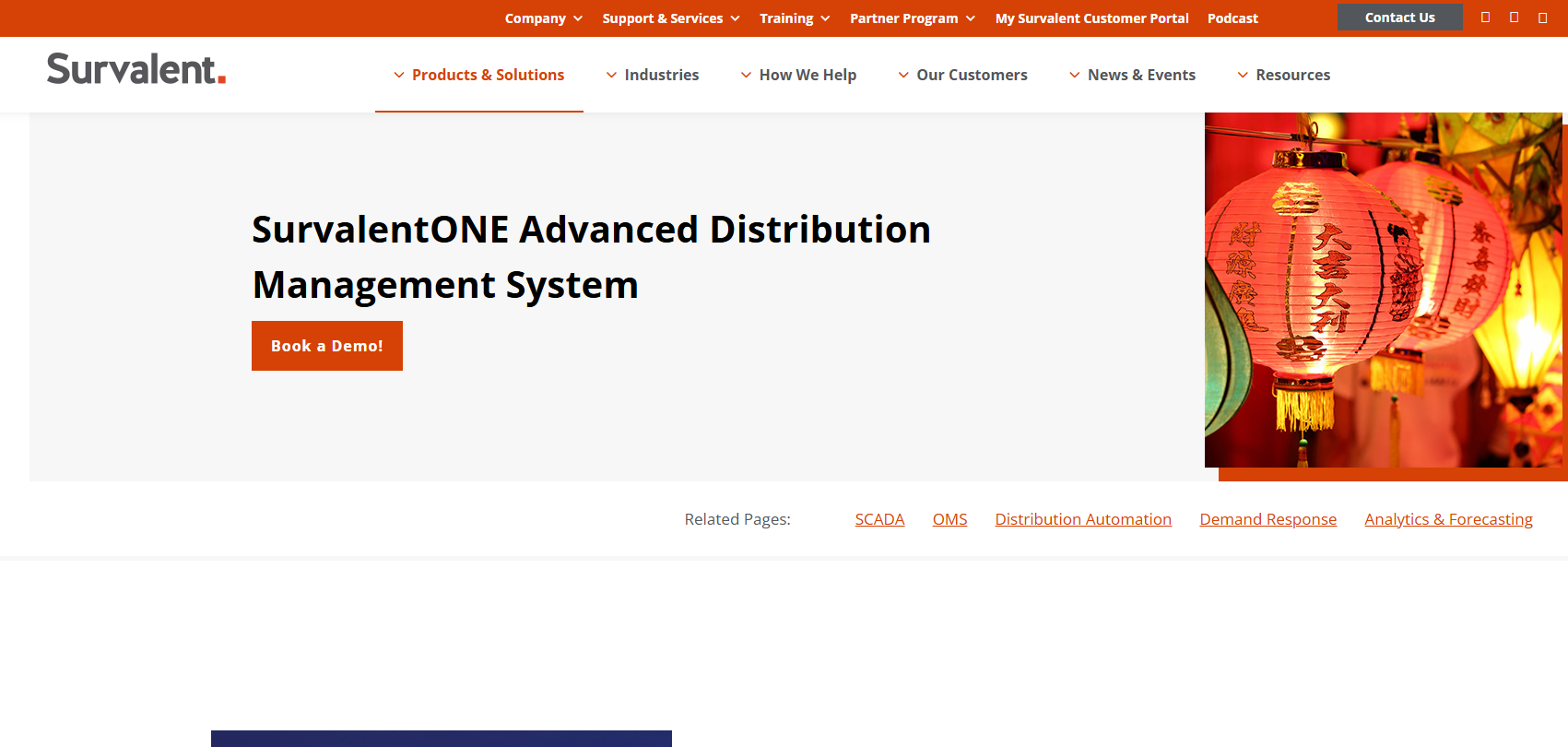
SurvalentONE ADMS brings SCADA, OMS, and DMS functions into a single integrated platform built on a shared operational network model. The vendor positions it around reducing operational complexity for utilities that currently manage those functions through separate applications with duplicate data. A single graphical interface covers learning, administration, and day-to-day operation, which shortens operator training time when compared to multi-system environments.
Best for: Municipal utilities, cooperatives, and investor-owned utilities replacing disconnected control room systems and wanting one operational source of truth.
Key features
- Unified SCADA, OMS, and DMS with a shared network model and database
- FLISR and outage restoration workflows
- DER monitoring and coordinated control
- Interoperability with third-party and legacy systems
- Flexible, scalable licensing structure
Why choose SurvalentONE ADMS: The primary argument is operational consolidation. Teams that currently maintain duplicate models across separate SCADA and OMS tools get one governed model, one interface, and one integration surface. Ask for a demonstration using a realistic outage scenario to see how the shared model performs under operational pressure.
SurvalentONE ADMS pricing: Enterprise pricing is arranged through Survalent's sales team. Cost drivers include operational scale, the number of feeders and substations covered, required application modules, integration scope, and implementation services. Request a proposal based on a comparable utility deployment to get a reliable cost baseline.
2. Oracle Utilities Network Management System
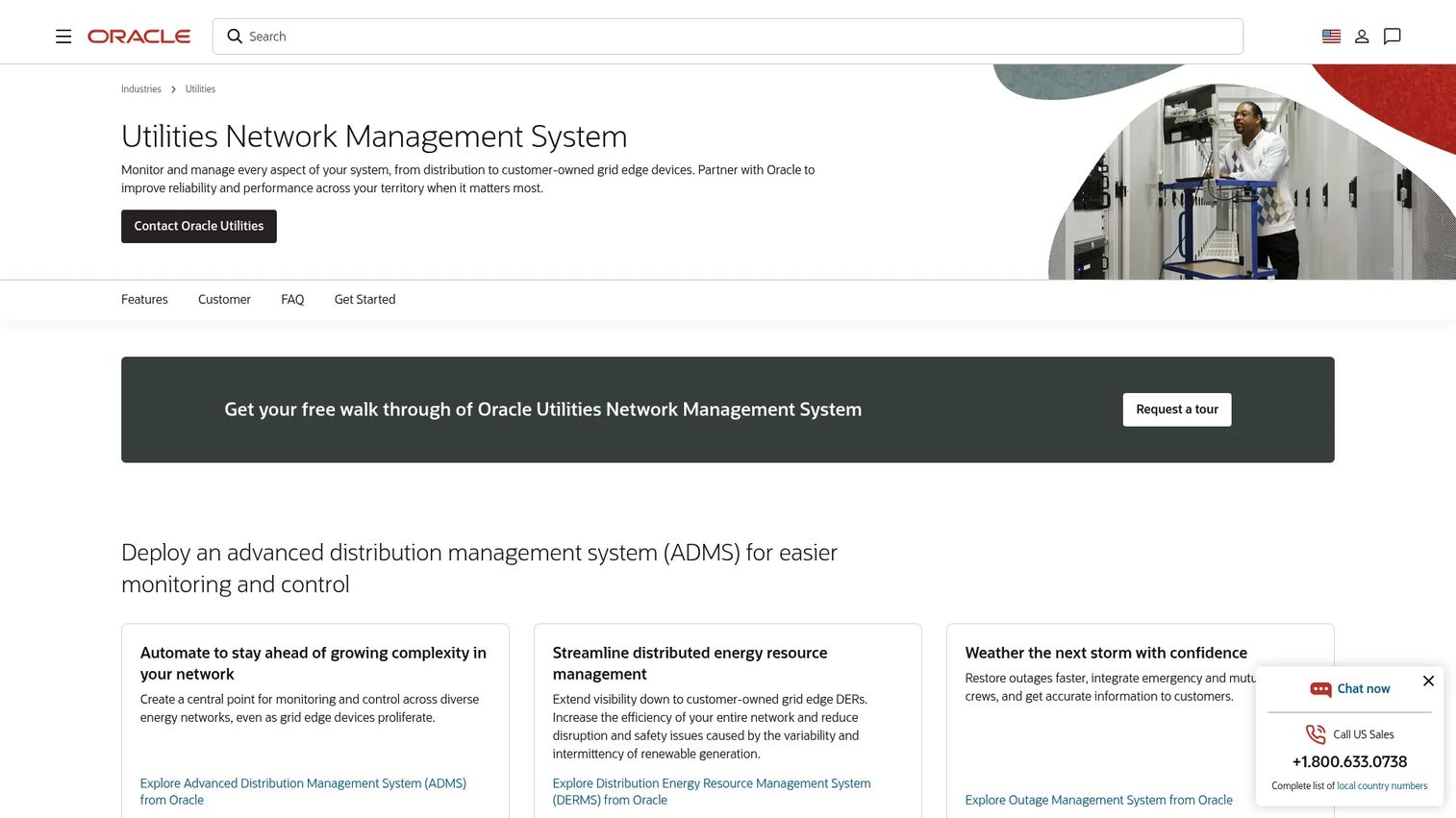
Oracle Utilities Network Management System is an enterprise distribution operations platform covering outage management, real-time monitoring and control, power flow analysis, and ADMS functions. It includes embedded SCADA, Volt/VAR optimization, state estimation, FLISR, and distributed energy resource management. The platform connects tightly with Oracle's broader utility application portfolio, which makes it a natural candidate for organizations already running Oracle Utilities billing, work management, or meter data systems.
Best for: Large electric, gas, water, and wastewater utilities seeking network management and ADMS capabilities aligned with an existing Oracle Utilities application investment.
Key features
- Advanced distribution management and real-time grid operations
- Outage management, network switching, and service restoration
- Embedded SCADA with power flow analysis and state estimation
- Volt/VAR optimization and distribution optimization
- Distributed energy resource management and common network model
Why choose Oracle Utilities Network Management System: Portfolio alignment is the core argument. If your billing, work management, and AMI data already flow through Oracle Utilities infrastructure, adding the network management system reduces integration complexity across the stack. Evaluate module packaging carefully because the scope and commercial structure of the Oracle platform can vary significantly by deployment.
Oracle Utilities Network Management System pricing: Oracle directs prospects to contact Oracle Utilities sales directly. The proposal reflects module selection, deployment model, user scope, required integrations, and implementation services. Ask Oracle to separate the platform license from implementation and ongoing support costs in their proposal.
3. ETAP Advanced Distribution Management System
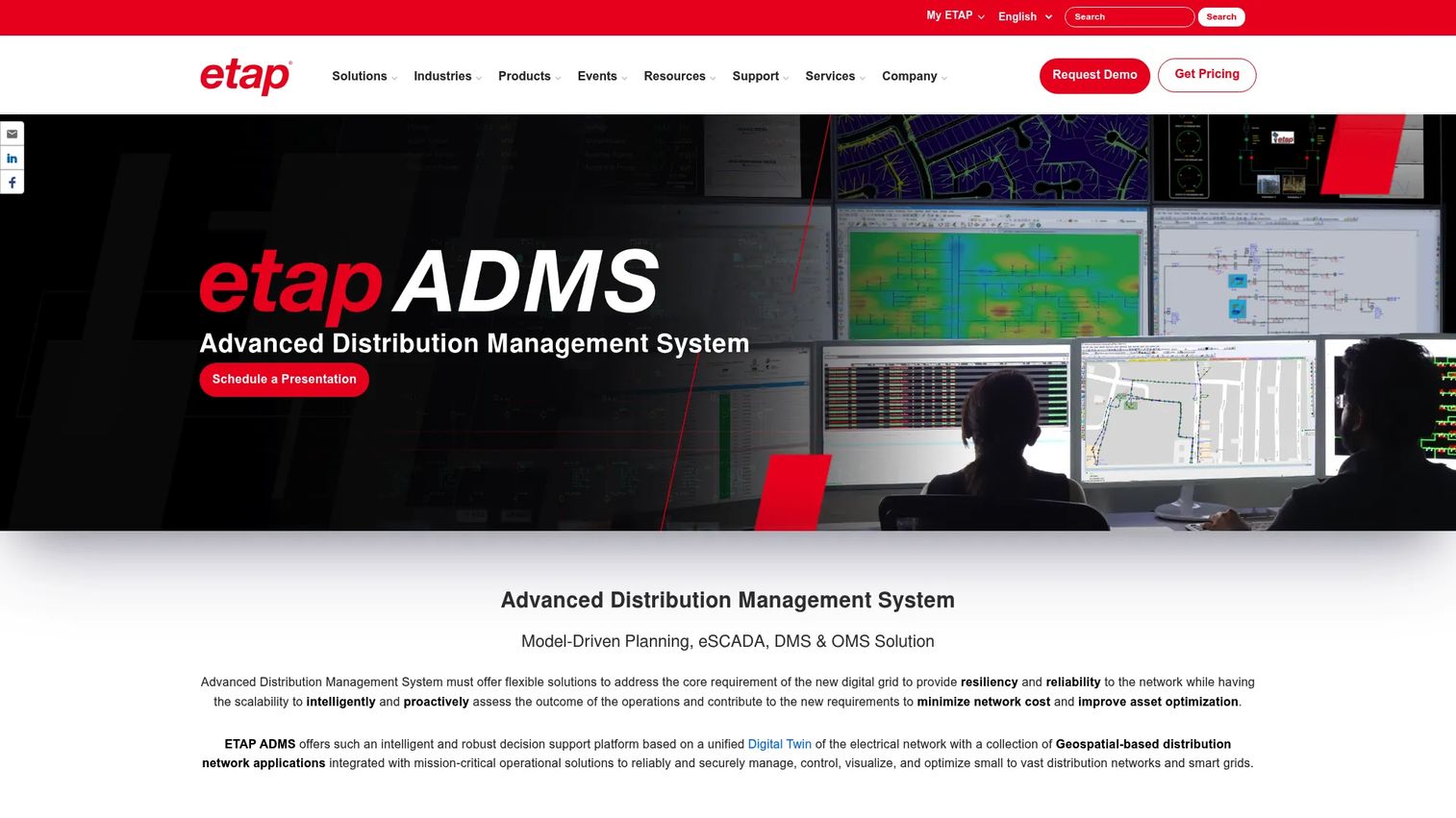
ETAP Advanced Distribution Management System takes a model-driven approach that connects planning-grade electrical analysis with real-time distribution operations. The platform includes geospatial electrical modeling, network connectivity analysis, real-time SCADA, Volt/VAR optimization, FLISR, load forecasting, switching management, outage management with crew dispatch, and web and mobile client access. The connection between the planning model and the operating model is a core architectural distinction.
Best for: Electric utilities and distribution operators where engineering model fidelity is a primary evaluation criterion, particularly those that already use ETAP for power system analysis.
Key features
- Geospatial electrical modeling and network connectivity analysis
- Real-time distribution operations with state estimation and load forecasting
- FLISR and switching order management
- Volt/VAR optimization and control
- Outage management with crew dispatch and storm assessment
Why choose ETAP Advanced Distribution Management System: The argument is model continuity. Planning engineers and operations teams work from the same electrical representation, which reduces the drift that typically develops between planning studies and the real-time operating picture. Ask specifically how model synchronization is managed when assets change, switching states are updated, or DER assets are added.
ETAP Advanced Distribution Management System pricing: ETAP provides pricing through a request-a-quote workflow on its website. The commercial proposal reflects deployment scope, model development effort, data interface requirements, application modules selected, and support package. ETAP's G2 pricing tab does not carry reviewer-reported figures for ADMS at this time.
4. ACS PRISM ADMS
ACS PRISM ADMS is an integrated utility platform for distribution network monitoring and control, outage management, automation, and DER management. The platform builds its network model from GIS and planning data through an application called DASmap, which produces the integrated single database that drives real-time operations. It includes FLISR, Integrated Volt/VAR Control (IVVC), restoration workflows, DER integration and optimization, and operator training through dynamic simulation. Note that the current Minsait ACS website presents the product family as Onesait ADMS while legacy PRISM documentation remains in circulation.
Best for: Electric utilities seeking a configurable ADMS platform where distribution visibility, outage workflows, and automation capabilities can be aligned to specific operating procedures.
Key features
- GIS-sourced integrated single database and network model
- FLISR and integrated Volt/VAR control (IVVC)
- Outage management and restoration workflows
- DER integration and optimization
- Operator training with dynamic simulation
Why choose ACS PRISM ADMS: Configuration depth is the primary consideration. The platform is designed to reflect each utility's own operating procedures rather than requiring the utility to adapt to a fixed workflow. Ask about the current product naming, any roadmap implications from the Onesait rebranding, and the implementation process for model migration from an existing GIS source.
ACS PRISM ADMS pricing: Pricing is set through enterprise proposals. The main cost drivers are application modules, system integrations, model migration effort, implementation services, training, and support scope. No reviewer-reported price ranges are available on G2 at this time.
5. ABB Network Manager ADMS
ABB Network Manager ADMS is an integrated distribution management platform for real-time monitoring, control, network analysis, optimization, outage management, and microgrid coordination. The platform provides a single network model view and unified access to advanced applications across the distribution grid. Microgrid integration covers both interconnected and islanded operating modes, which is relevant for utilities managing utility-owned grid-connected storage or generation assets.
Best for: Large electric utilities coordinating grid automation, distribution management, and control center modernization across complex asset bases with broad feeder coverage.
Key features
- Real-time network monitoring and control
- Network analysis, optimization, and outage management
- Single network model and unified application access
- Utility-owned microgrid integration (interconnected and islanded modes)
- Enterprise integration capabilities
Why choose ABB Network Manager ADMS: The argument is scale and automation breadth. For utilities with wide geographic coverage, significant distribution automation investment, and existing ABB infrastructure in substations or field devices, the platform minimizes integration friction across the operational environment. Validate the deployment architecture and confirm which modules are included in a standard deployment versus add-ons during vendor discussions.
ABB Network Manager ADMS pricing: Commercial terms are provided through ABB enterprise sales. Cost reflects operational scale, module selection, integration requirements, deployment architecture, and implementation services. No public pricing page or reviewer-reported figures are available.
6. GE PowerOn ADMS
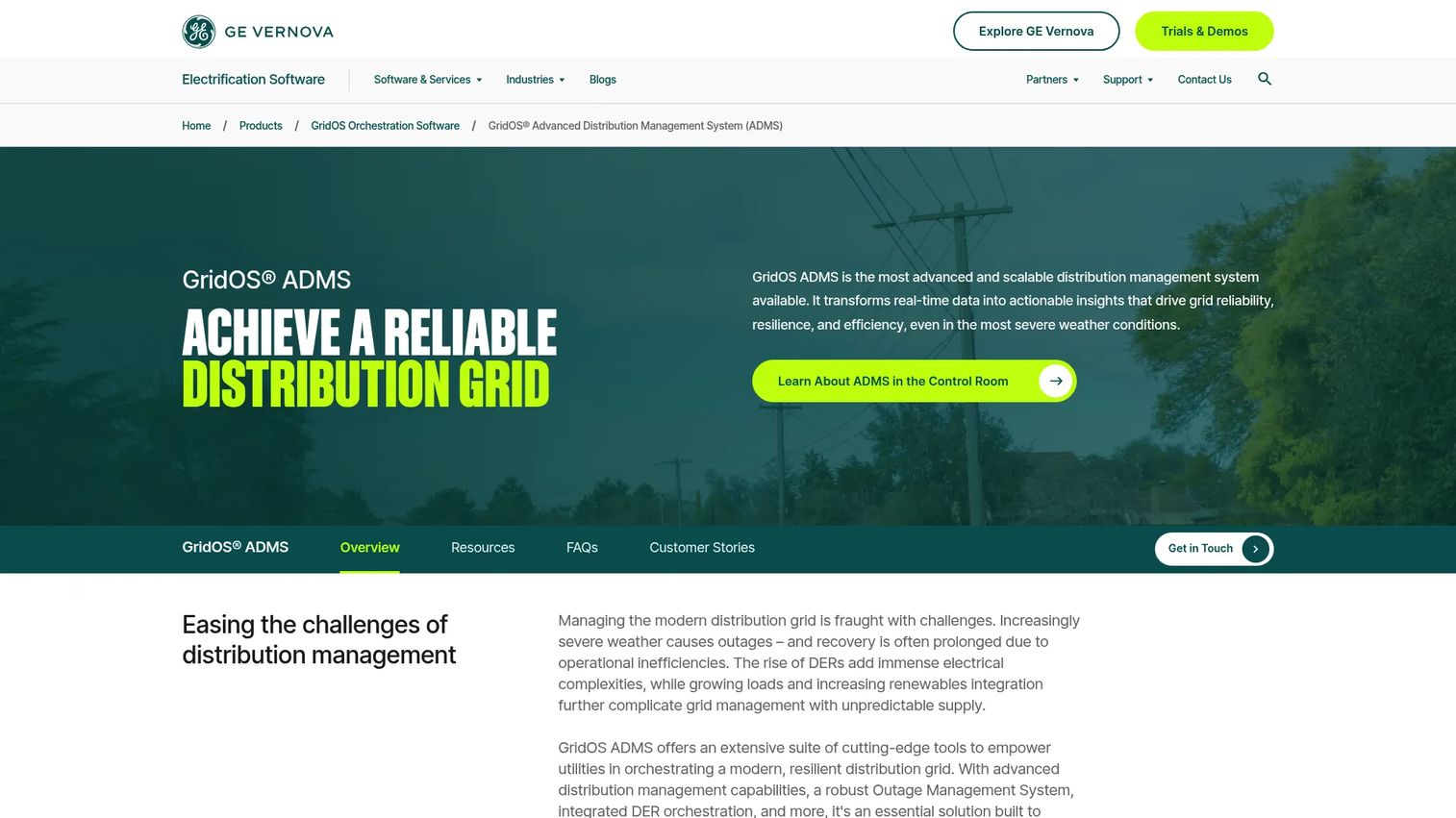
GE PowerOn ADMS, now marketed under the GridOS ADMS name by GE Vernova, is an enterprise-grade distribution operations platform covering real-time monitoring and control, outage management, FLISR, Volt/VAR optimization, and DER interoperability. A notable capability is advanced load prediction using AI and ML methods, which supports proactive operational planning alongside traditional restoration workflows. Confirm current product naming and available modules with GE Vernova sales given the GridOS rebranding.
Best for: Electric utilities running large grid modernization programs that need to coordinate control center workflows, outage operations, and distribution automation with AI-assisted planning capabilities.
Key features
- Integrated OMS with FLISR
- Advanced load prediction using AI/ML
- Distributed energy resource management interoperability
- Volt/VAR optimization
- Real-time distribution grid monitoring and control
Why choose GE PowerOn ADMS: The AI-assisted load prediction capability distinguishes this platform from peers that rely on traditional statistical methods alone. For utilities facing increasing DER variability and load uncertainty, that capability supports more proactive operational planning. Separate current GridOS ADMS functionality from roadmap claims during vendor discussions, and ask for a reference utility operating in a comparable grid environment.
GE PowerOn ADMS pricing: Enterprise pricing requires a commercial proposal from GE Vernova sales. Total cost depends on operational scope, module licensing, integration requirements, data conversion, implementation work, and ongoing support. No self-service pricing page is available.
7. Schneider Electric ADMS
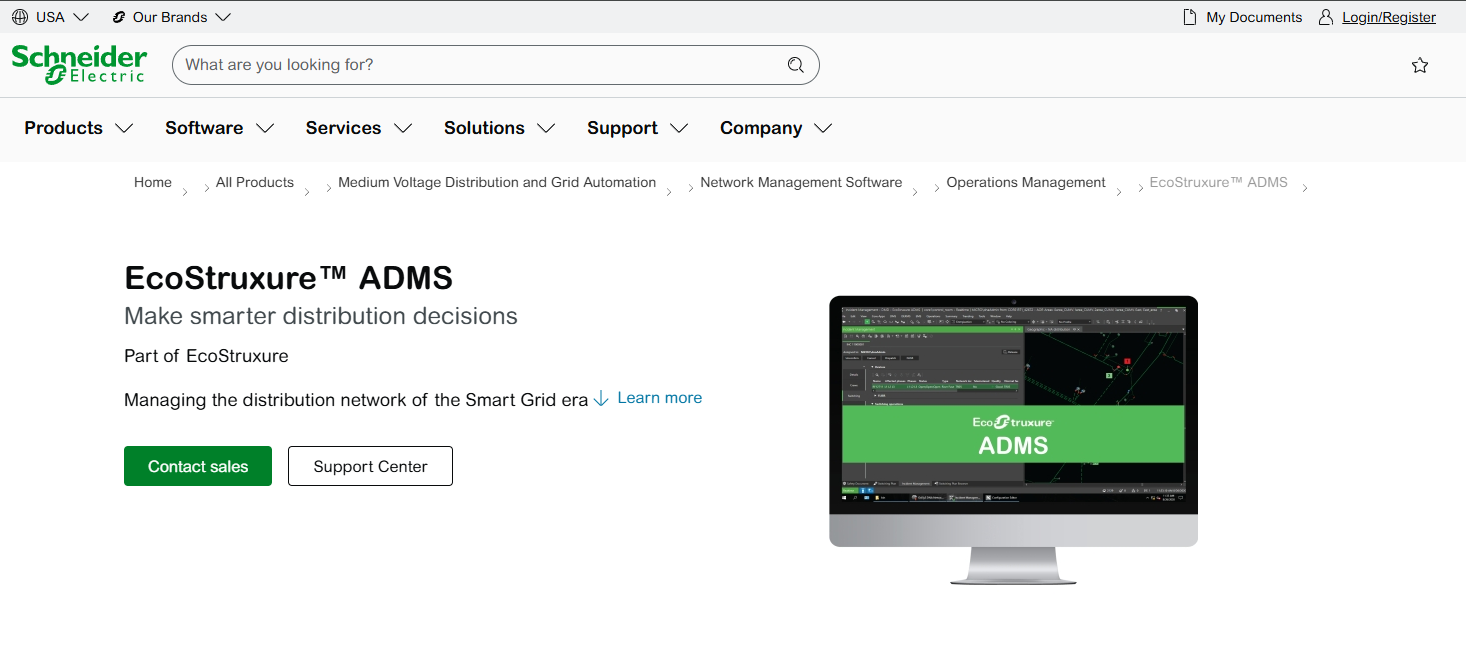
Schneider Electric EcoStruxure ADMS is a modular distribution management platform covering real-time forecasting, historical analysis, SCADA, OMS, and DMS functions under a common user experience and data model. The modular architecture means SCADA, OMS, and DMS can be deployed separately or together within the same platform, which supports phased adoption strategies. The platform connects to Schneider Electric's broader grid automation and energy management portfolio.
Best for: Electric utilities evaluating ADMS alongside a wider investment in Schneider Electric distribution automation, smart grid, or utility OT technology.
Key features
- Modular SCADA, OMS, and DMS with a common data model and integration framework
- Real-time forecasts and historical network views for situational awareness
- Flexible deployment: Separate or comprehensive module options
- Advanced planning for distributed generation, EV integration, and network reinforcement
Why choose Schneider Electric ADMS: Portfolio alignment and modular deployment flexibility are the core considerations. A utility standardizing on Schneider Electric substation automation, protection relay management, or grid analytics benefits from reduced integration effort across those layers. Before committing, clarify which functions are native to EcoStruxure ADMS, which depend on adjacent Schneider Electric products, and what the integration maintenance model looks like post-deployment.
Schneider Electric ADMS pricing: Pricing is arranged through Schneider Electric enterprise sales. Purchase drivers include selected modules, grid scale, integration scope, hosting model, implementation services, and support requirements. No public pricing figures are available.
8. Siemens Spectrum Power ADMS
Siemens Spectrum Power ADMS is a control-center-focused platform for distribution SCADA, outage management, network analysis, load forecasting, fault analysis, and renewable energy integration. The platform targets utilities and grid operators with large control center environments where operational monitoring, network applications, and IT/OT integration run across a broad asset footprint. Siemens positions the platform around managing and optimizing renewable energy integration into distribution systems alongside traditional grid operations.
Best for: Utilities with large control center environments that need ADMS capabilities evaluated within a broader operational technology and grid control architecture, particularly where renewable integration is a priority.
Key features
- Integrated distribution SCADA and outage management
- Distribution network applications: Fault analysis, network analysis, and load forecasting
- Integration with third-party IT/OT systems and renewable energy sources
- Grid visualization and operational analytics
Why choose Siemens Spectrum Power ADMS: Control room scale and renewable integration depth are the distinguishing factors. For utilities managing complex grid architectures with significant renewable generation at the distribution level, the platform's combination of network applications and IT/OT integration breadth supports a consistent operating picture. Test user experience, network model workflow, and interoperability with your specific SCADA and GIS environment during vendor evaluation.
Siemens Spectrum Power ADMS pricing: Siemens directs prospective customers to contact sales or request a quote. Platform configuration, operational scale, system interfaces, service scope, and regional delivery requirements all influence the final proposal.
Considerations when choosing an advanced distribution management system
Start with the network model
Every downstream workflow depends on the quality of the operating network model. Ask each vendor how GIS synchronization works, how topology changes propagate from field updates, and how DER assets are represented when they are added, removed, or change operating state. A strong vendor demonstration shows model changes moving from engineering to operations in a workflow you would actually use.
Separate native capabilities from integrations
"Supports SCADA, OMS, DERMS, and AMI" is not a complete answer. Ask which capabilities are built into the platform, which require a partner product or a separate license, and who owns integration maintenance after go-live. Integration ownership is where long-term cost and operational risk accumulate.
Evaluate the outage operating model under pressure
Testing a dashboard is not enough. Ask vendors to demonstrate fault detection, FLISR logic, switching workflows, crew coordination, estimated restoration updates, audit trails, and manual operator override in a realistic scenario. The outage operating model is where platform differences become visible under simulated field pressure.
Plan for DER and EV growth
A platform selected for today's operating conditions may face strain as solar, storage, EV charging, and flexible load grow on your network. Ask how DER constraints, dispatch, voltage impacts, and forecasting are handled. Confirm whether DERMS capability is native, integrated, or requires a separately deployed platform.
Budget for implementation and ongoing ownership
Software licenses represent one portion of total ADMS cost. Data cleanup, model migration, integration work, cybersecurity review, operator training, release management, and post-go-live support all add to the business case. Over 60% of utilities surveyed allocate at least 15% of capital budgets to resilience initiatives, according to Deloitte as reported by T&D World (2026), which reflects how seriously organizations are treating operational continuity investment. Build a realistic total cost model before committing to a vendor.
How to choose the right advanced distribution management system for your utility
If disconnected operations systems are the immediate problem
Prioritize a platform that unifies SCADA, OMS, and DMS workflows around a governed network model. SurvalentONE ADMS and ACS PRISM ADMS are both positioned specifically around this consolidation use case. Ask for evidence that a unified deployment reduces duplicate model updates and gives operators a consistent view during active outage events.
If DER growth is the main driver
Prioritize DER visibility, constraint awareness, DERMS coordination, and Volt/VAR control. Test each platform with a realistic scenario that includes solar, storage, and EV assets simultaneously affecting voltage and load. Oracle Utilities NMS, ETAP ADMS, and GE PowerOn ADMS each include DER-related capabilities worth examining in a structured proof of concept.
If engineering model quality is the bottleneck
Prioritize model-driven operations, topology processing, state estimation, and GIS integration fidelity. ETAP ADMS is the clearest option here given its architectural connection between planning analysis and real-time operations. The key question is whether the operating model remains trustworthy as assets and switching states change throughout the day.
If the utility is running a major modernization program
Evaluate the vendor's deployment approach as closely as the product itself. Review integration architecture, data migration methodology, implementation partner capabilities, training plans, cybersecurity documentation, and long-term support structure. ABB, Schneider Electric, and Siemens all have deployment experience across large utility environments and warrant evaluation for programs with broad operational scope.
Conclusion
Selecting an advanced distribution management system is an operating model decision, not a software procurement transaction. The platform you choose shapes how your operations team responds to outages, how your network model stays current as assets and DER penetration change, and how your control room handles the real-time decisions that fragmented systems cannot coordinate.
The strongest shortlist for your utility depends on your existing stack, grid complexity, DER trajectory, and the organizational capacity to support a multi-year implementation. No platform covered here is the universal answer. SurvalentONE and ACS PRISM are natural candidates if operational consolidation is the driving need. ETAP fits teams where engineering model fidelity matters most. Oracle NMS suits utilities deeply embedded in that vendor's portfolio. ABB, GE Vernova, Schneider Electric, and Siemens each bring deployment scale and automation breadth for larger modernization programs.
The right next step is to turn the buying criteria in this guide into an RFP scorecard, then require scenario-based demonstrations from your shortlist. Choose the platform that can support the grid you operate today while giving your operations team a credible path to manage the grid you will operate next.
Start your journey with Guideflow today!
FAQs
An advanced distribution management system (ADMS) is utility software that combines real-time distribution grid monitoring, supervisory control, outage management, network modeling, and optimization functions into a unified operating environment. The exact scope varies by vendor: Some platforms integrate SCADA, DMS, and OMS natively, while others deliver those functions through connected components. ADMS is designed for electric distribution networks specifically, not transmission or generation operations.
SCADA focuses on telemetry acquisition, alarm management, and supervisory control commands to field devices. ADMS builds on that data layer with network modeling, distribution optimization applications, outage coordination workflows, FLISR, and state estimation. Think of SCADA as the sensor and control layer, and ADMS as the analytical and operational layer that turns raw telemetry into actionable grid intelligence.
Some ADMS platforms include OMS capabilities natively, while others integrate with a separately deployed OMS. Before assuming consolidation, verify whether outage prediction, customer call management, restoration planning, crew coordination, and public communication capabilities are native to the ADMS or connected through a supported integration. This distinction affects both the implementation scope and the long-term support model.
FLISR stands for Fault Location, Isolation, and Service Restoration. The operational goal is to identify the probable location of a fault on the distribution network, isolate the affected section by opening the appropriate switching devices, and restore power to customers on unaffected network segments where switching plans and capacity allow. Effective FLISR depends on an accurate real-time network model and reliable telemetry from field devices.
ADMS platforms can provide visibility into how DER assets, including solar generation, battery storage, and EV charging, are affecting voltage, thermal loading, and protection coordination across the distribution network. Connection to DERMS capabilities allows the ADMS to incorporate DER forecasting, constraint awareness, and coordinated dispatch into the operating picture. The depth of that integration varies significantly across vendors, so ask specifically how DER assets are represented in the real-time model and what dispatch coordination capabilities are native versus integration-dependent.
Priority integrations to require include SCADA, GIS, AMI, OMS (if separate), DERMS (if separate), CIS, EMS, field mobility applications, historian, and operational technology interfaces for protection and automation devices. For each integration, ask who owns data synchronization logic, how error conditions are handled, what the cybersecurity testing requirements are, and what support coverage applies after deployment. Integration ownership is where long-term cost and operational risk concentrate.
No ADMS vendor in this comparison publishes self-service pricing. Each platform is sold through enterprise proposals that reflect utility scale, module selection, required integrations, data migration scope, implementation services, hosting model, operator training, and ongoing support structure. Utility-scale ADMS programs typically span multiple years of implementation work, which means the software license is a portion of total program cost. Request an itemized commercial proposal based on a comparable reference utility deployment to get a reliable cost picture.
Implementation timelines vary widely because the work includes network model preparation and GIS data cleanup, system integration development and testing, operator workflow design, cybersecurity review, acceptance testing, training, and phased cutover. Programs at large utilities with complex grid models and multiple system integrations commonly run two to four years or longer. Ask each vendor for a deployment plan based on a utility environment that matches your feeder count, integration scope, and model complexity.