A stablecoin feature can look deceptively simple on a roadmap. Then engineering opens the question of wallet architecture, compliance asks about counterparty data, finance wants reconciliation reports, and operations discovers that three corridors you planned to support require separate licensing arrangements.
B2B stablecoin payments reached roughly $226 billion in 2025, growing 733% year over year, according to McKinsey and Artemis Analytics (2026). That growth is pulling more product teams into the category, and the infrastructure decision they make determines whether stablecoin capabilities become a product advantage or a permanent operational queue.
The central question is not which platform has the most features. It is which provider reduces engineering opportunity cost, supports the exact money flows on your roadmap, and leaves room to instrument, maintain, and extend the product across release cycles.
This guide compares ten stablecoin infrastructure software platforms to help you build a defensible shortlist.
What's inside
This guide targets product managers at fintech, payments, crypto, and global commerce companies evaluating stablecoin infrastructure vendors. Each platform was selected based on four criteria:
- Payment jobs supported: Issuance, payouts, cross-border transfers, card programs, and settlement coverage
- Developer experience: API quality, documentation, wallet model, and integration complexity
- Operational controls: Reconciliation, compliance workflows, audit support, and release maintainability
- Pricing transparency: Published pricing, usage-based models, or verified enterprise contract terms
TL;DR
- Best for stablecoin issuance and enterprise settlement: Circle, with USDC infrastructure, usage-based wallet pricing, and a cross-chain transfer protocol
- Best for stablecoin orchestration across payments, wallets, and global payouts: Bridge, covering acceptance, storage, conversion, and payout in one API layer
- Best for card programs and digital-dollar payment products: Rain, with embedded wallets, card issuing, onramps, and rewards
- Best for cross-border business payments and treasury workflows: BVNK, built for enterprises processing at scale with compliance and AML built in
- Best for transaction compliance workflows: Notabene, with pre-transaction authorization and Travel Rule messaging infrastructure
The right platform depends on whether your roadmap job is issuance, money movement, wallet infrastructure, card programs, or compliance operations.
What is stablecoin infrastructure software?
Stablecoin infrastructure software provides APIs, operational tools, and regulated service layers that let businesses issue, hold, move, convert, settle, or monitor stablecoin value inside financial products.
The category covers several distinct infrastructure jobs:
- Stablecoin issuance: Creating and redeeming regulated stablecoins backed by reserves
- Payment orchestration: Moving funds across wallets, banks, and blockchain networks
- Wallet infrastructure: Creating, securing, and controlling user or business wallets with programmable signing policies
- Cross-border payouts: Sending stablecoin or fiat value internationally across corridors and currencies
- Card programs: Connecting stablecoin balances to virtual or physical card spending
- Fiat conversion: Supporting onramps, offramps, and settlement between fiat and stablecoin
- Compliance operations: Screening, monitoring, Travel Rule data exchange, and audit support
How stablecoin infrastructure differs from a crypto exchange
Exchange APIs focus on trading access: Order books, market prices, and asset swaps. Stablecoin infrastructure platforms support embedded financial workflows, programmatic money movement, account structures, wallet controls, and enterprise operations. The use case is building a financial product, not accessing a trading venue.
Key features to evaluate
- API coverage, documentation quality, and SDK availability
- Supported currencies, blockchains, and fiat corridors
- Wallet model: Custodial, non-custodial, or programmable signing
- Reconciliation tools and transaction reporting
- Card, payout, or account capabilities
- Security controls, access management, and compliance workflows
- Pricing model and volume commitments
When to use stablecoin infrastructure software
Launch cross-border payment or payout flows
Marketplaces, payroll products, contractor platforms, and B2B payment applications often need to move money across jurisdictions faster and at lower cost than traditional rails allow. Stablecoin infrastructure lets you instrument those flows at the transaction level, measure failed or delayed payments, and iterate without rebuilding the underlying rail. Start with the corridor and currency requirements, then match a provider to that coverage.
Build wallets, balances, or programmable accounts into a product
When the roadmap requires embedded wallets, business treasury accounts, or programmable transaction signing, you need infrastructure that handles key custody, policy enforcement, user permissions, and lifecycle events. PM concerns here include role-based access, recovery workflows, and the maintenance burden across release cycles.
Add stablecoin settlement, cards, or treasury workflows
Card programs, stablecoin settlement, digital-dollar accounts, and treasury operations each carry distinct compliance, network, and operational requirements. These features require early coordination with finance, compliance, risk, and engineering before committing to an architecture. Map every card network rule, settlement currency, and reporting obligation against your roadmap before selecting a vendor.
Stablecoin infrastructure software comparison
Not every platform competes on the same layer. A provider built primarily for issuance serves a different product job than one built for card programs or wallet key management. Use the table below as a routing guide, not a feature-for-feature ranking.
| # | Product | Best for | Key differentiator | Pricing | G2 rating |
|---|---|---|---|---|---|
| 1 | Circle | Stablecoin issuance and enterprise settlement | USDC infrastructure, cross-chain transfers, programmable wallets | Usage-based, free tier available | 4.2/5 |
| 2 | Bridge | Stablecoin payment orchestration | APIs for accepting, storing, converting, and paying out funds | Contact sales | N/A |
| 3 | Rain | Card programs and stablecoin payment products | Embedded wallets, card issuing, onramps, and rewards | Contact sales | N/A |
| 4 | BVNK | Cross-border business payments and treasury | Stablecoin-enabled payments with AML and Travel Rule support | Contact sales | 4.7/5 |
| 5 | Paxos | Regulated stablecoin issuance and custody | Regulated issuance, custody, tokenization, and settlement | Contact sales | 4.5/5 |
| 6 | Zero Hash | Embedded crypto and stablecoin capabilities | APIs for trading, custody, payments, and tokenized products | Contact sales | 4.3/5 |
| 7 | Coinbase Developer Platform | Developer-led wallet and payment builds | Wallet tools, onramp, and onchain payment APIs with free tier | Usage-based, free tier available | N/A |
| 8 | Crossmint | Embedded wallets and user onboarding | Programmable wallets, onramps, and compliance built in | Usage-based, free tier available | N/A |
| 9 | Turnkey | Secure programmable wallet infrastructure | Non-custodial wallet signing with policy controls | Usage-based, free tier available | N/A |
| 10 | Notabene | Transaction compliance operations | Pre-transaction authorization and Travel Rule messaging | Contact sales | N/A |
Best 10 stablecoin infrastructure software platforms for 2026
1. Circle
Circle is a blockchain infrastructure company behind USDC and EURC, providing the stablecoin payment rails, wallet infrastructure, smart contract tooling, and cross-chain transfer protocols that let businesses build internet-native financial applications. For product teams whose roadmap centers on stablecoin issuance, programmatic settlement, or USDC-based payment flows, Circle provides the issuer-backed infrastructure layer rather than a third-party aggregation of blockchain access.
Best for: Fintech and enterprise product teams building around stablecoin issuance, programmable wallets, cross-chain settlement, or USDC-denominated treasury workflows.
Key features
- USDC and EURC stablecoin issuance and redemption infrastructure
- Programmable wallet APIs for digital asset storage and transactions
- Cross-chain asset transfers via CCTP (Cross-Chain Transfer Protocol)
- Smart contract templates and workflow automation
- Global stablecoin payments via Circle Payments Network
Why choose Circle: Circle fits best when your product depends on stablecoin liquidity, issuer-backed settlement guarantees, or direct USDC rails. Teams whose primary need is card issuing or a broader embedded-wallet-as-a-service layer may need complementary infrastructure alongside it.
Circle pricing: Circle offers usage-based wallet pricing with a free tier covering the first 1,000 wallets per month. Above that threshold, the Signing API plan costs $0.038 per wallet and the All Included plan costs $0.050 per wallet, billed monthly. Contracts pricing starts free for up to 25,000 calls per month, then $0.0005 per call.
G2 rating: Circle holds a 4.2/5 on G2.
2. Bridge
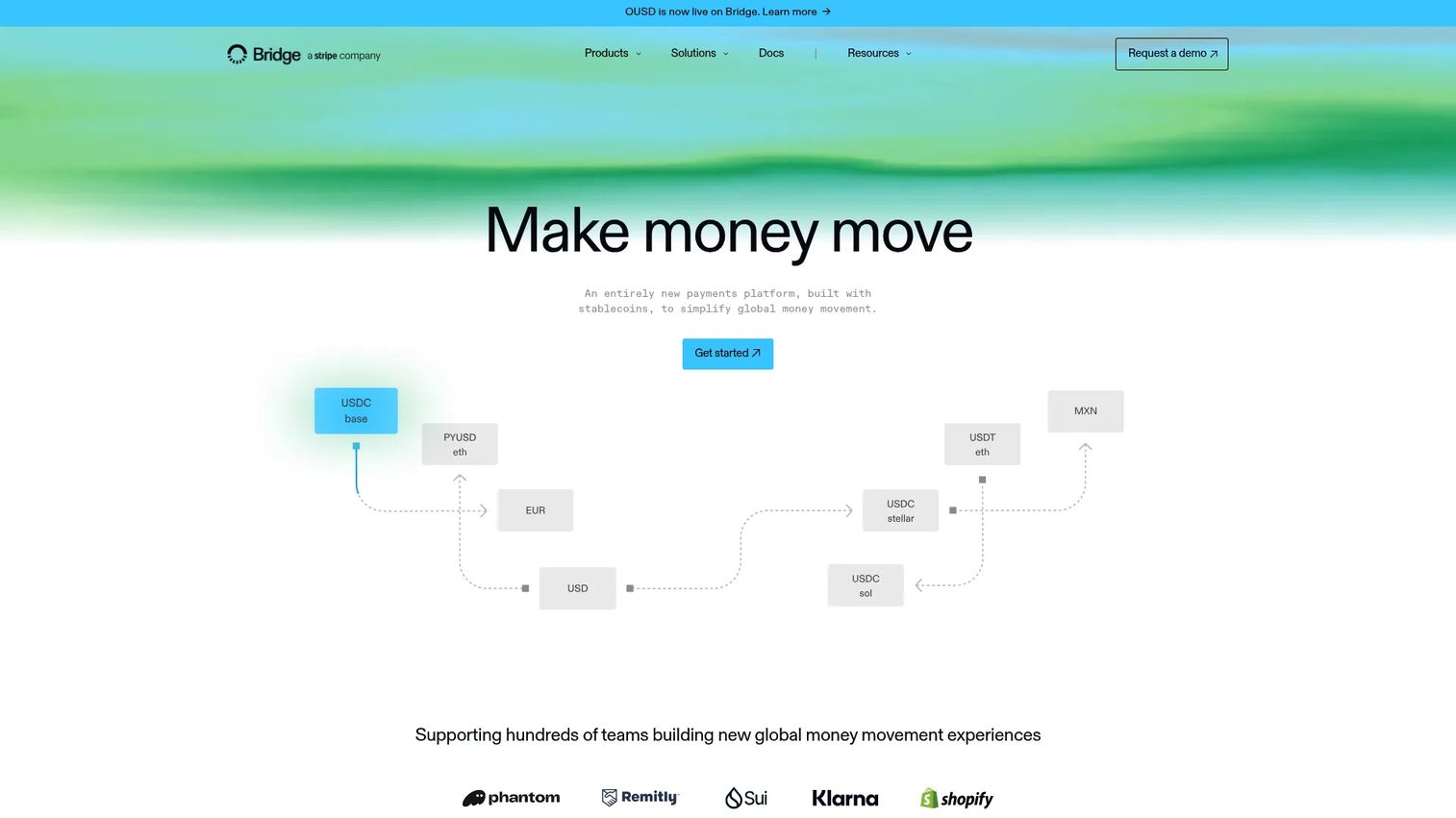
Bridge is a stablecoin infrastructure and API provider that lets businesses accept, store, convert, issue, and pay out stablecoins across multiple blockchains and currencies. For product teams assembling a global payments product, Bridge's value is in consolidating several money movement abstractions, including wallets, cross-border payouts, card programs, and custom stablecoin issuance, under a single API layer rather than building each separately.
Best for: Product teams building global payment products that combine stablecoin wallets, payouts, card programs, or embedded financial accounts in one engineering effort.
Key features
- Stablecoin and fiat orchestration across multiple blockchains and currencies
- Digital wallets with custody and transaction monitoring
- Virtual accounts, cross-border payments, and global payouts
- Stablecoin-backed global card programs
- Custom stablecoin issuance with reserve management and distribution
Why choose Bridge: Bridge works well for teams that want to ship several money movement functions without maintaining separate providers for wallets, payouts, and card infrastructure. The tradeoff is that pricing requires a sales conversation, so build that timeline into your evaluation cycle.
Bridge pricing: Bridge does not publish standard pricing tiers. Contact the Bridge team directly to discuss commercial terms for your transaction volume and product requirements.
3. Rain
Rain is an enterprise stablecoin payments platform that provides embedded non-custodial wallets, stablecoin-powered card issuing, onramps, offramps, virtual accounts, and global payouts through a unified API. Where other providers focus on raw blockchain infrastructure, Rain's product surface is oriented toward the consumer and business payment experience, including branded card programs, card-native rewards, and static virtual account routing.
Best for: Fintech teams and global platforms launching stablecoin-powered cards, digital-dollar accounts, remittance products, or branded enterprise payment experiences.
Key features
- Embedded non-custodial stablecoin wallet infrastructure
- Stablecoin-powered prepaid and credit card issuing
- Fiat onramps and offramps
- Virtual accounts with static routing details
- Card-native rewards on eligible spending
Why choose Rain: Rain fits product teams whose roadmap requires a card-plus-wallet product rather than just blockchain payments. Before signing, validate each target region's card network participation, card program sponsorship requirements, implementation timelines, and reconciliation responsibilities.
Rain pricing: Rain does not display standard pricing on its website. Reach out to the Rain team to get commercial terms aligned to your program volume and product structure.
4. BVNK
BVNK is a stablecoin payments infrastructure provider for enterprises, connecting fiat payment rails, banks, blockchains, wallets, cards, and compliance workflows in a single platform. It serves businesses that need to send and receive payments globally, hold and convert fiat and stablecoin balances, and meet AML monitoring and Travel Rule requirements at scale. BVNK states it targets businesses processing at least $500,000 monthly with at least six months of operating history, which positions it toward mid-market and enterprise payment operators.
Best for: B2B fintech products, marketplaces, payroll providers, and global payment teams needing stablecoin-enabled international collections, payouts, and treasury operations with built-in compliance.
Key features
- Send and receive stablecoin payments globally
- Store and convert fiat and stablecoin balances
- Embedded wallets, virtual accounts, and API integrations
- Stablecoin-backed virtual card issuing
- Compliance, AML monitoring, and Travel Rule support
Why choose BVNK: BVNK is a strong fit when cross-border money movement is the core product job and compliance infrastructure needs to be part of the same vendor relationship. Map each target corridor, settlement currency, payout destination, and reconciliation requirement against BVNK's coverage before committing to the architecture.
BVNK pricing: BVNK uses quote-based pricing. The help documentation notes that wallet custody and internal transfers carry no fees, while conversion, external transfers, and platform minimums apply by agreement. Contact BVNK sales for specific commercial terms.
G2 rating: BVNK holds a 4.7/5 from 19 reviews on G2.
5. Paxos
Paxos is a regulated blockchain infrastructure platform covering stablecoin issuance and management, digital asset custody, crypto brokerage APIs, tokenization, and settlement. Paxos operates under regulatory frameworks in multiple jurisdictions, which matters to product teams whose buyers or internal governance require a regulated infrastructure counterparty rather than an unregulated API provider.
Best for: Financial institutions and fintech platforms that need regulated stablecoin issuance, custody-adjacent infrastructure, or tokenization in a governance-heavy product environment.
Key features
- Stablecoin issuance and management infrastructure
- Regulated custody and wallet infrastructure
- Stablecoin payments and payouts
- Tokenized gold (PAXG) and broader asset tokenization
- Asset movement, conversion, transfers, and reporting
Why choose Paxos: Paxos is the right call when regulated status, institutional governance, and compliance credibility are procurement requirements, not just nice-to-haves. If your roadmap prioritizes a broader developer-led wallet or payment stack rather than issuer infrastructure, evaluate whether Paxos's product surface matches the actual job.
Paxos pricing: Paxos does not publish standard plan prices. Fees are provided through pricing supplements or product interfaces, and commercial terms require a direct conversation with the Paxos team.
G2 rating: Paxos holds a 4.5/5 on G2.
6. Zero Hash
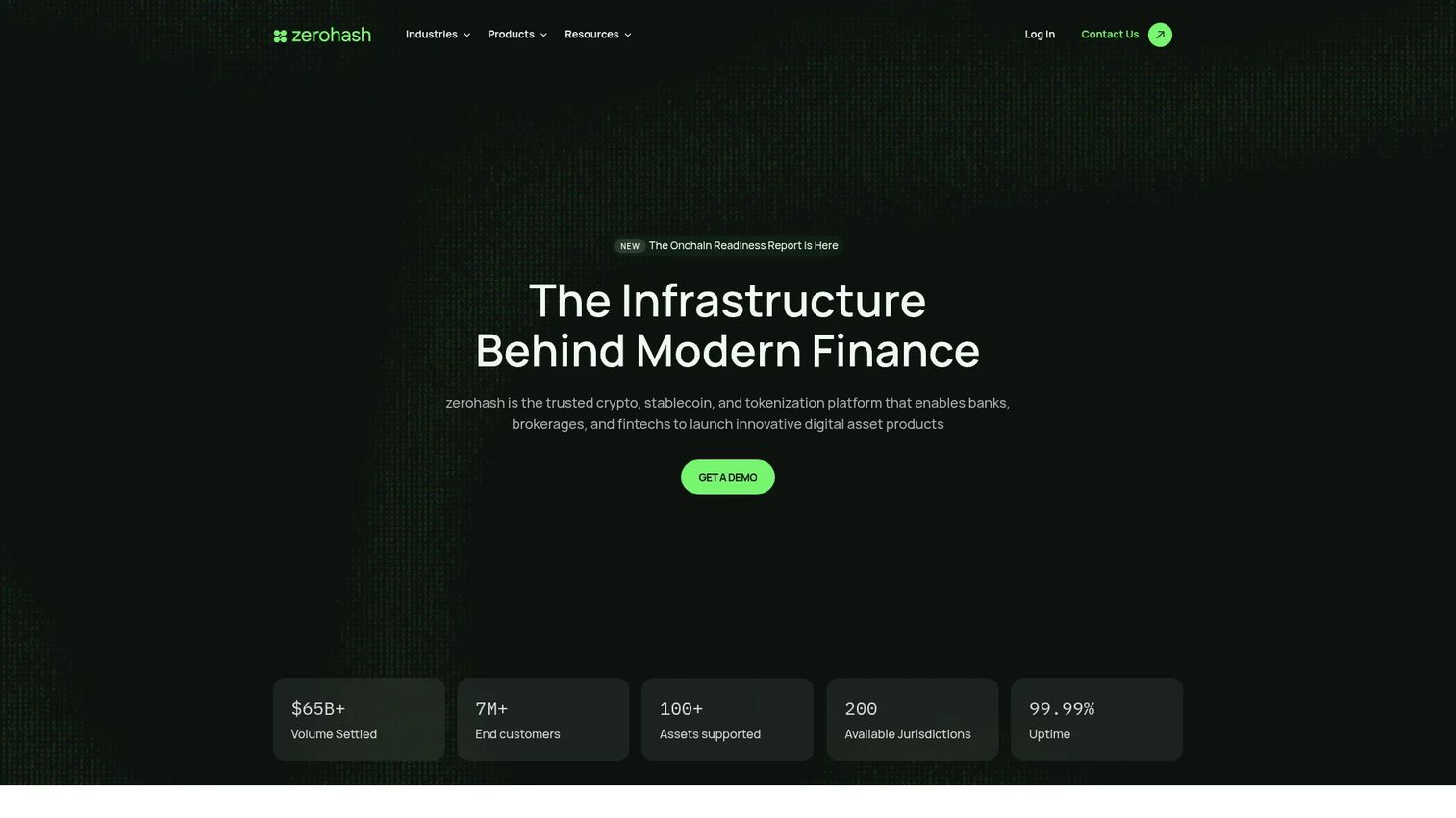
Zero Hash provides regulated embedded infrastructure for banks, brokerages, and fintechs that want to offer digital asset trading, stablecoin payments, custody, staking, and tokenization alongside their existing products. The platform is structured around three primary capabilities: Crypto trading with integrated liquidity and settlement, stablecoin payments and payouts with multi-chain orchestration, and a tokenization engine for issuing and managing tokenized financial products.
Best for: Financial institutions and fintech platforms embedding compliant digital-asset and stablecoin capabilities into an existing product without building a separate crypto infrastructure stack.
Key features
- Stablecoin payments, funding, and payouts with multi-chain orchestration
- Crypto trading with liquidity, custody, settlement, and compliance
- Tokenization engine for issuing and managing tokenized financial products
Why choose Zero Hash: Zero Hash fits a roadmap that includes stablecoin payments inside a broader digital asset product, including trading, custody, or tokenization. If stablecoin payments are the only job, confirm whether the depth of Zero Hash's payment-specific features matches your requirements before evaluating the wider platform.
Zero Hash pricing: Zero Hash does not publish pricing. Contact a Zero Hash representative to get fee structures for your transaction volume and product configuration.
G2 rating: Zero Hash holds a 4.3/5 from 6 reviews on G2.
7. Coinbase Developer Platform
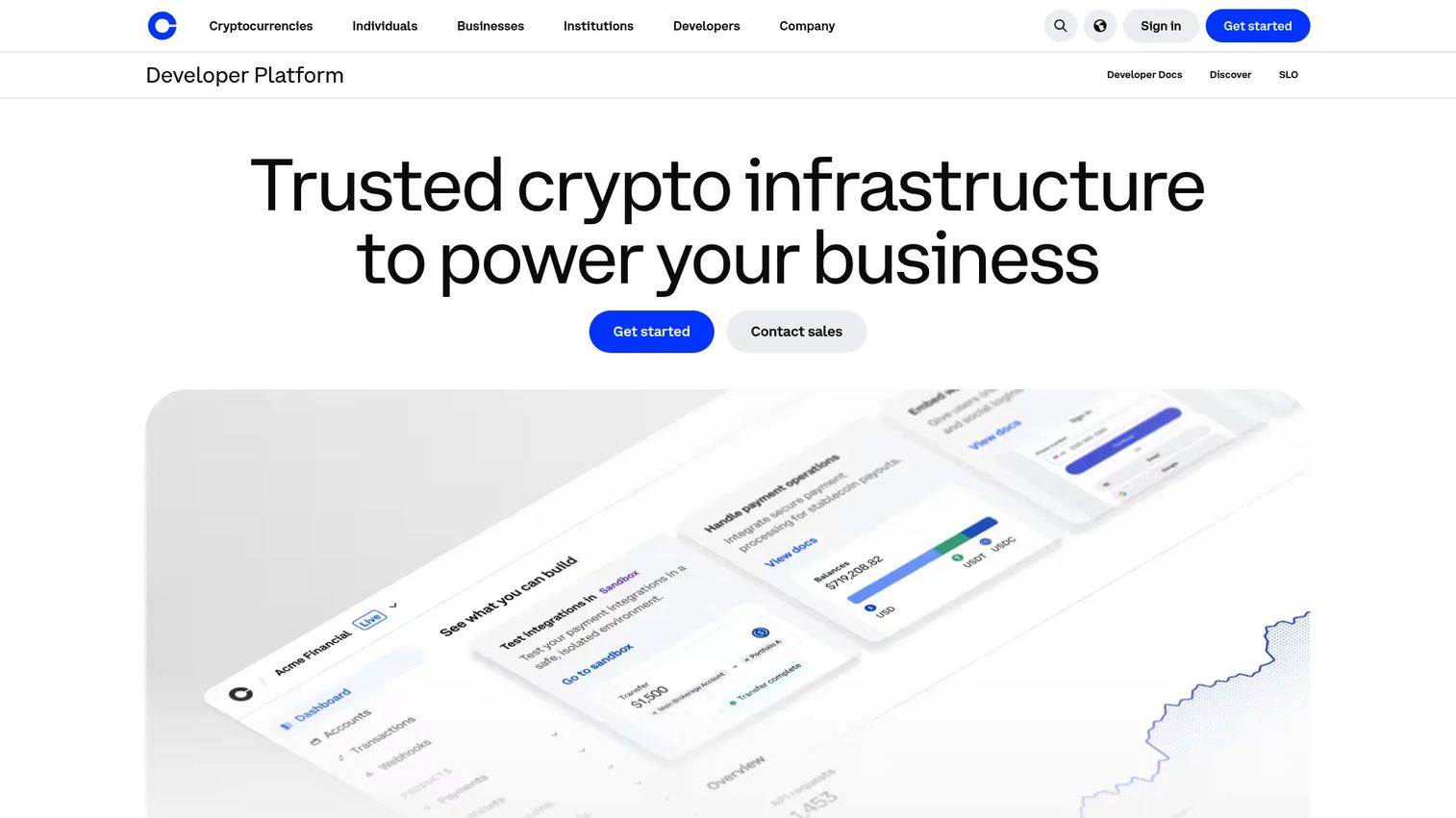
Coinbase Developer Platform is a crypto infrastructure platform offering APIs and SDKs for payments, trading, wallet creation, stablecoin deployment, and onchain applications. It covers stablecoin payments, customizable business wallets, USDC, and Coinbase Custom Stablecoins, alongside developer tools for building onchain products. The platform is oriented toward engineering-led teams that want to build on a widely adopted onchain infrastructure with developer documentation and ecosystem tooling.
Best for: Developer-heavy product teams that want wallet primitives, fiat onramp tooling, and access to a broad onchain application stack without managing underlying blockchain infrastructure.
Key features
- Stablecoin payments and USDC infrastructure
- Customizable business wallets and developer wallet tools
- Fiat onramp capabilities
- Onchain APIs and SDKs for payments and application development
- Coinbase Custom Stablecoins for branded stablecoin products
Why choose Coinbase Developer Platform: It fits roadmaps that need strong developer tooling and an established onchain ecosystem connection. Before committing, test the operational support available for reconciliation, compliance workflows, and region-specific payout needs, since those vary across the platform's products.
Coinbase Developer Platform pricing: CDP Node uses pay-as-you-go pricing with 10 million Billing Units free each month, then $0.50 per million additional Billing Units. Other CDP products use product-specific or sales-based pricing, so contact the team for full commercial terms.
8. Crossmint
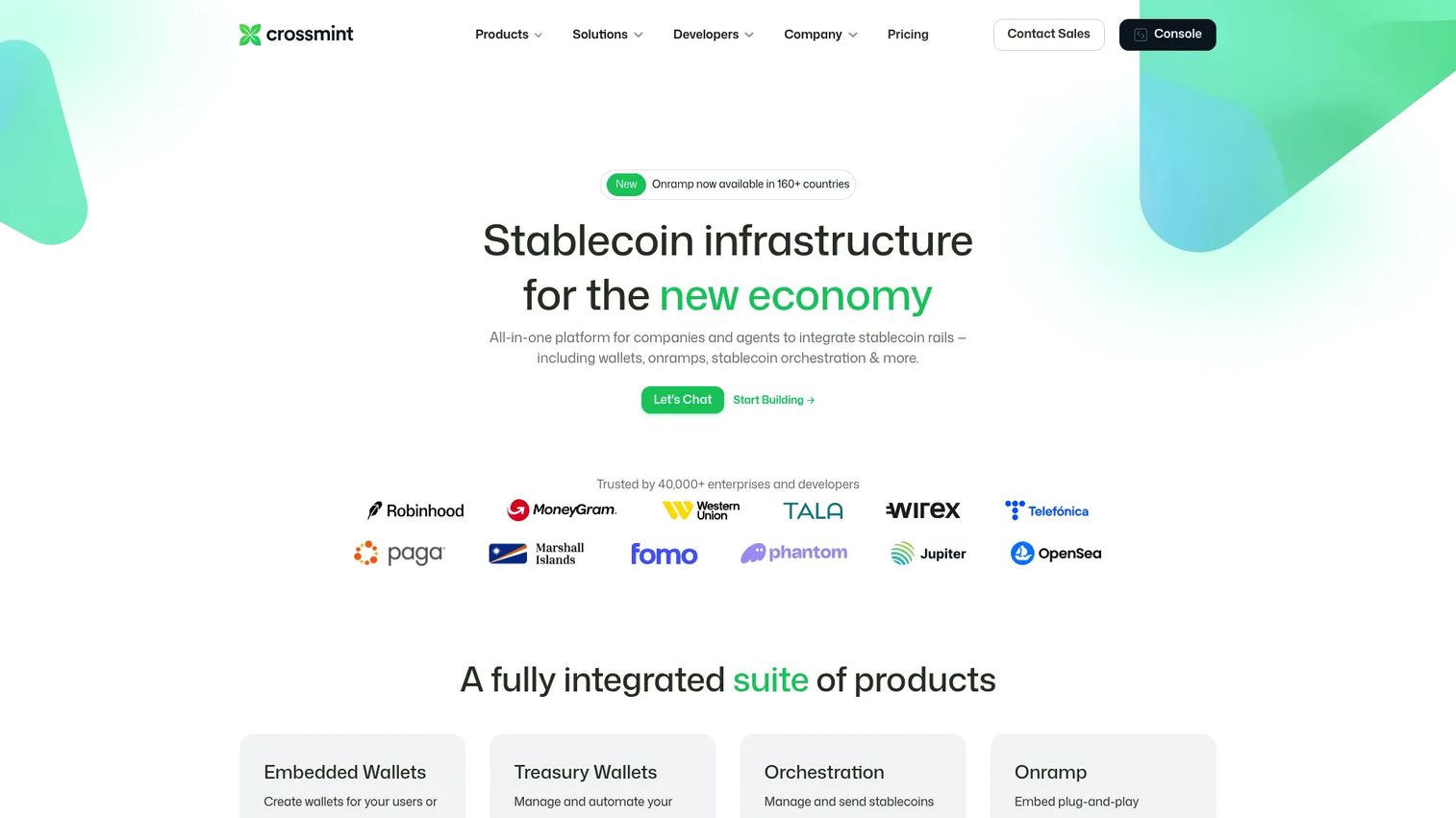
Crossmint provides enterprise stablecoin and wallet infrastructure covering programmable custodial and non-custodial wallets, onramps, offramps, stablecoin orchestration across 50-plus blockchains, checkout tooling, and tokenization APIs. Built-in KYC, AML, sanctions screening, and Travel Rule compliance are included at the infrastructure layer, which reduces the compliance surface a product team needs to build and maintain independently.
Best for: Fintechs, neobanks, remittance providers, and consumer-facing app teams that need embedded wallets, stablecoin access, and compliance built in without requiring users to manage complex wallet setup.
Key features
- Programmable custodial and non-custodial wallets
- Onramps, offramps, and checkout supporting fiat and stablecoin payments
- Stablecoin orchestration across 50-plus blockchains
- Tokenization APIs for issuing and managing onchain assets
- Built-in KYC, AML, sanctions, and Travel Rule compliance
Why choose Crossmint: Crossmint is well suited for user-experience-led products where onboarding friction and wallet abstraction matter as much as blockchain connectivity. Before launch, work through the support model for wallet recovery, funding failures, and identity-related exceptions, since those cases land in your customer support queue.
Crossmint pricing: Crossmint offers the first 1,000 wallets free, then usage-based pricing starting at $0.02 per monthly active wallet. Tokenization starts at $0.01 per action. Onramps, offramps, and checkout use per-transaction fees with volume discounts, and enterprise support requires a sales conversation.
9. Turnkey
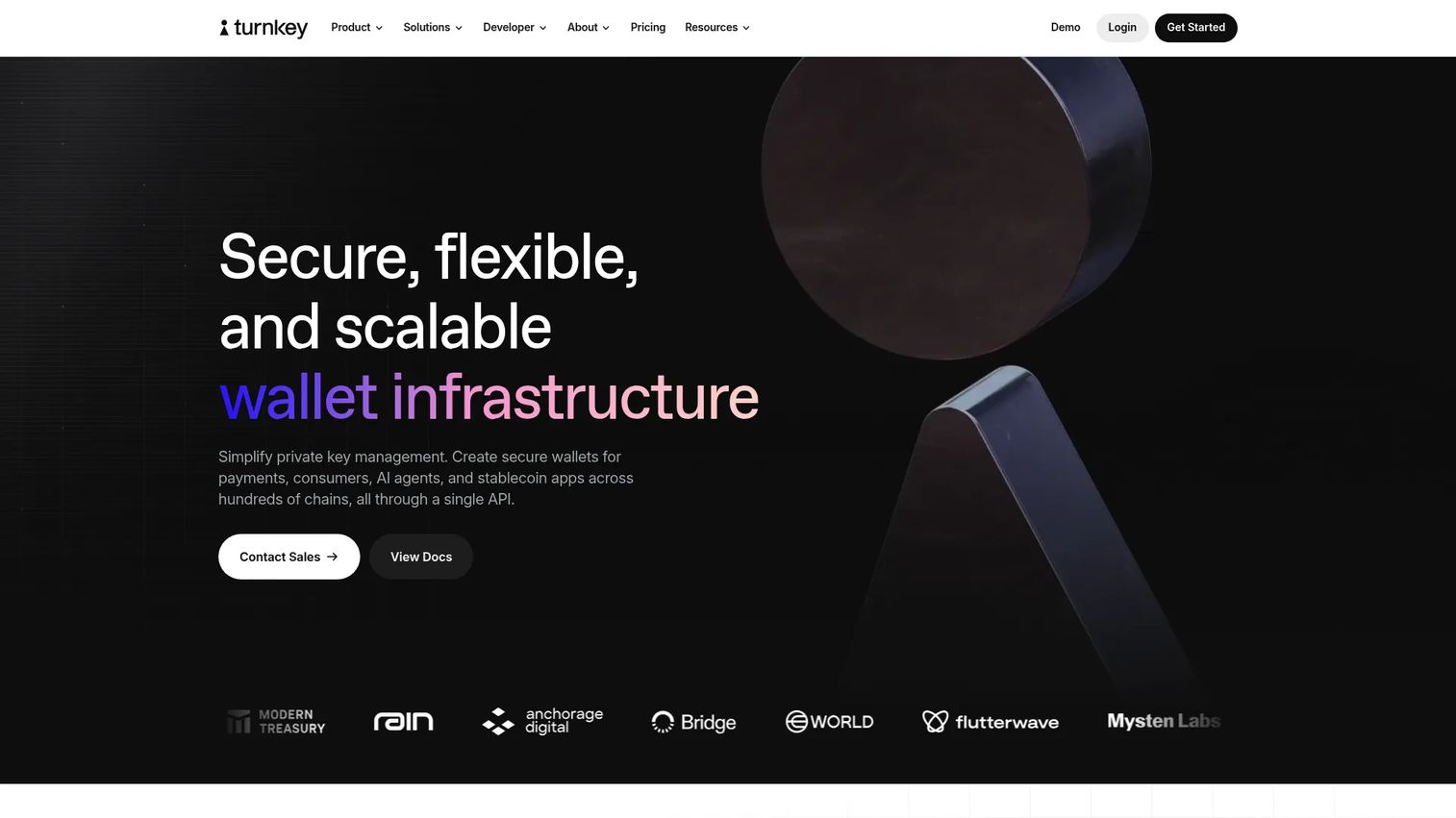
Turnkey is a non-custodial wallet infrastructure provider focused on programmable wallet creation, private key management, and onchain transaction signing through a single API. It supports multichain signing across EVM chains, Solana, Bitcoin, and others, with programmable policies, session management, and multi-user permission controls. The product is designed for teams that need fine-grained control over signing workflows rather than a managed custody service.
Best for: Product and engineering teams that need secure embedded wallets, transaction policies, and custom signing controls as core requirements in a stablecoin payments or onchain application.
Key features
- Non-custodial wallet generation and transaction signing
- Programmable policies, sessions, and transaction management
- Multichain support across EVM, Solana, Bitcoin, and more
- Multi-user account permissions and role-based controls
- Developer APIs and SDKs
Why choose Turnkey: Turnkey fits when wallet security and controllable signing logic are the primary product requirement. For teams whose immediate need is global payout coverage, card issuing, or stablecoin issuance, Turnkey serves as a narrower wallet-infrastructure component within a broader stack rather than a full payment platform.
Turnkey pricing: Pay as You Go starts free, including up to 1,000 wallets and 25 free signatures per month, then $0.10 per signature. The Pro plan is $99 per month plus $0.05 per signature, with up to 2,000 free wallets. Enterprise pricing starts as low as $0.0015 per signature with unlimited wallets, dedicated support, and SLAs.
10. Notabene
Notabene provides trust, compliance, and authorization infrastructure for institutional stablecoin and digital-asset payments. Its core capabilities cover pre-transaction compliance and risk-based authorization, stablecoin payment orchestration with pull, push, and recurring payment support, and a Transaction Authorization Protocol for secure interoperable messaging between virtual asset service providers. Notabene positions itself as a compliance and authorization layer that sits alongside a payment rail or custody provider.
Best for: Financial institutions, fintechs, exchanges, custodians, and payment providers that need Travel Rule compliance, pre-transaction authorization, and secure counterparty messaging built into their stablecoin transfer workflows.
Key features
- Pre-transaction compliance and risk-based authorization
- Travel Rule messaging via Transaction Authorization Protocol
- Stablecoin payment orchestration: Pull, push, and recurring payments
- Counterparty data exchange and audit support
- Integration APIs for virtual asset service providers
Why choose Notabene: Notabene belongs in your stack when a payments or wallet product needs compliance operations that go beyond basic transaction execution. It typically sits alongside an issuance, payment, or custody provider rather than replacing one. Factor in that evaluation early.
Notabene pricing: Notabene does not publish standard pricing. Commercial terms are provided through customer-specific order forms or sales discussions. Contact Notabene directly to understand package options.
Considerations when choosing stablecoin infrastructure software
Match the vendor to the money flow
Start with the exact product flow you are shipping: Customer funding, merchant settlement, wallet creation, cross-border payout, card spend, or treasury movement. A vendor that leads on issuance may be peripheral for card programs. Routing your evaluation through the specific flow reduces the risk of architectural decisions that require unwinding later.
Validate regional, currency, and network coverage
Do not stop at a "global coverage" claim on a pricing page. Validate each target country, settlement currency, blockchain network, fiat rail, and card program requirement against your actual roadmap. Coverage gaps discovered after integration are significantly more expensive than those found during vendor selection.
Plan for operational ownership before engineering commits
Clarify who owns reconciliation, transaction exceptions, wallet recovery, fraud operations, and customer support escalations. An API integration can feel fast to complete and still create a permanent operations queue. Map the operational responsibilities before signing a commercial agreement, not after.
Test compliance and governance workflows early
Bring compliance, risk, legal, and security stakeholders into vendor evaluation before engineering architecture decisions are made. Confirm audit data, transaction monitoring, access controls, reporting, and required counterparty data against your regulatory context. Avoid stating or implying that any vendor automatically makes your product compliant with a regulation.
Instrument the customer experience from day one
Define the events that show whether the feature works: Wallet created, funding completed, payout delivered, card activated, transaction failed, and support case opened. Connect those events to activation, payment completion, and support load. Infrastructure that cannot be instrumented will make it impossible to prove product quality or justify the next roadmap phase.
Conclusion
The stablecoin infrastructure category covers enough ground that no single provider is the right answer for every roadmap. Circle is the natural starting point for issuance and USDC settlement. Bridge handles the broadest orchestration of payments, wallets, and payouts. Rain is built for card-plus-wallet product experiences. BVNK fits cross-border business payment operations with compliance embedded. Notabene handles the compliance layer when Travel Rule and pre-transaction authorization are requirements.
For product managers, the selection framework stays consistent regardless of which layer you are building on: Start with the money flow, match vendors to the infrastructure layer that flow requires, evaluate operational ownership before integration begins, and instrument transaction completion from the first release.
The providers that deserve a shortlist position are the ones that reduce engineering opportunity cost on the current job while leaving room for the next roadmap phase without adding fragile operational dependencies.
When you need to explain a complex financial product to internal stakeholders, prospects, or partners, Start your journey with Guideflow today!
FAQs
Stablecoin infrastructure software provides APIs, operational tools, and regulated service layers for issuing, storing, moving, converting, settling, and monitoring stablecoin value inside financial products. Vendors specialize across different layers: Issuance, payment orchestration, wallet infrastructure, card programs, and compliance operations. No single platform covers every layer with equal depth, which is why product teams typically need to evaluate providers against a specific money-flow requirement.
Start with the specific money flow on your roadmap: Issuance, cross-border payouts, wallet creation, card programs, or settlement. From there, evaluate API quality and documentation, regional and currency coverage, wallet model and key custody, reconciliation tools, compliance workflows, and commercial terms. Build a scoring matrix that weights those criteria against your release cadence and operational capacity.
Issuance focuses on creating and redeeming a regulated stablecoin backed by reserves, which requires regulatory licenses and reserve management. Payments infrastructure focuses on transferring, settling, accepting, or paying out stablecoin value that already exists. Some providers, including Circle and Paxos, cover both layers. Others, such as Bridge or BVNK, operate primarily on the payments and orchestration layer without issuing their own stablecoin.
Yes, but payout support varies significantly by corridor, recipient type, fiat conversion requirements, sanctions controls, and local licensing. A provider may cover a broad list of countries at the marketing level while having narrower live payout rails in practice. Validate every intended market against confirmed live coverage before architecture decisions are finalized.
Some platforms offer programmable or embedded wallets, while others integrate with wallet providers or require you to bring your own. Wallet design decisions include key custody model, recovery workflow, signing policies, user permissions, and how customer support handles exception cases. Providers like Turnkey and Crossmint focus specifically on wallet infrastructure, while platforms like Bridge and Rain offer wallets as part of a broader payment product.
Some providers, including Rain and BVNK, support stablecoin-backed card programs or virtual card issuing. Before committing to a card program, validate the card network participation (Visa or Mastercard), issuing geography, settlement model between stablecoin and fiat, card controls, compliance checks, and which operational responsibilities sit with your team versus the platform.
Providers vary in how much compliance infrastructure they include. Some, like Notabene, specialize in Travel Rule messaging and pre-transaction authorization. Others, including Crossmint and BVNK, build KYC, AML, and sanctions screening into the platform. No provider makes your product compliant with a regulation by default. Your team still owns the decision of which regulatory obligations apply and how to satisfy them.
Pricing in this category combines several cost drivers: Platform access fees, per-transaction fees, asset conversion spreads, wallet or account fees, card program costs, and volume minimums. Transparent pricing is available from Circle, Crossmint, and Turnkey. Most enterprise-focused providers, including Bridge, BVNK, Paxos, Zero Hash, and Notabene, require a sales conversation. Model your expected transaction volume, active accounts, corridors, and operational requirements before entering pricing discussions so you can compare proposals on the same basis.