The board meeting is two weeks out. Finance is rebuilding the aging report by hand. Meanwhile, three customers with six-figure balances are 60 days past due, and nobody on the team has a clear picture of when the next loan payment lands.
That gap between healthy pipeline and actual cash is often a debt management problem. Global debt management software revenue reached $14.53 billion in 2025, according to ReportPrime, which tells you the market knows the pain is real. What the market does not always make clear is that "debt management software" covers two fundamentally different jobs: Tracking what your organization owes, and recovering what customers owe you.
Buy the wrong category and you have spent budget solving the wrong problem. A treasury system will not chase your overdue invoices. An accounts receivable tool will not generate CAFR-ready debt service schedules.
The right debt management platform depends on whether your bottleneck is debt reporting and obligation tracking, or getting paid faster. This guide separates the two, shortlists 10 tools across both categories, and gives you enough signal to hand the decision to your Head of Finance on day one.
What's inside
This guide is for founders and finance leaders evaluating debt management software at Series B and beyond. Tools were selected based on four criteria:
- Debt visibility: Does it replace spreadsheet-based obligation or receivables tracking?
- Collection automation: Does it reduce manual follow-up for overdue invoices?
- Reporting quality: Can it support board-level cash and debt reporting without manual reconciliation?
- Integration fit: Does it connect with the ERP, billing platform, or accounting software already in use?
This article covers business finance software only, not personal debt settlement or consumer budgeting apps.
TL;DR
- Best for public sector debt accounting: DebtBook covers debt, treasury, lease, and contract workflows for government and nonprofit finance teams
- Best for B2B collection automation: Upflow automates dunning, payment plans, and cash application for SaaS and B2B finance teams
- Best for institutional debt schedules: SymPro Debt Manager tracks CUSIP-level debt obligations and generates journal entries for public-sector issuers
- Best for enterprise order-to-cash: HighRadius handles collections, cash application, credit, and deductions for large finance operations
- Best for lean AR teams: Chaser (from $259/month) and Paidnice (from $69/month) automate invoice chasing with low setup overhead
What is debt management software?
Debt management software is a business system that tracks debt obligations or receivables, automates payment and collection workflows, and produces reporting for finance, treasury, and accounting decisions.
The category splits clearly into two types:
| Type | Primary job | Typical users | Core capabilities |
|---|---|---|---|
| Debt obligation management | Track what the organization owes | Treasury, controller, public finance, CFO | Debt schedules, interest calculations, maturity tracking, journal entries, compliance reporting |
| Debt collection management | Recover money owed to the organization | AR, collections, finance operations | Aging reports, dunning, payment links, promise-to-pay tracking, cash application |
Core capabilities across the category include:
- Debt and obligation records with due-date tracking
- Payment schedules and maturity alerts
- Aging reports and collection queues
- Dunning emails, SMS, or call workflows
- Cash flow and liquidity reporting
- Payment plans, autopay, and promise-to-pay tracking
- ERP, billing, and accounts receivable software integrations
- Audit trails and reporting exports
One important boundary: personal budgeting apps, debt settlement services, and collection agencies solve different problems. Every tool in this guide addresses business debt obligations or business receivables, not consumer debt counseling.
Most finance teams need one of these two categories. Some need both. Start by identifying which workflow is consuming the most finance-team hours today.
When to use debt management software
Replace spreadsheet-based debt schedules
Your organization has multiple loans, bond obligations, leases, or repayment commitments. Finance spends hours before board meetings rebuilding schedules from raw data and recalculating interest manually. A debt obligation platform gives you recurring, audit-ready reporting without the rebuild cycle.
Automate overdue invoice collection
Finance staff are writing individual reminder emails, manually coordinating promises to pay, and reconciling incoming payments against aging reports. Accounts payable software handles your outgoing obligations, but when the problem is inbound cash, a collections automation tool cuts DSO without adding headcount.
Improve board-level cash visibility
You cannot connect debt maturities, overdue receivables, and cash forecasts fast enough to make weekly decisions. The combination of obligation tracking and cash flow forecasting software gives a finance leader the inputs to run a reliable 13-week cash model and answer board questions in real time.
Debt management software comparison
The market has specialized products. A public-sector treasury team evaluating institutional debt tracking and a SaaS finance team chasing overdue invoices are solving completely different problems.
The table below maps each tool to the workflow it actually handles. Pricing and G2 ratings are sourced from vendor pricing pages and live G2 listings as of October 2026.
| # | Product | Best for | Key differentiator | Pricing | G2 rating |
|---|---|---|---|---|---|
| 1 | DebtBook | Public sector and nonprofit debt accounting | Debt, treasury, lease, and contract workflows | Custom pricing | Not listed on G2 |
| 2 | Upflow | B2B collections and AR teams | Automated dunning, payment plans, cash application | Free tier; paid plans by quote | 4.8/5 |
| 3 | SymPro Debt Manager | Institutional debt reporting | CUSIP-level debt schedules and journal entries | Custom pricing | 4.0/5 |
| 4 | Gaviti | Enterprise AR collections | Collections workflows with ERP-connected follow-up | Custom pricing | 4.4/5 |
| 5 | HighRadius | Large enterprise order-to-cash teams | AI-supported AR, collections, and cash application | Outcome-based; $0 until go-live | 4.3/5 |
| 6 | Invoiced | Mid-market AR automation | Invoice-to-cash automation and payment collection | Custom pricing | 4.5/5 |
| 7 | Versapay | Collaborative AR teams | Customer-facing payment and dispute resolution | Custom pricing | 4.1/5 |
| 8 | Chaser | Small and midsize businesses | Automated invoice chasing and payment reminders | From $259/month | 4.3/5 |
| 9 | Paidnice | SaaS and service businesses | Automated receivables with Xero and QuickBooks integrations | From $69/month | 4.8/5 |
| 10 | CollBox | Law firms and small businesses | Software plus human AR specialist follow-up | From $599/month | 4.3/5 |
Best 10 debt management software tools for 2026
1. DebtBook
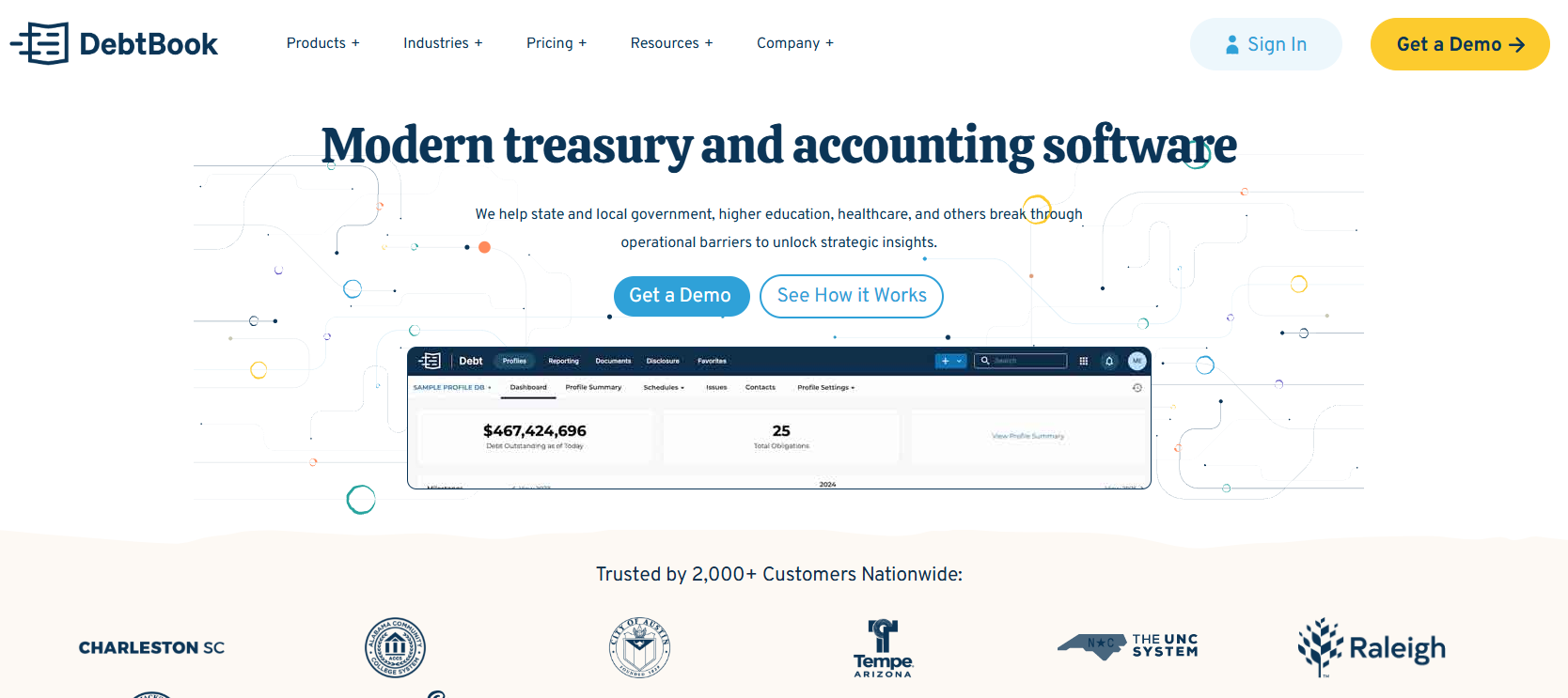
DebtBook is a cloud-based treasury and accounting platform built specifically for government, nonprofit, higher education, and healthcare finance teams. It covers debt, cash, investments, leases, subscriptions, and contracts from a single system, with automated journal entries and audit-ready reporting built in. The platform connects to bank feeds and generates financial reports without the manual spreadsheet rebuild that typically precedes board or council meetings.
Best for: Finance teams managing public-sector debt obligations, compliance reporting, and audit-ready debt service schedules.
Key features
- Debt, treasury, lease, and contract management in one platform
- Automated financial reporting, journal entries, and audit notes
- Cash forecasting, fraud detection, and bank integrations
Why choose DebtBook: It fits organizations where debt management is part of a broader public finance requirement, not just invoice chasing. If your team needs repeatable CAFR reporting, auditor access controls, and scheduled debt service outputs, DebtBook is purpose-built for that workflow.
DebtBook pricing: DebtBook prices by custom quote, with the contract reflecting organization size, the modules selected, and implementation scope. Contact their team for a proposal.
2. Upflow
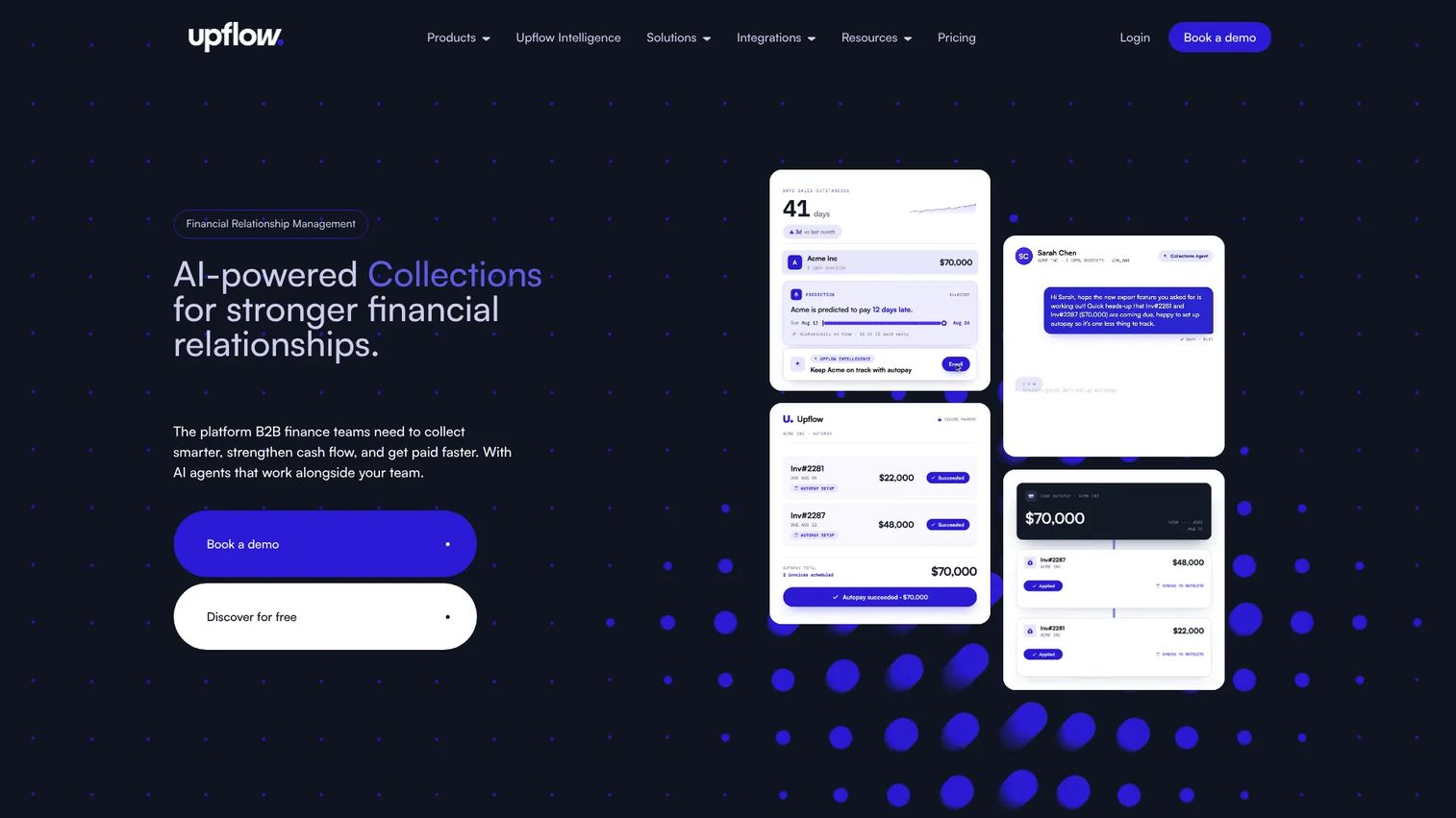
Upflow is a Financial Relationship Management platform that covers accounts receivable insights, collections automation, payments, and cash application for B2B finance teams. It automates reminders across email, SMS, calls, and letters, and gives finance teams a live view of overdue balances, payment commitments, and cash flow. The platform syncs with ERPs in real time, so reconciliation does not require a separate manual step.
Best for: SaaS and B2B finance teams that need to reduce overdue invoices without turning customer success into a collections operation.
Key features
- Automated payment reminders across email, SMS, calls, and letters
- Customer payment portal and online payments
- AI-assisted autonomous collection workflows
- Cash application with real-time ERP sync
- Advanced AR analytics and custom dashboards
Why choose Upflow: The key question for a Series B founder is whether a new Head of Finance can improve DSO without adding headcount. Upflow's promise-to-pay tracking and autonomous collection workflows let a lean team manage a large invoice base without constant manual intervention.
Upflow pricing: The Discover plan is free and provides AR visibility with no invoice volume cap. Paid plans (Starter, Grow, Scale, Accelerate, and Enterprise) are priced by annual invoiced revenue and require a sales conversation. Upflow Payments adds a $390/month platform fee plus transaction fees.
G2 rating: 4.8/5 from 234 reviews.
3. SymPro Debt Manager
SymPro Debt Manager is built around debt issuance data. It organizes outstanding obligations at the CUSIP level, tracks sources and uses of funds, calculates interest accruals and amortization automatically, and generates general ledger journal entries for each debt transaction. The platform is designed for public-sector issuers that manage complex debt portfolios and need recurring reporting without manual recalculation.
Best for: Municipalities and public-sector organizations managing complex debt portfolios with formal accounting and CAFR reporting requirements.
Key features
- Debt-service schedules broken down to the CUSIP level
- Call structures, redemptions, financing participants, and ratings history
- Automatic amortization and CAFR-reporting calculations
- General-ledger journal-entry generation
- Sinking fund and maturity schedule tracking
Why choose SymPro Debt Manager: It fits finance teams whose core problem is maintaining accurate debt records across a complex portfolio of bonds, notes, and other instruments. If the bottleneck is audit risk from spreadsheet-based debt schedules, SymPro removes it. It is not the right choice for routine B2B invoice chasing.
SymPro Debt Manager pricing: No self-serve pricing is available. Contact SymPro for a quote based on portfolio complexity and reporting requirements.
G2 rating: 4.0/5 based on 4 reviews of SymPro Treasury Management Software.
4. Gaviti
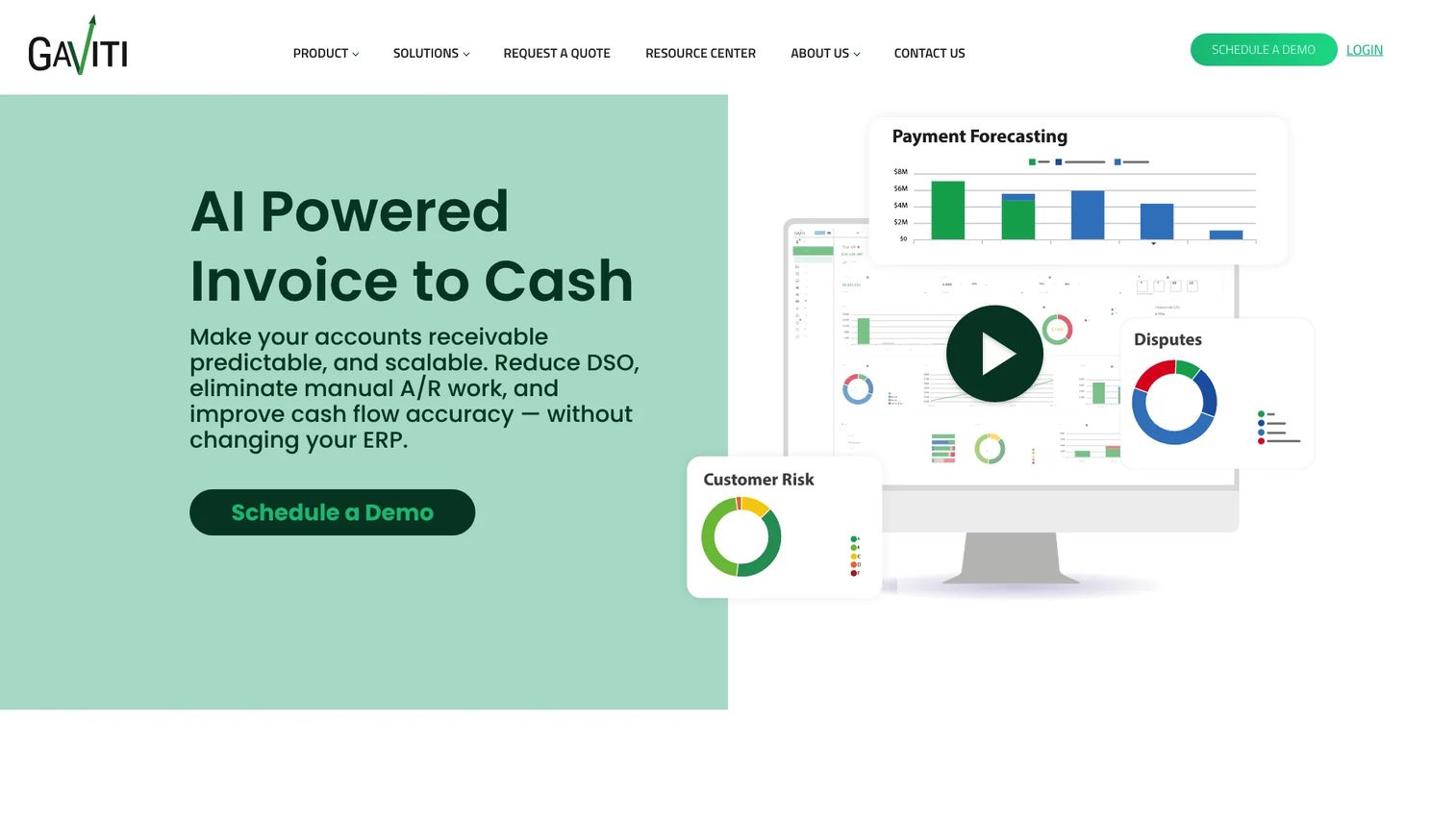
Gaviti is an autonomous invoice-to-cash platform for B2B organizations that need structured collections workflows connected to their ERP. It automates reminders, escalations, and follow-up tasks, and gives finance teams a customer-level view of outstanding balances, risk scores, and payment history. The AI-powered cash application module matches incoming payments to open invoices without manual intervention.
Best for: Mid-market and enterprise B2B finance teams running formal accounts receivable collections across a growing invoice base.
Key features
- Automated collection workflows with reminders, escalations, and task tracking
- Customer risk prioritization and segmentation
- AI-powered cash application and payment matching
- ERP data synchronization
- AR analytics and forecasting dashboards
Why choose Gaviti: When overdue invoice follow-up has become a headcount problem rather than a process problem, Gaviti gives a finance leader the structure to manage collections at scale. It is a better fit for teams with enough receivables volume that a manual queue approach breaks down.
Gaviti pricing: Pricing requires a quote and reflects invoice volume, ERP integration requirements, and the modules selected.
G2 rating: 4.4/5 from 190 reviews.
5. HighRadius
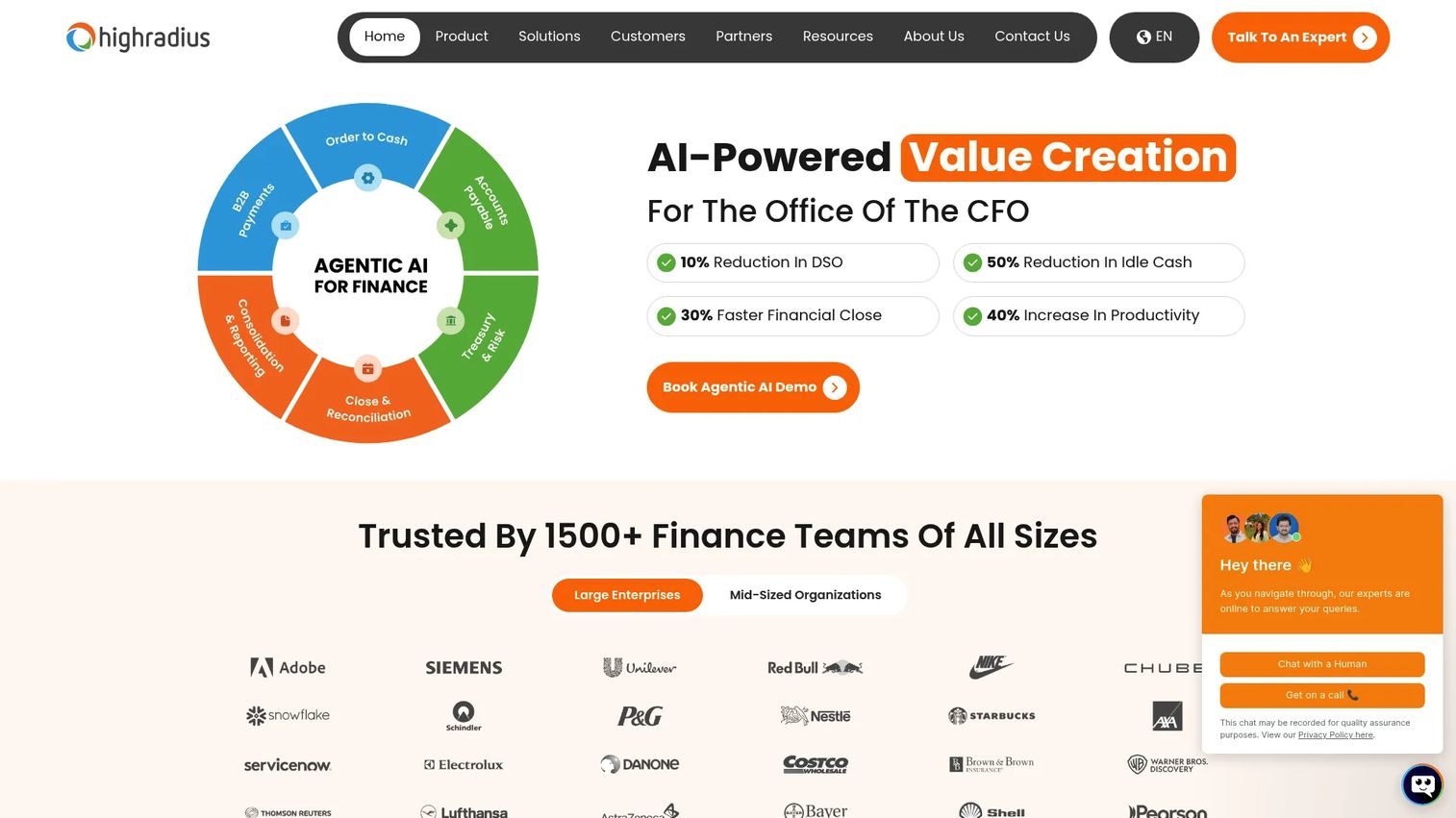
HighRadius is an AI-powered autonomous finance platform covering accounts receivable, accounts payable, treasury, financial close, and record-to-report workflows. On the AR side, it handles collections, cash application, credit management, deductions, invoicing, and B2B payments from a single system. The platform is designed for organizations with complex ERP environments and high transaction volumes.
Best for: Mid-market and enterprise finance teams consolidating multiple order-to-cash and treasury processes in one platform.
Key features
- Collections management with automated workflows and analytics
- Cash application automation and payment-to-invoice matching
- Credit and risk management
- Deductions and dispute management
- Treasury and cash forecasting
Why choose HighRadius: It fits organizations where the finance problem spans multiple functions and a point solution would create more integration work than it solves. The outcome-based pricing model removes upfront implementation risk, which matters when you are not yet sure the platform will fit.
HighRadius pricing: HighRadius charges no implementation fee and no subscription fee until go-live. Post-launch fees are tied to realized outcomes and mutually agreed success criteria.
G2 rating: 4.3/5 from 249 reviews.
6. Invoiced

Invoiced is an AI-native accounts receivable and invoice-to-cash platform for B2B finance teams. Its Smart Chasing feature automates collection workflows by triggering the next follow-up action based on customer payment behavior, and CashMatch AI handles payment reconciliation without manual matching. The platform supports online invoicing, customer payment portals, and ERP integrations.
Best for: Mid-market B2B businesses that want to automate invoicing and collections without building out a full order-to-cash operation.
Key features
- Automated invoice delivery and Smart Chasing collections workflows
- CashMatch AI for cash application and payment reconciliation
- Customer payment portal with online payment options
- Payment reminder automation
- ERP integrations
Why choose Invoiced: It sits between a lightweight payment reminder tool and a full enterprise AR suite, which makes it useful when manual invoicing and follow-up are distorting finance-team capacity. The AI-driven reconciliation reduces the time a controller spends matching payments to open invoices.
Invoiced pricing: Pricing is customized by use case and requirements. Contact Invoiced for a proposal.
G2 rating: 4.5/5.
7. Versapay
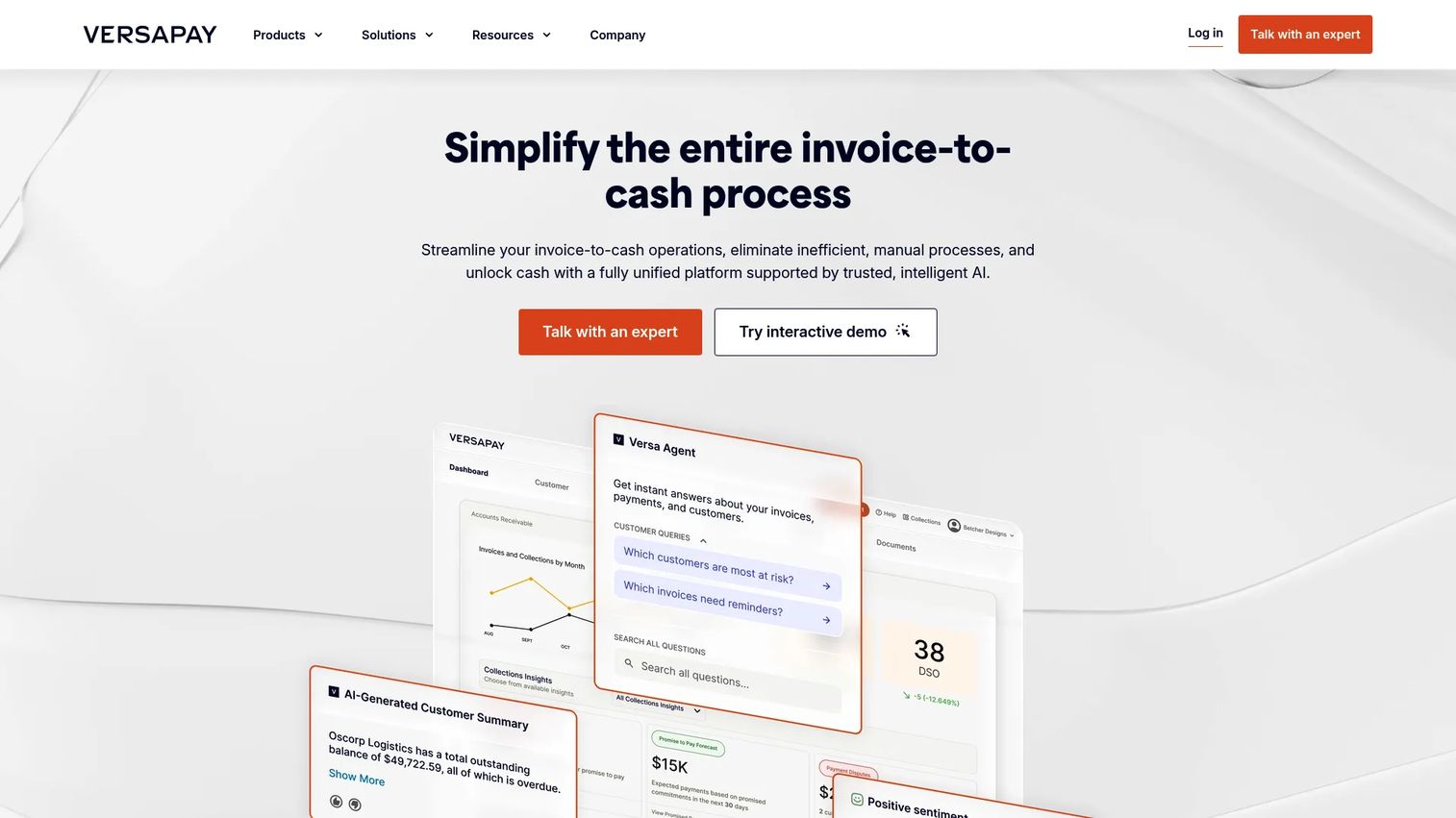
Versapay takes a collaborative approach to accounts receivable. Instead of treating collections as a one-way reminder flow, it gives customers a self-service portal to view invoices, make payments, raise disputes, and communicate with the finance team directly. This model addresses the common scenario where late payments are tied to invoice disputes or missing documentation rather than an unwillingness to pay.
Best for: Finance teams where payment delays are frequently connected to invoice disputes, missing POs, or handoff failures between sales and accounts receivable.
Key features
- Automated electronic invoicing and customer payment portal
- Collections automation with risk segmentation and payment-promise tracking
- AI-powered cash application and payment matching
- B2B payment acceptance for ACH, credit cards, virtual cards, and bank payments
- ERP integrations with automated reconciliation workflows
Why choose Versapay: If your team spends significant time mediating between customers and the AR queue because disputes are not resolved in your system, Versapay's collaborative model addresses the root cause. It is less useful when the primary issue is simply slow follow-up on undisputed invoices.
Versapay pricing: Versapay prices by custom quote based on transaction volume and integration requirements.
G2 rating: 4.1/5 from 101 reviews.
8. Chaser
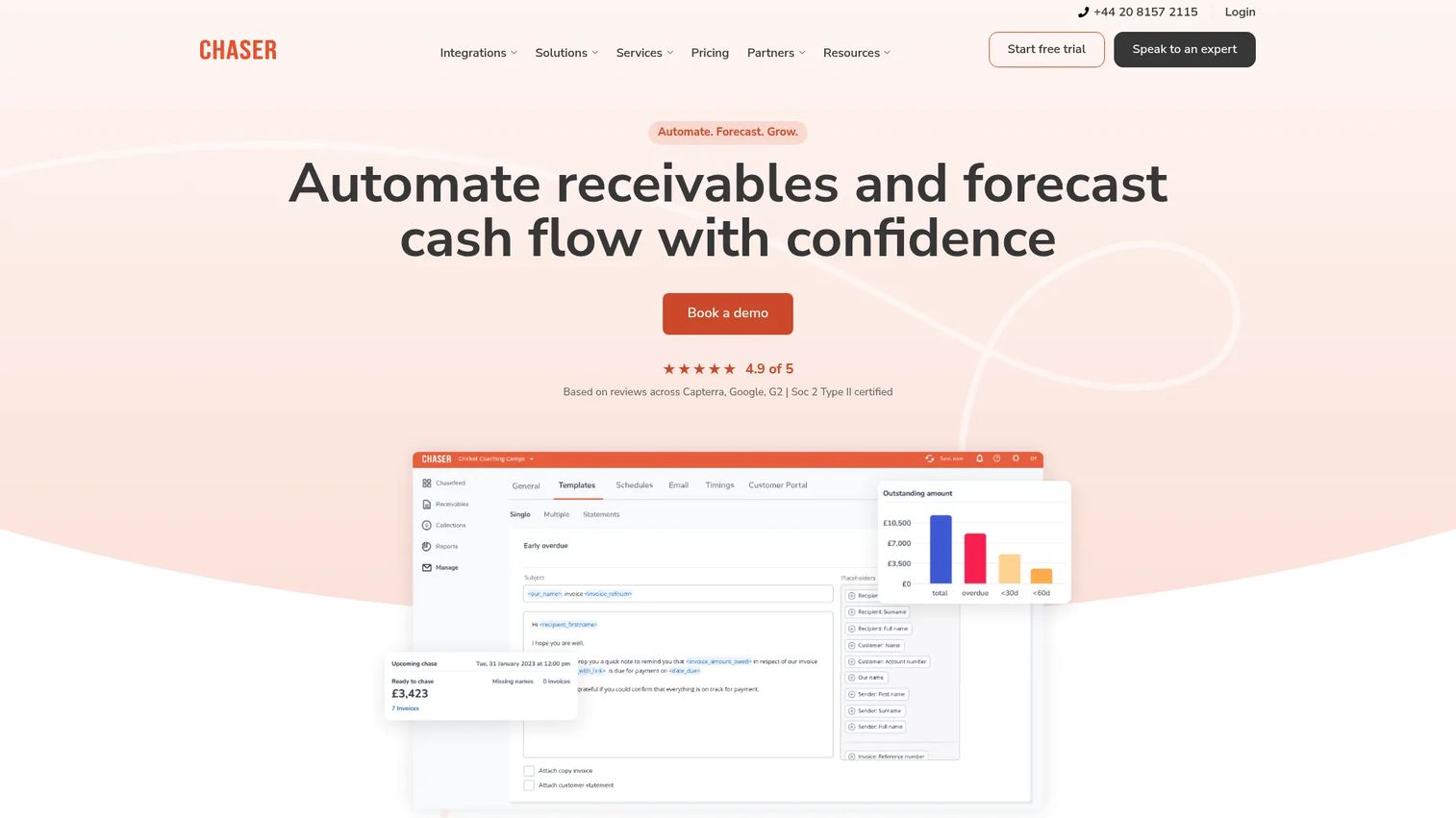
Chaser automates accounts receivable collections and cash-flow forecasting for small and midsize businesses. It chases invoices via email, SMS, and phone calls on a configurable schedule, keeps a full communication history per customer, and provides debtor risk scoring and payment prediction to help finance teams prioritize follow-up. Integration with accounting software means the invoice data syncs directly without manual export.
Best for: Lean finance teams that need automated invoice chasing and better cash visibility without enterprise implementation overhead.
Key features
- Automated invoice chasing via email, SMS, and phone calls
- Cash-flow, revenue, and receivables forecasting
- Credit monitoring and AI debtor risk scoring
- Customer communication history per account
- Accounting software integrations
Why choose Chaser: For a 30 to 150-person SaaS company that has not yet hired a dedicated collections team, Chaser removes the reminder-building work from a finance manager's plate and gives a founder a clearer view of late-paying customers. Annual billing saves 10% on plans.
Chaser pricing: Plans start at $259/month (Compact), $779/month (Core), and $1,169/month (Complete), billed monthly. Annual billing saves 10%. A free trial is available.
G2 rating: 4.3/5 from 70 reviews.
9. Paidnice
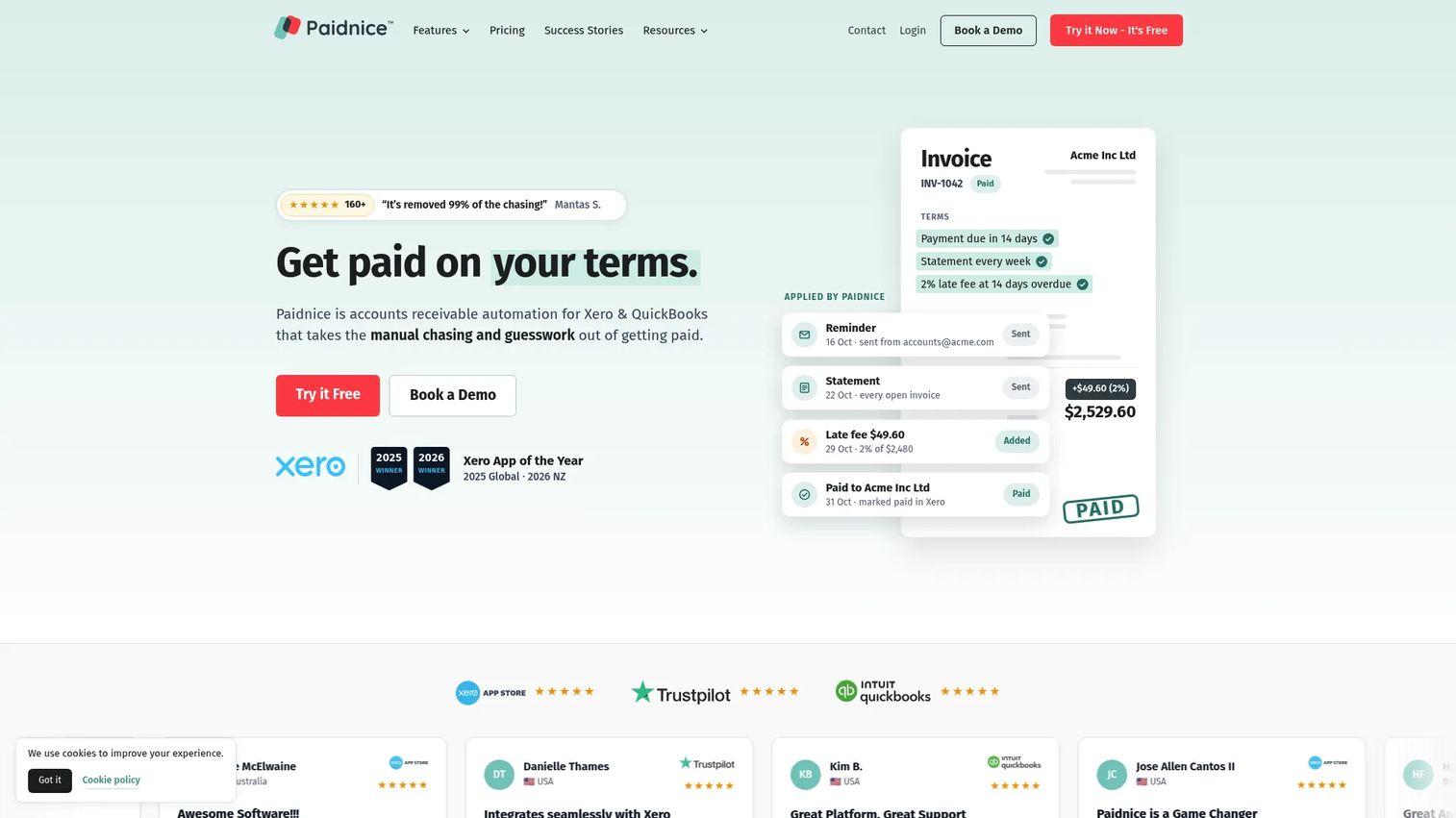
Paidnice is an accounts receivable automation tool for businesses using Xero or QuickBooks Online. It automates payment reminders, late fees, customer statements, and prompt-payment discounts, and gives finance teams an AR metrics dashboard with debtor reporting. The platform's invoice-volume pricing model means the cost scales directly with transaction activity rather than user count.
Best for: Small and midsize B2B businesses using Xero or QuickBooks that want automated credit control and invoice collection with minimal setup time.
Key features
- Automated email and SMS payment reminders
- Late fees, interest charges, and prompt-payment discounts
- Customer payment portal and payment plans
- AR metrics dashboard and debtor reporting
- Multi-currency support and webhook integrations
Why choose Paidnice: The accounting platform integration is the deciding factor. If the team already runs on Xero or QuickBooks, Paidnice connects directly and starts reducing manual follow-up in the first week. The Essentials plan at $69/month covers up to 150 invoices, which fits most early-stage SaaS billing volumes.
Paidnice pricing: Essentials starts at $69/month (up to 150 invoices). Pro starts at $99/month (up to 300 invoices, scaling to 4,000). Custom plans start from $999/month. The first 20 actions are free with no time limit or credit card required.
G2 rating: 4.8/5.
10. CollBox

CollBox is a hybrid accounts receivable service that combines software-based reminders with dedicated human follow-up by North America-based AR specialists. It is positioned primarily for law firms managing past-due client invoices, with integrations connecting to practice management and accounting systems. When automated reminders do not produce payment, CollBox's specialists handle phone follow-up directly.
Best for: Law firms and small businesses that need a clear escalation path for seriously overdue accounts, including human-assisted follow-up when automated chasing stalls.
Key features
- Automated past-due invoice reminders and invoice resending
- Dedicated North America-based AR specialist for phone follow-up
- Integrations with Clio, MyCase, Smokeball, QuickBooks, FreshBooks, and Xero
- Collection account placement and recovery status tracking
- CollBox Collect contingency option for severely delinquent accounts
Why choose CollBox: This is not a replacement for day-to-day invoice automation. It addresses accounts that have moved beyond routine AR reminders. For a small finance team that needs a defined "what happens next" for genuinely delinquent invoices, CollBox provides that escalation without requiring an in-house collections operation.
CollBox pricing: Ongoing monthly service starts at $599/month for firms billing 1 to 50 clients, with a one-time $999 setup fee. One-time clean-up projects are custom quoted. CollBox Collect uses a contingency fee on collected amounts, with no upfront cost.
G2 rating: 4.3/5 from 2 reviews.
Considerations when choosing debt management software
Match the tool to the debt type you are managing
Debt obligations and customer receivables need different systems. A public-sector treasury team and a SaaS AR team are not shopping for the same product. Start by identifying whether the bottleneck is reporting on what you owe or recovering what customers owe you, then evaluate within that category.
Check accounting and ERP integrations before anything else
The tool must connect with the systems holding your invoice, payment, general ledger, and customer data. Evaluate native connections to your specific ERP or accounting software first. Middleware and manual exports add maintenance work that erodes the time savings the tool was supposed to deliver.
Measure cash impact, not activity volume
More reminders do not automatically improve cash collection. The metrics that matter are DSO, overdue balance by aging band, payment-plan completion rate, and cash forecast accuracy. Ask each vendor how their analytics surface those numbers before you sign.
Understand implementation ownership from day one
A public-sector debt accounting system typically requires structured implementation, data migration, and training. A payment reminder tool may be live in a week. Before evaluating cost, confirm who owns data cleanup, workflow configuration, and finance-team training, and factor that into the realistic time-to-value.
Model the full cost at your current scale
Compare subscription price, user fees, invoice volume limits, implementation charges, payment processing fees, and any collection escalation costs. Entry-level pricing on some platforms becomes expensive at 500 invoices per month, or when integrations require a higher tier. Run the numbers at your actual volume, not the plan minimum.
Conclusion
The most common evaluation mistake in this category is conflating two distinct software jobs. Debt accounting and debt collection are not interchangeable, and buying the wrong one delays the outcome you actually need.
For public-sector organizations: DebtBook covers debt, treasury, lease, and contract reporting in one system. SymPro Debt Manager fits organizations with complex bond portfolios and formal CAFR requirements.
For B2B SaaS finance teams: Upflow is the strongest fit for automating collections without adding headcount. Chaser and Paidnice serve lean teams that want invoice chasing connected to their existing accounts receivable software without an enterprise implementation project.
For larger operations: HighRadius consolidates the full order-to-cash cycle, and Gaviti or Invoiced handle structured AR automation at mid-market scale.
The practical next step is to identify the workflow consuming the most finance-team hours today, confirm which tools integrate with your current stack, and run a pilot before committing to a contract. Your new VP of Finance should be able to evaluate and shortlist in the first two weeks, not the first quarter.
Start your journey with Guideflow today!
FAQs
Debt management software is a business system that tracks debt obligations or outstanding receivables, automates payment and collection workflows, and produces reporting for finance and accounting decisions. The category splits into two types: Obligation management (tracking loans, bonds, and repayment schedules) and collection management (recovering overdue invoices from customers).
Debt management software covers the full range of financial obligations and receivables, including institutional debt tracking, payment scheduling, and treasury reporting. Debt collection software focuses specifically on recovering overdue receivables through reminders, payment portals, escalation workflows, and cash application. Some platforms overlap both functions; most specialize in one.
Small businesses typically need lightweight accounts receivable tools with accounting integrations, automated payment reminders, and clear entry-level pricing rather than complex debt issuance reporting. Paidnice starts at $69/month and connects directly to Xero and QuickBooks. Chaser starts at $259/month and adds cash-flow forecasting and debtor risk scoring for teams with more invoice volume.
It can improve visibility into due dates, overdue balances, payment commitments, and collections activity, which gives finance leaders better inputs for cash forecasting. The outcome depends on whether the tool connects to your accounting system, whether workflows are configured correctly, and whether the team uses the data to act faster on overdue accounts.
Prioritize automated reminders across email and SMS, a customer payment portal, payment plan management, promise-to-pay tracking, collection queues with prioritization, aging reports, and direct integration with your ERP or accounting platform. Teams with disputed invoices should also evaluate collaborative resolution features.
Most platforms connect with accounting systems, ERPs, and billing tools, but the specific integrations vary. Paidnice is purpose-built for Xero and QuickBooks. Upflow, Gaviti, Invoiced, and Versapay support broader ERP connections. Validate your exact stack against the vendor's integration list before purchase, since middleware workarounds add ongoing maintenance cost.
Four pricing models are common: Flat monthly subscription (Chaser, Paidnice), invoice-volume pricing (Paidnice scales by invoices processed), outcome-based fees (HighRadius charges after go-live based on realized gains), and custom enterprise contracts (DebtBook, Upflow paid plans, Gaviti, Invoiced, Versapay, SymPro). Implementation fees, payment processing fees, and collection escalation costs often sit outside the subscription price and should be modeled separately.
It can replace spreadsheet-based tracking when finance teams need recurring schedules, automated calculations, audit trails, live reporting, and reminder workflows. A spreadsheet may still work for a small, stable debt portfolio with minimal reporting requirements and no customer-facing collections activity. The trigger to move off spreadsheets is usually a combination of scale (more obligations or invoices than one person can track), audit risk, and the time cost of manual reconciliation before board meetings.