

Your forecast said 14 months of runway. Then a big customer paid late, you moved two hires forward, and a vendor renewal came in higher than budgeted. Now the number you gave the board last quarter is wrong, and you find out three weeks after it mattered.
That gap between what your accounting data knows and what you can act on is the real problem. A spreadsheet updates when someone remembers to update it. By then the decision window has closed.
The category has matured fast. The global cash flow forecasting software market is projected at $726M in 2025 with a 7.4% CAGR through 2033, according to Dynamic Business (2026). And 72% of companies now use AI in some form of financial forecasting, per Dynamic Business (2026). The tools have moved from reporting history to helping you decide what happens next.
This guide compares eight tools built to close that gap.
What's inside
This guide is for founders, finance leaders, and FP&A teams who want to replace spreadsheet forecasting with software that stays current on its own. We picked tools based on four criteria that matter when the forecast has to survive a board meeting:
- Accounting integrations: how cleanly it syncs actuals from QuickBooks, Xero, Sage, or your ERP
- Scenario planning: whether you can model hiring, spend, and revenue changes side by side
- Rolling refreshes: how often the forecast updates as new data lands
- Reporting depth: whether outputs are clean enough for a board deck without manual rework
TL;DR
- Best for FP&A depth: Abacum, for mid-market finance teams running budgeting, headcount planning, and scenario planning in one place.
- Best for live short-term cash: Float, for 13-week rolling forecasts driven by Xero and QuickBooks Online transactions.
- Best for three-way forecasting: Fathom, for auditable P&L, balance sheet, and cash flow models with board-ready reporting.
- Best for AP/AR-connected forecasting: BILL, for teams that want payables, receivables, and cash visibility together.
- Best for treasury and multi-entity: Agicap, for unified cash visibility across banks and entities.
- Best for lightweight planning: Brixx and Cash Flow Frog, for small teams that want fast scenario modeling without heavy setup.
What is cash flow forecasting software?
Cash flow forecasting software is a tool that uses your accounting data and planning inputs to project future cash movements, so you can see runway, liquidity, and cash risk before they hit.
Unlike a static spreadsheet, cash flow forecast software syncs actuals automatically and updates the forecast as new transactions land. That turns forecasting from a monthly chore into a live view of the business.
Core capabilities to expect from any serious cash forecasting software:
- Rolling forecast: the model rolls forward automatically instead of ending at a fixed date
- Actuals vs forecast: compare what you projected against what happened, with variance analysis built in
- Scenario planning: model best case, worst case, and hiring or spend changes side by side
- Accounting integrations: direct sync with QuickBooks Online, Xero, Sage Intacct, or NetSuite
- Board-ready reporting: export clean projections and a forecasting dashboard without rebuilding slides
- Liquidity planning: track cash positions across accounts and, where needed, multi-entity forecasting
Most tools support both direct vs indirect forecasting. Direct works from expected cash in and out. Indirect starts from projected net income and adjusts. Which you use depends on how far out you plan and how granular your data is.
When to use cash flow forecasting software
When spreadsheets are slowing decisions
If your forecast lives in a spreadsheet that one person maintains, you have a single point of failure. Every refresh is manual. Every handoff loses context. Cash flow management software removes that bottleneck by syncing actuals and keeping the model current without anyone touching it.
The trigger is usually speed. When you need this week's cash position and the answer takes two days, the spreadsheet has already cost you the decision.
When hiring or spend changes need scenario modeling
A Series B founder rarely asks "what is our cash balance." They ask "if I hire four engineers in Q2 and the enterprise deal slips a quarter, when do we run out." That is a scenario question, and cash flow projection software answers it in minutes instead of a weekend of spreadsheet surgery.
Good scenario planning lets you model several futures at once and compare them. That is the difference between a forecast that reports history and one that helps you decide.
When board reporting needs consistency and traceability
Boards do not just want a number. They want to trust the number. When your forecast changes between meetings, you need to explain why. Software that ties every projection back to source accounting data gives you that traceability, so actuals vs forecast reconciliation is one click, not a fire drill.
Comparison table
Here is how the eight tools compare on fit, differentiation, pricing, and rating. Pricing reflects each vendor's public pricing page at the time of writing. Ratings reflect current public review listings where available.
| # | Product | Best for | Key differentiator | Pricing | G2 rating |
|---|---|---|---|---|---|
| 1 | Abacum | Mid-market FP&A teams | AI-native planning, forecasting, and reporting | Tailored quote | 4.8/5 |
| 2 | Float | Live short-term cash control | 13-week rolling forecast from Xero and QBO | From £79/mo | Not listed |
| 3 | Fathom | Three-way forecasting and reporting | Auditable P&L, balance sheet, and cash flow | From $65/mo | 5.0/5 |
| 4 | BILL | AP/AR-connected cash visibility | Payables, receivables, and cash in one platform | From $0/user/mo | 4.4/5 |
| 5 | Agicap | Treasury and multi-entity cash | Unified cash across banks and entities | Quote-based | 4.4/5 |
| 6 | Brixx | Lightweight scenario planning | Flexible 3-way models and what-if analysis | From £30/mo | 4.0/5 |
| 7 | Cash Flow Frog | Small business forecasting | Rolling forecasts up to 36 months | From $33/mo | Not listed |
| 8 | Futrli by Sage | Advisor-led forecasting | Daily 3-way forecasting across Sage, QBO, Xero | From £40/mo | 4.4/5 |
1. Abacum
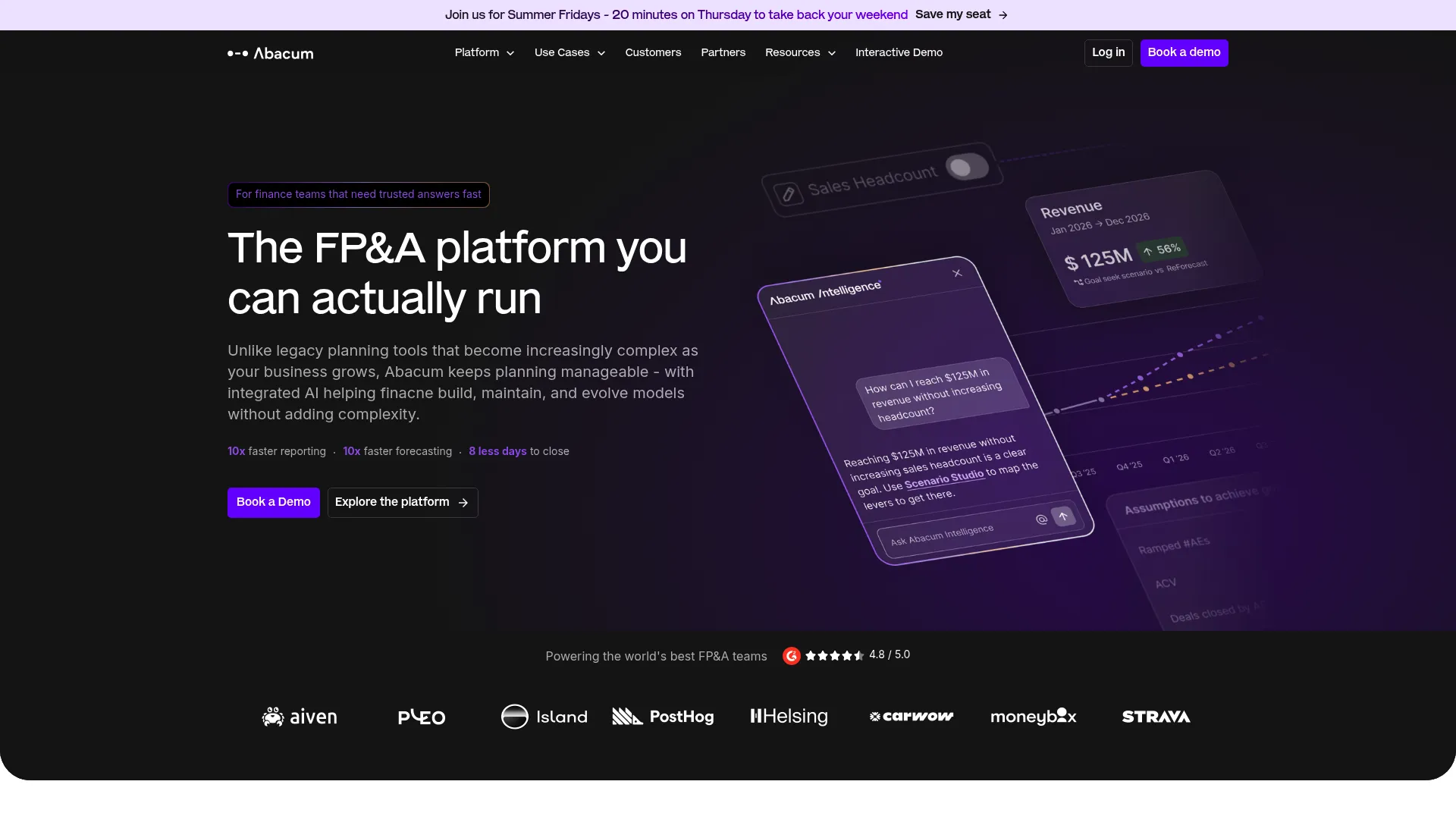
Abacum is an AI-native FP&A platform built for finance teams that need budgeting, forecasting, reporting, and planning in one place. It pulls actuals from your accounting stack and layers planning on top, so the forecast and the plan stay connected. For a scaling SaaS company, that means runway, headcount, and revenue live in the same model instead of three disconnected files.
Best for: Mid-market finance teams that need collaborative FP&A and automated planning workflows.
Key strengths
- Budgeting and forecasting in a single workspace
- Headcount planning tied to the cash model
- Scenario planning for hiring and spend decisions
- Collaborative workflows across finance and department leads
Why choose Abacum: If your finance team has outgrown spreadsheets but is not ready to buy heavy enterprise FP&A, Abacum fits the gap. It suits founders who want a Head of Finance to own planning without stitching five tools together.
Abacum pricing: Public pricing is not published. Abacum says pricing is tailored and depends on entities, users, and modules, so you request a quote based on your setup.
2. Float

Float is cash flow forecasting software for finance teams that connects directly to Xero and QuickBooks Online. It builds a live, transaction-driven rolling forecast that updates as bills and invoices move, giving you weekly, 13-week, and monthly views of cash. For founders who care most about short-term liquidity planning, Float answers "how much cash next Friday" without a rebuild.
Best for: Finance teams that need live cash flow forecasting and scenario planning tied to their accounting data.
Key strengths
- 13-week cash flow forecasting driven by live transactions
- Scenario planning for spend and revenue changes
- Multi-entity consolidation for groups
- Weekly, 13-week, and monthly cash views
Why choose Float: Float is the pick when short-term cash control matters more than long-range modeling. Teams already on Xero or QBO get a current forecast fast, with clean views to share internally or with a board.
Float pricing: Plans start at £79/mo for Essentials, £199/mo for Growth, and £235/mo for Scale. A 14-day free trial is available with no credit card required.
3. Fathom
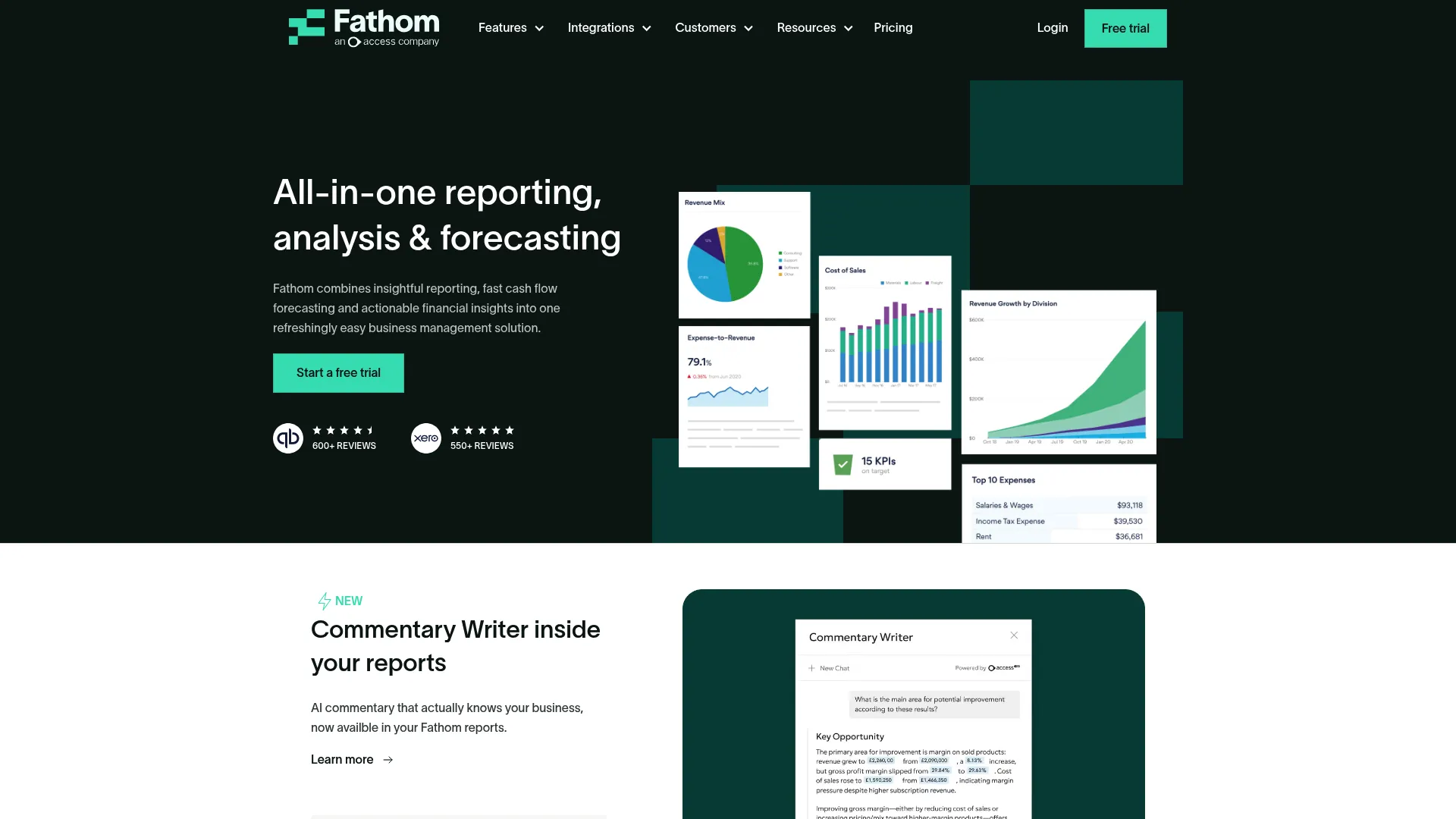
Fathom is financial analysis, reporting, forecasting, and consolidation software for businesses and accounting firms. Its three-way forecasting links P&L, balance sheet, and cash flow, so the numbers stay internally consistent and auditable. That matters for board reporting, where a projection you cannot trace back to source data invites hard questions.
Best for: Businesses and accounting firms that need financial insights, reporting, forecasting, and consolidations.
Key strengths
- Three-way cash flow forecasting across P&L, balance sheet, and cash
- Custom management reporting and dashboards
- Consolidated financial reporting for up to 300 entities
- Multi-currency consolidations and benchmarking
Why choose Fathom: Fathom fits teams that want board-ready reporting and drill-down auditability in the same tool. If your board asks "where did this number come from," Fathom answers it without a spreadsheet trail.
Fathom pricing: Pro pricing is based on companies connected. Plans start at $65/month for Starter, then $390 (Silver), $540 (Gold), and $860 (Platinum). All Pro subscriptions include unlimited users and cash flow forecasting.
4. BILL
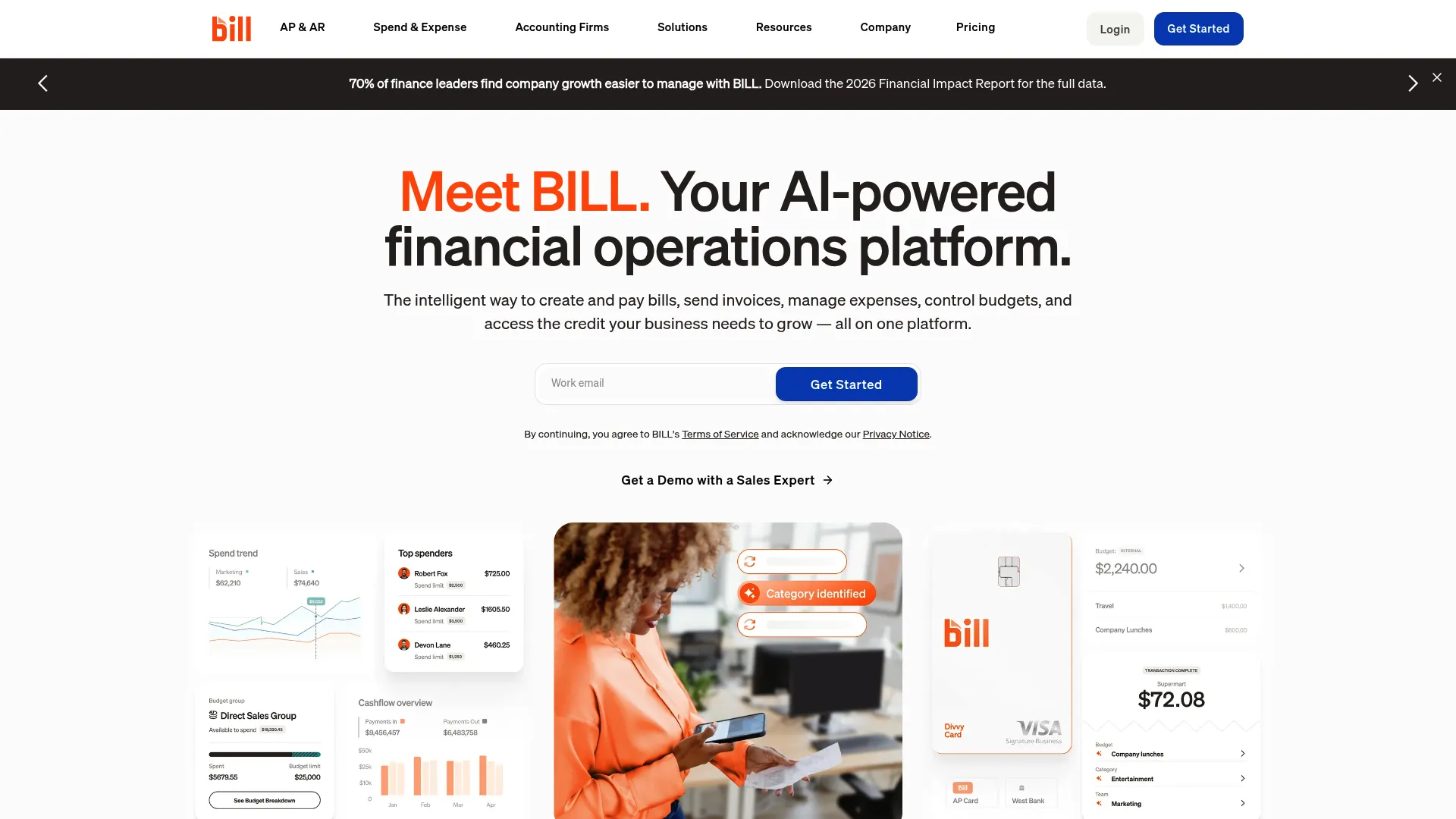
BILL is a financial operations platform that combines accounts payable, accounts receivable, and spend management. Because it sits on your AP and AR data, its forecasting ties directly to money actually owed and owed to you. For teams that want cash visibility and the workflows that move cash in one place, that connection is the draw.
Best for: Businesses that want one platform for AP, AR, and spend controls alongside cash visibility.
Key strengths
- Accounts payable automation
- Accounts receivable and invoicing automation
- Spend and expense management
- Cash visibility connected to ledger, AP, and AR data
Why choose BILL: BILL suits founders who want to consolidate payables, receivables, and cash forecasting rather than run a separate forecasting tool. It reduces the handoffs between paying bills and projecting cash.
BILL pricing: Spend and Expense is $0/user/month. AP/AR plans are $49/user/month (Essentials), $65 (Team), and $89 (Corporate). Enterprise is custom pricing.
5. Agicap
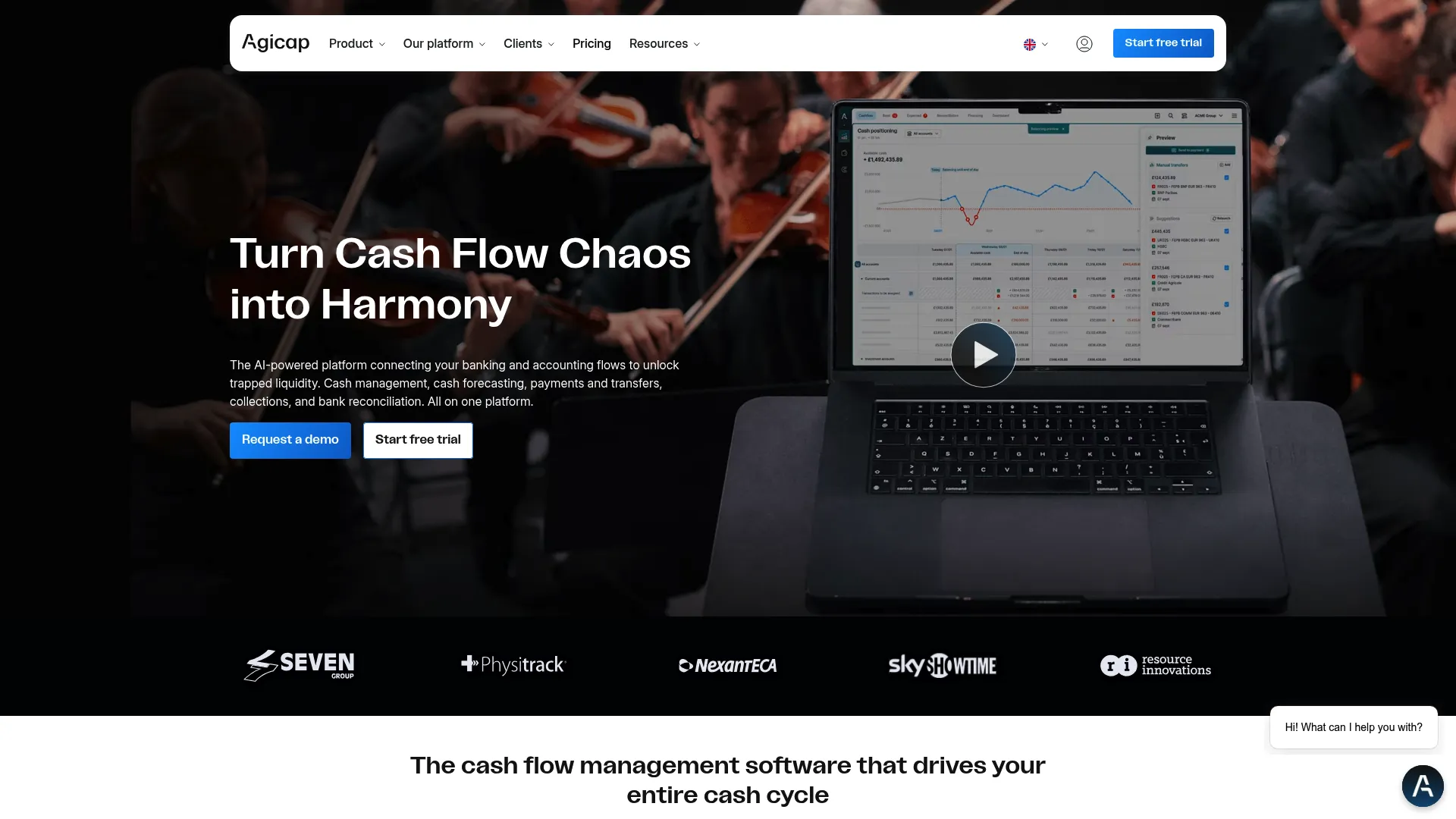
Agicap is cash flow and treasury management software for SMBs and mid-market finance teams. It connects banks and accounting data into one cash view, then layers forecasting, payments, and AP/AR automation on top. For groups managing several entities or bank accounts, Agicap centralizes liquidity planning that would otherwise live across many spreadsheets.
Best for: Finance teams that need unified cash visibility, forecasting, and payment control.
Key strengths
- Cash management and forecasting in one view
- Bank connectivity and payment execution
- Accounts payable and receivable automation
- Multi-entity cash consolidation
Why choose Agicap: Agicap fits finance teams that treat cash as a treasury function, not just a report. If you manage payments and forecasting together across entities, it removes the reconciliation overhead.
Agicap pricing: Public pricing is not displayed. Agicap offers annual subscriptions with a minimum 12-month commitment and quote-based Business and Enterprise plans. A free trial is available.
6. Brixx

Brixx is financial forecasting and business planning software for cash flow, scenarios, reporting, and 3-way financial models. It leans on straightforward forecasting workflows, so small teams can build a plan without a finance background. The what-if analysis makes it easy to test how a new hire or a price change moves the model.
Best for: Small businesses and finance teams that need flexible financial forecasting and planning models.
Key strengths
- Cash flow forecasting
- Scenario planning and what-if analysis
- Automated 3-way reporting across P&L, balance sheet, and cash flow
- Flexible planning models for early-stage teams
Why choose Brixx: Brixx suits founders who want scenario depth without enterprise pricing or a long setup. It is a practical cash flow planning software pick for teams modeling their first structured forecast.
Brixx pricing: A single plan is £30/month billed monthly, or £24/month billed annually. A 7-day free trial is available with no credit card required.
7. Cash Flow Frog

Cash Flow Frog is cash flow forecasting and planning software that syncs accounting data into rolling forecasts and scenario plans. It focuses on simple cash flow visibility for small businesses and accountant-led workflows, so you get a rolling forecast without heavy configuration. Forecasts run up to 36 months, which is unusual at this price point.
Best for: Small and mid-sized businesses that need automated cash flow forecasting from accounting data.
Key strengths
- Rolling cash flow forecasts up to 36 months
- Scenario planning and what-if analysis
- Multi-entity unified forecasts
- Customizable reports
Why choose Cash Flow Frog: Cash Flow Frog fits small teams and accountants who want automated forecasts fast, without paying for a full FP&A suite. It is a clean entry point into software for cash flow forecasting.
Cash Flow Frog pricing: Pricing is based on annual revenue. The visible Pro Plan (up to $1M annual revenue) is $55/month billed monthly or $33/month billed yearly, including forecasting up to 36 months, scenario planning, and up to 10 users.
8. Futrli by Sage

Futrli by Sage is financial forecasting, reporting, and business performance software with Sage, QuickBooks Online, and Xero integrations. It runs daily cash flow forecasting and 3-way models, and pairs them with a forecasting dashboard and a report template library. For advisory teams and accountants, the unlimited-users model makes it easy to work across many clients.
Best for: Accountants and advisory teams that need forecasting, reporting, and cash flow planning.
Key strengths
- Daily cash flow forecasting
- 3-way forecasting across P&L, balance sheet, and cash flow
- Budgets and scenario modelling
- Bespoke reporting and a report template library
Why choose Futrli by Sage: Futrli fits teams already in the Sage ecosystem or advisors managing multiple client forecasts. Unlimited users and daily refreshes make it strong for hands-on, advisor-led planning.
Futrli by Sage pricing: Plans start at £40/month for Single, then Starter, Professional, and Practice tiers for firms. A 14-day free trial is available with no card up front.
Considerations
Before you shortlist, run each tool through this checklist against your actual setup.
Accounting stack fit
Start here. If a tool does not sync cleanly with your general ledger, everything downstream breaks. Confirm native support for QuickBooks Online, Xero, Sage Intacct, or NetSuite, and check whether the sync is real-time or scheduled. Accounting integrations are the foundation, not a feature.
Forecast cadence
Decide how often you need the forecast to update. Monthly may be enough for a stable business. Fast-moving SaaS companies usually need a rolling forecast or weekly refreshes to catch late payments and spend changes in time to act.
Scenario depth
Ask how many scenarios you can run and compare at once. Modeling one future is a report. Modeling several and comparing them side by side is a decision tool. If scenario planning is shallow, you will be back in spreadsheets within a quarter.
Reporting and governance
Check that outputs are clean enough for a board deck without manual rework, and that permissions control who sees and edits what. Board-ready reporting and traceable actuals vs forecast reconciliation matter as much as the forecast itself.
Multi-entity needs
If you operate across entities or currencies, confirm multi-entity forecasting and consolidation are supported natively. Retrofitting consolidation later is painful and error-prone.
Conclusion
The right choice comes down to stage and operating style, not feature count.
If you are a mid-market team that has outgrown spreadsheets, Abacum gives you FP&A depth in one workspace. If short-term cash control is the priority, Float delivers a live 13-week view straight from Xero or QBO. For auditable three-way models and board-ready reporting, Fathom is hard to beat. Teams that want cash tied to payables and receivables should look at BILL, while Agicap suits treasury-minded, multi-entity finance functions. For lightweight, fast scenario modeling, Brixx and Cash Flow Frog do the job, and Futrli by Sage fits advisor-led workflows across the Sage ecosystem.
Shortlist by integration fit first. The tool that syncs cleanly with your accounting stack will always beat the one with more features you cannot feed. Then compare scenario depth, because that is what turns a forecast into a decision. Start a free trial with two finalists and run your real numbers through both before you commit.
FAQs
Cash flow forecasting software uses your accounting data and planning inputs to project future cash movements. It syncs actuals from your ledger, layers assumptions on top, and shows runway, liquidity, and cash risk. Unlike a spreadsheet, it updates as new data lands.
It connects to your accounting stack and pulls in actuals automatically. You layer assumptions like hiring, revenue, and spend, and the tool projects cash forward. As new transactions arrive, the forecast refreshes, so the number stays current instead of aging the moment you finish it.
Focus on runway visibility, scenario planning, board-ready reporting, and clean integration with your accounting stack. A founder rarely needs the deepest FP&A features. They need to see cash risk early and model hiring or deal-slip scenarios fast enough to act before the window closes.
For most operational forecasting, yes. Dedicated tools sync actuals, run scenarios, and produce board reporting without manual upkeep. Some teams still keep a spreadsheet for edge-case modeling or ad hoc analysis, but the core rolling forecast lives better in software that stays current on its own.
QuickBooks Online and Xero cover most SMB and mid-market teams. Sage Intacct and NetSuite matter for larger or multi-entity finance functions. Whatever general ledger or ERP you already run should be the first integration you confirm, because the forecast is only as good as the data feeding it.
It depends on how fast your cash moves. Monthly refreshes work for a stable business. Fast-moving SaaS companies usually need a rolling forecast or weekly updates to catch late payments and spend changes in time to act on them.
A budget is a fixed planning baseline set at a point in time. A forecast updates continuously with actuals and changing assumptions. Budgeting says what you intended to spend. Cash forecasting software shows what is actually likely to happen, so you can adjust before problems compound.
Yes. Most tools export clean projections and dashboards you can drop into a board deck without rebuilding slides. The bigger benefit is traceability: when a number changes between meetings, board-ready reporting tied to source data lets you explain exactly why in one click.