

You check three spreadsheets, two sensor apps, and a group chat before you can answer one question: how much did that cage cost to grow, and is it on track? The data exists. It just lives everywhere except one place you can act on.
That is the real problem aquaculture software solves. Not "better tracking" in the abstract, but the daily gap between what your farm is doing and what you can actually see. Feeding, mortality, water quality, biomass, and cost sit in separate silos, and by the time you reconcile them, the decision window has closed.
The market has caught up to that pain. The global aquaculture software market was valued at $1.2 billion in 2025 and is projected to reach $2.8 billion by 2034, growing at 11.8% CAGR, according to MarketIntelo (2025). Farm management modules alone hold the largest slice, at 34.2% of global revenues in 2025. Buyers are consolidating around platforms that turn farm data into operational decisions instead of cleanup work.
This guide is written for operators making that call in 2026: which fish farm software actually improves farm data visibility, and which one fits your operation.
What's inside
This guide covers seven aquaculture management software tools built for fish and shrimp operations. You will get a side-by-side comparison, per-tool breakdowns, and a buyer's checklist. We selected tools based on four criteria that matter to operators:
- Operational depth: does it handle production, feeding, mortality, and water quality in one workflow
- Traceability and reporting: can it follow batches and connect farm events to costs
- Data integration: sensor, IoT, and API integrations that prevent silos
- Fit by use case: production control, feeding, or advanced analytics
We excluded tools with no verifiable product presence or that only touch adjacent hardware.
TL;DR
- Best for connected production control: aquaManager, an end-to-end aquaculture farm management software platform covering hatchery through grow-out.
- Best for local resilience and real-time monitoring: Suderra, with offline-first architecture and sensor integration.
- Best for feed management software and farm control: FishFarmFeeder, built around precision feeding and FCR optimization.
- Best for predictive analytics and benchmarking: Manolin, with disease models and population-traced data.
- Best for larger farms needing a broad stack: Innovasea's Farm360.
- Best for computer-vision monitoring: AKVA Group and Aquabyte, both strong on biomass estimation and fish welfare.
What is aquaculture software?
Aquaculture software is a category of tools that help fish and shrimp farms record, monitor, and act on operational data across the production cycle, from hatchery to harvest. It centralizes feeding, mortality, water quality, biomass, inventory, costs, and reporting so operators can make decisions from one source instead of reconciling spreadsheets and disconnected sensor apps.
The category splits into a few overlapping jobs. Aquaculture management software runs the whole operation: planning, production records, costing, traceability, and reporting. Aquaculture monitoring software focuses on sensors, alerts, and real-time conditions like dissolved oxygen and temperature. Feed management software optimizes dosing and FCR. Aquaculture analytics layers benchmarking, forecasting, and predictive models on top of clean data.
Key features to look for:
- Real-time monitoring of water quality, feeding, and environmental conditions
- Batch tracking and traceability by cage, tank, or pond
- Feed management and FCR optimization tools
- Mortality and biomass tracking with growth projections
- Costing and aquaculture reporting software for margin visibility
- Dashboard reporting and operational decision support
- API integrations with sensors, IoT devices, ERP, and BI tools
- Mobile capture for field data entry
The strongest platforms connect farm events to outcomes. If the software cannot tie a feeding decision to a cost or a growth curve, it stays a record-keeping tool instead of a control system.
When to use aquaculture software
Centralize fragmented farm data
If your feeding logs, mortality counts, and water readings live in different tools, you are spending management time on reconciliation instead of decisions. Aquaculture management software pulls these into one workflow. That is the moment most operators buy: when farm data visibility becomes the bottleneck, not the collection of data itself.
Optimize feeding and farm control
Feed is the largest cost line in most operations. When FCR is drifting or feeding is still manual, feed management software and farm control software pay back fast. Precision feeding tied to biomass and water quality monitoring reduces waste and tightens conversion ratios across cycles.
Prove traceability and improve reporting
Buyers, auditors, and certifiers increasingly want batch-level history. Traceability software for aquaculture makes it possible to follow feed usage, mortalities, and site events per batch. If you are preparing for compliance, expansion, or a raise, clean aquaculture reporting software turns operational data into something you can defend.
Aquaculture software comparison
Here is how the seven tools compare on intent, key use case, pricing, and rating. Pricing across this category is largely quote-based, so several vendors route buyers to a demo rather than publishing tiers.
| # | Product | Intent | Key use case | Pricing | G2 rating |
|---|---|---|---|---|---|
| 1 | aquaManager | Connected production | End-to-end management, costing, traceability | Quote-based (Start-up, Business, Enterprise editions) | Not listed |
| 2 | Suderra | Real-time resilience | Offline-first monitoring, batch tracking, water quality | Contact sales | Not listed |
| 3 | FishFarmFeeder | Feeding and control | Precision feeding, FCR optimization, traceability | Quote-based | Not listed |
| 4 | Manolin | Predictive analytics | Disease models, benchmarking, population tracing | Free tier plus paid; Observer reports from $995 | Not listed |
| 5 | Innovasea | Broad intelligence stack | Farm360 management, environmental monitoring | Contact sales | Not listed |
| 6 | AKVA Group | Sensor-driven monitoring | Computer vision, biomass estimation, welfare | Quote-based | Not listed |
| 7 | Aquabyte | Biomass and welfare AI | Weight and biomass estimation, lice counting | Contact sales | Not listed |
Best 7 aquaculture software tools for 2026
1. aquaManager
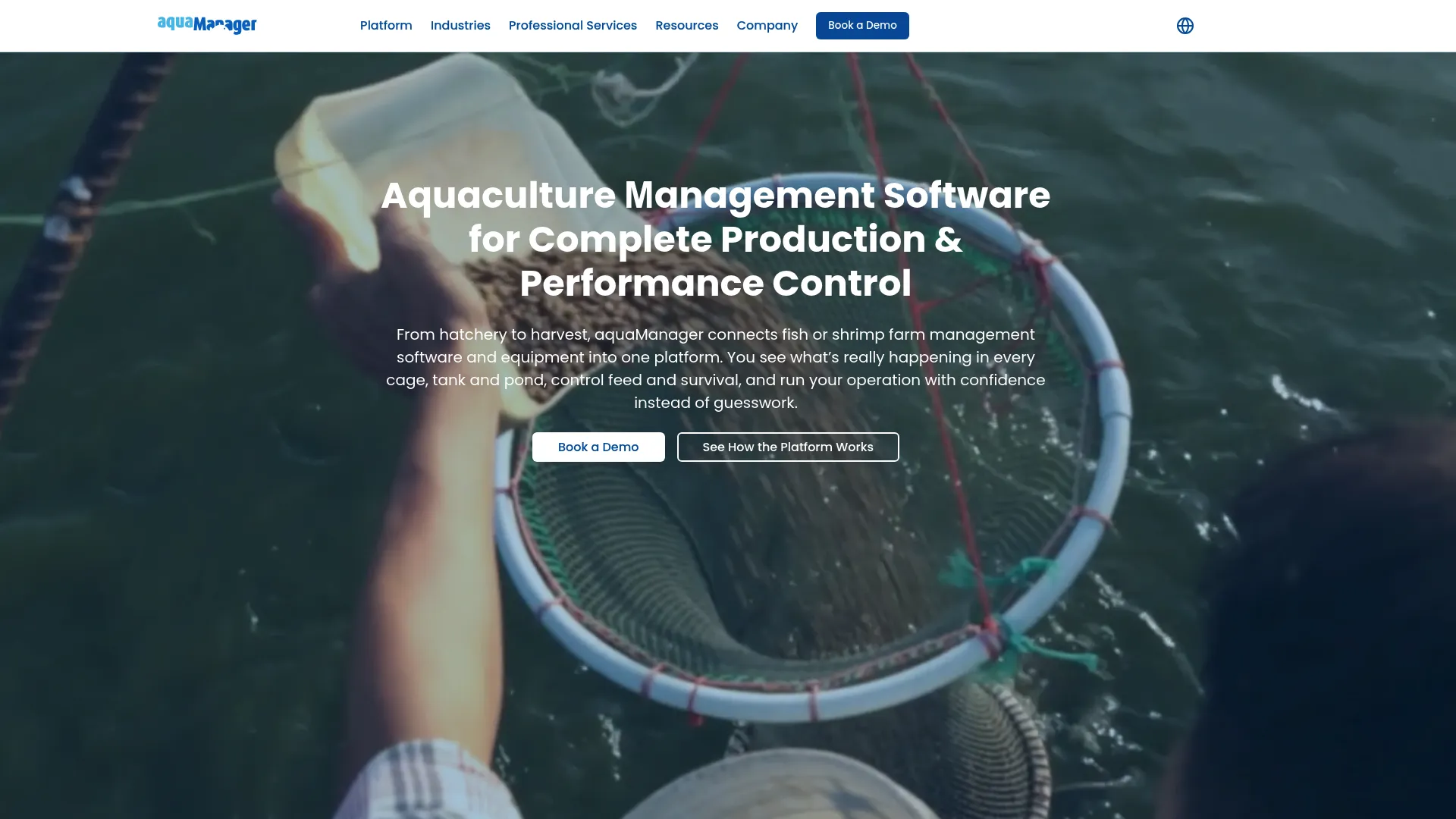
aquaManager is an end-to-end aquaculture management software platform built for production control across hatchery and grow-out. It captures daily events, feed, mortalities, and water quality, then connects those records to planning, costing, and reporting. For operators who want one connected production system instead of stitched-together tools, it covers the full operational stack.
The value here is breadth without losing the cost thread. aquaManager ties production data to inventory and costing, so a feeding or stocking decision shows up in margin, not just in a log. Mobile capture keeps field entry fast, and integrations with sensors, cameras, and BI tools mean your operational data feeds the dashboards leadership actually reviews.
Best for: aquaculture farms that need connected production, costing, and operational control across hatchery and grow-out.
Key strengths
- Production data capture for daily events, feed, mortalities, and water quality
- Planning, forecasting, inventory, costing, and reporting in one system
- Mobile apps plus integrations with sensors, cameras, and BI analytics
Why choose aquaManager: If your main pain is fragmented records and no clear line from farm activity to cost, aquaManager gives you a single production system with costing built in. It fits operators who want control and reporting depth over a narrow analytics angle.
aquaManager pricing: The site lists three editions, Start-up, Business, and Enterprise, without public prices. Pricing is tailored, so you book a demo to get an estimate for your operation.
2. Suderra
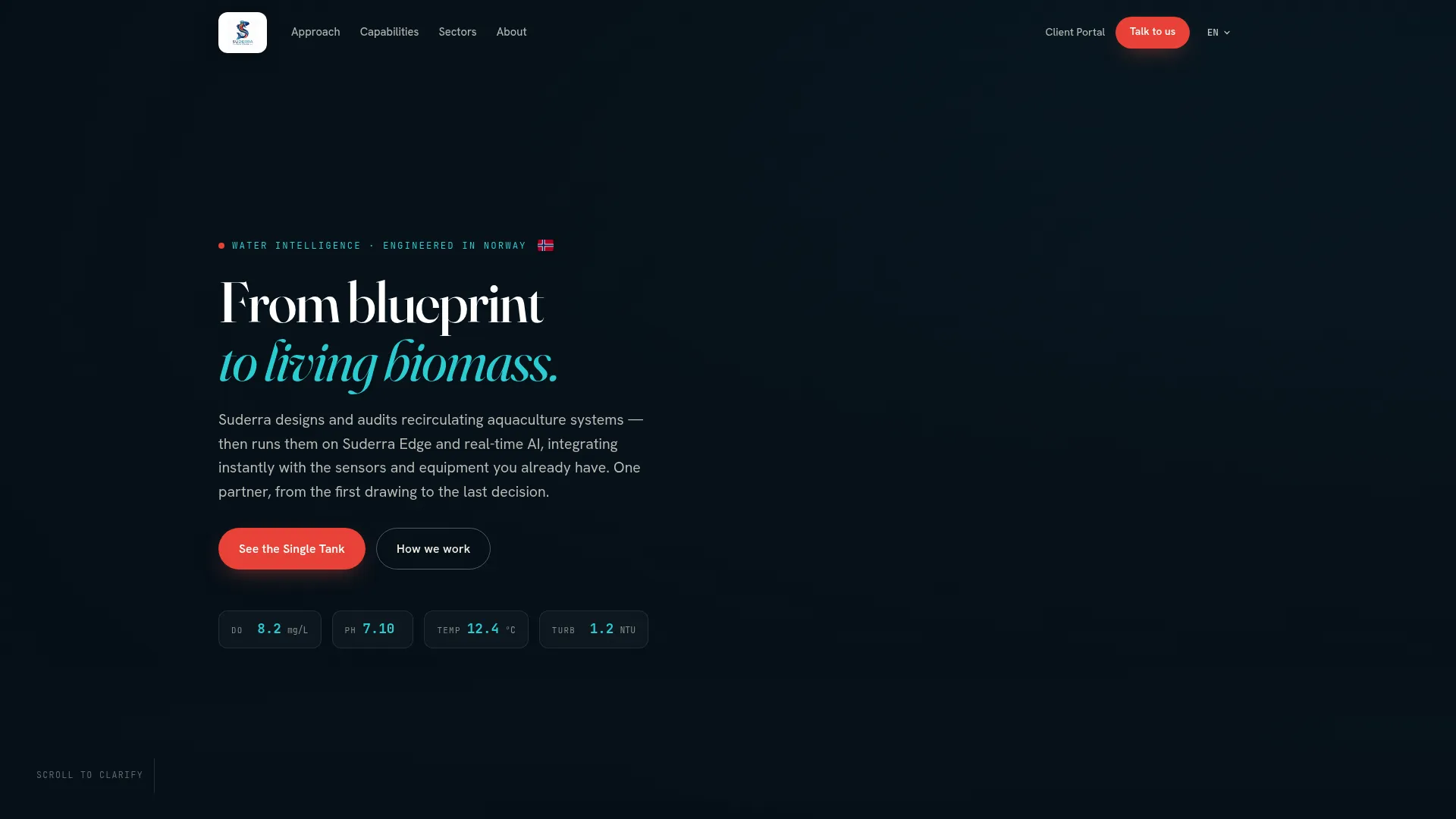
Suderra is a Norwegian water-engineering and software company that pairs aquaculture system design with operational software. It supports batch management, feed plans, mortality tracking, and water quality monitoring, with a unified dashboard sitting on top. The standout is its offline-first architecture, built for sites where connectivity is not guaranteed.
That resilience matters more than it sounds. Land-based and remote farms lose data and alerts when systems assume constant internet. Suderra keeps working locally and syncs when it can, so real-time monitoring does not fall over during an outage. Sensor integration through MQTT, Modbus, and OPC-UA means it plugs into the probes and controllers you already run, and AI-assisted water-quality logic surfaces alerts before conditions cross a threshold.
Best for: aquaculture operators needing integrated engineering, sensor data, and locally resilient operational software.
Key strengths
- Aquaculture system design and engineering alongside software
- Sensor integration with MQTT, Modbus, and OPC-UA
- Offline-first operations with AI-assisted water quality and alerts
Why choose Suderra: If your operation runs where connectivity is spotty, or you want engineering and software from one partner, Suderra's offline-first design removes a real failure point. It fits land-based fish farming and sites that need local resilience.
Suderra pricing: Suderra does not publish public pricing. The site uses contact-based sales, so you reach out to discuss scope and get a quote.
3. FishFarmFeeder
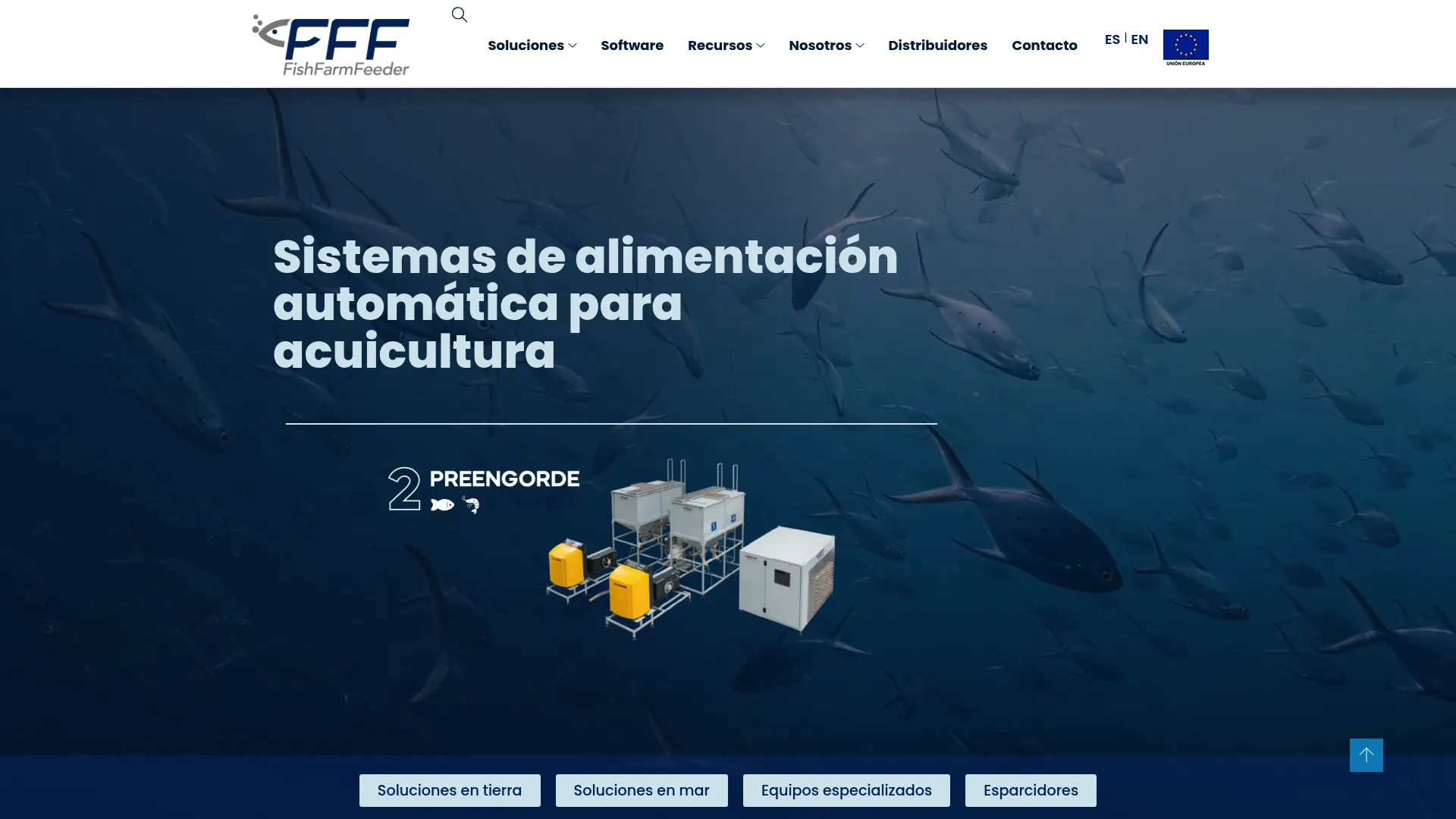
FishFarmFeeder builds automated feeding systems and the software to run them, across fish and shrimp operations from hatchery to grow-out. Its Aqua3F software handles real-time control, feeding schedules, and traceability, with sensor integration and remote monitoring through an app. If feed is your biggest cost and your biggest lever, this is the feed management software built around it.
Feeding is where FishFarmFeeder goes deep. You configure dosing and distribution tables, automate feeders, and pull FCR reports that connect feed input to growth. That closes the loop most operations leave open: you see whether a feeding plan is actually improving conversion, not just whether it ran. Traceability and report export mean the feeding data also serves compliance and reporting needs, not just daily control.
Best for: aquaculture operators needing automated feeding and remote farm control across hatchery to grow-out stages.
Key strengths
- Automated feed dosing and scheduling
- Aqua3F software for real-time control and traceability
- Remote monitoring via app and sensor integration
Why choose FishFarmFeeder: Choose this when feeding optimization and FCR are the core problem, not general record-keeping. It fits operators who want farm control software tied directly to feeding hardware and want to squeeze waste out of the largest cost line.
FishFarmFeeder pricing: FishFarmFeeder does not display public pricing. Pricing is quote-based and depends on system scope, so you contact the team for an estimate.
4. Manolin

Manolin is aquaculture data intelligence software for farms and suppliers, built around its Watershed platform. Where most tools record what happened, Manolin focuses on what happens next: predictive disease models, risk forecasting, and benchmarking against comparable farms. Its differentiator is population-traced data that follows fish across systems, sites, splits, merges, and transfers, plus the data cleaning that makes those comparisons trustworthy.
For operators fighting health and mortality risk, this is where aquaculture analytics earns its place. Risk alerts and predictive models give you a heads-up instead of a post-mortem, and benchmarking shows how a site performs relative to others rather than in isolation. The Harpoon side supports supplier research and reporting, so vendors and health teams can build on the same clean data.
Best for: aquaculture farms and suppliers needing data integration, benchmarking, and research-driven fish health insight.
Key strengths
- Population-traced farm data across systems, sites, splits, merges, and transfers
- Aquaculture-specific models for fish health, forecasting, and benchmarking
- Supplier research and reporting via Harpoon
Why choose Manolin: Pick Manolin when predictive analytics and benchmarking matter more than day-to-day production control. It is the analytics layer, and it pairs well with a production or feeding system rather than replacing one.
Manolin pricing: Watershed offers a free Researcher tier plus paid tiers. Harpoon adds one-time, observational, annual, and report-based options. A public price is visible for Observer reports at $995 USD; other paid tiers are quote-based.
5. Innovasea
Innovasea is an aquaculture and fish-tracking technology provider whose Farm360 platform brings farm management into a cloud-based system. It combines real-time monitoring, stock management, production planning, budgeting, and traceability with hardware like environmental sensors, underwater cameras, and submersible net pens. For larger farms that want a broad intelligence stack rather than a single-purpose tool, Innovasea covers a lot of surface.
The pull here is integration across hardware and software. Environmental monitoring feeds the same system that handles stock and production planning, so operational visibility spans the water column and the spreadsheet. That breadth suits multi-site operations where leadership needs one view of conditions, inventory, and traceability across the whole farm.
Best for: aquaculture operators and fish-tracking researchers needing integrated hardware and software across larger operations.
Key strengths
- Farm360 cloud-based farm management
- Real-time environmental monitoring
- Submersible net pens and integrated hardware
Why choose Innovasea: Choose Innovasea when you want hardware and management software from one provider and need a broad stack across multiple sites. It fits larger farms over lean, single-cage operations.
Innovasea pricing: Innovasea does not publish public pricing. The Farm360 product page routes you to contact the team for a scoped quote.
6. AKVA Group

AKVA Group is a global provider of aquaculture solutions and services spanning sea-based, land-based, digital, and service operations. On the software side, its digital platform and precision monitoring tools bring AI and computer vision to biomass estimation, fish welfare, and farm visibility. For teams that prioritize sensor-driven monitoring and precision insight, AKVA Group pairs deep equipment experience with digital control.
The strength is the combination of physical systems and digital layers. Land-based RAS and zero-water-exchange solutions sit alongside precision feeding and monitoring tools, so the same provider handles the tank and the intelligence running it. Computer-vision biomass estimation gives operators growth and welfare data without constant manual sampling, which is where a lot of monitoring time gets spent.
Best for: aquaculture operators needing integrated equipment, systems, and digital control solutions.
Key strengths
- Sea-based aquaculture products and systems
- Land-based RAS and zero-water-exchange solutions
- Digital platform with precision feeding and monitoring tools
Why choose AKVA Group: Choose AKVA Group when you want equipment and digital monitoring from a single provider and value computer-vision insight into biomass and welfare. It fits operations investing in precision monitoring at scale.
AKVA Group pricing: AKVA Group does not display public pricing. Pricing is quote-based and depends on the systems and digital scope you need, so you contact sales.
7. Aquabyte
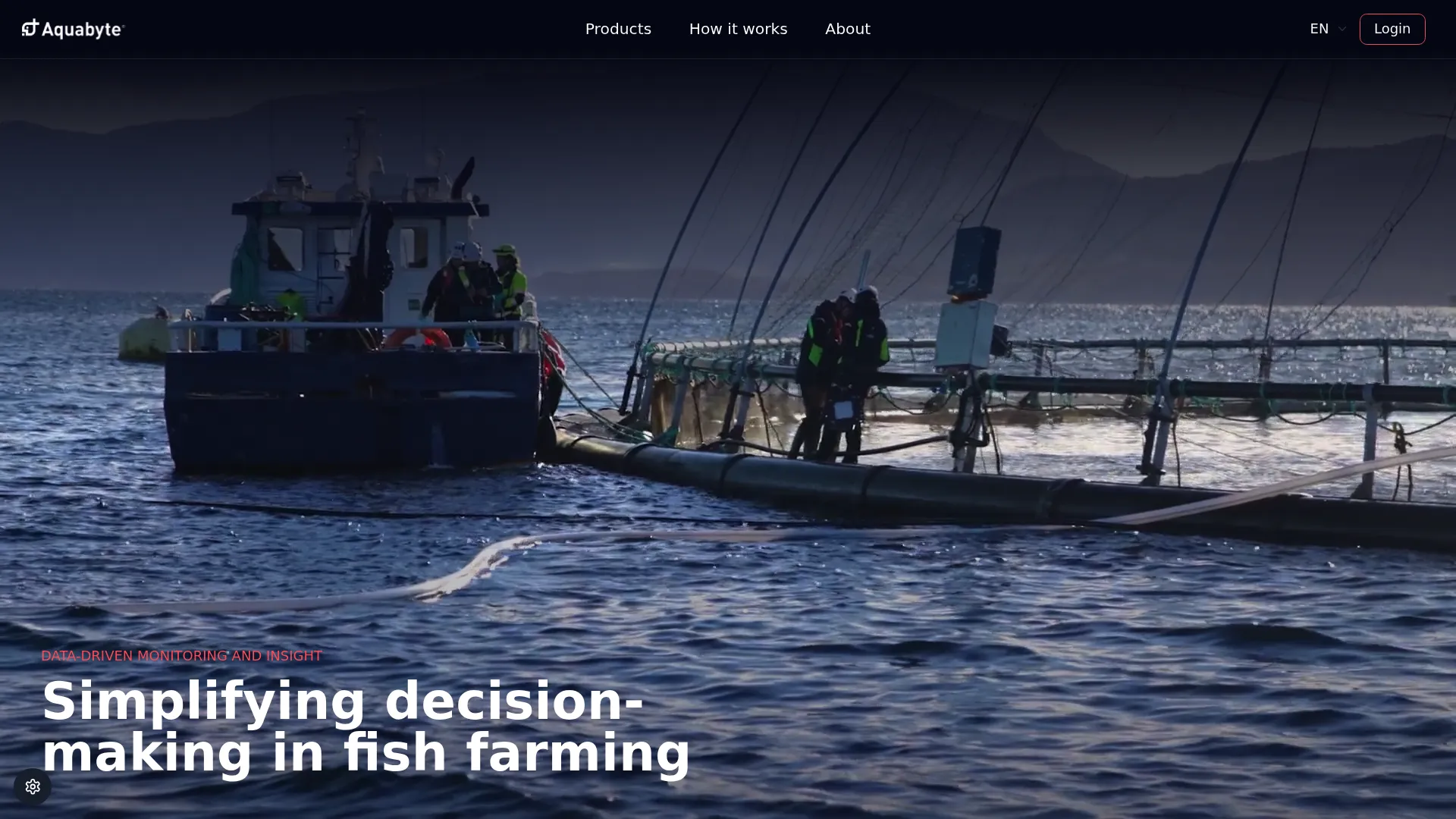
Aquabyte is an AI-powered aquaculture platform focused on monitoring and decision support for fish farmers. It uses computer vision for weight, biomass, and growth estimation, automatic lice counting, welfare monitoring, and behavior tracking. For teams centered on biomass and fish health intelligence, Aquabyte turns camera data into the numbers that drive feeding and harvest timing.
The practical win is removing guesswork from growth and welfare. Instead of manual sampling, computer vision estimates weight and biomass continuously, so feeding and harvest decisions rest on current data. Automatic lice counting and behavior monitoring flag welfare issues early, and its models are trained on large welfare, lice, behavior, and growth datasets, which sharpens the decision support over time.
Best for: fish farms that need AI-based monitoring and decision support for biomass and welfare.
Key strengths
- Weight, biomass, and growth estimation
- Automatic lice counting and welfare monitoring
- Behavior monitoring and decision support
Why choose Aquabyte: Pick Aquabyte when biomass estimation and welfare monitoring are the priority and you want computer vision doing the measurement. It works as a monitoring and analytics layer alongside a production system.
Aquabyte pricing: Aquabyte does not publish public pricing. The site uses contact and demo-based sales, so pricing is scoped per operation.
Considerations before you buy
Data integration and API support
Check which sensors, controllers, ERP, and BI tools each platform connects to. API integrations and protocols like MQTT, Modbus, and OPC-UA decide whether the software joins your stack or becomes another silo. If it cannot ingest your existing probe and camera data, you will end up with duplicate manual entry.
Traceability and reporting depth
Ask how batch tracking works: per cage, tank, or pond, and whether feed usage and mortalities follow the batch. Strong traceability software for aquaculture makes audits and compliance faster and gives leadership defensible numbers. Weak reporting turns every board or buyer question into a spreadsheet project.
Operational fit by farm type
A shrimp pond operation and a land-based RAS site have different needs. Match water quality monitoring, feed management, and offline resilience to your actual conditions. A tool built for sea cages may not fit a recirculating tank system, and vice versa.
Analytics versus control
Decide whether your gap is control (production, feeding, records) or insight (forecasting, benchmarking, disease risk). Some tools excel at operational decision support and daily control; others at predictive analytics. Many operations run one of each rather than forcing a single tool to do both.
Conclusion
The right aquaculture software depends on where your operation hurts most in 2026. For connected production control, costing, and traceability, aquaManager and Innovasea's Farm360 give you a broad management system. When feeding drives your economics, FishFarmFeeder ties feed management software to real FCR optimization. For local resilience and real-time monitoring, Suderra's offline-first design holds up where connectivity does not.
On the analytics side, Manolin brings predictive disease models and benchmarking, while AKVA Group and Aquabyte turn computer vision into biomass estimation and welfare data.
Here is a practical next step. Audit your current farm data flows: where feeding, mortality, water quality, and cost data live, and how long it takes to reconcile them. Then compare that mess against one production platform, one feeding platform, and one analytics platform from this list. Shortlist by farm size, feed complexity, and whether your gap is control or insight. Book demos with the two closest fits and bring your real data to the call. That is how you find the aquaculture reporting software and dashboard reporting your operation will actually use.
FAQs
It helps farms track feeding, survival, biomass, water quality, inventory, costs, and reporting in one place. Strong fish farm software turns farm data into operational decisions instead of spreadsheet cleanup. The goal is to close the gap between what your farm is doing and what you can see and act on.
Management software is broader. It combines planning, reporting, traceability, and decision support across the production cycle. Monitoring software is usually narrower and focuses on sensors, alerts, and real-time conditions like dissolved oxygen and temperature. Many operations run both, with monitoring feeding the management layer.
Look for real-time visibility, batch tracking, feeding control, reporting, traceability, and integrations. If the software cannot connect farm events to costs or outcomes, it will not help much at scale. Mobile capture and dashboard reporting also matter for teams entering data in the field and reviewing it from the office.
It makes it easier to follow batches, feed usage, mortalities, and site history. That improves auditability, helps with compliance, and gives leaders cleaner data when they need to explain performance. As buyers and certifiers demand more batch-level history, traceability moves from nice-to-have to a requirement.
Yes, especially if you already use sensors, ERP, BI tools, or other farm systems. API support prevents data silos and reduces duplicate manual entry. Check for protocols like MQTT, Modbus, and OPC-UA if you run industrial probes and controllers.
Shrimp farms should prioritize water quality tracking, feed management, growth monitoring, and traceability by pond or batch. If the system supports benchmarking and forecasting, that is a plus. Feeding is often the largest cost, so FCR optimization tools tend to pay back fastest.
Choose feeding software if feed optimization is the main pain and FCR is drifting. Choose farm management software if you need a broader operating system for planning, reporting, inventory, and multi-site visibility. Many operations run both, with feeding software feeding data into the management layer.
At minimum, track feed conversion ratio, mortality, biomass, water quality, harvest timing, inventory, and production costs. If those metrics are not visible in one workflow, decision-making stays slow. The best tools connect each metric to a decision, not just a record.