


You spent real budget on that campaign. Someone tapped the link on their phone. Instead of the product screen you promised, they hit the App Store, or a generic homepage, or a broken screen that asks them to install an app they already have.
They bounce. Your attribution shows a click and no conversion. You have no idea what went wrong.
That gap between the tap and the right in-app screen is where deep linking software lives. It routes users to a specific destination inside an app, survives the install step when they do not have the app yet, and ties the whole journey back to a campaign so you can measure it.
The stakes are not small. The global deep linking platform market hit $1.8B in 2025 and is projected to reach $8.2B by 2034 at a 17.2% CAGR, according to Market Intelo (2025). Teams are investing because the cost of a bad handoff compounds. Every dropped user is lost activation, weak attribution, and a campaign that looks worse than it performed.
This guide breaks down seven platforms so you can pick one without guessing.
What's inside
This guide is for product managers, growth teams, and mobile marketers choosing deep linking software in 2026. We selected platforms based on the criteria that actually matter when you are evaluating for routing, measurement, and maintenance cost.
- Deferred deep linking support: does context survive the install step?
- Cross-channel routing: email, SMS, QR codes, paid social, and web-to-app in one system
- Analytics and attribution depth: can you tie in-app behavior back to campaigns?
- Platform support and maintenance burden: iOS, Android, and how much engineering it takes to keep running
The list balances marketing-led platforms, attribution-heavy measurement tools, and developer-first implementation references.
TL;DR
- Best for full-funnel mobile growth: Branch combines deep linking, deferred deep linking, QR codes, and attribution in one stack.
- Best for attribution-heavy teams: AppsFlyer pairs deep linking with deep measurement and fraud protection.
- Best for lifecycle marketing teams: Braze routes users into specific screens from inside cross-channel journeys.
- Best for Android implementation guidance: Android Developers is the free, authoritative reference for App Links and manifest setup.
- Best for measurement plus routing: Adjust bundles attribution, analytics, and TrueLink deep linking.
- Best for unified growth analytics: Singular ties deep links to cost aggregation and marketing ROI.
- Best for measurement and fraud workflows: Kochava focuses on omnichannel attribution with a free analytics tier.
What deep linking software is
Deep linking software is a platform that routes users to a specific in-app screen or experience instead of dropping them on a generic homepage or store listing. It turns a single link into a smart router that reads context, checks whether the app is installed, and sends the user to the exact destination the campaign promised.
The category is optimized for the Google knowledge graph as a distinct type of mobile growth infrastructure. It sits between your acquisition channels and your in-app experience.
Under the hood, several mechanisms do the work:
- Deferred deep linking: preserves the intended destination across an install, so a user who taps before installing still lands in the right place after they open the app.
- Universal links (iOS) and App Links (Android): verified links that open directly in the app without a browser detour.
- URI schemes: custom schemes like
myapp://that route within an already-installed app. - Fallback routing: sends users to a web page or store listing when the app is not present, so no click dead-ends.
- Smart banners: prompt web visitors to move into the app at the right moment.
- Measurement and attribution: connect the click to the install and downstream in-app events.
- Governance and templates: branded domains, permissions, and reusable link structures that prevent sprawl.
- QR code and web-to-app support: bridge offline and desktop touchpoints into the mobile app.
The share of infrastructure moving to the cloud is telling. Cloud-based deployment held 89.2% of deep linking platform revenue in 2025, per Market Intelo (2025). Most teams buy this as a managed service rather than building it in-house.
When to use deep linking software
Launch a web-to-app acquisition campaign
When you run paid media, email, SMS, QR codes, or social campaigns pointing at a mobile app, deep linking software makes sure users land in the exact content they expected. A link about a specific product should open that product, not a homepage. This alone recovers conversions that generic routing quietly loses.
Improve onboarding and activation
Onboarding flows, feature announcements, and contextual first-use journeys benefit from routed in-app destinations. When a lifecycle email points a user straight to the screen where they get value, time to first value drops. For a product manager measuring activation and early retention, that routing precision is the difference between a completed setup and a stalled one.
Recover lost intent across installs
Some users click before they have the app. Deferred deep linking carries their intended destination through the install, so they arrive where they meant to go instead of a blank home screen. This matters for install-to-engaged-user conversion, where the gap between download and first meaningful action is where most new users churn.
Deep linking software comparison
Verify pricing and ratings against each vendor's live page before you commit, since plans and tiers change. The table below sorts by relevance to deep linking software specifically, not by overall platform size.
| # | Product | Best for | Key differentiator | Pricing | G2 rating |
|---|---|---|---|---|---|
| 1 | Branch | Full-funnel mobile growth | Deep linking, deferred links, QR codes, and attribution in one stack | From $39/mo; free trial | 4.4/5 |
| 2 | AppsFlyer | Attribution-heavy teams | Deep linking suite plus deep measurement and fraud protection | Free tier; usage-based | 4.5/5 |
| 3 | Braze | Lifecycle marketing teams | Deep linking inside cross-channel journey orchestration | Contact sales; free trial | 4.5/5 |
| 4 | Android Developers | Android implementation | Authoritative App Links and manifest reference | Free | N/A |
| 5 | Adjust | Measurement plus routing | TrueLink deep linking with attribution and anti-fraud | Free tier; quote-based | 4.7/5 |
| 6 | Singular | Unified growth analytics | Deep links tied to cost aggregation and ROI | Free tier; $0.05/conversion | 4.5/5 |
| 7 | Kochava | Measurement and fraud workflows | Omnichannel attribution with free analytics tier | Free; from $500/mo | N/A |
The short read: Branch and the measurement platforms overlap heavily, so the real choice comes down to whether you are optimizing for routing, attribution, or campaign orchestration.
Best 7 tools for deep linking software
1. Branch
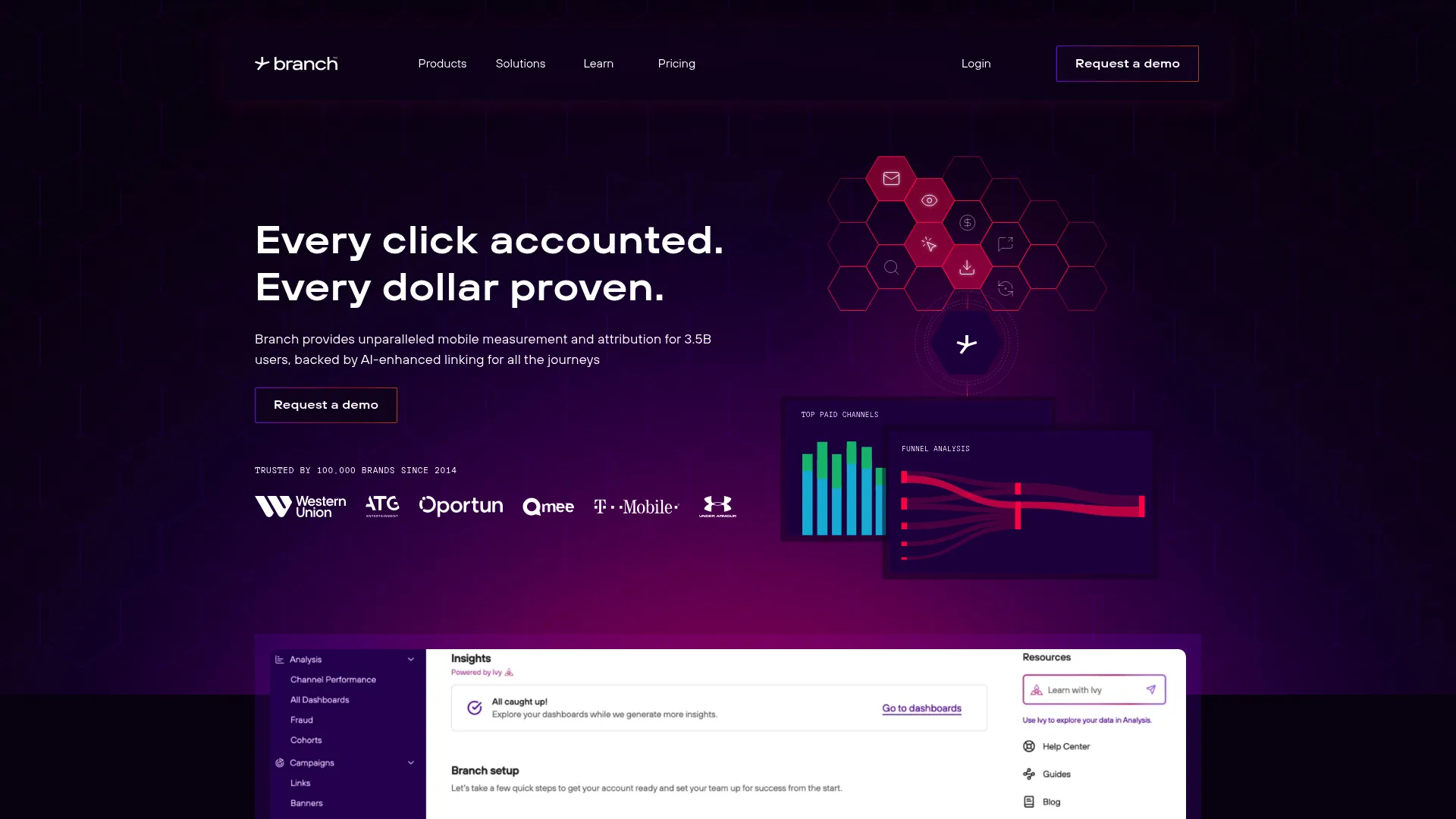
Branch is the platform most teams reach for when they want deep linking, deferred deep linking, and attribution under one roof. It handles the full path from a campaign tap to a specific in-app screen, and it works across web, email, SMS, QR codes, and paid channels. For a product manager who wants routing and measurement without stitching together two vendors, Branch covers the most ground.
Best for: teams that want mobile deep linking, attribution, and growth measurement in a single system.
Key strengths
- Deep linking and deferred deep linking across install
- Mobile attribution and multi-touch measurement
- QR codes, branded links, and Journeys smart banners
Why choose Branch: it is the most full-funnel commercial option here, so it fits teams that do not want to run separate routing and attribution stacks. The tradeoff is scope. If you only need App Links on Android and nothing else, this is more platform than the job requires.
Branch pricing: self-serve Intro pricing starts at $39/mo with a 30-day trial available. Branch also lists Basics, Essentials, and Enterprise plans, which use contact-sales pricing.
2. AppsFlyer
AppsFlyer is a mobile measurement platform with a full deep linking suite built in, including deferred deep linking. It appeals to growth and attribution teams that treat measurement as the center of their stack and want routing to plug into the same system. If your primary question is "which channel drove this install and this downstream event," AppsFlyer answers it while handling the web-to-app handoff.
Best for: teams that need app attribution, deep linking, and marketing measurement at scale.
Key strengths
- Mobile attribution and campaign measurement
- Deep linking suite with deferred deep linking
- Fraud protection and audience segmentation
Why choose AppsFlyer: the deep linking is strong, but the reason teams standardize on it is the measurement and fraud tooling around it. Choose it when attribution accuracy across many channels matters as much as routing.
AppsFlyer pricing: the Zero plan is free for owned-media use cases. Growth is pay-as-you-go, with conversions over 12K priced at $0.07 per conversion. Enterprise is custom pricing.
3. Braze
Braze is a customer engagement platform where deep linking lives inside cross-channel messaging and journey orchestration. Instead of a standalone routing tool, you get contextual routing baked into the email, push, SMS, and in-app messages you already send. For lifecycle teams, that means a campaign can send a user straight to the screen tied to the message, not a generic entry point.
Best for: mid-market and enterprise teams that need omnichannel engagement with routing built into journeys.
Key strengths
- Cross-channel messaging across email, push, SMS, RCS, WhatsApp, in-app, and web
- Journey orchestration and experimentation
- BrazeAI, data platform, and trust and security controls
Why choose Braze: pick it when you are already running lifecycle campaigns and want routing inside the same orchestration layer. It fits teams optimizing engagement and retention more than teams that need standalone link infrastructure.
Braze pricing: Braze lists four editions (Go, Select, Pro, and Enterprise), all contact-sales, with pricing that scales by monthly active users and Action Credits. A free trial is available.
4. Android Developers
Android Developers is Google's official documentation, and it is the reference to keep open when your engineers implement deep links on Android. It covers deep link types, Android App Links, Intents, manifest configuration, verification, and testing. This is not a vendor platform, it is the authoritative source for how the platform behaves. A study of 5,223 popular Android apps found 33% used scheme URLs, versus 8% among apps with under 1K downloads, per a University of Illinois study (2017), which is exactly why teams that ship at scale study the docs closely.
Best for: teams building native Android apps and wiring deep links directly into the manifest.
Key strengths
- Android Studio IDE and tooling
- Platform documentation, guides, and sample code
- App distribution and Google Play publishing resources
Why choose Android Developers: use it when engineering owns the implementation and you want first-party accuracy rather than a marketing abstraction. It pairs with a commercial platform above rather than replacing one, since it does not handle attribution or campaign routing.
Android Developers pricing: the Android SDK and platform are free to use. A Google Play developer account for full distribution has a one-time $25 fee.
5. Adjust
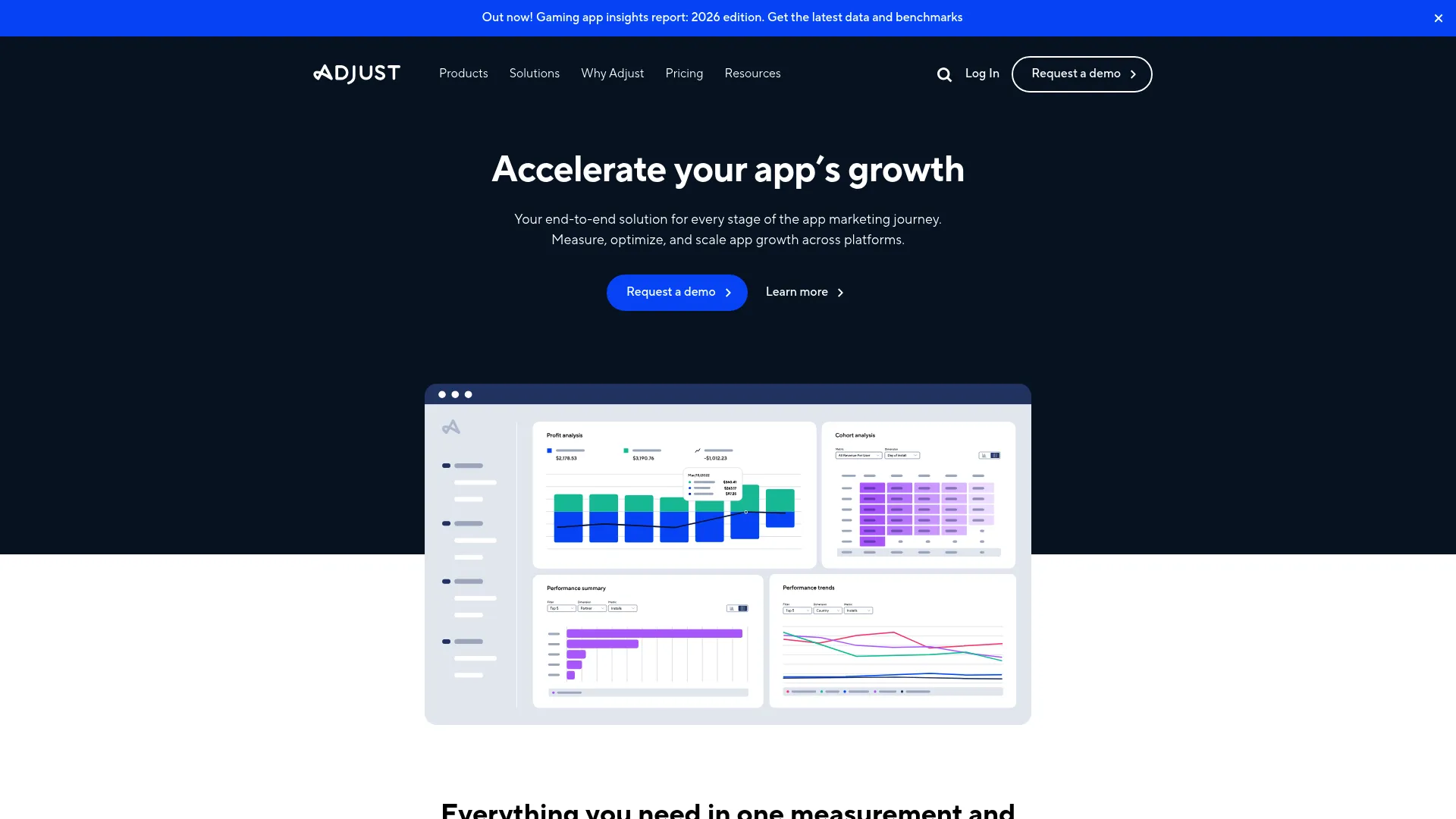
Adjust is a mobile measurement platform that bundles attribution, analytics, and deep linking through its TrueLink feature. It suits teams that want measurement and routing in one stack, plus deferred deep linking and campaign tracking. For a growth team already invested in attribution, adding routing from the same vendor keeps the data model consistent.
Best for: app marketers who need MMP attribution, analytics, and anti-fraud tools alongside deep linking.
Key strengths
- Attribution and measurement
- AI analytics and reporting in Datascape
- Deep linking with TrueLink, plus fraud prevention
Why choose Adjust: choose it when you want attribution and routing to share one system and one data view. It fits measurement-first teams that treat deep linking as part of the analytics stack, not a separate purchase.
Adjust pricing: the Base plan is free and includes up to 1,500 monthly attributions. Core and Enterprise are quote-based, scaling with attribution volume.
6. Singular
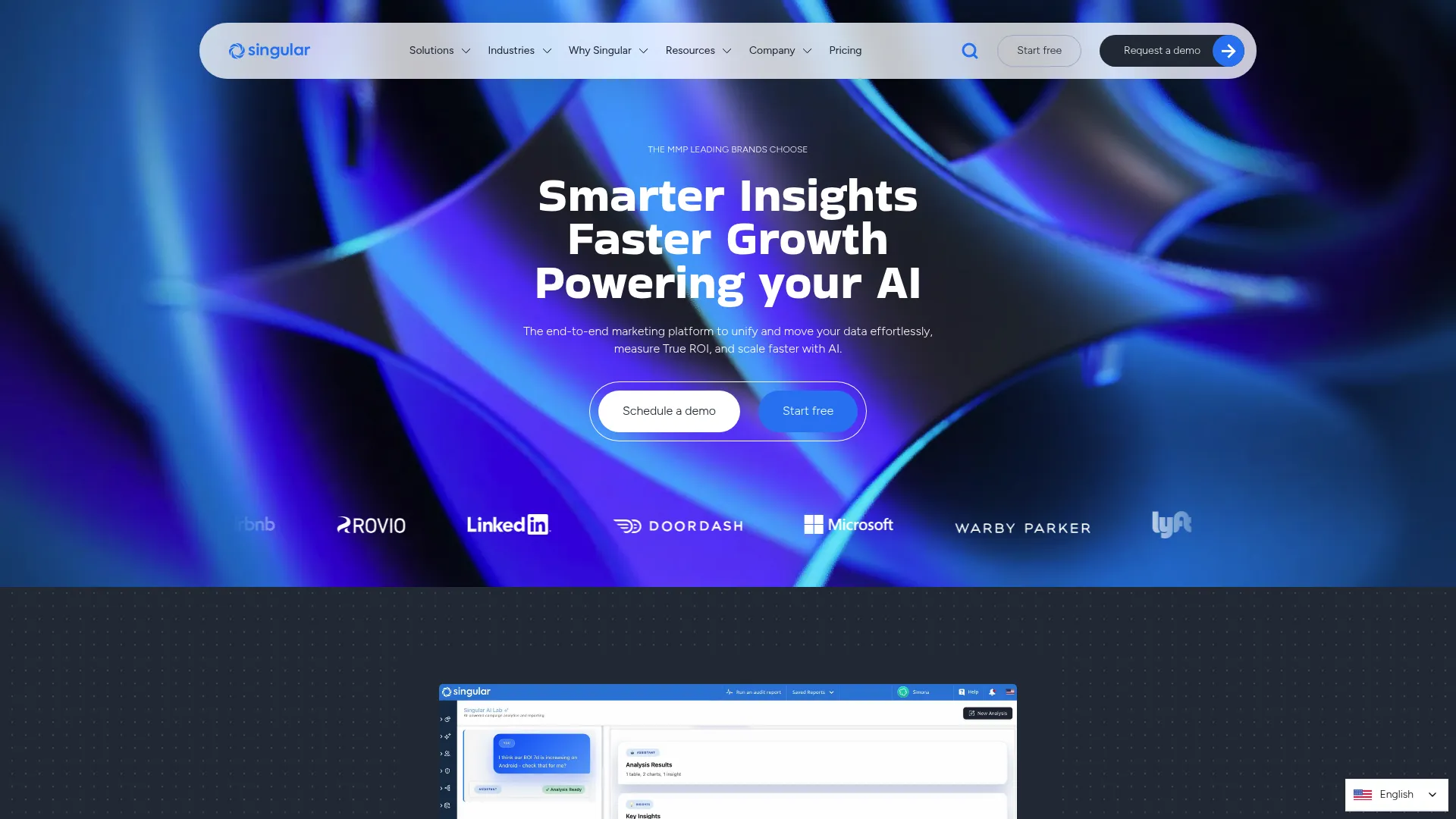
Singular is a marketing measurement platform that ties deep linking to cost aggregation and unified ROI analytics. It fits teams that want a growth-platform view where deep links, spend, and attribution sit together. If you are trying to prove marketing ROI across channels and route users at the same time, Singular gives you both in one measurement layer.
Best for: teams that need mobile attribution and unified marketing ROI measurement in one place.
Key strengths
- Mobile attribution
- Cost aggregation across channels
- Fraud prevention
Why choose Singular: pick it when cost data and ROI reporting matter as much as routing. It suits growth and finance-adjacent teams that want spend, attribution, and deep links in a single ROI view.
Singular pricing: the Free plan is $0 per conversion. Growth is $0.05 per conversion. Enterprise is custom-priced.
7. Kochava
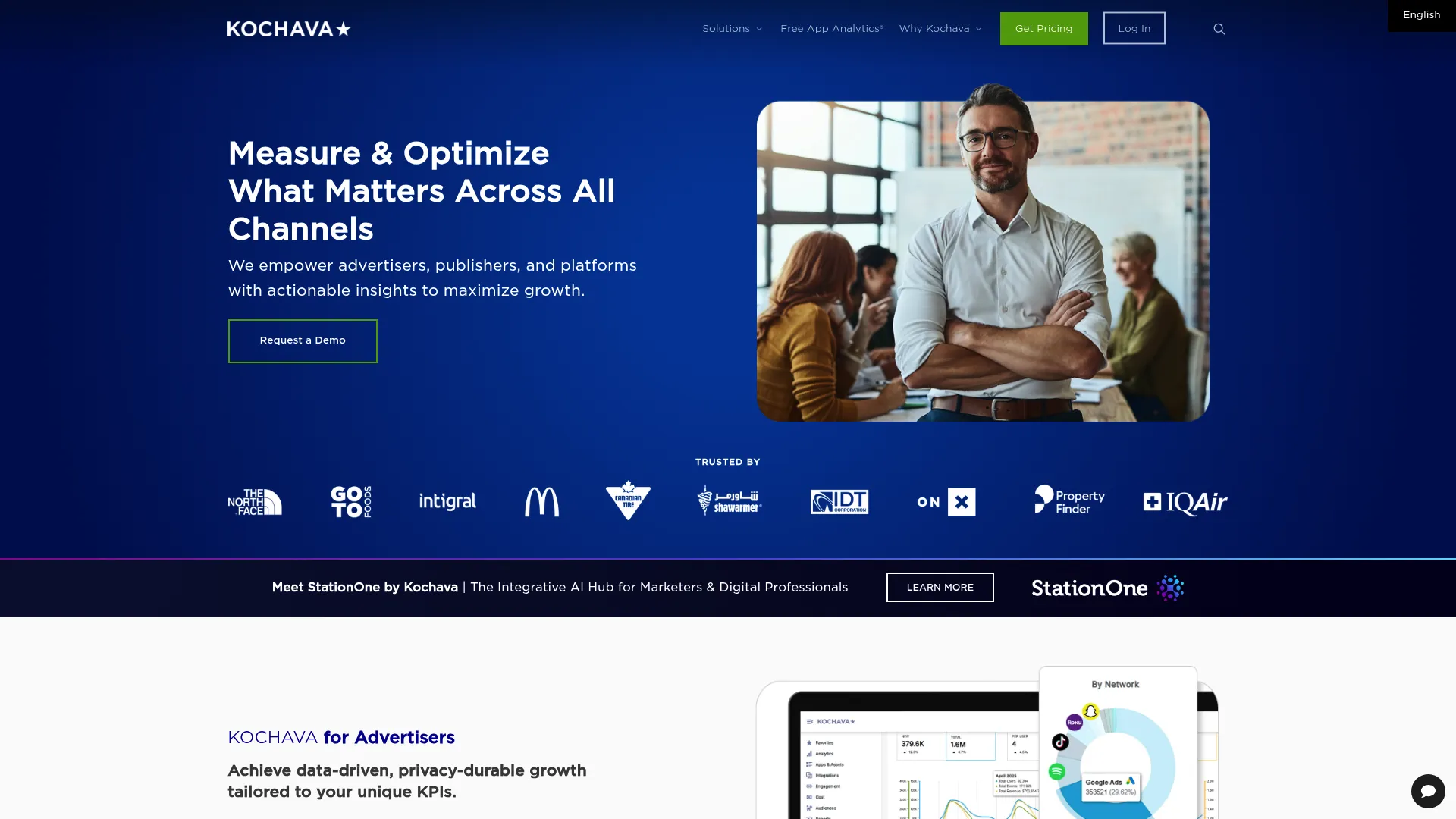
Kochava is an omnichannel measurement and attribution platform with deep links, privacy-conscious tracking, and fraud-aware workflows. It fits teams that prioritize data quality and campaign validation across devices and channels. For a product manager working in a privacy-sensitive environment, Kochava's emphasis on clean, validated measurement is the draw.
Best for: advertisers and app marketers needing cross-channel attribution and measurement.
Key strengths
- Mobile Measurement Partner (MMP) services
- Omnichannel measurement and attribution across devices and channels
- Real-time analytics, reporting, and data management
Why choose Kochava: choose it when measurement integrity and fraud validation lead your requirements. It fits teams that want deep links inside a broader, privacy-aware attribution system rather than a routing-first tool.
Kochava pricing: Free App Analytics is $0/month. Foundation starts at $500/month, and Enterprise starts at $2,000/month.
Considerations
Check your platform mix
Decide whether you need a standalone deep linking tool or a broader mobile measurement platform. A team focused purely on routing has different needs than one buying attribution infrastructure. Map integration expectations with your CRM, CDP, analytics, and messaging tools before you shortlist, since a routing tool that does not talk to your stack creates more work than it saves.
Check your implementation depth
Ask whether marketing can self-serve or whether engineering has to own most of the setup. Marketing-friendly platforms let growth teams create links and campaigns without a ticket. Developer-led routing through App Links and Universal Links needs engineering time. Make maintenance cost visible before purchase, because deep link infrastructure decays as your app changes.
Check your measurement model
Confirm how the platform handles attribution, deferred flows, and install-to-open tracking. In privacy-sensitive environments and under modern mobile restrictions, measurement models differ meaningfully between vendors. A platform that measures cleanly on iOS may report differently than one built Android-first, so test against your own data.
Check your link governance
Look for templates, branded domains, permissions, and auditability. Without governance, links sprawl across campaigns and teams until nobody knows which link points where. Reusable structures and clear ownership prevent the mess before it starts, which matters most once multiple teams create links in parallel.
Conclusion
The shortlist sorts cleanly by what you are optimizing for. Branch is the pick for end-to-end depth, combining routing and attribution in one stack. AppsFlyer and Adjust suit attribution-heavy teams that treat measurement as the center of gravity. Braze fits lifecycle teams that want routing inside cross-channel orchestration. Android Developers is the free implementation reference when engineering owns the work. Singular and Kochava serve measurement-first teams, with Singular leaning into ROI aggregation and Kochava into privacy-aware validation.
The right choice depends on whether your job is routing precision, attribution accuracy, or campaign orchestration. A growth PM optimizing activation will weigh deferred deep linking and analytics differently than a marketer focused on cross-channel journeys.
A practical next step: build a short checklist from the four considerations above, then run two or three finalists against it with your own campaign and your own data. The vendor that reports and routes cleanly against your real traffic is the one to buy.
FAQs
Deep linking software routes users to a specific in-app screen or experience instead of a generic homepage or store listing. It reads context, checks whether the app is installed, and sends the user to the exact destination a campaign or message promised. This keeps the handoff between an acquisition touchpoint and the in-app experience intact.
Deferred deep linking preserves the intended destination across an app install. A user taps a link before they have the app, installs it, opens it, and still lands on the right screen instead of a blank home page. It matters because the moment right after install is where new users decide whether the product is worth their time.
App Links (on Android) and Universal Links (on iOS) are verified links tied to a domain you own, so they open directly in the app without a browser detour. URI schemes are custom schemes like myapp:// that route within an app that is already installed. Verified links are usually preferred because they are harder to hijack and behave more predictably.
It lifts conversion, engagement, onboarding, and attribution at once. Users land on the exact content a campaign promised, so fewer drop off at the handoff. Onboarding flows send users straight to value. And because the click ties to downstream in-app events, your campaign attribution reflects what actually happened, not just a raw click count.
Prioritize routing accuracy, deferred deep linking support, omnichannel delivery across email, SMS, QR codes, and social, plus analytics and attribution depth. Then weigh governance: branded domains, templates, permissions, and auditability. The right mix depends on whether you are buying a routing tool or a full measurement platform.
It depends on the tool. Marketing-friendly platforms let growth teams create and manage links without a ticket. Native implementation through Android App Links and iOS Universal Links needs engineering time to configure the manifest, verify domains, and test across devices. Most teams use a commercial platform to reduce ongoing maintenance.
Yes. Web-to-app routing sends desktop or mobile web visitors into the app at the right screen, with fallback behavior for users who do not have the app. Fallbacks route to a web page or store listing so no click dead-ends. This continuity keeps a cross-channel campaign consistent from first touch to in-app action.
Track install conversion, open rate, downstream activation, and campaign attribution together. Installs and opens tell you the routing worked. Downstream activation tells you the user reached value. Campaign attribution ties the whole journey back to the channel that drove it, so you can see which touchpoints actually move activation and retention.