

A coder opens a chart, checks a CPT code, cross-references an ICD-10-CM entry, then stops. Did the quarterly errata change that code? Is the modifier still valid? Will this line trigger an NCCI edit and bounce the claim back?
That pause repeats hundreds of times a day across a coding team. Each one is small. Together they slow throughput, create rework, and push clean claims out of reach.
The stakes are not small either. The global medical coding software market was valued at USD 5.2 billion in 2025 and is projected to reach USD 11.3 billion by 2034 at a 9.8% CAGR, according to MarketIntelo (2025). That growth reflects a simple reality: code sets keep expanding, payer rules keep shifting, and manual lookup no longer scales.
The right software for medical coding removes the guesswork. It puts current codes, edits, crosswalks, and fee schedules one search away, and it flags problems before a claim leaves the building. This guide breaks down seven medical coding software programs, separates lookup-first tools from AI-assisted coding platforms, and helps you match a tool to how your team actually works.
What's inside
This guide is for coding managers, billing teams, revenue cycle leaders, and practice operations staff comparing medical billing and coding software in 2026.
We selected and ranked tools against the criteria that decide daily usefulness:
- Code-set coverage: CPT, HCPCS Level II, ICD-10-CM, and ICD-10-PCS breadth
- Update cadence: how fast errata, quarterly, and annual changes appear
- Workflow depth: lookup, crosswalks, claim edits, fee schedules, and RVUs
- Interoperability: EHR, data services, and API options where relevant
We split the list into two groups: reference and lookup platforms for coders, and AI-assisted coding tools for automation at scale.
TL;DR
- Best overall for deep code lookup and workflow support: Codify by AAPC, strongest for CPT, HCPCS, ICD, crosswalks, and claim edits in one search.
- Best for enterprise coding and publications: EncoderPro by Optum Coding, built around online code lookup and coding reference content.
- Best for AI-assisted coding at health-system scale: CodaMetrix or Phare Health.
- Best for coding automation with human review: CorroHealth PULSE or Fathom.
- Best for a custom-built solution: Belitsoft AI medical coding software, for teams that want to build around specific EHR and workflow needs.
- Best for hospital coding software and revenue cycle teams: one of the workflow-first automation options above.
What is medical coding software?
Medical coding software is a healthcare coding tool that helps users search, validate, map, and apply standardized code sets such as CPT, HCPCS Level II, ICD-10-CM, and ICD-10-PCS to clinical documentation for billing and reimbursement.
At its core, medical coding systems software does a few things well:
- Code lookup and navigation: find and verify codes across multiple code sets fast
- Updates and errata tracking: reflect quarterly changes, annual updates, and corrections
- Historical code access: retrieve prior-quarter and older code sets for audits
- Crosswalks and mappings: move between CPT, ICD, and HCPCS relationships
- Fee schedules, RVUs, and reimbursement tools: reference MPFS, RVUs, and global days
- Claim editing and denial prevention: run NCCI edits and claim scrubbing before submission
It helps to separate three flavors of the category. A medical encoder software or reference platform is built for coders to look up and validate codes quickly. AI-assisted coding tools read documentation and suggest or assign codes, then route them for human review. Custom-built healthcare coding software wraps AI and integrations around a specific organization's workflow. Most teams use at least one lookup tool and, increasingly, one automation layer beside it.
When to use medical coding software
Speed up code lookup across multiple code sets
A coder rarely lives in one code set. A single encounter can touch CPT, HCPCS Level II, and ICD-10-CM at once. Flipping between books or tabs adds seconds that compound across a shift. Software for medical coding puts smart search, crosswalks, and code details in one place, so verification takes a click instead of a hunt. Speed here is not vanity. It directly moves charts-coded-per-hour.
Reduce claim errors before submission
Most denials trace back to something avoidable: a bundled service, a missing modifier, an invalid code pairing. Medical billing and coding software with built-in NCCI edits and claim scrubbing catches those problems while the coder still has the chart open. Fixing an edit before submission costs minutes. Reworking a denial costs days and touches multiple teams. Denial prevention at the point of coding is the cheapest fix in the revenue cycle.
Support reimbursement and fee schedule work
Coding and reimbursement are two sides of one workflow. When your team quotes expected payment, checks global days, or validates RVUs, they need current fee schedule data beside the codes. Tools that surface MPFS, RVUs, and payer-specific fee schedules let coders and billers answer reimbursement questions without leaving the workflow. That matters most for practices managing tight margins and complex payer mixes.
Comparison table
We ranked these medical coding software programs by daily coder utility first, then by automation depth for larger revenue cycle operations. Lookup-first tools lead because they serve the widest range of coding teams. AI-assisted platforms follow, ordered by how they fit health-system scale. Pricing and ratings reflect verified, first-party or G2 values where publicly available; where a vendor uses quote-based pricing, we note that plainly.
| # | Product | Best for | Key differentiator | Pricing | G2 rating |
|---|---|---|---|---|---|
| 1 | Codify by AAPC | Code lookup and claim editing | AI smart search across CPT, HCPCS, ICD with NCCI edits | From $10/mo | 5.0/5 |
| 2 | EncoderPro by Optum Coding | Online code lookup and reference | Cross-coding plus monthly automatic updates | From $299.95/user | Not listed |
| 3 | CorroHealth PULSE | Coding automation for health systems | Universal EHR sync with AI coding and charge capture | Quote-based | Not listed |
| 4 | Fathom | Autonomous medical coding | Facility and professional coding with denial-risk flagging | Quote-based | Not listed |
| 5 | CodaMetrix | Enterprise autonomous coding | Contextual coding across specialties, EHR-integrated | Quote-based | Not listed |
| 6 | Phare Health | AI coding, CDI, and claims | Reads the complete EHR against guidelines and policy | Quote-based | Not listed |
| 7 | Belitsoft AI medical coding software | Custom-built coding solutions | Bespoke AI coding with FHIR integration | Quote-based | 4.9/5 |
1. Codify by AAPC
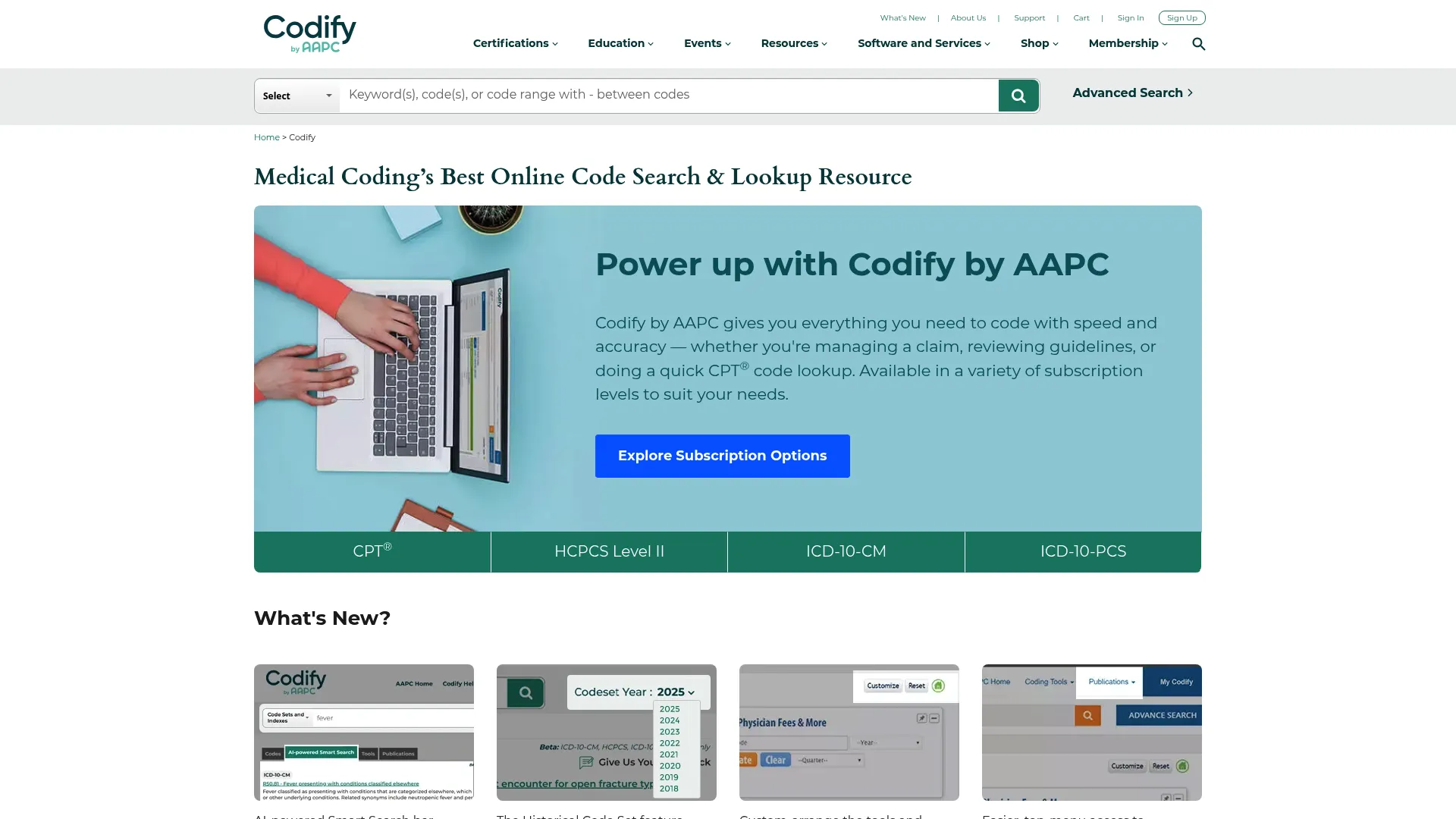
Codify by AAPC is online medical coding software built for CPT, HCPCS, ICD-10, and related coding workflows. It combines AI-powered smart search across code sets with the claim-editing and reference tools coders reach for every day. For teams that want breadth in one place, it is the strongest all-around fit on this list.
Best for: Medical coders and billing teams that need current code lookup plus claim-editing tools in a single subscription.
Key strengths
- AI-powered smart code search across CPT, HCPCS Level II, ICD-10-CM, and ICD-10-PCS
- CCI edits checker and CMS LCD lookup
- Claim scrubber, modifiers, and crosswalks
- Historical code sets for audits and retrospectives
- Fee schedule lookups and RVU reference
Why choose Codify by AAPC: If your team spends its day moving between code sets, verifying edits, and checking crosswalks, Codify puts all of that behind one search. It fits coders and billing staff who want daily lookup breadth without stitching together separate reference tools.
Codify by AAPC pricing: Codify shows monthly prices under an annual-plan-billed-monthly view. Coder Search starts at $10/mo, Basic Coder at $36/mo, Pro Fee Coder at $44/mo, and Complete Coder at $54/mo. A 14-day free trial is available. Team pricing is available by quote.
2. EncoderPro by Optum Coding
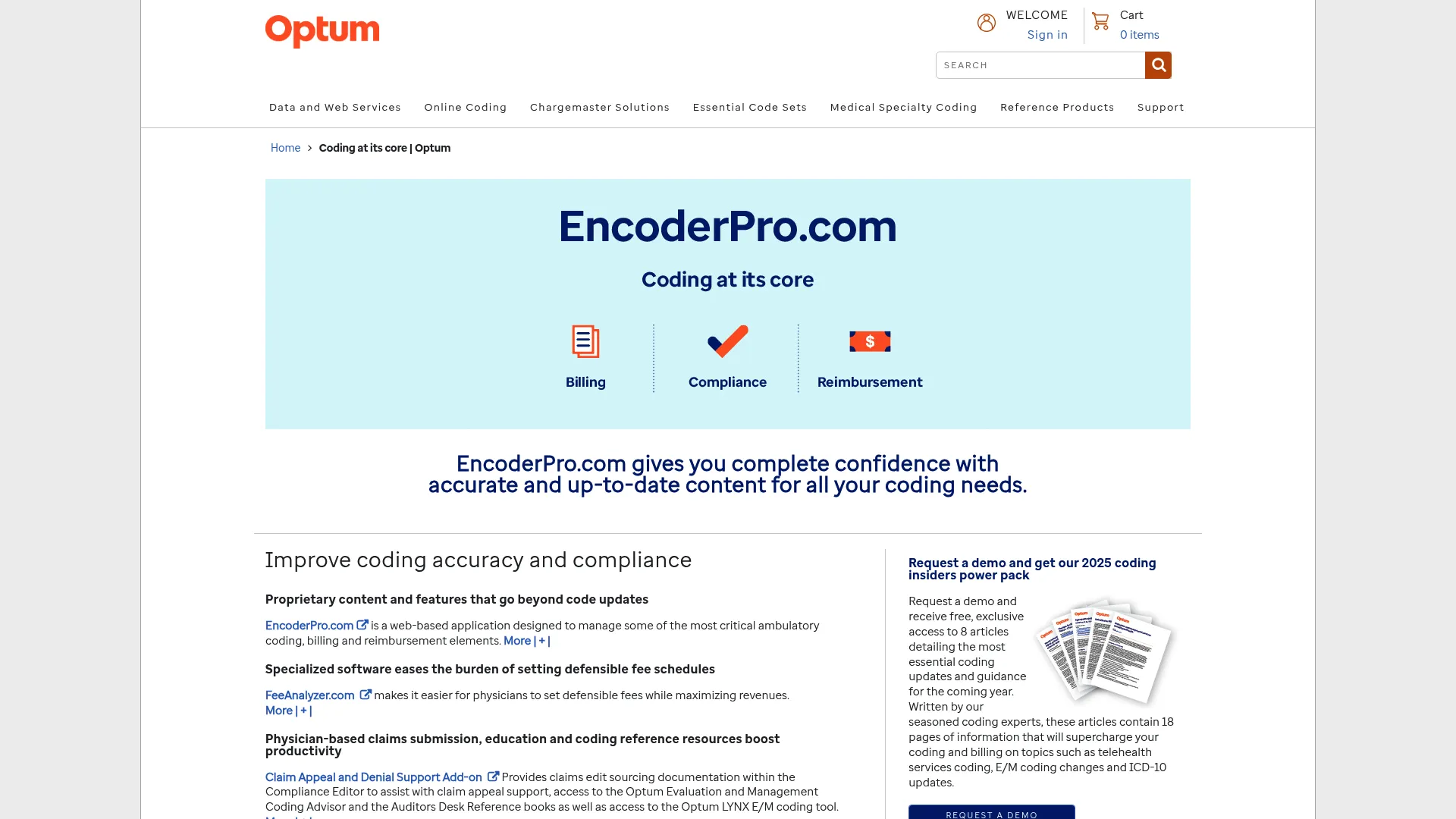
EncoderPro by Optum Coding is Optum's online medical coding reference and code lookup software for physician-based coding workflows. It centers on real-time lookup across major code sets, cross-coding, and the coding reference content Optum is known for. For organizations that already rely on Optum publications and data files, it slots into an existing reference workflow.
Best for: Physician practices and coders who want online code lookup paired with deep coding reference content.
Key strengths
- Real-time code lookup across CPT, HCPCS Level II, ICD-10-CM, and ICD-10-PCS
- Cross-coding functionality between related code sets
- Coding reference content and guidance
- Monthly automatic code updates
- Medicare and commercial coding information
Why choose EncoderPro by Optum Coding: Choose it when your coding needs extend into broader reference workflows, and when consistent monthly updates and cross-coding matter more than a low entry price. It fits practices that want an established reference platform behind their lookup.
EncoderPro by Optum Coding pricing: Optum lists three subscription levels: Standard Online at $299.95 per user, Professional Online at $549.95 per user, and Expert Online at $999.95 per user. Add-ons are sold separately.
3. CorroHealth PULSE
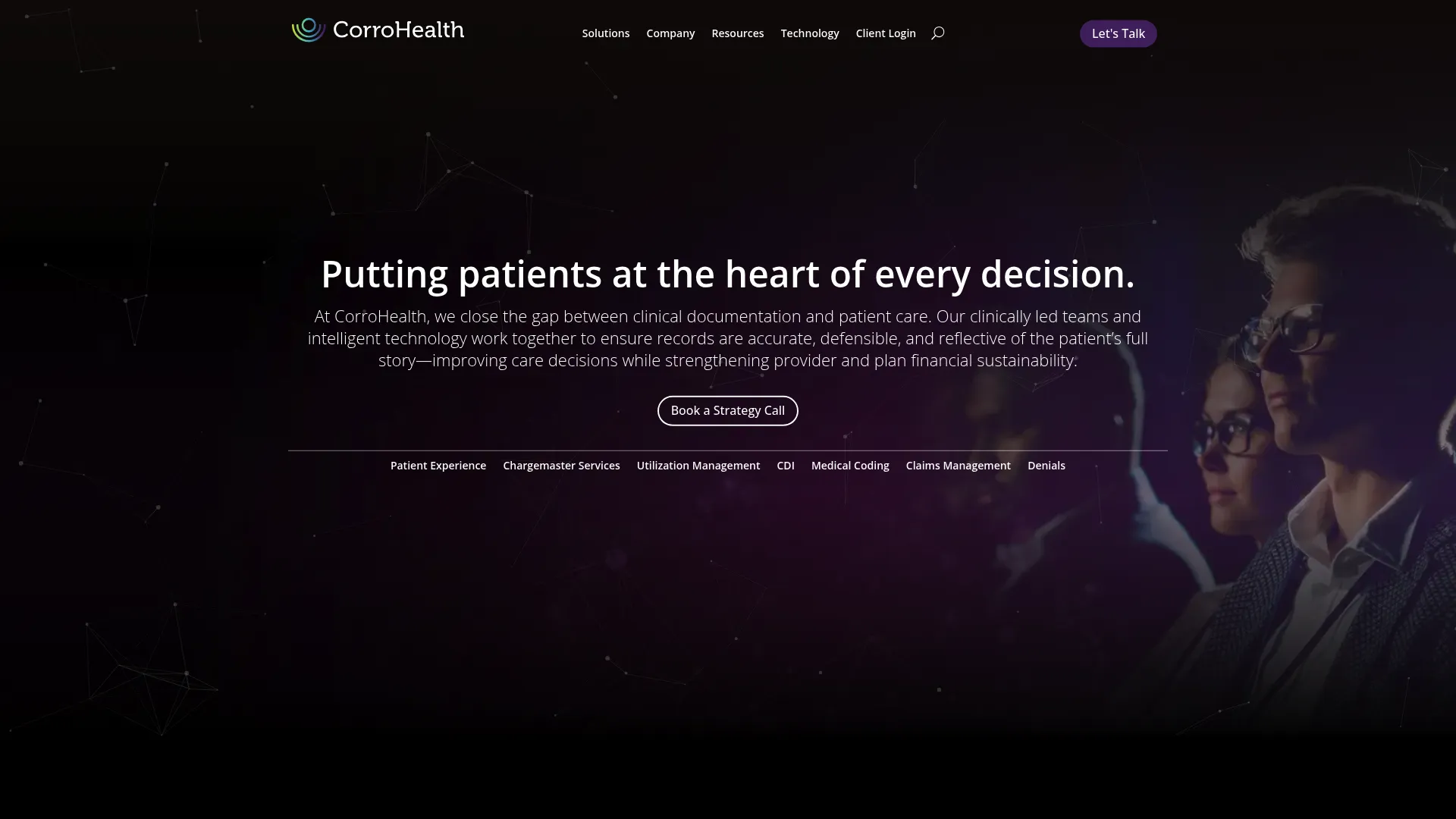
CorroHealth PULSE is an AI-driven healthcare coding automation platform built for revenue cycle workflows. It focuses on syncing with EHR data, automating code assignment, and validating output before it flows into charge capture. This is a tool for teams that want to lift throughput while keeping coders in the review loop.
Best for: Hospitals and health systems that need coding automation and charge capture across large volumes.
Key strengths
- Universal EHR synchronization
- AI medical coding automation
- Code routing and validation
- Charge capture support
- Revenue cycle alignment
Why choose CorroHealth PULSE: Pick PULSE when you want automation that reduces manual coding effort but still routes work through coder review and validation. It suits revenue cycle teams that measure success in throughput and clean charge capture.
CorroHealth PULSE pricing: CorroHealth does not publish public pricing for PULSE. Pricing is handled through direct contact with the vendor, typical for platforms sold into health-system revenue cycle operations.
4. Fathom
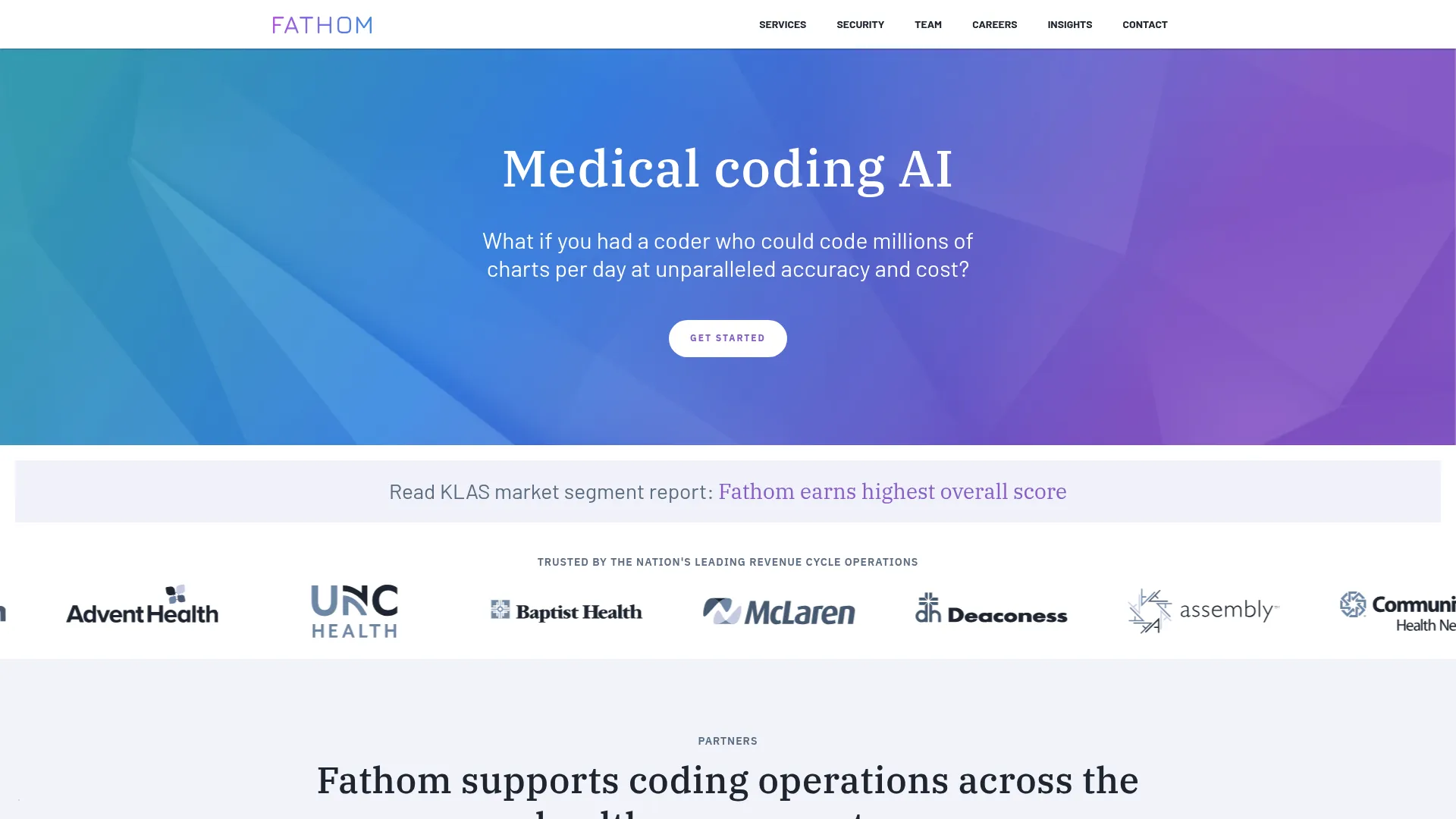
Fathom is an AI medical coding automation platform for healthcare organizations. It positions around autonomous coding across both facility and professional settings, with built-in flagging for audit and denial risk. For teams weighing throughput against control, Fathom keeps a review handoff in the workflow.
Best for: Health systems and providers that want AI-assisted coding automation with clear denial-risk flagging.
Key strengths
- Autonomous medical coding
- Facility and professional coding
- Audit and denial-risk flagging
- Coder review handoff
- Operational visibility
Why choose Fathom: Choose Fathom when you want to automate high-volume coding but still surface the charts that carry audit or denial risk for human review. It fits coding operations that want scale and a clear line between automated and reviewed work.
Fathom pricing: Fathom does not display public pricing. The company uses a quote request flow, so pricing depends on volume, specialty mix, and scope of coding automation.
5. CodaMetrix

CodaMetrix is an AI-powered contextual coding automation platform for healthcare revenue cycle management. It targets large health systems that need autonomous coding across specialties, tied into the EHR, with quality controls running in real time. Governance and scale sit at the center of its positioning.
Best for: Large health systems and provider organizations automating medical coding across many specialties.
Key strengths
- Autonomous medical coding across specialties
- EHR-integrated workflow support
- Real-time audit and quality controls
- Review and escalation paths
- Revenue cycle impact at scale
Why choose CodaMetrix: Pick CodaMetrix when volume and governance matter as much as accuracy, and when you need coding automation that spans multiple specialties inside one EHR-integrated workflow. It is built for enterprise operations rather than small practices.
CodaMetrix pricing: CodaMetrix does not publish pricing on its site. The company directs prospects to request a meeting or demo, so figures depend on organization size, specialty coverage, and integration scope.
6. Phare Health
Phare Health provides AI tools for healthcare claims, medical coding, CDI, and revenue cycle workflows. Its distinguishing angle is reading the complete EHR and cross-referencing coding against guidelines, best practices, and local policy. The product spans analytics, audit, and autonomous coding modules for teams modernizing their coding stack.
Best for: Hospitals and healthcare organizations modernizing medical coding, CDI, and claims workflows.
Key strengths
- Reads the complete EHR
- Cross-references coding with guidelines and best practices
- Local policy checks
- Phare Analytics, Phare Audit, and Phare Autonomous modules
- Coder review support
Why choose Phare Health: Choose Phare when you want AI assistance that checks coding against guidelines and local policy, without removing human oversight. It fits organizations that treat coding, CDI, and audit as one connected workflow rather than separate tasks.
Phare Health pricing: Phare Health does not list public pricing on its site. Given its enterprise and hospital focus, pricing is arranged directly with the vendor based on scope and modules.
7. Belitsoft AI medical coding software
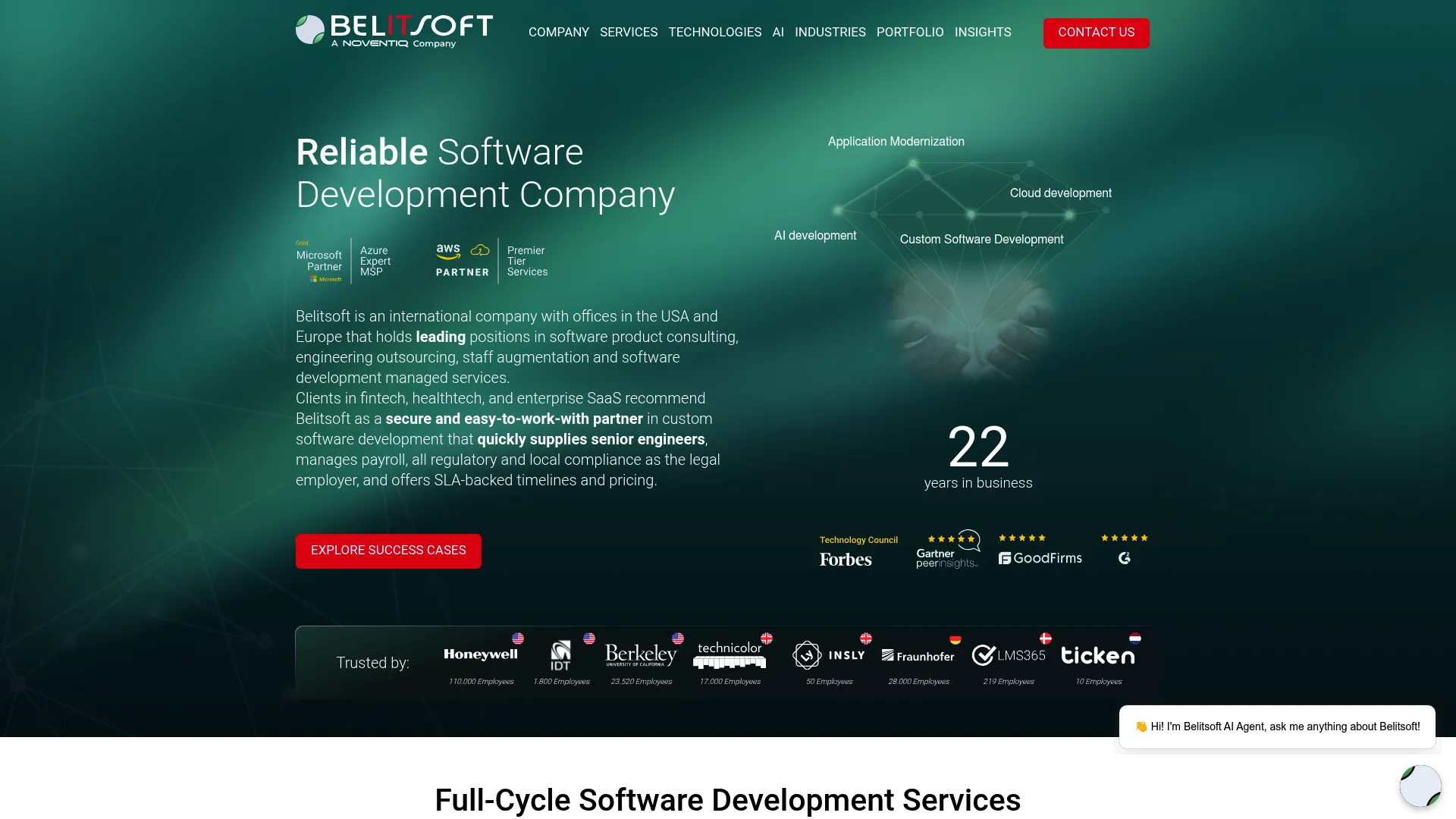
Belitsoft AI medical coding software is a custom development service for healthcare organizations that want a built solution rather than an off-the-shelf product. Belitsoft builds automated coding, clinical language analysis, and FHIR integration around a specific team's workflow. This is the option for buyers whose requirements do not fit a packaged tool.
Best for: Healthcare teams that want a custom-built AI medical coding solution shaped around their own systems.
Key strengths
- Automated medical coding
- FHIR integration
- Clinical language analysis
- Audit trail design
- Secure infrastructure buildout
Why choose Belitsoft AI medical coding software: Choose Belitsoft when your coding, integration, and compliance requirements are specific enough that a packaged product cannot cover them. It fits health tech teams and operators ready to invest in a build rather than a subscription.
Belitsoft AI medical coding software pricing: Belitsoft does not publish fixed pricing or tiers, since it delivers custom development. Cost depends on project scope, integration depth, and build timeline, and is scoped directly with the team.
Considerations
Before you commit to any medical encoder software or coding platform, work through these criteria against how your team codes today.
Code-set coverage
Confirm the tool covers every code set your specialties touch: CPT, HCPCS Level II, ICD-10-CM, and ICD-10-PCS at a minimum. If you handle audits or older claims, check for legacy code support too. A gap in coverage forces coders back into workarounds, which defeats the point.
Update cadence
Codes change on errata, quarterly, and annual cycles. Ask exactly how fast the software reflects each type of change. A reference tool that lags a quarterly update quietly introduces coding errors. Monthly or faster automatic updates should be the baseline expectation, not a premium feature.
Historical access
Auditors and retrospective reviews need the codes that were valid at the time of service, not just today's set. Verify whether the platform lets you pull prior-quarter or older code sets. Without historical access, defending a past claim becomes guesswork.
Workflow depth
Decide what you actually need. If lookup is the job, a reference platform is enough. If you want to prevent denials, look for NCCI edits, claim scrubbing, fee schedules, and RVUs built in. Buying more workflow than you use wastes budget; buying less creates rework downstream.
Integration and interoperability
For automation and hospital coding software, check EHR, HIE, FHIR, HL7, and API options. AI coding tools live or die on how cleanly they read your documentation and write back codes. Confirm the integration path before you sign, not after.
Conclusion
The right pick depends on the job in front of you. For daily code lookup, crosswalks, and claim edits across CPT, HCPCS, and ICD, Codify by AAPC is the strongest all-around software used for medical billing and coding. EncoderPro by Optum Coding fits practices that want established online lookup and reference content with reliable monthly updates.
On the automation side, CorroHealth PULSE and Fathom suit teams that want AI coding with a clear coder review handoff. CodaMetrix and Phare Health fit large health systems that need autonomous coding, governance, and EHR-integrated workflows at scale. Belitsoft AI medical coding software is the choice when your requirements demand a custom build.
A practical next step: shortlist two lookup-first tools and one AI-assisted workflow tool. Run each against real charts from your busiest specialty, and measure lookup speed, edit catches, and update freshness. The tool that holds up under your own volume is the one worth buying.
FAQs
Medical coding software is used to search, validate, and apply standardized codes like CPT, HCPCS, and ICD-10 to clinical documentation. It also tracks code updates, provides crosswalks and fee schedules, and runs claim edits to catch errors before submission. In short, it supports both accurate coding and cleaner reimbursement.
The features that matter most are code-set coverage, update cadence, and historical code access. Beyond lookup, prioritize NCCI edits and claim scrubbing for denial prevention, fee schedules and RVUs for reimbursement work, and EHR or FHIR integrations for automation. Match the depth to your actual workflow rather than buying every capability.
An encoder guides a coder through logic trees and prompts to arrive at a code, historically used in facility settings. Broader medical coding software programs add fast code lookup, crosswalks, claim edits, fee schedules, and reference content in one place. In practice the lines blur, and many modern platforms combine encoder logic with reference and editing tools.
AI medical coding software reads clinical documentation, extracts the relevant details, and suggests or assigns codes based on that context. It then routes charts for coder review, flags audit or denial risk, and learns from corrections over time. The goal is throughput with human oversight, not fully removing coders from the loop.
Yes. Auditors and retrospective reviews need the codes that were valid on the date of service, which may differ from today's set. Historical access lets your team defend past claims accurately and respond to audits without guesswork. Any serious healthcare coding software should offer prior-quarter and older code sets.
Hospitals should prioritize scale, EHR interoperability, denial reduction, and governance. Autonomous or AI-assisted coding with real-time quality controls and escalation paths helps handle high volume across specialties. Confirm FHIR, HL7, and API support, plus audit trails, so the tool fits an enterprise revenue cycle rather than a single practice.