

Your emails are landing in spam. You've checked the content, verified the list, and the open rates still tank. The problem usually isn't what you're saying - it's whether mailbox providers trust you enough to let recipients see it.
Email deliverability tools diagnose and fix the technical issues that send your messages to the junk folder. This guide covers 13 tested options for inbox placement testing, sender reputation monitoring, email warmup, and authentication checks, so you can find the right fit for your sending volume and use case.
What's inside
This guide covers 13 email deliverability tools that help your emails land in the inbox instead of the spam folder. We tested each tool for inbox placement accuracy, warmup capabilities, authentication checks, and real-time monitoring.
You'll learn what email deliverability tools actually do, which features matter for your specific use case, and how to pick the right one based on your email type and volume. The comparison table gives you a quick overview, while the detailed reviews break down strengths, pricing, and best-fit scenarios.
TL;DR
Mailpool is the best overall tool for safe email testing and deliverability monitoring in development and production environments.
Google Postmaster Tools is the best free option for monitoring your domain's reputation with Gmail users.
Warmup Inbox is the top choice for cold email warmup to build sender reputation from scratch.
Validity Everest serves enterprise teams that require comprehensive analytics and sender certification.
What is an email deliverability tool
An email deliverability tool is software that helps your emails reach the primary inbox rather than the spam or junk folder. "Deliverability" refers to whether your message actually lands where recipients can see it, which directly affects open rates, engagement, and revenue.
While some email marketing platforms include basic deliverability features, dedicated tools offer more specialized capabilities. Here's what they typically do:
Inbox placement testing: Sends test emails to seed accounts across Gmail, Outlook, and Yahoo to show exactly where your messages land.
Sender reputation monitoring: Tracks the health of your sending domain and IP addresses over time.
Authentication validation: Verifies that your SPF, DKIM, and DMARC records are configured correctly.
Warmup services: Gradually builds sending reputation for new or cold domains and inboxes.
Email deliverability features that actually matter
Before diving into specific tools, it helps to understand the terminology you'll encounter. The features below determine whether a tool fits your workflow.
Inbox placement testing
Inbox placement testing sends emails to a "seed list" of accounts across major providers like Gmail, Outlook, and Yahoo. The tool then reports exactly where your message landed: primary inbox, a secondary tab like Promotions, or the spam folder.
Open rates tell you someone engaged. Inbox placement tells you whether they even had the chance to see your email in the first place, yet only 13% of senders test inbox placement.
Email warmup and sender reputation
Email warmup is the process of gradually increasing your sending volume from a new domain or IP address. Mailbox providers like Google and Microsoft assign a "sender reputation" score based on your sending history and how recipients interact with your messages.
A new domain has no history, which means no trust. Warmup tools automate the process of building trust by sending emails that get opened, replied to, and marked as important.
Blacklist and domain monitoring
Blacklists are public databases of IP addresses and domains flagged for sending spam. If you land on a blacklist, your emails are likely to be blocked or filtered.
Real-time monitoring tools continuously check your status across major blacklists and alert you when problems appear. Catching a blacklist issue early can save weeks of damaged deliverability, but 59% of senders never monitor blocklists.
SPF, DKIM, and DMARC authentication checks
Three protocols form the foundation of modern email authentication:
SPF (Sender Policy Framework): Verifies which mail servers are authorized to send email on behalf of your domain by publishing a DNS record listing approved IP addresses. When a receiving server gets your email, it checks whether the sending IP matches your SPF record. Mismatched IPs fail authentication and often land in spam.
DKIM (DomainKeys Identified Mail): Adds a cryptographic signature to your email headers that receiving servers verify against a public key published in your DNS records. This signature proves the message originated from your domain and hasn't been modified during transmission. Failed DKIM verification signals potential tampering or spoofing.
DMARC (Domain-based Message Authentication, Reporting, and Conformance): Tells receiving servers what action to take when emails fail SPF or DKIM checks - whether to deliver them anyway, quarantine them to spam, or reject them entirely. DMARC also sends you reports showing who's sending email using your domain, helping you spot unauthorized senders and phishing attempts.
Most deliverability tools include authentication checkers that scan your DNS records and flag misconfigurations - with over 80% of domains lacking DMARC enforcement, these checks are essential.
Spam filter analysis
Spam filter analysis scans your email's content, HTML code, headers, and links against common spam triggers before you send. Think of it as a pre-flight check: you catch problems before they affect your actual campaign.
Real-time deliverability tracking
Unlike one-time tests, real-time tracking provides ongoing dashboards that monitor bounce rates, complaint rates, and reputation shifts over time. Continuous monitoring matters most for high-volume senders and teams managing transactional emails. For less frequent senders, periodic checks before each campaign may be sufficient.
When you need email deliverability software
Not every team requires the same level of deliverability tooling. Here's how to identify your situation.
Scaling cold email outreach
Sales teams sending cold emails at volume face the highest risk of landing in spam. Cold campaigns lack prior engagement signals, so mailbox providers are naturally suspicious. Dedicated warmup tools and sender reputation management become essential when you're reaching out to people who haven't opted in.
Improving marketing campaign performance
If your open rates are declining or spam complaints are increasing, deliverability software helps diagnose the root cause. Inbox placement testing and authentication audits reveal whether the problem is technical, content-related, or reputation-based.
Managing transactional email infrastructure
Transactional emails like password resets, shipping notifications, and purchase receipts are critical to customer experience. A failed delivery here creates real friction. Continuous monitoring ensures critical communications always reach the inbox.
Warming up a new domain or IP
New domains and IP addresses have no sending history. Mailbox providers treat them with suspicion until they prove trustworthy. Warming up is a critical step after registering a new domain, switching email providers, or setting up a dedicated IP. Skipping warmup often means your first campaigns go straight to spam.
Email deliverability tools comparison table
# | Product | Intent | Key differentiator | Pricing | G2 rating |
|---|---|---|---|---|---|
1 | GlockApps | Inbox placement testing | Tests across 70+ mailbox providers | From $79/mo | 4.5/5 |
2 | Mailpool | Domain pooling for cold outreach | Automated multi-domain rotation | Custom pricing | N/A |
3 | Mailtrap | Email testing and staging | Safe sandbox for dev teams | Free tier available | 4.8/5 |
4 | Mailgun Optimize | Developer-focused deliverability | Integrated with Mailgun API | From $35/mo | 4.3/5 |
5 | ZeroBounce | Email list cleaning | AI-powered list scoring | Pay-as-you-go | 4.6/5 |
6 | Warmup Inbox | Cold email warmup | Network of 20,000+ real inboxes | From $15/mo | 4.7/5 |
7 | Validity Everest | Enterprise monitoring | Sender certification program | Custom pricing | 4.3/5 |
8 | Folderly | AI-driven deliverability | Automated spam fix recommendations | From $120/mo | 4.6/5 |
9 | Warmy | All-in-one cold outreach | Warmup plus AI template checker | From $49/mo | 4.9/5 |
10 | MxToolbox | Free diagnostic checks | Comprehensive DNS and blacklist lookups | Free tier available | 4.4/5 |
11 | Google Postmaster Tools | Gmail reputation monitoring | Direct data from Google | Free | N/A |
12 | Bouncer | Email verification | Toxicity detection and real-time API | Pay-as-you-go | 4.8/5 |
13 | SendForensics | Deep deliverability audits | Proprietary sender scoring | From $29/mo | 4.2/5 |
13 best email deliverability tools reviewed
Each tool below was evaluated for ease of use, feature depth, and overall value. The reviews focus on what each tool does best to help you find the right fit.
1. GlockApps

GlockApps specializes in inbox placement testing and spam filter analysis, providing detailed reports on exactly where your emails land before you commit to sending a full campaign. The platform sends test messages to a comprehensive seed list spanning major providers like Gmail, Outlook, Yahoo, and Apple Mail, plus regional providers across Europe, Asia, and Latin America. Each test generates a visual report showing inbox placement percentages, spam folder rates, and tab categorization (like Gmail's Promotions or Social tabs), helping you identify provider-specific delivery issues before they affect your actual recipients.
The spam filter analysis scans your email's HTML structure, content, subject lines, and sender authentication against known spam triggers used by major filtering systems. GlockApps flags specific elements causing problems - whether it's broken authentication records, blacklisted links, or content patterns that trigger filters - and provides actionable recommendations for fixing each issue.
Best for: Email marketers who need to diagnose deliverability problems across multiple providers and test campaign variations before launch, especially those managing campaigns to international audiences.
Key strengths
Extensive seed list testing across 70+ mailbox providers including Gmail, Outlook, Yahoo, Apple Mail, and regional providers across Europe, Asia, and Latin America, showing exact placement rates for each
DMARC analytics dashboard tracking authentication pass rates, policy compliance, and aggregate reports from receiving servers, helping you monitor whether your emails are properly authenticated at scale
Real-time blacklist monitoring checking your sending IPs and domains against 50+ major blacklists with instant alerts when listings appear, plus guidance on delisting procedures for each database
Bounce analytics breaking down hard bounces, soft bounces, and block reasons by provider, revealing patterns like consistent rejections from specific ISPs that indicate reputation or configuration issues
Pricing: Pay-as-you-go credits starting at $49 for 20 tests, or monthly subscriptions from $79/month including unlimited tests and continuous monitoring features.
2. Mailpool
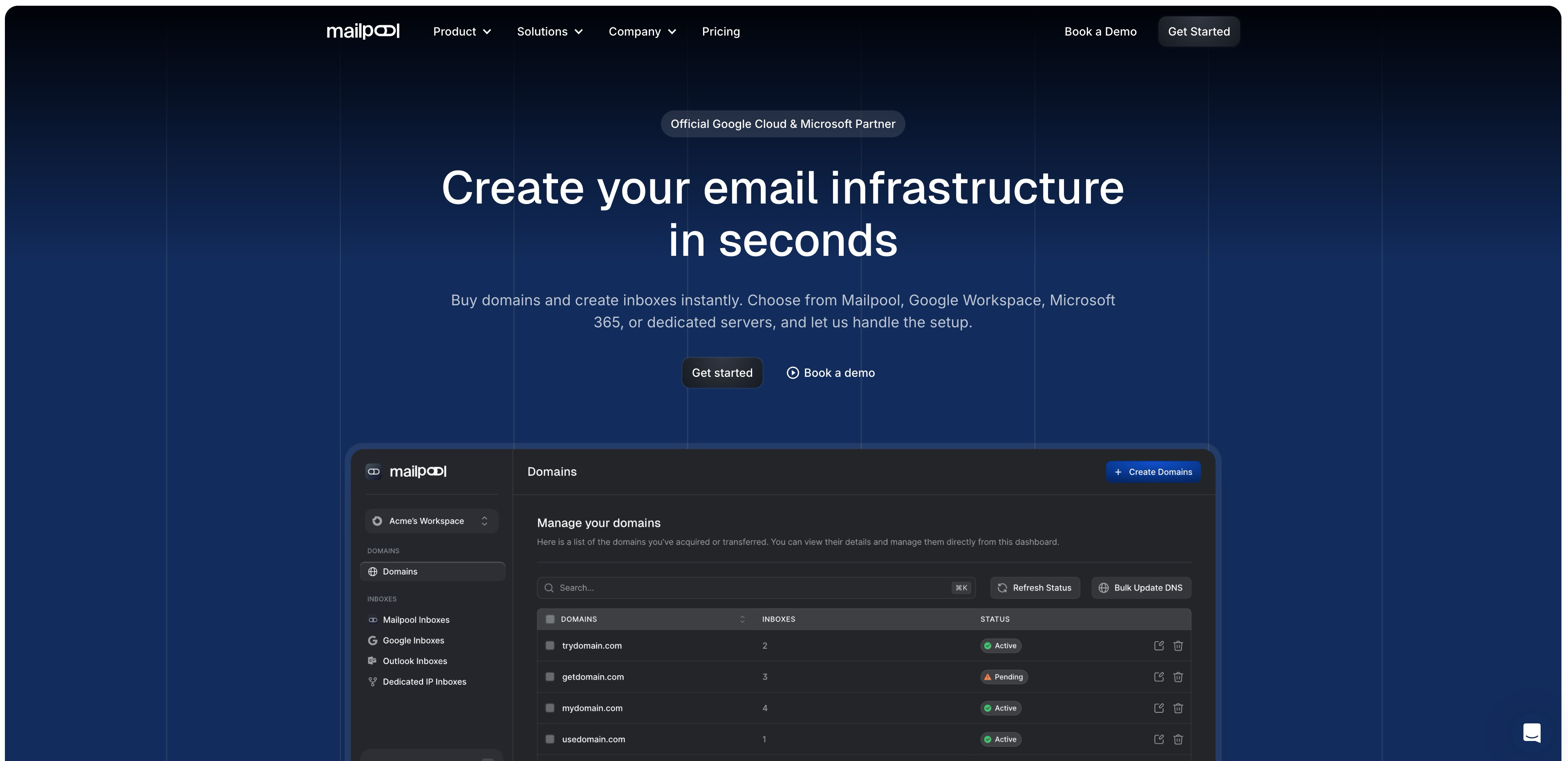
Mailpool is an email infrastructure platform that pools multiple domains and IP addresses to distribute sending load and protect your primary domain reputation. Instead of sending all your emails from a single domain, Mailpool rotates messages across a network of verified domains, reducing the risk that a single campaign or deliverability issue damages your core brand.
The platform automatically manages domain rotation, warmup schedules, and reputation monitoring across your entire pool. This approach works particularly well for high-volume cold outreach, where aggressive sending from a single domain quickly triggers spam filters. By spreading volume across multiple domains, you maintain consistent inbox placement even as you scale.
Best for: Sales teams and agencies running high-volume cold email campaigns who need to protect their primary domain while maintaining aggressive outreach schedules.
Key strengths
Automated domain pooling that distributes sending across multiple domains and IPs, preventing any single domain from accumulating reputation damage from high-volume campaigns
Built-in warmup automation for each domain in your pool, gradually building reputation across all sending infrastructure without manual intervention
Real-time reputation monitoring showing health scores for each domain and IP, with automatic traffic shifting away from domains showing deliverability decline
Centralized dashboard managing authentication records, DNS configuration, and sending schedules across your entire domain portfolio from a single interface
Pricing: Custom pricing based on the number of domains in your pool and monthly sending volume.
3. Mailtrap
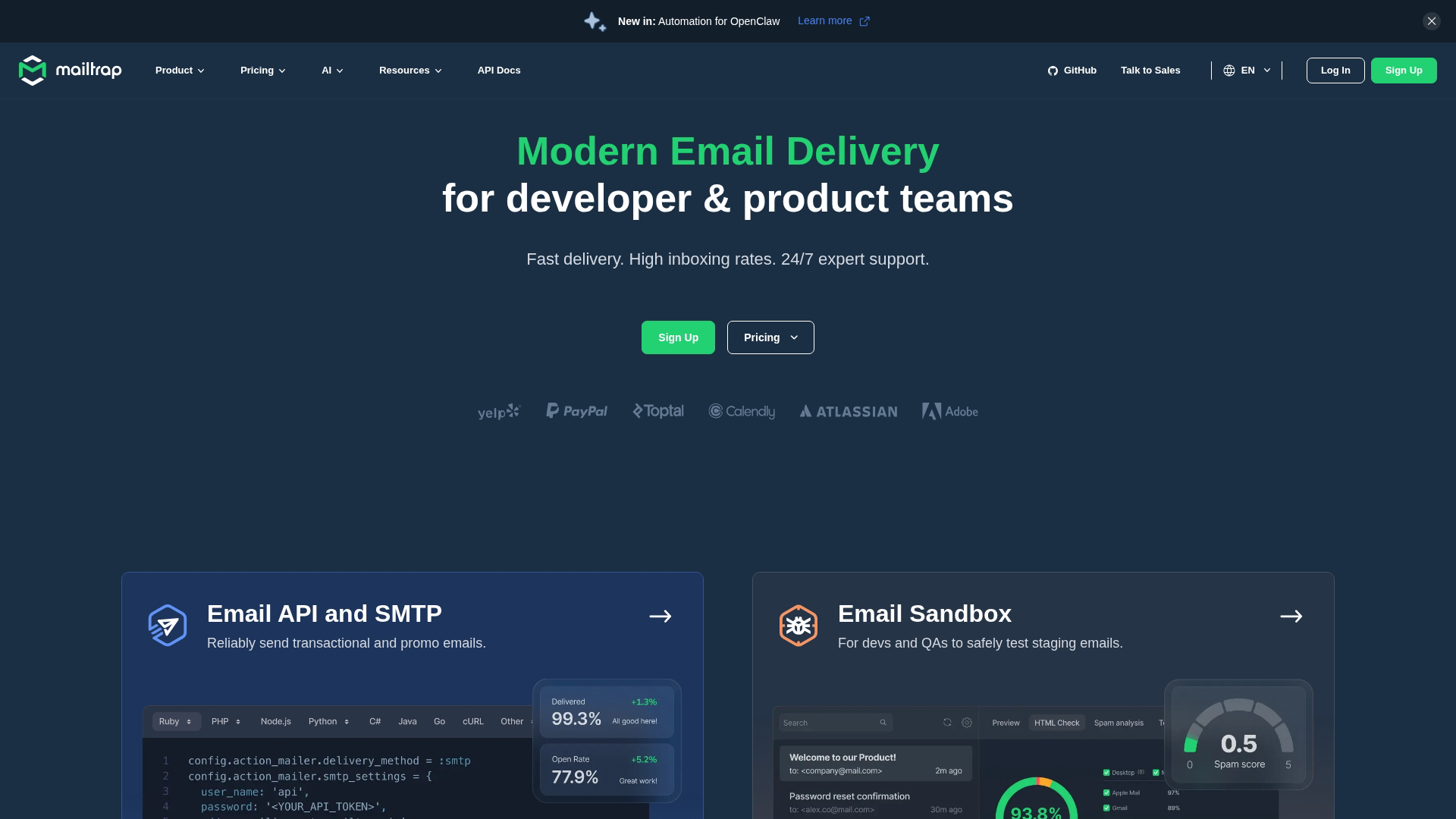
Mailtrap is a comprehensive email delivery platform offering an Email Sandbox for safe testing in development and staging, plus Email Sending with a deliverability-focused API and SMTP service.
Development teams use the sandbox to test email functionality without accidentally spamming real users. The sending infrastructure includes built-in deliverability monitoring, so you can track performance from a single dashboard.
Best for: Development teams testing email flows and businesses wanting reliable sending with built-in monitoring.
Key strengths
Safe email testing in a sandbox environment that captures all outgoing mail from your development and staging servers, preventing accidental sends to real users while letting you inspect HTML rendering, attachments, and headers
Actionable analytics showing deliverability metrics across projects including spam score analysis, authentication status (SPF, DKIM, DMARC), and inbox placement rates with provider-specific breakdowns
Real-time blacklist and authentication monitoring that continuously checks your sending domains and IPs against major blacklists, alerting you immediately when issues appear before they impact campaigns
Helicopter-view dashboards for multi-project oversight that consolidate deliverability health across all your domains and sending infrastructure in a single interface, helping teams manage complex email operations
Pricing: Free tier available for testing up to 500 emails per month. Paid plans start at $15/month and scale by email volume, number of projects, and advanced features like dedicated IPs.
4. Mailgun
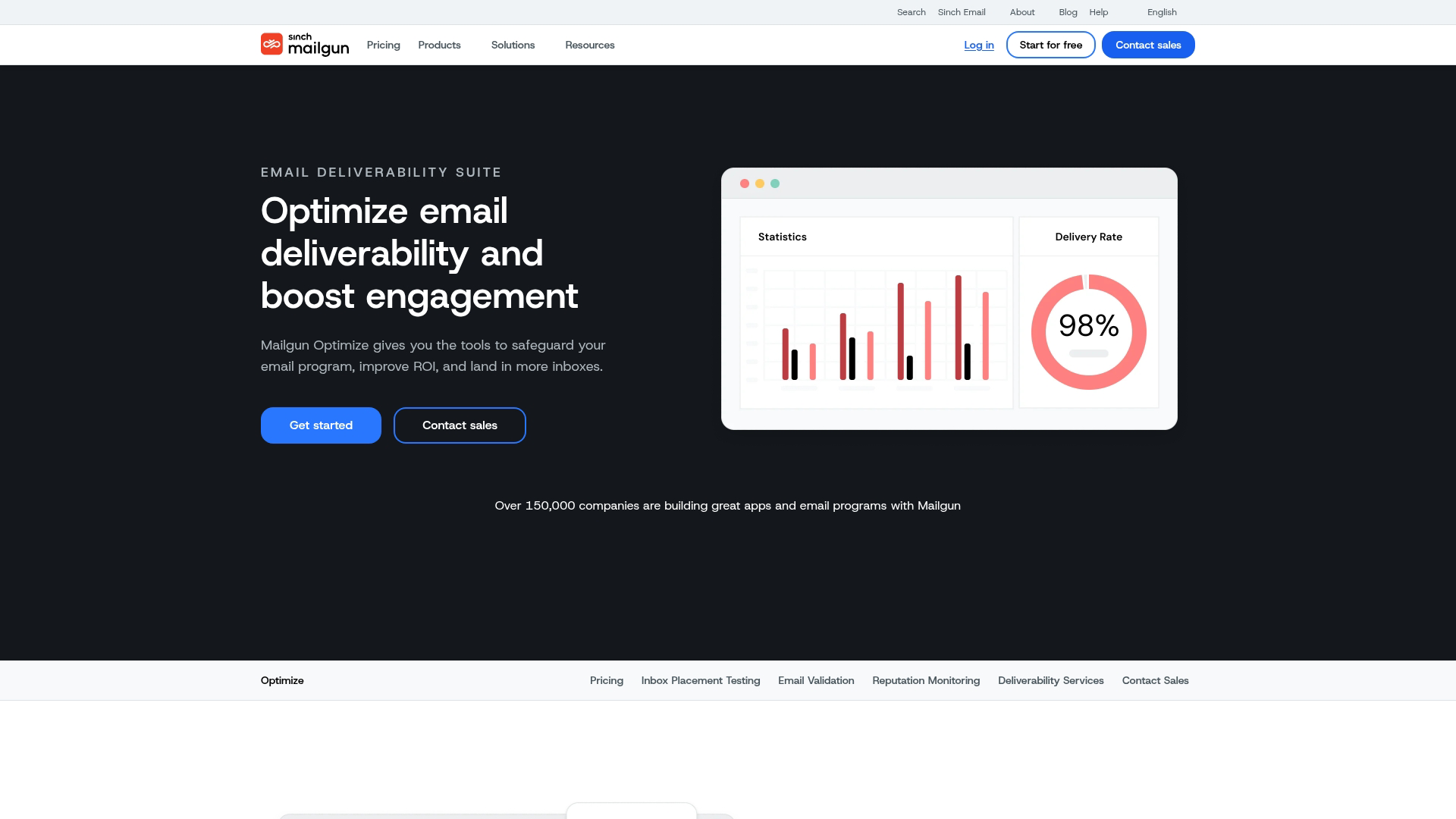
Mailgun is a suite of deliverability tools within the larger Mailgun email API platform. It includes validation, inbox placement testing, and monitoring. The platform integrates directly with Mailgun's sending infrastructure, allowing developers to manage both email delivery and deliverability optimization from a single interface without switching between multiple dashboards or vendors.
Mailgun validation API runs in real-time at the point of email capture, checking addresses against syntax rules, domain validity, and mailbox existence before they enter your database. The inbox placement testing uses seed lists across major providers to show exactly where your messages land, while the email preview tool renders your HTML across 90+ email clients to catch display issues before sending.
Best for: Developers and businesses already using Mailgun's API for transactional or marketing emails who want comprehensive deliverability features without adding another vendor to their stack.
Key strengths
Real-time email validation API that verifies addresses at signup or import, catching invalid, disposable, and risky addresses before they generate bounces or damage sender reputation
Inbox placement tests across major providers showing where emails land (inbox, spam, or promotions tab) with detailed reports on authentication status and spam score analysis
Email preview tool rendering messages across 90+ email clients and devices, helping you catch broken layouts, missing images, or formatting issues before campaigns launch
Integrated reputation monitoring within the Mailgun dashboard tracking bounce rates, complaint rates, and engagement metrics alongside your sending analytics without requiring separate logins
Pricing: Available as an add-on to Mailgun sending plans, starting at $35/month for validation credits and deliverability monitoring features.
5. ZeroBounce
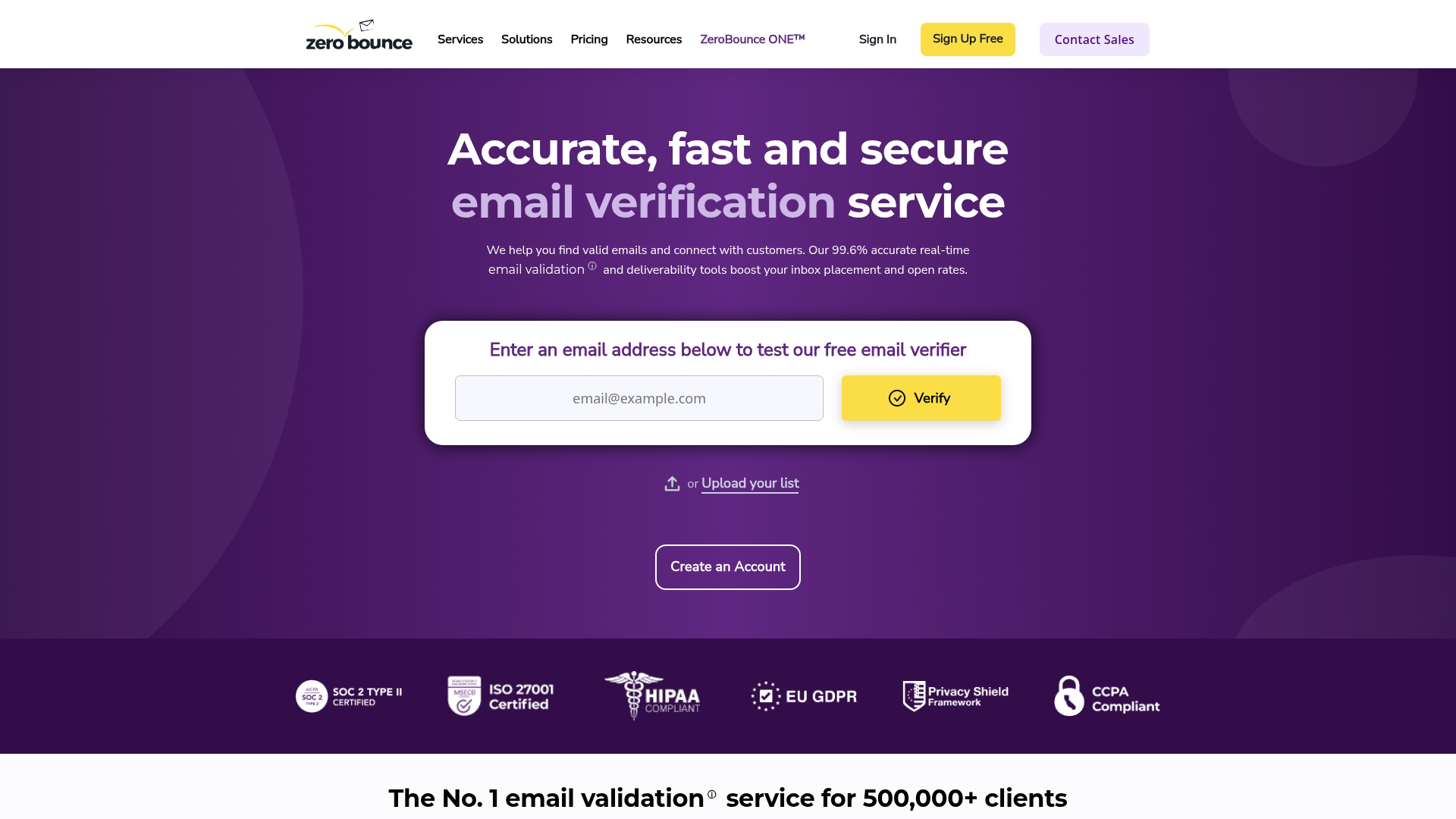
ZeroBounce is primarily an email validation and list cleaning service with additional deliverability features built around maintaining list quality. The platform validates email addresses through a multi-layered verification process that checks syntax, domain validity, mailbox existence, and engagement history. Clean lists directly improve deliverability because bounces and spam complaints hurt your sender reputation - every invalid address that bounces signals to mailbox providers that you're not maintaining proper list hygiene.
Beyond basic validation, ZeroBounce's AI scoring system evaluates each email address for quality and engagement potential, helping you segment lists based on deliverability risk. The platform flags problematic addresses before they damage your sender reputation, including those that appear valid but historically generate complaints or low engagement.
Best for: Teams with large email lists that prioritize list hygiene and verification, especially marketers managing databases with aging contacts or high acquisition volumes.
Key strengths
High-accuracy email verification with AI-powered scoring that evaluates deliverability risk beyond simple valid/invalid checks, assigning quality grades to help you prioritize high-value contacts
Identifies catch-all, role-based, and disposable addresses that technically accept mail but rarely convert, plus detects spam traps and abuse emails that actively damage sender reputation
Deliverability toolkit includes inbox placement testing across major providers, spam score analysis, and email preview rendering to check how messages display before sending
Integrations with major marketing platforms including Mailchimp, HubSpot, Salesforce, and ActiveCampaign, plus a real-time API for validating addresses at the point of capture
Pricing: Pay-as-you-go credits starting at $0.008 per email verification, or monthly subscriptions with volume discounts for teams processing large lists regularly.
6. Warmup Inbox
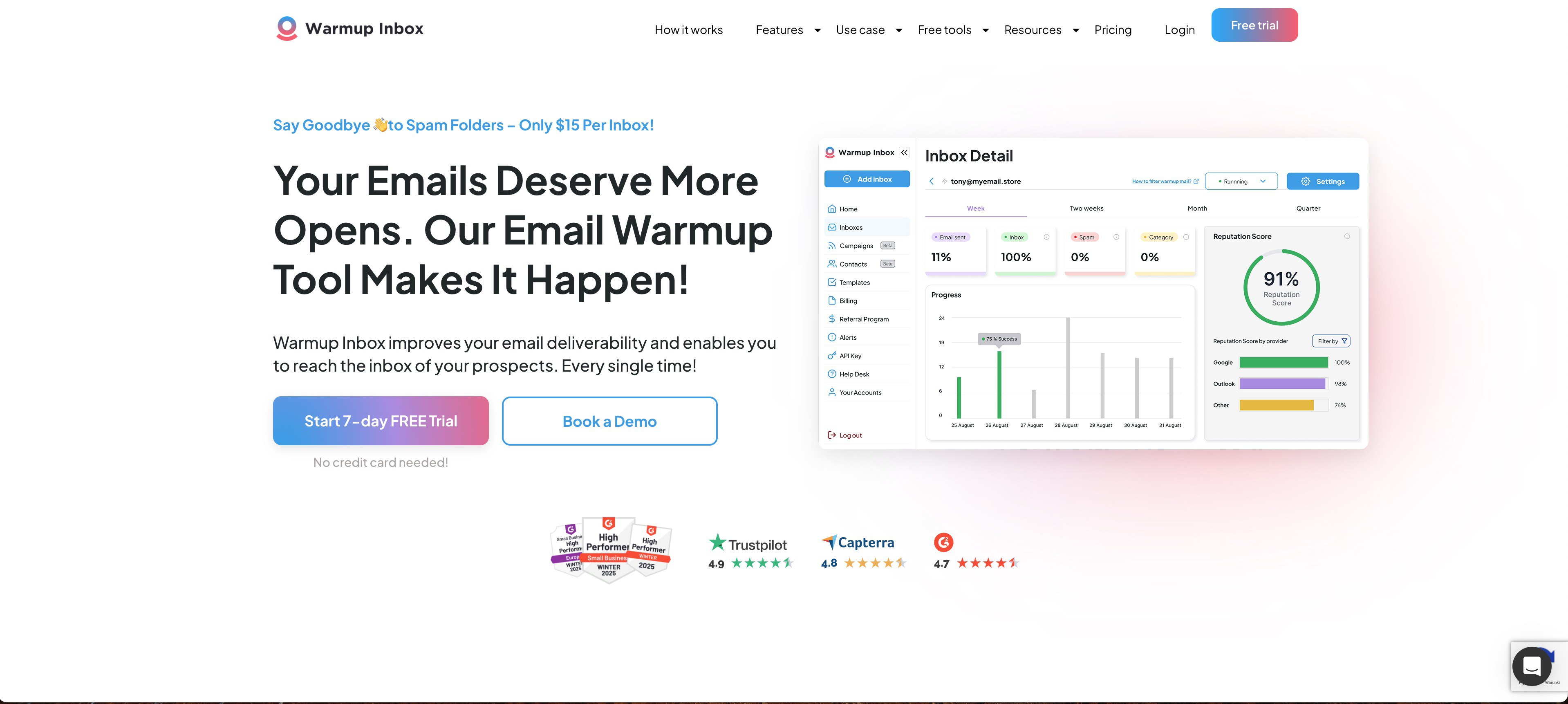
Warmup Inbox is a dedicated email warmup tool designed to build sender reputation for new or cold email accounts. It uses a network of real inboxes to generate positive engagement signals that establish trust with mailbox providers.
The tool sends emails from your account to its network of real inboxes, where they get opened, replied to, and moved out of spam folders. This simulated engagement creates the behavioral signals that Gmail, Outlook, and other providers use to evaluate sender trustworthiness. The platform automatically adjusts sending volume based on your account's current reputation, starting with just a few emails per day and gradually scaling up as your sender score improves.
Warmup Inbox monitors your progress through a reputation dashboard that tracks key metrics like spam folder placement, response rates, and overall inbox health. The system also handles the technical details of varying send times, randomizing message content, and ensuring conversations appear natural to spam filters.
Best for: Sales teams and marketers starting cold email campaigns who want to establish reputation from scratch, especially those launching new domains or recovering from previous deliverability issues.
Key strengths
Fully automated warmup process requiring minimal setup - connect your inbox and the platform handles the rest, including conversation management and engagement simulation
Network of over 20,000 real, high-reputation inboxes across major providers, ensuring your warmup emails interact with trusted accounts that positively influence your sender score
Gradual volume increases that mimic natural sending patterns, starting conservatively and scaling based on your account's response to avoid triggering spam filters with sudden activity spikes
Progress reports showing inbox health over time with metrics on spam placement rates, engagement levels, and reputation trends, helping you know exactly when your account is ready for full campaigns
Pricing: Plans start at $15/month per inbox, with volume discounts available for teams managing multiple sending accounts.
7. Validity Everest
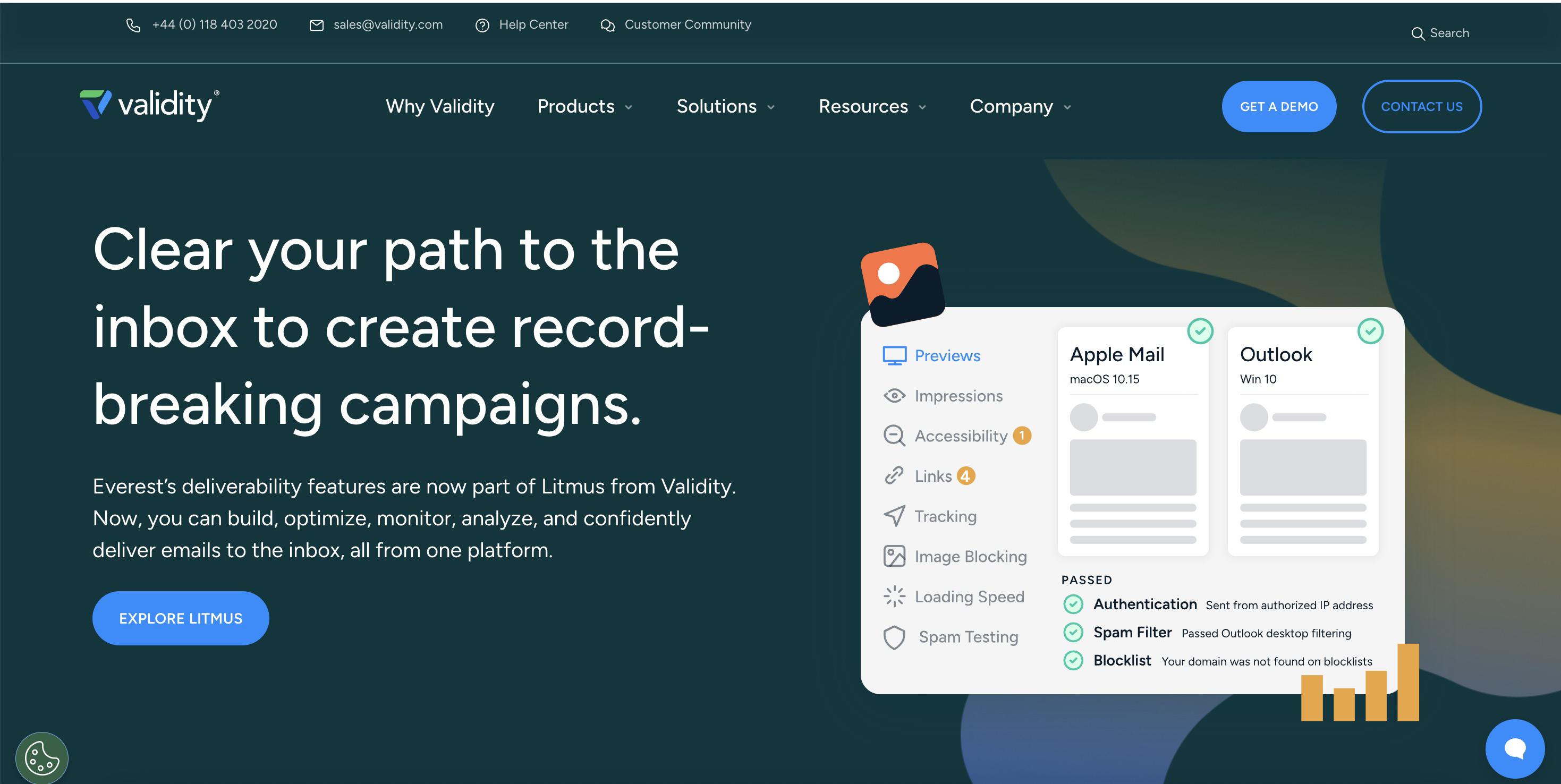
Validity Everest is an enterprise-grade deliverability platform offering comprehensive monitoring, analytics, and optimization across your entire email infrastructure. The platform provides unified visibility into sender reputation, authentication health, and inbox placement across multiple domains and IP addresses. The sender certification program acts as a "fast pass" to the inbox at participating mailbox providers, bypassing standard filtering for certified senders who maintain strict quality standards.
Best for: Large organizations with complex, high-volume email programs requiring deep analytics and multi-domain oversight.
Key strengths
Industry-leading sender certification program that whitelists your sending infrastructure at major ISPs, significantly improving inbox placement rates for certified domains while providing quarterly audits to maintain certification status
Comprehensive reputation monitoring across IPs and domains with historical trend analysis, showing how authentication failures, complaint rates, and engagement metrics affect your sender score over time
Competitive intelligence dashboards showing how your deliverability metrics compare against industry benchmarks and peer organizations, helping you identify performance gaps and optimization opportunities
Integrated email design and preview tools that render your messages across 90+ email clients and devices, catching display issues before campaigns launch while checking content against spam filters
Pricing: Custom pricing for enterprise clients based on sending volume and feature requirements.
8. Folderly
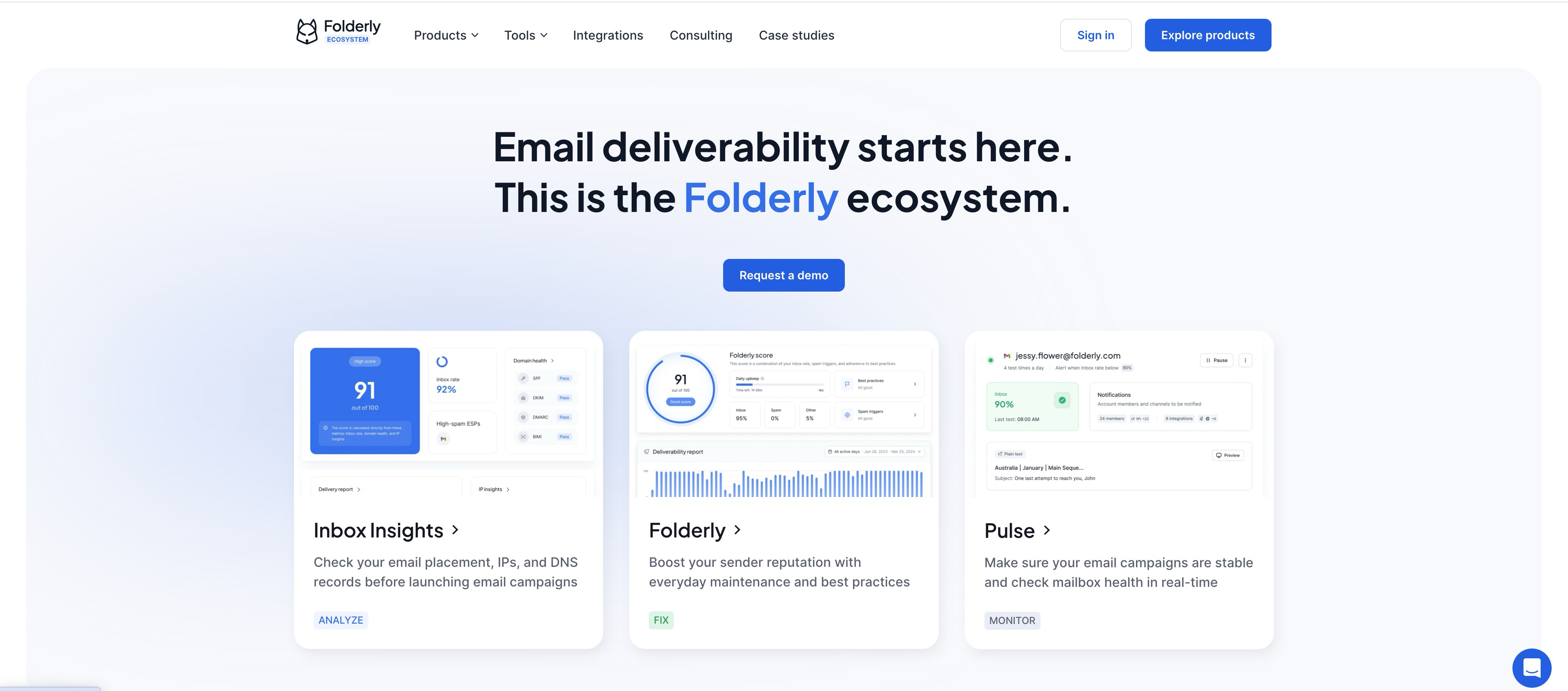
Folderly is an AI-driven platform that focuses on fixing deliverability issues rather than just identifying them. It analyzes your sending infrastructure, content, and reputation, then provides specific remediation steps ranked by impact. The platform scans DNS records, authentication protocols, email content, and sending patterns to pinpoint exactly what's hurting your inbox placement. Unlike diagnostic-only tools, Folderly's AI generates prioritized fix recommendations with step-by-step implementation guidance, helping non-technical teams resolve issues without hiring a deliverability consultant.
Best for: Teams wanting a hands-off approach to deliverability management with AI-powered fixes, especially those lacking dedicated email infrastructure expertise.
Key strengths
AI-driven analysis with specific spam fix recommendations ranked by priority and expected impact on inbox placement, including exact DNS record changes and content adjustments
Automated email warmup and reputation building that gradually increases sending volume while monitoring engagement signals and adjusting pace based on provider responses
Continuous DNS and blacklist monitoring with instant alerts when authentication records break or your domain appears on spam lists, plus automated delisting requests for common blacklists
Detailed deliverability audit reports showing before-and-after metrics, provider-specific placement rates, and historical trend analysis to track improvement over time
Pricing: Plans start at $120/month per mailbox, with volume discounts for teams managing multiple sending accounts.
9. Warmy
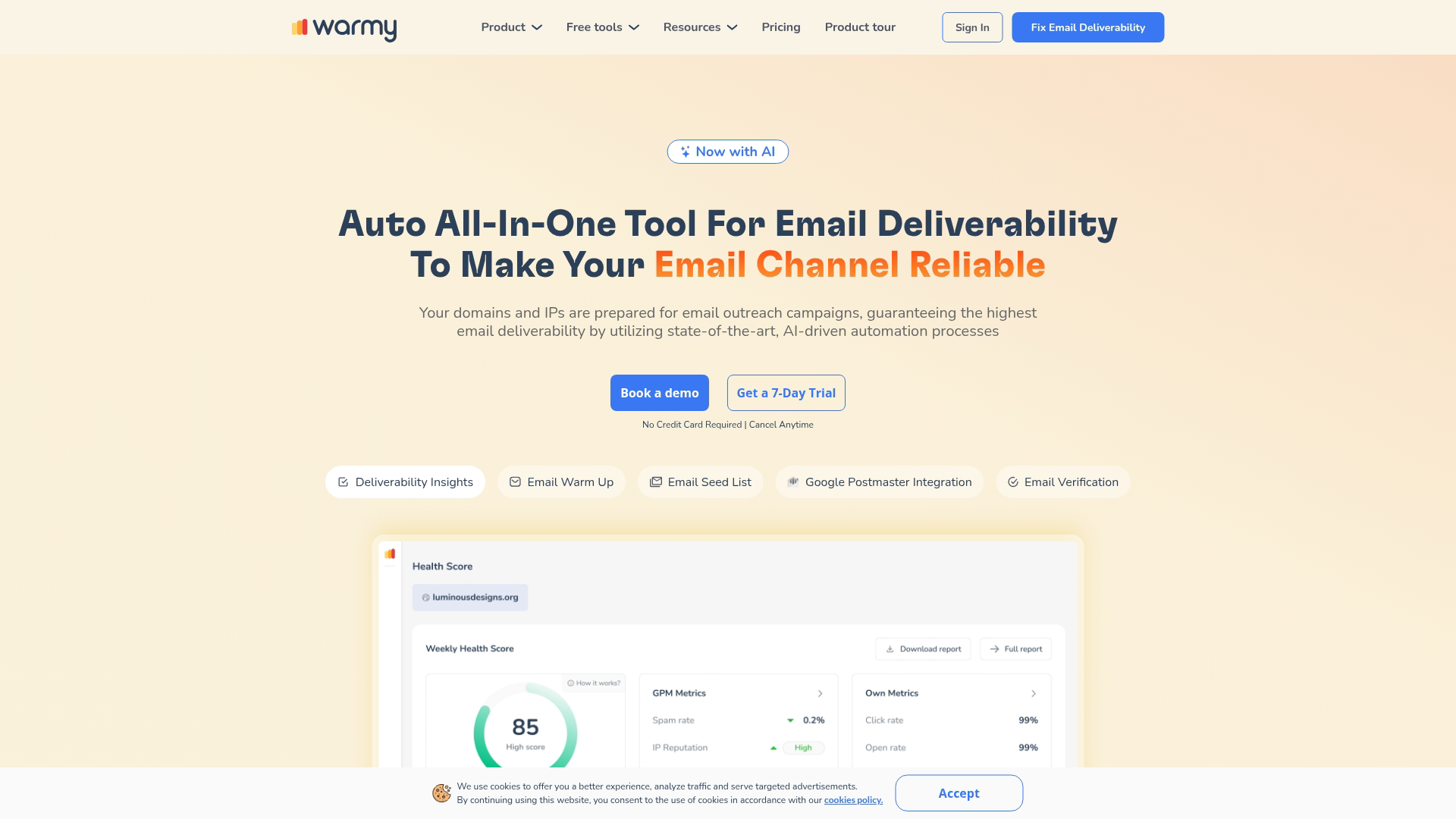
Warmy combines email warmup with deliverability testing features, positioning itself as an all-in-one solution for cold outreach. The platform automates reputation building while simultaneously checking where your emails land across major providers. The AI assistant helps improve email copy alongside technical deliverability, analyzing subject lines and body content for spam triggers before you send.
Best for: Cold email senders who want warmup and template testing in one place without juggling multiple tools.
Key strengths
Automated warmup with a network of real inboxes that gradually increases sending volume while generating positive engagement signals like opens and replies
Built-in inbox placement testing showing exactly where your emails land at Gmail, Outlook, Yahoo, and other providers, with spam score analysis
"Adeline" AI assistant that reviews email templates for spam triggers, suggests subject line improvements, and scores content quality before campaigns launch
Single dashboard tracking warmup progress, deliverability metrics, and domain health scores with real-time blacklist monitoring and DNS authentication checks
Pricing: Plans start at $49/month per mailbox, with volume discounts for teams managing multiple sending accounts.
10. MxToolbox
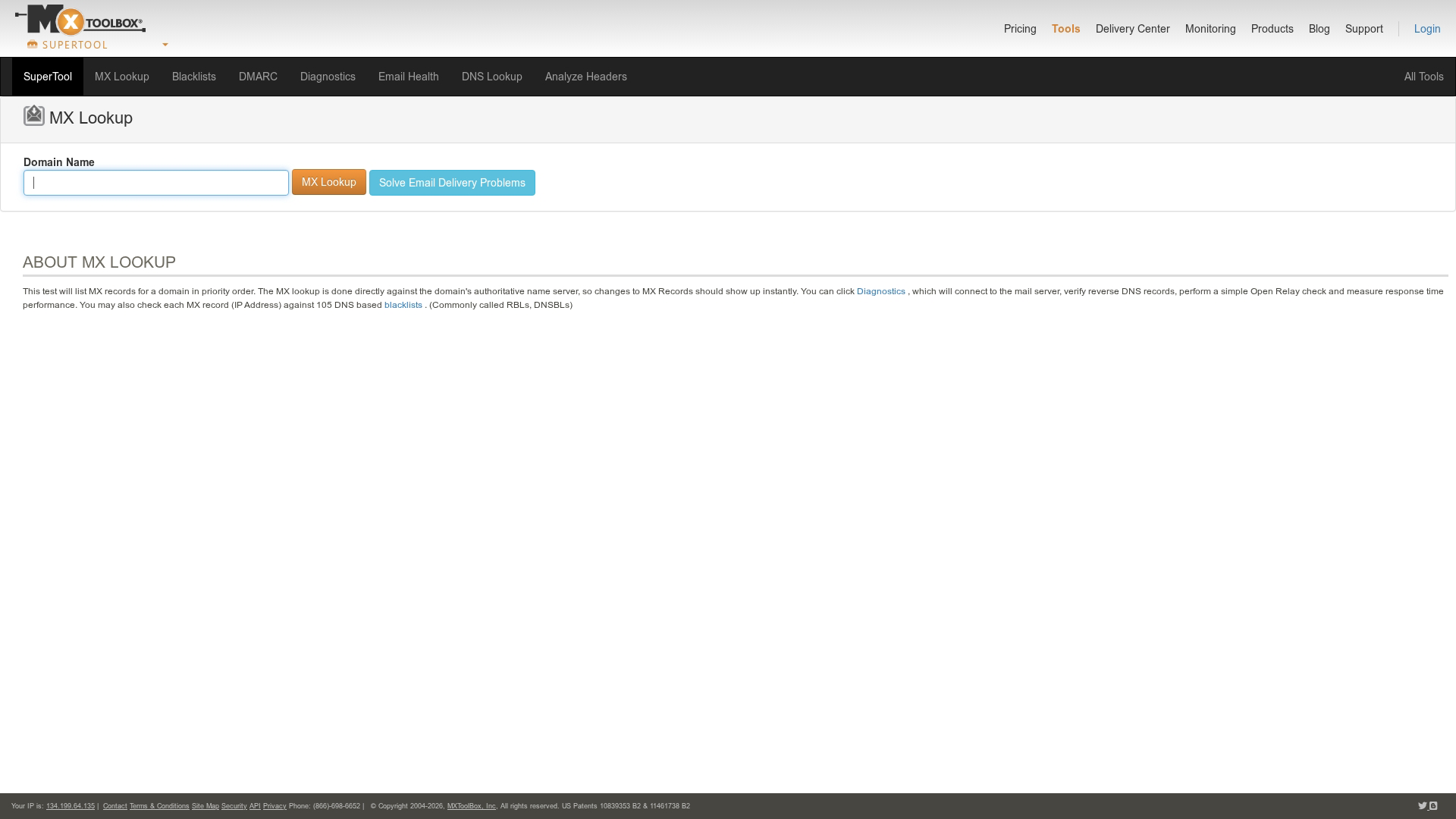
MxToolbox is a long-standing authority in network and email diagnostics, offering a suite of free and paid tools that IT professionals have relied on for over a decade. The platform provides instant lookups for DNS records, mail server configuration, and deliverability health checks without requiring an account. The free blacklist monitor checks your domain or IP against over 100 public blacklists simultaneously, delivering results in seconds - a critical capability when diagnosing sudden delivery drops. Beyond blacklists, the DNS lookup tools verify MX records, SPF alignment, DKIM signatures, and DMARC policies, flagging misconfigurations that commonly cause authentication failures.
Best for: Technical teams and IT admins performing quick diagnostic checks, troubleshooting delivery issues, or auditing email infrastructure configuration.
Key strengths
Comprehensive free blacklist checker covering 100+ lists including Spamhaus, Barracuda, and SORBS, with instant results showing which lists flagged your IP and why
Reliable DNS and SPF/DKIM/DMARC record lookups that parse authentication records and highlight syntax errors or policy conflicts affecting deliverability
Paid plans offer proactive monitoring with automated daily checks and instant email alerts when blacklist listings appear or DNS records change unexpectedly
Trusted by IT professionals for accurate diagnostics across email, network, and domain infrastructure with detailed technical explanations for each test result
Pricing: Many powerful free tools available without registration. Paid monitoring plans start at $129/month for continuous surveillance and alerting.
11. Google Postmaster Tools
Google Postmaster Tools is a free service from Google that provides direct visibility into how Gmail evaluates your sending domain and IP addresses. You get reputation scores, spam complaint rates, authentication status, and delivery error data straight from the source - no third-party interpretation required. Since Gmail accounts for roughly 30% of all email users globally, understanding how Google views your sending behavior is critical for maintaining inbox placement.
Best for: Any organization sending significant volume to Gmail recipients, especially those experiencing sudden drops in Gmail delivery rates.
Key strengths
Direct reputation data from Google showing separate IP and domain reputation scores on a scale from "High" to "Bad," updated daily based on recipient engagement and complaint patterns
Dashboard tracking spam rate percentage, SPF/DKIM/DMARC authentication pass rates, and specific delivery errors like rejected connections or rate limiting
Feedback Loop data identifying which campaigns generate high user complaint rates, helping you spot problematic content or targeting issues before they damage your overall reputation
Domain and IP-level insights that help diagnose whether Gmail-specific delivery problems stem from infrastructure issues, authentication failures, or content quality
Pricing: Completely free.
12. Bouncer
Bouncer is a highly-rated email verification platform emphasizing accuracy and toxicity detection. It validates email addresses through multi-step verification that checks syntax, domain validity, and mailbox existence. The real-time API integrates at signup forms and lead capture points to catch invalid, disposable, and high-risk addresses before they enter your list. Bouncer's toxicity check flags emails that appear in data breaches or spam traps, helping you avoid addresses that damage sender reputation even if they're technically valid.
Best for: Teams prioritizing list quality and wanting to prevent bounces before they happen.
Key strengths
High-accuracy verification with low "unknown" results - Bouncer's multi-step validation process delivers clear "valid" or "invalid" verdicts rather than leaving addresses in limbo, reducing the guesswork in list cleaning decisions
Toxicity check identifying widely-circulated or breached emails - Flags addresses that appear in spam traps, data breaches, or known complainers, helping you avoid contacts that damage sender reputation even when technically deliverable
Real-time and bulk verification APIs - Validate addresses at the point of capture through form integrations, or clean entire lists in batch uploads with results typically delivered within minutes
Deliverability Kit add-on for inbox placement testing - Optional module that extends beyond verification to show where your emails actually land across major providers, combining list hygiene with delivery monitoring in one platform
Pricing: Pay-as-you-go starting at $0.008 per email, or subscription plans.
13. SendForensics
SendForensics provides deep deliverability audits and a proprietary sender score that evaluates your email infrastructure holistically. The forensic analysis examines your DNS configuration, authentication records, sending patterns, content structure, and historical reputation data. Each audit generates a detailed report identifying specific technical issues, content flags, and reputation risks that affect inbox placement across major providers.
Best for: Teams and consultants wanting detailed analysis to pinpoint complex deliverability issues.
Key strengths
Detailed pre-send deliverability audits examining DNS configuration, authentication records, and content structure before campaigns launch
Proprietary sender scoring system that evaluates your email infrastructure holistically across multiple reputation factors
Analysis covering infrastructure setup, content triggers, sending patterns, and historical reputation data across major providers
Actionable insights identifying specific technical misconfigurations, content flags, and reputation risks with clear remediation steps
Pricing: Plans start at $29/month.
How to choose the right email deliverability tool
The right tool depends on your specific situation. Here's how to match your circumstances to the right category.
Match the tool to your email type
Different email types require different capabilities:
Cold email: A dedicated warmup tool like Warmup Inbox or Warmy helps build reputation before sending.
Marketing campaigns: Inbox placement testing from GlockApps or Mailtrap helps you check deliverability before launch.
Transactional emails: Real-time monitoring from Mailgun Optimize or Validity Everest ensures critical messages always arrive.
Check integration with your existing platform
Verify compatibility with your current Email Service Provider, CRM, or SMTP provider. Look for native integrations with platforms like HubSpot, Salesforce, or SendGrid. If you're using custom-built systems, a flexible API matters more than pre-built connectors.
Evaluate monitoring vs one-time testing
High-volume senders and teams managing transactional emails benefit from continuous monitoring dashboards. Less frequent senders may find periodic inbox placement tests before each campaign more cost-effective.
Compare pricing against email volume
Pricing models vary widely: per test, per email verified, or flat monthly rates. Calculate costs based on your typical sending volume and testing frequency. Pay-as-you-go works for infrequent testing; subscriptions make sense for continuous monitoring.
Deliverability is step one
Getting your email to the inbox is the crucial first step, but what happens after the open determines results. For teams using email to generate product interest and book meetings, landing in the inbox isn't enough. You want to engage the recipient immediately.
Instead of attaching static PDFs or linking to generic landing pages, consider how interactive demos can increase response rates. When prospects can experience your product directly from an email, you remove friction and shorten the path to a conversation.
Start your journey with Guideflow today!
FAQs about email deliverability tools
How do I check email deliverability for free?
Google Postmaster Tools provides free Gmail-specific data on your domain reputation and spam rates. MxToolbox offers free blacklist and authentication lookups. Many paid tools like Mailtrap also include free tiers for basic testing.
What causes emails to land in spam folders?
The main causes are poor sender reputation, missing or incorrect email authentication (SPF, DKIM, DMARC), spam trigger words in content, low recipient engagement rates, and blacklist listings. Often multiple factors combine to create deliverability problems.
How long does email warmup take to establish sender reputation?
Email warmup typically takes 4 to 8 weeks, depending on your target sending volume and the starting reputation of your domain. Rushing the process often backfires, as sudden volume spikes trigger spam filters.
Can I use multiple email deliverability tools together?
Yes, many teams combine tools. A common setup uses a warmup tool to build reputation, an inbox placement tester before campaigns, and Google Postmaster Tools for ongoing Gmail monitoring. The tools serve different purposes and complement each other.
What is a good sender reputation score?
Scores vary by provider, but generally a score above 90 (or 90%) indicates good to excellent reputation with high likelihood of inbox placement. Google Postmaster Tools uses categories like "High," "Medium," and "Low" rather than numeric scores.
How often do I run inbox placement tests?
Run a test before every major marketing campaign. For ongoing sending, weekly or bi-weekly tests help monitor deliverability health. High-volume senders may want continuous monitoring instead of periodic tests.
What is the difference between email verification and deliverability testing?
Email verification checks if an address is valid and exists before you send. Deliverability testing checks where your message actually lands (inbox, spam, etc.) after you send. Both matter, but they solve different problems.
Do email deliverability tools work with Gmail, Outlook, and Yahoo?
Yes, most deliverability testing tools check inbox placement across all major providers. The seed lists typically include accounts at Gmail, Outlook, Yahoo, and often international providers to give you a comprehensive view of performance.