A submission lands in an inbox. Someone forwards the PDF. An underwriter pulls data from three systems, re-keys it into a fourth, checks a rate table in a spreadsheet, and waits two days for a property inspection. By the time a decision comes back, the applicant has already bound coverage somewhere else.
That is the friction underwriting software is built to remove. The category is growing fast because the manual version does not scale. The global underwriting software market was valued between USD 5.81 and 7.15 billion in 2023 to 2025, with forecasts reaching USD 12.88 to 19.21 billion by 2030 to 2033 at a CAGR near 12 to 13% (Mordor Intelligence, 2025; Spherical Insights, 2023).
The tension every buyer feels is real. You want faster underwriting decisions without losing control, auditability, or compliance. Speed up too aggressively and you weaken your risk posture. Stay too manual and you lose deals to carriers that respond in minutes. The right insurance underwriting software closes that gap by automating the repetitive work while keeping the decision logic transparent and traceable.
What's inside
This guide covers underwriting platforms across insurance, lending, and workflow automation. Some are specialized for property insurance underwriting or loan decisioning. Others are configurable platforms that handle underwriting as part of broader business process automation.
We selected tools based on four criteria that matter in real underwriting operations:
- Automation depth: how much manual review, triage, and data entry the platform removes.
- Decisioning and rules: the strength of the rules engine, scorecards, and override controls.
- Compliance and audit trails: recordkeeping, permissions, and decision traceability.
- Integration and document handling: how well it connects to your core systems and centralizes submissions.
We chose tools built for underwriting operations, not generic project management software wearing an insurance label.
TL;DR
- Best for property insurance teams: UnderwritingCenter™ from Cotality, with virtual survey and roof analytics.
- Best for loan underwriting automation: TurnKey Lender, for AI scoring and end-to-end lending.
- Best for submission management and intake: Send, for commercial and specialty underwriting orchestration.
- Best for configurable business process automation: Creatio, an AI-native no-code platform.
- Best for insurance operations and risk workflows: Origami Risk, for integrated risk and compliance.
- Best for enterprise workflow orchestration: Appian, for complex organizations with many legacy systems.
- Best for standalone decision logic: DecisionRules, an API-first business rules engine.
What is underwriting software?
Underwriting software is a platform that collects applicant and risk data, evaluates that risk against defined rules or models, and routes the resulting decision to the right person or system. It is the operating layer for decision quality in insurance and lending.
An insurance underwriting platform does three core jobs: it collects data, it evaluates risk, and it routes decisions. Everything else is in service of those three. The best automated underwriting software handles all three without forcing underwriters back into email and spreadsheets.
Key capabilities to expect from underwriting technology:
- Workflow automation: intake, triage, task routing, and handoffs handled by the system, not by hand.
- Rules-based decisioning: a decision engine that applies consistent logic, stop rules, and scorecards.
- AI scoring and analytics: risk scoring, document extraction, and recommendation support.
- Document and submission management: centralized intake for PDFs, forms, attachments, and structured data.
- Audit trail and compliance support: who decided what, when, and why, retained for review.
- Integration with existing systems: connections to CRM, core policy or loan systems, data warehouses, and third-party data sources.
The use cases split cleanly. Insurance underwriting software focuses on policy risk, submission intake, and rating. Loan underwriting software focuses on credit decisioning, alternative data, and repayment risk. Property insurance underwriting adds inspection, roof condition, and location-specific data. Commercial underwriting software leans on complex rules and multi-stakeholder review. Match the tool to the line of business first, then to the workflow.
When to use underwriting software
Automating high-volume review work
Use it when your team is buried in repetitive intake and manual sorting. When underwriters spend more time triaging submissions than assessing risk, an underwriting management system pays for itself fast. More than 40% of policy approvals now run through automated underwriting tools, cutting manual assessment time by nearly 55% (Research Reports World, 2026). Faster triage means fewer handoffs and shorter cycle times.
Improving decision consistency
Use it when underwriters rely on tribal knowledge and judgment varies desk to desk. A rules engine turns inconsistent instinct into repeatable logic. Scorecards, rules-based controls, and stop rules apply the same standard to every submission, which is exactly what regulators and reinsurers want to see. Nearly 63% of underwriting teams now use automated rules engines (Research Reports World, 2026).
Centralizing submissions and documentation
Use it when data lives across email threads, PDFs, shared drives, and core systems. A centralized underwriting workspace ends the hunt for the latest version of a document. Everything the underwriter needs sits in one place, which reduces rework and stops decisions made on missing context.
Underwriting software comparison for 2026
Read this table top to bottom by relevance, not alphabetically. "Best for" tells you the primary fit. "Key use case" is the job the tool does best. Pricing and G2 ratings reflect what vendors and review sites publish; many underwriting platforms use custom, quote-based pricing tied to portfolio size and deployment.
| # | Product | Best for | Key use case | Pricing | G2 rating |
|---|---|---|---|---|---|
| 1 | UnderwritingCenter™ | Property insurers | Virtual inspection and roof analytics | Custom (contact sales) | Not listed |
| 2 | TurnKey Lender | Lenders and FinTechs | AI loan underwriting automation | Custom (contact sales) | 4.3/5 |
| 3 | Send | Commercial and specialty insurers | Submission and underwriting orchestration | Custom (contact sales) | 5.0/5 |
| 4 | Creatio | Configurable workflow teams | AI-native no-code process automation | From $40/user/mo | 4.6/5 |
| 5 | Origami Risk | Insurance and risk teams | Integrated risk and compliance workflows | Custom (contact sales) | 4.4/5 |
| 6 | Appian | Enterprises with legacy systems | Enterprise workflow orchestration | Custom; free Community Edition | 4.5/5 |
| 7 | FlowForma | Microsoft 365 teams | No-code process automation | From $2,347/mo | 4.5/5 |
| 8 | Socotra | Insurers and MGAs | Configurable core insurance platform | Custom (contact sales) | 4.5/5 |
| 9 | DecisionRules | Teams needing decision logic | API-first rules engine | Free; Lite from €291/mo | 4.4/5 |
| 10 | BriteCore | P&C carriers and MGAs | Cloud core insurance operations | Custom (contact sales) | 4.3/5 |
Best 10 underwriting software tools for 2026
1. UnderwritingCenter™
UnderwritingCenter™ from Cotality is built for property insurance underwriting. It automates the parts of property risk assessment that traditionally slow a file down: inspection, data collection, and roof condition analysis. Instead of scheduling a physical survey and waiting days, teams pull remote inspection data and route it straight into the decisioning workflow.
The differentiator is depth on property. Virtual Survey and AI Virtual Survey handle remote inspection. DIY Surveys let policyholders capture photos and video from their phones. Age of Roof and Roof Condition Insights (RCI) feed roof analytics into the decision, delivered by API or in bulk. For a carrier writing homeowners or property risk, that data arrives faster and more consistently than a field visit.
Best for: property insurers that want underwriting workflow automation with remote inspection built in.
Key strengths
- Virtual Survey and AI Virtual Survey for property inspection
- DIY Surveys with mobile photo and video capture
- Roof assessment via Age of Roof and Roof Condition Insights
- API and bulk delivery for data integration
Why choose UnderwritingCenter™: if property risk is your book, the roof and inspection analytics remove the biggest source of delay in property underwriting. It fits teams that want specialized data feeding a workflow, not a generic platform they have to bend to the job.
UnderwritingCenter™ pricing: pricing is not publicly listed. Cotality directs buyers to request a demo for a quote tied to their needs.
2. TurnKey Lender
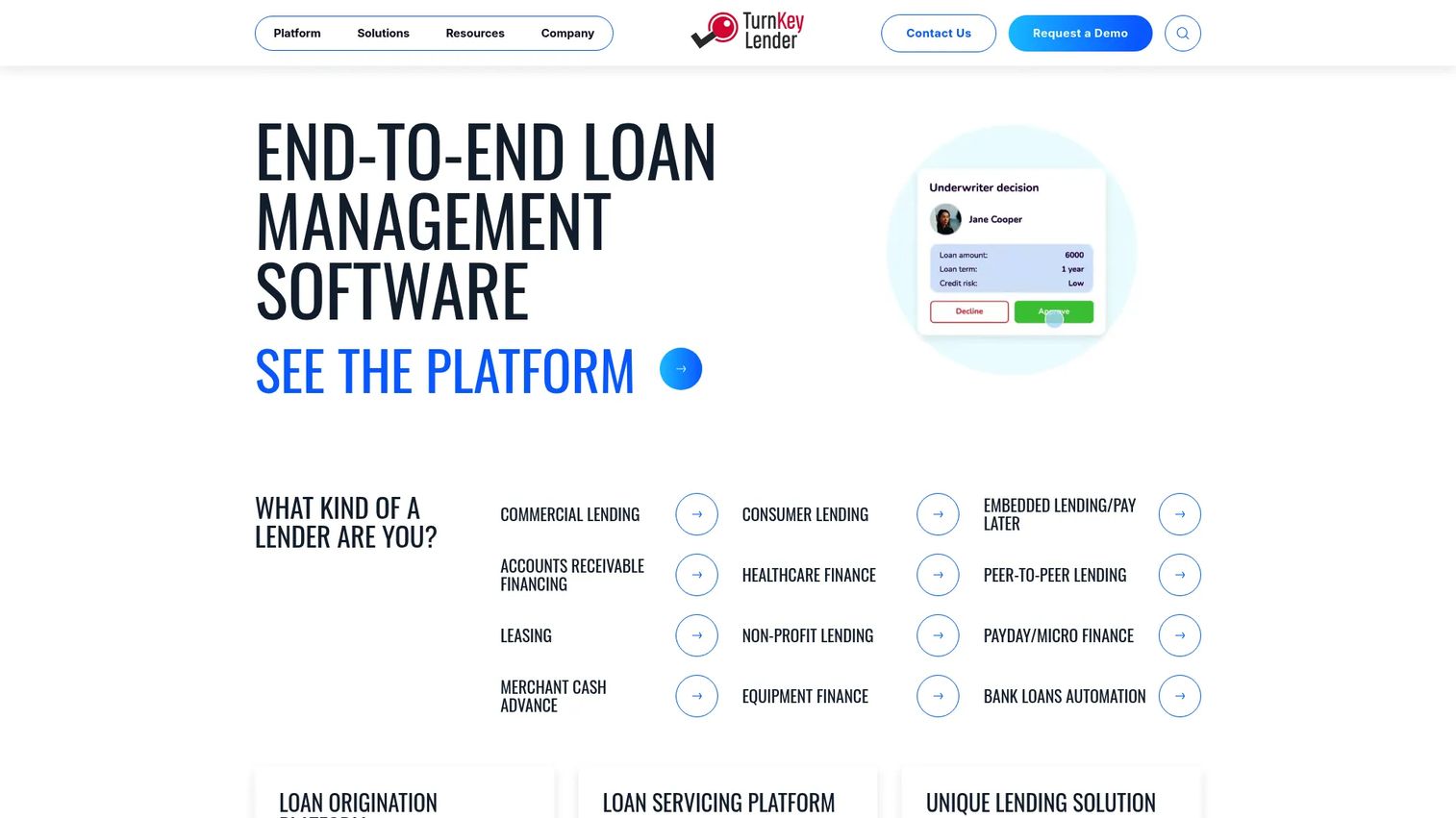
TurnKey Lender is an AI-powered lending automation platform covering the full loan lifecycle. For loan underwriting software specifically, it combines application intake, underwriting, decisioning, and risk-based pricing in one flow. Banks, credit unions, FinTechs, and embedded lenders use it to move from application to decision without manual credit review on every file.
The automation story is clear. Configurable application flows capture the data, the decision engine scores risk and applies stop rules, and risk-based pricing sets terms automatically. Because origination, servicing, and repayment management sit on the same platform, a decision made at underwriting carries forward without re-keying.
Best for: lending teams making high-volume credit decisions that want end-to-end automation.
Key strengths
- Loan origination with configurable application flow
- Underwriting, decisioning, and risk-based pricing
- Loan servicing and repayment management
- AI scoring for high-volume credit decisions
Why choose TurnKey Lender: it fits lenders who want the whole lifecycle in one system rather than stitching origination to a separate servicing tool. The automation depth suits high-volume portfolios where manual review does not scale.
TurnKey Lender pricing: pricing is not publicly listed. The company uses several licensing models based on portfolio size and platform functionality, and asks prospects to contact sales for a quote.
3. Send
Send is an underwriting orchestration platform for commercial and specialty insurers. Its strength is the front end of the process: getting submissions in, organized, and decision-ready before a quote is even priced. For teams drowning in inbound submissions across email and brokers, that intake discipline is the whole game.
The platform orchestrates underwriting data, workflows, and decisions in one place. Core capabilities include submission management, quote and rate lifecycle management, and bordereaux ingestion. It supports integrated rating with Excel-based and third-party rating engines, so teams keep the rating logic they trust while gaining a controlled workbench around it.
Best for: commercial and specialty insurance teams that need to organize submissions before decisioning.
Key strengths
- Submission management for high-volume intake
- Quote and rate lifecycle management
- Bordereaux ingestion for delegated authority
- Integrated rating with Excel and third-party engines
Why choose Send: it earns its place when submission volume, not rating logic, is the bottleneck. Teams that need a document and submission management layer on top of existing rating engines get control without ripping out what works.
Send pricing: pricing is not publicly listed. Send uses a quote-based model; contact the vendor for details.
4. Creatio
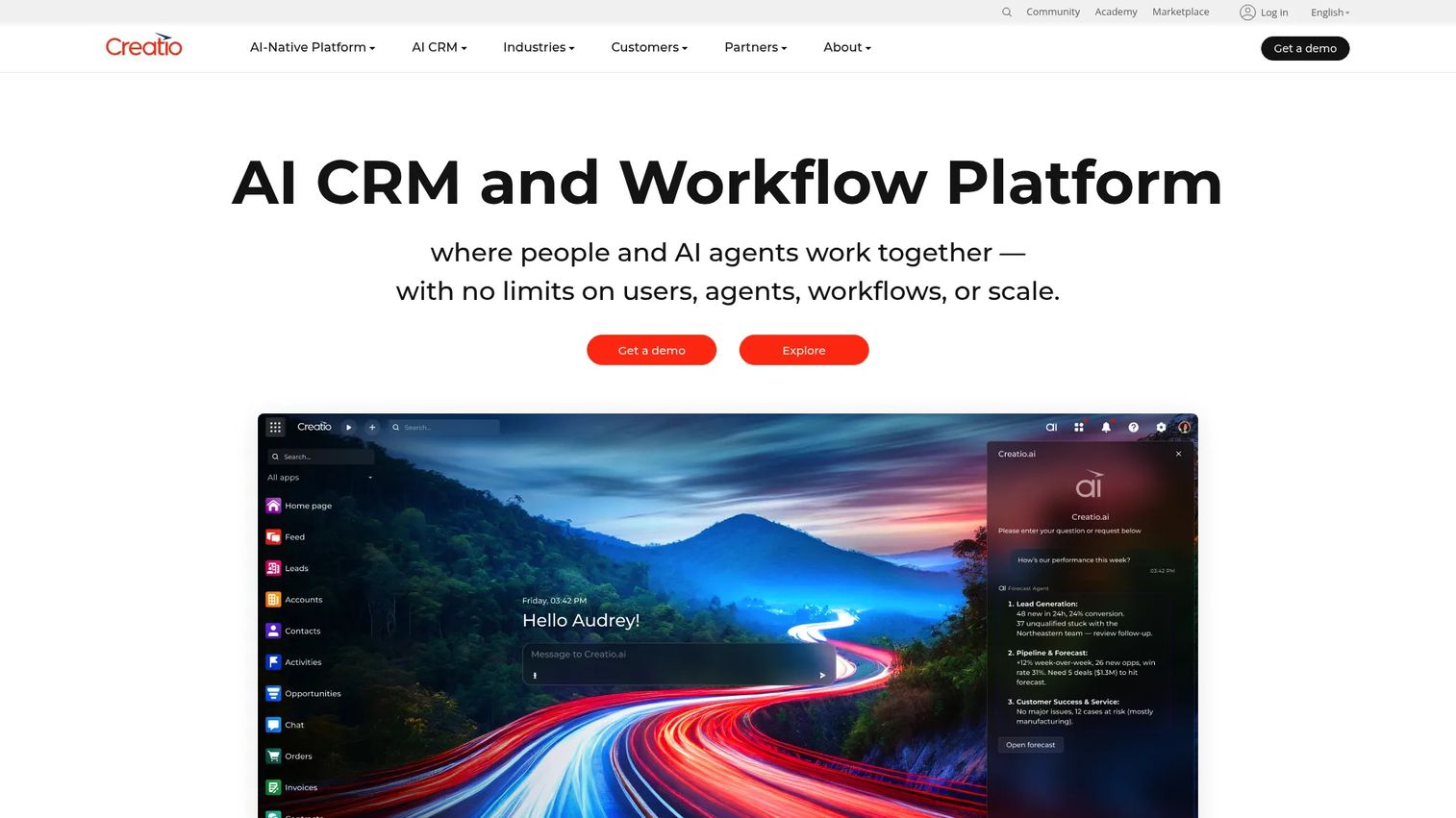
Creatio is an AI-native CRM and workflow platform with no-code automation for marketing, sales, and service. It is not underwriting-specific, and that is the point. Teams that need underwriting handled as part of broader business process automation can configure intake, review, approval, and routing without hard-coding it into a rigid core system.
The composable no-code approach means business users build and change workflows, not just engineers. AI-native automation and AI agents support triage and recommendation. Deployment runs on cloud, on-premises, or cloud-agnostic, which matters for insurers with data residency and compliance constraints. For an operations team that wants underwriting workflow automation flexible enough to change as rules change, that configurability is the draw.
Best for: operations teams that want a configurable platform to automate underwriting alongside other processes.
Key strengths
- Composable no-code platform for custom workflows
- AI-native automation and AI agents
- Cloud, on-premises, and cloud-agnostic deployment
- Cross-team orchestration across sales, service, and operations
Why choose Creatio: it fits teams whose underwriting needs sit inside a wider process footprint and who value changing logic without an engineering ticket. Less specialized than a property or lending tool, more adaptable across use cases.
Creatio pricing: the Growth plan starts at $40 per user per month, Enterprise at $75 per user per month, and Unlimited is custom. The published minimum purchase for new customers is $10,000 per year, with a standard three-year contract term.
5. Origami Risk
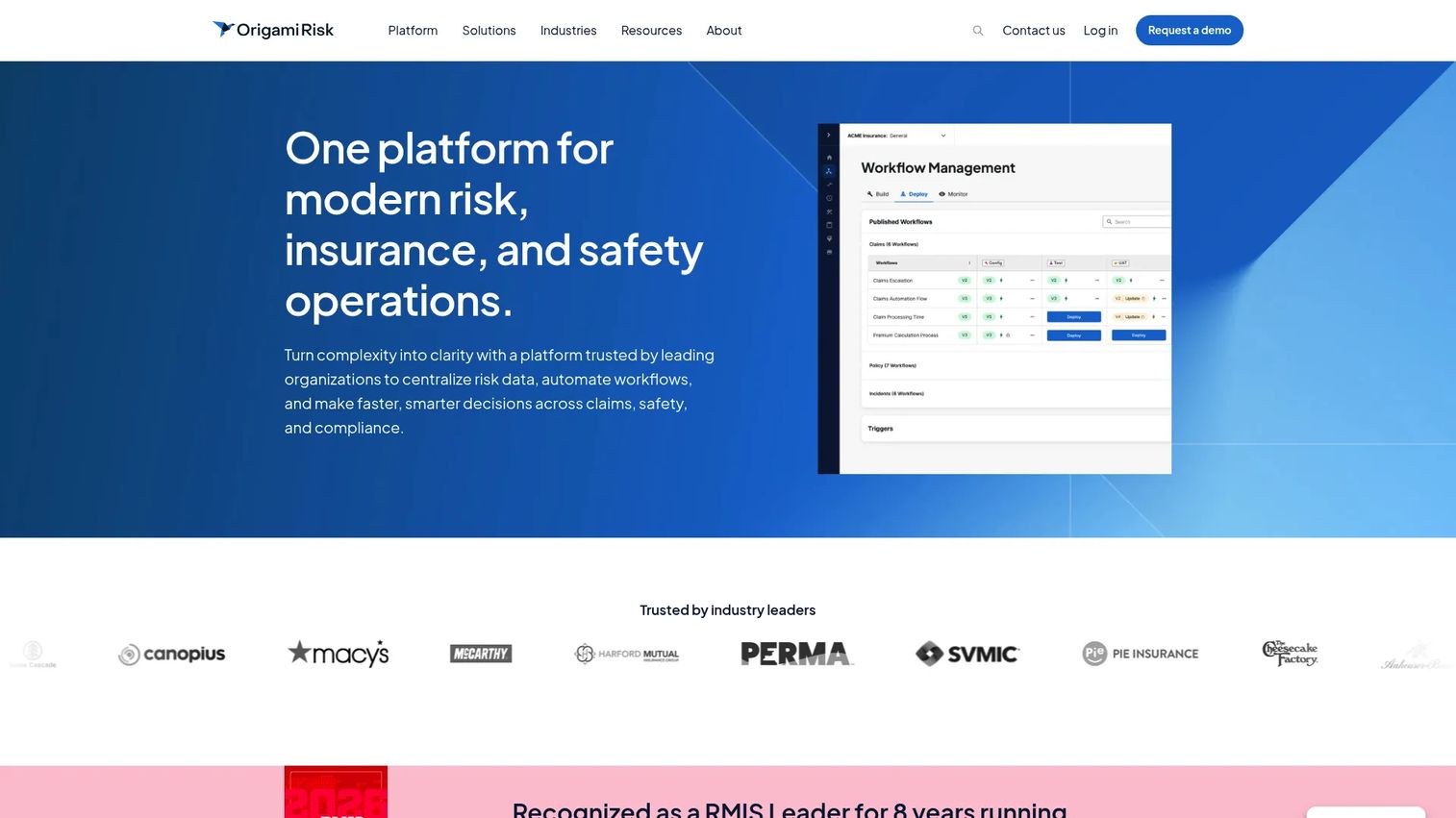
Origami Risk is a cloud-native SaaS platform for insurance, risk, safety, and compliance management. For underwriting, its value is context. It ties risk workflows to claims, policy administration, and analytics, so decisions are made with the full operational picture rather than a single submission in isolation.
The integrated approach covers RMIS, claims, policy administration, billing, and analytics in one place. That matters for insurance teams that want operational visibility and control across the lifecycle, not just at the point of underwriting. Solution suites for healthcare, EHS, and GRC extend the platform into specialized compliance needs, which is useful when audit and reporting requirements run deep.
Best for: midmarket and enterprise insurance teams needing integrated risk, insurance, and compliance software.
Key strengths
- Integrated risk, insurance, and safety workflows
- RMIS, claims, policy administration, billing, and analytics
- Healthcare, EHS, and GRC solution suites
- Operational visibility across the policy lifecycle
Why choose Origami Risk: it suits teams that see underwriting as one node in a connected risk operation. The compliance and reporting depth is a real advantage where audit trail requirements are strict.
Origami Risk pricing: pricing is not publicly listed. The site uses demo and request-a-quote CTAs; contact the vendor for pricing.
6. Appian
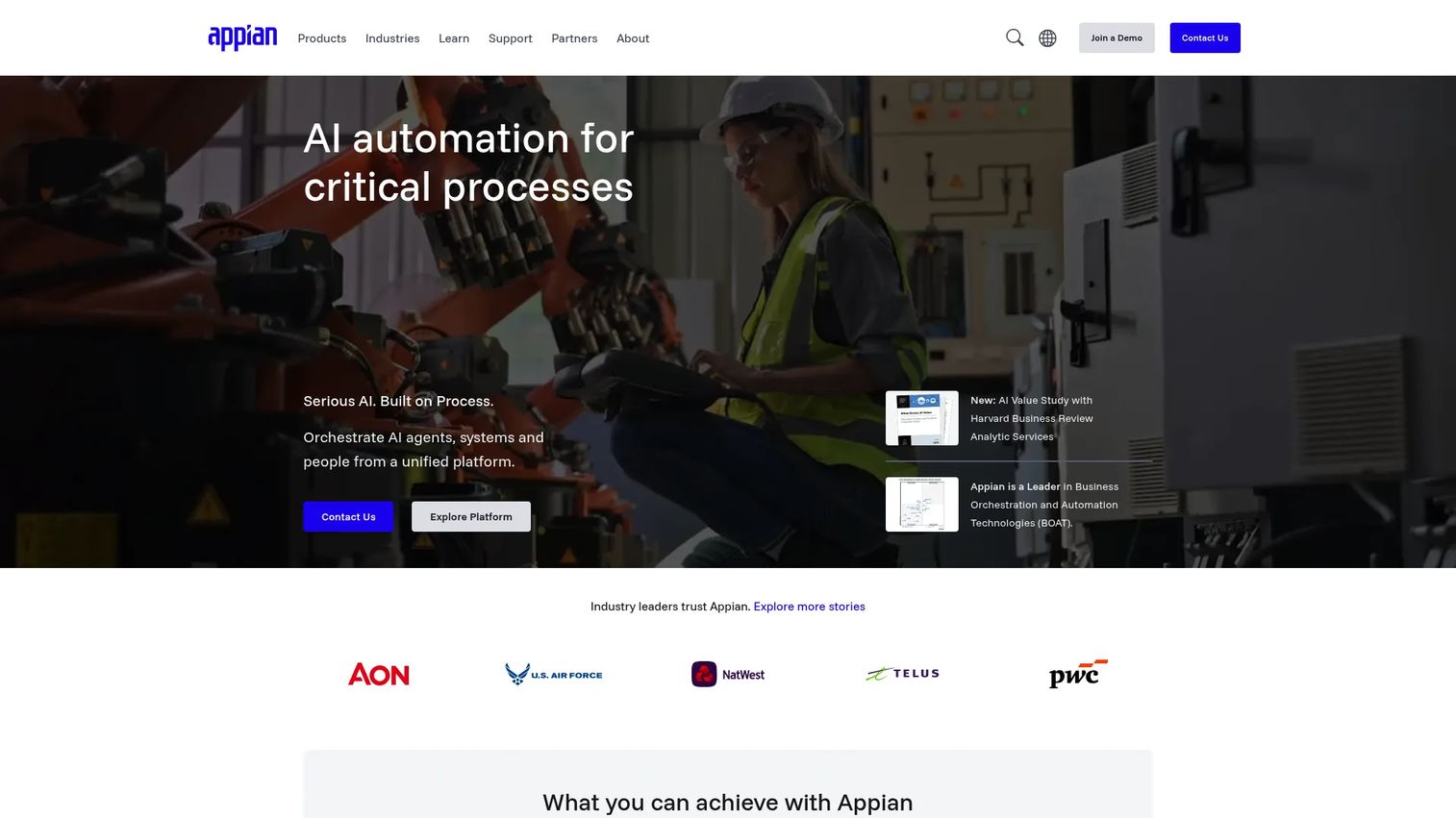
Appian is an AI process automation platform for building and running enterprise workflows and applications. For underwriting in large, complex organizations, its strength is orchestration across many systems. When your underwriting data is scattered across legacy core systems, a data warehouse, and third-party feeds, Appian's data fabric pulls it together without a rip-and-replace.
The platform combines process orchestration, low-code application development, RPA, and AI agents. Decision automation applies rules and routing at scale, while process intelligence surfaces where files stall. For enterprises that need governed automation with permissions, versioning, and audit built in, that governance layer is the reason to choose it.
Best for: large enterprises with multiple legacy systems that need governed workflow orchestration.
Key strengths
- Process orchestration and low-code development
- Data fabric to unify data across systems
- RPA and AI agents for automation
- Process intelligence to find bottlenecks
Why choose Appian: it earns its place in complex environments where integration with existing systems is the hard part. The low-code approach lets teams build underwriting applications without a full custom engineering effort.
Appian pricing: the public pricing page lists Standard, Advanced, and Premium tiers priced per user, per month, per app, without public numeric prices. A free Community Edition is available for evaluation.
7. FlowForma
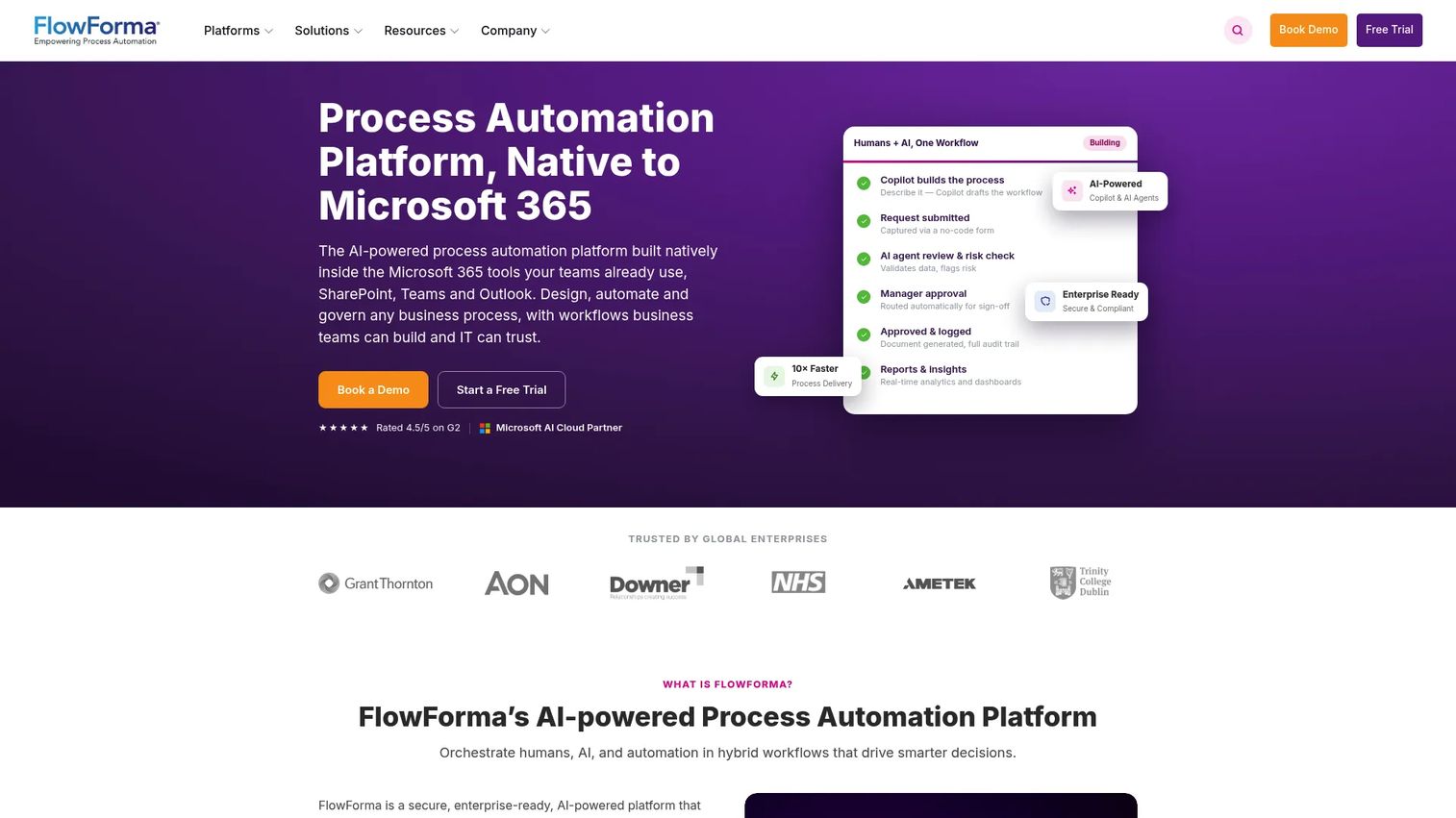
FlowForma is an AI-powered no-code process automation platform built for Microsoft 365. If your organization already lives in SharePoint and Microsoft 365, it lets you build underwriting workflows, forms, and document generation inside the environment your team already uses. That native fit shortens implementation and keeps governance where IT expects it.
The no-code builder handles workflow logic, forms capture the data, and document generation produces the outputs, all with audit trails and process governance built in. For teams that want faster implementation with process control, the Microsoft-native approach removes a layer of integration work. It fits organizations that value staying inside their existing stack over adopting a standalone platform.
Best for: midmarket and enterprise teams automating Microsoft 365-based underwriting and approval processes.
Key strengths
- No-code workflow automation
- Forms and document generation
- Microsoft 365 and SharePoint native deployment
- Audit trails and process governance
Why choose FlowForma: it fits Microsoft-centric teams that want process control without leaving their environment. The native SharePoint fit is the differentiator for organizations standardized on Microsoft 365.
FlowForma pricing: Essentials starts from $2,347 per month, Professional from $3,293 per month, and Enterprise is custom. A free trial is available on the site.
8. Socotra
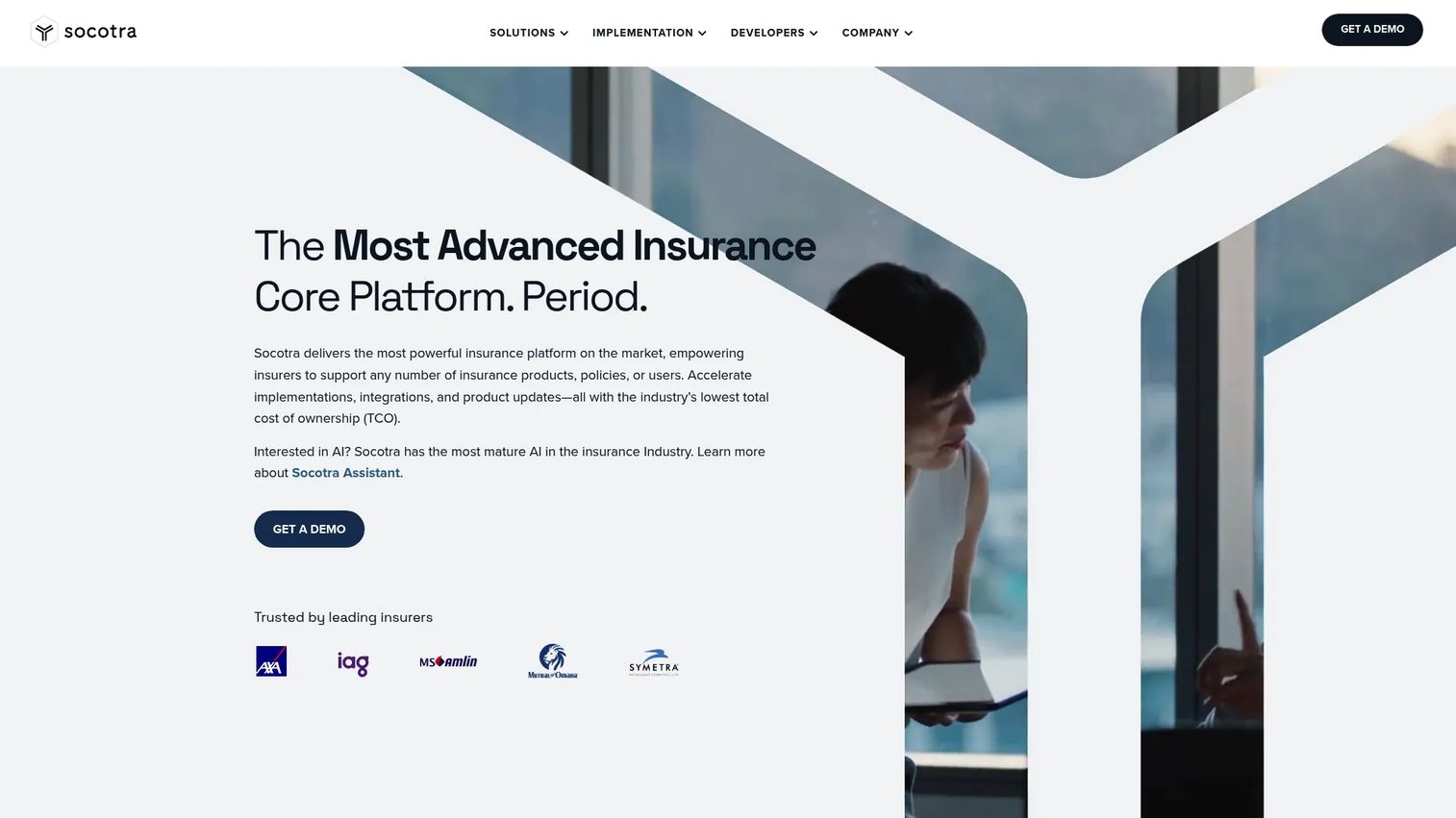
Socotra is a modern core insurance platform for policy administration, billing, portals, and reporting, with AI-assisted insurance operations. For teams modernizing off legacy core systems, it provides the underlying architecture that underwriting workflows plug into. The case here is foundational: get the core right and underwriting becomes far easier to automate.
The platform covers the full policy lifecycle with configurable policy administration, billing that integrates with payments and general ledger systems, and modern UI and portals that come out of the box but stay customizable. Insurers and MGAs that need flexible, modern architecture rather than a bolt-on to aging infrastructure are the fit. The configurability is what lets teams shape underwriting logic to their book.
Best for: insurers and MGAs that need a configurable, modern core platform.
Key strengths
- Policy administration across the full lifecycle
- Billing with payments and general ledger integrations
- Modern UI and configurable portals
- AI-assisted insurance operations
Why choose Socotra: it suits teams treating core modernization as the foundation for better underwriting rather than a point fix. The configurable architecture rewards insurers willing to build for their specific product lines.
Socotra pricing: pricing is not publicly listed. Contact the vendor for a quote based on your requirements.
9. DecisionRules
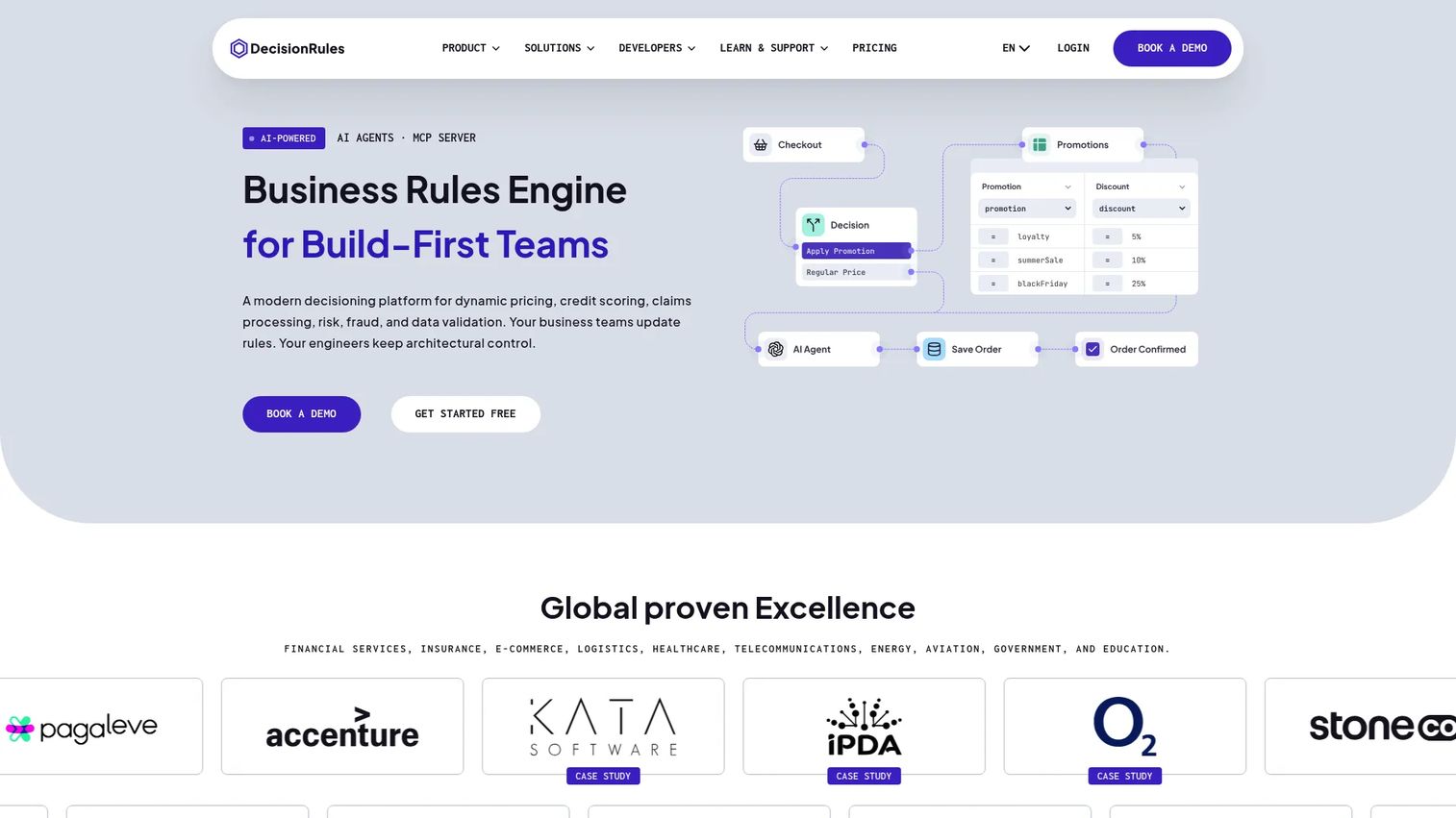
DecisionRules is a cloud-native business rules engine for building, deploying, and managing decision logic. It solves one specific problem well: keeping your underwriting policy logic separate from your core applications. When rules change, and they always do, business users update the logic without redeploying the whole system.
The visual, API-first approach lets teams build with Decision Tables, Decision Trees, and Decision Flows, then call that logic from any application. For underwriting consistency, that separation is powerful. Your rules live in one governed place, versioned and auditable, feeding whatever intake or core system you already run. It is a decision engine in the purest sense.
Best for: teams that want a standalone rules engine to manage underwriting logic separately from core apps.
Key strengths
- Decision Tables, Decision Trees, and Decision Flows
- Visual, API-first rules management
- Logic separated from core applications
- Versioned, auditable decision logic
Why choose DecisionRules: it fits teams that want business users, not engineers, changing underwriting rules. The API-first design pairs it with almost any existing intake or policy system.
DecisionRules pricing: the Free plan is €0 per month, Lite is €291 per month, and Premium is custom. Listed prices are approximate and based on annual billing.
10. BriteCore
BriteCore is cloud-native core insurance software for P&C insurers and MGAs. It modernizes insurance operations end to end, with underwriting support sitting inside policy administration, billing, and portal management. For property and P&C teams still running legacy systems, it offers a path to modern operations without piecing together separate tools.
The platform covers policy administration lifecycle management, billing and accounts receivable, and configurable agent and policyholder portals. Underwriting workflows benefit from being part of that connected core rather than bolted on. For carriers and MGAs that want a configurable cloud policy administration system supporting their underwriting, it is a strong fit.
Best for: P&C carriers and MGAs needing a configurable cloud policy administration system.
Key strengths
- Policy administration lifecycle management
- Billing and accounts receivable
- Configurable agent and policyholder portals
- Cloud-native P&C operations
Why choose BriteCore: it suits P&C carriers modernizing their core who want underwriting supported within a connected system. The configurability fits teams that need their portals and workflows shaped to their book.
BriteCore pricing: pricing is not publicly listed. Third-party listings indicate pricing is available only by contacting BriteCore.
Considerations before you buy
Integration with existing systems
Verify how the platform connects to your CRM, core policy or loan system, data warehouse, and document tools. Ask for the specifics: which APIs, how deep the data mapping goes, and what the real implementation effort looks like. A tool that automates underwriting but cannot pull data from your core system just moves the manual work upstream.
Compliance and audit trails
Confirm that every decision is traceable: who decided, when, on what data, and against which rules. Check permissions, evidence retention, and reporting. In regulated lines, the audit trail is not a nice-to-have. If you cannot reconstruct a decision for an examiner or a reinsurer, the automation created a new risk instead of removing one.
Decisioning flexibility
Evaluate the rules engine, stop rules, scorecards, and override controls. The key question: can business users change decision logic without an engineering ticket? Rules change constantly in underwriting. If every change requires a release cycle, the platform will fall behind your actual policy faster than you expect.
Document and submission handling
Centralized intake drives both speed and accuracy. Check support for PDFs, forms, attachments, and structured data, plus how the platform extracts and organizes what comes in. When submission data lives in one workspace instead of five inboxes, underwriters stop hunting for context and start making decisions.
AI and analytics
Ask what the AI actually does. There is a real difference between scoring, triage, recommendation, and monitoring. Some tools score risk, some extract data from documents, some flag anomalies for review. Match the AI underwriting capability to the job you need done, and be skeptical of anything that promises a black-box decision you cannot audit.
Conclusion
The right underwriting software depends on your line of business and your workflow complexity. For property insurance underwriting with remote inspection, UnderwritingCenter™ leads. For loan underwriting automation and straight-through processing, TurnKey Lender fits high-volume lending. For submission intake in commercial and specialty lines, Send organizes the front end. When you need broad configurability, Creatio and Appian adapt underwriting into wider process automation, while DecisionRules keeps your decision logic clean and separate.
For core-heavy insurance operations, Origami Risk, Socotra, and BriteCore each modernize the foundation underwriting runs on, and FlowForma suits Microsoft-native teams.
The practical next step is not to pick one today. Shortlist two or three tools by line of business, then pressure-test each on the things that break in production: integration depth, audit trail, and whether business users can change decision logic without waiting on engineering. Faster underwriting decisions come from matching the tool to how your team actually works.
FAQs
Underwriting software collects applicant and risk data, evaluates that risk against defined rules or models, and routes the resulting decision to the right person or system. It automates the repetitive parts of underwriting while keeping the decision logic transparent and auditable. Insurers and lenders use it to make faster, more consistent decisions.
Prioritize workflow automation, a strong decision engine with rules and scorecards, document and submission management, audit trails, and integration with existing systems. AI features like risk scoring and document extraction help, but check what the AI actually does. The right feature set depends on whether you underwrite insurance, loans, or property.
Most modern platforms integrate with CRM, core policy or loan systems, data warehouses, and document tools through APIs. Depth varies widely, so verify which systems are supported and how much data mapping the integration requires. A shallow integration can leave manual re-keying in place, so confirm the specifics before you buy.
It depends heavily on the platform, your data quality, and how many systems you are connecting. No-code and cloud-native tools can go live faster, while enterprise platforms integrating multiple legacy systems take longer. Ask vendors for a realistic timeline based on organizations similar to yours, not a best-case demo scenario.
A decision engine is the component that applies rules, scorecards, and logic to produce a decision. Underwriting software is the broader platform that also handles data collection, document management, workflow routing, and audit trails. Some tools, like a dedicated rules engine, focus purely on decisioning and connect to your other systems through APIs.
Yes, though the tools differ. Insurance underwriting software focuses on policy risk, submission intake, and rating, including property insurance underwriting with inspection data. Loan underwriting software focuses on credit decisioning, alternative data, and repayment risk. Match the platform to your line of business rather than assuming one tool covers both.
Decision traceability, permissions, and evidence retention matter most. You should be able to reconstruct any decision: who made it, when, on what data, and against which rules. Reporting that produces audit-ready records for examiners and reinsurers is essential in regulated lines, so confirm what the platform retains and how it exports that history.
Specialized tools like property or loan underwriting software go deep on one line and remove the biggest domain-specific bottlenecks. General platforms offer configurability across many processes and adapt as your rules change. Choose specialized when your book is concentrated and the domain data is the hard part, and general when underwriting sits inside a wider process footprint.