Your tee sheet lives in one system. Payments run through another. Member billing sits in a spreadsheet somebody updates on Mondays. Reporting means exporting three files and stitching them together by hand. Sound familiar?
That fragmentation is the real cost most golf operators carry. Not the software subscriptions themselves, but the hours lost reconciling systems that were never built to talk to each other, the double-bookings that slip through, and the revenue you cannot see because it is scattered across tools.
The market is moving fast toward consolidation. The global golf course software market is estimated at USD 721.84 million in 2026 and projected to reach USD 2.20 billion by 2035, according to Global Market Statistics. More telling for buyers: more than 71% of newly implemented golf management systems are now cloud-based, per the same 2026 report. Operators are actively replacing patchwork stacks with single platforms that run tee sheets, point of sale, memberships, billing, and reporting from one place.
The challenge is that "all-in-one" means something different at a municipal course than it does at a private country club or a five-property management group. A platform built for high-volume public tee times may not fit a club that lives and dies by member billing and dining operations. This guide breaks the field down by operational fit, so you can shortlist the two or three systems that actually match your course type and complexity before you sit through a single vendor demo.
What's inside
This guide covers cloud-based golf course management software for tee sheets, online booking, POS, member management, billing, reporting, and multi-course operations. It is written for course operators, club managers, owners, and multi-property groups comparing systems before they book demos.
We selected and ordered platforms based on four things: breadth of core modules, ease of use for day-to-day staff, scalability across course types, and integration depth. The list spans options for public courses, private clubs, resorts, event-heavy operations, and multi-course groups, so you can pattern-match to your own facility rather than read a generic feature dump.
TL;DR
- Best all-in-one cloud stack for busy public and semi-private courses: foreUP pairs tee sheet, POS, billing, and marketing in one modular system.
- Best for booking flow and revenue management: Lightspeed Golf leads on online booking, dynamic pricing, and an open integration ecosystem.
- Best for clubs that run course and dining together: Tee On and Jonas Club Software both handle F&B, member profiles, and back-office depth.
- Best "built by golf people" simplicity: Club Caddie and Teesnap focus on connected operations with hands-on support.
- Best for event-heavy and charity operations: GolfRegistrations covers tournament registration and fundraising, not full course operations.
- Best modern, commerce-first platform: MyGolfLinks combines an online tee sheet, integrated POS, and a built-in booking network.
What is golf course management software?
Golf course management software is a cloud-based platform that runs the core operations of a golf facility, including tee time scheduling, online booking, point of sale, payments, memberships, billing, and reporting, from a single system.
Modern platforms replace the old stack of a standalone tee sheet, a separate register, a marketing tool, and a billing spreadsheet. Instead, one system handles the full operational flow, from a golfer booking a tee time online to the pro shop ringing up a purchase to the month-end member statement.
The core modules buyers expect in 2026:
- Tee sheet software: Real-time tee time scheduling, availability, and rate management across multiple courses or nines.
- Online booking: Direct web and mobile reservations, often with dynamic pricing and a public booking marketplace.
- Point of sale: A golf POS for pro shop retail, food and beverage, and cart or rental transactions.
- Payments: Integrated card processing so checkout data flows straight into reporting.
- Member management: Profiles, dues, house accounts, and a member portal for private and semi-private clubs.
- Billing: Recurring dues, statements, and account reconciliation inside the same system.
- Reporting: Live dashboards and exports covering revenue, rounds, utilization, and facility performance.
- Integrations: Connections to accounting, CRM, marketing, booking networks, and payment hardware.
Two market signals shape what buyers should prioritize. Approximately 67% of golf clubs now use integrated software to automate membership billing and customer communications, and mobile booking accounts for over 58% of online tee-time reservations globally, both per Global Market Statistics (2026). If a platform treats mobile booking or member billing as an afterthought, it is already behind where the market is heading.
When to use golf course management software
Replace manual tee sheets and spreadsheets
If your staff still manages tee times on a paper sheet or a shared spreadsheet, double-bookings are not an occasional accident. They are a structural risk. Manual sheets do not update in real time, so a phone booking and an online booking can collide before anyone notices. A cloud tee sheet closes that gap by syncing every channel to one source of truth, and it lets a golfer book a mobile reservation without a staff member touching anything.
Unify POS, payments, and member billing
When checkout lives in one system and billing lives in another, reconciliation becomes a manual job nobody enjoys. A pro shop sale, a dining charge, and a member's monthly dues should all post to the same ledger. Bringing POS, payments, and member billing into one platform means the numbers match at month-end without exports and manual matching, and it gives you a single view of what each member actually spends across the facility.
Scale across multiple courses or facility types
Multi-course groups, resorts, driving ranges, academies, and simulator venues each have their own operational shape. A management group needs consolidated reporting across properties while keeping each course's rates and tee sheet separate. A resort needs to connect golf to lodging and dining. A range or simulator needs bay scheduling rather than tee times. The right platform scales to these formats without forcing every location into a single rigid template.
Comparison table
Read this table as a shortlisting tool, not a scoreboard. The "Intent" column tells you the operational job each platform is built for, and "Key differentiation" flags what sets it apart. Pricing and ratings are shown where a verified public source exists; several vendors quote per facility, so those fields are marked accordingly.
| # | Product | Intent | Key differentiation | Pricing | G2 rating |
|---|---|---|---|---|---|
| 1 | foreUP | All-in-one ops for public and semi-private courses | Modular pricing, pick the tools you need | From $70/mo per module | 4.5/5 |
| 2 | Lightspeed Golf | Booking flow and revenue management | Dynamic pricing, online booking, open API | Quote-based | 4.3/5 |
| 3 | Tee On | Clubs running course and dining together | One system, one price, all features included | Quote-based | Not listed |
| 4 | Teesnap | Connected ops with hands-on support | US-built platform plus marketing services | Quote-based | 3.8/5 |
| 5 | Club Caddie | Simple cloud ops for courses and clubs | Built by golf industry professionals | Quote-based | Not listed |
| 6 | Jonas Club Software | Private and country club back office | Deep accounting and member workflows | Quote-based | 3.9/5 |
| 7 | GolfRegistrations | Tournament and charity event registration | Event websites, sponsorships, fundraising | Free plus 4.9% per transaction | 4.3/5 |
| 8 | MyGolfLinks | Modern commerce-first golf platform | Integrated POS plus built-in booking network | Quote-based | Not listed |
1. foreUP

foreUP is a cloud-based golf course and club management platform built to run operations from one place. It brings the tee sheet, golf POS, billing, food and beverage, marketing, and tournament management under a single roof, which is why it shows up so often on public and semi-private course shortlists. Rather than forcing you into one big bundle, foreUP lets operators pick and choose the modules they actually need.
Best for: Public and semi-private courses that want an all-in-one operations suite without paying for tools they will not use.
Key strengths
- Tee sheet software: Real-time tee time scheduling with online booking that syncs across every channel.
- Golf course point of sale: A POS built for pro shop retail, F&B, and rentals that ties transactions back to reporting.
- Billing and member portal: Recurring dues, member accounts, and a self-serve portal for semi-private and membership operations.
Why choose foreUP: The modular approach is the real draw. A high-volume municipal course can start with tee sheet and POS, then add billing or marketing as needs grow, without a full re-platform. That flexibility fits operators who want to control cost while still consolidating onto one system.
foreUP pricing: foreUP prices by module, with starting-at rates published on its pricing page. Email and text marketing starts at $70 per month, billing at $80, tee sheet software at $120, food and beverage at $120, tournament management at $120, and golf course point of sale at $130. There is no free tier. The pick-and-choose model means your total depends on which modules you combine.
2. Lightspeed Golf
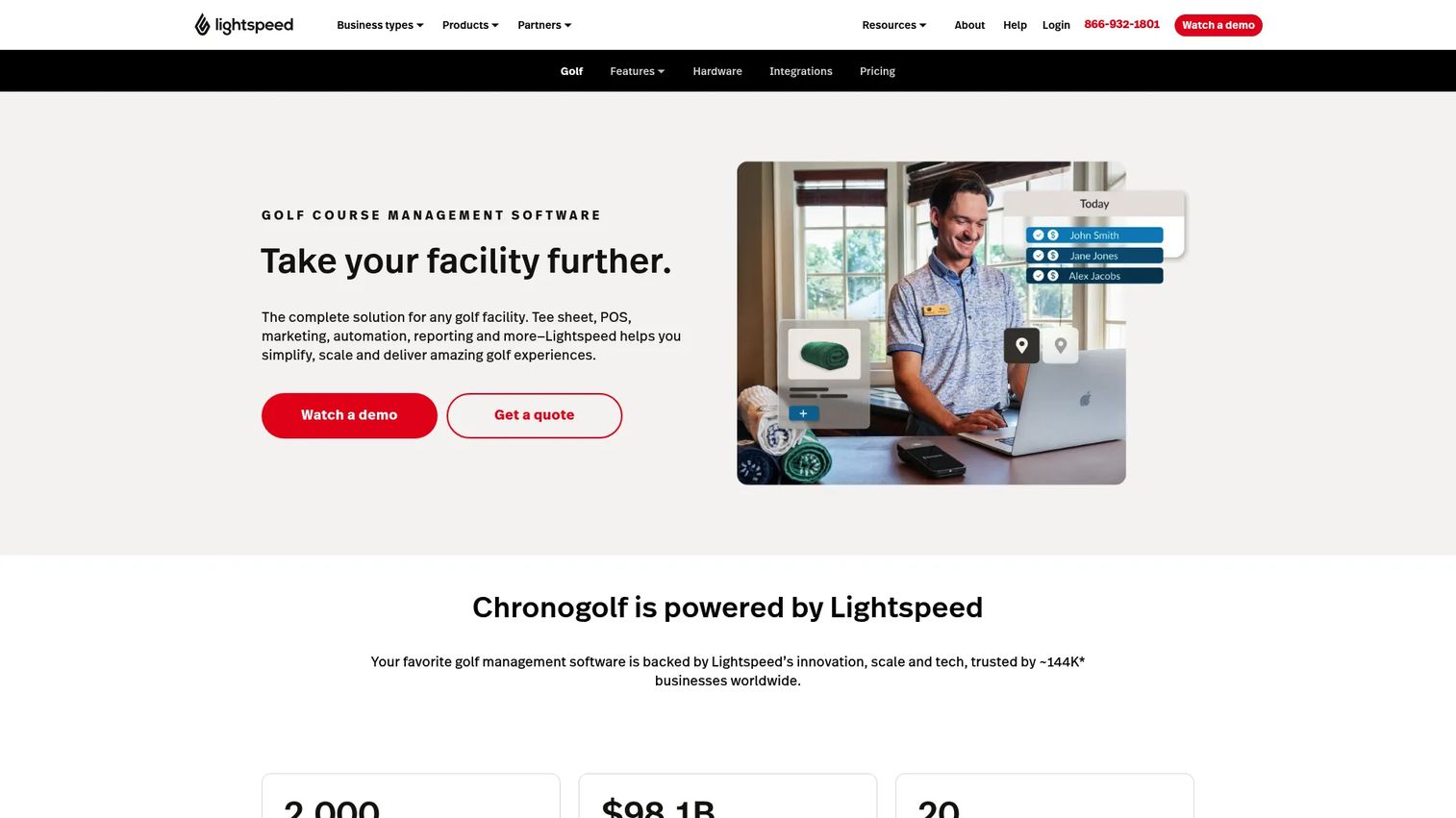
Lightspeed Golf is a cloud golf management platform built on the Chronogolf tee sheet, combining scheduling, POS, payments, online booking, marketing, and analytics. Its strength is the booking and revenue side: dynamic pricing, a promotional engine, and a players database that helps courses fill tee times and grow spend per round. It fits operators who treat online booking as a revenue lever, not just a scheduling convenience.
Best for: Golf facilities that want an all-in-one cloud platform with strong revenue management and an open integration ecosystem.
Key strengths
- Cloud-based tee sheet management: Chronogolf-powered scheduling with real-time availability across the operation.
- Unified golf POS and payments: One system for retail, F&B, and card processing that feeds directly into reporting.
- Online booking, dynamic pricing, and marketing: A booking engine with dynamic rates, SMS marketing, and business intelligence built in.
Why choose Lightspeed Golf: For multi-location operators, the open API and integration breadth matter. If you need golf to connect with existing accounting, marketing, or hospitality systems, Lightspeed's ecosystem gives you room to build the stack around your operation rather than the other way around.
Lightspeed Golf pricing: Lightspeed does not publish a public starting price. The pricing page requests a personalized quote and confirms the platform includes tee sheet, promotional engine, event management, players database, business intelligence, dynamic pricing, online booking, SMS marketing, free live support, and monthly updates. Plan on a demo and quote to get numbers specific to your facility. Lightspeed Golf holds a 4.3/5 rating on G2.
3. Tee On

Tee On is a golf course management system that ties tee sheets, POS, payments, tournaments, an online store, food and beverage, and reporting into one integrated platform. Its pitch is operational clarity across the whole facility, including the parts many tee-sheet-first tools treat lightly, like an online pro shop and dining. That makes it a strong fit for clubs that run the course and the restaurant as one connected operation.
Best for: Golf clubs that want operational clarity across course, retail, and dining in a single system.
Key strengths
- Integrated tee sheet management: Scheduling that connects to POS and reporting without separate tools.
- Payments and online store: Processing plus an online pro shop so retail sits inside the same platform.
- Tournaments, scoring, and reporting: Event handling and reporting built into the core system, not bolted on.
Why choose Tee On: The "one system, one price" positioning simplifies buying. Everything is included rather than gated behind add-on modules, which suits clubs that want the full operational picture without assembling a bundle. Staff work in one interface across the course and the pro shop.
Tee On pricing: Tee On states it is "one system, one price" with all features included, but does not publish a numeric price on its site. You will need to contact the vendor for a facility-specific quote. The all-inclusive model means you are not tracking per-module costs once you sign on.
4. Teesnap
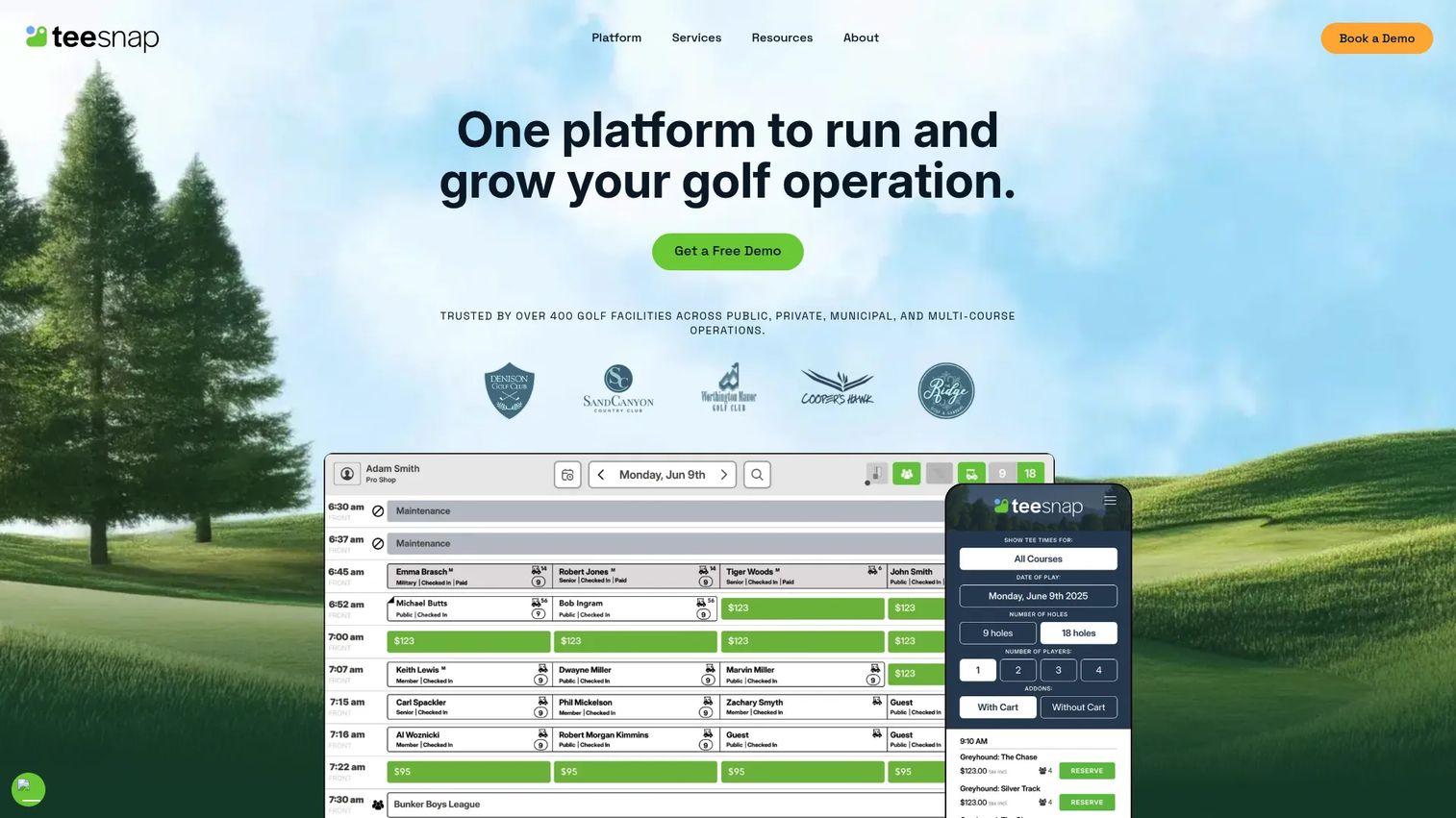
Teesnap is a US-built golf course management platform covering tee sheet, online booking, POS, payments, and reporting, paired with hands-on marketing services. The operations-first, connected-platform angle appeals to teams that want their tee sheet, checkout, and reporting to move together, plus a vendor that stays involved after go-live rather than handing over a login and disappearing.
Best for: Golf facilities that want a connected operations platform with hands-on vendor support.
Key strengths
- Tee sheet and online booking: Scheduling and web reservations that stay in sync across channels.
- Point of sale: A golf POS for pro shop and course transactions tied to the same platform.
- Payments and reporting: Integrated processing with reporting so revenue data lands in one place.
Why choose Teesnap: The support and services layer is the differentiator. Beyond the software, Teesnap offers marketing services, which helps smaller teams that do not have a dedicated marketer on staff. If you want a partner rather than just a tool, that combination is worth a look.
Teesnap pricing: Teesnap does not expose a clear public price for its core software on its site. The only published price found is a marketing services package ranging from $700 to $2,100 per month, which applies to services rather than the software platform. For core software pricing, request a quote directly. Teesnap holds a 3.8/5 rating on G2.
5. Club Caddie

Club Caddie is an all-in-one golf course management platform built by golf industry professionals, covering tee time management, POS, member management, and a golfer-facing mobile app. The "built by golf people" angle is concrete here: the reservation engine, the pro shop workflows, and the mobile features reflect how courses actually operate day to day rather than a generic retail template adapted to golf.
Best for: Public courses and private clubs that want a straightforward cloud system covering core operations.
Key strengths
- Tee time management and reservations: An online reservation engine with real-time tee time scheduling.
- POS and member management: Point of sale plus customer and member accounts in one system.
- Golfer mobile app: A mobile app with GPS rangefinder, scorecard, promotions, and event registration.
Why choose Club Caddie: The mobile app sets it apart. Giving golfers a GPS rangefinder, scorecard, and promotions in their pocket turns the platform into a golfer engagement tool, not just a back-office system. For courses that want to build a direct relationship with players, that is a real advantage.
Club Caddie pricing: Club Caddie does not publish pricing on its site, using a demo-and-contact model instead. You will need to request a quote for numbers specific to your facility. A product listing exists on Capterra for cross-referencing feature coverage and reviews.
6. Jonas Club Software
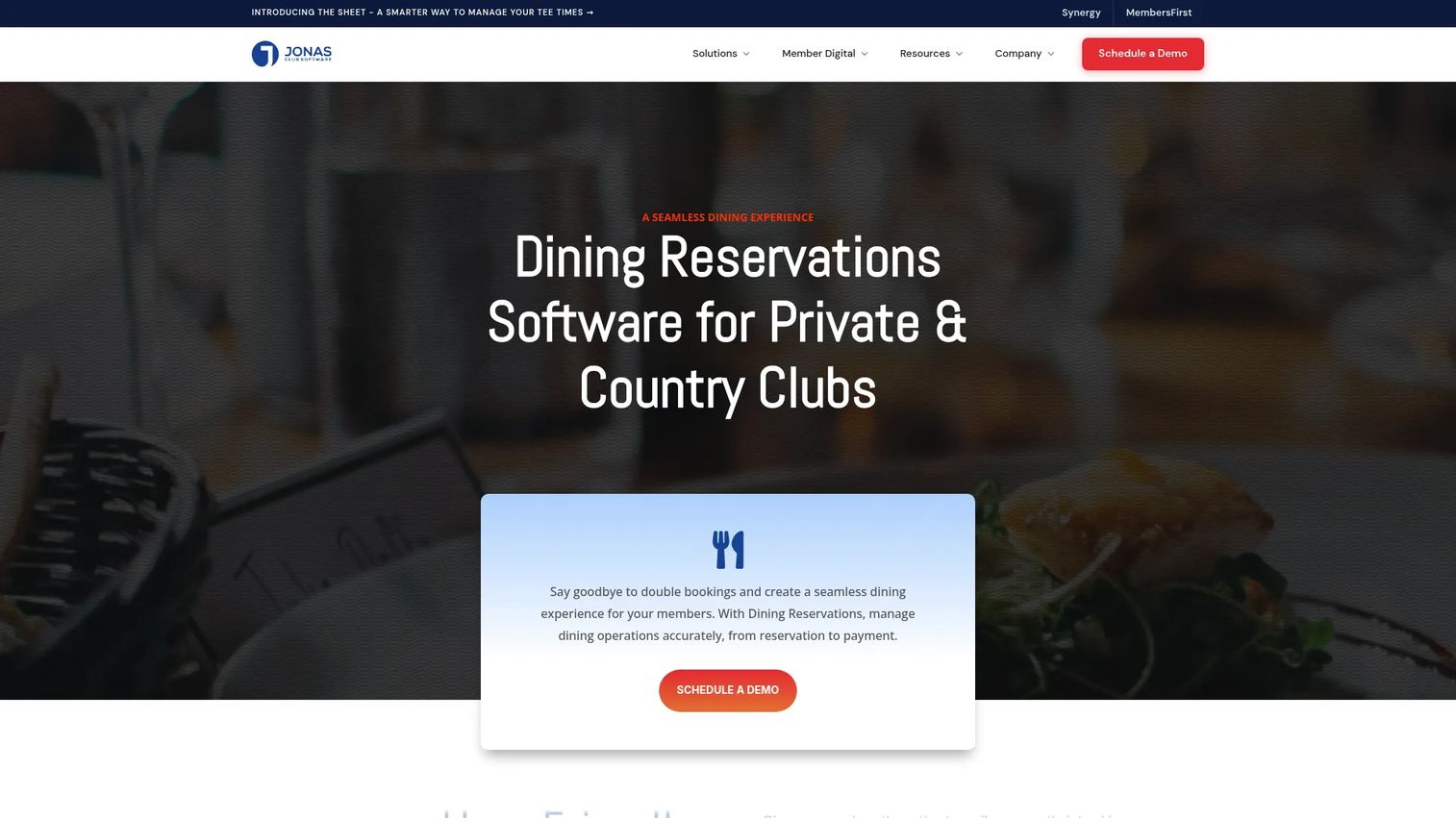
Jonas Club Software is a broad operations platform for private and country clubs, covering club management, accounting, POS, tee time reservations, event management, and member communications. Where tee-sheet-first tools focus on getting golfers on the course, Jonas focuses on the full back office a private club runs, including accounting depth that most golf-only platforms do not attempt.
Best for: Private and country clubs that need a wide back-office footprint alongside member workflows.
Key strengths
- Club management and accounting: Integrated accounting and club operations in one platform.
- Point of sale with mobile and self-serve options: POS that extends to mobile and member self-service.
- Tee time reservations and scheduling: Golf scheduling connected to the broader club system.
Why choose Jonas Club Software: The accounting and back-office depth is the reason clubs choose it. A private club with a full finance function, multiple dining outlets, and complex member billing gets a system built for that scale. The breadth means there is more to learn, so budget for onboarding time and lean on the vendor's implementation support.
Jonas Club Software pricing: Jonas uses a demo-and-contact-sales model rather than published prices, so you will need a quote scoped to your club's size and module needs. Jonas Club Software holds a 3.9/5 rating on G2.
7. GolfRegistrations
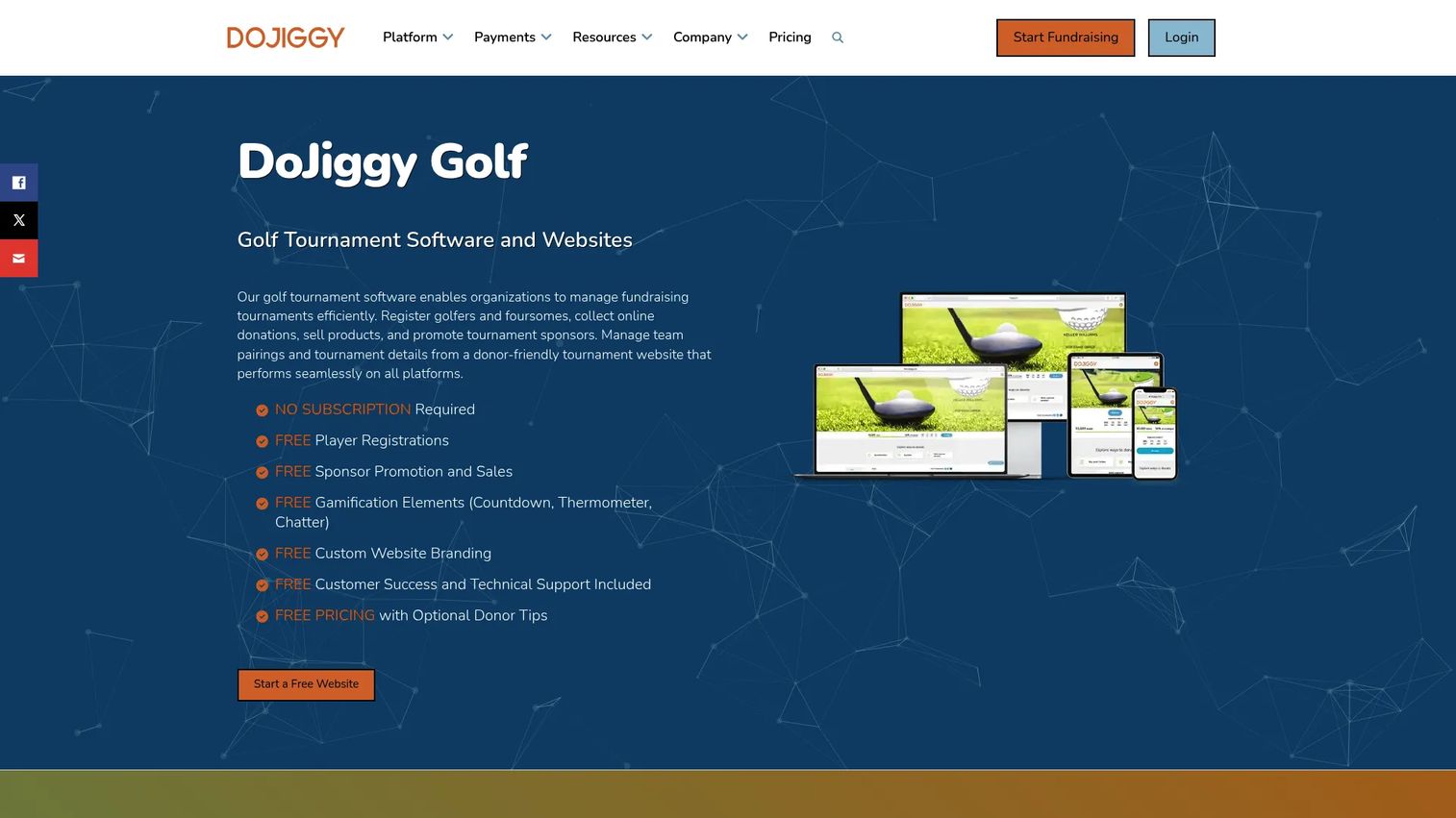
GolfRegistrations, now branded by DoJiggy, is a golf tournament registration and fundraising tool rather than a full course operating system. It handles the event side: customizable tournament websites, golfer and foursome registration, sponsorship sales, team pairings, reporting, and email communications. If your challenge is running charity tournaments and outings, this fills that specific job better than a tee sheet platform would.
Best for: Charity golf tournaments and event-heavy operations that need online registration, sponsorships, and lightweight fundraising.
Key strengths
- Customizable tournament website: A branded event site to promote and manage each tournament.
- Registration and sponsorships: Sell golfer and foursome registrations plus sponsorship packages online.
- Pairings, reporting, and email: Team pairings, event reporting, and participant communications in one place.
Why choose GolfRegistrations: It is honest about its scope. This is not a system for daily tee sheet and POS operations. It is a purpose-built tool for the tournament and fundraising workflow, and it does that job without the overhead of a full operations platform. Course operators often run it alongside their core system for events.
GolfRegistrations pricing: Two options are published. A Free plan with no platform fees and optional donor tips, and Percentage pricing at 4.9% per credit card transaction plus Stripe or PayPal processing fees. That structure fits charity events where keeping fixed costs near zero matters. GolfRegistrations holds a 4.3/5 rating on G2.
8. MyGolfLinks
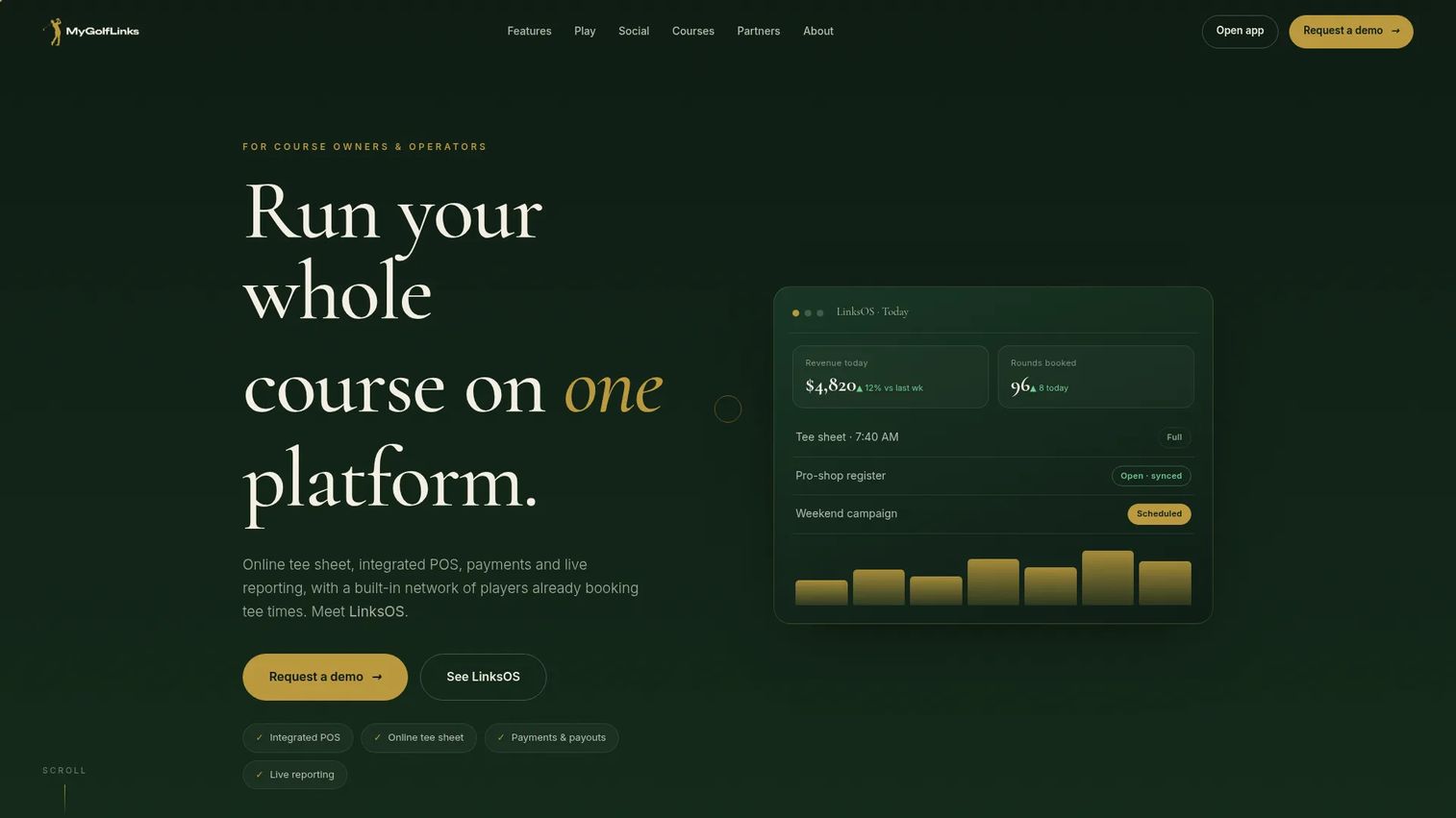
MyGolfLinks is a modern golf course operating platform and player app that combines an online tee sheet, integrated POS, payments, live reporting, and a built-in booking network. It leans into integrated commerce: gift cards, house accounts, inventory and purchase orders, and email and SMS campaigns all sit inside the platform, with an offline-resilient POS so the register keeps working even if the connection drops.
Best for: Courses that want a modern, commerce-first platform with support for both public and private operations.
Key strengths
- Online tee sheet and integrated POS: Scheduling and checkout in one system with offline resilience.
- Payments, gift cards, and house accounts: Integrated commerce covering payouts, gift cards, and member accounts.
- Live reporting and multi-course readiness: Real-time reporting with a platform built to scale across courses.
Why choose MyGolfLinks: The combination of an offline-resilient POS and a built-in booking network stands out. The offline capability protects revenue on shaky connections, and the booking network gives courses a demand channel beyond their own site. A companion player app with live GPS rounds and loyalty features adds a golfer-facing layer.
MyGolfLinks pricing: MyGolfLinks does not publish numeric pricing for its LinksOS platform, using a request-a-demo model and referencing a founding-course program with founder pricing. The player app is free for golfers. Contact the vendor for platform pricing scoped to your operation.
Considerations
Match the system to your course type
The single most important factor is fit to your facility. A high-volume public course prioritizes a fast tee sheet, online booking, and quick POS. A private club prioritizes member billing, house accounts, and dining. A resort needs golf to connect with lodging. A driving range or simulator needs bay scheduling instead of tee times. Shortlist by course type first, then compare features within that shortlist.
Check the real cost of migration
The subscription price is rarely the biggest cost. Migrating member data, historical transactions, and tee sheet history takes time, and staff training determines whether the system actually gets used. Ask each vendor how migration works, how long onboarding takes, and what change management support is included before you commit.
Verify reporting depth before buying
Reporting is where consolidation pays off, so test it directly. Ask to see live dashboards, run an export, and check whether a multi-course operator can view facility-level and consolidated numbers. If the reporting cannot answer the questions you ask at month-end today, the platform will not fix that gap on its own.
Pressure-test integrations
Confirm the platform connects to the tools you already rely on: accounting, CRM, marketing, booking networks, payment hardware, and any APIs your operation uses. An "all-in-one" system that will not talk to your accounting package just moves the reconciliation problem, it does not solve it.
Confirm support and implementation
Support quality shapes the day-to-day experience more than any feature list. Ask about onboarding, response times, and how much hands-on help is included versus paid extra. For platforms with deep back-office breadth, budget more time for implementation and lean on the vendor's support during rollout.
Conclusion
There is no single winner, because the right golf course management software depends on what kind of facility you run. For busy public and semi-private courses that want modular control, foreUP is a strong starting point. If online booking and revenue management drive your business, Lightspeed Golf leads on dynamic pricing and integrations. Clubs running course and dining together should look hard at Tee On and Jonas Club Software, while Club Caddie and Teesnap suit operators who want connected operations with a hands-on partner. Event-heavy operations get a purpose-built fit in GolfRegistrations, and MyGolfLinks appeals to courses that want a modern, commerce-first platform with a built-in booking network.
The practical next step is not to pick one from this page. It is to shortlist the two or three that match your course type and operational complexity, then book demos and pressure-test migration, reporting, and integrations against your real workflows. Bring your actual month-end questions to the demo. The platform that answers them cleanly is the one worth signing.
FAQs
Public courses usually prioritize a fast tee sheet, strong online booking, and a quick POS for high transaction volume. foreUP, Lightspeed Golf, and MyGolfLinks all fit this profile well, with dynamic pricing and mobile booking support that matter when tee time volume is your main lever. Shortlist based on booking flow and POS speed rather than back-office depth.
Private clubs live on member billing, house accounts, dining, and back-office accounting, so depth in those areas matters more than raw booking volume. Jonas Club Software is built for that full club footprint, and Tee On handles course-plus-dining operations well. Prioritize member management, billing, and F&B when you compare.
Most modern platforms include both. A golf POS handles pro shop retail, food and beverage, and rentals, while integrated payments process cards and feed the data straight into reporting. Keeping checkout and payments inside the same system is what eliminates manual reconciliation at month-end, so it is worth confirming both are native rather than bolted on.
Yes. That single-system consolidation is the entire point of modern golf course management software. Platforms like foreUP, Tee On, and Jonas Club Software combine tee sheet scheduling, member management, and recurring billing in one place, so a member's tee times, purchases, and dues all post to the same account. Confirm the billing depth matches your club's complexity before you buy.
Consolidated reporting is the first thing to test. A multi-course group needs to view each property's numbers separately and roll them up across the operation, while keeping rates and tee sheets distinct per course. Lightspeed Golf and MyGolfLinks flag multi-course readiness directly. Verify how the platform handles per-location settings and cross-property reporting during the demo.
Pricing varies widely by model. foreUP publishes modular starting-at prices, with individual modules ranging from $70 to $130 per month. Several vendors, including Lightspeed Golf, Tee On, Club Caddie, Jonas Club Software, and MyGolfLinks, use quote-based pricing scoped to your facility size and module needs. GolfRegistrations runs a free plan plus a 4.9% per-transaction fee for event use. Always request a facility-specific quote to compare true cost.
For most operators, yes. More than 71% of newly implemented golf management systems are cloud-based, per Global Market Statistics (2026), and the reasons are practical: real-time updates across booking channels, remote access, automatic updates, and mobile booking support. Given that mobile accounts for over 58% of online tee-time reservations, a cloud platform built for mobile-first booking is increasingly the baseline rather than an upgrade.
Accounting, payments, and marketing are the integrations that touch daily operations most. Beyond those, look at CRM, booking networks, and payment hardware compatibility. If you run multiple properties or connect golf to lodging and dining, confirm the platform's API can support those workflows. An "all-in-one" system still needs to connect cleanly with the tools already central to your operation.