A skilled nursing team can spend more of a shift documenting care than delivering it. Charting, MDS assessments, med passes, incident reports, census updates, billing codes, and survey prep all compete for the same hours. Then a resident transfers to a hospital and back, and the handoff data lives in three systems that don't talk to each other.
That is the real friction behind the search for long term care software. The market reflects the stakes: the long-term care software category is projected to reach roughly USD 6.29 billion in 2026, according to Coherent Market Insights. Cloud-based deployments already held about 65% share in 2025, per Precedence Research, which tells you where buyers are moving.
Choosing here is a systems decision, not an IT purchase. The right platform touches every team: clinical staff at the point of care, admissions, finance, compliance, and leadership reading census and quality dashboards. If you run a mixed portfolio of settings, the cost of fragmented operations compounds fast, the same way a founder feels it when data lives in five dashboards and no one can answer a simple question the same way twice.
The way to evaluate any of these tools mirrors how you'd stress-test a repeatable feedback loop or an ab testing program: does it hold up under real workflows, or only in the sales deck? This guide compares seven long term care software solutions through five lenses: care setting fit, workflow automation, interoperability, compliance, and platform breadth.
What's inside
This guide compares seven long term care software options built for skilled nursing facilities, assisted living, CCRCs, and broader senior living operations. We chose the list around four things that actually move the needle for operators: facility coverage across the care continuum, operational efficiency through workflow automation, care coordination and interoperability, and platform credibility backed by real adoption. This is a chooser's guide, not a category explainer. The focus stays on how to match a platform to your facility mix, your workflows, and how much breadth you need across clinical, financial, and operational functions.
TL;DR
- Best overall for broad continuum coverage: WellSky, for organizations spanning home health, senior living, and post-acute care.
- Best for SNFs and high-acuity workflows: PointClickCare, for point-of-care clinical visibility and med management.
- Best for assisted living and senior living teams: ECP, for all-in-one care, eMAR, CRM, and billing.
- Best for benchmark-driven buyers: KLAS Research, for independent vendor validation before you sign.
- Best for analytics and ecosystem breadth: Netsmart, for interoperability and connected care.
- Best for a stronger financial and operational layer: MatrixCare or Yardi Senior Living Suite, depending on your mix.
- Best for mixed facility organizations: MatrixCare, for balancing resident care, finance, and operations across settings.
What is long term care software?
Long term care software is a category of clinical and operational technology that helps skilled nursing, assisted living, senior living, and post-acute providers document care, coordinate transitions, manage compliance, and run facility operations from a shared system of record.
What it typically includes:
- Long term care EHR and resident charting: clinical documentation, care plans, assessments, and MDS support.
- Medication management: eMAR, med pass tracking, and safety checks.
- Admissions, discharge, and transfers: intake, referral management, and census workflows.
- Revenue cycle management: billing, claims, and accounts receivable tied to clinical documentation.
- Quality and compliance: survey readiness, incident tracking, and regulatory reporting.
- Reporting and analytics: census, occupancy, clinical, and financial dashboards.
Which care settings it serves: skilled nursing facilities, assisted living and memory care, continuing care retirement communities, life plan communities, home health, and hospice.
Why EHR, workflow, and compliance tools bundle together: in long-term care, clinical documentation drives billing, and billing accuracy drives survey and audit outcomes. Separating them creates the fragmentation operators are trying to escape.
How it differs from general healthcare software: acute-care EHRs optimize for episodic hospital encounters. Long-term care software optimizes for longitudinal resident care, extended stays, and the operational and financial realities of running a facility, not a hospital department.
Why integrated reporting and care coordination matter: residents move between settings, and every handoff is a data risk. A platform that keeps clinical, financial, and operational data connected reduces errors and gives leadership one version of the truth.
When to use long term care software
Reduce documentation and admin burden
The strongest buying trigger is time. When nurses and aides spend a large share of each shift on manual charting, duplicate entry, and paper med records, care quality and staff retention both suffer. Software for nursing homes that automates charting, pulls assessments into billing, and reduces redundant data entry gives that time back to residents. If your team is buried in admin, that is the signal.
Coordinate care across transitions and teams
Residents rarely stay in one setting. They move between skilled nursing, assisted living, the hospital, and home. Every transition is a handoff where medication lists, care plans, and history can get lost. This is where interoperability and data exchange earn their keep. When your platform shares data cleanly with hospitals, labs, and pharmacies, you cut readmission risk and keep the care team aligned. If handoffs are where things break in your organization, prioritize coordination.
Standardize compliance and quality workflows
Survey prep, medication tracking, and protocol consistency become buying triggers the moment an audit exposes gaps. When documentation is inconsistent across sites or shifts, quality and compliance reporting turns into a fire drill. Long term care facility software that standardizes workflows, timestamps documentation, and keeps records audit-ready turns compliance from a scramble into a routine. If your last survey was painful, that pain is the trigger.
Comparison table
A quick note before the table: pricing and ratings in long-term care are often quote-based and change over time, so verify both against each vendor's current pricing page and live G2 listing at the time you evaluate. Tools are sorted by relevance to the primary keyword, not alphabetically.
| # | Product | Intent | Key differentiation | Pricing | G2 rating |
|---|---|---|---|---|---|
| 1 | WellSky | Broad continuum coverage | Coordinated care across home health, senior living, and post-acute | Quote-based; Learning Center LMS from $205/year | 4.2/5 |
| 2 | PointClickCare | SNF and senior living clinical | Point-of-care intelligence and care-transition network | Quote-based | 4.3/5 |
| 3 | Netsmart | Interoperability and connected care | CareFabric platform with EHR and analytics | Quote-based | 3.6/5 |
| 4 | KLAS Research | Vendor validation | Independent healthcare IT benchmarking | Arch Collaborative from $16,400/year | Not listed |
| 5 | ECP | Assisted living all-in-one | eMAR, EHR, CRM, and billing in one system | Quote-based | 4.8/5 |
| 6 | MatrixCare | Mixed-facility operations | Post-acute and senior living EHR breadth | Quote-based | 3.8/5 |
| 7 | Yardi Senior Living Suite | Senior living operations | Care, sales, and finance on one platform | Quote-based | 3.6/5 |
1. WellSky
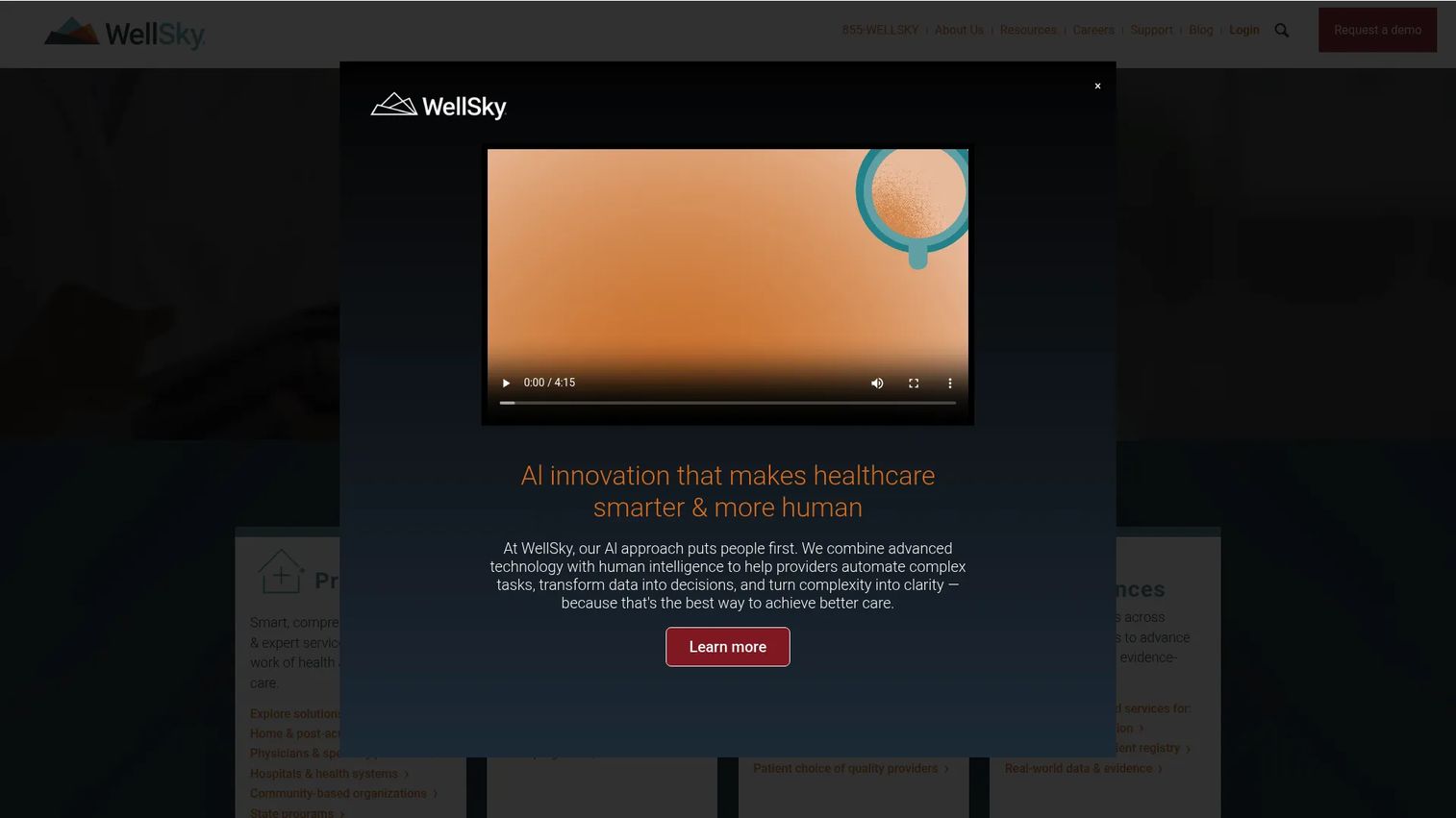
WellSky positions itself as a broad healthcare and community-care software provider built around coordinated care, analytics, and services. For organizations that span home health, senior living, and post-acute care, its appeal is continuum coverage: one vendor across settings rather than a patchwork of point tools that never reconcile.
Best for: Healthcare organizations that need coordinated-care software and related services across multiple care settings.
Key strengths
- AI-powered home health workflows: streamlines clinical documentation and scheduling for home-based care teams.
- Referral and intake management: captures and routes referrals to keep census and admissions moving.
- Predictive analytics and revenue cycle tools: ties clinical activity to financial performance and forecasting.
Why choose WellSky: If your organization operates across the continuum and you want fewer vendors managing more of the picture, WellSky's breadth is the draw. It fits operators who value coordinated care and adjacent modules like revenue cycle over a single narrow clinical tool. Its G2 rating sits at 4.2/5, reflecting a broad but capable platform.
WellSky pricing: WellSky does not publish general platform pricing; its core products are quote-based and depend on your setting mix and modules. The one publicly visible figure is the WellSky Learning Center LMS subscription at $205 per year. For platform pricing, you will need a direct quote. Verify current figures against WellSky's pricing page before you commit.
2. PointClickCare
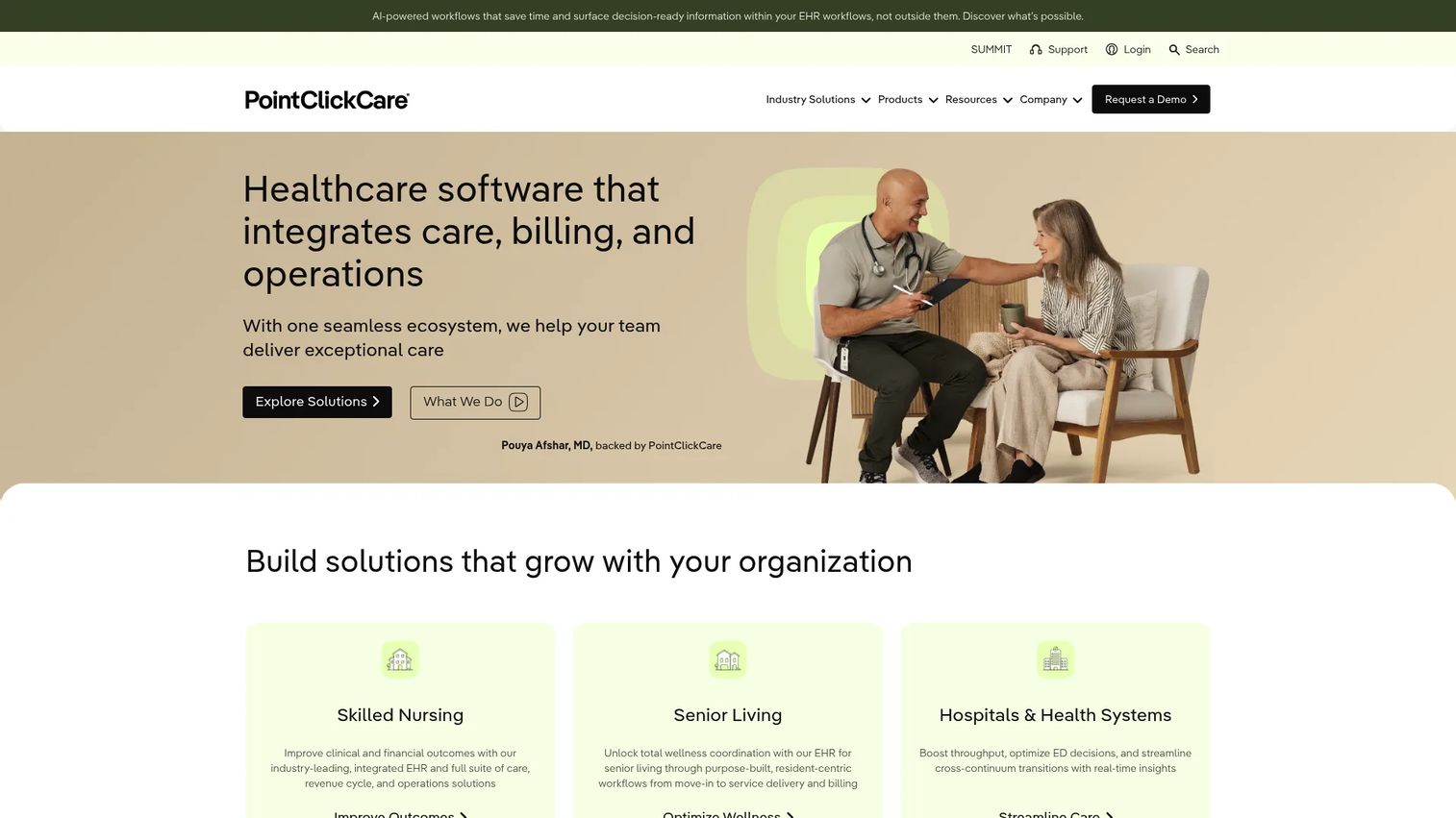
PointClickCare is one of the most recognized names in skilled nursing facility software and senior living technology. Its strength is point-of-care clinical visibility: the platform surfaces real-time resident data where staff work, connects care transitions across settings, and standardizes clinical workflows that otherwise drift shift to shift.
Best for: Providers in senior living, skilled nursing, and post-acute care that need an integrated care-and-operations platform.
Key strengths
- EHR for senior living and skilled nursing: a long term care EHR built for extended-stay documentation and care plans.
- Real-time intelligence network: visibility into care transitions and population health across the network.
- Billing, pharmacy, and workflow integrations: connects clinical documentation to med management and revenue.
Why choose PointClickCare: For SNFs and senior living organizations that care most about clinical visibility, medication workflows, infection prevention, and workflow standardization, PointClickCare is a natural shortlist entry. Its care-transition network is a real differentiator when residents move between hospitals and facilities. Its G2 rating is 4.3/5.
PointClickCare pricing: PointClickCare does not publish a general starting price. Its costs page describes which capabilities are included versus separately contracted but does not list a public figure, so pricing is quote-based and depends on facility type and modules. Confirm current terms directly with the vendor.
3. Netsmart
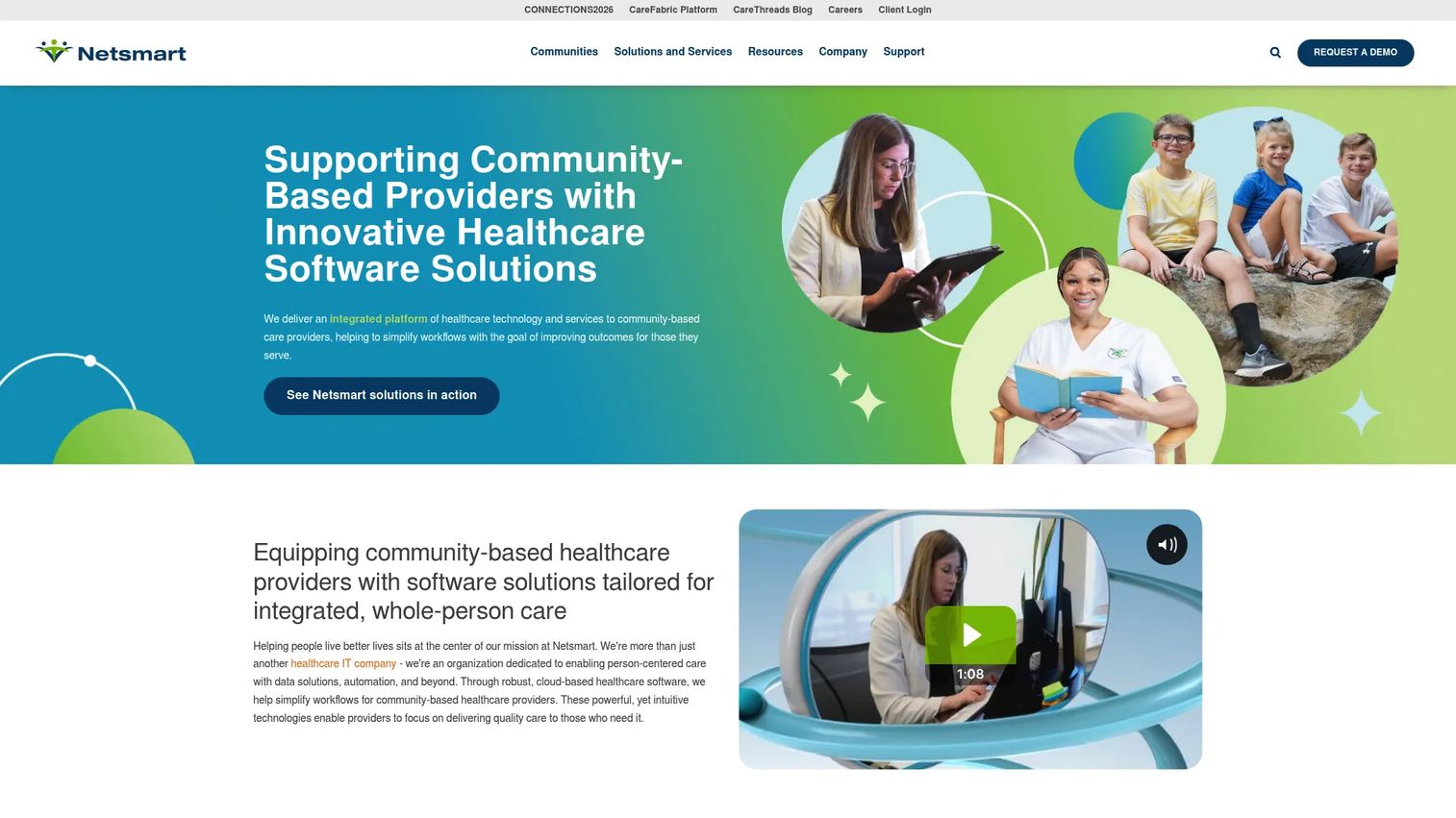
Netsmart builds healthcare software and services for community-based care organizations, anchored by its CareFabric platform and its myUnity EHR line. Its center of gravity is interoperability and connected care: moving data cleanly between providers, settings, and systems so care coordination does not depend on manual re-entry.
Best for: Community-based healthcare providers that need integrated clinical and administrative software with strong data exchange.
Key strengths
- Integrated CareFabric platform: unifies clinical, operational, and interoperability functions under one framework.
- EHR and practice management: covers documentation and administrative workflows in a single system.
- Interoperability, care coordination, and analytics: connects data across the care network and surfaces insights.
Why choose Netsmart: Buyers who prioritize data exchange, person-centered care, and platform depth over a narrow feature set tend to gravitate here. If interoperability is your top selection criterion because residents move across settings frequently, Netsmart's connected-care focus is the reason to evaluate it. Its G2 rating is 3.6/5, so weigh clinical usability against your specific workflows during a hands-on evaluation.
Netsmart pricing: Netsmart does not expose standard product pricing publicly. Pricing is quote-based and structured around your organization's setting mix, modules, and interoperability needs. Request a direct quote and verify any figures before committing.
4. KLAS Research
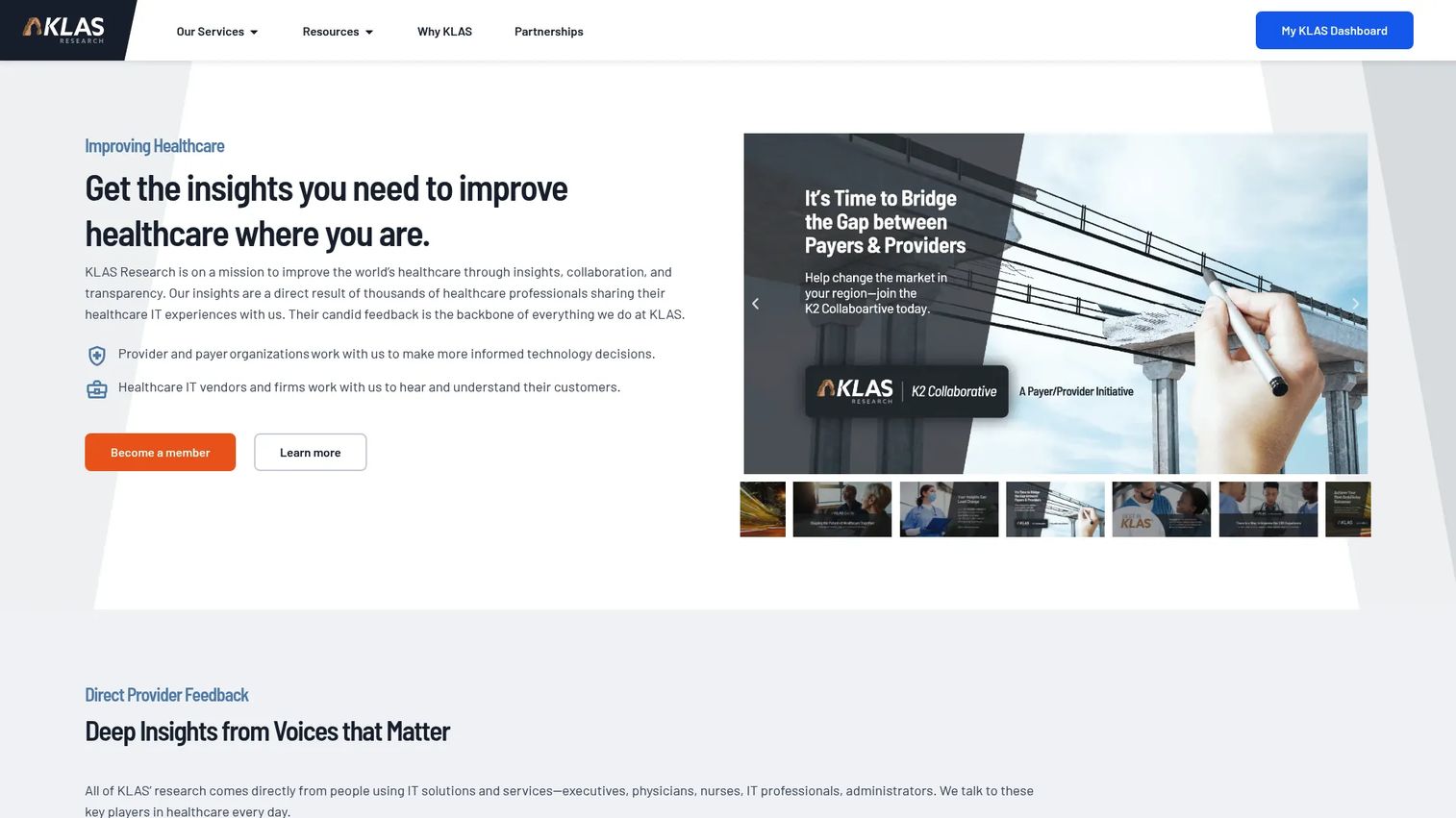
KLAS Research is not an operational system, and that is exactly the point. It is a healthcare IT research firm that publishes independent vendor performance reports, runs the Arch Collaborative benchmarking membership, and offers consulting. For buyers who want external validation before selecting an EHR or care platform, it is decision-support infrastructure.
Best for: Healthcare organizations and vendors seeking independent healthcare IT research and benchmarking before a purchase.
Key strengths
- Healthcare IT research reports: scored vendor performance based on real customer feedback.
- Arch Collaborative membership and benchmarking: compares your outcomes and clinician experience against peers.
- Healthcare consulting services: turns research into selection and implementation guidance.
Why choose KLAS Research: Treat this as a resource, not a replacement for hands-on evaluation. If your board or leadership wants third-party proof before signing a multi-year contract, KLAS scores and benchmarks give you defensible external validation. It pairs well with a shortlist of operational vendors from this list.
KLAS Research pricing: KLAS does not publish general software-style pricing. Its Arch Collaborative Standard Membership is priced by organization size: ambulatory clinics (11-75) start around $20,600 for a one-year membership or $16,400 as a three-year locked annual rate, and hospitals (1-250 beds) start around $22,700 for one year or $17,500 locked over three years. Larger or custom organizations require a quote.
5. ECP
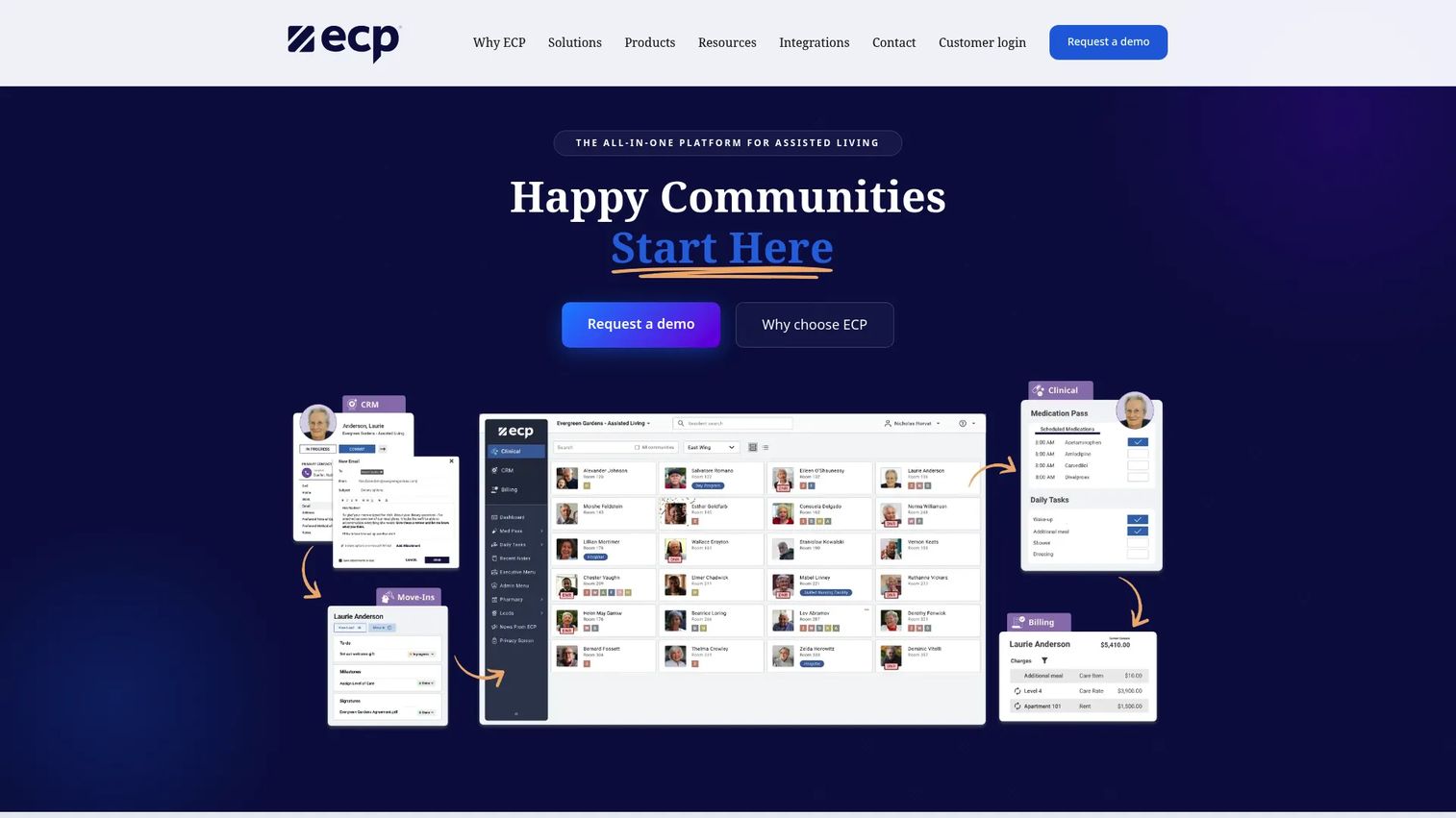
ECP is web-based assisted living software that unifies care, operations, CRM, move-ins, and billing in a single system. Its appeal is all-in-one simplicity for assisted living and senior living operators who want clinical documentation, medication management, and financials working together without stitching together separate tools.
Best for: Assisted living and senior living operators, including smaller and mid-sized communities, that want an easier all-in-one clinical and billing platform.
Key strengths
- eMAR medication administration and safety checks: reduces med errors with built-in verification.
- EHR and care plans: keeps resident records and care documentation unified.
- Billing with automated charge capture: pulls charges directly from clinical documentation to reduce leakage.
Why choose ECP: For assisted living operators who found enterprise-scale platforms heavier than they need, ECP's unified record and automated charge capture make it a strong fit. The tight link between clinical documentation and billing is especially useful for communities that want fewer moving parts. Its G2 rating is 4.8/5, the highest on this list, which reflects strong operator satisfaction.
ECP pricing: ECP does not publish public pricing. The company states that pricing is based on community size and the modules you select, so it is quote-based. Request a tailored quote and verify current terms before deciding.
6. MatrixCare
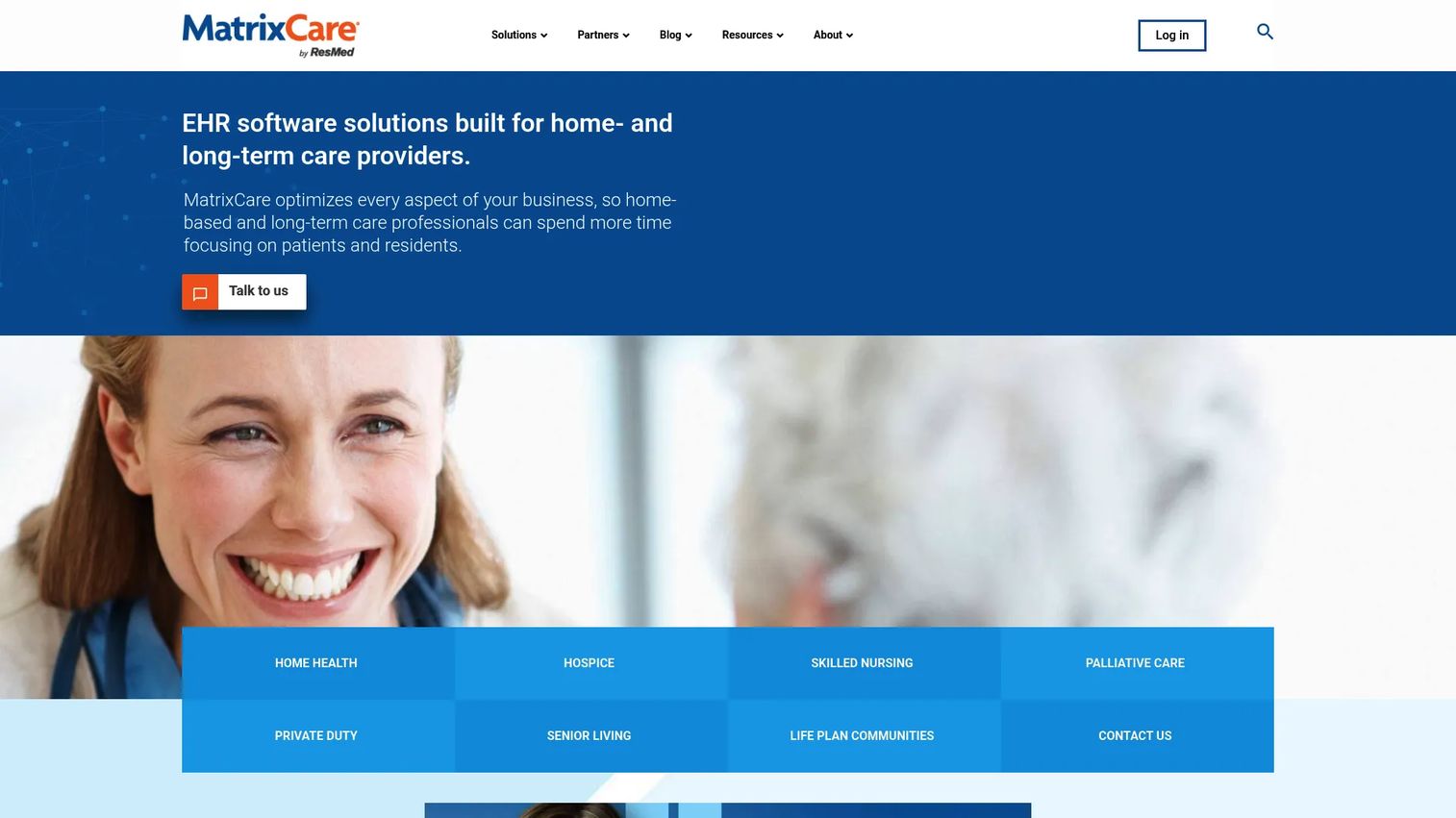
MatrixCare provides EHR and related software across post-acute, senior living, home health, hospice, and long-term care. Its positioning centers on life plan communities, CCRCs, and broad senior care management, with messaging around AI and machine learning applied to resident care and operations.
Best for: Healthcare providers that need post-acute and senior care software spanning multiple settings.
Key strengths
- Home health and hospice EHR: covers community-based and end-of-life care documentation.
- Skilled nursing software: supports high-acuity SNF clinical and operational workflows.
- Senior living and life plan community workflows: handles the operational complexity of CCRCs.
Why choose MatrixCare: For organizations balancing resident care, finance, and operations across a mixed portfolio, MatrixCare's breadth across settings is the draw. If you run life plan communities or CCRCs alongside skilled nursing, having one vendor cover those settings reduces integration overhead. Its G2 seller rating is 3.8/5, so validate the specific modules you need against your live workflows.
MatrixCare pricing: MatrixCare does not publish public pricing on its own site. Pricing is quote-based and depends on your setting mix and selected modules. Contact the vendor for a tailored quote and verify figures before committing.
7. Yardi Senior Living Suite
Yardi Senior Living Suite brings resident care, marketing, sales, finance, and business intelligence onto a single integrated platform. Yardi's heritage in property and financial management shows here: this is senior living software for operators who want broad community management, not just a clinical point tool.
Best for: Senior living operators that need an integrated operations and care platform spanning finance, sales, and clinical.
Key strengths
- Community management and financial accounting: runs operations and finance alongside resident services in one platform.
- CRM for lead management and electronic leases: handles sales, communications, and leasing end to end.
- EHR, eMAR, and clinical reporting: covers resident care documentation and clinical reporting.
Why choose Yardi Senior Living Suite: If your priority is broader senior living management, with finance, sales, marketing, and care unified, Yardi's operations-first breadth is appealing. It fits operators who see the community as a business to run, not only a clinical setting to document. Its G2 rating is 3.6/5, so pressure-test the clinical modules specifically during your evaluation.
Yardi Senior Living Suite pricing: Yardi does not publish public pricing for the suite; the site directs buyers to sales rather than posted prices, so pricing is quote-based. Request a quote and verify current terms before you commit.
Considerations
Match the software to the care setting
The single biggest mistake is buying breadth you don't need or depth you do. A platform tuned for skilled nursing may feel heavy for a small assisted living community, and a lightweight assisted living tool may not handle high-acuity SNF workflows. Confirm the vendor is genuinely built for your setting mix: SNF, assisted living, CCRC, or a blend.
Verify workflow coverage, not just feature breadth
Feature lists sell demos; workflows run facilities. Make sure the platform handles resident charting, admissions and transfers, medication management, quality reporting, and billing at the depth your teams actually need. A tool that checks every box shallowly can still leave nurses doing manual work.
Check interoperability and integrations
Ask how cleanly the system exchanges data with labs, pharmacies, hospitals, and your revenue cycle tools. Interoperability is what prevents lost handoff data when residents move between settings. If a vendor is vague here, treat that as a signal to dig deeper.
Confirm implementation and support model
Look for onboarding, training, and ongoing support that matches your operational maturity. A powerful platform your staff never fully adopts is a sunk cost. Ask for a realistic implementation timeline and references from facilities like yours.
Review reporting, compliance, and audit readiness
Ask how the tool supports quality and compliance reporting, documentation consistency, and survey readiness. The right platform makes audits routine instead of a scramble. Confirm it timestamps documentation and keeps records audit-ready across sites and shifts.
Conclusion
There is no single winner in long term care software, only the right fit for your care setting, workflow complexity, and how much platform breadth you need. WellSky leads for broad continuum coverage. PointClickCare is the strong pick for SNFs and clinical visibility. ECP fits assisted living operators wanting an easy all-in-one. KLAS Research gives benchmark-driven buyers independent validation. Netsmart stands out for interoperability, while MatrixCare and Yardi Senior Living Suite cover mixed-facility and operations-heavy needs.
The practical next step: shortlist two or three vendors that match your setting mix, then validate them against your live workflows, not the sales demo. Run your real charting, med pass, admissions, and billing scenarios through each. The platform that holds up under your actual operations, and that your staff will adopt, is the one worth signing.
FAQs
It supports resident charting, care coordination, medication management, compliance and quality reporting, resident data, and facility operations. In practice, it replaces manual and fragmented processes with a shared system of record that connects clinical, financial, and operational workflows across a facility or network.
A long term care EHR is the clinical documentation core: charting, care plans, assessments, and med records. Long term care software is usually broader and may bundle the EHR with operations, admissions, billing, revenue cycle, CRM, and management layers. Many platforms on this list combine both, which is why the terms often overlap.
There is no universal winner, but PointClickCare is a frequent shortlist entry for skilled nursing facility software because of its point-of-care clinical visibility and care-transition network. MatrixCare also covers high-acuity SNF workflows. The best choice depends on your acuity mix, integration needs, and how much operational breadth you want alongside clinical depth.
ECP is built specifically for assisted living and senior living, unifying eMAR, EHR, CRM, move-ins, and billing in one system, which suits smaller and mid-sized operators. Yardi Senior Living Suite fits larger senior living operators that want finance, sales, and care on one platform. Match the tool to your community size and operational complexity.
Most long-term care platforms use quote-based pricing that depends on care setting, resident census, and the modules you select. Public figures are rare: KLAS Research publishes Arch Collaborative membership pricing starting around $16,400 per year, and WellSky lists a Learning Center LMS at $205 per year, but core platform pricing across these vendors requires a direct quote.
Yes, most platforms include medication management, and many offer eMAR with safety checks and automated verification. Depth varies by vendor: ECP and PointClickCare emphasize medication workflows, while others treat it as one module among many. If med management is a priority, evaluate it hands-on during your trial.
Prioritize care setting fit, workflow depth across charting, admissions, med management, reporting, and billing, interoperability with labs, pharmacies, and hospitals, compliance and audit readiness, and ease of adoption for frontline staff. Then validate your top two or three vendors against real workflows before signing, the same way you'd stress-test any system meant to scale across teams and sites.