Managing health savings accounts at scale gets messy faster than most teams expect. Contributions flow through payroll. Reimbursements route through finance. Eligibility questions land on HR. Members expect a self-service experience that feels like their banking app. When those workflows live in disconnected systems, every open enrollment turns into a reconciliation project and every audit becomes a scramble.
The category is growing fast enough that the operational pain is only getting sharper. There were 40 million HSA accounts by 2026, up 6% year over year, holding $159 billion in total assets according to Truemed. Roughly 61% of those accounts are employer-affiliated, which means benefits teams and platform operators are carrying most of the administrative load. The right health savings account software turns that load into a repeatable process instead of a quarterly fire drill.
That is the real buying problem. You are not just picking an account provider. You are choosing the operating system for contributions, reimbursements, reporting, and member support across multiple stakeholders. If you are already thinking about how software reduces manual work across your stack, the same evaluation logic that applies to contract lifecycle management and customer data platforms applies here: fewer tools, cleaner signal, less founder or admin time spent stitching things together.
What's inside
This guide covers seven HSA platform options for employers, benefits teams, and platform operators who need a better way to administer accounts, process reimbursements, support tax-compliant savings, and connect to existing systems. It is written for the person accountable for whether the process actually scales, not just whether accounts get opened.
We selected and compared each tool on six criteria that matter in procurement:
- Administration depth (contribution controls, eligibility, plan configuration)
- Reimbursement workflow (receipt upload, claims, expense tracking)
- Reporting and tax compliance
- Integration support (payroll, HRIS, and API integration)
- Investment options for account growth
- Usability across employers and members
TL;DR
- Best overall for automation and embedding: Elevate, an AI-driven HSA administration software with instant claims, real-time reimbursements, and embeddable APIs.
- Best for employer administration and custodial trust: HSA Bank, a long-standing custodian with investment options and broad benefits account support.
- Best for scale and a mature benefits ecosystem: HealthEquity, with deep account administration and strong employer workflows.
- Best for member experience and fee transparency: Lively HSA, a user-friendly platform that individuals and employers both rate highly.
- Best for a single benefits and payments vendor: WEX, covering benefits administration alongside a broader payments ecosystem.
- Best for flexible, modern benefits programs: Forma and Benepass, for teams that want configurable spending accounts and reimbursement workflows in one place.
What is HSA software?
HSA software is a platform that lets employers and account holders open, fund, administer, reimburse, invest, and report on health savings accounts in one system. It sits at the intersection of benefits administration and tax-advantaged savings, automating the workflows that would otherwise route manually through payroll, finance, HR, and member support.
An HSA is a tax-advantaged account tied to a high-deductible health plan. The money goes in pre-tax, grows tax-free, and comes out tax-free for qualified medical expenses. The software's job is to make every step of that lifecycle reliable and auditable. Good HSA management software handles the following:
- Account setup and onboarding: identity verification, HSA onboarding, and eligibility checks so new accounts open without manual review.
- HSA contribution management: payroll-synced deposits, employer and employee contribution tracking, and IRS limit enforcement.
- HSA reimbursement processing: receipt upload, expense tracking, claims review, and fast payouts for qualified expenses.
- HSA reporting and tax compliance: contribution records, tax forms, and audit-ready reporting.
- HSA integrations: payroll integration, HRIS connections, and API integration into existing benefits and finance systems.
- HSA investment management: brokerage and fund options so balances can grow beyond cash.
- HSA mobile app and self-service account management: balance checks, card controls, and receipt submission from a phone.
- Audience fit: the same platform often serves employers, financial institutions, and benefit platforms with different needs.
That last point matters. The strongest HSA benefits platform supports multi-stakeholder use cases, giving employers admin control, members self-service, and finance clean reporting from one source of truth.
When to use HSA software
Not every organization needs the same thing from an HSA platform. Here is how to pattern-match your situation.
Administer HSAs without manual back-office work
If your team is reconciling contribution files by hand or chasing eligibility questions across email threads, you need administration automation. Look for payroll-synced HSA contribution management, automated file syncs, and plain-language reporting that survives an audit. This is where the operational drag disappears.
Reimburse employees and track qualified expenses
When members submit receipts and expect fast payouts, HSA reimbursement processing becomes the workflow that defines member satisfaction. Prioritize receipt upload, expense tracking, and claims automation. Instant or near-instant approvals reduce support tickets and keep the queue clear.
Offer a more modern member experience
Members compare your HSA mobile app to their banking app, not to your old benefits portal. If adoption is low, a cleaner self-service account management experience often fixes it faster than more education. Ease of use drives engagement, and engagement drives retention.
Embed HSA capabilities into a broader platform
If you are a fintech operator or benefits platform, you may not want to build HSA infrastructure from scratch. A white-label HSA platform with API integration lets you embed account opening, contributions, and reimbursements into your own product. This is where cloud-based HSA software with embeddable APIs earns its place.
Comparison table
Row order reflects relevance to the keyword and decision-making utility. Where a vendor does not publish pricing, that is noted rather than estimated.
| # | Product | Intent | Key differentiation | Pricing | G2 rating |
|---|---|---|---|---|---|
| 1 | Elevate | Automated HSA administration and embedding | AI-driven claims, real-time reimbursements, embeddable APIs | Sales-led, not public | Not published |
| 2 | HSA Bank | Custodial HSA administration | Long-standing custodian with investment options | HSA Invest fees from 0.10% to 0.35% of assets | Not published |
| 3 | HealthEquity | Scaled HSA administration | Mature benefits ecosystem, deep employer workflows | HSA from $2.50 per account/month | 3.5/5 |
| 4 | Lively HSA | Member-friendly HSA experience | Fee-transparent, individual and employer accounts | Free for individuals; $0.00 PEPM with $200/month minimum for businesses | 4.7/5 |
| 5 | WEX | One vendor across benefits | Benefits administration plus a broad payments ecosystem | Not public | Not published |
| 6 | Forma | Flexible benefits and spending accounts | Configurable accounts, card, claims, and rewards | Sales-led, not public | 4.8/5 |
| 7 | Benepass | Modern flexible benefits | Configurable benefits and reimbursement, global reach | LSA from $2.40 PEPM | 4.8/5 |
1. Elevate
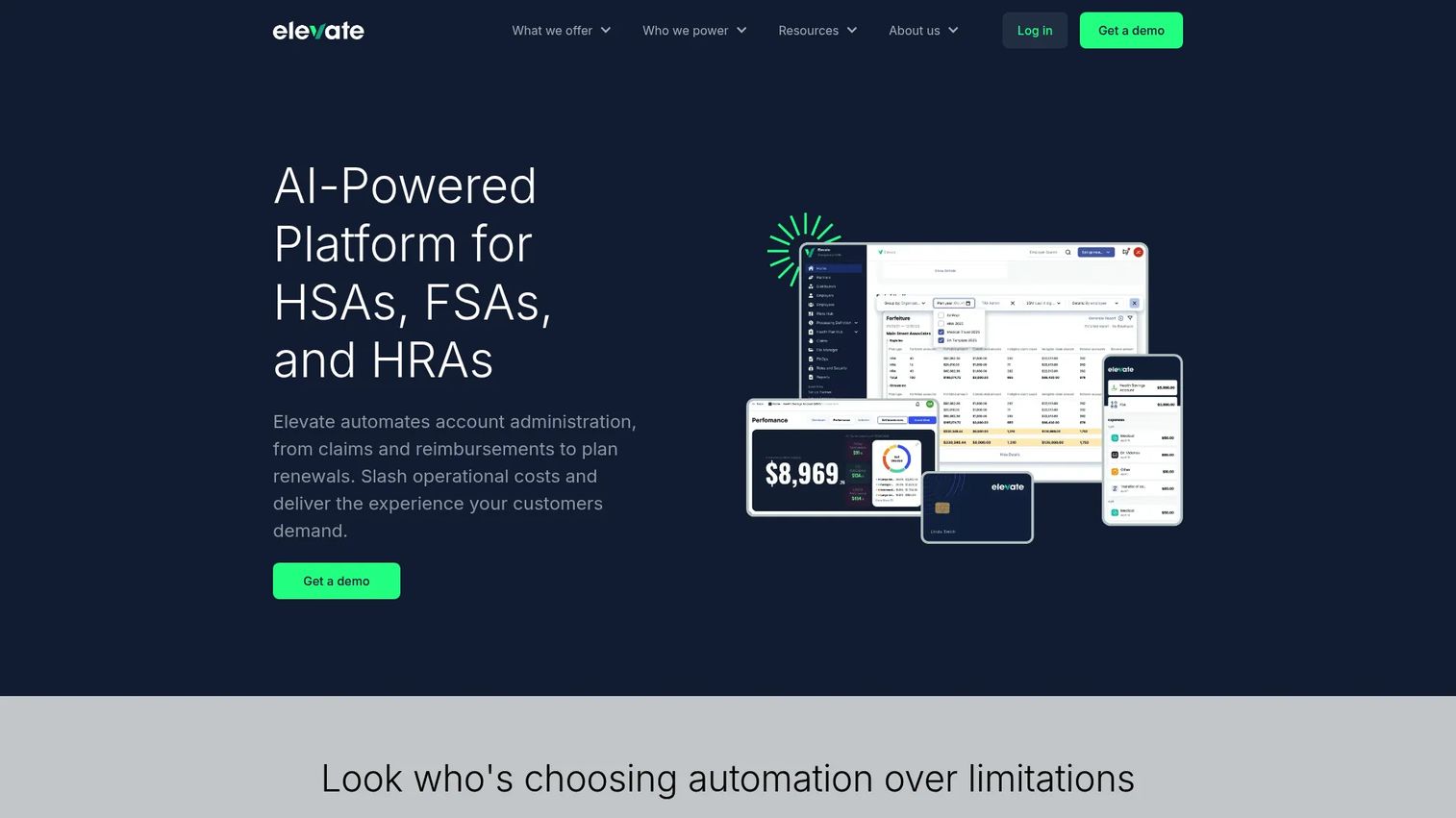
Elevate is an AI-powered benefits administration platform for HSAs, FSAs, and HRAs, built for the operators who carry the administrative load rather than the members using the account. It targets benefits administrators, third-party administrators, health plans, and financial institutions that want automation and embedded experiences instead of yet another portal to manage. If your evaluation is about reducing manual back-office work, Elevate is designed for exactly that job.
The platform leans into instant CIP workflows, so account opening does not stall on manual identity checks. Claims process instantly and reimbursements happen in real time, which is the difference between a member support queue that clears and one that grows. For platform operators, the embeddable RESTful APIs and configurable plan builder mean you can build HSA account management directly into your own product with sub-plan control.
Best for: Benefits administrators, TPAs, health plans, and financial institutions managing consumer-directed benefits at scale.
Key strengths
- Instant claims and real-time reimbursements: Approvals happen fast, cutting the reimbursement queue and reducing member support tickets.
- Embeddable RESTful APIs: A white-label HSA platform foundation for fintechs and benefits businesses that want to embed HSA capabilities natively.
- Configurable plan builder: Sub-plan control lets you tailor contribution rules, eligibility, and plan design without engineering rework.
Why choose Elevate: If your problem is manual administration and you want HSA infrastructure that scales without headcount, Elevate is the automation-first pick. It fits platform operators and benefits businesses that need embedded, cloud-based HSA software rather than a standalone account portal. The AI-driven administration angle is genuine differentiation for teams tired of reconciliation work.
Elevate pricing: Elevate does not publish public pricing. The site directs prospects to request a demo, and it notes that Elevate does not contract directly with employers, which fits its platform and TPA positioning. Expect a sales-led conversation scoped to your account volume and integration needs.
2. HSA Bank

HSA Bank, a division of Webster Bank, N.A., is a long-standing U.S. HSA administrator and custodian. If Elevate is the embed-first platform, HSA Bank is the custodial anchor. It appeals to employers and individuals who want a recognized account experience backed by an actual bank, with the trust and FDIC framing that comes with it. For risk-sensitive benefits teams, that custodial pedigree carries weight in procurement.
The platform covers the full HSA account management lifecycle: account opening, employer support, member education, calculators, and a debit card that works across HSA, FSA, and HRA spending. Investment options let members grow balances beyond cash, positioning HSA Bank as both a spending account and a long-term savings vehicle. The broader benefits account ecosystem means employers can consolidate more than just HSAs under one administrator.
Best for: Employers and individuals who want an established HSA administrator with investment options and custodial trust.
Key strengths
- Custodial trust and FDIC framing: A bank-backed HSA that reassures risk-sensitive benefits teams and members.
- HSA investment management: Tiered investment options so balances can grow beyond a cash account.
- Multi-account support: One debit card and one administrator across HSA, FSA, and HRA spending.
Why choose HSA Bank: Choose HSA Bank when institutional trust and a proven custodial track record matter more than a modern embedded API layer. It is a strong fit for employers who prioritize a well-known, bank-backed member experience and want investment options built in.
HSA Bank pricing: HSA Bank does not publish a public price for opening or maintaining the account itself. Its HSA Invest program lists annual asset-based fees: 0.10% for Choice, 0.25% for Select, and 0.35% for Managed, billed quarterly. Those fees may be waived when the average HSA cash balance is $7,500 or more for the quarter.
3. HealthEquity

HealthEquity is a mature HSA and consumer-directed benefits platform serving employers, brokers, and members at scale. Where a boutique platform might win on speed, HealthEquity wins on breadth and track record. It administers HSAs alongside FSAs, HRAs, and commuter benefits, which makes it a fit for larger organizations that want one provider across the full benefits picture.
The platform covers HSA account administration, savings growth, member support, and investment features, plus employer workflows for enrollment and contribution management. A mobile app gives members balance visibility, card controls, receipt upload, and investment tools in one place. For a benefits team managing thousands of accounts, that consolidation and scale is the core value.
Best for: Employers and brokers who need HSA administration inside a broad, established consumer-directed benefits ecosystem.
Key strengths
- HSA administration at scale: Built to handle large employer populations with mature enrollment and contribution workflows.
- Broad benefits coverage: HSA, FSA, HRA, and commuter benefit support under one platform.
- Member mobile app: Balance, card, receipt upload, and HSA investment management tools in one place.
Why choose HealthEquity: Choose HealthEquity when scale, trust, and a broad benefits ecosystem outweigh the desire for a lean, single-purpose tool. It is a strong fit for mid-market and enterprise employers who want one provider across HSA and adjacent benefit accounts, with reporting that holds up under scrutiny.
HealthEquity pricing: HealthEquity publishes HSA pricing for employers and brokers. The Standard HSA runs $2.50 per account per month, the Fee waiver HSA runs $3.95 per account per month, and a health plan integrated HSA is priced by the health plan. Other product types on the site route to sales. It holds a 3.5/5 rating on G2.
4. Lively HSA
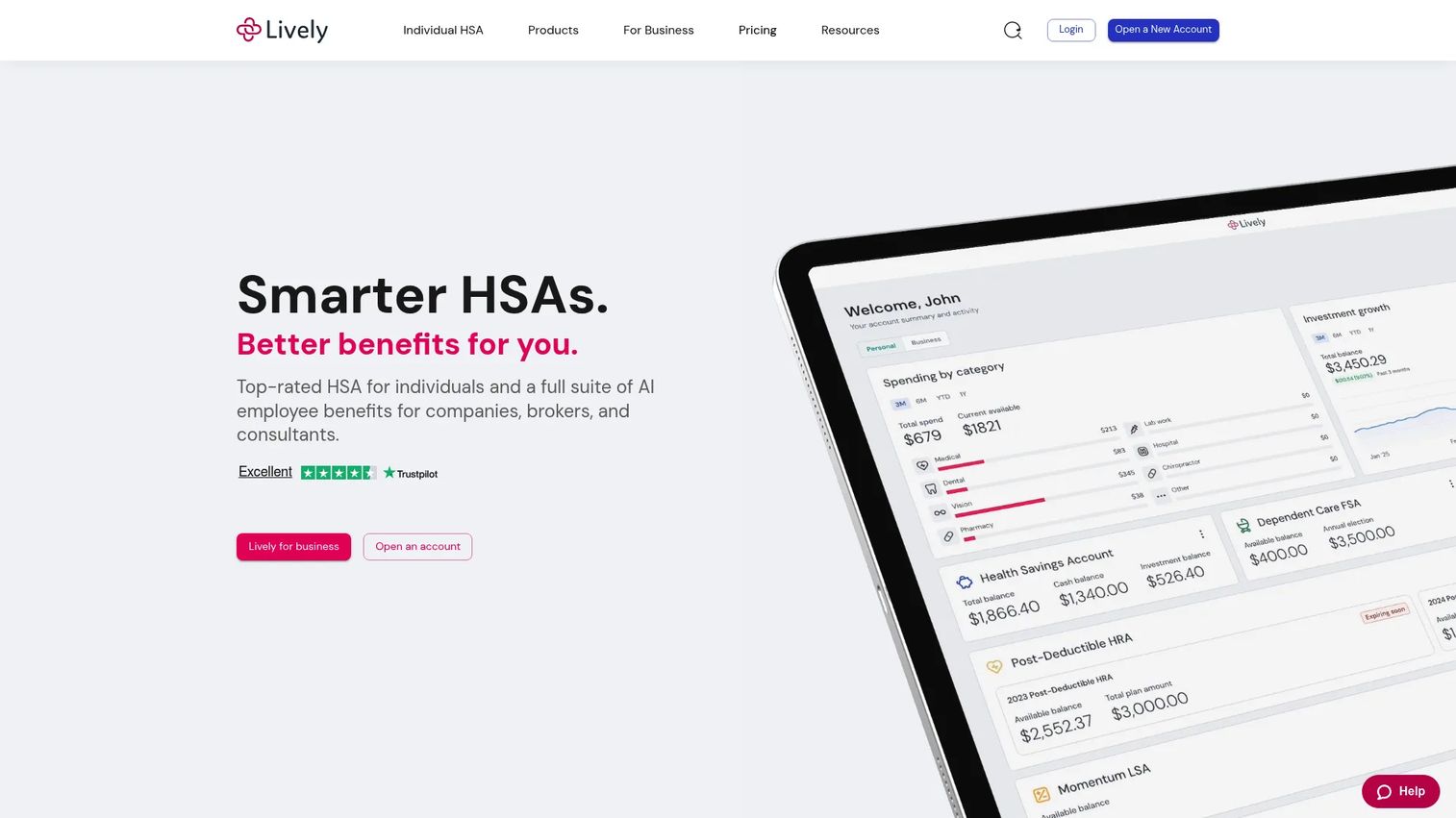
Lively HSA is a health savings account platform for individuals, families, and employers, built around a clean, user-friendly experience and transparent fees. If member adoption is your problem, Lively is the platform that consistently earns high marks from the people actually using the account. Its 4.7/5 G2 rating reflects that member-facing polish.
For employers, Lively offers an administration dashboard, automated file syncs, and plain-language reporting that reduces manual reconciliation. Members get debit card spending, reimbursement, contribution tracking, and eligibility scanning through a marketplace. Investment options run through Schwab and Devenir, so balances can grow beyond cash. Lively HSAs are FDIC-insured and use bank-grade security, which pairs modern UX with the trust framing benefits teams expect.
Best for: Individuals, families, and employers who want a fee-transparent HSA platform that members actually enjoy using.
Key strengths
- Fee transparency: Free for individuals and families, with clear, published pricing for businesses.
- Hands-off administration: Automated file syncs and plain-language reporting cut manual reconciliation for employer teams.
- HSA investment management: Investment access through Schwab and Devenir for long-term savings growth.
Why choose Lively HSA: Choose Lively when member experience and fee transparency are the deciding factors. It is a strong fit for teams that want high adoption without a heavy administrative burden, and for individuals who want a free, well-rated HSA. The self-service account management experience is a differentiator here.
Lively HSA pricing: Individuals and families use Lively for $0.00. Businesses are listed at $0.00 per employee per month (PEPM), subject to a $200 monthly minimum. Optional investment-related fees apply: a $24 annual fee or $3,000 minimum cash balance for Schwab brokerage access, and 0.50% annually for the HSA Guided Portfolio. It holds a 4.7/5 rating on G2.
5. WEX
WEX is a global commerce platform spanning fleet cards, business payments, and employee benefits administration. Its HSA capability sits inside a much larger fintech footprint, which makes it interesting for companies that want to consolidate vendors rather than manage a benefits-only tool. If you are already thinking about reducing tools while increasing signal, WEX is the one-vendor-across-benefits play.
On the benefits side, WEX provides administration breadth, employee support, and integrations into broader HR and finance systems. The employee experience runs through a website and debit card spending model that keeps day-to-day HSA account management simple for members. For a company that values a single vendor across multiple benefits workflows, WEX's payments infrastructure is a genuine differentiator.
Best for: Companies that want one vendor across benefits administration and payments infrastructure.
Key strengths
- Benefits administration breadth: HSA support alongside a wider set of employee benefits workflows.
- Payments ecosystem: Fleet, business payments, and benefits under one fintech platform for vendor consolidation.
- Member card spending: A debit card and web experience that keeps everyday HSA reimbursement processing straightforward.
Why choose WEX: Choose WEX when consolidation is the priority and you would rather run benefits, payments, and card programs through a single fintech partner. It fits companies that value one relationship and integrated payments over a narrow, HSA-only tool.
WEX pricing: WEX does not publish a public price on its main U.S. product pages, which route to contact-us and product overview content instead. Pricing is scoped through a sales conversation based on your benefits and payments footprint.
6. Forma
Forma is a flexible employee benefits platform covering lifestyle spending accounts, pre-tax accounts, HRAs, claims, and rewards. It sits adjacent to pure HSA administration but earns a place here for teams building modern, configurable benefits programs where HSA-related accounts are one part of a broader spending-account strategy. Its 4.8/5 G2 rating signals strong satisfaction with that flexible approach.
The platform centers on customizable benefit administration, the Forma Card for employee spending, and claims administration with reimbursement. A Forma Store and rewards layer extend it beyond compliance into engagement, while HRIS, payroll integration, and benefits integrations keep it connected to your existing stack. For benefits teams that want configurability and a modern user experience, Forma is built for exactly that.
Best for: Employers building a global, flexible benefits program with spending accounts and claims administration in one place.
Key strengths
- Configurable benefit administration: Tailor spending accounts and programs to your specific benefits design.
- Forma Card and claims: Employee spending and reimbursement workflows with claims administration built in.
- Stack integrations: HRIS, payroll, and benefits integrations that connect to your existing systems.
Why choose Forma: Choose Forma when your priority is flexibility and a modern experience across a broad set of accounts, not just standalone HSAs. It fits teams that want to configure benefits to their program and value a polished, engagement-forward member experience.
Forma pricing: Forma does not publish public pricing. The site offers demo and assessment calls rather than a public price, so expect a sales-led conversation scoped to your program design and headcount. It holds a 4.8/5 rating on G2.
7. Benepass
Benepass is a flexible benefits management platform for employers, built around configurable programs, card-based spending, and reimbursement workflows. Like Forma, it serves broader benefits stacks rather than HSA administration alone, which makes it a fit for modern HR teams that want one platform to fund and manage a range of benefits. Its 4.8/5 G2 rating reflects strong employer sentiment.
The platform provides physical and virtual cards, reimbursements, HRIS and payroll integrations, engagement and spending analytics, and automated enrollment and compliance. That combination keeps admin simple while giving finance the reporting and controls it needs. With clients across many countries and a large volume of card transactions processed, Benepass is built to scale reimbursement and spending workflows globally.
Best for: Modern HR teams that want a configurable, global benefits platform with reimbursement and card spending built in.
Key strengths
- Configurable benefits: Fund and manage a range of benefits from one platform, tailored to your program.
- Reimbursement and card spending: Physical and virtual cards plus reimbursement workflows with automated approvals.
- Analytics and compliance: Spending analytics, automated enrollment, and compliance controls for finance and HR.
Why choose Benepass: Choose Benepass when you want a modern, configurable benefits platform that handles reimbursement and card spending across a global workforce. It fits HR teams that value admin simplicity and clean engagement analytics over a single-purpose HSA custodian.
Benepass pricing: Benepass does not expose a full public pricing table. Its lifestyle spending account page lists $2.40 PEPM and notes that pricing varies, directing prospects to request a proposal. It holds a 4.8/5 rating on G2.
Considerations before you buy
A comparison table narrows the field. These criteria decide the shortlist. Before you commit, pressure-test each candidate against your actual workflow.
Administration and contribution automation
The core job is removing manual back-office work. Verify how the platform handles payroll-synced HSA contribution management, eligibility checks, and file reconciliation. If your team is still exporting and importing files by hand, you have not solved the problem you are paying to solve.
Reimbursement speed and expense tracking
Reimbursement is where members judge you. Test the receipt upload flow, claims review, and how fast qualified expenses get paid. Slow or manual reimbursement generates support tickets and erodes trust, so treat approval speed as a first-class evaluation criterion.
Reporting and tax compliance
HSAs are regulated and audit-sensitive. Confirm the platform produces contribution records, tax forms, and audit-ready HSA reporting and tax compliance without manual assembly. Clean reporting is what keeps an audit from becoming a project.
Integrations and API depth
Your HSA platform has to fit the stack you already run. Check for payroll integration, HRIS connections, and API integration depth if you plan to embed HSA account management into your own product. Shallow integrations push work back onto your team.
Member experience and adoption
Adoption is the metric behind every other number. Evaluate the HSA mobile app, self-service account management, and how intuitive the everyday experience feels. A well-rated member experience drives the engagement that makes the whole program worth running.
Conclusion
The right HSA software depends on which job you are solving. For automated administration and embedded, API-driven experiences, Elevate is the clearest fit. For custodial trust and a bank-backed account, HSA Bank leads. HealthEquity wins on scale and a broad benefits ecosystem, while Lively HSA stands out for member experience and fee transparency. WEX is the pick when you want one vendor across benefits and payments, and Forma and Benepass suit modern teams that want flexible, configurable benefits with reimbursement and card spending built in.
The next step is practical. Map your own workflow requirements against the comparison table above, then shortlist based on the criteria that carry the most weight for you: integrations, reimbursement speed, reporting, and member experience. HSA software is a regulated, trust-sensitive category, so favor specificity over hype and validate every claim against your real operational needs before you sign.
FAQs
HSA software is used to open, fund, administer, reimburse, invest, and report on health savings accounts in one system. Employers use it to automate HSA contribution management and eligibility, finance uses it for reporting and tax compliance, and members use it for self-service account management, receipt upload, and card spending. The goal is turning a manual, multi-team process into a repeatable one.
Core features are account setup and onboarding, contribution management, HSA reimbursement processing, reporting and tax compliance, integrations, investment options, and a mobile app. The strongest HSA administration software also supports payroll integration, expense tracking, and self-service account management so employers, finance, and members each get what they need from one source of truth.
A member submits a qualified expense, usually through receipt upload in a mobile app or web portal. The platform reviews the claim, checks it against eligibility and IRS rules, and pays the reimbursement from the HSA balance. Faster HSA reimbursement processing, sometimes instant, reduces support tickets and improves member satisfaction, which is why approval speed is a key evaluation criterion.
Yes. Most HSA platforms offer payroll integration and HRIS connections so contributions sync automatically and eligibility stays current. Platforms with strong API integration also let fintech operators and benefits businesses embed HSA account management directly into their own products, which is essential for a white-label HSA platform strategy.
It depends on scale and priorities. HealthEquity fits larger employers wanting a broad benefits ecosystem, HSA Bank fits those prioritizing custodial trust and investments, and Lively HSA fits teams that want fee transparency and high member adoption. For automated, embeddable employer HSA software, Elevate is built for platform operators and administrators.
HSA Bank, HealthEquity, and Lively HSA all offer HSA investment management. HSA Bank provides tiered investment options with asset-based fees, HealthEquity includes investment tools in its member app, and Lively HSA offers investing through Schwab and Devenir. Investment support matters because roughly 46% of all HSA assets are now invested, per Truemed and Devenir data.
Not exactly. HSA software focuses specifically on health savings account administration, contributions, reimbursements, and compliance. Benefits administration software is broader, covering multiple benefit types. Platforms like WEX, Forma, and Benepass blur the line by offering HSA-related accounts inside a wider benefits and spending-account platform, which suits teams that want to consolidate vendors.