Your roadmap depends on data your team does not own. That is the quiet tax every product manager pays when building fintech features, embedded finance workflows, investing tools, or AI-powered analytics. Getting an API key is the easy part. The harder questions come later: Does this provider cover the banks your users actually hold accounts at? How stale is the data? What happens to activation rates when verification fails for 8% of users? Who owns the consent renewal, and how does that affect your release cadence?
The global financial data APIs market was valued at $2.85 billion in 2025 and is forecast to reach $8.20 billion by 2033, according to Verified Market Research (2026). That growth is being driven by fintech infrastructure builds, open banking mandates, and AI agents that need structured, auditable financial data. Choosing the wrong provider creates engineering rework, support load, and compliance risk. Choosing well shortens time to first value and keeps the engineering cost manageable as you scale.
This guide compares 17 financial data APIs across banking connectivity, market data, SEC filings, and AI-agent workflows.
What's inside
- Coverage: APIs spanning banking data, open banking, market prices, fundamentals, SEC filings, and alternative datasets
- Evaluation criteria: Coverage depth, data freshness, provenance and auditability, developer experience, and verified pricing
- Who it's for: Product managers, data leads, and engineering teams building fintech, investing, lending, embedded finance, or AI data products
- Selection method: Each provider was chosen for category relevance, documentation quality, integration fit, and pricing transparency. G2 ratings are verified from live listings; providers with no G2 listing are marked N/A
TL;DR
- Best for consumer-permissioned banking data: Plaid, with broad bank connectivity and account-linking workflows across more than 12,000 institutions
- Best for payments-adjacent account verification: Stripe Financial Connections, purpose-built for Stripe-centric stacks
- Best for AI agents and SEC filing provenance: Financial Datasets, with structured statements, citations, and historical datasets
- Best for real-time market data: Polygon.io (now operating as Massive), from free end-of-day feeds to real-time commercial tiers
- Best affordable entry for stock and fundamentals data: Alpha Vantage and Financial Modeling Prep, both with free tiers for early validation
- Best for enterprise market infrastructure: FactSet or LSEG Data and Analytics, both requiring sales-led procurement
What is a financial data API?
A financial data API gives applications programmatic access to financial information, including bank accounts, transaction history, market prices, company fundamentals, SEC filings, payments data, and reference datasets.
Financial data APIs differ fundamentally from one another because they serve different product jobs. A banking connectivity API links to consumer bank accounts through user-permissioned OAuth flows. A market data API streams equity prices and options chains from exchanges. An SEC filings API returns structured income statements sourced directly from EDGAR. Treating them as interchangeable categories is how roadmaps break.
Key capabilities the category covers:
- Data access: Connect to banks, exchanges, filings databases, market feeds, or normalized datasets
- Authentication: OAuth flows, API keys, consent screens, and tokenized account numbers for credential-free access
- Data types: Account balances, transactions, ownership data, market prices, fundamentals, filings, news, and reference data
- Access patterns: Real-time streaming, periodic refreshes, webhooks, and bulk historical retrieval
- Developer experience: REST endpoints, JSON responses, SDKs, API documentation tools, and sandbox environments
- Trust layer: Data provenance, consent timestamps, rate limits, audit trails, uptime SLAs, and correction handling
For PMs, the product risk from a poor provider fit is concrete: Incomplete data causes failed verifications, broken onboarding flows, user confusion, and CS ticket volume. Provenance gaps create problems in AI-generated outputs and regulated workflows. Rate limit surprises produce overages that land in your next finance review.
Adjacent categories include open banking APIs (consumer-permissioned bank account access), market data APIs (exchange-sourced prices and quotes), SEC filing APIs (EDGAR-derived financial statements), and financial datasets (normalized, bulk, or API-accessible datasets for research and modeling).
When to use financial data APIs
Verify accounts and onboard users faster
Bank account verification through consumer-permissioned APIs removes the manual document upload step from onboarding. Users connect their bank account directly, your product confirms ownership and checks balances, and ACH setup completes without CS involvement. For PMs, the measurable outcome is activation rate: Fewer steps means fewer drop-offs at a stage where first-session abandonment is hard to recover.
Power investing, analytics, and AI workflows
Market data, fundamentals, SEC filings, and historical datasets support investing products, financial dashboards, quantitative models, and AI agents. Provenance matters here: When an AI agent returns a revenue figure, a cited source tracing back to the original SEC filing is what separates an auditable output from a hallucination. Historical-as-reported data also matters for backtesting, because restated numbers corrupt model results if you use them in place of the figures that were known at the time.
Build embedded finance and data-rich product experiences
Budgeting apps, lending products, payroll verification, cash-flow underwriting, and business analytics tools all rely on financial data that sits outside your own database. The cash flow management software layer, the categorization engine, or the credit decisioning model all depend on reliable, refreshed data from a provider your engineering team can maintain across release cycles without rebuilding the integration.
Financial data API comparison
Financial data APIs vary by data job. A banking connectivity API does not replace a market data API, and a fundamentals provider does not cover open banking consent flows. Shortlist providers by data type first, then compare coverage depth, latency, documentation, pricing, and compliance requirements.
Pricing and G2 ratings below are verified from live vendor pricing pages and G2 listings.
| # | Product | Best for | Key differentiator | Pricing | G2 rating |
|---|---|---|---|---|---|
| 1 | Plaid | Consumer-permissioned banking data | 12,000+ institution connectivity with OAuth account linking | Custom pricing | 4.2/5 |
| 2 | Stripe Financial Connections | Payments-adjacent account verification | Native Stripe integration with pay-as-you-go data access | From $0.10/API call | N/A |
| 3 | Financial Datasets | AI agents and SEC filing provenance | Citations, historical-as-reported data, structured statements | From $20 one-time | N/A |
| 4 | Yodlee | Enterprise account aggregation | Banking, wealth, and enrichment data for financial institutions | Custom pricing | 1.4/5 |
| 5 | MX | Transaction enrichment and financial wellness | Cleansing, categorization, and actionable financial insights | Custom pricing | 4.7/5 |
| 6 | Finicity | Lending and account verification | Mastercard-backed open banking for lending and cash-flow data | Custom pricing | 3.7/5 |
| 7 | Polygon.io | Real-time and historical market data | Stocks, options, forex, crypto; free to Business and Enterprise tiers | From $0/month | N/A |
| 8 | Alpha Vantage | Affordable stock and indicator data | Free tier with time series, technical indicators, and fundamentals | Free tier available | N/A |
| 9 | Finnhub | Market data plus news and sentiment | Stocks, fundamentals, news, alternative datasets; quarterly billing | From $49.99/month | N/A |
| 10 | Financial Modeling Prep | Fundamentals and company analysis | Statements, ratios, earnings, analyst data; free tier at 250 calls/day | From $0/month | 4.6/5 |
| 11 | Intrinio | Modular financial datasets | Normalized, AI-ready data with SDK and GenAI integrations | From $150/month | N/A |
| 12 | Tiingo | Historical market data and news | Clean historical prices, news, fundamentals, and crypto APIs | From $0/month | N/A |
| 13 | Nasdaq Data Link | Premium and alternative datasets | Marketplace model with free open feeds and à la carte premium data | Free open data available | N/A |
| 14 | IEX Cloud | US market data applications | IEX-ecosystem developer data with G2-verified listing | Custom pricing | 4.5/5 |
| 15 | Twelve Data | Multi-asset global market data | Stocks, forex, crypto, ETFs, and technical indicators; four public tiers | From $0/month | 4.7/5 |
| 16 | FactSet | Enterprise investment data | Institutional market, fundamentals, portfolio analytics, and APIs | Custom pricing | 4.2/5 |
| 17 | LSEG Data and Analytics | Global market infrastructure | Cross-asset data, Reuters news, AI analytics, and enterprise feeds | Custom pricing | 3.8/5 |
Best 17 financial data APIs for 2026
1. Plaid
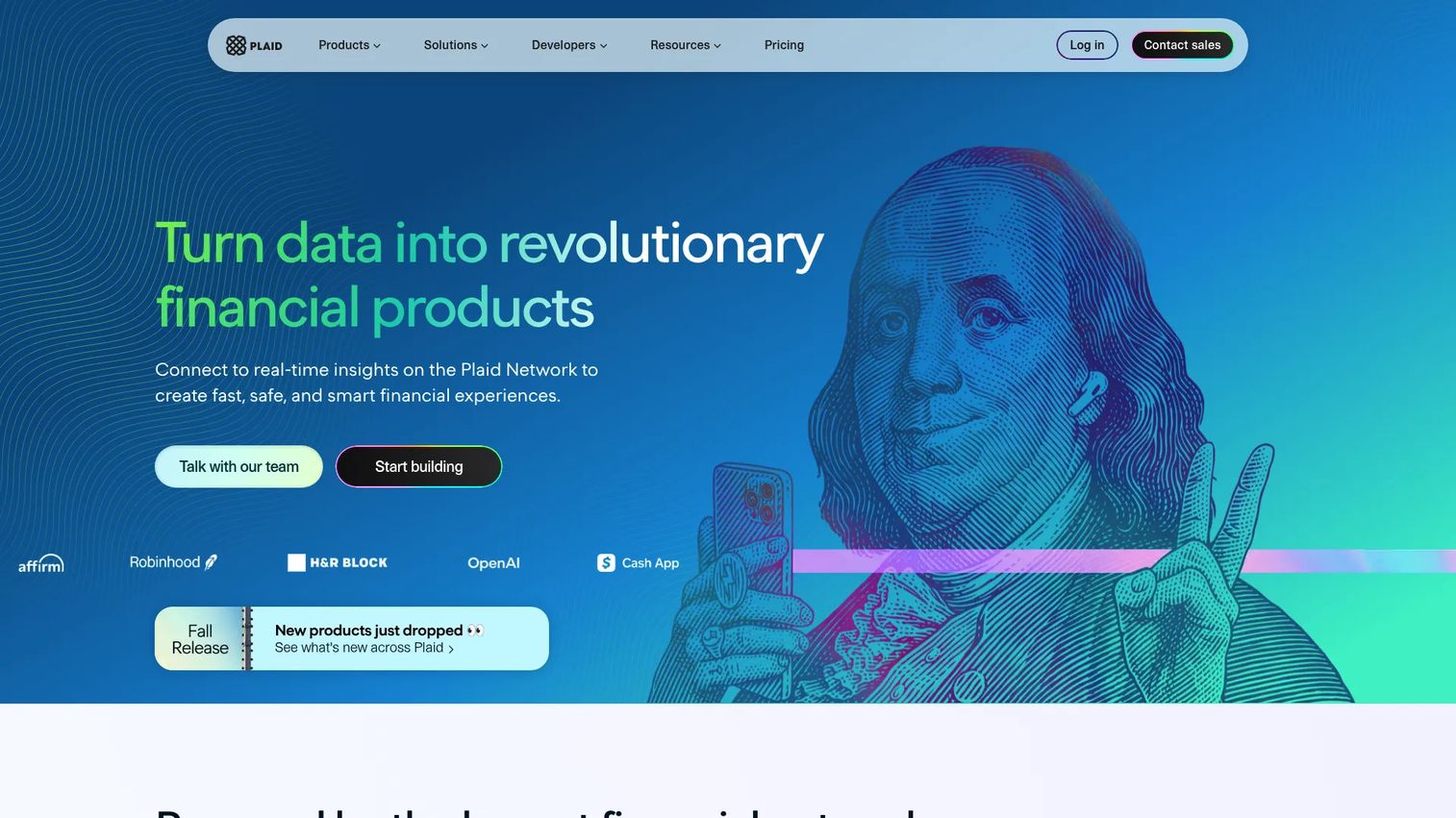
Plaid is a financial data network giving apps programmatic access to bank accounts, transactions, balances, identity data, income verification, and payment infrastructure. It connects to more than 12,000 financial institutions across the US and Canada through user-permissioned OAuth flows, which means your users authorize access without handing over credentials. PMs evaluate Plaid when their activation depends on users linking an external financial account quickly and reliably.
Best for: Product teams building bank-connected consumer or SMB financial products, where account linking is a core onboarding step.
Key features
- Account linking to 12,000+ institutions via OAuth
- Transactions, balances, identity, and liabilities APIs
- Income verification and cash-flow data
- ACH, RTP, and FedNow payment processing
- Fraud detection and AML watchlist screening
Why choose Plaid: Plaid fits when activation depends on account linking and your product needs a range of financial data types from a single provider with broad institution coverage. Evaluate consent renewal behavior, data refresh latency, and pricing at scale before committing to a production rollout.
Plaid pricing: Plaid offers Pay as You Go, Growth (12-month commitment with discounted rates), and Custom plans. Production pricing is usage-based and requires a sales conversation or dashboard access. A free sandbox is available for development, and eligible new US and Canadian teams can access up to 10 Production Items at no cost during a trial period.
G2 rating: 4.2/5
2. Stripe Financial Connections
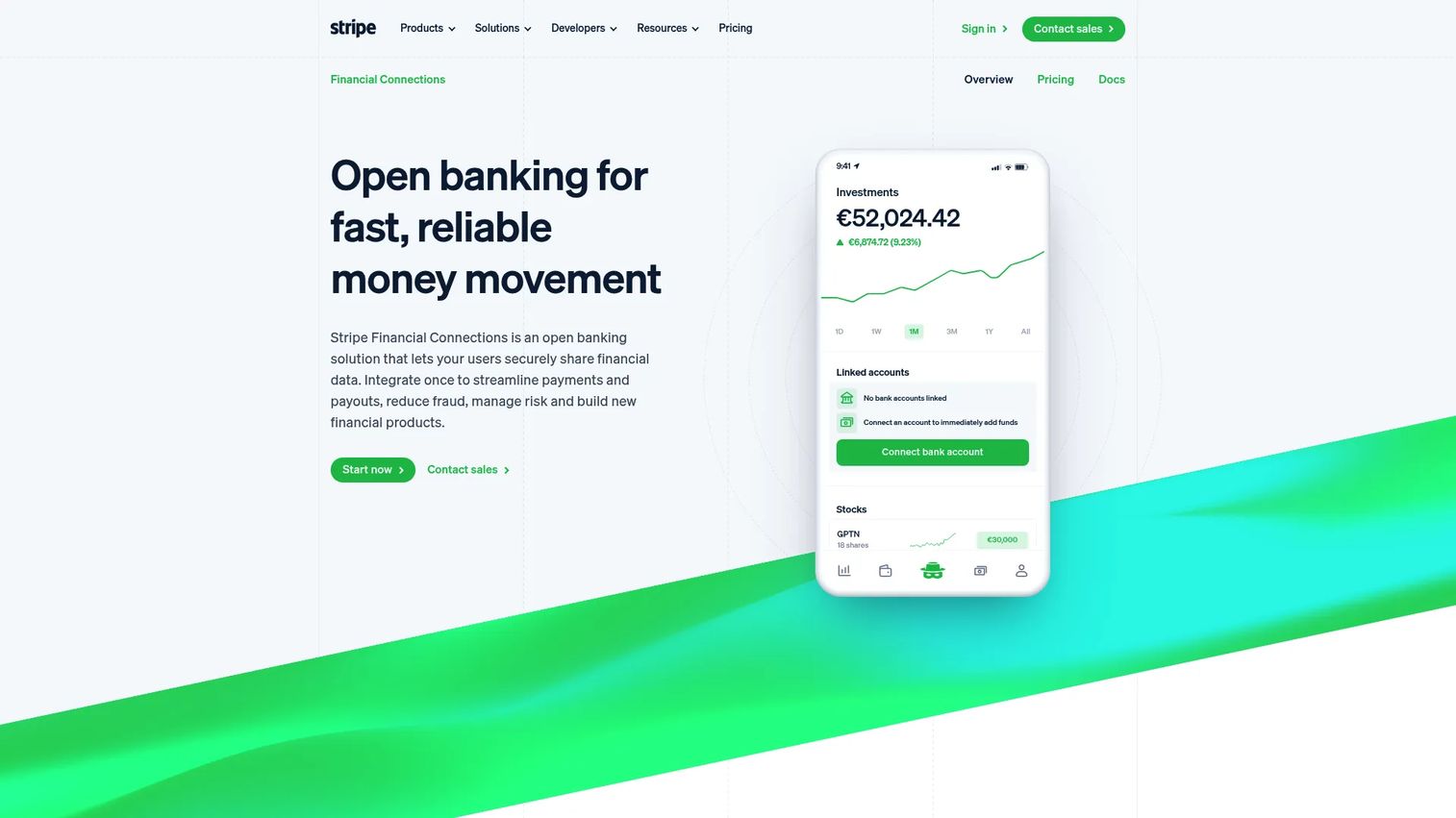
Stripe Financial Connections is Stripe's bank account data product, giving businesses that already run payments through Stripe a way to link accounts, verify ownership, check balances, and pull transaction history, all without leaving the Stripe environment. Its hosted bank-selection and consent flow handles OAuth on your behalf, which reduces engineering work on the authorization layer.
Best for: Teams that already use Stripe and need bank account data inside payment or onboarding flows without integrating a separate banking connectivity provider.
Key features
- Instant bank account verification with tokenized account numbers
- Balance retrieval for underwriting and payment failure prevention
- Account-owner information retrieval
- Automatically updated transaction feeds
- Secure OAuth connections with encrypted data handling
Why choose Stripe Financial Connections: The strongest case is consolidation. If your stack is already Stripe-centric, adding a separate account management software layer creates a second integration to maintain. Stripe Financial Connections removes that overhead. Evaluate whether Stripe's institution coverage and data types match your users' banks before treating it as a complete open banking replacement.
Stripe Financial Connections pricing: Pay-as-you-go across data products. Instant bank account verifications cost $1.50 per verified account. Balance API calls cost $0.10 per successful call. Account owner lookups cost $1.50 per call. Transaction feeds cost $0.30 per institution per account holder per month. Custom pricing is available for high-volume usage.
3. Financial Datasets
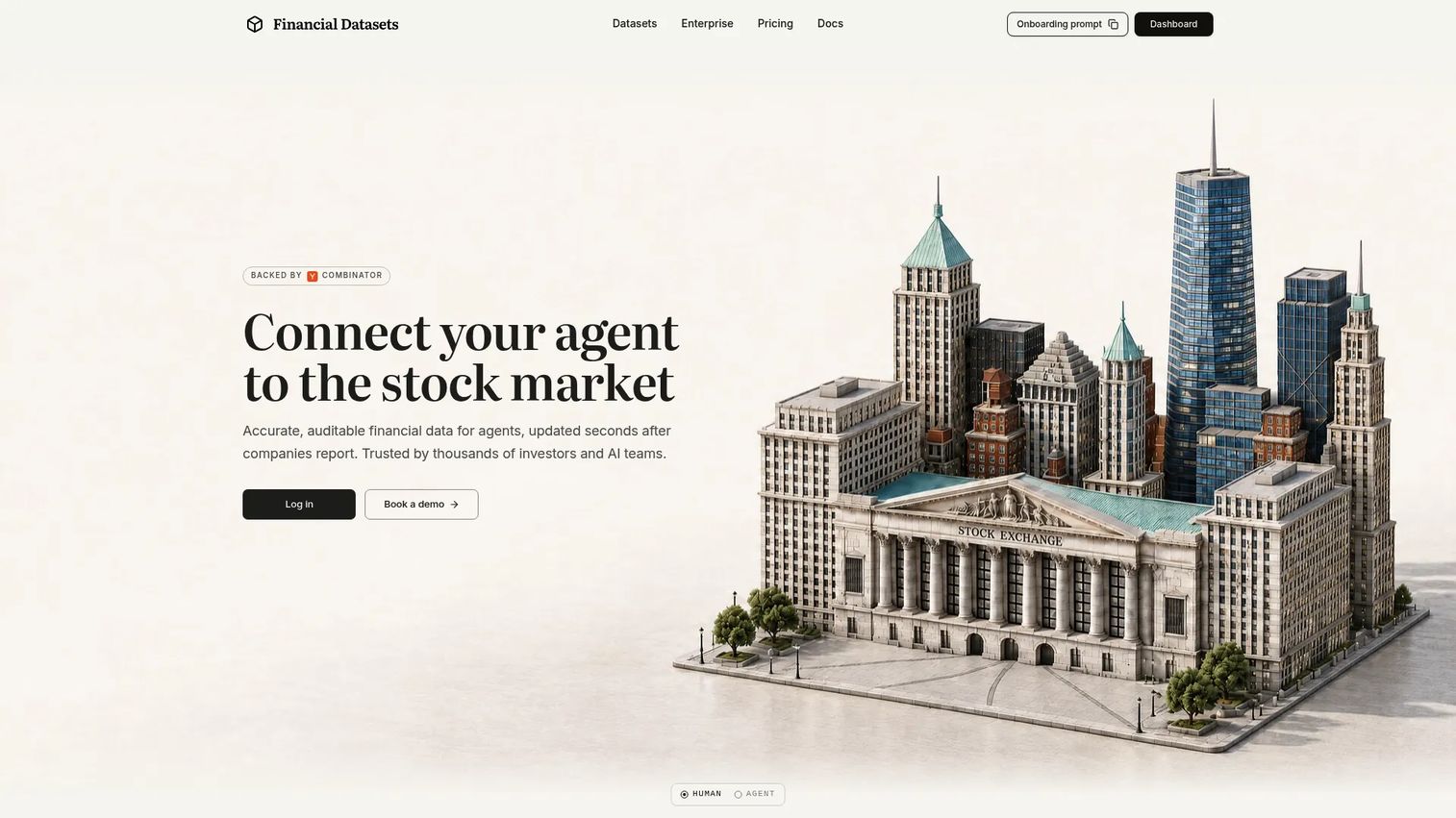
Financial Datasets is an API-first provider built for AI agents, quantitative research applications, and investment data workflows. Its core offering is structured, auditable financial data: Standardized income statements, balance sheets, and cash-flow statements; SEC filings with original source citations; operating KPIs and forward guidance; segment-level data; and historical-as-reported datasets that preserve the numbers as they were known at the time of filing.
Best for: Product and data teams building AI agents, investment research tools, backtesting systems, or any workflow where data provenance needs to be traceable.
Key features
- Standardized and as-reported financial statements
- SEC filing search with source citations
- Operating KPIs, forward guidance, and non-GAAP metrics
- Historical datasets for backtesting
- REST API with JSON responses
Why choose Financial Datasets: The provenance model is the differentiator. When your product returns a revenue figure or feeds an AI agent, being able to cite the original filing reduces hallucination risk and satisfies compliance teams who ask where a number came from. This fits products where incorrect or unsourced data creates material downstream risk.
Financial Datasets pricing: Credits plan at $20 one-time (1,000 requests). Personal plan at $200/month (100,000 requests, personal licensing). Professional at $2,000/month (2 million requests, commercial licensing, redistribution rights, webhooks, and uptime SLAs). Enterprise pricing is custom.
4. Yodlee
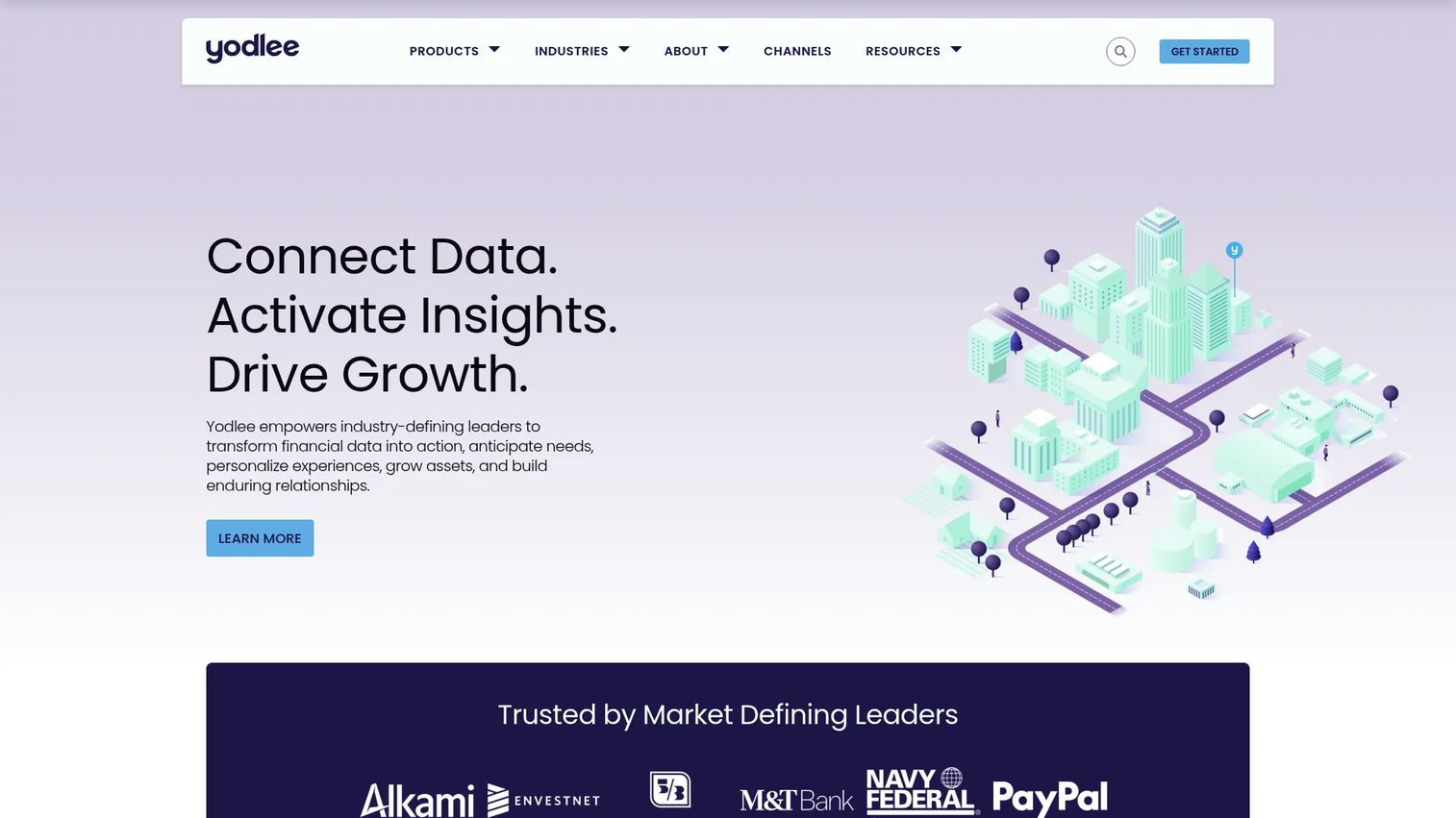
Yodlee has operated in the account aggregation space since the late 1990s, making it one of the more established financial data platforms in this guide. It provides bank connectivity, transaction data enrichment and categorization, wealth data, credit and cash-flow insights, and personalized financial management experiences for financial institutions and larger fintechs.
Best for: Enterprise fintech teams and financial institutions that need broad account aggregation, enrichment, and financial wellness features within a procurement-mature vendor relationship.
Key features
- Account aggregation and bank connectivity
- Real-time account verification
- Transaction enrichment and categorization
- Personal financial management data
- Credit and cash-flow insights
Why choose Yodlee: Yodlee suits teams where procurement maturity, long-term vendor stability, and depth of financial institution coverage matter more than developer-first onboarding. Evaluate implementation complexity, data refresh behavior, and support SLAs before signing, as G2 reviewers have flagged reliability and support issues in their feedback.
G2 rating: 1.4/5
5. MX
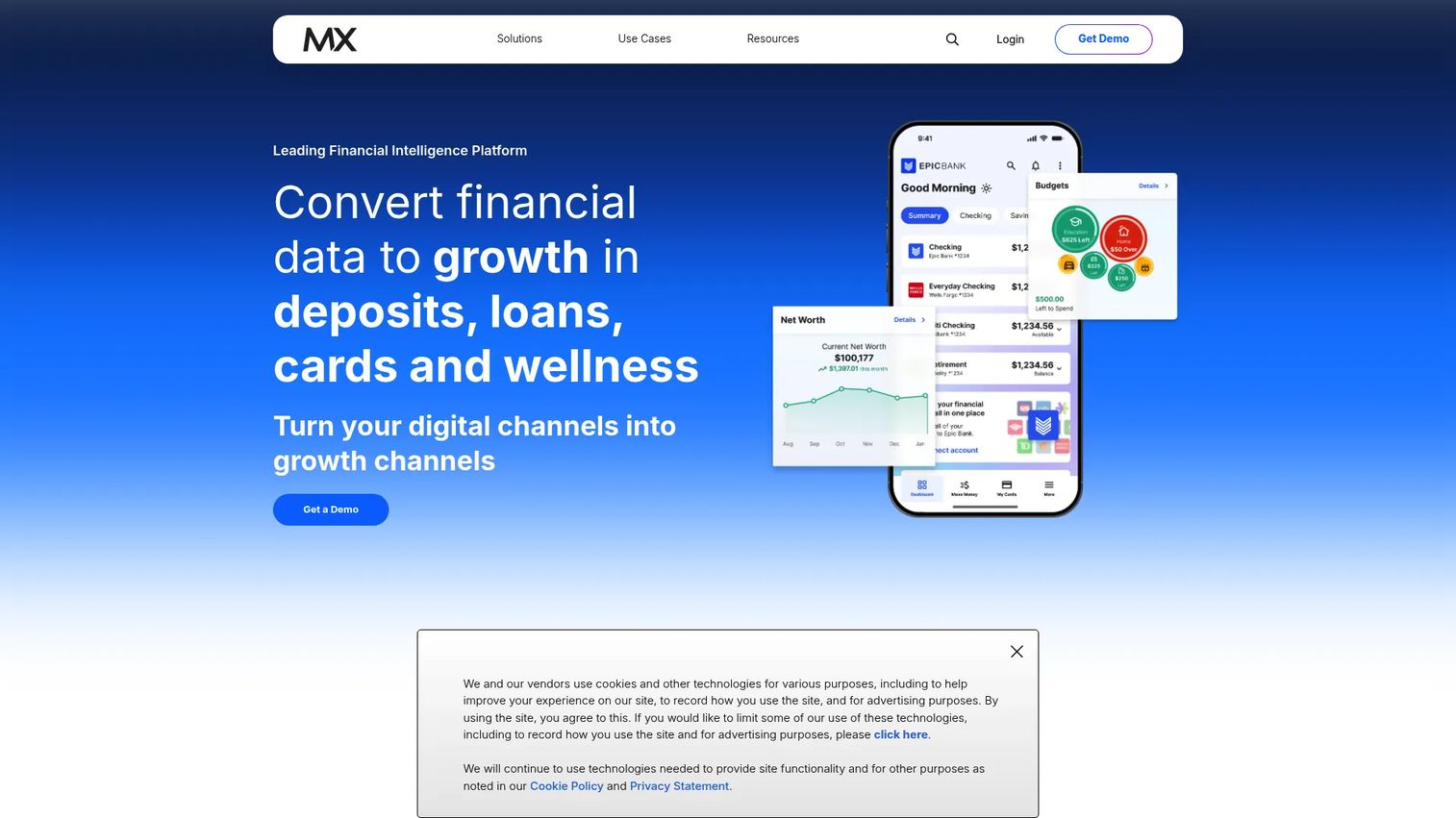
MX is a financial intelligence platform focused on what happens to data after it arrives: Cleaning, categorizing, and enriching raw transaction feeds into something actionable for users and for your product logic. It covers account aggregation and connectivity, but its differentiation is in enrichment accuracy and the downstream financial insights that enriched data enables.
Best for: Teams building budgeting tools, personal finance experiences, or banking products where raw transaction strings from a bank feed need to be readable and actionable for end users.
Key features
- Account aggregation and data connectivity
- Transaction cleansing and categorization
- Instant account and identity verification
- Personalized financial insights
- Mobile banking and embedded financial experiences
Why choose MX: Choose MX when raw transaction data is not usable in its bank-provided form and your product experience depends on clean, categorized financial data. The enrichment quality reduces the in-house processing work your engineering team would otherwise own. Evaluate how enrichment accuracy performs across the specific transaction types your users generate.
MX pricing: All plans require contacting sales.
G2 rating: 4.7/5
6. Finicity
Finicity is Mastercard's open banking platform, covering consumer-permissioned account verification, income data, cash-flow insights for lending, and account-to-account payments. It is particularly used in mortgage, lending, and underwriting workflows where verified income and cash-flow data reduce manual document review and accelerate decisioning.
Best for: Product teams building lending, mortgage, underwriting, or cash-flow-based credit products that need verified financial data with an established open banking consent flow.
Key features
- Account and account-owner verification
- Income verification for lending and payroll
- Cash-flow data for credit decisioning
- Account-to-account payments
- Consumer-permissioned open banking access
Why choose Finicity: The strongest case is lending-adjacent verification. Finicity's Mastercard backing adds procurement credibility for financial institution buyers, and its lending-specific data products reduce build time on income and cash-flow features. Review consent flow behavior, institution coverage against your user base, and support responsiveness before committing.
Finicity pricing: All pricing routes through sales. The Finicity homepage and product pages redirect to Mastercard's Open Finance site, and no numeric prices are displayed anywhere in the public-facing experience.
G2 rating: 3.7/5
7. Polygon.io
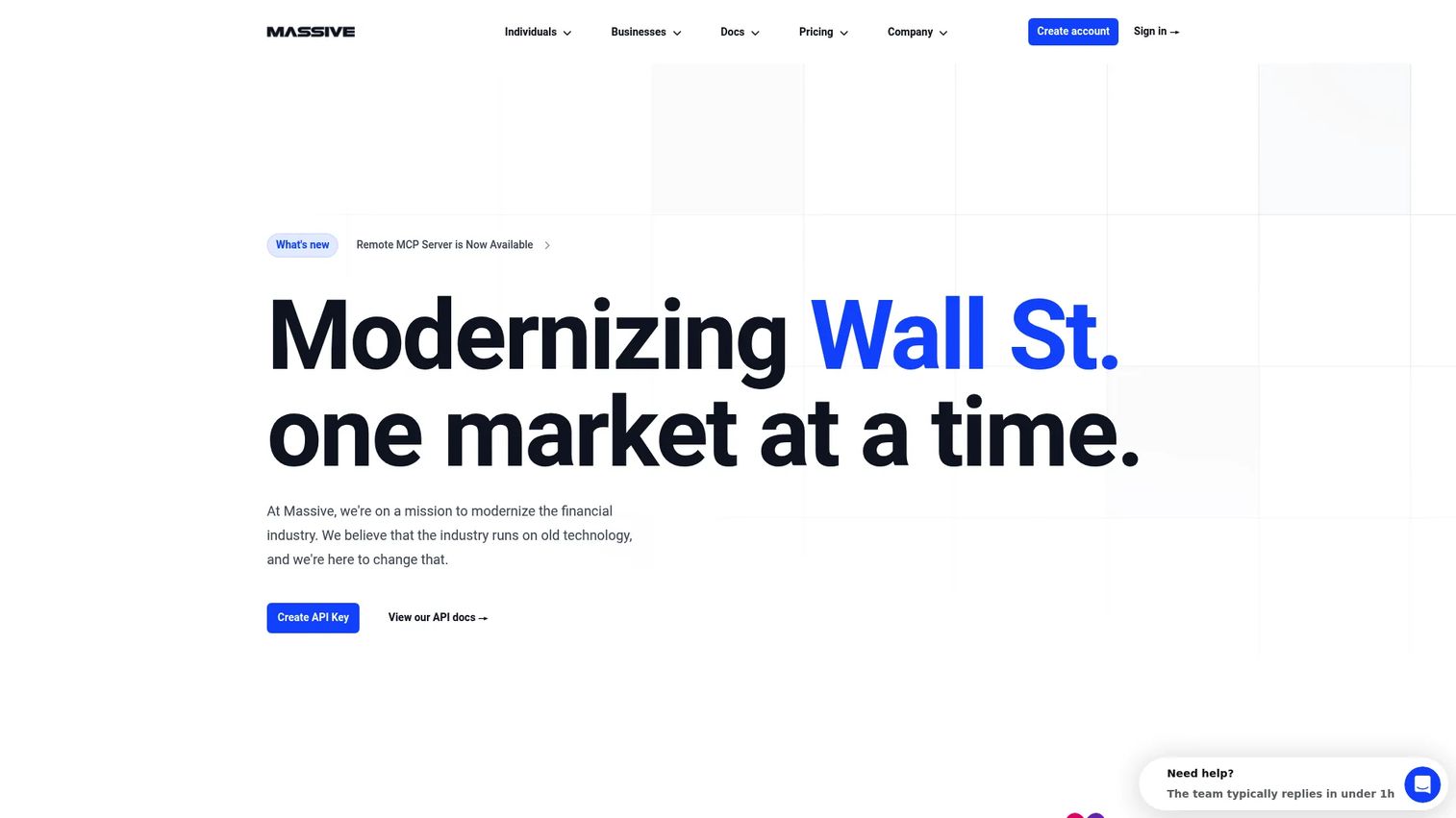
Polygon.io now operates under the Massive brand, with its documentation explicitly stating that Massive is Polygon.io under a new name and all endpoints continue to work. It provides REST APIs, WebSocket feeds, flat-file S3 downloads, and MCP tooling for AI agents across US equities, options, indices, currencies, futures, and crypto. For PMs building trading, investing, or market analytics products, it is one of the more developer-friendly market data providers with transparent public plan pricing.
Best for: Developers and data teams building trading applications, market dashboards, quantitative models, backtests, or financial AI agents.
Key features
- Real-time and historical stocks, options, indices, currencies, and futures data
- WebSocket feeds and REST APIs
- Aggregates, trades, quotes, and snapshots
- Flat-file S3 downloads for bulk data
- AI-agent MCP tooling
Why choose Polygon.io: The public tier structure makes it easier to model costs before signing a contract, which matters when you are validating demand before committing to a data budget. Evaluate exchange licensing terms on paid plans, asset-class coverage against your roadmap, and redistribution rights if your product displays data to end users.
Polygon.io pricing: Stocks Basic at $0/month (end-of-day data). Stocks Starter at $29/month. Stocks Developer at $79/month. Stocks Advanced at $199/month. Stocks Business at $2,499/month with commercial and display rights. Enterprise pricing is custom.
8. Alpha Vantage
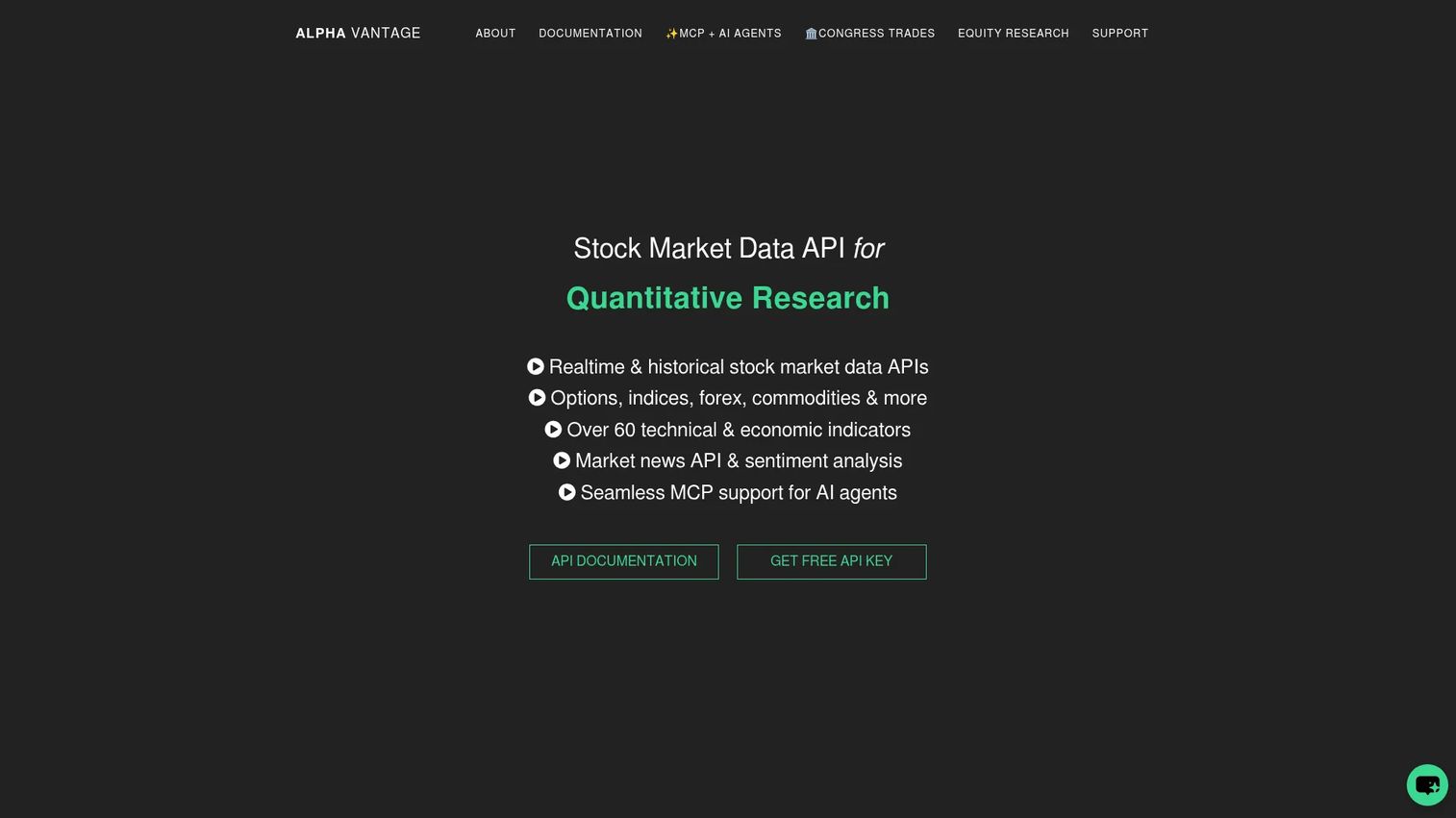
Alpha Vantage provides financial market data APIs and spreadsheet integrations covering global equities, ETFs, mutual funds, indices, options, forex, cryptocurrencies, commodities, economic indicators, and technical indicators. For early-stage products and prototypes, the free tier makes it possible to build and test a stock data feature before making a data budget commitment.
Best for: Developers and smaller teams prototyping stock dashboards, indicator-based features, or analytics workflows where low entry cost is a validation priority.
Key features
- Real-time and historical stock market data
- Technical indicators and fundamental data
- Forex, cryptocurrency, and commodity data
- News and sentiment analysis
- MCP support for AI agents; Excel and Google Sheets integrations
Why choose Alpha Vantage: The free tier at 25 API requests per day covers proof-of-concept work and early validation. Once your product moves toward production volume, evaluate the rate limits, latency for real-time use cases, and commercial licensing terms carefully before assuming the free tier pricing model scales to your traffic.
Alpha Vantage pricing: A free tier is available with a standard limit of 25 API requests per day. Premium plans provide higher usage limits and access to premium endpoints.
9. Finnhub
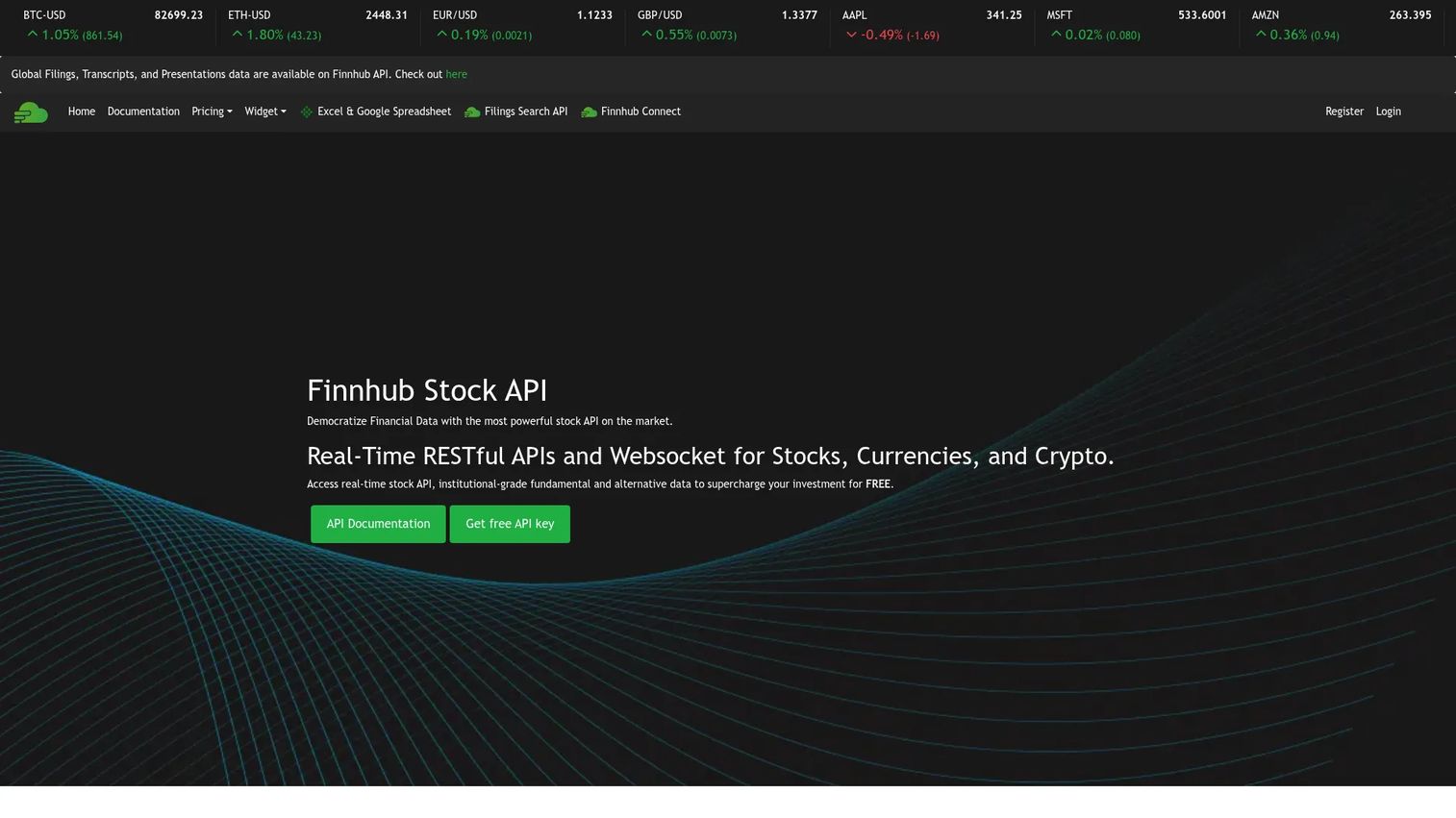
Finnhub provides financial data APIs for stocks, company fundamentals, earnings estimates, SEC filings, transcripts, forex, and cryptocurrency, with an additional layer of market news, sentiment data, and alternative datasets. Products that need market context alongside price history, such as investing apps that surface news alongside a stock chart, can get multiple data types from a single Finnhub integration.
Best for: Investing apps and analytics products that need market prices plus news signals and fundamental data from a single API vendor.
Key features
- Global stock data and real-time market feeds
- Company fundamentals, estimates, and filings
- Market news and sentiment data
- Forex and cryptocurrency data
- WebSocket API for streaming
Why choose Finnhub: The breadth of data types reduces the number of API integrations your engineering team manages. Evaluate per-plan rate limits, real-time data availability by tier, and exchange licensing requirements before assuming the starting tier covers your production use case.
Finnhub pricing: Basic plan at $49.99/month billed quarterly. Standard plan at $129.99/month billed quarterly. Enterprise pricing is flexible and requires contacting sales; it includes commercial use, redistribution rights, unlimited API calls, and full exchange coverage.
10. Financial Modeling Prep
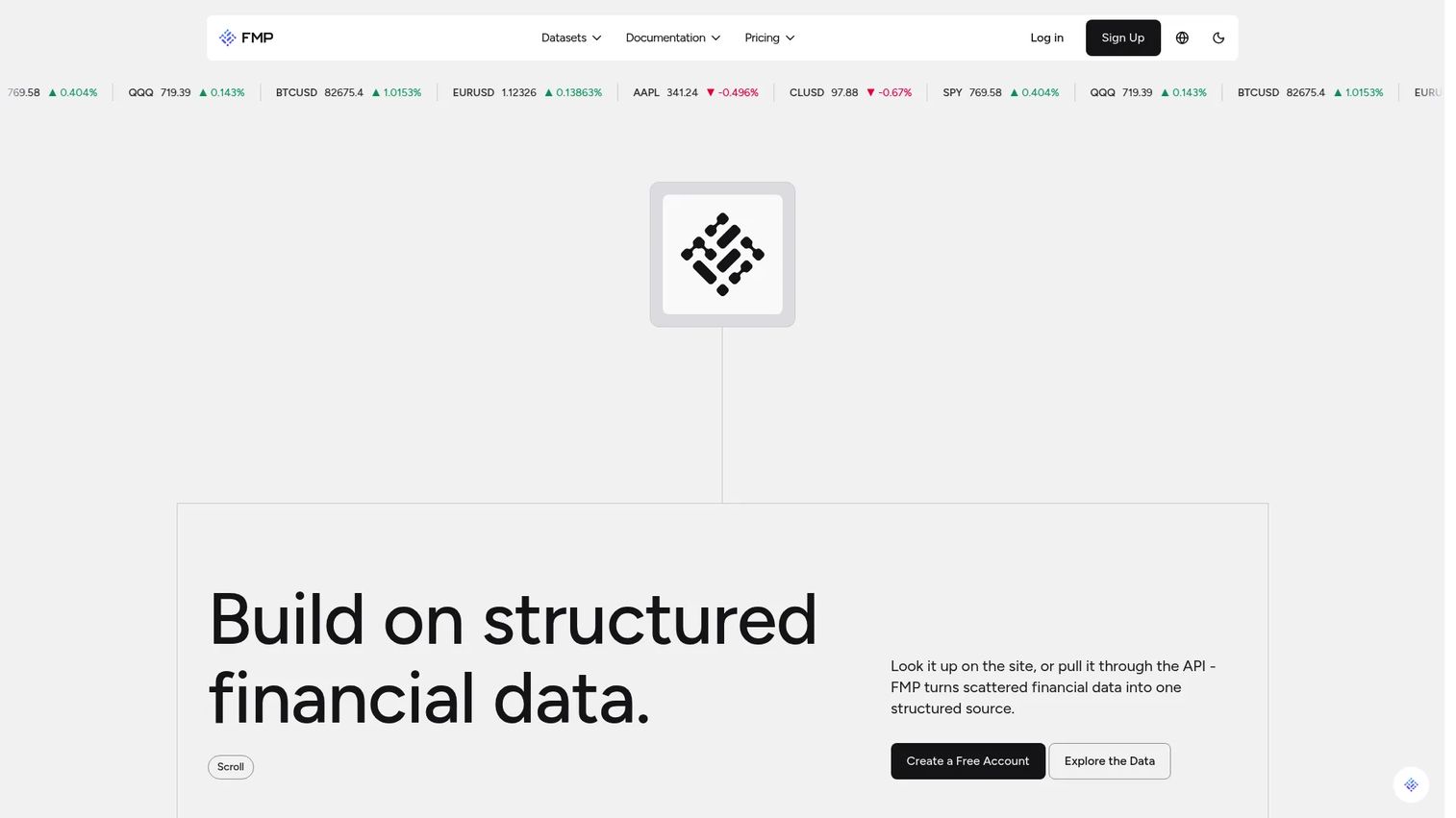
Financial Modeling Prep provides financial data APIs for company fundamentals, financial statements, ratios, earnings data, analyst estimates, market prices, and stock screening. Its free tier at 250 API calls per day covers early development, while annual-billed paid plans give growing products higher limits at accessible price points.
Best for: Teams building equity research tools, stock screening features, or fundamentals-heavy analytics products where company financial data matters more than ultra-low-latency trading feeds.
Key features
- Financial statements, ratios, and company profiles
- Real-time and historical market data
- Earnings data and analyst estimates
- Crypto, forex, ETF, and ESG data
- Market news and earnings-call data
Why choose Financial Modeling Prep: The combination of a free tier and transparent annual pricing makes it one of the easier providers to budget against early in a roadmap. Evaluate endpoint breadth for your specific data needs and check data quality on the financial statement fields your product will expose to users.
Financial Modeling Prep pricing: Basic at $0/month (250 calls/day). Starter at $19/month billed annually. Premium at $49/month billed annually. Ultimate at $99/month billed annually. Enterprise pricing requires contacting sales and includes display and redistribution licensing with custom API call limits.
G2 rating: 4.6/5
11. Intrinio
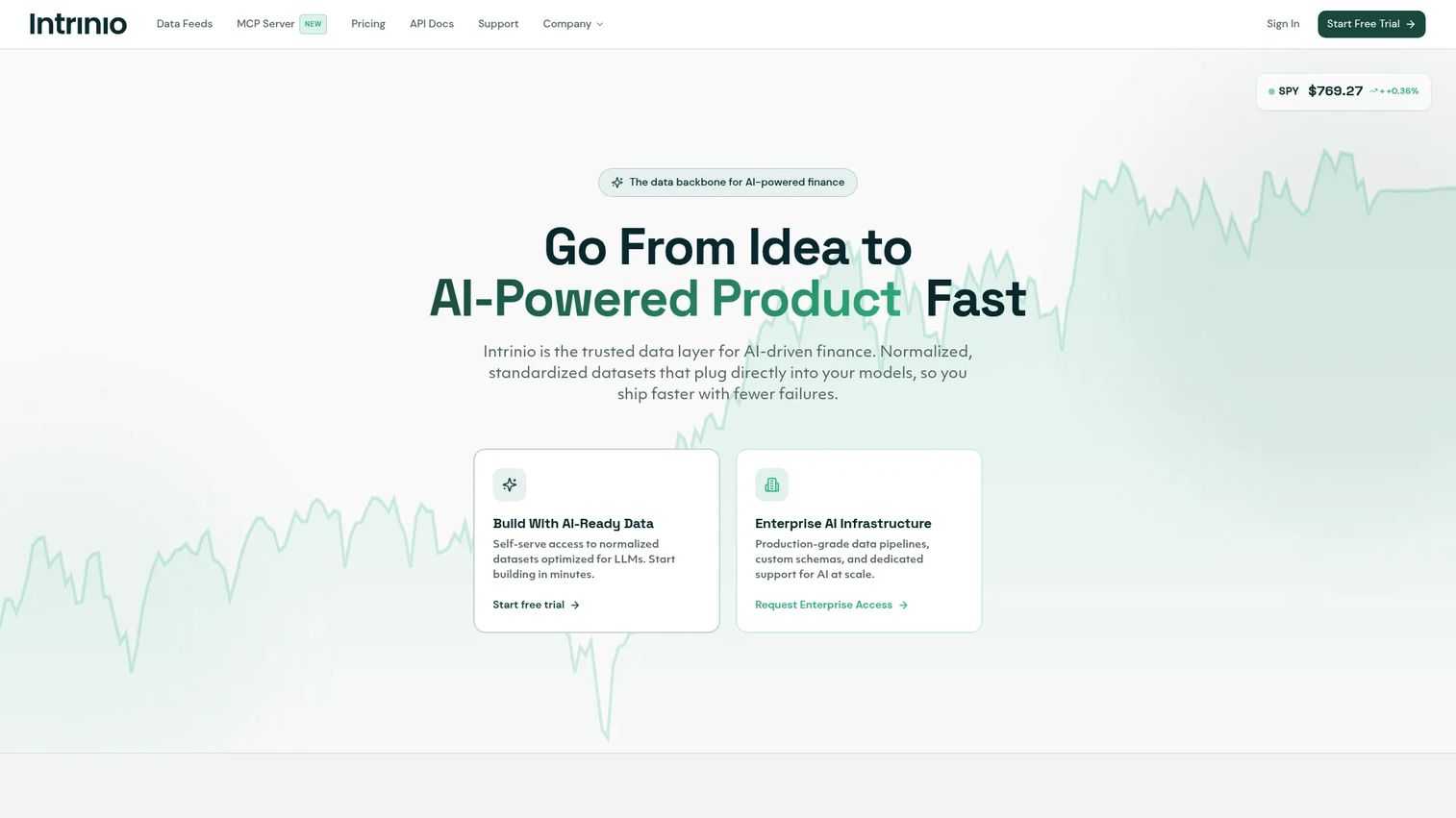
Intrinio provides normalized, AI-ready financial and market data through APIs, feeds, and infrastructure. Its data is optimized for LLM integration, with Python, Ruby, and JavaScript SDKs, GenAI integrations with Claude and ChatGPT, WebSocket streams, bulk downloads, and webhooks. For teams building AI-powered financial applications, the normalization layer reduces the preprocessing work before data reaches a model.
Best for: Businesses and developers building AI-powered financial applications that need structured market data, options, ETF coverage, and fundamentals in a format ready for model ingestion.
Key features
- Normalized, LLM-optimized financial datasets
- Real-time, historical, and delayed market data
- Options, ETF, ESG, and mutual fund data
- Python, Ruby, and JavaScript SDKs
- GenAI integrations; WebSocket streams and webhooks
Why choose Intrinio: The normalization for AI applications is the relevant differentiator for PMs building products where financial data feeds models or agents. The modular plan structure means you pay for datasets that match your product scope rather than a bundle with data your roadmap does not need.
Intrinio pricing: Individual plan at $150/month (personal use). Startup plan from $333/month, billed quarterly for the first six months, stepping to $666/month for the following six, then $999/month thereafter. Enterprise starts at $1,250/month with custom billing, dedicated support, and SLA.
12. Tiingo
Tiingo is a financial market data platform providing APIs and analytics for stocks, ETFs, mutual funds, crypto, forex, news, and fundamentals. Its historical data is clean and split-adjusted, which matters for backtesting: Dirty price history produces misleading model results. The free Starter tier and the $30/month Power plan make it accessible for teams validating a historical data use case before committing to larger data contracts.
Best for: Developers, investors, and product teams building backtesting, historical charting, or market research workflows where data integrity across splits and dividends is a requirement.
Key features
- End-of-day stock prices (split and dividend adjusted)
- Real-time IEX stock prices
- Stock news and fundamental data APIs
- Crypto and forex APIs
- REST and WebSocket APIs
Why choose Tiingo: Historical data quality is the specific reason to evaluate Tiingo ahead of providers with broader feature sets but less documented adjustment methodology. Check data refresh behavior, fundamental data coverage depth, and commercial licensing requirements for your production use case.
Tiingo pricing: Starter plan at $0/month with limited API usage for personal and internal use. Power plan at $30/month with higher limits and expanded capabilities. Commercial use, redistribution, and some enterprise data require a separate conversation.
13. Nasdaq Data Link
Nasdaq Data Link is a cloud-based platform providing access to curated financial, economic, and alternative datasets through streaming, REST, and Tables APIs, with integrations for Python, R, SQL, and Excel. Its marketplace model means you subscribe to specific datasets à la carte rather than buying a single monolithic package. Open data feeds carry no platform fee, making it possible to test coverage before committing to premium dataset subscriptions.
Best for: Analysts, financial institutions, and product teams that need specialized financial, economic, or alternative datasets beyond standard market price feeds.
Key features
- Streaming, REST, and Tables API access
- Python, R, SQL, and Excel integrations
- Real-time, delayed, historical, and premium datasets
- À la carte premium dataset subscriptions
- Free open data feeds with no platform fee
Why choose Nasdaq Data Link: The marketplace model fits teams whose roadmap needs a specific dataset, such as economic indicators, commodity prices, or alternative data, without paying for broad coverage they do not use. Evaluate each dataset's refresh frequency, licensing terms, and whether the provider allows redistribution for your product's display use case.
Nasdaq Data Link pricing: No platform fee for the base access or open data feeds. Premium datasets are priced à la carte; specific prices are visible after account creation and vary by dataset provider.
14. IEX Cloud
IEX Cloud provides developer-oriented market data, company data, and financial API access tied to the IEX ecosystem. The product has a G2 rating verified from a live listing, though product status, branding, and plan availability should be confirmed directly on the IEX Cloud site before committing engineering work, as API platforms in this space do rebrand and restructure pricing.
Best for: Teams building US-market data products within the IEX ecosystem where developer tooling and exchange-connected data are the primary requirements.
Key features
- US equities and company data
- Market data endpoints and developer tooling
- API access with JSON responses
- Financial data for applications and dashboards
Why choose IEX Cloud: Evaluate it when your product focuses on US equity data and the IEX exchange connection aligns with your coverage needs. Confirm current plan availability, data types, and pricing on the vendor site before any implementation starts, given the platform's history of changes.
IEX Cloud pricing: Check the IEX Cloud pricing page directly for current plan options and costs.
G2 rating: 4.5/5
15. Twelve Data
Twelve Data is a financial market data platform providing APIs, WebSocket streaming, SDKs, and spreadsheet add-ins covering stocks, forex, cryptocurrencies, ETFs, mutual funds, commodities, fixed income, and fundamentals. Four publicly priced individual tiers make it straightforward to model costs against expected API call volume, and the free Basic tier supports testing and side projects without a contract.
Best for: Developers, fintech teams, and researchers building global market dashboards, watchlists, or technical analysis features where broad asset coverage across multiple classes reduces the need for multiple data vendors.
Key features
- Real-time and historical market data APIs
- WebSocket streaming
- Technical indicators and fundamental data
- Multi-asset coverage: Stocks, forex, crypto, ETFs, commodities, and fixed income
- Spreadsheet add-ins for Google Sheets and Excel
Why choose Twelve Data: The transparent individual pricing and broad asset coverage make it a practical starting point for teams that need data across multiple asset classes in a single integration. Evaluate exchange coverage depth by specific market, real-time data availability at each tier, and rate limits against your projected API call volume.
Twelve Data pricing: Basic at $0/month (testing and side projects). Grow at $79/month. Pro at $229/month. Ultra at $999/month. Annual billing saves approximately 17%.
G2 rating: 4.7/5
16. FactSet
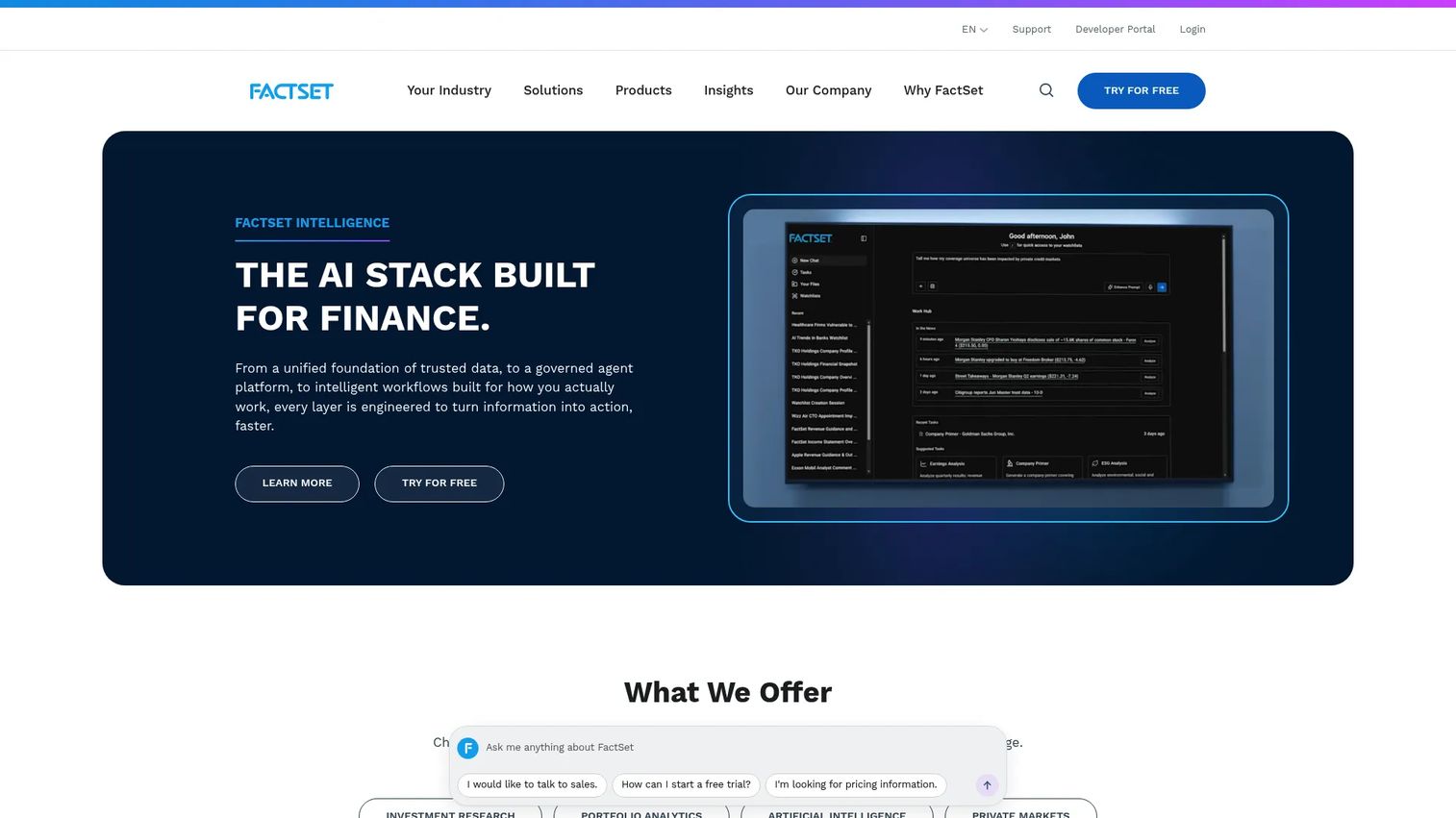
FactSet provides financial data, analytics, AI-powered workflows, data feeds, and APIs for investment and financial professionals. Its product suite covers investment research, market analysis, portfolio analytics, performance attribution, risk analysis, estimates, benchmarks, and ownership data. Enterprise procurement and onboarding are heavier than most providers in this guide, but the data depth and institutional-grade quality justify that for the right product.
Best for: Enterprise teams building platforms for professional investors, portfolio managers, wealth advisors, or institutional analytics workflows.
Key features
- Investment research and market analysis
- Portfolio analytics, performance, and risk attribution
- Financial data feeds and APIs
- Estimates, benchmarks, and ownership data
- AI-powered analytics and workflow integrations
Why choose FactSet: The case for FactSet is institutional data quality at enterprise scale. If your product serves professional investors or financial institutions that require audited, deeply sourced data across multiple asset classes, FactSet is a credible vendor to evaluate. Budget for procurement timelines, entitlement configuration, and onboarding complexity before setting a release date.
FactSet pricing: Custom pricing; FactSet directs all prospects to request a demo or contact the company.
G2 rating: 4.2/5
17. LSEG Data and Analytics
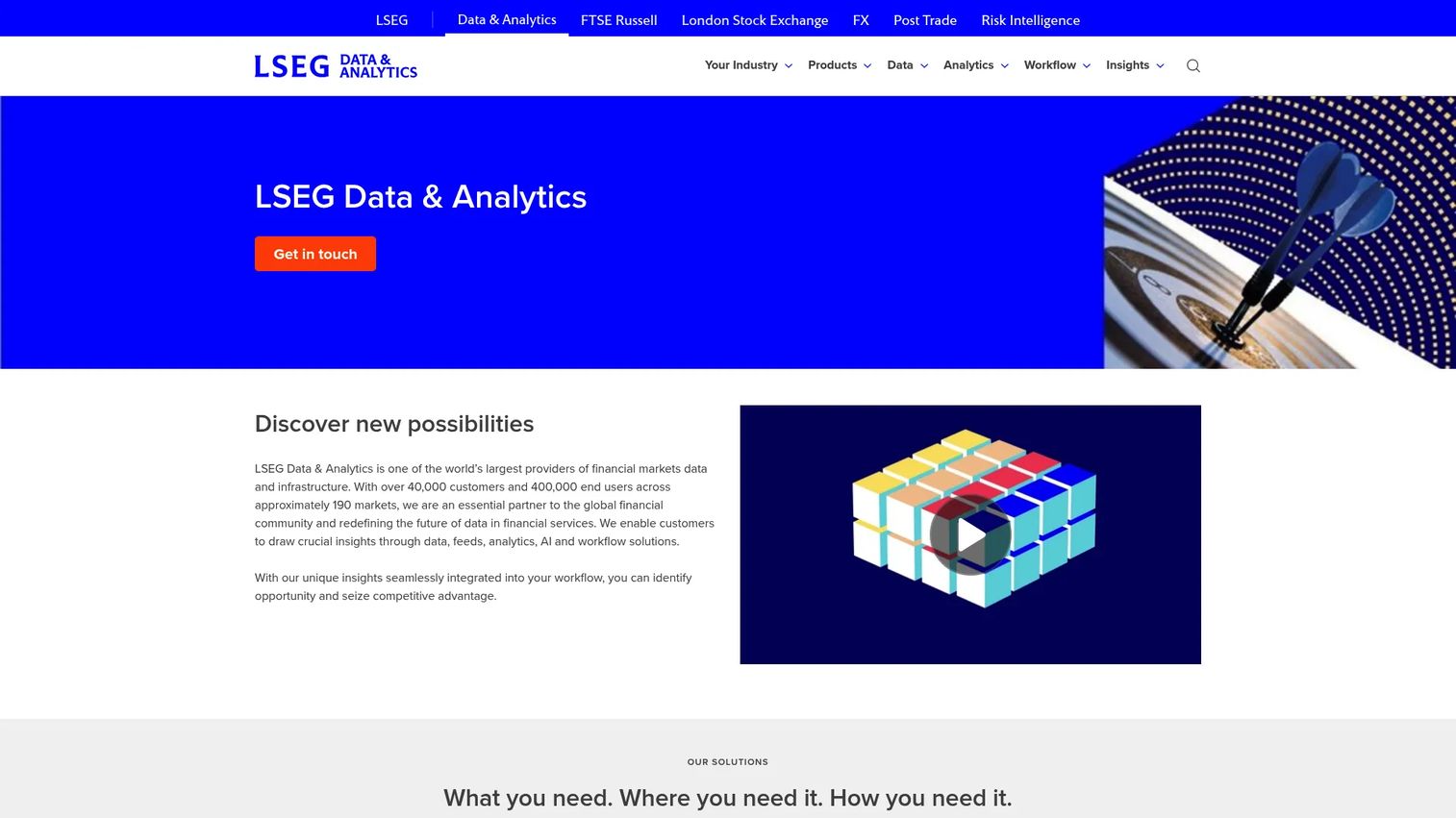
LSEG Data and Analytics provides financial markets data, feeds, analytics, AI-powered workflows, and enterprise solutions for financial-services organizations. Its LSEG Workspace product delivers cross-asset market data, exclusive Reuters financial news, customizable analytics, and interoperable integrations through APIs and applications. LSEG operates at global market infrastructure scale, which means its data breadth and regulatory credibility are strong, but so is the enterprise buying motion required to access it.
Best for: Large financial institutions and enterprise teams needing global market data infrastructure, cross-asset coverage, reference data, and analytics within a regulated enterprise environment.
Key features
- Global market data and cross-asset feeds
- AI-powered and customizable analytics
- Exclusive Reuters financial news
- LSEG Workspace with interoperable integrations
- Cloud, API, and application integrations
Why choose LSEG Data and Analytics: Choose LSEG when your product requires global market data coverage, data governance at the level financial regulators expect, and a vendor whose reference data is trusted by institutional market participants. Plan for procurement timelines, entitlement structures, and implementation complexity that differ substantially from self-serve or mid-market providers.
LSEG Data and Analytics pricing: Custom pricing; all pricing routes through sales contact.
G2 rating: 3.8/5
Considerations when choosing financial data APIs
Start with the data job, not the vendor
Define what your product needs first: Consumer banking connectivity, market prices, SEC filings, fundamentals, alternative datasets, payment verification, or portfolio analytics. A strong open banking provider will not solve a market data use case, and vice versa. Shortlisting starts with matching data type to product need, not brand familiarity.
Check coverage at the institution, exchange, and region level
Coverage claims can hide meaningful gaps. A banking API that covers 12,000 institutions may still miss the regional credit unions your users bank at. A market data API that claims global coverage may delay non-US exchanges or exclude certain options chains. Test your exact coverage requirements in a sandbox before committing.
Evaluate freshness, latency, and refresh behavior
Real-time, 15-minute delayed, periodic, webhook, and bulk historical retrieval are not interchangeable. A product that promises live portfolio values needs a different plan than a research tool consuming nightly price snapshots. Mismatch between your data freshness promise and the provider's actual plan limits is a support ticket waiting to happen.
Verify provenance, auditability, and correction handling
For AI agents, lending decisions, investment research, and regulated workflows, you need to know where a value came from and whether it has been restated. Ask how the provider handles SEC filing corrections, historical-as-reported data versus restated figures, and citation trails. This is the question most teams skip until an output is challenged.
Model pricing against product usage before launch
API pricing scales by calls, connected accounts, institutions, datasets, exchange licenses, or enterprise contracts, depending on the provider. Model expected volume at a realistic usage rate before launch, not after the first overage invoice. For cash flow forecasting software or lending products, usage can spike significantly with user growth in ways that are hard to predict from early numbers.
Conclusion
The "best" financial data API for your product is the one that matches the actual data job on your roadmap. Plaid and Stripe Financial Connections address consumer bank account access from different integration points. Financial Datasets serves AI agents and auditable SEC filing workflows. Polygon.io covers market data from a free entry tier through to commercial redistribution. Financial Modeling Prep and Alpha Vantage give accessible entry points for fundamentals and stock data. FactSet and LSEG Data and Analytics operate at institutional data infrastructure scale, with procurement processes to match.
The practical next step is to shortlist two providers per data type your first release depends on, run both against a sandbox using real-world workflows, and compare data completeness on the specific fields your product will expose. Coverage gaps and data quality issues that look minor in a demo become activation and retention problems in production.
Pick the provider that makes your first release reliable, then pressure-test the parts most likely to break: Coverage, latency, provenance, and pricing at scale.
FAQs
A financial data API gives applications programmatic access to financial information such as bank accounts, transactions, market prices, company fundamentals, SEC filings, and reference datasets. Different APIs specialize in different data types: A banking connectivity API handles consumer-permissioned account access, while a market data API streams exchange prices. Choosing the right one starts with identifying which data type your product actually needs.
For consumer banking data, Plaid, MX, Yodlee, and Finicity cover account aggregation and verification from different angles. Stripe Financial Connections fits teams already running payments through Stripe. For market data or fundamentals-driven fintech products, a separate shortlist of Polygon.io, Financial Modeling Prep, or Twelve Data is more appropriate. The data job determines the relevant shortlist.
Polygon.io covers real-time and historical equities, options, forex, and crypto with transparent plan pricing. Twelve Data offers broad multi-asset coverage with four public tiers. Financial Modeling Prep and Alpha Vantage both provide free entry tiers for fundamentals and stock data. Intrinio is well-suited to AI-ready normalized data. For institutional-grade market data, FactSet and LSEG Data and Analytics operate at a different scale and procurement model. The right choice depends on real-time requirements, asset classes, historical depth, and redistribution licensing.
Open banking APIs access consumer-permissioned bank account data: Balances, transactions, account ownership, and income, sourced from the user's bank through an OAuth or consent-based authorization flow. Market data APIs provide exchange-sourced prices, quotes, trades, fundamentals, filings, and investment datasets. They solve different product problems and should not be treated as alternatives to each other.
Start with coverage: Does the provider cover the specific banks, exchanges, asset classes, or filing types your users need? Then evaluate data freshness and latency against your product's promises. Check authentication and consent models for security review compatibility. Assess documentation and sandbox quality against your engineering team's implementation time estimate. Verify pricing at your expected production volume, rate limits, and support SLAs. Data provenance and correction handling matter for AI and regulated workflows.
Many bank-data workflows use OAuth or tokenized authorization to prevent users from sharing their banking credentials directly with your application. The specific implementation varies by provider, institution, and region. Stripe Financial Connections and Plaid both use OAuth-based consent flows. Market data APIs typically authenticate with API keys or bearer tokens rather than user-level OAuth, since they do not access personal account data.
Pricing models vary significantly. Banking data providers like Plaid, MX, Yodlee, and Finicity use usage-based or custom contract pricing; most require a sales conversation for production access. Market data providers like Polygon.io, Twelve Data, and Financial Modeling Prep publish tiered plans from free to several hundred dollars per month for individual use, with commercial and redistribution licensing adding cost. Enterprise providers like FactSet and LSEG use fully custom pricing based on data entitlements, users, and contract terms. Model your expected API call volume and user scale before comparing plans.
Financial Datasets is purpose-built for AI agent workflows, with source citations, structured statements, and historical-as-reported data that supports auditable outputs. Intrinio offers LLM-optimized normalized data with GenAI integrations for Claude and ChatGPT. Financial Modeling Prep and Nasdaq Data Link work for agents consuming company fundamentals or economic datasets. For agents that need institutional-grade data, FactSet and LSEG provide deeper coverage with enterprise buying requirements. Provenance, structured JSON responses, and historical consistency are the criteria most relevant to agentic AI platforms consuming financial data.