A larger customer just sent a security questionnaire with 80 questions. Your board wants to know whether sensitive customer data is protected before the next raise. A new enterprise deal has stalled because someone asked about your email authentication setup.
At Series B, these questions arrive faster than your team can build answers from scratch. The average cost of a data breach hit $4.44 million in 2025, according to IBM, and SaaS companies with distributed data across email, SaaS apps, cloud storage, and customer-facing workflows carry exactly the risk profile that makes auditors nervous.
The problem is that "confidentiality software" is not one category. It spans five distinct control layers: secure communication and file sharing, credential protection, certificate lifecycle management, email-domain authentication, and privacy and data access governance. Buying one tool without understanding which layer is actually exposed means spending money on the wrong problem.
This guide maps all five layers, compares 15 tools built for each, and helps you assign the right control to the right owner so the next security review becomes a process rather than a scramble.
What's inside
This guide compares 15 confidentiality software tools across five categories for 2026. It is written for Series B SaaS founders and their security, engineering, legal, and privacy leads.
Tools were selected based on:
- Protection layer: Which confidentiality risk each tool addresses (email, files, credentials, certificates, domains, or data stores)
- Operating fit: Implementation effort and team ownership at a 30 to 150-person SaaS company
- Auditability: Logs, reporting, policy controls, and evidence for board and enterprise review
- Stack fit: Cloud, identity, CRM, and security workflow integrations
Every price below comes from the vendor's own published pricing page, and every rating from the product's own G2 listing, as both stood in October 2026. Where a vendor publishes no list price, the entry describes how pricing is structured and points you to the vendor for a quote.
TL;DR
- Best for secure email and file sharing: Virtru gives SaaS teams data-centric encryption for board materials, contracts, and customer data with post-send access controls
- Best for credential protection: Proton Pass For Business starts at $1.99/user per month and gives lean teams an encrypted credential layer before a larger identity project
- Best for certificate lifecycle management: Sectigo Certificate Manager, AWS Certificate Manager, and DigiCert ONE each serve a different infrastructure profile
- Best for email-domain protection: Valimail, EasyDMARC, and PowerDMARC all automate DMARC, SPF, and DKIM management, with EasyDMARC starting at $35.99/month
- Best for privacy and data governance: OneTrust, BigID, and Varonis cover the compliance, discovery, and access monitoring needs that enterprise deals and audits now demand
What is confidentiality software?
Confidentiality software helps organizations prevent unauthorized access to sensitive information by protecting data, credentials, communications, certificates, identities, and privacy workflows.
The category is not a single product class. It covers five distinct tool types that each address a different confidentiality risk:
Core types of confidentiality software:
- Encryption and secure file sharing: Protects the content of emails, files, and documents in transit and at rest
- Password and credential management: Controls who holds access credentials and how they are shared
- Certificate lifecycle management: Manages the SSL/TLS and PKI certificates that establish trust in web applications and services
- Email authentication and domain protection: Prevents attackers from impersonating your domain in outbound email
- Privacy management and sensitive-data governance: Discovers, classifies, and controls access to personal and regulated data across your stack
Key features to look for:
- End-to-end encryption
- Role-based access controls
- Audit logs and exportable reports
- Data discovery and classification
- Certificate automation and renewal
- DMARC, SPF, and DKIM management
- Secure external sharing
- Admin policy controls
- Integrations with identity and cloud systems
How confidentiality differs from adjacent categories:
Confidentiality focuses on preventing unauthorized access. Privacy focuses on lawful and transparent use of personal data. Data protection covers backup, recovery, monitoring, and resilience. Many tools in this list overlap across two or more of these frames, but the buying decision should start with the specific risk you need to reduce first, not the broadest platform available.
For additional reading on related topics, see our guides to access control software, access review software, and audit management software.
When to use confidentiality software
Protect sensitive customer and company data before sharing it
Series B companies typically have customer contracts, board materials, employee records, and product plans spread across a dozen tools. Confidentiality software controls who can access, share, and retrieve sensitive files, even after they leave your environment. Start with the data flows that carry the highest legal, financial, or reputational risk if exposed.
Pass enterprise security and compliance reviews
Larger customers now send detailed security questionnaires covering encryption, access controls, email authentication, and data governance. Tools in this category produce the evidence those reviews demand: audit logs, policy reports, certificate inventories, and domain authentication records. The goal is turning a review from a founder-led scramble into a documented, repeatable response.
Reduce operational risk before the next scale event
New markets, larger customers, fundraising, and leadership hires all expose weak controls. A VP of Security hired on Monday needs something to work with by Friday. Confidentiality tools help teams build repeatable processes before external pressure forces improvisation. The AI security posture management tools guide covers the adjacent monitoring layer for teams ready to go deeper.
Confidentiality software comparison
The 15 tools below span all five confidentiality layers. Use the table to identify which category fits your most urgent risk, then read the detailed sections for fit and pricing.
One vendor relationship affects how you should read this list: DigiCert announced its acquisition of Valimail on 16 September 2025, so entries 6 and 9 are products of the same company rather than two independent vendors.
| # | Product | Best for | Key differentiator | Pricing | G2 rating |
|---|---|---|---|---|---|
| 1 | Virtru | Secure email and file sharing | Post-send access revocation and data-centric encryption | From $119/month (5 users) | 4.4/5 |
| 2 | Proton Pass For Business | Business credential management | End-to-end encrypted vaults with SSO and SCIM | From $1.99/user/month | 4.7/5 |
| 3 | Sectigo Certificate Manager | Enterprise certificate lifecycle management | Multi-CA support with full automation | SCM Pro from $25/month; enterprise quoted | 4.5/5 |
| 4 | Cloudflare Application Security and Performance | Web app protection and edge security | WAF, DDoS, bot management, and CDN in one layer | Free; paid from $20/month | 4.5/5 |
| 5 | AWS Certificate Manager | AWS-native certificate provisioning | Free public certificates for integrated AWS services | Free for AWS-integrated; from $1/domain for ACME | 4.5/5 |
| 6 | Valimail (DigiCert) | Automated DMARC enforcement | Fully automated SPF and DKIM alignment with BIMI | Free monitor; paid plans quoted | 4.5/5 |
| 7 | EasyDMARC | DMARC management with guided setup | DNS management, SPF flattening, and sender health | From $35.99/month (annual); no free plan | 4.7/5 |
| 8 | PowerDMARC | Broad email authentication across domains | Hosted DMARC, SPF, DKIM, BIMI, and MTA-STS | Free for personal domains; from $15/month | 4.9/5 |
| 9 | DigiCert ONE | Enterprise digital trust lifecycle | Unified PKI, code signing, and device identity | Custom pricing | 4.3/5 |
| 10 | Signal | Private team communication | Open-source end-to-end encrypted messaging | Free | 4.4/5 |
| 11 | DataLocker | Encrypted hardware storage and transport | Managed USB drives with centralized SafeConsole | Per managed device, quoted by DataLocker or a reseller | Not listed on G2 |
| 12 | SpiderOak | Zero-trust access and secure data exchange | Decentralized peer-to-peer data exchange | Custom pricing | Not listed on G2 |
| 13 | OneTrust | Privacy operations and compliance workflows | AI-driven data mapping, consent, and risk management | Custom pricing | 4.3/5 |
| 14 | BigID | Sensitive data discovery and classification | Cross-environment PII discovery with access intelligence | Custom pricing | 4.3/5 |
| 15 | Varonis | Data access governance and threat detection | Automated permissions remediation and behavioral monitoring | Custom pricing | 4.6/5 |
The 15 tools, layer by layer
1. Virtru
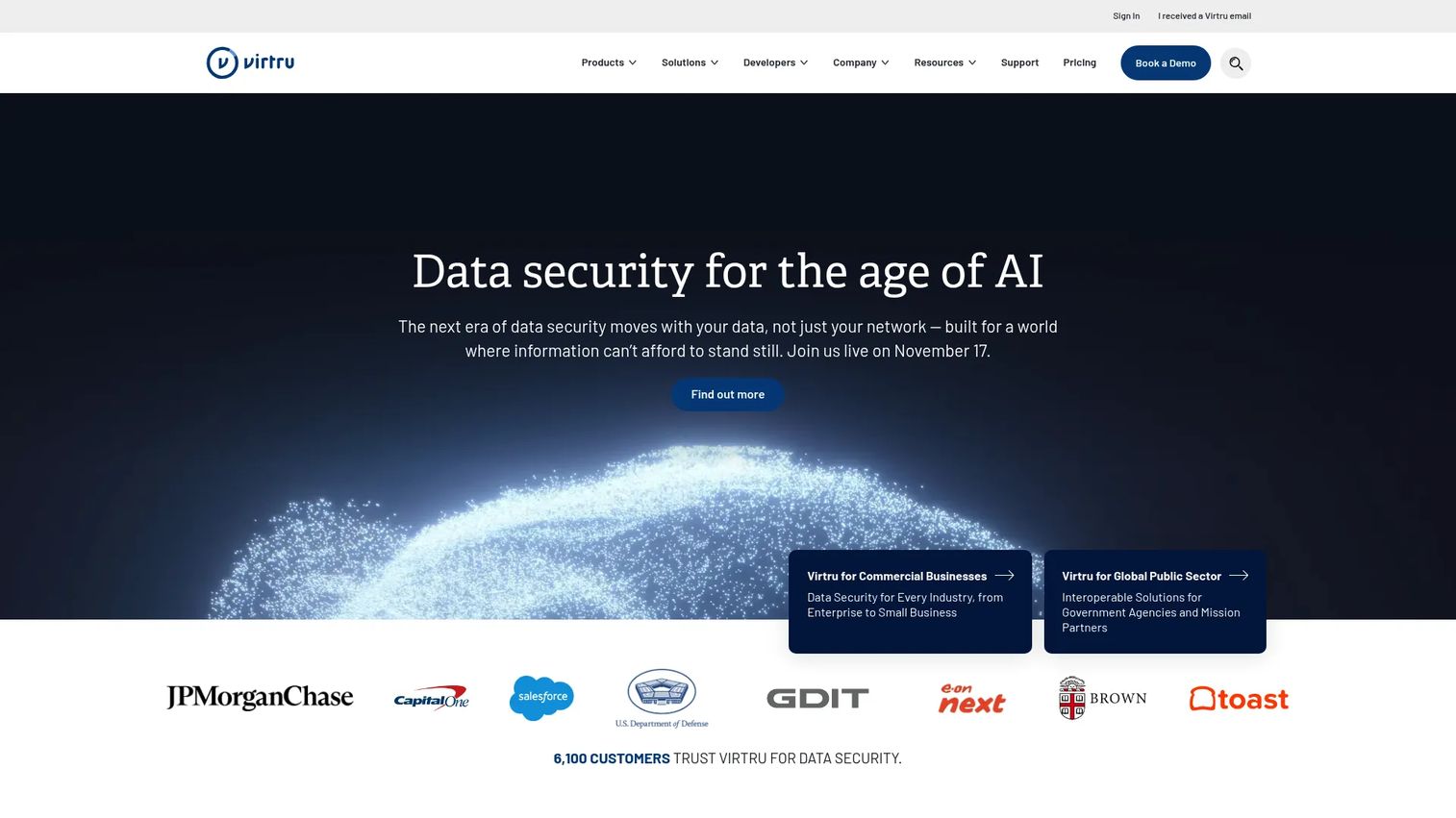
Virtru provides data-centric encryption for email and files, with controls that stay attached to the content even after it leaves your environment. It works directly inside Google Workspace and Microsoft 365, so teams protect board materials, customer contracts, and sensitive communications without changing their existing workflows. Granular controls let you set expiration dates, revoke access after sending, block forwarding, and add watermarks to shared files.
Best for: SaaS teams that need secure communication and file-sharing controls without rebuilding existing workflows.
Key features
- Email encryption for Gmail and Microsoft Outlook
- Access revocation and expiration after sending
- Secure file sharing with Google Drive, OneDrive, SharePoint, and Microsoft Teams
- Forwarding restrictions and watermarking
- Admin audit controls and access logs
Why choose Virtru: If your team already runs on Google Workspace or Microsoft 365 and you need a fast way to protect board communications, customer data, and contract exchanges, Virtru drops into those environments without requiring a new workflow. It fits teams that need proof of control quickly, not a multi-month implementation.
Virtru pricing: Plans start at $119/month billed annually for up to five users on the Starter tier. Business runs $219/month and Compliance $499/month, both covering five users. Enterprise uses custom pricing, and Virtru sells additional seats at a lower annual rate.
G2 rating: 4.4/5 from 439 reviews
2. Proton Pass For Business
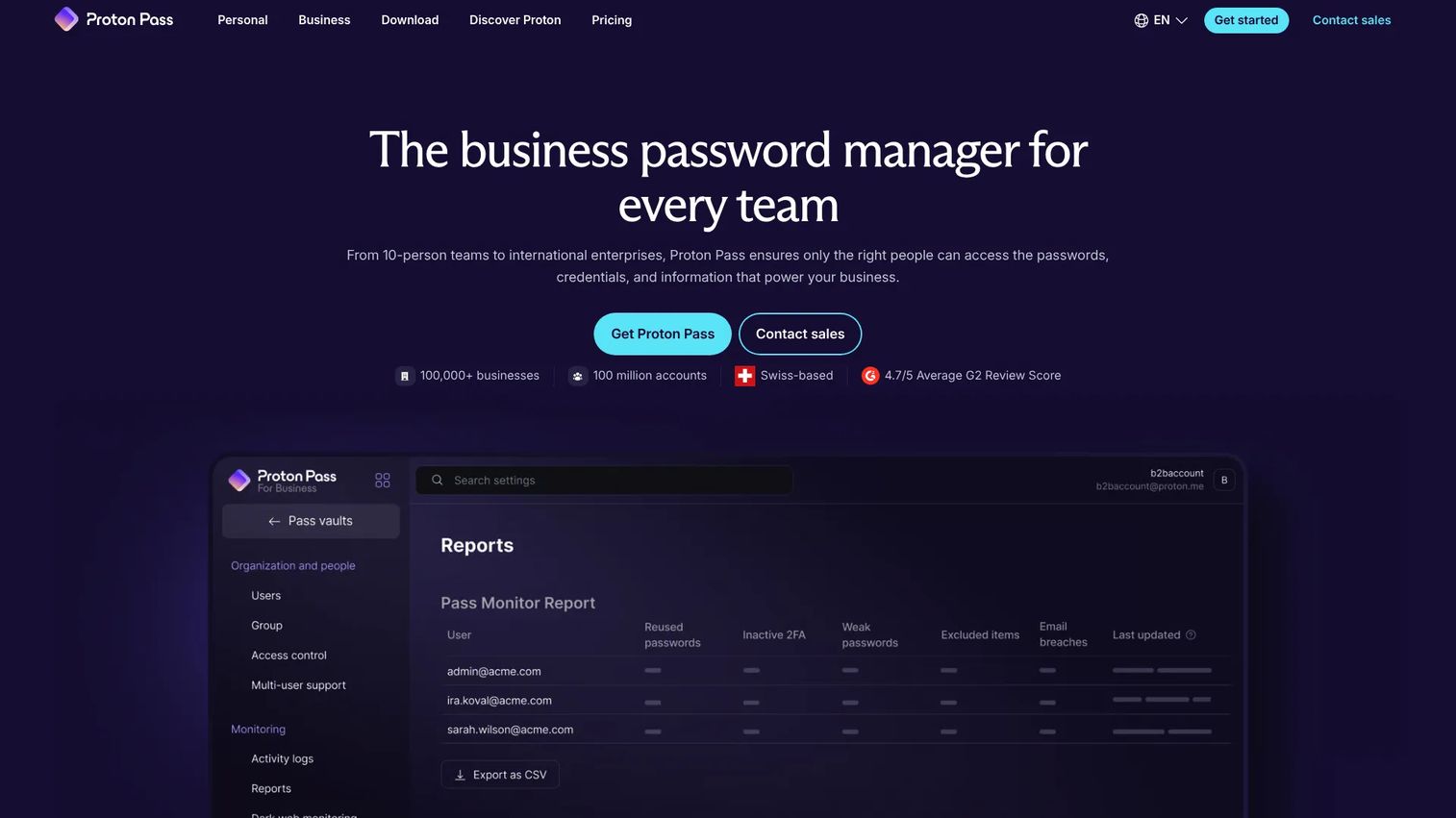
Proton Pass For Business is an end-to-end encrypted password manager built for teams that want credential confidentiality without trusting a third party with unencrypted vault data. It covers shared vaults, built-in two-factor authentication, admin dashboards, and dark web monitoring, all under Proton's zero-knowledge architecture. SSO, SCIM, and activity logging are available on the Professional tier, making it a fit for teams moving toward more structured identity hygiene.
Best for: Founders who need a fast credential-control layer before committing to a larger identity management project.
Key features
- End-to-end encrypted vaults and item sharing
- Admin dashboard with usage reporting and activity logs
- Built-in 2FA authenticator and passkey support
- SSO and SCIM provisioning
- Dark web monitoring and password health checks
Why choose Proton Pass For Business: The price point is the clearest argument. At $1.99/user per month on the Essentials tier, a 20-person team gets encrypted credential management, shared vaults, and admin visibility for less than the cost of one tool renewal. It earns its place in the stack before a heavier identity platform makes sense at your stage.
Proton Pass For Business pricing: Pass Essentials starts at $1.99/user per month billed annually, with a three-user minimum, which works out to $23.88 per user over a 12-month term. Pass Professional, which adds SSO, SCIM, group sharing, and SIEM integration, costs $4.99/user per month billed annually. Enterprise pricing is available on request.
G2 rating: 4.7/5 from 127 reviews
3. Sectigo Certificate Manager
Sectigo Certificate Manager is a cloud-native platform for managing the full certificate lifecycle across enterprise environments, from discovery and issuance through renewal, deployment, and revocation. It handles SSL/TLS, S/MIME, code-signing, and device-authentication certificates from multiple certificate authorities, including Microsoft CA. For SaaS companies with many domains, environments, and infrastructure owners, a missed renewal can create outages and erode customer trust. Sectigo centralizes that risk into a manageable inventory.
Best for: SaaS teams with multiple domains, staging environments, customer portals, and distributed infrastructure ownership.
Key features
- Centralized certificate discovery and inventory
- Automated issuance, renewal, deployment, and revocation
- Multi-CA support including Microsoft CA and private CA
- Support for SSL/TLS, S/MIME, and code-signing certificates
- Cloud, DevOps, and security environment integrations
Why choose Sectigo Certificate Manager: When you have engineering teams managing certificates across production, staging, and customer-facing services, manual tracking stops working. Sectigo gives a central view and automated renewal so a certificate expiring at 2am on a holiday weekend stops being a founder-level problem.
Sectigo Certificate Manager pricing: The self-serve SCM Pro product publishes list prices and charges per domain rather than per certificate: Basic is $25/month or $250/year for three fully qualified domain names, Plus is $100/month or $1,000/year for five, and Advanced is $225/month or $2,250/year for ten. A 30-day trial is available without a card. Full enterprise Certificate Manager deployments are quoted individually through Sectigo sales.
G2 rating: 4.5/5 from 199 reviews
4. Cloudflare Application Security and Performance
Cloudflare Application Security and Performance combines web application firewall, DDoS mitigation, bot management, API security, TLS management, and CDN under one operational layer. For a SaaS company with a customer-facing product accessed globally, Cloudflare protects the edge, reducing the attack surface before traffic reaches your application. The free tier is functional enough to get started, and the Pro tier handles the majority of growth-stage requirements.
Best for: SaaS teams that want application protection and edge security in a single operational layer, without running separate tools for each function.
Key features
- Web application firewall with managed and custom rules
- DDoS protection
- Bot management and API security via API Shield
- TLS certificate management
- Global CDN and intelligent traffic routing
Why choose Cloudflare Application Security and Performance: The breadth of protection relative to the entry price is hard to match. At $20/month on the Pro plan, a growth-stage SaaS company gets WAF, DDoS coverage, bot management, and CDN in one account, which replaces multiple point solutions and reduces the number of vendors your security team manages.
Cloudflare pricing: Free tier available. Pro starts at $20/month billed annually ($25/month billed monthly). Business runs $200/month billed annually ($250/month billed monthly). Cloudflare's top tier, which it labels Contract, is custom and billed annually.
G2 rating: 4.5/5 from 809 reviews
5. AWS Certificate Manager
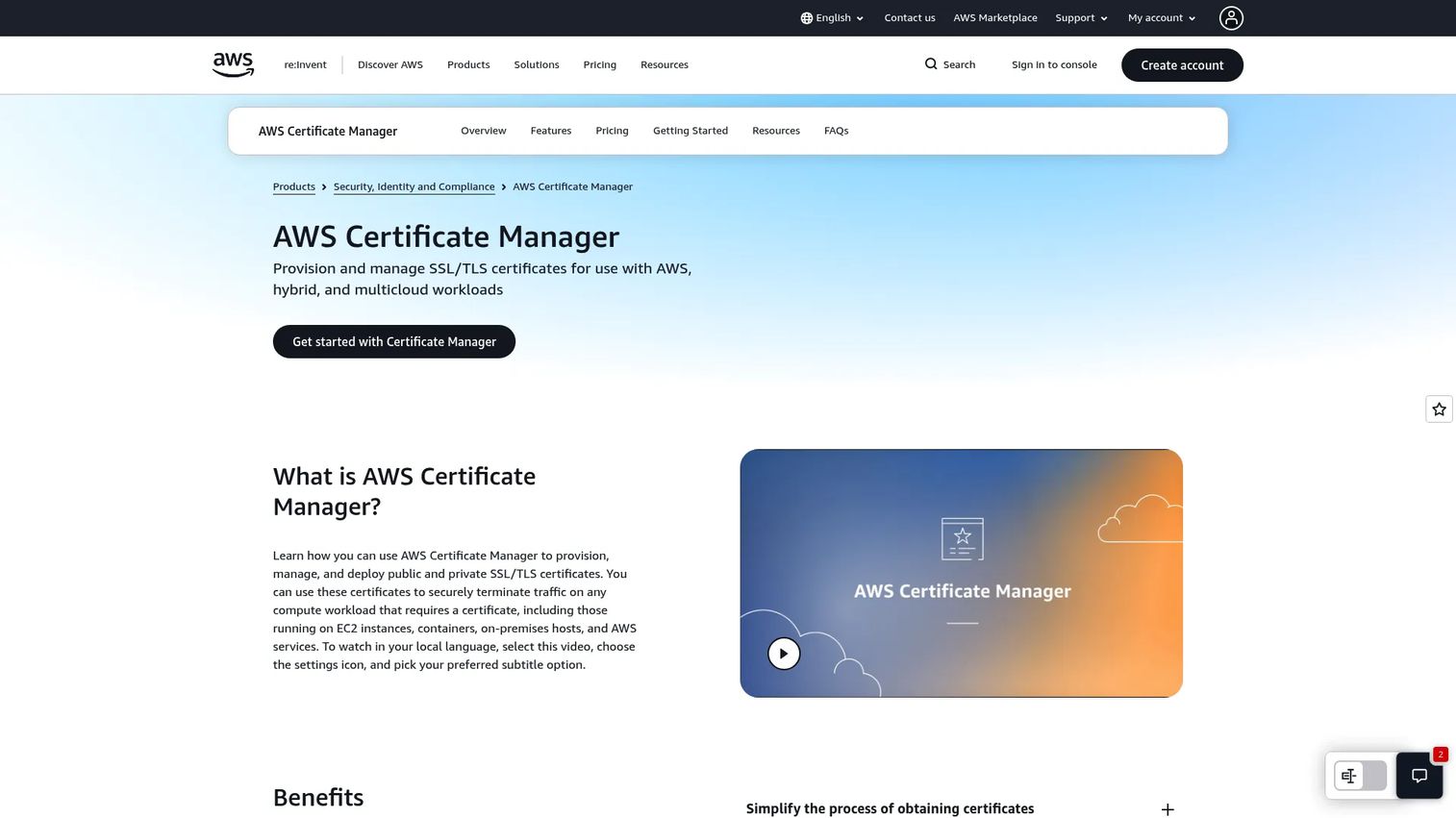
AWS Certificate Manager handles SSL/TLS certificate provisioning, management, and automated renewal inside the AWS ecosystem. Public certificates used with Elastic Load Balancing, CloudFront, and API Gateway carry no additional charge. For engineering teams already standardized on AWS, certificate automation is available without adopting a separate platform. Private CA capabilities and exportable certificates carry separate usage-based pricing.
Best for: AWS-first SaaS companies that need certificate automation inside existing infrastructure without adding a dedicated certificate management tool.
Key features
- Public TLS certificates for AWS-integrated services
- Automated certificate renewal
- Integration with Elastic Load Balancing, CloudFront, and API Gateway
- Private CA support for internal services
- Exportable certificates for non-AWS workloads
Why choose AWS Certificate Manager: If your product runs on AWS and your certificate exposure is primarily within that environment, this is the lowest-friction option. Certificates for integrated services carry no additional cost, and renewal happens automatically. The case for a dedicated certificate lifecycle platform grows once you have infrastructure spread across multiple cloud providers or certificate types that AWS does not natively manage.
AWS Certificate Manager pricing: Public certificates used with integrated AWS services are free. ACME public certificates cost $1.00 per domain for the first 1,000 fully qualified domain names per account per month, dropping to $0.50 and then $0.25 per domain at higher volumes, with wildcard domains at $5.00 each for the first 500. Exportable public certificates run $7.00 per standard fully qualified domain name and $79.00 per wildcard name, charged at issuance and renewal. AWS Private CA is priced separately on its own page.
G2 rating: 4.5/5 from 58 reviews
6. Valimail
Valimail automates DMARC enforcement, SPF management, and DKIM alignment so SaaS companies can reach full email-domain protection without manual DNS configuration. Its sender visibility dashboard shows every service sending email on behalf of your domain, including tools you may have forgotten are sending on your behalf. BIMI support allows brand logo display in participating email clients once DMARC is at an enforcement policy of quarantine or reject, since BIMI does not work on a domain left at p=none.
Vendor relationship to note: DigiCert announced its acquisition of Valimail on 16 September 2025 and folded email authentication into the DigiCert ONE platform, so Valimail and entry 9 below now sit under the same owner. If you are running a vendor-diversity requirement or a two-supplier shortlist, treat them as one supplier.
Best for: SaaS companies that rely heavily on outbound email and need to reduce spoofing risk without assigning a full-time email security specialist to the problem.
Key features
- Automated DMARC enforcement and monitoring
- Sender visibility and authorization dashboard
- Automated SPF and DKIM management
- BIMI and branded-logo support
- Reporting, alerts, and enforcement dashboards
Why choose Valimail: The automation is the differentiator. Most DMARC implementations stall at monitoring because SPF and DKIM alignment requires ongoing DNS management as your sending stack changes. Valimail handles that automatically, which is what makes enforcement reachable for a team without a dedicated email security hire.
Valimail pricing: A free Monitor tier is available. Paid Enforce plans and the Amplify add-on carry no published list price and are quoted through direct sales. Contact Valimail for current Enforce pricing.
G2 rating: 4.5/5 from more than 600 reviews on the Valimail listing
7. EasyDMARC
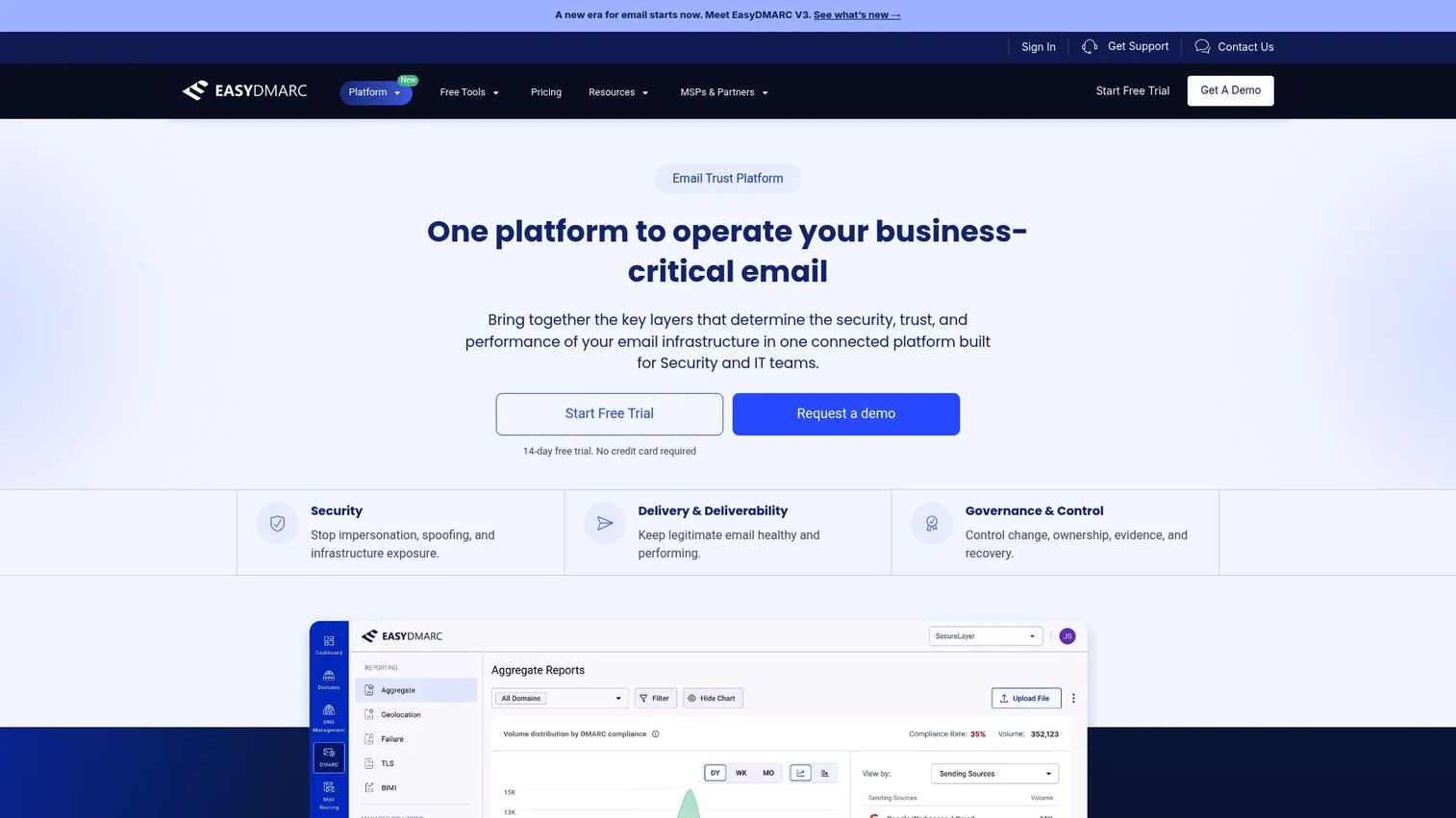
EasyDMARC is an email trust platform that covers DMARC monitoring, SPF flattening, DKIM management, DNS zone validation, and sender health tracking. Its guided setup and reporting dashboards make it approachable for teams without a dedicated email security specialist. The platform also covers deliverability monitoring and blocklist tracking, giving operations and marketing teams visibility alongside security.
Best for: SaaS teams that need practical DMARC setup and ongoing email authentication management without heavy operational overhead.
Key features
- DMARC, SPF, and DKIM authentication management
- DNS zone management, monitoring, and SPF flattening
- Sender reputation and blocklist monitoring
- BIMI support
- Threat reports and managed email health tracking
Why choose EasyDMARC: The combination of DMARC management and DNS health monitoring in one interface reduces the number of places your team needs to check when a deliverability or authentication issue surfaces. A free trial with no card required lets you test monitoring before committing to a paid plan.
EasyDMARC pricing: EasyDMARC has no free plan. DMARC Plus is $35.99/month billed annually or $44.99/month billed monthly and covers two domains with three months of data history. DMARC Premium is $71.99/month billed annually or $89.99/month billed monthly and covers four domains with a year of history. The Deliverability and Enterprise Email Trust tiers carry unlimited domains and are quoted by sales. A free trial is available on the Plus and Premium plans, and EasyDMARC also publishes a set of free standalone checkers for DMARC, SPF, DKIM, BIMI, MTA-STS, and TLS-RPT outside any plan.
G2 rating: 4.7/5 from 298 reviews
8. PowerDMARC
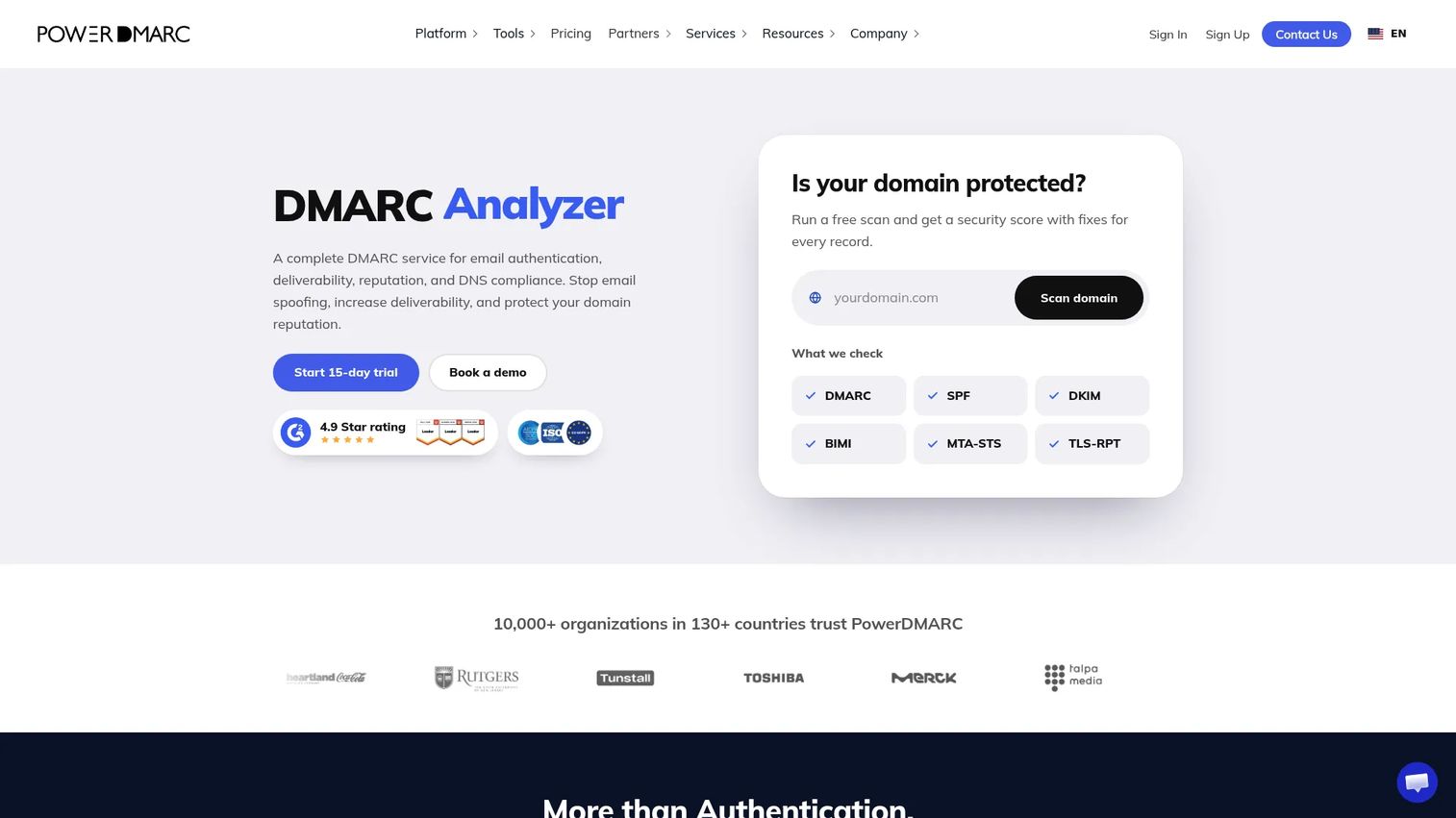
PowerDMARC provides hosted DMARC, SPF, DKIM, BIMI, MTA-STS, and TLS-RPT management from one platform, which makes it useful for companies managing multiple sending domains or a growing number of outbound tools. Its AI agent and DNS security compliance monitoring add an analytical layer on top of standard authentication reporting, and SIEM integration is available for teams with existing security operations tooling.
Best for: Teams that need to manage email authentication across a growing domain footprint with centralized reporting and enforcement.
Key features
- DMARC aggregate and forensic report processing
- Hosted SPF, DKIM, MTA-STS, TLS-RPT, and BIMI services
- Threat intelligence and geolocation reporting
- AI agent and DNS security compliance monitoring
- SIEM integration and SSO support
Why choose PowerDMARC: The breadth of hosted authentication services (covering MTA-STS and TLS-RPT alongside the standard DMARC stack) makes PowerDMARC a fit for companies that want one place to manage the full email security authentication posture, not just DMARC policy alone.
PowerDMARC pricing: The free tier covers personal domains only, with one active domain, one user, 10,000 emails per month, and 10 days of history. Basic is $15/month, or $12/month billed yearly, and covers five active domains, two platform users, and a year of data history, with email volume tiers starting at 50,000 per month. Enterprise and Partner pricing is custom. Note that PowerDMARC's own comparison table shows a wider Basic range than its plan card, so confirm the figure for your volume tier before budgeting.
G2 rating: 4.9/5 from 270 reviews
9. DigiCert ONE
DigiCert ONE is a unified digital trust platform that covers PKI, DNS, certificate lifecycle management, software code signing, device identity provisioning, and content authenticity under one architecture. For SaaS companies with complex certificate, code-signing, or device trust requirements across multiple environments, DigiCert ONE provides the governance controls and automation that enterprise scale demands.
Vendor relationship to note: DigiCert acquired Valimail, entry 6 above, in a deal announced on 16 September 2025, and email authentication is now part of this platform. Shortlisting both means shortlisting one supplier twice.
Best for: SaaS companies with complex certificate, code-signing, or digital trust requirements across enterprise-scale infrastructure.
Key features
- Centralized PKI and certificate lifecycle management
- Automated certificate issuance, renewal, replacement, and discovery
- Software code-signing and supply-chain protection
- Device identity provisioning and lifecycle management
- Policy enforcement, governance, and audit-ready controls
Why choose DigiCert ONE: When your certificate and digital trust requirements span multiple product lines, environments, and certificate types, a single-vendor platform that can manage all of them reduces coordination overhead. DigiCert ONE is built for the complexity that appears when a SaaS company moves into regulated markets or enterprise distribution.
DigiCert ONE pricing: Subscription-based. DigiCert publishes no list price for DigiCert ONE, so budgeting requires direct engagement with its sales team.
G2 rating: 4.3/5 from 78 reviews
10. Signal
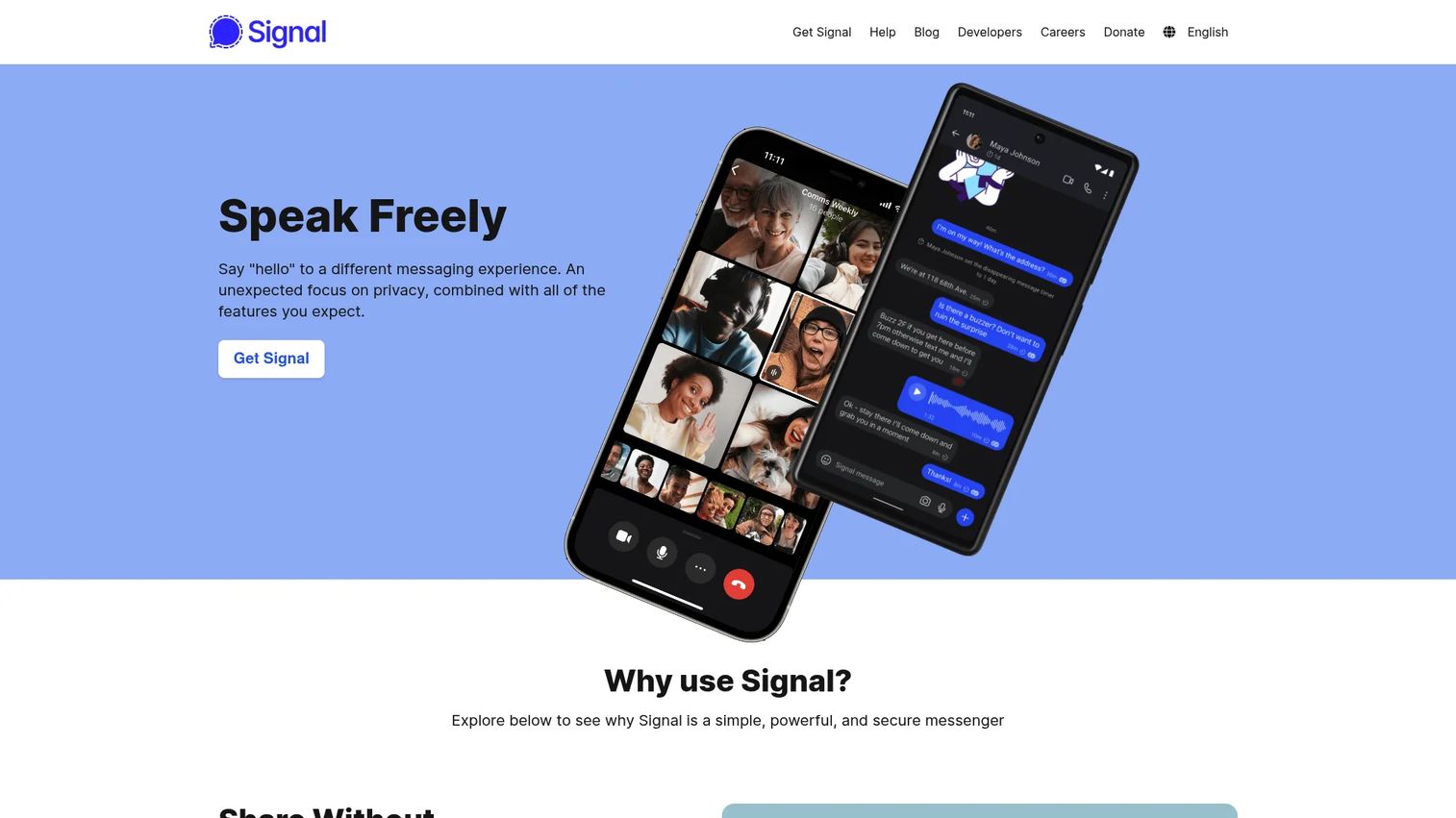
Signal is a privacy-focused messenger built on an open-source end-to-end encryption protocol. It covers text messaging, encrypted voice and video calls, group chats, and disappearing messages. Signal is not a full enterprise confidentiality platform and does not offer the admin controls, audit logs, or user management that a 50-person SaaS team expects from business software. Its place in a founder's security stack is narrow: private communication for specific sensitive conversations where participants already use Signal.
Best for: Small teams or executive groups that need private, encrypted communication for specific sensitive conversations without adding a managed messaging platform.
Key features
- End-to-end encrypted text, voice, and video
- Group chats and encrypted file sharing
- Disappearing messages
- Open-source Signal Protocol
- No ads and no tracking
Why choose Signal: Signal earns trust through what it does not do: no ads, no tracking, no metadata harvesting. For a founder communicating with board members, legal counsel, or a small leadership team on sensitive matters, it removes a class of interception risk that standard business messaging tools do not address. Treat it as a narrow tool for specific conversations, not a replacement for business messaging.
Signal pricing: Signal is free to use, supported by grants and donations with no subscription charge.
G2 rating: 4.4/5 from 453 reviews
11. DataLocker
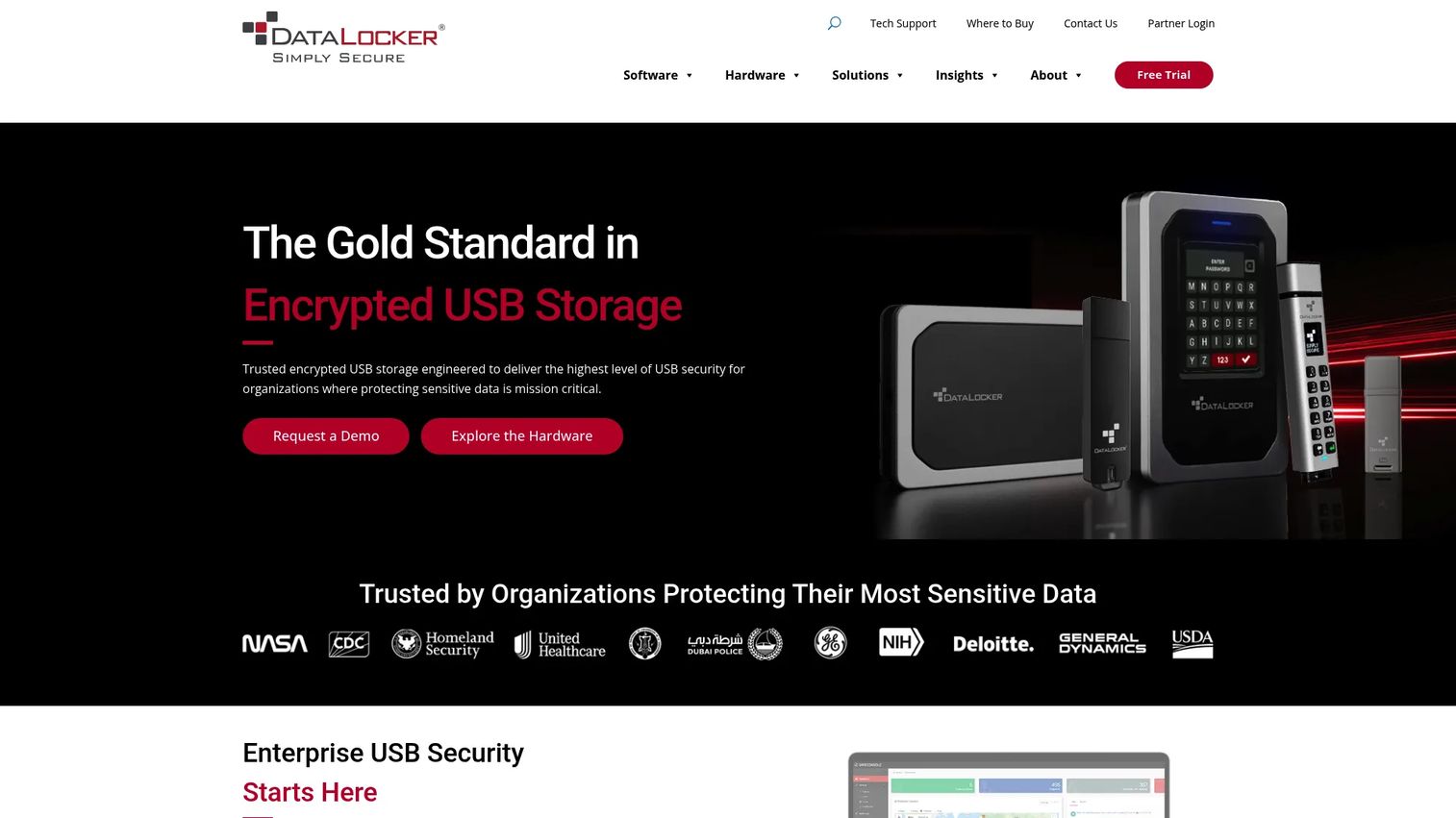
DataLocker provides AES hardware-encrypted USB flash drives and external hard drives, managed through its SafeConsole platform. SafeConsole lets administrators enforce policies, remotely lock or wipe devices, track inventory, and pull compliance reports across a fleet of encrypted storage devices. This matters for teams that handle offline data transport, field sales, regulated data movement, or audit evidence that needs to travel physically.
Best for: Organizations that need hardware-backed confidentiality for portable or offline data, including field operations, regulated environments, and audit evidence management.
Key features
- AES hardware-encrypted USB drives and external hard drives
- Centralized device management and policy enforcement via SafeConsole
- Remote lock, wipe, reset, and password recovery
- Compliance reporting and audit logs
- Optional anti-malware scanning and USB port control
Why choose DataLocker: Cloud-first SaaS companies rarely think about physical data movement until a security questionnaire, field sales situation, or audit exposes the gap. DataLocker closes that gap with hardware encryption that does not depend on an internet connection, making it the right fit for data that has to move outside your cloud environment.
DataLocker pricing: DataLocker publishes no list prices. SafeConsole is sold as a subscription on one-year and multi-year terms, in Cloud and On-Prem editions, across Basic, Professional, and Enterprise server tiers, with a separate device management license for each managed drive. Anti-malware is a paid add-on. Both the console subscription and the hardware are quoted through DataLocker or its resellers, so build your estimate from your device count and term length.
G2 rating: Not listed on G2. SafeConsole has no G2 profile, and the only DataLocker product listed on the company's G2 seller page is IronKey EMS.
12. SpiderOak
SpiderOak offers zero-trust security software for protecting data, managing access, and enabling secure communications in edge environments. Its OrbitSecure platform covers identity and access management with role- and attribute-based access control, secure decentralized peer-to-peer data exchange, and tamper-evident audit logs. SpiderOak positions its technology for space, defense, industrial, and IoT environments where traditional cloud architectures cannot be trusted or are unavailable, and its work includes an OrbitSecure payload tested in low-Earth orbit.
Best for: Organizations with zero-trust access control and secure data exchange requirements in defense, industrial, IoT, or other edge environments.
Key features
- Identity and access management with role- and attribute-based controls
- Secure, decentralized peer-to-peer data exchange and messaging
- Data segmentation and key management
- Tamper-evident audit logs
- Edge and offline environment support
Why choose SpiderOak: SpiderOak fits a narrow but important profile: companies operating in environments where centralized cloud trust models are not viable or where regulatory requirements demand decentralized, zero-trust architectures. It is not a general-purpose SaaS productivity tool; the value is specific to organizations with edge, defense, or high-assurance data exchange requirements.
SpiderOak pricing: SpiderOak publishes no pricing for its zero-trust platform. Team and enterprise engagements are quoted through direct contact with SpiderOak.
G2 rating: Not listed on G2. The zero-trust platform has no G2 profile. The 4.2/5 score sometimes attached to SpiderOak belongs to a different product, the company's separate One Backup listing, which carries five reviews, so do not read it as a rating of the platform described here.
13. OneTrust
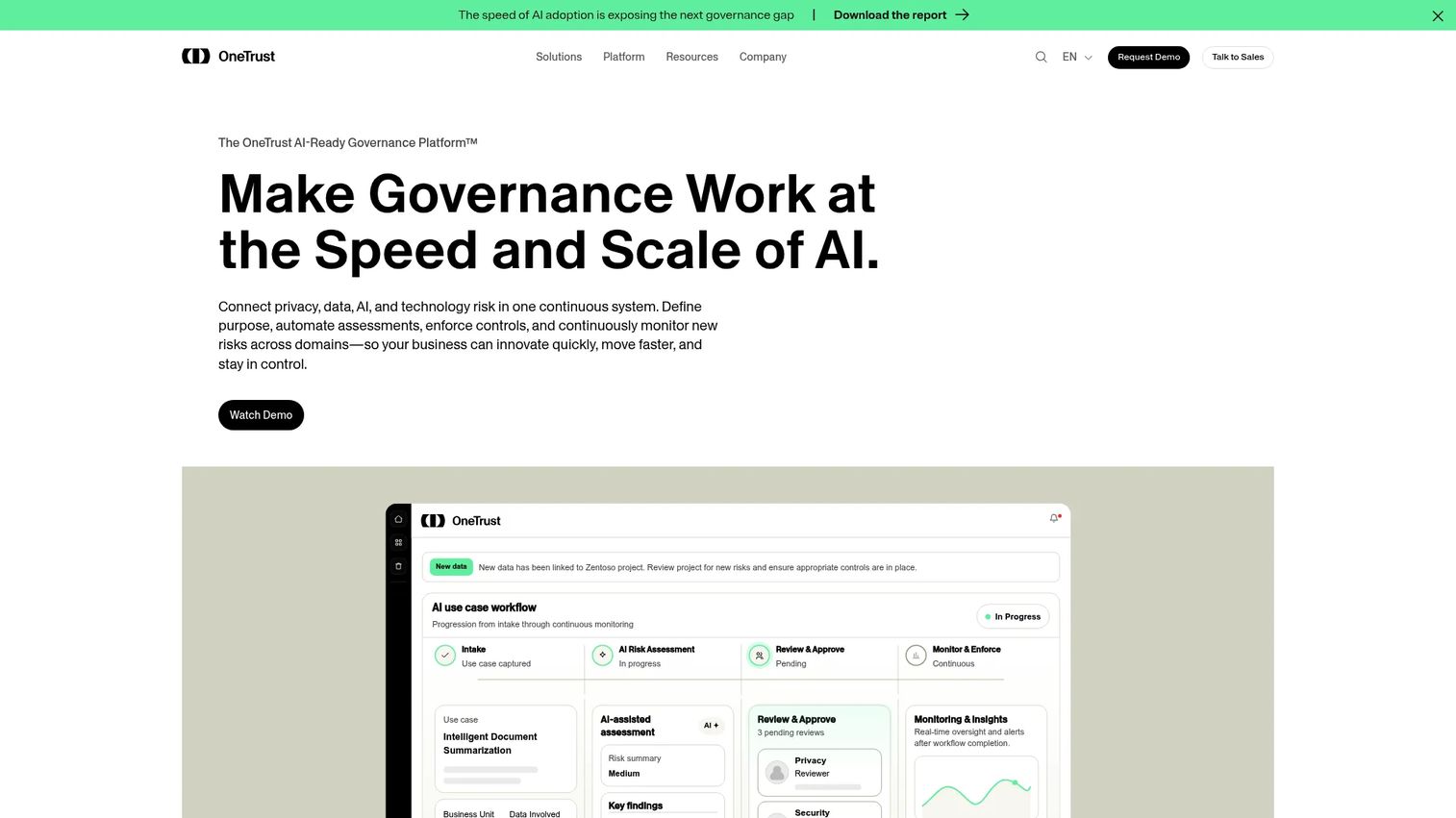
OneTrust is an AI-ready governance platform covering privacy management, consent, data mapping, AI governance, technology risk, and third-party risk management. For a SaaS company moving into enterprise segments or regulated markets, OneTrust provides the operational infrastructure to manage GDPR, CCPA, and similar frameworks at scale. Its data discovery capabilities connect across more than 200 out-of-the-box data source connectors, a figure OneTrust first announced in June 2023, and its consent management platform covers web, mobile app, and connected TV surfaces.
Best for: SaaS companies entering larger enterprise customer segments or regulated markets where structured privacy operations and compliance workflows are required by contract or law.
Key features
- AI-driven data discovery and classification across more than 200 connectors
- Automated privacy assessments, data mapping, and data subject request fulfillment
- Consent and preference management across web, mobile, and connected TV
- AI governance with risk assessments and policy controls
- Third-party risk management from onboarding through offboarding
Why choose OneTrust: The depth of privacy workflow automation justifies the cost when your team is managing DSARs, vendor risk assessments, and consent records across multiple jurisdictions. A new VP of Privacy or Legal dropped into a 100-person company needs something operational on day one. OneTrust covers a wide span of that surface. For teams exploring related compliance tooling, the audit management software guide covers adjacent options.
OneTrust pricing: All plans use custom, usage-based pricing. Contact OneTrust directly for a quote based on user count, data subject volume, and modules needed.
G2 rating: 4.3/5 from 154 reviews on the OneTrust Privacy Automation listing
14. BigID
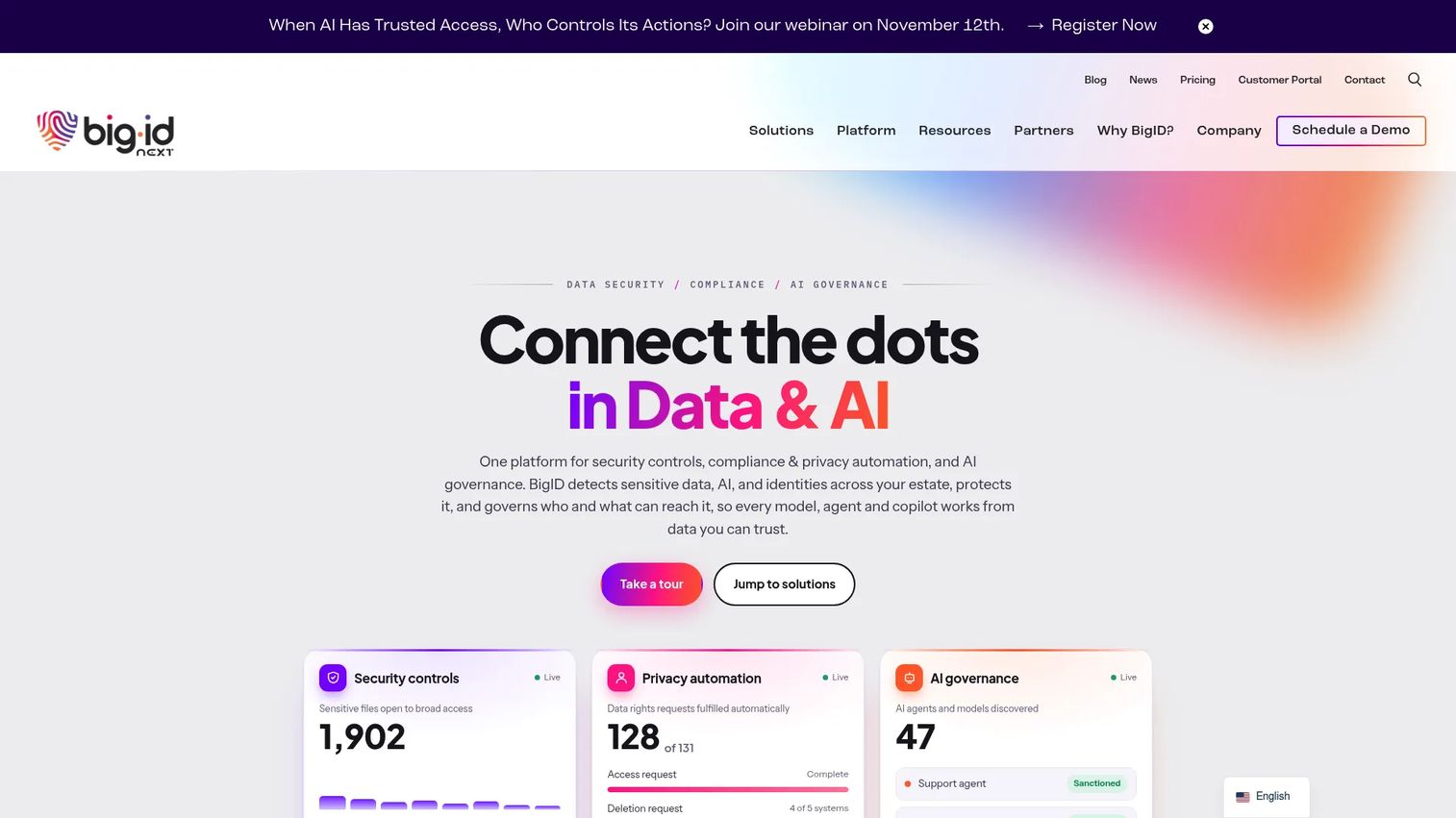
BigID is a data intelligence platform that discovers, classifies, and governs sensitive data across cloud, SaaS, on-premises, structured, unstructured, and AI-connected environments. It combines sensitive data discovery, PII classification, data security posture management, access intelligence, and privacy automation under one architecture. For a Series B company with fragmented data stores and growing audit pressure, BigID answers the question that precedes every confidentiality control decision: where does your sensitive data actually live?
Best for: SaaS companies with fragmented data stores and growing audit or enterprise diligence pressure that need to know where sensitive data exists before promising to control it.
Key features
- Sensitive data discovery and classification across cloud, SaaS, and on-premises environments
- Data security posture management and access intelligence
- Privacy automation including data rights requests, consent, and deletion workflows
- Risk scoring and remediation recommendations
- Activity monitoring and policy enforcement
Why choose BigID: Most confidentiality failures start with a gap in visibility. BigID closes that gap by finding sensitive data before an auditor, regulator, or security incident does. The AI security posture management tools guide covers tools that extend this posture management layer further.
BigID pricing: Custom pricing based on data sources, connectors, deployment type, and services. A free trial is available. Contact BigID for a quote.
G2 rating: 4.3/5 from 16 reviews
15. Varonis
Varonis provides a unified data security platform that discovers sensitive data, analyzes permissions, monitors behavior, detects threats, and automatically remediates risky access configurations across cloud, SaaS, on-premises, and AI environments. Its automated remediation of overpermissioned data is the feature that saves the most engineering time, because Varonis identifies and closes exposure without requiring manual ticket-by-ticket permission reviews.
Best for: Enterprise security teams that need to see who can access sensitive data, reduce exposure automatically, and detect anomalous access behavior across a complex environment.
Key features
- Sensitive data discovery and classification
- Automated remediation of risky permissions and misconfigurations
- Data-centric threat detection and behavioral monitoring
- Permissions analysis across cloud, SaaS, and on-premises systems
- Cloud monitoring and data security posture management
Why choose Varonis: When your data access governance problem is large enough that manual remediation is not viable, Varonis's automated approach becomes the strongest argument for the platform. It addresses the data access governance problem at scale, closing permissions exposure that would otherwise sit open until an incident surfaces it.
Varonis pricing: Custom pricing. Contact Varonis for a quote through their price request page.
G2 rating: 4.6/5 from 94 reviews
Considerations when choosing confidentiality software
Start with the data you need to protect
Do not start with the broadest platform on this list. Start with the highest-risk data flow you have right now: customer credentials, board materials, TLS certificates, outbound email, or PII spread across cloud apps. The right first purchase addresses the gap that is currently slowing an enterprise deal, an audit, or board confidence, not the most impressive-looking platform in a vendor's deck.
Match the tool to the owner
Confidentiality tools fail when nobody owns them. Engineering owns certificates and infrastructure security. IT or operations owns passwords and endpoint storage. Security owns access monitoring and threat detection. Legal or privacy owns privacy workflows and compliance reporting. Sales or GTM ops owns secure customer communications. Assign an internal owner before purchasing, not after.
Check what proof the tool produces
Audit logs, policy reports, access records, and exportable evidence are what survive due diligence. A tool that protects data but cannot prove it protected data is worth far less to a board or enterprise buyer. Prioritize tools with clear audit trails, admin dashboards, and reporting formats your team can share externally without additional processing.
Watch implementation drag
A heavyweight platform without an internal owner stalls immediately. For a Series B company, first-win speed matters: a new VP of Security or Privacy needs something producing value in their first 30 days. Favor tools with clear onboarding paths and a defined starting scope, not platforms that require a six-month implementation before delivering any signal.
Avoid overlapping tools in the same category
Map what your existing stack already covers before adding anything here. Some tools in this list overlap in discovery, governance, and reporting. The goal is closing specific gaps, not adding dashboards. For related reading on managing tool sprawl across your operations stack, see our guide to business process management software.
Conclusion
Confidentiality is not one purchase. It is a stack of controls, each addressing a different risk layer.
For secure email and file sharing, Virtru is a clear starting point for teams running on Google Workspace or Microsoft 365. Proton Pass For Business handles credential confidentiality at a price that earns its place at any stage. Sectigo, AWS Certificate Manager, and DigiCert ONE each serve a distinct certificate infrastructure profile. Valimail, EasyDMARC, and PowerDMARC all automate email-domain authentication, with EasyDMARC's $35.99/month annual plan offering a low-friction entry into paid enforcement. OneTrust, BigID, and Varonis cover the privacy, data discovery, and access governance needs that enterprise sales and audits increasingly demand.
For a Series B founder, the priority question is simple: which confidentiality gap is blocking a deal, slowing an audit, or producing unnecessary board-level questions right now? Pick that layer first, assign an owner, and run a 30-day pilot with a measurable output (a passed security questionnaire, a completed DMARC enforcement, a certificate inventory under management). The rest can follow.
Several of these tools change how your product gets explained, not just how it gets protected. Once access controls tighten, prospects and auditors can no longer poke around a live environment with real customer data in it. An interactive demo solves that: Guideflow lets presales and product marketing teams build a shareable product experience from a captured version of your app, so buyers see the workflow without touching production records.
Start your journey with Guideflow today!
FAQs
Confidentiality software protects sensitive information from unauthorized access through a combination of encryption, access controls, secure sharing, data discovery, certificate management, and audit logging. It spans multiple distinct tool categories, including encrypted file sharing, credential management, email authentication, and privacy governance. No single tool covers every confidentiality layer, so most organizations use a small set of tools that each address a different risk.
No, though the categories overlap. Confidentiality focuses on preventing unauthorized access to sensitive information. Privacy focuses on the lawful, transparent, and governed use of personal data. Some platforms in this list, particularly OneTrust, BigID, and Varonis, address both. Others, like Virtru or Proton Pass For Business, focus specifically on access prevention without covering privacy compliance workflows.
Start with the risk that is currently blocking you. If passwords are the weakest link, start with a business password manager. If enterprise customers are asking about email encryption or secure file sharing, start with a tool like Virtru. If DMARC is failing and spoofed emails are a concern, EasyDMARC or PowerDMARC is a fast first step. Save privacy management and data governance platforms for when you have a clear internal owner and an audit or compliance motion driving the need.
Enterprise security questionnaires typically ask about secure file sharing controls, certificate management, email authentication (DMARC, SPF, DKIM), data discovery, privacy workflows, and access governance. The tools that produce the clearest evidence for those questions are Virtru for communication controls, Sectigo or DigiCert ONE for certificate inventories, EasyDMARC or PowerDMARC for email authentication records, and OneTrust or Varonis for privacy and access governance reports. Evidence that can be exported and shared directly speeds a review more than capability claims in a vendor deck.
Not always. If your product runs entirely on AWS and your certificates are primarily used with integrated AWS services, AWS Certificate Manager handles automated renewal at no additional cost. Dedicated certificate lifecycle platforms earn their place when you have infrastructure spread across multiple cloud providers, many domains and environments, or certificate types that fall outside what a cloud-native manager handles. That point typically arrives at 50 to 100 people with a distributed infrastructure footprint.
Encryption protects the content of data itself, making it unreadable without the correct key. Access governance controls who can reach data in the first place, by managing permissions, reducing overexposure, and monitoring access behavior. Both matter, but they address different failure modes. Encryption fails when the key is compromised. Access governance fails when too many people or systems have permissions they should not have. For most SaaS teams, the access governance problem is larger than they realize until a data discovery tool maps it out.
DMARC tools prevent attackers from impersonating your domain in outbound email, which protects both your customers and your employees from phishing campaigns that appear to come from your company. Successful domain impersonation is a common entry point for social engineering attacks that compromise credentials or sensitive communications. Enforcing DMARC, SPF, and DKIM alignment closes that vector and protects the trust your outbound email has built with customers, investors, and partners.
Compare the cost against the risk it reduces and the internal time it replaces. A DMARC tool at $36/month that removes a class of domain impersonation risk pays back fast. A privacy management platform at enterprise pricing is justified when it replaces a legal or compliance team member who would otherwise spend weeks manually managing data subject requests and vendor risk assessments. Factor in implementation time, the need for an internal owner, and whether the tool produces audit-ready outputs. Tools that require months of configuration before delivering any signal are hard to justify at a stage where your VP-level hires need quick wins.