Your clinicians are working from separate meal-plan files, client notes, a scheduling tool, and a food tracker that none of them agreed on. You're still the one fielding questions about where the intake form lives. That's the actual problem nutritionist software is supposed to solve.
The global nutritionist software market reached $2.8 billion in 2025, according to Verified Market Reports (2026), and the category is growing alongside telehealth adoption. A 2025 study published in the Journal of the Academy of Nutrition and Dietetics found that 90% of surveyed registered dietitians routinely incorporate telehealth into their practice. The infrastructure question is no longer theoretical.
But "nutritionist software" covers four meaningfully different product types. A practice-management platform, a meal-planning tool, a nutrient-analysis program, and a food-labeling system all carry that label. Choosing the wrong category costs more than choosing the wrong vendor.
The right platform becomes the operating system for care delivery. The wrong one becomes another tab your team avoids.
What's inside
This guide is for nutrition-tech founders, clinic operators, and practice owners deciding which software category fits their operating model, not just which product has the most features. Tools were assessed on:
- Client management and workflow fit
- Nutrition-specific capabilities (meal planning, nutrient analysis, food labeling)
- Pricing clarity and growth economics
- Telehealth and multi-provider readiness
Prices and G2 ratings were verified against each vendor's live pricing page and current G2 listing at publication time.
TL;DR
- Best for broad private-practice operations: Practice Better covers scheduling, telehealth, charting, payments, and client messaging in one platform, with a free tier to start
- Best for nutrition-focused follow-up and mobile engagement: Nutrium is built around dietitian workflows, meal plans, and a client mobile app
- Best for telehealth and virtual care infrastructure: Healthie suits multi-provider clinics and virtual health businesses needing a full EHR stack
- Best for nutrient analysis and food labeling: Nutritionist Pro handles recipe calculations, diet recalls, and label formats across multiple jurisdictions
- Best for branded meal-plan content: That Clean Life produces polished, filterable plans quickly for solo practitioners and teams
- Best for personalized meal planning at scale: EatLove Pro fits practices where individualized nutrition recommendations are the core deliverable
- Best for detailed dietary tracking: Cronometer Pro covers 92 nutrients per food diary, suited to data-driven coaching models
What is nutritionist software?
Nutritionist software is a category of digital tools that helps dietitians, nutritionists, clinics, and food-service teams manage nutrition workflows such as client records, meal plans, dietary analysis, appointments, nutrient tracking, recipes, menus, and food labeling.
Core types of nutritionist software
| Type | Primary job | Who uses it | Examples from this list |
|---|---|---|---|
| Practice management | Scheduling, records, billing, telehealth, messaging | Dietitians and clinic operators | Practice Better, Healthie |
| Meal planning | Recipe creation, plan templates, dietary filters, client delivery | Nutrition coaches and practitioners | That Clean Life, EatLove Pro, Nutrium |
| Nutrient and diet analysis | Food databases, diet recalls, nutrient calculations, reporting | Dietitians, researchers, food consultants | Nutritionist Pro, Cronometer Pro |
| Food labeling and school nutrition | Label formats, menu calculations, regulated menu planning | Food companies, schools, restaurant consultants | Nutritionist Pro |
Key features to look for
- Client profiles and secure intake forms
- Appointment scheduling and payment processing
- Meal plans and recipe workflows
- Macro and micronutrient analysis
- Telehealth and client messaging
- Mobile access and food diary logging
- Role permissions and data access controls
- Reporting tied to retention or program outcomes
What nutritionist software does not replace
A practice-management platform does not automatically replace an EHR, an accounting system, or a specialist food-labeling tool. The right stack depends on your regulated-data requirements and service model. Food companies building products around clinical nutrition analysis need a different stack than a virtual coaching practice managing recurring client appointments.
When to use nutritionist software
Run a growing private practice without founder oversight
If you're still the person answering questions about where the intake form lives or how to invoice a client, that's a systems problem. A practice-management platform consolidates scheduling, forms, session notes, payments, and client messaging. Prioritize systems that reduce handoffs between practitioners and operations so a new clinical hire can work independently from day one.
Standardize meal plans across a multi-practitioner team
Reusable recipes, branded templates, dietary filters, and shopping lists matter when you have more than one practitioner producing client plans. Without a shared content system, your team rebuilds the same plan from scratch repeatedly. Content consistency also matters for brand quality as you scale.
Analyze diets, recipes, or menus at a professional level
Nutrient reporting, diet recalls, recipe calculations, label compliance, and menu analysis require dedicated tools with validated food databases. A client management software platform built for wellness coaching won't meet a professional food-analysis requirement. These are different purchases serving different workflows.
Nutritionist software comparison
The category splits into broad practice platforms and specialist nutrition tools. A founder building a multi-provider service may need both. For example, Healthie or Practice Better covers operations while Nutritionist Pro handles label calculations or Cronometer Pro tracks detailed dietary data.
| # | Product | Best for | Key differentiator | Pricing | G2 rating |
|---|---|---|---|---|---|
| 1 | Practice Better | Broad private-practice operations | All-in-one scheduling, charting, telehealth, payments | Free to $155/mo | 4.7/5 |
| 2 | Nutrium | Nutrition-focused client follow-up | Dietitian workflow plus client mobile app | From $15/mo | 2.7/5 |
| 3 | Healthie | Telehealth and virtual care delivery | API-first EHR with multi-provider support | From $19.99/mo | 4.0/5 |
| 4 | Nutritionist Pro | Nutrient analysis and food labeling | Multi-jurisdiction label formats and diet analysis | From $25/mo | 3.3/5 |
| 5 | That Clean Life | Branded meal-plan content | Recipe library with 100+ filters and brand exports | From $30/mo | 4.6/5 |
| 6 | EatLove Pro | Personalized meal planning | Dietitian-approved meal recommendations at scale | Free to $199/quarter | No current G2 rating |
| 7 | Cronometer Pro | Dietary tracking and adherence data | 92-nutrient food diary with practitioner reporting | From $39.99/mo | No current G2 rating |
Best nutritionist software tools for 2026
1. Practice Better
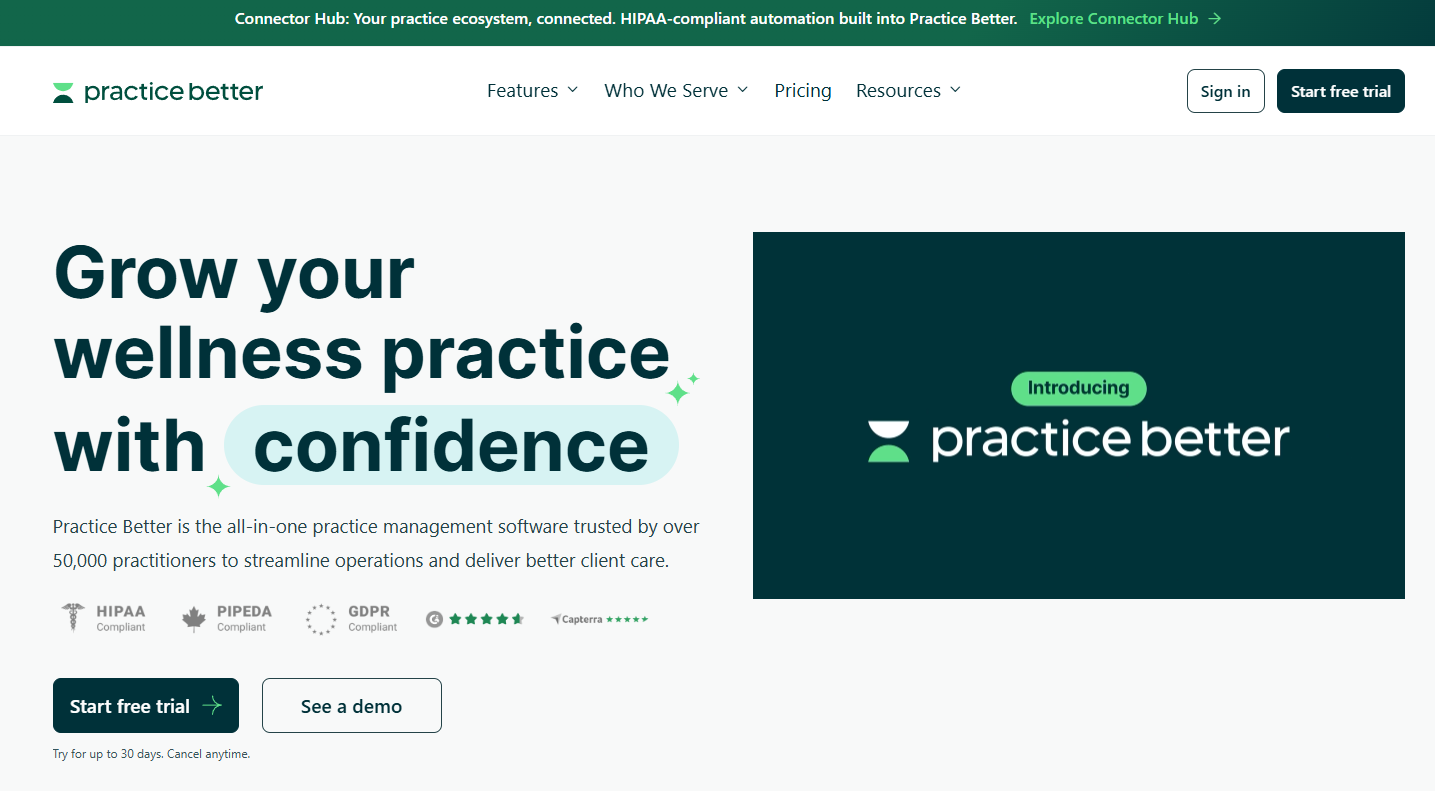
Practice Better is an all-in-one practice management and EHR platform for health and wellness professionals. It consolidates client intake, scheduling, telehealth, charting, secure messaging, payments, programs, and a client portal into a single system. Thousands of dietitians and wellness practitioners use it as their primary operating layer.
Best for: Founders standardizing a private practice or multi-provider nutrition service around one core platform rather than stitching together separate tools.
Key features
- Client intake forms and secure portal
- Appointment scheduling and calendar sync
- Telehealth video sessions built in
- Integrated billing, payments, and packages
- Note templates and charting tools
Why choose Practice Better: It's the right starting point when operational fragmentation is the bottleneck. A new VP of clinical operations can run the workflow without rebuilding it. The free Sprout plan lets a solo practitioner start without upfront commitment, and the Team plan at $155/month supports group practices.
Practice Better pricing: Sprout is free forever. Paid plans start at $25/month (billed annually) or $35/month billed monthly for the Starter tier, up to $155/month for Team. Paid plans include 14-day trials; Team gets 30 days.
G2 rating: 4.7/5
2. Nutrium
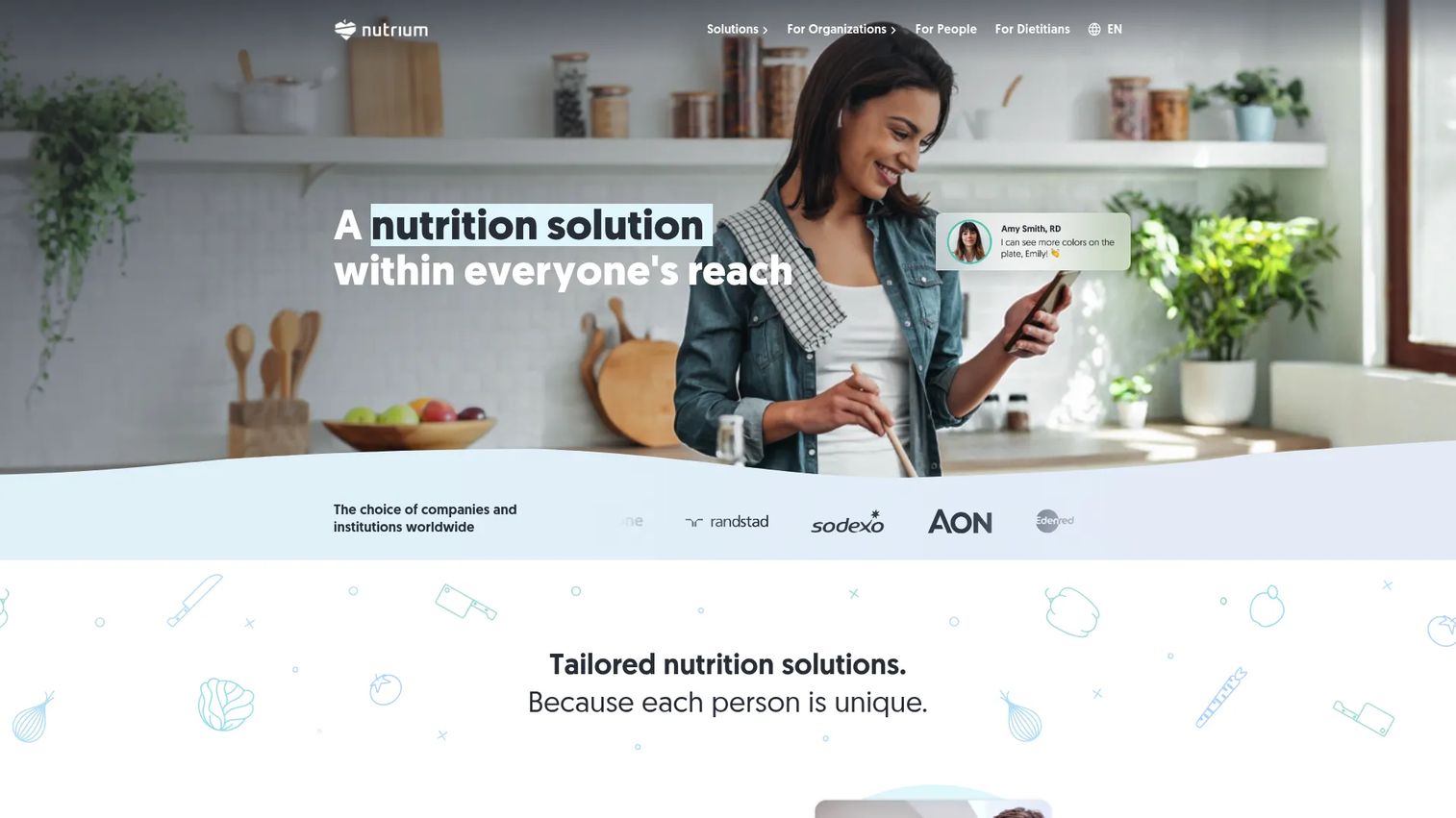
Nutrium is nutrition practice software built specifically for dietitians and nutritionists managing ongoing client relationships. It combines dietary assessment, personalized meal planning, appointment booking, and a client-facing mobile app with food diary, measurements, and shopping lists. Video consultations include AI-generated clinical summaries.
Best for: Nutrition businesses where client adherence, recurring consultations, and mobile engagement are central to the service model.
Key features
- Dietary and nutritional analysis tools
- Personalized meal plan and recipe creation
- Client mobile app with food diary and messaging
- Appointment scheduling and reminders
- Progress tracking reports
Why choose Nutrium: The client mobile experience sets it apart from general wellness platforms. If your service model depends on clients logging food, tracking progress, and staying in contact between sessions, Nutrium builds that loop into the product. Check regional availability before committing, as the platform operates across multiple markets with varying payment workflows.
Nutrium pricing: Plans start at $15/month (billed yearly) for up to 10 customers per month, or $25/month for unlimited clients billed yearly. Monthly billing is available at $25/month for 10 customers and $39/month for unlimited clients. A 14-day free trial is available.
G2 rating: 2.7/5
3. Healthie
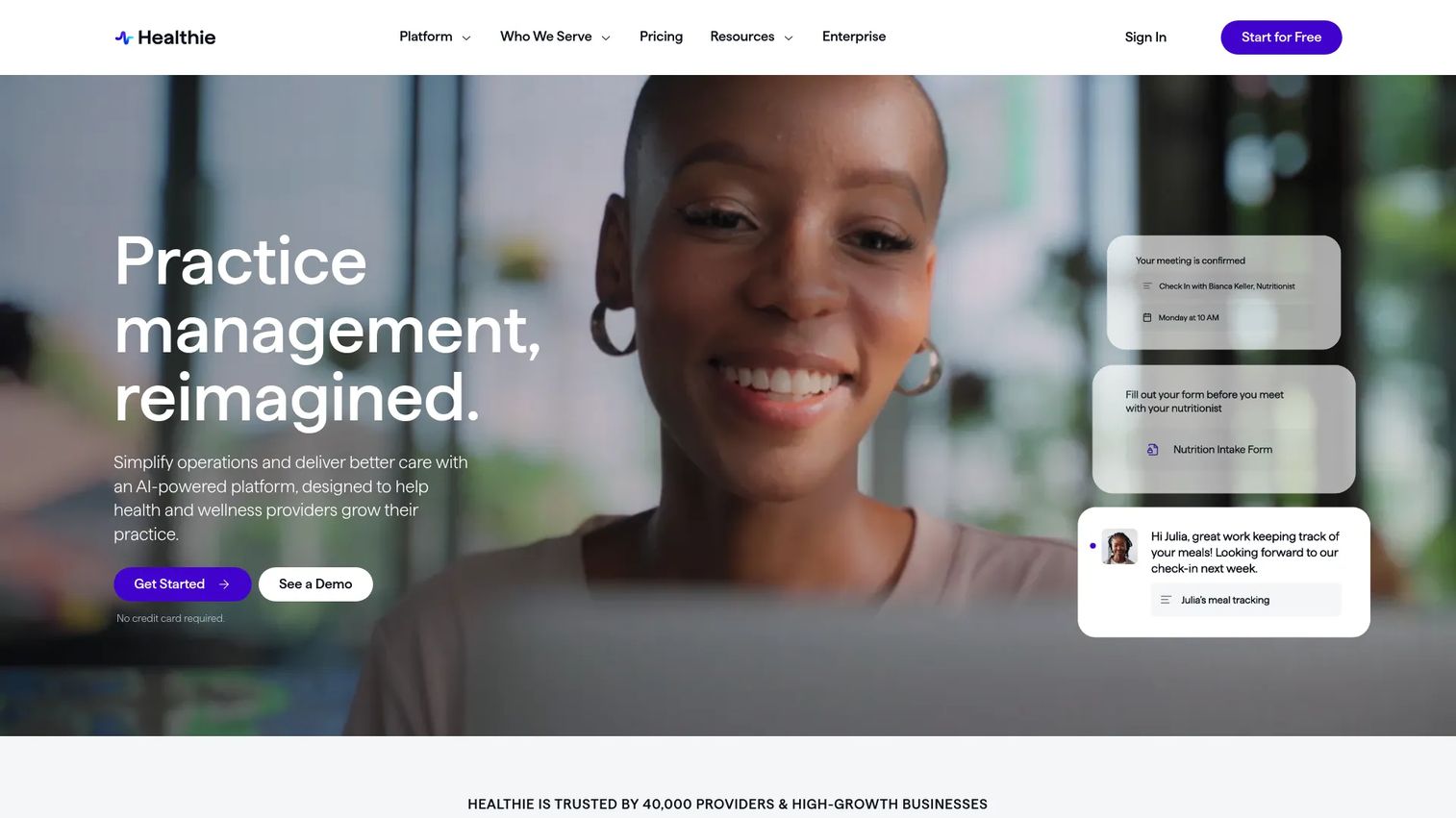
Healthie is an API-first, HIPAA-compliant EHR and practice management platform for virtual-first care organizations. It serves nutrition practices, wellness businesses, and digital health companies that need telehealth, charting, billing, and multi-provider coordination in one system. The API-first architecture makes it a better fit than most practice platforms for founders building on top of an existing tech stack.
Best for: Founders operating virtual clinics, care programs, or multidisciplinary services where nutrition delivery sits inside a broader health workflow.
Key features
- Telehealth and webinar tools
- Electronic paperwork and charting
- Scheduling and calendar management
- Insurance and direct billing
- Cloud-based EHR with mobile app
Why choose Healthie: It belongs on the shortlist when nutrition is embedded in a broader virtual-care model rather than a standalone private practice. The Group plan at $149.99/month and above supports multi-provider operations with the permissions and reporting a growing team needs. Implementation requires more planning than a solo-practitioner tool, so factor that into your evaluation timeline.
Healthie pricing: Core starts at $18/month billed annually ($19.99/month monthly). Essentials is $45/month annually. Plus is $129.99/month with a 10% annual discount. Group is $149.99+/month. Enterprise pricing is by quote. A 14-day free trial is available.
G2 rating: 4.0/5
4. Nutritionist Pro
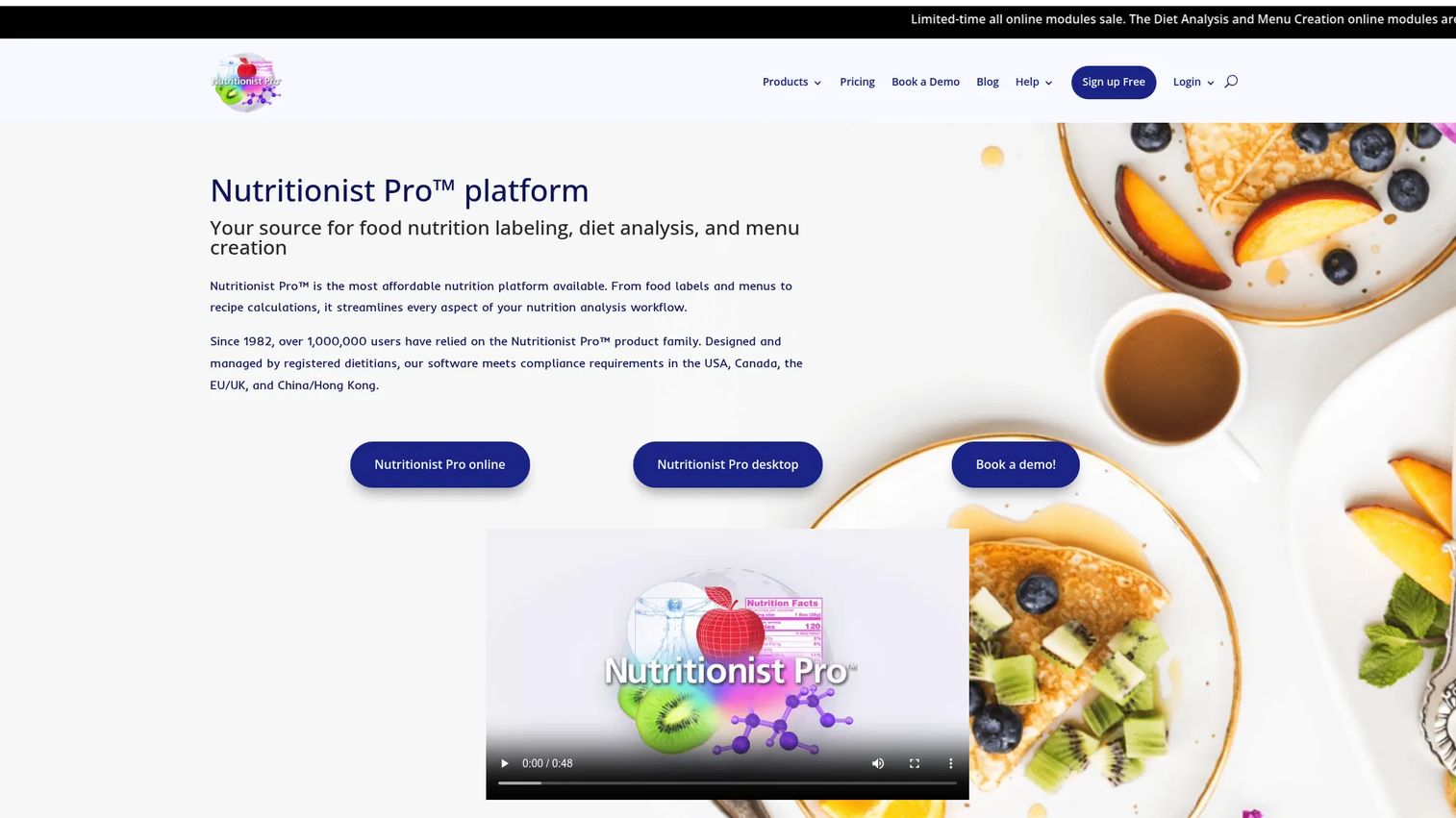
Nutritionist Pro is a specialist nutrition analysis program for professionals who need accurate nutrient analysis, recipe calculations, menu planning, and food labeling. It covers label formats for the USA, Canada, UK/EU, and China/Hong Kong, making it a practical choice for food companies operating across jurisdictions. Diet analysis and menu creation modules are available as online subscriptions or desktop purchases.
Best for: Food businesses, dietitian consultants, school nutrition teams, and any operation where nutritional calculation accuracy or label-ready output is the commercial center of the work.
Key features
- Food labels for USA, Canada, UK/EU, and China/Hong Kong
- Diet recall analysis and nutrient goal tracking
- Recipe building and menu creation
- Cycle menu planning
- Raw nutrient database access
Why choose Nutritionist Pro: This is a fundamentally different purchase from a client-management platform. Choose it when the business sells nutrition analysis, label compliance, or professional menu planning rather than coaching relationships. The online All Modules Bundle at $42/month (billed annually) is the most cost-effective starting point for teams needing the full feature set.
Nutritionist Pro pricing: The online All Modules Bundle runs $42/month billed annually ($59/month monthly). Food Labeling alone is $25/month annually ($36/month monthly). Desktop Diet Analysis and Menu Creation modules are each $599 as annual purchases. A free trial is advertised on the site.
G2 rating: 3.3/5
5. That Clean Life
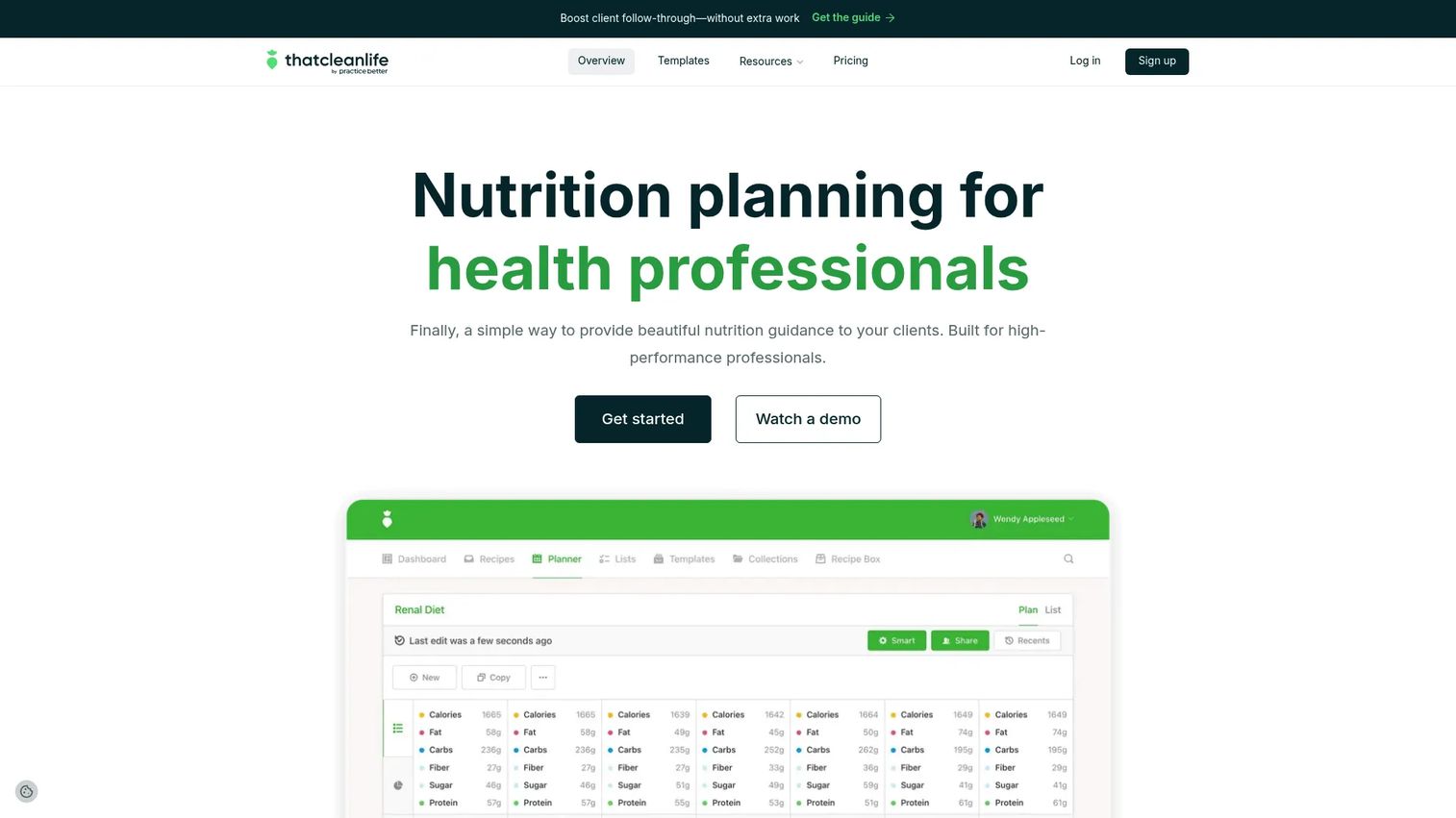
That Clean Life is a meal planning and recipe content platform built for health and wellness professionals who need to produce polished, client-ready nutrition plans quickly. It offers a recipe library with 100+ filters, automation based on calories and macros, branded PDF exports, and a native integration with Practice Better. The platform focuses on plan creation speed rather than broader practice operations.
Best for: Teams losing time rebuilding client meal plans from scratch or managing inconsistent recipe files across practitioners.
Key features
- Personalized meal plan automation by calories and macros
- Recipe library with 100+ dietary filters
- Branded PDF exports for client delivery
- Shopping lists and custom recipe collections
- Practice Better integration
Why choose That Clean Life: The content production workflow is where it earns its place in the stack. Practitioners who currently rebuild plans manually will reclaim significant prep time. It does not cover scheduling, billing, or telehealth, so it works best alongside a practice management platform rather than instead of one.
That Clean Life pricing: Starter is $30/month billed monthly with 10 shares. Plus is $60/month billed monthly (or $35/month billed annually at $420/year) with unlimited shares, advanced exports, automation, and AI Health Insights. No free trial is offered.
G2 rating: 4.6/5
6. EatLove Pro
EatLove Pro is a nutrition intelligence platform for professionals delivering personalized meal planning at scale. It provides dietitian-approved recipes, customizable nutrition prescriptions, smart grocery lists with optional delivery, food logging, restaurant recommendations, and HIPAA-compliant messaging. Web and iOS/Android apps are available for both practitioners and clients.
Best for: Nutritionists whose core deliverable is individualized meal content rather than broader care-coordination workflows.
Key features
- Personalized meal plans and nutrition prescriptions
- Dietitian-approved recipe library
- Food logging and nutrient analysis
- Smart grocery lists with optional delivery integration
- HIPAA-compliant messaging and APIs
Why choose EatLove Pro: The personalization depth makes it a strong fit for practices where tailored meal recommendations are the reason clients pay. A free plan supports up to 2 clients, which gives you enough to test the practitioner workflow before committing. Compare it against broader operating platforms if your business also needs scheduling, payments, or telehealth in the same system.
EatLove Pro pricing: A free plan is available for up to 2 active clients. The Premium plan costs $199 per quarter or $650 per year for up to 15 active clients.
7. Cronometer Pro
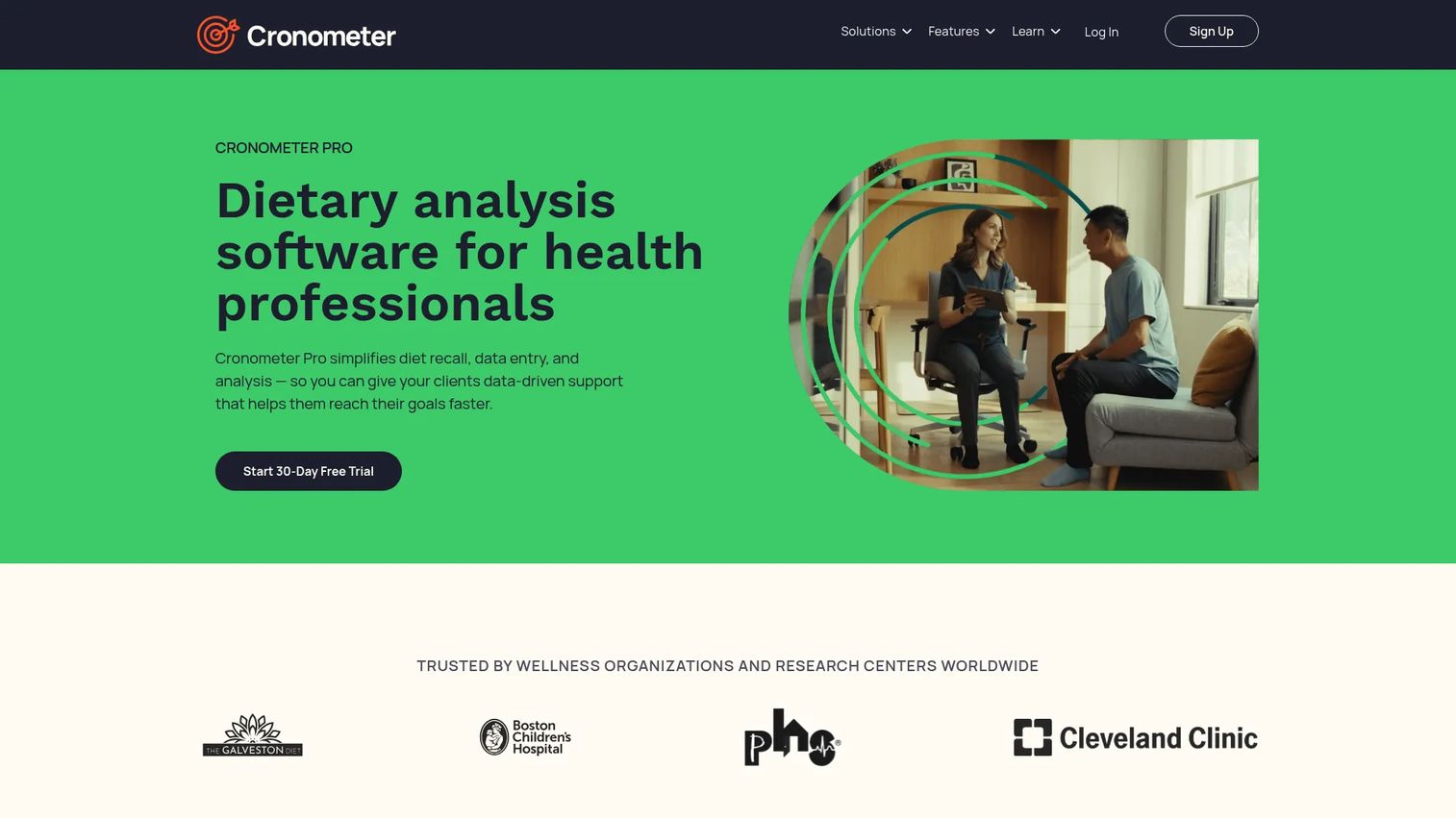
Cronometer Pro is dietary analysis software for nutrition professionals, healthcare organizations, researchers, and hospitals managing client nutrition data at a granular level. It tracks up to 92 nutrients and compounds per food diary entry, supports automated nutrition reports, offers a verified database with over 1 million foods, and includes in-app messaging and recipe analysis.
Best for: Nutrition businesses where detailed food-tracking data drives coaching conversations, clinical research, or measurable dietary interventions.
Key features
- Dietary analysis tracking up to 92 nutrients
- Automated nutrition reports and charts
- Verified food database with over 1 million foods
- Secure in-app client messaging
- PDF and CSV report export
Why choose Cronometer Pro: The nutrient-tracking depth is the differentiator. If your service is built around measurable dietary outcomes and clients need to understand exactly where their intake falls short, Cronometer Pro provides the data infrastructure. It may complement rather than replace a platform handling payments, forms, and appointment scheduling.
Cronometer Pro pricing: The Individual plan starts at $39.99/month and includes 10 client seats. Additional seats cost $2.50 each per month. Enterprise pricing is by custom quote.
Considerations when choosing nutritionist software
Start with the operating model, not the feature list
Private practices need an all-in-one client workflow covering scheduling, records, and billing. Food-product companies often need label calculations more than appointment tools. Virtual clinics need telehealth and multi-provider controls. No single platform covers every operating model equally well, so identify the workflow that most directly drives retention and revenue before comparing products.
Separate client operations from nutrition content
Assess whether you need an operating system for care delivery, a meal-plan creation layer, detailed nutrient tracking, or a specialist analysis product. These are different purchases with different ownership patterns inside your team. Buying an all-in-one platform when you only need meal-plan templates creates unnecessary cost and complexity. The reverse is also true: A meal-planning tool won't replace a scheduling and billing system.
Verify privacy, access controls, and data handling before committing
Ask each vendor about role permissions, data access by provider, secure communication features, and audit capabilities for client records. Review their security documentation and confirm how they handle protected health information. Do not rely on vendor marketing language alone for compliance decisions. Involve your legal or compliance advisor when the platform will handle sensitive patient or client data.
Test the client experience, not just the admin interface
A platform can look strong in practitioner screens and still fail if clients don't log food, book appointments, or open the app. Run a complete test client through intake, booking, plan delivery, and follow-up before migrating your team. Pay particular attention to mobile experience, notification flows, and the ease of completing a first session.
Model cost as the team grows
Compare practitioner seats, client limits, payment processing fees, and any charges for telehealth usage or premium integrations. A plan that works at 3 providers may become expensive at 10. Connect this to your revenue per employee and NRR targets, not just the monthly subscription cost.
Conclusion
Nutritionist software is not one category. It's four distinct purchase decisions that share a label.
Practice Better handles broad private-practice operations with scheduling, telehealth, and billing in one platform. Nutrium is the pick when recurring follow-up and mobile client engagement define the service. Healthie suits virtual care infrastructure with multi-provider support and an API-first architecture. Nutritionist Pro is the right tool when nutrient analysis, diet recalls, or food labeling is the commercial center of the business. That Clean Life and EatLove Pro serve practices where meal-plan content production is the core practitioner workflow. Cronometer Pro provides the dietary data granularity that data-driven coaching models require.
Choose the workflow that drives your retention, care quality, and operating efficiency. Then shortlist the two tools that best match it, run the same client journey through both trials, and ask the person who will own the system daily to score setup time and usability. That score matters more than any feature comparison.
Start your journey with Guideflow today!
FAQs
The answer depends on whether the practice prioritizes operations, meal planning, or nutrient analysis. A broad practice-management platform like Practice Better typically suits client scheduling, charting, and payment follow-up. Specialists like That Clean Life or EatLove Pro are better fits when the main workflow is producing meal plans. Most private practices eventually need at least two tools: One for operations and one for nutrition content.
Nutritionist software is the broader category, covering everything from meal-planning apps to food-labeling tools to full EHR platforms. Dietitian practice-management software specifically describes operational platforms built around scheduling, clinical forms, billing, telehealth, session notes, and client communication. Not all nutritionist software includes practice-management features, which is why the category distinction matters before you start evaluating products.
Many platforms offer this capability, but depth varies significantly. Meal-planning specialists like That Clean Life and EatLove Pro offer more dietary filter control, recipe library breadth, and shopping-list automation than a general practice-management system. If meal plans are the primary client deliverable, evaluate specialist tools rather than assuming a practice platform's built-in meal planner will be sufficient.
Nutritionist Pro and Cronometer Pro are the options built specifically for professional-grade nutrient analysis. Nutritionist Pro covers diet recalls, recipe calculations, menu planning, and multi-jurisdiction food labeling. Cronometer Pro focuses on tracking up to 92 nutrients per food diary with detailed client reporting. A client-management platform will not meet these requirements. If accurate nutrient calculations drive your business model, treat this as a separate purchase from your operations stack.
Telehealth matters when consultations are remote or hybrid. A 2025 study found that 90% of surveyed registered dietitians routinely incorporate telehealth into their practice, so the expectation is now mainstream rather than optional. Evaluate platforms based on whether secure video, client intake, messaging, appointment workflows, and local data-handling requirements can all be managed in one system. Running telehealth through a separate tool adds friction for both practitioners and clients.
Yes, but the operational requirements change significantly at the team level. Verify provider seat limits, role permissions, client assignment rules, shared template access, and team-level reporting before committing to a plan. A platform that works well for a solo practitioner may require a higher tier or a different product entirely once you're managing a team of five or more. Practice Better's Team plan and Healthie's Group and Enterprise tiers are both designed for multi-provider environments.
Pricing ranges from free entry tiers (Practice Better's Sprout plan, EatLove Pro's 2-client free plan) to individual subscriptions from $15 to $60 per month, up to quote-based enterprise plans for larger organizations. The price drivers are practitioner seats, active client limits, telehealth inclusion, billing features, and reporting depth. Model cost against your current client volume and projected team size before comparing plans.
Run one complete client journey: Intake form submission, appointment booking, a consultation, meal-plan delivery, food logging, a follow-up message, payment collection, and progress reporting. The goal is to find workflow breaks before the business migrates. Any step that requires manual workarounds or outside tools is a signal worth taking seriously, especially if the system owner isn't also the person evaluating it.